
By Dr. Pellumb Kabashi, DBA, MBA, CES, CFE, EA
Founder, Tax Expert Today LLC · Tax advisors, enrolled agents, CPAs, and attorneys · Serving clients in all 50 states
Quick Answer: The New York estate tax cliff removes the $7,350,000 exclusion for 2026 deaths once the New York taxable estate passes 105 percent of it, $7,717,500, so the whole estate is taxed from the first dollar. After a genuine move to Florida, New York taxes only New York real estate and tangible property, measured by itself, and gifts made after the move are not added back. Call (239) 441-2005 for a free consultation.
Published: October 2026
The New York estate tax cliff is one of the most expensive features of any state death tax in the country, and it catches families who believed they were safely under the threshold. Many of the people who now spend the winter in Naples built their wealth in Manhattan, Westchester, Long Island or the Hudson Valley, and many of them still own a house or an apartment there. They have usually heard that Florida has no estate tax, which is true, and that New York has an exclusion of more than $7 million, which is also true. What they have often not heard is that New York does not phase the exclusion in gently. It takes it away, completely, from an estate that exceeds the exclusion by more than five percent.
For a person who is still domiciled in New York, the cliff applies to almost everything they own. For a person who has genuinely moved to Florida, the picture changes completely. New York can then reach only real estate and tangible property located in New York, and the cliff is measured against that property alone, not against the whole estate. A Florida domiciliary with a $20,000,000 estate and a $3,000,000 house in the Hamptons can owe no New York estate tax at all, while the same family, still domiciled in New York, would owe more than $2,300,000. A Florida domiciliary whose New York townhouse alone is worth $9,000,000 is a different story, because that one asset is over the cliff on its own.
This guide is written for the person who has moved from New York to Florida, or who lives in Florida and still owns New York real estate. It explains how the 105 percent rule works with the 2026 figures, how the tax is computed for a nonresident, what property New York can still tax after the move, how the three year gift clawback works and why the date of a gift relative to the move matters so much, why married couples cannot rely on portability, how a formula charitable gift can pull an estate back below the cliff, and what the executor of a Florida estate must file in New York. The rules were checked against the current text of Article 26 of the New York Tax Law, the Department of Taxation and Finance estate tax page and the Form ET-706 instructions on the date of publication. The examples are hypothetical illustrations of the statutory arithmetic and assume no deductions unless stated, so they are not a projection for any particular family. The income tax side of leaving, including the residency audit, is covered in our guide to the New York exit tax; this page covers the estate tax cliff and the gift clawback only.
What Is the New York Estate Tax Cliff?
The New York estate tax cliff is the rule in N.Y. Tax Law section 952(c) that removes the applicable credit entirely when the New York taxable estate exceeds 105 percent of the basic exclusion amount. For 2026 deaths that point is $7,717,500, and above it New York tax is computed on the whole taxable estate, starting with the first dollar.
- Exclusion for 2026 deaths: $7,350,000, as published by the Department of Taxation and Finance
- Phase-out band: five percent of the exclusion, $367,500, between $7,350,000 and $7,717,500
- Above the cliff: no credit at all, so the full rate schedule applies from zero
- Rates: 3.06 percent on the first $500,000, rising to 16 percent above $10,100,000
- No portability: a surviving spouse cannot use the first spouse’s unused exclusion
Most estate taxes, including the federal estate tax, work like a deductible. The exclusion is subtracted, and tax applies only to what is left. New York does something different. Under N.Y. Tax Law section 952, tax is first computed on the entire New York taxable estate using the rate table in subsection (b). A credit, called the applicable credit amount, is then subtracted. When the taxable estate is at or below the basic exclusion amount, the credit equals the whole tax, so nothing is owed. When the taxable estate is above the exclusion by no more than five percent, the credit shrinks on a sliding scale. When the taxable estate is above 105 percent of the exclusion, the statute says plainly that no credit is allowed.
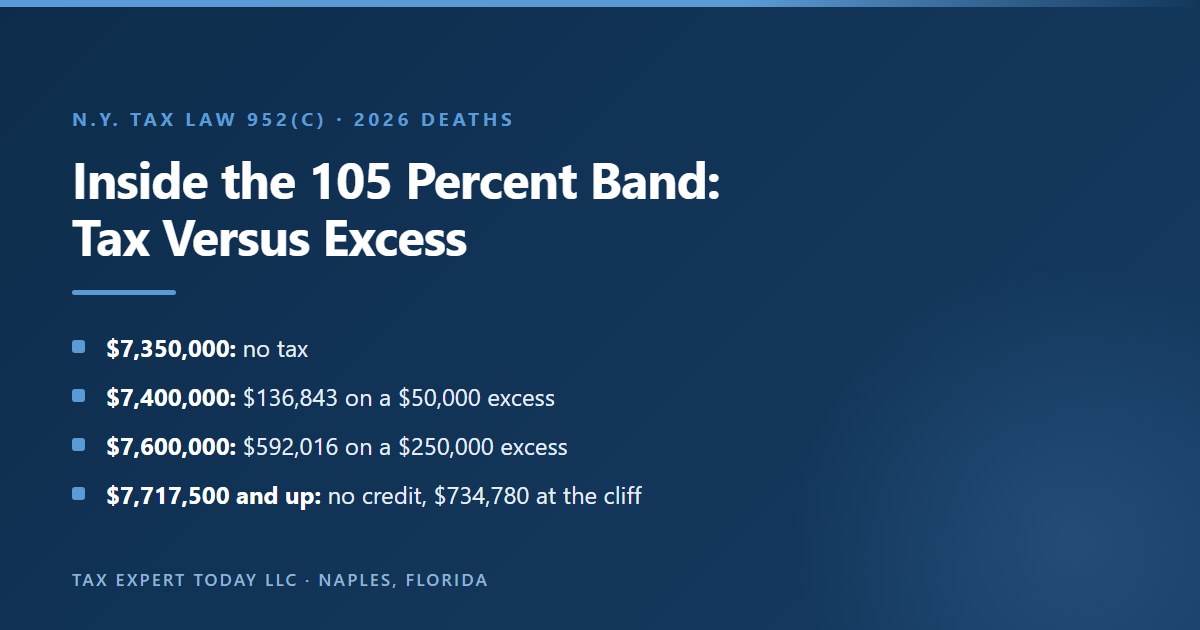
The effect is that the tax on an estate just over the line is not a small tax on a small excess. It is the full tax on the whole estate. At exactly $7,717,500, the New York estate tax cliff produces a tax of $734,780, which is almost exactly twice the $367,500 by which the estate exceeds the exclusion. Few state estate taxes have anything like it, which is why the phrase New York estate tax cliff has become shorthand among estate planners for one of the most punishing thresholds in state tax law.
How Does the 105 Percent Rule Work in 2026?
For 2026, an estate at or below $7,350,000 owes nothing, an estate between $7,350,000 and $7,717,500 receives a partial credit that shrinks to zero across the band, and an estate above $7,717,500 receives no credit. Inside the band, each dollar of excess can cost more than two dollars of tax.
- Step one: compute the tentative tax on the whole New York taxable estate from the section 952(b) table
- Step two: divide the excess over $7,350,000 by $367,500, carried to four decimals
- Step three: multiply $7,350,000 by one minus that fraction, and look up the tax on the result
- Step four: that table amount is the credit, subtracted from the tentative tax
The arithmetic is set out in the applicable credit worksheet in the Form ET-706 instructions, which use the 2025 exclusion of $7,160,000 in their printed example. Running the same worksheet with the 2026 exclusion of $7,350,000 produces the figures below. They are hypothetical New York taxable estates, after deductions, for a decedent who died in 2026.
| New York taxable estate (2026 death) | Excess over $7,350,000 | New York estate tax | Tax as a share of the excess |
|---|---|---|---|
| $7,350,000 | $0 | $0 | Not applicable |
| $7,400,000 | $50,000 | $136,843 | 274% |
| $7,500,000 | $150,000 | $386,430 | 258% |
| $7,600,000 | $250,000 | $592,016 | 237% |
| $7,700,000 | $350,000 | $721,694 | 206% |
| $7,717,500 | $367,500 | $734,780 | 200% |
| $8,000,000 | $650,000 | $773,200 | 119% |
| $10,000,000 | $2,650,000 | $1,067,600 | 40% |
The table shows why the New York estate tax cliff is described as a cliff rather than a slope. The first $50,000 over the exclusion produces $136,843 of tax. The phase-out band is where the damage is concentrated: every dollar inside it costs between two and almost three dollars of New York tax. Once the estate is past $7,717,500, the marginal rate falls back to the ordinary bracket rate of 13.6 percent, but by then the estate has already paid tax on the first $7,350,000 that a smaller estate would have kept free of tax.
The worksheet also shows something practical. Because the credit depends on the taxable estate, after deductions, anything that reduces the taxable estate inside the band, a charitable bequest, a deductible debt, an expense of administration, saves far more than its face value. That is the basis for the formula charitable gift discussed later in this guide.
What Are the New York Estate Tax Rates in 2026?
New York applies a graduated schedule from 3.06 percent to 16 percent under Tax Law section 952(b). The brackets are fixed by statute and are not indexed, while the $7,350,000 exclusion is indexed each year to inflation. The table is applied to the whole New York taxable estate, with the credit subtracted afterward.
- Bottom bracket: 3.06 percent on the first $500,000
- At the exclusion: the table tax on $7,350,000 is $684,800, which is the full credit for an estate at the line
- Top bracket: $1,082,800 plus 16 percent of the excess over $10,100,000
- Indexing: the exclusion follows a statutory cost of living formula, rounded to the nearest $10,000
| New York taxable estate over | But not over | Tax |
|---|---|---|
| $0 | $500,000 | 3.06% of the taxable estate |
| $500,000 | $1,000,000 | $15,300 plus 5.0% of the excess over $500,000 |
| $1,000,000 | $1,500,000 | $40,300 plus 5.5% of the excess over $1,000,000 |
| $1,500,000 | $2,100,000 | $67,800 plus 6.5% of the excess over $1,500,000 |
| $2,100,000 | $2,600,000 | $106,800 plus 8.0% of the excess over $2,100,000 |
| $2,600,000 | $3,100,000 | $146,800 plus 8.8% of the excess over $2,600,000 |
| $3,100,000 | $3,600,000 | $190,800 plus 9.6% of the excess over $3,100,000 |
| $3,600,000 | $4,100,000 | $238,800 plus 10.4% of the excess over $3,600,000 |
| $4,100,000 | $5,100,000 | $290,800 plus 11.2% of the excess over $4,100,000 |
| $5,100,000 | $6,100,000 | $402,800 plus 12.0% of the excess over $5,100,000 |
| $6,100,000 | $7,100,000 | $522,800 plus 12.8% of the excess over $6,100,000 |
| $7,100,000 | $8,100,000 | $650,800 plus 13.6% of the excess over $7,100,000 |
| $8,100,000 | $9,100,000 | $786,800 plus 14.4% of the excess over $8,100,000 |
| $9,100,000 | $10,100,000 | $930,800 plus 15.2% of the excess over $9,100,000 |
| $10,100,000 | No limit | $1,082,800 plus 16.0% of the excess over $10,100,000 |
The exclusion history matters for anyone reviewing an older estate plan. The Department’s estate tax page lists the basic exclusion amount as $5,740,000 for 2019, $6,110,000 for 2022, $6,940,000 for 2024, $7,160,000 for 2025 and $7,350,000 for 2026. A will written with a fixed dollar figure keyed to an earlier year, or a formula clause that was drafted around the federal exclusion, may no longer line up with the New York number. The figures to use are always the ones for the year of death.
Does the New York Estate Tax Cliff Apply After You Move to Florida?
Yes, but only to New York real estate and tangible property. Once domicile is in Florida, Tax Law section 960 taxes a nonresident’s New York situs real and tangible property, and the cliff is measured against that property alone. Stocks, bonds, bank accounts and retirement accounts follow the Florida domicile and are outside the computation.
- Still reachable: a house, condominium or land in New York, and furniture, art, jewelry, vehicles and boats kept there
- No longer reachable: brokerage accounts, bank deposits, bonds, retirement accounts and most business interests
- Measured alone: the cliff is tested against the New York taxable estate, which for a nonresident is the New York property
- Domicile is the hinge: if New York shows the decedent never left, everything comes back in
For a New York resident, the starting point is the federal gross estate. Under Tax Law section 954(a), it is reduced only by real and tangible property located outside New York, so a Naples house drops out, but the investment portfolio, the retirement accounts and the New York real estate all stay in. For a nonresident, Tax Law section 960 imposes the tax only on the transfer of real and tangible personal property with an actual situs in New York. Subsection (b) then computes the tax as though the decedent had died a resident, except that the New York taxable estate does not include intangible personal property or the deductions that relate to it, and does not include gifts other than gifts of New York real or tangible property or of intangibles used in a New York business.
The practical meaning of the New York estate tax cliff for a mover is significant. Several other states that tax nonresidents, including Maine, Minnesota and Connecticut, compute the tax on the whole estate and then apply a fraction, so a large portfolio in Florida pushes the New York property into a higher bracket. New York does not work that way. For a Florida domiciliary, the New York taxable estate is essentially the New York property itself, net of the deductions allocated to it, and the rate table and the cliff are applied to that figure. A large Florida portfolio does not raise the New York tax on the house.
| Hypothetical 2026 estate: $15,000,000 portfolio, $3,000,000 Hamptons house, $2,000,000 Naples home | Still domiciled in New York | Domiciled in Florida |
|---|---|---|
| Federal gross estate | $20,000,000 | $20,000,000 |
| Excluded by New York | $2,000,000 Naples home (real property outside New York) | $2,000,000 Naples home and the $15,000,000 portfolio (intangibles) |
| New York taxable estate | $18,000,000 | $3,000,000 |
| Position against the $7,717,500 cliff | Far above it, no credit | Below the $7,350,000 exclusion, full credit |
| New York estate tax | $2,346,800 | $0 |
The Florida column still has paperwork. Because this estate owns New York real property and its federal gross estate exceeds the exclusion, the executor must file a New York return, as explained in the filing section below, even though the tax is zero. The numbers above are before the federal estate tax, which is a separate computation that applies to this estate either way because it exceeds the 2026 federal basic exclusion of $15,000,000.
How Is a Nonresident Taxed on New York Property?
The executor lists the New York real and tangible property on Schedule C of Form ET-706, subtracts the deductions directly related to that property and an allocated share of general deductions, and applies the section 952 table and credit to the result. If the net New York property exceeds $7,717,500, the New York estate tax cliff removes the credit entirely.
- Schedule C: every item of real and tangible property located in New York, at federal values
- Direct deductions: a mortgage, property taxes and maintenance tied to the New York property reduce it
- General deductions: funeral costs, executor commissions and professional fees are allocated by a percentage
- Result: Schedule A, Part 2, line 33, the taxable estate for New York State
Form ET-706 has a separate Part 2 of Schedule A for nonresidents. It starts with the federal gross estate, subtracts property outside New York and intangible personal property as the nontaxable estate for New York purposes, and arrives at the amount of the federal gross estate subject to New York tax. Includible gifts and any New York QTIP property are then added, federal deductions are brought in, and Schedule E, Part 2 removes the deductions that belong to the excluded property. Deductions that cannot be tied to either side, such as executor commissions and attorney fees, are split using an allocation percentage, the excluded property divided by the federal gross estate. A Florida estate with most of its value in Florida assets will therefore allocate most of its general expenses away from New York, and only the deductions tied to the New York house, chiefly a mortgage on it, do much to reduce the New York figure.
The worked example below follows a hypothetical Florida domiciliary who dies in 2026 owning a Manhattan townhouse and a large Florida portfolio, with no lifetime gifts.
| Hypothetical Florida domiciliary, 2026 death | Townhouse worth $9,000,000 | Townhouse worth $7,600,000 | $7,600,000 townhouse with a $300,000 mortgage |
|---|---|---|---|
| New York taxable estate | $9,000,000 | $7,600,000 | $7,300,000 |
| Position against the cliff | Above $7,717,500 | Inside the band | Below $7,350,000 |
| Tentative tax from the table | $916,400 | $718,800 | $678,000 |
| Applicable credit | $0 | $126,784 | $678,000 |
| New York estate tax | $916,400 | $592,016 | $0 |
The second and third columns describe the same townhouse. A mortgage directly secured by the New York property is a deduction directly related to property inside New York, and here it moves the estate out of the band and below the exclusion. That does not mean a family should borrow against a house to save estate tax, which raises its own questions of interest cost, use of the proceeds and whether the debt is genuine. It does show how sensitive the computation is near the line, and why the New York figure should be modeled whenever the property is appraised or refinanced.
What Property Does New York Tax for a Florida Resident?
New York taxes a Florida domiciliary’s real property located in New York and tangible personal property kept there. Tax Law section 951-a defines tangible property to exclude bank deposits, stocks, bonds, notes and similar intangibles. Property held through an entity raises a separate classification question that should not be assumed away.
- Real property: a house, a condominium unit, vacant land, a rental building
- Tangible property in New York: furniture, art, collections, jewelry, cars and boats kept at the New York home
- Intangible property: brokerage and bank accounts, bonds, retirement accounts, life insurance proceeds
- Uncertain categories: cooperative apartment shares and interests in an LLC or partnership that owns New York real estate
| Asset owned by a Florida domiciliary | Included in the New York taxable estate? | Why |
|---|---|---|
| House or condominium in Westchester or the Hamptons | Yes | Real property with an actual situs in New York under section 960(a) |
| Art, furniture and jewelry kept at that house | Yes | Tangible personal property located in New York |
| Art on loan to a qualifying New York museum | Generally no | The exhibition exception in section 960(d) |
| Brokerage account held at a Manhattan firm | No | Shares and bonds are intangible property under section 951-a(c) |
| Bank deposits in a New York bank | No | Deposits are expressly excluded from tangible property |
| IRA or 401(k) | No | Intangible property that follows the Florida domicile |
| Cooperative apartment shares | Confirm with counsel | Classification of co-op shares for a nonresident is a question of New York law to confirm on the facts |
| LLC or partnership that owns New York real estate | Do not assume no | Entity form, ownership and purpose can affect treatment |
The definitions in Tax Law section 951-a are the reason the portfolio leaves New York with the owner. Subsection (c) defines tangible personal property as corporeal personal property and states that it does not include deposits in banks, mortgages, debts, receivables, shares of stock, bonds, notes, credits or choses in action. That is a broad exclusion, and it is what allows the portfolio of a genuine Florida domiciliary to sit outside the New York computation even if it is held at a firm with a Park Avenue address.
Two categories deserve caution. The first is the cooperative apartment, which is technically shares in a corporation coupled with a proprietary lease, and whose treatment for a nonresident decedent is a question of New York law that should be confirmed on the facts rather than assumed in either direction. The second is real estate held through an LLC or a partnership. A family that moves the New York house into an entity specifically to convert it into intangible property is relying on a classification that the Department may examine, and a single member LLC that is disregarded for federal tax purposes is a particular risk. These are matters for New York counsel, and the estate plan should not be built on an assumption about them.
How Does the Three Year Gift Clawback Work?
Under Tax Law section 954(a)(3), a New York resident’s estate adds back taxable gifts made during the three years before death. Gifts made while a nonresident, before April 1, 2014, or of real or tangible property outside New York are excluded. The add-back ends for deaths on or after January 1, 2032.
- Window: the three year period ending on the date of death
- What counts: taxable gifts under IRC section 2503, so gifts within the $19,000 annual exclusion for 2026 do not count
- Key exclusion: any gift made when the decedent was not a resident of New York
- Sunset: no add-back for decedents dying on or after January 1, 2032
- Who bears it: the extra tax is treated as an obligation of the decedent, but it is not deductible
New York has no separate gift tax. That gap invited a simple strategy: a person near the end of life could give away enough to bring the estate below the exclusion, and pay nothing. The add-back closes that door for residents. The Department’s guidance states that the estate must add back any taxable gift made during the three year period that ends on the date of death and not already included in the federal gross estate, with the exceptions listed above and a narrow exception for gifts made between January 1 and January 15, 2019. The Form ET-706 instructions confirm that the add-back has been extended for decedents dying before January 1, 2032.
The add-back interacts directly with the New York estate tax cliff. A gift that brought a resident’s estate from $9,000,000 down to $7,000,000 would, if the donor died within three years, be added back, and the estate would be measured at $9,000,000 again. The amount added back is the amount of the taxable gift, measured when the gift was made, so later appreciation in the recipient’s hands does not increase it. The result is that deathbed gifting does not move a New York resident’s estate below the New York estate tax cliff.
The gifts that count are taxable gifts as defined in federal gift tax law. Gifts within the annual exclusion, $19,000 per recipient for 2026, gifts to a spouse that qualify for the marital deduction, and direct payments of tuition or medical expenses are not taxable gifts and are not added back. A family that gives annual exclusion gifts year after year is not building up a New York add-back.
Why Does the Timing of a Move Matter for Lifetime Gifts?
Because the clawback depends on residency at the time of the gift and at death. A resident’s gift is added back if the donor dies a resident within three years. A gift made after a genuine move to Florida is never added back, and a pre-move gift of securities is not added back for a Florida decedent.
- Gift while resident, death while resident: added back if within three years
- Gift of securities while resident, death as a Florida domiciliary: not added back, because a nonresident estate includes only gifts of New York real or tangible property and New York business intangibles
- Gift of the New York house while resident, death as a Florida domiciliary within three years: added back
- Any gift made after the move: not added back, because it was made while the decedent was not a New York resident
The nonresident rule is spelled out in the instructions to Schedule D of Form ET-706. For a nonresident decedent, an includible gift must be a taxable gift made during the three year window, and it should only be included if it is a gift of real or tangible personal property located in New York or of intangible property employed in a business, trade or profession carried on in New York. The same exclusions apply, including the exclusion for any gift made when the decedent was not a New York resident. Section 960(b) says the same thing in statutory form.
The table below follows a hypothetical family through four versions of the same plan. In each case the donor dies in 2026, within three years of the gift, and no deductions apply.
| Scenario | Property at death | Gift added back | New York taxable estate | New York estate tax |
|---|---|---|---|---|
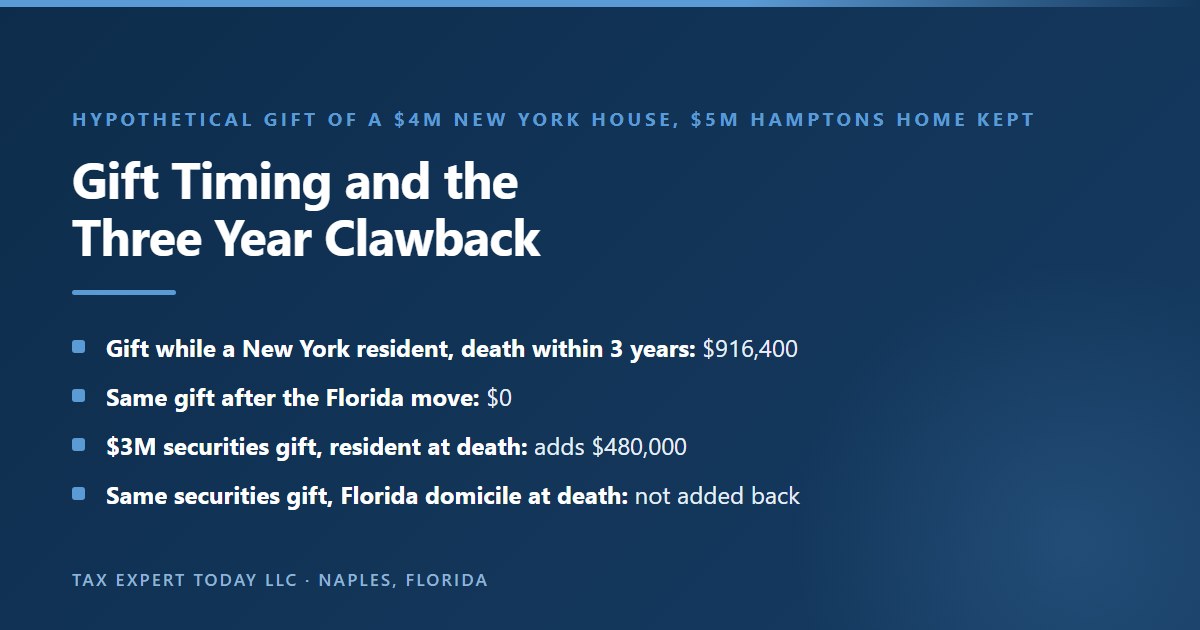
| $3,000,000 gift of securities while a New York resident; dies still domiciled in New York with $12,000,000 | $12,000,000 | $3,000,000 | $15,000,000 | $1,866,800 |
| Same gift, same estate, no add-back for comparison | $12,000,000 | $0 | $12,000,000 | $1,386,800 |
| $3,000,000 gift of securities while a New York resident; dies a Florida domiciliary owning no New York property | Florida assets only | $0 | $0 | $0 |
| $4,000,000 gift of a New York house while a resident; dies a Florida domiciliary still owning a $5,000,000 Hamptons home | $5,000,000 in New York | $4,000,000 | $9,000,000 | $916,400 |
| Same $4,000,000 house given after the move to Florida; same Hamptons home at death | $5,000,000 in New York | $0 | $5,000,000 | $0 |
The first two rows show what the clawback costs a resident: $480,000 of additional New York tax on the same facts. The last two rows show why the timing of a gift of New York real estate matters even after the move. The same house, given a few months apart, can add $916,400 of New York tax or nothing, depending on which side of the change of domicile the deed was signed. A family planning a large gift of New York property in the year of a move should treat the date of domicile change and the date of the deed as linked decisions.
There is a caveat that runs through every row of this table. The Florida results depend on the decedent actually being domiciled in Florida at the time that matters. A gift made in the first months after a move, by a person whose domicile is still disputed, is exactly the kind of transaction that invites a residency examination, and if New York establishes that the donor was still domiciled there, the gift is a resident’s gift and the estate is a resident’s estate.
Can Giving Away the New York House After the Move Avoid the Tax?
It can remove the house from the New York estate tax, because a gift made while a nonresident is not added back. But a lifetime gift gives the recipient the donor’s income tax basis under IRC section 1015 instead of a step-up at death under section 1014, and it uses federal lifetime exclusion, so the trade has to be modeled.
- New York result: a completed gift by a Florida domiciliary leaves no New York property in the estate and no add-back
- Federal gift tax: the gift uses part of the $15,000,000 basic exclusion for 2026 and requires a Form 709
- Income tax cost: the children take the donor’s basis, so a later sale can produce a large capital gain
- Retained use: continuing to live in the house rent free after the gift can pull it back into the federal estate
The arithmetic for New York alone is attractive. In the last two rows of the gift table, the post-move gift of the house saved $916,400 of New York tax. The income tax arithmetic can run the other way. A townhouse bought decades ago for $1,500,000 and now worth $9,000,000 would receive a basis equal to its value at death under IRC section 1014 if it passed by inheritance, wiping out the $7,500,000 of appreciation for the heirs. Given during life, it carries the $1,500,000 basis under IRC section 1015, and a later sale by the children could produce federal and New York capital gains tax on most of that appreciation, since gain on New York real property is taxed by New York even to a nonresident seller. For a property the family intends to keep, that may not matter. For one the family will sell, it can outweigh the estate tax saving.
The retained use problem is just as important. A parent who gives the house to the children and keeps using it as before has, for federal purposes, often made a transfer with a retained interest that brings the house back into the federal gross estate under IRC section 2036. A qualified personal residence trust is the structure designed for this situation, and a sale or lease at fair rent can also work, but each has rules that must be followed carefully. Families weighing the federal side should also read our guide to the lifetime gift tax exemption in 2026.
Why Is There No Portability for Married Couples in New York?
New York does not allow a surviving spouse to use the first spouse’s unused exclusion. If everything passes outright to the survivor, the first exclusion is lost, and the survivor’s larger estate can go over the cliff. A credit shelter trust funded at the first death is the usual way to use both $7,350,000 exclusions.
- Federal rule: portability lets a survivor use the first spouse’s unused federal exclusion
- New York rule: no portability, confirmed in the Form ET-706 instructions
- Common fix: a credit shelter trust that holds up to the New York exclusion at the first death
- QTIP: a New York QTIP election must be made on the New York return, and is irrevocable
The ET-706 instructions state plainly that New York estate tax law does not conform with the federal portability rule. For a couple still domiciled in New York, the result can be dramatic. Take a hypothetical couple with a combined $14,000,000. If the first spouse leaves everything outright to the survivor, the marital deduction makes the first estate’s New York tax zero, but the survivor then dies with $14,000,000 and owes $1,706,800. If instead the first spouse’s will places $7,350,000 in a credit shelter trust for the survivor and leaves the rest outright, the first estate is at the exclusion and owes nothing, and the survivor dies with $6,650,000, below the exclusion, and also owes nothing.
For a Florida couple, the same logic applies to the New York property only. Consider a Florida domiciled couple who own a $10,000,000 New York townhouse as tenants by the entirety. At the first death the house passes to the survivor by operation of law, the marital deduction applies, and the first estate owes no New York tax. At the second death the survivor owns the whole $10,000,000 townhouse, which is above the cliff on its own, and the tax is $1,067,600. If the ownership and the documents had been arranged so that the first spouse’s half passed into a credit shelter trust instead, each estate would hold $5,000,000 of New York property, each below the exclusion, and the combined New York tax would be zero. Changing the title of real estate held by the entirety has creditor protection and transfer consequences of its own, so this is a decision for New York and Florida counsel together, not a form to fill in.
| Hypothetical couple | Plan | First death New York tax | Second death New York tax |
|---|---|---|---|
| New York domiciled, $14,000,000 combined | Everything outright to the survivor | $0 | $1,706,800 |
| New York domiciled, $14,000,000 combined | $7,350,000 credit shelter trust at the first death | $0 | $0 |
| Florida domiciled, $10,000,000 New York townhouse | Held as tenants by the entirety, passes to the survivor | $0 | $1,067,600 |
| Florida domiciled, $10,000,000 New York townhouse | Each half held so that it can fund a credit shelter trust | $0 | $0 |
The New York QTIP election is the other half of marital planning. Under Tax Law section 955(c), when no federal estate tax return is required, the executor makes the QTIP election directly on the New York return, and once made it is irrevocable. Property for which a New York marital deduction was allowed then returns in the survivor’s New York gross estate under section 954(a)(4). A survivor who moves to Florida after the first death should have that trust reviewed, because what New York can reach at the second death will depend on what the trust holds and where the survivor is domiciled.
What Is a Santa Clause and Does It Work for Nonresidents?
A Santa clause is a formula charitable bequest that gives charity only the amount needed to bring the New York taxable estate down to the exclusion, and only if the estate would otherwise land inside or just over the cliff. A charitable deduction reduces the taxable estate, so it can work for a nonresident estate too.
- Trigger: applies only if the New York taxable estate would fall in a defined range above the exclusion
- Amount: the smallest gift that returns the estate to the basic exclusion amount
- Result: the heirs often receive more after the gift than they would have without it
- Nonresident detail: the deduction must be allocated to the New York side of the computation to help
The arithmetic is the strongest argument for using the clause against the New York estate tax cliff. A hypothetical estate with a New York taxable estate of $7,600,000 owes $592,016, leaving $7,007,984 for the heirs. If a formula clause sends $250,000 to charity, the taxable estate falls to $7,350,000, the tax falls to zero, and the heirs receive $7,350,000. The heirs are $342,016 better off and the charity receives $250,000. Because the formula only operates when it saves tax, it has no cost in the years when the estate is comfortably under the line.
For a nonresident, the clause needs more careful drafting. The New York computation for a Florida domiciliary allocates deductions between New York property and everything else, and a charitable bequest paid from Florida assets may not reduce the New York side unless it is drafted to relate to the New York property. The formula should therefore be written by counsel who understands the nonresident schedule on Form ET-706, and the charitable recipients should be chosen with the family. Families with charitable intent already may find a charitable remainder trust or a charitable lead trust a better fit for the larger plan.
How Does New York Decide Domicile at Death?
An estate that claims the decedent was not domiciled in New York files Form ET-141, the domicile affidavit, which asks about New York residences, real estate, safe deposit boxes and five years of residence and income tax filing history. Domicile is decided on the whole record, and the burden falls on the estate that claims a change.
- Form ET-141: completed by the executor, the surviving spouse or a family member who knows the facts
- Five year history: residences owned or rented and the states where income tax returns were filed
- Charity is neutral: section 951-a(f) says charitable gifts and volunteering cannot be used to decide domicile
- Florida evidence: a declaration of domicile under Fla. Stat. 222.17, homestead, voter and vehicle records
The domicile question is where the New York estate tax cliff for a Florida family is won or lost. Every favorable result in this guide assumes that New York accepts the Florida domicile. If it does not, the estate is a resident estate, the portfolio returns to the computation, gifts made while the decedent was supposedly a Floridian may become resident gifts, and the estate can land far above the cliff. Form ET-141 asks whether the decedent ever lived in New York, whether the decedent owned New York real estate and for what periods, whether there was a New York safe deposit box and whether it has been inventoried, and where the decedent lived and filed income tax returns for the five years before death.
One rule in the statute is helpful to families with long ties to New York institutions. Tax Law section 951-a(f) provides that charitable contributions, pledges, loans of art and volunteer time to a qualifying organization shall not be used in any manner to determine domicile at death. A Floridian who remains on the board of a New York museum, or keeps giving to a New York hospital, does not create New York domicile by doing so.
The Florida side of the record is built under Fla. Stat. 222.17, which allows a person to file a sworn declaration of domicile with the clerk of the circuit court, together with the ordinary markers of a change: driver license, voter registration, vehicle registration, the location of doctors and advisers, and where the family actually spends its time. Our guides to establishing Florida residency, the New York residency audit and the dual state residency trap cover this record in detail, and the Florida 183 day rule calculator helps track the day count that New York statutory residency depends on.
Who Must File a New York Estate Tax Return After a Move?
A Florida domiciliary’s estate must file Form ET-706 if it includes real or tangible property located in New York and the federal gross estate, plus includible gifts, exceeds $7,350,000 for 2026 deaths. That test uses the whole federal gross estate, so a return can be required even when the New York tax is zero.
- Residents: file if the federal gross estate plus includible gifts exceeds the basic exclusion amount
- Nonresidents: file if there is any New York real or tangible property and the federal gross estate plus includible gifts exceeds the exclusion
- With the return: a copy of federal Form 706, even if no federal return is otherwise required, and Form ET-141
- Real property: a release of lien, generally through Form ET-117, before the property can pass cleanly to a buyer
| Hypothetical Florida domiciliary, 2026 death | New York property | Federal gross estate | ET-706 required? | New York tax |
|---|---|---|---|---|
| Retiree with a condominium in Saratoga Springs | $1,200,000 | $5,000,000 | No, the federal gross estate is below $7,350,000 | $0 |
| Couple’s survivor with a Hamptons house | $3,000,000 | $20,000,000 | Yes | $0 |
| Owner of a Manhattan townhouse | $9,000,000 | $25,000,000 | Yes | $916,400 |
| Investor with only New York brokerage accounts | None (intangibles only) | $12,000,000 | No, there is no New York real or tangible property | $0 |
The filing test is in the Department’s estate tax guidance and in the ET-706 instructions, which also require a completed Form ET-141 for a nonresident estate. Because the federal return is the starting point for the New York return, the instructions require a completed copy of federal Form 706 to be submitted even when the estate is below the federal filing threshold. A Florida estate with a modest New York property and a large portfolio therefore has a real compliance task in New York even when no tax is due.
The release of lien deserves attention in any estate that owns New York real estate. New York requires authorization to transfer real property, described as a release of lien, and the instructions direct the estate to Form ET-117 for each county, with a separate form for each cooperative corporation. The instructions also state that a release is not required for property held by the decedent and the surviving spouse as the only joint tenants with the right of survivorship. If the executor will sell the house, the release should be planned early so that it does not delay the closing.
When Is the Return Due and Can the Estate Get More Time?
Form ET-706 and payment are due nine months after the date of death. The estate can apply on Form ET-133 for an extension to file, to pay, or both; an extension to file generally may not exceed six months, and an extension to pay can run up to four years where payment would cause undue hardship.
- Due date: nine months after death for both the return and the tax
- Form ET-133: one application for an extension of time to file, to pay, or both
- Filing extension: generally capped at six months unless the executor is out of the country
- Payment extension: up to four years on a showing of undue hardship, with interest running
The Department’s estate tax page states that within nine months of death the estate must pay the tax due and file Form ET-706, using the version for the date of death, together with federal Form 706. Penalties may apply for late filing or late payment, and interest is due on any late payment, including one made under an extension. For a Florida estate whose New York tax comes almost entirely from a single house, the hardship extension can matter, because the tax may be due before the house can be sold. After processing, the Department issues a closing letter, which the instructions describe as usually arriving about nine months after filing.
How Does the New York Cliff Interact With the Federal Estate Tax in 2026?
They are separate taxes with separate thresholds. The 2026 federal basic exclusion is $15,000,000 per person with portability, while New York’s exclusion is $7,350,000 with no portability and a cliff. Many New York estates owe New York tax and no federal tax, and a state death tax paid can be deducted federally under IRC section 2058.
- Federal exclusion: $15,000,000 for 2026 deaths, as published by the IRS
- New York exclusion: $7,350,000 for 2026 deaths, less than half the federal figure
- Federal deduction: New York estate tax actually paid is deductible in computing the federal taxable estate
- Common pattern: estates between about $7.7 million and $15 million owe New York tax and often no federal tax
The IRS estate tax page shows the federal basic exclusion at $15,000,000 for 2026 deaths, up from $13,990,000 for 2025. That is more than twice the New York exclusion. New York estate tax actually paid is deductible in computing the federal taxable estate under IRC section 2058. The gap means that the New York estate tax cliff can catch a family who has stopped worrying about estate tax because of the federal number and leave it with a large New York bill, and the cliff makes the bill disproportionate for estates just over the New York line. For those estates, a plan drafted around the federal exclusion alone, for example a will that leaves everything to the surviving spouse and relies on federal portability, may produce the worst possible New York result.
The New York computation also has its own version of federal law in places. The ET-706 instructions explain that when an estate below the federal filing threshold elects alternate valuation on the pro forma federal return filed with the New York return, the calculation must use the Internal Revenue Code with amendments through January 1, 2014, which is one reason the federal figures cannot always be copied straight into the New York filing. For families comparing New York with the other states this track covers, our guides to the Connecticut estate tax, the Massachusetts estate tax and the New Jersey inheritance tax show how differently neighboring states treat a Florida domiciliary.
What Do Florida Movers Get Wrong About the New York Estate Tax Cliff?
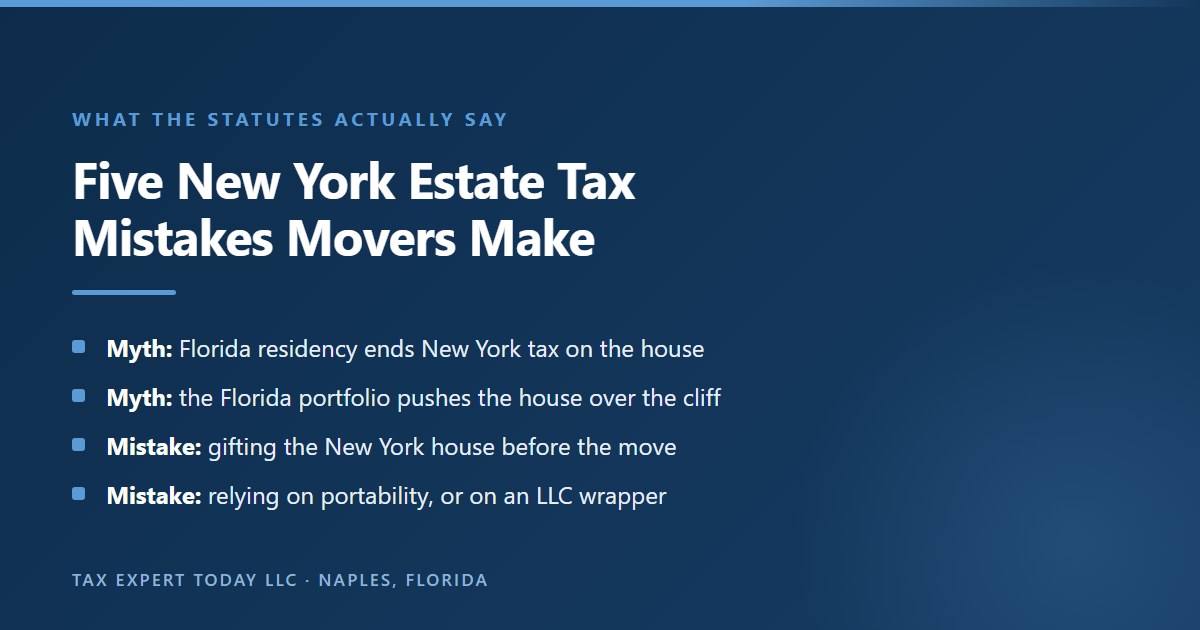
The most common mistakes are assuming the move removes New York real estate from the tax, measuring the cliff against the whole estate instead of the New York property, making a large gift of the New York house just before the move, relying on federal portability, and assuming an LLC turns the house into intangible property.
- Myth: Florida residency ends all New York estate tax
- Myth: a large Florida portfolio pushes the New York house over the cliff
- Mistake: gifting the New York house while still a New York resident, then dying within three years
- Mistake: leaving everything outright to the spouse because federal portability exists
- Mistake: moving the house into an LLC and treating the problem as solved
The first myth comes from the general rule that Florida has no estate tax. That is true of Florida, and it is irrelevant to a house in East Hampton. New York taxes the transfer of its real property regardless of where the owner lived. The second myth runs the other way: some families who have read about other states, where the whole estate sets the bracket, assume that a large portfolio in Florida will push their New York property into the top rate. Under section 960(b), a nonresident’s New York taxable estate excludes intangibles, so the cliff is tested against the New York property alone.
The third mistake is the timing one. A gift of the New York house made while the owner is still a New York resident is a resident’s gift of New York real property, and it is added back if the owner dies within three years, even as a Florida domiciliary. The same gift made after the move is not. The fourth mistake, reliance on portability, costs the most on large New York estates, because the survivor’s combined estate often lands well above the cliff. The fifth, the LLC, is a classification question that the plan should not depend on without advice from New York counsel.
What Should a New York Mover Check Before and After the Move?
Before the move, list every New York asset by type, measure the New York property against the $7,717,500 cliff, decide whether large gifts should wait until after domicile changes, and review the wills for portability assumptions. After the move, build the Florida domicile record and recheck the New York numbers whenever values change.
- Inventory: separate New York real and tangible property from intangibles, and flag co-ops and entities
- Measure: compute the New York figure for each spouse at current values, net of related debt
- Time the gifts: large gifts of New York real estate generally belong after the change of domicile
- Review documents: credit shelter trusts, New York QTIP language and any formula charitable clause
- Document domicile: declaration under Fla. Stat. 222.17, day counts, and the records Form ET-141 will ask for
The inventory is the foundation of any New York estate tax cliff review. Most families can sort their assets into the categories in the situs table above in an afternoon, and the result usually shows that only one or two assets matter for New York after the move. If the New York property for each spouse is comfortably below $7,350,000, the remaining work is mostly compliance: knowing that a return may be required, and that the release of lien must be obtained. If the New York property is near or above the New York estate tax cliff, the planning becomes urgent, and the questions of gifting, trusts, titling and charitable formulas all deserve a careful look.
The estate plan should be read with New York in mind. A plan drafted in New York years ago may contain credit shelter and QTIP language that is still valuable, but dollar amounts and formulas should be checked against the 2026 figures. A plan drafted in Florida for a Florida family may not mention New York at all, which is a common gap when the New York property was kept rather than sold. Our guides to Florida estate planning for new residents, trust situs after moving to Florida and the spousal lifetime access trust cover the related planning, and sellers of the New York residence should read our guide to selling your home after moving to Florida and the mechanics of a nonresident state tax return.
Finally, the computation should be rerun whenever something changes: a new appraisal, a refinancing, the death of a spouse, a large gift, or a new exclusion figure each January. The New York estate tax cliff is mechanical, and that is its danger: a modest increase in the value of a single property can move an estate from no tax to hundreds of thousands of dollars of tax with no other change in the family’s circumstances.
New York Estate Tax Cliff Help in Naples & Southwest Florida
Tax Expert Today LLC works with families who have moved, or are moving, from New York to Naples, Florida and across Southwest Florida on the tax side of the relocation, including the New York estate tax cliff and the tax New York can still apply to a house, an apartment or the property kept in it. The firm is multidisciplinary, with enrolled agents, CPAs and attorneys, and it handles residency and tax matters nationwide, coordinating with New York and Florida estate counsel when documents need to change. Our office is at 11983 Tamiami Trail N, Naples, FL 34110, open Monday through Friday, 10 a.m. to 5 p.m. ET, and reachable at (239) 441-2005.
- New York estate tax cliff help Naples: modeling of the New York taxable estate for a Florida domiciliary’s New York property at current values, for each spouse.
- Gift and spouse planning: review of planned gifts against the three year clawback and the timing of the move, and of credit shelter, New York QTIP and formula charitable clauses.
- Domicile and filings: the residency record, the day count, and Form ET-706, Form ET-141 and release of lien coordination for a Florida personal representative.
Our Naples tax planning practice, our Florida tax services page and our estate and trust planning services describe the wider work, and our guide to Florida asset protection for new residents covers the protective side of Florida ownership. Executives still drawing New York deferred compensation should read our guide to Florida domicile for executives and the convenience of the employer rule.
We live in Naples now but kept our apartment on the Upper East Side. Will New York tax our whole estate?
Not if your domicile is genuinely in Florida. New York then taxes only New York real estate and tangible property, measured by itself against the $7,350,000 exclusion and the $7,717,500 cliff, and your Florida portfolio stays outside the computation. If the apartment is a cooperative, its classification should be confirmed with counsel, and your estate may still need to file a New York return.
When to Engage a Professional
A Florida resident who owns nothing in New York, or whose New York property is well below $7,350,000, rarely needs New York estate tax advice beyond knowing whether a return will be required and how a release of lien will be obtained. Professional help earns its cost when the New York property for either spouse is near or above the $7,717,500 New York estate tax cliff; when the family is still domiciled in New York and the whole estate sits near the line; when large gifts, especially of New York real estate, are planned around the year of the move; when a spouse has died and the survivor holds the New York property or a New York QTIP trust; when the New York property is a cooperative apartment or is held through an LLC or partnership; or when a Florida personal representative must prepare Form ET-706 and Form ET-141. It is also worth a conversation when the move is recent and the domicile record is still being built, because that record decides whether New York taxes one house or the entire estate. Tax Expert Today LLC’s enrolled agents, CPAs and attorneys can model the computation, coordinate with your estate counsel in both states, and help document the change of domicile. Call (239) 441-2005 to schedule a consultation.
Frequently Asked Questions
What is the New York estate tax cliff in 2026?
For 2026 deaths, New York exempts a taxable estate up to $7,350,000. If the New York taxable estate exceeds 105 percent of that amount, $7,717,500, the applicable credit in N.Y. Tax Law section 952(c) disappears and tax is computed on the whole taxable estate from the first dollar. An estate of exactly $7,717,500 owes $734,780.
Does the New York estate tax apply after I move to Florida?
Only to New York real estate and tangible property kept in New York. Under N.Y. Tax Law section 960, a nonresident’s New York taxable estate excludes intangible property such as stocks, bonds, bank accounts and retirement accounts. The rate table and the cliff are applied to the New York property alone, so a large Florida portfolio does not raise the New York tax.
Does New York add back gifts made before death?
Yes, for deaths before January 1, 2032. Taxable gifts made during the three years before death are added back under N.Y. Tax Law section 954(a)(3), except gifts made while the decedent was not a New York resident, gifts before April 1, 2014, and gifts of property located outside New York. Annual exclusion gifts of $19,000 per recipient in 2026 are not taxable gifts.
Is a gift made after moving to Florida added back to the New York estate?
No. The add-back excludes any gift made when the decedent was not a New York resident. For a Florida decedent, a gift of securities made before the move is also not added back, because a nonresident estate includes only gifts of New York real or tangible property and intangibles used in a New York business. A pre-move gift of New York real estate within three years is added back.
Is the New York estate tax exclusion portable between spouses?
No. New York does not follow the federal portability rule, so each spouse has a separate $7,350,000 exclusion for 2026 deaths. If the first spouse leaves everything outright to the survivor, the first exclusion is lost for New York purposes. A credit shelter trust funded at the first death, or a New York QTIP election made on the New York return, is the usual planning response.
Does a Florida resident’s estate have to file a New York estate tax return?
Yes, if the estate includes real or tangible property located in New York and the federal gross estate plus includible gifts exceeds $7,350,000 for 2026 deaths. Form ET-706 is due nine months after death, with a copy of federal Form 706 and Form ET-141, the domicile affidavit, even when the New York tax works out to zero.
Published October 31, 2026 by Dr. Pellumb Kabashi « Back to Learning Center
Have a question this article touches on?
Tax Expert Today LLC, based in Naples, Florida and serving clients across the United States.
Schedule a Consultation (239) 441-2005