
By Dr. Pellumb Kabashi, DBA, MBA, CES, CFE, EA
Founder, Tax Expert Today LLC · Tax advisors, enrolled agents, CPAs, and attorneys · Serving clients in all 50 states
Quick Answer
The lifetime gift tax exemption in 2026 is $15,000,000 per person, unified with the estate tax under IRC Section 2010(c)(3). Public Law 119-21 set that figure and deleted the sunset that would have cut it roughly in half. A married couple can shelter $30,000,000, but only if the first estate files a return it does not otherwise owe. Call (239) 441-2005 for a free consultation.
What is the lifetime gift tax exemption 2026 amount?
The lifetime gift tax exemption 2026 amount is $15,000,000 per individual. It is not a separate gift allowance sitting alongside the estate tax. Under IRC Section 2010(c), one basic exclusion amount covers lifetime gifts and transfers at death together, so every taxable gift made during life reduces what remains available to the estate.
- Unified, not parallel. Section 2505(a) computes the gift tax credit by reference to the same Section 2010(c) figure, which is why practitioners describe the system as a unified transfer tax.
- Per person, not per couple. Each spouse has an exclusion of their own. The $30,000,000 figure quoted for couples is two individual amounts, and reaching it depends on an election discussed below.
- A running total. Taxable gifts are cumulative for life. A gift made in 2019 still counts against the amount available at death decades later.
- Separate from the annual exclusion. The $19,000 annual exclusion under Section 2503(b) sits in front of the lifetime figure and is not subtracted from it.
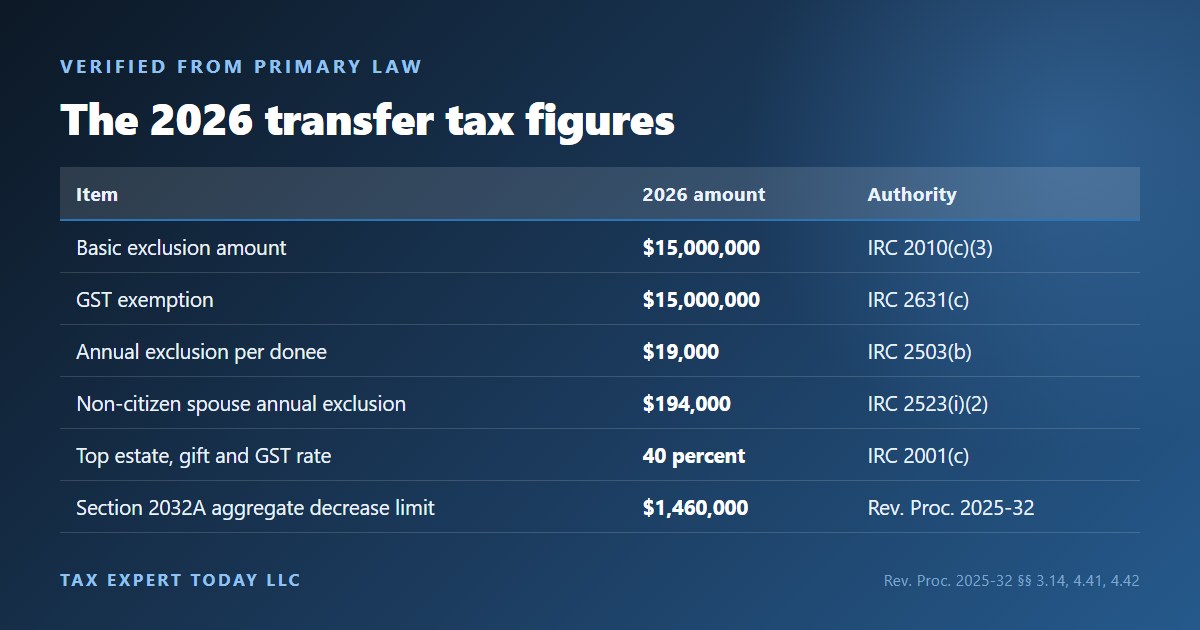
The figures that govern 2026 come from two places. The exclusion amount itself is in the statute, as amended in 2025. The inflation-adjusted items are in Rev. Proc. 2025-32, which states at section 3.14 that the basic exclusion amount is $15,000,000 for calendar year 2026 and that the generation-skipping transfer exemption under Section 2631(c) equals the same amount.
| Item | 2026 amount | Authority |
|---|---|---|
| Basic exclusion amount, per person | $15,000,000 | IRC 2010(c)(3); Rev. Proc. 2025-32 sec. 3.14 |
| Generation-skipping transfer exemption | $15,000,000 | IRC 2631(c); Rev. Proc. 2025-32 sec. 3.14 |
| Annual exclusion per donee | $19,000 | IRC 2503(b); Rev. Proc. 2025-32 sec. 4.42(1) |
| Annual exclusion, non-citizen spouse | $194,000 | IRC 2523(i)(2); Rev. Proc. 2025-32 sec. 4.42(2) |
| Top estate, gift and GST rate | 40 percent | IRC 2001(c) |
| Section 2032A aggregate decrease limit | $1,460,000 | Rev. Proc. 2025-32 sec. 4.41 |
Which law changed the exemption, and what is it actually called?
Public Law 119-21, enacted July 4, 2025, amended Section 2010(c)(3) at section 70106(a). It raised the base figure and moved the inflation base year from 2010 to 2025, which together removed the reduction scheduled to take effect in 2026. The law appears under two different names in IRS materials, which causes avoidable confusion.
- The IRS web guidance calls it the Working Families Tax Cuts, or WFTC. The agency page for estate and gift tax describes the bill as signed into law on July 4, 2025 as Public Law 119-21.
- Rev. Proc. 2025-32 calls the same statute the OBBBA. Section 3.14 of that revenue procedure attributes the amendment to section 70106 of the OBBBA.
- Both names refer to Public Law 119-21. Searching for one name and not the other is a common reason a reader concludes that guidance is missing when it is not.
- The public law number is the reliable identifier. Citing P.L. 119-21 section 70106(a) avoids the naming problem entirely.
The practical consequence matters more than the label. Before this amendment, the elevated exclusion carried an expiration date at the end of 2025, and a large body of planning was written on the assumption that the figure would fall to roughly half its level. That deadline is gone. The statutory text now provides for a cost-of-living adjustment for decedents dying after 2026, computed under Section 1(f)(3) by substituting calendar year 2025 for calendar year 2016, with the result rounded to the nearest $10,000.
Planning built entirely around a use-it-or-lose-it deadline may therefore deserve a fresh look. That does not mean the planning was wrong when it was done, and it does not mean the structures should be unwound. It means the urgency argument supporting some of it no longer applies on the same terms, and the analysis is worth redoing on current law rather than repeating from memory.
How do the annual exclusion and the lifetime exemption interact?
The annual exclusion is applied first and it consumes no lifetime exemption. Under Section 2503(b), the first $19,000 given to any one person in 2026, other than a gift of a future interest, is left out of total taxable gifts entirely. Only the excess becomes a taxable gift that reduces the $15,000,000 figure.
- It resets every calendar year and it is measured per donee, so the number of recipients matters as much as the amount.
- Gift splitting doubles it for a married couple who consent under Section 2513, producing $38,000 per donee in 2026.
- Future interests do not qualify. A gift into a trust generally needs a present-interest mechanism for the exclusion to apply at all.
- The non-citizen spouse figure is separate. Transfers to a spouse who is not a United States citizen use the Section 2523(i)(2) limit of $194,000 rather than the unlimited marital deduction.
The arithmetic below holds the 2026 figures constant and varies only the facts. Every line is illustrative and assumes present-interest gifts of cash with no prior taxable gifts.
| Hypothetical gift pattern | Total given | Covered by annual exclusion | Taxable gift reducing the $15,000,000 |
|---|---|---|---|
| $19,000 to one child | $19,000 | $19,000 | $0 |
| $50,000 to one child | $50,000 | $19,000 | $31,000 |
| $1,019,000 to one child | $1,019,000 | $19,000 | $1,000,000 |
| $19,000 to each of three children | $57,000 | $57,000 | $0 |
| $100,000 to each of three children, spouses splitting | $300,000 | $114,000 | $186,000 |
The last line is the one that surprises people. Splitting raises the shelter to $38,000 per child, or $114,000 across three, and the remaining $186,000 is a taxable gift. No tax is payable while exemption remains, but a return is due and the running total moves. Readers working through the community property version of this question may find the state-specific treatment in our Texas gift tax guide more directly on point.
When does a gift require Form 709?
A return is required whenever a gift exceeds the annual exclusion, whether or not any tax is due. Section 6019 ties the filing obligation to the making of a taxable gift, not to the existence of a liability. Because the $15,000,000 exclusion absorbs the tax for most filers, the common pattern is a return reporting a great deal and paying nothing.
- Any transfer above $19,000 to one donee in 2026 generally triggers the return, even though the credit usually eliminates the tax.
- Gift splitting requires a return even when each half falls under the exclusion, because the consent is made on the return itself.
- Gifts of a future interest are reportable at any amount, since the annual exclusion does not reach them.
- Hard-to-value assets deserve particular care. Adequate disclosure starts the limitations period under Section 6501(c)(9); without it, the valuation can be revisited for far longer.
That last point is the one worth paying for. A gift of closely held stock or a fractional real estate interest reported without adequate disclosure may leave the valuation open long after the file is closed. Reporting it properly, with the appraisal and the description the regulations contemplate, is what converts an open-ended exposure into a finite one. The Form 709 instructions set out what the disclosure has to contain. The same disclosure rules govern gifts of limited interests in a family limited partnership, where the appraisal and its discounts are usually the main item an examiner reviews.
How does portability let a married couple use $30,000,000?
Portability lets a surviving spouse add the unused exclusion of the last deceased spouse to their own. Section 2010(c)(4) defines that transferred figure as the deceased spousal unused exclusion, or DSUE. It is the lesser of the basic exclusion amount or the excess of the deceased spouse’s applicable exclusion over the taxable estate plus adjusted taxable gifts.
- It is not automatic. The DSUE amount exists only if the first estate makes the election on an estate tax return.
- It is computed once, on the first death, from that estate’s specific numbers.
- It covers gifts as well as estates. Section 2505(a) lets the survivor apply the DSUE to lifetime gifts, not only at death.
- It is capped. The DSUE can never exceed the basic exclusion amount, so an unusually small first estate does not create more than one full exclusion to carry forward.
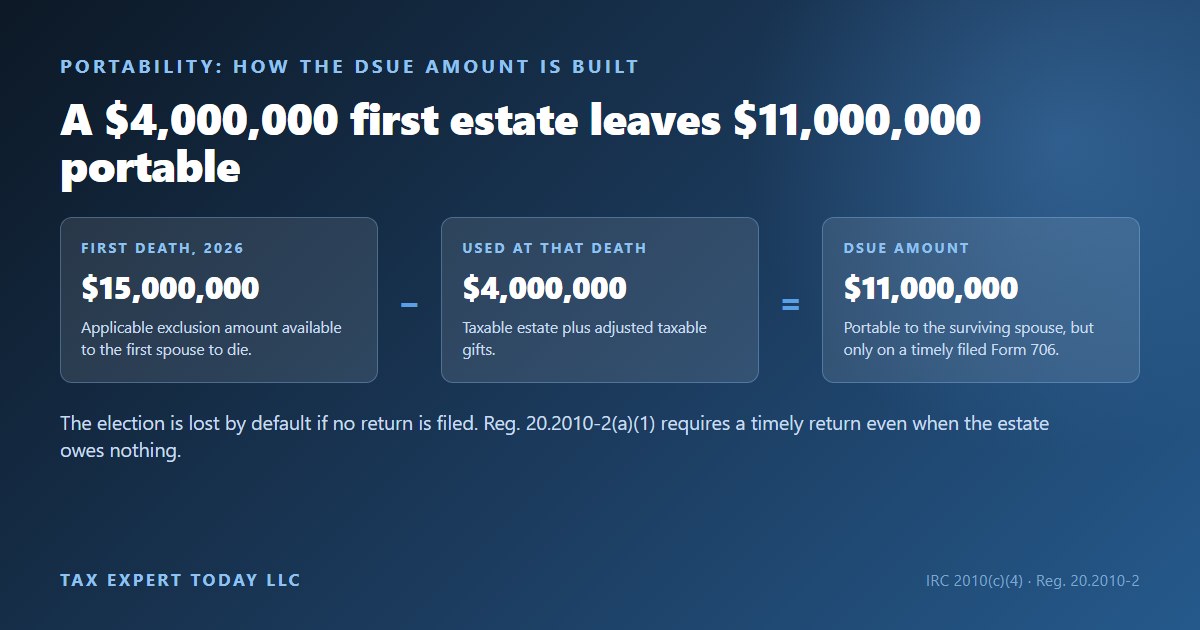
The table below applies the Section 2010(c)(4) formula across several first estates, holding 2026 law constant. Each row assumes a United States citizen decedent survived by a spouse, with no prior taxable gifts unless the row says otherwise.
| Taxable estate at the first death | Adjusted taxable gifts | Total used | DSUE available to the survivor |
|---|---|---|---|
| $2,000,000 | $0 | $2,000,000 | $13,000,000 |
| $4,000,000 | $0 | $4,000,000 | $11,000,000 |
| $9,000,000 | $0 | $9,000,000 | $6,000,000 |
| $12,000,000 | $3,000,000 | $15,000,000 | $0 |
| $15,000,000 | $0 | $15,000,000 | $0 |
Notice the fourth row. Lifetime gifts made by the first spouse to die are added back as adjusted taxable gifts in the computation, so a history of substantial gifting reduces what is left to port. This is the mechanism most consumer summaries omit, and it is the reason a couple who have both gifted heavily may find far less available than the headline $30,000,000 suggests.
What does the portability election actually require?
It requires a complete and properly prepared Form 706 filed on time, even by an estate that owes nothing and has no independent filing obligation. Treas. Reg. 20.2010-2(a)(1) makes the return itself the election. Filing timely and completely elects portability by default; declining it takes an affirmative opt-out under paragraph (a)(3)(i).
- The deadline is nine months from the date of death, or the last day of a period covered by an extension.
- An estate below the filing threshold must still file to elect. Portability is the only reason such a return exists.
- The election is the default on a timely return. An executor who files completely and says nothing has elected portability.
- Reduced reporting is available. Under paragraph (a)(7), property passing to a surviving spouse or to charity may be described rather than separately appraised, with the executor exercising due diligence to estimate the gross estate.
That last provision is the practical answer to the most common objection, which is that preparing a full estate tax return for a modest estate is disproportionate. It is a real concession. Assets qualifying for the marital or charitable deduction can be reported by description, ownership and beneficiary rather than by appraised value, provided the executor makes a good faith estimate of the total. The return is still a serious undertaking, but it is not the exercise many families assume when they decline to file.
What happens when the portability election is missed?
The DSUE amount is simply lost, and with it the ability to shelter a second exclusion at the survivor’s death. Because no tax is due at the first death in these cases, nothing signals the omission at the time. The consequence appears years later, on the survivor’s estate, when the exclusion that should have been available is not there.
- Nothing goes wrong at the first death. No notice is issued, no tax is assessed, and the family has no reason to suspect an error.
- The cost is deferred and can be large. The gap is measured at 40 percent of the amount that the missing exclusion would have covered.
- Relief exists but it has a deadline. Rev. Proc. 2022-32 provides a simplified route, discussed below.
- Relief is not available to every estate. An estate that was required to file under Section 6018(a) cannot use the simplified method at all.
The arithmetic makes the point better than description does. The table below assumes the first spouse died in 2026 with a $4,000,000 taxable estate and no adjusted taxable gifts, producing a DSUE of $11,000,000 if the election is made. It then varies the survivor’s taxable estate and compares the federal estate tax with and without the election, at the 40 percent top rate and ignoring state taxes, deductions and credits other than the unified credit.
| Survivor’s taxable estate | Exclusion with the election | Tax with the election | Tax without the election | Difference |
|---|---|---|---|---|
| $15,000,000 | $26,000,000 | $0 | $0 | $0 |
| $20,000,000 | $26,000,000 | $0 | $2,000,000 | $2,000,000 |
| $26,000,000 | $26,000,000 | $0 | $4,400,000 | $4,400,000 |
| $30,000,000 | $26,000,000 | $1,600,000 | $6,000,000 | $4,400,000 |
The first row is the honest one. Where the survivor’s estate stays below a single exclusion, the missed election costs nothing at all, which is why the omission is defensible in many families and why blanket advice to always file is not obviously right either. The difference only becomes real above $15,000,000, and it plateaus once the DSUE is fully absorbed. Whether the return is worth preparing is a judgment about the plausible range of the survivor’s future estate, not a fixed rule.
How long is the deadline for a late portability election?
Rev. Proc. 2022-32 gives a simplified method available until the fifth anniversary of the decedent’s date of death. It superseded Rev. Proc. 2017-34, which had allowed only until the second anniversary, and it took effect July 8, 2022. Within that window the simplified method is the exclusive route, so no private letter ruling is needed.
- The decedent must have been survived by a spouse, died after December 31, 2010, and been a citizen or resident of the United States at death.
- The estate must not have been required to file under Section 6018(a), determined without regard to the need to file for portability.
- No return can have been filed within the period prescribed by Reg. 20.2010-2(a)(1).
- The return must carry a specific legend. The executor states at the top of Form 706 that it is filed pursuant to Rev. Proc. 2022-32 to elect portability under Section 2010(c)(5)(A).
The five-year window is generous, and it is frequently the reason a situation that looks unrecoverable is not. A death in early 2024 with no return filed still has time. A death in 2019 does not, and the only remaining route would be a letter ruling request under Section 301.9100-3, which Rev. Proc. 2022-32 contemplates for executors who fall outside the simplified method. An estate that was required to file in the first place has no extension available at all, because in that case the due date is fixed by statute rather than by regulation.
Is the DSUE amount indexed for inflation?
No. The DSUE amount is fixed as of the first spouse’s death under Treas. Reg. 20.2010-2(c), while the survivor’s own basic exclusion continues to be adjusted each year. The inherited portion therefore shrinks in real terms and as a share of the couple’s total shelter for as long as the survivor lives.
- The computation happens once. The figure is determined from the first estate return and does not move afterward.
- The survivor’s own amount keeps growing, because Section 2010(c)(3)(B) indexes the basic exclusion for years after 2026.
- A long survivorship dilutes the DSUE. The longer the gap between deaths, the smaller the inherited share of the total.
- One narrow exception exists. Where property passes to a qualified domestic trust, the DSUE amount is redetermined on the final distribution or other terminating event under Section 2056A.
The illustration below is not a forecast and it uses no official figure beyond 2026. It applies a flat two percent assumption purely to show the direction of travel, rounded to the nearest $10,000 as the statute directs. The actual adjusted amounts for 2027 and later years will be published by the IRS and should be read from that source rather than estimated.
| Year | Survivor’s own basic exclusion, illustrative only | Frozen DSUE | Combined shelter | DSUE share of total |
|---|---|---|---|---|
| 2026 | $15,000,000 | $11,000,000 | $26,000,000 | 42.3 percent |
| 2027 | $15,300,000 | $11,000,000 | $26,300,000 | 41.8 percent |
| 2028 | $15,610,000 | $11,000,000 | $26,610,000 | 41.3 percent |
| 2029 | $15,920,000 | $11,000,000 | $26,920,000 | 40.9 percent |
| 2030 | $16,240,000 | $11,000,000 | $27,240,000 | 40.4 percent |
| 2031 | $16,560,000 | $11,000,000 | $27,560,000 | 39.9 percent |
The drift is slow, and over a short survivorship it is immaterial. Over twenty or thirty years it is not, and it is one of the arguments that favor using the DSUE sooner through lifetime gifting rather than holding it until the second death. That argument has to be weighed against the loss of a basis step-up on gifted assets, which frequently points the other way for appreciated property. The clearest example of that trade is a qualified personal residence trust, which removes a home and its future appreciation from the estate but hands the beneficiaries carryover basis in place of a step-up. Where the asset in question is expected to appreciate sharply rather than merely drift, a grantor retained annuity trust is the structure that moves that growth without consuming exclusion, subject to its own hurdle rate.
Which deceased spouse DSUE applies after a remarriage?
Only the last deceased spouse counts. Treas. Reg. 25.2505-2 defines the available DSUE by reference to the last deceased spouse, so remarriage followed by a second death replaces the first DSUE rather than adding to it. Amounts already applied to gifts before the second death are not clawed back.
- DSUE amounts do not stack. A survivor cannot accumulate unused exclusion from two deceased spouses and hold both.
- A later death can reduce the amount available if the new last deceased spouse leaves a smaller unused figure, or none.
- Divorce does not change the identity of the last deceased spouse. If a later marriage ends in divorce or annulment, the subsequent death of that former spouse does not displace the prior deceased spouse.
- Using it before the second death protects it. DSUE applied to a completed gift is already absorbed and is not revisited.
This is where portability and gift planning meet in a way that has real timing consequences. A surviving spouse holding a large DSUE who then remarries has an identifiable exposure, because the new spouse’s death could substitute a much smaller amount. Making completed gifts that absorb the existing DSUE before that happens is a recognized response, and it is one of the few areas where the ordering rule genuinely works in the taxpayer’s favor.
Why does the ordering rule matter when the survivor makes a gift?
Because DSUE is used first. Treas. Reg. 25.2505-2(b) provides that a surviving spouse is considered to apply the DSUE amount to a taxable gift before applying their own basic exclusion amount. The inherited, frozen, vulnerable amount is therefore spent ahead of the indexed amount the survivor keeps.
- The rule is automatic and does not require an election or a statement on the return.
- It protects the survivor’s own exclusion, which continues to grow with inflation while the DSUE does not.
- It reduces remarriage risk by converting a fragile inherited amount into a completed transfer.
- It is a reason lifetime gifting is often the efficient use of DSUE, subject always to the basis consequences of giving rather than bequeathing.
The counterweight deserves equal weight. Property transferred by lifetime gift generally carries over the donor’s basis under Section 1015, while property held until death is ordinarily eligible for a basis adjustment under Section 1014. For highly appreciated assets in a family that is unlikely to face estate tax at all, giving early can cost more in capital gains than it saves in transfer tax. Households weighing the charitable version of this trade-off often review it alongside a charitable remainder trust or a donor advised fund deduction, both of which change the arithmetic in different directions.
Why is the GST exemption not portable?
Because no statute provides for it. Section 2631 grants each individual a GST exemption equal to the Section 2010(c) basic exclusion amount and allows that individual or the executor to allocate it, but it contains no mechanism transferring an unused amount to a surviving spouse. Portability under Section 2010(c)(4) reaches the estate and gift exclusion only.
- The GST exemption for 2026 is $15,000,000, the same figure as the basic exclusion, per Section 2631(c) and Rev. Proc. 2025-32 section 3.14.
- Unused GST exemption is lost at death unless it is allocated, and allocation is irrevocable once made under Section 2631(b).
- Portability creates a false symmetry. A family that correctly ports the estate exclusion may assume the GST exemption came with it.
- Allocation is the substitute for portability. Where multigenerational transfers are intended, the exemption has to be allocated deliberately at the first death.
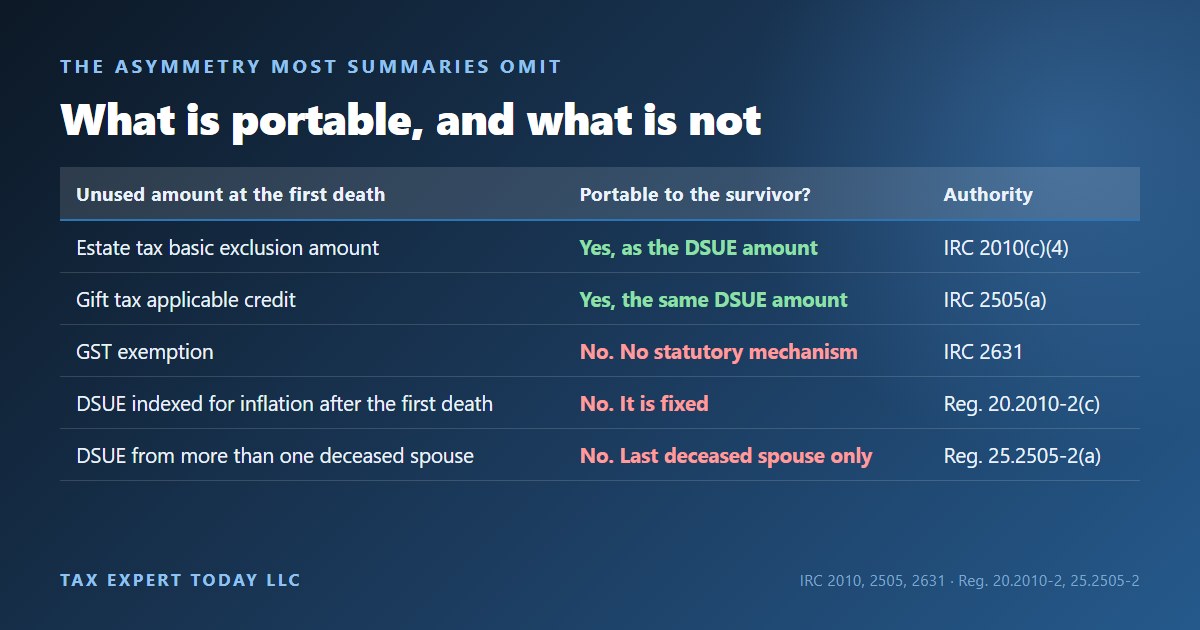
| Unused amount at the first death | Portable to the survivor | Authority |
|---|---|---|
| Estate tax basic exclusion amount | Yes, as the DSUE amount | IRC 2010(c)(4) |
| Gift tax applicable credit | Yes, the same DSUE amount | IRC 2505(a) |
| Generation-skipping transfer exemption | No. No statutory mechanism | IRC 2631 |
| Inflation indexing on the transferred amount | No. The DSUE is fixed at the first death | Reg. 20.2010-2(c) |
| DSUE from more than one deceased spouse | No. Last deceased spouse only | Reg. 25.2505-2(a) |
On the facts used earlier, the same $11,000,000 that ports as DSUE also represents $11,000,000 of GST exemption that does not port. Where the plan contemplates grandchildren, that is the amount at risk, and the response is an allocation on the first estate return rather than anything the survivor can do later. Families building longer-horizon structures usually take this up as part of estate and trust planning rather than as a filing question.
Does Florida impose its own estate or gift tax?
No. The Florida Department of Revenue states that a federal change eliminated the Florida estate tax for people who died after December 31, 2004, and Florida imposes no gift tax. A Florida resident therefore faces the federal transfer tax system alone, which makes the federal exclusion the only shelter that matters and the portability election the only one to preserve.
- No state estate tax layer sits behind the federal one for a Florida domiciliary who died after December 31, 2004.
- No state gift tax applies to lifetime transfers by a Florida resident.
- The no-tax-due affidavits are gone. Since July 1, 2023, personal representatives no longer file Form DR-312 or Form DR-313.
- Other states still reach non-resident property. Real property situated in a state with its own estate tax can remain within that state’s reach whatever the domicile.
- Domicile has to be genuine. A former state may test a claimed move, and the evidence is built in advance rather than argued afterward.
For families arriving from a state that levies its own estate tax at a much lower threshold, the change is larger than the federal figure suggests. A move can remove a state layer entirely while leaving the federal analysis unchanged. The timing and the documentation matter, and they are a separate exercise from the transfer tax work. Households doing both in the same year usually look at establishing Florida residency and at retiring to Florida alongside the estate plan.
Georgia is in the same position as Florida on this point: it has no state gift tax, so Georgia residents plan only around the federal exemption. The Georgia consequences that remain, including carryover basis on a later sale and the reduced title ad valorem tax on a vehicle given to a family member, are covered in our guide to the Georgia gift tax.
Gift tax help Naples: lifetime exemption planning in Southwest Florida
Tax Expert Today LLC advises families in Naples, Florida and across Southwest Florida on the 2026 exclusion, Form 709 reporting and adequate disclosure, portability elections at a first death, late elections under Rev. Proc. 2022-32, and the GST allocation that portability does not cover. The firm serves clients in all 50 states under federal practice authority.
Two patterns recur locally. The first is the surviving spouse who was told, correctly, that no estate tax was due at the first death, and who therefore filed nothing. Years later the question of the second estate arises and the DSUE is not there. Where the death was recent enough, the five-year window in Rev. Proc. 2022-32 is often still open, and the answer is a return rather than a lost opportunity. The second is the family that moved to Collier County from a state with its own estate tax and assumed the whole transfer tax question had gone away with the move. The state layer did. The federal one did not, and it is the one the plan has to be built around.
Our office is at 11983 Tamiami Trail N, Naples, FL 34110. Call (239) 441-2005, Monday through Friday, 10am to 5pm ET. Clients in Naples, Bonita Springs, Estero, Fort Myers, Marco Island, and the surrounding communities work with us in person or remotely.
My spouse died two years ago in Naples and we filed nothing. Is it too late to elect portability?
Probably not, on those facts. Rev. Proc. 2022-32 allows the simplified late election until the fifth anniversary of the date of death, so a death two years ago leaves roughly three years of the window. The conditions are that the decedent was survived by a spouse, died after December 31, 2010, was a citizen or resident of the United States, and that the estate was not required to file under Section 6018(a) without regard to portability. Where those hold, the route is a complete Form 706 carrying the legend the revenue procedure prescribes. Whether it is worth preparing depends on the plausible size of the survivor’s estate, which is the first thing to work out.
When to engage a professional
The decisions in this area are made in narrow windows and are difficult to revisit once the window closes. The work worth paying for happens before a return is filed or a transfer is completed, not afterward. Consider engaging an adviser when any of the following is true.
- A spouse has died within the last five years and no estate tax return was filed, since the Rev. Proc. 2022-32 window may still be open and it does not reopen.
- A first estate return is being prepared, where the GST allocation has to be considered deliberately because it does not travel with the portability election.
- A surviving spouse holding DSUE is remarrying, where the last deceased spouse rule can substitute a smaller amount.
- Gifts of closely held or hard-to-value property are contemplated, where adequate disclosure decides how long the valuation stays open.
- Substantial gifts were made by the first spouse to die, since adjusted taxable gifts reduce the DSUE and the headline couple figure may not be available.
- Planning was built around the pre-2026 sunset and has not been revisited since Public Law 119-21 removed it.
- A move to Florida is happening in the same period, where domicile evidence and transfer tax planning interact.
Tax Expert Today LLC works as a multidisciplinary firm of tax advisors, enrolled agents, CPAs, and attorneys, which matters here because the question spans return preparation, valuation, trust drafting, and often a residency change in the same year. Our estate and trust planning practice handles the election and allocation work, our tax planning services cover the modeling, and our Naples tax planning practice coordinates the residency timing alongside it. Owners whose estate is concentrated in a business usually need the business sale tax rules considered in the same conversation. Fees are scoped and quoted after a consultation.
Frequently asked questions
What is the lifetime gift tax exemption for 2026?
It is $15,000,000 per individual. The figure comes from IRC Section 2010(c)(3) as amended by Public Law 119-21 section 70106(a), and Rev. Proc. 2025-32 section 3.14 confirms it for calendar year 2026. The same amount serves as the generation-skipping transfer exemption under Section 2631(c). It is unified with the estate tax, so lifetime taxable gifts reduce what remains available at death.
Does the exemption still fall back to about half in 2026?
No. That reduction was scheduled under prior law, and Public Law 119-21 removed it. The statute now sets the basic exclusion amount at $15,000,000 and provides a cost-of-living adjustment for years after 2026, using calendar year 2025 as the base and rounding to the nearest $10,000. A great deal of published planning material still assumes the sunset, so the date of any article on this subject is worth checking.
How much can I give someone in 2026 without filing anything?
Up to $19,000 per recipient, under Section 2503(b), provided the gift is a present interest. A married couple who elect to split gifts can reach $38,000 per recipient, but splitting itself requires a gift tax return because the consent is made on the return. Gifts to a spouse who is not a United States citizen use a separate $194,000 annual figure under Section 2523(i)(2). Gift splitting is generally not available for a gift to a spousal lifetime access trust, because the spouse’s discretionary interest cannot be valued and severed from the gift. The same limit can affect premium gifts to an irrevocable life insurance trust that names the spouse as a beneficiary.
Do I have to file a gift tax return if no tax is due?
Yes, where the gift exceeds the annual exclusion. Section 6019 ties the filing requirement to the making of a taxable gift rather than to a liability, and the unified credit usually eliminates the tax while leaving the return obligation intact. For hard-to-value property the return does more than report, because adequate disclosure under Section 6501(c)(9) is what starts the limitations period on the valuation.
Is the deceased spousal unused exclusion adjusted for inflation?
No. The DSUE amount is computed once at the first death under Treas. Reg. 20.2010-2(c) and stays fixed, while the surviving spouse’s own basic exclusion continues to be indexed. There is a narrow exception for property passing to a qualified domestic trust, where the amount is redetermined on a terminating event under Section 2056A. Because DSUE is applied before the survivor’s own exclusion under Reg. 25.2505-2(b), lifetime gifting tends to spend the frozen amount first.
Can a surviving spouse use the unused GST exemption of the first spouse?
No. Section 2631 provides no portability mechanism, so unused GST exemption is lost at the first death unless it is allocated. Portability under Section 2010(c)(4) covers the estate and gift exclusion only. Where transfers to grandchildren or more remote descendants are intended, the allocation has to be made deliberately, ordinarily on the first estate tax return, and Section 2631(b) makes an allocation irrevocable once made. How a deliberate allocation shelters a trust across several generations is explained in our guide to the dynasty trust.
How late can a portability election be made?
Under Rev. Proc. 2022-32, until the fifth anniversary of the date of death, using a simplified method that requires no letter ruling. It superseded Rev. Proc. 2017-34 and its two-year window and took effect July 8, 2022. The estate must not have been required to file under Section 6018(a), the decedent must have been survived by a spouse and died after December 31, 2010, and the Form 706 must state at the top that it is filed pursuant to Rev. Proc. 2022-32 to elect portability under Section 2010(c)(5)(A).
Published September 3, 2026 by Dr. Pellumb Kabashi « Back to Learning Center
Have a question this article touches on?
Tax Expert Today LLC, based in Naples, Florida and serving clients across the United States.
Schedule a Consultation (239) 441-2005