
By Dr. Pellumb Kabashi, DBA, MBA, CES, CFE, EA
Founder, Tax Expert Today LLC · Tax advisors, enrolled agents, CPAs, and attorneys · Serving clients in all 50 states
Quick Answer: A charitable remainder trust is an irrevocable trust that pays you or another person an annual amount for life or up to 20 years, then leaves the remainder to charity. The trust pays no income tax when it sells appreciated property, so the gain spreads across the payment term instead of landing in one year. The remainder must be worth at least 10 percent of what you put in. Call (239) 441-2005 for a free consultation.
A charitable remainder trust is usually described as a way to give to charity and get paid at the same time. That description is accurate and almost useless, because it does not tell you the two things that actually decide whether the structure helps: what interest rate applies on the day you fund it, and what character the money carries when it comes back out.
Both of those are knowable in advance. Both are governed by rules that have moved recently. The interest rate that values the charitable remainder sat near 1 percent as recently as 2021, which quietly disqualified a large category of these trusts, and it stands at 5.2 percent for August 2026. The charitable deduction rules changed for tax years beginning after 2025, adding a floor that did not previously exist and capping what the deduction is worth to the highest earners. Most published guidance on this topic predates both changes.
This guide works through the mechanics with the arithmetic attached, using the rate in effect this month.
What Is a Charitable Remainder Trust and How Does It Work?
A charitable remainder trust is an irrevocable trust that splits an asset into two interests. A person receives payments for a fixed term or for life, and a qualified charity receives whatever remains at the end. The trust itself is exempt from income tax under Section 664(c)(1), so it can sell appreciated property without paying capital gains tax at the moment of sale.
- You fund it irrevocably. Assets placed in the trust cannot be taken back. The IRS states this plainly on its charitable remainder trusts page.
- The trust takes carryover basis. Your basis follows the asset in. Funding does not step anything up.
- The trust sells without immediate tax. Section 664(c)(1) exempts the trust from income tax, so the full sale proceeds stay invested.
- You receive payments. At least annually, for a term of years not exceeding 20, or for one or more lives.
- Charity takes the remainder. Valued at funding, it must be at least 10 percent of what went in.
The tax benefit is deferral and spreading, not elimination. The gain is not erased. It sits inside the trust and is handed to the payment recipient a slice at a time, which is a materially different outcome from a single-year sale but not the same thing as a tax-free transaction. Understanding that distinction is the difference between using this structure well and being disappointed by it.
What Are the Statutory Requirements for a Charitable Remainder Trust?
Section 664(d) sets four hard requirements. The annual payout must be at least 5 percent and no more than 50 percent, the term cannot exceed 20 years if it is a term of years, at least one payment recipient must be a non-charitable person, and the present value of the charitable remainder must equal at least 10 percent of the funding value.
- Payout floor and ceiling: not less than 5 percent nor more than 50 percent, stated identically in Section 664(d)(1)(A) for annuity trusts and Section 664(d)(2)(A) for unitrusts.
- Term limit: a term of years may not exceed 20 years. A life or lives measurement has no fixed cap.
- The 10 percent test: the remainder value determined under Section 7520 must be at least 10 percent, tested at funding for a CRAT and on every contribution for a CRUT.
- Qualified remainder beneficiary: the remainder must pass to an organization described in Section 170(c).
- Annual filing: Form 5227 every year, with Schedule K-1 reporting to each payment recipient.
| Requirement | Authority | The rule |
|---|---|---|
| Minimum annual payout | Section 664(d)(1)(A), (d)(2)(A) | Not less than 5 percent |
| Maximum annual payout | Section 664(d)(1)(A), (d)(2)(A) | Not more than 50 percent |
| Maximum term of years | Section 664(d)(1)(A), (d)(2)(A) | 20 years, or a life or lives instead |
| Minimum charitable remainder | Section 664(d)(1)(D), (d)(2)(D) | At least 10 percent of funding value, measured under Section 7520 |
| Trust level income tax | Section 664(c)(1) | None, the trust is exempt |
| Tax on unrelated business taxable income | Section 664(c)(2)(A) | Excise tax equal to the entire amount of that income |
The IRS publishes sample governing documents that satisfy these requirements, including Revenue Procedures 2003-53 through 2003-60 for annuity trusts and Revenue Procedures 2005-52 through 2005-59 for unitrusts. Drafting away from those forms is permitted, and it raises the qualification risk accordingly.
How Does the Section 7520 Rate Decide Whether a CRAT Qualifies?
The Section 7520 rate is the discount rate used to value the charitable remainder. A higher rate reduces the present value of the payment stream, which raises the remainder value and makes the 10 percent test easier to pass. The rate is 5.2 percent for August 2026 under Revenue Ruling 2026-13. At low rates, otherwise sensible annuity trusts fail outright.
This is not a theoretical point. Consider a charitable remainder annuity trust funded with 2,000,000 dollars, paying 5 percent, or 100,000 dollars annually, for a 20 year term. The structure is identical in every case below. Only the rate moves. All figures are illustrative.
| Section 7520 rate | Present value of the payments | Charitable remainder | Remainder as a percentage | 10 percent test |
|---|---|---|---|---|
| 1.0 percent | 1,804,555 dollars | 195,445 dollars | 9.77 percent | Fails |
| 2.0 percent | 1,635,143 dollars | 364,857 dollars | 18.24 percent | Passes |
| 3.0 percent | 1,487,747 dollars | 512,253 dollars | 25.61 percent | Passes |
| 4.0 percent | 1,359,033 dollars | 640,967 dollars | 32.05 percent | Passes |
| 5.0 percent | 1,246,221 dollars | 753,779 dollars | 37.69 percent | Passes |
| 5.2 percent (August 2026) | 1,225,356 dollars | 774,644 dollars | 38.73 percent | Passes |
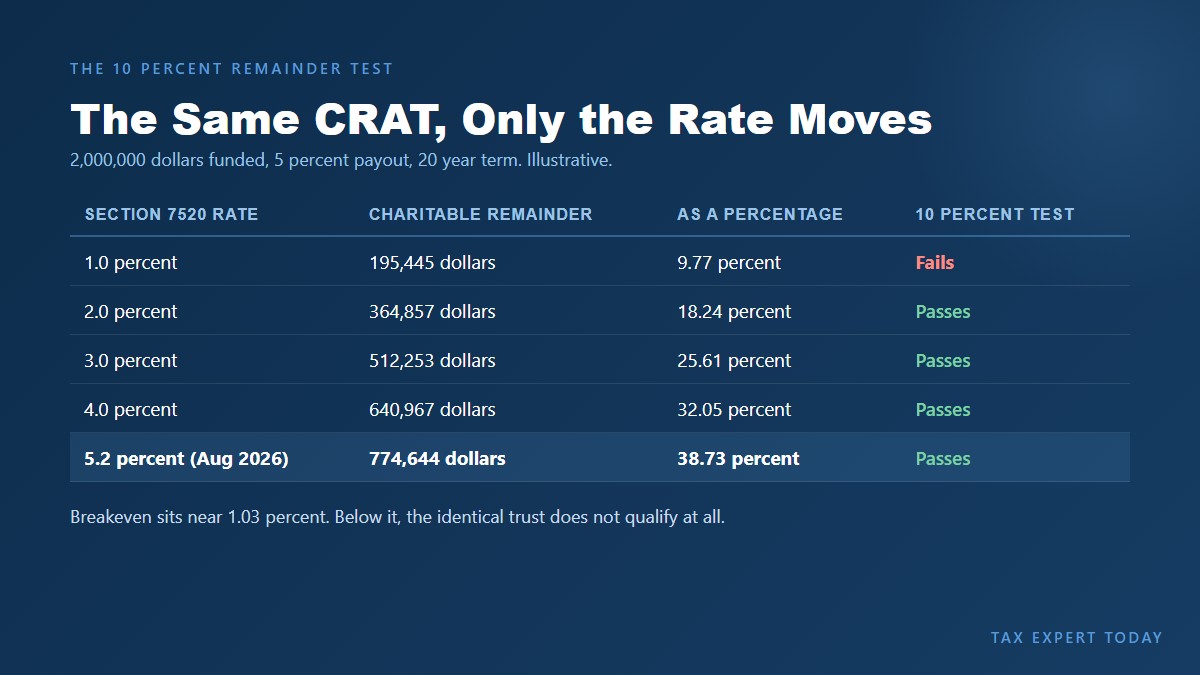
The breakeven for this particular trust sits at roughly 1.03 percent. Below that, the same document that qualifies comfortably today does not qualify at all. During 2020 and 2021 the Section 7520 rate ran between 0.4 percent and 1.2 percent, which is precisely why practitioners spent those years steering clients toward unitrusts and away from annuity trusts. At 5.2 percent that constraint has lifted, and the deduction generated by an annuity trust is roughly four times what the same trust produced at a 1 percent rate. The direction of that rate sensitivity is not universal across split interest vehicles, and a qualified personal residence trust moves the opposite way, since a higher rate there enlarges the retained interest and shrinks the reported gift. A grantor retained annuity trust reads that same rate history in reverse, because a low rate lowers the hurdle it has to clear rather than shrinking the deduction it produces. A charitable lead trust, which pays the charity first and the family last, also prefers a low rate, for the same reason.
Two practical consequences follow. First, the rate is fixed by the month of the valuation date, and a taxpayer funding near a month end may choose between two published rates. Second, a charitable remainder unitrust behaves differently, because its remainder factor under Treasury Regulation Section 1.664-4 depends principally on the payout percentage and the term rather than on the discount rate, which is what made unitrusts the default during the low-rate era.
Should You Use a CRAT or a CRUT?
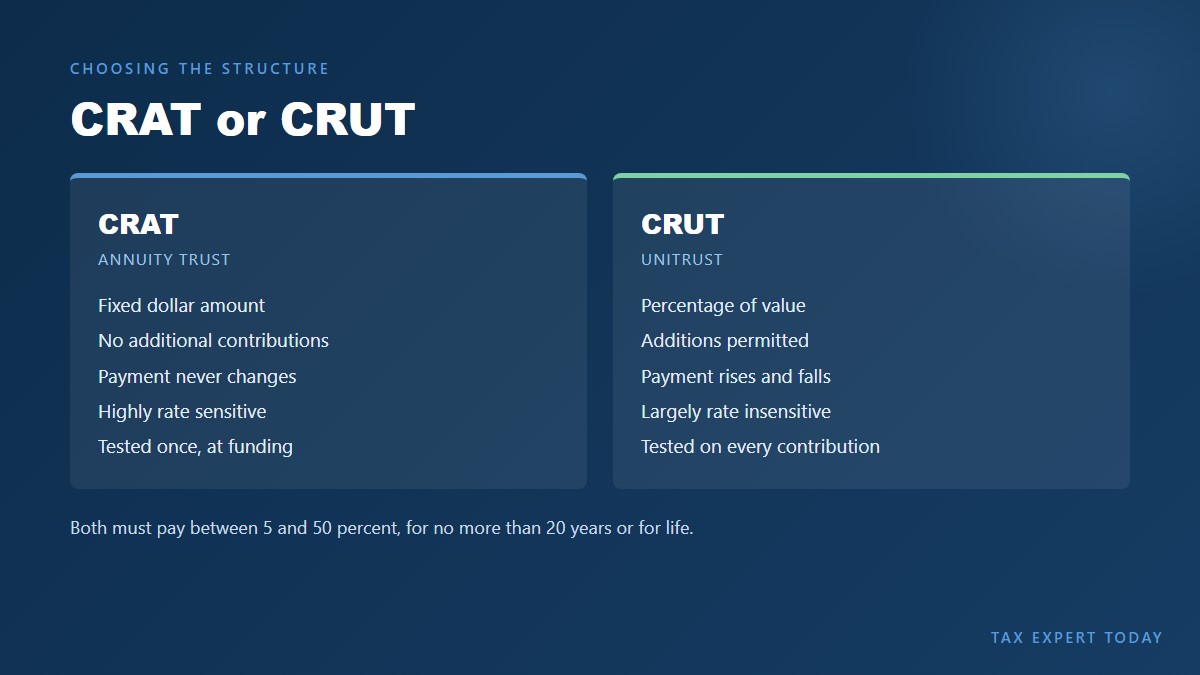
A charitable remainder annuity trust pays a fixed dollar amount set at funding and accepts no later contributions. A charitable remainder unitrust pays a fixed percentage of the trust value revalued every year, and it does accept later contributions. The annuity trust gives certainty of payment, and the unitrust gives inflation participation and funding flexibility.
- Choose an annuity trust when the recipient needs a predictable, unchanging amount and the funding is a single event.
- Choose a unitrust when the recipient would benefit from payments that rise with the portfolio, or when more property will be added later.
- Watch the 10 percent test on each addition to a unitrust, because Section 664(d)(2)(D) applies it to every contribution, not just the first.
- Remember the unitrust downside: payments fall in bad years, because the percentage applies to a lower value.
| Feature | CRAT (annuity trust) | CRUT (unitrust) |
|---|---|---|
| Annual payment | Fixed dollar amount, set at funding | Fixed percentage of the value, revalued annually |
| Additional contributions | Not permitted | Permitted |
| Effect of investment performance | None on the payment amount | Payment rises and falls with the trust value |
| Sensitivity to the Section 7520 rate | High, the rate drives the remainder value | Low, the payout rate and term dominate |
| 10 percent test applied | Once, at funding | On every contribution |
| Best suited to | Predictable income needs, single funding event | Inflation participation, staged funding |
How Are Charitable Remainder Trust Payments Taxed?
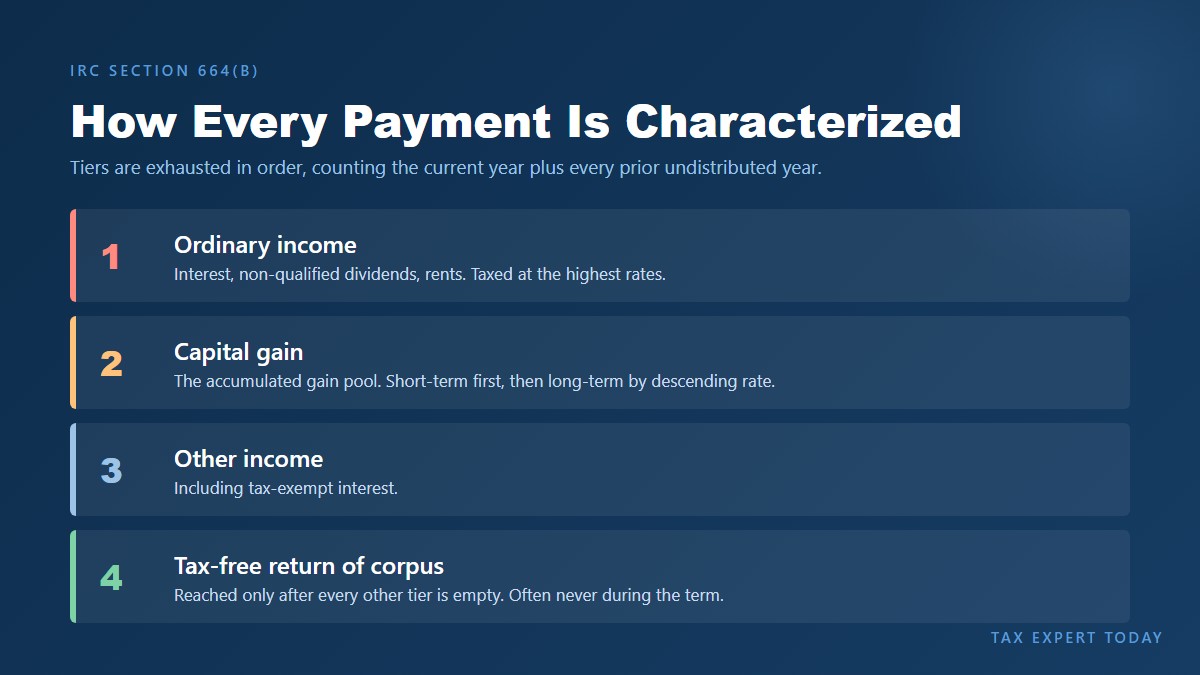
Section 664(b) assigns character to each payment through a four-tier ordering system. Payments are treated as ordinary income first, capital gain second, other income third, and tax-free return of corpus last. The tiers are exhausted in that order, counting both the current year and every prior undistributed year, which means the worst character comes out first.
- Tier 1, ordinary income: interest, non-qualified dividends, and rents, current year plus all prior undistributed amounts.
- Tier 2, capital gain: the accumulated gain pool, determined on a cumulative net basis.
- Tier 3, other income: including tax-exempt interest.
- Tier 4, corpus: returned tax free, and reached only after every other tier is empty.
- Within each tier, highest rate first: Treasury Regulation Section 1.664-1(d) orders classes inside a category beginning with the class subject to the highest federal rate.
That last point is where the structure most often disappoints people who were told the payments would be largely tax free. Within the capital gains category the regulation directs distributions to come first from short-term gain, then from each long-term class in descending rate order, meaning the 28 percent collectibles class, then the 25 percent unrecaptured Section 1250 class, and only then the ordinary long-term class. The favorable rates come out last.
Take the 2,000,000 dollar trust above, funded with stock carrying a 400,000 dollar basis, which creates a 1,600,000 dollar gain pool when the trust sells. Assume the portfolio then throws off 40,000 dollars of ordinary income in year one. The 100,000 dollar payment is characterized this way. Figures are illustrative.
| Tier | Character | Amount | Why |
|---|---|---|---|
| 1 | Ordinary income | 40,000 dollars | All of the trust’s ordinary income for the year |
| 2 | Long-term capital gain | 60,000 dollars | Drawn from the 1,600,000 dollar accumulated gain pool |
| 3 | Other income | 0 dollars | Tiers 1 and 2 absorbed the entire payment |
| 4 | Tax-free corpus | 0 dollars | Never reached while a gain pool remains |
At 60,000 dollars of gain absorbed per year, that 1,600,000 dollar pool would take roughly 27 years to exhaust. The term is 20 years. On these assumptions not one payment across the entire term is a tax-free return of principal. Any illustration promising otherwise is describing a trust with a much smaller embedded gain, a much higher payout, or both.
Applying 2026 rates to that year one payment, and assuming the recipient’s other income already fills the lower brackets, the ordinary slice is taxed at 37 percent and the gain slice at 20 percent, with the 3.8 percent net investment income tax under Section 1411 applying to both. That produces 14,800 dollars, 12,000 dollars, and 3,800 dollars respectively, or 30,600 dollars of federal tax on a 100,000 dollar payment, an effective rate of 30.6 percent.
How Large Is the Charitable Deduction, and What Limits Apply in 2026?
The deduction equals the present value of the charitable remainder, not the value of what you contributed. Three separate limits then apply in sequence: the 30 percent of adjusted gross income ceiling for appreciated property, the new 0.5 percent floor added by Section 170(b)(1)(I), and the Section 68 reduction that caps the deduction’s value at 35 cents per dollar for top-bracket taxpayers.
A donor who wants the deduction without the trust machinery, and who does not need an income stream back, generally compares this structure against a simpler account. Our guide to the donor advised fund tax deduction works through the same floor and ceiling rules as they apply to a fund contribution, including the point that the new non-itemizer charitable deduction does not reach those accounts at all. A third route funds a split interest vehicle directly from a retirement account under the one-time election described in our guide to the qualified charitable distribution, although the character rules that apply to those payments are less favorable than the ordering described here.
- The ceiling: appreciated capital gain property given for the benefit of a public charity is limited to 30 percent of the contribution base under Section 170(b)(1)(C)(i), with a five year carryforward.
- The floor, new for 2026: Section 170(b)(1)(I) allows charitable contributions only to the extent they exceed 0.5 percent of the contribution base.
- The carryforward trap: under Section 170(d)(1)(C) the floored amount carries forward only from a year in which the percentage limitation is also exceeded. Otherwise it is simply lost.
- The value cap: Section 68 as rewritten reduces itemized deductions by two thirty-sevenths of the lesser of the itemized deductions or taxable income above the 37 percent threshold, which is 768,700 dollars for joint filers in 2026 per Revenue Procedure 2025-32.
- Private foundation remainder: the ceiling drops to 20 percent under Section 170(b)(1)(D).
Both the floor and the Section 68 rewrite were enacted by Public Law 119-21 on July 4, 2025, and both apply to taxable years beginning after December 31, 2025. This is the first filing season in which either one bites. Carrying the earlier example forward, with a 774,644 dollar remainder and a donor whose adjusted gross income is 900,000 dollars, all figures illustrative:
| Step | Authority | Amount |
|---|---|---|
| Charitable remainder value | Treasury Regulation Section 1.664-2(c) | 774,644 dollars |
| 30 percent of AGI ceiling | Section 170(b)(1)(C)(i) | 270,000 dollars |
| Carried to the five succeeding years | Section 170(b)(1)(C)(ii) | 504,644 dollars |
| Less the 0.5 percent floor | Section 170(b)(1)(I) | 4,500 dollars |
| Current year deduction | 265,500 dollars | |
| Value at a 35 percent effective rate | Section 68 | 92,925 dollars |
Two observations that rarely appear elsewhere. First, the deduction here is 774,644 dollars on a 2,000,000 dollar gift, which is 38.7 percent, not anything close to the full contribution. Second, a donor in the top bracket saves 35 cents rather than 37 cents on each deductible dollar, because Section 68 removes two percentage points of value. On 265,500 dollars of deduction that difference is 5,310 dollars, which is small in isolation and compounds across a five year carryforward.
What Does a Charitable Remainder Trust Save Compared With Selling Outright?
The comparison turns on one number: the tax that would have been due in the year of sale. Selling the same 2,000,000 dollar position outright triggers tax on the entire 1,600,000 dollar gain immediately. Funding a charitable remainder trust defers that liability across the payment term, at the cost of permanently giving away the remainder.
| Measure | Sell outright | Fund the charitable remainder trust |
|---|---|---|
| Tax in the year of sale | 380,800 dollars | 0 dollars at the trust, Section 664(c)(1) |
| Capital remaining invested | 1,619,200 dollars | 2,000,000 dollars |
| Charitable deduction | None | 265,500 dollars in year one, balance carried forward |
| Tax on the year one payment | Not applicable | 30,600 dollars |
| Amount permanently directed to charity | None | 774,644 dollars of value at funding |
| Access to principal | Full | None, the trust is irrevocable |
The honest framing is that 380,800 dollars stays invested and working instead of going to the Treasury in the year of sale, and the family gives up the remainder interest to achieve it. Whether that trade is worth making depends on the donor’s charitable intent, the size of the embedded gain, and how long the payment term runs. A donor with no charitable motivation at all is usually better served by other planning, because the remainder is a real and permanent cost, not an accounting entry. Deferral without a charitable transfer is the province of tools such as a cash balance plan for business owners, or installment structuring, and those belong in the same comparison rather than being ruled out before it starts.
The deferral is also worth more to some taxpayers than others. A Florida resident already pays no state income tax, so the benefit is entirely federal. A resident of a high tax state considering a move should look at the interaction between the trust’s payment stream and residency, which is the subject of our guide to establishing Florida residency, and at the timing questions covered in selling a business and the tax on the sale.
What Traps Undermine a Charitable Remainder Trust?
The most expensive traps are the 100 percent excise tax on unrelated business taxable income, the irrevocability of the structure itself, and the reporting obligations that continue for the life of the trust. Each one is avoidable with planning and difficult to fix afterward.
- Unrelated business taxable income: Section 664(c)(2)(A) imposes an excise tax equal to the entire amount of that income, defined by reference to Section 512. Debt-financed property is the usual cause, so contributing mortgaged real estate deserves careful review.
- Self-dealing: the chapter 42 rules, including Section 4941, reach transactions between the trust and disqualified persons.
- Irrevocability: the assets cannot be recovered. A donor who may need the principal should not fund the trust with it.
- Annual compliance: Form 5227 is due every year, with Schedule K-1 to each recipient, for the entire term.
- Basis inflation: the IRS specifically lists inflating basis to market value on funding, rather than using carryover basis, among the illegal uses of these trusts.
- Mischaracterizing distributions: reporting ordinary or capital gain payments as corpus is also on the agency’s published list of prohibited practices.
The IRS is direct about the abuse patterns it examines. Its charitable remainder trusts page states that a trust may not omit or fail to account for the sale of assets, may not mischaracterize distributions of ordinary or capital gain income as distributions of corpus, and may not make an upfront cash payment to a charitable beneficiary in place of the remainder interest. It further states that donors and beneficiaries may not pay personal expenses with trust funds, borrow from the trust, or use loans and forward sales to hide gain inside it. A properly drafted and properly administered trust encounters none of this, and the list is a useful description of where examination attention goes.
Charitable Remainder Trust Naples: Help in Southwest Florida
The profile that makes this structure worth analyzing is common in Southwest Florida. Owners here frequently hold a single concentrated position with a very low basis, often real estate acquired decades ago, a closely held business, or an appreciated securities portfolio, and they are approaching or already in retirement with a genuine charitable interest. That combination of large embedded gain, an income need, and charitable intent is exactly the fact pattern a charitable remainder trust addresses. Where the same estate is also large enough for transfer tax to matter, the lifetime gift tax exemption and the portability election belong in the same review, since the charitable structure changes what is left to shelter.
Florida changes the arithmetic in one specific way. Because Florida imposes no personal income tax, the deferral achieved inside the trust is a purely federal benefit, and the payment stream is not exposed to state tax as it comes out. A donor moving here from a state that does tax income should consider the sequence carefully, since the residency question and the funding question interact and the order in which they happen matters. The same sequencing problem arises on a company sale, which our guide to moving to Florida before selling a business works through in detail.
Tax Expert Today LLC works with clients on modeling the remainder value at the current Section 7520 rate before anything is drafted, on projecting the four-tier character of the payment stream year by year so the after-tax income is understood in advance, and on coordinating the charitable deduction with the new floor and ceiling rules. Our team includes tax advisors, enrolled agents, CPAs, and attorneys, so the trust design and the tax modeling happen in the same conversation rather than months apart.
Our office is at 11983 Tamiami Trail N, Naples, Florida 34110. Call (239) 441-2005, Monday through Friday, 10:00am to 5:00pm ET. We serve clients in Naples, Bonita Springs, Estero, Fort Myers, Marco Island, and throughout Florida and all 50 states. Related planning is available through our estate and trust planning practice, our Naples tax planning services, and our broader tax planning practice.
Does Florida residency change how a charitable remainder trust is taxed? It does not change the federal treatment at all. The trust remains exempt under Section 664(c)(1), the four-tier ordering rules still apply, and the same 10 percent test governs qualification. What changes is the state layer. A Florida resident receiving payments pays no state income tax on them, so the entire deferral benefit is retained. A recipient in a state that taxes income will generally owe state tax on the same payments as they are received. Where the trust itself was drafted in a state that still claims it, the separate question of trust situs after moving to Florida decides whether that state layer survives the move.
When to Engage a Professional
A charitable remainder trust is not a structure to attempt from a template. Consider engaging a professional when a concentrated low-basis position is approaching a sale and the resulting single-year gain would be substantial; when charitable intent is genuine and an income stream is also needed; when the property under consideration carries debt, since that raises the unrelated business taxable income question directly; when a trust is already in place and the character of its distributions has never been projected; or when the interaction between the deduction ceiling, the new 0.5 percent floor, and a multi-year carryforward needs to be modeled before the year closes.
Tax outcomes depend on individual facts and circumstances, and nothing here should be treated as advice for a specific situation. Whether any particular taxpayer may benefit from this structure depends on the asset, the basis, the intended term, the applicable rate in the month of funding, and the donor’s charitable objectives. This guide describes mechanisms and the arithmetic behind them so that the right questions can be asked. Call (239) 441-2005 or visit our estate and trust planning page to discuss whether a charitable remainder trust fits your circumstances. Engagement scope and pricing are determined after a consultation.
Frequently Asked Questions
What is the 10 percent rule for charitable remainder trusts? Sections 664(d)(1)(D) and 664(d)(2)(D) require that the present value of the charitable remainder, measured under Section 7520, be at least 10 percent of the value contributed. For an annuity trust it is tested once at funding. For a unitrust it is tested on every contribution. A trust that fails the test does not qualify.
Who pays the income tax on a charitable remainder trust? The recipient of the payments does, not the trust. Section 664(c)(1) exempts the trust from income tax. Each payment is assigned a character under the four-tier rules and reported to the recipient on Schedule K-1, and the recipient reports it on a personal return at the rates applicable to that character.
What are the downsides of a charitable remainder trust? The structure is irrevocable, so the principal cannot be recovered. The remainder passing to charity is a permanent transfer of value. Annual filings continue for the life of the trust. Unrelated business taxable income is taxed at 100 percent under Section 664(c)(2)(A). And the payments are rarely tax free, because the four-tier rules distribute the least favorable character first.
How much does it cost to set up a charitable remainder trust? Cost is driven by the complexity of the asset being contributed, whether an appraisal is required, whether the trust is drafted from an IRS sample form or customized, the choice of trustee, and the ongoing administration and filing burden. Engagement scope and pricing are determined after a consultation.
Can a charitable remainder trust hold real estate? It can, and debt is the complication. Mortgaged property can generate unrelated business taxable income inside the trust, which Section 664(c)(2)(A) taxes at 100 percent, and it can raise self-dealing questions. Unencumbered real estate is a far more straightforward contribution than financed property. Owners weighing whether to contribute a building or to keep it and accelerate deductions instead should also look at what a cost segregation study would produce on the same property.
What happens if the Section 7520 rate falls again? Existing trusts are unaffected, because the rate is fixed at the valuation date. New annuity trusts become harder to qualify, since a lower rate raises the present value of the payment stream and shrinks the remainder. In a low-rate environment the unitrust generally becomes the workable structure, which is what happened across 2020 and 2021.
Published August 14, 2026 by Dr. Pellumb Kabashi « Back to Learning Center
Have a question this article touches on?
Tax Expert Today LLC, based in Naples, Florida and serving clients across the United States.
Schedule a Consultation (239) 441-2005