
By Dr. Pellumb Kabashi, DBA, MBA, CES, CFE, EA
Founder, Tax Expert Today LLC · Tax advisors, enrolled agents, CPAs, and attorneys · Serving clients in all 50 states
Quick Answer
A charitable lead trust pays a charity first, for a term of years or a life, and then passes what remains to family. The gift is valued using the Section 7520 rate, and a low rate helps. At the October 2026 rate of 5.6 percent, the highest this year, a charitable lead trust needs strong growth to leave heirs anything. Call (239) 441-2005 for a free consultation.
What is a charitable lead trust?
A charitable lead trust is an irrevocable trust that pays a fixed annuity or a fixed percentage of its value to one or more charities for a set term, and then distributes whatever is left to noncharitable beneficiaries, usually children or a trust for them. The donor receives a charitable deduction for the value of the charity’s stream.
The charitable lead trust is the mirror image of the better known charitable remainder trust. In a remainder trust the family takes the income stream first and the charity receives what is left. In a charitable lead trust the order is reversed: the charity leads, and the family waits. That reversal changes almost everything about the tax result, because the family’s interest is now a future interest whose value depends on how much the charity is expected to take out of the trust first.
The mechanism that makes the structure useful is valuation. On the day the trust is funded, the tax law assumes the trust will earn exactly the Section 7520 rate for the whole term. The value of the charity’s lead interest is computed on that assumption and deducted. Whatever is left over is the taxable gift to the family. If the trust later earns more than the assumed rate, the excess passes to the family without further gift or estate tax. If it earns less, the family receives less, sometimes nothing.
- Irrevocable. Once funded, the donor cannot reclaim the assets or change the charitable payment.
- Split interest. The trust holds a charitable lead interest and a noncharitable remainder interest at the same time.
- Two forms. A charitable lead annuity trust pays a fixed dollar amount; a charitable lead unitrust pays a fixed percentage of annual value.
- Two tax regimes. A grantor trust gives the donor an income tax deduction; a non-grantor trust does not, but deducts its own payments.
- A bet on growth. The family benefits only to the extent the assets outperform the Section 7520 rate in force when the trust was valued.
| Feature | Charitable lead annuity trust (CLAT) | Charitable lead unitrust (CLUT) |
|---|---|---|
| Charity receives | A fixed dollar amount every year | A fixed percentage of the trust value, revalued every year |
| Legal definition | Guaranteed annuity interest, Treas. Reg. 25.2522(c)-3(c)(2)(vi) | Unitrust interest, Treas. Reg. 25.2522(c)-3(c)(2)(vii) |
| Sensitivity to the 7520 rate | High: the rate drives the whole valuation | Low: the valuation barely moves with the rate |
| Can the gift be zeroed out? | Yes, by setting the annuity high enough | No, the remainder factor never reaches zero |
| Generation skipping exemption | Measured at the end of the term under section 2642(e) | Allocated and fixed at funding |
| Who benefits from strong growth | The family keeps all of it | The charity shares in it every year |
| IRS sample forms | Rev. Proc. 2007-45 and 2007-46 | Rev. Proc. 2008-45 and 2008-46 |
How does a charitable lead trust work, step by step?
A donor signs a trust instrument, transfers assets, and chooses the charitable payment and term. The trust is valued that month using the Section 7520 rate. The trust pays the charity every year of the term, and when the term ends the remaining assets pass to the family or to a continuing trust for them.
Each step carries a decision that is difficult to undo, which is why the drafting stage matters more here than in most planning structures. The sequence below follows the order in which those decisions are usually made.
- Choose the form. Annuity or unitrust. The choice affects valuation, the generation skipping result, and who shares in growth.
- Choose the tax regime. Grantor or non-grantor, which decides whether the donor gets an income tax deduction now and pays the trust’s income tax later.
- Choose the term. A fixed number of years or the life of a permitted measuring life, discussed below.
- Choose the charity. A public charity, a donor advised fund sponsor, or a private foundation, each with different consequences.
- Value the interests. Apply the Section 7520 rate for the month of funding, or elect one of the two prior months.
- File the returns. A gift tax return for an inter vivos trust, and a Form 5227 for the trust every year of its life.
The deduction is measured by the IRS actuarial tables under section 7520, which the regulations apply to a lead annuity through Treas. Reg. 25.7520-2 and to a lead unitrust through the factors published in the IRS actuarial tables. Every figure in this article uses those methods applied to hypothetical facts.
What is the difference between a charitable lead trust and a charitable remainder trust?
The order of payment is reversed. A charitable remainder trust pays the family first and the charity last, is tax exempt, and suits a donor who wants income and deferral. A charitable lead trust pays the charity first and the family last, is not tax exempt, and suits a donor who wants to move future growth to heirs.
The two vehicles are often discussed together because both are split-interest trusts governed in part by the private foundation rules, and both file Form 5227. Beyond that they solve different problems. The remainder trust is described in section 664 and is exempt from income tax, which is why it is used to sell appreciated assets without immediate gain. The lead trust has no exemption. A non-grantor lead trust is a taxable trust that deducts its charitable payments; a grantor lead trust is ignored for income tax and its income is taxed to the donor. Our article on charitable remainder trusts covers the other side of the pair in detail.
| Question | Charitable remainder trust | Charitable lead trust |
|---|---|---|
| Who is paid first? | The donor or family | The charity |
| Who receives what is left? | The charity | The family |
| Is the trust exempt from income tax? | Yes, section 664(c) | No |
| Main goal | Income stream and deferral on a sale | Moving growth to heirs at a reduced gift value |
| Effect of a higher 7520 rate | Generally helps: the family’s stream is worth less, so the charity’s remainder, the deduction, and the 10 percent test all improve | Hurts, the charity’s stream is worth less so the family’s gift is larger |
| Minimum charitable value test | The 10 percent remainder test | None |
| Annual return | Form 5227 | Form 5227, plus Form 1041 for a non-grantor trust |
What is the difference between a CLAT and a CLUT?
A charitable lead annuity trust pays the charity the same dollar amount every year, so any growth above that payment stays in the trust for the family. A charitable lead unitrust pays a fixed percentage of the trust’s value each year, so the charity’s payment rises when the assets grow and the family shares that growth with the charity.
The difference sounds technical, but it decides who captures the upside. Consider a trust that doubles in value over its term. In an annuity trust, the charity still receives the same fixed amount it was promised on the first day, and the doubling belongs almost entirely to the remainder beneficiaries. In a unitrust, each annual payment is recomputed from the higher value, so the charity collects progressively larger checks and the family’s share of the gain is diluted.
- A CLAT is a leveraged bet. Growth above the 7520 rate goes to the family; growth below it falls on the family too.
- A CLUT shares the result. Good and bad years flow through to the charity’s payment.
- A CLAT can run dry. Fixed payments out of a shrinking trust can exhaust it before the term ends.
- A CLUT cannot run dry. A percentage of a smaller balance is a smaller payment.
- Generation skipping favors the CLUT. Its exemption is fixed at funding rather than tested at the end.
Most wealth transfer planning uses the annuity form for exactly the reason the unitrust looks attractive to charities: it concentrates the benefit of outperformance in the family. The unitrust earns its place in two situations, where the remainder is meant for grandchildren and where the donor genuinely wants the charity to share in the growth.
How does the Section 7520 rate decide whether a charitable lead trust works?
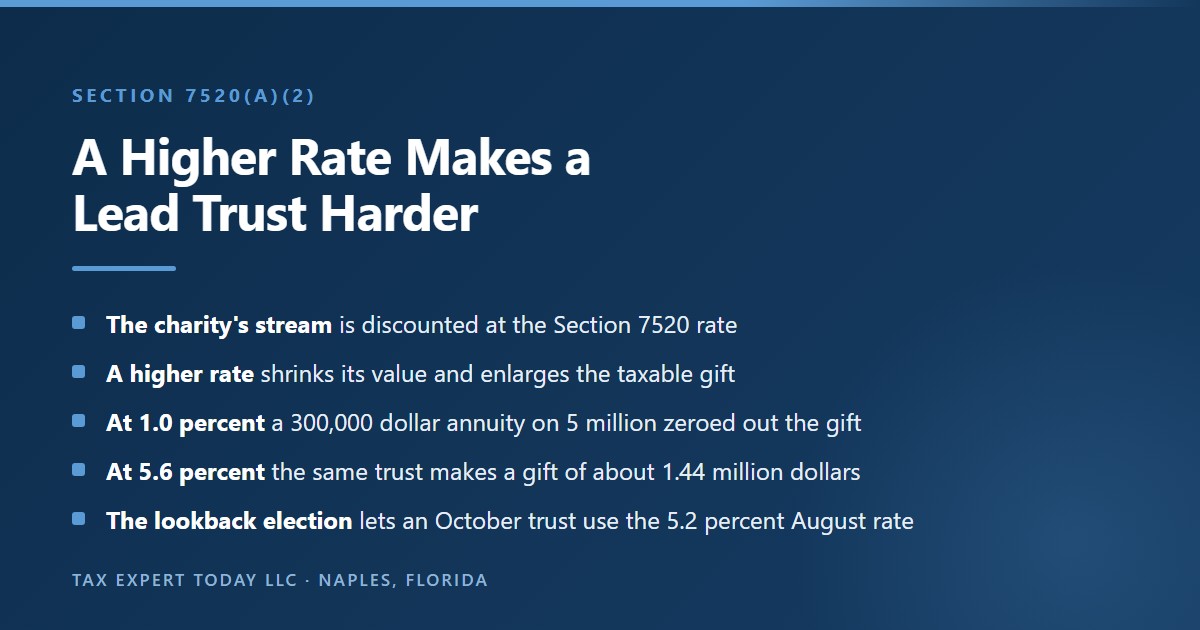
The Section 7520 rate is the growth the tax law assumes the trust will earn. A higher rate means the charity’s fixed payments are discounted more heavily, so the charity’s lead interest is worth less and the taxable gift to the family is larger. A charitable lead annuity trust therefore performs best when the rate is low.
This is the single most important fact about the charitable lead trust, and it cuts in the opposite direction from the charitable remainder trust and the qualified personal residence trust, both of which benefit from a higher rate. The reason is arithmetic. The charity’s interest is a stream of future payments. Present value falls as the discount rate rises. Because the family’s gift is simply the amount funded minus the value of the charity’s stream, every increase in the rate transfers value out of the deduction and into the taxable gift.
Under section 7520(a)(2), the rate is 120 percent of the federal midterm rate for the month of the valuation date, rounded to the nearest two tenths of a percent. The IRS publishes it monthly in a revenue ruling. The table below holds a hypothetical $5,000,000 trust paying $300,000 a year to charity for 20 years constant, and moves only the rate.
| Section 7520 rate | Value of the charity’s 20 year stream | Taxable gift to the family | Gift as a share of the trust |
|---|---|---|---|
| 1.0 percent (September 2021) | $5,413,666 | $0 | 0.0 percent |
| 3.0 percent | $4,463,242 | $536,758 | 10.7 percent |
| 4.6 percent (January 2026) | $3,868,785 | $1,131,215 | 22.6 percent |
| 5.2 percent (July and August 2026) | $3,676,067 | $1,323,933 | 26.5 percent |
| 5.4 percent (September 2026) | $3,615,048 | $1,384,952 | 27.7 percent |
| 5.6 percent (October 2026) | $3,555,557 | $1,444,443 | 28.9 percent |
Hypothetical illustration. Annual payments at the end of each year, valued with the term certain annuity factor from the IRS actuarial tables. At the 2021 rate the charity’s stream was worth more than the entire trust, so the family’s gift was zero. At today’s rate the identical trust makes a taxable gift of more than $1.4 million.
- Low rate, small gift. The charity’s stream absorbs most or all of the trust’s value.
- High rate, large gift. The same payments are worth less, and the remainder is taxed more heavily.
- The rate is locked at funding. Later changes in market rates do not revalue the gift.
- The hurdle is the same rate. The family only benefits if actual returns beat the rate used on day one.
What does the October 2026 rate of 5.6 percent do to a charitable lead annuity trust?
It raises the bar. At 5.6 percent, a 20 year trust must pay the charity about 8.4 percent of its starting value every year to zero out the gift, and the family receives anything only if the assets earn more than 5.6 percent a year. That is achievable, but it is no longer easy.
The October 2026 rate of 5.6 percent comes from Table 5 of Rev. Rul. 2026-19, and it is the highest rate of the year. The September rate was 5.4 percent under Rev. Rul. 2026-17. For comparison, the 2021 planning literature that still ranks for this topic worked its examples at 1.0 percent. That difference is not a detail. It is the difference between a structure that passed wealth to heirs in almost any market and one that needs a sustained period of real outperformance.
| Section 7520 rate | 20 year annuity factor | Annual payout needed to zero out | Annual payment on $5,000,000 | Total paid to charity over 20 years |
|---|---|---|---|---|
| 1.0 percent | 18.0456 | 5.542 percent | $277,077 | $5,541,531 |
| 3.0 percent | 14.8775 | 6.722 percent | $336,079 | $6,721,571 |
| 4.6 percent | 12.8960 | 7.754 percent | $387,719 | $7,754,372 |
| 5.2 percent | 12.2536 | 8.161 percent | $408,045 | $8,160,895 |
| 5.4 percent | 12.0502 | 8.299 percent | $414,932 | $8,298,644 |
| 5.6 percent | 11.8519 | 8.437 percent | $421,875 | $8,437,496 |
Hypothetical illustration. The charity receives more in total at a higher rate, which is good for the charity and is part of the honest case for the structure today. The family’s prospects are what shrink.
Can a donor use an earlier month’s Section 7520 rate?
Yes. When an income, estate, or gift tax charitable deduction is allowable for part of the transfer, section 7520(a)(2) lets the taxpayer elect the rate for either of the two months before the valuation month. For a charitable lead annuity trust the donor usually wants the lowest of the three rates available.
The election is written into the flush language of section 7520(a) and it exists precisely because charitable split-interest gifts take time to arrange. In a rising rate environment it is valuable, because it lets a donor reach back to a lower month. The table below shows the choice available for a trust funded in each of the last three months of 2026’s rate series.
| Month the trust is funded | Rates available (current and two prior months) | Lowest rate available | Month to elect for a CLAT |
|---|---|---|---|
| August 2026 | 5.2, 5.2, 5.0 percent | 5.0 percent | June |
| September 2026 | 5.4, 5.2, 5.2 percent | 5.2 percent | July or August |
| October 2026 | 5.6, 5.4, 5.2 percent | 5.2 percent | August |
A trust funded in October 2026 can still be valued at 5.2 percent by electing the August rate, which on the illustration above lowers the zero out payout from 8.437 percent to 8.161 percent. The election is made on the return that reports the gift, and it must be made consistently for the whole transfer. A remainder trust donor would normally elect the highest of the three rates instead, which is a useful reminder that the same election cuts in opposite directions for the two kinds of trust.
What is a zeroed-out charitable lead annuity trust?
A zeroed-out CLAT sets the annual charitable payment so that the present value of the charity’s stream equals the full amount transferred. The taxable gift to the family is then zero or close to it, so no lifetime exemption is used, and the family receives whatever growth the trust earns above the Section 7520 rate.
The zeroed-out design is the standard wealth transfer form of the charitable lead trust. It is sometimes described with reference to the Walton decision, but that case concerned grantor retained annuity trusts, where the question was whether the donor’s own retained annuity could be valued for a term of years. A charitable lead annuity has always been valued as a term certain annuity under the regulations, so a zeroed-out charitable design has never depended on that litigation. The regulation that governs is Treas. Reg. 25.2522(c)-3(c)(2)(vi), which allows a charitable annuity for a specified term of years and defines the determinable amount that the trust must pay.
- No exemption consumed. A gift valued at zero uses none of the $15,000,000 basic exclusion.
- A gift tax return is still filed. The transfer and the charitable deduction are reported on Form 709.
- The charity is paid in full. The payments are fixed and do not depend on performance.
- The family bears the risk. Weak returns can leave the remainder at nothing.
How much can a zeroed-out CLAT actually pass to heirs?
Only the growth above the Section 7520 rate. On a hypothetical $5,000,000 trust zeroed out at 5.2 percent for 20 years, the family receives nothing if the assets earn 5.2 percent or less, about $2.6 million at 7 percent, and about $7.1 million at 9 percent, all free of gift tax.
The table compares the same trust zeroed out at the elected 5.2 percent rate and at the October 5.6 percent rate across a range of constant annual returns. Real portfolios do not earn a constant return, and the order of returns matters: poor years early in the term hurt a fixed payment structure more than poor years late in the term. The table is an illustration of direction and scale, not a projection.
| Constant annual return | Zeroed out at 5.2 percent (annuity $408,045) | Zeroed out at 5.6 percent (annuity $421,875) |
|---|---|---|
| 4.0 percent | Trust exhausted before the term ends | Trust exhausted before the term ends |
| 5.2 percent | $0 | Trust exhausted before the term ends |
| 5.6 percent | $487,403 | $0 |
| 7.0 percent | $2,620,427 | $2,053,458 |
| 9.0 percent | $7,146,436 | $6,438,890 |
Hypothetical illustration, $5,000,000 funded, 20 year term, payments at the end of each year. Electing the lower August rate is worth roughly $567,000 to the family at a 7 percent return. At the 2021 rate of 1.0 percent, the same trust would have needed to pay only $277,077 a year and would have left about $2.7 million to the family even at a 4 percent return. That comparison is the honest summary of where this planning stands today: a charitable lead annuity trust is harder to justify on wealth transfer grounds than it was, and it now works best for a donor who would make the charitable gifts anyway.
Can the charitable annuity increase during the term?
Generally yes, if the increases are fixed in the trust instrument on the date of the gift. The regulations require only that the amount be determinable at that date, such as a stated sum that changes by a specified amount. A back-loaded annuity keeps more invested early, which can raise the family’s share.
The governing text is in Treas. Reg. 25.2522(c)-3(c)(2)(vi)(a): an amount is determinable if the exact amount can be ascertained on the date of the gift, and it may be a stated sum that is later changed by a specified amount, but it may not be redetermined by reference to a fluctuating index. Practitioners use that room to draft payments that rise each year, or a modest payment for most of the term followed by a large final payment, a pattern often called a shark fin. How far that design can be pushed is a matter of judgment and drafting, and it should be reviewed against current guidance before use.
| Constant annual return | Level annuity, zeroed out at 5.2 percent | Annuity rising 20 percent a year, zeroed out at 5.2 percent |
|---|---|---|
| First year payment | $408,045 | $57,322 |
| Final year payment | $408,045 | $1,831,334 |
| Remainder at 4.0 percent | Trust exhausted | Trust exhausted in year 19 |
| Remainder at 7.0 percent | $2,620,427 | $4,150,106 |
| Remainder at 9.0 percent | $7,146,436 | $10,964,395 |
Hypothetical illustration, $5,000,000 funded for 20 years. The back-loaded design amplifies both directions. It leaves more capital invested during the early years, which magnifies the family’s result when returns beat the rate, and it concentrates the obligation at the end of the term, which is exactly when a weak portfolio has the least left to pay it. A trust that cannot make its final payments creates problems for the trustee and the charity that the gift tax valuation does not reflect.
Why can a charitable lead unitrust never be zeroed out?
Because a unitrust pays a percentage of a declining balance, some value always remains at the end of the term. The remainder factor approaches zero but never reaches it, so every unitrust makes a taxable gift. Its valuation is also nearly insensitive to the Section 7520 rate, which removes the rate arbitrage that drives annuity trust planning.
The unitrust remainder factor for a term of years is computed by adjusting the payout rate for payment timing and raising one minus that adjusted rate to the power of the term. The interest rate enters only through the timing adjustment, which is why the result barely moves when the rate moves. The table holds a $5,000,000 trust for 20 years constant.
| Section 7520 rate | Taxable gift at a 5 percent unitrust payout | Taxable gift at an 8 percent unitrust payout |
|---|---|---|
| 1.0 percent | $1,811,203 | $959,846 |
| 3.0 percent | $1,848,192 | $992,425 |
| 5.2 percent | $1,888,033 | $1,027,970 |
| 5.6 percent | $1,895,183 | $1,034,399 |
Hypothetical illustration, annual payments at the end of each year. Moving from a 1.0 percent rate to a 5.6 percent rate changes the unitrust gift by less than 8 percent, while the same move changes the annuity trust gift from nothing to more than $1.4 million. That is why the unitrust is chosen for reasons other than rate, most often the generation skipping result discussed below.
What is the difference between a grantor and a non-grantor charitable lead trust?
In a grantor charitable lead trust, the donor is treated as owner for income tax, receives an upfront deduction for the charity’s interest, and then pays tax on all trust income for the whole term. In a non-grantor trust, the donor gets no income tax deduction, and the trust itself deducts its charitable payments each year.
The choice is made in the trust instrument. Section 170(f)(2)(B) allows an income tax deduction for a charitable lead interest only if the interest is a guaranteed annuity or a fixed percentage unitrust and the donor is treated as the owner of that interest under section 671. The IRS sample grantor trust in Rev. Proc. 2007-45 creates that status through a power to substitute trust assets under section 675(4), held by a person other than the donor, the trustee, or a disqualified person, and exercisable only in a nonfiduciary capacity.
| Question | Grantor CLT | Non-grantor CLT |
|---|---|---|
| Upfront income tax deduction for the donor | Yes, for the present value of the charity’s interest | No |
| Who pays income tax on trust earnings | The donor, every year of the term | The trust, after its own charitable deduction |
| Deduction ceiling | 30 percent of AGI for cash, 20 percent for capital gain property, as a gift for the use of the charity | No percentage ceiling under section 642(c), subject to section 681 |
| Risk if the donor dies during the term | Recapture of part of the deduction | None |
| Gift tax treatment of the remainder | Taxable gift, reduced by the charitable deduction | Same |
| Usually suits | A donor with a large one time income spike | A donor focused on wealth transfer rather than income tax |
How large is the income tax deduction for a grantor charitable lead trust in 2026?
It equals the present value of the charity’s payments, but three limits apply. The gift counts as made for the use of the charity, so cash is capped at 30 percent of adjusted gross income. A new 0.5 percent floor follows, and the rewritten Section 68 caps the value at about 35 cents per dollar.
Each limit comes from a separate provision. Treas. Reg. 1.170A-8(a)(2) treats a contributed income interest deductible under section 170(f)(2)(B) as made for the use of, rather than to, the charity, which moves it into the 30 percent ceiling of section 170(b)(1)(B), or the 20 percent ceiling of section 170(b)(1)(D) for capital gain property. Section 170(b)(1)(I), added by P.L. 119-21 for taxable years beginning after December 31, 2025, then allows charitable contributions only to the extent they exceed 0.5 percent of the contribution base. Finally, section 68 now reduces itemized deductions by 2/37 of the lesser of those deductions or taxable income above the start of the 37 percent bracket, which is $768,700 for a joint return in 2026 under Rev. Proc. 2025-32.
| Step | Hypothetical amount | Authority |
|---|---|---|
| Cash transferred to a grantor CLAT, 10 year term, $80,000 a year | $1,000,000 | Trust instrument |
| Present value of the charity’s annuity at 5.2 percent | $611,783 | Section 7520 |
| 30 percent ceiling on $1,500,000 of joint AGI | $450,000 | Section 170(b)(1)(B); Reg. 1.170A-8(a)(2) |
| Less the 0.5 percent floor | ($7,500) | Section 170(b)(1)(I) |
| Deductible this year | $442,500 | |
| Carried forward up to five years | $161,783 plus the floor amount | Section 170(d)(1) |
| Tax value at a flat 37 percent | $163,725 | |
| Tax value after the Section 68 limit, about 35 percent | $154,875 | Section 68 |
Hypothetical illustration for a joint filer with taxable income well inside the 37 percent bracket. Because the ceiling was exceeded in the contribution year, section 170(d)(1)(C) allows the amount disallowed by the floor to be carried forward as well; where the ceiling is not exceeded, the floor amount is simply lost. The cost on the other side of the ledger is that the donor pays income tax on every dollar the trust earns for ten years. At a 5 percent yield on $1,000,000 taxed at 37 percent, that is $18,500 a year, or $185,000 before discounting. The deduction is front loaded and the tax is spread out, so the grantor design is a timing trade that usually makes sense only in a year of unusually high income, such as the year a business is sold.
What happens if the grantor dies during the term?
Part of the income tax deduction is recaptured. When a donor stops being treated as owner before the lead interest ends, section 170(f)(2)(B) treats the donor as receiving income equal to the deduction taken, reduced by the discounted value of the payments already made to charity. The amount is reported on the donor’s final return.
The statute states the rule and Treas. Reg. 1.170A-6(c)(4) supplies the measurement: each payment actually made to the charity before the grantor status ends is treated as a remainder interest after a term of years and valued as of the original contribution date, consistently with the method used for the original deduction. Death is the most common trigger, but releasing the substitution power or any other event that ends grantor status has the same effect.
| Item | Hypothetical amount |
|---|---|
| Deduction originally allowed, 10 year CLAT at $80,000 a year, 5.2 percent | $611,783 |
| Discounted value of four payments made before the donor’s death | $282,363 |
| Income recaptured on the final return | $329,420 |
| Tax at 37 percent | $121,885 |
Hypothetical illustration. The recapture is measured against the deduction allowed, so a donor who could use only part of the deduction because of the 30 percent ceiling should have the calculation reviewed rather than assumed. After grantor status ends the trust becomes a non-grantor trust and deducts its later payments itself; the regulation confirms that the recapture does not disallow those later trust deductions.
How is a non-grantor charitable lead trust taxed?
As a complex trust that files Form 1041. Under section 642(c) it deducts, without percentage limit, the gross income it pays to charity under the trust instrument. Income that exceeds the charitable payment is taxed to the trust at trust rates, which reach 37 percent above $16,000 of taxable income in 2026.
Two limits shape the result. The deduction in section 642(c)(1) is for amounts of gross income paid for a charitable purpose, so a payment made out of principal that the trust did not earn produces no deduction. And section 681(a) disallows the deduction to the extent the income is unrelated business income, which matters for a trust holding an operating partnership interest or debt financed property.
| Trust year | Ordinary income | Realized gain | Charitable annuity paid | Section 642(c) deduction | Taxable to the trust |
|---|---|---|---|---|---|
| Ordinary year | $200,000 | $150,000 | $408,045 | $350,000 | $0 |
| Year of a large sale | $200,000 | $450,000 | $408,045 | $408,045 | $241,955 |
Hypothetical illustration, a $5,000,000 non-grantor CLAT zeroed out at 5.2 percent. In the ordinary year the trust pays more to charity than it earns, so the deduction wipes out its income and the balance of the payment comes from principal. In the sale year it earns more than it pays, and the excess is taxed at trust rates, where the 37 percent bracket begins at $16,000 and the 3.8 percent net investment income tax may also apply to undistributed investment income. Trustees commonly manage the timing of sales for exactly this reason.
Does a charitable lead trust have to pay out annually?
Yes, at least annually. The regulations define a guaranteed annuity as a determinable amount paid periodically but not less often than annually, and a unitrust interest as a fixed percentage of value determined and paid each year. Payments may be made more often, but a trust cannot skip a year and catch up later.
The payment timing also enters the valuation. An annuity paid at the end of each year is valued with the term certain factor alone, while payments made at the beginning of the year or quarterly carry a small upward adjustment from the IRS tables, which slightly increases the charitable deduction. The IRS sample forms in Rev. Proc. 2007-45 include a provision for paying the annuity in installments and for correcting an incorrect valuation, and a trustee should follow the instrument closely because a missed payment is not a formality: it can call the qualification of the charitable interest into question.
- Frequency. Annually or more often, never less.
- Source. Income first, then principal if income falls short, as the instrument directs.
- In kind payments. Permitted, but a distribution of appreciated property can itself trigger gain to a non-grantor trust.
- Short first and last years. The payment is prorated under the instrument.
Which private foundation rules apply to a charitable lead trust?
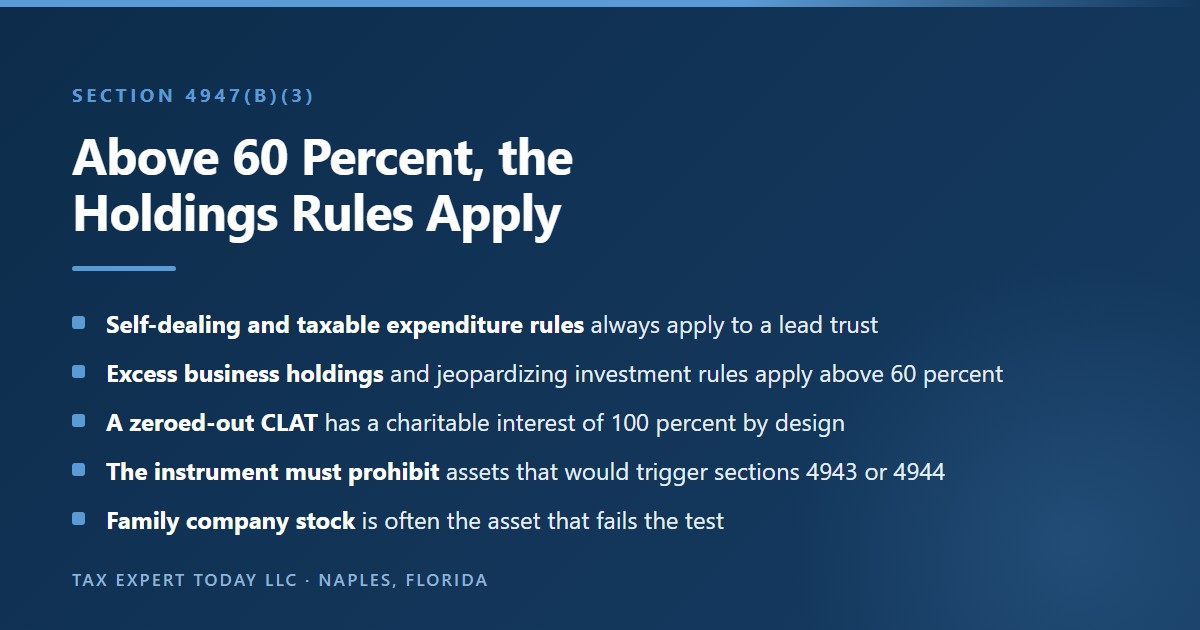
A charitable lead trust is a split-interest trust under section 4947(a)(2), so the private foundation rules on self-dealing and taxable expenditures apply as if it were a private foundation. The rules on excess business holdings and jeopardizing investments also apply, unless the charity’s interest is worth 60 percent or less of the trust.
Section 4947(a)(2) imports section 4941 on self-dealing and section 4945 on taxable expenditures without exception, and imports section 4943 on excess business holdings and section 4944 on jeopardizing investments except as provided in section 4947(b)(3). That exception applies where all the income interest is devoted to charity and the charitable amounts are worth no more than 60 percent of the trust. The IRS annotations to Rev. Proc. 2007-45 add the practical consequence: where the charitable annuity is worth more than 60 percent of the trust, the charitable interest will not be treated as a guaranteed annuity unless the instrument prohibits holding assets that would trigger the tax under sections 4943 or 4944.
| Rule | Applies to a CLT? | What it prohibits in practice |
|---|---|---|
| Self-dealing, section 4941 | Always | Sales, loans, leases, or services between the trust and the donor, family members, or their entities |
| Taxable expenditures, section 4945 | Always | Payments to non-qualifying recipients or for non-charitable purposes |
| Excess business holdings, section 4943 | When the charity’s interest exceeds 60 percent | Holding more than the permitted share of a business owned with disqualified persons |
| Jeopardizing investments, section 4944 | When the charity’s interest exceeds 60 percent | Investments that show a lack of ordinary business care and prudence |
The 60 percent line is where the current rate environment bites a second time. A zeroed-out CLAT has a charitable interest equal to 100 percent of the trust by design, so it is always above the line, and the instrument must carry the section 4943 and 4944 prohibitions.
Can a charitable lead trust hold a family business?
Often not in the form a family would want. A zeroed-out CLAT is always above the 60 percent line, so the excess business holdings rules apply, and the trust generally cannot keep a large stake in a company that the family also owns. Closely held stock usually needs a smaller charitable interest, a sale, or a different vehicle.
This is one of the most common reasons a charitable lead trust is designed and then abandoned. The appeal of funding a lead trust with shares of a family company is obvious: a closely held interest may be valued at a discount and may grow quickly. But the excess business holdings rules of section 4943 treat the trust like a private foundation, whose permitted holdings in a business are measured together with those of disqualified persons, a group that includes the donor and the donor’s family. A company that the family already controls leaves little or no room.
- Stay under 60 percent. A charitable interest worth 60 percent or less of the trust takes the trust outside sections 4943 and 4944 under section 4947(b)(3), at the cost of a larger taxable gift.
- Sell first. Funding with proceeds rather than the shares avoids the holdings problem entirely.
- Consider a unitrust. The same 60 percent test applies, but the unitrust gift is less rate driven.
- Watch self-dealing. Redemptions, leases, and management agreements with the family company are all potential acts of self-dealing.
Owners approaching a liquidity event may find it useful to read our guide to selling a business alongside this article, because the order of the sale and the trust funding changes the result.
Can the lead beneficiary be the family’s private foundation or a donor advised fund?
It can, but each choice carries a cost. Naming the donor’s own private foundation can pull the trust back into the donor’s estate if the donor keeps influence over the foundation’s grants. A donor advised fund is a public charity for most purposes, but the income tax deduction is still limited, and the donor must not receive any benefit.
The IRS annotations to Rev. Proc. 2007-45 warn that where the charitable beneficiary is a private foundation and the donor is an officer or director of it, or holds certain decision making authority, some or all of the trust property may be included in the donor’s gross estate under section 2036(a)(2). The usual response is to wall the donor off from decisions about the lead trust’s grants through foundation governance documents. For income tax, a grantor lead trust funded with appreciated property for the use of a private foundation may also be limited to the donor’s basis, other than for qualified appreciated stock, under section 170(e)(1)(B)(ii). Readers weighing a donor advised fund as the lead recipient may find our article on the donor advised fund tax deduction useful for the 2026 limits that apply to the fund itself.
How long can a charitable lead trust last, and whose life can measure it?
A charitable lead trust can run for any fixed number of years, or for the life of the donor, the donor’s spouse, or a lineal ancestor or spouse of a lineal ancestor of all the remainder beneficiaries. Those individuals must be living on the date of the gift. There is no minimum or maximum term in the regulations.
Treas. Reg. 25.2522(c)-3(c)(2)(vi)(a) limits measuring lives to that short list, and adds a probability test: the requirement that the noncharitable remainder beneficiaries be lineal descendants of the measuring life is met if there is less than a 15 percent probability that someone else will receive trust corpus. The rule was adopted to stop the use of unrelated, seriously ill measuring lives, a technique known as the vulture or ghoul CLAT. A term of years is by far the most common choice because it produces a predictable result and removes mortality from the valuation.
| Term | Zero out payout at 5.2 percent | Years of growth the family needs to capture the spread |
|---|---|---|
| 10 years | 13.1 percent a year | Short: less time for returns to compound above the rate |
| 15 years | 9.8 percent a year | Moderate |
| 20 years | 8.2 percent a year | Long: more time for the spread to compound, more exposure to a bad sequence |
Hypothetical illustration, payments at the end of each year.
Why is a charitable lead annuity trust a poor vehicle for grandchildren?
Because the generation skipping exemption cannot be locked in at funding. Section 2642(e) measures a CLAT’s inclusion ratio only when the annuity ends, by growing the allocated exemption at the Section 7520 rate and comparing it with the trust’s value then. If the assets outperform, part of the remainder is exposed to generation skipping tax.
This is the feature that most often surprises families. For most trusts, allocating exemption equal to the value of the gift on the funding date shelters all future growth. Section 2642(e) takes that away from a charitable lead annuity trust. The numerator of the applicable fraction is the exemption allocated, increased by interest at the rate used to value the charitable deduction for the actual length of the annuity. The denominator is the value of the trust immediately after the annuity ends. Any growth above the Section 7520 rate, which is the very growth the CLAT exists to capture, is exactly what the adjusted exemption fails to cover.
| Constant annual return | Remainder at the end of the term | Adjusted exemption at the end | Inclusion ratio | Generation skipping tax at 40 percent |
|---|---|---|---|---|
| 4.0 percent | $2,022,192 | $3,649,057 | 0.000 | $0 |
| 7.0 percent | $7,049,775 | $3,649,057 | 0.482 | $1,360,287 |
| 9.0 percent | $12,674,018 | $3,649,057 | 0.712 | $3,609,984 |
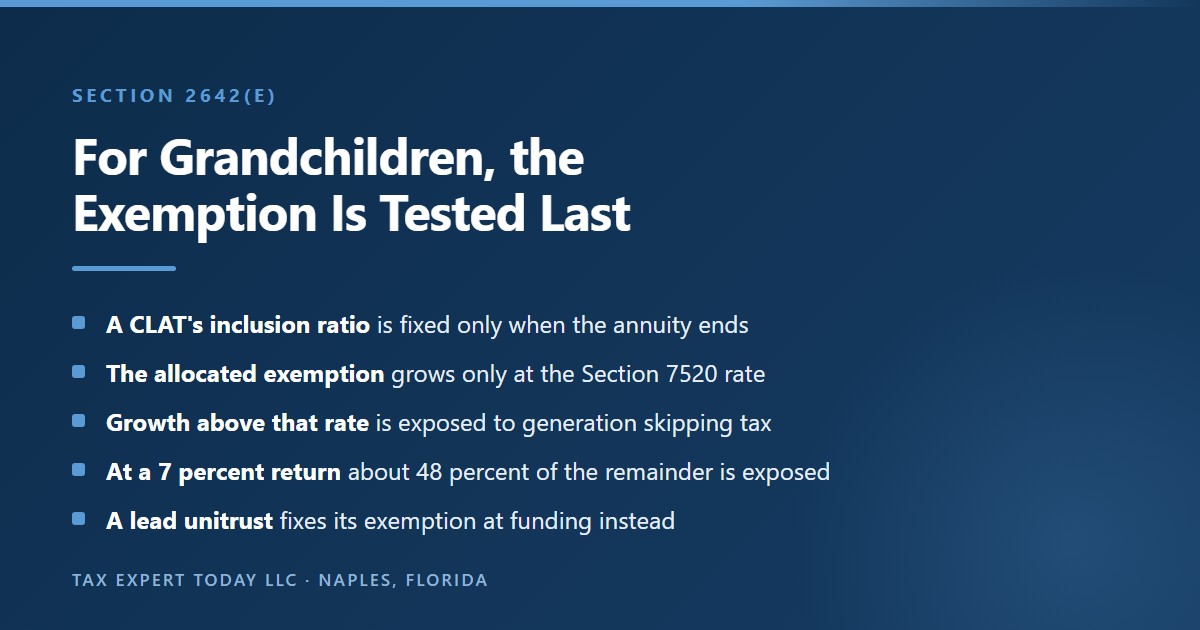
Hypothetical illustration: $5,000,000 CLAT for grandchildren, $300,000 a year for 20 years, valued at 5.2 percent, with exemption of $1,323,933 allocated to match the taxable gift. The better the trust performs, the larger the share exposed. A charitable lead unitrust is not subject to section 2642(e), so its exemption is allocated and fixed at funding in the ordinary way. For a remainder meant for grandchildren, that difference usually decides the form. The GST exemption for 2026 is $15,000,000 under Rev. Proc. 2025-32.
What are the disadvantages of a charitable lead trust?
The main disadvantages are irrevocability, sensitivity to the Section 7520 rate, the risk that weak returns leave the family nothing, the private foundation restrictions, the lost basis step-up on assets that pass during life, recapture risk in a grantor trust, and annual trust returns for the whole term. At current rates, the wealth transfer case is weaker than it was.
None of these is a reason to rule the structure out. Each is a reason to test it against the alternatives before signing. The list below groups them by who bears the cost.
| Disadvantage | Who bears it | How it is usually managed |
|---|---|---|
| Irrevocable once funded | The donor | Fund only assets the donor will not need; choose a term that matches the goal |
| High 7520 rate raises the gift and the hurdle | The family | Elect the lowest of the three available months; consider a unitrust |
| Underperformance leaves nothing | The family | Diversified assets; avoid back-loading where returns are uncertain |
| Self-dealing and holdings rules | The donor and family | Keep family transactions out of the trust; avoid concentrated family stock |
| No basis step-up on the remainder | The family | Fund with high basis or cash; weigh against the estate tax saved |
| Recapture on early death | The donor’s estate | Use a non-grantor trust where mortality is a concern |
| Generation skipping exposure in a CLAT | Grandchildren | Use a unitrust for skip persons |
| Annual Form 5227 and trustee duties | The trustee | Budget for administration for the full term |
The basis point deserves emphasis because it is easy to overlook. Assets that pass to the family through a lifetime charitable lead trust carry the trust’s basis, not a new basis at death under section 1014. With a $15,000,000 basic exclusion now permanent, many families will owe no estate tax at all, and for them the lost step-up can outweigh the transfer tax the trust was meant to save. Our article on the lifetime gift tax exemption in 2026 works through that trade in more detail.
How does a charitable lead trust compare with a GRAT, a charitable remainder trust, and a donor advised fund?
A GRAT pays the annuity back to the donor instead of to charity, so it moves growth to family with no charitable gift. A charitable remainder trust gives the donor income and the charity the rest. A donor advised fund is a simple current gift. The charitable lead trust is the only one that pays charity first and family second.
The comparison matters because a family considering a charitable lead trust is usually choosing among these structures, and the right answer depends on whether the charitable gift is a goal in its own right or a means to reduce transfer tax. Where the charity is incidental, a grantor retained annuity trust generally transfers the same above-hurdle growth without giving the annuity away.
| Question | Charitable lead trust | GRAT | Charitable remainder trust | Donor advised fund |
|---|---|---|---|---|
| Who receives the annual payments | Charity | The donor | The donor or family | No annual payments |
| Who receives what is left | Family | Family | Charity | Charity, as advised |
| Effect of a high 7520 rate | Hurts | Hurts | Generally helps | None |
| Income tax deduction | Only in grantor form, limited to 30 or 20 percent | None | Yes, for the remainder | Yes, at the time of the gift |
| Mortality risk | Recapture in grantor form | Estate inclusion if the donor dies in the term | Depends on the payout term | None |
| Private foundation rules | Yes, through section 4947(a)(2) | No | Yes, through section 4947(a)(2) | Sponsor rules instead |
| Best suited to | A donor who wants to fund charity and pass growth to family | A donor who wants to pass growth to family | A donor who wants income and deferral on a sale | A donor who wants a simple current gift |
Our article on the qualified personal residence trust completes the Section 7520 picture for the family home, and a donor who is over age 70 and a half and wants to give from an IRA may find a qualified charitable distribution simpler than any trust.
Does a charitable lead trust still make sense with a $15,000,000 exclusion?
For fewer families than before. With the basic exclusion permanently set at $15,000,000 per person for 2026 and indexed after that, a married couple can pass $30,000,000 without transfer tax. Below that level the charitable lead trust is mainly a charitable tool, and the basis and administration costs weigh more heavily against it.
P.L. 119-21 amended section 2010(c)(3) to set the basic exclusion at $15,000,000 for 2026, with inflation adjustments for later years, and removed the scheduled reduction that drove much of the lead trust planning written between 2022 and 2025. Rev. Proc. 2025-32 confirms the $15,000,000 exclusion and the matching generation skipping exemption for 2026. For a family with an estate well above those amounts, the structure remains a legitimate way to move growth at a reduced gift value. For a family comfortably below them, the honest questions are different.
- Would the donor make these charitable gifts anyway? If yes, the trust can wrap an existing plan in a tax efficient structure.
- Is estate tax a realistic exposure? If not, the transfer tax saving may be small or zero.
- Is there a large income year? A grantor trust can concentrate a deduction into it, within the 30 percent ceiling.
- Is basis step-up worth more? For appreciated assets in a nontaxable estate, often yes.
What must a charitable lead trust file each year?
Every charitable lead trust files Form 5227, the split-interest trust information return, for each year of its term, due April 15 for a calendar year trust. A non-grantor trust also files Form 1041. An inter vivos trust requires a Form 709 gift tax return for the year it is funded, even when the gift is zeroed out.
The Form 5227 instructions state that all trusts, such as charitable lead trusts, that meet the definition of a split-interest trust under section 4947(a)(2) must file, and that for calendar year 2025 the return was due April 15, 2026, with an automatic extension available on Form 8868. The Form 709 for the funding year reports the transfer, the charitable deduction under section 2522, the election of an earlier month’s Section 7520 rate if one is made, and any generation skipping allocation.
| Return | Who files | When |
|---|---|---|
| Form 709 | The donor, for an inter vivos trust | April 15 of the year after funding |
| Form 5227 | The trust, grantor and non-grantor alike | April 15 each year of the term |
| Form 1041 | A non-grantor trust | April 15 each year of the term |
| Form 706 | The estate, for a testamentary trust | Nine months after death, claiming the deduction under section 2055 |
Charitable Lead Trust Help in Naples & Southwest Florida
Charitable lead trust help Naples families ask for usually begins with one question: does the math still work at today’s rate? Our office in Naples, Florida models the annuity, the unitrust, and the alternatives side by side, with the current and prior month rates, before any trust is drafted.
Southwest Florida has an unusually high concentration of families who are both charitably active and concerned with transfer planning, and many arrive here from states with their own estate taxes. Florida imposes no state estate tax and no personal income tax, which simplifies part of the analysis: a Florida resident’s grantor trust income is taxed only federally, and a Florida non-grantor trust generally owes no state income tax. The federal questions remain, and they are the ones covered above. Families relocating may also want to review our guide to Florida estate planning and the rules on trust situs after moving to Florida.
- Rate election modeling. Comparing the current month with the two prior months before funding.
- Annuity versus unitrust analysis. Including the generation skipping result for grandchildren.
- Grantor versus non-grantor review. Matching the deduction to an actual high income year.
- Private foundation rule screening. Testing proposed assets against self-dealing and the 60 percent line.
- Form 5227 and Form 1041 preparation. For every year of the term.
Tax Expert Today LLC
11983 Tamiami Trail N, Naples FL 34110
Phone: (239) 441-2005
Hours: Monday to Friday, 10:00 to 5:00 ET
Does a charitable lead trust work differently for a Naples resident because Florida has no estate tax? The federal rules are identical, but the reason to plan can differ. A resident of a state with its own estate tax may save state tax as well as federal tax through a lead trust. A Florida resident saves only federal transfer tax, which with a $15,000,000 exclusion applies only to larger estates. For a Naples family below that level, the lead trust is best viewed as a structured way to fund charitable goals, with any transfer tax saving as a secondary benefit.
When to Engage a Professional
Any charitable lead trust should be designed with professional help, because it is irrevocable, it is valued once at funding, and it is governed by private foundation rules for its whole life. The situations below are ones in which an error is especially difficult to correct afterward, and should be reviewed before anything is signed.
- Funding in a rising rate month. The election of an earlier month has to be made on the gift tax return.
- Closely held business interests. The excess business holdings and self-dealing rules can defeat the plan.
- Grandchildren as remainder beneficiaries. The annuity form exposes growth to generation skipping tax.
- A family private foundation as the lead charity. Governance must be arranged to avoid estate inclusion.
- A grantor trust for an older donor. Recapture on death can reverse much of the deduction.
- Back-loaded payments. The design should be tested against weak return sequences.
- An estate below the exclusion. The lost basis step-up may outweigh the transfer tax saved.
Tax Expert Today LLC is a multidisciplinary practice of tax advisors, enrolled agents, certified public accountants, and attorneys serving clients in all 50 states. To discuss how a charitable lead trust fits within a broader Naples tax planning approach, our tax planning services, or our estate and trust planning work, call (239) 441-2005. Readers comparing split-interest trusts may also find our article on net unrealized appreciation useful where employer stock is the asset being considered.
This article is general information about federal and Florida tax provisions and is not tax advice for any specific taxpayer. Figures were verified against primary sources on September 22, 2026 and are subject to change. Every illustration is hypothetical and outcomes depend entirely on individual facts. Consult a qualified professional before acting.
Published September 22, 2026 by Dr. Pellumb Kabashi « Back to Learning Center
Have a question this article touches on?
Tax Expert Today LLC, based in Naples, Florida and serving clients across the United States.
Schedule a Consultation (239) 441-2005