
By Dr. Pellumb Kabashi, DBA, MBA, CES, CFE, EA
Founder, Tax Expert Today LLC · Tax advisors, enrolled agents, CPAs, and attorneys · Serving clients in all 50 states
Quick answer: The New Jersey inheritance tax nonresident rules reach only real property and tangible personal property located in New Jersey. Intangible assets such as bank accounts, brokerage holdings and cooperative apartment shares stay exempt no matter how large they are. What is owed depends on who inherits rather than on the size of the estate, and Class A beneficiaries owe nothing at all. Call (239) 441-2005 for a free consultation.
Published: September 2026
What Are the New Jersey Inheritance Tax Nonresident Rules?
The New Jersey inheritance tax nonresident rules impose a transfer tax on property passing at death, but for a decedent who lived elsewhere the tax reaches only real property and tangible personal property physically located in New Jersey. N.J.S.A. 54:34-1(b) is the operative subsection. Intangible personal property is outside the tax entirely for a nonresident, and the rate turns on the beneficiary relationship rather than on the size of the estate.
- It is an inheritance tax, not an estate tax. The question is who receives the property, not how much the decedent owned.
- Situs decides exposure. For a nonresident decedent, only New Jersey real estate and tangible items sitting in New Jersey are taxable.
- There is no size threshold. The statute applies to transfers of $500.00 or more, so a modest shore condominium can produce a filing obligation.
- Class A beneficiaries pay nothing. Spouses, parents, children, grandchildren and stepchildren are exempt regardless of value.
- The problem is often the waiver, not the tax. Even an untaxed estate frequently needs a release before the property can be conveyed.
This is the piece of a Florida relocation that surfaces years after the move is complete. Someone establishes domicile in Naples, files a Florida declaration of domicile, stops filing New Jersey resident returns, and keeps the house at the shore or a condominium near the grandchildren. New Jersey has no further claim on the income. It retains a claim on that specific real estate at death, and the family usually discovers it when a title company declines to close without a waiver.
If the departure itself is still ahead of you, the income tax side of a New Jersey sale is a separate mechanism with its own forms and its own timing, covered in our guide to the New Jersey exit tax. This article deals with what happens when the property is still owned at death.
Does Moving to Florida End New Jersey Inheritance Tax?
Moving to Florida ends New Jersey inheritance tax on everything except New Jersey real estate and tangible property left inside the state. Domicile changes what New Jersey may reach, and it removes the entire intangible estate from the calculation, but it does not release land. Selling or restructuring the New Jersey property is what ends that exposure, not the move itself.
- Domicile controls the scope. A New Jersey resident is taxed on real and tangible property in the state plus intangible property wherever it sits.
- A nonresident loses the intangible exposure. Brokerage accounts, bank deposits, bonds and mortgages drop out of the taxable base completely.
- Real estate stays. Situs is fixed by geography, and no residency filing changes it.
- Florida adds nothing. Florida imposes neither an inheritance tax nor an estate tax, so there is no second layer and no credit to coordinate.
The difference is large in practice. A New Jersey domiciliary holding a $6 million portfolio and a $700,000 house runs the entire $6.7 million through the inheritance tax computation. The same person domiciled in Florida runs only the $700,000 house through it. That is one of the strongest arguments for completing a domicile change properly rather than approximately, and it sits alongside the income tax argument that usually drives the decision in the first place.
It also raises the standard of proof. A residency challenge after death is harder to answer than one raised during life, because the person who could explain the pattern of living is gone. The evidence file described in our guide to establishing Florida residency and the day counting discipline behind the Florida 183 day rule calculator serve the estate as much as they serve the living taxpayer. Where a state has already opened a look at the move, our guide to defending a Florida residency audit walks through what that record needs to contain, and the same evidentiary habits carry over to a dual state residency situation where two states each assert a claim.
Which New Jersey Assets Are Taxed and Which Are Not?
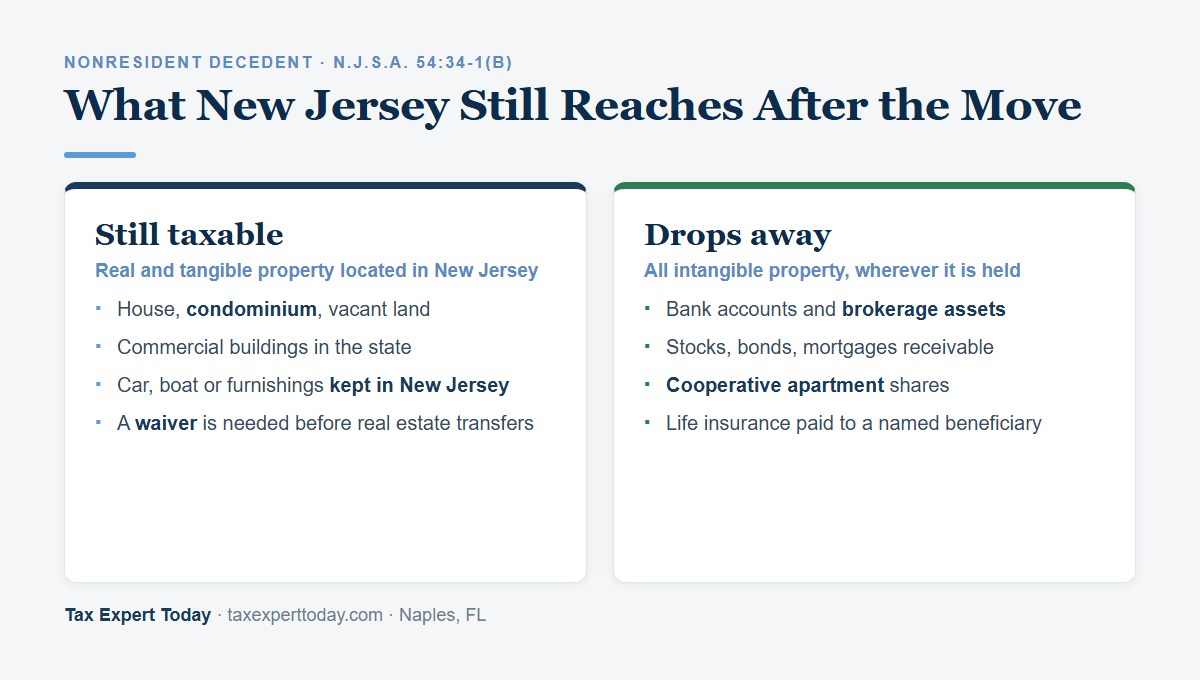
For a nonresident decedent New Jersey taxes real property located in New Jersey and tangible personal property located in New Jersey. Everything intangible is exempt, wherever it is held. The IT-NR instructions state that a membership certificate or stock in a cooperative housing corporation is intangible personal property, so a cooperative apartment is neither taxed nor subject to a waiver, while a condominium is real property and is both.
- Taxable: a house, condominium, land or commercial building, and tangible items such as a car, a boat or furnishings kept in New Jersey.
- Not taxable: bank accounts at a New Jersey branch, stock in New Jersey companies, bonds, mortgages receivable, and interests in business entities.
- Cooperative apartments: treated as intangible personal property under the Division instructions, which places them outside the nonresident tax and outside the waiver requirement.
- Life insurance: proceeds payable to named beneficiaries other than the estate are exempt under N.J.S.A. 54:34-4, for residents and nonresidents alike.
| Asset held by a Florida domiciliary | Subject to New Jersey inheritance tax? | Waiver needed to transfer? |
|---|---|---|
| House or condominium in New Jersey | Yes, unless a listed exemption applies | Yes, unless held as tenants by the entirety |
| Cooperative apartment shares in New Jersey | No, treated as intangible property | No |
| Vacant land in New Jersey | Yes | Yes |
| Car, boat or furnishings kept in New Jersey | Yes, as tangible personal property | No, but the item must be reported on the return |
| Bank account at a New Jersey branch | No | No |
| Stock, bonds and brokerage assets | No | No |
| Interest in an LLC or partnership | Generally no, as an intangible interest | No |
| Life insurance paid to a named beneficiary | No, exempt by statute | No |
| Real estate held as tenants by the entirety, passing to the surviving spouse | No | No, and no forms are required |
The intangible exemption is why the entity question comes up so often. Because an interest in a limited liability company is an intangible interest rather than land, families ask whether contributing the shore house to an entity converts a taxable asset into an exempt one. The mechanism is real and it is used, but it is not free. It carries transfer, income tax, basis, insurance and creditor consequences of its own, the entity has to be respected in substance rather than existing only on paper, and the three year rule discussed further below can pull a transfer made too close to death back into the estate. This is a step to consider with counsel well in advance, not a filing season adjustment.
How Much Is the Tax, and Who Actually Pays It?
New Jersey sets the rate by beneficiary class rather than by estate size. Class A and Class E beneficiaries are entirely exempt. Class C beneficiaries take a $25,000 exemption and then pay 11 percent through 16 percent in bands. Class D beneficiaries, meaning everyone not named in another class, pay 15 percent on the first $700,000 and 16 percent above that, with no exemption at all. Where the beneficiary happens to live changes none of this, and a beneficiary who lives in California can find the same question answered from the heir side in our guide to the California inheritance tax.
- Class A: spouse, civil union partner, registered domestic partner, parent, grandparent, child, adopted child, the issue of a child, and a stepchild. Exempt.
- Class C: brother or sister, including a half sibling, and the spouse or surviving spouse of a child of the decedent.
- Class D: every other beneficiary, which in practice means nieces, nephews, cousins, friends, and unmarried partners who never registered.
- Class E: New Jersey and its subdivisions, and qualifying charitable, religious, educational and similar organizations. Exempt.
| Class | Who is included | Rate applied to the New Jersey share |
|---|---|---|
| A | Spouse, civil union partner, registered domestic partner, parent, grandparent, child, adopted child, issue of a child, stepchild | No tax |
| C | Brother, sister, half sibling, son-in-law, daughter-in-law | First $25,000 exempt; next $1,075,000 at 11%; next $300,000 at 13%; next $300,000 at 14%; over $1,700,000 at 16% |
| D | Everyone not in Class A, C or E | First $700,000 at 15%; over $700,000 at 16% |
| E | New Jersey and its subdivisions, and qualifying charities and institutions | No tax |
Two boundaries inside those definitions catch families who assume the classes track ordinary usage of the word family.
The first is the stepchild line. A stepchild of the decedent is Class A. A step-grandchild is not, and the IT-NR instructions say so in the class definition itself. A blended family that leaves the shore house to the children of a spouse from an earlier marriage sits in Class A, while the same house left one generation further down that same branch lands in Class D at 15 percent. Nothing about the relationship feels different to the family. The statute treats the two transfers very differently.
The second is the unmarried partner. A civil union partner from February 19, 2007 forward and a registered domestic partner from July 10, 2004 forward are Class A. A long term partner who never registered is Class D, and the first $700,000 is taxed at 15 percent with no exemption. For a couple who moved to Naples together and kept a property in New Jersey, that distinction is worth confirming rather than assuming, and it is one reason the beneficiary review in our guide to Florida estate planning for new residents matters after a move.
Which of the Four Filing Methods Should the Estate Elect?
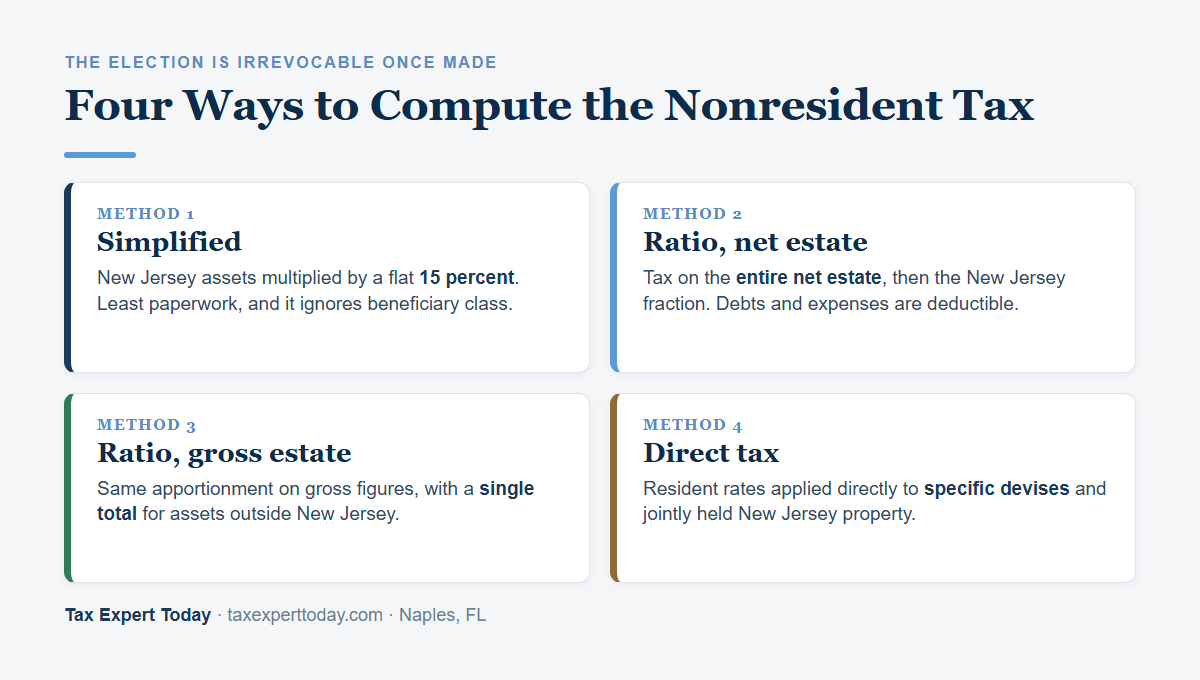
The IT-NR instructions give a nonresident estate four methods for computing the tax, and the election is irrevocable once made. Method 1 applies a flat 15 percent to the New Jersey assets. Methods 2 and 3 compute a hypothetical resident tax on the whole estate and then apportion it. Method 4 taxes specific devises directly. The simplest method is frequently not the cheapest.
- Method 1, simplified computation: multiply the total New Jersey assets by 15 percent. Least paperwork, and it ignores beneficiary class entirely.
- Method 2, ratio tax using net estate: report every asset everywhere, deduct qualified debts and expenses, compute the tax on the whole net estate, then apply the New Jersey fraction.
- Method 3, ratio tax using gross estate: the same apportionment idea using gross figures and a single total for assets outside New Jersey. Less disclosure than Method 2.
- Method 4, direct tax: tax specific devises and jointly owned New Jersey property directly at resident rates, in combination with a ratio computation for the rest.
| Method | How the tax is computed | Disclosure required | Usually favors |
|---|---|---|---|
| 1. Simplified | New Jersey assets multiplied by a flat 15 percent | Only the New Jersey schedule | Estates whose New Jersey beneficiaries are Class D, where 15 percent is the rate anyway |
| 2. Ratio, net estate | Tax on the entire net estate, multiplied by the New Jersey fraction | All assets everywhere, plus debts and expenses on Schedules A through F | Estates with meaningful debts, administration expenses and commissions |
| 3. Ratio, gross estate | Tax on the entire gross estate, multiplied by the gross New Jersey fraction | A single total for assets outside New Jersey | Class C beneficiaries, and estates wanting less disclosure than Method 2 |
| 4. Direct tax | Resident rates applied directly to specific devises and jointly held New Jersey property, combined with a ratio computation | Full schedules | Estates where the New Jersey property is left to a specific person rather than passing through the residue |
The election matters most when the New Jersey beneficiary is Class C. Consider a purely hypothetical estate in which a Florida domiciliary leaves a New Jersey house worth $600,000 to a sister and holds $2.4 million of intangible assets that New Jersey cannot tax. Under Method 1 the computation is mechanical: $600,000 multiplied by 15 percent. Under a ratio method the tax on the whole estate is computed using the Class C schedule, which exempts the first $25,000 and then applies 11 percent, and only the New Jersey fraction of that result is due. The Class C rate is well below 15 percent through the first $1,075,000, so the ratio route generally produces the lower figure. Method 1 asks for the least paperwork and quietly discards the benefit of the sister being Class C rather than Class D.
The reverse can also be true. Where the New Jersey property passes to a niece or a friend, Class D applies at 15 percent regardless, the ratio methods add work without adding benefit, and Method 1 becomes the sensible answer. The point is that this is a decision with a right answer for a given set of facts, it is made once, and it cannot be revisited. Estates that reach for the shortest form without running the alternative are choosing without comparing.
How Does the Ratio Formula Pull Florida Assets Into the Math?
New Jersey does not tax a nonresident decedent on assets outside the state, but the ratio methods use those assets in the formula. The Division computes a hypothetical resident tax on the entire estate wherever located, then multiplies it by a fraction whose numerator is the New Jersey property and whose denominator is the whole estate. Florida assets are untaxed and still shape the result.
- Untaxed is not the same as invisible. The IT-NR instructions state that items outside New Jersey are not taxed but are used in the formula computing the nonresident tax.
- The numerator is the New Jersey real and tangible property. The denominator is the entire estate on the same measure, net or gross depending on the method.
- The ratio cannot exceed 100 percent. The worksheets cap it.
- The effect can cut either way. A large exempt estate raises the graduated resident tax but also enlarges the denominator, which is why the methods need to be compared rather than assumed.
This is the same structural idea that governs a nonresident income tax return after a move, where a state computes a base tax as though the filer were a full year resident and then apportions it. We describe that mechanism in detail in our guide to the nonresident state tax return. Recognizing the pattern is useful, because the instinct that out of state assets are simply irrelevant is wrong in both settings. They are excluded from the tax base and included in the arithmetic.
It also means the estate has to assemble a full picture of the Florida holdings in order to file the New Jersey return under a ratio method, which surprises executors who expected to report only the shore house. Method 3 exists precisely to soften that: it accepts a single total for everything outside New Jersey rather than a schedule by schedule listing.
When Is No New Jersey Return Required at All?
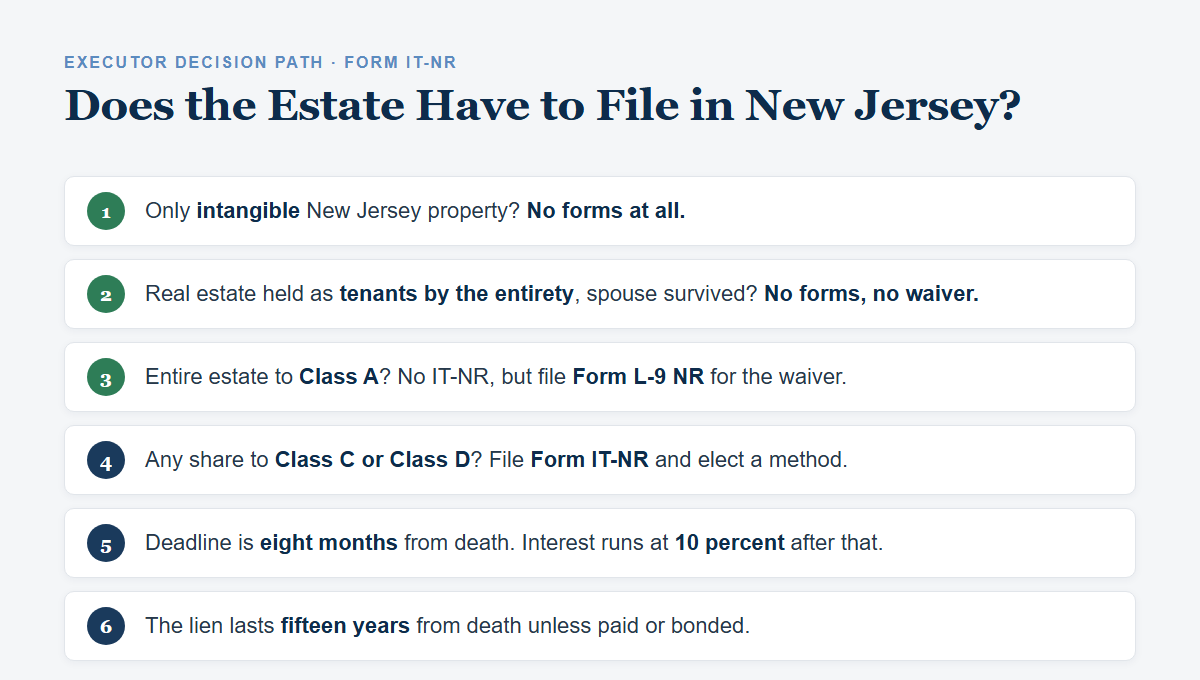
The IT-NR instructions identify three situations in which a nonresident decedent estate files nothing. If the only New Jersey property was intangible, no forms are required. If the only New Jersey real estate was held as tenants by the entirety and the spouse or civil union partner survived, no forms are required and no waiver is issued. If the entire estate passes to Class A beneficiaries, the return is unnecessary, although Form L-9 NR is still filed to release the real estate.
- Intangible property only: New Jersey bank accounts and stock, with no real estate and no tangible property in the state, produce no tax and no filing.
- Tenants by the entirety: for dates of death after February 18, 2007, real estate passing to the surviving spouse or civil union partner is not taxed and needs no waiver.
- All Class A beneficiaries: no IT-NR is due, but the title company will still want the lien released, which is what Form L-9 NR does.
- Under the statutory floor: N.J.S.A. 54:34-1 applies to transfers valued at $500.00 or more.
That third situation is the one that produces the most confusion, because no tax is owed and yet a filing is still needed. New Jersey places a lien on the decedent property, and the lien does not lift on its own merely because the beneficiaries happen to be exempt. Form L-9 NR is an affidavit requesting the real property waiver for a nonresident decedent, and it is the shorter path to a clean title than filing a full return the estate does not otherwise owe. Executors who skip it usually learn about it from the closing attorney at the worst possible moment, when a buyer is waiting.
Note as well that the Division does not accept electronic filing for inheritance and estate tax returns. These are paper filings sent to the Trenton office, which is a real scheduling consideration when an eight month deadline is approaching and the estate is being administered from Southwest Florida.
Can Gifting the New Jersey House Before Death Remove It?
Not reliably, and not close to death. N.J.S.A. 54:34-1(c) reaches transfers made in contemplation of death, and it presumes that a transfer of a material part of the estate made without adequate valuable consideration within three years before death was made in contemplation of death, absent proof to the contrary. The subsection applies expressly to the New Jersey real and tangible property of a nonresident.
- The three year window is a presumption, not a bar. The statute allows proof to the contrary, so the fact pattern and the contemporaneous reasons matter.
- Transfers before the three year period are protected. The statute states that no transfer made before that period shall be deemed to have been made in contemplation of death.
- Adequate consideration takes it outside the rule. The presumption is aimed at gratuitous transfers of a material part of the estate.
- Retained enjoyment is a separate trap. A transfer intended to take effect in possession or enjoyment at or after death is taxable under the same subsection regardless of timing.
That last point deserves emphasis, because it is the one that defeats the informal arrangement families reach for most often. Deeding the shore house to the children while continuing to use it every summer, without rent and without a genuine transfer of control, is the classic transfer intended to take effect in enjoyment at death. The deed date does not resolve it. New Jersey looks at what actually changed.
The practical reading is that lifetime planning around this tax works when it is early, documented and real, and fails when it is late and cosmetic. The same discipline applies to the asset protection steps described in our guide to Florida asset protection for new residents, where timing rules likewise reward action taken well before it is needed.
What Are the Deadlines, the Interest, and the Fifteen Year Lien?
The return and the tax are due within eight months after the date of death. Interest accrues at 10 percent per year on any tax not paid within that eight month window. Under N.J.S.A. 54:35-5 the tax remains a lien on all property owned by the decedent at death for fifteen years, and no longer, unless it is paid sooner or secured by an acceptable bond.
- Eight months from death, not from the appointment of the executor and not from probate.
- 10 percent annual interest runs on unpaid tax from the end of that eight month period.
- A fifteen year lien attaches by statute, which is why waivers exist and why title companies ask for them.
- A bond can substitute where the estate needs to convey before the liability is settled.
- Paper filing only. The Division does not offer electronic filing for these returns.
| Item | Rule | Source |
|---|---|---|
| Filing and payment deadline | Eight months after the date of death | NJ Division of Taxation filing requirements |
| Interest on late payment | 10 percent per year on the unpaid amount | NJ Division of Taxation filing requirements |
| Lien duration | Fifteen years from the date of death, unless paid sooner or secured by bond | N.J.S.A. 54:35-5 |
| Statutory floor | Transfers of $500.00 or more | N.J.S.A. 54:34-1 |
| Nonresident return | Form IT-NR | NJ Division of Taxation filing requirements |
| Waiver where no return is due | Form L-9 NR affidavit | Form IT-NR instructions |
| Electronic filing | Not available | NJ Division of Taxation filing requirements |
The fifteen year figure is worth holding onto, because it explains behavior that otherwise looks excessive. A buyer years removed from the death still asks for a waiver, and the reason is that the statutory lien period has not run. It also means an unresolved filing does not quietly disappear. It sits on the title until it is addressed, and the 10 percent interest continues to accrue in the meantime.
Does New Jersey Still Have an Estate Tax?
No. The New Jersey Division of Taxation states that under current law the New Jersey Estate Tax is no longer imposed for individuals who die on or after January 1, 2018. The inheritance tax was not repealed and continues to apply. The IT-NR instructions separately confirm that there is no New Jersey Estate Tax for the estate of a nonresident decedent in any year.
- Two different taxes. The estate tax was based on the size of the estate. The inheritance tax is based on who inherits.
- Only one was repealed. The 2018 repeal removed the estate tax and left the inheritance tax untouched.
- Nonresidents were never in the estate tax. Even before 2018 there was no New Jersey estate tax for a nonresident decedent.
- Federal exposure is separate. The federal estate tax runs on its own thresholds and is unaffected by either New Jersey rule.
This conflation is the single most common error we see on this topic, and it runs in the direction that hurts. Families read that New Jersey repealed its death tax, conclude that nothing is owed, and take no action on a property that still carries a lien and may still generate a Class C or Class D liability. The repeal was real and it was significant. It simply did not touch the tax that reaches a nonresident.
Where the departure state is New York rather than New Jersey, the structure is different again, because New York retains an estate tax with its own threshold and cliff. We cover that comparison in our guides to the New York exit tax and the New York residency audit, and the broader planning picture for a Florida arrival in Florida estate planning for new residents.
New Jersey Inheritance Tax Help in Naples & Southwest Florida
Tax Expert Today LLC works with individuals and families who have relocated to Florida from New Jersey and other high tax states, and with executors administering an estate that still holds New Jersey property. The firm brings together tax advisors, enrolled agents, CPAs and attorneys, and handles residency and multistate tax matters nationwide. New Jersey is one of the largest feeder states into Southwest Florida, so estates that straddle a completed domicile change are familiar ground here.
Our office is located at 11983 Tamiami Trail N, Naples, Florida 34110. You can reach us at (239) 441-2005, Monday through Friday, 10am to 5pm ET. We also work with clients across all 50 states.
- New Jersey inheritance tax help Naples: review of which New Jersey assets are in the base, which beneficiary class applies, and which of the four computation methods to elect before the election becomes irrevocable.
- Estate tax planning Naples FL: coordinating the New Jersey exposure with the wider plan, described further on our estate and trust planning page.
- Florida residency Naples FL: building and preserving the domicile record that decides how much of the estate New Jersey may reach at all.
- Tax planning Naples FL: sequencing a sale, a gift or an entity step against the three year rule, described on our Naples tax planning page.
- Tax resolution Naples: unfiled nonresident years, late filings and state notices, described on our Naples tax resolution page and on our resolution and audit support page.
- Statewide and nationwide: multistate work handled from Naples for clients across Florida and the country.
My mother moved from New Jersey to Naples years ago but kept the house in Ocean County. She left it to my sister and me. What do we actually have to file?
On those facts the two of you are Class A beneficiaries, so no inheritance tax is due on the house regardless of its value, and no IT-NR is required. What is still required is a release of the New Jersey lien before the property can be conveyed, and that is what Form L-9 NR is for. If the house was held with a surviving spouse as tenants by the entirety, even that step falls away and no forms are needed. The answer changes materially if any share passes to someone outside Class A, such as a niece, a step-grandchild or an unmarried partner, because that share moves into Class D at 15 percent and the computation method election then matters.
When to Engage a Professional
Most of what is described here can be handled by an executor working from the Division instructions when the beneficiaries are all Class A and the only asset is a single property. The situations that reward professional help are the ones where a choice is being made rather than a form being completed.
Consider engaging an advisor when any of the following is present: a beneficiary outside Class A is receiving New Jersey property, so the computation method election has a real financial consequence and cannot be revisited later; a lifetime transfer of New Jersey real estate occurred within three years of death, or the decedent continued using property already deeded away; the domicile change itself is not fully documented, which puts the entire intangible estate at risk of being pulled back into the New Jersey base; the eight month deadline is close or has passed and interest is running; or an entity or trust step is being considered before death, where the sequencing against the three year presumption drives whether the plan works.
The firm brings together tax advisors, enrolled agents, CPAs and attorneys and handles residency and multistate tax matters nationwide, including for clients who left New Jersey years ago and are only now dealing with the property they kept. If you are working through a New Jersey estate from Southwest Florida, or planning a move that will leave New Jersey real estate behind, call (239) 441-2005 or use our contact page to arrange a consultation. Outcomes depend on the specific facts, and nothing here is a prediction about any particular estate.
This article is educational and general in nature. It is not legal, tax or accounting advice, and it does not create a professional relationship. State law changes and applies differently to different facts. Please consult a qualified advisor about your own situation.
Published September 2, 2026 by Dr. Pellumb Kabashi « Back to Learning Center
Have a question this article touches on?
Tax Expert Today LLC, based in Naples, Florida and serving clients across the United States.
Schedule a Consultation (239) 441-2005