
By Dr. Pellumb Kabashi, DBA, MBA, CES, CFE, EA
Founder, Tax Expert Today LLC · Tax advisors, enrolled agents, CPAs, and attorneys · Serving clients in all 50 states
Quick Answer
A New York residency audit is a New York State Department of Taxation and Finance examination of whether you were a resident, a nonresident, or a part-year resident for a given year. The Department applies two independent tests, domicile and statutory residency, and requests records covering every year under review. The party asserting a change of domicile carries the burden of proof. Call (239) 441-2005 for a free consultation.
Published: August 2026
What Is a New York Residency Audit?
A New York residency audit is a field examination in which the Department of Taxation and Finance tests whether you correctly reported yourself as a nonresident or a part-year resident. Residency status controls whether New York taxes your worldwide income or only your New York source income, so the status question alone can change the entire liability for a year.
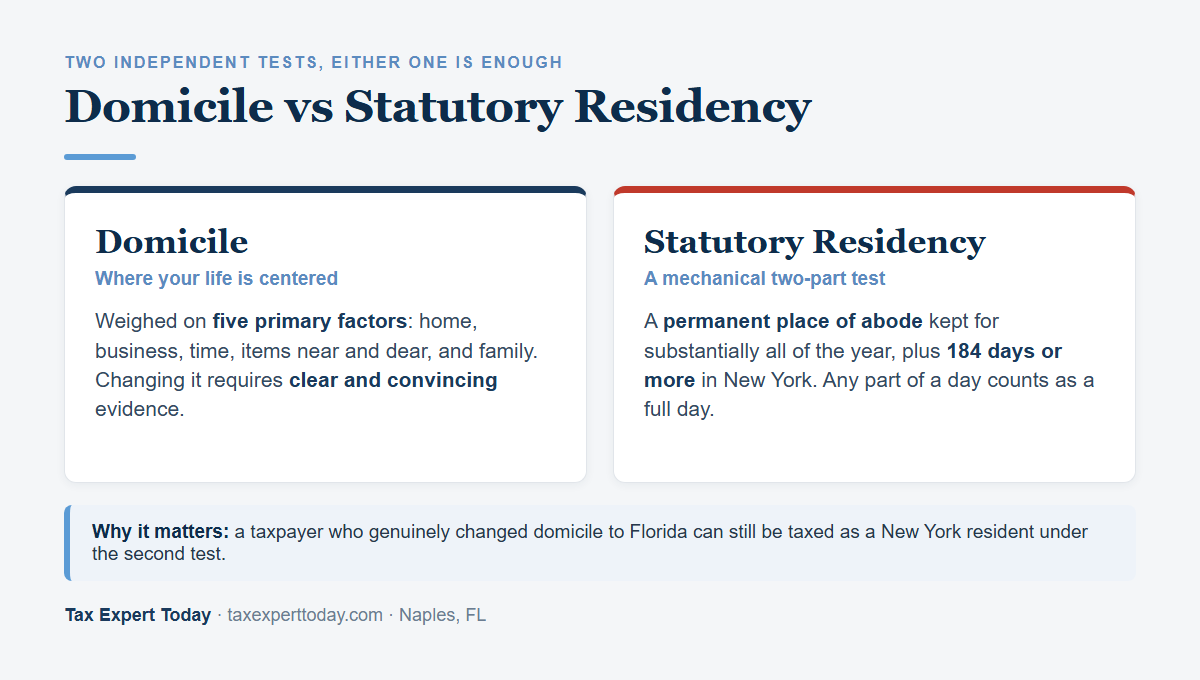
Two separate tests can each make you a New York resident, and they operate independently of one another. Under N.Y. Tax Law §605, you are a resident if New York is your domicile, or if you maintain a permanent place of abode in New York for substantially all of the taxable year and spend enough days in the state. Failing either test produces resident treatment, which is why a taxpayer who genuinely moved can still be assessed under the second test.
- Two independent tests. Domicile and statutory residency are evaluated separately, and satisfying either one is sufficient for resident status.
- Worldwide income at stake. Resident status reaches income earned anywhere, not only income sourced to New York.
- A documentary examination. The Department asks for dated third party records rather than narrative explanations of intent.
- New York City runs in parallel. The same definitions apply to New York City and Yonkers residency, substituting the city for the state.
This guide covers the audit itself. For the broader cost of departing the state, including the accrual rules that pull deferred income onto a final resident return, see our guide to the New York exit tax.
What Triggers a New York Residency Audit?
Most residency audits begin with a visible filing change rather than a random selection. The Department compares filing history across years, and a taxpayer who filed as a full year resident and then filed as a nonresident or part-year resident presents an obvious variance, particularly where income is substantial and New York connections continue.
- A change in filing status. Moving from Form IT-201 as a resident to Form IT-203 as a nonresident or part-year resident is the most common trigger.
- Retained New York property. Keeping an apartment or a house in the state raises the statutory residency question even where domicile genuinely changed.
- Continuing New York income. Wages, partnership income, or closely held business income sourced to New York after the reported departure invites review.
- A large one time event. A business sale, an equity compensation event, or a substantial distribution near the departure date increases the amount at issue.
- Information matching. Wage reporting, information returns, and property records that continue to show New York addresses create inconsistencies with the filed position.
Which Five Primary Factors Does New York Weigh?
The Nonresident Audit Guidelines direct auditors to analyze five primary factors before requesting anything else. Those factors are the home, active business involvement, time, items near and dear, and family connections. Each factor is compared on both sides, weighing the New York ties against the ties in the claimed new location.
The Guidelines are explicit that no single factor decides the question, and that a conclusion reached for one year does not automatically carry to another. Auditors are instructed to request documentation on the secondary factors only after the primary factors establish a basis for New York domicile, or where the primary factors weigh about equally between New York and the other location.
| Primary factor | What the auditor compares | Typical records requested |
|---|---|---|
| Home | The size, value, and use of every residence maintained in each year under audit | Deeds, leases, closing statements, utility usage, insurance policies |
| Active business involvement | Where the taxpayer works and whether a New York trade or closely held business continues | Employment records, partnership agreements, board minutes, calendars |
| Time | The pattern of physical presence in each location across the full year | Travel logs, toll records, card and phone records, flight itineraries |
| Items near and dear | Where items of sentimental value are kept, as evidence of where life is centered | Moving inventories, appraisals, artwork and collection schedules |
| Family connections | Where the immediate family lives, and where minor children attend school | School enrollment, spousal filings, household records |
What Is the 184 Day Statutory Residency Test?
Statutory residency is a mechanical test that applies even when domicile has genuinely changed. You are treated as a resident if you maintain a permanent place of abode in New York for substantially all of the taxable year and spend 184 days or more in the state, which the statute expresses as a count in excess of 183 days.
The Department states the threshold as 184 days or more on its income tax definitions page, and notes that any part of a day counts as a full day for this purpose. That counting convention matters more than the headline number, because a morning flight out of a New York airport consumes a full day of the allowance. Our Florida 183 day rule calculator illustrates how quickly partial days accumulate.
- Any part of a day counts. A brief stop in the state consumes a full day, subject to narrow exceptions described in the Guidelines.
- Domicile is irrelevant here. A taxpayer domiciled in Florida can still be a New York statutory resident.
- Both conditions must be met. Without a permanent place of abode, the day count alone does not create residency.
- Records decide it. Day counts are proved with contemporaneous documents, not with recollection.
Two exceptions can relieve a taxpayer who remains domiciled in New York. Under the Group A test, a domiciliary who maintains no permanent place of abode in New York, maintains one outside the state for the entire year, and spends 30 days or less in New York is not a resident. The Group B test applies to taxpayers abroad for at least 450 days in a 548 consecutive day period, subject to day limits for the taxpayer, the spouse, and minor children.
How Long Must You Maintain a Permanent Place of Abode?
The statute requires that the abode be maintained for substantially all of the taxable year. This is where much published commentary is now out of date, because the Audit Division changed its interpretation. The widely repeated 11 month rule reflects pre 2022 policy and no longer describes how the Department applies the test.
The Nonresident Audit Guidelines state that prior to tax year 2022 the Audit Division defined substantially all of the year as a period exceeding 11 months, and that beginning with tax year 2022 it generally defines that phrase as a period exceeding 10 months. The Guidelines describe this as the 10 month rule and indicate that it is applied in tax years where a taxpayer either acquires or disposes of a residence.
- The threshold moved. Policy shifted from a period exceeding 11 months to a period exceeding 10 months beginning with tax year 2022.
- It targets transition years. The Guidelines apply the 10 month rule where a residence is acquired or disposed of during the year.
- It is policy, not statute. The underlying regulatory phrase in 20 NYCRR 105.20 remains substantially all of the taxable year.
- A shorter window is riskier. Selling a New York residence in February no longer reliably places the year outside the test.
Maintaining an abode also requires more than holding title. In Matter of Gaied, the Court of Appeals addressed a taxpayer who owned a multi-family property where his parents lived, paid the expenses, and stayed there occasionally. The Guidelines treat that decision as requiring a residential interest in the dwelling rather than mere ownership, which is why a property held purely as an investment, or occupied by a relative, is worth analyzing separately.
How Does the Audit Process Actually Work?
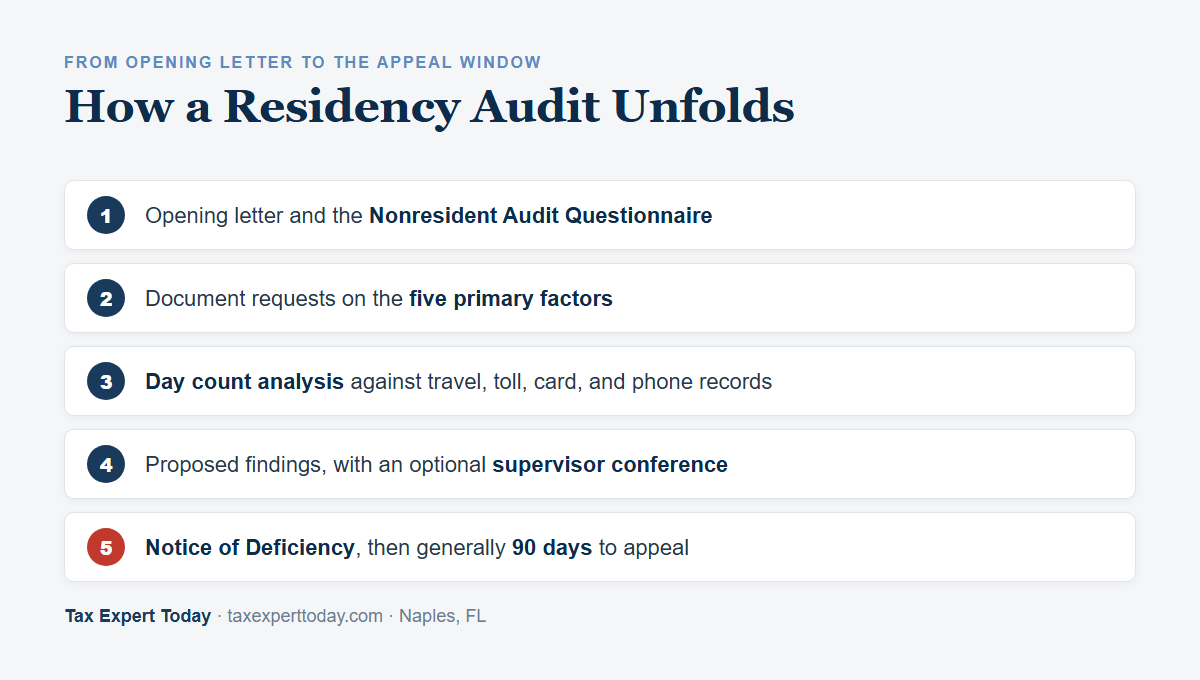
A residency audit proceeds as a field audit rather than as a simple correspondence notice. It opens with a letter and a Nonresident Audit Questionnaire, moves into document requests covering each year at issue, and closes with either an agreed position or a statutory notice that starts an appeal clock.
The questionnaire reproduced in the appendix to the Guidelines asks when the last New York resident return was filed, what specific acts were taken to change status, and where the taxpayer works or carries on business. Answers given at this stage frame the rest of the examination, which is why the response deserves the same care as a filed return.

| Stage | What happens | What governs the timing |
|---|---|---|
| Opening letter and questionnaire | The Department identifies the years at issue and sends the Nonresident Audit Questionnaire | The response deadline stated in the letter |
| Document requests | Records on the primary factors, then the secondary factors if a basis for New York domicile appears | Rolling deadlines set by the auditor |
| Day count analysis | Reconciliation of travel, toll, card, and phone records against the claimed calendar | Availability of contemporaneous records |
| Proposed findings | The auditor issues findings, and a supervisor conference may be requested | Discretionary, per Publication 130-F |
| Statutory notice | A Notice of Deficiency or a Notice of Determination is issued if no agreement is reached | Starts the 90 day appeal window |
How Far Back Can New York Audit Your Residency?
New York generally applies a three year statute of limitations on tax audits, beyond which the Department may not audit without your written consent. That limit carries significant exceptions, and the most important one for a departing taxpayer is the year in which no return was filed at all.
Publication 130-F states that the three year limit does not apply for any period during which you failed to file a return, failed to report federal changes, or filed a false or fraudulent return to evade tax. A taxpayer who moved and simply stopped filing in New York, rather than filing a part-year return for the departure year, may therefore leave that year open indefinitely. Filing the part-year return is what starts the clock.
- Three years is the general rule. Extending beyond it normally requires your written consent.
- No return means no clock. An unfiled departure year does not begin the limitations period.
- Federal changes matter. A failure to report federal adjustments also removes the limit for that period.
- Consent requests are strategic. A request to extend the period is a decision worth evaluating rather than signing automatically.
Who Carries the Burden of Proof in a Residency Audit?
The burden of proving a change of domicile falls on the party asserting the change, and the standard is clear and convincing evidence. For a taxpayer historically domiciled in New York who now claims Florida domicile, that means the taxpayer must support the change, rather than the Department disprove it.
The Guidelines cite Bodfish v. Gallman for the clear and convincing standard, and note that a taxpayer historically domiciled in New York must support the asserted intention with unequivocal acts. The Guidelines also record that the Department bears the burden when it asserts that an individual changed domicile into New York, so the direction of the claim determines who must prove what.
- Clear and convincing is the standard. It sits above the ordinary preponderance standard applied in many civil matters.
- Acts outweigh statements. The Guidelines look for unequivocal acts rather than declarations of intent.
- Silence is not neutral. The absence of documentation tends to resolve against the party carrying the burden.
- Direction matters. The Department carries the burden when it argues that domicile moved into New York.
What Records Should You Keep for a New York Residency Audit?
The records that carry weight are dated, generated by third parties, and created at the time of the events they describe. Reconstructed calendars and personal affidavits are the weakest category of evidence, while records produced by unrelated institutions in the ordinary course are the strongest.
| Category | Records that carry weight | Why the Department values it |
|---|---|---|
| Day count | Toll transponder statements, airline itineraries, card transactions, phone records | Third party generated and contemporaneously dated |
| Home | Closing statements, leases, monthly utility usage, homeowner insurance | Shows relative use of each residence, not only ownership |
| Business | Employment agreements, remote work policies, partnership records, calendars | Establishes where work is actually performed |
| Family and personal | School enrollment, physician and dental records, club memberships | Demonstrates where daily life is centered |
| Florida side proof | Declaration of domicile, homestead application, voter registration, driver license | Dated public filings that establish the new location |
Building that file is far easier before a move than after a notice arrives. Our guide to how to establish Florida residency covers the sequence, and the Florida residency audit guide covers what defending a move looks like generally.
What Happens If New York Disagrees With Your Position?
If the audit closes without agreement, the Department issues a Notice of Deficiency or a Notice of Determination. From that point you generally have 90 days to file an appeal, and you may choose between the Bureau of Conciliation and Mediation Services and the Division of Tax Appeals.
Publication 130-F states that you must generally file within 90 days of the date the notice was issued, and directs you to the notice itself for the applicable time limit. It also states that a written appeal is required even if you previously wrote to the Department objecting to its position, which is a common and costly assumption to get wrong.
- Ninety days is the general window. Confirm the exact limit printed on the notice you received.
- Two forums are available. Conciliation through the Bureau of Conciliation and Mediation Services is less formal, while the Division of Tax Appeals is the adjudicative route.
- Prior correspondence does not count. A formal written appeal is required regardless of earlier objections.
- Penalties and interest accrue. Amounts continue to run while a matter remains open.
Where a New York assessment sits alongside a federal examination or an unpaid balance, the two tracks need to be coordinated rather than handled in isolation. Our IRS resolution and audit support service page describes how that coordination generally works.
How Does a Move to Florida Change the Analysis?
Florida imposes no personal income tax, so the entire dispute concerns whether New York may continue to tax you. Florida contributes the affirmative evidence side of the record, because its public filings are dated, official, and straightforward for an auditor to verify independently.
A declaration of domicile under Fla. Stat. §222.17 is filed with the clerk of the circuit court and creates a dated public record of the intention to maintain a Florida residence. A homestead exemption application, Florida voter registration, and a Florida driver license each add to that file. None of these alone defeats a New York claim, and they carry the most weight when the underlying facts match them. New York has more at stake in these examinations than any other state, sending Florida 43,187 households reporting $5.75 billion of adjusted gross income in 2022-2023, as recorded in our Florida wealth migration report.
- Florida supplies the proof, New York supplies the test. The two ends of the move play different roles in the record.
- Dated filings beat narratives. Clerk stamped and county recorded documents are independently verifiable.
- Consistency is the point. Filings that conflict with actual patterns of use can weaken rather than strengthen a position.
- Real property has its own rule. Nonresidents selling New York real property face estimated tax obligations at closing under N.Y. Tax Law §663.
Snowbirds face the sharpest version of this problem, because keeping a northern residence keeps the statutory residency test alive every year. See our guides to the dual state residency trap and snowbird taxes in year one. Taxpayers leaving California face a structurally similar examination, described in our California residency audit guide.
Which Factors Does New York Ignore in a Domicile Audit?
The Nonresident Audit Guidelines identify a set of items auditors are told to treat as nonfactors. These are not weak evidence, they are excluded evidence, and the Guidelines instruct auditors neither to request documentation about them nor to spend time exploring them.
This matters in both directions. Taxpayers frequently assemble evidence that carries no weight at all, and auditors are not permitted to hold those same items against them. The Guidelines list the nonfactors as including the place of interment, the location where a will is to be probated, passive interests in partnerships or small corporations, the mere location of bank accounts, contributions to political candidates or causes, and the location where the individual income tax return is prepared and filed.
- Bank account location alone counts for nothing. The Guidelines exclude the mere location of accounts, as distinct from where financial life is actually conducted.
- Where the return is prepared is irrelevant. Keeping a longtime New York accountant does not by itself support New York domicile.
- Burial and probate plans are excluded. The place of interment and the expected probate venue are both listed as nonfactors.
- Passive ownership is not active involvement. A passive interest in a partnership or small corporation is treated differently from active business involvement, which is a primary factor.
The strongest example is statutory. New York Tax Law §605 was amended in 1994 to add subsection (c), which prohibits the use of charitable contributions in determining domicile, and extends that prohibition to the volunteering, giving, or donation of uncompensated time. The Department had already taken that position in TSB-M-84(17)I. Under the Guidelines, whether a contribution is tax deductible makes no difference, and a taxpayer who volunteers at a New York church or nonprofit cannot have that service used as evidence of continuing New York ties.
One important distinction survives that rule. Days physically spent in New York in connection with volunteer work are still countable for the statutory residency day count, even though the volunteering itself cannot be weighed in the domicile analysis. The two tests draw on different evidence, and an item excluded from one may still matter to the other.
Is a New York City Residency Audit Different?
New York City residency is a separate determination that can be audited on its own. The state and city apply the same definitions, substituting the city for the state, so a taxpayer can resolve the state question and still face a city assessment, or move within New York and change city status without changing state status.
The Department confirms on its income tax definitions page that the resident, nonresident, and part-year resident definitions apply to New York City and to Yonkers with the city substituted for the state. The Guidelines contemplate exactly this scenario, noting that the residency questionnaire can be modified for cases where New York State residents are audited and the issue is New York City residency only.
- City domicile is its own question. Moving from Manhattan to Westchester can change city domicile while leaving state domicile untouched.
- City statutory residency exists too. The permanent place of abode and day count analysis runs at the city level, as in Matter of Kern.
- Day counting follows the city line. Days are counted against the city boundary rather than the state boundary for that test.
- Two assessments are possible. A single move can generate a state issue and a separate city issue for the same years.
There is a further trap for taxpayers who are found to be New York residents while another state also taxed the same income. A resident credit for taxes paid to other jurisdictions is available under N.Y. Tax Law §620 and 20 NYCRR 120, claimed on Form IT-112-R. The Guidelines state plainly that this credit reduces New York State tax only and may not be claimed against New York City resident tax. A taxpayer who assumes the credit neutralizes an adverse residency finding may find that it does so only at the state level.
Frequently Asked Questions
Does spending fewer than 184 days in New York end the audit risk?
No. The day count addresses only the statutory residency test. A taxpayer who remains domiciled in New York is taxed as a resident regardless of the day count, unless the Group A or Group B exception applies. Domicile and day counting are separate questions, and both need to be addressed.
Can I keep an apartment in New York after moving to Florida?
Yes, but keeping a permanent place of abode preserves one half of the statutory residency test, so the day count then becomes decisive every year. Whether the property qualifies as a permanent place of abode depends on the facts, including the nature of your interest in it, as discussed in Matter of Gaied.
How long does a New York residency audit take?
Residency audits are document intensive and frequently span many months, particularly where several years are open or where day count records must be reconstructed. The duration depends on the number of years at issue, the completeness of the records, and how quickly requests are answered.
Should I answer the Nonresident Audit Questionnaire myself?
The questionnaire is not a routine form. Answers frame the examination and are difficult to walk back later, so reviewing it against your actual records before responding is generally advisable. Whether representation is warranted depends on the amount at issue, the number of open years, and the condition of your records.
New York Residency Audit Help in Naples & Southwest Florida
Tax Expert Today LLC works with individuals and business owners who have relocated from New York to Florida, including clients responding to Department of Taxation and Finance residency examinations. The firm brings together tax advisors, enrolled agents, CPAs, and attorneys, and handles state residency and tax matters nationwide. Southwest Florida is a common destination for New York departures, so the New York to Florida corridor is familiar ground.
Our office is located at 11983 Tamiami Trail N, Naples, Florida 34110. You can reach us at (239) 441-2005, Monday through Friday, 10am to 5pm ET. We also work with clients across all 50 states.
- Residency audit help Naples: review of a New York notice, the questionnaire, and the departure year records before anything is submitted.
- Tax planning Naples FL: forward looking work on domicile evidence, day count tracking, and timing, described on our Naples tax planning page.
- Lee County seasonal residents: households that keep a New York home alongside a Florida one, a pattern covered in our Bonita Springs tax preparation guide.
- Tax resolution Naples: coordination where a state assessment sits alongside a federal balance or examination, described on our Naples tax resolution page.
- Statewide and nationwide: residency matters handled from Naples for clients in Florida and across the country.
I moved from New York to Naples last year and just received a letter from the Department of Taxation and Finance. What should I do first?
Note the mailing date and the stated response deadline before anything else, then gather the departure year records described above rather than replying immediately with a narrative. Southwest Florida arrivals often have strong documentary evidence already available, including a declaration of domicile, a homestead filing, and Collier or Lee County property records, which is exactly the kind of dated third party proof a residency examination weighs. Estate documents frequently need review at the same time, which our estate and trust planning page addresses.
When to Engage a Professional
Consider professional guidance if any of the following describe your situation: you have received a New York contact letter, a Nonresident Audit Questionnaire, or a Notice of Deficiency; your departure year included a business sale, equity compensation, or a large distribution; you kept an apartment, a business interest, or a family presence in New York after moving; you did not file a part-year return for the year you left; or you are approaching the 90 day appeal deadline printed on a notice.
Outcomes in residency matters depend on the specific facts, the quality of the documentation, and the procedural posture of the file, and no result can be promised in advance. What professional involvement can do is make sure the record is assembled correctly the first time, that deadlines are met, and that the position taken in the departure year is consistent with the evidence available to support it. If you are planning a move that has not yet happened, the window before departure is where the most durable evidence gets created.
Published August 18, 2026 by Dr. Pellumb Kabashi « Back to Learning Center
Have a question this article touches on?
Tax Expert Today LLC, based in Naples, Florida and serving clients across the United States.
Schedule a Consultation (239) 441-2005