
By Dr. Pellumb Kabashi, DBA, MBA, CES, CFE, EA
Founder, Tax Expert Today LLC · Tax advisors, enrolled agents, CPAs, and attorneys · Serving clients in all 50 states
Is There a New York Exit Tax?
Quick answer: There is no New York exit tax. What New York has instead is a residency system that keeps taxing you until you prove you left, a special accrual rule that pulls deferred income back onto your final resident return, and an estate tax with a cliff. The real cost of leaving is the cost of proving it. Call (239) 441-2005 for a free consultation.
Published: August 2026
Almost every conversation about leaving New York starts with the same phrase. Somebody heard there is a New York exit tax, or read a headline about one being proposed, and wants to know how much it costs to go. The premise is wrong, and the correction matters, because the thing people are actually worried about is real and it is not a toll charged at the border.
New York does not tax you for leaving. New York taxes you for not having left convincingly enough. Those are different problems with different solutions, and the second one is considerably more expensive than most people planning a move to Naples expect, because it can arrive three years after the moving truck did.
This guide covers what New York can actually collect from a departing resident, the two independent tests that decide whether you are still a New York resident, the special accrual rule in §639 that reaches income you receive after the move, the returns you file in the move year, and the estate tax exposure that stays behind if the domicile change never fully takes. It is written for the person doing the leaving rather than for the practitioner administering the rules.
What Does New York Actually Charge When You Leave?
New York charges nothing for the act of leaving. There is no departure levy, no mark to market on unrealized gains, and no fee tied to changing your address. What New York does is continue to apply its ordinary resident income tax and estate tax to anyone it still classifies as a resident, and it decides that classification after the fact, on audit, using its own tests.
- No statutory exit tax exists. Nothing in the Tax Law imposes a charge triggered by relocation itself.
- The federal expatriation tax is a different subject. The mark to market regime under IRC §877A applies to people giving up United States citizenship or long term green card status, not to people moving between states.
- Proposed legislation is not enacted law. Wealth tax and exit tax bills are introduced in several states in most sessions, and news coverage of a proposal frequently reads as though it passed.
- The real exposure is retroactive residency. New York asserting that you never stopped being a resident produces a full resident tax bill for years you believed were settled, plus interest and penalties.
- The second exposure is timing. Income that economically belongs to your New York years can be dragged onto your final resident return even though you collect it in Florida.
That last pair is what people mean when they say New York exit tax. The label is inaccurate, but the instinct behind it is sound. Leaving New York has a cost, and the cost is concentrated in the year of the move and in the quality of the record you build around it.
How Does New York Decide Whether You Still Live There?
New York applies two independent tests, and failing either one makes you a resident for the full year. The first is domicile, which asks where your permanent home is and where you intend to return. The second is statutory residency, which ignores intent entirely and looks only at whether you kept a permanent place of abode in New York and spent enough days there.
Under N.Y. Tax Law §605(b), you are a resident if your domicile is New York, or if you maintain a permanent place of abode in New York for substantially all of the taxable year and spend 184 days or more in the state. The word “or” is doing enormous work in that sentence. A person who has genuinely moved to Florida, changed everything, and never looked back can still be taxed as a full year New York resident on worldwide income purely because a Manhattan apartment stayed in the family and the day count crept past the line.
| Test | What it measures | How you fail it | Result if you fail |
|---|---|---|---|
| Domicile | Where your permanent home is and where you intend to return | New York concludes you never abandoned your New York domicile and established a new one | Full year New York resident, taxed on worldwide income |
| Statutory residency | Physical days plus a permanent place of abode, with no reference to intent | You keep a qualifying abode for substantially all of the year and are present 184 days or more | Full year New York resident, taxed on worldwide income |
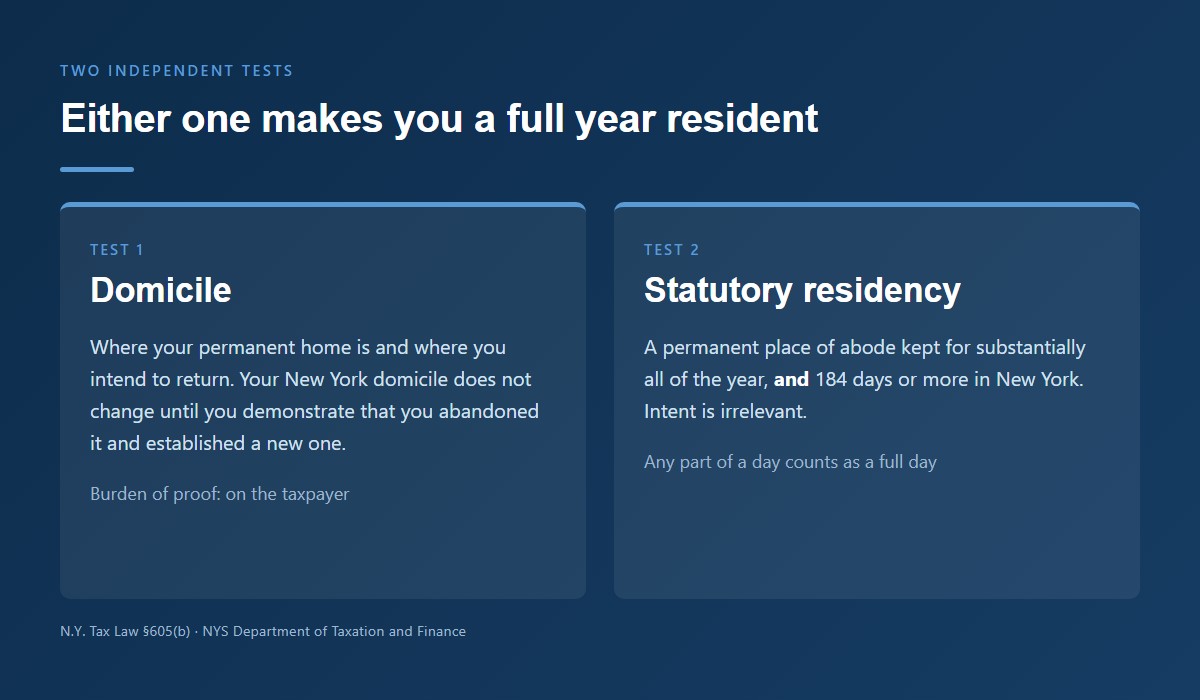
The Department’s own income tax definitions page states that your New York domicile does not change until you can demonstrate that you abandoned the old one and established a new one. The burden sits with the taxpayer, and the standard applied in practice is clear and convincing evidence rather than a simple balance of probabilities. This is the same structural problem that appears in every high tax state corridor, and readers comparing corridors may find our guide to the California exit tax useful, because the misconception and the mechanism are close cousins.
What Is the New York 184 Day Statutory Residency Rule?
Statutory residency requires two conditions at once. You must maintain a permanent place of abode in New York for substantially all of the taxable year, generally read as more than eleven months, and you must be present in New York for 184 days or more. Any part of a day counts as a full day, so a lunch in Manhattan and a two week stay are recorded identically.
- Both conditions must be met. Days alone do not create statutory residency if no qualifying abode exists, and an abode alone does not create it if the day count stays below the threshold.
- The threshold is 184 days, not 183. The Department states the test as 184 days or more, which is the same line described from the other side as more than 183, and a great deal of published commentary states it loosely.
- Part days count in full. Presence for any part of a day is a day, subject to narrow exceptions such as travel through the state and certain medical circumstances.
- The abode need not be owned. A leased apartment counts, and a residence maintained by a spouse generally counts as well.
- Not every dwelling qualifies. Property unsuitable for year round use, structures lacking ordinary living facilities, and an abode maintained only during a temporary duty assignment fall outside the definition.
The day count is where otherwise careful moves come apart, because it is the one element that accumulates silently through the year. Grandchildren, board meetings, a co-op that nobody wants to sell, and a long summer all add up without any single decision feeling significant. We built the Florida 183 day rule calculator for exactly this tracking problem, and the mechanics of being caught by two states at once are covered in our guide to the dual state residency trap.
Can You Be Domiciled in New York and Still Not Be a Resident?
Yes. Section 605(b) contains two exceptions that most published guidance on leaving New York never mentions. Group A covers a person who keeps no New York abode and spends 30 days or less in the state. Group B is a foreign safe harbor built around 450 days abroad within a 548 day period.
- Group A requires all three conditions. No permanent place of abode maintained in New York during the tax year, a permanent place of abode maintained outside New York for the entire year, and 30 days or less spent in New York.
- Group B is for people who go abroad. At least 450 days in a foreign country during a 548 consecutive day period, with the taxpayer, spouse, and minor children spending 90 days or less in New York during that window.
- Group B prorates the bookend years. Days allowed in the nonresident portion of the first and last tax years are limited by a ratio the Department sets out on its definitions page.
- These are exceptions to domicile, not to statutory residency. They resolve the domicile question for a taxpayer New York still considers domiciled there.
Group A is worth understanding even for a straightforward move to Southwest Florida, because it describes the shape of an unambiguous exit. No abode, a real home elsewhere, and a very small number of days in New York is the fact pattern New York finds hardest to challenge, and it is a useful benchmark against which to measure a messier real world plan.
What Does Section 639 Pull Back Onto Your Final New York Return?
Section 639 is the rule people are really describing when they call something a New York exit tax. When you change from resident to nonresident, §639 requires you to accrue to your period of residence any item of income, gain, loss, or deduction that accrued before the change of status, regardless of your method of accounting.
In plain terms, the question is not when the money arrives. The question is when the right to it was earned. Income that accrued while you were a New York resident is reported on your final New York resident period even though the payment lands in a Florida bank account months later.
| Item | General treatment on a resident to nonresident change |
|---|---|
| Deferred compensation and vested incentive pay earned during residency | Accrued to the resident period under §639(a) |
| Installment sale gain from a sale that closed while a resident | Accrued to the resident period rather than spread across later nonresident years |
| Ordinary income portion of a lump sum distribution accruing before the change | Named expressly in §639(a) |
| Partnership and S corporation distributive share | Allocated between resident and nonresident periods on a proportionate basis under §639(f) |
| Items already properly includible in a prior year under your method of accounting | Not accrued again, because §639 reaches only items not otherwise includible |
| Income accruing entirely after the change of status | Outside §639, and taxable by New York only if derived from New York sources |
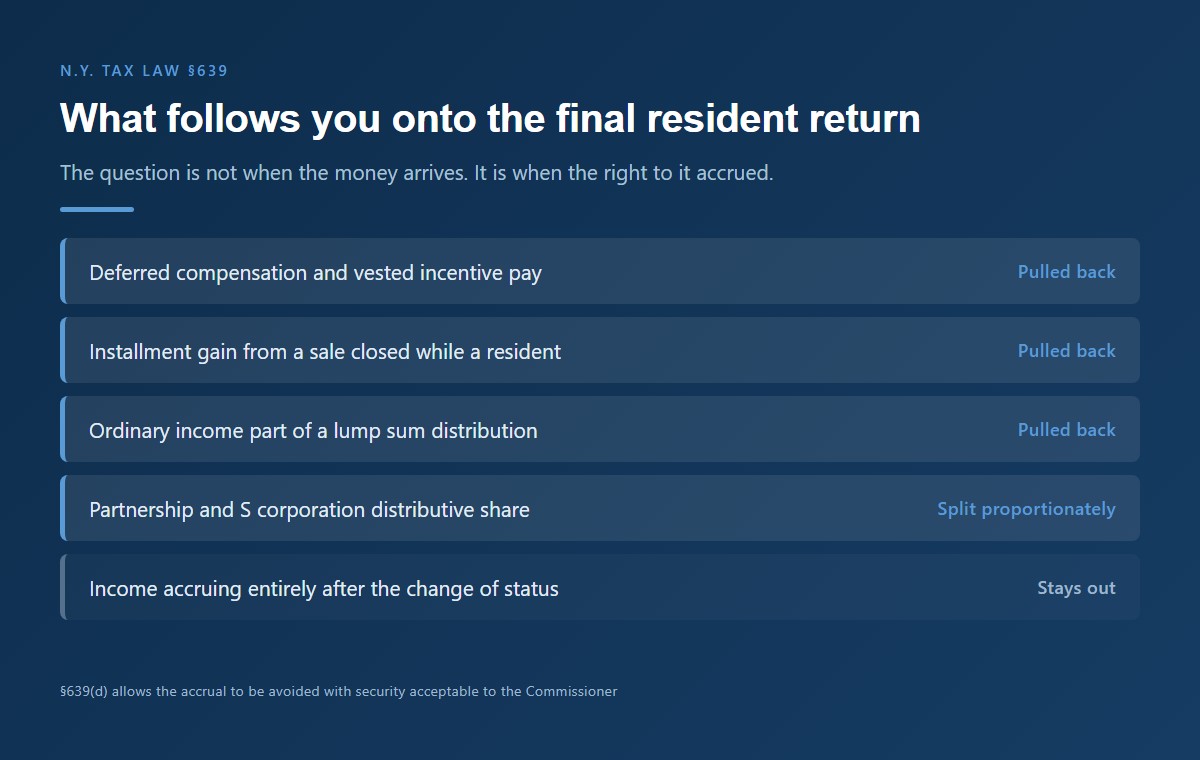
Section 639(c) closes the loop by providing that an item accrued under the section is not counted again in a later year, so the rule accelerates recognition rather than duplicating it. The interaction between this rule and equity compensation is the single most expensive detail in most executive relocations, and it is treated at length in our guide to Florida domicile for executives.
Can You Avoid the Section 639 Accrual?
There is a statutory alternative that almost no published article on leaving New York mentions. Under §639(d), the accrual is not required if the taxpayer files a bond or other security acceptable to the Commissioner, on condition that the amounts are taken into account in later years as though the change of resident status had not occurred.
- It is an alternative, not an exemption. The income remains subject to New York tax; what changes is that it is reported as it is received rather than pulled forward.
- Acceptance is discretionary. The security must be acceptable to the Commissioner, so this is a request rather than an election made unilaterally on a return.
- It suits illiquid timing. The case for it is strongest where the accrued item is a long installment obligation and paying New York tax now on money not yet received creates a genuine cash problem.
- It requires planning before the change. This is not a position discovered while assembling a return in April after the move year has closed.
Whether it makes sense in a given situation depends on the size and shape of the deferred item and on the taxpayer’s own view of future New York rates, so it belongs in a conversation before the move rather than in a generic checklist. Sale timing around a relocation is a related and frequently decisive issue, and it is covered separately in our guide to moving to Florida before selling a business.
Which Returns Do You File in the Year You Leave New York?
The move year almost always produces a part-year New York return on Form IT-203, which reports worldwide income for the resident portion of the year and New York source income only for the nonresident portion. There is no Florida individual income tax return, because Florida imposes none.
- Form IT-203 is the nonresident and part-year resident return that carries the income split across the domicile change date.
- Form IT-360.1 computes the change of city resident tax when the move also ends New York City or Yonkers residency partway through the year.
- Form IT-2663 handles estimated tax at closing when a nonresident sells New York real property, which is a separate obligation from the annual return.
- Form IT-203-B allocates wages when work days are split between New York and elsewhere, which matters enormously for anyone still working for a New York employer.
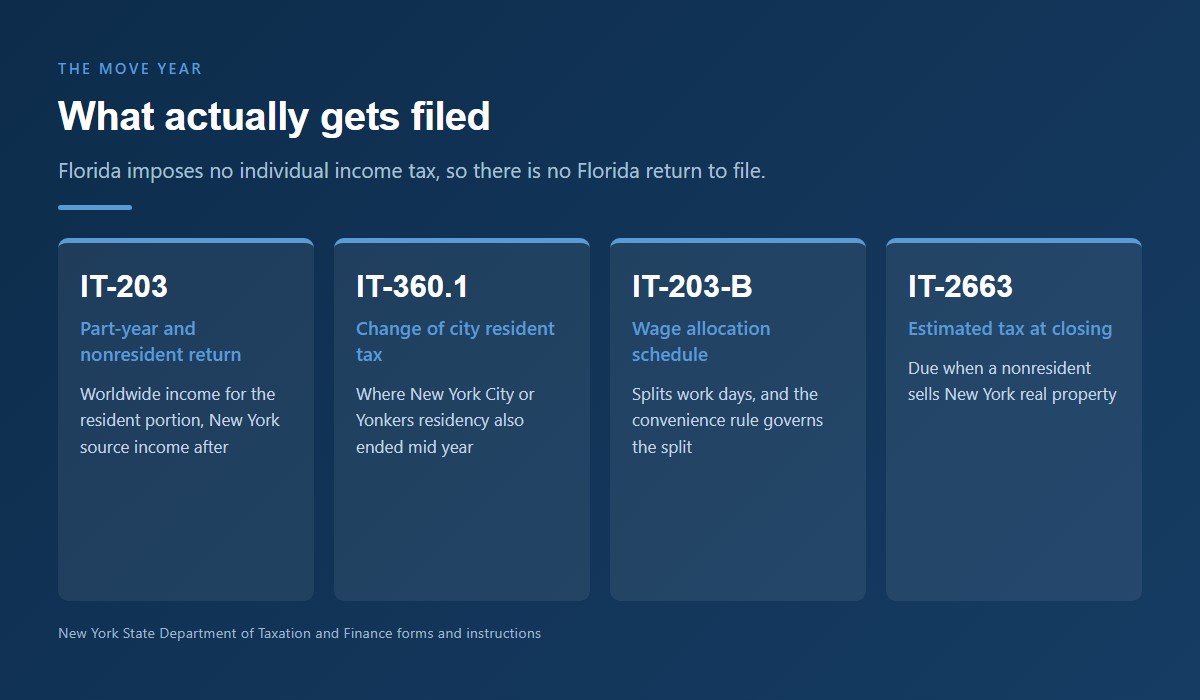
The wage allocation point deserves emphasis, because New York applies a convenience of the employer rule that treats days worked from a Florida home office as New York work days unless a narrow exception is met. Moving does not by itself stop New York from taxing the paycheck, and that mechanism is covered in full in our guide to the convenience of the employer rule. The broader mechanics of a first part-year filing are laid out in our snowbird taxes year one guide, and the treatment of the former residence when it is finally sold appears in selling your home after moving to Florida.
Is Leaving New York City Different From Leaving New York State?
They are two separate determinations and they can produce different answers. New York City imposes its own resident income tax, and the City applies the same resident, nonresident, and part-year definitions with New York City substituted for New York State. Leaving the City while remaining in the State ends the City tax but not the State tax.
- The City tax is residence based only. A nonresident of the City is not subject to the City personal income tax on wages earned there, which is why the City residency question is often the larger number for a Manhattan household.
- The same tests apply at City level. Domicile and statutory residency are both applied with the City substituted for the State.
- A retained City apartment is doubly dangerous. The same abode can support statutory residency for the State and the City at once.
- Form IT-360.1 is where the split is computed in the year City residency ends.
This distinction is the most common gap in general commentary about leaving New York. Guidance written at the state level frequently ignores the City entirely, and for a household whose exposure is concentrated in the City tax, that omission changes the arithmetic of the entire move.
What Does the New York Estate Tax Cost If the Move Never Sticks?
New York imposes an estate tax with a basic exclusion amount of $7,350,000 for dates of death on or after January 1, 2026 through December 31, 2026, at rates reaching 16 percent. The structure includes a cliff, so an estate exceeding the exclusion by more than five percent loses the benefit of the exclusion entirely rather than paying tax only on the excess.
- The 2026 figure is $7,350,000 per the Department of Taxation and Finance, and a good deal of currently ranking commentary still quotes the 2025 amount.
- The cliff is the distinguishing feature. Crossing 105 percent of the exclusion removes the exclusion rather than merely taxing the overage.
- Nonresidents are not fully outside the system. A nonresident estate must file where the estate includes real or tangible property located in New York and the federal gross estate plus includible gifts exceeds the exclusion.
- Florida imposes no estate tax, which is why the domicile question carries estate consequences that dwarf the annual income tax difference for larger estates.
- Domicile at death is what governs, and it is determined on the same principles applied to income tax residency, years after the planning was done.
This is the exposure that makes a half completed move genuinely expensive. An income tax residency dispute is measured against one or two years of income. An estate domicile dispute is measured against the whole estate, and it is litigated by an executor who was not present for the decisions. Our guide to Florida estate planning for new residents covers what changes on arrival, and our estate and trust planning services address the documents themselves.
What Does a New York Residency Audit Review?
A New York residency audit is a documentary examination of where you actually lived. It tests the domicile factors and reconstructs your day count from records you did not create for that purpose, including credit card statements, phone records, toll and travel data, appointment histories, and building access logs.
- The primary domicile factors are the home, active business involvement, time, items near and dear, and family connections.
- Day count reconstruction is evidentiary. Absent your own contemporaneous record, the Department builds one from third party data, and ambiguity tends not to resolve in the taxpayer’s favor.
- The burden is on the taxpayer to demonstrate the change of domicile, and the practical standard applied is clear and convincing.
- Records made in advance are worth more than records assembled after a notice arrives, because contemporaneous evidence is what the factors are designed to weigh.
- The audit can arrive years later, long after memories and receipts have gone.
The structure of a residency examination and the evidence that actually carries weight in one are covered in detail in our guide to the Florida residency audit, which addresses the same defensive record from the arrival side.
For the New York side of that examination specifically, including the five primary domicile factors, the current policy on how long a permanent place of abode must be maintained, and the 90 day appeal window, see our guide to the New York residency audit.
How Do You Establish Florida Domicile After Leaving New York?
Florida makes the arrival side straightforward. A declaration of domicile filed with the clerk of the circuit court under Fla. Stat. §222.17 is a sworn statement that Florida is your predominant and principal home. It is useful evidence, and it is not proof.
- File the declaration of domicile in the county of residence, which for Naples is Collier County, and keep the recorded copy.
- Move the ordinary markers, including the driver license, vehicle registration, voter registration, and primary banking.
- Claim the homestead exemption where the property qualifies, since it is a recorded assertion that the Florida property is the permanent residence.
- Deal with the New York abode, because retaining a qualifying place of abode leaves the statutory residency test live no matter how complete the Florida record is.
- Keep a contemporaneous day log from the first year, since it is the single most useful document in any later examination.
The full arrival checklist is set out in our guide to how to establish Florida residency. The point worth carrying away is that New York decides whether you left New York. Florida documentation supports that conclusion but does not deliver it, and a stack of Florida paperwork paired with a retained Manhattan apartment and 190 days in the state is not a winning combination.
New York Exit Tax Help Naples and Southwest Florida
Tax Expert Today LLC works with households and business owners relocating from New York throughout Naples, Florida and the surrounding Southwest Florida communities, including Bonita Springs, Estero, Fort Myers, Marco Island, and Cape Coral, as well as clients in all 50 states. The firm brings together tax advisors, enrolled agents, CPAs, and attorneys, which matters on a question like this one because a New York departure usually involves a residency analysis, a compensation timing question, and an estate document review at the same time, and those three pieces are ordinarily handled by three different people.
New York is the largest single feeder state into this market, and the pattern here is consistent. The move is real, the intent is genuine, and the record is thin, because nobody was thinking about evidence during a relocation. The households that come through an examination comfortably are the ones that treated the first year in Collier County as the year the file was built.
Office: 11983 Tamiami Trail N, Naples, FL 34110
Phone: (239) 441-2005
Hours: Monday through Friday, 10:00 am to 5:00 pm ET
Local FAQ: I moved from New York to Naples in June and sold my company in September. Does New York still tax the sale?
It depends on when the gain accrued rather than on where you were standing at closing. If the binding agreement and the economic accrual occurred while you were still a New York resident, §639 generally pulls that gain onto the resident portion of the final New York return even though the proceeds arrived after the move. If the accrual genuinely occurred after the change of status and the gain is not from a New York source, New York ordinarily has no claim on it. Because the analysis turns on the sequence of the agreement, the closing, and the domicile change date, this is a question to work through before signing rather than at filing time, and where an installment obligation is involved the §639(d) security alternative may also be worth considering.
When to Engage a Professional
Not every departure needs professional help. A person who sells the New York home outright, keeps no abode there, spends very little time in the state, and has no deferred compensation is in a clean position, and an ordinary part-year return is usually the end of it.
Professional review is worth considering in these situations:
- You are keeping a New York apartment or house after the move, which leaves the statutory residency test live regardless of your intent.
- You expect to spend a meaningful number of days in New York, particularly where family or business obligations make the count difficult to control.
- Your compensation includes deferred pay, vesting equity, or an installment obligation that straddles the move date.
- Your estate approaches or exceeds the New York exclusion, where the cliff makes the domicile question disproportionately expensive.
- You continue to work for a New York employer from a Florida home office.
- You have received a residency questionnaire, an information document request, or a notice from the Department of Taxation and Finance.
Where an examination has already opened, the work shifts from planning to defense, and the available evidence is largely fixed by then. Our Naples tax planning page describes how relocation engagements are handled locally, and our Florida tax services page covers the broader engagement types.
Outcomes in this area depend on the specific facts of the move, the records available, and the position the Department takes, so nothing in this guide should be read as a prediction about any particular return. To review a specific situation, contact Tax Expert Today or call (239) 441-2005.
This article is educational and does not constitute tax advice for any specific taxpayer. State residency rules and exclusion amounts change, and the treatment of any particular move depends on its facts.
Published August 12, 2026 by Dr. Pellumb Kabashi « Back to Learning Center
Have a question this article touches on?
Tax Expert Today LLC, based in Naples, Florida and serving clients across the United States.
Schedule a Consultation (239) 441-2005