
By Dr. Pellumb Kabashi, DBA, MBA, CES, CFE, EA
Founder, Tax Expert Today LLC · Tax advisors, enrolled agents, CPAs, and attorneys · Serving clients in all 50 states
Quick Answer: The Vermont estate tax is a flat 16 percent on a Vermont taxable estate above $5,000,000. After a genuine move to Florida, Vermont taxes only real estate and tangible property located in Vermont, but the tax is first computed on the whole estate and then multiplied by the Vermont share, so a large Florida portfolio raises the tax on a Vermont house. Call (239) 441-2005 for a free consultation.
Published: November 2026
The Vermont estate tax is easy to describe and easy to misjudge. Vermont exempts the first $5,000,000 of a taxable estate and taxes everything above that at a single flat rate of 16 percent. There are no brackets, no phase-in and no cliff. For a person who still lives in Vermont, the arithmetic is simple: an $8,000,000 estate with no deductions owes 16 percent of $3,000,000, or $480,000.
For a person who has moved to Florida and kept a ski house in Stowe, a lake camp in the Northeast Kingdom or a farmhouse in Woodstock, the arithmetic is different, and the difference is what most of the pages written about this tax leave out. Vermont can no longer tax the Florida brokerage account or the Naples condominium. It can still tax the Vermont real estate and the furniture, cars and art kept there. But it does not tax that property as if it were the whole estate. Vermont first computes the tax as if everything the person owned were subject to it, and then multiplies the result by the share of the gross estate that has a Vermont situs. The bigger the Florida side of the estate, the larger the tax on the same Vermont house.
This guide is written for the person who has moved from Vermont to Florida, or who lives in Florida and owns property in Vermont. It explains the rate and exemption as they stand for 2026 deaths, what changed in the 2026 filing threshold, how the tax is computed for a nonresident with worked numbers, which property Vermont can still reach, how the two year gift add-back works and why the date of a gift relative to the move changes the answer, why married couples cannot rely on portability, and what a Florida executor must file in Vermont. The rules were checked against the current text of chapter 190 of title 32 of the Vermont Statutes and Act 164 of 2026 on the date of publication. The examples are hypothetical illustrations of the statutory arithmetic, assume no deductions unless stated, and are not a projection for any particular family. The broader question of what a Florida estate plan should look like after the move is covered in our guide to Florida estate planning for new residents; this page covers the Vermont estate tax only.
What Is the Vermont Estate Tax?
The Vermont estate tax is a state tax on the transfer of a decedent’s estate, imposed by 32 V.S.A. section 7442a. It applies a flat 16 percent rate to the Vermont taxable estate above $5,000,000. It reaches residents on almost everything they own and nonresidents, including Florida domiciliaries, on Vermont real estate and tangible property.
- Who pays: the estate, through its executor, not the heirs individually
- Rate: a single 16 percent rate on the excess over $5,000,000, with no brackets
- Base: the federal taxable estate, adjusted by Vermont, whether or not any federal tax is due
- Reach after a move: real property in Vermont and tangible property normally kept there
- Not covered: Vermont imposes no inheritance tax and no separate lifetime gift tax
Vermont’s statute is built on the federal estate tax. Section 7401 states that the chapter is intended to conform Vermont law to the estate and gift tax provisions of the Internal Revenue Code, and section 7402 defines the Vermont taxable estate by starting with the federal taxable estate under 26 U.S.C. section 2051. That design has two practical consequences. First, the executor computes the federal gross estate and the federal deductions in the ordinary way, even when the estate is far below the $15,000,000 federal exclusion for 2026 and owes no federal tax at all. Second, federal rules on valuation, the marital deduction and the charitable deduction carry through to Vermont, so the planning tools that reduce a federal taxable estate generally reduce the Vermont one as well.
Section 7401(b) also states the policy behind the nonresident computation in plain terms: taxpayers are to be taxed only on the Vermont taxable estate, but at a rate that reflects their ability to pay as measured by the whole federal taxable estate. That sentence, written for the old graduated structure, explains why the current flat rate is still applied to the whole estate before the Vermont fraction is taken.
Who Owes Vermont Estate Tax After Moving to Florida?
A person whose domicile at death is Florida owes Vermont estate tax only if the estate includes property with a Vermont situs, meaning Vermont real estate or tangible property normally kept in Vermont, and the Vermont taxable estate exceeds $5,000,000. If the Florida domicile does not hold up, Vermont can tax the estate as a resident estate.
- Domicile is the test: section 7402 defines a nonresident as a person whose domicile is not Vermont
- The 183 day rule is an income tax rule: the statutory resident test in section 5811 does not decide the estate tax
- No Vermont property: a true Florida domiciliary with nothing in Vermont owes nothing
- Vermont property kept: the estate tax follows the house, the camp and its contents
Two definitions do the work. Section 7402(10) defines a resident of Vermont as a person whose domicile is Vermont, and section 7402(9) defines a nonresident as a person whose domicile is not Vermont. Domicile is the place a person treats as their permanent home and intends to return to, which is a question of facts and intent. The Vermont income tax uses a broader test: under 32 V.S.A. section 5811, a person can also be a resident for income tax purposes by maintaining a permanent place of abode in Vermont and spending more than 183 days there during the year. That statutory resident test belongs to chapter 151, the income tax, and chapter 190 does not borrow it. A Florida domiciliary who spends a long summer at the lake can therefore be a Vermont statutory resident for income tax in one year without becoming a Vermont resident for estate tax at death, although a long Vermont season is exactly the kind of fact that invites a domicile challenge.
The domicile question is where most of the money is. If the estate of a person with a $20,000,000 estate and a $1,200,000 Vermont house is treated as a Florida estate, the Vermont estate tax in the examples below is $144,000. If the same estate is treated as a Vermont resident estate, the tax is $2,400,000. The record that persuades a state that a person really left is covered in our guide to how to establish Florida residency, and the audit process that tests it is covered in our guide to the Florida residency audit. A Florida declaration of domicile filed under Fla. Stat. section 222.17 is part of that record, but it is one piece of evidence and not a substitute for actually moving the center of family life.
What Are the Vermont Estate Tax Rate and Exemption in 2026?
For 2026 deaths, 32 V.S.A. section 7442a imposes no tax on a Vermont taxable estate under $5,000,000 and 16 percent of the excess over $5,000,000 on an estate at or above that amount. The $5,000,000 figure is fixed in the statute and is not indexed for inflation, unlike the federal exclusion.
- Exemption: $5,000,000, unchanged since January 1, 2021
- Rate: a flat 16 percent on the excess, from the first dollar over
- No cliff: an estate just over the line owes 16 percent of the small excess only
- No indexing: as federal figures rise each year, the gap to Vermont widens
The rate table in section 7442a(b) has two lines. A Vermont taxable estate under $5,000,000 owes nothing. A Vermont taxable estate of $5,000,000 or more owes 16 percent of the excess over $5,000,000. The amendment history printed with the statute shows that its last change was made by 2019 Act 71, effective January 1, 2021, so the current two line table has applied to deaths since that date. Unlike New York, which removes its exclusion entirely above 105 percent of the threshold, Vermont has no cliff. The cost of the first dollar over the threshold is 16 cents, which is high for a single dollar but predictable.
| Vermont taxable estate (resident, no deductions) | Excess over $5,000,000 | Vermont estate tax at 16 percent | Effective rate on the whole estate |
|---|---|---|---|
| $4,900,000 | $0 | $0 | 0.0 percent |
| $6,000,000 | $1,000,000 | $160,000 | 2.7 percent |
| $7,250,000 | $2,250,000 | $360,000 | 5.0 percent |
| $8,000,000 | $3,000,000 | $480,000 | 6.0 percent |
| $10,000,000 | $5,000,000 | $800,000 | 8.0 percent |
| $20,000,000 | $15,000,000 | $2,400,000 | 12.0 percent |
The comparison with the federal tax matters for planning. For 2026 deaths the federal basic exclusion amount is $15,000,000, according to the IRS estate tax page, and a married couple can use two of them, including through portability. Many families who will never owe federal estate tax are well inside the Vermont range. A widow with a $9,000,000 estate that includes a Vermont house owes no federal estate tax in 2026, but whether she owes Vermont estate tax depends almost entirely on where she was domiciled and how the Vermont property is held.
What Changed in the 2026 Vermont Filing Threshold?
Section 16 of Vermont Act 164 of 2026 raised the filing threshold in 32 V.S.A. section 7444 from $2,750,000 to $5,000,000, effective June 18, 2026, so it now matches the $5,000,000 level at which tax begins. Before the change, many estates had to file a Vermont return even though they owed no tax.
- Old rule: a return was due once the federal gross estate plus recent gifts exceeded $2,750,000
- New rule: the dollar test is now $5,000,000, effective June 18, 2026
- Still required: a return whenever a federal Form 706 must be filed under IRC section 6018
- Gross, not taxable: the filing test uses the federal gross estate, before deductions
The amended section 7444(a) requires a Vermont return when the decedent had an interest in property with a Vermont situs and either a federal estate tax return is required under 26 U.S.C. section 6018, or the federal gross estate plus federal adjusted taxable gifts made within two years of death exceeds $5,000,000. The text of Act 164 shows the change directly, striking $2,750,000.00 and inserting $5,000,000.00, and the statute’s history note records the June 18, 2026 effective date.
Two features of the filing test matter to a Florida family. First, it is measured with the whole federal gross estate, not the Vermont property alone. A Florida domiciliary with a $400,000 Vermont camp and a $6,000,000 estate still meets the dollar test, because the test asks about the whole estate and only requires that some property have a Vermont situs. Second, it uses the gross estate, before the marital or charitable deduction. An estate that passes entirely to a surviving spouse may owe no Vermont tax at all and still need to file. Section 7445 adds that the executor of a resident, or of a nonresident with Vermont real estate or tangible property, must give the Department of Taxes a copy of any federal estate tax return, or a pro forma federal return where none is filed but Vermont tax is owed.
How Is the Vermont Estate Tax Computed for a Nonresident?
For a Florida domiciliary, Vermont first applies 16 percent to the whole Vermont taxable estate above $5,000,000, then multiplies the result by a fraction: the Vermont situs gross estate plus Vermont situs gifts, divided by the federal gross estate plus those gifts. The result is the Vermont share of a tax computed on everything.
- Step one: compute the Vermont taxable estate as if the whole estate were Vermont property
- Step two: apply 16 percent to the excess over $5,000,000
- Step three: multiply by the Vermont situs share of the gross estate, never more than one
- Result: a tax on the Vermont property at a rate set by the size of the whole estate
Section 7442a(b) says that the amount produced by the rate table “shall be multiplied by a fraction not greater than one.” The numerator is the value of the Vermont gross estate plus the value of gifts within two years of death that have a Vermont situs. The denominator is the federal gross estate plus the same two year gifts. Section 7402(13) defines the Vermont gross estate as the federal gross estate excluding property that has its situs outside Vermont, and section 7402(14) defines the Vermont taxable estate as the federal taxable estate with three additions described below. All values are as finally determined for federal estate tax purposes under section 7442a(c).
Take a hypothetical Florida domiciliary who dies in 2026 with a $10,000,000 estate, including a $1,500,000 house in Vermont, and no deductions. Step one: the Vermont taxable estate is $10,000,000. Step two: 16 percent of the $5,000,000 excess is $800,000. Step three: the Vermont fraction is $1,500,000 divided by $10,000,000, or 15 percent. The Vermont estate tax is $800,000 times 15 percent, or $120,000. If the same person had remained a Vermont domiciliary, the tax would have been the full $800,000.
| Step | Vermont resident, $10,000,000 estate | Florida domiciliary, same estate, $1,500,000 Vermont house |
|---|---|---|
| Federal gross estate | $10,000,000 | $10,000,000 |
| Vermont taxable estate (no deductions) | $10,000,000 | $10,000,000 |
| 16 percent of excess over $5,000,000 | $800,000 | $800,000 |
| Vermont fraction | Not greater than one; all property has Vermont situs except out of state real and tangible property | $1,500,000 / $10,000,000 = 15 percent |
| Vermont estate tax | $800,000 | $120,000 |
The resident column assumes that all of the property is intangible or located in Vermont. A Vermont resident’s Florida condominium is real property with a Florida situs, so it would fall out of the numerator even for a resident; the fraction is not only a nonresident device. The same structure appears in several other New England and Midwest estate taxes, including the Maine computation described in our guide to the Maine estate tax and the Minnesota computation in our guide to the Minnesota estate tax. It is the opposite of the New York approach, where a nonresident’s taxable estate is the New York property alone, explained in our guide to the New York estate tax cliff.
Why Does the Rest of Your Estate Raise the Tax on a Vermont House?
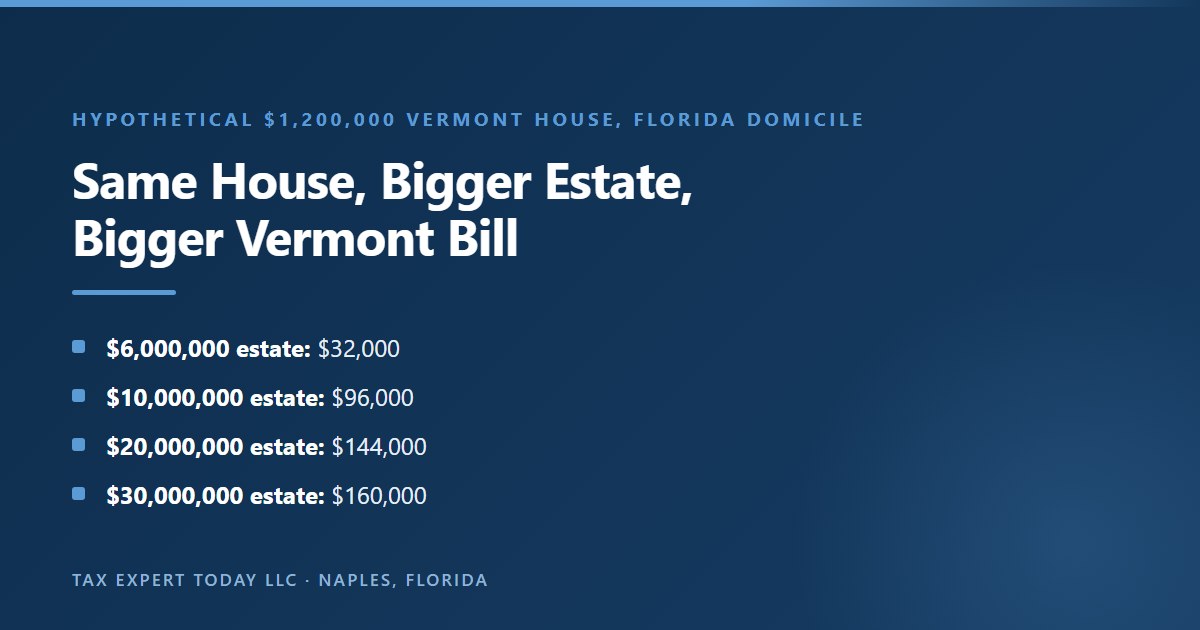
Because the 16 percent rate applies only above $5,000,000 of the whole estate, the share of the tax assigned to a Vermont house grows as the Florida side of the estate grows. With no deductions, the tax on Vermont property equals 16 percent of its value times one minus $5,000,000 divided by the whole estate.
- Small estate: the exemption absorbs most of the tax, so the house bears little
- Large estate: the exemption shrinks as a share, and the house approaches a 16 percent charge
- Same house, different bills: a $1,200,000 house costs $32,000 in a $6,000,000 estate and $160,000 in a $30,000,000 estate
- Planning point: growth in the Florida portfolio quietly raises the Vermont cost
The formula follows from the statute. Write the whole estate as E and the Vermont property as V. With no deductions and no gifts, the tax is 16 percent of (E minus $5,000,000), multiplied by V divided by E, which simplifies to 16 percent of V times (1 minus $5,000,000 divided by E). In effect, a Florida domiciliary gets a share of the Vermont exemption in proportion to the Vermont share of the estate, and the larger the estate, the smaller that share. The table below holds a hypothetical $1,200,000 Vermont ski house constant and changes only the size of the rest of the estate.
| Whole estate of a Florida domiciliary | Vermont fraction for a $1,200,000 house | Vermont estate tax | Tax as a percent of the house value |
|---|---|---|---|
| $5,000,000 | 24.0 percent | $0 | 0.0 percent |
| $6,000,000 | 20.0 percent | $32,000 | 2.7 percent |
| $8,000,000 | 15.0 percent | $72,000 | 6.0 percent |
| $10,000,000 | 12.0 percent | $96,000 | 8.0 percent |
| $15,000,000 | 8.0 percent | $128,000 | 10.7 percent |
| $20,000,000 | 6.0 percent | $144,000 | 12.0 percent |
| $30,000,000 | 4.0 percent | $160,000 | 13.3 percent |
This is the single most important fact for a wealthy family that kept a Vermont property after moving. It is also why the question “is our estate over $5,000,000?” is the wrong first question. A Florida retiree with a $25,000,000 estate and a modest $800,000 lake camp might assume that Vermont cares only about the camp, and that an $800,000 asset is far below a $5,000,000 exemption. Under the statute, the camp is taxed at roughly 12.8 percent of its value in that estate, about $102,400, because the exemption is measured against the whole estate and not against the camp.
What Property Has a Vermont Situs for a Florida Resident?
Under 32 V.S.A. section 7402(15), real property has its situs where it is located, tangible personal property where it was normally kept at death, and intangible property where the decedent was domiciled. For a Florida domiciliary, that leaves Vermont real estate and the furniture, vehicles, boats and art normally kept in Vermont.
- Real property: the house, camp, land, farm or rental building located in Vermont
- Tangible property: contents, cars, snowmobiles, boats and collections normally kept in Vermont
- Intangible property: stocks, bonds, bank and retirement accounts follow the Florida domicile
- Loaned art: a qualified work of art on loan to a Vermont charity is treated as outside Vermont
The situs rules in section 7402(15) are short and literal. Real property has its situs in the state or country where it is located. Tangible personal property has its situs where it was normally kept or located at the time of death. Intangible personal property has its situs in the state or country of the decedent’s domicile at death. A narrow carve-out treats a qualified work of art, as defined in 26 U.S.C. section 2503(g)(2), owned by a nonresident and kept in Vermont because it is on loan to a section 501(c)(3) organization located in Vermont, as having its situs outside Vermont.
The tangible property rule is the one families forget. The contents of a fully furnished Vermont house can be worth a meaningful amount, and a collection of antiques, paintings or vehicles kept there is Vermont property even after the owner has moved to Florida. Moving valuable tangible property to Florida, where it will genuinely be kept, changes its situs; leaving it in Vermont and calling it Florida property does not. The phrase “normally kept” points to a factual pattern, not a single day, so a painting carried to Naples for the winter and returned each summer is not obviously a Florida asset.
| Asset of a Florida domiciliary | Situs under 32 V.S.A. 7402(15) | In the Vermont numerator? |
|---|---|---|
| Vermont ski house or lake camp, owned outright | Vermont (real property) | Yes |
| Furniture, art and vehicles normally kept at the Vermont house | Vermont (tangible property) | Yes |
| Naples home and its contents | Florida | No |
| Brokerage account, bonds, cash, IRA and 401(k) | Florida (intangible, follows domicile) | No |
| Shares of a corporation that owns a Vermont business | Florida (intangible), but see the entity discussion below | Generally no |
| Painting on loan to a Vermont 501(c)(3) museum | Deemed outside Vermont | No |
Every asset in the table still counts in the denominator, because the denominator is the whole federal gross estate. That is what produces the bracket effect described above. Retirement accounts, life insurance owned by the decedent and the Florida home all raise the denominator and the Vermont taxable estate, even though none of them is Vermont property.
Does Holding Vermont Property in an LLC Change the Result?
Possibly, but it should not be assumed. Section 7402(15) gives intangible property, which includes an interest in an LLC or partnership, the situs of the owner’s domicile, and the Vermont statute has no express entity look-through rule like Maine’s. Whether Vermont would respect an entity that holds only a personal residence is a question for Vermont counsel.
- The statutory text: intangible property follows domicile, and an entity interest is intangible
- What is missing: no Vermont provision expressly looks through an entity to its real estate
- What can still apply: substance over form arguments, and federal inclusion rules such as IRC 2036
- Costs of the wrapper: transfer tax, financing, insurance and income tax consequences
Several states that tax nonresidents on real estate have written rules to stop an entity from converting a vacation house into intangible property. Maine, for example, looks through a pass-through entity unless it passes a business purpose test, as explained in our guide to the Maine estate tax. Vermont’s chapter 190, read on the date of publication, contains no comparable provision. That does not make an LLC a safe answer. A taxing authority can argue that an entity with no purpose other than holding the owner’s personal residence should be disregarded, and the federal gross estate itself can pull the property back in under IRC section 2036 if the owner keeps using the house as before.
There are also practical costs. Conveying Vermont real estate to an entity can trigger the Vermont property transfer tax unless an exemption applies, can require lender consent and can complicate insurance. A recent transfer made shortly before death draws the most attention. Families who own Vermont real estate through an operating business, a rental partnership or a long-standing family LLC with several members are in a different position from a couple who retitles their own ski house a year before the move. Any of these structures should be reviewed by a Vermont real estate and estate attorney before it is relied on for estate tax.
What Is the Vermont Two Year Gift Rule?
Under 32 V.S.A. section 7402(14)(C), the Vermont taxable estate is increased by taxable gifts, as defined in IRC section 2503, made within two years of death, valued under IRC section 2512, excluding any part already in the federal gross estate. Gifts made more than two years before death are not added back, and annual exclusion gifts are not taxable gifts.
- Window: two years before death, shorter than the three year windows in some states
- What counts: taxable gifts only, after the $19,000 per recipient annual exclusion for 2026
- Effect on the rate: the gift raises the Vermont taxable estate above $5,000,000
- Effect on the fraction: the gift is added to the denominator, and to the numerator if it has a Vermont situs
The add-back exists because a state without a gift tax would otherwise lose its estate tax to deathbed gifts. Vermont repealed its own gift tax in 1979, and the gift tax subchapter, sections 7411 to 7418, now reads only “Repealed.” Instead of taxing gifts when they are made, Vermont adds recent gifts back into the estate. The window is two years, and the gift is valued at its date of gift value under IRC section 2512, not its value at death, so appreciation after the gift is not added back. Gifts covered by the federal annual exclusion, $19,000 per recipient for 2026 according to the IRS gift tax FAQ, are not taxable gifts under IRC section 2503 and are never added back.
The filing threshold uses a slightly different measure. Section 7444 counts “federal adjusted taxable gifts, as defined in 26 U.S.C. section 2001(b),” made within two years of death. In most families the two measures produce the same number, but an executor should compute each where it is used rather than assuming they match.
Why Can a Gift Made Before the Move Raise the Vermont Tax?
Because section 7402(15) gives a gift of intangible property, made within two years of death, the situs of the donor’s domicile when the gift was made. A gift of securities made while the donor still lived in Vermont is a Vermont situs gift and enters the numerator, while the same gift made after the move to Florida does not.
- Intangible gifts: situs is the donor’s domicile on the date of the gift, not at death
- Tangible gifts: situs is where the item was normally kept when the gift was made
- Pre-move gift: raises both the taxable estate and the Vermont share
- Post-move gift: raises the taxable estate but not the Vermont share
This rule surprises families who make large gifts as part of the move. Section 7402(15)(D) says intangible property has its situs where the decedent was domiciled at death, or, “for a gift of intangible personal property within two years of death, the state or country in which the decedent was domiciled when the gift was executed.” Section 7402(15)(B) applies the same logic to tangible property, using the place it was normally kept when the gift was executed. Combined with the fraction in section 7442a(b), which adds gifts “with a Vermont situs” to the numerator, the date of the gift relative to the move can multiply the Vermont tax.
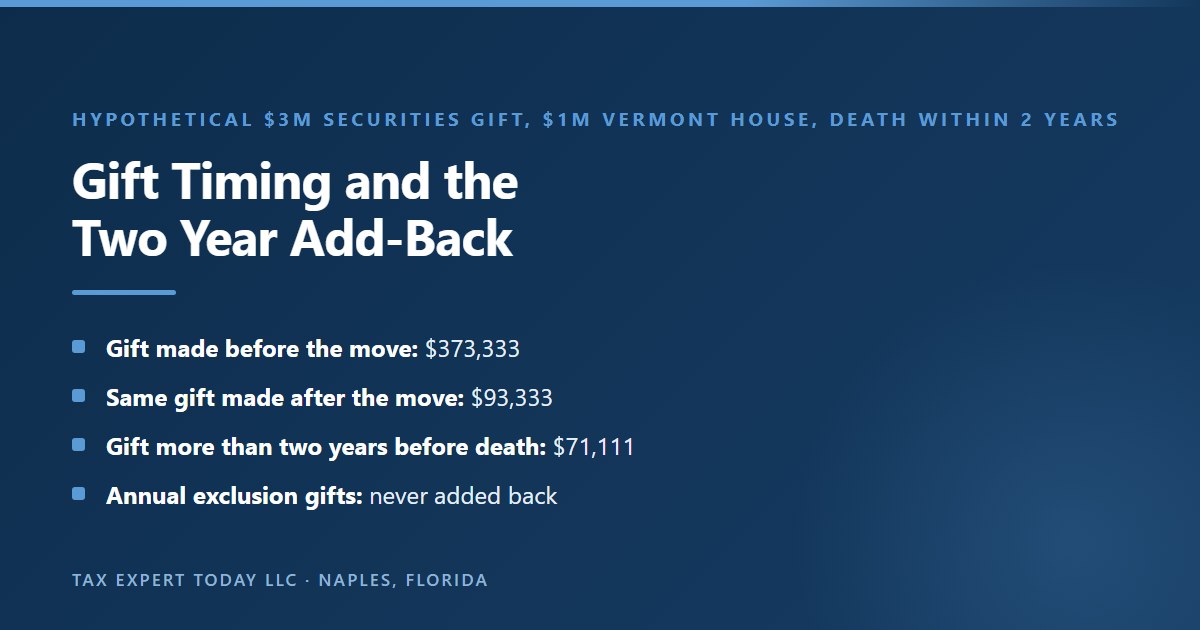
Consider a hypothetical Vermont couple’s surviving spouse who, before moving, makes a $3,000,000 taxable gift of securities to the children, then establishes a genuine Florida domicile and dies within two years, leaving a $9,000,000 estate that includes a $1,000,000 Vermont lake house. The table compares four versions of the same facts.
| Scenario (Florida domicile at death, $1,000,000 Vermont house) | Vermont taxable estate | Vermont fraction | Vermont estate tax |
|---|---|---|---|
| $3,000,000 securities gift made before the move, death within two years | $12,000,000 | $4,000,000 / $12,000,000 | $373,333 |
| Same gift made after the move, death within two years | $12,000,000 | $1,000,000 / $12,000,000 | $93,333 |
| No gift, $12,000,000 estate at death | $12,000,000 | $1,000,000 / $12,000,000 | $93,333 |
| Gift made more than two years before death | $9,000,000 | $1,000,000 / $9,000,000 | $71,111 |
The pre-move gift costs $280,000 more than the post-move gift, on the same assets and the same date of death, only because of where the donor lived on the day the gift was signed. The lesson is not that gifts are bad; a gift that survives the two year window removes both the gift and its future growth from the estate. The lesson is that the order of operations matters. Where a large gift is part of the plan and the move is genuinely happening, completing the change of domicile first and making the gift afterward avoids the Vermont situs on the gift. The federal side of the same decision, including the loss of a basis step-up on gifted property under IRC section 1015 compared with IRC section 1014, is covered in our guide to the lifetime gift tax exemption for 2026.
Does Vermont Have a Gift Tax or an Inheritance Tax?
No. Vermont repealed its gift tax in 1979, and sections 7411 to 7418 of chapter 190 are marked repealed. Vermont does not impose a separate inheritance tax on heirs. Lifetime gifts matter only through the two year add-back, and Vermont also keeps a generation-skipping transfer tax in section 7460 tied to an old federal credit.
- Gift tax: none since 1979; no Vermont gift tax return is filed for a lifetime gift
- Inheritance tax: none; the tax is paid by the estate, whoever the heirs are
- Two year add-back: the only way a gift reaches the Vermont estate tax
- GST tax: section 7460 reaches nonresidents only for Vermont real or tangible property
The absence of an inheritance tax means that the identity of the heirs does not change the Vermont estate tax, except through the federal marital and charitable deductions that flow into the Vermont taxable estate. A Vermont house left to a child is taxed the same way as one left to a niece. That is different from states such as Pennsylvania and New Jersey, where the relationship of the heir sets the rate, as explained in our guides to the Pennsylvania inheritance tax and the New Jersey inheritance tax.
Section 7460 imposes a separate tax on generation-skipping transfers in an amount equal to the credit for state death taxes allowed under 26 U.S.C. section 2604 as in effect on January 1, 2001. For an original transferor who is not a Vermont resident at the date of the transfer, the tax applies only with regard to real or tangible personal property in Vermont. A trust that skips a generation and holds Vermont real estate is the situation where an executor or trustee should check this section; it is uncommon, but it has its own return and its own deadline tied to the federal return.
Can Married Couples Use Portability for the Vermont Estate Tax?
No. Vermont computes its tax on the Vermont taxable estate with a fixed $5,000,000 exemption for each decedent, and federal portability of a deceased spouse’s unused exclusion is a federal credit, not a deduction, so it does not carry into the Vermont computation. A first spouse’s Vermont exemption that is not used at the first death is lost.
- Outright to spouse: the marital deduction removes the first estate, but wastes its $5,000,000
- Credit shelter trust: funding up to $5,000,000 at the first death uses both exemptions
- Vermont house in the trust: keeps it out of the survivor’s estate entirely
- Federal coordination: a federal portability election can still be made separately
Because the Vermont taxable estate starts from the federal taxable estate under IRC section 2051, the federal marital deduction under IRC section 2056 reduces the Vermont taxable estate as well. A first estate that passes entirely to the surviving spouse therefore owes no Vermont tax. The cost comes later: the survivor’s estate holds everything, and only one $5,000,000 exemption is available. The federal deceased spousal unused exclusion amount reduces federal tax as part of the applicable credit, but Vermont’s rate table is applied to the taxable estate before any federal credit, so the federal election does nothing for Vermont.
Take a hypothetical Florida couple with a $12,000,000 combined estate, held by one spouse, including a $2,000,000 Vermont lake house. If the first spouse leaves everything outright to the survivor, the first estate owes nothing, and at the survivor’s death the Vermont estate tax is 16 percent of $7,000,000, or $1,120,000, times $2,000,000 divided by $12,000,000, which is $186,667. If instead the first spouse’s will funds a credit shelter trust with $5,000,000, including the Vermont house, the first estate’s Vermont taxable estate is $5,000,000 and owes nothing, and the survivor’s $7,000,000 estate has no Vermont property and owes nothing either. These figures ignore growth and assume the house was held by the first spouse to die; a house owned jointly is analyzed differently, and the trust itself has to be drafted so that it is not included in the survivor’s estate.
| Hypothetical Florida couple, $12,000,000, $2,000,000 Vermont house | Vermont tax at first death | Vermont tax at second death | Total |
|---|---|---|---|
| Everything outright to the surviving spouse | $0 | $186,667 | $186,667 |
| $5,000,000 credit shelter trust holding the Vermont house | $0 | $0 | $0 |
| $5,000,000 credit shelter trust holding securities only | $0 | $320,000 x $2,000,000 / $7,000,000 = $91,429 | $91,429 |
The last row shows that the choice of assets for the trust matters as much as the trust itself. If the trust takes Florida securities and the survivor keeps the Vermont house, the survivor’s estate is smaller, $7,000,000, so 16 percent applies to only $2,000,000 of excess, but the Vermont house is now a larger share of that estate, about 28.6 percent, so the survivor’s estate still owes about $91,429. Which assets fund which share is a drafting and administration decision, and it is one of the reasons a Florida couple with Vermont property should have both wills reviewed together.
How Do Deductions and Charitable Gifts Change the Vermont Tax?
Federal deductions, such as debts, expenses, the marital deduction and the charitable deduction, reduce the Vermont taxable estate and so the base taxed at 16 percent. They do not change the fraction, which uses the gross estate. Vermont adds back any deduction taken for state death taxes under IRC section 2058 and foreign death taxes under section 2053(d).
- Reduce the base: mortgages and debts, administration expenses, marital and charitable bequests
- Do not reduce the fraction: the numerator and denominator are gross estate figures
- Added back: the federal deduction for state death taxes paid, so Vermont is not reduced by itself
- Charity: a bequest to charity lowers the 16 percent base dollar for dollar
Section 7402(14) defines the Vermont taxable estate as the federal taxable estate under IRC section 2051, “without regard to whether the estate is subject to the federal estate tax,” increased by three items: the deduction for state death taxes under IRC section 2058 to the extent deducted, the deduction for foreign death taxes under IRC section 2053(d) to the extent deducted, and the two year gifts. The add-backs prevent a circular computation in which the Vermont tax reduces itself. Everything else that reduces the federal taxable estate reduces the Vermont taxable estate.
Because the fraction is computed on gross values, a deduction lowers the tax on Vermont property by reducing the amount above $5,000,000, not by changing the Vermont share. Take the hypothetical Florida domiciliary with a $10,000,000 estate and a $1,500,000 Vermont house who owed $120,000. A $1,000,000 bequest to charity reduces the Vermont taxable estate to $9,000,000. The tax becomes 16 percent of $4,000,000, or $640,000, times 15 percent, which is $96,000. The charitable bequest saves $24,000 of Vermont tax. The same logic applies to the debts of the estate, including a mortgage on the Vermont house, although the federal rules on how a mortgage is reported can change the gross value used in the fraction, which the preparer of Form 706 will determine.
Does Vermont Give Relief to Farm Estates?
Yes. Under 32 V.S.A. section 7443, an estate that qualifies for federal installment payment under IRC section 6166, where the closely held business is farming in Vermont, has its Vermont tax reduced by the percentage that the value of the farm business bears to the federal adjusted gross estate.
- Gateway: the estate must qualify under the federal section 6166 tests
- Business: the closely held business must be the business of farming in Vermont
- Reduction: the tax falls by the farm’s share of the federal adjusted gross estate
- Florida owners: a working Vermont farm owned from Florida can still qualify if the federal test is met
The relief in section 7443 is narrow but large when it applies. Using hypothetical numbers for a Vermont resident, a $10,000,000 estate owes $800,000. If $4,000,000 of the estate is a closely held Vermont farming business that qualifies under IRC section 6166, and the federal adjusted gross estate is $10,000,000, the tax is reduced by 40 percent, to $480,000. For a Florida domiciliary the farm real estate would usually be the Vermont property in the numerator, so the reduction can remove most of the Vermont tax. Section 6166 has its own tests, including that the business interest exceed 35 percent of the adjusted gross estate, so a hobby property with a few acres in hay is not a farm business for this purpose.
How Does Vermont Decide Where You Were Domiciled at Death?
Vermont generally applies the common law test of domicile: the place where a person has their true, fixed and permanent home and intends to remain. The question is decided on the facts after death, by an executor who must assert it and a Department that may question it, so the record built during life is what the estate relies on.
- Intent plus conduct: a declaration of domicile helps only if daily life matches it
- Where family life happens: holidays, doctors, clubs, pets and valuables
- Time: days spent in each state, documented, not estimated
- Paper trail: voter registration, driver license, homestead exemption, tax returns, wills
The estate tax statute defines resident and nonresident by domicile and does not list factors, so the analysis follows the general approach courts use in domicile disputes. The facts that tend to persuade are the ones that show where a person’s life is centered: where the person votes and holds a driver license, where the homestead exemption is claimed, where the doctors, accountant and lawyers are, where the important belongings are kept, where holidays are spent, and how the time is divided. A Vermont property that remains larger, older and more personal than the Florida home makes the argument harder. The 183 day count used for the income tax is not the estate tax test, but day counts are still evidence, and our Florida 183 day rule calculator is a simple way to keep that record current.
The stakes are asymmetric. If domicile is in Florida, Vermont reaches only the Vermont situs share. If domicile is in Vermont, the Vermont fraction can approach one, and the Florida home falls out of the numerator only because it is out of state real property. A couple with a $20,000,000 estate and a $1,200,000 Vermont house is looking at $144,000 on one answer and close to $2,400,000 on the other. Families who split time between the two states, or who kept a Vermont house that is the center of family life, are the ones for whom the domicile file is worth building deliberately. The income tax side of the same facts is covered in our guide to the dual state residency tax trap.
When Must a Vermont Estate Tax Return Be Filed and Paid?
Under 32 V.S.A. sections 7446 and 7447, the Vermont estate tax return is due nine months after death, and the tax is due on the same date. The executor may apply for a six month extension to file before the deadline, but the tax is payable on the original date, with interest if payment is extended.
- Return due: nine months after the date of death
- Filing extension: six months, requested before the deadline
- Payment due: nine months, without extension unless the Commissioner grants one
- Federal changes: report any IRS adjustment to Vermont within 30 days under section 7479
Section 7446 sets the nine month filing date and allows executors to apply for a six month extension before the filing period expires. Section 7447 makes the tax payable at the time the return is required to be filed, “without extension.” Section 7481 separately lets the Commissioner extend the time to file for good cause, and when that happens payment time is extended too, but interest runs from the original due date. Because the tax rests on federal values, section 7479 requires the taxpayer to notify the Commissioner within 30 days of learning that the federal taxable estate or federal tax is being changed, or of filing an amended federal return.
| Item | Vermont rule | Statute |
|---|---|---|
| Who must file | Executor, when the decedent had property with a Vermont situs and a federal return is required or gross estate plus two year adjusted taxable gifts exceeds $5,000,000 | 32 V.S.A. 7444 |
| Copy of federal return | Duplicate of any federal estate tax return, or a pro forma return if none is filed and Vermont tax is owed | 32 V.S.A. 7445 |
| Return due date | Nine months after death; six month extension on application | 32 V.S.A. 7446 |
| Payment due date | Same as the return due date, without extension | 32 V.S.A. 7447 |
| Hardship payment extension | Up to five years at the Commissioner’s discretion, without interest | 32 V.S.A. 7448(a) |
| Federal adjustments | Notify the Commissioner within 30 days | 32 V.S.A. 7479 |
| Executor discharge | Not discharged until Vermont estate tax is paid and the receipt is filed with the Probate Division | 32 V.S.A. 7454 |
The Department of Taxes prescribes the form of the return under section 7480, and section 7454(b) separately requires the Probate Division to find that the decedent’s Vermont income taxes have been paid before it allows a final account. The executor, or the Vermont attorney handling the ancillary probate, should use the Department’s current estate tax return and instructions for the year of death.
Can the Estate Get More Time to Pay Vermont Estate Tax?
Yes, at the Commissioner’s discretion. Under 32 V.S.A. section 7448(a), if paying on the due date would cause undue hardship to the estate, the Commissioner may extend payment for a reasonable period of up to five years, and no interest is charged on a hardship extension. Other extensions for good cause carry interest.
- Hardship extension: up to five years from the due date, interest free
- Good cause extension: available, but interest runs from the original due date
- Illiquid estates: a Vermont farm or house that must be sold is the typical case
- Discretionary: the estate asks; the statute does not grant it automatically
Section 7448 has two parts. Subsection (a) lets the Commissioner extend payment for up to five years from the due date where paying on time “would result in undue hardship to the estate.” Subsection (b) lets the Commissioner extend payment for good cause, but the taxpayer then pays interest at the rate set under section 3108 from the original due date, and the last sentence of the section confirms that no interest is required on a hardship extension under subsection (a). For a Florida estate whose Vermont liability rests on a single house that the family intends to sell, the right request, made early, can avoid a forced sale on an unfavorable timetable. Section 7472 also allows the Commissioner to waive, reduce or compromise tax, penalties or interest, with a record of the reasons, although an executor should not plan on that relief.
What Happens in Vermont Probate for a Florida Estate?
A Florida domiciliary’s Vermont real estate usually requires an ancillary probate in the Vermont Probate Division. Under 32 V.S.A. sections 7450 and 7454, the Vermont administrator has the same tax duties as for a resident estate and is not discharged until the Vermont estate tax is paid and the receipt is filed.
- Ancillary probate: the Vermont court handles the transfer of Vermont real estate
- Tax duties: the Vermont administrator answers for the Vermont estate tax
- Discharge: no final discharge until the tax is paid and receipted
- Recipients liable: heirs and surviving tenants can be personally liable for unpaid tax
Under section 7449, the Probate Division notifies the Commissioner when it grants letters in any estate. Section 7450 gives an executor or administrator appointed in Vermont for a nonresident’s estate the same powers, duties and liabilities for the Vermont estate tax as if the decedent had been a resident, and section 7451 lets the Commissioner seek the appointment of a Vermont administrator where none exists. Section 7454 provides that the administrator, executor or trustee is not finally discharged or relieved from bond until the estate taxes have been paid and a receipt from the Commissioner has been filed with the Probate Division.
Avoiding the probate does not avoid the tax. Section 7452 makes the spouse, transferee, trustee, surviving joint tenant or beneficiary who receives property included in the federal gross estate personally liable for unpaid Vermont estate tax, up to the value of the property received. A Vermont house held in a revocable trust or as joint tenants skips probate, but the Vermont tax still follows it, and a later buyer’s title review will usually ask whether it was paid.
How Does the Vermont Estate Tax Interact With the Federal Estate Tax in 2026?
The two taxes share a base but not a threshold. For 2026 deaths the federal exclusion is $15,000,000 per person, while Vermont’s is $5,000,000 and is not portable. Vermont follows the Internal Revenue Code as amended through December 31, 2025, so the 2025 federal changes generally carry into the Vermont computation.
- Federal exclusion: $15,000,000 for 2026 deaths, with portability between spouses
- Vermont exemption: $5,000,000 per decedent, fixed and not portable
- Conformity date: the Code as amended through December 31, 2025, under section 7402(8)
- Federal deduction: Vermont tax paid is deductible for federal purposes under IRC section 2058
Section 61 of Act 164 updated the definition of “laws of the United States” in section 7402(8) to the Internal Revenue Code as amended through December 31, 2025, applying to taxable years from January 1, 2025. Because the Vermont computation begins with the federal taxable estate, the federal valuation, deduction and inclusion rules in force through that date apply to Vermont. For estates large enough to owe federal tax, the Vermont tax paid is itself deductible from the federal taxable estate under IRC section 2058, which reduces the combined cost somewhat, and Vermont then adds that deduction back for its own computation.
The planning gap is the $10,000,000 difference between the two exclusions. A Florida family with a $12,000,000 estate owes no federal estate tax in 2026, yet a Vermont house in that estate can carry a five or six figure Vermont bill. Federal planning that relies entirely on portability, and that leaves everything to the surviving spouse, is often the right federal answer and the wrong Vermont one. Our estate and trust planning work is built around reconciling the two.
What Can a Florida Resident Do About Vermont Property?
The main options are to confirm and document the Florida domicile, sell the Vermont property during life, fund a credit shelter trust with it at the first spouse’s death, give it away more than two years before death, make charitable bequests that reduce the 16 percent base, or, with Vermont counsel, consider how the property is owned.
- Domicile first: every other option assumes Vermont will accept the Florida domicile
- Sell during life: proceeds held in Florida are intangible and leave the numerator
- Use both exemptions: credit shelter trust drafting that can hold the Vermont property
- Gift with time to spare: after the move, and more than two years before death
- Review ownership: only with Vermont counsel and a reason beyond the estate tax
Each option has a cost on another tax. A sale during life converts the Vermont house into Florida cash, but it triggers capital gain without the basis step-up the heirs would get at death under IRC section 1014, and a nonresident’s sale of Vermont real estate is still subject to Vermont income tax on the gain; the income tax mechanics of a sale after the move are covered in our guide to selling rental property after moving and our guide to the nonresident state tax return. A gift of the house removes it from the estate if the donor survives two years, but the children take the donor’s basis. A qualified personal residence trust can transfer a vacation home at a reduced gift value while the owner keeps using it for a term, with its own federal rules and its own risk if the owner dies during the term. Life insurance held in an irrevocable life insurance trust does not reduce the Vermont tax but can pay it without adding to either estate.
For a couple, the most efficient step is often in the wills, not in the property. A credit shelter trust that is allowed to hold the Vermont house at the first death uses the first spouse’s $5,000,000 Vermont exemption and keeps the house out of the second estate, as shown in the portability table above. Where an existing trust was drafted in Vermont before the move, our guide to trust situs after moving to Florida explains the questions that follow the trust itself.
What Do Vermont Movers Get Wrong About the Estate Tax?
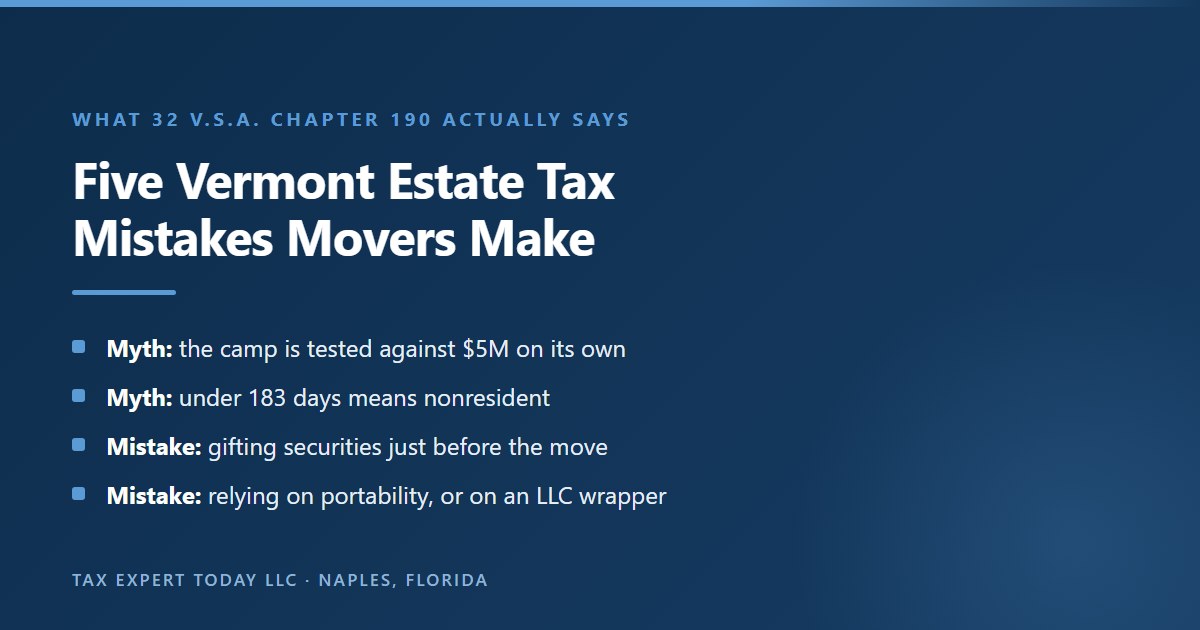
The common mistakes are assuming the house is measured against the $5,000,000 exemption on its own, assuming a 183 day count settles the estate tax, making large gifts just before the move, relying on federal portability, and treating an LLC as an automatic fix. Each one is contradicted by the text of chapter 190.
- Myth: “The camp is worth $800,000, so it is far below $5,000,000”
- Myth: “We were in Vermont fewer than 183 days, so we are not residents for estate tax”
- Mistake: gifting securities to the children the month before the move
- Mistake: leaving everything outright to the spouse and relying on portability
- Mistake: retitling the ski house into an LLC and assuming the tax is gone
| Assumption | What chapter 190 says | Where it is |
|---|---|---|
| The Vermont house is tested against $5,000,000 by itself | The tax is computed on the whole estate, then multiplied by the Vermont share | 32 V.S.A. 7442a(b) |
| A Florida domicile means no Vermont return | A return is due if there is Vermont situs property and gross estate plus gifts exceeds $5,000,000 | 32 V.S.A. 7444(a) |
| Under 183 days means nonresident for estate tax | The estate tax test is domicile only; the 183 day test is an income tax rule | 32 V.S.A. 7402(9), (10); 5811 |
| A gift before the move is as good as a gift after it | A gift within two years has the situs of the donor’s domicile when made | 32 V.S.A. 7402(15)(B), (D) |
| Portability preserves the first spouse’s Vermont exemption | Vermont taxes the taxable estate above a fixed $5,000,000 per decedent | 32 V.S.A. 7442a(b) |
| Skipping probate skips the tax | Recipients and surviving tenants are personally liable for unpaid tax | 32 V.S.A. 7452 |
A sixth mistake is timing the analysis to the federal threshold. Families are used to hearing that estate tax is a concern only for estates above $15,000,000. For a Florida family with Vermont property, the relevant number is $5,000,000, measured across the whole estate.
What Should a Vermont Mover Check Before and After the Move?
Before the move, decide which large gifts to delay until after the change of domicile and review both spouses’ wills for a credit shelter trust. After the move, document the Florida domicile, inventory what remains in Vermont, value the Vermont property periodically, and keep the executor informed of the nine month deadline.
- Before: gift timing, will and trust review, decision on the Vermont property
- At the move: Florida declaration of domicile, homestead, driver license, voter registration
- After: move valuables that will live in Florida, keep a day log, update advisors
- Every few years: re-run the Vermont fraction as the estate and the house change in value
A practical checklist for a Vermont family relocating to Southwest Florida looks like this. Complete the Florida domicile steps under Fla. Stat. section 222.17 and the related homestead filing in Collier or Lee County. Decide whether the Vermont property stays, is sold, or is held for a later gift, and model the Vermont estate tax on each path. Delay any large gift of securities until the Florida domicile is established, unless there is a reason to accept the Vermont situs. Make sure the wills or revocable trusts of both spouses can fund a credit shelter share with Vermont real estate. Move art, collections and other valuable tangible property that will genuinely be kept in Florida, and keep records of where it is normally kept. Tell the named executor that a Vermont return may be due in nine months even if no federal return is, and who in Vermont would open the ancillary probate. Re-check the computation when the estate grows, because growth in Florida assets raises the Vermont tax on the same house. The first year income tax questions are covered in our guide to snowbird taxes in year one, and the wider picture for retirees is in our guide to retiring to Florida.
Vermont Estate Tax Help in Naples & Southwest Florida
Tax Expert Today LLC works with families who have moved, or are moving, from Vermont to Naples, Florida and across Southwest Florida on the tax side of the relocation, including the estate tax that Vermont can still apply to a ski house, a lake camp, a farm or the property kept in them. The firm is multidisciplinary, with enrolled agents, CPAs and attorneys, and it handles residency and tax matters nationwide, coordinating with Vermont and Florida estate counsel when documents need to change. Our office is at 11983 Tamiami Trail N, Naples, FL 34110, open Monday through Friday, 10 a.m. to 5 p.m. ET, and reachable at (239) 441-2005.
- Vermont estate tax help Naples: modeling of the Vermont fraction for a house, camp, farm or rental at current values.
- Gift and spouse planning: review of planned gifts against the two year add-back and the gift situs rule, and of credit shelter trust funding.
- Domicile and filings: the residency record, the day count, and coordination of the Vermont return and ancillary probate for a Florida personal representative.
Our Naples tax planning practice and our Florida tax services page describe the wider planning work, and our guide to Florida asset protection for new residents covers the protective side of Florida ownership. For a recent closing on a Naples home, our guide to the Florida intangible tax explains the one-time charges on the closing statement, and executives still drawing deferred compensation should read our guide to Florida domicile for executives. Families with property in more than one northern state can compare the neighboring regimes in our guides to the Massachusetts estate tax and the Connecticut estate tax.
We spend summers at our place in Vermont and winters in Naples. Will Vermont tax our whole estate?
Not if your domicile is genuinely in Florida. Vermont then taxes only the share of the estate that corresponds to the Vermont property and its contents, and only if the whole Vermont taxable estate exceeds $5,000,000. The share still reflects the size of your whole estate, so a larger Florida portfolio raises the bill. The real risk is a domicile dispute, so the record you build in Collier County matters.
When to Engage a Professional
A Florida resident whose whole estate is comfortably under $5,000,000, or who owns nothing in Vermont, rarely needs Vermont estate tax advice. Professional help earns its cost when the estate is above $5,000,000 and includes a Vermont house, camp, farm, rental or business real estate; when large gifts are planned in the year of the move; when a spouse has died and the survivor holds the Vermont property; when a family LLC or partnership owns Vermont property among several relatives; or when a personal representative needs to file a Vermont return and open an ancillary probate. It is also worth a conversation when the move itself is recent and the domicile record is still being built, because that record decides whether Vermont taxes a share of the estate or nearly all of it. Tax Expert Today LLC’s enrolled agents, CPAs and attorneys can model the computation, coordinate with your estate counsel in both states, and help document the change of domicile. Call (239) 441-2005 to schedule a consultation.
Frequently Asked Questions
What is the Vermont estate tax rate in 2026?
Vermont taxes a Vermont taxable estate under $5,000,000 at zero and charges a flat 16 percent on the excess over $5,000,000, under 32 V.S.A. section 7442a. There are no brackets and no cliff. A Vermont resident with an $8,000,000 estate and no deductions owes 16 percent of $3,000,000, or $480,000.
Does the Vermont estate tax apply after I move to Florida?
Only to Vermont real estate and tangible property normally kept in Vermont, if the Florida domicile holds up. Vermont computes 16 percent of the whole Vermont taxable estate above $5,000,000 and multiplies it by the Vermont situs share of the gross estate, so the size of the Florida estate still affects the tax on the Vermont property.
When does a Florida resident’s estate have to file a Vermont estate tax return?
When the decedent had property with a Vermont situs and either a federal estate tax return is required or the federal gross estate plus federal adjusted taxable gifts made within two years of death exceeds $5,000,000. Act 164 raised that dollar threshold from $2,750,000 effective June 18, 2026. The return and the tax are due nine months after death.
Does Vermont add back gifts made before death?
Yes. Taxable gifts made within two years of death are added to the Vermont taxable estate under 32 V.S.A. section 7402(14)(C), at their gift date value. Annual exclusion gifts, $19,000 per recipient in 2026, are not taxable gifts. A gift of securities made while the donor was still domiciled in Vermont also counts as Vermont property in the fraction.
Is the Vermont estate tax exemption portable between spouses?
No. Each decedent has a fixed $5,000,000 Vermont exemption, and federal portability of the unused exclusion is a federal credit that does not carry into the Vermont computation. If the first spouse leaves everything outright to the survivor, the first spouse’s Vermont exemption is lost. A credit shelter trust funded at the first death is the usual response.
Does Vermont have an inheritance tax or a gift tax?
No. Vermont repealed its gift tax in 1979 and does not impose an inheritance tax on heirs. Lifetime gifts affect Vermont only through the two year add-back to the estate. Vermont does keep a generation-skipping transfer tax in 32 V.S.A. section 7460, which reaches nonresidents only with regard to Vermont real or tangible property.
Published November 1, 2026 by Dr. Pellumb Kabashi « Back to Learning Center
Have a question this article touches on?
Tax Expert Today LLC, based in Naples, Florida and serving clients across the United States.
Schedule a Consultation (239) 441-2005