
By Dr. Pellumb Kabashi, DBA, MBA, CES, CFE, EA
Founder, Tax Expert Today LLC · Tax advisors, enrolled agents, CPAs, and attorneys · Serving clients in all 50 states
Quick Answer
A qualified personal residence trust moves a home out of the taxable estate at a discounted gift value while the grantor keeps the right to live there for a fixed term of years. The September 2026 Section 7520 rate of 5.4 percent works in the grantor’s favor, because a higher rate enlarges the retained interest and shrinks the reportable gift. The strategy may not suit estates below the $15,000,000 exclusion. Call (239) 441-2005 for a free consultation.
What is a qualified personal residence trust?
A qualified personal residence trust is an irrevocable trust that holds one home for a fixed term while the grantor continues to live in it rent free. At the end of the term the residence passes to the remainder beneficiaries. Because the grantor keeps a term interest, the gift reported at funding is only the remainder value, not the full market value of the house.
- Irrevocable by design. Once the deed is recorded into the trust the grantor generally cannot unwind the transfer or reclaim the residence.
- One residence, not a portfolio. Treas. Reg. 25.2702-5(c) requires the trust instrument to prohibit holding any asset other than one personal residence, subject to narrow cash exceptions.
- A term of years, not a life estate. The retained interest runs for a stated number of years chosen at funding, which is what makes the mortality question in a later section so important.
- A completed gift of a future interest. The remainder is reportable on Form 709, and because it is a future interest it does not qualify for the $19,000 annual exclusion under IRC Section 2503(b).
The vehicle exists because of a statutory exception. IRC Section 2702 generally values a retained interest in a transfer to a family member at zero, which would make the gift equal to the entire value of the property. Section 2702(a)(3)(A)(ii) carves out a transfer of an interest in trust where the trust property consists of a residence to be used as a personal residence by the person holding the term interest. A qualified personal residence trust is the structure that fits inside that carve out, and the regulation sets the price of admission in the form of drafting requirements.
How does a QPRT actually remove value from the estate?
Two separate mechanisms do the work. The first is the valuation discount at funding, since the reported gift is only the remainder interest. The second and usually larger effect is that all appreciation after the funding date accrues outside the estate, because the residence already belongs to the trust.
- The discount at funding. The retained term interest is subtracted from fair market value, so a portion of the exclusion is consumed rather than the whole value of the home.
- The appreciation freeze. Growth after the transfer date belongs to the remainder beneficiaries and is generally outside IRC Section 2033.
- The rent at term end. Fair market rent paid after the term is a further transfer of cash out of the estate that is not itself a taxable gift.
- Leverage on the exclusion. The exclusion is measured at the funding date value, not at the date of death value.
The second mechanism is the one that decides whether the structure is worth the trouble. A residence worth $3,000,000 that grows at a hypothetical 3 percent a year would be worth roughly $4,673,902 after fifteen years. If the reported gift at funding were approximately $1,363,051, the arithmetic difference of roughly $3,310,851 sits outside the estate. At a 40 percent rate that difference is worth roughly $1,324,341 in estate tax, assuming the estate is large enough to be taxable at all. That last assumption is doing far more work in 2026 than most published discussions acknowledge, and a later section takes it apart.
How does the Section 7520 rate change the taxable gift?
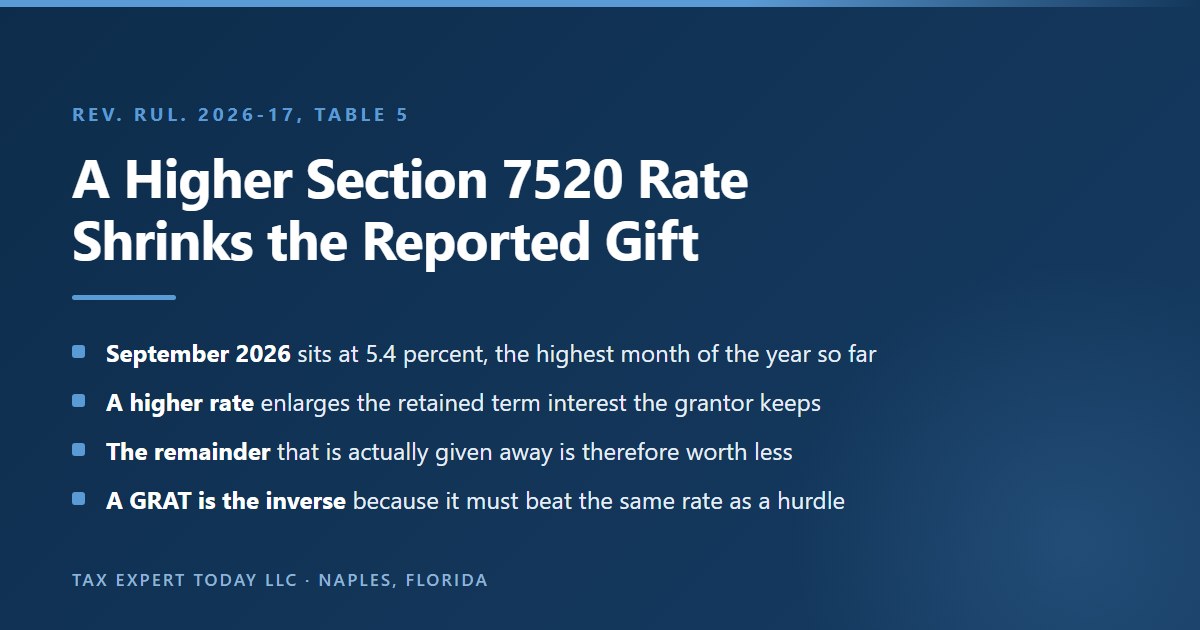
A higher Section 7520 rate makes a qualified personal residence trust more attractive, not less. The rate is the assumed rate of return used to split a property into a term interest and a remainder. When the assumed rate rises, the retained term interest is worth more, so the remainder that is actually given away is worth less and the reportable gift shrinks.
- The rate is set monthly. Under IRC Section 7520, it equals 120 percent of the applicable federal midterm rate, compounded annually, rounded to the nearest two-tenths of one percent.
- September 2026 sits at 5.4 percent. Rev. Rul. 2026-17, Table 5, sets the figure, and it is the highest month of 2026 so far.
- The direction is the opposite of a grantor retained annuity trust. A GRAT has to beat the same rate as a hurdle, so a GRAT prefers a low rate.
- A month of timing can matter. The rate for the month of the valuation date applies, and the taxpayer may in some cases elect one of the two prior months under Section 7520(a).
The published Section 7520 table on the IRS website is worth a word of caution. When this article was prepared the page had last been reviewed on 23 July 2026 and listed rates only through August 2026, even though the September ruling had already been released. Anyone relying on that page alone in early September would have used a stale 5.2 percent. The authoritative figure is in the monthly revenue ruling itself, which for September 2026 is Rev. Rul. 2026-17.
The table below isolates the rate effect on a single hypothetical. It holds the residence value and the term constant and changes only the Section 7520 rate, so the entire difference in the reported gift is attributable to the rate. The effect runs the other way for a charitable lead trust, where a higher rate enlarges the taxable gift.
| Valuation month | Section 7520 rate | Governing ruling | Reported gift, $3,000,000 residence, 15 year term |
|---|---|---|---|
| January 2026 | 4.6 percent | Rev. Rul. 2026-2 | approximately $1,528,080 |
| August 2026 | 5.2 percent | Rev. Rul. 2026-13 | approximately $1,402,443 |
| September 2026 | 5.4 percent | Rev. Rul. 2026-17 | approximately $1,363,051 |
The spread between the January figure and the September figure is roughly $165,029 of reported gift on the same house and the same term. That is exclusion preserved for other purposes rather than tax paid, but for a family working against a finite exclusion it is a real number. These figures are simplified illustrations that use only the term component of the calculation and are not a valuation of any particular property.
How is the retained interest valued under Section 2702?
The reported gift equals fair market value reduced by the value of the interests the grantor keeps. Those are the right to occupy the residence for the term, and in most drafting a reversion that returns the property to the grantor’s estate if the grantor dies inside the term. Both retained pieces reduce the gift, and both depend on the Section 7520 rate.
- The term interest. Valued by discounting the remainder back over the chosen number of years at the Section 7520 rate.
- The retained reversion. A contingent reversion, valued using the actuarial tables prescribed under Section 7520, reduces the gift further and depends on the grantor’s age.
- Age and term drive the result together. An older grantor and a longer term both increase the value of the retained interests.
- The tables are prescribed, not chosen. The mortality component comes from the actuarial tables the IRS publishes, so this is not a free negotiation.
The following illustration isolates the term component at the September 2026 rate of 5.4 percent. It deliberately ignores the retained reversion, which would reduce the reported gift further, because the reversion depends on the grantor’s age and cannot be shown in a general table. An actual engagement would run the full calculation on the specific facts.
| Retained term | Remainder factor at 5.4 percent | Reported gift on a $3,000,000 residence | Value of retained term interest |
|---|---|---|---|
| 10 years | 0.59101 | approximately $1,773,026 | approximately $1,226,974 |
| 15 years | 0.45435 | approximately $1,363,051 | approximately $1,636,949 |
| 20 years | 0.34929 | approximately $1,047,874 | approximately $1,952,126 |
The pattern is straightforward and it is also the trap. A longer term produces a smaller reported gift, which makes a long term look efficient on paper. A longer term also increases the probability that the grantor does not survive it, and the next section explains what happens then. Term selection is a mortality judgment dressed up as a valuation exercise.
What does the trust document have to say to qualify?
Treas. Reg. 25.2702-5(c) imposes a list of governing instrument requirements. If the document fails any of them the trust is not a qualified personal residence trust, Section 2702 values the retained interest at zero, and the grantor has made a gift of the entire fair market value of the residence rather than the discounted remainder.
- Asset restriction. The instrument must prohibit holding any asset other than one personal residence, with the limited cash and related exceptions the regulation permits.
- Cash limits. Cash may generally be held for a limited period for expenses already incurred or reasonably expected, for improvements, and for the purchase of a replacement residence, subject to the regulation’s timing rules.
- No commutation. The instrument must prohibit prepayment or commutation of the term holder’s interest.
- Cessation of residence use. The document must address what happens if the property stops being used as a personal residence, generally by terminating the trust or converting the interest into a qualified annuity interest.
- Two residence ceiling. A grantor is generally limited to a principal residence and one other residence for these purposes.
| Governing instrument requirement | What the document must do | Consequence of getting it wrong |
|---|---|---|
| Permitted assets | Prohibit holding any asset other than one personal residence, subject to the stated exceptions | Loss of qualification, so Section 2702 values the retained interest at zero |
| Cash holdings | Limit cash to expenses, improvements, and a replacement purchase within the permitted periods | Excess or overlong cash holdings can disqualify the trust |
| Commutation | Prohibit prepayment of the term holder’s interest | Loss of qualification |
| Cessation of use | Provide for termination or conversion to a qualified annuity interest | The structure has no defined exit and qualification is at risk |
| Sale proceeds | Require reinvestment in a replacement residence within the permitted period | Forced termination or conversion |
| Number of residences | Respect the ceiling of a principal residence and one other residence | The additional trust generally fails to qualify |
The definition of a personal residence carries its own detail. The regulation looks to the principal residence concept that now sits in IRC Section 121, or one other residence within the meaning of the personal use rules, together with appurtenant structures and a reasonable amount of adjacent land. A property that is substantially a rental, or acreage well beyond what the residence reasonably requires, invites a challenge to the qualification itself. In Southwest Florida this is not a hypothetical concern, because waterfront parcels and guest structures are common and the boundary between a residence and an investment property is not always obvious from the deed.
What happens if the grantor dies during the QPRT term?
If the grantor dies before the term ends, the full date of death value of the residence is generally included in the gross estate under IRC Section 2036(a)(1), because the grantor retained possession and enjoyment of the property. The commonly repeated claim that the family is then worse off overstates the damage, since the exclusion applied to the original gift is restored in the estate tax computation.
- Inclusion is the rule. IRC Section 2036(a)(1) reaches property transferred with a retained right to possession or enjoyment for a period that does not in fact end before death.
- The exclusion is not lost twice. The estate tax computation adjusts for the prior taxable gift, so the exclusion consumed at funding is generally not wasted on top of the inclusion.
- The realistic cost is friction. Drafting costs, appraisal costs, administration, and the opportunity cost of the exclusion in the interim are the practical loss.
- Basis is arguably better. Because the residence is back in the gross estate, the heirs may pick up a basis adjustment under IRC Section 1014 that a surviving term would have denied them.
That last point deserves emphasis, because it inverts the usual framing. A grantor who does not survive the term produces roughly the estate tax result that would have applied without any planning, and the family may recover the basis step-up that the successful version of the strategy gives away. The failure mode is expensive and disappointing rather than catastrophic. That is a materially different risk profile from the one most published summaries describe, and it should change how a term is chosen rather than simply frightening a client away from a longer one.
What happens when the QPRT term ends?
At the end of the term the residence belongs to the remainder beneficiaries outright or in a continuing trust. A grantor who wishes to keep living there must pay fair market rent under a genuine lease. Paying that rent is not a penalty, since it moves cash out of the estate every year without using any exclusion.
- The lease has to be real. A below market or unenforced arrangement risks an argument that the grantor retained enjoyment, which points back toward Section 2036.
- Rent is a second transfer engine. A hypothetical $120,000 of annual rent paid for ten years moves $1,200,000 out of the estate with no gift tax consequence.
- The rent is income to the recipient. Unless the trust remains a grantor trust as to the payor, the rent is generally taxable to the beneficiaries or the continuing trust.
- Plan the housing question early. Whether the grantor can afford market rent for the rest of a long life is a cash flow question that belongs in the original analysis.
Families often treat the rent obligation as the unpleasant surprise at the end of the structure. Framed correctly it is the most efficient part of it. The grantor is transferring cash to the next generation annually, at fair value, with no gift reporting and no exclusion consumed, while continuing to live in the same house. The planning failure is not the rent itself. It is discovering the rent obligation for the first time in year sixteen, without a lease, without a cash flow plan, and without anyone having documented a market rate.
Does a QPRT still make sense with a $15,000,000 exemption?
For many families the honest answer is no. Public Law 119-21 set the basic exclusion amount at $15,000,000 for 2026 under IRC Section 2010(c)(3) and removed the scheduled sunset. An estate comfortably below that figure, and below $30,000,000 for a married couple with portability, may pay no federal estate tax at all, in which case a qualified personal residence trust gives away a basis step-up to avoid a tax that was never going to be owed.
- The exclusion is verified, not assumed. Rev. Proc. 2025-32 confirms the $15,000,000 figure and the matching generation skipping transfer exemption under IRC Section 2631(c).
- The sunset is gone. The prior law reduction that drove a decade of urgency planning was deleted rather than deferred.
- Portability is not automatic. The deceased spousal unused exclusion under IRC Section 2010(c)(4) requires a timely filed estate tax return from the first estate.
- Florida adds no state layer. Florida imposes no state estate tax, so the federal calculation is generally the whole calculation for a Florida domiciliary.
This is where the analysis has genuinely changed and where most of the material still circulating online has not caught up. A great deal of published QPRT commentary was written when the exclusion was expected to fall by roughly half after 2025. That pressure is gone. The remaining candidates are estates that expect to exceed the exclusion after accounting for growth, families holding a residence they expect to appreciate faster than the general estate, and clients who have already used most of their exclusion on other transfers. Our discussion of the lifetime gift tax exemption in 2026 sets out the exclusion mechanics that this decision turns on.
| Situation | Federal estate tax exposure | Does a QPRT tend to help | Dominant consideration |
|---|---|---|---|
| Single filer, total estate well under $15,000,000 | Generally none | Usually not | Preserving the Section 1014 basis adjustment |
| Married couple, combined estate under $30,000,000, portability elected | Generally none | Usually not | Filing the first estate return to preserve portability |
| Estate expected to exceed the exclusion after growth | Possible | Potentially | Freezing appreciation on a specific asset |
| Exclusion largely consumed by prior gifts | Likely | Potentially | Discounting the value of a further transfer |
| Residence expected to outgrow the rest of the estate | Depends on facts | Potentially | Choosing which asset to freeze |
What does a QPRT cost in lost basis step-up?
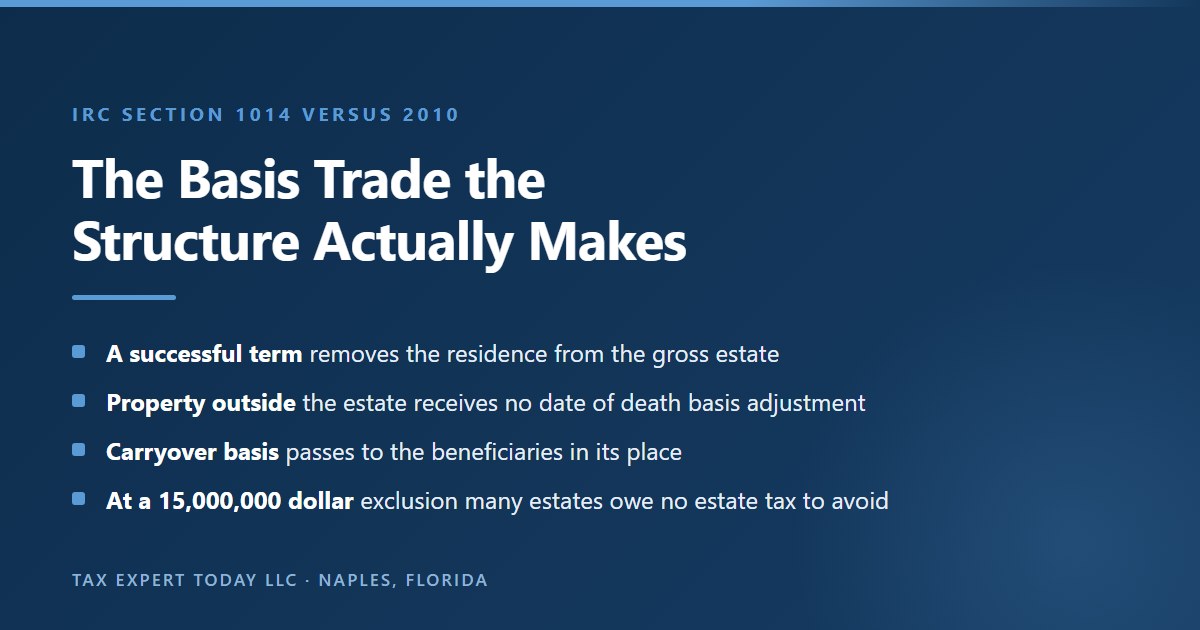
A successful qualified personal residence trust removes the residence from the gross estate, and property outside the gross estate does not receive a basis adjustment under IRC Section 1014. The beneficiaries generally take the grantor’s carryover basis instead. For a long held Southwest Florida residence with a low basis, that forgone adjustment can be the largest number in the entire analysis.
- Carryover replaces step-up. A completed lifetime gift generally carries the donor’s basis to the recipient rather than resetting it at death.
- Low basis magnifies the cost. Decades of Naples and Collier County appreciation frequently produce a basis far below current value.
- The Section 121 exclusion narrows. After the term the beneficiaries own the home and must satisfy their own ownership and use tests to claim any exclusion on a later sale.
- Compare the two taxes directly. The estate tax actually avoided has to exceed the capital gains tax created, or the structure has moved money to the government rather than the family.
The illustration below uses a hypothetical $3,000,000 residence with a $600,000 adjusted basis and applies a combined 23.8 percent rate representing the long term capital gains rate together with the net investment income tax under IRC Section 1411. It is a simplified comparison and it ignores state income tax, selling costs, and any later improvements to basis.
| Measure | No QPRT, residence in the estate | QPRT, grantor survives a 15 year term |
|---|---|---|
| Value included in gross estate | approximately $4,673,902 at assumed 3 percent growth | $0, plus $1,363,051 of exclusion used at funding |
| Basis in the hands of the family | Adjusted to approximately $4,673,902 | Carryover of approximately $600,000 |
| Built in gain on a sale shortly after death or term end | Approximately none | Approximately $4,073,902 |
| Capital gains cost at a combined 23.8 percent | Approximately none | Approximately $969,589 |
| Estate tax avoided if the estate is under the exclusion | Not applicable | Approximately none |
| Estate tax avoided at a 40 percent rate if the estate is taxable | Not applicable | Approximately $1,324,341 |
Families weighing this same basis question on a concentrated stock position rather than a residence face a close parallel, and our discussion of net unrealized appreciation works through the version that involves employer securities. Read the bottom two rows together, because they are the decision. For a family whose estate will never reach the exclusion, the right column produces roughly $969,589 of capital gains tax in exchange for approximately nothing. For a family whose estate is comfortably taxable, the same column produces roughly $1,324,341 of estate tax savings against that same capital gains cost, and the structure earns its keep. The identical trust document is a good idea in one case and a costly one in the other, and nothing about the drafting tells you which case you are in.
How does a QPRT compare with a GRAT at 5.4 percent?
They respond to the Section 7520 rate in opposite directions. A grantor retained annuity trust has to outperform the rate to transfer anything, so a GRAT prefers a low rate. A qualified personal residence trust uses the rate to value a retained occupancy interest, so a QPRT prefers a high rate. At 5.4 percent the environment favors the QPRT side of that pair.
- The GRAT hurdle. Assets inside a GRAT must beat 5.4 percent before any value passes to the remainder beneficiaries.
- The QPRT discount. The same 5.4 percent enlarges the retained term interest and reduces the reported gift.
- Different assets, different tools. A GRAT suits marketable securities or business interests; a QPRT holds a residence and essentially nothing else.
- Mortality risk is shared. Both structures generally fail their purpose if the grantor dies inside the term.
| Feature | Qualified personal residence trust | Grantor retained annuity trust |
|---|---|---|
| Preferred Section 7520 rate | Higher | Lower |
| Effect of the September 2026 rate of 5.4 percent | Favorable | Unfavorable relative to early 2026 |
| Typical asset | One personal residence | Marketable securities or closely held interests |
| Payment to the grantor during the term | Rent free occupancy | A fixed annuity |
| Result if the grantor dies during the term | Generally included under Section 2036 | Generally included in whole or in part |
| Can the gift be reduced toward zero | No, a remainder is always given | Yes, through a zeroed out structure |
Because the two vehicles pull in opposite directions, the current rate is not a general verdict on split interest planning. It is a reason to look harder at the residence and less hard at the securities portfolio this year. Families comparing charitable structures face the same rate sensitivity, and our discussion of charitable remainder trust taxation works through the version of that question that involves a charitable beneficiary. The securities side of that comparison is worked in full in our guide to the grantor retained annuity trust, which is the vehicle a 5.4 percent rate actively works against.
What are the income tax consequences during and after the term?
During the retained term the trust is generally a grantor trust, so the grantor continues to be treated as the owner of the residence for income tax purposes. That treatment preserves the familiar deductions and, in many cases, the Section 121 exclusion on a sale during the term. After the term the analysis depends on how the continuing trust is drafted.
- Grantor trust status during the term. The retained interest generally causes the grantor to be treated as owner, so the residence is reported as though it were still owned outright.
- Deductions follow ownership. Qualified residence interest and state and local property taxes remain the grantor’s items during the term, subject to the usual limitations.
- Section 121 during the term. A sale while grantor trust status applies may still qualify for the exclusion if the ownership and use tests are otherwise met.
- Replacement property has a clock. Sale proceeds must generally be reinvested in a replacement residence within the period the regulation allows, or the trust must convert or terminate.
The post term picture is the one that surprises people. If the continuing trust remains a grantor trust as to the original grantor, rent paid by the grantor to that trust is generally disregarded for income tax purposes, which makes the rent an unusually efficient transfer. If the trust is not a grantor trust, the rent is generally income to the trust or the beneficiaries. Two documents that look nearly identical to a client can produce materially different annual outcomes for decades, which is why the drafting attorney and the tax advisor need to agree on the intended post term status before the document is signed rather than after.
How is the QPRT gift reported on Form 709?
The transfer is reported on Form 709 for the calendar year of funding. Because the remainder is a future interest, no annual exclusion applies and the entire computed remainder value consumes lifetime exclusion. Adequate disclosure on a timely filed return is what starts the limitations period on the valuation.
- Timing. Form 709 is generally due 15 April of the year following the gift, with extension available.
- Appraisal support. A qualified appraisal of the residence supports the fair market value the whole calculation depends upon.
- Disclose the calculation. Showing the Section 7520 rate used, the term, the actuarial factors, and the resulting remainder is what makes the disclosure adequate.
- Exclusion tracking. The exclusion consumed reduces what remains available under IRC Section 2505 for future transfers.
Adequate disclosure is not a formality. A gift that is adequately disclosed on a timely filed return generally starts the assessment period running on the valuation, so the reported number becomes settled after that period expires. A gift that is never reported, or reported without enough information to alert the IRS to the nature of the transfer, may leave the valuation open indefinitely. Given that the entire benefit of the structure rests on a valuation, leaving that valuation permanently open is a poor trade for the cost of preparing a complete return.
Does a Florida homestead exemption survive a transfer to a QPRT?
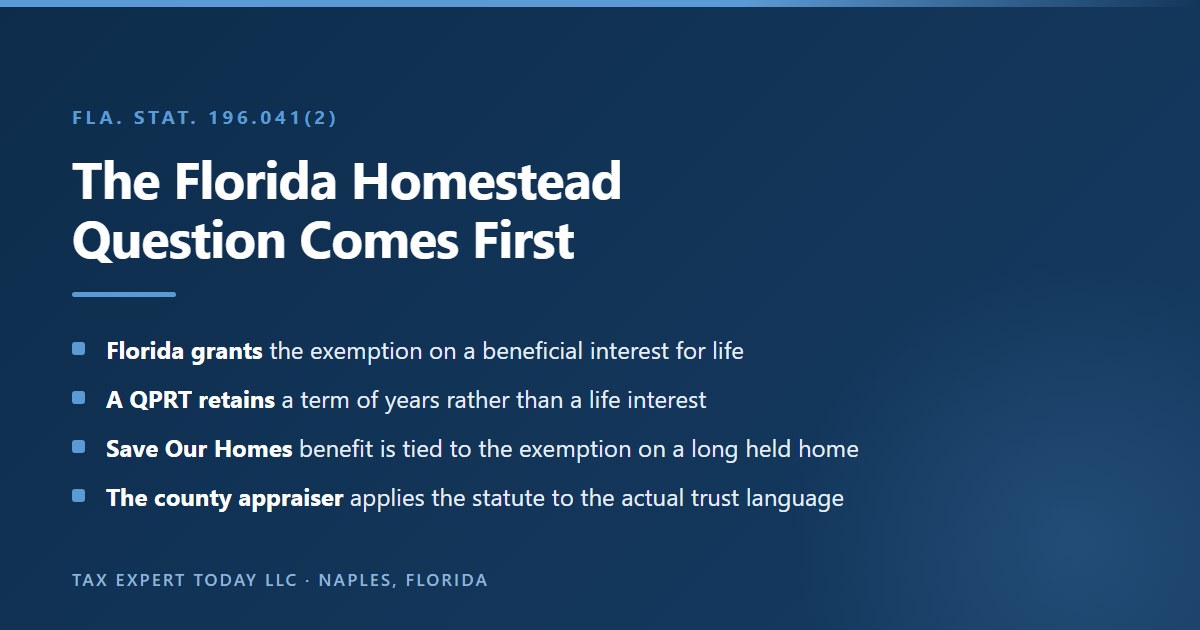
This is the question that most national commentary skips, and for a Naples residence it can outweigh the federal analysis. Florida grants the ad valorem homestead exemption to a trust beneficiary whose possessory right rests on an instrument granting a beneficial interest for life. A qualified personal residence trust grants a term of years rather than a life interest, so the exemption should never simply be assumed to carry over.
- The statute is specific about life. Fla. Stat. 196.041(2) treats a beneficial interest for life as equitable title for homestead purposes.
- A term of years is not a life interest. The standard QPRT retained interest is measured in years, which is the source of the difficulty.
- Save Our Homes is at stake too. The assessment limitation and any accumulated benefit are tied to the exemption, so the annual property tax consequence can be substantial on a long held Collier County home.
- The property appraiser decides locally. The county property appraiser applies the statute to the specific deed and trust language, so the drafting has to be reviewed against local practice before the deed is recorded.
For QPRT planning help Naples families should treat this as a gating item rather than a detail to clean up later. A Southwest Florida residence carrying a long accumulated Save Our Homes differential can produce an annual property tax increase that, compounded over a fifteen year term, rivals the federal benefit the structure was created to capture. The federal calculation and the Florida property tax calculation have to be run together, and they have to be run before the deed is recorded, because unwinding an irrevocable transfer to restore an exemption is not a remedy that is generally available. Where an existing irrevocable trust needs different terms rather than unwinding, the separate question is the tax consequences of decanting a trust. Families who moved to Florida recently should also read our guidance on establishing Florida residency, since the homestead claim and the domicile claim rest on overlapping facts.
None of this makes a Florida QPRT unworkable. It makes it a structure that requires Florida counsel and the county property appraiser’s actual practice to be consulted alongside the federal actuarial math. Approaches that address the point exist, and whether any of them fits depends entirely on the family’s facts and on current local administration. The broader Florida picture, including why the absence of a state estate tax changes the weighting of every federal decision above, is covered in our overview of Florida estate planning, and families who moved an existing trust south should review trust situs after moving to Florida before adding a new structure on top of it.
Qualified Personal Residence Trust Help in Naples & Southwest Florida
Tax Expert Today LLC works with Naples, Florida families and their attorneys on residence based transfer planning, including whether a qualified personal residence trust is the right answer at all. Our team includes tax advisors, enrolled agents, CPAs, and attorneys, and we coordinate with the drafting attorney rather than replacing that relationship. Southwest Florida residence values, long accumulated Save Our Homes differentials, and the absence of a Florida estate tax combine to make the analysis here genuinely different from the national template, and we run the federal actuarial calculation and the Florida property tax consequence side by side before anything is recorded.
Tax Expert Today LLC
11983 Tamiami Trail N, Naples, FL 34110
Phone: (239) 441-2005
Hours: Monday through Friday, 10:00 to 5:00 ET
We serve Naples, Bonita Springs, Estero, Fort Myers, Marco Island, and the wider Collier and Lee County area, and we work with clients in all 50 states. Our Naples tax planning practice and our estate and trust planning services cover the transfer side of this work, and our tax planning services page describes how an engagement is structured.
Local question: my Naples home has a large Save Our Homes benefit. Should I still consider a QPRT? Possibly, but the property tax consequence has to be quantified first. A long held Collier County residence may carry an assessed value far below market value, and the annual saving that produces can be significant. That saving has to be weighed against a federal estate tax benefit that, at a $15,000,000 exclusion, many families will not realize at all. We would generally price out both sides before recommending either direction, and we would involve Florida counsel on the homestead question.
When to Engage a Professional
A qualified personal residence trust is irrevocable, it turns on an actuarial calculation, and in Florida it interacts with a property tax regime that the federal rules do not contemplate. The combination rewards planning and punishes improvisation. Consider engaging a professional when any of the following apply.
- The estate may exceed the exclusion. Projected growth, not today’s balance sheet, is what determines whether federal estate tax is a real risk.
- The residence has a low basis. The forgone Section 1014 adjustment has to be quantified before, not after, the transfer.
- The home is a Florida homestead. The Fla. Stat. 196.041(2) life interest question should be resolved before the deed is recorded.
- A term has to be chosen. Term selection is a mortality judgment with a valuation consequence, and it deserves an explicit analysis.
- A prior QPRT term is ending. The lease, the rent, and the post term grantor trust status all need attention in advance.
- Form 709 is due. Adequate disclosure is what makes the reported valuation final.
Our team can run the federal calculation, model the basis trade off, and coordinate with your attorney on the Florida homestead question. Where an existing structure has already created an IRS issue, our IRS resolution and audit support practice handles examination and correspondence work. Call (239) 441-2005 to discuss whether this structure fits your facts.
Frequently Asked Questions
Can I put two homes into qualified personal residence trusts?
Generally a grantor may hold interests in trusts covering a principal residence and one other residence. The regulation limits the number of personal residences that may be treated this way, so a family with several properties cannot simply replicate the structure for each of them. The specific limits and the definition of a qualifying residence should be checked against Treas. Reg. 25.2702-5 on the particular facts.
What happens if I sell the residence during the QPRT term?
The trust may generally hold the sale proceeds for a limited period and reinvest them in a replacement residence. If a replacement is not acquired within the period the regulation allows, the trust must generally either terminate and distribute to the grantor or convert the retained interest into a qualified annuity interest, which effectively turns the arrangement into a grantor retained annuity trust for the remainder of the term.
Does a QPRT protect the home from creditors?
Any creditor effect is a matter of state law rather than federal tax law, and in Florida the analysis is complicated by the constitutional homestead protection that may already apply to the residence. Transferring a Florida homestead into a trust can change that protection in either direction depending on the facts, so this question belongs with Florida counsel and should not be assumed to favor the trust.
Is the QPRT gift eligible for the annual exclusion?
No. The remainder interest is a future interest, and the $19,000 annual exclusion for 2026 applies only to gifts of present interests under IRC Section 2503(b). The entire computed remainder value consumes lifetime exclusion, which is one reason the Section 7520 rate matters so much to the outcome.
Can a married couple use a QPRT for a jointly owned home?
Spouses may each transfer their respective interest in a jointly owned residence, and doing so can produce fractional interest considerations in the valuation. The structure and the appraisal both become more involved, and the mortality analysis has to be run for each spouse separately, so this variation should be modeled rather than assumed to double the benefit.
What Section 7520 rate applies to my transfer?
The rate for the month containing the valuation date generally applies, and Section 7520(a) permits an election in certain cases to use the rate for either of the two preceding months. For September 2026 the rate is 5.4 percent under Rev. Rul. 2026-17. Because the IRS summary page can lag the monthly rulings, the ruling itself is the reliable source.
Published September 6, 2026 by Dr. Pellumb Kabashi « Back to Learning Center
Have a question this article touches on?
Tax Expert Today LLC, based in Naples, Florida and serving clients across the United States.
Schedule a Consultation (239) 441-2005