
By Dr. Pellumb Kabashi, DBA, MBA, CES, CFE, EA
Founder, Tax Expert Today LLC · Tax advisors, enrolled agents, CPAs, and attorneys · Serving clients in all 50 states
Quick Answer: The Connecticut estate tax can still reach you after a move to Florida, but only through Connecticut real estate and tangible property kept there. In 2026 the exemption matches the federal $15 million basic exclusion and the rate is 12 percent above it. Connecticut also has the only standalone state gift tax, so gifts made before the move still count. Call (239) 441-2005 for a free consultation.
Published: October 2026
Connecticut sends a steady stream of retirees, executives and business owners to Southwest Florida, and many of them keep something behind: a house in Fairfield County, a shoreline cottage, a boat in a Mystic marina, a share of a family property in Litchfield. Florida has no estate tax and no gift tax. Connecticut has both, and it is the only state in the country that still imposes a standalone gift tax, unified with its estate tax under a single lifetime exemption. That combination is what makes the Connecticut estate tax different from every other departure state this guide series covers.
The usual summaries explain how the tax works for a Connecticut resident: the exemption that now tracks the federal basic exclusion amount, the flat 12 percent rate above it, and the $15 million cap on the combined estate and gift tax. This guide is written for the person who has moved, or is about to move, to Florida. It answers the questions that decide the bill after the move. What does Connecticut still reach once your domicile is in Florida? How is the tax computed when only part of the estate is in Connecticut? Why do gifts made before the move still count? And what does the statute mean when it says every decedent is presumed to have died a Connecticut resident?
The rules below were checked against the current text of Conn. Gen. Stat. chapters 217 and 228c on the date of publication. The worked examples are hypothetical illustrations of the statutory method, not a projection of any particular estate. If you are still working out the Florida side of the plan, our guide to Florida estate planning for new residents covers the documents and federal rules that change with the move; this page covers the Connecticut layer only.
What Is the Connecticut Estate Tax in 2026?
The Connecticut estate tax is a state tax on the transfer of a decedent’s estate. For deaths in 2026 the exemption equals the federal basic exclusion amount of $15,000,000, and the Connecticut taxable estate above that amount is taxed at a flat 12 percent. The tax is capped at $15 million, and every estate files a return.
- Exemption: tied by statute to the federal basic exclusion amount, which is $15,000,000 for 2026 under 26 U.S.C. §2010(c)(3).
- Rate: a flat 12 percent on the Connecticut taxable estate above the exemption, for deaths on or after January 1, 2023.
- Cap: the tax payable cannot exceed $15 million, reduced by Connecticut gift tax already paid since 2016.
- Due date: six months after the date of death, under section 12-392.
- Who files: every resident estate, and every nonresident estate that includes Connecticut real or tangible property.
The statute that imposes the tax is Conn. Gen. Stat. section 12-391. It has been amended many times, and the rate schedule in subsection (g) reads like a history of the tax: a $2 million exemption with graduated rates up to 16 percent for deaths from 2005 through 2009, a $3.5 million exemption from 2010, and then a series of steps from 2018 onward that raised the exemption each year until it reached the federal amount. For deaths on or after January 1, 2023, subdivision (g)(9) says simply that no tax is due on a Connecticut taxable estate up to the federal basic exclusion amount, and 12 percent of the excess is due above it.
That link to the federal figure matters in 2026. The federal basic exclusion amount was raised to $15,000,000 for 2026 by Public Law 119-21, which amended section 2010(c)(3) of the Internal Revenue Code, and it is indexed for inflation after 2026. Because Connecticut defines its exemption by reference to the amount the IRS publishes each year, the Connecticut exemption moves with it automatically. The IRS confirms the $15,000,000 figure for 2026 in its gift tax FAQs.
The IRS estate tax page explains the federal filing threshold that Connecticut borrows. Two features keep the Connecticut estate tax relevant even at that level. First, the Connecticut taxable estate is not just the gross estate at death. It adds back Connecticut taxable gifts made since 2005, which we cover below. Second, Connecticut does not recognize federal portability, so a married couple can lose the first spouse’s Connecticut exemption entirely if the estate plan relies on the federal election alone.
| Feature | Connecticut rule for 2026 deaths | Source |
|---|---|---|
| Exemption | Federal basic exclusion amount, $15,000,000 | Section 12-391(c)(4) and (g)(9); 26 U.S.C. §2010(c)(3) |
| Rate above the exemption | Flat 12 percent | Section 12-391(g)(9) |
| What is added to the estate | Connecticut taxable gifts since 2005 not already in the gross estate, plus gift tax paid within three years of death | Section 12-391(c)(1)(C) |
| Maximum tax | $15 million, reduced by Connecticut gift tax paid since 2016 | Section 12-391(d)(1)(E) and (e)(1)(D) |
| Residency presumption | Every decedent presumed a Connecticut resident; the estate carries the burden | Section 12-391(h)(1) |
| Payment due | Six months after death | Section 12-392(a)(1) |
Does Connecticut Estate Tax Apply After You Move to Florida?
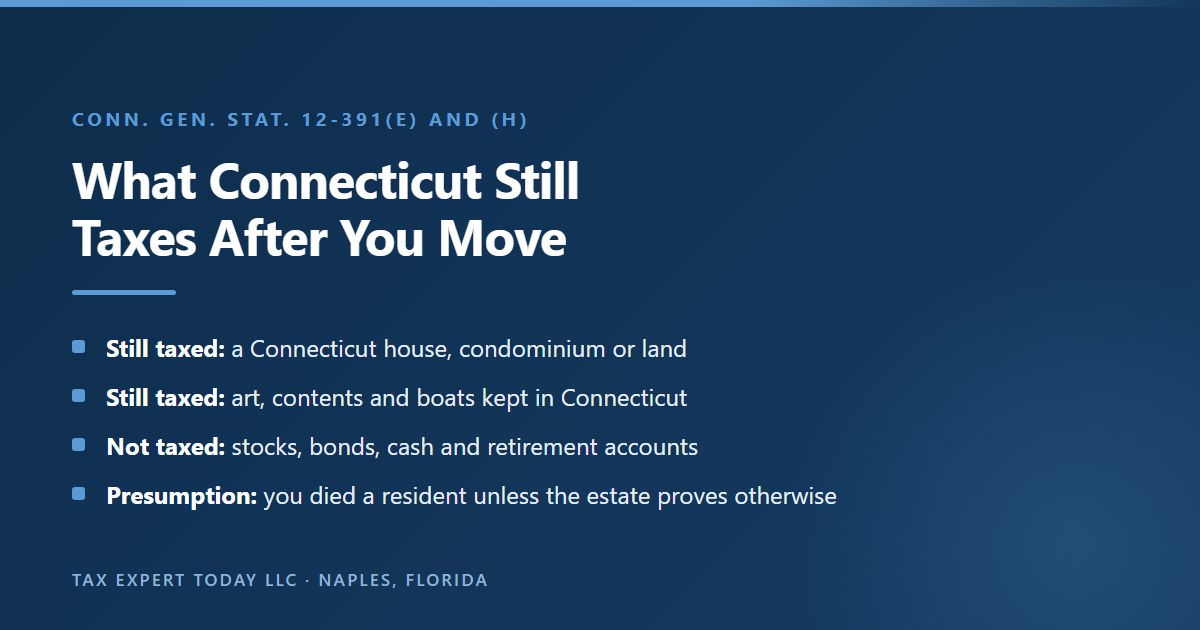
Only to the extent you leave property in Connecticut. Once your domicile is genuinely in Florida, Connecticut can tax a nonresident estate only on real property located in Connecticut and tangible personal property with an actual situs there. Stocks, bonds, bank accounts, retirement accounts and most business interests fall outside the Connecticut estate tax after a completed move.
- Still reachable: a Connecticut house, condominium, land or vacation property.
- Still reachable: furniture, art, cars and boats physically kept in Connecticut.
- Not reachable: brokerage accounts, cash, notes and most closely held stock owned by a Florida domiciliary.
- Exception: Connecticut real estate inside a pass-through entity can be looked through in three situations.
Section 12-391(e)(2)(A) gives Connecticut “the power to levy the estate tax upon all real property situated in this state and tangible personal property having an actual situs in this state” for a nonresident estate. That is the whole of Connecticut’s jurisdiction over a nonresident. Compare that with subsection (d)(3), which gives Connecticut power over a resident estate’s real and tangible property in Connecticut and “intangible personal property included in the gross estate of the decedent, regardless of where it is located.” The difference between those two subsections is the difference between Connecticut taxing your entire portfolio and Connecticut taxing only the house you kept.
Florida, for its part, does not tax estates. Article VII, section 5(a) of the Florida Constitution bars any state tax upon estates or inheritances of residents in excess of the amount that may be credited against a similar federal or state tax, and the federal state death tax credit no longer exists, so Florida collects nothing. A Florida domiciliary’s only state death tax exposure is therefore to the states where that person still owns real or tangible property.
The phrase that does the work is “genuinely in Florida.” Connecticut decides residency for its own estate tax, and it starts from a presumption that favors Connecticut. A move that looks complete on paper but leaves the family, the doctors, the club memberships and most of the year in Connecticut can be reclassified after death, and then the entire estate, intangibles included, is back in the Connecticut base. Our guide on how to establish Florida residency covers the domicile change itself, and the section below explains why Connecticut’s version of the test is harder than most.
Why Does Connecticut Presume You Died a Connecticut Resident?
Because the statute says so. Section 12-391(h)(1) presumes every decedent died a Connecticut resident and places the burden of proof on any estate claiming nonresidency. After a move to Florida, the executor must prove the domicile changed, and the estate files the return before Connecticut decides. A separate procedure lets the estate ask for a formal determination of domicile.
- Presumption: every decedent is presumed to have died a Connecticut resident.
- Burden: on the estate claiming the decedent was a nonresident.
- Request window: between 270 days and three years after the return’s due date, including extensions.
- Commissioner’s deadline: 180 days after the request, unless extended by agreement or tolled by negotiations with another state.
- Protest: 60 days after a proposed determination is mailed.
The presumption is unusually blunt. It does not say that a person who once lived in Connecticut is presumed to remain a resident; it says each decedent shall be presumed to have died a resident of Connecticut, and the burden of proof in an estate tax proceeding is on any estate claiming exemption by reason of nonresidency. In practice that means the record the decedent built while alive is the record the executor has to rely on after death, without the decedent available to explain it.
Section 12-391(h)(2) then sets out a procedure for resolving the question. After filing the return, the person required to file may submit a written request for determination of domicile to the Commissioner of Revenue Services, stating the specific grounds. The request can be filed only when at least 270 days, but no more than three years, have passed since the due date of the return (or the extended due date), and only if the Commissioner has not already decided the question or begun negotiating a compromise with another state’s tax authorities under section 12-395a. The Commissioner then has 180 days to decide, a period that can be extended by written agreement and that is tolled while negotiations with another jurisdiction are under way. A proposed determination becomes final 60 days after mailing unless a written protest is filed, and a final determination can be appealed under section 12-395(b).
Two practical points follow. First, the request does not suspend the obligation to pay: subdivision (h)(6) says nothing in the procedure relieves the estate of paying the correct tax on time. An executor who believes the decedent was a Florida domiciliary but who is not certain Connecticut will agree has to decide how much to pay while the question is open. Second, the compromise reference matters for people who split time among several states. Connecticut has statutory authority to negotiate with another state that also claims the decedent, which is a reminder that the risk in a contested domicile case is not only Connecticut’s tax but two states taxing the same intangibles.
The facts that decide these cases are the same ones that decide income tax residency disputes: where the decedent’s home was, where the family lived, where time was spent, where the doctors, dentists, clubs, religious community and valuables were, where the decedent voted and was licensed, and what the decedent said about where home was. Our guides on the Florida residency audit and the dual-state residency tax trap walk through those factors in detail, and the Florida 183-day rule calculator helps keep the day count that underpins them.
Which Connecticut Property Is Still Taxed After the Move?
Connecticut real estate and tangible personal property physically located in Connecticut stay inside the Connecticut estate tax for a Florida domiciliary. Intangible property, including stocks, bonds, cash, retirement accounts and most business interests, falls outside it. Real estate held through a partnership, S corporation or single member LLC can be pulled back in.
- Real property: any Connecticut house, condominium, land or commercial building owned directly.
- Tangible property: contents, art, jewelry, vehicles and boats kept in Connecticut at death.
- Intangibles: outside the tax for a nonresident, wherever the account or certificate is held.
- Entities: generally intangible, unless the look-through rule in section 12-391(e)(2)(B) applies.
The distinction between tangible and intangible property is older than the Connecticut estate tax itself, and it is the reason a move works. A share of stock is property that follows the owner, so it is taxed by the owner’s domicile. A house cannot follow anyone, so it is taxed where it sits. The table below applies that line to the assets a typical Connecticut family owns.
| Asset | Connecticut resident at death | Florida domiciliary at death |
|---|---|---|
| Connecticut house or condominium | In the Connecticut base | In the Connecticut base |
| Florida home | Excluded by the out-of-state real property reduction | Outside Connecticut’s jurisdiction |
| Art, furniture or a boat kept in Connecticut | In the Connecticut base | In the Connecticut base |
| Brokerage account, bonds, cash | In the Connecticut base | Outside Connecticut’s jurisdiction |
| IRA, 401(k) and annuities | In the Connecticut base | Outside Connecticut’s jurisdiction |
| Operating business stock or LLC units | In the Connecticut base | Generally outside, as intangible property |
| Connecticut real estate in a disregarded LLC with no business purpose | In the Connecticut base | Can be treated as owned directly under section 12-391(e)(2)(B) |
Two details are worth adding. Tangible property is taxed where it has an “actual situs,” which is a question of where it physically is and is kept, not where it happens to be on a given day. A painting that hangs in the Greenwich house most of the year is a Connecticut asset; a car that is registered and garaged in Naples is not, even if it was driven north for the summer. And a Connecticut resident’s estate gets a reduction for real and tangible property located outside Connecticut under section 12-391(d)(2), which is why the Florida home does not count against a resident’s Connecticut tax either. The difference after the move is the intangibles.
If the property you kept is a former principal residence that you intend to sell, the income tax side has its own clock. Our guide on selling your home after moving to Florida covers the section 121 exclusion and old-state withholding at closing, which run on a separate track from the Connecticut estate tax described here.
How Is Connecticut Estate Tax Computed for a Nonresident?
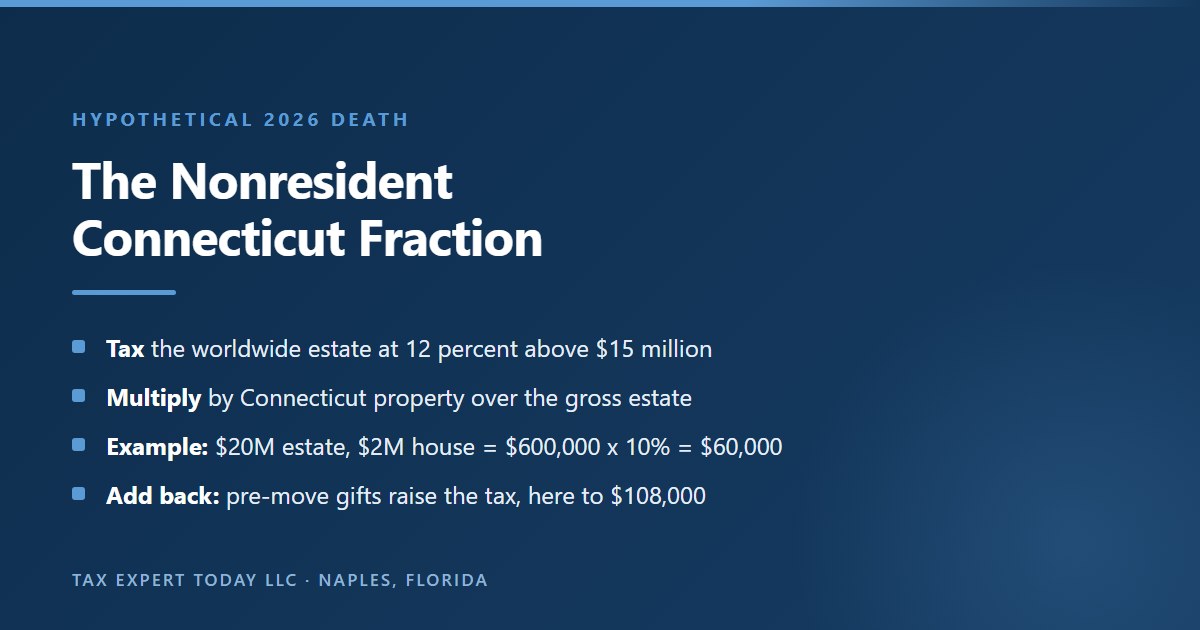
Connecticut first computes the tax as if the entire estate were Connecticut’s, using the worldwide Connecticut taxable estate and the 12 percent rate above the exemption. It then multiplies that tax by a fraction: the value of Connecticut real and tangible property over the value of the whole gross estate. Florida assets stay in the arithmetic, untaxed.
- Step one: compute the worldwide Connecticut taxable estate, including adjusted Connecticut taxable gifts.
- Step two: apply 12 percent to the amount above $15,000,000 for a 2026 death.
- Step three: multiply by Connecticut real and tangible property divided by the gross estate.
- Step four: subtract credit for Connecticut gift tax paid, and apply the $15 million cap.
Section 12-391(e)(1)(D) states the method for nonresident deaths on or after January 1, 2019. The tax is “computed by multiplying the amount of tax determined using the schedule in subsection (g)” by a fraction whose numerator is the value of the part of the gross estate over which Connecticut has jurisdiction and whose denominator is the value of the decedent’s gross estate. The schedule in subsection (g) is applied to the Connecticut taxable estate, which section 12-391(c)(1)(C) defines as the gross estate less allowable federal deductions, plus Connecticut taxable gifts made since 2005 that are not already in the gross estate, plus Connecticut gift tax paid within three years of death.
The consequence is that a large Florida portfolio does not escape the arithmetic. It pushes the tentative tax up, and the fraction then scales the tax back down to the Connecticut share. For a modest Connecticut property inside a large estate, the result is a meaningful but proportionate bill. For an estate under the exemption, the result is no tax at all, no matter how valuable the Connecticut property is, because the tentative tax is zero before the fraction is ever applied.
The hypothetical examples below assume a 2026 death, a single decedent or a surviving spouse with no marital deduction available, no deductions other than those shown, and no lifetime Connecticut taxable gifts unless stated. They illustrate the statutory method only.
| Hypothetical estate | Connecticut taxable estate | Tentative tax at 12% above $15M | Connecticut fraction | Connecticut estate tax |
|---|---|---|---|---|
| $14M worldwide, $3M Connecticut house | $14,000,000 | $0 | 3/14 | $0 (return still required) |
| $20M worldwide, $2M Connecticut house | $20,000,000 | $600,000 | 2/20 = 10% | $60,000 |
| $30M worldwide, $3M Connecticut house | $30,000,000 | $1,800,000 | 3/30 = 10% | $180,000 |
| $20M worldwide, $2M Connecticut house, plus $4M of Connecticut taxable gifts made in 2024 while a resident | $24,000,000 | $1,080,000 | 2/20 = 10% | $108,000 |
| $20M worldwide, all intangible, decedent still a Connecticut resident | $20,000,000 | $600,000 | Not applied | $600,000 |
The last two rows carry the planning point. In the fourth row, gifts made while the decedent lived in Connecticut increase the tentative tax even though the decedent died a Florida domiciliary, because those gifts were Connecticut taxable gifts when they were made and the statute adds them back. The fraction does not include them in its denominator, which is the gross estate, so the add-back raises the bill from $60,000 to $108,000. In the fifth row, the same $20 million estate with no Connecticut property at all pays $600,000 if Connecticut successfully claims the decedent never left. That is the stake in the residency question.
How Does the Connecticut Gift Tax Work?
Connecticut is the only state with a standalone gift tax. It taxes Connecticut taxable gifts above the federal basic exclusion amount at 12 percent, counting every Connecticut taxable gift made since 2005. The exemption is shared with the estate tax, so lifetime gifts use up the same $15 million that would otherwise shelter the estate.
- Who: any individual, resident or nonresident, under section 12-640.
- What: gifts that are taxable gifts for federal purposes, after the annual exclusion and the marital and charitable deductions.
- How much: nothing on cumulative Connecticut taxable gifts up to the federal basic exclusion amount, 12 percent above it.
- When: return and payment due April 15 of the year after the gift.
- Backstop: if the donor does not pay, the donee is personally liable up to the value of the gift.
The gift tax lives in chapter 228c of the General Statutes. Section 12-640 imposes it on transfers by gift during the year “by any individual resident or nonresident.” Section 12-643 borrows the federal definition of taxable gifts, so the federal annual exclusion, which is $19,000 per donee for 2026 according to the IRS, and the federal marital and charitable deductions all carry over. Gifts within the annual exclusion and gifts to a United States citizen spouse are therefore not Connecticut taxable gifts at all.
Section 12-642(a)(11) sets the rate for gifts made in calendar years beginning on or after January 1, 2023. The schedule is applied to the gifts of the current year “including the aggregate amount of all Connecticut taxable gifts made by the donor during all calendar years commencing on or after January 1, 2005,” with a credit for Connecticut gift tax previously paid. No tax is due up to the federal basic exclusion amount, and 12 percent is due above it. Because the computation is cumulative, a $5 million gift in 2020 and a $10 million gift in 2026 are measured together; the 2026 gift is the one that crosses the exemption.
Most people never pay Connecticut gift tax. What they do is consume exemption. Every dollar of Connecticut taxable gifts reduces, dollar for dollar, the room left to shelter the estate at death, exactly as the federal unified credit does. The difference is that the federal and Connecticut ledgers are kept separately, and they do not always match, because Connecticut only counts gifts it had jurisdiction over and only counts them from 2005 forward.
A Connecticut gift tax return is due on or before April 15 following the close of the calendar year under section 12-645, with payment due the same day under section 12-647. If the donor dies in the year of the gift, the return and payment are due with the estate tax return instead. Late payment carries a penalty of 10 percent of the unpaid tax or $50, whichever is greater, plus interest at 1 percent per month. Section 12-642(b) adds a feature that surprises many families: if the donor does not pay, the donee becomes personally liable for the tax to the extent of the value of the gift.
Does Connecticut Gift Tax Apply to Gifts Made Before You Move?
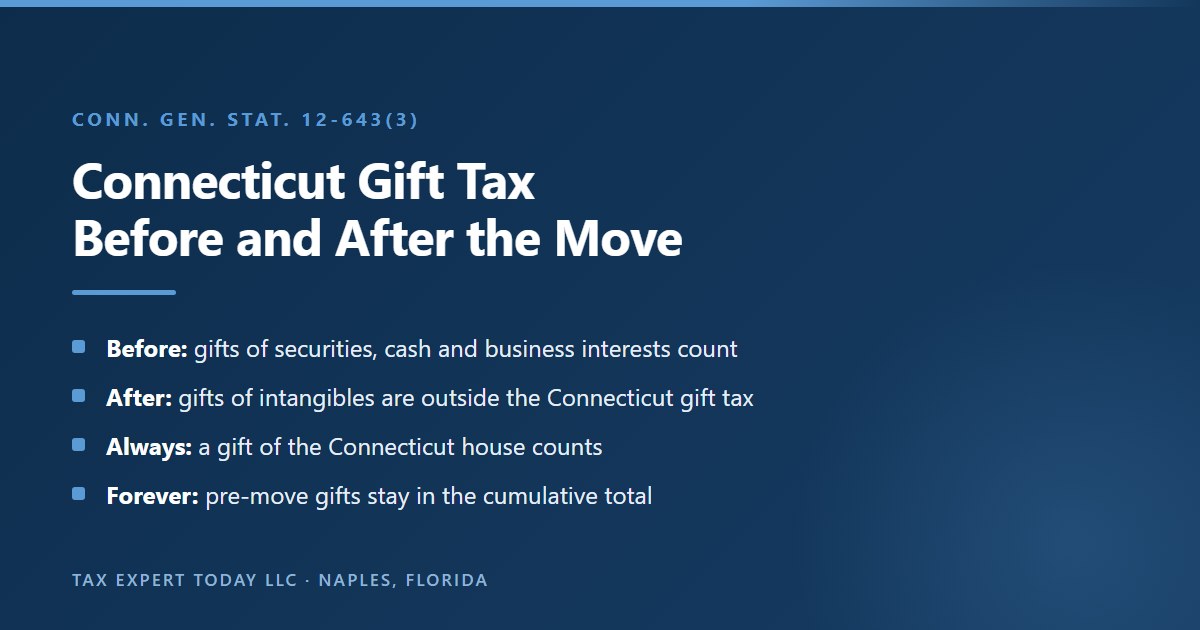
Yes. A gift made while you are a Connecticut resident is a Connecticut taxable gift whatever the property, except real or tangible property located outside Connecticut. After a completed move to Florida, only gifts of Connecticut real estate and tangible property located in Connecticut remain Connecticut taxable gifts. The date of the move therefore controls which gifts count.
- Before the move: gifts of securities, cash and business interests count, wherever the account is held.
- After the move: gifts of intangibles by a Florida domiciliary are outside the Connecticut gift tax.
- Either way: a gift of the Connecticut house to your children is a Connecticut taxable gift.
- Permanently counted: pre-move gifts stay in the cumulative total and in the estate tax base.
Section 12-643(3) is the key definition. Connecticut taxable gifts are taxable gifts made in calendar years beginning on or after January 1, 2005 that are “(A) for residents of this state, taxable gifts, wherever located, but excepting gifts of real estate or tangible personal property located outside this state, and (B) for nonresidents of this state, gifts of real estate or tangible personal property located within this state.” Section 12-641 confirms that the gift tax does not apply to real and tangible property with a situs outside Connecticut.
For a family that intends to make large gifts, the sequencing question is direct. A $16 million gift of marketable securities to an irrevocable trust, made in 2026 by a Connecticut resident with no prior taxable gifts, produces a Connecticut gift tax of $120,000 (12 percent of the $1,000,000 above the exemption), due April 15, 2027, in addition to any federal gift tax. The same gift made after a completed, provable move to Florida is not a Connecticut taxable gift at all. A smaller gift that stays under the exemption is not taxed in either case, but if it is made before the move, it is permanently recorded in the Connecticut cumulative total and comes back into the estate tax computation at death.
| Gift | Made while a Connecticut resident | Made after a completed Florida move |
|---|---|---|
| Marketable securities to a trust | Connecticut taxable gift | Not a Connecticut taxable gift |
| Cash to children above the $19,000 annual exclusion | Connecticut taxable gift | Not a Connecticut taxable gift |
| LLC units in an operating business | Connecticut taxable gift | Generally not a Connecticut taxable gift |
| The Connecticut house, deeded to children | Connecticut taxable gift | Connecticut taxable gift |
| A Florida condominium, deeded to children | Not a Connecticut taxable gift | Not a Connecticut taxable gift |
| Gifts within the annual exclusion or to a U.S. citizen spouse | Not taxable | Not taxable |
This is the point the general summaries tend to miss. The common advice that lifetime gifting avoids a state estate tax works in states without a gift tax, subject to whatever add-back rules they have. In Connecticut, a large lifetime gift made as a resident is itself taxed above the exemption and is permanently counted. The move does not erase it. What the move does is stop the clock: from the day domicile changes, gifts of intangibles stop counting. Our guide on the 2026 lifetime gift tax exemption covers the federal side of the same decision.
Do Gifts Made in Connecticut Come Back Into the Estate?
Yes. The Connecticut taxable estate adds back every Connecticut taxable gift made since 2005 that is not already included in the federal gross estate, plus Connecticut gift tax paid on gifts made within three years of death. The gift tax actually paid is then credited against the estate tax, so the add-back measures the rate, not a second tax.
- Added back: Connecticut taxable gifts since 2005, other than gifts already in the gross estate.
- Grossed up: Connecticut gift tax paid on gifts made in the three years before death.
- Credited: Connecticut gift tax paid by the decedent, or by a spouse on a split gift that is includable.
- Applies to nonresidents: the same definition drives the nonresident computation.
Section 12-391(c)(1)(C) defines the Connecticut taxable estate for deaths on or after January 1, 2015 as the gross estate less allowable deductions, plus “the aggregate amount of all Connecticut taxable gifts, as defined in section 12-643, made by the decedent for all calendar years beginning on or after January 1, 2005, other than Connecticut taxable gifts that are includable in the gross estate,” plus the amount of any Connecticut gift tax paid on gifts made by the decedent or the decedent’s spouse during the three years before death. The state death tax deduction under section 2058 of the Internal Revenue Code is disregarded.
The three year gross-up is the familiar federal concept from section 2035(b): a donor who pays gift tax shortly before death removes the tax dollars from the estate, so the law brings them back. Connecticut applies the same logic to its own gift tax. The broader add-back, however, has no three year limit at all. It reaches back to 2005, which means a Connecticut resident who made large gifts fifteen years ago and later moved to Florida still carries those gifts into the Connecticut computation if the estate includes any Connecticut real or tangible property.
The fourth example in the computation table above shows how that works for a nonresident. The add-back increases the tentative tax, but the fraction that apportions it is based on the gross estate, which does not include the gifts. The add-back therefore raises the effective rate on the Connecticut property. For an estate well under the exemption, it may make no difference. For an estate near or over it, it can move the Connecticut bill materially.
What Is the $15 Million Cap on Connecticut Estate and Gift Tax?
The Connecticut estate tax payable for a death on or after January 1, 2019 cannot exceed $15 million, and the cap is reduced by Connecticut gift tax already paid on gifts made since 2016. The gift tax has a matching $15 million aggregate cap. At a 12 percent rate, the cap matters only for very large estates.
- Estate tax cap: $15 million for resident and nonresident estates alike.
- Gift tax cap: $15 million aggregate for gifts made in years beginning in 2016 or later.
- Shared: gift tax paid since 2016 reduces the estate tax cap dollar for dollar.
- Threshold: a 12 percent tax reaches $15 million only on roughly $125 million above the 2026 exemption.
The cap appears in section 12-391(d)(1)(E) for resident estates and section 12-391(e)(1)(D) for nonresident estates, and in section 12-642(c)(2) for the gift tax. Before 2019 the cap was $20 million. For a resident with a 2026 death, a 12 percent tax on the amount above $15,000,000 reaches $15 million when the Connecticut taxable estate is about $140,000,000. For a nonresident, the fraction scales the tax down before the cap is compared, so the cap is almost never the binding limit for a Florida domiciliary with a single Connecticut property.
For the very largest families, the cap is one reason Connecticut estate planning looks different from planning in a state with no ceiling. Once the cap is reached, additional value is not taxed by Connecticut at all, which changes the arithmetic of lifetime gifts and of where to hold assets. Those are decisions that turn on specific facts and should be modeled with counsel rather than generalized.
Does Connecticut Recognize Portability Between Spouses?
No. Connecticut measures its exemption against the federal basic exclusion amount, which does not include a deceased spouse’s unused exclusion. A federal portability election therefore does not carry the first spouse’s Connecticut exemption to the survivor. Married couples protect both Connecticut exemptions through drafting, such as a credit shelter trust or a state-only QTIP election.
- No portability: the first spouse’s unused Connecticut exemption is lost unless the plan uses it.
- Marital deduction: transfers to a U.S. citizen spouse are deductible for Connecticut, as they are federally.
- State-only QTIP: Connecticut allows a QTIP election for state purposes even without a federal election.
- Florida move: after the move, the issue matters only for the Connecticut property left behind.
Section 12-391(c)(4) defines the federal basic exclusion amount as the dollar amount published annually by the IRS at which a decedent would be required to file a federal estate tax return. That is the basic exclusion amount under section 2010(c)(3), not the applicable exclusion amount under section 2010(c)(2), which is the figure that includes the deceased spousal unused exclusion amount. The practical result, which Connecticut commentators consistently describe the same way, is that portability is a federal tool only.
Connecticut does give married couples one important flexibility. Section 12-391(f) says the Connecticut taxable estate is determined taking into account all federal deductions, specifically including the qualified terminable interest property deduction under section 2056(b)(7), and that a QTIP election “may be made for state estate tax purposes regardless of whether any such election is made for federal estate tax purposes.” That separate election lets an executor use the first spouse’s Connecticut exemption without wasting any of the federal exemption, which is useful in plans written when the two exemptions differed.
For a couple who has moved to Florida, the stakes are narrower. The only Connecticut estate exposure is the Connecticut property, so the question is whether the survivor’s estate will include enough Connecticut real or tangible property, and a large enough worldwide estate, to produce a Connecticut tax at the second death. Our guides on the spousal lifetime access trust and the irrevocable life insurance trust cover two of the tools families commonly use alongside these elections.
How Is Connecticut Real Estate Held in an LLC Treated?
Generally as an intangible interest, which a Florida domiciliary’s estate would not owe Connecticut tax on. But section 12-391(e)(2)(B) looks through a partnership, S corporation or disregarded single member LLC and treats the Connecticut real estate as owned directly if any one of three conditions applies, which most personal-use LLCs meet.
- Condition one: the entity does not carry on a business for profit and gain.
- Condition two: the entity’s ownership of the property was not for a valid business purpose.
- Condition three: the property was not acquired in a bona fide sale for full consideration, and the decedent kept powers or interests that pull it into the federal gross estate.
- Covered entities: partnerships, S corporations and single member LLCs disregarded for federal income tax.
The rule exists because the simplest way to convert a Connecticut house into intangible property would be to deed it into an LLC and hold the membership interest. The statute closes that door for nonresident estates. The look-through applies to real and tangible property owned by a pass-through entity, and when it applies, the property is “treated as personally owned by the decedent in proportion to the nonresident decedent’s constructive ownership.” A family vacation home held in an LLC that carries on no business, that was formed to hold the property rather than for a business reason, and that the decedent funded by contribution rather than sale will usually meet at least one of the three conditions.
The look-through has limits that matter for business owners. An operating company that owns its Connecticut plant or offices and carries on a real business for profit is outside it, and the decedent’s interest stays intangible. A rental property held in an LLC that is actively managed for profit raises a closer question, which turns on the facts of the operation. The statute also clarifies that it does not create a lien on the real property beyond what would apply to a resident’s interest in the same entity.
Our guides on selling rental property after a move and trust situs after moving to Florida cover the income tax side of property held through entities and trusts. Restructuring how a Connecticut property is held is a legal decision, and the documents should be prepared by Connecticut counsel.
What Connecticut Returns Must a Florida Estate File?
An estate that includes any Connecticut real or tangible property must file a Connecticut estate tax return, whether or not tax is due. Taxable estates file Form CT-706/709 with payment due six months after death. Estates under the exemption file Form CT-706 NT. Gift tax returns are due April 15 after the gift.
- Who files: every resident estate and every nonresident estate with Connecticut real or tangible property.
- Taxable estates: Form CT-706/709, the combined estate and gift tax return.
- Nontaxable estates: Form CT-706 NT.
- Payment: due six months after death; 10 percent penalty or $50 if late, plus 1 percent interest per month.
- Extension: available for reasonable cause, with interest running from the original due date.
The Connecticut Probate Courts state that a Connecticut estate tax return must be filed for each decedent who was a Connecticut resident and for nonresidents who died owning real or tangible personal property located in Connecticut, and that a return is required for every decedent’s estate whether or not tax is due. The probate courts also note that the return must report all property, real and personal, tangible and intangible, wherever located. For a nonresident that is the arithmetic described above: the whole estate is reported so that the Connecticut fraction can be computed.
Payment rules come from section 12-392. For deaths on or after July 1, 2009, the tax is payable to the Commissioner of Revenue Services six months after the date of death, without assessment or demand. Late payment draws a penalty of 10 percent of the unpaid amount or $50, whichever is greater, and interest at 1 percent per month. The Commissioner may extend the time to pay for reasonable cause, and may require a tentative return and payment with the extension. Executors, trustees, beneficiaries and surviving joint owners are each liable for the tax up to the value of the property they received.
In practice, a nonresident estate with a Connecticut house also faces an ancillary probate proceeding in the Connecticut probate district where the property sits, unless the property passes outside probate through a revocable trust or joint ownership. Probate avoidance does not avoid the tax; the property is still in the gross estate and still in the numerator of the fraction. For the federal and Florida filings that run alongside, see our guide on the nonresident state tax return.
How Does Connecticut Compare With Other Departure States?
Connecticut is the only departure state with a standalone gift tax, and it now has the highest exemption of any state estate tax because it tracks the federal amount. New York, Massachusetts and Maryland have lower thresholds. New Jersey and Pennsylvania tax heirs through an inheritance tax instead. All of them can reach property left behind after a Florida move.
- Connecticut: estate tax plus a unified gift tax, exemption equal to the federal amount, 12 percent flat.
- New York: estate tax with a cliff above the exclusion, no gift tax, a three year gift add-back.
- Massachusetts: estate tax with a $2 million threshold and no gift tax.
- Maryland: both an estate tax and an inheritance tax.
- New Jersey and Pennsylvania: inheritance tax only, depending on who receives the property.
The common thread is the one this guide series keeps returning to. A completed change of domicile to Florida removes the departure state’s claim on intangible property, and leaves its claim on the real and tangible property that stays behind. What differs from state to state is the threshold, the rate, whether gifts count, and how the tax on the remaining property is computed. Connecticut is generous on the threshold and unforgiving on gifts.
| Departure state | Death tax type | Gift tax or gift add-back | Our nonresident guide |
|---|---|---|---|
| Connecticut | Estate tax, exemption equal to the federal basic exclusion | Standalone gift tax, cumulative since 2005 | This guide |
| Massachusetts | Estate tax | No gift tax | Massachusetts estate tax |
| Maryland | Estate tax and inheritance tax | No gift tax | Maryland estate tax |
| New Jersey | Inheritance tax | Transfers within three years of death can be reached | New Jersey inheritance tax |
| Pennsylvania | Inheritance tax | Transfers within one year of death can be reached | Pennsylvania inheritance tax |
| Florida | None | None | Florida estate planning |
For families leaving New York, the income tax side of the move is covered in our guide to the New York exit tax, and families leaving Illinois will find the parallel analysis in our Illinois exit tax guide.
What Should a Connecticut Resident Do Before Moving to Florida?
Complete the change of domicile before making large gifts, decide what to do with each Connecticut property, check whether any LLC holding Connecticut real estate would be looked through, and rewrite the estate plan for Florida. Then keep the record that rebuts Connecticut’s presumption, because the executor will need it after death.
- Sequence the gifts: large gifts of intangibles made after a completed move are outside the Connecticut gift tax.
- Review each property: keep, sell, or restructure the Connecticut house with counsel.
- Test the entities: confirm whether a property LLC has a business purpose that survives the look-through.
- Rewrite the documents: Florida wills, trusts and powers of attorney, with a plan for both spouses’ Connecticut exemptions.
- Build the record: declaration of domicile, day logs, licenses, voting, doctors, and where the valuables are kept.
The first step is the move itself. Florida lets a new resident file a sworn declaration of domicile with the clerk of the circuit court under Fla. Stat. section 222.17, and that filing is useful evidence. It is not decisive, because Connecticut weighs the full pattern of the decedent’s life, but it belongs in the file along with the Florida driver’s license, voter registration, vehicle registrations, and the homestead application. Valuables, family heirlooms and important papers should move with you; a safe deposit box left in Connecticut is a classic piece of contrary evidence.
The second step is timing gifts. If a large lifetime gift is part of the plan, a gift of intangibles made after a completed move is outside the Connecticut gift tax and outside the cumulative Connecticut total. A gift made a month before the move is permanently in both. That said, a gift made immediately after a move, when the Florida record is thin, invites the argument that the donor was still a Connecticut resident on the date of the gift. The safer sequence is a move that is clearly complete, followed by the gift.
The third step is the property left behind. Some families sell the Connecticut house, which removes it from the Connecticut estate tax entirely and starts the income tax analysis covered in our guide on selling your home after moving to Florida. Others keep it for family use and accept a proportionate Connecticut tax at death if the estate is above the exemption. Others restructure ownership, which has to clear the pass-through look-through and should be handled by Connecticut counsel. A qualified personal residence trust is one tool families sometimes consider for a second home, with the federal consequences that come with it.
The fourth step is the documents. Connecticut wills and revocable trusts are generally valid in Florida, but they were written for a Connecticut domiciliary and often for a world in which the Connecticut and federal exemptions differed. A Florida estate planning attorney should review them, and the review should address both spouses’ Connecticut exemptions on any property that stays in Connecticut. Our guides on Florida asset protection for new residents and decanting a trust cover two adjacent decisions.
The last step is the income tax side of the move year. Connecticut taxes a resident’s worldwide income for the part of the year before the move, and the same domicile facts that decide the estate tax decide the income tax. Our guide on snowbird taxes in year one walks through the part-year return.
Connecticut Estate Tax Help in Naples & Southwest Florida
Tax Expert Today LLC works with Connecticut families who have moved, or are moving, to Naples, Florida and across Southwest Florida on the state tax side of the relocation, including the Connecticut estate and gift tax exposure on property left behind, the sequencing of lifetime gifts around the change of domicile, and the residency record that answers Connecticut’s presumption. The firm is multidisciplinary, with enrolled agents, CPAs and attorneys, and it handles residency and tax matters nationwide, coordinating with Connecticut and Florida estate counsel on the legal documents. Our office is at 11983 Tamiami Trail N, Naples, FL 34110, open Monday through Friday, 10 a.m. to 5 p.m. ET, and reachable at (239) 441-2005.
- Connecticut estate tax help Naples: nonresident estate tax computations, CT-706 NT and CT-706/709 coordination, and gift sequencing for families from Connecticut.
- Florida residency records: the declaration of domicile, day logs, licenses and the other facts Connecticut weighs.
- Second homes and entities: analysis of Connecticut property held directly, jointly, in trust or through an LLC.
Our Naples tax planning practice and our Florida tax services page describe the wider planning work, and our estate and trust planning services cover the documents that should change with the move.
We moved from Westport to Naples and kept our Connecticut house for the summers. Will Connecticut tax our estate?
Possibly, but only through the house and anything else physically kept there, and only if the worldwide estate exceeds the exemption, which is $15,000,000 for a 2026 death. Connecticut computes the tax on the whole estate and keeps the share that the Connecticut property bears to the gross estate. A Connecticut return is required either way, and the strength of your Florida record matters because Connecticut presumes residency.
When to Engage a Professional
A family whose worldwide estate is well under the exemption, who has made no large lifetime gifts and who has no plans to make them, often needs only a clean Florida domicile record and a review of the estate documents. Professional help with the Connecticut estate tax earns its cost when the estate is near or above $15 million, when large gifts were made while living in Connecticut or are planned around the move, when a Connecticut property is held through an LLC or a trust, when one spouse spends substantial time in Connecticut, or when the plan still relies on federal portability to protect the first spouse’s exemption. Those are the points where sequencing and drafting change the result. Tax Expert Today LLC’s enrolled agents, CPAs and attorneys can model the Connecticut computation, coordinate with your Connecticut and Florida counsel, and help build the record that answers Connecticut’s presumption. Call (239) 441-2005 to schedule a consultation.
Frequently Asked Questions
Does Connecticut estate tax apply after I move to Florida?
Only to Connecticut real estate and tangible personal property located in Connecticut. Under section 12-391(e), a nonresident estate is taxed on that property alone, computed as a fraction of the tax on the whole estate. Intangible assets such as stocks, bonds and bank accounts are outside the Connecticut estate tax once your domicile is genuinely in Florida.
What is the Connecticut estate tax exemption in 2026?
For deaths in 2026 the Connecticut exemption equals the federal basic exclusion amount, which is $15,000,000. Section 12-391(g)(9) ties the exemption to the figure the IRS publishes each year, so it moves with the federal amount. The Connecticut taxable estate above the exemption is taxed at a flat 12 percent.
Does Connecticut have a gift tax?
Yes. Connecticut is the only state with a standalone gift tax. It taxes cumulative Connecticut taxable gifts made since 2005 above the federal basic exclusion amount at 12 percent, and the exemption is shared with the estate tax. Gifts within the $19,000 annual exclusion and gifts to a U.S. citizen spouse are not Connecticut taxable gifts.
Are gifts I made before moving to Florida still counted by Connecticut?
Yes. A gift made while you were a Connecticut resident is a Connecticut taxable gift whatever the property, except real or tangible property outside Connecticut. It stays in the cumulative gift total and is added back to the Connecticut taxable estate at death. After a completed move, only gifts of Connecticut real or tangible property count.
Is portability available for the Connecticut estate tax?
No. Connecticut measures its exemption against the federal basic exclusion amount, which does not include a deceased spouse’s unused exclusion. A federal portability election therefore does not preserve the first spouse’s Connecticut exemption. Couples typically protect it through a credit shelter trust or a state-only QTIP election, which Connecticut allows under section 12-391(f).
Does putting my Connecticut house in an LLC avoid the tax?
Often not. Section 12-391(e)(2)(B) looks through a partnership, S corporation or disregarded single member LLC and treats Connecticut real estate as owned directly if the entity carries on no business for profit, lacks a valid business purpose for owning it, or acquired it other than by bona fide sale while the decedent kept certain powers.
Published October 17, 2026 by Dr. Pellumb Kabashi « Back to Learning Center
Have a question this article touches on?
Tax Expert Today LLC, based in Naples, Florida and serving clients across the United States.
Schedule a Consultation (239) 441-2005