
By Dr. Pellumb Kabashi, DBA, MBA, CES, CFE, EA
Founder, Tax Expert Today LLC · Tax advisors, enrolled agents, CPAs, and attorneys · Serving clients in all 50 states
Quick answer: Massachusetts estate tax still applies after you move to Florida, but only to Massachusetts real estate and tangible property such as a Cape house, a Boston condominium and its contents. For deaths on or after August 1, 2025, the tax is computed on that property alone, less related deductions, and a $99,600 credit means Massachusetts property worth $2 million or less owes nothing. Call (239) 441-2005 for a free consultation.
Published: September 2026
Moving from Massachusetts to Florida ends Massachusetts income tax on your future earnings and, for most families, ends the Massachusetts estate tax on almost everything you own. Almost is the operative word. Many people who leave the Commonwealth keep a foothold there: the summer house in Chatham or Falmouth, a condominium in the Back Bay or the Seaport for visits with grandchildren, a ski place in the Berkshires, or a boat that never came south. Each of those is real estate or tangible personal property located in Massachusetts, and each one keeps a Massachusetts estate tax return in your family’s future. This guide explains what the Massachusetts estate tax still reaches after a move to Florida, how the nonresident tax is computed under the rules that took effect on August 1, 2025, when a return is required even though no tax is due, and what a Florida domiciliary can do about it while still alive.
The figures in this guide were verified against the statute, the Department of Revenue guidance and the IRS on the date of publication. Massachusetts has changed this tax three times since 2023, so an estate should confirm the rules for the actual date of death before relying on any number here.
Does Massachusetts Estate Tax Apply After You Move to Florida?
Yes, but only to part. Once you are domiciled in Florida, Massachusetts can tax only real estate and tangible personal property located in Massachusetts under M.G.L. c. 65C, §2A(b). Brokerage accounts, retirement accounts, bank accounts and the Florida home fall outside its reach, and Massachusetts property worth $2 million or less owes no tax after the $99,600 credit.
- Still reached: a Cape Cod or Islands house, a Boston condominium, Berkshires land and the furniture, cars and boats kept at those places.
- Not reached: stocks, bonds, mutual funds, IRAs, 401(k) plans, bank deposits and life insurance of a nonresident.
- Not reached: your Florida homestead or any real estate outside Massachusetts.
- The condition: you must actually have been domiciled in Florida at death, not merely spending winters there.
The statute imposes two separate taxes. Section 2A(a) taxes the transfer of the entire estate of a person who was a resident of the Commonwealth at death. Section 2A(b) taxes the transfer of real property situated in Massachusetts and tangible personal property having an actual situs in Massachusetts of a person who was not a resident at death. The Department of Revenue defines a resident for this purpose as a person whose permanent and principal home is in the Commonwealth. For the estate tax, then, the question is domicile, not a count of days, and that distinction matters later in this guide.
For a family that has genuinely moved, the practical effect is that Massachusetts stops caring about the investment portfolio, which is usually the largest part of the estate. What remains is a tax on the Massachusetts house and its contents. That is a much smaller target, and after the 2025 change it is measured on its own rather than as a slice of the whole estate.
What Massachusetts Property Is Still Taxed for a Nonresident?
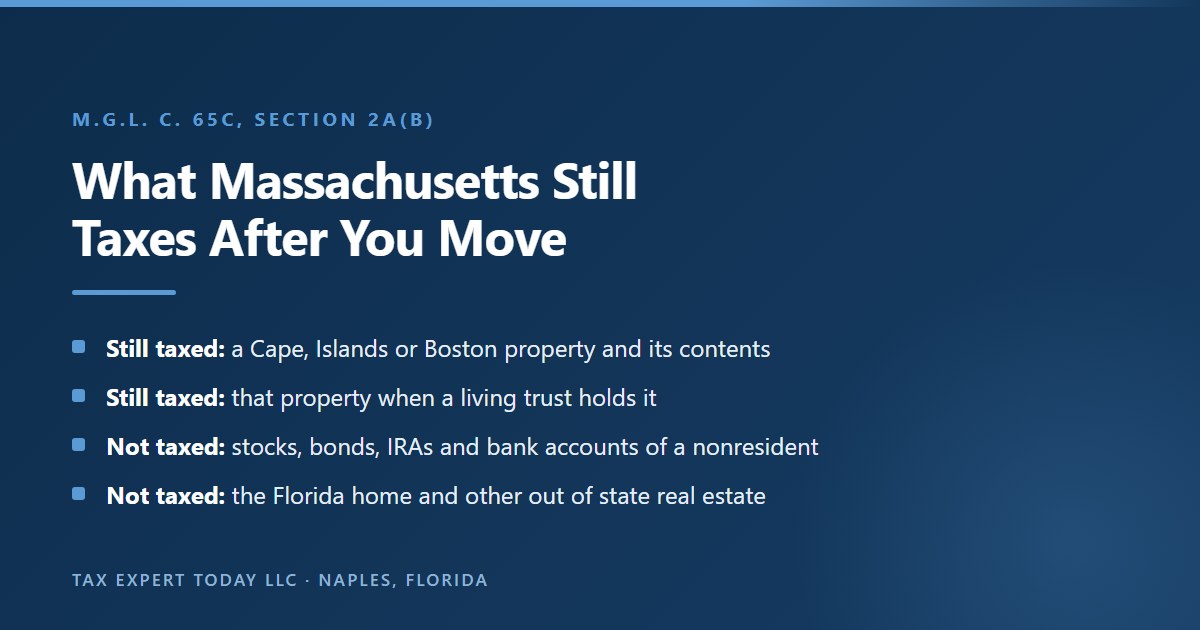
Massachusetts real estate and tangible personal property with an actual situs in Massachusetts remain taxable when a Florida domiciliary dies. That covers houses, condominiums and land, plus furniture, art, jewelry kept there, vehicles and boats. Intangible property such as stocks, bank accounts, insurance and pensions is outside the nonresident tax base under M.G.L. c. 65C, §2A(b).
- Real property: any Massachusetts house, condominium unit, timeshare deed or parcel of land in your name or held in a revocable trust.
- Tangible property: the contents of the Massachusetts home, plus any car or boat garaged or moored in the Commonwealth.
- Intangible property: excluded for a nonresident, wherever the brokerage firm or bank is located.
- Massachusetts QTIP: a special inclusion that can reach a surviving spouse, covered later in this guide.
The Department of Revenue’s own definitions draw the line. Tangible personal property is property that is movable and has a visible existence and a value of its own, and the Department lists automobiles, boats, equipment, furniture, jewelry, coin collections and silver as examples. Intangible property is property that represents value rather than having value in itself, and the Department lists stocks, bank accounts, insurance and pensions. A Florida domiciliary who keeps a brokerage account at a Boston firm does not create Massachusetts situs for that account.
The table below summarizes how common assets are treated for a decedent who died a Massachusetts resident and for one who died domiciled in Florida, for deaths on or after August 1, 2025.
| Asset | Massachusetts resident decedent | Florida domiciliary (nonresident decedent) | Authority |
|---|---|---|---|
| Massachusetts house or condominium | Included | Included | M.G.L. c. 65C, §2A(a) and (b) |
| Furniture, art, cars and boats located in Massachusetts | Included | Included | M.G.L. c. 65C, §2A(a) and (b) |
| Massachusetts house held in a revocable living trust | Included | Included | Federal gross estate rules as of December 31, 2000; DOR lien guidance on real estate held in trust |
| Florida home and other real estate outside Massachusetts | Excluded | Excluded | M.G.L. c. 65C, §2A(a) and (b) |
| Stocks, bonds, mutual funds and bank accounts | Included | Excluded | M.G.L. c. 65C, §2A(b) |
| IRAs, 401(k) plans and pensions | Included | Excluded | M.G.L. c. 65C, §2A(b) |
| Life insurance on the decedent’s life | Included if in the federal gross estate | Excluded | M.G.L. c. 65C, §2A(b) |
One practical point about the resident column: since 2023, even a Massachusetts resident’s estate excludes real estate and tangible property located outside Massachusetts. A snowbird who still counts as a Massachusetts domiciliary therefore does not pay Massachusetts tax on the Florida house. The difference between the two columns is the portfolio, which is usually where the money is.
An interest in an LLC or partnership that owns the Massachusetts house is the hard case. Such an interest is generally treated as intangible property, and some families have restructured for that reason. We have not found published Department of Revenue guidance addressing that structure under the post-2025 computation, and the answer can turn on how and when the entity was formed and whether it has any purpose beyond holding the house. Treat an entity as a question to settle with Massachusetts counsel, not as a settled answer. Entity planning also overlaps with creditor protection, which our guide to asset protection for new Florida residents covers.
What Is the Massachusetts Estate Tax Threshold and Credit in 2026?
Since 2023, a return is required when the gross estate plus adjusted taxable gifts exceeds $2,000,000. A credit of up to $99,600 under M.G.L. c. 65C, §2A(f) offsets the tax, which is exactly the tax on a $2,000,000 taxable estate. Above that level the full graduated tax applies, less the credit, at rates up to 16 percent.
- Filing threshold: gross estate plus adjusted taxable gifts over $2,000,000.
- Credit: up to $99,600 against the tax, under §2A(f).
- No tax at or below: a federal taxable estate of $2,000,000, under §2A(g).
- Rates: Table B of the pre-2001 federal state death tax credit, from 0.8 percent to 16 percent.
The Massachusetts estate tax is unusual because it is not written as its own rate schedule. The tax equals the credit for state death taxes that the federal estate tax allowed under section 2011 of the Internal Revenue Code as in effect on December 31, 2000. The federal credit was repealed long ago, but Massachusetts froze the old table in place, so Massachusetts practitioners still compute the tax on the July 1999 revision of federal Form 706. Changes to the federal estate tax after 2000, including the 2026 federal exclusion, have no effect on the Massachusetts computation, as the Department of Revenue guide states directly.
The old table works on an “adjusted taxable estate,” which is the taxable estate less $60,000. The rows most relevant to a Massachusetts house appear below, taken from the Department of Revenue’s Table B.
| Adjusted taxable estate from | To | Credit on the lower amount | Plus this percent of the excess |
|---|---|---|---|
| $840,000 | $1,040,000 | $27,600 | 5.6 |
| $1,040,000 | $1,540,000 | $38,800 | 6.4 |
| $1,540,000 | $2,040,000 | $70,800 | 7.2 |
| $2,040,000 | $2,540,000 | $106,800 | 8.0 |
| $2,540,000 | $3,040,000 | $146,800 | 8.8 |
| $3,040,000 | $3,540,000 | $190,800 | 9.6 |
| $4,040,000 | $5,040,000 | $290,800 | 11.2 |
| $10,040,000 | No limit | $1,082,800 | 16.0 |
The arithmetic explains the $99,600 figure. A taxable estate of $2,000,000 is an adjusted taxable estate of $1,940,000. The table produces $70,800 plus 7.2 percent of the $400,000 above $1,540,000, which is $28,800, for a total of $99,600. The credit therefore wipes out the tax at exactly $2,000,000, and every dollar above that level is taxed at the marginal rate of the bracket it falls in. Unlike the federal exclusion, the Massachusetts credit is not portable between spouses, a point that matters for couples and is covered below.
How Is Massachusetts Estate Tax Computed for a Nonresident Decedent?
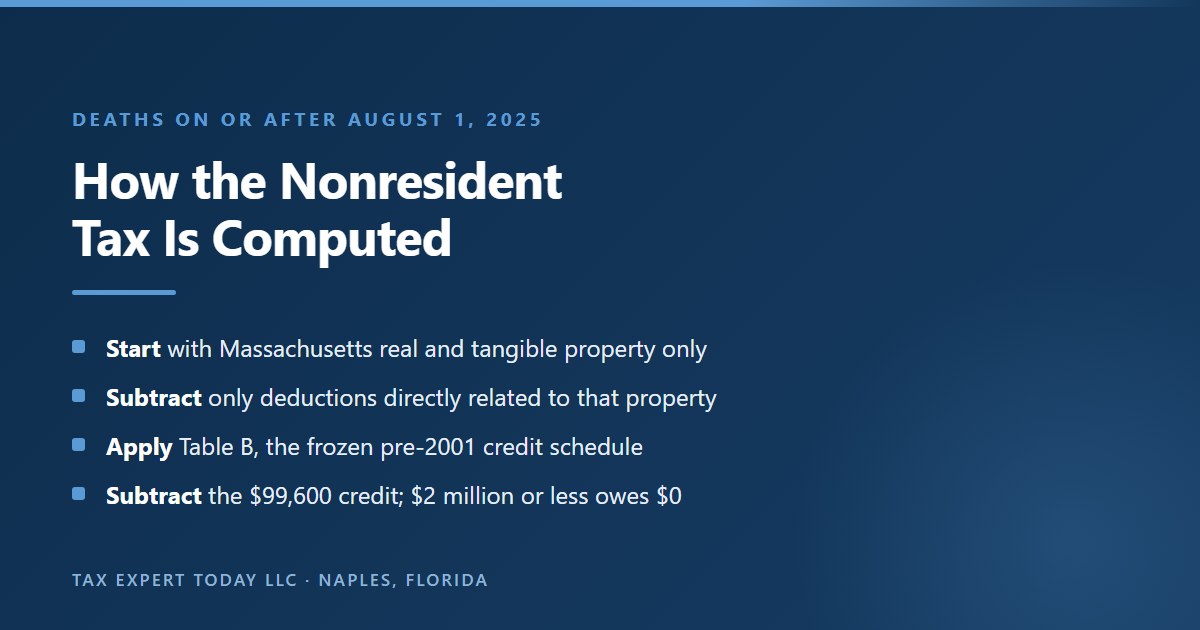
For deaths on or after August 1, 2025, the Department of Revenue starts with the federal gross estate, removes everything except Massachusetts real and tangible property, adds any Massachusetts QTIP property located in Massachusetts, and subtracts only deductions directly related to that property. It applies Table B to the result and subtracts the $99,600 credit.
- Step 1: federal gross estate, measured under the Internal Revenue Code as of December 31, 2000.
- Step 2: subtract all property other than Massachusetts real and tangible property.
- Step 3: add Massachusetts QTIP assets that are real or tangible property in Massachusetts.
- Step 4: subtract federal deductions directly related to the Massachusetts property, then apply Table B and subtract $99,600.
Those four steps come straight from the nonresident section of the Department of Revenue’s Estate Tax Guide, which tracks the statutory text inserted by St. 2025, c. 9, §35. Under the new §2A(b), the nonresident tax is the credit calculated on a federal gross estate equal to the Massachusetts real and tangible property, and for the purpose of calculating the taxable estate “no deduction shall be allowed that is attributable to property other than” that Massachusetts property.
The effect is that a nonresident’s Massachusetts tax now depends only on the size of the Massachusetts holdings and the debts and expenses tied to them. The size of the Florida portfolio does not change the Massachusetts number. A retired couple with $20 million of investments and a $1.5 million Cape house is treated, for the Massachusetts computation, much like a couple whose only asset is the Cape house. The larger estate still has to file, as the next sections explain, but it pays the same Massachusetts tax.
Three illustrations make the method concrete. They assume a Florida domiciliary who died after August 1, 2025, with a worldwide estate well over $2 million, and they ignore administration expenses except where stated. They are illustrations of the published method, not a prediction for any particular estate.
| Illustration | Massachusetts real and tangible property | Related deductions | Taxable amount | Table B result | Massachusetts estate tax after $99,600 credit |
|---|---|---|---|---|---|
| A. Cape house with contents, no mortgage | $1,500,000 | $0 | $1,500,000 | $64,400 | $0 (return still required) |
| B. Boston condominium with contents, no mortgage | $3,000,000 | $0 | $3,000,000 | $182,000 | $82,400 |
| C. Same condominium with a $500,000 mortgage | $3,000,000 | $500,000 | $2,500,000 | $138,800 | $39,200 |
| D. Condominium plus a $1,000,000 Berkshires house | $4,000,000 | $0 | $4,000,000 | $280,400 | $180,800 |
Illustration A reflects a common pattern among people who have moved to Southwest Florida: a meaningful but not enormous Massachusetts house. It produces no tax at all, yet the estate still files because the worldwide estate exceeds $2,000,000. Illustration C shows why the mortgage matters. A mortgage secured by the Massachusetts property is the clearest example of a deduction directly related to it, and in this example it cuts the Massachusetts tax by $43,200. Paying off that mortgage with Florida money late in life raises the Massachusetts tax by the same amount.
The same arithmetic shows how steep the first dollars above $2,000,000 can be. At a taxable amount of $2,200,000, the Table B result is $114,800 and the tax after the credit is $15,200. The first $200,000 above the line is taxed at an effective 7.6 percent, and the marginal rate keeps rising from there.
What Changed for Deaths on or After August 1, 2025?
St. 2025, c. 9, §35 rewrote the resident and nonresident computations in M.G.L. c. 65C, §2A, effective for decedents dying on or after August 1, 2025. For nonresidents, the key change is that deductions attributable to property outside the Massachusetts base, such as unsecured debts and general expenses, no longer reduce the Massachusetts taxable amount.
- Deaths before 2023: the nonresident tax was a proration of a credit computed on the whole estate, with a $1 million threshold.
- Deaths from 2023 through July 2025: the Department computed the tax using the Massachusetts property as the gross estate, under St. 2023, c. 50 and St. 2024, c. 206.
- Deaths on or after August 1, 2025: the same base, but only deductions directly related to the Massachusetts property are allowed.
- Constant throughout: the $99,600 credit and the $2,000,000 filing threshold for deaths since 2023.
The history explains why so much of what is published about this tax is out of date. Before 2023, the nonresident statute said the tax was the proportion of the credit that the Massachusetts real and tangible property bore to the total federal gross estate. The credit was computed on everything, then sliced. That is why older articles describe a Florida resident’s Cape house as being taxed “as if” the whole estate were in Massachusetts. In 2023, the Legislature added the $99,600 credit and the $2 million rule. In 2024, it changed the treatment of out of state property, and the Department’s FAQ instructed nonresident estates to replace the total gross estate on Form M-706 with the gross value of Massachusetts real and tangible property.
The 2025 amendment then addressed deductions. Under the Department’s current guide, a resident estate subtracts “allowable federal deductions for Massachusetts purposes,” while a nonresident estate subtracts only “allowable federal deductions directly related to Massachusetts property.” For a Florida family, the practical result is that a large pile of Florida debts, a margin loan or estate expenses paid from Florida assets does not shrink the Massachusetts number. A mortgage on the Massachusetts house does. Whether a particular expense, such as a share of executor fees or a marital deduction for the Massachusetts house left to a spouse, counts as directly related is a question to confirm with the preparer of the return.
The date of death controls which set of rules applies. An estate of someone who died in early 2025 follows the 2023 to July 2025 method described in the Department’s FAQ and in the Form M-706 instructions for deaths on or after January 1, 2023. An estate of someone who dies today follows the August 2025 method. Families who read an article written before the summer of 2025 should not assume its computation is still correct.
When Does a Nonresident Estate Have to File Form M-706?
A nonresident estate that owned or transferred Massachusetts real or tangible property must file Form M-706 when the worldwide gross estate plus adjusted taxable gifts exceeds $2,000,000, even if no Massachusetts tax is due. It also files Form M-NRA, the Massachusetts Nonresident Decedent Affidavit. Both are due nine months after death.
- The trigger: total worldwide estate plus adjusted taxable gifts over $2,000,000, not the value of the Massachusetts property.
- The forms: Form M-706, Form M-NRA and a copy of the July 1999 revision of federal Form 706.
- The deadline: nine months after the date of death, with an automatic six month extension to file if at least 80 percent of the tax is paid on time.
- Where: MassTaxConnect, or by mail to the Department of Revenue in Boston.
This is the rule that surprises Florida families most. The Department of Revenue states that the filing requirement for a nonresident decedent who owned or transferred Massachusetts real estate or tangible property “is the same as for a resident and is based on their total worldwide estate plus adjusted taxable gifts.” The Department’s FAQ confirms the related point for residents: an estate that exceeds $2 million before out of state property is removed must still file even if it falls to $2 million or less afterward. So the family in Illustration A, with a $1.5 million Cape house and a large Florida portfolio, owes nothing but must still file a full Massachusetts return, attach the 1999 federal form, and sign the nonresident affidavit.
The Department’s guide lists the supporting documents: the executed July 1999 revision of federal Form 706 with its attachments, a copy of any current federal Form 706 that is required, the signed Form M-NRA, the death certificate, the will and trust, the letters of authority and a Form M-2848 if a representative handles the matter. A current federal return is not required for most estates in 2026 because the federal basic exclusion is $15,000,000, so the 1999 form is often prepared only for Massachusetts.
| Item | Rule for a Florida domiciliary with Massachusetts property | Source |
|---|---|---|
| Return required | Worldwide gross estate plus adjusted taxable gifts over $2,000,000 | DOR Estate Tax Guide |
| Forms | Form M-706, Form M-NRA, July 1999 federal Form 706 | DOR Estate Tax Guide |
| Due date | Nine months after death, return and payment | DOR Estate Tax Guide |
| Extension to file | Automatic six months if at least 80 percent of the tax is paid by the due date | DOR Estate Tax Guide, TIR 16-10 |
| Extension to pay | Form M-4768, six months at a time, for undue hardship or reasonable cause, up to three years | DOR Estate Tax Guide |
| Late filing and late payment penalties | Each 1 percent per month or fraction, to a maximum of 25 percent, plus interest | DOR Estate Tax Guide |
| Estate tax lien | Arises at death on Massachusetts real estate; released by certificate after filing | DOR Estate Tax Guide |
Who signs is its own question. The Department treats as the executor the personal representative appointed, qualified and acting within Massachusetts, and if there is none, any person in actual or constructive possession of the decedent’s property. For a Florida estate with a Massachusetts house in a revocable trust, that is often the successor trustee. A personal representative can be held personally liable for tax shown on the return if it is not otherwise paid, which is a reason for a Florida personal representative to take the Massachusetts filing seriously even when the tax is zero.
How Does the Massachusetts Estate Tax Lien Affect Selling the House?
At death, a Massachusetts estate tax lien arises automatically on the decedent’s Massachusetts real estate, including property held jointly or in trust. To sell or refinance, the estate needs a Certificate Releasing Massachusetts Estate Lien, which the Department issues after Form M-706 and Form M-NRA are filed, or earlier through Form M-4422.
- Automatic lien: no notice is recorded; it attaches by operation of law at death.
- Normal release: file the return and complete Part 7 of Form M-706 to request the certificate.
- Early sale: Form M-4422 with the deed, the purchase and sale agreement, and an estimated payment.
- Small estates: a recorded affidavit of no filing requirement when the worldwide estate is $2,000,000 or less.
The lien is where the Massachusetts estate tax meets the closing table. A title examiner for the buyer of the Cape house will ask how the Massachusetts estate tax lien was released. If the estate never filed Form M-706 and Form M-NRA, the Department will not issue the certificate, and the sale can stall. The Department’s guide is explicit that failure to file prevents issuance of the Certificate Releasing Massachusetts Estate Lien, and that a release is necessary to obtain clear title.
When the family wants to sell within the first nine months, Form M-4422, the Application for Certificate Releasing Massachusetts Estate Tax Lien, is the route. The Department requires an attested copy of the deed, the purchase and sale agreement or mortgage commitment, the letters of authority or the trust document, payment of the estimated tax and a copy of the death certificate. The full return and nonresident affidavit are still due on time afterward.
When the worldwide estate is $2,000,000 or less, no return is required, and the release works differently. The personal representative records an affidavit, signed under the pains and penalties of perjury, stating that the gross estate does not require a Massachusetts filing. The Department does not publish a blank version, so the affidavit is usually drafted by Massachusetts counsel or the closing attorney.
Does a Living Trust or Joint Ownership Avoid Massachusetts Estate Tax?
No. A revocable living trust can keep a Massachusetts house out of ancillary probate, but the house is still in the federal gross estate and still in the Massachusetts nonresident base. Joint ownership with a spouse or child does not remove the decedent’s share either, and the estate tax lien reaches jointly held and trust owned real estate.
- Revocable trust: avoids ancillary probate, not the tax, because the grantor could revoke the transfer.
- Joint tenancy: the decedent’s includible share remains in the gross estate under the federal rules as of 2000.
- Tenancy by the entirety: named by the Department as property subject to the lien.
- The benefit that is real: a successor trustee can often manage and sell the house without a Massachusetts court appointment.
Families often confuse probate avoidance with tax avoidance, and the Massachusetts house is a good example of why the two are separate. A Florida domiciliary who dies owning a Massachusetts house in his or her own name usually needs an ancillary proceeding in the Massachusetts Probate and Family Court so that someone has authority over that house. Holding the house in a revocable trust generally avoids that step, which saves time and cost. It does nothing to the Massachusetts estate tax, because the Massachusetts computation starts from the federal gross estate as defined under the Internal Revenue Code as in effect on December 31, 2000, and property in a revocable trust is part of it.
The Department’s guide lists the gross estate items in plain terms: joint estates with right of survivorship, tenancies by the entirety, property over which the decedent held a general power of appointment and certain lifetime transfers made without full consideration. It also lists real estate owned jointly, real estate held in trust and other real estate outside the probate inventory as property that needs a lien release. If the house is in the gross estate, it is in the Massachusetts base for a nonresident.
Joint ownership with a child deserves a specific warning. Adding a child to the deed can move part of the house out of the estate only if the child actually paid for that share, and it can create a taxable gift and the loss of a stepped up basis on the child’s portion. It rarely helps and often hurts, and it should not be done without advice.
Can You Gift or Restructure the Massachusetts Property Before Death?
Possibly, but a gift only helps if you truly give up the property. Massachusetts has no gift tax, and property you give away outright is no longer Massachusetts property you own at death. Keeping the right to use the house, or retaining control, can pull it back into the estate, and a gift gives up the step up in basis.
- Outright gift: removes the house from the nonresident base if you keep no retained interest.
- Retained use: continuing to summer at the house without paying rent can bring it back into the gross estate.
- Basis cost: the recipient generally takes your basis rather than a date of death value.
- Sale: selling the house during life converts it into proceeds that a nonresident does not owe Massachusetts estate tax on.
For a Florida domiciliary with a single Massachusetts property, the planning options are simple to list and harder to choose among. The first is to sell. Once the house is sold, the proceeds are intangible property, and a nonresident’s intangible property is outside the Massachusetts estate tax. For owners who no longer use the property much, that can be the cleanest answer, subject to income tax on the gain, which our guide to selling your home after moving to Florida explains.
The second is a gift. Because Massachusetts has no gift tax and the nonresident base consists of Massachusetts property owned or transferred at death, an outright gift of the house to children during life can take it out of the Massachusetts computation. Adjusted taxable gifts still count toward the $2,000,000 filing threshold, so the estate may still need to file. Two costs come with the gift. The children generally take the parent’s income tax basis under 26 U.S.C. §1015 instead of the value at death, which can create a large capital gain when they sell. And if the parent keeps using the house as before, the federal rules on retained interests in 26 U.S.C. §2036 can pull the house back into the gross estate, defeating the gift. A gift of a family vacation home works best when the parents truly step back or pay fair rent.
The third is a change in ownership form, most often a transfer to an LLC. As noted above, whether Massachusetts respects an entity interest as intangible for a nonresident is a fact sensitive question that should be settled with Massachusetts counsel before relying on it. The fourth, for couples, is dividing ownership so that each spouse’s share of Massachusetts property stays below $2,000,000. Because the Massachusetts credit is not portable, a couple whose only Massachusetts property is a $3 million house owned by one spouse is in a different position from a couple who each own half and each leave their half in a way that does not simply stack in the survivor’s estate. Couples already using lifetime trusts, such as a spousal lifetime access trust, should confirm where any Massachusetts property ends up.
Each of these options interacts with Florida law, including homestead restrictions on the Florida home, and with the federal estate and gift tax. Our guide to Florida estate planning for new residents covers the Florida side.
How Does Massachusetts Decide Whether You Were Still Domiciled There?
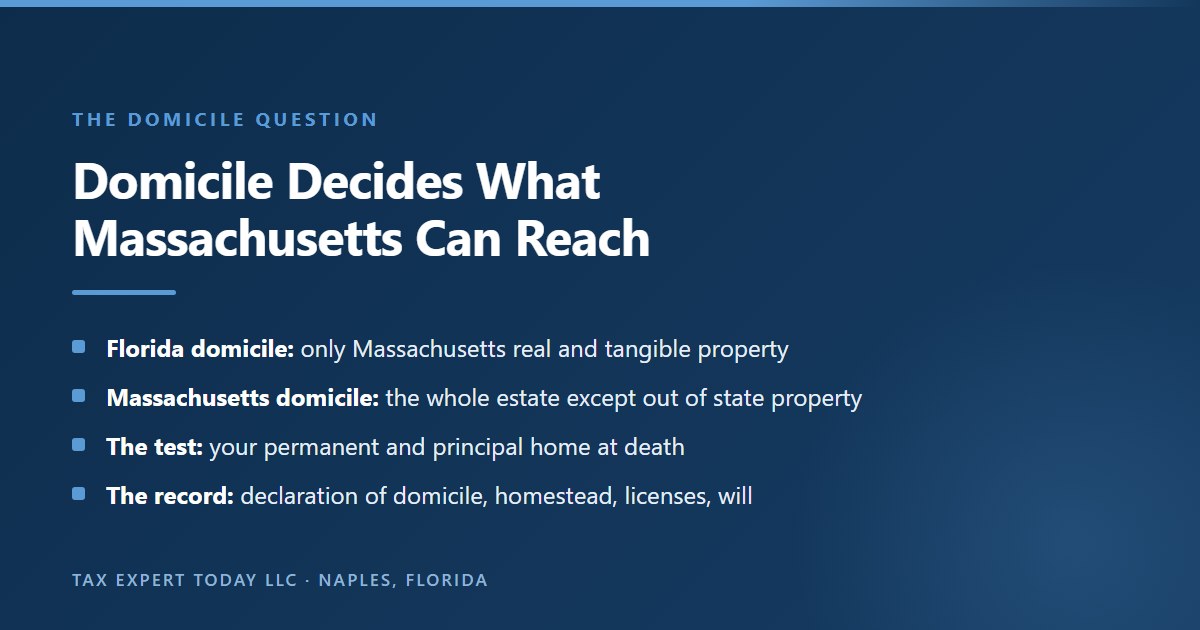
For the estate tax, residency means domicile, which the Department of Revenue defines as a person’s permanent and principal home. If Massachusetts concludes that a decedent never truly left, the whole estate except real and tangible property outside Massachusetts is taxed as a resident estate, which can turn a zero tax into a six or seven figure bill.
- The test: where the permanent and principal home was at death, judged on the whole record.
- Florida evidence: a declaration of domicile under Fla. Stat. §222.17, homestead, voter registration, driver license, vehicle registration and a Florida will.
- Massachusetts evidence against you: keeping the larger home in Massachusetts, doctors, clubs, worship and the family’s gathering place.
- The paper trail: filing Massachusetts income tax returns as a nonresident after the move, consistently.
The stakes of domicile dwarf everything else in this guide. Take a couple whose estate at the second death is $8 million, of which $2 million is the Florida home and $1.5 million is a Cape house. If the surviving spouse died domiciled in Florida, Massachusetts reaches only the Cape house, and under Illustration A the tax is zero. If Massachusetts successfully argued that the survivor was still domiciled in Massachusetts, the Florida home would be excluded but the rest, $6 million, would be the Massachusetts taxable amount before deductions. Table B produces $510,800 on a $6 million taxable estate, and after the $99,600 credit the tax would be $411,200.
Domicile for estate tax purposes is not the same as the day count used for Massachusetts income tax residency. Some published material states that a person is a Massachusetts resident for estate tax purposes if they keep a home there and spend more than 183 days in the state. The Department’s own estate tax guide does not use that test; it defines a resident as a person whose permanent and principal home is in the Commonwealth. A day count is still good evidence, and a Florida domiciliary who spends most of the year in Massachusetts will struggle to prove a Florida domicile, but the question is where home was. When a former home state does challenge a move, the process looks much like the one described in our guide to a Florida residency audit, and our article on the dual state residency trap explains how two states can each claim the same person.
The most useful habits are the ones that build a consistent record over years. File the Florida declaration of domicile with the clerk of the circuit court under Fla. Stat. §222.17. Claim the Florida homestead exemption. Register to vote, license and register vehicles, and see doctors in Florida. Sign a new Florida will and update the trust to name Florida law. Stop filing Massachusetts returns as a resident, and file a nonresident state return only for Massachusetts source income. The transition year has its own traps, covered in our first year snowbird tax guide. Our guide on how to establish Florida residency walks through the full checklist, and the Florida 183 day rule calculator helps you document the day count that supports it.
What About a Surviving Spouse and Massachusetts QTIP Property?
If the first spouse died a Massachusetts resident and the estate claimed a Massachusetts marital deduction for a QTIP trust that was not elected federally, the surviving spouse’s estate must later include that Massachusetts QTIP property. For a survivor who moved to Florida, the Department’s nonresident method includes the QTIP assets that are real or tangible property in Massachusetts.
- What it is: property in a trust for the survivor’s life that received a Massachusetts marital deduction at the first death.
- Why it returns: the deduction at the first death is paid for by inclusion at the second death.
- For a Florida survivor: the Department adds Massachusetts QTIP assets that are Massachusetts real or tangible property.
- What to check: the Massachusetts return filed at the first death and any separate Massachusetts QTIP election.
This is a narrow issue, but it catches families who assume that a move after the first death wipes the slate clean. Many Massachusetts plans created a separate trust at the first death to use the Massachusetts exemption while deferring federal tax, and some elected QTIP treatment for Massachusetts purposes alone. Section 2A now expressly includes property in which the decedent had a qualifying income interest for life described in §3A(c) and for which a Massachusetts deduction was allowed. For a surviving spouse domiciled in Florida, the Department’s computation adds back the Massachusetts QTIP assets that are real or tangible property in Massachusetts, such as a Cape house held in that trust.
If you are a surviving spouse who moved to Florida after your spouse died in Massachusetts, the first document to find is the Massachusetts estate tax return filed for your spouse. It will show whether a Massachusetts QTIP election was made and which assets went into the trust. If the trust holds only securities, the inclusion has little practical effect for a nonresident. If it holds the Massachusetts house, the house returns to the base at your death. Trusts created under Massachusetts law raise separate income tax questions after a move, covered in our guide to trust situs after moving to Florida, and in some cases a trustee can restructure an old trust through decanting.
How Does the Massachusetts Tax Interact With the Federal Estate Tax?
The two are computed separately. The federal basic exclusion is $15,000,000 per person in 2026, so most estates owe no federal tax while still owing Massachusetts tax on Massachusetts property above $2,000,000. When both apply, the Massachusetts tax paid is generally deductible in computing the federal taxable estate under 26 U.S.C. §2058.
- Federal exclusion in 2026: $15,000,000 per person, with portability of an unused amount to a surviving spouse.
- Massachusetts threshold: $2,000,000, with no portability.
- Federal deduction: state death taxes actually paid are deductible under §2058, subject to its timing rules.
- Florida: no state estate tax and no inheritance tax, so Florida adds nothing on top.
The IRS confirms that Public Law 119-21 increased the basic exclusion amount to $15,000,000 for 2026. That figure has no role in the Massachusetts computation, which by statute uses the Internal Revenue Code as of December 31, 2000. The result is a wide gap: a Florida estate can be far below the federal line and still owe Massachusetts tax on a valuable Massachusetts property.
For estates large enough to owe federal tax, 26 U.S.C. §2058 allows a deduction for estate, inheritance, legacy or succession taxes actually paid to a state on property included in the gross estate. The deduction reduces the federal cost of the Massachusetts tax. Florida itself adds nothing: it has no estate or inheritance tax, as our new resident estate planning guide explains. Families with property in more than one former home state should also look at how each state treats nonresidents. New Jersey, for example, imposes an inheritance tax on some heirs rather than an estate tax, covered in our guide to New Jersey inheritance tax for nonresidents, and Pennsylvania’s rules are covered in our guide to Pennsylvania inheritance tax for Florida residents.
What Should a Former Massachusetts Resident Do Now?
List every Massachusetts asset that is real estate or tangible property, value it, and compare the total to $2,000,000. Then confirm your Florida domicile record, review how each Massachusetts asset is titled, check for a Massachusetts QTIP trust from a prior death, and decide whether to keep, sell, gift or restructure the Massachusetts property.
- Inventory: Massachusetts houses, condominiums, land, boats, vehicles and valuable contents, at current value.
- Debts: mortgages secured by the Massachusetts property, which reduce the Massachusetts amount.
- Domicile file: the §222.17 declaration, homestead, licenses, voter registration and a Florida will.
- Executor plan: who will file Form M-706 and Form M-NRA, and how the lien will be released at sale.
The steps are straightforward once they are written down. If the Massachusetts property is worth well under $2,000,000 and is likely to stay that way, the estate will probably owe no Massachusetts tax, but the family should still expect to file if the worldwide estate is above $2,000,000, and the executor should know that the lien has to be released before the house can be sold. If the Massachusetts property is worth more, the decision to keep, sell or give it away is worth modeling with actual numbers, including the income tax on a sale and the basis a recipient would take after a gift.
Couples should look at how the Massachusetts property is owned between them, because the Massachusetts credit cannot be carried from one spouse to the other. Anyone who still spends substantial time in Massachusetts should look hard at the domicile record, because a successful challenge changes the answer on the entire portfolio. And anyone who inherited a trust interest from a spouse who died in Massachusetts should find the first return and check for a Massachusetts QTIP election.
Other taxes follow a move, too. The treatment of pensions and retirement withdrawals after the move is covered in our guide to retiring to Florida, and the sale of a former home state rental is covered in our guide to selling rental property after a move. Readers comparing their situation with other departures may also find our guides to the New Jersey exit tax and the Illinois exit tax useful.
Massachusetts Estate Tax Help in Naples & Southwest Florida
Tax Expert Today LLC works with individuals and families who have moved to Southwest Florida from Massachusetts and other high tax states and who still hold property, trusts or family connections in the state they left. The firm brings together tax advisors, enrolled agents, CPAs and attorneys, and handles residency and tax matters nationwide. Boston, the North Shore and the Cape send a steady stream of new residents to Collier and Lee counties, so the retained summer house, the old Massachusetts trust and the nonresident estate tax return are familiar ground here.
Our office is located at 11983 Tamiami Trail N, Naples, Florida 34110. You can reach us at (239) 441-2005, Monday through Friday, 10am to 5pm ET. We also work with clients across all 50 states.
- Massachusetts estate tax help Naples: identifying what Massachusetts can still reach in your estate and estimating the tax under the August 2025 method.
- MA estate tax Naples FL: coordinating Form M-706, Form M-NRA and the lien release for a Florida domiciliary’s estate.
- Tax planning Naples FL: coordinating the move with the wider plan described on our Naples tax planning page and in our guide to Florida tax services.
- Estate and trust planning Naples: reviewing title, trusts and gifting options for Massachusetts property with counsel through our estate and trust planning practice.
- Tax resolution Naples: responding when a state questions a claimed Florida domicile, through our resolution and audit support practice and our Naples tax resolution page.
A local question we are asked often: we live in Naples most of the year and keep a house on the Cape for July and August. Will our children owe Massachusetts estate tax on everything? No, provided you are genuinely domiciled in Florida. Massachusetts would look only at the Cape house and its contents, less any mortgage on it. If that total is $2,000,000 or less, no Massachusetts tax is due, although your executor will likely still file a return to clear the title. The risk is a weak domicile record, which could let Massachusetts claim the whole portfolio.
When to Engage a Professional
A Massachusetts nonresident estate is simple when the only Massachusetts asset is a modest house, the domicile record is clean and the worldwide estate is under $2,000,000, because then no return is required and a recorded affidavit clears the title. Many families who ask about the Massachusetts estate tax are not in that position. The combination that makes it complicated is specific: Massachusetts property worth more than $2,000,000, a worldwide estate that requires a return even when the tax is zero, a Massachusetts QTIP trust from a prior death, property held in an LLC or with children on the deed, a gift of the house under consideration, or a split year pattern that could invite a domicile challenge.
Consider engaging an advisor when any of the following is present: you still own Massachusetts real estate after the move; your will or trust was signed while you lived in Massachusetts; your spouse died a Massachusetts resident and a trust was created; you are thinking about deeding the property to your children or into an entity; a death has occurred and the house may be sold within nine months; or you spend a large part of each year in Massachusetts. Coordinating the Massachusetts side with the Florida plan is part of what our Florida residency and Florida estate planning guidance covers, and trust and title changes should be made with a trusts and estates attorney.
The firm brings together tax advisors, enrolled agents, CPAs and attorneys and works with clients nationwide from its Naples office. If you have moved from Massachusetts to Southwest Florida and still hold Massachusetts property, or you are handling the estate of someone who did, call (239) 441-2005 or use our contact page to arrange a consultation. Outcomes depend on the specific facts of each estate, and nothing here is a prediction about any particular return.
This article is educational and general in nature. It is not legal, tax or accounting advice, and it does not create a professional relationship. Massachusetts statutes, Department of Revenue guidance and forms change, and the figures cited here were verified against primary sources on the date of publication. Please consult a qualified advisor about your own situation.
Published September 28, 2026 by Dr. Pellumb Kabashi « Back to Learning Center
Have a question this article touches on?
Tax Expert Today LLC, based in Naples, Florida and serving clients across the United States.
Schedule a Consultation (239) 441-2005