
By Dr. Pellumb Kabashi, DBA, MBA, CES, CFE, EA
Founder, Tax Expert Today LLC · Tax advisors, enrolled agents, CPAs, and attorneys · Serving clients in all 50 states
Quick Answer: The Massachusetts capital gains tax is 5 percent on most long-term gains and 8.5 percent on short-term gains, plus a 4 percent surtax on taxable income above $1,107,750 for 2026. After a genuine move to Florida, gains on stocks and other investments are generally no longer Massachusetts income, but gains on Massachusetts real estate and on Massachusetts business interests stay taxable. Call (239) 441-2005 for a free consultation.
What Is the Massachusetts Capital Gains Tax in 2026?
The Massachusetts capital gains tax is part of the state personal income tax under M.G.L. chapter 62, section 4. Most long-term gains are taxed at 5 percent, short-term gains at 8.5 percent, and collectibles at a separate higher rate. A 4 percent surtax then applies to total taxable income above $1,107,750 for tax year 2026.
- Long-term gains: assets held more than one year, taxed at 5 percent as Part C income
- Short-term gains: assets held one year or less, taxed at 8.5 percent as Part A income
- Surtax: an extra 4 percent on the portion of taxable income above the indexed threshold
- Threshold history: $1,000,000 for 2023, $1,053,750 for 2024, $1,083,150 for 2025 and $1,107,750 for 2026
- Who pays: residents on all gains, nonresidents only on Massachusetts source gains
Massachusetts does not have a separate capital gains statute. Gains are simply a class of income inside the personal income tax, sorted into three parts. Part A covers interest, dividends and short-term capital gains. Part B covers wages, business income and most other ordinary income. Part C covers long-term capital gains. The sorting matters because the rates differ by part, and because losses in one part offset gains in another only within limits. The holding period test comes straight from the federal definitions in 26 U.S.C. section 1222: more than one year is long term, one year or less is short term.
The short-term rate is the one that surprises people. Until tax year 2023 Massachusetts taxed short-term gains at 12 percent. The rate is now 8.5 percent, which is still well above the 5 percent rate on long-term gains and wages. A trader who sells within the year therefore pays the Commonwealth nearly twice what a long-term holder pays on the same dollar of profit.
The surtax came from the Fair Share Amendment, approved by voters in November 2022 as Article 44 of the Amendments to the Massachusetts Constitution, as amended. It adds 4 percent on the portion of annual taxable income above a threshold that started at $1,000,000 for 2023 and is indexed each year. The Department of Revenue has certified $1,107,750 for tax year 2026. The surtax applies to all taxable income, not just gains, but a single large sale is by far the most common way a household crosses the line for one year only.
| Type of gain | Massachusetts class | Base rate | Top combined rate with surtax |
|---|---|---|---|
| Long-term gain on stock, funds or a business interest | Part C | 5 percent | 9 percent |
| Short-term gain (held one year or less) | Part A | 8.5 percent | 12.5 percent |
| Long-term gain on Massachusetts real estate | Part C | 5 percent | 9 percent |
| Gain on a principal residence above the IRC 121 exclusion | Part C | 5 percent | 9 percent |
| Collectibles held long term | Part C, separate rate | Higher than 5 percent | Higher than 9 percent |
The combined rates in the table are marginal rates on the slice of income above the threshold. They are not effective rates on the whole gain. A household with $1,500,000 of taxable income pays the 4 percent surtax only on the $392,250 above $1,107,750, not on the whole $1,500,000.

How Does the 4 Percent Surtax Apply to a Single Large Gain?
The surtax applies to the part of a year’s Massachusetts taxable income above $1,107,750 for 2026. A one-time sale that lifts income above that line for a single year is taxed at 9 percent on the excess long-term gain instead of 5 percent. The threshold is annual and applies per return, so a joint return gets one threshold, not two.
- Annual test: the threshold resets every tax year, so the year a gain lands in matters
- Per return: married couples filing jointly share one threshold
- All income counts: wages, dividends, interest and gains are added together before the test
- Nonresidents too: a nonresident with more than the threshold of Massachusetts taxable income owes the surtax
For most households the surtax is not a permanent feature of life. It is a one-year event triggered by the sale of a business, a block of founder stock, a rental building or a large concentrated position. That is exactly the profile of many people who move from Massachusetts to Florida. They often sell something big around the time they leave, and the question of whether the sale lands in a Massachusetts year or a Florida year can move the state bill from six figures to zero.
Here is the arithmetic on a hypothetical. A married couple, both still Massachusetts residents, have $250,000 of other taxable income in 2026 and sell a long-held stock position for a $2,000,000 long-term gain. Their Massachusetts taxable income is roughly $2,250,000, before exemptions, which are small at this level and are ignored here for clarity.
| Step | Amount |
|---|---|
| Taxable income (gain plus other income) | $2,250,000 |
| Base tax at 5 percent | $112,500 |
| Income above the 2026 threshold ($2,250,000 minus $1,107,750) | $1,142,250 |
| Surtax at 4 percent | $45,690 |
| Total Massachusetts tax | $158,190 |
| Massachusetts tax on the same stock gain after a genuine change of domicile | $0 |
That gap is why the timing of a move and the timing of a sale deserve the same attention. Federal tax on the gain does not change with the move: the 20 percent top long-term rate and the 3.8 percent net investment income tax under 26 U.S.C. section 1411 apply whether the seller lives in Boston or Naples. The state layer is the only one that the move can change, and it can change it completely for investment gains.
Does Massachusetts Tax Capital Gains After You Move to Florida?
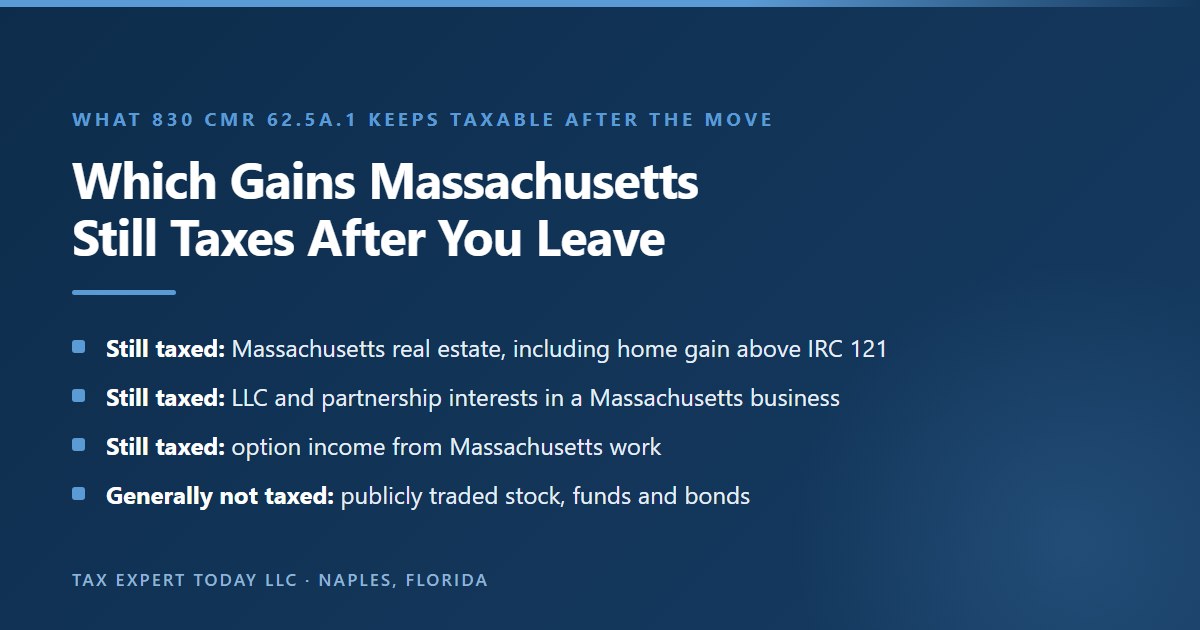
Generally not on investment gains. Once you have genuinely changed domicile to Florida and no longer keep a Massachusetts residence, gains from selling stocks, bonds, mutual funds and similar intangibles are not Massachusetts source income. Gains on Massachusetts real estate, on tangible property located there, and on interests in businesses operating there remain taxable to you as a nonresident.
- Not taxed after the move: gains on publicly traded stock, funds and bonds not tied to a Massachusetts business
- Still taxed: gains on Massachusetts real property, including a former home above the IRC 121 exclusion
- Still taxed: gains on an interest in a sole proprietorship, partnership or LLC doing business in Massachusetts
- Still taxed: income tied to Massachusetts employment, such as certain stock option income
- Florida side: Florida has no personal income tax, so there is no Florida tax on any of these gains
The rule comes from M.G.L. chapter 62, section 5A, which limits the tax on a nonresident to Massachusetts source income, and from the Department of Revenue regulation at 830 CMR 62.5A.1. The regulation states that certain income received by nonresidents is excluded, including non-business interest, dividends and gains from the sale or exchange of intangibles that are not derived from or effectively connected with a trade or business carried on in Massachusetts. Read the other way, the regulation keeps Massachusetts taxation on income from real and tangible property located in the Commonwealth, and on income from a trade or business carried on there, which the regulation says includes the sale of a business or an interest in a business.
The word that carries the weight is “genuinely.” Massachusetts defines a resident as a person domiciled in Massachusetts, or a person who keeps a permanent place of abode there and spends more than 183 days of the tax year in the Commonwealth. A Florida mover who keeps the Wellesley house and spends the summer and fall there can be a Massachusetts resident under the second test even with a valid Florida declaration of domicile, the situation our guide to the dual state residency tax trap describes. If that happens, every gain for the year is Massachusetts income again, including the stock sale that was supposed to be outside the reach of the Commonwealth.
| Asset sold after a genuine move | Massachusetts source income? | Why |
|---|---|---|
| Publicly traded stock in a brokerage account | Generally no | Intangible not connected with a Massachusetts trade or business |
| Mutual funds, ETFs, Treasury and municipal bonds | Generally no | Intangible investment income excluded for nonresidents |
| A rental house or condo in Massachusetts | Yes | Income from real property located in Massachusetts |
| The former principal residence, gain above IRC 121 | Yes | Real property located in Massachusetts |
| Interest in an LLC or partnership operating in Massachusetts | Generally yes | The regulation treats the sale of a business interest as trade or business income |
| Shares of a C or S corporation | Generally no, with exceptions | Excluded as intangibles unless tied to Massachusetts employment or treated as business income |
| Nonqualified stock options from Massachusetts employment | Yes, to the extent tied to Massachusetts work | Compensation connected with Massachusetts employment |
The corporate share row deserves a caution. The regulation says the business interest rule generally does not apply to shares of stock in a C or S corporation, but Massachusetts courts have upheld taxing a former resident’s gain on company stock where the gain was tied to work performed in Massachusetts, and the Commonwealth has been moving to widen the reach of section 5A over nonresident sales of interests in businesses with Massachusetts operations. A founder, an executive or a partner selling an interest after the move needs a current read of the statute and the facts before the deal closes, not after. Our guide to moving to Florida before selling a business covers the deal-timing side of that question across states.
Which Gains Stay Massachusetts Source Income for a Nonresident?
Three kinds of gain stay Massachusetts source income after a move: gain on real or tangible property located in Massachusetts, gain from a Massachusetts trade or business, including the sale of a pass-through business interest, and income connected with Massachusetts employment. Where you live when you sell does not change the source of these gains.
- Real property: land, houses, condos, rental buildings and vacation homes located in Massachusetts
- Tangible property: property physically located in Massachusetts, such as equipment or a boat kept there
- Business interests: a sole proprietorship, general partnership, LLP or LLC conducting business in Massachusetts
- Employment-linked income: stock options, deferred compensation and severance earned for Massachusetts work
- Anti-abuse: transactions without a real business purpose can be disregarded under the sham transaction rule
The regulation is blunt on this point. It states that the current residence or domicile of a nonresident taxpayer has no effect on the taxability of Massachusetts source income. If the income derives from Massachusetts real estate or a Massachusetts business, it is Massachusetts income whether the owner lives in Naples, Nashua or Nice.
Real estate is the clearest case. The regulation gives the example of a Connecticut resident who sells Massachusetts real estate and takes a five year note from the buyer for part of the price. Both the gain and the interest received on the note are subject to Massachusetts income tax, whether or not the nonresident elects installment reporting. A Florida resident who sells the Cape house or a Somerville triple-decker is in exactly the same position.
Pass-through business interests are the next case. The regulation treats the activities of a pass-through entity as attributed to its individual members, and it treats income from the sale of an interest in a sole proprietorship, a general partnership, a limited liability partnership, most limited partnership interests and an LLC as trade or business income. When the entity does business both in Massachusetts and elsewhere, the gain is generally apportioned, so only the Massachusetts share is taxed. The regulation generally excludes the sale of a limited partner’s interest in a publicly traded partnership and the sale of shares in a C or S corporation, but the exclusion is not absolute, as the corporate share caution above explains.
Employment-linked income is the third case. The regulation requires a taxpayer to recognize income from nonqualified stock options connected with Massachusetts employment in the year the income is recognized for federal purposes, whether or not the taxpayer is a Massachusetts resident in that year, with an allocation when the work was split between states. Deferred compensation follows a similar rule, and our guide to nonqualified deferred compensation covers the federal side. Note that the option income at exercise is compensation; any later gain on the shares after exercise is a capital gain on an intangible, which follows the general rule for intangibles. Our guide to Florida domicile for executives walks through equity compensation across the move.
How Does the Part-Year Return Split Gains in the Move Year?
In the move year you file one Form 1-NR/PY as both a part-year resident and a nonresident. Gains realized while you were a resident are taxed in full. Gains realized after the change of residence are taxed only if they are Massachusetts source income. The trade date and the move date decide the side of the line.
- One return: the regulation requires a single Form 1-NR/PY covering both periods of the year
- Resident period: all gains from all sources, wherever the asset is located
- Nonresident period: only Massachusetts source gains, such as Massachusetts real estate
- Exemptions: personal exemptions are prorated between the two periods
- Surtax: tested against Massachusetts taxable income for the year as reported on the return
The regulation at 830 CMR 62.5A.1 addresses the move year directly. If during a single tax year an individual changes status from resident to nonresident, the individual files one Form 1-NR/PY as both a nonresident and a part-year resident. A part-year resident is defined as a taxpayer who terminates Massachusetts residency and establishes a residence outside the state during the tax year. In practice the return reports everything earned during the resident period, plus Massachusetts source income for the nonresident period, and allocates exemptions between them.
Gains are placed by the date they are realized. For a sale of publicly traded stock that is generally the trade date, not the settlement date. For a sale of real estate or a business it is generally the closing date when the sale becomes final under the contract, which is why the date in the purchase agreement matters as much as the date on the moving truck. A seller who signs a binding agreement in Massachusetts in May and closes in Florida in August needs advice on whether any part of the gain is treated as realized earlier.
The move date itself is a question of fact. Massachusetts asks when domicile actually changed and when a permanent place of abode in Massachusetts stopped being maintained, not when the Florida driver license was issued. A Florida declaration of domicile filed under Fla. Stat. section 222.17 is a useful piece of evidence with a date on it, but it is one piece among many. The pattern of where you live, work, keep your family, store your valuables, see your doctors and spend your days carries more weight than any single filing. Our guide to the nonresident state tax return explains the mechanics of filing in a state you have left, and our guide to snowbird taxes in year one walks through the first-year filing pattern across states.
| Move-year event | Realized while resident | Realized after the change of residence |
|---|---|---|
| Sale of a brokerage stock position | Taxed by Massachusetts | Generally not taxed by Massachusetts |
| Sale of a Massachusetts rental property | Taxed by Massachusetts | Taxed by Massachusetts as source income |
| Sale of the former home above the IRC 121 exclusion | Taxed by Massachusetts | Taxed by Massachusetts as source income |
| Sale of an LLC interest in a Massachusetts business | Taxed by Massachusetts | Generally taxed, apportioned to Massachusetts activity |
| Year-end mutual fund capital gain distribution | Taxed if paid during the resident period | Generally not taxed if paid after the change |
Should You Sell Before or After the Move to Florida?
For investment assets such as publicly traded stock, selling after a genuine change of domicile generally removes the Massachusetts tax entirely, while selling before it exposes the gain to 5 percent, or 9 percent above the surtax threshold. For Massachusetts real estate and business interests the move does not remove the tax, so timing turns on the surtax.
- Stocks and funds: waiting until after the change of domicile can save the whole state tax
- Massachusetts real estate: taxed either way, so focus on spreading the gain below the surtax line
- Business sale: depends on the entity type, where it operates and the deal structure
- Market risk: holding an asset longer to wait for the move carries price risk that can exceed the tax saved
- Substance first: a sale timed to follow a move that is not real invites the strongest kind of audit
The arithmetic on a concentrated stock position is straightforward. A long-term gain of $3,000,000 realized while a Massachusetts resident, with $200,000 of other income, produces Massachusetts tax of 5 percent of $3,200,000, or $160,000, plus 4 percent of the $2,092,250 above the 2026 threshold, or $83,690, for a total of $243,690. The same gain realized after a genuine change of domicile to Florida produces no Massachusetts tax and no Florida tax. The federal tax is the same in both cases.
That number is large enough to tempt people into timing the move around the sale, and that is where the risk lives. Massachusetts examines departures that coincide with large liquidity events. The examiner asks whether the move would have happened without the sale, whether the Massachusetts house was really given up, whether the seller kept spending most of the year in the Commonwealth, and whether the family, the business relationships and the social life actually moved. A move that is real, documented and sustained can support a post-move sale. A move that exists only on paper usually cannot. Our guide to the Florida residency audit explains what an examiner looks at, and the Florida 183 day rule calculator helps track the day count that feeds the statutory resident test.
Holding an appreciated position for months to wait for the move is also an investment decision, not just a tax decision. A 10 percent drop in a $5,000,000 position costs $500,000, roughly twice the hypothetical Massachusetts tax above. Hedging and collar strategies exist, but they have their own federal tax rules, including the constructive sale rules, and they belong in a conversation with the investment adviser as well as the tax adviser.
How Do Installment Sales Work When the Payments Straddle the Move?
An installment sale under IRC section 453 spreads gain over the years payments are received. For Massachusetts real estate and Massachusetts business interests, each later payment stays Massachusetts source income after you move, including the interest on the note. Spreading the gain can keep each year below the surtax threshold, which is where most of the Massachusetts saving comes from.
- Real estate notes: the regulation treats both the gain and the interest as Massachusetts income for a nonresident
- Surtax planning: several years under $1,107,750 can avoid the 4 percent surtax that a lump sum would trigger
- Publicly traded stock: cannot be reported on the installment method under section 453(k)(2)
- Large notes: federal interest charge rules under section 453A can apply when notes outstanding exceed $5,000,000
- Credit risk: the seller becomes a lender to the buyer, which is a business risk as well as a tax choice
The federal installment rules in 26 U.S.C. section 453 let a seller report gain as payments arrive instead of all at once. Massachusetts follows the installment method through M.G.L. chapter 62, section 63, and IRS Publication 537 explains the federal mechanics. For an asset that stays Massachusetts source income after the move, such as a rental building, the move does not escape the tax on later payments. What the installment method can do is keep the gain in each year below the surtax line.
Consider a hypothetical Florida resident selling a Massachusetts rental building with a $3,000,000 long-term gain and no other Massachusetts income. A lump-sum closing in 2026 produces 5 percent of $3,000,000, or $150,000, plus 4 percent of the $1,892,250 above the threshold, or $75,690, for $225,690. An installment sale that recognizes $1,000,000 of gain in each of three years produces $50,000 of base tax each year and no surtax, for $150,000 in total, plus Massachusetts tax on the interest. Using the 2026 threshold for all three years keeps the illustration simple; the indexed threshold rises each year, which helps further.
| Structure (hypothetical $3,000,000 gain, Massachusetts rental) | Base tax at 5 percent | Surtax | Total Massachusetts tax on the gain |
|---|---|---|---|
| Lump sum in 2026 | $150,000 | $75,690 | $225,690 |
| Installment, $1,000,000 a year for three years | $150,000 | $0 | $150,000 |
| Installment, $1,500,000 a year for two years | $150,000 | $31,380 | $181,380 |
| Same building if it were stock sold after the move | $0 | $0 | $0 |
Depreciation recapture on a rental is a separate wrinkle. Federally, recapture income taxed as ordinary income under section 1245 or section 1250 is reported in the year of sale under section 453(i) and cannot be deferred; for a building depreciated on the straight-line method that amount is usually small, while unrecaptured section 1250 gain is still reported as payments arrive. The interest on the buyer’s note is also Massachusetts source income for a nonresident under the regulation example. A like-kind exchange under the 1031 exchange rules is the other deferral route for a rental, and a mover who swaps a Massachusetts rental for Florida property should confirm how Massachusetts tracks the deferred gain before closing. The installment route is a real planning tool for Massachusetts real estate, but it requires a buyer willing to pay over time, security for the note and an honest view of the credit risk.
An installment sale of intangibles is a different question. If a resident sells a privately held asset that is not Massachusetts source income for a nonresident and reports it on the installment method, the treatment of payments received after the move depends on the asset, the date of sale and the current Massachusetts rules on income that accrued during residency. That is a question to settle before the contract is signed, because the answer can change the structure.

What About Selling a Business or an Interest in an LLC or Partnership?
The sale of an interest in a sole proprietorship, partnership, LLP or LLC doing business in Massachusetts is generally Massachusetts source income for a nonresident, apportioned to the Massachusetts activity. Shares in a C or S corporation are generally intangibles, but that exception has been narrowing. Entity type and deal structure drive the answer.
- Partnership and LLC interests: generally taxed as trade or business income, apportioned
- Asset sale by a pass-through: gain flows to the owners and is sourced by where the business operates
- Corporate stock: generally excluded as an intangible, unless tied to Massachusetts employment or other facts
- Founders and executives: compensation-like elements of a sale can be taxed as Massachusetts employment income
- Current law check: the reach of section 5A over business sales has been a live legislative topic
Business owners who move to Florida often assume that a stock sale after the move is outside Massachusetts. For a C corporation shareholder with no Massachusetts employment link, that assumption is often right under the regulation. For an owner of a Massachusetts LLC or partnership, it is usually wrong, because the regulation attributes the business activity to the owner and treats the sale of the interest as trade or business income. For an S corporation shareholder, the answer can turn on whether the transaction is a stock sale, an asset sale or a stock sale with a section 338(h)(10) or section 336(e) election, because an asset sale flows through as business income sourced where the business operated.
The Commonwealth’s position has also been moving. In 2022 the Supreme Judicial Court limited the Commonwealth’s ability to tax a nonresident corporate seller of a partnership interest in the VAS Holdings case, and the administration then proposed amending section 5A to treat the sale of a business or an interest in a business as Massachusetts source income for nonresidents. An April 2025 Appeals Court decision upheld taxing a nonresident’s stock gain that was tied to Massachusetts employment. Anyone planning a business sale around a move needs a current reading of the enacted statute, the regulation and the cases at the time of the deal, which is work for a professional rather than a rule of thumb. Founders holding qualified small business stock should also confirm separately how Massachusetts treats the federal exclusion in the move year.
Apportionment matters when the business operates in several states. A Massachusetts LLC with half its sales and payroll in New Hampshire may generate gain that is only partly Massachusetts source. The apportionment formula and the records that support it can change the Massachusetts share substantially, which is another reason to involve the company’s tax preparer early.
What Happens When You Sell Your Massachusetts Home After Moving?
Massachusetts generally follows the federal principal residence exclusion in IRC section 121, up to $250,000 of gain, or $500,000 on a joint return, if you owned and used it as your main home for two of the five years before the sale. Gain above the exclusion stays Massachusetts source income, taxed at 5 percent.
- Exclusion: up to $250,000 single or $500,000 joint under the two-of-five-year test
- Clock: you have up to three years after moving out to sell and still meet the two-year use test
- Excess gain: taxed by Massachusetts because the home is Massachusetts real property
- Surtax: a large excess gain plus other Massachusetts income can exceed the threshold
- Keeping the house: owning a Massachusetts home after the move can also keep the residency question open
The federal exclusion in 26 U.S.C. section 121 requires ownership and use as a principal residence for periods totaling two years during the five years ending on the date of sale. A couple who move to Florida in June 2026 after decades in the house can generally sell the house as late as mid-2029 and still qualify, because they used it for at least two of the five years before that sale.
Take a hypothetical couple who sell their Newton house after moving to Naples for a $1,400,000 gain. The first $500,000 is excluded. The remaining $900,000 is Massachusetts source income, taxed at 5 percent, or $45,000. If they have no other Massachusetts income that year, they stay below the surtax line. If they also sell a Massachusetts rental the same year, the combined Massachusetts income could cross $1,107,750 and pull the surtax into play. Splitting the two sales across tax years can matter.
There is also a residency side effect. Keeping the Massachusetts house for years after the move, furnished and available, is one of the facts Massachusetts weighs in deciding whether a permanent place of abode is still maintained. The principal residence exclusion clock and the residency analysis pull in the same direction: a sale within a year or two of a genuine move tends to help both. IRS Publication 523 walks through the federal exclusion worksheet. Our guide to selling your home after moving to Florida covers the exclusion, the timing and the closing withholding in more detail.
How Does Massachusetts Decide Whether You Are Still a Resident?
Massachusetts treats you as a resident if you are domiciled there, or if you keep a permanent place of abode in Massachusetts and spend more than 183 days of the tax year there, counting partial days. Either test makes all your gains for the year Massachusetts income, even with a Florida domicile.
- Domicile test: where your true, fixed and permanent home is, and where you intend to return
- Statutory test: a permanent place of abode plus more than 183 days, with partial days counted as Massachusetts days
- Evidence: homes, family, business ties, valuables, memberships, doctors and the day count
- Burden: the taxpayer generally carries the burden of showing that domicile changed
- Timing: the date the change occurred decides which gains fall in the resident period
The regulation’s definition is precise: a resident or inhabitant is any natural person domiciled in Massachusetts, or any natural person who is not domiciled in Massachusetts but who maintains a permanent place of abode there and spends in the aggregate more than 183 days of the tax year in Massachusetts, including days spent partially in and partially out of Massachusetts. That partial-day rule is unforgiving. Arriving at Logan at 11 p.m. counts as a Massachusetts day.
Changing domicile is a common law question about intent shown by conduct. Massachusetts examiners look at the size and use of the Massachusetts home compared with the Florida home, where the family and pets are, where the business is run from, where valuables and heirlooms are kept, and where the taxpayer spends time. A filed Florida declaration of domicile, a Florida driver license, Florida voter registration and the Florida homestead exemption under Fla. Stat. section 196.031 are all good evidence of intent, but they are not decisive if the rest of the life stayed in Massachusetts. Our foundational guide on how to establish Florida residency sets out the full record.
| Fact pattern in the year of a large sale | Likely Massachusetts treatment |
|---|---|
| Massachusetts house sold, Florida home bought, family moved, under 60 days back in Massachusetts | Strong case for nonresident status after the move date |
| Massachusetts house kept, 150 days in Massachusetts, Florida domicile documented | Statutory test not met, but domicile may be questioned on audit |
| Massachusetts house kept, 190 days in Massachusetts, Florida domicile documented | Statutory resident for the year; all gains Massachusetts income |
| Florida declaration filed, but business, family and social life stayed in Massachusetts | High risk that domicile is found never to have changed |
| Move completed in June, stock sold in September, no Massachusetts home kept | Stock gain generally outside Massachusetts if the record holds |
What Is the Sham Transaction Rule and Why Does It Matter?
Massachusetts can disregard a transaction that lacks a real business purpose or economic substance and is used to avoid Massachusetts tax. For a Florida mover, a Massachusetts asset cannot become a non-Massachusetts intangible simply by dropping it into an entity or trust before a sale. Substance decides the source.
- Wrapper risk: moving a Massachusetts building into an LLC does not by itself make the gain an intangible gain
- Timing risk: steps taken just before a sale with no purpose other than tax are vulnerable
- Trust risk: trust planning for state income tax needs real substance and careful design
- Documentation: a written non-tax reason for each step is the minimum defense
The regulation defines a sham transaction and applies the rule across the nonresident income provisions. It specifically notes, for example, that income otherwise excluded as intangible income may still be taxable to nonresidents under the sham transaction rule. In plain terms, a Massachusetts rental house dropped into a single-member LLC shortly before a sale, so that the owner can call the sale a sale of an LLC interest, does not escape tax. The regulation already treats LLC interests in a Massachusetts business as trade or business income, and the sham rule backs that up.
Trust planning is a separate and more technical area. Some families use non-grantor trusts sited outside Massachusetts, such as the NING trust, to hold appreciated assets, but the Massachusetts rules on resident trusts, the federal grantor trust rules and the gift tax consequences make this a matter for estate counsel. Our estate and trust planning team works with counsel on these structures.
What Federal Tax Applies to the Same Gain Wherever You Live?
Federal tax on a capital gain does not change when you move. Long-term gains are taxed at 0, 15 or 20 percent depending on income, short-term gains at ordinary rates up to 37 percent, and the 3.8 percent net investment income tax applies above $250,000 of modified adjusted gross income on a joint return. Only the state layer moves.
- Long-term federal rates: 0, 15 or 20 percent, with the 20 percent rate at the top of the income scale
- Short-term federal rates: taxed as ordinary income at the regular brackets
- Net investment income tax: 3.8 percent above $200,000 single or $250,000 joint, not indexed
- Unrecaptured section 1250 gain: up to 25 percent federally on prior depreciation of real property
- State layer: 0 in Florida, 5 to 12.5 percent in Massachusetts depending on the gain and the surtax
A large gain realized by a high-income household typically carries a federal rate of 23.8 percent under 26 U.S.C. section 1(h) and the net investment income tax, combining the 20 percent long-term rate with the 3.8 percent net investment income tax. Massachusetts adds 5 percent below the surtax threshold and 9 percent above it. The state share is therefore a meaningful slice of the total, roughly a quarter of the combined tax on the portion above the threshold, which is why the move-year question gets so much attention.
The net investment income tax thresholds in section 1411 are fixed in the statute and are not adjusted for inflation, so more households cross them every year. Gain on the sale of an active trade or business interest in which the owner materially participates can fall outside the net investment income tax, which is a federal question that sits alongside the Massachusetts sourcing question for business sellers. The two analyses use different tests and should be run separately. IRS Topic 409 summarizes the federal capital gain rates for the year.
| Layer of tax on a $1,000,000 long-term gain (hypothetical, top brackets, above the surtax threshold) | Massachusetts resident | Florida resident, stock gain | Florida resident, Massachusetts rental gain |
|---|---|---|---|
| Federal long-term rate, 20 percent | $200,000 | $200,000 | $200,000 |
| Net investment income tax, 3.8 percent | $38,000 | $38,000 | $38,000 |
| Massachusetts at 9 percent (5 percent base plus 4 percent surtax) | $90,000 | $0 | $90,000 |
| Florida personal income tax | $0 | $0 | $0 |
| Total | $328,000 | $238,000 | $328,000 |
The table assumes the whole $1,000,000 sits above the surtax line because of other income in the same year. It also ignores depreciation recapture, which would raise the federal tax on the rental column. The point is the shape: for intangibles, the move removes the Massachusetts layer; for Massachusetts real estate, it does not.
How Do Mutual Fund Distributions and Year-End Events Fit Into the Move Year?
Capital gain distributions from mutual funds and similar pooled investments are generally taxed when paid. In the move year, a distribution paid during the resident period is Massachusetts income, while one paid after a genuine change of domicile is generally not. Because many funds pay in December, a mid-year mover often avoids Massachusetts tax on the year-end distribution entirely.
- Fund distributions: placed in the period in which they are paid
- Dividends and interest: resident period amounts are Massachusetts Part A income
- Wash sales: the federal wash sale rule still applies across the move date
- Brokerage reporting: Forms 1099 do not split the year, so the preparer must allocate
Brokerage tax forms are issued for the calendar year and show a single address, often the new Florida address. They do not split income between the resident and nonresident periods. The move-year preparer has to build that split from monthly statements and trade confirmations. A clean split depends on the client providing a clear move date and on the statements themselves, so it helps to download the monthly statements around the move date before they become harder to find.
The same allocation discipline applies to income from pass-through entities. A partner in a Massachusetts partnership who moves mid-year receives one Schedule K-1 for the year. The resident period share is taxed in full, and the nonresident period share is taxed to the extent it is Massachusetts source income. Partnerships often have to supply additional detail so that the partner can allocate correctly, and asking for it early avoids an amended return later.
Florida does not impose a personal income tax, as Article VII, section 5 of the Florida Constitution provides, so none of these items creates a Florida filing obligation. The only state return in the move year for most Massachusetts movers is the Massachusetts Form 1-NR/PY, plus any return required by a third state where the household owns property or earns income.
What Should a Massachusetts Mover Do Before a Large Sale?
Before a large sale, list every asset likely to be sold within three years, classify each as an intangible or a Massachusetts source asset, set the move date and build its record, model the tax for each period with the surtax, and only then set the sale dates. The sale date is the easiest variable to change.
- Inventory: brokerage positions, private company shares, LLC and partnership interests, real estate
- Classify: intangible, Massachusetts real property, Massachusetts business interest, or employment-linked
- Record: the move date, the Florida filings and the Massachusetts exit steps, with dates
- Model: state tax by year, including the surtax and the federal net investment income tax
- Coordinate: investment adviser, deal counsel, estate counsel and the Massachusetts preparer
| When | Step | Why it matters for Massachusetts capital gains tax |
|---|---|---|
| 12 months before the move | List assets likely to be sold within three years | Identifies which gains the move can change and which it cannot |
| 6 to 12 months before | Decide the fate of the Massachusetts home | Drives both the residency analysis and the IRC 121 clock |
| 3 to 6 months before | Model sale years against the surtax threshold | Shows where splitting Massachusetts real estate sales saves surtax |
| Move month | File the Florida declaration of domicile and other Florida filings | Puts dated evidence in the record on the day the change occurs |
| After the move | Keep a day log and limit Massachusetts days | Protects against the 183 day statutory resident test |
| Sale month | Write a short file memo on the timing reason | A contemporaneous explanation carries weight on audit |
| Following spring | File Form 1-NR/PY with a careful period split | The return itself is the first document an examiner reads |
Most of the value in this list comes from the first two rows. Once a family knows which assets the move can change and has decided what happens to the Massachusetts house, the rest is execution. The households that face difficult audits are usually the ones that sold first and planned the move afterward, or that kept the Massachusetts house and most of their Massachusetts life while claiming Florida on paper.
For business owners, add one more row at the top: talk to deal counsel before a letter of intent is signed. The structure of a sale, whether it is a stock sale, an asset sale, a merger or an installment sale, and whether any part of the price is really compensation for services or a noncompete, can change both the federal character of the income and the Massachusetts source answer. Those choices are much easier to make before the buyer’s lawyers have drafted the documents.
Families who are not selling a business face a simpler version of the same exercise. For most retirees the only large Massachusetts source asset is the house, and the only real decision is whether to sell it before the move, shortly after it, or keep it. Selling before the move puts any gain above the exclusion in the resident period, where it stacks with a full year of Massachusetts dividends and interest. Selling after the move keeps the gain Massachusetts source income, but the other investment income of the nonresident period no longer stacks with it, so the surtax is less likely to apply. Keeping the house indefinitely preserves a summer base but leaves the residency question open every year and keeps the house inside the Massachusetts estate tax. None of these choices is wrong in itself. Each has a cost, and the right answer depends on how the family actually intends to live, which is the same question an examiner will ask.
How Do Capital Losses Work in Massachusetts in the Move Year?
Massachusetts lets capital losses offset capital gains, and a net long-term loss can offset up to $2,000 of interest and dividend income, but not wages. In the move year, a loss realized on an intangible after you become a Florida resident has no Massachusetts value, so loss harvesting belongs in the resident period.
- Gains first: losses offset gains within the Massachusetts income classes
- Limited ordinary offset: up to $2,000 against Part A interest and dividends, not against wages
- Carryforward: unused net capital losses generally carry forward for Massachusetts purposes
- Move-year timing: harvest losses before the change of domicile if the gains also fall before it
- Federal is separate: the federal $3,000 ordinary offset and carryforward follow their own rules
Massachusetts does not simply copy the federal loss rules. Federally, under 26 U.S.C. section 1211, a net capital loss can offset up to $3,000 of ordinary income a year. Massachusetts instead allows a net long-term loss to offset up to $2,000 of Part A interest and dividends and does not allow capital losses against wages. That difference matters most for a retiree with a large bond ladder in the resident period, and very little for someone with a large gain.
The planning point in the move year is simple. If a household sells a large position before leaving Massachusetts, the losses that can reduce the Massachusetts tax on that gain are the losses realized during the resident period. A loss harvested in December, after the move, still reduces federal tax, subject to the wash sale rule, but it does nothing for Massachusetts if the asset is an intangible that would not have produced Massachusetts income anyway. Our guide to tax gain harvesting explains the reverse strategy, realizing gains in low-tax years, which can also fit a move: a household that will be a Florida resident next year may prefer to defer gains into that year rather than harvest them now.
Massachusetts Capital Gains Tax Examples for a Florida Mover
The examples below are hypothetical and simplified. They ignore exemptions, deductions and federal tax, and assume a genuine change of domicile where the facts say so. They show how the type of asset, the date of the sale relative to the move and the surtax threshold combine to set the Massachusetts bill.
- Purpose: to show the mechanism, not to predict any particular return
- Threshold used: $1,107,750 for 2026 throughout
- Federal tax: not shown, because it does not change with the move
| Scenario (hypothetical) | Massachusetts taxable amount | Base tax | Surtax | Total Massachusetts tax |
|---|---|---|---|---|
| $2,000,000 long-term stock gain sold while resident, $250,000 other income | $2,250,000 | $112,500 | $45,690 | $158,190 |
| Same stock gain sold after a genuine move | $0 from the gain | $0 | $0 | $0 |
| $400,000 short-term gain sold while resident, no other income | $400,000 | $34,000 | $0 | $34,000 |
| $1,500,000 gain on a Massachusetts rental sold after the move, no other Massachusetts income | $1,500,000 | $75,000 | $15,690 | $90,690 |
| Former home sold after the move, $1,400,000 gain, $500,000 excluded | $900,000 | $45,000 | $0 | $45,000 |
| Home and rental both sold in the same year after the move | $2,400,000 | $120,000 | $51,690 | $171,690 |
| Home sold in 2026, rental sold in 2027 (2026 threshold used for both) | $900,000 and $1,500,000 | $120,000 | $15,690 | $135,690 |
The last two rows make the surtax point clearly. The same two sales cost $36,000 more in Massachusetts tax when they land in the same year, purely because the combined income crosses the threshold by a wider margin. Neither sale escapes Massachusetts, because both are Massachusetts real property, but the calendar still matters.
The short-term row shows the cost of impatience. A $400,000 gain on a position held eleven months is taxed at 8.5 percent, or $34,000. Held one more month, the same gain would be a long-term gain taxed at 5 percent, or $20,000. Held until after a genuine move, a stock gain would not be Massachusetts income at all.
What Records Prove a Gain Fell After the Change of Domicile?
The records that matter are the ones that date the move and the sale independently: the closing or trade confirmation, the sale of or lease-out of the Massachusetts home, the Florida declaration of domicile, Florida driver license and voter registration, the homestead filing, moving invoices, and a day-by-day travel log backed by phone, card and travel records.
- Sale side: trade confirmations, closing statements and the signed purchase agreement with its dates
- Move side: deed or lease for the Florida home, moving company invoices, utility start dates
- Florida filings: declaration of domicile, driver license, vehicle registration, voter registration, homestead
- Massachusetts exit: sale or genuine rental of the Massachusetts house, change of address, ended memberships
- Day count: a contemporaneous calendar supported by phone location, credit card and travel records
Massachusetts residency audits are document audits, much like the New York residency audit that many former New Yorkers face. The examiner builds a timeline from records the taxpayer cannot easily change after the fact, such as credit card statements, toll transponder records, phone records and medical appointments. A taxpayer who kept a careful calendar from the first day of the move is in a far better position than one who reconstructs it two years later from memory. The Florida filings are important because they carry dates, but they work best when the rest of the record agrees with them.
For a large sale, it helps to put a short memo in the file at the time of the sale that states the move date, the facts that show it, and the reason the sale happened when it did. If the sale was driven by a buyer’s timetable or a market event rather than by the move, a contemporaneous note saying so is worth far more than an explanation written after a notice arrives.
How Does the Massachusetts Income Tax on Gains Relate to the Massachusetts Estate Tax?
They are separate taxes with separate tests. The income tax on gains asks where you lived when the gain was realized. The Massachusetts estate tax asks where you were domiciled at death and what Massachusetts real or tangible property you still owned. Keeping a Massachusetts house can matter to both, and one well-documented move protects both.
- Income tax: resident period gains taxed in full; nonresident period only Massachusetts source gains
- Estate tax: nonresidents taxed only on Massachusetts real and tangible property, through a separate computation
- Shared record: the same domicile evidence supports both positions
- Different planning: selling the Massachusetts house can reduce exposure to both taxes at once
This page covers the income tax on gains only. The Massachusetts estate tax, its $2,000,000 exemption and the way it reaches a Florida resident’s Massachusetts property are covered in our guide to the Massachusetts estate tax for Florida residents. Movers from other high-tax states face their own versions of the income tax rules on this page, covered in our guides to the New York exit tax, the New Jersey exit tax, the Illinois exit tax and the California exit tax. Families with property in more than one northern state can compare the death tax regimes in our guides to the New York estate tax cliff, the Connecticut estate tax and the Vermont estate tax.
The two taxes do interact in one practical way. Many families sell the Massachusetts house within a few years of moving, both to use the principal residence exclusion and to simplify the estate. That one decision reduces the Massachusetts estate tax exposure, closes the permanent place of abode question for income tax purposes, and converts a Massachusetts real asset into cash that, invested after the move, produces gains Massachusetts no longer taxes.
What Are the Most Common Massachusetts Capital Gains Mistakes Movers Make?
The common mistakes are selling a concentrated stock position a few weeks before the move instead of after it, assuming that a Florida declaration alone ends Massachusetts residency, assuming that a Massachusetts LLC interest sold after the move is untaxed, landing two large Massachusetts real estate sales in one year, and harvesting losses in the wrong period.
- Selling too early: a gain realized in the resident period is fully taxed, surtax included
- Paper domicile: keeping the Massachusetts house and most of the year there can keep you a resident
- Entity assumption: pass-through business interests generally stay Massachusetts source income
- Stacking sales: two Massachusetts property sales in one year can trigger avoidable surtax
- Wrong-period losses: losses realized after the move do not reduce resident period gains
Each of these mistakes has the same root: treating the move and the sale as separate decisions. They are one decision with two dates. A planning conversation six to twelve months before the move, with the list of assets the household expects to sell over the next three years, usually finds the issues while they can still be fixed.
Massachusetts capital gains tax planning for a Florida move also has to fit the rest of the relocation. The wider tax picture for retirees is in our guide to retiring to Florida, and the protective side of Florida ownership is in our guide to Florida asset protection for new residents.
Massachusetts Capital Gains Tax Help in Naples & Southwest Florida
Tax Expert Today LLC works with families who have moved, or are moving, from Massachusetts to Naples, Florida and across Southwest Florida on the tax side of the relocation, including the Massachusetts capital gains tax on stock, real estate and business sales around the move. The firm is multidisciplinary, with enrolled agents, CPAs and attorneys, and it handles residency and tax matters nationwide, coordinating with Massachusetts counsel and preparers when a sale or a residency question needs local input. Our office is at 11983 Tamiami Trail N, Naples, FL 34110, open Monday through Friday, 10 a.m. to 5 p.m. ET, and reachable at (239) 441-2005.
- Massachusetts capital gains tax help Naples: modeling of resident period and nonresident period gains, including the 4 percent surtax.
- Sale timing: review of planned stock, real estate and business sales against the move date and the residency record.
- Filings: the move-year Form 1-NR/PY, installment reporting and the supporting domicile file.
Our Naples tax planning practice and our Florida tax services page describe the wider planning work.
We are moving from Massachusetts to Naples this year and plan to sell a large stock position. When should we sell?
If the move is genuine and you will not keep a permanent place of abode in Massachusetts, a sale of publicly traded stock after the change of domicile is generally not Massachusetts income, while a sale before it is taxed at 5 percent, plus 4 percent on income above $1,107,750. That saving has to be weighed against market risk while you wait, and the residency record must support the move date. Talk it through before you set a sale date.
When to Engage a Professional
A Massachusetts mover with no large sales planned and no Massachusetts property left behind rarely needs specialized advice on the Massachusetts capital gains tax. Professional help earns its cost when a sale of a concentrated stock position, a business, a partnership or LLC interest, or Massachusetts real estate is planned within a year or two of the move; when the Massachusetts home will be kept for a time after the move; when equity compensation from Massachusetts employment is still vesting; when an installment sale is on the table; or when a residency audit letter has already arrived. Tax Expert Today LLC’s enrolled agents, CPAs and attorneys can model the move-year return, coordinate with your Massachusetts preparer and counsel, and help document the change of domicile. Call (239) 441-2005 to schedule a consultation.
Frequently Asked Questions
What is the Massachusetts capital gains tax rate in 2026?
Massachusetts taxes most long-term capital gains at 5 percent and short-term gains, on assets held one year or less, at 8.5 percent. Collectibles carry a separate higher rate. A 4 percent surtax also applies to the portion of total taxable income above $1,107,750 for tax year 2026, so the top combined rate is 9 percent on long-term gains and 12.5 percent on short-term gains.
Do I pay Massachusetts capital gains tax after moving to Florida?
On investment gains, generally not. After a genuine change of domicile, with no Massachusetts permanent place of abode kept for more than 183 days, gains on stocks, funds and bonds not tied to a Massachusetts business are not Massachusetts source income. Gains on Massachusetts real estate, on interests in Massachusetts pass-through businesses, and on income tied to Massachusetts employment remain taxable.
Does the Massachusetts 4 percent surtax apply to nonresidents?
Yes. A nonresident whose Massachusetts taxable income for the year exceeds the threshold, $1,107,750 for 2026, owes the 4 percent surtax on the excess. For a Florida resident that usually happens only in a year with a large sale of Massachusetts real estate or a Massachusetts business interest, which is why spreading such sales across years can reduce the tax.
Is the sale of my Massachusetts house taxed after I move to Florida?
Gain up to $250,000, or $500,000 on a joint return, can be excluded under IRC section 121 if you owned and used the home as your main home for two of the five years before the sale. Gain above the exclusion is Massachusetts source income because the house is Massachusetts real property, so it is taxed at 5 percent and counts toward the surtax threshold.
How is the move year handled on the Massachusetts return?
You file one Form 1-NR/PY as both a part-year resident and a nonresident. Gains realized while you were still a resident are taxed in full, and gains realized after the change of residence are taxed only if they are Massachusetts source income. Exemptions are prorated between the two periods, and the date of the move is a question of fact proven by your records.
Can an installment sale reduce Massachusetts capital gains tax?
For Massachusetts real estate and business interests, the installment method does not remove the tax, because each later payment remains Massachusetts source income, interest included. It can keep each year below the surtax threshold. In a hypothetical $3,000,000 gain on a Massachusetts rental, three equal years avoid about $75,690 of surtax compared with a lump-sum sale in 2026.
Published November 8, 2026 by Dr. Pellumb Kabashi « Back to Learning Center
Have a question this article touches on?
Tax Expert Today LLC, based in Naples, Florida and serving clients across the United States.
Schedule a Consultation (239) 441-2005