
By Dr. Pellumb Kabashi, DBA, MBA, CES, CFE, EA
Founder, Tax Expert Today LLC · Tax advisors, enrolled agents, CPAs, and attorneys · Serving clients in all 50 states
Quick answer: There is no Illinois exit tax. Illinois charges nothing for leaving, and the phrase usually describes real estate transfer tax on a home sale. What does follow you to Florida is income tax on Illinois source income, a residency test that asks whether your absence is temporary, and an estate tax with a $4,000,000 exclusion and no portability between spouses. Call (239) 441-2005 for a free consultation.
Published: September 2026
Is There an Illinois Exit Tax When You Move to Florida?
No. There is no Illinois exit tax on leaving the state, and no statute charges a departing resident for crossing the border. The label is borrowed from debates over real estate transfer taxes and from social media posts about proposals. Moving to Florida does not end every Illinois tax, though. Income, residency and estate rules still reach you.
- No departure charge. Nothing in the Illinois Income Tax Act imposes a tax because a resident moves away.
- No mark to market on unrealized gains. Illinois does not tax the appreciation in your portfolio on the day you change domicile.
- No closing table withholding form set of the New Jersey kind. A nonresident reports Illinois real property gain on the Illinois return rather than through a GIT/REP style exemption filing.
- Three real exposures. The departure year return, income that stays Illinois source, and the estate tax on property left in Illinois.
The confusion is understandable. The pages that rank for the phrase are mostly arguing about local transfer taxes, proposed transit funding measures and rumors of a fee on people who leave. Fact checkers have dismissed the departure fee rumor, and the transfer taxes are real but small and apply to any seller, whether they are leaving or staying. The more useful question is what Illinois can still tax after you have become a Florida domiciliary, and the answer runs through four different statutes. This guide follows the same structure we used for the California exit tax, the New York exit tax and the New Jersey exit tax, because every one of those phrases describes the same misconception with different statutory details underneath.
| What people call the Illinois exit tax | What the law actually says | Authority |
|---|---|---|
| A fee for moving out of Illinois | No such tax exists | No provision of the Illinois Income Tax Act imposes one |
| A tax on unrealized gains when you leave | Illinois taxes income when it is realized, and gain realized after the move on intangibles is not allocated to Illinois | 35 ILCS 5/301(c)(2) and 5/303(b)(3) |
| Transfer tax on selling the Illinois home | State tax of 50 cents per $500 of value, a county tax of 25 cents per $500 where the county imposes it, and municipal taxes in some home rule cities; owed by movers and non movers alike | 35 ILCS 200/31-10 and 55 ILCS 5/5-1031 |
| Illinois keeps taxing you after you leave | Only if you remain a resident under the temporary or transitory test, or on income that stays Illinois source | 35 ILCS 5/1501(a)(20) and 5/301(b) |
| A death tax on former residents | The estate tax reaches Illinois real property and tangible property of a nonresident, prorated | 35 ILCS 405/3(c) |
One more note on the proposals. Surcharges on income above one million dollars and new regional transfer taxes for transit have been debated in Springfield. As read on the publication date of this guide, the individual rate in 35 ILCS 5/201(b)(5.4) remains a flat 4.95 percent of net income. Check the enacted statute on the date of your own move rather than a headline.
How Does Illinois Decide Whether You Are Still a Resident?
Illinois asks whether you are in the state for other than a temporary or transitory purpose, or are domiciled there and absent only temporarily. That is the whole test in 35 ILCS 5/1501(a)(20). There is no 183 day rule and no permanent place of abode test of the New York kind, despite what at least one ranking page claims.
- Domicile prong. A domiciliary stays a resident unless the absence is for other than a temporary or transitory purpose.
- Presence prong. Someone domiciled elsewhere becomes a resident if their stay in Illinois is long or indefinite.
- Facts and circumstances. The regulation says the answer depends on each case, and it gives worked examples rather than a number.
- One domicile at a time. Illinois domicile ends only by locating elsewhere with intent to stay and abandoning any intention of returning.
This correction matters because the Illinois exit tax conversation online is full of borrowed rules. At least one page ranking for the phrase states that Illinois treats you as a resident if you keep a permanent place of abode and spend more than 183 days in the state. That is the New York statutory residency test, which we explain in our guide to the dual state residency trap. It is not Illinois law. Read the statute itself and you find only the temporary or transitory language, language that closely tracks the California residency regulation rather than the New York statute.
The Department of Revenue explains the test in 86 Ill. Adm. Code §100.3020. Its purpose, the regulation says, is to tax everyone who is physically present in Illinois enjoying the benefit of its government, except people who are there temporarily, and to exclude domiciliaries who are outside Illinois for other than temporary purposes. Passing through, a brief vacation, or completing a particular transaction is temporary. A long business assignment, an indefinite job, or retiring and settling in with no definite plan to leave is not.
The regulation’s second example is the one every Illinois snowbird should read. A taxpayer declared a new domicile in Nevada, moved bank accounts there, and spent three or four months a year at a Nevada summer home. He kept spending six or seven months a year at his Illinois estate and kept his club and business connections in Illinois. The regulation concludes he remained an Illinois resident taxable on his entire net income. Paperwork did not change the answer, because his time and his life stayed in Illinois.
Which Two Presumptions Keep Former Illinois Residents Taxable?
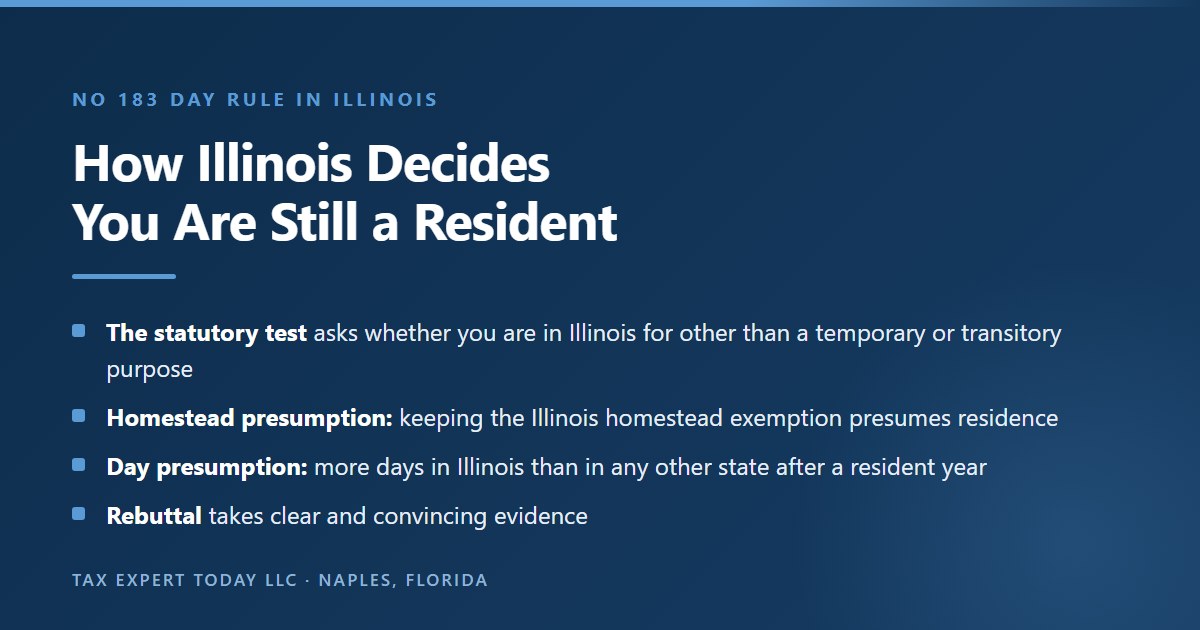
Section 100.3020(f) creates two rebuttable presumptions of residence. Anyone receiving an Illinois homestead exemption is presumed a resident. A person who was a resident in one year is presumed a resident the next year if present in Illinois more days than in any other state. Rebutting either takes clear and convincing evidence.
- The homestead presumption. Keeping the general homestead exemption on the Illinois house after the move is evidence against you.
- The relative day count presumption. The comparison is Illinois days against days in any other single state, not against 183.
- The evidentiary bar. Clear and convincing evidence is a higher standard than the ordinary preponderance test.
- The protective return. The regulation tells a presumed resident who believes otherwise to file anyway and explain why.
The relative day count presumption is the closest thing Illinois has to a day test, and it works differently from the one most people expect. It applies only to someone who was an Illinois resident in the prior year, and it compares Illinois days with days in any other state. A retiree who spends five months in Naples, four months in Illinois and three months travelling among several other states has more Florida days than Illinois days, so the presumption does not arise. The same retiree who spends five months in Illinois and four in Florida has triggered it, even though neither figure approaches 183.
The homestead presumption is easier to avoid and easier to trip over. The general homestead exemption in 35 ILCS 200/15-175 is for property occupied as a principal residence. Once the Florida homestead exemption is claimed on the Naples home, leaving the Illinois exemption in place contradicts the Florida claim and hands the Department a ready presumption. Ending it is handled with the county assessor, and it belongs on the same checklist as the Florida declaration of domicile.
The regulation also answers a question most departing residents never ask. Under section 100.3020(g)(3), a person subject to either presumption who believes they were a nonresident should still file an Illinois return for the year, marked as a nonresident return, computed as though a resident, carrying the notation the regulation prescribes to show no liability as a nonresident, and accompanied by a signed statement explaining which presumption applies and why it is overcome. Filing that return protects against failure to file penalties if the Department later disagrees, and it puts the evidence in front of the Department early rather than in response to a notice.
How Is Income Taxed in the Year You Leave Illinois?
The departure year is a part-year resident year. Under 35 ILCS 5/301(b), every item of income for the resident period is allocated to Illinois regardless of source, and for the rest of the year only Illinois source items are. You file Form IL-1040 with Schedule NR, and Illinois applies its flat 4.95 percent rate.
- Resident period. Wages, interest, dividends and gains received while a resident are all Illinois income.
- Nonresident period. Only compensation, nonbusiness income and business income allocated by sections 302 to 304 remain.
- The date matters. A portfolio sale one week after the documented domicile change is treated very differently from one a week before it.
- Florida adds nothing. Florida levies no personal income tax under Fla. Const. Art. VII, §5(a), so there is no second return.
The departure year return is the first part of the Illinois exit tax picture that is real rather than mythical. The Department’s Schedule NR instructions put the principle plainly: income received while a resident is taxed in full regardless of source, and income received while a nonresident is taxed only if it comes from Illinois sources. The practical consequence is timing. A large discretionary item, such as a planned sale of appreciated stock, a Roth conversion or a partnership distribution with a gain component, produces a very different Illinois result depending on which side of the domicile date it lands.
That makes the domicile date itself the most important fact on the return, and it is a fact you prove rather than declare. Signing the Florida declaration of domicile under Fla. Stat. §222.17, obtaining a Florida driver license, registering to vote and moving the household all support a date. A lease that continues in Illinois, children still enrolled there, or a pattern of returning for most of the working week undercuts it. Our first year snowbird filing guide walks through the part-year return mechanics that apply across states, and our Florida residency guide covers the Florida side of the record.
Illinois does not use the accrual rule that New York applies to former residents, under which income accrued before the move is pulled back into the resident period. Illinois allocates by when an item is received during the resident or nonresident portion of the year, subject to the sourcing rules for the nonresident portion. That still leaves room for an Illinois claim on compensation earned for Illinois services and paid later, which is covered below.
What Illinois Income Follows You to Florida After the Move?
After the move, Illinois can still tax rent and gain from Illinois real estate, compensation for work performed in Illinois, business income apportioned to Illinois, and part of the gain on selling an S corporation or partnership interest. Interest, dividends and gain on publicly traded securities are generally not allocated to Illinois for a nonresident individual.
- Real property. Rent and gain from Illinois real estate are allocated to Illinois under 35 ILCS 5/303(b)(1) and (c)(1).
- Portfolio income. Section 301(c)(2)(A) says interest and dividends of a nonresident individual are not allocated to Illinois.
- Stock and other intangibles. Gain follows commercial domicile under section 303(b)(3), which for an individual now points to Florida.
- Closely held business interests. Section 303(b)(4) is the exception that catches business owners.
That last point is the one no page ranking for the Illinois exit tax mentions, and it is the most expensive. Under 35 ILCS 5/303(b)(4), gain on the sale of shares in an S corporation or an interest in a partnership is allocable to Illinois if the entity is taxable in Illinois, in proportion to the average of the entity’s Illinois apportionment factor for the year of sale and the two preceding years. The owner of a Chicago area operating company who moves to Naples and then sells the stock has not escaped Illinois on the share of the gain that reflects the company’s Illinois business. The move changes where the owner lives. It does not change where the company earned its money.
Investment partnerships, as defined in section 1501(a)(11.5), are carved out of that rule, and an asset sale by the entity is a different analysis from a sale of the interest. Both points deserve modelling before a letter of intent, which is the timing issue we explore in our guide to moving to Florida before selling a business.
| Income item after the move | Allocated to Illinois? | Authority |
|---|---|---|
| Rent from an Illinois rental property | Yes | 35 ILCS 5/303(c)(1) |
| Gain on selling Illinois real estate | Yes, to the extent it is taxable federally | 35 ILCS 5/303(b)(1) |
| Gain on selling publicly traded stock | No | 35 ILCS 5/303(b)(3) |
| Interest and dividends | No | 35 ILCS 5/301(c)(2)(A) |
| Gain on selling S corporation shares or a partnership interest | Yes, by the entity’s three year average Illinois apportionment factor | 35 ILCS 5/303(b)(4) |
| Wages for days worked in Illinois | Yes, under the compensation rules | 35 ILCS 5/302 and 5/304(a)(2)(B) |
| Wages for work performed entirely in Florida for an Illinois employer | Generally no, because Illinois has no convenience of the employer rule | 35 ILCS 5/304(a)(2)(B) |
| Qualified pension and IRA distributions | No | 4 U.S.C. §114 |

Remote workers get better treatment from Illinois than from New York. Illinois has not adopted a convenience of the employer rule, so an employee who moves to Naples and works entirely from Florida for a Chicago employer is generally outside Illinois on those wages. Days physically worked in Illinois are another matter, and a hybrid arrangement with regular weeks in the Chicago office produces Illinois source compensation for those days. Our guide to the convenience of the employer rule explains why New York, Pennsylvania and a few other states reach much further. Executives with equity awards face a separate allocation question over the vesting period, discussed in our guide to Florida domicile for executives.
Does Illinois Tax Your Pension or IRA After You Leave?
No, and it largely did not tax them before you left either. Illinois residents subtract qualified plan, IRA and government pension distributions under 35 ILCS 5/203(a)(2)(F), and Social Security is also subtracted. After the move, 4 U.S.C. §114 bars Illinois from taxing retirement income of a nonresident.
- Resident treatment. Distributions under IRC §402(a), 403(a), 403(b) and 408 are subtracted from Illinois base income.
- Nonresident protection. Federal law prohibits a state from taxing a nonresident’s qualified retirement income.
- Nonqualified plans differ. A nonqualified deferred compensation plan is protected under 4 U.S.C. §114 only if it pays in the forms that section describes.
- The retiree paradox. A retiree living on pension and IRA income may save little Illinois income tax by moving.
This is where the Illinois exit tax story diverges from New York and California. A New York retiree drawing a large IRA distribution pays New York tax on it above a modest exclusion, so the income tax saving from moving is real every year. An Illinois retiree already pays nothing on that income. For that household the income tax case for leaving is weak, and the case that remains is about three other things: the Illinois estate tax, property carrying costs on an Illinois home, and the tax on investment income such as interest, dividends and capital gains, which Illinois does tax for residents at 4.95 percent.
Nonqualified deferred compensation is the exception worth checking. The federal source tax statute protects payments from nonqualified plans only when they are part of a series of substantially equal periodic payments over the life or life expectancy of the recipient or over at least ten years, or come from an excess benefit plan. A lump sum from a nonqualified plan earned for Illinois services and paid after the move may still be Illinois source compensation. Our guide to retiring to Florida explains the ten year and life payout rules in detail.
Why Is the Illinois Estate Tax the Real Cost of Staying?
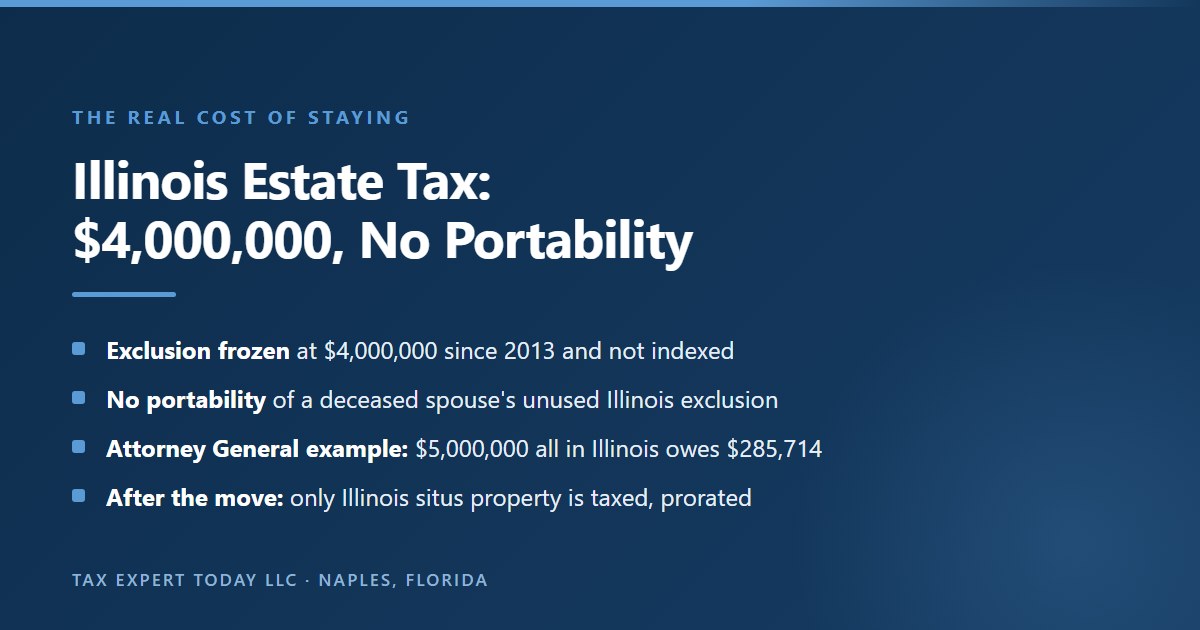
Because it starts at $4,000,000 and has no portability. The exclusion in 35 ILCS 405/2 has been $4,000,000 since 2013 and is not indexed. A surviving spouse cannot use the first spouse’s unused Illinois exclusion. The Attorney General’s own example shows a $5,000,000 Illinois estate owing $285,714 in Illinois tax.
- A frozen threshold. The federal exclusion for 2026 is $15,000,000 per person, nearly four times the Illinois figure.
- No portability. The Attorney General states that the federal portability election does not apply to the Illinois computation.
- A threshold, not a credit. Once an estate crosses $4,000,000, the interrelated computation reaches the full taxable estate rather than only the excess.
- Adjusted taxable gifts count. Lifetime gifts are added back when testing the $4,000,000 filing threshold, even though Illinois has no separate gift tax.
The Attorney General’s fact sheet is unusually direct about the numbers, and they are worth reproducing because they show how steep the curve is. The figures below are the Attorney General’s published computation examples, not our estimates, and they assume no federal estate tax is due.
| Attorney General example | Illinois estate tax | What it shows |
|---|---|---|
| Estate of $4,000,000, all Illinois property | $0 | An estate exactly at the exclusion owes nothing |
| Estate of $5,000,000, all Illinois property | $285,714 | One million dollars over the line produces a tax well above what a simple rate on the excess would suggest |
| Estate of $5,000,000, half in Illinois and half in Florida | $142,857 | Only the Illinois situs share is taxed, even though Florida imposes no estate tax |
| Estate of $13,610,000 with a surviving spouse and an Illinois QTIP election of $9,610,000 | $0 | The Illinois only QTIP election can hold the taxable estate at the exclusion |
If any part of the Illinois exit tax idea has a real core, it is this one. The absence of portability is what turns a married couple’s estate plan into an Illinois problem. At the federal level, a surviving spouse can carry over the deceased spouse’s unused exclusion. Illinois refuses that, so a plan that leaves everything outright to the surviving spouse wastes the first spouse’s $4,000,000 Illinois exclusion, and the second estate is taxed on the combined assets. Illinois does allow a QTIP election for Illinois purposes that is separate from the federal election under 35 ILCS 405/2(b-1), which is how the Attorney General’s fourth example reaches zero. Using it well requires drafting before death, not a filing decision afterward.
For a household with a combined estate well above $4,000,000, this is the strongest financial reason to complete the move to Florida and complete it convincingly. Florida has no estate tax, a point we develop in our guide to Florida estate planning for new residents. The exposure that survives the move is narrower, and it is the subject of the next section.
Does the Illinois Estate Tax Still Apply After You Move to Florida?
Only to property with an Illinois tax situs. Under 35 ILCS 405/3(c), the tax is computed as if every asset were in Illinois and then reduced by the share of the gross estate located elsewhere. For a Florida domiciliary, Illinois real estate and tangible property remain; stocks, bonds and bank accounts leave with the domicile.
- Illinois real property stays in. A retained Chicago condominium or lake house keeps an Illinois situs.
- Tangible property located in Illinois stays in. Furnishings, art and vehicles kept at the Illinois property count.
- Intangibles follow domicile. A brokerage account owned by a Florida domiciliary is not Illinois situs property.
- The whole estate still sets the tax. The preliminary tax uses total assets, so a large Florida portfolio raises the tax on a modest Illinois property.
That fourth point is the one that surprises people, and it is the closest thing to a true Illinois exit tax that survives a completed move. Illinois does not tax the Florida assets, but it uses them. The statute computes the full state tax credit on the entire estate and then multiplies by the Illinois share. A nonresident with a $600,000 Illinois condominium and a $9,000,000 Florida estate files an Illinois Form 700 if the gross estate including adjusted taxable gifts exceeds $4,000,000, and owes Illinois the condominium’s share of a tax computed on the whole. The Attorney General’s fact sheet describes the same steps, including the Form 700 addendum for estates with less than all of their assets in Illinois.
Retained Illinois real estate is therefore the main Illinois exit tax planning question for an estate, not only a property management question. Selling it during life, or holding it in a structure that changes its character, can change the estate tax answer, but whether a particular entity wrapper achieves that is a legal question for Illinois estate counsel and one the Attorney General may test. Our guide to the New Jersey inheritance tax for nonresidents shows how differently another state draws the same situs line.
What Happens to a Trust Created While You Lived in Illinois?
Illinois treats an irrevocable trust as a resident trust if the grantor was domiciled in Illinois when it became irrevocable, and a testamentary trust as resident if the decedent died domiciled there. Your move does not change that label. The Linn decision limits Illinois when the trust has no remaining Illinois connection.
- Revocable trusts. A revocable trust that becomes irrevocable at the death of a Florida domiciliary is not an Illinois resident trust.
- Irrevocable trusts created before the move. The statutory label under 35 ILCS 5/1501(a)(20)(D) stays with the trust.
- The constitutional limit. Linn v. Department of Revenue, 2013 IL App (4th) 121055, held the tax unconstitutional where the trust had no Illinois connection beyond the grantor’s former domicile.
- Connections that matter. An Illinois trustee, Illinois administration or Illinois property can supply the nexus that Linn found missing.
Trusts are the least discussed part of the Illinois exit tax question. For most people who move with a revocable living trust, this is good news. The trust becomes irrevocable at death, and if death occurs after a genuine Florida domicile change, subparagraph (D) never attaches. The exposure belongs to families who created irrevocable trusts while living in Illinois, such as insurance trusts, gifting trusts and dynasty trusts, and who assume that moving the grantor moves the trust. The statute says otherwise, and relief depends on removing the remaining Illinois connections so the Linn reasoning applies. That question, and the federal limit the Supreme Court drew in Kaestner, are the subject of our guide to trust situs after moving to Florida.
What Does Selling the Illinois House Actually Cost?
Usually less than people fear. Gain excluded under IRC §121 never enters federal adjusted gross income, which is where Illinois starts. Gain above the exclusion is Illinois source under 35 ILCS 5/303(b)(1) even after the move. The transfer taxes are modest, and they apply to every seller.
- The federal exclusion flows through. Up to $250,000, or $500,000 on a qualifying joint return, never reaches the Illinois computation.
- The clock keeps running after you leave. The two of five years test gives roughly three years after moving out to sell and still qualify.
- Excess gain stays Illinois source. Selling after the move does not escape Illinois on gain above the exclusion.
- Converting to a rental changes things. Rent becomes Illinois source income and depreciation adds a layer the exclusion cannot touch.
The Illinois house raises two separate issues, and the Illinois exit tax label tends to merge them. The first is the income tax on the gain, which for most long held homes is covered in whole or in part by the section 121 exclusion, explained step by step in our guide to selling your home after moving to Florida. The second is the residency signal the house sends while you still own it. An Illinois home that keeps its homestead exemption, stays furnished and occupied for half the year, and remains the address on your professional licenses is evidence that you never left.
If you keep the house and rent it out, the rent is Illinois source and so is the eventual gain, including the part attributable to depreciation, which no exclusion reaches. That path is covered in our guide to selling rental property taxes after a move. Illinois does not publish a nonresident seller withholding form set comparable to New Jersey’s GIT/REP forms or California’s Form 593 among its individual income tax forms, so the gain is reported on Form IL-1040 with Schedule NR. Estimated payments may be needed to avoid an underpayment penalty on a large sale.
What Records Prove You Left Illinois?
Section 100.3020(g) lists the evidence the Department weighs, and it goes well beyond a driver license. The list includes where your spouse and dependents live, voter and vehicle registration, a resident return filed elsewhere, home ownership, professional licenses, your doctors and advisors, club memberships and utility usage over time.
- Florida filings. The Fla. Stat. §222.17 declaration of domicile, the Florida homestead exemption, a Florida driver license and voter registration.
- Illinois filings removed. The Illinois homestead exemption withdrawn, vehicle registration moved and voter registration cancelled.
- Relationships moved. Physicians, dentist, accountant and attorney in Florida, with Illinois providers seen only when visiting.
- A day log. A contemporaneous calendar supported by phone, card and travel records, because the relative day count presumption turns on it.
None of the Illinois exit tax myths matter as much as this list. A useful discipline is to read it the way an auditor would, as a comparison. The question is never whether you have a Florida connection; it is whether your connections to Florida are now closer than your connections to Illinois. The regulation’s third example makes the point from the other direction: a Minnesota couple who winter in Illinois in a house they own, but whose clubs, business office, social life and family remain in Minnesota, are not Illinois residents, because their connection to Minnesota is closer. Reverse the states and the same facts keep a former Illinois resident taxable.
Illinois has not published residency audit guidelines of the kind New York issues, but the Department does examine part-year and nonresident returns, and the burden is on the taxpayer. The same evidence discipline we recommend in our guides to the Florida residency audit and the New York residency audit applies here. Our Florida 183 day rule calculator is a practical way to keep the day count honest, even though for Illinois the comparison that matters is relative rather than absolute.
Illinois Exit Tax Help in Naples & Southwest Florida
Tax Expert Today LLC works with individuals and families who have moved to Southwest Florida from Illinois and other high tax states and who still hold property, business interests or trusts connected to the state they left. The firm brings together tax advisors, enrolled agents, CPAs and attorneys, and handles residency and tax matters nationwide. The Chicago area is one of the steadiest sources of new Naples residents, so the Illinois departure year return, the retained Illinois condominium and the Illinois estate tax exposure are familiar ground here.
Our office is located at 11983 Tamiami Trail N, Naples, Florida 34110. You can reach us at (239) 441-2005, Monday through Friday, 10am to 5pm ET. We also work with clients across all 50 states.
- Illinois exit tax help Naples: separating the Illinois exit tax myth from the exposures that are real for your household, and pricing each one before the move date is fixed.
- Leaving Illinois tax planning Naples FL: timing large income items around the domicile date and preparing the part-year Form IL-1040 with Schedule NR.
- Tax planning Naples FL: coordinating the move with the wider plan described on our Naples tax planning page and in our guide to Florida tax services.
- Florida residency Naples FL: building the record that answers the Illinois presumptions, alongside the nonresident state tax return for Illinois source income.
- Estate and trust planning Naples: addressing the $4,000,000 Illinois exclusion, the Illinois only QTIP election and retained Illinois real estate with the plan described on our estate and trust planning page.
- Tax resolution Naples: Illinois notices challenging a claimed nonresident year, handled through our IRS resolution and audit support practice and our Naples tax resolution page.
A local question we are asked often: does splitting the year between Naples and the Chicago suburbs keep me an Illinois resident? It depends on where the balance of your life sits, and on the day comparison. Illinois has no 183 day rule, but if you were an Illinois resident last year and spend more days in Illinois than in Florida this year, the Department presumes you are still a resident, and you must rebut that with clear and convincing evidence. Spending the larger share of the year in Naples, and making Naples the center of your family, medical, financial and social life, is what the regulation’s examples reward.
When to Engage a Professional
A move from Illinois to Florida is simple when the household is retired, lives on qualified plan income, sells the Illinois home within the section 121 window, holds no closely held business and has an estate comfortably below $4,000,000. Most households that ask about the Illinois exit tax are not in that position. The combination that makes the move complicated is specific: a business interest whose sale would be apportioned under section 303(b)(4), a combined estate above the Illinois exclusion with a plan that relies on portability, irrevocable trusts created while in Illinois, and a retained Illinois property that keeps pulling the household back for half the year.
Consider engaging an advisor before the move date is fixed when any of the following is present: a sale of an S corporation, partnership interest or operating business is under discussion; a large discretionary income event could fall on either side of the domicile date; the combined estate including adjusted taxable gifts exceeds $4,000,000; the estate plan leaves everything outright to the surviving spouse and assumes portability; an irrevocable trust was created while you were an Illinois domiciliary; you plan to keep Illinois real estate; or you expect to spend a large part of the year in Illinois and will need to manage the relative day count presumption. Coordinating those issues with the Florida side of the plan is part of what our Florida residency and Florida asset protection guidance covers.
The firm brings together tax advisors, enrolled agents, CPAs and attorneys and works with clients nationwide from its Naples office. If you are planning a move from Illinois to Southwest Florida, or have already moved and still hold Illinois property, business interests or trusts, call (239) 441-2005 or use our contact page to arrange a consultation. Outcomes depend on the specific facts of each household, and nothing here is a prediction about any particular return or estate.
This article is educational and general in nature. It is not legal, tax or accounting advice, and it does not create a professional relationship. Illinois statutes, regulations and estate tax procedures change, and the figures cited here were verified against primary sources on the date of publication. Please consult a qualified advisor about your own situation.
Published September 19, 2026 by Dr. Pellumb Kabashi « Back to Learning Center
Have a question this article touches on?
Tax Expert Today LLC, based in Naples, Florida and serving clients across the United States.
Schedule a Consultation (239) 441-2005