
By Dr. Pellumb Kabashi, DBA, MBA, CES, CFE, EA
Founder, Tax Expert Today LLC · Tax advisors, enrolled agents, CPAs, and attorneys · Serving clients in all 50 states
Quick answer: The New Jersey exit tax is not a tax and it is not charged for leaving. It is an estimated income tax payment collected when a nonresident records a deed, equal to the greater of 10.75 percent of the gain or 2 percent of the sale price. The right GIT/REP box can stop it at closing rather than reclaiming it later. Call (239) 441-2005 for a free consultation.
Published: August 2026
What Is the New Jersey Exit Tax?
The New Jersey exit tax is a nickname, not a statute. New Jersey imposes no charge for moving away. What exists is an estimated income tax payment that a nonresident seller of New Jersey real property must remit before the county will record the deed, under N.J.S.A. 54A:8-8 through 54A:8-10. It is a prepayment against a tax you may or may not owe.
The name has done real damage. It suggests a toll gate at the state line, and it sends people looking for ways to escape something that is not a tax at all. The Division of Taxation describes the requirement plainly in Technical Bulletin TB-57(R), revised June 15, 2026: a nonresident individual, estate, or trust that sells or transfers real property in New Jersey must make an estimated Gross Income Tax payment prior to the recording of the deed, and must do so whether or not there is a gain on the sale.
- It is a withholding, not a levy. The money is credited against your New Jersey income tax for the year of the sale, and any excess comes back to you.
- It attaches to the deed, not to the move. Nothing is collected when you load the truck. The trigger is a recorded transfer of New Jersey real property.
- It applies to nonresidents. A seller who is still a New Jersey resident on the closing date is outside the payment requirement entirely.
- It has sixteen written exemptions. Most sellers who qualify for one can certify their way out at the closing table rather than paying and reclaiming.
- It settles nothing about domicile. Making the payment does not establish that you left New Jersey, and skipping it does not establish that you stayed.
That last point separates this article from most of what is written about the subject. The withholding is a cash flow event on one transaction. Whether New Jersey can still tax your salary, your portfolio, and your retirement distributions next year is a residency question governed by an entirely different set of rules, and the closing statement has no bearing on it. Our guide to establishing Florida residency covers that second question in full.
How Much Is the New Jersey Exit Tax Withholding?
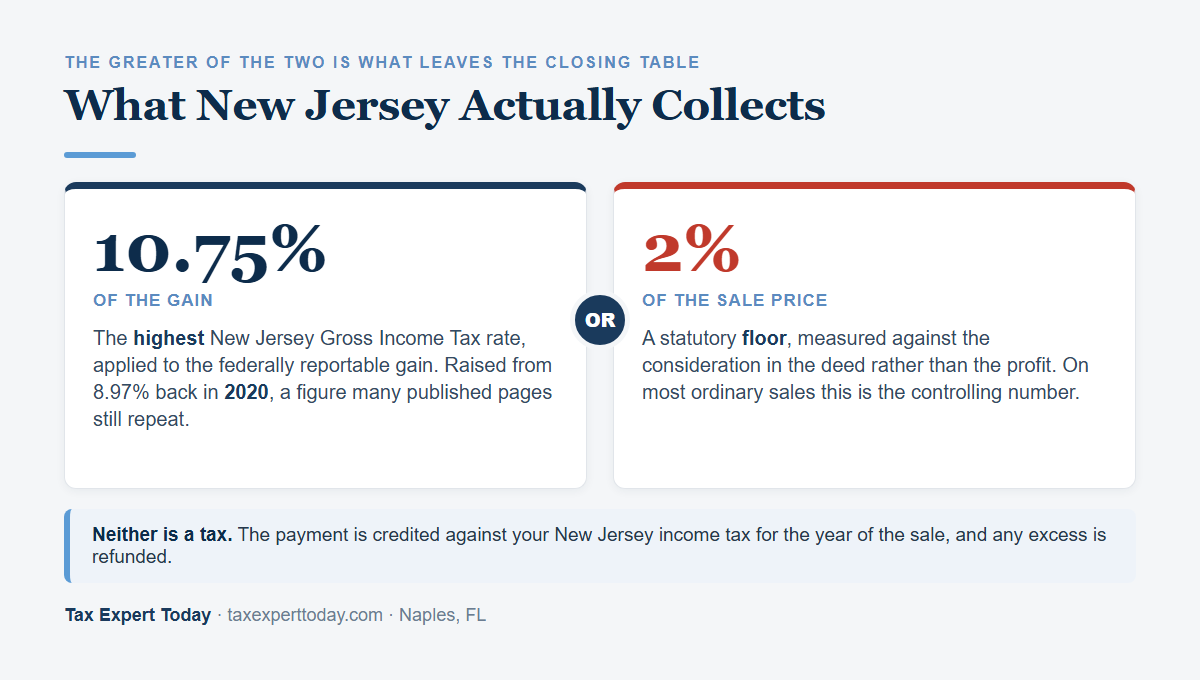
The estimated payment equals the reportable federal gain multiplied by the highest New Jersey Gross Income Tax rate, which is 10.75 percent, and the law sets a floor: the payment cannot be less than 2 percent of the consideration stated in the deed. Whichever figure is larger is the amount the settlement agent remits.
Both numbers deserve a second look, because both are commonly misstated. The 10.75 percent figure is not a capital gains rate and it is not the rate you will ultimately pay. It is simply the top marginal rate in the New Jersey rate schedule, applied to the whole gain as a deliberately conservative estimate. New Jersey adopted that top rate effective January 1, 2020, raising it from 8.97 percent. Several pages that currently rank for this topic still publish the 8.97 percent figure, which has been wrong for more than six years.
The 2 percent floor is the number that actually bites, because it is measured against the gross price rather than the profit. On a sale with a modest gain, 2 percent of the price is almost always the larger of the two, so the floor rather than the rate determines what leaves the closing table.
| Measure | What it is applied to | Authority | Practical effect |
|---|---|---|---|
| 10.75 percent | The gain reportable for federal income tax purposes | Highest rate under N.J.S.A. 54A:2-1 | Controls only on a high gain relative to price |
| 2 percent | The consideration stated in the deed | Statutory floor in N.J.S.A. 54A:8-9 | Controls on most ordinary sales |
| Realty transfer fee | The consideration, on a graduated scale | A separate recording requirement | Owed in addition, and frequently confused with the withholding |
The last row is there because the conflation is so common. The realty transfer fee and the supplemental fee that applies to higher priced residential sales are recording charges on the transaction itself. TB-57(R) is explicit that the GIT/REP filing is required in addition to the realty transfer fee form. They are separate obligations with separate forms, and a seller who budgets for one and not the other is surprised twice.
Who Pays the New Jersey Exit Tax, and When Is Residency Measured?
Only a nonresident seller owes the estimated payment, and New Jersey measures residency on the date of closing. A seller who is a New Jersey resident when the deed is signed may certify that status on Form GIT/REP-3 and pay nothing, even though the county records the deed weeks later and even though the seller has by then moved out of state.
This is the single most useful and least published fact about the subject, and it comes directly from the Division. TB-57(R) explains box 1 of the GIT/REP-3 with a worked example: a seller closes on a New Jersey house in April, the deed is recorded in May, the house was her primary residence, and because she was a New Jersey resident at the time of closing, box 1 is acceptable. The bulletin states the rule in one line, that the box is based on the date of closing.
- The closing date governs, not the recording date. A recording delay does not convert a resident seller into a nonresident seller.
- The closing date governs, not the moving date. A seller who has not yet established a home elsewhere on the closing date is still a resident for this purpose.
- Sequence is a planning lever. Selling before the domicile change and selling after it produce different paperwork at the same closing table.
- Part year residents are treated as nonresidents. The GIT/REP-3 instructions say so directly, so a seller who has already established a home outside New Jersey cannot use box 1.
None of this means a seller should reorder a life around a form. It does mean that when a closing and a relocation are already going to happen within weeks of each other, the order in which they happen changes whether 2 percent of the price sits with the State of New Jersey for the better part of a year. For anyone weighing that sequence alongside a larger liquidity event, our guide to moving to Florida before selling a business works through the same timing logic on a different asset.
New Jersey defines residency the way most states do. You are a resident if New Jersey is your domicile, unless you maintained no permanent home in New Jersey, did maintain a permanent home outside it, and spent no more than 30 days in the state. You are also a resident if New Jersey is not your domicile but you maintained a permanent home there and spent more than 183 days in the state. Those tests, published by the Division on its nonresident page, decide far more money than the withholding ever will.
Which GIT/REP Form Applies to Your Closing?
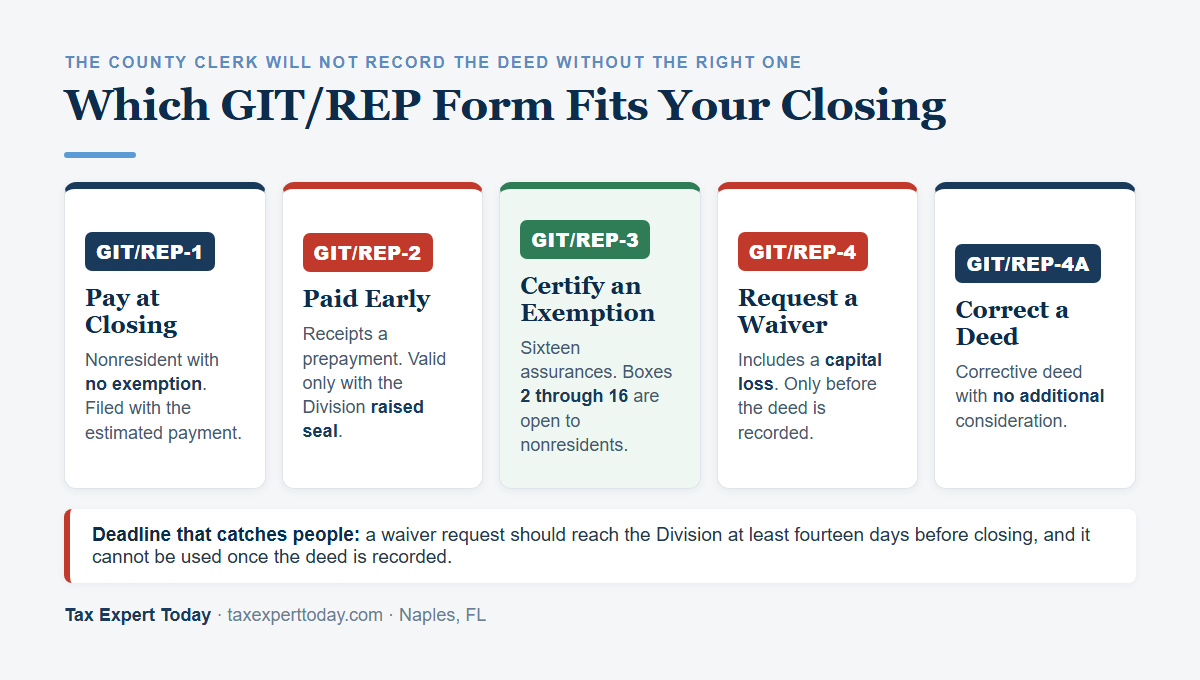
There are five forms in the GIT/REP family and the county clerk will not record a deed without the correct one. GIT/REP-1 accompanies a payment, GIT/REP-2 proves a prepayment already certified by the Division, GIT/REP-3 certifies an exemption, GIT/REP-4 carries a waiver the Division granted in advance, and GIT/REP-4A covers a corrective deed with no consideration.
Choosing the wrong form is the most common way an otherwise clean closing stalls. The forms are not interchangeable, and two of them require the Division to physically affix a raised seal before a county clerk will accept them.
| Form | Who uses it | What it does | Advance approval needed |
|---|---|---|---|
| GIT/REP-1 | Nonresident seller with no exemption | Declares the sale and accompanies the estimated payment at closing | No |
| GIT/REP-2 | Nonresident seller who paid early | Receipts a payment made at a Regional Information Center before closing | Yes, and only valid with the raised seal |
| GIT/REP-3 | Residents and nonresidents with an assurance | Certifies that one of sixteen exemptions applies, so no payment is due | No, and it is not submitted to the Division |
| GIT/REP-4 | Sellers with no available assurance | Carries a waiver the Division granted, including for a capital loss | Yes, and only before recording |
| GIT/REP-4A | Current owner correcting a deed | Covers a corrective deed with no additional consideration | No |
Two mechanical points are worth carrying to the closing. First, the GIT/REP-2 and the GIT/REP-4 must be submitted to the county clerk physically, because a raised seal cannot be transmitted electronically, while the GIT/REP-1, GIT/REP-3, and GIT/REP-4A can be scanned or electronically signed alongside an electronically recorded deed. Second, an error on a GIT/REP form does not unwind anything. N.J.S.A. 54A:8-10.g provides that where the deed itself was validly recorded and accurately completed, the recording is not invalid and title is not impaired by errors on the GIT/REP forms, so no re-recording is required to fix one.
One narrow exception removes the paperwork entirely. TB-57(R) confirms that no estimated payment and no GIT/REP form is needed to record a sheriff’s deed in a foreclosure sale or a bankruptcy trustee’s deed in a bankruptcy action.
Can You Avoid the Withholding Instead of Reclaiming It?
Frequently, yes. Boxes 2 through 16 of the GIT/REP-3 are available to nonresidents as well as residents, and any one of them that applies means no estimated payment is due at closing. The principal residence exemption in box 2 covers most departing homeowners, and the Division has stated that checking it is valid even when the sale price suggests a large paper gain.
This is where the ranking coverage of this topic falls short. Almost every article describes the withholding as inevitable and then explains how to get the money back. The Division’s own instructions describe a system where a large share of sellers never pay it in the first place, because they qualify for a written assurance and say so on a form the settlement agent files with the deed.
The instruction accompanying box 2 is unusually direct. It confirms that checking box 2 is valid, acceptable, and permissible despite a paper gain based solely on the sales price, on the reasoning that the actual capital gain can only be known once the seller assembles the documentation establishing federal and state basis. A seller who qualifies under IRC §121, having owned and used the home as a principal residence for two of the five years before the sale, is not obliged to hand over 2 percent of the price and wait because the arithmetic looks alarming at the closing table. The federal exclusion that box 2 rests on shelters up to $250,000 of gain for a single filer and up to $500,000 for a married couple filing jointly, and New Jersey follows it, so a very large share of ordinary home sales produce no New Jersey tax at all on the gain.
| GIT/REP-3 assurance | Typical situation it covers | Available to a nonresident |
|---|---|---|
| Box 1, resident taxpayer | Seller is still a New Jersey resident on the closing date | No, residents only |
| Box 2, principal residence | Home used exclusively as a principal residence under IRC §121 | Yes |
| Box 6, consideration of $1,000 or less | Nominal transfers | Yes |
| Box 7a, nonrecognition | Gain not recognized federally under IRC §721, §1031, or §1033 | Yes |
| Box 8, estate distribution | Executor or administrator conveying to a devisee or heir | Yes |
| Box 10, pre August 2004 deed | Deed dated before August 1, 2004 and never recorded | Yes |
| Box 12, divorce transfer | Transfer between spouses or incident to divorce under IRC §1041 | Yes |
| Box 14, no net proceeds | Seller receives nothing on the settlement sheet | Yes |
| Box 16, deployed service member | Property bought as a New Jersey resident, sold on deployment | Yes |
Box 12 has a defined boundary that catches people. The transfer is incidental to the divorce if it occurs within one year after the date the marriage ceases, or if it is otherwise related to the cessation of the marriage. Where a former spouse will not cooperate in signing the GIT/REP-3, the bulletin points the seller toward a waiver request instead. Divorce related property transfers carry several tax questions at once, which our guide to dual state residency touches on where the parties end up in different states.
A seller who claims box 2 and later determines the gain exceeds the exclusion is not left exposed. The instructions direct that seller to make an estimated payment to the State using Form NJ-1040-ES after recording, rather than submitting a GIT/REP-1 and a payment to the county.
What Happens If You Sell at a Loss?
Contrary to the most repeated claim about this subject, a seller with a capital loss is not simply required to surrender 2 percent of the price and wait for a refund. TB-57(R) directs a seller selling at a capital loss to request a waiver from the Division on Form GIT/REP-4, and recommends submitting the request at least fourteen days before closing.
The widely published version of this rule, repeated in the Google AI Overview and in most of the pages currently ranking for the term, is that even a sale at a loss requires the 2 percent payment. That is what happens by default if nobody asks for anything. It is not what the Division’s own guidance tells a loss seller to do.
- The request is made in advance. A GIT/REP-4 is only applicable before the deed is recorded, and waiver requests for deeds already recorded are rejected.
- Timing is tight. Fourteen days before closing is the recommended lead time, which means the decision belongs in the contract period rather than the closing week.
- Documentation carries it. The request goes in with the original deed into the seller, the proposed deed, the settlement statement or closing disclosure verifying the date, and a letter explaining the reason.
- A loss from improvements needs detail. Where the loss arises from capital improvements, the Division requires an itemized list of the improvements with corresponding dollar amounts.
- A waiver will not substitute for an assurance. Where a GIT/REP-3 box applies, the Division will decline the waiver and point the seller to the correct box.
If the moment passes and the deed is recorded with the payment made, the waiver route closes permanently for that transaction. TB-57(R) is explicit that no refund claim can be made on a GIT/REP-4 once the deed has been recorded, and that the seller must instead use Form A-3128. Questions about the forms or a waiver can go to the Division’s GIT/REP Unit at (609) 322-9275.
How Do You Get the New Jersey Exit Tax Refunded?
There are two routes and the calendar decides between them. Form A-3128 claims the refund directly and can be filed once the deed is recorded, without waiting for year end. Alternatively the excess is claimed on the New Jersey nonresident return, Form NJ-1040NR, for the year of the sale. A seller who uses the A-3128 still has to file the NJ-1040NR.
The Division sets out the choice in practical terms. Where the sale happens early in the year and the seller does not want to wait, the A-3128 is the faster route. Where the sale happens late in the year, filing the nonresident return alone avoids doing the work twice. For a prior year still within the statute of limitations, the seller files an amended NJ-1040NR, or an original one if no New Jersey return was ever filed for that year.
| Situation | Route | Notes |
|---|---|---|
| Sale early in the tax year | Form A-3128 | Faster, but the NJ-1040NR is still required for the year |
| Sale late in the tax year | Form NJ-1040NR | Claims the excess on the return and avoids duplicate filings |
| An assurance applied but no GIT/REP-3 was filed | Form A-3128 with a copy of the GIT/REP-3 | Expressly permitted by the Division |
| Prior year, still open | Amended or original NJ-1040NR | Must fall inside the refund statute of limitations |
| Resident with erroneous withholding | A-3128, NJ-1040, or NJ-1040X | Applies where the payment was made in error by a resident |
The A-3128 is mailed with supporting documentation to the Division of Taxation, Taxpayer Accounting Branch, PO Box 046, Trenton, New Jersey 08646-0046, and it can only be filed after the deed is recorded with the county clerk. Separate forms are used for each taxpayer other than spouses filing jointly. The mechanics of that nonresident return, including how a state computes the tax before apportioning it, are covered in our guide to the nonresident state tax return.
Does Paying the New Jersey Exit Tax End Your New Jersey Tax Exposure?
No, and treating it as though it does is the costliest mistake in this area. The withholding resolves one transaction. If New Jersey still regards you as domiciled there, it can tax your worldwide income for the year of the move and for every year after it, and nothing on the closing statement changes that conclusion.
Selling the house is powerful evidence in a domicile analysis and it is not the analysis itself. New Jersey looks at where your permanent home is, where you actually spend your days, and where the center of your life sits. A seller who closes on the New Jersey house, pays the estimated tax, and then keeps a condominium in the state, keeps New Jersey licenses and registrations, and spends more than 183 days there has changed the address on the mail and very little else.
- Domicile is one place at a time. New Jersey uses the standard definition, the permanent home you intend to return to after an absence.
- The 30 day exception is narrow. Escaping resident status while remaining domiciled requires no permanent home in New Jersey, a permanent home elsewhere, and no more than 30 days in the state.
- Statutory residency is a separate trap. A permanent home in New Jersey plus more than 183 days makes you a resident even if you are domiciled elsewhere.
- Filing thresholds are low. A nonresident files when gross income from all sources exceeds $10,000 filing single, or $20,000 filing jointly, as head of household, or as a qualifying surviving spouse.
- The withholding proves nothing either way. Making the payment is not an admission that you left, and being exempt from it is not proof that you stayed.
The pattern we see most often is a seller who did everything right at the closing table and nothing at all about the residency record. That combination invites the exact review our guide to a residency audit describes, and the same review New York runs in the form documented in our guide to the New York residency audit. The New Jersey corridor and the New York corridor run on the same logic, which our guide to the New York exit tax sets out for the neighboring state.
How Does a Florida Move Change the New Jersey Calculation?
Florida changes two things. It removes any resident state income tax against which New Jersey tax could be credited, so New Jersey tax becomes an absolute cost rather than an offset, and it gives you a clean evidentiary record to build, because Florida imposes no income tax on natural persons and asks nothing of you beyond genuinely living here.
The credit point is the one that changes the arithmetic. A New Jersey resident who paid tax to another state received a credit on the New Jersey return. A Florida resident has no resident return at all, because the Florida Constitution bars a tax on the income of natural persons resident in the state, so there is nothing for a credit to reduce. Any New Jersey tax that survives the move is paid once and stays paid. New Jersey is among the largest sources of income moving to Florida, with a net $2.17 billion of adjusted gross income in 2022-2023 according to our Florida wealth migration report.
The evidentiary point is where the work is. Florida offers a recorded declaration of domicile under Fla. Stat. §222.17, which is a useful document precisely because it is dated and public, and it is one item in a record rather than a substitute for one. What matters alongside it is the ordinary furniture of a life: the homestead exemption filing, the Florida license and vehicle registrations, the voter registration, the physicians and dentists and veterinarians, the primary bank, the club memberships, and above all the day count. Our Florida 183 day rule calculator exists for that last item, and our guide to snowbird taxes in year one covers the split year filing that follows.
- Build the record before the audit, not during it. Contemporaneous evidence is worth far more than a reconstruction assembled two years later.
- Count days deliberately. A partial day in the departure state generally counts as a day in the departure state.
- Watch what stays behind. A retained New Jersey home is the single item most likely to keep the question open.
- Do not stop at the house sale. Registrations, memberships, and professional relationships all carry weight, and none of them move themselves.
- Plan the estate side in parallel. Different states reach different assets after death, and New Jersey is one of the states that reaches further than most.
That final item deserves a word of caution specific to this state. New Jersey repealed its estate tax for deaths after 2017 but retained an inheritance tax that is levied by reference to the relationship between the decedent and the beneficiary rather than the size of the estate, and its reach over New Jersey real property does not stop at the state line simply because the owner moved. Anyone leaving New Jersey with property or family remaining there should treat that as a live question, alongside the arrival side questions covered in our guide to Florida estate planning for new residents and to Florida asset protection.
Does the Exit Tax Apply to a 1031 Exchange or Rental Property?
Investment property is squarely inside the requirement and the principal residence exemption does not reach it. A nonresident selling a New Jersey rental owes the estimated payment unless another assurance applies. A properly structured like kind exchange under IRC §1031 is covered by box 7a of the GIT/REP-3, and a partially exempt exchange has two defined settlement routes.
The nonrecognition assurance covers gain not recognized federally under IRC §721, §1031, or §1033, and the seller circles the applicable section on the form. Where a nonresident claims the 1031 exemption, the form requires the value of the like kind property received to be shown. The assurance also carries an acknowledgment: if the section does not ultimately apply to the transaction, the seller accepts the obligation to file a New Jersey return for the year of the sale and report the recognized gain.
Partial exemptions are the practical problem, because exchanges rarely land on a clean boundary. Where the transaction includes cash or other property that is not like kind, the seller chooses between two routes set out by the Division. The seller may complete a GIT/REP-1 showing the greater of the consideration or the fair market value of the non like kind property received and remit 2 percent of the nonexempt amount at recording, which closes out the estimated payment obligation for that portion. Alternatively the seller may file only the GIT/REP-3 at recording and make an estimated payment to the State afterward on Form NJ-1040-ES, based on the nonexempt portion. Where the deferred exchange is voided, the qualified intermediary completes a GIT/REP-1 and remits 2 percent of the total consideration.
Rental owners have a further consideration the residence rules never raise. The gain on New Jersey real property remains sourced to New Jersey after any move, depreciation taken over the holding period comes back into income, and the resulting New Jersey tax is no longer offset by a resident credit once you live in Florida. Our guide to selling your home after moving to Florida covers the residence side of that question, and the state level filing that follows is covered in our guides to retiring to Florida and to the convenience of the employer rule for those still earning from a former state. For executives holding equity compensation through a move, our guide to Florida domicile for executives addresses the sourcing question on that asset class.
New Jersey Exit Tax Help in Naples & Southwest Florida
Tax Expert Today LLC works with individuals and families relocating to Florida from New Jersey and other high tax states, and with those who have already moved and still hold New Jersey property. The firm brings together tax advisors, enrolled agents, CPAs, and attorneys, and handles residency and multistate tax matters nationwide. New Jersey is one of the largest feeder states into Southwest Florida, so closings that straddle a domicile change are familiar ground here.
Our office is located at 11983 Tamiami Trail N, Naples, Florida 34110. You can reach us at (239) 441-2005, Monday through Friday, 10am to 5pm ET. We also work with clients across all 50 states.
- New Jersey exit tax help Naples: review of the GIT/REP form that fits your closing, and of whether an assurance or a waiver applies before the settlement agent files.
- Florida residency Naples FL: building the domicile record that decides the far larger question the withholding does not answer.
- Tax planning Naples FL: sequencing a closing and a relocation, described further on our Naples tax planning page.
- Tax resolution Naples: unfiled nonresident years, refund claims, and state notices, described on our Naples tax resolution page.
- Statewide and nationwide: multistate work handled from Naples for clients across Florida and the country.
I am closing on my New Jersey house next month and moving to Naples. Should I close before or after I move?
Generally the paperwork is simpler if the closing happens while you are still a New Jersey resident, because residency for this purpose is measured on the closing date and a resident seller certifies on box 1 of the GIT/REP-3 rather than remitting 2 percent of the price. The Division confirms that a later recording date does not disturb that. If the sequence is already fixed the other way, the principal residence assurance in box 2 usually reaches the same result for a qualifying home, so the more useful question is which assurance applies rather than which month you drive south. Neither choice affects the domicile record, which is decided by where you actually live afterward.
When to Engage a Professional
Consider professional guidance if any of the following describe your situation: you are selling New Jersey real property in the same season you are changing your domicile; you are selling at a loss and the closing is more than two weeks away; you believe a GIT/REP-3 assurance applies but the settlement agent has asked for the payment anyway; you sold and the withholding was taken when an exemption was available; you own New Jersey rental or investment property and are weighing a sale or an exchange; you have not filed a New Jersey nonresident return for a year in which an estimated payment was made; or you have received correspondence from New Jersey after establishing a home in Florida.
The withholding itself is usually the smallest question in the file. What decides the real number is whether New Jersey accepts that you left, and that determination rests on a record built over the whole year rather than on a single form filed at a single closing. Whether professional involvement is warranted depends on the size of the transaction, the state of the residency record, and whether any year remains unfiled. For matters that have already reached a notice or an examination, our resolution and audit support page describes that work, and longer term structuring for property and beneficiaries is described on our estate and trust planning page. You can reach our office at (239) 441-2005 or through our contact page.
This article is educational and is not tax advice for any particular situation. New Jersey forms, rates, thresholds, and Division procedures change, and outcomes depend on individual facts. Consult a qualified tax professional about your own circumstances.
Published August 26, 2026 by Dr. Pellumb Kabashi « Back to Learning Center
Have a question this article touches on?
Tax Expert Today LLC, based in Naples, Florida and serving clients across the United States.
Schedule a Consultation (239) 441-2005