
By Dr. Pellumb Kabashi, DBA, MBA, CES, CFE, EA
Founder, Tax Expert Today LLC · Tax advisors, enrolled agents, CPAs, and attorneys · Serving clients in all 50 states
Quick Answer
The 1031 exchange rules let an investor defer gain by trading real property held for business or investment into other real property of like kind. Replacement property must be identified within 45 days and received within 180 days, a qualified intermediary must hold the proceeds, and depreciation recapture is deferred rather than forgiven. Call (239) 441-2005 for a free consultation.
What are the 1031 exchange rules?
The 1031 exchange rules are five requirements that must all hold: both properties must be real property held for business or investment, the properties must be like kind, replacement property must be identified within 45 days, it must be received within 180 days or by the return due date if earlier, and the taxpayer must never control the proceeds.
The 1031 exchange rules sit in one of the oldest deferral provisions in the Internal Revenue Code, and their structure is simpler than their reputation suggests. Section 1031 does not reward the investor for buying better property or for holding longer. It does one thing: it postpones the gain that a sale would otherwise trigger, provided the transaction is built as an exchange rather than as a sale followed by a purchase.
- Real property only. Since 2018, section 1031 applies to real property and nothing else.
- Held for business or investment. Property held primarily for sale is excluded by section 1031(a)(2).
- Like kind. Nearly all United States real property is like kind to other United States real property.
- 45 days to identify. The identification must be in writing and must be delivered before the period closes.
- 180 days to close. Or the due date of the return for the year of the transfer, whichever arrives first.
- No constructive receipt. A qualified intermediary holds the money so the taxpayer never does.
| Requirement | Authority | What breaks it |
|---|---|---|
| Real property held for productive use or investment | Section 1031(a)(1) | A flip, a dealer inventory parcel, or personal property standing alone |
| Not held primarily for sale | Section 1031(a)(2) | A pattern of short holds and rapid resale |
| Written identification within 45 days | Section 1031(a)(3)(A) | A late, oral, or ambiguous identification |
| Receipt within 180 days or the return due date | Section 1031(a)(3)(B) | Filing the return early without an extension |
| Qualified intermediary holds the proceeds | Treas. Reg. 1.1031(k)-1(g)(4) | Cash routed through the seller or a disqualified person |
| Domestic property on both sides | Section 1031(h) | A United States property exchanged for foreign property |
Everything else in the 1031 exchange rules follows from those six lines. The rest of the difficulty lies in the edges: what happens when the replacement property costs less, what happens to the depreciation already claimed, and what the return has to say about it afterward.
What property qualifies for a 1031 exchange in 2026?
Only real property qualifies. Public Law 115-97 replaced the word property with the words real property throughout section 1031(a)(1), effective for exchanges completed after December 31, 2017. Machinery, vehicles, equipment, artwork, and collectibles no longer qualify, although incidental personal property transferred with real property is disregarded within a 15 percent limit.
This is the single most common source of stale advice about the 1031 exchange rules on the open web, and the reason deserves stating plainly. Section 13303(a) of Public Law 115-97 substituted “real property” for “property” wherever it appeared in section 1031(a)(1), and section 13303(b)(5) changed the heading of the section itself, which now reads “Exchange of real property held for productive use or investment.” The current statutory text carries that language.
Material written before 2018 describes a much wider provision, and a good deal of it is still in circulation. At the time of writing, the highest ranked organic result on Google for this very topic is an IRS fact sheet published in February 2008 that states real property and personal property can both qualify under section 1031, and illustrates the point by explaining that cars are not like kind to trucks. That was correct when it was written. It has not been correct since 2018. An investor reading it today would reach the wrong conclusion about the threshold question.
| Asset | Qualifies in 2026 | Why |
|---|---|---|
| Rental house exchanged for an apartment building | Yes | Both are real property held for investment |
| Raw land exchanged for a retail strip center | Yes | Like kind refers to nature, not grade or quality |
| A 30 year leasehold interest in real property | Generally yes | A lease of 30 years or more is treated as real property |
| Appliances and furniture inside the rental | Only as incidental property | Disregarded if under the 15 percent limit in Treas. Reg. 1.1031(k)-1(g)(7) |
| Construction equipment | No | Personal property, removed from section 1031 in 2018 |
| Partnership interests | No | Excluded unless a valid section 761(a) election is in effect |
| A house in Naples exchanged for a villa in Italy | No | Section 1031(h) treats domestic and foreign real property as not like kind |
| A property bought to renovate and resell | No | Held primarily for sale, excluded by section 1031(a)(2) |
The incidental personal property rule is worth understanding rather than skipping. Under Treas. Reg. section 1.1031(k)-1(g)(7), personal property that is incidental to the replacement real property is disregarded in testing whether the taxpayer had access to non like kind property, provided it is typically transferred with that kind of real property and its aggregate fair market value does not exceed 15 percent of the aggregate fair market value of the replacement real property. Disregarded is not the same as qualifying. The personal property still does not receive nonrecognition treatment. It simply does not poison the exchange.
How do the 45 day and 180 day deadlines work?
The clock starts when the relinquished property transfers. Replacement property must be identified in writing within 45 days, and it must be received by the earlier of 180 days or the due date of the return for the year of transfer, determined with regard to extension. Both periods run on calendar days and neither is extended for weekends or holidays.
Section 1031(a)(3) sets both periods, and the wording of subparagraph (B) is where an exchange built correctly against every other one of the 1031 exchange rules quietly fails. Property is treated as not like kind if it is received after the earlier of two dates: the day which is 180 days after the transfer, or “the due date (determined with regard to extension) for the transferor’s return” for the taxable year in which the transfer occurred. The Form 8824 instructions repeat the same rule at line 6.
- Day 45 and day 180 both count from the same date, the day the relinquished property transfers, not from the contract date.
- There is no grace period. A deadline that lands on a Saturday, a Sunday, or a federal holiday does not move.
- The identification must be delivered, in writing and signed, to the intermediary or another party to the exchange.
- An extension protects the 180 days. Without one, a late year sale loses the tail end of the exchange period.
- Federally declared disasters can extend both periods under Rev. Proc. 2018-58, which matters in a hurricane exposed region.
The trap is arithmetic rather than legal, and it is the reason a fourth quarter closing needs a conversation before year end rather than in April. Consider a relinquished property that transfers on November 12, 2026.
| Event | Date | Effect |
|---|---|---|
| Relinquished property transfers | November 12, 2026 | Both periods begin |
| Day 45, identification deadline | December 27, 2026 | Written identification must be delivered |
| Unextended due date of the 2026 return | April 15, 2027 | Exchange period ends here if no extension is filed |
| Day 180 | May 11, 2027 | The full statutory period, available only with an extension |
| Days at stake | 26 days | Lost by filing on time without extending |
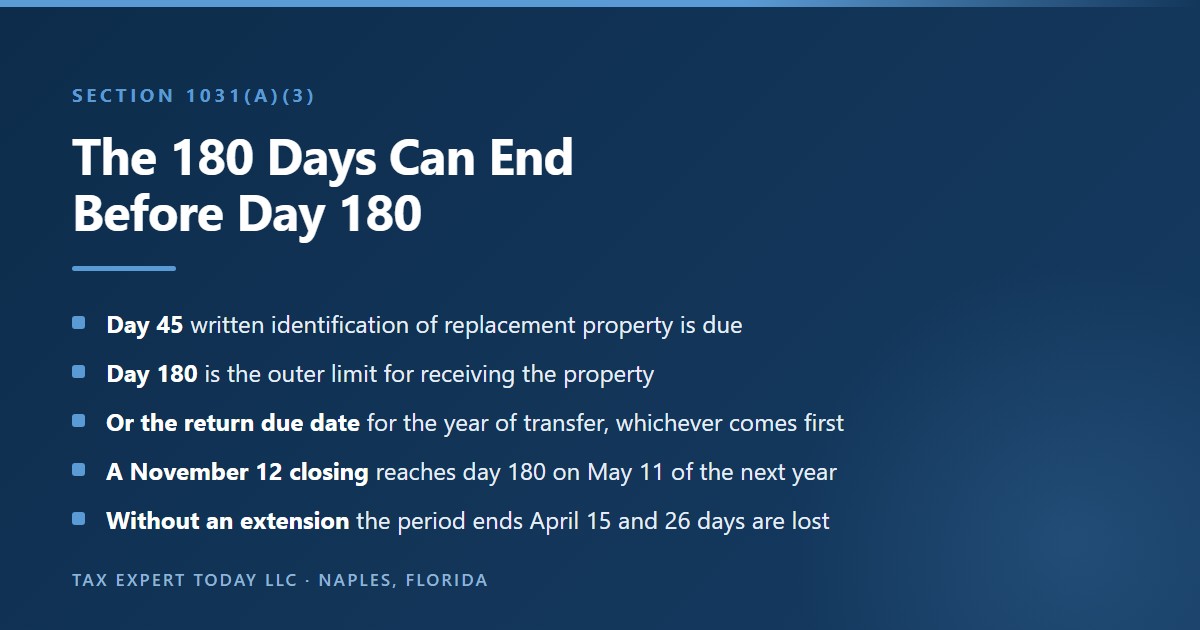
Twenty six days is a meaningful share of a closing window in a market where financing and inspections routinely slip. The remedy costs nothing and takes minutes: file Form 4868 or the entity equivalent, preserve the full 180 days, and file the return afterward. The order matters, because once the return is filed the exchange period has ended for that taxpayer even if day 180 has not arrived.
What are the three identification rules?
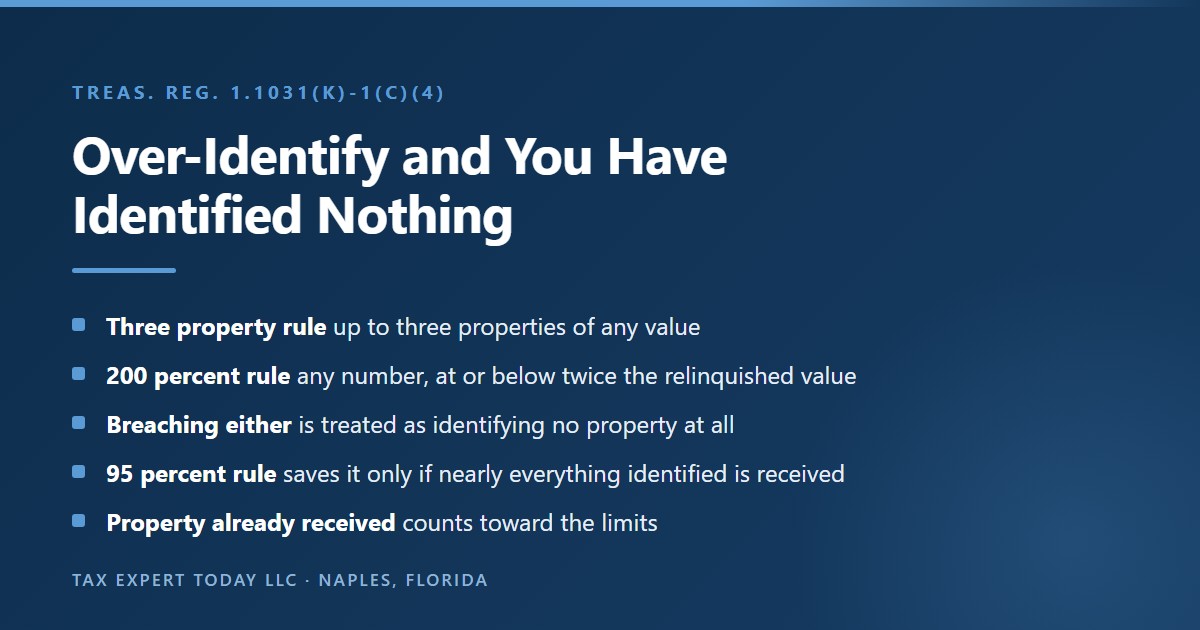
A taxpayer may identify three properties of any value under the three property rule, or any number of properties whose combined value does not exceed 200 percent of the relinquished property value under the 200 percent rule. Identifying more than either rule allows is treated as identifying nothing, unless the 95 percent rule saves it.
These particular 1031 exchange rules live in Treas. Reg. section 1.1031(k)-1(c)(4), and the consequence of breaching them is unusually harsh. Paragraph (c)(4)(ii) states that a taxpayer who identifies more properties than permitted “is treated as if no replacement property had been identified.” Not as if the excess were struck. As if none had been named at all.
| Rule | Test | Measured when | Practical use |
|---|---|---|---|
| Three property rule | No more than three properties, any value | End of the identification period | The default for most exchanges |
| 200 percent rule | Any number, aggregate value at or below 200 percent of the relinquished value | Replacement values at the end of the identification period; relinquished value at transfer | Portfolio buyers assembling several smaller assets |
| 95 percent rule | Taxpayer actually receives at least 95 percent of the aggregate identified value | Earlier of receipt or the last day of the exchange period | A fallback, not a plan |
The 95 percent rule reads like a safety net and functions like a tightrope. It only rescues an over identification if the taxpayer actually closes on nearly everything identified, which is the opposite of why a taxpayer over identifies in the first place. Anyone naming a long list because the outcome is uncertain is relying on the rule least able to help. The 200 percent rule is the disciplined answer, and property already received before the identification period ends counts toward the limits under paragraph (c)(4)(iii).
Why must a qualified intermediary hold the money?
Because actual or constructive receipt of the sale proceeds converts the exchange into a sale. The qualified intermediary safe harbor in Treas. Reg. section 1.1031(k)-1(g)(4) lets a third party hold the funds and acquire the replacement property, so the taxpayer never has the right to receive, pledge, borrow against, or otherwise benefit from the money.
The intermediary is not a formality and not a fee for paperwork. It is the mechanism that keeps the transaction inside section 1031 at all. The regulation is built around the idea that a taxpayer who could reach the cash has effectively sold, whatever the documents say.
- Who cannot serve. The Form 8824 instructions confirm that related parties and agents of the taxpayer are disqualified persons.
- The two year lookback. A person who acted as the taxpayer’s attorney, accountant, investment banker, broker, or employee within the previous two years is disqualified.
- The agreement must limit access. The exchange agreement has to restrict the taxpayer’s rights to the funds in the way the regulation describes.
- Intermediaries are largely unregulated. There is no federal licensing regime, and funds have been lost to intermediary insolvency.
- There is narrow relief if one fails. If the intermediary defaults because of bankruptcy or receivership, Rev. Proc. 2010-14 may allow gain to be reported as payments are received.
That last point is worth reading twice. The relief exists because the risk is real. An investor selecting an intermediary is making a credit decision about an entity holding the entire proceeds of a property sale, often for months, and the federal tax rules governing who may hold that money say nothing about whether the holder is solvent. Segregated qualified escrow accounts, written confirmation of how funds are held, and a look at the entity behind the brand are ordinary diligence rather than excessive caution.
What is boot and how is it taxed?
Boot is anything received in the exchange that is not like kind real property. Cash boot is money taken out of the transaction. Mortgage boot arises when the debt on the replacement property is less than the debt relieved on the relinquished property. Under section 1031(b), gain is recognized up to the total boot received.
Section 1031(b) states the rule compactly: where an exchange would otherwise qualify but the taxpayer also receives money or other property, gain is recognized “but in an amount not in excess of the sum of such money and the fair market value of such other property.” The final sentence of section 1031(d) supplies the second half, treating an assumption of the taxpayer’s liability as money received.
The following illustration is hypothetical and is used only to show the mechanics. The figures do not describe any client or any actual transaction, and results depend entirely on individual facts.
| Item | Amount | Source |
|---|---|---|
| Original cost of the relinquished property | $900,000 | Assumed |
| Straight line depreciation claimed over the hold | $262,000 | Assumed |
| Adjusted basis | $638,000 | Cost less depreciation |
| Sale price | $1,650,000 | Assumed |
| Selling costs | $99,000 | Assumed at 6 percent |
| Amount realized | $1,551,000 | Sale price less selling costs |
| Realized gain | $913,000 | Amount realized less adjusted basis |
| Mortgage relieved on the relinquished property | $520,000 | Assumed |
Now compare two versions of the same exchange. In the first, the investor trades up into a $1,900,000 replacement property with a $770,000 mortgage and takes no cash. Value goes up, debt goes up, and nothing comes out, so there is no boot and the entire $913,000 of gain is deferred. In the second, the investor buys a $1,380,000 replacement property, carries only a $400,000 mortgage, and takes $60,000 in cash at closing.
| Boot component | Computation | Amount |
|---|---|---|
| Cash boot | Cash received from the intermediary | $60,000 |
| Mortgage boot | $520,000 debt relieved less $400,000 debt assumed | $120,000 |
| Total boot | Cash boot plus mortgage boot | $180,000 |
| Recognized gain | Lesser of total boot or realized gain | $180,000 |
| Deferred gain | $913,000 realized less $180,000 recognized | $733,000 |
Mortgage boot surprises people because no money changes hands. Debt relief is economically equivalent to receiving cash and paying off the loan, and the statute treats it that way. Cash boot and mortgage boot may be netted against each other in limited circumstances, but cash received is never offset by taking on more debt. An investor who wants cash out of a property is usually better served by refinancing the replacement property after the exchange has closed rather than taking proceeds inside it, although the timing of any such refinance should be reviewed rather than assumed.
Is depreciation recapture deferred or forgiven in a 1031 exchange?
Deferred, never forgiven. The depreciation claimed on the relinquished property carries into the replacement property and remains taxable on a future sale. Worse, when boot is received in a partial exchange, the recognized gain is absorbed by the depreciation layer first, so boot is taxed at the 25 percent unrecaptured section 1250 rate rather than 15 or 20 percent.
This is the part of the 1031 exchange rules that promotional material consistently omits, and it is the single most expensive misunderstanding in the topic. A 1031 exchange does not erase depreciation. Section 1031(d) of the statute sets the basis of the replacement property by reference to the basis of the relinquished property, which means the depreciation already claimed stays embedded in a low basis and resurfaces the moment the chain ends.
- Unrecaptured section 1250 gain is the portion of gain attributable to straight line depreciation, taxed at a maximum of 25 percent under section 1(h)(1)(E).
- Section 1250 recapture of any depreciation in excess of straight line is ordinary income, entered on line 21 of Form 8824.
- The potential travels. The Form 8824 instructions state plainly that remaining potential section 1250 recapture attaches to the property received.
- Lines 25a through 25c allocate the replacement basis between section 1250 property and section 1245, 1252, 1254, and 1255 property, preserving the character split.
- Cost segregation compounds it. Accelerated components reclassified into shorter lives are personal property, which since 2018 cannot travel through section 1031 at all.
The ordering rule is the part almost nobody writes down. The Unrecaptured Section 1250 Gain Worksheet in the Schedule D instructions computes the amount at line 1 as the smaller of Form 4797 line 22, the depreciation allowed, or Form 4797 line 24, the total gain. In plain terms, recognized gain fills the depreciation bucket before anything reaches the ordinary capital gain ladder. Apply that to the partial exchange above.
| Layer | Amount | 2026 rate | Tax |
|---|---|---|---|
| Unrecaptured section 1250 gain | $180,000 | 25 percent | $45,000 |
| Residual long term capital gain | $0 | 15 or 20 percent | $0 |
| Net investment income tax | Applied to income above the threshold | 3.8 percent | $4,180 |
| Total tax on $180,000 of boot | 27.3 percent | $49,180 |
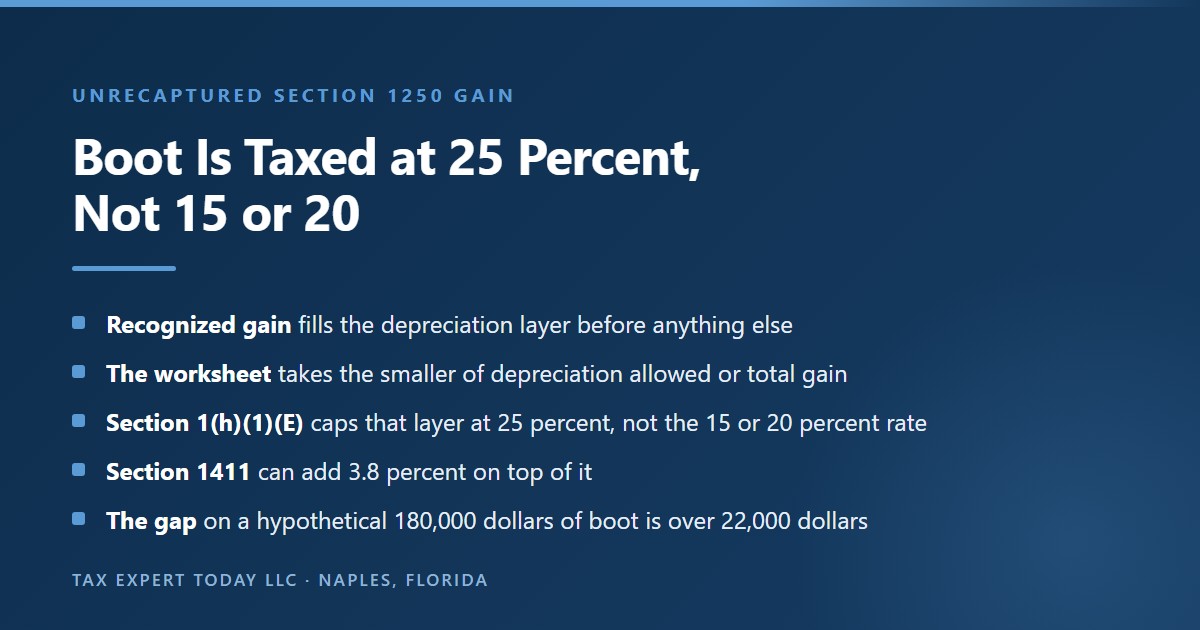
An investor who assumed boot would be taxed at the 15 percent long term rate would have budgeted roughly $27,000 and would be short by more than $22,000. The illustration assumes joint filers with $180,000 of other taxable income, so the ordinary marginal rate exceeds 25 percent and the statutory cap on unrecaptured section 1250 gain binds. At lower income levels the rate is the ordinary rate instead, which is one of several reasons this arithmetic belongs in a projection rather than in a rule of thumb.
The interaction with a cost segregation study deserves its own line. A study that reclassified components into five, seven, and fifteen year property created personal property for tax purposes. Section 1031 no longer reaches personal property, so that reclassified basis cannot roll into the replacement real property. Accelerating deductions and later exchanging the asset are both defensible strategies. Combining them without modelling the exit is how an investor discovers a taxable component in the middle of what was meant to be a fully deferred exchange.
How is basis calculated after a 1031 exchange?
Section 1031(d) carries the old basis forward. The basis of the replacement property equals the basis of the relinquished property, decreased by money received and increased by gain recognized and by any new debt taken on. The simpler equivalent is the cost of the replacement property less the gain deferred.
Both formulations give the same answer, and checking one against the other is the fastest way to catch an error. Using the full deferral version of the illustration, where the investor bought a $1,900,000 replacement property and took no boot:
| Step | Computation | Amount |
|---|---|---|
| Cost of the replacement property | Purchase price | $1,900,000 |
| Less gain deferred | Entire realized gain, no boot | $913,000 |
| Basis in the replacement property | Cost less deferred gain | $987,000 |
| Memo: cost if the property had simply been bought | No exchange | $1,900,000 |
| Memo: depreciable basis foregone | The deferral has a price | $913,000 |
The last two rows describe the trade that promotional material rarely frames honestly. Deferring $913,000 of gain also gives up $913,000 of depreciable basis. The investor keeps cash today and accepts smaller depreciation deductions across the entire hold of the replacement property. Whether that is a good trade depends on the investor’s marginal rate now against the rate expected later, the length of the intended hold, and whether the chain is likely to end in a sale or at death. For the partial exchange version, the same check produces a basis of $647,000, being the $1,380,000 replacement cost less the $733,000 of deferred gain.
What is the 2 year rule for a 1031 exchange?
There are two different two year rules and they are frequently confused. Section 1031(f) disallows nonrecognition if either party to a related party exchange disposes of the property within two years. Separately, an intermediary is disqualified if it acted as the taxpayer’s agent within the previous two years. Neither is a general holding period.
Google’s own People Also Ask block carries this question, and the answers in circulation blend the two rules together. They are unrelated.
| Rule | What it governs | Authority | Consequence |
|---|---|---|---|
| Related party disposition | Either party selling within two years of the last transfer | Section 1031(f)(1)(C) | Nonrecognition is lost, and the gain is taken into account in the year of the later disposition |
| Disqualified intermediary lookback | Who may hold the proceeds | Treas. Reg. 1.1031(k)-1(k) | The safe harbor fails, so the taxpayer is in constructive receipt |
| Reporting obligation | Form 8824 filing after a related party exchange | Form 8824 instructions, When To File | The form must be filed for the two years following the exchange year |
The related party rule is stricter than its summary suggests, and three features of it are worth knowing. A related person is defined by section 1031(f)(3) by reference to sections 267(b) and 707(b)(1), which reaches family members, controlled entities, and certain trusts and estates. Section 1031(f)(4) then disallows the section entirely for any exchange that is part of a transaction structured to avoid the subsection, which closes the obvious workaround of routing the deal through an intermediary. And section 1031(g) suspends the running of the two year clock during any period in which the holder’s risk of loss is substantially diminished by a put, an option held by another person, or a short sale.
Section 1031(f)(2) provides three exceptions: a disposition after the earlier of the death of the taxpayer or the related person, a compulsory or involuntary conversion under section 1033 where the exchange preceded the threat of conversion, and a disposition that the taxpayer establishes to the satisfaction of the Secretary did not have federal income tax avoidance as one of its principal purposes. The third exception is a facts and circumstances argument made after the fact, which is a poor foundation for a plan.
The reporting point is the one most often missed in practice. Form 8824 is not a one year filing after a related party exchange. The instructions require it for the two years following the year of the exchange, which means the obligation outlives the transaction and typically outlives the engagement in which the exchange was arranged. A preparer who inherits the client in year two has no way to discover the requirement except by asking.
Can you do a reverse 1031 exchange?
Yes, within the safe harbor of Rev. Proc. 2000-37. An exchange accommodation titleholder takes title to one of the properties under a qualified exchange accommodation arrangement, letting the replacement property be acquired before the relinquished property sells. The combined parking period may not exceed 180 days.
The deferred exchange regulations under section 1031(a)(3) do not address reverse exchanges at all, which left them in an uncertain position for years. Rev. Proc. 2000-37 supplies a safe harbor under which the Service will not challenge the treatment of the accommodation party as the beneficial owner.
| Requirement | Deadline | Section |
|---|---|---|
| Qualified exchange accommodation agreement in writing | Within 5 business days of transferring title to the accommodation titleholder | 4.02(3) |
| Relinquished property properly identified | Within 45 days of the transfer to the accommodation titleholder | 4.02(4) |
| Property transferred out of the parking arrangement | Within 180 days | 4.02(5) |
| Combined parking period for both properties | May not exceed 180 days | 4.02(6) |
Two practical observations follow. First, the reverse structure solves a real problem, which is a competitive market where the replacement property will not wait for the relinquished property to sell. Second, it is substantially more expensive and more fragile than a forward exchange, because someone must fund the acquisition while the arrangement is parked and the accommodation titleholder must genuinely hold qualified indicia of ownership throughout. Section 3.04 of the revenue procedure states that if the requirements are not satisfied, for example if the property is not transferred within the time period provided, the revenue procedure simply does not apply and ownership is determined without regard to it.
Can a vacation home or a former residence be exchanged?
A dwelling unit can qualify if it is genuinely held for investment. Rev. Proc. 2008-16 gives a safe harbor requiring ownership for 24 months, rental at fair market value for 14 days or more in each of the two preceding 12 month periods, and personal use no greater than 14 days or 10 percent of days rented.
The safe harbor in Rev. Proc. 2008-16 exists because the Service recognized that owners hold properties primarily for rental income while occasionally using them personally. It defines a dwelling unit as real property improved with a house, apartment, condominium or similar improvement providing sleeping space, a bathroom, and cooking facilities.
| Test | Relinquished property | Measured over |
|---|---|---|
| Ownership period | At least 24 months immediately before the exchange | The qualifying use period |
| Rental at fair rental | 14 days or more | Each of the two 12 month periods before the exchange |
| Personal use limit | Greater of 14 days or 10 percent of days rented at fair rental | Each of the same two 12 month periods |
The two 12 month periods are defined precisely: the first ends the day before the exchange and begins 12 months before that day, and the second ends the day before the first begins. Failing the safe harbor does not automatically disqualify the property. It removes the assurance, leaving the question to a facts and circumstances analysis of whether the dwelling was truly held for investment.
A former principal residence raises a different issue, and it runs in the opposite direction. Where part of a property was used as a main home, section 121 and section 1031 can apply to the same transaction, and Rev. Proc. 2005-14 describes how they combine. The Form 8824 instructions set out the mechanics: subtract line 18 from line 17 and enter the result on line 19 with the notation “Section 121 exclusion,” then follow the modified line 20 and line 25 computations. Where the property was split between residential and investment use, two worksheet copies of Form 8824 are prepared and the amounts combined on the filed form.
Two traps sit on the other side of that combination.
- Section 121(d)(10). If a home was acquired in a 1031 exchange, the section 121 exclusion is unavailable on a sale within five years of that acquisition. Converting exchanged rental property into a residence does not produce a quick tax free sale.
- Section 121(b)(5). Gain allocated to periods of nonqualified use, meaning periods after 2008 during which the property was not the principal residence, is carved out of the exclusion entirely by a time based ratio.
Does a 1031 exchange avoid capital gains tax?
It defers the tax, it does not avoid it. Gain deferred under section 1031 is tax deferred and not tax free, as the IRS itself has stated for decades. The only route to permanent elimination is holding until death, when heirs receive a basis step up under section 1014, which is an estate outcome.
The distinction matters because the arithmetic of deferral is not the arithmetic of exemption. Using the illustration above, a failed exchange on a $913,000 realized gain would produce the following for joint filers with $180,000 of other taxable income, at the 2026 thresholds in Rev. Proc. 2025-32.
| Layer | Amount | Rate | Tax |
|---|---|---|---|
| Unrecaptured section 1250 gain | $262,000 | 25 percent | $65,500 |
| Long term capital gain at 15 percent | $171,700 | 15 percent | $25,755 |
| Long term capital gain at 20 percent | $479,300 | 20 percent | $95,860 |
| Net investment income tax | $843,000 | 3.8 percent | $32,034 |
| Total federal tax if the exchange fails | $913,000 | 24.0 percent effective | $219,149 |
For 2026, the maximum zero rate amount for joint filers is $98,900 and the maximum 15 percent rate amount is $613,700, so gain above that level is taxed at 20 percent. The net investment income tax threshold of $250,000 for joint filers comes from section 1411(b) and is not indexed for inflation, which means more sellers cross it every year without any change in the law. Florida imposes no personal income tax, so a Florida resident in this position faces the federal figure alone, which is a genuine advantage but not the whole answer.
What is the downside of a 1031 exchange?
The costs are a reduced depreciable basis, a compressed and unforgiving timeline, the risk of a forced purchase, intermediary credit risk, transaction expense, and the fact that the deferred gain eventually comes due unless the property is held until death. The tax tail should not wag the investment dog.
This question appears in Google’s People Also Ask block and is answered poorly across the first page of results on the 1031 exchange rules, which is unsurprising given that most of the pages ranking for it are published by qualified intermediaries who earn a fee when the exchange proceeds.
- Lower depreciation for the whole hold. Carryover basis means smaller annual deductions on a more expensive property.
- The 45 day window drives decisions. Investors regularly overpay because the alternative is a fully taxable sale.
- Concentration and geography. Replacement property must be real property, so the proceeds cannot be diversified into anything else.
- Intermediary insolvency. The entire proceeds sit with a largely unregulated third party for months.
- The liability follows the property. Each exchange stacks deferred gain, and a later forced sale realizes all of it at once.
- Estate dependence. The plan that makes deferral permanent requires holding until death, which is not always compatible with the owner’s own plans.
A related question in the same block asks how much a 1031 exchange costs. The honest answer is that it depends on the structure rather than on a published rate. A forward exchange involves intermediary fees, additional closing costs on two transactions rather than one, and professional time for the reporting. A reverse exchange or a construction exchange adds the cost of the accommodation entity, the carrying cost of the parked property, and materially more legal work. Those components should be quoted for the specific transaction, and they should be weighed against the tax figure the exchange is deferring, which is the only comparison that means anything.
What is better than a 1031 exchange?
It depends on the objective. An installment sale under section 453 spreads gain without requiring reinvestment. The section 121 exclusion may cover a former residence. Holding until death produces a basis step up. And for farmland sold to a qualified farmer, new section 1062 added by Public Law 119-21 creates a deferral election that did not exist before.
The section 1062 election is genuinely new and is not yet reflected in most published material. The 2025 Form 8824 instructions record that section 70437 of Public Law 119-21, the One Big Beautiful Bill Act, added section 1062 allowing a taxpayer to elect to defer the net income tax attributable to gain on the sale or exchange of qualified farmland property to a qualified farmer, effective for tax years beginning after July 4, 2025. For an owner of Southwest Florida agricultural land, that is an alternative worth testing before defaulting to an exchange.
| Alternative | Best when | Main limitation |
|---|---|---|
| Section 1031 exchange | The investor intends to stay in real estate and hold for the long term | Timeline, carryover basis, reinvestment is mandatory |
| Installment sale, section 453 | The seller wants out of real estate and can accept payments over time | Credit risk on the buyer, and recapture is still accelerated |
| Section 121 exclusion | The property was a principal residence for 2 of the last 5 years | Capped, and reduced by nonqualified use under section 121(b)(5) |
| Hold until death | The property is part of a long term estate plan | Requires never selling, and depends on the law at that future date |
| Section 1062 farmland election | Qualified farmland sold to a qualified farmer | New and narrow, tied to the statutory definitions |
| Do nothing and pay the tax | The investor wants liquidity or diversification | Immediate tax at the rates shown above |
The People Also Ask block also asks what a poor man’s 1031 exchange is. The phrase is not a tax term and has no statutory meaning. It is used loosely to describe selling a property, paying the tax, and reinvesting the net proceeds, and sometimes to describe offsetting the gain with losses from elsewhere in the portfolio. Neither is a deferral provision, and treating the phrase as though it named one is how informal advice turns into an unexpected assessment.
What happens if a 1031 exchange fails?
A failed exchange is a taxable sale, generally reported in the year the relinquished property transferred. Where the proceeds are not received until the following year because the exchange period straddled year end, the transaction may be eligible for installment treatment under section 453, which can move the gain into the later year.
Failure has several ordinary causes: no suitable replacement property was identified within 45 days, the identification was defective, the closing slipped past the exchange period, or financing collapsed. In each case the character of the transaction reverts to what it economically was.
- Report it on Schedule D and Form 4797 according to the character of the asset, rather than on Form 8824.
- The straddle year question matters. A late year sale whose exchange period ends in the following year can shift the gain by a full tax year.
- Extension timing interacts with this. The same extension that preserves the 180 days also keeps the straddle year analysis open.
- Intermediary failure has its own route. Rev. Proc. 2010-14 addresses bankruptcy or receivership of the intermediary.
- Estimated tax exposure appears immediately. A gain that was expected to be deferred can create an underpayment that the safe harbours may not cover.
The practical lesson is that a fourth quarter exchange and a first quarter exchange carry different risk, and not only because of the calendar. A first quarter sale has its full 180 days regardless of filing behavior. A fourth quarter sale depends on an extension being filed and on the straddle year analysis being run before the return goes out, which is a coordination problem between the investor, the intermediary, and the preparer rather than a technical one.
How do you report a 1031 exchange on Form 8824?
Form 8824 Parts I through III report the exchange with the tax return for the year the relinquished property transferred. Part I describes the properties and the dates, Part II covers related party exchanges, and Part III computes realized gain, recognized gain, and the basis of the replacement property.
Reporting is where the deferral is actually claimed, and it is the step brokerage and intermediary content almost never reaches, because it is the preparer’s job rather than theirs. The instructions set out the structure clearly enough that the key entries can be mapped.
| Line | What it captures | Watch for |
|---|---|---|
| Lines 1 and 2 | Description of the properties given up and received | Foreign property must be flagged with the country |
| Line 5 | Date of the written identification | Receipt within the 45 days is treated as identification |
| Line 6 | Date the replacement property was received | Earlier of day 180 or the extended return due date |
| Line 7 | Related party exchange | Triggers the two following years of filings |
| Line 15 | Cash and non like kind property received, net of liabilities | Where boot lands |
| Line 19 | Realized gain | Where a section 121 exclusion is noted |
| Line 20 | Recognized gain | Generally the smaller of line 15 or line 19 |
| Line 21 | Ordinary income under the recapture rules | Section 1250 and section 1245 computations |
| Line 25 | Basis of the like kind property received | Allocated across lines 25a to 25c by character |
Two administrative points are easy to lose. Lines 12a, 15a, and 25a through 25c are now available on electronically filed returns, so separate attachments are no longer required for those items. And where a multi asset exchange or non like kind property is involved, the instructions direct the preparer to skip lines 12 through 18 and attach a statement showing how realized and recognized gain were computed, entering the results on lines 19 through 25. A return that quietly forces those lines without the statement is a return that invites a question.
How does state tax affect a 1031 exchange?
Federal deferral does not bind the states. Several states claw back deferred gain when property originally located there is later sold, and California requires an annual information return on Form 3840 for as long as the deferred gain remains untaxed. Florida has no personal income tax, which removes the state layer for Florida residents.
This guide covers the federal 1031 exchange rules, and the state overlay is genuinely separate. The general pattern is that a state which taxed the original property expects eventually to tax the gain that arose there, whatever the taxpayer’s residence has since become. California is the most demanding example, pairing a clawback with a continuing annual filing obligation, and our article on California Form 593 withholding covers the California side including how a failed exchange is handled at escrow. An investor exchanging out of one state and into another should treat the state question as a second analysis rather than a footnote to the federal one.
Can you exchange into a Delaware Statutory Trust?
Yes, where the arrangement follows Rev. Rul. 2004-86. An interest in a Delaware Statutory Trust that is properly structured is treated as an undivided interest in the underlying real property rather than as a business entity interest, so it can serve as replacement property in a 1031 exchange.
This route matters to investors who want to complete an exchange without taking on active management, and to investors whose identification window is closing without a suitable direct purchase. The conditions in the ruling are restrictive by design, and the restrictions are what preserve the treatment.
- The trustee’s powers are deliberately limited. The trust may not renegotiate leases, refinance, or reinvest proceeds.
- Capital cannot be contributed after closing. New money would look like a business rather than a co ownership arrangement.
- The investor holds no management rights. That is the point, and it is also the drawback.
- Liquidity is limited. Interests are not readily transferable and there is no reliable secondary market.
- Diligence sits with the sponsor. The tax treatment says nothing about whether the investment is sound.
Within the 1031 exchange rules a Delaware Statutory Trust solves a timing problem and a management problem. It does not solve an investment problem, and the fact that an interest qualifies as replacement property is a statement about section 1031 rather than a recommendation. The deferred gain now sits inside an illiquid holding that the investor does not control, which is a materially different risk profile from the building that was sold.
Does the net investment income tax apply to a 1031 exchange?
The 3.8 percent tax under section 1411 applies to gain that is recognized. Fully deferred gain is not recognized, so no net investment income tax arises on it. Boot received in a partial exchange is recognized and does enter net investment income, subject to the threshold amounts.
The threshold amounts in section 1411(b) are $250,000 for joint filers and surviving spouses, half that for married taxpayers filing separately, and $200,000 in any other case. They have never been indexed for inflation, which is a slow but reliable expansion of the tax’s reach. In the partial exchange illustration above, the $180,000 of recognized boot pushed modified adjusted gross income to $360,000, so $110,000 of the gain sat above the threshold and attracted $4,180 of additional tax.
One planning consequence follows directly. Because the net investment income tax is calculated on the lesser of net investment income or the excess of modified adjusted gross income over the threshold, the size of the boot interacts with everything else on the return. An exchange planned alongside a qualified business income deduction computation, a retirement plan contribution, or a bonus depreciation election is a different calculation from an exchange planned in isolation.
Do you have to reinvest all the proceeds and all the debt?
Not as a legal requirement, but as a condition of full deferral. To defer the entire gain, the replacement property must cost at least as much as the net sale price of the relinquished property, all of the equity must be reinvested, and the debt must be replaced either with new debt or with additional cash. Any shortfall becomes boot.
The often repeated instruction to “buy equal or up” is shorthand for two separate tests that can fail independently. An investor can buy a more expensive property and still create boot by reducing the mortgage, and an investor can match the debt exactly and still create boot by pocketing cash at closing.
| Scenario | Replacement price | New debt | Cash taken | Boot |
|---|---|---|---|---|
| Trade up, replace debt | $1,900,000 | $770,000 | $0 | $0 |
| Trade up, reduce debt | $1,900,000 | $400,000 | $0 | $120,000 mortgage boot |
| Trade down, replace debt | $1,380,000 | $520,000 | $60,000 | $60,000 cash boot |
| Trade down, reduce debt, take cash | $1,380,000 | $400,000 | $60,000 | $180,000 total |
The second row is the one that catches people. Buying a more expensive property while bringing less debt to it means additional cash was contributed from outside the exchange, which does not offset the debt relief on the relinquished side in the way many investors assume. Additional cash contributed can offset mortgage boot, but cash actually received is never cured by adding debt. Modelling the four columns before the replacement property is under contract is considerably easier than explaining the result afterward.
Can a partnership do a 1031 exchange?
The partnership can exchange the property it owns, because the partnership is the taxpayer. An individual partner cannot exchange a partnership interest, because section 1031 applies to real property and a partnership interest is not real property. The narrow exception in section 1031(e) covers a partnership with a valid section 761(a) election.
This is where otherwise sound exchanges come apart, and the reason is structural rather than technical. Where three partners own a building through a limited liability company taxed as a partnership, the taxpayer that holds the real property is the company. If two partners want to exchange and one wants cash, the entity cannot do both at once without careful planning well ahead of the closing.
- The same taxpayer must appear on both sides. The entity that sells must be the entity that buys.
- A disregarded entity is transparent. A single member limited liability company is treated as its owner, which usually helps rather than hinders.
- Section 1031(e) is narrow. It applies only where a valid election under section 761(a) excludes the partnership from all of subchapter K.
- Drop and swap carries holding period risk. Distributing tenancy in common interests shortly before a sale invites a challenge to whether each holder held for investment.
- Timing is the whole argument. A restructuring decided in the same month as the closing is far weaker than one decided well before.
The honest position is that the partnership exit problem has no clean answer once the property is under contract. It has good answers when it is addressed a year or more ahead, which is why the ownership structure belongs in the first conversation about a sale rather than the last. Publication 544 covers the general dispositions framework that applies when the exchange route is not available.
Can you exchange United States property for foreign property?
No. Section 1031(h) states that real property located in the United States and real property located outside the United States are not property of a like kind. Foreign property can be exchanged for other foreign property, but the two pools never mix, and the Form 8824 instructions require the country to be identified.
The rule is short and absolute. Section 1031(h) contains a single sentence with no exceptions and no facts and circumstances test. An investor selling a Naples rental and buying an apartment in Europe has made a taxable sale followed by a purchase, whatever the intermediary documentation says.
Two adjacent points are worth separating from this one. First, the rule is about location rather than about the taxpayer, so a United States person may exchange one foreign property for another foreign property and remain inside section 1031. Second, an investor moving capital abroad faces reporting obligations that have nothing to do with section 1031, and those obligations survive whether or not the transaction was an exchange. The deadlines and penalties there are separate from the exchange calendar and should be mapped separately.
What happens to a 1031 exchange when the owner dies?
Death ends the deferral chain favorably for the heirs. Property passing from a decedent generally takes a basis equal to fair market value at death under section 1014, which eliminates the accumulated deferred gain and the embedded depreciation recapture. Section 1031(f)(2)(A) also switches off the related party two year rule on a disposition after death.
This is the mechanism behind the phrase swap until you drop, and it is the only route by which deferred section 1031 gain is permanently eliminated rather than postponed. Section 1014 supplies the basis adjustment, and it reaches the whole of the accumulated gain rather than only the most recent exchange.
- The entire chain resets. Gain deferred across several exchanges over decades disappears from the income tax system at once.
- Depreciation recapture goes with it. The unrecaptured section 1250 exposure does not survive the basis adjustment.
- Estate tax is a separate question. The property remains in the taxable estate and is measured against the applicable exclusion.
- Community property can do better. In community property jurisdictions the full value may adjust rather than half, which Florida does not provide by default.
- The plan depends on not selling. Any lifetime sale outside an exchange realizes everything that has accumulated.
The practical caution is that this is an estate outcome and not an investment strategy. Holding an illiquid, concentrated, and possibly deteriorating asset until death in order to preserve a basis adjustment is a real cost, and it is borne by the owner while the benefit accrues to the heirs. That trade should be made deliberately and reviewed as circumstances change, rather than assumed at the start and never revisited.
1031 Exchange Help in Naples & Southwest Florida
1031 exchange help Naples investors ask for usually turns on three questions: whether the timeline can realistically be met, what the exchange would cost if it failed, and how much depreciation recapture is riding on the property. Our office in Naples, Florida works through all three before the relinquished property goes under contract.
Southwest Florida carries an unusually heavy concentration of investment real estate, which is why the 1031 exchange rules come up here as often as they do: seasonal rentals along the coast, small commercial and medical buildings inland, agricultural land east of the interstate, and a steady flow of owners relocating from higher tax states. That mix produces the full range of section 1031 questions, and several of them are regional rather than general.
- Exchange feasibility review. Testing the 45 day and 180 day calendar against the intended closing before anything is signed.
- Recapture exposure analysis. Quantifying the unrecaptured section 1250 gain that a failed or partial exchange would expose.
- Boot modelling. Running the price, debt, and cash columns so a trade down is a decision rather than a discovery.
- Cost segregation coordination. Checking whether reclassified components will survive the exchange.
- Form 8824 preparation. Including the related party follow on filings for the two years afterward.
- State overlay. Identifying clawback and continuing filing obligations where the relinquished property sits outside Florida.
Tax Expert Today LLC
11983 Tamiami Trail N, Naples FL 34110
Phone: (239) 441-2005
Hours: Monday to Friday, 10:00 to 5:00 ET
Does a Naples investor still benefit from a 1031 exchange when Florida has no state income tax? Often yes, because the federal layer is the larger one. Florida imposes no personal income tax, so a Florida resident selling Florida property faces the federal capital gain rates, the 25 percent unrecaptured section 1250 rate, and the 3.8 percent net investment income tax, with no state addition. That still reached roughly 24 percent of the realized gain in the illustration above. The absence of Florida income tax removes a layer, but it does not remove the reason to plan. Where the relinquished property sits in another state, the state layer returns and may follow the investor to Florida.
When to Engage a Professional
A straightforward exchange of one rental property for another of greater value, with all equity reinvested and no related parties, applies the 1031 exchange rules in their simplest form and is well within reach of a competent intermediary and preparer. The situations below are difficult or impossible to correct afterward.
- A closing in the fourth quarter. The extension question has to be settled before the return is filed, not after.
- Any related party on either side. Section 1031(f) and the two years of follow on filings both apply.
- A trade down in price, debt, or both. Boot should be quantified and characterized in advance.
- Property that had a cost segregation study. The reclassified components need to be identified before the exchange is structured.
- A dwelling with any personal use. The Rev. Proc. 2008-16 tests are counted in days and cannot be reconstructed later.
- A former or intended principal residence. Sections 121(d)(10) and 121(b)(5) both restrict the outcome.
- A reverse or construction exchange. The 180 day combined parking limit leaves no room for drift.
- Relinquished property outside Florida. Clawback and continuing state filings need to be mapped at the start.
Tax Expert Today LLC is a multidisciplinary practice of tax advisors, enrolled agents, certified public accountants, and attorneys serving clients in all 50 states. To discuss how a like kind exchange fits within a broader Naples tax planning approach, our tax planning services, or a business advisory relationship where property, entity, and exit decisions are planned together, call (239) 441-2005. Investors weighing whether to exchange or simply sell may also find our article on selling rental property after relocating useful, and owners considering a sale of the wider business should see selling a business taxes and moving to Florida before selling a business. Short term rental owners weighing an exchange against continued operation should read our guide to the short term rental rules, and owners who used accelerated depreciation should review cost segregation studies alongside this article.
This article is general information about federal and Florida tax provisions and is not tax advice for any specific taxpayer. Figures were verified against primary sources on September 20, 2026 and are subject to change. Every illustration is hypothetical and outcomes depend entirely on individual facts. Consult a qualified professional before acting.
Published September 20, 2026 by Dr. Pellumb Kabashi « Back to Learning Center
Have a question this article touches on?
Tax Expert Today LLC, based in Naples, Florida and serving clients across the United States.
Schedule a Consultation (239) 441-2005