
By Dr. Pellumb Kabashi, DBA, MBA, EA, CFE, CES
Founder, Tax Expert Today LLC · Tax advisors, enrolled agents, CPAs, and attorneys · Serving clients in all 50 states
Quick Answer: The Georgia state income tax is a flat 4.99 percent for 2026 under HB 463, down from 5.19 percent for 2025. The 2026 standard deduction is $15,000 for single filers and $30,000 for joint filers, Social Security is exempt, and residents 65 and older can exclude up to $65,000 of retirement income each. Call (239) 441-2005 for a free consultation.
Most people who search for the Georgia state income tax want three numbers: the rate, the standard deduction, and how much of their retirement income Georgia leaves alone. Those three numbers changed again in 2026, and a good part of what ranks for the question has not caught up. Some pages still show the old graduated schedule that ran from 1 percent to 5.75 percent. Others quote 5.39 percent, the rate for 2024. Even the Department of Revenue still has older pages online that list the $12,000 and $24,000 standard deduction amounts that applied before 2026. This guide puts the current Georgia state income tax rules in one place, with the date each figure was read and the source it came from, and then walks through how the return is actually built: who files, what is added and subtracted, which credits apply, and when payments are due.
Tax Expert Today LLC handles state tax matters nationwide from its office in Naples, Florida. Many of the Georgia state income tax questions we see come from people with a foot in two states: Georgia residents planning a move to Florida, Florida residents who still earn wages or rent in Georgia, and retirees deciding where to draw down their savings. Our Georgia tax services overview shows how this topic connects to the rest of a Georgia taxpayer’s filings. Every Georgia figure in this article was read from Georgia Department of Revenue pages, the 2025 IT-511 booklet, and the Governor’s HB 463 release on October 19, 2026. It is educational, not advice for any particular return, and every example is hypothetical.
A note on scope. Several Georgia topics have their own detailed articles on this site, and this guide gives each one a section and a link rather than repeating it. The Georgia retirement income exclusion, the Georgia part year resident return, Georgia capital gains tax, and Georgia estimated tax on Form 500-ES are the most common follow up questions. This page is the overview that ties them together.
What Is the Georgia State Income Tax Rate for 2026?
The Georgia state income tax rate for 2026 is a flat 4.99 percent of Georgia taxable income, according to the Georgia Department of Revenue. HB 463, signed May 11, 2026, cut the rate from 5.19 percent and applies from January 1, 2026, so the 2026 return filed in 2027 uses 4.99 percent on every dollar of taxable income.
- Flat rate: one rate, 4.99 percent, applies to all Georgia taxable income.
- No brackets: the graduated schedule ended after tax year 2023.
- Retroactive start: the cut applies to income earned from January 1, 2026.
- Same rate for corporations: the Department lists 4.99 percent for corporate income tax too.
- Further cuts possible: HB 463 provides for additional annual reductions.
The Department of Revenue’s Important Tax Updates page states the 2026 change plainly: the Georgia income tax rate has been reduced to a flat 4.99 percent. The Governor’s signing release describes HB 463 as lowering the rate from 5.19 percent to 4.99 percent beginning January 1, 2026. Because the bill was signed in May, the first part of 2026 was earned while employer withholding tables were still built on the older rate. That matters for anyone who wants to know whether their withholding will match their Georgia state income tax at filing time, a point covered later in this guide.
A flat rate does not mean everyone pays 4.99 percent of their income. The rate applies to Georgia taxable income, which is what remains after the Georgia starting point, the Schedule 1 additions and subtractions, the standard or itemized deduction, and the $4,000 dependent exemption. A single filer with $40,000 of wages pays 4.99 percent of $25,000 after the $15,000 standard deduction, which works out to about 3.1 percent of total wages. Credits then reduce the tax further. The effective Georgia state income tax rate for most households is therefore well below the headline figure.
Business owners sometimes ask whether the individual rate and the corporate rate move together. The Department’s business tax page currently lists 4.99 percent for corporate income tax as well, and our Georgia corporate tax rate article covers the corporate side, including the net worth tax. This guide stays with individuals, including owners of pass through businesses whose income lands on their personal Georgia return.
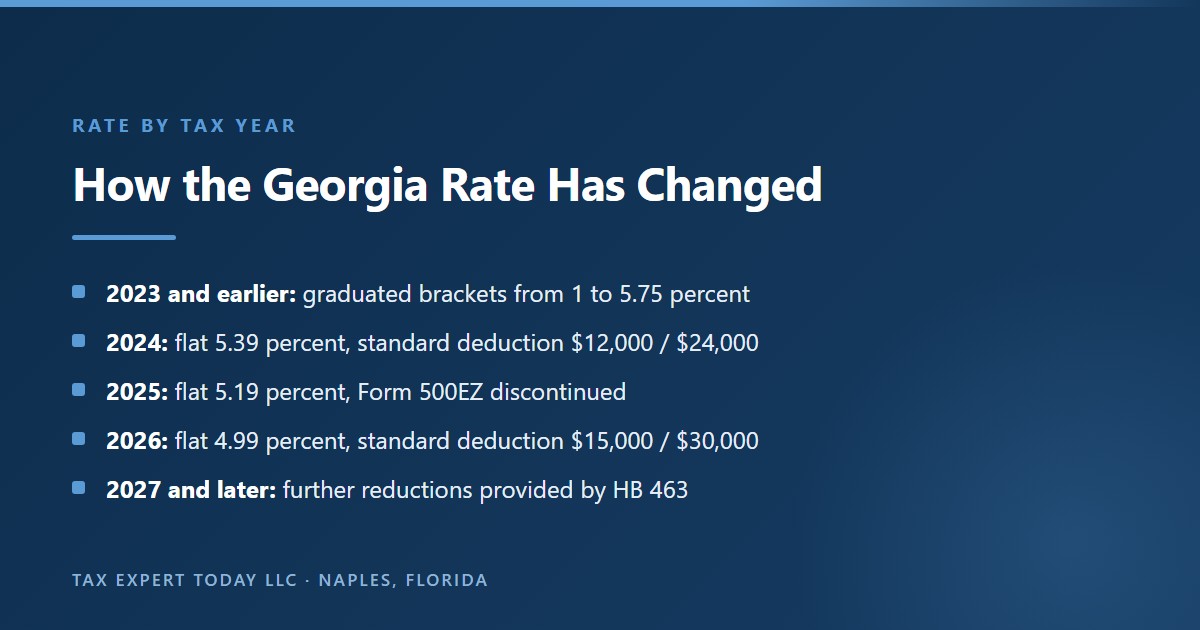
How Has the Georgia State Income Tax Rate Changed Since 2023?
Georgia used a graduated Georgia state income tax with six brackets from 1 percent to 5.75 percent through tax year 2023. A flat rate began in 2024 at 5.39 percent, fell to 5.19 percent for 2025, and fell again to 4.99 percent for 2026 under HB 463. Each change was made by a separate act of the General Assembly.
- 2023 and earlier: graduated brackets, highest rate 5.75 percent.
- 2024: flat 5.39 percent, personal exemptions repealed except dependents.
- 2025: flat 5.19 percent, Form 500EZ discontinued.
- 2026: flat 4.99 percent, larger standard deduction.
- Later years: further scheduled reductions under HB 463.
The history explains why so many pages disagree. Each year the IT-511 booklet published by the Department of Revenue states the rate for that tax year. The 2023 booklet printed a schedule for single filers that charged 1 percent on the first $750 of taxable income and rose in steps to 5.75 percent on income over $7,000; joint filers reached 5.75 percent above $10,000. The 2024 booklet announced the move to a flat 5.39 percent and the repeal of personal exemptions except for the $4,000 dependent exemption. The 2025 booklet states a 5.19 percent rate. The 2026 rate of 4.99 percent comes from HB 463 and the Department’s update page. A page showing brackets is describing 2023 or earlier.
| Tax year | Georgia individual rate | Standard deduction (single / joint) | Source |
|---|---|---|---|
| 2023 | Graduated, 1 to 5.75 percent | $5,400 / $7,100 plus personal exemptions | 2023 IT-511 booklet |
| 2024 | Flat 5.39 percent | $12,000 / $24,000 | 2024 IT-511 booklet |
| 2025 | Flat 5.19 percent | $12,000 / $24,000 | 2025 IT-511 booklet |
| 2026 | Flat 4.99 percent | $15,000 / $30,000 | DOR Important Tax Updates; HB 463 |
| 2027 and later | Further reductions provided by HB 463 | Further increases provided by HB 463 | Governor’s HB 463 release |
The practical point for a taxpayer is simple. When you prepare or review a return, match the rate to the tax year, not to the year you are filing. A 2025 return filed in April 2026 uses 5.19 percent. A 2026 return filed in 2027 uses 4.99 percent. An amended 2023 return still uses the graduated brackets. Software handles this automatically, but anyone estimating a payment by hand, or checking a notice from the Department, should confirm the year first.
The 2024 change also explains a quieter difference between old and new returns. Before 2024, Georgia allowed a personal exemption for the taxpayer and spouse in addition to the standard deduction. Those exemptions were repealed, and in exchange the standard deduction rose sharply. Only the dependent exemption of $4,000 per dependent survived. Anyone comparing a 2023 Georgia state income tax return with a 2025 return will see the personal exemption line disappear and the deduction line grow.
What Did HB 463 Change for 2026 and Later Years?
HB 463 lowered the Georgia state income tax rate to 4.99 percent from January 1, 2026, raised the standard deduction to $15,000 and $30,000, created temporary exclusions for qualified overtime and cash tips through 2028, and raises the retirement income exclusion to $70,000 beginning in 2027. It also provides for further rate cuts and repeals some credits and exemptions.
- Rate: 4.99 percent for 2026, with additional annual reductions provided.
- Standard deduction: $15,000 single, head of household, or separate; $30,000 joint.
- Overtime and tips: up to $1,750 of each excluded, temporarily.
- Retirement exclusion: increases to $70,000 beginning in 2027.
- Repeals: some credits and sales and use tax exemptions end.
The Governor’s office summarized HB 463 this way: it lowers the rate from 5.19 percent to 4.99 percent beginning January 1, 2026, provides for further annual reductions of the rate and increases of the standard deduction, raises the retirement income exclusion to $70,000 beginning in 2027, introduces temporary exclusions for qualified overtime compensation and cash tips through 2028, and repeals some tax credits and sales and use tax exemptions. Published summaries of the bill describe the later rate cuts as steps of 0.125 percentage points a year toward 3.99 percent. Georgia’s earlier rate laws tied each step to conditions in the statute, and the amount of each future step should be confirmed against the Department’s update page for that year rather than assumed.
For a household planning its Georgia state income tax, the changes split into two groups. The 2026 items are certain and already apply: the 4.99 percent rate, the $15,000 and $30,000 standard deduction, and the overtime and tip exclusions described below. The later items are scheduled but should be treated as planning assumptions until each year’s booklet confirms them. That includes the 2027 increase in the retirement exclusion and any further rate steps. A retiree who is deciding whether to take a large IRA distribution in late 2026 or early 2027, for example, can reasonably plan around the higher 2027 exclusion, but should confirm it before acting on a large transaction.
HB 463 does not change the basic architecture of the Georgia return. Form 500 still starts with federal adjusted gross income, Schedule 1 still carries the additions and subtractions, part year residents and nonresidents still use Schedule 3, and the Department still publishes the instructions in the IT-511 booklet. If you understood the 2025 Georgia state income tax return, the 2026 return will look familiar, with different numbers on a handful of lines.
Who Must File a Georgia State Income Tax Return?
A Georgia resident must file a Georgia state income tax return if they must file a federal return, have Georgia taxable income that is not federally taxable, or have income above the Georgia standard deduction. Part year residents and nonresidents with Georgia source income must file Form 500 if they are required to file a federal return.
- Federal filing trigger: required to file federally means required to file in Georgia for residents.
- Georgia only income: income taxable in Georgia but not federally triggers a return.
- Income over the deduction: income above the standard deduction triggers a return.
- Nonresidents: Georgia source income plus a federal filing duty means Form 500.
- Refund filers: anyone with Georgia tax withheld can file to recover it.
The Department’s Residency Filing Requirements page sets out three triggers for full year residents. A resident must file if they are required to file a federal income tax return, if they have income subject to Georgia income tax that is not subject to federal income tax, or if their income exceeds the standard deduction. That page still lists the earlier $12,000 and $24,000 deduction amounts; for 2026, the Department’s update page gives $15,000 and $30,000. A resident remains a resident for filing purposes even when temporarily absent from the state.
Even when no return is required, filing can make sense. A part time worker with Georgia tax withheld from a paycheck recovers that withholding only by filing. The Department notes that a person may file to receive a refund of tax withheld even when income is below the filing requirement. The same is true for a retiree who had Georgia tax withheld from a pension or an IRA distribution but whose income is fully covered by the retirement exclusion and the standard deduction.
Georgia also requires electronic filing in some situations, according to the 2025 IT-511 booklet. A return must be filed electronically if the taxpayer pays by electronic funds transfer on a mandatory or voluntary basis, if a paid preparer prepares it and the federal counterpart must be e-filed, or if it claims or allocates a Series 100 tax credit. Most individuals file electronically in any case, through software, a preparer, or the Georgia Tax Center.
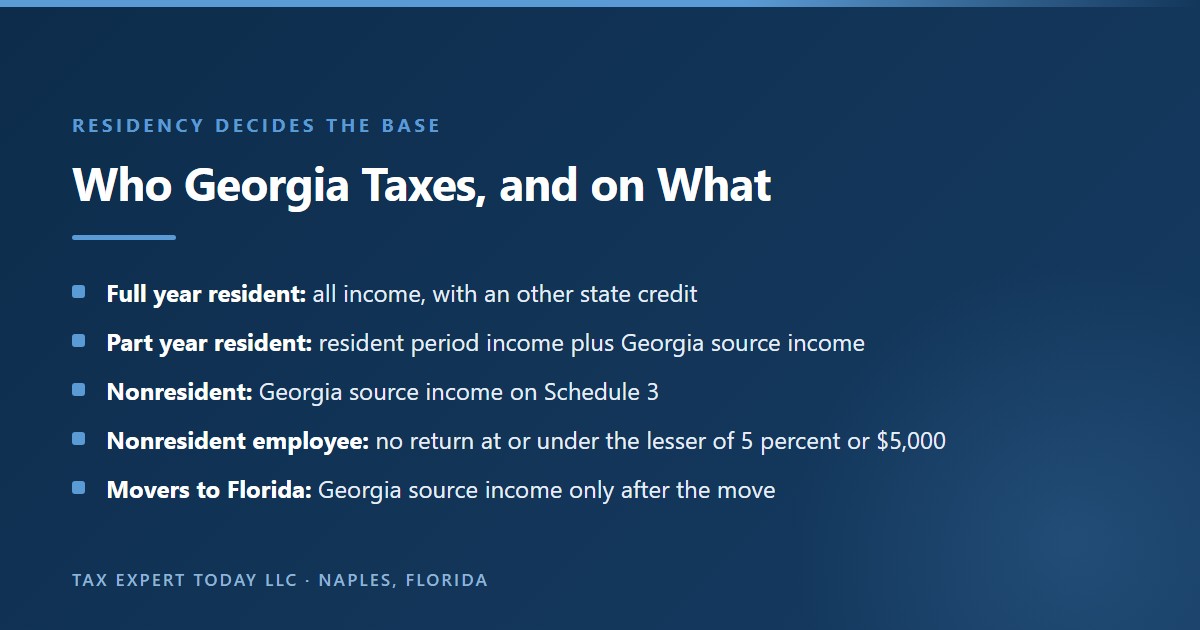
How Does Georgia Treat Full Year, Part Year, and Nonresident Filers?
Full year residents pay Georgia state income tax on all income, with a credit for tax paid to other states. Part year residents pay on income earned while a resident plus Georgia source income earned while a nonresident. Nonresidents pay only on Georgia source income. Both compute this on Schedule 3 of Form 500.
- Full year resident: taxed on worldwide income, with an other state credit.
- Part year resident: taxed on resident period income plus Georgia source income.
- Nonresident: taxed on Georgia source income only.
- Schedule 3: computes the Georgia share and prorates deductions.
- Same form: all three file Form 500.
Residency drives the size of the Georgia state income tax bill more than any other single fact. A full year resident who earns wages in Georgia, interest from a bank in Ohio, and rent from a condominium in Florida reports all of it on the Georgia return. A nonresident with the same income reports only what has a Georgia source. The Department lists wages for work performed in Georgia, Georgia lottery winnings, income from flow through entities such as S corporations, partnerships, LLCs, trusts, and estates, and rents from Georgia property as examples of Georgia source income.
| Filer type | Income Georgia taxes | Form and schedule | Deductions |
|---|---|---|---|
| Full year resident | All income from every source, except exempt income | Form 500 | Full standard or itemized deduction |
| Part year resident | All income while a resident, plus Georgia source income while a nonresident | Form 500 with Schedule 3 | Prorated by the Schedule 3 income ratio |
| Nonresident | Georgia source income only | Form 500 with Schedule 3 | Prorated by the Schedule 3 income ratio |
| Federal Form 1040NR filer | Georgia source income | Form 500 | Generally no standard deduction; limited itemized deductions |
Schedule 3 works by ratio. The filer lists federal income in one column and Georgia income in another, and the ratio of Georgia income to total income is applied to the standard or itemized deduction and the dependent exemption. The 2025 IT-511 booklet gives an example in which a $12,000 standard deduction multiplied by a ratio of 78.98 percent produces a prorated deduction of $9,478. The same method applies in 2026 with the larger deduction. Our Georgia part year resident tax return guide walks through Schedule 3 line by line, including how to split income in the year of a move.
Residency itself is a question of legal residence, sometimes called domicile, not simply where you spent the night. A person who moves to Florida but keeps a Georgia home, a Georgia driver’s license, and Georgia voter registration may find that the Department still treats them as a Georgia resident. The steps that support a change of residence, and the records that prove it, are covered in our general nonresident state tax return guide.
When Does a Nonresident Worker Not Have to File in Georgia?
A nonresident employee does not have to file a Georgia state income tax return when their only Georgia activity is working as an employee and their Georgia pay does not exceed the lesser of 5 percent of their total wages or $5,000. Anyone with other Georgia income, such as rent or a business, must still file if federally required.
- Employees only: the exception covers wages, not business or rental income.
- Lesser of two limits: 5 percent of all wages or $5,000.
- Small amounts: short trips and occasional Georgia work days.
- Withholding still possible: an employer may withhold anyway.
- Refund route: filing recovers any tax withheld.
The Department states the rule on its residency page: a legal resident of another state is not required to file a Georgia return if their only activity for financial gain or profit in Georgia consists of performing services in Georgia for an employer as an employee, and the compensation for those services does not exceed the lesser of 5 percent of their wages in all places or $5,000. A Florida resident who earns $150,000 and spends three days a year at a client site in Atlanta, for instance, may fall under this exception if the Georgia share of pay is under $5,000.
The exception is narrow. It does not apply to a nonresident who also owns a Georgia rental, receives a K-1 from a Georgia partnership, or wins a Georgia lottery prize. Those taxpayers file Form 500 with Schedule 3 when they must file federally, whatever the size of their Georgia wages. It also does not apply to the self employed, because their Georgia activity is not services performed as an employee.
Employers sometimes withhold Georgia tax for an employee who meets the exception, especially when payroll systems assign a work location by office address. In that case, filing a Georgia nonresident return is the way to recover the withholding. The return reports the Georgia wages, shows the computation on Schedule 3, and claims the tax withheld as a payment. When the Georgia wages are small, the Georgia state income tax computed on Schedule 3 may be little or nothing, and the withholding comes back as a refund.
How Is Georgia Taxable Income Calculated?
Georgia taxable income starts with federal adjusted gross income, adds and subtracts the Georgia adjustments on Schedule 1, then subtracts the Georgia standard or itemized deduction and $4,000 for each dependent. The 4.99 percent Georgia state income tax rate applies to what remains, and credits reduce the resulting tax.
- Start: federal adjusted gross income from Form 1040.
- Adjust: Schedule 1 additions and subtractions.
- Deduct: Georgia standard deduction or federal itemized deductions, adjusted.
- Exempt: $4,000 for each dependent.
- Tax and credit: multiply by 4.99 percent, then subtract credits.
Form 500 follows the federal return closely at the start. The taxpayer enters federal adjusted gross income, and everything Georgia does after that point is an adjustment. That design has a practical benefit. Most of the income rules people worry about, such as how a Roth conversion is taxed, whether a home sale gain is excluded, or how a capital loss carryover works, are answered on the federal return and simply flow through. Georgia then makes a limited number of changes on Schedule 1, which is where the state’s own policies show up.
| Step | Form 500 item | What happens |
|---|---|---|
| 1 | Federal adjusted gross income | Carried from federal Form 1040 |
| 2 | Schedule 1 adjustments | Additions (for example, non Georgia municipal bond interest) and subtractions (for example, Social Security and retirement income) |
| 3 | Georgia adjusted gross income | Federal AGI plus or minus Schedule 1 |
| 4 | Standard or itemized deduction | $15,000 or $30,000 standard for 2026, or federal itemized deductions with Georgia adjustments |
| 5 | Dependent exemption | $4,000 times the number of dependents |
| 6 | Georgia taxable income | Step 3 minus steps 4 and 5 |
| 7 | Tax | Step 6 times 4.99 percent for 2026 |
| 8 | Credits | Low income, other state, itemizer, and Schedule 2 credits |
Part year residents and nonresidents follow the same order, with Schedule 3 inserted to separate Georgia income from other income and to prorate the deduction and exemption. Everyone then subtracts withholding, estimated payments, and any extension payment to find the refund or the balance due. Understanding these steps makes it easier to see where planning can change the Georgia state income tax: mostly in the subtractions, in the choice between standard and itemized deductions when the federal choice allows it, and in credits.
Because the state starts from federal AGI, any error on the federal return usually carries into the Georgia return. If the IRS adjusts federal income, Georgia generally expects the state return to be amended as well. Our Georgia amended tax return guide explains Form 500X and the timing rules that apply after a federal change.
What Is the Georgia Standard Deduction for 2026?
For 2026 the Georgia standard deduction is $15,000 for single filers, heads of household, and married people filing separately, and $30,000 for married couples filing jointly, according to the Department of Revenue. For 2024 and 2025 it was $12,000 and $24,000. A taxpayer who takes the federal standard deduction must take the Georgia standard deduction.
- Single, head of household, separate: $15,000 for 2026.
- Married filing jointly: $30,000 for 2026.
- 2024 and 2025: $12,000 and $24,000.
- Tied to the federal choice: federal standard means Georgia standard.
- Prorated: part year and nonresident filers multiply by the Schedule 3 ratio.
The Department’s update page gives the 2026 amounts: $15,000 for single taxpayers, heads of household, and married taxpayers filing separately, and $30,000 for married taxpayers filing jointly. The 2025 booklet lists $12,000 and $24,000 for the 2025 return, along with the same amounts for qualifying surviving spouses. HB 463 also provides for further increases in later years, described in published summaries as tied to state revenue conditions. Several pages on the first page of search results, including some older Department pages, still show the $12,000 and $24,000 figures or even the 2022 amounts of $5,400 and $7,100, which is why the tax year matters when you read any number.
| Filing status | 2025 Georgia standard deduction | 2026 Georgia standard deduction |
|---|---|---|
| Single | $12,000 | $15,000 |
| Head of household | $12,000 | $15,000 |
| Married filing separately | $12,000 | $15,000 |
| Married filing jointly | $24,000 | $30,000 |
Georgia locks the standard deduction choice to the federal return. The 2025 IT-511 booklet says that if you use the standard deduction on your federal return, you must use the Georgia standard deduction on your Georgia return, and if you itemize federally, you must itemize in Georgia. A married person filing separately must also itemize in Georgia if their spouse itemizes. There is no separate Georgia election, so a household that would benefit from itemizing in Georgia but not federally cannot do so.
The larger 2026 deduction has a direct effect on the Georgia state income tax of most households. A married couple filing jointly gains $6,000 of additional deduction, which at 4.99 percent is worth about $299 of tax before any other change. Combined with the rate cut from 5.19 percent to 4.99 percent, a typical working household should see a lower Georgia bill for 2026 than for 2025 on the same income.
When Must You Itemize Deductions on the Georgia Return?
You must itemize on the Georgia return if you itemize federally, and you may not itemize in Georgia after taking the federal standard deduction. Georgia itemized deductions begin with federal Schedule A, then remove income taxes paid to other states and certain investment interest. An itemizer credit of up to $300 per taxpayer may apply.
- Federal choice controls: itemize federally, itemize in Georgia.
- Start with Schedule A: federal itemized deductions are the base.
- Remove other state taxes: income taxes paid to other states come out.
- SALT cap formula: a ratio removes the disallowed share when the federal cap applied.
- Itemizer credit: up to $300 per taxpayer for full year and part year residents who itemize.
The Georgia itemized deduction is the federal figure with two adjustments. The 2025 IT-511 booklet tells filers to enter federal Schedule A itemized deductions on Line 12a, then on Line 12b remove income taxes other than Georgia and investment interest expense for producing income exempt from Georgia tax. Georgia income tax itself stays in the deduction. That can seem odd, since Georgia is allowing a deduction for its own tax, but it follows from the federal starting point: the Georgia figure is federal itemized deductions less non Georgia income taxes.
When the federal state and local tax limit applied, the booklet prescribes a formula. Other state income taxes are divided by total taxes on Schedule A Line 5d and multiplied by the lesser of Line 5d or the federal cap that applied, and that share is what comes out. The federal cap changed for 2025 under federal law, and Georgia had not adopted that federal act as of the 2025 booklet, so this is one of the places where a preparer should check the current year’s Georgia instructions rather than copy the federal figure.
The Georgia Eligible Itemizer Tax Credit is a separate benefit. According to the 2025 booklet, full year and part year residents who itemize are entitled to a credit of up to $300 per taxpayer, limited to the tax liability and not carried forward. It is claimed on Form 500 Line 19. For a household that itemizes because of a large mortgage, charitable gifts, or medical costs, this credit reduces Georgia state income tax directly and is easy to overlook when software is not set up correctly.
How Does the Georgia Dependent Exemption Work?
Georgia allows a $4,000 exemption for each qualifying dependent, subtracted from income after the standard or itemized deduction. Georgia repealed personal exemptions for the taxpayer and spouse starting in 2024 but kept the dependent exemption, and it also counts qualifying unborn dependents. Part year residents and nonresidents prorate the exemption on Schedule 3.
- Amount: $4,000 per dependent.
- Personal exemptions: repealed for the taxpayer and spouse from 2024.
- Federal rules decide who qualifies: the booklet applies federal dependency rules.
- Unborn dependents: reported separately on Line 7b when they qualify.
- Value at 4.99 percent: about $200 of tax per dependent.
The dependent exemption is entered on Form 500 Line 14 as the number of dependents on Line 7c multiplied by $4,000. The 2025 IT-511 booklet explains that the federal rules for who can claim a dependent determine who is entitled to the Georgia exemption. Georgia also allows an exemption for a qualifying unborn dependent, reported on Line 7b; the booklet notes that a child born during the year is listed as a regular dependent on Line 7a instead.
At the 2026 rate, each $4,000 exemption reduces Georgia state income tax by about $199.60. For a family with three children, that is roughly $599 a year. The exemption is not a credit, so it helps only to the extent the household has taxable income to offset. A family whose income is already below the standard deduction gets no further benefit from the exemption.
Divorced and separated parents should pay attention to who claims each child. Because Georgia follows the federal dependency rules, the parent who claims the child federally is generally the one who claims the Georgia exemption. A mismatch between the two returns is a common reason for a Department of Revenue notice.
What Income Must Be Added Back on Schedule 1?
Schedule 1 additions increase Georgia income above federal AGI. The most common are interest from municipal bonds issued outside Georgia, loss carryovers from years you were not subject to Georgia tax, depreciation differences such as federal bonus depreciation Georgia does not follow, and adjustments for federal tax changes Georgia has not adopted.
- Out of state municipal interest: federally exempt but taxable in Georgia.
- Pre residency losses: carryovers from non Georgia years are added back.
- Depreciation differences: Georgia does not follow federal bonus depreciation.
- Federal change adjustments: items from federal laws Georgia did not adopt.
- Credit related deductions: deductions tied to certain Georgia donation credits.
The booklet’s additions list starts with interest received from non Georgia municipal bonds and dividends from mutual funds that earned such interest. A Georgia resident who holds a national municipal bond fund will often have a modest addition each year, because the share of the fund’s income from Georgia bonds is exempt and the rest is not. Fund companies usually publish a state by state breakdown each January, and that schedule is what supports the Georgia figure.
Other additions are less common but larger when they apply. Loss carryovers from years in which you were not subject to Georgia income tax are added back, which matters for someone who moves to Georgia with a federal capital loss or net operating loss carryover. Our Georgia net operating loss guide covers the separate Georgia computation. Depreciation differences arise because Georgia has long declined to follow federal bonus depreciation, so business owners and landlords often have a Georgia addition in the year property is placed in service and a subtraction in later years.
Several Georgia credits for contributions, including the qualified education expense, rural hospital, education donation, foster child, and law enforcement donation credits, require the related deduction to be added back when the contribution was deducted federally. The idea is that the taxpayer should not receive both a full credit and a deduction for the same dollars. Our Georgia rural hospital tax credit and Georgia qualified education expense credit articles explain how each addition is computed.
What Income Can Be Subtracted on Schedule 1?
Schedule 1 subtractions reduce Georgia income below federal AGI. The most valuable are Social Security and Railroad Retirement benefits, the retirement income exclusion, the military retirement exclusion, interest on U.S. government obligations, other state tax refunds, Path2College 529 contributions up to $4,000 per beneficiary or $8,000 joint, and, for 2026, qualified overtime and tips up to $1,750 each.
- Social Security: fully subtracted to the extent included in federal AGI.
- Retirement income: up to $35,000 or $65,000 per person for 2026.
- U.S. obligations: Treasury interest, net of related expenses.
- 529 contributions: up to $4,000 per beneficiary, $8,000 on a joint return.
- Overtime and tips: up to $1,750 of each for 2026.
Subtractions are where most planning around the Georgia state income tax happens, because they can remove whole categories of income. The 2025 IT-511 booklet lists them in order. Retirement income comes first, followed by military retirement income, depreciation differences from 1981 through 1986, interest and dividends on U.S. government bonds and other U.S. obligations reduced by related expenses, Social Security and Railroad Retirement included in federal AGI, wages reduced because of the federal jobs credit, and income tax refunds from states other than Georgia that were included in federal AGI.
| Subtraction | Limit or rule | Who benefits most |
|---|---|---|
| Social Security and Railroad Retirement | Amount included in federal AGI | Retirees |
| Retirement income exclusion | $35,000 (ages 62 to 64 or disabled) or $65,000 (65 and older) per person for 2026 | Retirees with pensions, IRAs, or investment income |
| Military retirement income | $17,500 under age 62, plus $17,500 more with over $17,500 of Georgia earned income | Younger military retirees |
| U.S. obligation interest | Net of related interest expense; not Fannie Mae, Ginnie Mae, or Freddie Mac interest | Treasury bond and bill holders |
| Other state tax refunds | Amount included in federal AGI; not Georgia refunds | Movers and multistate filers |
| Path2College 529 contributions | $4,000 per beneficiary, $8,000 per beneficiary on a joint return | Parents and grandparents |
| Qualified overtime and cash tips | Up to $1,750 of each for 2026, temporary through 2028 | Hourly and service workers |
| Organ donation expenses | Up to $25,000 of unreimbursed costs | Living donors |
The U.S. obligation subtraction has a detail that trips up investors. The booklet notes that interest from the Federal National Mortgage Association, the Government National Mortgage Association, the Federal Home Loan Mortgage Corporation, and repurchase agreements is taxable and should not be subtracted. A bond fund that holds a mix of Treasury securities and mortgage backed securities will usually report the share eligible for the state subtraction, and only that share comes off the Georgia return.
The Path2College 529 deduction is covered in our Georgia 529 plan tax deduction article. In brief, contributions to Georgia’s own plan are deductible up to $4,000 per beneficiary, or $8,000 per beneficiary on a joint return, and the taxable portion of a nonqualified withdrawal must be added back. The deduction is per beneficiary, so a couple with three grandchildren could deduct up to $24,000 in a year, which at 4.99 percent reduces Georgia state income tax by about $1,198.
Does Georgia Tax Social Security and Retirement Income?
Georgia does not tax Social Security or Railroad Retirement benefits; the amount in federal AGI is subtracted on Schedule 1. Pension, IRA, annuity, interest, dividend, rental, and capital gain income is taxable, but taxpayers 62 and older can exclude up to $35,000 each, or $65,000 each from age 65, before the Georgia state income tax applies.
- Social Security: exempt in full.
- Ages 62 to 64: up to $35,000 of retirement income excluded per person.
- Age 65 and older: up to $65,000 per person for 2026.
- 2027 change: the maximum rises to $70,000 under HB 463.
- Per person: spouses each qualify separately.
For retirees, the combination of a fully exempt Social Security benefit and a large retirement income exclusion means many people owe little or no Georgia state income tax. A married couple, both 65 or older, can exclude up to $130,000 of retirement income for 2026, plus all Social Security, before the $30,000 standard deduction is even applied. That is one reason Georgia appears on many retirement relocation lists, alongside states with no income tax at all.
The exclusion is broad. The Department’s Retirement Income Exclusion page lists pensions and annuities, interest, dividends, net rental income, capital gains, royalties, and up to $5,000 of earned income as retirement income for this purpose. That means a retiree selling appreciated stock or a rental property can apply the exclusion to the gain, which is a significant planning point for anyone timing a large sale. Our Georgia capital gains tax guide works through that interaction.
Retirement income above the cap is taxed at the regular rate. A single retiree, age 70, with a $90,000 pension and $20,000 of Social Security would subtract the Social Security in full and exclude $65,000 of the pension, leaving $25,000 of Georgia income before the standard deduction. After the $15,000 deduction, $10,000 is taxed at 4.99 percent, for about $499 of Georgia state income tax.

How Does the Georgia Retirement Income Exclusion Work?
The retirement income exclusion is a Schedule 1 subtraction for taxpayers 62 or older, or under 62 and permanently and totally disabled. For 2026 it is up to $35,000 per person at ages 62 to 64 and $65,000 per person at 65 and older. Only $5,000 may be earned income, and part year and nonresident filers prorate it.
- Age test: 62 or older, or permanently and totally disabled.
- Separate for each spouse: each must qualify on their own.
- Joint property: income is split 50 percent to each spouse.
- Earned income limit: no more than $5,000 of wages or self employment income.
- Proration: part year and nonresident filers reduce the exclusion.
The 2025 IT-511 booklet sets the maximum exclusion at $35,000 for taxpayers who are 62 to 64 years of age, or under 62 and permanently disabled to the extent they cannot perform any type of gainful employment, and $65,000 for taxpayers who are 65 or older. The exclusion is available to the taxpayer and the spouse, but each must qualify separately. Income from jointly owned property is allocated 50 percent to each spouse. Up to $5,000 of the allowable exclusion may be earned income.
| Age during the year | 2026 maximum per person | Scheduled 2027 maximum | Earned income allowed in exclusion |
|---|---|---|---|
| Under 62, not disabled | None | None | Not applicable |
| Under 62, permanently and totally disabled | $35,000 | Confirm in the 2027 booklet | $5,000 |
| 62 to 64 | $35,000 | Confirm in the 2027 booklet | $5,000 |
| 65 and older | $65,000 | $70,000 under HB 463 | $5,000 |
The per person rule is where couples lose money. If one spouse holds a large IRA and the other has little retirement income, only the account owner’s exclusion applies to the IRA distributions, and the other spouse’s unused exclusion cannot be transferred. Planning around the Georgia state income tax for a couple in that position can include drawing investment income from jointly owned accounts, which splits evenly, or, in some cases, Roth conversions timed before the larger 2027 exclusion applies. Each of these depends on the federal picture too, and none should be done for the Georgia result alone.
The full worksheet, including how the exclusion is prorated for part year residents and how the earned income limit interacts with part time work, is in our Georgia retirement income exclusion guide. The Governor’s HB 463 release describes the 2027 change as raising the exclusion to $70,000 beginning in 2027; the 2027 booklet will confirm exactly which age band the increase applies to.
How Does Georgia Tax Military Retirement Pay?
Military retirees under 62 can exclude up to $17,500 of military retirement income from Georgia state income tax, and an additional $17,500 if they have more than $17,500 of Georgia earned income. From age 62, military retirement pay falls under the general retirement income exclusion of $35,000 or $65,000 instead.
- Under 62: $17,500 base military retirement exclusion.
- Additional amount: another $17,500 with over $17,500 of Georgia earned income.
- Each spouse separately: both can qualify if both are military retirees.
- Nonresidents: must meet the earned income test with Georgia source earnings.
- From 62: the general retirement exclusion applies.
The Department’s retirement page states that beginning January 1, 2022, $17,500 of military retirement income can be excluded for taxpayers under 62, and an additional $17,500 can be excluded for taxpayers with more than $17,500 of earned income in Georgia. The booklet adds that part year residents and nonresidents may claim the base $17,500 against their total military retirement income, but can claim the additional $17,500 only after meeting the earned income threshold with Georgia source earned income.
This creates a planning difference for younger military retirees who take a civilian job. A retiree with $40,000 of military retirement pay and a $60,000 civilian salary in Georgia could exclude $35,000 of the retirement pay. The same retiree without Georgia earnings could exclude only $17,500. Our Georgia military retirement tax article covers the details, including how the exclusion interacts with survivor benefit payments and combat zone pay.
Active duty members who are Georgia legal residents pay Georgia state income tax on all income regardless of where they are stationed, unless Georgia law specifically exempts it. Georgia does provide a combat zone pay exclusion, and the booklet notes rules for spouses of nonresident military personnel under federal law.
How Does Georgia Treat Overtime and Tips in 2026?
Georgia did not adopt the federal overtime and tip deductions in the One Big Beautiful Bill Act. Instead, the Department says up to $1,750 of qualified overtime and up to $1,750 of tipped wages may be excluded from Georgia taxable income for 2026. HB 463 makes these exclusions temporary, running through 2028.
- Federal deduction not adopted: the federal amounts do not flow to Georgia.
- Georgia limit: up to $1,750 of overtime and up to $1,750 of tips.
- Separate limits: a worker with both can use both.
- Temporary: through tax year 2028 under HB 463.
- Value: about $87 of Georgia tax for each full $1,750.
The Department’s update page states that Georgia did not conform to the exemptions from income for overtime and tipped wages in the One Big Beautiful Bill Act, but that up to $1,750 of each may be exempted from the calculation of taxable net income. The Governor’s release describes these as temporary exclusions for qualified overtime compensation and cash tips through 2028. At 4.99 percent, a full $1,750 exclusion reduces Georgia state income tax by about $87, or about $175 for a worker who uses both.
The federal deductions are much larger, so the Georgia exclusion will rarely match what a worker subtracts federally. Because Georgia starts with federal adjusted gross income, and the federal overtime and tip amounts are deductions below that line on the federal return, the federal deduction does not reduce Georgia income on its own. The Georgia exclusion is a separate, smaller item. The 2026 booklet will set out exactly where it is entered and what records support it; until then, workers should keep the pay stubs and employer statements that show qualified overtime and tips.
Employers should also expect questions. Payroll systems often withhold Georgia tax on all wages, so a worker who qualifies for the overtime or tip exclusion may see the benefit as a slightly larger refund rather than a smaller paycheck. That is normal and does not require any change to a W-4 or Georgia G-4 for most people.
Does Georgia Follow the Federal One Big Beautiful Bill Act?
Not automatically. The 2025 IT-511 booklet says Georgia conforms to the Internal Revenue Code as amended through federal law enacted on or before January 1, 2025, and has not adopted the One Big Beautiful Bill Act, signed July 4, 2025. Georgia adopts federal changes year by year, so some federal items need Georgia adjustments on Schedule 1.
- Fixed conformity date: the Code as of January 1, 2025, for the 2025 return.
- Federal act not adopted: the July 2025 federal law was not adopted for 2025.
- Annual bill: the General Assembly updates conformity each session.
- Schedule 1 adjustments: differences are entered as additions or subtractions.
- Overtime and tips: Georgia substituted its own $1,750 exclusions.
Georgia uses what is often called static conformity. Instead of following the Internal Revenue Code as it changes, Georgia adopts the Code as of a fixed date, and the General Assembly moves that date forward by statute, usually once a year. The 2025 booklet states that Georgia conforms to the Code as amended by federal law enacted on or before January 1, 2025, and that Georgia has not adopted the federal changes in the One Big Beautiful Bill Act because the act was signed on July 4, 2025. The Department maintains a federal tax changes page listing the items that differ.
For most wage earners, the difference is small, because Georgia starts from federal adjusted gross income and many of the federal changes affect deductions below that line, where Georgia uses its own standard deduction anyway. The differences matter more for business owners and investors: depreciation and expensing rules, the treatment of research expenses, the business interest limit, and other provisions that change the amount of federal AGI itself. Those items are where a Georgia Schedule 1 adjustment is most likely, and where the Georgia state income tax can diverge noticeably from what a federal estimate suggests.
When the 2026 booklet is published, check its conformity statement first. If the General Assembly has moved the conformity date, some 2025 adjustments may disappear for 2026. If it has not, the same adjustments will carry forward. Our Georgia pass through entity tax article discusses how these conformity differences show up for partnership and S corporation owners.
How Are Capital Gains Taxed in Georgia?
Georgia taxes capital gains as ordinary income at the same 4.99 percent rate for 2026. There is no separate lower rate for long term gains. Gains are part of federal AGI, so they flow into the Georgia return, and for taxpayers 62 and older capital gains count as retirement income that the exclusion can shelter.
- Same rate: 4.99 percent for 2026, short term or long term.
- Federal flow through: gains enter through federal AGI.
- Retirement exclusion: gains qualify as retirement income from age 62.
- Home sale exclusion: the federal exclusion carries into Georgia automatically.
- Nonresident sellers: Georgia real estate gains are Georgia source income.
Because the Georgia state income tax is a flat rate applied to income that starts with federal AGI, a long term capital gain and a salary dollar are taxed the same way at the state level. A $100,000 long term gain for a Georgia resident under 62 adds about $4,990 of Georgia tax for 2026, in addition to any federal tax. The federal home sale exclusion of up to $250,000, or $500,000 for joint filers, removes gain from federal AGI, so it removes the same gain from the Georgia return without any separate election.
Nonresidents who sell Georgia real estate face two Georgia rules at once. The gain is Georgia source income that belongs on a Form 500 with Schedule 3, and the closing may be subject to Georgia’s nonresident withholding unless an exemption applies. Our Georgia capital gains tax guide covers the rate question in detail, and our 1031 exchange Georgia article covers withholding and deferral when the sale is part of an exchange.
Timing matters for retirees. A taxpayer who turns 62 or 65 during the year qualifies for the higher exclusion for that year, which can make it worth delaying a large sale by a few months. A retiree whose other retirement income already uses the full exclusion gets no further shelter for a gain, so a sale in a year with lower pension or IRA income can keep more of the gain inside the exclusion.
What Credits Reduce Georgia State Income Tax?
The credits most individuals use are the low income credit for federal AGI under $20,000, the credit for tax paid to other states, the itemizer credit of up to $300 per taxpayer, and the child and dependent care credit at 50 percent of the federal credit. Business and donation credits go on Schedule 2 or Form IND-CR.
- Low income credit: federal AGI under $20,000 and not a dependent.
- Other state credit: tax paid to another state on income Georgia also taxes.
- Itemizer credit: up to $300 per taxpayer who itemizes.
- Child and dependent care: 50 percent of the federal credit.
- Donation and business credits: Schedule 2 and Form IND-CR.
Credits reduce Georgia state income tax dollar for dollar, so they are worth more than deductions of the same size. The 2025 booklet describes the low income credit as available when federal adjusted gross income is under $20,000 and the taxpayer is not claimed, or eligible to be claimed, as a dependent on another return. Part year residents can claim it only if they were residents at the end of the year, and it must be claimed within 12 months after the end of the tax year. The credit cannot exceed the tax liability.
| Credit | Basic rule (2025 booklet) | Where claimed |
|---|---|---|
| Low income credit | Federal AGI under $20,000; not a dependent; limited to the tax | Form 500 Line 17 |
| Other state tax credit | Lesser of Georgia tax on the income or the other state’s tax; copy of the other return required | Form 500 Line 18 |
| Georgia eligible itemizer credit | Up to $300 per taxpayer who itemizes; not carried forward | Form 500 Line 19 |
| Child and dependent care expense credit | 50 percent of the federal credit; not carried forward | IND-CR, code 202 |
| Disabled person home purchase or retrofit credit | Lesser of $500 per residence or the tax | IND-CR |
| Qualified education expense and other donation credits | Preapproval and related deduction add back | Schedule 2 |
The child and dependent care credit rose for 2025. The booklet’s summary of new items says the credit has been increased to 50 percent of the federal child and dependent care expense credit, and the IND-CR worksheet multiplies the federal credit by 0.50. A family that claims a $1,200 federal credit would claim $600 against Georgia state income tax. The credit cannot be carried forward, so any excess over the Georgia tax is lost.
The donation credits, including the qualified education expense credit for student scholarship organizations, the rural hospital credit, and the foster child and law enforcement donation credits, each require preapproval and come with the add back described earlier. HB 328, signed the same day as HB 463, increases the student scholarship organization credit. Each has its own cap and timing, and our individual credit articles on the Georgia hub link to them.
How Does the Georgia Credit for Taxes Paid to Other States Work?
A Georgia resident who pays income tax to another state on income Georgia also taxes can claim a credit on Form 500 Line 18. The credit is the smaller of the Georgia tax on that income or the other state’s tax, and a copy of the other state’s return must be attached or the credit is not allowed.
- Residents mainly: full year and part year residents claim it for resident period income.
- Lesser of two amounts: Georgia tax on the income or the other state’s tax.
- Attach the other return: required for the credit.
- Net income taxes only: state, Washington DC, and U.S. local income taxes.
- Foreign taxes excluded: foreign country and possession taxes do not qualify.
The credit prevents double taxation when a Georgia resident earns income in another state. A resident who works in Alabama, for example, pays Alabama tax on those wages and also reports them to Georgia, because Georgia taxes residents on all income. The 2025 booklet’s worksheet computes the Georgia tax attributable to the other state income, compares it with the tax shown on the other state’s return for income also taxed by Georgia, and allows the lesser amount. The booklet stresses that a copy of the other state’s return must be included or the credit will not be allowed.
The booklet also limits the credit to taxes imposed on net income by another state, Washington DC, or a U.S. local government. Taxes paid to a foreign country, a foreign province or city, or a U.S. possession do not qualify for the Georgia credit, even though they may qualify for a federal foreign tax credit. A Georgia resident working abroad therefore needs to look at the federal foreign earned income exclusion and foreign tax credit rules, because Georgia will not provide relief through this credit.
Owners of pass through businesses have a related Schedule 1 subtraction. When a Georgia resident’s S corporation or partnership pays an entity level income tax to another state, such as the Texas margin tax, the booklet allows a subtraction for the portion of income on which that tax was actually paid, computed with the entity’s apportionment ratio in the other state. This keeps the Georgia state income tax from applying in full to income that another state already taxed at the entity level.
How Do Pass Through Business Owners Pay Georgia State Income Tax?
Owners of S corporations, partnerships, and LLCs taxed as partnerships generally report their share of business income on their own Georgia return, where the 4.99 percent rate applies. Georgia also allows an entity level election, the pass through entity tax, and requires composite returns or withholding for many nonresident owners of Georgia businesses.
- Owner level by default: K-1 income flows to Form 500.
- Entity election: the entity can elect to pay Georgia tax itself.
- Nonresident owners: composite return or withholding usually applies.
- No federal QBI deduction effect: Georgia starts from AGI, so no adjustment is needed.
- Entity returns: Form 600S for S corporations, Form 700 for partnerships.
The default rule is simple. Business income from a pass through entity appears in federal AGI through the K-1, so it is part of the Georgia return without any separate step. The 2025 booklet notes that Georgia does not allow the federal 20 percent qualified business income deduction, but because that deduction is taken after federal AGI, no Georgia adjustment is needed. The entity itself files Form 600S or Form 700 to report income, apportionment, and owner information, as explained in our Georgia Form 600S guide and Georgia Form 700 guide.
The entity level election changes the picture for owners who want a federal deduction for state taxes paid by the business. When an entity elects to pay Georgia tax itself, the owners make related adjustments on their own returns, and the booklet points them to Regulation 560-7-3-.03(9)(a) for the treatment of income and losses. The tradeoffs, including how the election affects nonresident owners and the credit for taxes paid to other states, are covered in our Georgia pass through entity tax article.
Nonresident owners are where the most mistakes happen. A Florida resident with a share of a Georgia LLC has Georgia source income and generally must either file a Georgia nonresident return or be included in a composite return filed by the entity. Our Georgia composite return guide covers when each route applies, and our Georgia LLC taxes article explains which return an LLC files in the first place.
When Are Georgia Estimated Tax Payments Required?
Georgia requires estimated tax payments when you expect income not subject to withholding of more than $1,000 above your dependent exemptions and estimated deductions. For calendar year filers the payments are generally due April 15, June 15, September 15, and January 15 of the following year, and underpayment is charged at 9 percent a year on Form 500 UET.
- Threshold: more than $1,000 of income not subject to withholding beyond exemptions and deductions.
- Four dates: April 15, June 15, September 15, and January 15.
- Form: Form 500-ES vouchers or a Georgia Tax Center payment.
- Penalty: 9 percent a year for the period of underpayment.
- Calculation: Form 500 UET, with exceptions.
The 2025 booklet describes the requirement in statutory terms: estimated tax is required for each individual subject to Georgia income tax who reasonably expects gross income during the year that exceeds the exemption for dependents, plus estimated deductions, plus $1,000 of income not subject to withholding. The first payment is due April 15 of the tax year, with later payments due June 15, September 15, and January 15 of the following year, and a person who first meets the requirement later in the year starts at the next date. Farmers and fishermen follow special rules.
| Installment for 2026 | Due date | Common reason for a payment |
|---|---|---|
| First | April 15, 2026 | Self employment, rental, or investment income |
| Second | June 15, 2026 | Income that began in the spring |
| Third | September 15, 2026 | Capital gains from a summer sale |
| Fourth | January 15, 2027 | Year end bonus or late year gain |
Retirees and investors are often surprised by this rule. Pension and IRA distributions may carry no Georgia withholding at all unless the retiree asks for it, and a capital gain from selling stock carries none. Our Georgia Form 500-ES guide explains the voucher and online payment options, and the Georgia estimated tax penalty calculator estimates the 9 percent charge when a payment was missed.
The 2026 rate cut creates one unusual wrinkle. Because HB 463 was signed in May 2026 and applies from January 1, payments and withholding computed early in the year at the older rate may run slightly high. That generally produces a refund rather than a penalty, but it is worth checking the fourth quarter payment against the 4.99 percent rate rather than simply repeating the earlier amount.
When Is the Georgia Return Due, and How Do Extensions Work?
The Georgia state income tax return for a calendar year is due April 15 of the following year, so the 2026 return is due in April 2027. A federal extension carries to Georgia with a copy of Form 4868 or the IRS confirmation, or you can use Georgia Form IT-303. An extension to file is not an extension to pay.
- Due date: April 15 for calendar year filers.
- Fiscal year: the 15th day of the fourth month after year end.
- Federal extension: attach Form 4868 or the IRS confirmation.
- Georgia only extension: Form IT-303.
- Payment: due by the original date; use Form IT-560 or the Georgia Tax Center.
The 2025 booklet states that calendar year taxpayers must file on or before April 15, 2026, and fiscal year taxpayers by the 15th day of the fourth month after the close of their year. When the date falls on a weekend or holiday, the Department’s update page notes that the return is due the next business day. The Department began processing 2025 returns on February 2, 2026, and says most refunds are issued within three weeks, though some take up to 12 weeks.
A federal extension generally works for Georgia too. The booklet says the Georgia return must be filed with a copy of federal Form 4868 or the IRS confirmation by the extended federal due date. If you do not need a federal extension, Georgia Form IT-303 requests a Georgia one, as covered in our Georgia Form IT-303 guide. In either case, the tax must be paid by the original due date to avoid late payment penalties and interest, and the amount paid with the extension is entered on Form 500 Line 26.
First time filers and people who have not filed in five or more years receive a paper refund check rather than direct deposit, according to the Department. That is a fraud control, not a sign that anything is wrong with the return, but it does add time.
What Penalties and Interest Apply to Late Georgia Tax?
Georgia charges a late payment penalty of 0.5 percent per month and a late filing penalty of 5 percent per month on tax not paid by the original due date, with the two combined capped at 25 percent. Interest runs at the federal prime rate plus 3 percent. Negligence, fraud, and frivolous return penalties can also apply.
- Late payment: 0.5 percent of the unpaid tax per month or fraction of a month.
- Late filing: 5 percent per month of the tax not paid by the original due date.
- Combined cap: 25 percent of the unpaid tax.
- Interest: prime rate plus 3 percent, reviewed each January.
- Other penalties: 5 percent negligence, 50 percent fraud, $1,000 frivolous return.
The 2025 booklet sets out the penalty structure. Tax not paid by the statutory due date is subject to interest and a 0.5 percent late payment penalty per month or fraction of a month. A monthly late filing penalty is imposed at 5 percent of the tax not paid by the original due date. The combined total of late filing and late payment penalties cannot exceed 25 percent of the tax not paid by the original due date. Interest accrues at the federal prime rate plus 3 percent, with the rate reviewed in January of each year.
| Charge | Rate or amount | Notes |
|---|---|---|
| Late payment penalty | 0.5 percent per month | On tax not paid by the statutory due date |
| Late filing penalty | 5 percent per month | On tax not paid by the original due date |
| Combined cap | 25 percent | Late filing plus late payment |
| Interest | Prime rate plus 3 percent | Reviewed each January |
| Negligent underpayment | 5 percent of the underpayment | Added when negligence applies |
| Fraudulent underpayment | 50 percent of the underpayment | Added when fraud applies |
| Estimated tax underpayment | 9 percent a year | Computed on Form 500 UET |
| Frivolous return | $1,000 | Returns filed to delay or impede |
The practical lesson is that filing on time matters more than paying in full. The late filing penalty is ten times the late payment penalty, so a taxpayer who cannot pay should still file by the due date or extension date and then address the balance. The Department offers payment plans, covered in our Georgia Department of Revenue payment plan guide, and in limited cases an offer in compromise, covered in our Georgia offer in compromise article.
How Do You Correct a Georgia Return or Respond to a Notice?
To correct a filed Georgia state income tax return, file Form 500X, never a second Form 500. When the Department sends a notice or proposed assessment, compare it with the return and the federal account, respond by the stated date, and protest formally if you disagree. A federal change usually requires a Georgia amendment too.
- Form 500X: the only way to amend Form 500.
- Federal changes: an IRS adjustment usually means a Georgia amendment.
- Notices: check the math, the year, and withholding credits first.
- Disagreement: a formal protest preserves appeal rights.
- Appeals: the Georgia Tax Court hears unresolved disputes.
The 2025 booklet is direct on this point: file Form 500X to correct information reported on Form 500, and do not use Form 500 to correct a previously filed return or use Form 500X as an original return. Our Georgia amended tax return guide covers the deadlines, including the rule for reporting a federal change to Georgia.
Department notices most often involve withholding that does not match employer records, a missing copy of another state’s return for the other state credit, a retirement exclusion that exceeds the limit for the taxpayer’s age, or a mismatch between the dependents claimed federally and in Georgia. Many are resolved by sending the missing document. When the Department proposes a larger assessment and the taxpayer disagrees, the protest process leads, if necessary, to the Georgia Tax Court, which replaced the Georgia Tax Tribunal, as explained in our Georgia Tax Tribunal article.
Georgia Department of Revenue matters are state tax matters, separate from any federal IRS issue. A taxpayer who has both a federal and a Georgia balance often needs to address them in a coordinated way, because a federal adjustment changes the Georgia return and the timing of each payment plan affects cash flow. Our firm handles state tax matters nationwide, and federal matters are covered in our IRS resolution articles linked from the site’s Learning Center.
How Does Moving From Georgia to Florida Change Your State Income Tax?
Florida has no individual income tax, so a Georgia resident who changes legal residence to Florida stops owing Georgia state income tax on income earned after the move, except Georgia source income such as Georgia wages, rent, or business income. The move year is a part year return, and the change must be real and documented.
- Before the move: Georgia taxes all income.
- After the move: Georgia taxes only Georgia source income.
- Move year: Form 500 with Schedule 3 as a part year resident.
- Proof: new home, driver’s license, voter registration, and homestead.
- Timing: large sales after the move may avoid Georgia tax, subject to the source rules.
Many of our Georgia clients are moving to Southwest Florida, and the Georgia state income tax is usually the largest state tax they leave behind. The rule is straightforward in principle. Income earned while a Georgia resident is taxed by Georgia, and income earned after a change of legal residence is taxed by Georgia only if it has a Georgia source. A brokerage gain realized after the move, for example, is generally not Georgia source income, while rent from a Georgia property that is kept as a rental remains Georgia source income every year.
The move must be a genuine change of domicile. The Department will look at where the taxpayer’s home is, where they are registered to vote and licensed to drive, where their family lives, where they file for a homestead exemption, and where they spend their time. Keeping the Georgia home and returning for most of the year undercuts a Florida residence claim. Our Georgia part year resident return guide covers the move year computation, and our Naples tax planning services page explains how we approach a move across both states.
Retirees moving from Georgia should also compare what they are giving up. Because Georgia exempts Social Security and allows a large retirement exclusion, a retiree whose income is mostly Social Security and modest pensions may already owe little Georgia tax. The savings from a move are largest for people with substantial investment income, large IRA distributions above the exclusion, or a planned sale of a business or concentrated stock position.
What Records Support a Georgia State Income Tax Return?
Keep the federal return and every schedule, W-2s and 1099s showing Georgia withholding, brokerage statements that break out U.S. obligation and municipal bond income by state, records for each Schedule 1 subtraction, copies of other state returns, estimated payment confirmations, and, for movers, proof of the date and fact of the residence change.
- Federal return: Georgia starts from it.
- Withholding records: W-2, 1099-R, and Form G2 series statements.
- Investment detail: state by state municipal and Treasury breakdowns.
- Other state returns: required for the other state credit.
- Residency proof: closing statements, licenses, registrations, and travel records.
Georgia’s adjustments depend on detail that often does not appear on the face of the federal return. The share of a bond fund’s dividends from Treasury securities, the split of municipal bond interest between Georgia and other states, the amount of a retirement distribution attributable to each spouse, and the qualified overtime and tips shown by an employer all need their own support. A copy of the other state’s return is mandatory for the other state credit.
Records for a move deserve special care, because residency disputes often arise years later. A file holding the Georgia home’s sale closing statement or lease termination, the new Florida deed or lease, the Florida driver’s license issue date, the voter registration change, and a simple calendar of where the taxpayer spent each month will answer most Department questions quickly.
What Are Common Georgia State Income Tax Mistakes?
The most common Georgia state income tax mistakes are using the wrong year’s rate or standard deduction, claiming the retirement exclusion for the wrong spouse, missing the out of state municipal bond addition, forgetting the other state’s return copy, skipping estimated payments on retirement or investment income, and filing as a nonresident without a documented change of residence.
- Wrong year’s numbers: 5.19 percent and $12,000 are 2025 figures.
- Exclusion by spouse: each spouse’s exclusion covers only their income.
- Municipal interest: non Georgia bond interest must be added back.
- Missing attachments: no other state return, no credit.
- Unsupported residency: a nonresident filing without proof invites review.
| Mistake | Result | How to avoid it |
|---|---|---|
| Using 2025 rate or deduction on a 2026 estimate | Overpaid estimates or wrong planning figures | Use 4.99 percent and $15,000 or $30,000 for 2026 |
| Claiming both spouses’ exclusions against one spouse’s IRA | Disallowed exclusion and a balance due | Allocate retirement income by owner; split joint accounts 50 percent each |
| Omitting non Georgia municipal bond interest | Underreported income and a notice | Use the fund’s state by state breakdown |
| Subtracting Fannie Mae or Ginnie Mae interest | Disallowed subtraction | Subtract only qualifying U.S. obligation interest |
| Claiming the other state credit without the other return | Credit not allowed | Attach a copy of the other state return |
| No estimated payments on large IRA distributions or gains | 9 percent a year underpayment charge | Withhold or pay quarterly on Form 500-ES |
| Itemizing in Georgia after a federal standard deduction | Deduction disallowed | Follow the federal choice |
| Filing as a Florida resident while keeping Georgia ties | Residency review and possible assessment | Document the change of domicile |
Most of these mistakes are small on their own, but they compound. A residency claim that fails, for instance, can turn several years of returns into resident returns at once, with penalties and interest on each year. The most expensive errors are the ones that sit unnoticed for three or four years.
Hypothetical Example: A Single Filer in Atlanta
A single Atlanta resident with $85,000 of wages and no adjustments subtracts the $15,000 standard deduction and pays 4.99 percent of $70,000, which is $3,493 of Georgia state income tax for 2026. If $1,750 of that pay is qualified overtime, Georgia taxable income falls to $68,250 and the tax to about $3,406.
- Federal AGI: $85,000 of wages.
- Standard deduction: $15,000 for 2026.
- Taxable income: $70,000.
- Tax: $70,000 times 4.99 percent equals $3,493.
- With overtime exclusion: about $3,406.
Consider a hypothetical worker, Dana, a single Georgia resident living in Atlanta with no dependents. Dana’s only income is $85,000 of wages, Dana takes the federal standard deduction, and there are no Schedule 1 adjustments. Georgia adjusted gross income is $85,000. Subtracting the $15,000 Georgia standard deduction leaves $70,000 of Georgia taxable income, and 4.99 percent of $70,000 is $3,493.
| Line | 2025 rules | 2026 rules |
|---|---|---|
| Georgia adjusted gross income | $85,000 | $85,000 |
| Standard deduction | $12,000 | $15,000 |
| Georgia taxable income | $73,000 | $70,000 |
| Rate | 5.19 percent | 4.99 percent |
| Tax before credits | $3,789 | $3,493 |
On the same income, Dana’s Georgia state income tax falls by about $296 from 2025 to 2026, from the rate cut and the larger deduction together. If $1,750 of Dana’s wages is qualified overtime, the exclusion reduces taxable income to $68,250 and the tax to about $3,406. The overtime exclusion is worth about $87 here. These figures are illustrative; actual returns depend on all of the taxpayer’s facts.
Hypothetical Example: A Retired Couple in Savannah
A Savannah couple, both 66, with $78,000 of pensions, a $20,000 IRA distribution, $12,000 of joint investment income, and $39,100 of taxable Social Security would subtract the Social Security and $101,000 of retirement income. After the $30,000 standard deduction, their Georgia state income tax for 2026 would be zero.
- Federal AGI: $149,100.
- Social Security subtraction: $39,100.
- Spouse A exclusion: capped at $65,000.
- Spouse B exclusion: $36,000, the full amount of that spouse’s retirement income.
- Taxable income: zero after the standard deduction.
Take a hypothetical couple, both age 66, living in Savannah and filing jointly. Spouse A has a $48,000 pension and takes a $20,000 IRA distribution. Spouse B has a $30,000 pension. They share $12,000 of interest and dividends from joint accounts, which Georgia splits 50 percent to each spouse. The taxable portion of their Social Security on the federal return is $39,100, so federal AGI is $149,100.
| Item | Spouse A | Spouse B | Joint return |
|---|---|---|---|
| Pension | $48,000 | $30,000 | $78,000 |
| IRA distribution | $20,000 | $0 | $20,000 |
| Joint investment income, split 50 percent | $6,000 | $6,000 | $12,000 |
| Retirement income | $74,000 | $36,000 | $110,000 |
| Exclusion allowed (65 and older, $65,000 maximum) | $65,000 | $36,000 | $101,000 |
| Social Security subtraction | $39,100 | ||
| Georgia adjusted gross income | $9,000 | ||
| Standard deduction | $30,000 | ||
| Georgia taxable income | $0 |
Spouse A’s retirement income exceeds the $65,000 cap by $9,000, and that $9,000 remains in Georgia adjusted gross income. The $30,000 standard deduction absorbs it, so the couple owes no Georgia state income tax. If Spouse A instead took a $60,000 IRA distribution, the excess over the cap would grow to $49,000, Georgia taxable income would be $19,000, and the tax would be about $948. Shifting some of that distribution to a year when the 2027 exclusion of $70,000 applies, or drawing from joint accounts, could reduce it. This example is hypothetical, and federal tax effects must be weighed with any Georgia planning.
Hypothetical Example: A Mid Year Move From Georgia to Naples
A single filer who moves from Georgia to Naples on July 1, 2026, with $200,000 of federal AGI and $90,000 of Georgia income, uses a Schedule 3 ratio of 45 percent. The prorated standard deduction is $6,750, Georgia taxable income is $83,250, and the 2026 Georgia state income tax is about $4,154.
- Federal AGI: $200,000.
- Georgia income: $90,000 earned while a resident.
- Ratio: 45 percent.
- Prorated deduction: $15,000 times 45 percent equals $6,750.
- Tax: $83,250 times 4.99 percent, about $4,154.
Suppose a hypothetical taxpayer, Morgan, lives in Georgia until June 30, 2026, then sells the Georgia home and moves to Naples on July 1, taking a remote job with the same employer. Morgan earns $80,000 of wages and $10,000 of investment income during the Georgia months, and $110,000 of wages and other income after the move, for $200,000 of federal AGI. On Schedule 3, the Georgia column shows $90,000, and the ratio of Georgia income to total income is 45 percent.
The $15,000 standard deduction is multiplied by 45 percent, giving a prorated deduction of $6,750. Georgia taxable income is $90,000 minus $6,750, or $83,250, and the tax at 4.99 percent is about $4,154. If Morgan had stayed a Georgia resident all year, Georgia taxable income would have been $185,000 and the tax about $9,232. The difference reflects only the Georgia source rules; Morgan must still show that the move to Florida was a real change of residence and that the post move wages were for work performed outside Georgia. The home sale gain, if any, is generally excluded federally up to $250,000 and therefore excluded in Georgia too.
Georgia State Income Tax Help in Naples & Southwest Florida
Tax Expert Today LLC helps Georgia residents, former residents, and nonresidents with the Georgia state income tax from its office at 11983 Tamiami Trail N, Naples, FL 34110. Georgia clients are served nationwide from Naples, by phone and secure document exchange. Call (239) 441-2005.
- Georgia state income tax help Naples: resident, part year, and nonresident Form 500 returns.
- Movers: Georgia to Florida residence changes and the move year return.
- Retirees: retirement exclusion planning and withholding on distributions.
- Business owners: pass through income, composite returns, and the entity election.
- Notices: Department of Revenue letters, amended returns, and payment plans.
Tax Expert Today LLC is based at 11983 Tamiami Trail N, Naples, FL 34110, and our office is open Monday through Friday, 10 a.m. to 5 p.m. Eastern time. You can reach us at (239) 441-2005. Many of the Georgia questions we answer come from people who now live in Collier or Lee County but still have Georgia wages, Georgia rental property, or a Georgia business, and from Georgia residents planning a move south. We work with Georgia clients remotely, and there is no need to visit Naples to work with us.
For the full range of our Georgia work, see our Georgia tax services page. Related Georgia topics include the Georgia withholding tax for employers, the Georgia inheritance tax question many families ask after a death, and the Georgia surplus tax refund.
A point of scope, stated plainly: Georgia Department of Revenue matters are state tax matters. Our role is the Georgia computation, the returns, planning around the Georgia rules, and correspondence with the Department. Our team of tax advisors, enrolled agents, CPAs, and attorneys handles state tax matters nationwide.
When to Engage a Professional
Consider professional help with the Georgia state income tax if you are moving into or out of Georgia, have income in more than one state, are retired with income above the exclusion, own a pass through business, sold real estate or a business, received a Department of Revenue notice, or have unfiled Georgia returns.
- Moves: to plan timing and document the change of residence.
- Multistate income: to claim the other state credit correctly.
- Retirees: to allocate income between spouses and time distributions.
- Business owners: to weigh the entity election and composite filings.
- Notices and unfiled years: to respond before deadlines pass.
A Georgia return is often simple when income is all wages and the taxpayer has lived in Georgia all year. It becomes more involved when residency changes, when income crosses state lines, or when retirement and investment income interact with the exclusion. If any of the situations above applies to you, talk with us before the next estimated payment date or filing deadline. You can learn more about our Georgia state tax services or call (239) 441-2005 for a free consultation.
This article is general educational information about the Georgia state income tax as of October 19, 2026, based on the Georgia Department of Revenue Important Tax Updates, Residency Filing Requirements, and Retirement Income Exclusion pages, the 2023, 2024, and 2025 IT-511 instruction booklets, and the Office of the Governor’s May 11, 2026 release on HB 463, read on that date. It is not tax or legal advice for any specific return. All examples are hypothetical. Georgia rates, deductions, and rules change; confirm current requirements with the Georgia Department of Revenue or a qualified professional before filing or acting on any transaction.
Frequently Asked Questions About the Georgia State Income Tax
What is the Georgia state income tax rate for 2026?
The Georgia state income tax rate for 2026 is a flat 4.99 percent of Georgia taxable income. HB 463, signed May 11, 2026, reduced the rate from 5.19 percent and applies from January 1, 2026, according to the Georgia Department of Revenue and the Office of the Governor.
Does Georgia still have income tax brackets?
No. Georgia replaced its graduated brackets, which ran from 1 percent to 5.75 percent, with a flat rate beginning in tax year 2024. The flat rate was 5.39 percent for 2024, 5.19 percent for 2025, and is 4.99 percent for 2026.
What is the Georgia standard deduction for 2026?
For 2026 the Georgia standard deduction is $15,000 for single filers, heads of household, and married people filing separately, and $30,000 for married couples filing jointly, according to the Department of Revenue. It was $12,000 and $24,000 for 2024 and 2025.
Does Georgia tax Social Security benefits?
No. Social Security and Railroad Retirement benefits included in federal adjusted gross income are subtracted in full on Schedule 1 of Form 500, so they are not subject to the Georgia state income tax.
How much retirement income is exempt from Georgia state income tax?
For 2026, taxpayers age 62 to 64, or permanently and totally disabled, can exclude up to $35,000 each, and taxpayers 65 and older up to $65,000 each. Only $5,000 may be earned income. HB 463 raises the maximum to $70,000 beginning in 2027.
Does Georgia exempt overtime and tips?
Partly. Georgia did not adopt the federal overtime and tip deductions, but the Department of Revenue says up to $1,750 of qualified overtime and up to $1,750 of tipped wages may be excluded from Georgia taxable income for 2026. The exclusions are temporary through 2028.
Who has to file a Georgia state income tax return?
A Georgia resident must file if they must file a federal return, have Georgia taxable income not taxed federally, or have income above the Georgia standard deduction. Part year residents and nonresidents with Georgia source income must file Form 500 if they are required to file federally.
Do I have to file in Georgia if I worked there only a few days?
Not always. A nonresident whose only Georgia activity is working as an employee does not have to file if Georgia pay is no more than the lesser of 5 percent of total wages or $5,000. Filing may still be worthwhile to recover Georgia tax withheld.
When is the 2026 Georgia income tax return due?
Calendar year returns are due April 15 of the following year, so the 2026 return is due in April 2027, moved to the next business day if the date falls on a weekend or holiday. A federal extension or Georgia Form IT-303 extends the filing date but not the payment date.
I live in Naples, Florida, and still earn income in Georgia. Can you help with my Georgia return?
Yes. Tax Expert Today LLC handles state tax matters nationwide from its Naples, Florida office at 11983 Tamiami Trail N, including Georgia nonresident and part year returns, residency changes, and Department of Revenue notices. Georgia clients work with us remotely. Call (239) 441-2005 for a free consultation.
Published October 19, 2026 by Dr. Pellumb Kabashi « Back to Learning Center
Have a question this article touches on?
Tax Expert Today LLC, based in Naples, Florida and serving clients across the United States.
Schedule a Consultation (239) 441-2005