
By Dr. Pellumb Kabashi, DBA, MBA, EA, CFE, CES
Founder, Tax Expert Today LLC · Tax advisors, enrolled agents, CPAs, and attorneys · Serving clients in all 50 states
The Georgia Tax Tribunal stopped hearing cases on June 30, 2026. Since July 1, 2026, Georgia tax appeals go to the Georgia Tax Court, a judicial branch court. A taxpayer appeals an official assessment within 45 days, pays a $60 fee unless small claims applies, and the case is first remanded to the Department for 90 days. Call (239) 441-2005 for a free consultation.
This guide is written for the taxpayer who has a Georgia tax dispute and keeps finding pages that describe a forum that no longer exists. Many search results, legal alerts, and form sites still describe the Georgia Tax Tribunal as if it were open. It is not. The Tribunal was an independent division of the Office of State Administrative Hearings from 2013 through June 30, 2026, and the Georgia Tax Court took over its work on July 1, 2026. The basic idea is the same: a taxpayer can challenge the Department of Revenue before a judge who knows tax law without paying the tax first. Almost everything around that idea changed: the branch of government, the appeal route, the governing statute, the petition form, and the court that hears an appeal from the decision.
The guide walks the whole path, from a notice of proposed assessment through the protest at the Department, the official assessment, the 45 day appeal window, the petition, the automatic remand, and an appeal to the Georgia Court of Appeals. It uses the court’s own petition form and standing order, the Department’s protest and appeal pages, and the current text of O.C.G.A. 48-2-59. Where a point comes from a secondary source, such as the June 2025 Tax Notes State analysis of the new court by Eversheds Sutherland attorneys, the article says so. For the wider set of Georgia matters this firm handles, see our Georgia tax advisory services page.
What Is the Georgia Tax Tribunal, and What Replaced It?
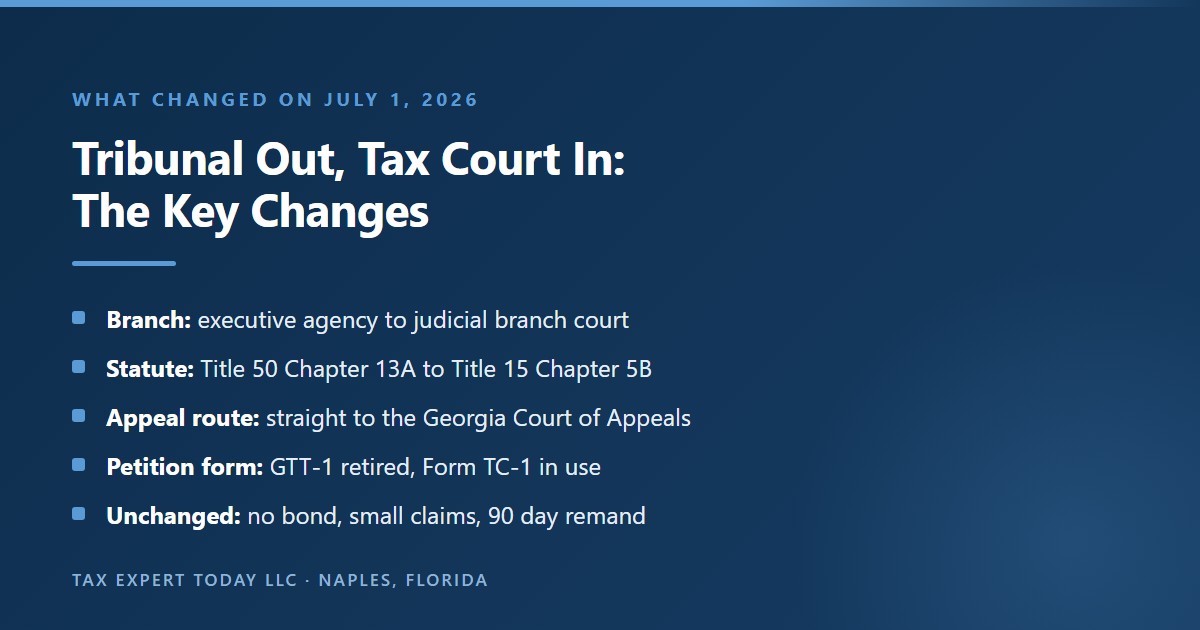
The Georgia Tax Tribunal was an independent division of the Office of State Administrative Hearings that heard most disputes with the Georgia Department of Revenue from January 1, 2013 until June 30, 2026. It was replaced by the Georgia Tax Court, a court in the judicial branch, which began operations on July 1, 2026.
- The old forum: an executive branch tribunal created by the Georgia Tax Tribunal Act of 2012, Chapter 13A of Title 50.
- The new forum: a judicial branch court created under Chapter 5B of Title 15, the Georgia Tax Court Act of 2025.
- What carried over: no payment of the disputed tax before filing, a small claims division, and a judge with tax experience.
- What changed: an appeal goes directly to the Georgia Court of Appeals rather than first to the Fulton County Superior Court.
The Department of Revenue describes the new court in plain terms on its Georgia Tax Court page: it began operations on July 1, 2026, it handles state tax disputes that cannot be resolved informally with the Department, and it is completely separate from and independent of the Department. The state’s directory listing on Georgia.gov states that it replaced the former Georgia Tax Tribunal and that by law its judges must be experienced tax attorneys.
For a taxpayer, the practical point is simple. If a notice, an old letter, an online form site, or a prior advisor tells you to file with the Georgia Tax Tribunal, that instruction is out of date. Any new appeal of an official assessment, a refund denial, or a recorded state tax execution is filed with the Georgia Tax Court at taxcourt.georgiacourts.gov, or in the appropriate superior court. The old Tribunal petition, Form GTT-1, still appears on third party form sites and should not be used for a new case.
The Tribunal’s name will linger for years in search results, in court decisions, and in older Department letters. Its decisions are not erased. The Georgia Tax Court’s own decisions archive includes rulings that were issued under the Tribunal name, and those rulings remain useful as a guide to how Georgia’s tax statutes have been read. What a taxpayer cannot do is start a new case in a forum that no longer accepts filings.
| Feature | Georgia Tax Tribunal (2013 to June 30, 2026) | Georgia Tax Court (from July 1, 2026) |
|---|---|---|
| Branch of government | Executive, inside the Office of State Administrative Hearings | Judicial |
| Governing statute | Chapter 13A of Title 50, the Georgia Tax Tribunal Act of 2012 | Chapter 5B of Title 15, the Georgia Tax Court Act of 2025 |
| Appeal from a regular case | Petition for review in the Fulton County Superior Court, then a discretionary application to an appellate court | Directly to the Georgia Court of Appeals |
| Pay the tax before filing | Not required | Not required (the superior court bond rule in 48-2-59(c) does not apply) |
| Small claims division | Yes, under $15,000 income tax or $50,000 other taxes | Yes, same dollar limits on Form TC-1 |
| Petition form | Form GTT-1 (retired) | Form TC-1 (06-2026), or any written petition that meets the requirements |
| Automatic remand to the Department | Yes, by standing order | Yes, 90 days by the Standing Remand Order of July 13, 2026 |
When Did the Georgia Tax Court Replace the Georgia Tax Tribunal?
The Georgia Tax Court began operations on July 1, 2026, the day after the Georgia Tax Tribunal ceased operations. The change followed a constitutional amendment approved by Georgia voters on November 5, 2024, the 2024 enabling act, House Bill 1267, and a 2025 cleanup act, House Bill 392, that set the start date.
- November 5, 2024: voters approved the constitutional amendment allowing a judicial branch tax court.
- 2024 session: House Bill 1267 created the new chapter of Title 15 and amended 48-2-59 effective July 1, 2026.
- 2025 session: House Bill 392 moved the start date from August 1 to July 1, 2026, so there was no gap.
- April 1, 2026: the first judge’s term began, according to the Tax Notes State analysis, to set up operations.
The sequence matters mainly for one reason: it tells a taxpayer which rules governed a case at each stage. The history note to O.C.G.A. 48-2-59 records that the 2024 amendment, effective July 1, 2026, substituted “Georgia Tax Court in accordance with Chapter 5B of Title 15” for “Georgia Tax Tribunal in accordance with Chapter 13A of Title 50” throughout the appeal provisions. A separate 2025 amendment, Senate Bill 141, effective July 1, 2025, had already changed the appeal window in the same statute from 30 days to 45 days. A third amendment in 2026, House Bill 1247, revised the closing words of the no deference rule in subsection (e).
The June 2025 analysis published in Tax Notes State by attorneys at Eversheds Sutherland, New Georgia Tax Court Will Improve Tax Dispute Resolution, describes the legislative history in detail. It reports that the legislation passed nearly unanimously, that the court was modeled on the enabling law for the Georgia Statewide Business Court, and that House Bill 392 moved the start date to July 1, 2026 because the Tribunal would cease operations on that date. The Department’s own page confirms the July 1, 2026 start.
The chief judge of the new court is Frank M. O’Connell, whose signature appears on the court’s Standing Remand Order dated July 13, 2026. Georgia press coverage in July 2025 reported his selection while he was serving as the state revenue commissioner. A taxpayer does not need to know who the judge is to file a petition, but the name appears on the court’s orders and decisions.
Why Did Georgia Move Tax Appeals Out of the Executive Branch?
The move addressed three weaknesses of the Tribunal identified by practitioners: an appeal had to pass through the Fulton County Superior Court and then a discretionary application, the Tribunal could not rule on constitutional questions, and it sat in the same branch of government as the Department of Revenue whose decisions it reviewed.
- Appeal path: the Tribunal route added a superior court review and an application that an appellate court could refuse.
- Scope of issues: an administrative body could not decide constitutional claims, so some cases needed a second forum.
- Independence: the Tribunal was part of the executive branch, the same branch as the Department.
- Preserved benefit: the new court keeps the rule that the tax does not have to be paid before the case is heard.
Under the Tribunal system, a party that lost a regular case could seek review in the Fulton County Superior Court, which was generally confined to the Tribunal’s record. After that, the losing party had to file an application for a discretionary appeal to the Court of Appeals. The Tax Notes State analysis notes that superior court review of some Tribunal decisions took up to a year, and that if an appellate court rejected the application, the taxpayer’s last review would have been in a court that is not an appellate court.
The Georgia Tax Court removes the intermediate step. Decisions in regular cases are appealed to the Georgia Court of Appeals, which the Department and the court both state on their pages. The same analysis notes that the new court has concurrent jurisdiction with the superior courts, so only the taxpayer chooses between the Tax Court and the superior court, and that the court can hear all legal issues arising out of the tax dispute, including equitable claims such as declaratory relief.
The independence point is about perception as much as practice. The Tribunal decided cases fairly by most accounts, but it was housed inside an executive branch agency. A taxpayer facing the Department now argues before a judge in a different branch of government entirely, with a statute that tells that judge to decide questions of law without deference to the Department’s reading of the law. For a taxpayer, those structural changes mean that the record built at the protest stage and in the Tax Court is the record an appellate court will review, and there is one fewer step between a decision and a final answer.
What Law Created the Georgia Tax Court?
The court is created by Chapter 5B of Title 15 of the Official Code of Georgia, which O.C.G.A. 48-2-59 calls the Georgia Tax Court Act of 2025. The appeal rights themselves sit in 48-2-59, which was amended effective July 1, 2026 to send appeals to the Georgia Tax Court instead of the Tribunal.
- Chapter 5B of Title 15: the court’s organization, judges, and jurisdiction, in the Title of the Code that governs courts.
- O.C.G.A. 48-2-59: who may appeal, where, the 45 day deadline, and the superior court bond.
- O.C.G.A. 48-2-46 and 48-2-47: the protest of a proposed assessment and the final assessment that follows it.
- Court rules and orders: the court’s own rules of practice and its Standing Remand Order govern procedure.
Subsection (a) of 48-2-59 provides that, except for refund claims, either party may appeal from any order, ruling, or finding of the commissioner to the Georgia Tax Court in accordance with Chapter 5B of Title 15, or to the superior court of the county of the taxpayer’s residence. Separate venue rules apply to a public utility, a nonresident, and a nonresident individual or foreign corporation with no place of business in Georgia.
Subsection (b) is the deadline rule. The taxpayer commences an appeal by filing a petition with the Georgia Tax Court or the superior court within 45 days from the date of decision by the commissioner, or at any time after the Department records a state tax execution under 48-3-42. Subsection (c) imposes the superior court requirements, a written statement agreeing to pay admitted taxes and a surety bond, and then states that it does not apply to appeals filed with the Georgia Tax Court. Subsection (e) says that all questions of law, including interpretations of constitutional, statutory, and regulatory provisions, are decided without deference to any determination or interpretation by the Department.
The Justia page for Chapter 5B itself was behind a bot verification screen when this article was researched on October 1, 2026, so this guide does not quote the chapter section by section. Points about the judges and the court’s structure are taken from the Department’s page, the state directory listing, the court’s own pages, and the Tax Notes State analysis, and each is attributed to its source. A taxpayer who needs the exact text of a Chapter 5B provision should read it in the current Georgia Code before relying on it.
What Kinds of Disputes Can the Georgia Tax Court Hear?
The Georgia Tax Court hears a taxpayer’s appeal of an official assessment, the denial of a refund claim, a challenge to a recorded state tax execution, a declaratory judgment action against a Department regulation, and the denial of a petition for an alternative allocation or apportionment method, according to the court and the Department.
- Official assessments: the final assessment and demand for payment issued after the protest stage or after no protest.
- Refund denials: including real estate transfer tax and intangible recording tax refunds listed on Form TC-1.
- State tax executions: the recorded lien the Department files when an assessment is not paid or appealed.
- Regulation challenges and apportionment petitions: declaratory judgment actions and alternative apportionment denials.
The list comes from two matching sources, the court’s About the Georgia Tax Court page and the Department’s Georgia Tax Court page. Form TC-1 adds detail through its check boxes. Line 4 of the petition asks which Department notice or action is disputed: an official assessment and demand for payment, a recorded state tax execution, a real estate transfer tax refund, an intangible recording tax refund, a failure to grant a tax refund, a proposed assessment of public utility property or airline flight equipment, a final assessment of railroad equipment cars, or other.
Line 3 lists the tax types the form expects most often: individual income tax, corporate income tax, sales and use tax, IFTA fuel tax, withholding tax, and other. That covers the disputes this firm sees most in Georgia practice: a residency or part year allocation fight on an individual return, a sales and use tax audit assessment on a business, a withholding assessment against an employer, and a corporate apportionment question. A taxpayer whose dispute arose from a Georgia part year resident tax return or a Georgia withholding tax account follows the same appeal path as any other income or withholding dispute.
The court also hears cases for business taxpayers whose disputes involve corporate income tax and the Georgia net worth tax, which is assessed on the same return. A pass through entity that elected to pay tax at the entity level is a corporate or partnership taxpayer for this purpose, so an assessment arising from the Georgia pass through entity tax election is appealed by the entity, and entity taxpayers need counsel in the Tax Court, as explained below.
What Can the Georgia Tax Court Not Hear?
The Georgia Tax Court cannot hear a protest of a proposed assessment, a request for a payment plan, an offer in compromise, or a penalty waiver, disputes over alcoholic beverage or motor vehicle administration, or most local property tax cases. Those matters stay with the Department or go to another forum entirely.
- Proposed assessments: must be protested to the Department first, and cannot be appealed to the court.
- Collection alternatives: payment plans, offers in compromise, and penalty waivers are requested from the Department.
- Alcohol and motor vehicle matters: excluded from the court’s jurisdiction by the court’s own description.
- Local property tax: excluded, except property tax centrally assessed by the commissioner, such as public utilities and railroads.
The exclusions matter because a petition filed in the wrong place does not stop a deadline that is running somewhere else. The Department’s Protests and Appeals page states directly that a taxpayer may not appeal a proposed assessment to the Georgia Tax Court, and that a payment agreement, offer in compromise, or penalty waiver cannot be requested from the court. A taxpayer who mails a petition about a proposed assessment can lose the 45 day protest window while waiting for the court to say it has no jurisdiction.
The collection alternatives each have their own Department process. A payment plan is requested through the Georgia Tax Center or on Form GA-9465, explained in our guide to the Georgia Department of Revenue payment plan. An offer is submitted on Form OIC-1, explained in our guide to the Georgia offer in compromise. A penalty waiver is requested on Form TSD-3. None of those processes is a substitute for an appeal when the taxpayer disputes the tax itself, and some of them waive appeal rights, a point covered later in this guide.
The property tax exclusion reflects how Georgia’s property tax system is built. County boards of assessors and county boards of equalization handle ordinary real and personal property valuations, with appeals to the superior court. This guide does not cover county property tax appeals. The Tax Court’s property tax jurisdiction is limited to property the commissioner assesses directly, such as public utility property, airline flight equipment, and railroad equipment cars, which is why those items appear on Form TC-1.
Why Can You Not Take a Proposed Assessment to the Georgia Tax Court?
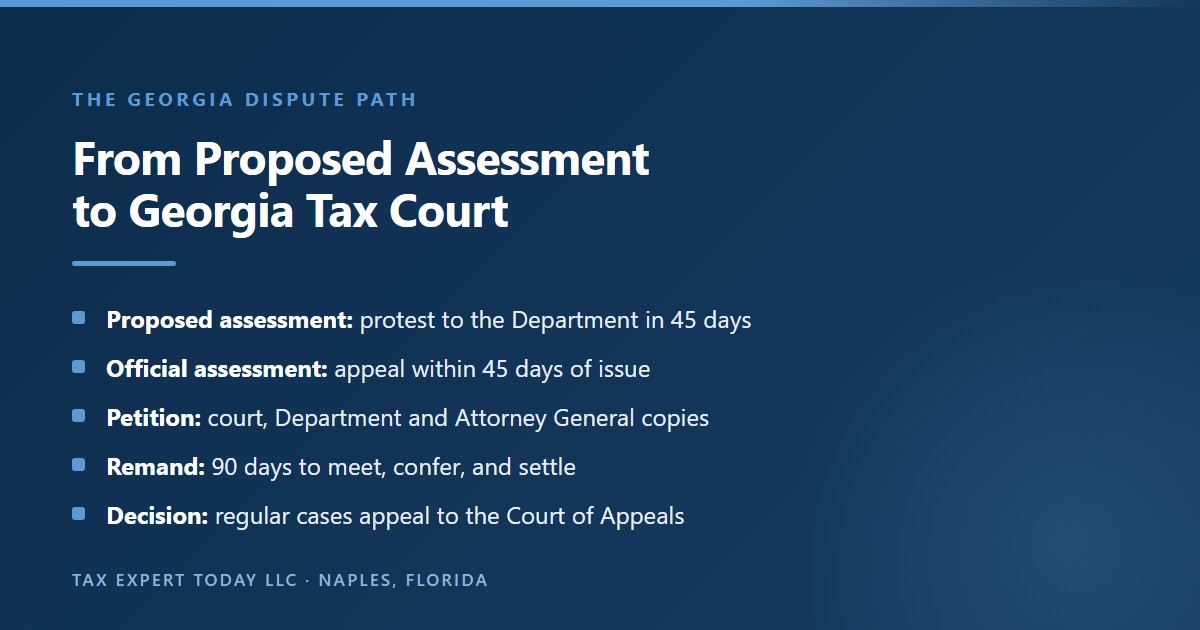
A proposed assessment is not yet a final decision of the commissioner. Georgia law gives the taxpayer 45 days to protest it to the Department under O.C.G.A. 48-2-46, and only the official assessment that follows under 48-2-47, or a refund denial or execution, is the kind of decision the Tax Court reviews.
- Proposed assessment: the Department’s first notice of an adjustment, which invites a protest.
- Protest: a written objection filed with the Department within 45 days, online or on Form TSD-1.
- Official assessment: the final assessment and demand for payment issued after the protest is decided or the window closes.
- Appeal: the petition to the Tax Court or superior court, filed within 45 days of the official assessment.
O.C.G.A. 48-2-46 lets any taxpayer contest a proposed assessment by filing a written protest with the commissioner within 45 days from the date of notice, or within any different time limit stated on the notice. The protest must include a summary statement of the grounds and the taxpayer’s reasons for disputing the finding. If the taxpayer wants a conference, the protest must say so, and the commissioner must grant one.
O.C.G.A. 48-2-47 then requires the commissioner to consider the information in the protest and any information submitted in a conference, to make a final assessment, and to notify the taxpayer of the amount, subject to the right of appeal provided by law. That notice, which the Department calls the Official Assessment and Demand for Payment, starts the 45 day appeal clock in 48-2-59(b).
This structure is the reason the protest is not a formality. The protest is where the Department’s auditor and the taxpayer exchange workpapers, where the taxpayer can ask for a conference, and where many disputes end. It is also where the factual record begins. A taxpayer who skips the protest, or files a one line protest that says only “I disagree,” reaches the Tax Court with the Department’s file and nothing else. A taxpayer who files a detailed protest, with the computations and documents attached, reaches the court with a record that already explains why the assessment is wrong.
How Does the Department of Revenue Protest Work Before Any Appeal?
A taxpayer protests a proposed assessment or refund denial within 45 days of the issued date on the notice, either online in the Georgia Tax Center or by mailing Form TSD-1 with supporting documents. The Department may ask for more information, holds a conference if requested, and then grants or denies the protest in full or in part.
- Online: log on to the Georgia Tax Center and file the protest from the notice.
- By mail: complete Form TSD-1, Protest of Proposed Assessment or Refund Denial.
- Mailing date: a postmark counts as the filing date, a meter date does not, and IRS designated private delivery services count when delivered to the carrier.
- Not a ground: inability to pay is not a valid reason to protest.
The Department’s Protests and Appeals page sets out the mechanics. Protests mailed through the U.S. Post Office are considered filed on the postmark date, and the Department does not recognize metered dates. Protests sent through an IRS designated private delivery service are timely when given to the carrier, and protests sent by any other method are filed when the Department receives them. After the protest arrives, a Department representative contacts the taxpayer if more information is needed or if a conference was requested. If the protest is complete enough to decide, the Department issues a decision granting or denying it in full or in part.
The protest also affects the assessment period. Under 48-2-46, the filing of a written protest tolls the period of limitations for making an assessment until the petition is denied by the commissioner or the request is withdrawn in writing by the taxpayer. The general assessment period in O.C.G.A. 48-2-49 is three years after the return is filed, with no limit for a false or fraudulent return or a failure to file, and the parties may extend it by written agreement.
A protest is a state tax matter handled under Georgia procedure, and a representative needs a Georgia power of attorney on Form RD-1061. The Department’s Taxpayer Bill of Rights states that a taxpayer has the right to be represented by an authorized agent, who may be an attorney, an accountant, or another person with a properly completed power of attorney, in any hearing or conference with the Department. That right covers the protest and conference stage. Representation in the Tax Court itself follows the court’s rules, discussed below.
A protest that will support a later appeal usually contains five parts: the notice and letter ID, a statement of each adjustment disputed, the facts behind each objection, the legal authority for the taxpayer’s position, and the documents that prove the facts. Where a refund is at issue because the taxpayer filed a corrected return, the protest of the refund denial often turns on the same records described in our guide to the Georgia amended tax return.
What Is the Deadline to Appeal an Official Assessment in Georgia?
A taxpayer has 45 days from the issued date of the Official Assessment and Demand for Payment to appeal to the Georgia Tax Court or the appropriate superior court. The window was 30 days before July 1, 2025, and some special assessments, such as centrally assessed property and intangible recording tax, still carry a 30 day window.
- Official assessment: 45 days from the issued date on the notice, under 48-2-59(b) as amended by Senate Bill 141.
- Refund denial: the later of two years from the denial or 45 days after a protest decision, if the taxpayer protested first.
- Recorded state tax execution: at any time after the Department records the execution.
- Special assessments: check the notice, because a shorter statutory period can apply.
The 45 day period is counted from the date of decision by the commissioner, which the Department describes as the issued date on the official assessment. The notice date, not the date the taxpayer opened the envelope, is what counts. A taxpayer who moved, whose mail goes to an old business address, or whose Georgia Tax Center notices go to an inbox nobody checks can lose most of the window before learning about the assessment. Updating the mailing address on every Georgia account is part of dispute preparation.
The Tax Notes State analysis notes that the change from 30 to 45 days applies to appeals of most final assessments, and that the time to appeal certain types of assessments, such as centrally assessed property and intangible recording tax, remains 30 days from the date of the assessment. The safest practice is to read the appeal language printed on the specific notice, calendar the shorter of the printed date and the statutory date, and file well before the last day.
| Department action | First step | Deadline | Where |
|---|---|---|---|
| Notice of proposed assessment | Protest | 45 days from the issued date | Department, online or Form TSD-1 |
| Official Assessment and Demand for Payment | Appeal | 45 days from the issued date | Georgia Tax Court or superior court |
| Refund denial, no protest | Appeal | Two years from the denial | Georgia Tax Court or superior court |
| Refund denial, protested first | Appeal after the protest decision | Later of two years from the denial or 45 days from the protest decision | Georgia Tax Court or superior court |
| Recorded state tax execution | Appeal | Any time after recording | Georgia Tax Court or superior court |
| Centrally assessed property or intangible recording tax assessment | Appeal | 30 days, per the Tax Notes State analysis; check the notice | Georgia Tax Court or superior court |
How Do Refund Denial Appeals Work in the Georgia Tax Court?
A taxpayer whose Georgia refund claim is denied can either protest the denial to the Department or appeal immediately to the Georgia Tax Court or superior court. The appeal is due within the later of two years from the denial or, if the taxpayer protested first, 45 days from the Department’s protest decision.
- Two routes: protest first for a conference, or go straight to the court.
- Two year outer limit: the appeal of a refund denial has a longer window than an assessment appeal.
- Protest extension: a protest decision restarts a 45 day period if that ends later than two years.
- Form TC-1 boxes: refund appeals include failure to grant a refund and specific transfer and recording tax refunds.
The Department’s Protests and Appeals page and the Taxpayer Bill of Rights both describe the refund route the same way. A refund claim must first be filed with the Department in writing, with a summary of the grounds and identification of the transactions behind the claim. If the Department denies the claim, the taxpayer chooses. A protest keeps the matter at the Department and allows a conference. An immediate appeal moves the case to a judge.
The choice usually turns on whether the denial is about facts the Department has not yet seen, or about a legal position the Department has already taken. A denial for missing documents is often better handled by protest with the documents attached. A denial based on the Department’s reading of a statute, for example on whether a credit applies or how an exclusion is computed, may be better taken straight to a judge, because subsection (e) of 48-2-59 requires the court to decide legal questions without deference to the Department.
Refund disputes are common where a taxpayer claims a credit the Department reads narrowly. A business claiming a research credit under the rules in our Georgia R&D tax credit guide, a production company using the Georgia film tax credit, or a retiree whose exclusion under the Georgia retirement income exclusion was reduced can each end up with a refund denial. The appeal path is the same; what changes is the evidence and the statute.
Can You Challenge a Recorded State Tax Execution?
Yes. Under O.C.G.A. 48-2-59(b), a taxpayer may file a petition with the Georgia Tax Court or the superior court at any time after the Department records a state tax execution. The execution is the lien the Department files when an official assessment is neither paid nor appealed within 45 days.
- When it arises: after an official assessment is not paid or appealed within 45 days.
- What it does: becomes a lien on the taxpayer’s property and allows garnishment and levy.
- Collection fee: the Department may impose a 20 percent collection fee when an execution issues.
- How long it lasts: ten years from filing under 48-3-42(g), subject to tolling.
The Taxpayer Bill of Rights states that if a taxpayer fails to pay or appeal an official assessment within 45 days, the Department may issue a state tax execution and impose a 20 percent collection fee, and that the execution may be recorded in county records as a lien covering all property in which the taxpayer has an interest. After issuance, the Department can use all lawful collection means, including garnishment, levy, and sale of property.
O.C.G.A. 48-3-42 requires the Department to file an execution within five years of a final assessment and provides that an execution filed after January 1, 2018 expires ten years from the date of filing. The ten year period is tolled for an installment agreement plus 90 days, for an offer in compromise under consideration, for bankruptcy plus six months, and in the other situations the statute lists.
An appeal of a recorded execution is not a second chance to argue a protest that was never filed. The kinds of claims that fit this route include an execution recorded for a liability that was already paid, an execution against the wrong taxpayer, an execution recorded for a period that was never validly assessed, and similar defects. Whether a petition against an execution can also reach the underlying tax depends on the facts and the governing law, and that question should be reviewed with counsel before filing. A taxpayer who simply missed the 45 day window and agrees the tax is owed is usually better served by the collection alternatives than by a petition.
Georgia Tax Court or Superior Court: Which Forum Fits?
Most taxpayers who dispute a Georgia assessment choose the Georgia Tax Court because it does not require payment or a bond before the case is heard. A superior court appeal requires a written agreement to pay admitted taxes and a surety bond or qualifying real estate equity, and the Department recommends counsel.
- Tax Court: no bond, a $60 fee or no fee in small claims, a judge who is an experienced tax attorney.
- Superior court: a bond equal to the amount in dispute unless Georgia real estate equity covers it.
- Appeals: regular Tax Court decisions go to the Georgia Court of Appeals.
- Who chooses: the taxpayer picks the forum by where the petition is filed.
Subsection (c) of 48-2-59 sets the superior court conditions. Before the superior court has jurisdiction, the taxpayer files a written statement agreeing to pay on the due dates all taxes for which the taxpayer admits liability. Within 45 days of the commissioner’s decision, the taxpayer also files a surety bond or other security satisfactory to the clerk, conditioned to pay any tax found due with interest and costs, unless the value of the taxpayer’s interest in Georgia real property exceeds the tax in dispute. Failing to pay admitted taxes on time is a ground for dismissal. The subsection then states that it does not apply to appeals filed with the Georgia Tax Court.
The Department’s guidance matches. Its Protests and Appeals page states that a superior court appeal must satisfy procedural requirements and be accompanied by a surety bond in an amount equal to the amount in dispute, and that retaining counsel is highly recommended for a superior court appeal. The Taxpayer Bill of Rights adds the alternative of timely evidence of Georgia real estate equity equal to or greater than the amount in dispute.
| Point of comparison | Georgia Tax Court | Superior court |
|---|---|---|
| Pay or bond before the case | No | Statement agreeing to pay admitted taxes plus a surety bond or other security, or qualifying Georgia real estate equity |
| Filing fee | $60 for a regular case, none for a small claims case | The superior court’s own civil filing costs |
| Judge | An experienced tax attorney, by law | A general jurisdiction judge |
| Automatic remand to the Department | Yes, 90 days | No standing order of this kind |
| Small claims option | Yes, under $15,000 income tax or $50,000 other taxes | No |
| Deference to the Department on law | None, under 48-2-59(e) | None, under 48-2-59(e) |
| Collection while pending | Generally stayed | Generally stayed |
A superior court can still make sense for some taxpayers, for example when the dispute is joined with non tax claims that belong in a court of general jurisdiction, or when counsel has a specific procedural reason. For an individual or a small business disputing an assessment it cannot pay while the case is pending, the bond requirement alone usually decides the question. The forum choice should be made before the 45 day window closes, because the petition itself is the election.
What Does It Cost to File in the Georgia Tax Court?
The Georgia Tax Court charges a $60 filing fee for a case conducted under regular procedures, paid online by credit card, debit card, or e-check. A taxpayer who elects small claims procedures on the petition does not pay a filing fee. The court accepts online payments only, unless the court administrator arranges otherwise.
- Regular case: $60, paid through the payment link on the court’s website.
- Small claims case: no filing fee.
- Payment method: online only, by credit card, debit card, or e-check.
- No bond: the tax in dispute is not paid or secured to file.
The court’s Frequently Asked Questions page states that the court accepts online payments for filing fees only, by credit card, debit card, or e-check, and that a taxpayer unable to pay online should contact the Tax Court Administrator. Item 8 on Form TC-1 says the same thing from the other direction: a taxpayer who chooses small claims does not pay a filing fee, and a regular case requires the $60 fee through the link on the court’s website.
The filing fee is the only court charge the published materials describe for starting a case. It is not the cost of the dispute. The cost of a Georgia tax dispute is mostly the time spent building the record: gathering returns and workpapers, reconstructing transactions, preparing computations, and, in a regular case, any counsel fees. This firm does not publish fees for its own services, and the cost of a particular matter depends on the issues and the records involved.
| Item | Regular case | Small claims case |
|---|---|---|
| Court filing fee | $60 | None |
| Payment of disputed tax to file | Not required | Not required |
| Certified mail to the Department and the Attorney General | Postal charges | Postal charges |
| Right to appeal the decision | Yes, to the Court of Appeals | No, the decision is final for both sides |
How Do You File a Petition in the Georgia Tax Court?
A taxpayer files a written petition with the Georgia Tax Court, online through the court’s e-filing portal or by mail to 225 Peachtree Street NE, Suite 400, Atlanta, Georgia 30303, together with the Department notice, the Statement of Taxpayer Identification Number, and the $60 fee unless small claims is elected.
- Step one: prepare the petition on Form TC-1 or in any written form that states the facts and law relied on.
- Step two: file it with the court, attaching the Department notice and the Statement of Taxpayer Identification Number.
- Step three: pay the $60 fee online, unless electing small claims.
- Step four: send copies of the petition to the commissioner and the Attorney General by certified mail or statutory overnight delivery.
The court’s How to File a Petition page sets out the three steps: complete a written petition, send it to the court with the listed items, and mail copies to the State Revenue Commissioner and the other respondents. The page explains that there is no set form for a petition, and that it may be in any form that reasonably specifies the matter for the court’s consideration, but it must be in writing and must include a summary statement of facts and law upon which the petitioner relies.
The information page attached to Form TC-1 describes the online route. On the court’s website, the taxpayer fills out the online petition and the Statement of Taxpayer Identification Number, completes an online Certificate of Service attesting that the petition was sent to the Department and the Attorney General, uploads the related Department notice, and pays the fee if one applies. The paper route uses the same pieces: print and complete the petition, the Statement of Taxpayer Identification Number, and the Certificate of Service, and send them to the court with a copy of the notice.
The court’s Forms, Filing, and Orders page lists the petition form, the Statement of Taxpayer Identification Number, an Election Form for small claims procedures, a subpoena form, and the Standing Remand Order. Because the court opened in July 2026 and is still building its site, the forms page is the place to confirm the current version of each form on the day of filing.
What Must a Georgia Tax Court Petition Say?
The petition must be in writing and must state the facts and the law the taxpayer relies on. Form TC-1 asks for the letter ID on the notice, the tax type, the Department action disputed, the small claims or regular election, each reason the taxpayer disagrees, and the facts relied on, listed point by point.
- Letter ID: the number on the Department notice, which links the case to the right account.
- Each disagreement, separately: line 6 asks for every point of disagreement as its own item.
- Facts, separately: line 7 asks for each fact the taxpayer relies on as its own item.
- No evidence attached: the form tells taxpayers not to submit tax forms, receipts, or other evidence with the petition.
Form TC-1, revised June 2026, captions the case as the taxpayer, as petitioner, against the Commissioner of the Georgia Department of Revenue, as respondent. Line 1 asks for the letter ID on the notice. Line 2 asks the taxpayer to attach a copy of the notice or other Department document on which the petition is based. Line 3 asks for the tax type, and, if no letter ID was given, the taxpayer’s identification number only on the copy sent to the Department. Line 4 asks which notice or action is disputed. Line 5 is the small claims or regular election.
Lines 6 and 7 are where the case is framed. The form asks for each point of disagreement separately and each fact separately, and allows additional pages. That structure is useful discipline. A petition that lists four separate errors, each tied to specific facts, tells the Department’s counsel and the court exactly what is in dispute and what is not. It also limits surprises later, because the issues not raised in the petition may be harder to add after the remand period.
The instruction not to attach evidence is easy to miss. The court wants the Department notice attached, because it identifies the action under review, but not the supporting documents. Those are exchanged with the Department during the remand and, if the case continues, produced in discovery and offered at hearing under the court’s rules. A taxpayer who mails a box of receipts with the petition has not proved anything; the documents simply sit in the court file without being admitted.
Who Must Receive a Copy of the Georgia Tax Court Petition?
The taxpayer must send the petition to three places: the Georgia Tax Court, the State Revenue Commissioner at Georgia Department of Revenue, P.O. Box 105665, Atlanta, GA 30348-5665, and the Georgia Department of Law, Tax Section, 40 Capitol Square SW, Atlanta, GA 30334-1300, plus any other named respondent.
- The court: the full filing, online or at 225 Peachtree Street NE, Suite 400, Atlanta.
- The Department: a copy of only the petition form, by certified mail with return receipt or statutory overnight delivery.
- The Attorney General: a copy of only the petition form, by the same delivery methods.
- Proof of service: the Certificate of Service tells the court the copies went out.
The court’s filing page and the information page on Form TC-1 both describe the copies. The information page specifies that only the petition form, not the whole filing package, is mailed to the Department and to the Department of Law, and that each copy goes by certified mail, return receipt, or statutory overnight delivery. The Department of Law represents the commissioner in the case, which is why the Attorney General’s Tax Section receives its own copy.
Service is not a detail to leave to the end of the day the petition is due. Keep the certified mail receipts and the return receipts with the case file. If the Department later says it never received the petition, the receipts and the Certificate of Service are the evidence that it did. They also fix the date on which the Department learned of the appeal, which can matter if collection activity continued after the petition was filed.
What Is the Georgia Tax Court Small Claims Division?
The small claims division hears eligible cases under simpler, less formal procedures. A taxpayer may elect it when the income tax in controversy, including penalties but excluding interest, is less than $15,000, or the other tax in controversy is less than $50,000. The decision cannot be appealed by either side.
- Income tax limit: under $15,000 of tax and penalties, excluding interest.
- Other taxes: under $50,000 of tax and penalties, excluding interest.
- Election window: generally any time within 90 days of filing the petition, and it cannot be changed afterward.
- Finality: neither the taxpayer nor the Department can appeal a small claims decision.
Form TC-1 explains the division on its information page. The dollar limits vary by tax type. For an income tax liability, the amount must be less than $15,000, counting principal and penalties but not interest. For other taxes, the limit is less than $50,000, measured the same way. With certain exceptions, an eligible taxpayer may elect small claims procedures any time within 90 days of filing the petition, and the election cannot be changed after that period ends. A taxpayer who checks neither box on line 5 is treated as filing a regular case.
The small claims division does not have jurisdiction over four kinds of matters, according to the same page: any proceeding contesting a liability, or associated penalties, that the Department or another respondent alleges is due to evasion or attempted evasion; petitions challenging proposed or official assessments of public utility property, airline flight equipment, or railroad equipment cars; petitions challenging the denial of an alternative allocation or apportionment method; and declaratory judgment actions challenging a Department rule.
The Department’s Taxpayer Bill of Rights states the same thresholds and adds that decisions in small claims cases are final. The Tax Notes State analysis notes that under the Tribunal, small claims cases were nonprecedential and unpublished. Whether the new court follows the same publication practice is a question for its rules and decisions archive.
| Tax type | Small claims limit (tax plus penalties, excluding interest) | Hypothetical amount in dispute | Eligible? |
|---|---|---|---|
| Individual income tax | Less than $15,000 | $11,800 tax and penalty, $2,900 interest | Yes, interest is excluded |
| Individual income tax | Less than $15,000 | $16,400 tax and penalty | No, regular case |
| Sales and use tax | Less than $50,000 | $38,000 tax and penalty | Yes, unless evasion is alleged |
| Withholding tax | Less than $50,000 | $52,500 tax and penalty | No, regular case |
| Corporate income tax with an apportionment petition denial | Excluded matter | Any amount | No, regular case |
The amounts in the table are illustrative only and are not drawn from any client matter.

Should You Choose Small Claims or a Regular Georgia Tax Court Case?
Small claims suits a taxpayer with an eligible amount, a mostly factual dispute, and a wish for a faster and less formal hearing, who accepts that the decision is final. A regular case suits a dispute that turns on a legal question, may matter for later years, or may need an appeal.
- Finality cuts both ways: a taxpayer who wins small claims cannot be appealed against, and a taxpayer who loses cannot appeal.
- Recurring issues: an issue that will repeat in later years usually belongs in a regular case.
- Accountant participation: in small claims, an accountant or return preparer may appear with the taxpayer to give factual information.
- Timing: the election can generally be made within 90 days of filing, so it can follow the remand discussions.
The 90 day election window lines up with the 90 day remand period, which gives a taxpayer room to learn the Department’s position before deciding. If the remand conversations show that the dispute is about documents and arithmetic, small claims may be a sensible way to have a judge resolve it. If the Department’s counsel signals that it reads a statute in a way that affects every year the taxpayer files, a regular case keeps the appeal available and may produce a decision with value beyond this one assessment.
| Factor | Leans toward small claims | Leans toward a regular case |
|---|---|---|
| Nature of the dispute | Facts, records, arithmetic | Statutory or constitutional interpretation |
| Future years | One time event | The same issue recurs every year |
| Need for an appeal | The taxpayer accepts a final answer | The taxpayer wants appellate review available |
| Filing fee | None | $60 |
| Taxpayer type | Individual with a preparer who knows the facts | Business entity represented by counsel |
What Happens During the 90 Day Standing Remand?
Under the court’s Standing Remand Order of July 13, 2026, every new case is automatically remanded to the Department of Revenue for 90 days after the petition is filed. The parties must meet and confer in good faith to settle, and either party may return the case to the court on ten days’ written notice.
- Automatic: applies to every case unless the court orders otherwise in a particular proceeding.
- Good faith settlement efforts: the order requires the parties to meet, confer, and try to resolve the case.
- Early return: any party may bring the case back on ten days’ written notice, or all parties by agreement at any time.
- After remand: if the case does not settle, the court sets a conference on discovery and scheduling.
The Standing Remand Order, signed by Chief Judge Frank M. O’Connell, is short and specific. The remand period ends 90 days after the petition is filed. If a party files a dispositive motion during the remand, the other party’s time to respond is tolled until the remand ends. If the case does not settle, the court will, as soon as reasonably practicable, order the parties to a conference to address discovery, scheduling, and other matters.
The remand continues a practice the Tribunal used for years. The Tax Notes State analysis reports that under the Tribunal’s standing order, most cases were resolved during the remand period without litigation. That is a description of the Tribunal’s history, not a prediction for any case. What it does tell a taxpayer is how to use the first 90 days: as a structured negotiation with the Department’s counsel, with a judge waiting if it fails.
A taxpayer gets the most from the remand by arriving prepared. That means having the full protest file, a clean computation of the tax the taxpayer believes is correct, the documents that support each disputed adjustment, and a clear view of which issues could be conceded. A remand conversation that starts with a complete package can move quickly. One that starts with a request for time to find records uses the period the order gives the parties to settle.
Does Filing a Georgia Tax Court Petition Stop Collection?
Generally yes. The Department’s Taxpayer Bill of Rights states that an appeal to the Georgia Tax Court or superior court stays enforcement and collection actions, except actions taken because of a jeopardy assessment, and that a judge may lift the stay for good cause. Collection of other, undisputed balances can continue.
- General rule: filing a petition operates as a stay of enforcement or collection on the disputed matter.
- Jeopardy exception: collection continues on a jeopardy assessment unless the taxpayer posts a bond with the Department.
- Lifting the stay: a Tax Court or superior court judge may lift it for good cause.
- Other periods: liabilities not under appeal remain collectible.
Both the court’s About page and the Department’s Georgia Tax Court page state that filing a petition generally operates as a stay of enforcement or collection activity until the case is finalized. The Taxpayer Bill of Rights adds the two qualifications above. A jeopardy assessment is one the Department issues for immediate collection when there is evidence the taxpayer intends to leave Georgia, remove or conceal property, discontinue a business without providing for state taxes, or otherwise jeopardize collection. It can be appealed like any official assessment, but collection continues unless the taxpayer files a bond with the Department that adequately secures payment.
The stay is one of the strongest reasons to appeal on time rather than let an assessment become an execution. Once a petition is pending, the Department generally may not garnish wages or levy accounts for the disputed liability. A taxpayer who lets the 45 day window pass invites a recorded execution, a 20 percent collection fee, and collection action, and then has a narrower set of options.
Do You Need a Lawyer in the Georgia Tax Court?
An individual taxpayer may represent himself or herself in the Georgia Tax Court or be represented by an attorney. Every other type of taxpayer, including corporations, partnerships, and limited liability companies, must have legal counsel. Nonresident attorneys who are not members of the State Bar of Georgia may move for permission to appear.
- Individuals: may appear without a lawyer in regular and small claims cases.
- Entities: must be represented by counsel.
- Out of state attorneys: may ask permission to appear under the court’s rules.
- Small claims: accountants or return preparers may appear with the taxpayer to give factual information.
The information page on Form TC-1 states these rules. In regular tax cases, individuals may represent themselves or be represented by an attorney, and all other types of taxpayers must have legal counsel. The same rules apply in small claims cases, except that accountants or other tax return preparers may appear with the taxpayer to provide factual information about positions taken on the taxpayer’s returns. The form’s signature block has a line for counsel’s bar number, with a note for attorneys admitted outside Georgia.
The entity rule is the one that catches business owners. A single member LLC owner who handled the Department audit personally may assume he or she can also handle the Tax Court case. If the assessment is against the LLC or a corporation as the taxpayer, the entity needs counsel. If the assessment is against the owner personally, for example a responsible person assessment for unremitted sales or withholding tax, the individual rule applies.
What Role Do Enrolled Agents and CPAs Play in a Georgia Tax Dispute?
Enrolled agents and CPAs commonly handle the Department side of a Georgia dispute under a Form RD-1061 power of attorney: the audit, the protest, the conference, and the computations. In the Tax Court, they may appear with an individual in small claims to give factual information, and otherwise work alongside the taxpayer or counsel.
- Audit and protest: the Taxpayer Bill of Rights allows representation by an accountant or other authorized agent at Department conferences.
- Computations and records: the tax computation and supporting schedules are usually prepared by the tax professional.
- Small claims: an accountant or preparer may appear with the taxpayer to explain return positions.
- Regular cases: the taxpayer, if an individual, or an attorney presents the case.
A Georgia tax dispute is a state matter governed by Georgia procedure, not a federal matter, and the professional roles follow Georgia’s rules rather than federal practice rules. The useful division of labor is practical. The tax professional who prepared or reviewed the returns knows the facts, the workpapers, and the computation. Counsel knows court procedure, pleadings, evidence, and appellate practice. A case that reaches a regular hearing usually needs both kinds of work, and the protest record the tax professional builds is often the core of what counsel presents.
Tax Expert Today LLC includes tax advisors, enrolled agents, certified public accountants, and attorneys. For Georgia matters, the firm’s work typically centers on the protest record, the computations, the coordination of documents, and the evaluation of whether a matter is better resolved by appeal or by a collection alternative. Whether a particular case is better filed in the Tax Court or the superior court, and how it should be pleaded, is a question for Georgia licensed counsel, and the firm coordinates with counsel on those matters.
What Rules of Procedure and Evidence Apply in the Georgia Tax Court?
As a court in the judicial branch, the Georgia Tax Court adopts its own rules of practice and procedure, and the Tax Notes State analysis reports that it is governed by the Georgia Civil Practice Act and the Georgia Rules of Evidence except where exceptions are expressly adopted. The court publishes forms and orders online.
- Court rules: Form TC-1 refers to the court’s rules of practice and procedure for matters such as nonresident attorneys.
- Civil Practice Act: governs pleadings, motions, and discovery in Georgia civil courts.
- Evidence: documents must be offered and admitted, not simply mailed in with the petition.
- Subpoenas: the court’s forms page offers a subpoena form for witnesses and documents.
The Tax Notes State analysis explains that the Tribunal adopted its own procedural rules as regulations, while the new court, as part of the judiciary, adopts its own court rules, filing system, and procedures. It expected the court to keep many of the Tribunal’s favorable rules, including the automatic remand, while clarifying how the Civil Practice Act and the rules of evidence apply. The court did adopt the automatic remand by its July 13, 2026 order.
For a taxpayer without counsel, the practical consequence is that a hearing is not an informal conversation. Documents are exchanged, witnesses may be called, and facts are proved by admissible evidence. The court’s subpoena form exists because a taxpayer may need records or testimony from a third party, such as a former employer, a vendor, or a bank. Preparing for that stage starts at the protest, when the documents are first collected and organized.
Does the Georgia Tax Court Defer to the Department of Revenue?
No, on questions of law. O.C.G.A. 48-2-59(e) requires the Georgia Tax Court and other courts to decide all questions of law, including interpretations of constitutional, statutory, and regulatory provisions, without any deference to a determination or interpretation by the Department, whether written or unwritten.
- Scope: covers constitutional, statutory, and regulatory interpretation.
- Applies to: the Georgia Tax Court and any court hearing an appeal under 48-2-59(a).
- Written or unwritten: covers published guidance and informal positions alike.
- Facts are different: the taxpayer still has to prove the facts with evidence.
The no deference rule changes how a taxpayer should think about the Department’s published guidance. A policy bulletin, a form instruction, or a statement on a Department web page is useful evidence of how the Department reads the law, and it often reflects careful work. But in a 48-2-59 appeal, the court reads the statute itself. If the taxpayer’s reading of a credit provision or an exclusion is the better reading of the statute’s text, the Department’s contrary interpretation does not carry extra weight.
The history note to 48-2-59 records that the 2026 amendment, House Bill 1247, effective May 12, 2026, removed language at the end of subsection (e) that had preserved the judicial deference accorded to rules promulgated under the Georgia Administrative Procedure Act. The current text ends after the no deference sentence. How that change applies to a particular regulation is a legal question for counsel, but it is one of the most significant features of a Georgia tax appeal in 2026.
How Are Georgia Tax Court Decisions Appealed?
A decision in a regular Georgia Tax Court case can be appealed to the Georgia Court of Appeals, according to the Department and the court. Decisions in small claims cases cannot be appealed by the taxpayer or the Department. The Tribunal’s old route through the Fulton County Superior Court no longer applies to new cases.
- Regular cases: appeal to the Court of Appeals of Georgia.
- Either party: the Department can appeal a taxpayer win in a regular case, just as the taxpayer can appeal a loss.
- Small claims: final, with no appeal for either side.
- Further review: after the Court of Appeals, a party may seek review in the Supreme Court of Georgia under its rules.
The Department’s Georgia Tax Court page states that decisions of the court, with the exception of small claims cases, can be appealed to the Georgia Court of Appeals, and the Taxpayer Bill of Rights repeats the point. The Tax Notes State analysis describes this as an appeal as of right, without the application for discretionary review that the Tribunal route required. That analysis also explains why the change matters: under the old route, review could take a year in superior court before an appellate court even decided whether to hear the case.
Because the Department can appeal too, a taxpayer who wins a regular case on a significant legal issue should expect that the Department may seek appellate review. That is one more reason to build the record carefully at the start. The appellate court reviews the case on the record made below, and a fact that was never proved at the Tax Court is very hard to add on appeal. Appellate procedure, deadlines, and briefing are matters for counsel, and this guide does not restate the appellate rules.
What Happened to Cases Pending at the Georgia Tax Tribunal on June 30, 2026?
According to the Tax Notes State analysis of the 2025 cleanup act, House Bill 392, cases pending at the Georgia Tax Tribunal as of June 30, 2026 transferred automatically to the Georgia Tax Court, unless they were resolved before that date. A taxpayer with an older case should confirm its status and case number with the court.
- Automatic transfer: no new petition was needed for a case already pending at the Tribunal.
- Earlier law: the analysis notes the prior text appeared to require the taxpayer to act to move a case.
- Resolution before transfer: parties could resolve a case before June 30, 2026 instead of transferring it.
- Practical step: confirm the new case number, the judge, and any deadlines set after transfer.
The Tax Notes State analysis explains that House Bill 392 provides for the automatic transfer of all cases pending at the Tribunal as of June 30, 2026 to the new court, and that it replaced earlier language that appeared to require the taxpayer to act. That point is attributed to the analysis rather than quoted from the act, because the act’s text was not read for this guide. A taxpayer who had a Tribunal case open before July 1, 2026 should treat the court’s docket as the authority on where the case now stands.
A case that was transferred may be in a different procedural position from a new filing. A long pending Tribunal case may already be past any remand period, may have scheduling orders in place, or may be awaiting a decision. The court’s post remand conference and scheduling practice under the new standing order describes new filings, so the status of a transferred case should be checked against the orders actually entered in it.
Are Old Georgia Tax Tribunal Decisions Still Useful?
Yes, as guidance on how Georgia tax statutes have been read. The Georgia Tax Court’s decisions archive includes rulings issued under the Tribunal name, and those decisions show how specific issues were analyzed. How much weight a later court gives them is a legal question, and small claims rulings were nonprecedential under the Tribunal.
- Where to find them: the court’s decisions and judicial opinions page.
- Regular cases: written decisions explain the issues, the evidence, and the reasoning.
- Small claims: under the Tribunal, nonprecedential and unpublished, according to the Tax Notes State analysis.
- Appellate decisions: decisions of the Court of Appeals and Supreme Court of Georgia bind the Tax Court.
Older Tribunal decisions are useful for a practical reason: they show the kinds of evidence that persuaded or failed to persuade a tax judge on familiar Georgia issues, from residency and domicile to sales tax exemptions and apportionment. A taxpayer reading them should focus on the facts and the evidence, not just the outcome. An outcome in one case says little about another taxpayer’s case unless the facts and the governing statute are the same.
One caution applies to any decision issued before July 1, 2025 on a timing question. Decisions that discuss a 30 day appeal window reflect the law before Senate Bill 141. The current window for most official assessments is 45 days. The same caution applies to older articles on law firm sites and to form sites that still describe the Tribunal’s procedure. They may be accurate history and inaccurate instructions.
Which Georgia Tax Types Commonly Reach the Georgia Tax Court?
Form TC-1 lists individual income tax, corporate income tax, sales and use tax, IFTA fuel tax, and withholding tax, plus refunds of real estate transfer tax and intangible recording tax. Each tax type brings its own typical issues, records, and small claims threshold, and the protest record differs by tax.
- Individual income tax: residency, part year allocation, retirement exclusion, and credits.
- Corporate income tax: apportionment, net worth tax, and credits.
- Sales and use tax: exemption certificates, sampling, and use tax on purchases.
- Withholding tax: employer accounts, nonresident withholding, and responsible person issues.
| Tax type on Form TC-1 | Common issues in dispute | Small claims limit | Related guide |
|---|---|---|---|
| Individual income tax (SSN) | Domicile, part year allocation, exclusions, credits | Less than $15,000 | Georgia capital gains tax |
| Corporate income tax (FEIN) | Apportionment, net worth tax, credits | Less than $15,000 | Georgia corporate tax rate |
| Sales and use tax (STN) | Exemption certificates, taxable sales, use tax | Less than $50,000 | Georgia sales tax exemption |
| Withholding tax (WTN) | Deposits, reconciliations, nonresident withholding | Less than $50,000 | Georgia withholding tax |
| Composite and pass through returns | Nonresident member tax and entity elections | Depends on the tax type assessed | Georgia composite return |
| Real estate transfer and intangible recording tax refunds | Refund claims after a closing or loan recording | Less than $50,000 | Check the notice for the appeal period |
Corporate income tax is shown with the $15,000 limit because Form TC-1 sets that limit for “an income tax liability,” and corporate income tax is an income tax. A taxpayer near either threshold should compute the amount in controversy carefully, counting tax and penalties and leaving out interest, and should confirm the classification with counsel before relying on a small claims election.
What Documents Should You Gather Before Filing a Georgia Tax Court Petition?
Gather the Department notice with its letter ID, the full audit file and workpapers, the protest and the Department’s protest decision, the returns for every period involved, and the records that prove each disputed fact. The petition itself carries only the notice; the rest supports the remand and any hearing.
- Notice: the official assessment, refund denial, or recorded execution being challenged.
- Audit file: the auditor’s schedules, which show exactly how each adjustment was computed.
- Protest record: what the taxpayer argued, what was provided, and what the Department decided.
- Proof: contracts, invoices, bank records, certificates, and residency evidence, depending on the issue.
| Document | Why it matters | Filed with the petition? |
|---|---|---|
| Department notice with letter ID | Identifies the action under review and the date that started the clock | Yes |
| Statement of Taxpayer Identification Number | Required by the court with every petition | Yes |
| Certificate of Service and mail receipts | Proves the Department and the Attorney General received the petition | The certificate, yes; keep the receipts |
| Audit workpapers | Show the computation the taxpayer is challenging | No |
| Protest and protest decision | Show the issues already raised and the Department’s answer | No |
| Returns and schedules for each period | Anchor the taxpayer’s own computation | No |
| Source records | Prove each disputed fact at the remand and at any hearing | No |
If the audit file is incomplete, ask for it. The Taxpayer Bill of Rights lists among the Department’s obligations furnishing copies of the audit documents that explain the basis for an assessment. A taxpayer cannot answer an adjustment it cannot see, and the workpapers often show that a disputed amount rests on an estimate, a sample, or a missing document that the taxpayer can supply.
How Does a Georgia Tax Court Case Interact With an IRS Dispute?
They are separate. The Georgia Tax Court decides only Georgia tax disputes with the Georgia Department of Revenue, and it has no authority over federal tax. A federal deficiency goes to the United States Tax Court under federal law. Many Georgia assessments, however, start from a federal adjustment, so the two cases can affect each other.
- Different courts: the Georgia Tax Court and the United States Tax Court are unrelated institutions.
- Different deadlines: a federal notice of deficiency has its own petition period under federal law.
- Linked facts: a federal audit change often flows into a Georgia assessment for the same year.
- Sequencing: the outcome of a federal dispute can change the Georgia tax that depends on it.
The similar names cause real confusion. A taxpayer who receives a federal notice of deficiency and a Georgia official assessment in the same season may think one petition covers both. It does not. The federal process is described in our guides to the IRS notice of deficiency and to what happens in an IRS audit, and federal disputes for Southwest Florida residents are handled through our IRS resolution and audit support service. This guide does not restate federal procedure.
Where a Georgia assessment is based on a federal adjustment, the taxpayer should think about both cases together. If the federal adjustment is wrong and is being contested, the Georgia appeal may raise the same issue, and the remand period may be a time to discuss with the Department whether the Georgia case can wait for the federal result. If the federal adjustment is final, the Georgia dispute often narrows to how Georgia’s own rules, such as its exclusions and allocation rules, apply to the corrected federal figures.
What Should Former Georgia Residents in Florida Know About the Georgia Tax Court?
Moving to Florida does not end a Georgia tax dispute for a year when Georgia tax was owed. A nonresident may appeal to the Georgia Tax Court, and 48-2-59 gives special superior court venue rules for nonresidents. The Tax Court accepts petitions online, so a Florida resident can file without travelling to Atlanta.
- Same deadlines: the 45 day protest and appeal windows apply wherever the taxpayer now lives.
- Online filing: the e-filing portal and online fee payment remove the need to mail from Florida.
- Venue: a nonresident individual with no Georgia place of business may use the Tax Court, the Fulton County Superior Court, or the county where the commissioner resides.
- Mail: update the Georgia mailing address so notices reach the taxpayer in Florida.
Subsection (a)(2) of 48-2-59 provides that a nonresident individual or a foreign corporation with no place of doing business and no officer or employee maintaining an office in Georgia may appeal to the Georgia Tax Court, to the Superior Court of Fulton County, or to the superior court of the county where the commissioner in office resides. For most former residents, the Tax Court is the practical choice because it avoids the superior court bond.
The disputes this firm sees most among former Georgia residents now in Southwest Florida involve the year of the move. Georgia may assert that the taxpayer remained domiciled in Georgia for part or all of the year, or may challenge how income was allocated on a part year return. Those cases are won or lost on evidence of the change of domicile: the Florida homestead, driver license, voter registration, the sale or rental of the Georgia home, and where the taxpayer actually spent time. Gathering that evidence at the protest stage is far easier than reconstructing it a year later for a hearing.
Can You Still Settle or Use a Payment Plan After Filing a Petition?
Settlement is expected; the 90 day remand exists to encourage it, and a case can settle at any stage. Collection alternatives are different. Form GA-9465 waives the protest and appeal rights for the liabilities in a payment plan, and an accepted offer in compromise bars contesting the tax, so those choices should follow, not precede, the dispute decision.
- Settlement: the parties can resolve the case by agreement during or after the remand.
- Payment plan waiver: line 9 of Form GA-9465 waives the protest and the appeal of the final assessment.
- Offer in compromise: accepted offers include a term that the tax will not be contested.
- Penalty waiver: requested from the Department, and a request does not stop the assessment process.
This sequencing is one of the most practical points in this guide. A taxpayer who disputes part of an assessment and cannot pay the rest is often tempted to request a payment plan right away to stop the letters. On Form GA-9465, as our Georgia payment plan guide explains, the request waives the 45 day protest and the appeal of the final assessment for the liabilities covered. Requesting the plan first can give up the dispute.
The better sequence is usually to decide what is genuinely disputed, protest or appeal that part on time, and address the undisputed part separately. The Department’s Protests and Appeals page notes that inability to pay is not a ground for a protest, and that a penalty waiver request does not stop the assessment process. Where the liability is correct but cannot be paid in full, the collection alternatives fit. Where it is wrong, the appeal fits. Many cases involve both, and they need to be handled in the right order.
What Does a Georgia Tax Dispute Timeline Look Like From Start to Finish?
A typical Georgia income tax dispute runs from a notice of proposed assessment, through a 45 day protest window and a Department decision, to an official assessment, a 45 day appeal window, a petition, a 90 day remand, and either settlement or a scheduled case. The timeline below is hypothetical.
- Day 0: the notice of proposed assessment is issued.
- By day 45: the protest is filed with documents and a conference request.
- After the protest decision: an official assessment issues for any remaining amount.
- Within 45 days of that: the petition is filed, starting the remand.
| Hypothetical date | Event | Rule |
|---|---|---|
| March 2 | Notice of proposed assessment issued for a part year residency adjustment | O.C.G.A. 48-2-46 |
| April 10 | Protest filed in the Georgia Tax Center with domicile evidence and a conference request | Within 45 days |
| August 14 | Protest granted in part; Official Assessment and Demand for Payment issued | O.C.G.A. 48-2-47 |
| September 18 | Petition filed with the Georgia Tax Court; copies sent to the Department and the Attorney General | Within 45 days, O.C.G.A. 48-2-59(b) |
| September 18 to December 17 | Automatic remand; the parties meet and confer | Standing Remand Order |
| By December 17 | Small claims election deadline, if eligible and not yet made | Within 90 days of filing, Form TC-1 |
| After December 17 | If not settled, post remand conference on discovery and scheduling | Standing Remand Order |
The dates are illustrative and do not describe any client matter. Real timelines vary with how quickly the Department decides the protest, and the appeal deadline is always counted from the issued date on the actual notice.
What Are the Most Common Georgia Tax Tribunal and Tax Court Mistakes?
The most damaging mistakes are procedural: filing with the Georgia Tax Tribunal or on its old form, petitioning the court about a proposed assessment, missing the 45 day appeal window, skipping service on the Department and Attorney General, and requesting a payment plan that waives the appeal.
- Following outdated instructions: pages and forms that still describe the Tribunal and a 30 day window.
- Wrong stage: sending a proposed assessment to the court instead of protesting to the Department.
- Thin protest: reaching the court with no record beyond the Department’s file.
- Entity without counsel: an LLC or corporation filing without an attorney.
- Collection first: requesting a payment plan or offer before deciding whether to dispute.
| Mistake | Consequence | How to avoid it |
|---|---|---|
| Using Form GTT-1 or addressing the Tribunal | Delay while the filing is redirected or questioned | Use Form TC-1 from the court’s forms page |
| Counting 30 days instead of 45 | Usually harmless if early, but a sign of outdated guidance | Read the deadline printed on the current notice |
| Counting from the date the letter arrived | A late appeal and a possible execution | Count from the issued date on the notice |
| No copies to the Department and the Attorney General | Service questions and delay | Certified mail or statutory overnight delivery, with receipts kept |
| Attaching evidence to the petition | Documents sit in the file without being admitted | Attach only the notice; exchange records at remand |
| Electing small claims on an issue that recurs | A final decision with no appeal on a multi year issue | Weigh finality before making the election |
Each of these mistakes is avoidable with a calendar, the current forms, and a clear decision about what is disputed. None of them requires a complicated legal theory to prevent. Most are the result of reading guidance written for the Tribunal or for a prior version of the statute, which is the reason this guide exists.
Georgia Tax Tribunal Help in Naples & Southwest Florida
Tax Expert Today LLC works from Naples, Florida and handles state tax matters nationwide, including Georgia Department of Revenue protests, Georgia Tax Court preparation, residency and part year disputes, sales and withholding assessments, and state tax execution issues. Georgia clients are served from the Naples office and do not need to travel to Atlanta.
- Georgia tax appeal help Naples serves Southwest Florida residents who moved from Georgia or who still own Georgia property or businesses.
- Protest preparation starts with the notice, the audit workpapers, and every return for the periods involved.
- Coordination with counsel covers cases where an entity needs an attorney or a regular case is likely.
- Remote engagement is standard. Documents are exchanged through a secure client portal and not by email.
Tax Expert Today LLC
11983 Tamiami Trail N, Naples, FL 34110
Telephone: (239) 441-2005
Hours: Monday through Friday, 10:00 a.m. to 5:00 p.m. Eastern Time
A local question we are asked often: I moved to Naples from Atlanta two years ago, and Georgia has now assessed me as a full year resident for the year I moved. The letter tells me to appeal to the Georgia Tax Tribunal. What do I do? The instruction to use the Tribunal is out of date; appeals now go to the Georgia Tax Court, or to a superior court with a bond. First, check which notice you have. If it is a proposed assessment, the next step is a protest to the Department within 45 days of the issued date, with your Florida domicile evidence attached. If it is an official assessment, the petition is due within 45 days of the issued date, and you can file online from Florida. The full range of Georgia engagements is described on our Georgia tax services page, and federal collection matters for Southwest Florida residents are covered on our Naples tax resolution page.
When to Engage a Professional
A taxpayer with a small, purely arithmetic Georgia adjustment can often resolve it through a well documented protest. Professional review is worth it when the amount is significant, the issue is residency or a credit, an entity is the taxpayer, a federal adjustment is involved, or an appeal deadline is close.
- A former Georgia resident assessed on a domicile or part year allocation issue.
- A business with a sales, use, or withholding assessment that needs the audit sample and workpapers reviewed.
- An LLC or corporation that must appear through counsel in the Tax Court.
- A taxpayer weighing small claims against a regular case on an issue that recurs.
- A taxpayer who owes the IRS and Georgia for linked adjustments in the same years.
Dr. Pellumb Kabashi is the founder of Tax Expert Today LLC, and the firm includes tax advisors, enrolled agents, certified public accountants, and attorneys. Georgia Department of Revenue matters are state tax matters and not federal ones, and they are handled under Georgia procedure and Georgia authority. Representation in the Georgia Tax Court follows the court’s rules, under which individuals may appear for themselves and entities must appear through counsel. Nothing in this article is advice for a particular taxpayer, and no result in any dispute can be promised. To discuss a Georgia notice before a deadline passes, call (239) 441-2005 or review our Georgia tax advisory services.
Frequently Asked Questions
Does the Georgia Tax Tribunal still exist?
No. The Georgia Tax Tribunal ceased operations on June 30, 2026. The Georgia Tax Court, a court in the judicial branch, began operations on July 1, 2026 and now hears the appeals the Tribunal used to hear. New petitions are filed with the Georgia Tax Court at taxcourt.georgiacourts.gov.
How long do I have to appeal a Georgia official assessment?
Forty five days from the issued date on the Official Assessment and Demand for Payment, under O.C.G.A. 48-2-59(b) as amended effective July 1, 2025. Before that date the window was 30 days. Some special assessments carry a shorter period, so read the notice.
Can I appeal a Georgia proposed assessment to the Georgia Tax Court?
No. A proposed assessment must be protested to the Department of Revenue within 45 days, online in the Georgia Tax Center or on Form TSD-1. Only the official assessment that follows, a refund denial, or a recorded state tax execution can be appealed to the court.
How much does it cost to file in the Georgia Tax Court?
The filing fee is $60 for a regular case, paid online. There is no filing fee for a small claims case. The taxpayer does not have to pay the disputed tax or post a bond to file in the Tax Court, unlike an appeal to a superior court.
What are the Georgia Tax Court small claims limits?
A taxpayer may elect small claims procedures when the amount in controversy, counting tax and penalties but not interest, is less than $15,000 for income tax or less than $50,000 for other taxes. The election is generally available within 90 days of filing, and the decision cannot be appealed.
Does filing a Georgia Tax Court petition stop collection?
Generally yes. An appeal to the Georgia Tax Court or superior court stays enforcement and collection on the disputed matter, except for a jeopardy assessment, and a judge may lift the stay for good cause. Balances that are not under appeal remain collectible.
Do I need a lawyer to file in the Georgia Tax Court?
Individuals may represent themselves or use an attorney. Corporations, partnerships, LLCs, and other non individual taxpayers must have legal counsel. In small claims cases, an accountant or return preparer may appear with the taxpayer to give factual information.
What happens after I file a Georgia Tax Court petition?
Under the court’s Standing Remand Order, the case is automatically remanded to the Department for 90 days so the parties can try to settle. Either party can return the case on ten days’ written notice. If it does not settle, the court holds a conference on discovery and scheduling.
Where are Georgia Tax Court decisions appealed?
Decisions in regular cases are appealed to the Georgia Court of Appeals, replacing the Tribunal’s route through the Fulton County Superior Court. Small claims decisions are final and cannot be appealed by the taxpayer or the Department.
I live in Naples, Florida now. Can I file a Georgia Tax Court petition from Florida?
Yes. The court accepts petitions and fee payments online, so a former Georgia resident can file from Florida. The same 45 day deadlines apply. Tax Expert Today LLC handles Georgia protest and appeal matters from its Naples, Florida office at (239) 441-2005.
Published October 1, 2026 by Dr. Pellumb Kabashi « Back to Learning Center
Have a question this article touches on?
Tax Expert Today LLC, based in Naples, Florida and serving clients across the United States.
Schedule a Consultation (239) 441-2005