
By Dr. Pellumb Kabashi, DBA, MBA, EA, CFE, CES
Founder, Tax Expert Today LLC · Tax advisors, enrolled agents, CPAs, and attorneys · Serving clients in all 50 states
Quick Answer: Georgia LLC taxes follow the federal classification. A single member LLC is reported on the owner’s return, a multi member LLC files Form 700 as a partnership, and an LLC that elects S or C corporation status files Form 600S or Form 600. The 2026 Georgia rate is a flat 4.99 percent, and every LLC also files a $60 annual registration. Call (239) 441-2005 for a free consultation.
Georgia LLC taxes confuse owners for a simple reason: a limited liability company is a creature of state law, but its tax treatment is borrowed almost entirely from a federal election. The Secretary of State registers the company, the Department of Revenue taxes it, and the Internal Revenue Service decides, through a default rule or a form the owners file, whether the company is invisible for income tax, a partnership, an S corporation, or a C corporation. Search for Georgia LLC taxes and you will find formation services that mention a tax rate in passing, a registered agent page that still describes last year’s rate, and answer boxes that quote a corporate rate Georgia replaced in 2026. What is hard to find is a single page that starts from the classification decision and follows it all the way through to the Georgia return, the rate, the net worth tax question, the nonresident owner rules, and the annual filings that apply no matter which path you chose. This guide does that, with figures read from Georgia Department of Revenue, Secretary of State, and IRS pages in October 2026. It is educational, not advice for any particular company, and every example is hypothetical.
Tax Expert Today LLC handles state tax matters nationwide from its office in Naples, Florida. Questions about Georgia LLC taxes reach us most often from Florida residents who own a Georgia rental or operating LLC, from Georgia owners who have moved to Southwest Florida but kept the company, and from new owners deciding whether an S corporation election makes sense. Our Georgia tax services overview shows how this topic fits with the rest of a Georgia owner’s filings.
This page is a routing guide. Several of the returns and elections it mentions have their own detailed articles on this site, and where that is the case we summarize the point in a paragraph and link to the full explanation rather than repeat it.
What Are Georgia LLC Taxes?
Georgia LLC taxes are the state income tax, the possible net worth tax, and the related filings that follow from how an LLC is classified for federal income tax. The LLC usually pays no Georgia income tax; its owners do. The exceptions are an LLC taxed as a C corporation and one that elects to pay at the entity level.
- Income tax: owed by the members on their own returns in most cases, at 4.99 percent for 2026.
- Entity level tax: owed by the LLC only if it is a C corporation or makes the pass through entity election.
- Net worth tax: applies only when the LLC is treated as a corporation.
- Annual registration: a Secretary of State filing every LLC makes, whatever its tax status.
- Payroll and sales taxes: separate accounts that depend on what the business does, not on the entity type.
It helps to separate three questions that owners tend to blend together. The first is legal: the LLC exists because articles of organization were filed with the Georgia Secretary of State, and it stays in good standing by filing an annual registration. That has nothing to do with income tax. The second is classification: for income tax purposes, the LLC is whatever the federal rules say it is, and Georgia adopts that answer. Georgia LLC taxes are built on that second answer. The third is operational: whether the business has employees, sells taxable goods, or owns property determines which other Georgia tax accounts it needs. A Georgia LLC can be invisible for income tax and still be a full employer for withholding and unemployment tax.
When people ask what Georgia LLC taxes cost, they are usually asking about the second question, the income tax. The honest answer is that the LLC label does not set the tax; the classification does. Georgia LLC taxes are a classification question first. Two LLCs with the same profit can produce different Georgia filings, different payment schedules, and different exposure to the net worth tax depending on whether one is disregarded and the other has elected to be an S corporation. That is why any discussion of Georgia LLC taxes has to start with classification.
How Does Georgia Classify an LLC for Income Tax?
Georgia classifies an LLC the same way it is classified for federal income tax. The Department of Revenue says an LLC is treated as a partnership unless it is classified otherwise for federal purposes, in which case Georgia follows the federal check the box classification. Georgia has no separate state election for LLC status.
- One member, no election: disregarded, so its income is reported by the owner.
- Two or more members, no election: a partnership.
- Form 8832 corporate election: taxed as a C corporation.
- Form 2553 S election: taxed as an S corporation, subject to Georgia’s nonresident consent rule.
The Department of Revenue states the rule plainly on its LLC FAQ: each LLC and foreign LLC is classified as a partnership for Georgia income tax purposes unless it is classified otherwise for federal income tax purposes, and Georgia follows the federal check the box classifications. The federal side of that rule is on the IRS LLC page: a domestic LLC with at least two members is a partnership unless it elects otherwise on Form 8832, and an LLC with one member is disregarded as separate from its owner unless it elects to be treated as a corporation.
For Georgia LLC taxes, the practical consequence is that an owner never needs to file anything with the Department of Revenue to choose a tax classification. The choice is made federally, once, and Georgia reads it from the federal return. That also means a mistake on the federal side, such as a late S corporation election or an election that was never actually accepted, flows straight through to Georgia. The Georgia return cannot fix a classification problem; only the federal process can. Getting the federal record right is the first step in getting Georgia LLC taxes right.
There is one place where Georgia adds a condition of its own. Georgia recognizes a federal S corporation election, but every nonresident shareholder must sign an agreement to pay Georgia tax on their share of the company’s Georgia income. That rule is covered in its own section below because it is the most common way a Georgia LLC ends up with a federal classification that Georgia does not honor.
| Federal status of the LLC | How Georgia treats it | Who pays Georgia income tax |
|---|---|---|
| Single member, disregarded (default) | Not a separate taxpayer for income tax | The owner, on the owner’s own return |
| Multi member, partnership (default) | Partnership | The members, unless the LLC elects to pay at the entity level |
| Elected S corporation | S corporation, if nonresident consents are filed | The shareholders, unless the entity level election is made |
| Elected C corporation | Corporation | The LLC itself |
Which Georgia Return Does Each Type of LLC File?
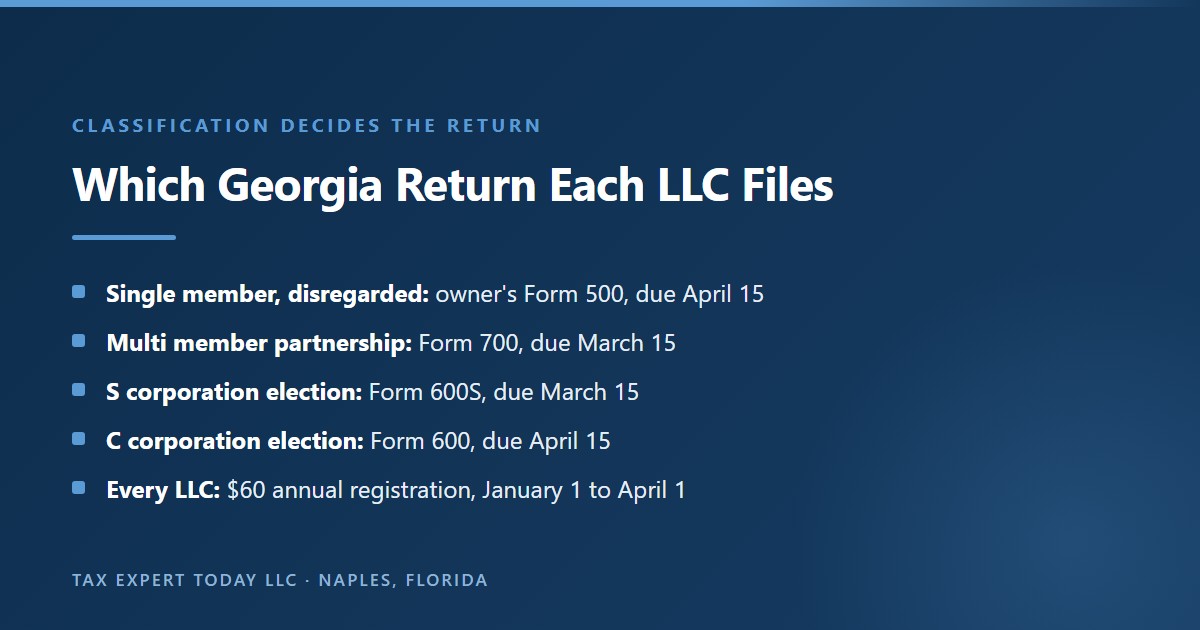
A disregarded single member LLC files no separate Georgia income tax return; its activity goes on the owner’s Form 500, Form 600, or Form 700. A partnership LLC files Form 700. An S corporation LLC files Form 600S, and a C corporation LLC files Form 600. Every LLC also files the Secretary of State annual registration.
- Form 500: the individual return, where an individual owner reports a disregarded LLC.
- Form 700: the partnership return for a multi member LLC.
- Form 600S: the S corporation return, which also carries the net worth tax.
- Form 600: the corporation return for an LLC taxed as a C corporation.
This is the table most owners need, and it is the one the formation services rarely draw. Each row is a separate path through Georgia LLC taxes, with its own form, due date, and set of follow on obligations.
| LLC classification | Georgia return | Calendar year due date | Net worth tax? | Detailed guide |
|---|---|---|---|---|
| Single member, owned by an individual | Owner’s Form 500 (Schedule C, E, or F income flows through federal adjusted gross income) | April 15 | No | This article |
| Single member, owned by a corporation | Owner’s Form 600 or 600S, as a division | Owner’s due date | The corporate owner may owe it | This article |
| Single member, owned by a partnership | Owner’s Form 700, as a division | March 15 | No | Georgia Form 700 |
| Multi member, partnership | Form 700 | March 15 | No | Georgia Form 700 |
| Elected S corporation | Form 600S | March 15 | Yes | Georgia Form 600S |
| Elected C corporation | Form 600 | April 15 | Yes | Georgia corporate tax rate |
Two notes keep this table accurate. First, the due dates are for a calendar year business; a fiscal year LLC uses the same month count from its own year end, and a date that falls on a weekend or holiday moves to the next business day. Second, the single member rows assume the LLC has not elected corporate status. Once a single member LLC elects to be an S or C corporation, it leaves the disregarded rows and files its own return.
How Is a Single Member LLC Owned by a Georgia Resident Taxed?
A single member LLC owned by a Georgia resident individual is disregarded. Its profit or loss appears on the owner’s federal Schedule C, E, or F, flows into federal adjusted gross income, and is taxed on the owner’s Georgia Form 500 at the 2026 flat rate of 4.99 percent. The LLC files no Georgia income tax return of its own.
- Federal reporting: Schedule C for a business, Schedule E for rentals, Schedule F for farming.
- Georgia reporting: the owner’s Form 500, starting from federal adjusted gross income.
- Self employment tax: owed federally on business profit, as for a sole proprietor.
- Payroll: if the LLC has employees, it registers and reports under its own name and EIN.
The IRS describes the federal reporting on its single member LLC page: if a single member LLC does not elect to be treated as a corporation, it is a disregarded entity and its activities are reflected on the owner’s federal return, generally on Schedule C, Schedule E, or Schedule F for an individual owner. Georgia’s individual return starts from federal adjusted gross income, so the LLC profit arrives on Form 500 without a separate Georgia schedule for the LLC. For this owner, Georgia LLC taxes are simply part of the individual return.
For a Georgia resident, all of that income is Georgia income regardless of where the customers are. The owner pays Georgia tax on it at the flat rate, after the standard deduction and any Georgia adjustments. The Department of Revenue’s Important Tax Updates page confirms the 2026 flat rate of 4.99 percent and the 2026 standard deduction of $15,000 for single filers and $30,000 for married couples filing jointly.
Because no Georgia income tax is withheld from LLC profit, a resident owner normally pays Georgia estimated tax through the year. Our guide to Georgia Form 500 ES covers the thresholds and dates; the short version is that an owner whose LLC profit is not covered by withholding elsewhere should plan quarterly payments rather than wait for April. Estimated payments are where Georgia LLC taxes most often catch new owners off guard.
Disregarded does not mean invisible for every purpose. The IRS treats a single member LLC as a separate entity for employment taxes and certain excise taxes, and Georgia follows the same pattern for payroll: if the LLC has employees, the LLC registers for Georgia withholding and Georgia unemployment tax in its own name. Our articles on Georgia withholding tax and Georgia unemployment tax explain those accounts.
How Is a Single Member LLC Owned by a Nonresident Taxed in Georgia?
A nonresident who owns a disregarded Georgia LLC reports the LLC activity federally and then files Georgia Form 500 with Schedule 3, which isolates the Georgia source portion of income. Only income from Georgia sources, such as a Georgia storefront, Georgia rental property, or business conducted in Georgia, is taxed by Georgia.
- Return: Georgia Form 500 as a nonresident, with Schedule 3.
- What is taxed: Georgia source business income and income from Georgia property.
- Rate: the same 4.99 percent flat rate for 2026, applied after the Schedule 3 ratio.
- Home state: the owner also reports the income where they live, with any credit that state allows.
The IT-511 individual instruction booklet tells nonresidents with income from Georgia sources to file Form 500 and complete Schedule 3 to compute Georgia taxable income. Schedule 3 lists federal income, Georgia income, and the ratio between them, which is then applied to deductions so that the nonresident pays Georgia tax only on the Georgia share.
The question that matters most for a nonresident owner is what counts as Georgia source income. Rent from Georgia real estate is Georgia income. Profit from a business physically operating in Georgia is Georgia income. A consulting LLC owned by a Florida resident who does all the work from Naples, for clients who happen to be in Georgia, is a different fact pattern and may produce little or no Georgia source income at all. That distinction is fact specific, and it is worth settling before the first Georgia return rather than after a notice arrives. For nonresident owners, sourcing is the largest variable in Georgia LLC taxes.
Owners who moved during the year are part year residents rather than nonresidents. Our guide to the Georgia part year resident tax return explains how Schedule 3 handles the year of the move, which is often the year an owner first notices that the LLC is still a Georgia company.
What Happens When a Corporation or Partnership Owns a Single Member LLC?
When a corporation or partnership is the sole member, the LLC is reported as a division of its owner. A corporate owner includes the LLC’s activity on its Form 600 or 600S, and a partnership owner includes it on Form 700. The LLC files no separate income tax return, but a corporate owner can owe net worth tax.
- Corporate owner: LLC income, property, and receipts are part of the corporation’s Georgia return.
- Partnership owner: LLC activity flows through the partnership’s Form 700 to its partners.
- Net worth tax: the corporate owner may become subject to it if the LLC does business or owns property in Georgia.
- Credits: claimed on the owner’s return, with credit forms filed in the LLC’s name.
The federal rule is on the same IRS page: if a single member LLC is owned by a corporation or partnership, it is reflected on the owner’s return as a division of that corporation or partnership. Georgia follows the federal treatment for income tax. The Department of Revenue’s net worth tax FAQ adds the Georgia twist: the single member LLC itself is not subject to the net worth tax, but if its owner is a corporation, the corporation is subject to the net worth tax if the single member LLC does business or owns property in Georgia.
That last point matters for holding structures. An out of state corporation that owns a Georgia property through a single member LLC may assume the LLC wrapper keeps the corporation out of Georgia. For net worth tax, the Department of Revenue says it does not. The corporation may need to file the net worth portion of Form 600 or 600S, and our Georgia net worth tax guide explains how that tax is measured. Holding structures are an area where Georgia LLC taxes reach further than owners expect.
Tax credits follow the same disregarded logic. The 2025 IT-711 booklet states that if a taxpayer owns or is owned by a disregarded single member LLC, the LLC is disregarded for filing purposes, all credits are claimed on the owner’s return, and the credit forms are filed in the name of the single member LLC but included with the owner’s return.
How Are Multi Member LLCs Taxed in Georgia?
A multi member LLC without a corporate election is a partnership for Georgia income tax. It files Form 700 by the 15th day of the third month after year end, usually as an information return. Each member reports their share of income on their own Georgia return, unless the LLC elects to pay Georgia tax at the entity level.
- Filing trigger: doing business in Georgia, owning Georgia property, having Georgia source income, or having members domiciled in Georgia.
- Return: Form 700, the Georgia counterpart of federal Form 1065.
- Who pays: the members, through their own returns, in most years.
- Nonresident members: 4 percent withholding, a composite return, or the entity level election.
The IT-711 booklet lists the filing requirement: a partnership, limited liability company, syndicate, group, pool, joint venture, or unincorporated organization that is engaged in business or owns property in Georgia, has members domiciled in Georgia, or has income from Georgia sources, and is required to file federal Form 1065, must file Georgia Form 700. The Department of Revenue’s Taxes for Partnerships page adds that Form 700 is an information return when the partnership does not elect to pay at the entity level, and that this also applies to an LLC treated as a partnership for federal income tax purposes.
The domicile trigger surprises some owners. An LLC with no Georgia operations at all must still file Form 700 if one of its members lives in Georgia, because the return is how the Georgia member’s share is documented. The reverse is also true: an LLC run from Georgia must file even if every member lives elsewhere.
Form 700 itself, with its schedules, the receipts factor that sources income to Georgia, the extension rules, and the depreciation differences from the federal return, is explained in our Georgia Form 700 guide. For Georgia LLC taxes, the point to carry forward is that the partnership path puts the tax on the members, which is why the nonresident member rules and the entity level election matter so much.
Is a Georgia LLC Owned by Spouses a Partnership?
Generally yes. Georgia is not a community property state, so the federal community property exception that lets spouses treat a jointly owned LLC as disregarded does not apply. A Georgia LLC owned by two spouses defaults to a partnership and files Form 700, unless it elects to be taxed as a corporation.
- Default: two members means a partnership, even if the members are married to each other.
- Community property exception: available only in community property states, which Georgia is not.
- Filing result: federal Form 1065 and Georgia Form 700, with a schedule for each spouse.
- Alternative: one spouse as sole member, which changes ownership as well as tax filing.
The IRS single member LLC page describes Rev. Proc. 2002-69, which lets an entity owned solely by spouses as community property under state law be treated as either a disregarded entity or a partnership. That relief is tied to community property law. Georgia property law is not community property, so a Georgia couple who form an LLC together and each hold a membership interest are two members, and the federal default for two members is a partnership.
Couples sometimes discover this only when the first federal return is due and a preparer asks for a Form 1065. The fix is not to file as a sole proprietor and hope; it is to file the partnership return, or to change the ownership so that only one spouse is a member, with legal advice about what that change means outside the tax return. Each choice has property, liability, and estate planning consequences that a tax return does not capture. The tax return should follow the ownership, not the other way around, and Georgia LLC taxes follow the federal result.
What Is the Georgia Income Tax Rate for LLC Income in 2026?
For 2026, Georgia taxes LLC income at a flat 4.99 percent whether it is reported by an individual member, paid by an electing partnership or S corporation at the entity level, or paid by an LLC taxed as a C corporation. For 2025 tax years the rate was 5.19 percent, and Georgia has reduced it on a rolling basis.
- Individuals, 2026: 4.99 percent flat, per the Department of Revenue.
- Corporations, 2026: 4.99 percent, per the Taxes for Business page.
- Electing partnerships, 2026: 4.99 percent, the same rate as individuals.
- 2025 returns: 5.19 percent, not prorated, with fiscal years using the rate for the year they begin.
Several pages that rank for Georgia LLC taxes still show older numbers, including a 5.19 percent corporate rate and a 5.39 percent individual rate. As of October 2026, the Department of Revenue’s Taxes for Business page describes a 4.99 percent income tax on corporations and a 4.99 percent income tax on partnerships that elect to pay at the entity level, and the Important Tax Updates page states that the individual rate has been reduced to a flat 4.99 percent.
| Tax year | Individual rate | Corporate and entity level rate | Source |
|---|---|---|---|
| 2025 | 5.19 percent | 5.19 percent | 2025 IT-511 and IT-711 booklets |
| 2026 | 4.99 percent | 4.99 percent | Georgia DOR, Taxes for Business and Important Tax Updates |
The rate is a flat rate, so there is no bracket planning inside Georgia the way there is federally. The real Georgia variables are the base, meaning which income is Georgia income and which Georgia adjustments apply, and the timing, meaning when the tax is paid and by whom. Our separate article on the Georgia corporate tax rate follows the history of the rate cuts and how a fiscal year corporation picks its rate. Using the current rate is the simplest Georgia LLC taxes check to get right.
Does a Georgia LLC Pay Self Employment Tax?
Self employment tax is federal, not Georgia. An individual who owns a disregarded LLC, or who is an active member of an LLC taxed as a partnership, generally owes federal self employment tax of 15.3 percent on net earnings from the business. Georgia has no separate self employment tax, but the federal deduction affects the Georgia starting point.
- Rate: 15.3 percent, made up of 12.4 percent Social Security and 2.9 percent Medicare.
- Threshold: net earnings from self employment of $400 or more.
- Deduction: the employer equivalent portion reduces federal adjusted gross income, which Georgia starts from.
- S corporation owners: pay payroll tax on wages instead, and not self employment tax on distributions.
The IRS self employment tax page sets out the 15.3 percent rate and the $400 filing threshold, and its single member LLC page confirms that an individual owner of a single member LLC that operates a trade or business is subject to self employment tax in the same manner as a sole proprietor. None of that is a Georgia tax, but it is often the largest tax an LLC owner pays, and it is the main reason owners ask about an S corporation election.
For Georgia LLC taxes, the effect is indirect. Half of the self employment tax is deducted in arriving at federal adjusted gross income, so it reduces the starting point of Georgia Form 500. An owner comparing Georgia LLC taxes on the disregarded path with an S corporation should therefore compare the federal payroll and self employment results first, and only then look at the smaller Georgia differences. Our self employment tax calculator shows the federal arithmetic.
What Changes When a Georgia LLC Elects S Corporation Status?
An LLC that files federal Form 2553 is taxed as an S corporation, and Georgia follows that status if every nonresident shareholder signs Form 600S-CA. The LLC then files Georgia Form 600S, pays owners wages through payroll, and becomes subject to the Georgia net worth tax, which a disregarded or partnership LLC does not owe.
- Federal form: Form 2553, which also serves as the corporate classification election for an LLC.
- Georgia return: Form 600S, due the 15th day of the third month after year end.
- New obligations: owner payroll, Georgia withholding, unemployment tax, and the net worth tax.
- Georgia condition: nonresident shareholders must consent on Form 600S-CA.
The IRS Instructions for Form 2553 explain that an entity eligible to elect to be treated as a corporation that meets the S corporation tests is treated as a corporation as of the effective date of the S election and does not need to file Form 8832. In other words, an LLC owner who wants S corporation treatment files one federal form, not two.
For Georgia LLC taxes, the company moves from the owner’s return or Form 700 to Georgia Form 600S. That return reports the S corporation’s Georgia income, which still flows to the shareholders in most years, and it carries the net worth tax for the following year on the same form. Our Form 600S guide walks through its schedules, the nonresident withholding special note, and the entity level option. Read together, that guide and this one cover Georgia LLC taxes for an S corporation LLC from election to return.
The reason owners make the election is federal: wages paid to an owner employee carry payroll tax, while distributions of remaining profit do not carry self employment tax. That benefit depends on paying a reasonable salary, which is an IRS standard, not a Georgia one. Our article on S corporation reasonable compensation explains the factors. Georgia LLC taxes add costs rather than savings: a payroll account, quarterly unemployment reports, a separate return, and the net worth tax. Whether the federal result outweighs those costs depends on profit level and facts, and it is a calculation to run before filing Form 2553, not after. Georgia LLC taxes belong in that calculation from the start.
Why Must Nonresident Owners Sign Form 600S-CA?
Georgia recognizes a federal S election only if every nonresident shareholder signs Form 600S-CA, agreeing to pay Georgia income tax on their share of the company’s Georgia taxable income. If a nonresident shareholder does not sign, the Georgia Commissioner can terminate the S election for Georgia purposes, and the LLC is taxed as a C corporation in Georgia.
- Who signs: each shareholder who is not a Georgia resident.
- What they agree to: pay Georgia income tax on their share of Georgia taxable income.
- Risk if missing: Georgia termination of the S election, with corporate level tax.
- Common trigger: an owner who moves out of Georgia after the election.
The 2025 IT-611S booklet states that Georgia law recognizes an S corporation election under the Internal Revenue Code, that any nonresident shareholders must complete Form 600S-CA for the election to be recognized, and that under O.C.G.A. Sections 48-7-21 and 48-7-27 all nonresident shareholders must execute the agreement or the S corporation election will be terminated by the Commissioner.
For LLC owners this is the trap that sits outside the federal election. A Georgia couple who formed an LLC, elected S status, and then moved to Florida are now nonresident shareholders. If no Form 600S-CA was ever filed for them, the company may have a federal S election that Georgia does not recognize. Owners in that position should review the file before the next Form 600S, because the fix is far simpler before Georgia raises it. Missing consents are among the most expensive Georgia LLC taxes problems to discover late.
What Changes When a Georgia LLC Elects C Corporation Status?
An LLC that elects C corporation status on Form 8832 becomes a Georgia corporate taxpayer. It files Form 600, pays Georgia income tax at the 2026 rate of 4.99 percent on its own Georgia taxable income, owes the net worth tax, and makes corporate estimated payments. Owners are then taxed again on dividends they receive.
- Return: Georgia Form 600, due the 15th day of the fourth month after year end.
- Tax: 4.99 percent for 2026 on Georgia taxable income, paid by the LLC.
- Net worth tax: yes, as for any corporation.
- Second layer: dividends are taxed to Georgia resident owners on Form 500.
C corporation status for an LLC is less common among small Georgia businesses, but it appears in companies raising outside capital, in some holding structures, and in businesses planning around the federal qualified small business stock rules. Georgia LLC taxes then follow the corporate rules: a Form 600 filing, the corporate rate, apportionment of income for a multistate company, and the net worth tax. The Taxes for Business page lists the 4.99 percent corporate income tax for corporations that own property, do business in Georgia, or receive income from Georgia sources, and our Georgia corporate tax rate article explains how the rate has changed.

Does a Georgia LLC Pay Net Worth Tax?
Only if it is treated as a corporation. The Department of Revenue says a disregarded LLC is not subject to the Georgia net worth tax, and there is no net worth tax on an LLC taxed as a partnership. An LLC that elects S or C corporation status files the net worth portion of Form 600S or Form 600.
- Disregarded LLC: not subject, although a corporate owner may be.
- Partnership LLC: not subject.
- S corporation LLC: subject, reported on Form 600S.
- C corporation LLC: subject, reported on Form 600.
Two Department of Revenue pages say this directly. The LLC FAQ states that an LLC is only subject to net worth tax if it is treated as a corporation for income tax purposes. The net worth tax FAQ answers both LLC questions: a disregarded single member LLC is not subject to the net worth tax, and an LLC that files as a partnership is not subject because there is no net worth tax on partnerships.
| LLC status | Net worth tax? | Where it is reported |
|---|---|---|
| Single member, owned by an individual | No | Not applicable |
| Single member, owned by a corporation | The LLC no; the corporate owner may be subject | Owner’s Form 600 or 600S |
| Partnership | No | Not applicable |
| S corporation | Yes | Form 600S |
| C corporation | Yes | Form 600 |
The net worth tax is measured on the company’s net worth from its balance sheet, and the net worth FAQ explains that a corporation doing business in Georgia, owning Georgia property, or registered with the Secretary of State must file the net worth portion of Form 600 or 600S every year, even if the income tax portion does not apply. Our Georgia net worth tax article explains the brackets and the exemption threshold. For an LLC owner weighing a corporate election, the point is that the election brings this filing with it. Net worth tax is the clearest example of Georgia LLC taxes changing with classification.
What Is the Georgia Pass Through Entity Tax Election for an LLC?
A Georgia LLC taxed as a partnership or S corporation can elect to pay Georgia income tax at the entity level instead of passing it to the owners. The election is made on the timely filed Form 700 or 600S, binds every owner for that year, and requires estimated payments. For 2026 the entity level rate is 4.99 percent.
- Who can elect: LLCs taxed as partnerships or S corporations.
- How: on the Form 700 or 600S filed by its due date, including extensions.
- Effect on owners: they subtract the electing entity’s income on their own Georgia returns.
- Nonresident owners: a composite return is not required for an electing year.
The IT-711 booklet explains that the election to pay tax at the entity level is binding on all partners, including nonresident partners, that a composite return is not required when the election is made, and that a partnership that elects must make estimated tax payments in the same manner as a corporation using Form 602-ES. The Department of Revenue’s partnership page repeats the estimated tax point.
Owners usually consider the election because the tax paid by the entity may be deductible federally, which is a federal question with its own limits. Whether it helps depends on each owner’s federal itemized deduction position, the residence of each owner, and whether nonresident owners can claim credit at home. Our Georgia pass through entity tax guide covers the election, the Schedule 1 and Schedule 3 mechanics, and the owner side adjustments; for this article the routing point is simply that only partnership and S corporation LLCs can make it. A disregarded single member LLC has no Georgia return on which to make the election. The election is a Georgia LLC taxes decision that only some LLCs can make.
How Does Georgia Tax Nonresident Members of an LLC?
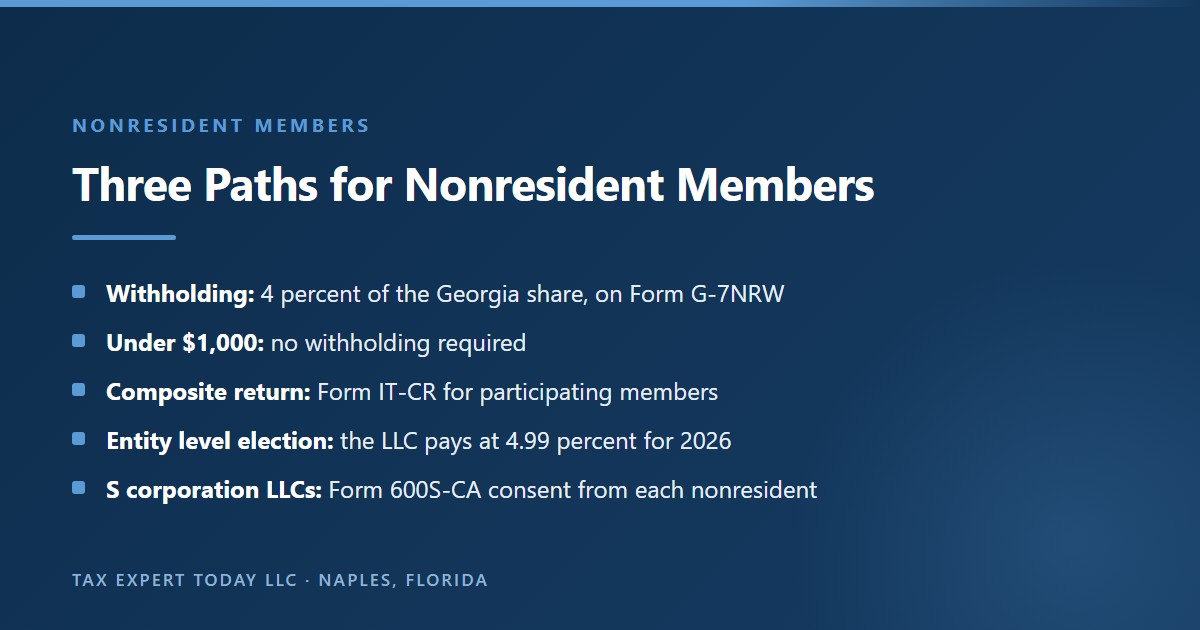
A Georgia LLC taxed as a partnership or S corporation must withhold 4 percent on a nonresident member’s share of Georgia taxable income, unless the share is under $1,000, an exemption applies, the LLC files a composite return, or the LLC makes the entity level election. Withholding is reported on Form G-7NRW and credited on the member’s Form 500.
- Rate: 4 percent of the nonresident member’s Georgia share, under O.C.G.A. Section 48-7-129.
- Floor: no withholding if the annual Georgia share is less than $1,000.
- Alternatives: the composite return on Form IT-CR, or the entity level election.
- Member credit: reported on Form G2-A and entered on Form 500.
The IT-711 booklet states the rule: a partnership that owns property or does business in Georgia is required by O.C.G.A. Section 48-7-129 to withhold on the annual partner’s share of taxable income sourced to Georgia, the withholding tax rate is 4 percent, and withholding is not required if that share is less than $1,000. It also notes exemptions under Regulation 560-7-8-.34 and Form NRW-Exemption, and that the partnership may file a composite return, Form IT-CR, for its nonresident partners as an alternative. The Department of Revenue’s G-7NRW page describes that form as the return partnerships, S corporations, and LLCs use to pay the withholding.
| Path for a nonresident member | What the LLC does | What the member does | Detailed guide |
|---|---|---|---|
| Withholding | Withholds 4 percent of the Georgia share and files G-7NRW | Files Form 500 and claims the withholding | This article |
| Under $1,000 share | No withholding required | Still evaluates whether a Georgia return is required | This article |
| Composite return | Files Form IT-CR for participating members | Usually no separate Georgia return for that income | Georgia composite return |
| Entity level election | Pays Georgia tax at 4.99 percent for 2026 | Adjusts the income off their own Georgia return | Georgia pass through entity tax |
A disregarded single member LLC sits outside this table because it has no members to withhold for; its nonresident owner simply files Form 500 with Schedule 3 as described earlier. The withholding rule matters once a second member is added, and it is one of the first questions to ask when a Georgia LLC admits an out of state investor or when an existing member moves away. Nonresident members are where Georgia LLC taxes most often require action by the company itself.
How Do Forms 8832 and 2553 Control the Timing of an LLC Tax Classification?
A Form 8832 election generally cannot take effect more than 75 days before it is filed or more than 12 months after. A Form 2553 S election is due no more than 2 months and 15 days after the start of the tax year it is to cover, or during the prior year. Georgia follows the federal date.
- Form 8832 window: up to 75 days back and 12 months forward from filing.
- Form 2553 deadline: 2 months and 15 days into the year, or any time in the prior year.
- Change limit: a classification change generally cannot be followed by another within 60 months.
- Georgia effect: the Georgia return type changes on the federal effective date.
The IRS LLC page and Form 8832 state that an election specifying an entity’s classification cannot take effect more than 75 days before the date it is filed, nor later than 12 months after. Form 8832 also asks whether the entity filed an election with an effective date within the last 60 months, which reflects the general rule that an eligible entity that changes its classification cannot change again for 60 months, subject to limited exceptions. The Instructions for Form 2553 set the S election deadline.
| Federal election | Purpose for an LLC | Timing rule | Georgia return that follows |
|---|---|---|---|
| None (default) | Disregarded or partnership | Applies automatically | Owner’s return or Form 700 |
| Form 8832, corporation | Taxed as a C corporation | Effective up to 75 days before filing, no later than 12 months after | Form 600 |
| Form 2553 | Taxed as an S corporation | Within 2 months and 15 days of the year it covers, or during the prior year | Form 600S, plus 600S-CA for nonresidents |
A mid year effective date produces a short year. An LLC that is disregarded until April 1 and an S corporation afterward reports the first three months on the owner’s return and the rest on Form 600S, with a matching split in Georgia. Planning the effective date to coincide with the start of a year avoids that extra layer, but the date is a federal decision with federal consequences, and it should be made with the federal return in view. Timing the effective date is a federal choice with Georgia LLC taxes consequences.
What If an LLC Missed Its S Corporation or Classification Election Deadline?
Federal late election relief is often available. Rev. Proc. 2013-30 allows a late S corporation election, and a late combined classification election, if Form 2553 is filed within 3 years and 75 days of the intended effective date and the other conditions are met. Rev. Proc. 2009-41 provides similar relief for a late Form 8832.
- Late S election: file Form 2553 marked as filed pursuant to Rev. Proc. 2013-30.
- Late 8832: relief under Rev. Proc. 2009-41, generally within 3 years and 75 days.
- Conditions: reasonable cause and consistent reporting are central to both.
- Georgia: follows the federal result once relief is granted, and may need amended returns.
The Form 2553 instructions describe relief for late S corporation elections and for late S corporation and entity classification elections for the same entity, and they require the words “FILED PURSUANT TO REV. PROC. 2013-30” at the top of the late form. The entity must have intended to be an S corporation as of the requested date, and the form must be filed within 3 years and 75 days of that date. Form 8832 refers to Rev. Proc. 2009-41 for late classification relief on a similar 3 years and 75 days window.
Georgia reads the federal classification, so once federal relief is granted, the filings for Georgia LLC taxes should match it. If the LLC already filed Georgia returns under a different classification for the years involved, the Georgia returns may need to be amended. Our guide to the Georgia amended tax return covers individual amendments, and the Form 700 and Form 600S guides cover the entity returns. Late election relief is a federal request with federal risk, so the decision to seek it should be made carefully.
Can a Georgia LLC Change Its Tax Classification Later?
Yes. An LLC can move from disregarded or partnership status to S or C corporation status by filing the federal election, and an S corporation LLC can revoke its election. Each change has federal consequences, can create a deemed liquidation or contribution, and generally starts a 60 month period before another classification change.
- Into corporate status: treated federally as a contribution of the LLC’s assets to a corporation.
- Out of corporate status: treated as a liquidation, which can trigger tax on appreciated assets.
- Revoking S status: generally bars a new S election for five years without IRS consent.
- Georgia: changes the return type, the net worth tax position, and the owner reporting.
Form 8832 points to Regulations section 301.7701-3(g) for the federal consequences of elective changes. Moving into corporate status is usually treated as if the LLC contributed its assets to a new corporation, which is often tax free. Moving out of corporate status is treated as a liquidation, which can be costly when assets have appreciated. These are federal rules, but Georgia follows the federal income result, so a gain recognized federally on a liquidation generally becomes Georgia income as well.
For Georgia LLC taxes, a classification change also changes the paperwork. The first year after a change usually involves a final return on the old path and a first return on the new one, a change in net worth tax status, and new or closed payroll accounts. A short checklist at the time of the change prevents the most common gap, which is a Georgia return that never gets filed because nobody realized the return type changed. Georgia LLC taxes in a change year deserve their own review.
When Are Georgia LLC Tax Returns Due?
For calendar year filers, Form 700 and Form 600S are due March 15, Form 600 is due April 15, and an individual owner’s Form 500 is due April 15. The Secretary of State annual registration is due between January 1 and April 1. Dates that fall on a weekend or holiday move to the next business day.
- March 15: Form 700 for partnership LLCs and Form 600S for S corporation LLCs.
- April 1: the last day of the annual registration window.
- April 15: Form 600 for C corporation LLCs and Form 500 for individual owners.
- Quarterly: estimated tax, withholding, and unemployment reports where they apply.
| Filing | Who files | Calendar year due date | Extension |
|---|---|---|---|
| Form 700 | Partnership LLC | March 15 | Federal extension attached, with the Extension box checked |
| Form 600S | S corporation LLC | March 15 | Seven months with the federal automatic extension |
| Form 600 | C corporation LLC | April 15 | Seven months with the federal automatic extension |
| Form 500 | Individual owners | April 15 | Federal extension or Form IT-303 |
| Annual registration | Every LLC, with the Secretary of State | January 1 to April 1 | None; the window is fixed |
The IT-711 booklet sets Form 700 at the 15th day of the third month after the close of the tax year and notes the weekend and holiday rule. The IT-611S booklet notes that corporate taxpayers are granted seven months to file their Georgia return if they receive the automatic six month federal extension. An extension to file is not an extension to pay; the IT-711 booklet states that a taxpayer with an extension must pay Georgia tax by the original due date using Form IT-560C. Our Georgia Form IT-303 guide covers the extension mechanics for individuals and entities.
Is the Georgia LLC Annual Registration a Tax?
No. The annual registration is a Secretary of State filing that keeps the LLC in good standing, not a tax. Every Georgia LLC files it between January 1 and April 1 each year, whatever its tax classification, and the fee is $60, made up of a $50 filing fee and a $10 service charge.
- Window: January 1 through April 1 of each calendar year.
- Fee: $60, a $50 filing fee plus a $10 service charge.
- First filing: due in the window of the year after the LLC was formed.
- Advance filing: allowed for up to three calendar years ahead.
The Secretary of State’s registration guide states that each LLC must file an annual registration between January 1 and April 1 of each calendar year, that the fee is $60.00 ($50 filing fee plus $10 service charge), that the initial annual registration is due in the January 1 to April 1 window of the year following the year of formation, and that an LLC may file for up to three calendar years in advance. The same filing is used to update the principal office address and the registered agent.
Several pages that rank for Georgia LLC taxes describe this fee as an LLC tax. It is not one. It is a state filing fee that does not depend on income, it is paid to the Secretary of State rather than the Department of Revenue, and it is due even when the LLC has no income at all. The distinction matters because owners sometimes assume that paying it settles their Georgia LLC taxes, when in fact it says nothing about the income tax return the LLC or its owner must file.
For completeness, the same Secretary of State guide lists the fee to form a domestic LLC online as $110, a $100 filing fee plus a $10 service charge, with optional expedited processing for additional fees. That is a one time formation cost, not an annual obligation.
What Happens if a Georgia LLC Misses Its Annual Registration?
An LLC that does not file its annual registration is subject to administrative dissolution by the Secretary of State. A dissolved LLC can be reinstated within five years of the dissolution date for a $260 fee, made up of a $250 filing fee and a $10 service charge. Dissolution does not end the tax filing obligations for income already earned.
- Consequence: administrative dissolution of the LLC.
- Reinstatement window: within five years of the effective date of dissolution.
- Reinstatement fee: $260, a $250 filing fee plus a $10 service charge.
- Tax side: returns and payments for the years the LLC operated are still due.
The Secretary of State guide states each of these points. The practical problem is that administrative dissolution often happens quietly, when the registered agent or principal office address on file is out of date and reminders go nowhere. Owners who moved to Florida are especially exposed, because the LLC’s Georgia address may be a property they sold years ago. Checking the LLC’s status on the Secretary of State site once a year, and keeping the registered agent current, prevents most of these cases.
Dissolution and tax status are separate tracks. A dissolved LLC that continued to operate still produced income that belongs on a Georgia return, and the Department of Revenue does not stop expecting Form 700 or Form 600S because the Secretary of State records changed. Reinstatement restores good standing; it does not file missed tax returns. Good standing and Georgia LLC taxes are tracked separately.
Which Georgia Tax Accounts Does an LLC Register For?
The accounts depend on what the business does, not on the LLC label. An LLC with employees registers for Georgia income tax withholding with the Department of Revenue and for unemployment tax with the Department of Labor. An LLC that sells taxable goods registers for sales and use tax. Electing entities also make estimated payments.
- Employees: Georgia withholding through the Georgia Tax Center and unemployment tax with the Department of Labor.
- Taxable sales: a sales and use tax account, with returns on the schedule the Department assigns.
- Purchases without tax: use tax on taxable items bought from out of state sellers.
- Nonresident members: a withholding account for Form G-7NRW where withholding applies.
This is where a disregarded LLC stops being invisible. Even when the LLC files no income tax return of its own, it is the employer, the seller, and the buyer for these taxes. The IRS single member LLC page makes the same point federally: a disregarded LLC is a separate entity for employment taxes and certain excise taxes and must use its own name and EIN for them.
Each account has its own article on this site. Our guides to Georgia withholding tax, Georgia unemployment tax, Georgia use tax, and the Georgia sales tax exemption certificate explain registration, filing frequency, and the common errors. For Georgia LLC taxes as a whole, the useful habit is a one page list of every account the LLC holds, with the agency, the account number, the filing frequency, and who files it. That list is the operational side of Georgia LLC taxes.
Does a Georgia LLC Need Its Own EIN?
A partnership or corporate LLC always needs an EIN. A disregarded single member LLC needs one if it has employees or certain excise tax obligations, and many obtain one anyway for banking or state registrations. For income tax reporting, a disregarded LLC uses its owner’s taxpayer identification number.
- Partnership and corporate LLCs: an EIN is required to file their own returns.
- Disregarded LLC with employees: an EIN is required for payroll.
- Disregarded LLC without employees: may use the owner’s SSN or EIN for income tax.
- Form W-9: a disregarded LLC gives the owner’s number, not the LLC’s EIN.
The IRS single member LLC page explains that a disregarded LLC generally must use the owner’s SSN or EIN for information returns and income tax reporting, that a disregarded LLC must use its own name and EIN for employment taxes, and that an LLC can obtain an EIN for a bank account or a state requirement even when it is disregarded. Georgia payroll and sales tax registrations generally ask for the federal EIN, so most operating LLCs end up with one.
A frequent source of mismatched notices is a disregarded LLC that gives its own EIN on a Form W-9, so that a Form 1099 is issued under a number with no income tax return behind it. Using the owner’s number on the W-9, as the IRS instructs, keeps the information returns matched to the return that actually reports the income. Small identification errors like this create many of the notices we see on Georgia LLC taxes.
How Do Georgia LLC Owners Make Estimated Tax Payments?
Owners of disregarded and pass through LLCs pay Georgia estimated tax on Form 500 ES when their income is not covered by withholding. An LLC taxed as a corporation, or a partnership or S corporation that elects to pay at the entity level, pays corporate style estimated tax on Form 602 ES once its expected Georgia net income exceeds $25,000.
- Owners: Form 500 ES, generally due April 15, June 15, September 15, and January 15.
- Electing entities: Form 602 ES, in the same manner as a corporation.
- Threshold for entities: net income reasonably expected to exceed $25,000.
- Underpayment: computed on Form 500 UET for individuals.
The IT-511 booklet requires estimated tax from an individual who reasonably expects gross income exceeding the exemptions, estimated deductions, and $1,000 of income not subject to withholding, and sets April 15 as the first due date for most taxpayers. The IT-711 booklet states that a partnership electing to pay at the entity level must make estimated payments in the same manner as a corporation using Form 602 ES, and that a partnership subject to Georgia tax must pay estimated tax if its net income can reasonably be expected to exceed $25,000.
Our Georgia Form 500 ES article covers the safe harbors and the annualized method for owners whose LLC income arrives unevenly. The point for LLC owners is that switching classification switches the payment system: a disregarded owner pays through Form 500 ES, while the same business as an electing S corporation pays through Form 602 ES at the entity level.
How Are Georgia Tax Credits Claimed When an LLC Is Disregarded?
Credits earned by a disregarded single member LLC are claimed on the owner’s Georgia return. The Department of Revenue instructs that the credit forms be filed in the name of the single member LLC but included with the owner’s return. Partnership and S corporation LLCs generally pass credits to the owners through the entity return.
- Disregarded LLC: credits go on the owner’s Form 500, 600, 600S, or 700.
- Credit forms: filed in the LLC’s name and attached to the owner’s return.
- Pass through LLC: credits flow to members, subject to the credit’s own rules.
- E filing: returns that generate or claim a Series 100 credit must be filed electronically.
Both the IT-511 and IT-711 booklets carry the same disregarded single member LLC credit instruction, and the IT-711 booklet notes that a return must be filed electronically if it generates, allocates, claims, or uses a Series 100 credit. Our articles on the Georgia Quality Jobs Tax Credit and the Georgia R&D tax credit explain two of the business credits most often claimed through LLCs. Credits are often overlooked in Georgia LLC taxes for disregarded companies.
What Penalties and Interest Apply to Late Georgia LLC Taxes?
Georgia charges a late payment penalty of one half of one percent per month, up to 25 percent, plus interest, on tax not paid by the original due date, even when an extension was granted. Separate penalties apply to late filing and to underpaid estimated tax, and the Secretary of State has its own consequence for a missed annual registration.
- Late payment: one half of one percent per month, up to 25 percent, plus interest.
- Extensions: extend the filing date only; the payment date does not move.
- Form 700 extension box: failing to check it can make a timely extended return look late.
- Annual registration: administrative dissolution rather than a monetary penalty.
The IT-711 booklet states that if tax is not paid by the statutory due date, a late payment penalty of one half of one percent per month, up to 25 percent, and interest accrue until the tax is paid, regardless of an extension, and that the Extension box on Form 700 must be checked when a federal or Georgia extension was granted. Our Georgia Department of Revenue payment plan guide explains the options when a balance cannot be paid at once.
For partnership LLCs, the late payment penalty usually lands on the owners rather than the LLC, because the owners pay the tax. For electing entities and corporate LLCs, it lands on the LLC. That difference is worth remembering when an entity level election is made late in a year: the election moves the payment obligation, and with it the penalty exposure, onto the company. Knowing who carries the penalty is part of managing Georgia LLC taxes.
What Happens to Georgia LLC Taxes After an IRS Audit?
Georgia requires taxpayers to report federal changes within 180 days of the final determination date. For a partnership LLC under the federal centralized audit regime, the Georgia booklets tie the date to the federal filing or adjustment. An LLC or owner whose federal income changes usually needs an amended Georgia return as well.
- Deadline: 180 days from the federal final determination date.
- Partnership audits: the date can be the filing date of an amended return or adjustment request under Section 6225(c).
- Who reports: the entity, the owners, or both, depending on classification and elections.
- Georgia audits: handled separately by the Department of Revenue.
The 2025 IT-611S booklet states that taxpayers must report federal changes resulting from a federal audit within 180 days of the final determination date, and that when the changes come from an amended federal return, a refund claim, an administrative adjustment request, or a similar filing under Section 6225(c), the final determination date is the date of that filing. Our Form 700 guide covers the partnership audit elections Georgia offers, and our Georgia Tax Court article explains where Georgia disputes go. An IRS change rarely stays federal; it usually becomes a Georgia LLC taxes question as well.
How Is a Georgia LLC That Owns Rental Property Taxed?
A rental LLC follows the same classification rules as any other Georgia LLC. A disregarded rental LLC is reported on the owner’s federal Schedule E and Georgia Form 500. A multi member rental LLC files Form 700. Rent from Georgia real estate is Georgia source income, so nonresident owners generally owe Georgia tax on it.
- Disregarded rental LLC: Schedule E income flows to the owner’s Form 500.
- Multi member rental LLC: Form 700, with nonresident member withholding where it applies.
- Nonresident owners: Georgia rent is Georgia source income on Schedule 3.
- Property tax: a separate county matter that does not change the income tax analysis.
Rental property is one of the most common reasons a Florida resident has Georgia LLC taxes at all. A Georgia house or small commercial building held in a single member LLC produces Schedule E income for the owner, and because the property is in Georgia, that income is Georgia source income even when the owner lives in Naples. The owner files a nonresident Form 500 with Schedule 3 to report it.
When two or more people hold the rental through an LLC, the LLC files Form 700 and the nonresident member rules apply. Rental LLCs are often family entities, with parents and adult children in different states, so the residence list in the checklist below tends to matter more for rentals than for operating businesses. The sale of the property raises a separate set of questions, which our Georgia capital gains tax guide covers.
Holding a rental in an LLC does not change the federal passive activity rules, the depreciation rules, or the treatment of losses, and Georgia starts from the federal result. What the LLC changes is the legal wrapper and, for a multi member LLC, the return that reports the income. Owners who expect the LLC itself to change their income tax should look at the classification table near the top of this guide; the LLC label alone does not. For rental owners, Georgia LLC taxes are mostly a sourcing and filing question.
How Does a Multistate LLC Decide How Much Income Is Georgia Income?
A partnership LLC with business in several states apportions its business income to Georgia using a single gross receipts factor: Georgia receipts divided by total receipts everywhere. Some income, such as rent from real estate held purely for investment, is allocated directly rather than apportioned. The result sets each member’s Georgia share.
- Apportionment: one factor, the ratio of Georgia gross receipts to gross receipts everywhere.
- Allocation: investment interest and investment rents are allocated, not apportioned.
- Section 179: not deducted in computing the partnership’s Georgia income; members may deduct it on their own returns.
- Corporate LLCs: apportion under the corporate rules on Form 600 or 600S.
The IT-711 booklet describes the one factor gross receipts formula and the sourcing rules for receipts, and it explains that rentals from real estate held purely for investment and not used in the business, along with interest on investment bonds and other intangible investment income, are not subject to apportionment. It also states that expenses subject to further limitation, such as the Section 179 deduction and charitable contributions, are not deductible in computing total income for Georgia purposes at the partnership level, although they may be deductible on the partner’s own return.
For Georgia LLC taxes, apportionment is what turns a multistate company’s income into a Georgia number. A Georgia LLC that sells mostly to customers in other states may have a small Georgia share of its business income, while an out of state LLC with a large Georgia customer base may have a large one. The receipts factor, not the state of formation, controls the answer. Our Form 700 guide walks through the schedules where the factor is computed.
Which Federal Deductions Matter Most to Georgia LLC Owners?
Because Georgia starts from federal adjusted gross income, federal deductions that reduce it also reduce Georgia LLC taxes for individual owners. The deduction for half of self employment tax, the self employed health insurance deduction, and retirement plan contributions are common examples. Georgia then applies its own additions and subtractions.
- Half of self employment tax: reduces federal adjusted gross income for disregarded and partnership owners.
- Self employed health insurance: deductible federally within limits, with S corporation owners following special rules.
- Retirement contributions: plans funded through the business can lower federal adjusted gross income.
- Accountable plans: reimbursements for S corporation owner employees that are not wages.
These are federal rules, and the details belong in federal guides. Our articles on the self employed health insurance deduction and on an accountable plan for S corporation owners explain two that LLC owners ask about most. The Georgia point is narrower: whatever lowers federal adjusted gross income generally lowers the Georgia starting point, and Georgia then makes its own adjustments on Form 500 Schedule 1.
For LLC owners comparing classifications, these deductions also behave differently by path. A disregarded owner deducts half of self employment tax, while an S corporation owner instead has a salary on which the company pays the employer share of payroll tax. Health insurance and retirement plan rules also change with the election. Running the comparison on the federal return first, and then carrying it to Georgia, keeps the Georgia numbers honest. Federal deductions are often the largest lever on Georgia LLC taxes for individual owners.
How Are Florida Owners of a Georgia LLC Taxed?
Florida has no personal income tax, so a Florida resident who owns a Georgia LLC generally pays income tax only to Georgia on the LLC’s Georgia source income, through a nonresident Form 500, withholding, a composite return, or the entity level election. Florida’s corporate income tax can apply if the LLC is taxed as a C corporation.
- Disregarded LLC: nonresident Form 500 with Schedule 3 for Georgia source income.
- Partnership or S corporation LLC: withholding, composite filing, or the entity level election.
- No home state credit: Florida has no individual income tax to offset Georgia tax against.
- C corporation LLC: Georgia corporate tax, and possibly Florida corporate tax.
For many of our clients, this is the core of Georgia LLC taxes. A Florida resident who owns Georgia rental property through an LLC, or who kept a Georgia operating company after moving south, owes Georgia tax on the Georgia income and nothing to Florida on that income at the individual level. That makes the Georgia tax a true cost, with no home state credit to soften it, and it makes the nonresident paths in the earlier table worth comparing carefully.
A Florida owner who formed an LLC in Florida that operates in Georgia faces a parallel question with the Secretary of State: a foreign LLC doing business in Georgia must register with the Secretary of State under the foreign entity procedure. The tax rules above apply in the same way whether the LLC was formed in Georgia or registered as a foreign LLC; the Department of Revenue’s LLC FAQ applies its classification rule to each limited liability company and foreign limited liability company alike.
Owners who moved from Georgia to Florida mid year should also look at their own residency change, since the year of the move is a part year return in Georgia. Our guide to the Georgia part year resident tax return explains how that year is split, and our Georgia capital gains tax article covers the sale of Georgia property held through an LLC. Residency changes are the most common trigger for a fresh look at Georgia LLC taxes.
What Happens to Georgia LLC Taxes When the LLC Closes?
Closing a Georgia LLC involves a final Georgia tax return for its classification, closing its payroll and sales tax accounts, and filing articles of dissolution with the Secretary of State. A partnership or corporate LLC marks its last Form 700, 600S, or 600 as final, and a disregarded LLC simply stops appearing on the owner’s return.
- Final income tax return: on the LLC’s own form, or on the owner’s return if disregarded.
- Payroll accounts: final withholding and unemployment reports, then closure.
- Sales and use tax: a final return and account closure.
- Secretary of State: dissolution filings, so the annual registration stops coming due.
The order matters. Dissolving with the Secretary of State without closing the Department of Revenue accounts leaves open accounts that may continue to generate notices for missing returns. Closing tax accounts without dissolving leaves an LLC that still owes annual registrations. Our article on Georgia withholding tax covers closing a withholding account, and the Form 600S and Form 700 guides cover final entity returns.
Liquidating distributions can also produce tax. A partnership LLC that distributes appreciated property, or a corporate LLC that liquidates, may recognize gain federally, and Georgia generally follows that result. Planning the final year with the federal return in view avoids a final Georgia return that reports gain nobody expected. Closing an LLC is the last chapter of its Georgia LLC taxes, and it is worth planning.
Georgia LLC Taxes Example: Two Members, One in Florida
In this hypothetical, a two member Georgia LLC taxed as a partnership earns $80,000 of Georgia income split evenly. The Georgia member reports $40,000 on Form 500. Unless the LLC files a composite return or elects to pay at the entity level, it withholds 4 percent, or $1,600, on the Florida member’s $40,000 share.
- Return: the LLC files Form 700 by March 15 as an information return.
- Georgia member: reports $40,000 on a resident Form 500.
- Florida member: files a nonresident Form 500 and claims the $1,600 withheld.
- Rough scale: 4.99 percent of $40,000 is $1,996 before deductions and the Schedule 3 ratio.
Assume a hypothetical LLC that owns and operates a small Georgia property business. It has two members with equal interests: one lives in Georgia and one moved to Naples, Florida. For 2026 the LLC’s Georgia income is $80,000, and it has made no elections. The facts and numbers are invented to show the mechanics; they are not drawn from any client.
| Item | Georgia member | Florida member |
|---|---|---|
| Share of Georgia income | $40,000 | $40,000 |
| Nonresident withholding by the LLC (4 percent) | Not applicable | $1,600 |
| Georgia return | Resident Form 500 | Nonresident Form 500 with Schedule 3 |
| Georgia tax at 4.99 percent on the share, before deductions | $1,996 | $1,996 |
| Home state tax on the same income | Georgia is the home state | None; Florida has no personal income tax |
The table shows the routing, not a final liability. Each member’s actual Georgia tax depends on deductions, other income, and for the Florida member the Schedule 3 ratio. The point is the structure: the LLC itself owes no Georgia income tax, the Georgia member pays through their own return, and the Florida member’s tax is partly prepaid through withholding.
Now change one fact. If the LLC files a composite return for the Florida member, it reports and pays that member’s Georgia tax on Form IT-CR instead of withholding. If the LLC instead makes the entity level election, it pays Georgia tax at 4.99 percent on the full $80,000, or $3,992 for 2026, and both members adjust their own Georgia returns to remove the income. Each path ends with a similar amount of Georgia tax in this simple example; the differences are who pays it, when it is paid, and how it interacts with each member’s federal return. That is the practical shape of Georgia LLC taxes for a mixed residence LLC.
Georgia LLC Taxes Example: A Single Owner Weighing an S Election
In this hypothetical, a Georgia resident’s single member LLC earns $120,000. As a disregarded LLC, the profit carries about $16,955 of federal self employment tax. With an S election and a $70,000 salary, payroll tax on the salary is about $10,710. Georgia income tax changes little, but Georgia filings and costs increase.
- Disregarded: Schedule C and Form 500; self employment tax on 92.35 percent of profit.
- S corporation: payroll on the salary, Form 600S, and the net worth tax filing.
- Georgia income tax: wages and pass through profit are both Georgia income at 4.99 percent.
- New Georgia costs: payroll accounts, unemployment tax on wages, and a separate return.
Assume a hypothetical Georgia resident who owns a consulting LLC with $120,000 of net profit for 2026. The numbers below show the mechanism only. They ignore the deduction for half of self employment tax, the qualified business income deduction, retirement plan effects, and other items that change the result for any actual business, and they are not a projection for any business.
| Item | Disregarded LLC | LLC taxed as an S corporation |
|---|---|---|
| Federal employment tax base | $110,820 (92.35 percent of $120,000) | $70,000 salary |
| Federal self employment or payroll tax at 15.3 percent | About $16,955 | About $10,710 (employer and employee shares combined) |
| Georgia income tax rate on the owner’s income | 4.99 percent | 4.99 percent |
| Georgia income tax return for the business | None; reported on Form 500 | Form 600S, plus Form 500 for the owner |
| Georgia net worth tax | Not subject | Subject; reported on Form 600S |
| Georgia unemployment tax | None on the owner | Owed on the owner’s wages; a new employer pays 2.70 percent on the first $9,500 |
The federal difference in this illustration is the reason owners consider the election. The Georgia column is the reason it is not automatic. The S corporation path adds a Georgia return, a net worth tax filing, a withholding account, and Georgia unemployment tax on the owner’s salary, and the salary must be reasonable under federal standards. Whether the trade works depends on profit stability, the owner’s other income, and the cost of running payroll properly. A Georgia owner who expects to move out of state also needs a plan for Form 600S-CA before the move, not after it. In short, the election changes Georgia LLC taxes in ways a federal comparison alone will miss.
What Are the Most Common Georgia LLC Tax Mistakes?
The most common Georgia LLC tax mistakes are treating the $60 annual registration as the LLC tax, filing as a sole proprietor when spouses co own the LLC, missing Form 600S-CA consents for nonresident owners, skipping nonresident withholding, using outdated rates, and letting the LLC fall into administrative dissolution after an owner moves.
- Fee versus tax: the annual registration is not an income tax filing.
- Spouse owned LLCs: a partnership by default in Georgia, not a disregarded entity.
- Missing consents: an S election Georgia may not recognize.
- Outdated figures: using 5.19 or 5.39 percent for 2026 instead of 4.99 percent.
- Stale addresses: missed annual registrations and notices after a move.
A few more errors recur often enough to list. A disregarded LLC that gives its own EIN on a Form W-9 creates information returns that do not match the owner’s return. A partnership LLC that files Form 700 on extension without checking the Extension box can look late. An owner who makes an S election and never sets up Georgia payroll leaves the company without the withholding and unemployment accounts its owner salary requires. And an LLC owned by an out of state corporation sometimes assumes the corporation has no Georgia net worth tax filing, which the Department of Revenue’s FAQ says is not correct when the LLC does business or owns property in Georgia.
Most of these mistakes come from treating the LLC as a single tax rather than a set of filings that depend on classification. A routing list, built once and checked each January, prevents most of them. Georgia LLC taxes reward a little routine.
What Should Be on a Georgia LLC Tax Checklist?
A Georgia LLC tax checklist should confirm the federal classification and its effective date, the Georgia return that follows from it, the due date and extension method, the nonresident owner path, the net worth tax position, every payroll and sales tax account, estimated payments, and the January to April annual registration.
- Classification: default, Form 8832, or Form 2553, with copies of any IRS acceptance letters.
- Return: Form 500, 700, 600S, or 600, with its due date.
- Owners: residence of each owner, Form 600S-CA consents, and withholding or composite plans.
- Accounts: withholding, unemployment, sales and use tax, and nonresident withholding.
- State filings: annual registration, registered agent, and principal office address.
| Checklist item | When to review | Why it matters |
|---|---|---|
| Federal classification and effective date | At formation and after any election | Sets the Georgia return type |
| Owner residence list | Each January and after any move | Drives withholding, composite filing, and 600S-CA consents |
| Annual registration | January 1 to April 1 | Avoids administrative dissolution |
| Estimated payments | Quarterly | Avoids underpayment charges for owners or the entity |
| Payroll and sales tax accounts | Quarterly or as assigned | Separate from income tax and required regardless of classification |
| Entity level election decision | Before the Form 700 or 600S due date | Must be made on a timely filed return and binds all owners |
| Federal audit or amended return | When it occurs | Georgia reporting is due within 180 days |
Reviewed once a year, this checklist covers most of what Georgia LLC taxes require. Owners with several LLCs can keep one row per company, so that Georgia LLC taxes for each entity are tracked on the same page and nothing depends on memory.
Georgia LLC Taxes Help in Naples & Southwest Florida
Tax Expert Today LLC works with Georgia LLC owners from its Naples, Florida office at 11983 Tamiami Trail N, Naples, FL 34110. We review classification and elections, prepare and review Georgia entity and owner returns, plan nonresident owner filings, and help owners who moved to Southwest Florida keep their Georgia company compliant.
- Classification reviews: confirming what the federal record says and what Georgia return follows.
- Nonresident owners: withholding, composite filing, and entity level election comparisons.
- Election planning: S corporation and C corporation decisions with Georgia LLC taxes included.
- Clean up: missed returns, missing consents, and account closures.
Many of our Georgia clients are Florida residents with Georgia rental or operating LLCs, or Georgia owners who now live in Naples, Bonita Springs, or Fort Myers and kept the company they built up north. Florida’s lack of a personal income tax makes Georgia LLC taxes the main state cost, which is exactly why the classification and nonresident choices deserve attention. Our office is open Monday through Friday, 10 a.m. to 5 p.m. Eastern time, and you can reach us at (239) 441-2005. Georgia clients are served nationwide from Naples, by phone and secure document exchange, without needing to visit. For the full range of our Georgia work, see our Georgia tax services page, and for Florida owners planning across both states, our Naples tax planning services page explains how we approach it.
One point of scope, stated plainly: Georgia Department of Revenue matters are state tax matters, and Secretary of State filings, operating agreements, and changes of ownership are legal and corporate matters. Our role is the tax side, meaning classification, returns, elections, and payments. When an LLC needs new organizational documents, a reinstatement strategy, or a change in membership, we work alongside the owner’s Georgia business attorney rather than in place of one. That division keeps Georgia LLC taxes and corporate housekeeping each in the right hands.
When to Engage a Professional
Consider professional help when you are choosing or changing an LLC’s tax classification, when an owner lives outside Georgia or is about to move, when the LLC has missed returns or an annual registration, when a Georgia notice arrives, or when an S election was made without nonresident consents or payroll in place.
- Elections: before filing Form 2553 or Form 8832, with Georgia LLC taxes counted.
- Moves: before an owner changes residence, so consents and withholding are ready.
- Missed filings: unfiled Form 700 or 600S years, or a dissolved LLC.
- Notices: Georgia Department of Revenue letters with response deadlines.
- Transactions: admitting a new member, selling the business, or closing the LLC.
Georgia LLC taxes are rarely complicated in any one year, but they compound when classification, owner residence, and state filings drift apart. If your LLC is in any of the situations above, talk with us before the next due date. You can learn more about our Georgia state tax services or call (239) 441-2005 for a free consultation.
This article is general educational information about Georgia LLC taxes as of October 14, 2026, based on the Georgia Department of Revenue’s LLC FAQ, Taxes for Business, Taxes for Partnerships, Important Tax Updates, and Net Worth Tax for Corporations FAQ pages, the 2025 IT-511, IT-611S, and IT-711 instruction booklets, the Georgia Secretary of State’s domestic entity registration guide, and IRS pages on LLCs, single member LLCs, self employment tax, Form 8832, and Form 2553, read on that date. It is not tax or legal advice for any specific business. All examples are hypothetical. Georgia rates, forms, and rules change; confirm current requirements with the Georgia Department of Revenue, the Secretary of State, or a qualified professional before filing.
Frequently Asked Questions About Georgia LLC Taxes
What taxes does a Georgia LLC pay?
It depends on federal classification. A disregarded or partnership LLC usually pays no Georgia income tax itself; its owners pay on their own returns at 4.99 percent for 2026. An LLC taxed as a corporation, or one that elects to pay at the entity level, pays Georgia income tax directly. Every LLC also files a $60 annual registration.
How does Georgia classify an LLC for income tax?
Georgia follows the federal check the box classification. An LLC is treated as a partnership unless it is classified otherwise for federal income tax purposes, so a single member LLC is disregarded and an LLC that elects corporate or S corporation status is treated that way in Georgia.
Does a single member LLC file a Georgia tax return?
Not a separate income tax return if it is disregarded. Its activity is reported on the owner’s return: Form 500 for an individual, Form 600 or 600S for a corporate owner, or Form 700 for a partnership owner. It still files the annual registration and any payroll or sales tax returns.
What is the Georgia income tax rate for LLC income in 2026?
A flat 4.99 percent for 2026, whether the income is taxed to an individual member, to an LLC taxed as a corporation, or to a partnership or S corporation that elects to pay at the entity level. The rate for 2025 tax years was 5.19 percent.
Does a Georgia LLC pay net worth tax?
Only if it is treated as a corporation. The Department of Revenue says a disregarded single member LLC and an LLC taxed as a partnership are not subject to net worth tax. An LLC that elects S or C corporation status reports net worth tax on Form 600S or Form 600.
When is the Georgia LLC annual registration due?
Between January 1 and April 1 of each year, starting the year after the LLC is formed. The fee is $60, a $50 filing fee plus a $10 service charge. An LLC that does not file can be administratively dissolved and reinstated within five years for $260.
Is a Georgia LLC owned by a married couple a partnership?
Generally yes. The federal rule that lets spouses treat a jointly owned LLC as disregarded applies only to community property, and Georgia is not a community property state. A Georgia LLC with both spouses as members defaults to a partnership and files Form 700 unless it elects corporate status.
Does a Georgia LLC have to withhold tax for nonresident members?
A partnership or S corporation LLC withholds 4 percent of a nonresident member’s share of Georgia taxable income under O.C.G.A. Section 48-7-129, unless the share is under $1,000, an exemption applies, the LLC files a composite return, or it elects to pay Georgia tax at the entity level.
Does Georgia recognize an LLC’s S corporation election?
Yes, if every nonresident shareholder signs Form 600S-CA agreeing to pay Georgia tax on their share of Georgia income. If a nonresident shareholder does not sign, the Commissioner can terminate the S election for Georgia purposes, and the company is taxed as a C corporation in Georgia.
I live in Naples, Florida, and own a Georgia LLC. Can you help with Georgia LLC taxes?
Yes. Tax Expert Today LLC handles state tax matters nationwide from its Naples, Florida office at 11983 Tamiami Trail N, including Georgia LLC classification reviews, Form 700 and Form 600S filings, nonresident owner planning, and catch up filings. Call (239) 441-2005 for a free consultation.
Published October 14, 2026 by Dr. Pellumb Kabashi « Back to Learning Center
Have a question this article touches on?
Tax Expert Today LLC, based in Naples, Florida and serving clients across the United States.
Schedule a Consultation (239) 441-2005