
By Dr. Pellumb Kabashi, DBA, MBA, EA, CFE, CES
Founder, Tax Expert Today LLC · Tax advisors, enrolled agents, CPAs, and attorneys · Serving clients in all 50 states
Georgia withholding tax is the Georgia income tax an employer holds back from wages and pays to the Department of Revenue. For 2026 the rate is a flat 4.99 percent after a $15,000 or $30,000 standard deduction and $5,000 per dependent, but employers kept withholding at 5.19 percent until May 11, 2026. Deposits run annual, quarterly, monthly, or semi-weekly by volume. Call (239) 441-2005 for a free consultation.
What Is Georgia Withholding Tax?
Georgia withholding tax is the state income tax an employer deducts from wages and sends to the Georgia Department of Revenue for the employee. It also covers tax withheld from pensions, lottery prizes, nonresident partnership distributions, and nonresident real estate sales. It is a prepayment of the payee’s Georgia income tax, not a separate tax.
- Who collects it: the employer or other payer, acting as withholding agent for the state.
- Who owes it in the end: the employee or payee, who claims the withholding as a credit on the Georgia return.
- Who administers it: the Georgia Department of Revenue through the Georgia Tax Center, known as GTC.
- Where the rules live: Article 5 of Chapter 7 of Title 48 of the Official Code of Georgia Annotated, beginning at O.C.G.A. 48-7-100.
The Department describes it plainly on its withholding tax page for employers: withholding is the amount held from an employee’s wages and paid directly by the employer, and it includes tax withheld from wages, nonresident distributions, lottery winnings, pension and annuity payments, and other sources of income. That breadth matters. Many business owners think of withholding as a payroll function that the payroll software handles, and for ordinary wages that is largely true. The parts that cause trouble are the parts that sit outside ordinary payroll, which is where this guide spends most of its time.
Georgia does not have a separate state unemployment tax paid by employees or a local city income tax that employers must withhold. The state unemployment insurance tax exists, but it is paid by the employer to the Georgia Department of Labor, not withheld from wages, and it is outside the scope of this article. Everything below concerns Georgia income tax withholding administered by the Department of Revenue.
A note on sources before the detail. The Department’s withholding landing page still says the withholding rate is a graduated scale. That wording predates Georgia’s move to a single flat rate and no longer matches the law. The document that controls is the 2026 Employer’s Withholding Tax Guide, revised June 2026, which states the flat rate, the tables, and the percentage method used throughout this article.
What Is the Georgia Withholding Tax Rate for 2026?
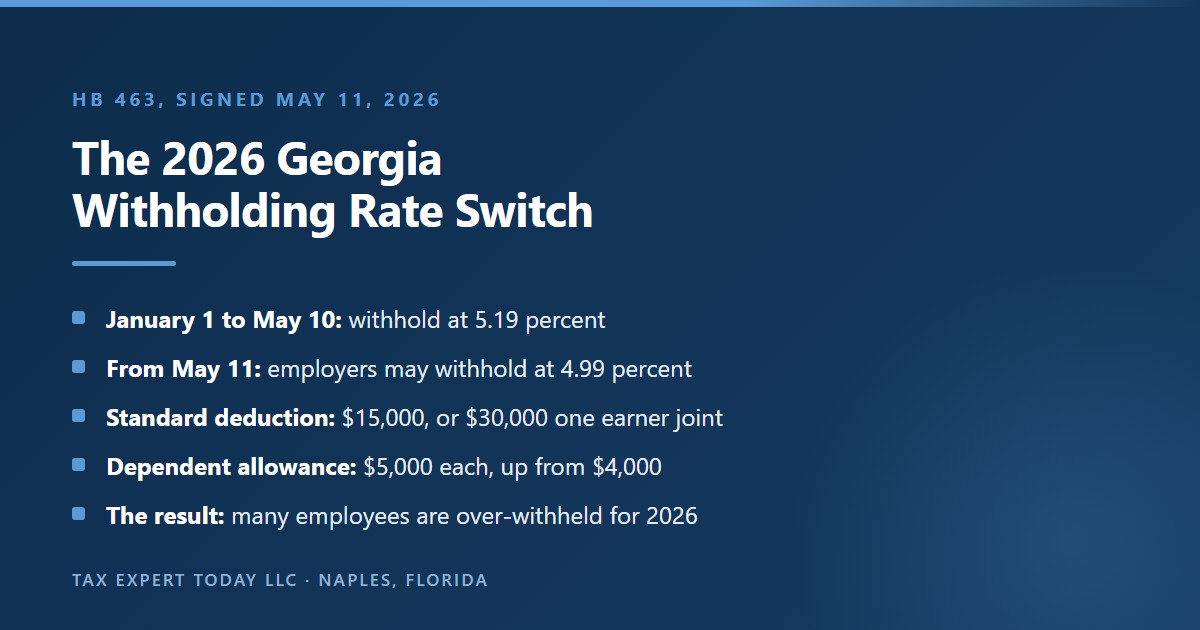
The Georgia withholding tax rate for 2026 is a flat 4.99 percent, applied after subtracting the standard deduction and $5,000 for each dependent allowance. The standard deduction is $15,000 for single, head of household, and married filing separately, and $30,000 for married filing jointly with one spouse working. Before May 11, 2026, employers withheld at 5.19 percent.
- Rate: 4.99 percent of wages after deductions, retroactive to January 1, 2026 for the income tax itself.
- Standard deduction: $15,000, or $30,000 for a married couple filing jointly where only one spouse works.
- Dependent allowance: $5,000 per allowance, up from $4,000.
- Married, both working: each spouse uses the $15,000 column so the household does not double count the joint deduction.
The Department’s Important Tax Updates page confirms the 2026 income tax changes: a flat rate of 4.99 percent and a standard deduction of $15,000 for single filers, heads of household, and married taxpayers filing separately, or $30,000 for married taxpayers filing jointly. The June 2026 Employer’s Withholding Tax Guide carries the same numbers into the withholding formula and adds the dependent allowance increase from $4,000 to $5,000.
The rate is set to keep falling. The law signed in May 2026 provides for further annual reductions toward a 3.99 percent floor in later years, so an employer should expect the withholding formula to change again. Our article on the Georgia corporate tax rate walks through that rate path in detail, because Georgia ties its corporate rate to the individual rate. For withholding purposes the practical rule is simple: use the formula in the Employer’s Withholding Tax Guide that is current on the pay date, and check the Department’s page each January.
| Item | Before the 2026 change | 2026 formula (from May 11, 2026) |
|---|---|---|
| Flat rate applied to wages after deductions | 5.19 percent | 4.99 percent |
| Standard deduction, single or head of household | $12,000 | $15,000 |
| Standard deduction, married, both spouses working or filing separately | $12,000 | $15,000 |
| Standard deduction, married filing jointly, one spouse working | $24,000 | $30,000 |
| Dependent allowance, each | $4,000 | $5,000 |
| Supplemental wages such as bonuses | 5.19 percent | 4.99 percent, if paid on or after May 11, 2026 |
The “before” column reflects the formula in use for early 2026 pay dates, as summarized in the National Finance Center payroll bulletin of July 21, 2026, which updated the Georgia formula for federal employees. The “2026 formula” column comes from Tables E and F of the Department’s June 2026 guide.
Why Did Georgia Withholding Change on May 11, 2026?
Georgia withholding changed on May 11, 2026 because that is the day HB 463 was signed. The law cut the rate to 4.99 percent retroactive to January 1, 2026, but the Department told employers to keep withholding at 5.19 percent until the signing date and allowed the new rate starting May 11, 2026.
- The tax change: retroactive to taxable years beginning on or after January 1, 2026.
- The withholding change: prospective only, starting with pay dates on or after May 11, 2026.
- No retroactive payroll fix required: the guide does not ask employers to recompute or refund earlier 2026 withholding.
- The catch-up happens on the return: the difference comes back to the employee through the 2026 Georgia Form 500.
The introduction to the June 2026 Employer’s Withholding Tax Guide explains the sequence. The rate cut and the higher standard deductions are effective upon the signature of HB 463 but retroactive to taxable years beginning on or after January 1, 2026. In the same paragraph the Department says that employers must continue to withhold at the rate of 5.19 percent before the effective date of the change and can begin withholding at the new rate of 4.99 percent starting May 11, 2026. The Governor’s office announced the signing on May 11, 2026.
The wording “can begin” matters. Payroll providers did not all switch on the same day. The Department released the revised guide in June, and the federal government’s own payroll center moved its Georgia formula effective with pay period 13 of 2026, according to its July bulletin. An employer whose software updated in late June withheld at the old formula for more pay dates than an employer that switched in May. Neither was wrong, but the employees of the late switcher will see a larger difference on their 2026 returns.
The same law made other changes that touch payroll only indirectly. Georgia did not adopt the federal exclusions for tips and overtime, but it created its own limited exclusions of up to $1,750 each, which the employer reports but does not use to reduce 2026 withholding. That rule has its own section below. The law also continued Georgia’s $10,000 limit on the state and local tax deduction for Georgia purposes, which affects itemizers but not the withholding formula, because the formula uses only the standard deduction and allowances.
Are Georgia Employees Over-Withheld for 2026?
Many Georgia employees are over-withheld for 2026 because early pay dates used the 5.19 percent rate and the smaller $12,000 or $24,000 standard deduction, while the final tax uses 4.99 percent and the larger deductions. The difference is not lost. It is credited on the 2026 Form 500 and usually increases the refund or reduces the balance due.
- Who is affected most: employees paid all year by one Georgia employer whose payroll switched late.
- What the employee does: nothing special, beyond filing the 2026 Georgia return.
- What the employer does: nothing retroactive, unless it chooses to adjust within the calendar year under O.C.G.A. 48-7-104.
- Who might still owe: people with other income, such as self-employment or investment income, where withholding never covered the tax.
Here is the arithmetic for one hypothetical employee. A single filer earns $78,000 a year, paid biweekly at $3,000 per paycheck, with no dependents and no other income. The employer’s first 2026 payday is Friday, January 2, so ten paydays fall before May 11 and sixteen fall after it, and the employer switches formulas on the first payday on or after May 11.
| Step | Old formula (10 paydays) | New formula (16 paydays) |
|---|---|---|
| Gross wages per paycheck | $3,000.00 | $3,000.00 |
| Biweekly standard deduction | $461.54 ($12,000 divided by 26) | $576.92 ($15,000 divided by 26) |
| Wages subject to withholding | $2,538.46 | $2,423.08 |
| Rate | 5.19 percent | 4.99 percent |
| Withheld per paycheck | $131.75 | $120.91 |
| Withheld in the period | $1,317.50 | $1,934.56 |
Total Georgia withholding for the year is $3,252.06. The 2026 tax on the same wages is $78,000 minus the $15,000 standard deduction, or $63,000, times 4.99 percent, which is $3,143.70. The employee has about $108 of excess withholding, which comes back as a credit on the 2026 return. If the employer did not switch until late June, the excess would be larger, roughly $10.84 for each extra paycheck at the old formula.
The amount is modest for a single paycheck earner, but it is not modest for everyone. A married employee claiming the one earner status and two dependents would see a bigger swing, because both the standard deduction and the dependent allowances rose. The mirror image also matters: an employee who expected a balance due, perhaps because of side income, may find it smaller than planned. That is useful when deciding whether a fourth quarter estimated payment is still needed, a topic covered in our guide to Georgia Form 500 ES estimated payments.
Can an employer give the money back during 2026 instead? O.C.G.A. 48-7-104 allows adjustments within the same calendar year when more or less than the correct amount was withheld, and it requires the employer to keep the employee’s receipt for any repayment. Whether early 2026 withholding at 5.19 percent counts as an overcollection at all is a fair question, because the Department told employers to withhold at that rate until May 11. We are not aware of any Department instruction asking employers to refund it through payroll, and doing so creates reconciliation work on Forms G-7 and G-1003. For most employers the cleaner path is to let the return do the work.
How Do You Calculate Georgia Withholding on a Paycheck?
To calculate Georgia withholding under the percentage method, subtract the per-period standard deduction for the employee’s G-4 status, subtract $5,000 per year for each allowance converted to the pay period, and multiply the rest by 4.99 percent. The Department also publishes wage bracket tables, which give slightly different results.
- Step one: start with taxable wages for the period, after pre-tax items such as 401(k) deferrals.
- Step two: subtract the standard deduction for the period from Table E or Table F.
- Step three: subtract the dependent allowance for the period times the allowances claimed.
- Step four: multiply by 4.99 percent, and add any extra amount the employee requested on Form G-4.
The per-period amounts come straight from Tables E and F of the June 2026 guide, which divide the annual figures by the number of pay periods. The table below reproduces the figures for the common payroll frequencies.
| Pay period | Married filing jointly, one spouse working | Single, head of household, married separate, or both working | Each dependent allowance |
|---|---|---|---|
| Weekly | $576.92 | $288.46 | $96.15 |
| Biweekly | $1,153.85 | $576.92 | $192.31 |
| Semi-monthly | $1,250.00 | $625.00 | $208.33 |
| Monthly | $2,500.00 | $1,250.00 | $416.67 |
| Quarterly | $7,500.00 | $3,750.00 | $1,250.00 |
| Annual | $30,000.00 | $15,000.00 | $5,000.00 |
A worked example shows the steps. A married employee on a semi-monthly payroll earns $4,000 per paycheck, the spouse does not work, and the employee’s Form G-4 claims two dependent allowances. Subtract the $1,250.00 standard deduction for the one earner joint status and two allowances of $208.33 each, which leaves $2,333.34. Multiply by 4.99 percent and the Georgia withholding is $116.43 per paycheck. Over 24 paychecks that is $2,794.32, which lines up with the annual tax on $96,000 less $30,000 less $10,000, or $56,000 at 4.99 percent, $2,794.40.
The wage bracket tables on pages 28 through 47 of the guide build in the same deductions but work on income ranges, so the result can differ by a few cents or dollars from the percentage method. The Department says either method is acceptable. Most payroll software uses the percentage method, which is also easier to audit when an employee asks why the figure changed.
Taxable wages for Georgia generally follow the federal definition. The guide confirms that contributions to qualified 401(k), profit sharing, and deferred compensation plans are subtracted before the calculation, because Georgia follows the federal treatment of those plans. Taxable fringe benefits are added in, the same way they are for federal income tax withholding.
How Does Form G-4 Work, and What Does Each Status Mean?
Form G-4 is the Georgia employee withholding certificate. The employee picks one of four statuses, lists dependent allowances, may claim extra allowances through a worksheet, and may request additional withholding. The employer uses the status letter to choose the correct standard deduction column and keeps the form on file.
- Status A: single, using the $15,000 standard deduction.
- Status B: married filing separately, or married filing jointly with both spouses working, each using $15,000.
- Status C: married filing jointly with only one spouse working, using $30,000.
- Status D: head of household, using $15,000.
The current Form G-4 is revision 06/03/26, and it prints the new standard deduction amounts on the form itself. Line 4 is for dependent allowances, using the federal definition of a dependent, with Georgia’s addition that an unborn child with a detectable human heartbeat qualifies as a dependent minor. Line 5 is for Georgia adjustment allowances, which require the worksheet on the form, and the worksheet divides the excess deductions by $5,000 to reach the number of extra allowances. Line 6 is for a flat additional dollar amount per paycheck.
The status B and status C distinction is where two income households get caught. The $30,000 joint deduction belongs to the household, not to each spouse. If both spouses work and each claims status C, each employer subtracts $30,000, and the household is under-withheld on $30,000 of income. The table shows the effect for a couple where each spouse earns $60,000.
| Scenario | Withheld per spouse for the year | Household total | Joint 2026 tax |
|---|---|---|---|
| Both claim status B (correct) | ($60,000 less $15,000) x 4.99% = $2,245.50 | $4,491.00 | ($120,000 less $30,000) x 4.99% = $4,491.00 |
| Both claim status C (incorrect) | ($60,000 less $30,000) x 4.99% = $1,497.00 | $2,994.00 | $4,491.00, leaving $1,497.00 due |
The figures ignore dependents and other adjustments to keep the comparison clean. The point is that the withholding error is the full value of one extra standard deduction times the rate, and it shows up as a balance due in April, sometimes with an underpayment penalty computed on Form 500 UET. Our Georgia estimated tax penalty calculator estimates that penalty, and it is worth running before assuming the withholding covered the year.
An employee may file a new G-4 as often as they wish. Under O.C.G.A. 48-7-102(c)(3), as the guide summarizes it, a new form takes effect with the first payroll period after the employer receives it and stays in effect until replaced. The employee should also file a federal Form W-4, because the two certificates do different jobs.
What Happens If an Employee Does Not Turn In a Form G-4?
If an employee does not submit Form G-4, the employer may use the federal Form W-4 when it holds enough information to compute Georgia withholding. Otherwise the employer withholds as if the employee were single with zero allowances. An employer that knows a G-4 is false must also withhold as single with zero allowances until a corrected form arrives.
- Default status: single, zero allowances, which produces the highest ordinary withholding.
- Exempt claims: honored as submitted, but the employer mails them to the Department.
- More than 14 allowances: also honored, and also mailed to the Department for review.
- Record keeping: the employer keeps every G-4 on file for at least four years.
The guide cites O.C.G.A. 48-7-102 and 48-7-102.1 and Department regulation Ga. Comp. R. & Regs. 560-7-4-.03 for these rules. Forms claiming exempt status or more than 14 allowances go to the Department’s Taxpayer Services Division at P.O. Box 105685, Atlanta, Georgia 30348-5685. The Department no longer writes back on every form it receives. It contacts the employer only when a certificate should not be honored, and until then the employer follows the form as filed.
Exempt status has two routes on the current form. Line 8(a) is for an employee who had no Georgia income tax liability last year and expects none this year, which tracks O.C.G.A. 48-7-101(g). Line 8(b) is the military spouse route under the Servicemembers Civil Relief Act, and the form requires that the employee’s state of residence and the servicemember’s state of residence be the same. An exempt G-4 remains in effect until February 15 of the following year, so employers should ask for a fresh certificate each January from anyone claiming exempt.
The phrase “honor the form unless you know it is wrong” deserves emphasis. An employer is not an auditor, and the law does not ask it to second guess ordinary claims. But an employer that actually knows the status or allowance count is false, for example because the employee’s spouse also works for the same company and both claimed status C, should not keep withholding on a form it knows to be erroneous.
Who Must Withhold Georgia Income Tax?
Any employer that pays wages to a Georgia resident, or to a nonresident for work performed in Georgia above a threshold, must withhold Georgia income tax. For nonresidents the trigger is more than 5 percent of total earned income, or more than $5,000 of wages, attributable to Georgia. Employers of every entity type are covered.
- Residents: withhold on wages for work inside or outside Georgia, unless the work state requires its own withholding.
- Nonresidents: withhold on Georgia work when the 5 percent or $5,000 test is met.
- Every employer type: individuals, corporations, LLCs, partnerships, estates, trusts, nonprofits, and governments.
- Household workers: not required for housekeepers, nannies, farm laborers, or ministers, although voluntary withholding is allowed.
The definitions come from O.C.G.A. 48-7-100 and 48-7-1, as the guide lays them out. A resident is someone who is legally a Georgia resident on December 31, lives in Georgia on a regular or permanent basis, or spent 183 days or more in Georgia during the 365 day period ending on December 31. A taxable nonresident is someone who regularly engages in activity for financial gain in Georgia during the year, which includes an employee who can attribute more than 5 percent of wages, or more than $5,000 of wages, to Georgia.
For a resident employee who works in another state, the guide says Georgia residents are subject to the withholding laws of the state where they work. If that other state does not require withholding, the employer should withhold Georgia tax. That second sentence is the one that matters most for employers outside Georgia, because several neighboring and popular remote work states, including Florida, Tennessee, and Texas, have no wage income tax and therefore no withholding requirement.
A single member LLC that is disregarded for income tax purposes still reports its own employment taxes. The guide notes that Georgia follows the federal rule, in place since wages paid in 2009, under which the disregarded LLC pays its own employment taxes and files its own reports. So the withholding account belongs to the LLC, not to the owner personally, even though the owner reports the LLC’s profit on a personal return.
Do You Withhold Georgia Tax for Remote Workers and Florida Residents?
Yes, in two common cases. A Georgia resident working remotely for an out-of-state employer usually needs Georgia withholding when the employer’s state has no income tax, such as Florida. A Florida resident who works in Georgia needs Georgia withholding once Georgia wages pass 5 percent of earned income or $5,000.
- Georgia resident, Florida employer: Florida requires no withholding, so the Georgia rule applies and the employer registers in Georgia.
- Florida resident, Georgia work days: track days and wages sourced to Georgia against the 5 percent and $5,000 tests.
- Georgia resident, work state with an income tax: withhold for the work state, and the employee claims a Georgia credit for the other state’s tax.
- Mid-year moves: change withholding when residency changes, not at year end.
The first case surprises small employers in Southwest Florida. A Naples company that hires a remote employee living in Savannah or Atlanta is paying a Georgia resident for work performed at a Georgia home office. Florida has no wage withholding, so under the rule in the guide the employer should withhold Georgia tax, which means registering for a Georgia withholding number and filing Georgia returns. Whether the company has other Georgia filing obligations, such as corporate income tax nexus from an employee located in the state, is a separate question worth reviewing at the same time, and it is one of the questions our Georgia tax services for businesses are set up to answer.
The second case runs the other way. A Florida resident who travels into Georgia for work, for example a project manager spending part of the year on Georgia job sites, becomes a taxable nonresident for withholding once Georgia sourced wages cross the thresholds. The employer needs a reasonable method of tracking Georgia work days. For the employee, the Georgia return in that case is a nonresident Form 500 with Schedule 3, and our guide to the Georgia part year resident tax return explains how the income is allocated when someone moves in or out during the year.
Severance paid after an employee has left Georgia follows a specific rule in the guide: if the person is not a Georgia resident when the payment is made, Georgia income tax withholding does not apply. If the person is a resident when paid, the payment is treated like ordinary wages. That timing rule is worth checking before a separation agreement fixes the payment date.
How Do You Register for a Georgia Withholding Number?
An employer registers for a Georgia withholding number online through the Georgia Tax Center at gtc.dor.ga.gov. The guide says the number and the assigned filing frequency arrive through GTC within about 15 minutes. An employer should register before the first payroll, because tax withheld before registration is still due on the normal schedule.
- Where: the Georgia Tax Center, which is also where returns are filed and payments made.
- When: before the first payroll that includes Georgia withholding.
- Separate accounts: nonresident distribution withholding and film loan-out withholding use different account numbers from wage withholding.
- New structure, new number: buying a business or changing the entity usually requires a new withholding account.
The Department states that tax withheld prior to receipt of a withholding account number is due in accordance with established filing requirements. In other words, a late registration does not delay the due dates; it only makes it harder to meet them. The Department’s registration page explains who needs a payroll withholding number.
A payroll company cannot register on the employer’s behalf without the employer’s information, and the guide notes that a third party payroll provider whose client has not supplied a withholding number may not simply mail in the payment. Either the client or a person holding a valid power of attorney contacts the Department to obtain the number. A provider handling more than 250 employers must pay by electronic funds transfer under O.C.G.A. 48-2-32.
Film productions are a special case. A film production company or qualified interactive entertainment production company that pays a loan-out company registers a separate withholding film account, files quarterly, and issues Form G2-FP to the loan-out company by January 31. The loan-out company, in turn, passes the credit to its workers on Form G2-FL, as the Department’s withholding instructions explain. Our article on the Georgia film tax credit covers the credit side of productions in Georgia.
Which Georgia Deposit Schedule Applies to Your Business?
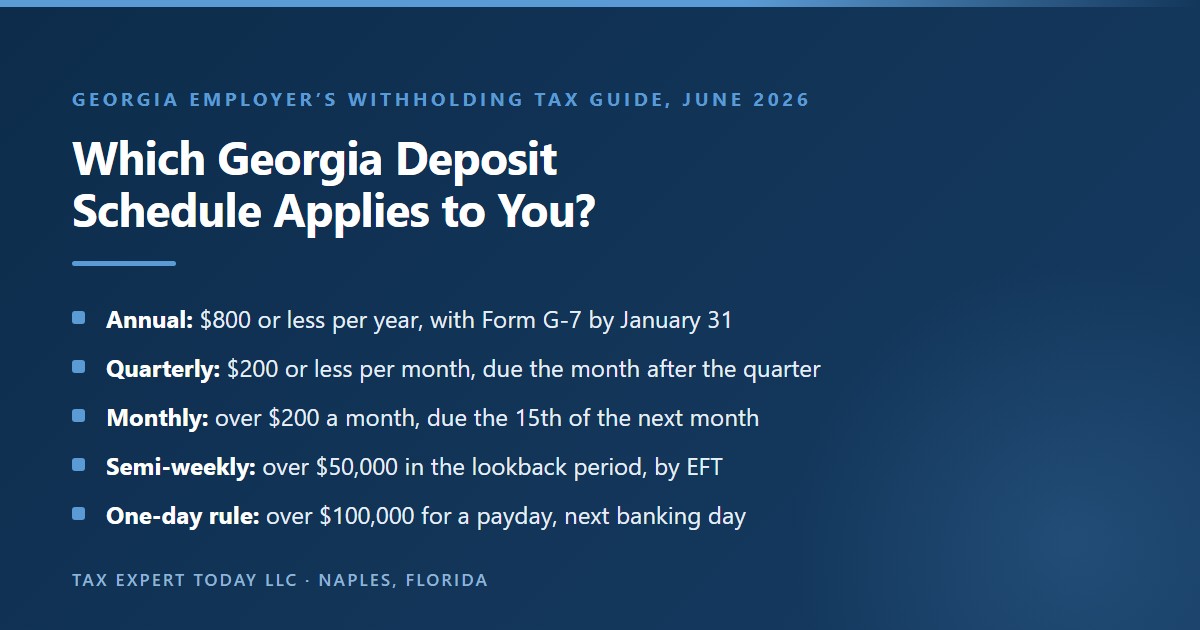
Georgia assigns one of four deposit schedules based on how much tax an employer withholds. Annual payers withhold $800 or less a year, quarterly payers $200 or less a month, monthly payers more than $200 a month, and semi-weekly payers more than $50,000 during the lookback period ending the prior June 30. A one-day rule overrides them all.
- Annual: $800 or less per year, with Form G-7 and payment by January 31, and only after a GTC request.
- Quarterly: $200 or less per month but more than $800 per year, due the last day of the month after the quarter.
- Monthly: more than $200 per month, payment by the 15th of the following month, with a quarterly G-7.
- Semi-weekly: more than $50,000 in the lookback period, paid by EFT on the Wednesday or Friday schedule.
- One-day rule: more than $100,000 for a payday is due the next banking day.
The thresholds come from O.C.G.A. 48-7-103 and the June 2026 guide. The lookback period is the 12 month period that ended the previous June 30. For the semi-weekly schedule, paydays on Wednesday, Thursday, or Friday are due the following Wednesday, and paydays on Saturday, Sunday, Monday, or Tuesday are due the following Friday, which mirrors the federal semi-weekly rule.
| Payer status | Threshold | Payment due | Return |
|---|---|---|---|
| Annual | $800 or less per year | January 31 of the following year | Form G-7 with payment |
| Quarterly | $200 or less per month, over $800 per year | Last day of the month after the quarter | Form G-7 for quarterly payers |
| Monthly | Over $200 per month, $50,000 or less in the lookback period | 15th of the following month, Form GA-V if paying by check | Form G-7 for monthly payers, quarterly |
| Semi-weekly | Over $50,000 in the lookback period | Following Wednesday or Friday, by EFT | Form G-7 with Schedule B, quarterly |
| Any payer, one-day rule | Over $100,000 for a single payday | Next banking day after the payday, by EFT | Reported on the usual G-7 |
Two details differ from what many employers expect. First, Georgia’s one-day rule runs from the payday, not from the day the liability accumulates. The guide says so directly: the due date for deposits greater than $100,000 is the banking day after the payday, not the next banking day after it has been accumulated. Second, the Department, not the employer, sets the filing status. When an employer was not in business for the whole lookback period, the guide says the status usually does not change, and the employer should confirm it in GTC rather than assume.
The lookback calculation uses the liability before any job tax credits applied against withholding. The guide gives an example: an employer that incurred $100,000 of withholding liability and applied $75,000 of job tax credits, paying only $25,000, still has a $100,000 lookback liability for purposes of its payer status. Businesses using Georgia credits against withholding, including the research credit that can offset payroll withholding, should expect to stay on the semi-weekly schedule even when little cash changes hands.
What Are the Georgia Withholding Tax Due Dates for the Rest of 2026?
For monthly payers, the September 2026 payment is due October 15, the third quarter Form G-7 is due November 2, and the December payment is due January 15, 2027. The fourth quarter G-7 and the W-2 and 1099-NEC transmittal on Form G-1003 are both due February 1, 2027, and other 1099s are due March 1, 2027.
- Weekend and holiday rule: a due date on a weekend, a Federal Reserve holiday, or a Georgia state holiday moves to the next banking day.
- Why November 2: October 31, 2026 is a Saturday, so the third quarter return moves to Monday.
- Why February 1: January 31, 2027 is a Sunday.
- Zero returns: Form G-7 is still due for a quarter with no withholding while the account is open.
These dates come from the due date tables on page 5 of the June 2026 guide and the Department’s withholding tax due dates page.
| Period | Monthly payers | Quarterly and annual payers |
|---|---|---|
| September 2026 payroll | Payment October 15, 2026 | Included in the third quarter |
| Third quarter 2026 | Form G-7 November 2, 2026 | Form G-7 and payment November 2, 2026 |
| October 2026 payroll | Payment November 16, 2026 | Included in the fourth quarter |
| November 2026 payroll | Payment December 15, 2026 | Included in the fourth quarter |
| December 2026 payroll | Payment January 15, 2027 | Included in the fourth quarter |
| Fourth quarter 2026 | Form G-7 February 1, 2027 | Form G-7 and payment February 1, 2027 |
| W-2 and 1099-NEC with Form G-1003 | February 1, 2027 | February 1, 2027 |
| All other 1099s with Form G-1003 | March 1, 2027 | March 1, 2027 |
Semi-weekly payers follow their Wednesday and Friday deposit schedule and file Form G-7 with Schedule B by the same quarterly return dates. Employees must receive their W-2s by January 31 under O.C.G.A. 48-7-105, which in 2027 means the next business day, February 1.
When Does Georgia Require Electronic Payment and Filing?
Georgia requires electronic funds transfer once the tax withheld, or required to be withheld, on a Form G-7 exceeds $500, and the requirement then applies to every later payment and return. An employer required to pay by EFT must also file its withholding returns, income statements, and refund claims electronically.
- Trigger: more than $500 on any Form G-7, then electronic for all later payments and returns.
- Refund claims: a mandated filer’s paper refund claim is treated as not filed, which can let the refund period expire.
- Series 100 credits: a withholding return claiming any series 100 tax credit must be filed electronically.
- Payment methods: ACH debit through GTC is free, and ACH credit requires Form EFT-002.
The $500 trigger is low. A small employer with a handful of employees crosses it quickly, and once it does, every return and payment after that must be electronic. The penalty for missing the payment rule is steep: 10 percent of the tax due on any otherwise timely payment that is not remitted by EFT, in addition to other penalties and interest, under O.C.G.A. 48-2-32 and 48-7-126. The penalty for failing to e-file a return that must be e-filed is the greater of $25 or 5 percent of the tax due on the return, under O.C.G.A. 48-2-44.1.
The refund rule deserves a separate warning. The guide says that failure to electronically file a refund claim results in the claim being deemed not filed for all purposes, including any statute that limits the time for filing a refund claim. An employer that overpaid years ago and mailed a paper claim may discover that, as far as the Department is concerned, no claim was ever filed and the time to file one has passed. Rejected electronic claims can be refiled at any time within the limitations period.
GTC charges nothing for ACH debit payments. Credit card, PayPal, and Venmo payments carry a processor’s convenience fee of 2.31 percent with a $1.00 minimum, according to the guide. Fedwire payments are not accepted.
What Are Forms G-7, GA-V, and G-1003?
Form G-7 is the quarterly Georgia withholding return that reports tax withheld and payments made. Form GA-V is the payment voucher used by monthly payers who pay by check. Form G-1003 is the annual transmittal that sends W-2 and 1099 information to the Department with the income statements.
- Form G-7: one version each for monthly, quarterly, and semi-weekly payers, with Schedule B for semi-weekly deposits.
- Form GA-V: not needed when no tax was withheld for the month or when the payment is electronic.
- Form G-1003: due with W-2s and 1099-NECs by January 31, and with other 1099s by the end of February.
- Form 1099-K: the Department requires it even when no Georgia tax was withheld.
Form G-7 reconciles what the employer withheld with what it paid for the quarter. Adjustments to earlier periods of the same year go on the “Adjustment to Tax” line or through an amended return, and the Department will not accept an amendment without a stated reason. Returns update to the account in one to two business days after filing in GTC.
Form G-1003 is where the year’s payroll meets the employee’s return. The Department matches the withholding shown on each W-2 against the Georgia returns employees file, so a W-2 that shows Georgia withholding the employer never paid will surface as a mismatch. Only statements showing Georgia withholding, or W-2s from employers with a withholding number, need to go to the Department, but the guide makes an exception for Form 1099-K. Georgia participates in the combined federal and state filing program only for statements that show no Georgia withholding.
Records must be kept for at least four years after the tax is due or paid, whichever is later, under O.C.G.A. 48-7-111. That includes G-4 certificates, payroll registers, and copies of income statements, or the ability to recreate them.
How Are Bonuses and Supplemental Wages Withheld in Georgia?
Georgia withholds on bonuses and other supplemental compensation at the income tax rate in effect when the compensation is paid. For 2026 that means 5.19 percent for a bonus paid before May 11, 2026, and 4.99 percent for a bonus paid on or after May 11, once the employer has updated its payroll.
- The rule: O.C.G.A. 48-7-101(f)(5) and the June 2026 guide.
- Pay date controls: the rate follows the date the bonus is paid, not the period it was earned.
- Small holiday gifts: no withholding is required on a Christmas or birthday payment of $100 or less.
- Final tax: the bonus is taxed at 4.99 percent on the 2026 return regardless of the withholding rate.
Take a $10,000 bonus. Paid on April 30, 2026, the Georgia supplemental withholding at the flat rate is $519.00. Paid on June 30, 2026, after the employer switched, it is $499.00. On the 2026 return both bonuses produce the same tax, because the 4.99 percent rate applies to the whole year, so the $20 difference is simply more or less excess withholding credited on Form 500.
Some payroll vendor pages still list a 5.19 percent supplemental rate for Georgia, which was correct for early 2026 pay dates and is not correct after the switch. A few online tables also show rates that do not match any Georgia law in effect for 2026. When a vendor table and the Department’s guide disagree, the guide controls, and an employer’s payroll setup should be checked against it.
Pension and annuity payers follow parallel rules. Periodic payments are withheld as if they were wages unless the recipient elects out on Form G-4P, under O.C.G.A. 48-7-101(h). For a nonperiodic distribution, the payer withholds the amount the payee specifies, but not less than the amount that would apply if the payment were wages for the appropriate payroll period. Retirees should also consider the Georgia retirement income exclusion, explained in our guide to the Georgia retirement income exclusion, when deciding how much withholding they actually need.
How Do Georgia Tips and Overtime Rules Affect Payroll in 2026?
For 2026, Georgia’s new exclusions of up to $1,750 each for qualified cash tips and qualified overtime compensation do not change withholding. Employers keep withholding and filing Form G-7 as usual, report the tip and overtime amounts on W-2s and 1099s sent with Form G-1003, and employees claim the exclusions on their Georgia returns.
- Withholding: unchanged for 2026 unless the Department issues separate calculation guidance.
- Reporting: use the federal W-2 box 12 codes, and Form 1099-NEC boxes 1b through 1d or Form 1099-MISC boxes 13a, 13b, and 14.
- Do not apply the cap: report the full amounts, because the employee applies the $1,750 limit on the return.
- 2027 change: Form G-7 will be updated to collect this information beginning in 2027.
Georgia did not conform to the federal exclusions for tips and overtime enacted in 2025. Instead, HB 463 created a narrower Georgia treatment, described on the Department’s Important Tax Updates page as an exemption of up to $1,750 of each from the calculation of Georgia taxable net income. The guide says the reporting applies for taxable years beginning on or after January 1, 2026 and ending on December 31, 2028.
The instruction not to apply the $1,750 limit on the income statement is easy to miss. The guide states plainly that the employer should not account for the $1,750 amount for either overtime or cash tips when reporting; the employee makes the adjustment on the Georgia individual return. If tip or overtime amounts are corrected after Form G-1003 is filed, the employer files corrected income statements with an amended G-1003, and if the correction changes Georgia withholding for a prior period, an amended G-7 as well.
For restaurants, hospitality businesses, and trades with heavy overtime, the practical task for the rest of 2026 is to confirm that the payroll system is capturing the federal box 12 codes and the related 1099 boxes. The Georgia reporting piggybacks on that data, so a gap in the federal setup becomes a gap in the Georgia filing.
Some employers reduce their Georgia withholding deposits with income tax credits they could not use on their own return. That happens only after a Form IT-WH election and a letter of eligibility from the Department, and it never changes what is withheld from employees. Our guide to the Georgia quality jobs tax credit explains one credit that commonly uses this route.
How Do You Correct a Georgia Withholding Mistake?
O.C.G.A. 48-7-104 lets an employer correct under-withholding or over-withholding in a later period of the same calendar year without interest. Under-withheld tax is reported and paid on a later return. Over-withheld tax can be repaid to the employee with a receipt, or reported and paid over if it is not repaid.
- Same year only: the no-interest adjustment works only within the calendar year of the error.
- After notice and demand: an underpayment the Department has already assessed cannot be adjusted away.
- Recovering from the employee: an employer may deduct an undercollection from later pay.
- Across years: file amended G-7s and corrected income statements rather than adjusting the current year.
The statute, O.C.G.A. 48-7-104, sets out the mechanics. If the error is found before the return for that period is filed, the employer reports the correct amount on that return. If it is found later in the year, the undercollection may be corrected by an adjustment on a later return for the same calendar year, and the amount is paid without interest at the time the tax for the adjustment period is due. The employer may recover an undercollection from the employee’s later remuneration, even if that remuneration is not wages.
Over-withholding works in reverse. The employer may repay the employee during the same calendar year and must keep the endorsed check or a written receipt showing the date and amount. An overcollection that is not repaid to the employee must be reported and paid to the Department with the return for the period in which it occurred. That last rule is the one that prevents an employer from quietly keeping excess withholding.
Once a year has closed, adjustments stop working. An employer that discovers a prior year error files amended Forms G-7 for the affected quarters and corrected W-2s with an amended Form G-1003. A refund of overpaid withholding is claimed through GTC, or on Form IT-550 if the employer is not required to file electronically, with copies of the amended returns and corrected statements attached. The Department does not issue withholding refunds automatically.
An employee whose own Georgia return needs fixing, for example because a corrected W-2 arrived after filing, uses Form 500X. Our guide to the Georgia amended tax return covers the deadlines for that.
What Are the Georgia Withholding Penalties?
Georgia charges $25 plus 5 percent of the tax for each month a withholding return or payment is late, up to $25 plus 25 percent. Other penalties include 10 percent for missing a required EFT payment, $10 per employee per quarter for failing to withhold, per-statement penalties for late W-2s and 1099s, and 25 percent for unpaid nonresident distribution withholding.
- Late filing or payment: O.C.G.A. 48-7-126(c), with a $25 minimum.
- Interest: the prime rate plus 3 percent, reset each January under O.C.G.A. 48-2-40.
- Willful failure: a misdemeanor, apart from the civil penalties.
- Reasonable cause: several penalties do not apply when the failure was due to reasonable cause and not willful neglect.
| Failure | Penalty | Authority |
|---|---|---|
| Late return or late payment | $25 plus 5 percent of the tax per month or part month, capped at $25 plus 25 percent | O.C.G.A. 48-7-126(c) |
| Failure to withhold | $10 per wage payment, not over $10 per employee per quarter | O.C.G.A. 48-7-126(b) |
| Required EFT payment made another way | 10 percent of the tax due | O.C.G.A. 48-2-32 |
| Required electronic return filed on paper | Greater of $25 or 5 percent of the tax due | O.C.G.A. 48-2-44.1 |
| Late W-2 or 1099 to payees or the Department | $10 per statement up to 30 days late (cap $50,000), $20 for 31 to 210 days (cap $100,000), $50 after 210 days (cap $200,000) | Employer’s Withholding Tax Guide, penalty section |
| Fraudulent withholding receipt | $50 per receipt | O.C.G.A. 48-7-126(d) |
| Nonresident member withholding not paid over | Up to 25 percent of the amount, plus interest | O.C.G.A. 48-7-129(a)(3) |
| False representation that a member is a Georgia resident | Greater of $250 or 5 percent of the amount that should have been withheld | O.C.G.A. 48-7-129(c) |
Here is how the monthly penalty adds up in a hypothetical case. A monthly payer withholds $6,000 for September 2026, due October 15, and pays it on December 28. The payment is more than two months late, so the part month counts as a third month. The penalty is $25 plus 15 percent of $6,000, or $925, before interest. Because the employer withholds more than $500 a quarter, it is also required to pay electronically. If the late payment arrives by paper check, the 10 percent EFT penalty of $600 is added on top. The cap on the late payment penalty is $25 plus 25 percent, or $1,525, which the employer reaches after five months.
The Department’s penalty and interest rates page publishes the current interest rate. For interest periods beginning on or after July 1, 2016, the rate is the Federal Reserve prime rate plus 3 percent, updated each January. Interest on unpaid withholding runs from the original due date, irrespective of any extension, under O.C.G.A. 48-7-126(e).
Can an Owner or Officer Be Personally Liable for Georgia Withholding Tax?
Yes. Under O.C.G.A. 48-2-52, an officer or employee of a corporation, or a member, manager, partner, or employee of an LLC or LLP, who controls collecting and paying over withheld taxes and willfully fails to do so is personally liable for the amount not paid over. The Department assesses and collects it like the tax itself.
- Who: the person with control or supervision over collecting and paying the tax, not every owner.
- What: an amount equal to the tax evaded, not collected, not accounted for, or not paid over.
- Standard: willful failure, meaning a knowing choice, not an innocent mistake.
- Separate from the federal rule: the IRS trust fund recovery penalty is a different liability under a different statute.
The text of O.C.G.A. 48-2-52 is short. It reaches any officer or employee of a corporation, any member, manager, or employee of a limited liability company, and any partner or employee of a limited liability partnership who has control or supervision of collecting taxes from employees and paying them over to the commissioner, and who willfully fails to collect, account for, or pay them over. That person is personally liable for an amount equal to the unpaid tax, payable upon notice and demand and collected in the same manner as the underlying tax.
This is the Georgia counterpart of the federal trust fund recovery penalty, and the logic is the same: money withheld from employees never belonged to the business. When cash is tight, paying suppliers or rent with withheld tax is the decision that turns a business debt into a personal one. The federal rule under IRC 6672 is explained in our article on the trust fund recovery penalty. A business that has fallen behind on federal payroll deposits has often fallen behind on Georgia withholding at the same time, and the two agencies pursue their claims independently.
The statute’s reference to “willfully” is the center of most disputes. Who signed the checks, who decided which creditors got paid, and who knew the withholding was not being remitted are the factual questions that usually decide whether a particular person is liable. The use of a payroll company does not, by itself, take the obligation off the employer, and owners should confirm from their own GTC account that the deposits the payroll company reports are actually arriving. A person facing a Georgia assessment of this kind should have the facts reviewed before the appeal period runs out.
Withholding deposits can also be reduced by certain income tax credits. A company whose Georgia research credit exceeds 50 percent of its remaining Georgia income tax can elect, on Form IT-WH, to apply the excess against future withholding payments after the Department issues a Letter of Eligibility, while employees keep full credit for the tax withheld from their wages. How that election works, and the three year window for filing it, is explained in our guide to the Georgia R&D tax credit.
What Georgia Withholding Applies Beyond Wages?
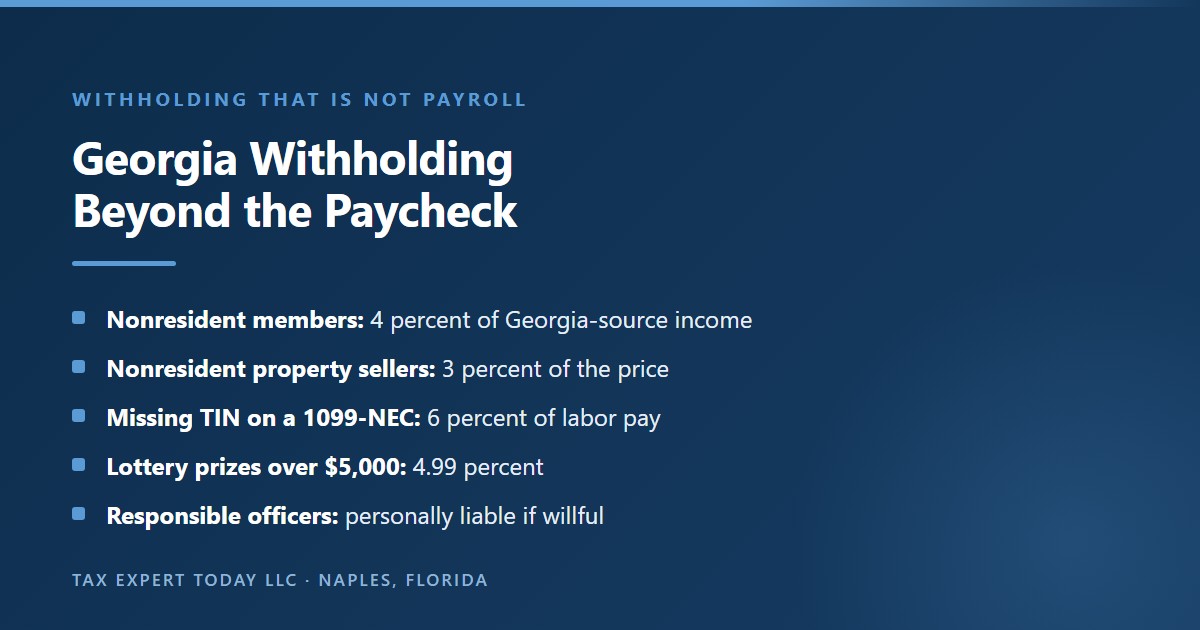
Georgia withholding reaches well beyond payroll. It applies at 4 percent to a nonresident member’s share of Georgia income from a partnership, S corporation, or LLC, at 3 percent to Georgia real estate sold by a nonresident, at 6 percent to 1099-NEC labor pay without a valid taxpayer number, and at 4.99 percent to lottery prizes over $5,000.
- Nonresident members: O.C.G.A. 48-7-129, reported on Form G-7NRW with Form G2-A to each member.
- Nonresident real estate sellers: O.C.G.A. 48-7-128, reported on Form G2-RP.
- Contractors without a valid number: O.C.G.A. 48-7-101(i), for labor performed in Georgia.
- Lottery prizes: O.C.G.A. 48-7-101(f)(7), and 4.99 percent of the price on an assigned prize, reported on Form G2-LP.
The contractor rule is the one most often missed by small businesses. The guide says withholding is required at 6 percent of compensation for labor services, meaning the physical performance of services in Georgia, paid to an individual and reported on Form 1099-NEC, when the individual failed to provide a taxpayer identification number, provided an incorrect one under rules like the federal backup withholding rules in IRC 3406, or provided an IRS number issued to nonresident aliens. A withholding agent that fails to comply is liable for the tax that should have been withheld, unless the payee properly filed federal Form 8233 and a copy was provided to the Department.
The lottery rule applies to winnings of more than $5,000 paid by the Georgia Lottery Corporation, at 4.99 percent of the total amount won. When a winner assigns an installment prize under a court order, the buyer withholds 4.99 percent of the purchase price within 10 days of the purchase and sends it with Form G2-LP.
Each of these rules shares one feature with payroll: the payer is the withholding agent and carries the liability if it does not withhold. The difference is that most of them happen once, outside the payroll system, when no one on staff is thinking about withholding.
How Does Georgia Withholding Work for Nonresident Partners and Shareholders?
A partnership, S corporation, or LLC doing business in Georgia must withhold 4 percent of each nonresident member’s share of Georgia-sourced taxable income, whether or not it distributes cash. The entity and the member are jointly and severally liable. A composite return, a Georgia pass-through entity election, or a share under $1,000 removes the requirement.
- Rate: 4 percent, which is below the 4.99 percent tax rate, so the member may still owe more.
- Due date: the entity’s return due date, without extensions, with Form G-7NRW.
- Member statement: Form G2-A, furnished to the member and filed with the Department.
- Exceptions: composite return, members under $1,000, publicly traded partnerships, approved hardship petitions, and electing entities.
The statute, O.C.G.A. 48-7-129, applies to income “whether distributed or not,” which is the phrase that catches entities that retain their cash. The withholding is due by the due date of the entity’s own income tax return, without regard to any extension, and the guide says the nonresident withholding number is different from the number used for wage withholding. The Department’s Form G-7NRW page carries the return.
A hypothetical shows why the 4 percent rate is only a down payment. A Florida resident owns 40 percent of a Georgia LLC taxed as a partnership, and the member’s share of Georgia-sourced taxable income for 2026 is $200,000. The LLC withholds 4 percent, or $8,000. Georgia tax on $200,000 at 4.99 percent, before the member’s prorated deductions, would be $9,980, so the member should expect a balance of roughly $1,980 before the member’s share of the standard deduction when filing a Georgia nonresident return. If the member’s actual Georgia tax is lower than the withholding, the statute entitles the member to a refund of the excess.
The alternatives change the analysis rather than eliminate it. A composite return files and pays on behalf of all nonresident members, and a qualifying composite filer is exempt from the withholding requirement; our guide to the Georgia composite return covers Form IT-CR. An entity that makes the Georgia pass-through entity tax election pays Georgia tax at the entity level, and subsection (e.1) of the statute removes it from this withholding regime; our article on the Georgia pass through entity tax explains that election and its trade-offs.
Tiered structures need care. The guide explains that withholding may be passed through each tier of a flow-through entity, but the entity claiming the credit must attach the Form G2-A or G2-RP it received and complete the allocation schedule on page 2 of that form. Failure to attach the form and complete the schedule results in disallowance of the withholding credit, which is an expensive paperwork error in a multi-tier fund or real estate structure.
What Is the Georgia Withholding on Real Estate Sold by a Nonresident?
When a nonresident sells Georgia real property, the buyer generally withholds 3 percent of the purchase price under O.C.G.A. 48-7-128 and reports it on Form G2-RP. Exemptions and affidavits can reduce or remove the withholding, and the seller claims the amount withheld as a credit on a Georgia nonresident return.
- Rate: 3 percent of the price, on the real property and associated tangible personal property.
- Who withholds: the buyer, usually through the closing attorney.
- Form: G2-RP, sent with the payment and documentation of the sale.
- The seller’s return: a Georgia nonresident Form 500 reporting the gain, where the withholding is a credit.
On a $400,000 sale, 3 percent is $12,000 withheld at closing and remitted with Form G2-RP. A seller whose actual gain is small, or who has a loss, often has far more withheld than the eventual Georgia tax, and the difference comes back only after filing. The seller affidavits that can reduce or eliminate the withholding, and the computation of Georgia tax on the gain itself, are covered in detail in our guide to Georgia capital gains tax, so they are not repeated here.
Foreign sellers face a second, federal layer of withholding under FIRPTA, which applies alongside the Georgia rule, not instead of it. Our article on FIRPTA withholding covers the federal side.
How Do You Protest a Georgia Withholding Assessment or Request a Penalty Waiver?
A Georgia withholding assessment becomes final unless the employer files a written appeal within 45 days of the notice date. The protest goes through GTC or on Form TSD-1, and collection is suspended while it is pending. Penalty waivers are requested separately with a specific statement of reasonable cause.
- Deadline: 45 days from the date of the assessment notice, under O.C.G.A. 48-2-45.
- How: through GTC or Form TSD-1, the protest of proposed assessment or refund denial, under O.C.G.A. 48-2-46.
- Penalty waiver: a written explanation that includes a specific waiver request, under O.C.G.A. 48-2-43.
- Interest waiver: only when the Department’s own action or inaction caused the delay, under O.C.G.A. 48-2-41.
The Department mails assessment notices by first class mail to the last known address in its records, so an out of date business address in GTC is a real risk. A notice that reaches an old office may run out its 45 days unseen. Employers who move should update the address in GTC, and a business that closes should keep a forwarding address on file until its final returns are processed.
A penalty waiver request works best with a clear chronology and documents: when the problem started, why it happened, what was done to fix it, and when the tax was paid. The penalties that carry a reasonable cause exception in the statute, such as the late filing and payment penalty in O.C.G.A. 48-7-126(c), are the natural candidates. A waiver request is not a substitute for a protest when the underlying tax is wrong; the two can be pursued together.
A balance that cannot be paid at once is a different problem from a disputed one. Georgia has its own payment agreement process for tax debts, separate from any federal installment agreement, and a federal arrangement does nothing for a Georgia balance or the reverse. For the federal side, our tax resolution services page describes how resolution work is handled.
When a withholding assessment is final and the balance cannot be paid in full, Form OIC-1 allows employer withholding tax and a responsible person liability to be listed for settlement. The Department names unremitted withholding as a rejection risk, so the grounds and the financial statement matter; both are explained in our guide to the Georgia offer in compromise.
How Do You Close a Georgia Withholding Account?
A business that stops having employees, or changes structure in a way that requires a new withholding number, must file a final Form G-7 and pay any tax withheld within 30 days of the change. Income statements are due with the final return, and the account should be closed in GTC so zero returns stop being due.
- Final return: Form G-7 and payment within 30 days of the last wages or the structure change.
- Income statements: W-2s and G-1003 within 30 days after final wages, with a written extension request if more time is needed.
- Closing the number: through GTC, or by email to withholding.issues@dor.ga.gov.
- Until closed: a zero G-7 is due every quarter, and late zero returns draw penalties.
The guide cites O.C.G.A. 48-7-106 and regulation 560-7-8-.33 for the closing rules. The problem it is designed to prevent is common: a business stops payroll, forgets the Georgia account, and receives penalty assessments for unfiled quarterly returns months or years later. The fix is procedural, but it has to be done.
A buyer of an ongoing business should apply for its own withholding number rather than using the seller’s, and the guide asks anyone reactivating a previously deactivated number to call the Department first. A buyer should also consider a tax clearance request before closing, because unpaid withholding can follow the business in ways that are hard to unwind after the sale.
Georgia Withholding Tax Example: A Small Employer’s Year
A hypothetical Georgia employer with six employees and about $1,800 of Georgia withholding a month is a monthly payer, crosses the $500 electronic payment trigger in its first quarter, must switch formulas in May 2026, and ends the year with a G-1003 filing due February 1, 2027. Each step has a deadline.
- Status: monthly payer, because withholding exceeds $200 a month and stays under $50,000 in the lookback period.
- Payments: by the 15th of each following month, by EFT once the first quarter return exceeds $500.
- Returns: a quarterly Form G-7 listing the monthly payments.
- Year end: W-2s to employees and Form G-1003 to the Department by February 1, 2027.
Consider a landscaping company in Augusta with six employees. Its annual Georgia withholding is about $21,600, or roughly $1,800 a month, which places it on the monthly schedule. Its first quarter G-7 reports about $5,400, so it is now required to pay by electronic funds transfer and file electronically for every later period. The owner had been mailing checks with Form GA-V; from the second quarter on, a mailed check is a 10 percent penalty even if it arrives on time.
In May the payroll provider updates the Georgia formula. The owner confirms that the change took effect on the first payday after May 11 and keeps a note of the date, because employees ask why their Georgia withholding went down. Two employees are married to each other and both claimed status C on their G-4s. The owner does not know whether they file jointly, but the owner does know both spouses work for the company, which makes the certificates erroneous on their face. The owner asks both employees for corrected G-4s and, until they arrive, follows the guide’s instruction to withhold as single with zero allowances.
In August the company pays a subcontractor $2,500 for three days of work in Georgia. The subcontractor never returned a Form W-9. Under O.C.G.A. 48-7-101(i), the company should withhold 6 percent, or $150, and report it; if it does not, the company is liable for the $150 itself. In November the company files its third quarter G-7 on November 2, because October 31 falls on a Saturday. In January 2027 it furnishes W-2s showing tips and overtime amounts using the federal box 12 codes and files Form G-1003 by February 1.
None of these steps is complicated alone. The risk is in the number of separate deadlines and in the rules that only come up once a year. For owners with operations in several states, our guide to Texas payroll taxes is a useful comparison, because Texas has no state income tax withholding at all.
What Are the Most Common Georgia Withholding Tax Mistakes?
The most common Georgia withholding mistakes are paying by check after the $500 electronic payment trigger, letting both working spouses claim the one earner joint status, missing zero returns on an open account, overlooking nonresident member withholding, and using a pre-May 11 supplemental rate on later bonuses.
- Paper after the EFT trigger: a 10 percent penalty on otherwise timely payments.
- Status C for two earners: household under-withholding equal to $30,000 times the rate.
- Dormant accounts: quarterly zero G-7s still due until the account is closed.
- Nonresident members: 4 percent due whether or not cash was distributed.
- Stale payroll tables: a 5.19 percent rate or old standard deductions after the switch.
Several quieter mistakes also recur. Employers outside Georgia with a single remote employee in Georgia often do not register at all. Businesses pay contractors without collecting a taxpayer identification number and never apply the 6 percent rule. Entities with tiered ownership forget the page 2 allocation schedule on Forms G2-A and G2-RP, which forfeits the credit. Employers that paid on paper and later overpaid file paper refund claims that the Department treats as never filed.
And some mistakes are about who sees the mail. An assessment notice that goes to a former office or a departed bookkeeper can become final before anyone reads it, because the appeal clock runs 45 days from the notice date, not from the date someone opens it.
Finally, the mistake with the largest personal consequence is treating withheld tax as working capital. The withholding belongs to the employees and the state from the moment it is deducted, and O.C.G.A. 48-2-52 makes the responsible person personally liable for it when the failure is willful.
Georgia Withholding Tax Help in Naples & Southwest Florida
Tax Expert Today LLC works from Naples, Florida and handles state tax matters nationwide, including Georgia withholding registration, deposit schedule reviews, G-4 and payroll setup checks, nonresident member withholding, penalty waiver requests, and protests of Georgia withholding assessments. Georgia clients are served from the Naples office and do not need to visit Georgia or Florida.
- Georgia payroll tax help Naples covers Florida employers with Georgia remote employees and Georgia employers with Florida owners.
- Southwest Florida owners of Georgia businesses often need nonresident withholding, composite return, and pass-through election decisions made together.
- Assessment and penalty work starts with the account transcript in GTC and the notice dates.
- Remote engagement is standard. Documents are exchanged through a secure client portal rather than by email.
Tax Expert Today LLC
11983 Tamiami Trail N, Naples, FL 34110
Telephone: (239) 441-2005
Hours: Monday through Friday, 10:00 a.m. to 5:00 p.m. Eastern Time
A local question we are asked often: My company is based in Naples and I just hired a remote employee who lives in Georgia. Do I need to withhold Georgia tax? In most cases, yes. The employee is a Georgia resident performing the work in Georgia, and because Florida does not require income tax withholding, the Georgia rule in the Department’s guide points to Georgia withholding. That usually means registering for a Georgia withholding number in the Georgia Tax Center, collecting a Form G-4, and filing Georgia returns on the schedule the Department assigns. Whether the hire creates other Georgia filing obligations for the company is worth reviewing at the same time. The full range of Georgia engagements is described on our Georgia tax services page, and planning for Southwest Florida business owners is covered on our Naples tax planning services page.
When to Engage a Professional
An employer with a single Georgia location, a reputable payroll provider, and no nonresident owners can usually manage Georgia withholding directly through GTC. Review is worth it for multistate and remote workforces, entities with nonresident members, businesses behind on deposits, and anyone who has received a Georgia assessment notice.
- A Florida or out-of-state employer with employees living or working in Georgia.
- A partnership, S corporation, or LLC with nonresident members deciding between withholding, a composite return, and the entity election.
- A business behind on withholding deposits, where O.C.G.A. 48-2-52 exposure for the responsible person is a live question.
- An employer with a penalty assessment inside the 45 day appeal window.
- A buyer of a Georgia business who wants the seller’s withholding history checked before closing.
Dr. Pellumb Kabashi is an enrolled agent and the founder of Tax Expert Today LLC, and the firm includes tax advisors, enrolled agents, certified public accountants, and attorneys. Georgia Department of Revenue matters are state tax matters rather than federal ones, and they are handled under Georgia procedure and Georgia authority. Nothing in this article is advice for a particular taxpayer, and the result in any specific case depends on facts that a general article cannot know. Business owners who want Georgia withholding reviewed as part of a broader plan can start with our Georgia tax planning and business advisory page. Call (239) 441-2005 for a free consultation, or reach the Naples, Florida office during business hours.
Frequently Asked Questions
What is the Georgia withholding tax rate for 2026?
Georgia withholding for 2026 uses a flat 4.99 percent rate applied after the standard deduction and dependent allowances. Employers withheld at 5.19 percent until May 11, 2026, when HB 463 was signed, and could switch to 4.99 percent from that date. The standard deduction is $15,000, or $30,000 for a married couple filing jointly with one spouse working.
Will I get a refund because Georgia withheld 5.19 percent early in 2026?
Possibly. The 2026 tax is computed at 4.99 percent for the whole year with the larger standard deduction, so wages withheld under the old formula often produce excess withholding. That excess is credited on the 2026 Georgia Form 500. Whether it becomes a refund depends on your other income, credits, and payments.
What is Form G-4 and do I need one?
Form G-4 is the Georgia employee withholding certificate. It tells the employer your filing status letter, dependent allowances, any extra allowances, and any additional amount to withhold. If you do not give your employer a G-4, the employer may use your federal W-4 if it is sufficient, or withhold as if you were single with zero allowances.
Which G-4 status should a married couple use if both spouses work?
Status B, married filing jointly with both spouses working, which gives each spouse the $15,000 standard deduction column. Status C, the $30,000 column, is for a joint return where only one spouse works. If both spouses claim status C, the household is typically under-withheld on $30,000 of income.
When are Georgia withholding payments due?
It depends on the payer status the Department assigns. Monthly payers pay by the 15th of the following month and file Form G-7 quarterly. Quarterly payers pay with the G-7 by the last day of the month after the quarter. Semi-weekly payers pay by EFT on the following Wednesday or Friday, and any payday over $100,000 is due the next banking day.
When must a Georgia employer pay withholding electronically?
Once the tax withheld or required to be withheld on a Form G-7 exceeds $500, the employer must pay by electronic funds transfer on all later payments and must file returns electronically. A timely payment made another way draws a 10 percent penalty, and a mandated filer’s paper refund claim is treated as not filed.
Do I withhold Georgia tax for a remote employee who lives in Georgia?
Usually yes. Georgia residents are subject to the withholding laws of the state where they work, and if that state does not require withholding, the employer should withhold Georgia tax. A Florida employer with a Georgia resident employee working from home generally registers for a Georgia withholding number and withholds Georgia tax.
Can a business owner be personally liable for unpaid Georgia withholding?
Yes, in some cases. O.C.G.A. 48-2-52 makes an officer, member, manager, partner, or employee who controls collecting and paying over withheld taxes, and who willfully fails to pay them over, personally liable for the unpaid amount. It is a Georgia liability separate from the federal trust fund recovery penalty.
Does Georgia require withholding on payments to nonresident partners or LLC members?
Yes. A partnership, S corporation, or LLC doing business in Georgia withholds 4 percent of each nonresident member’s share of Georgia-sourced taxable income, whether or not it is distributed, and reports it on Form G-7NRW with Form G2-A. A composite return, the pass-through entity election, or a share under $1,000 removes the requirement.
What are the penalties for late Georgia withholding returns or payments?
The penalty is $25 plus 5 percent of the tax for each month or part month the return or payment is late, capped at $25 plus 25 percent. Interest runs at the prime rate plus 3 percent. Separate penalties apply for failing to pay electronically when required, failing to withhold, and filing W-2s or 1099s late.
Published September 24, 2026 by Dr. Pellumb Kabashi « Back to Learning Center
Have a question this article touches on?
Tax Expert Today LLC, based in Naples, Florida and serving clients across the United States.
Schedule a Consultation (239) 441-2005