
By Dr. Pellumb Kabashi, DBA, MBA, CES, CFE, EA
Founder, Tax Expert Today LLC · Tax advisors, enrolled agents, CPAs, and attorneys · Serving clients in all 50 states
Quick answer: Georgia lets each qualifying taxpayer exclude up to $35,000 of retirement income at ages 62 to 64, and up to $65,000 at age 65 or older, under O.C.G.A. §48-7-27(a)(5). No more than $5,000 of that exclusion may come from earned income such as wages. A married couple who both qualify at 65 or older can shelter up to $130,000 between them, and Georgia does not tax Social Security at all. At Georgia’s 2026 flat rate of 4.99%, a full $65,000 exclusion is worth about $3,244 in tax per person. Call (239) 441-2005 for a free consultation.
Georgia is one of the more generous states for retirees, and the retirement income exclusion is the reason. Retirees who move to Georgia, or who are planning the year they turn 62 or 65, routinely leave money on the table because they misread which income counts and how the per-spouse rule works. This guide lays out the exact figures, what qualifies, how much tax it actually saves, and how the exclusion is claimed on the Georgia return.
What is the Georgia retirement income exclusion?
The Georgia retirement income exclusion is a subtraction that removes a set amount of retirement income from Georgia taxable income for taxpayers who are 62 or older, or who are permanently and totally disabled regardless of age. It is authorized by O.C.G.A. §48-7-27(a)(5) and claimed on the Retirement Income Exclusion Worksheet in the Georgia Form IT-511 booklet.
The exclusion is not a tax credit and it is not automatic. It reduces the income Georgia taxes in the first place, and the taxpayer has to claim it on Schedule 1 of Form 500. A retiree who never files the worksheet never gets it.
How much retirement income can you exclude in Georgia?
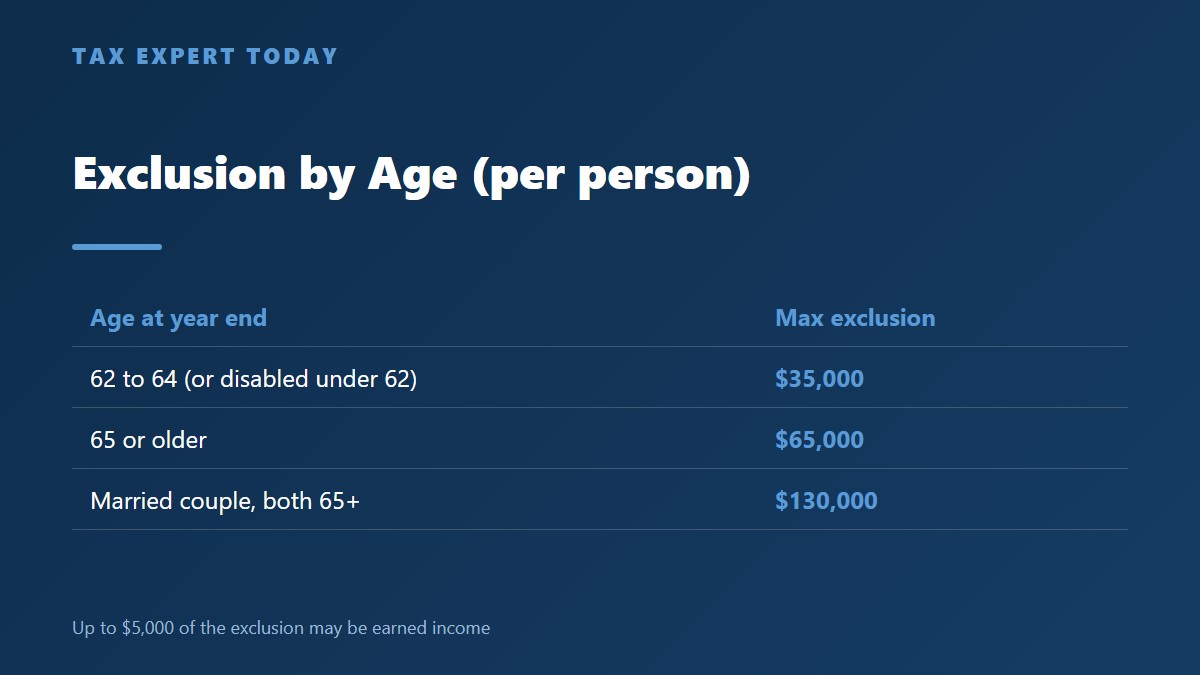
The exclusion depends on age at the end of the tax year. Taxpayers 62 to 64 exclude up to $35,000. Taxpayers 65 and older exclude up to $65,000. A taxpayer under 62 who is permanently and totally disabled qualifies for the $35,000 tier.
- Ages 62 to 64: up to $35,000 per person
- Age 65 or older: up to $65,000 per person
- Under 62 and permanently and totally disabled: up to $35,000 per person
- Married couple, both 65 or older: up to $130,000 combined
| Age at year end | Maximum exclusion per person | Married couple, both qualify |
|---|---|---|
| Under 62, permanently and totally disabled | $35,000 | $70,000 |
| 62 to 64 | $35,000 | $70,000 |
| 65 or older | $65,000 | $130,000 |
The exclusion is per person, not per return. That is the single most valuable detail in this guide. Each spouse qualifies on a separate basis, so on a joint return where both spouses are 65 or older, the household can exclude up to $130,000, but only against each spouse’s own retirement income. One spouse cannot borrow the other spouse’s unused room.
What counts as retirement income for the exclusion?
Retirement income for this exclusion covers most passive and investment income, plus up to $5,000 of earned income. Pensions, annuities, interest, dividends, net rental income, capital gains, and royalties all qualify.
- Income from pensions and annuities
- Interest and dividend income
- Net income from rental property
- Capital gains income
- Income from royalties
- Up to $5,000 of earned income, such as wages or self-employment income
The $5,000 earned-income figure is a sublimit inside the total, not an addition to it. A 66-year-old with a $40,000 pension and $20,000 in wages does not exclude $65,000 plus wages. The wage portion of the exclusion is capped at $5,000, so the countable total is the $40,000 pension plus $5,000 of wages, well under the $65,000 ceiling.
Capital gains are one of the unearned categories that draw on this same ceiling, which is what makes the exclusion relevant in a year with a large sale. Our guide to Georgia capital gains tax works through the flat rate by tax year and how the exclusion applies to a gain.
One kind of income retirees sometimes expect the exclusion to cover is not on the list at all. Lottery and gambling winnings are not among the categories the Department names, so a retiree who wins a prize pays Georgia tax on it at the full rate even when the exclusion has room left. Interest and dividends earned later on the invested prize money can qualify. The details are in our guide to Georgia lottery tax and what withholding misses.
Does Georgia tax Social Security?
No. Georgia does not tax Social Security benefits. Any Social Security or railroad retirement benefit that was in your federal adjusted gross income is subtracted separately on the Georgia return, and it does not use up any of your $35,000 or $65,000 retirement income exclusion.
This is where retirees most often undercount their benefit. Social Security comes out first and on its own line. The retirement income exclusion then applies to pensions, investment income, and the rest. Treating them as one pool is the mistake I see most often when reviewing a new Georgia client’s prior-year return.
The exclusion has a side effect that surprises many retirees. Georgia’s special surplus refunds return part of a prior year’s Georgia income tax, so a retiree whose exclusion brought that year’s Georgia liability to zero receives no surplus refund at all, even after paying federal tax. How the 2026 refund is measured is explained in our guide to the Georgia surplus tax refund and who qualifies.
The exclusion is one step in the wider Georgia return. For the 2026 flat rate of 4.99 percent, the $15,000 and $30,000 standard deduction, and how Schedule 1 subtractions fit into Form 500, see our guide to the Georgia state income tax.
How much tax does the Georgia retirement exclusion actually save?
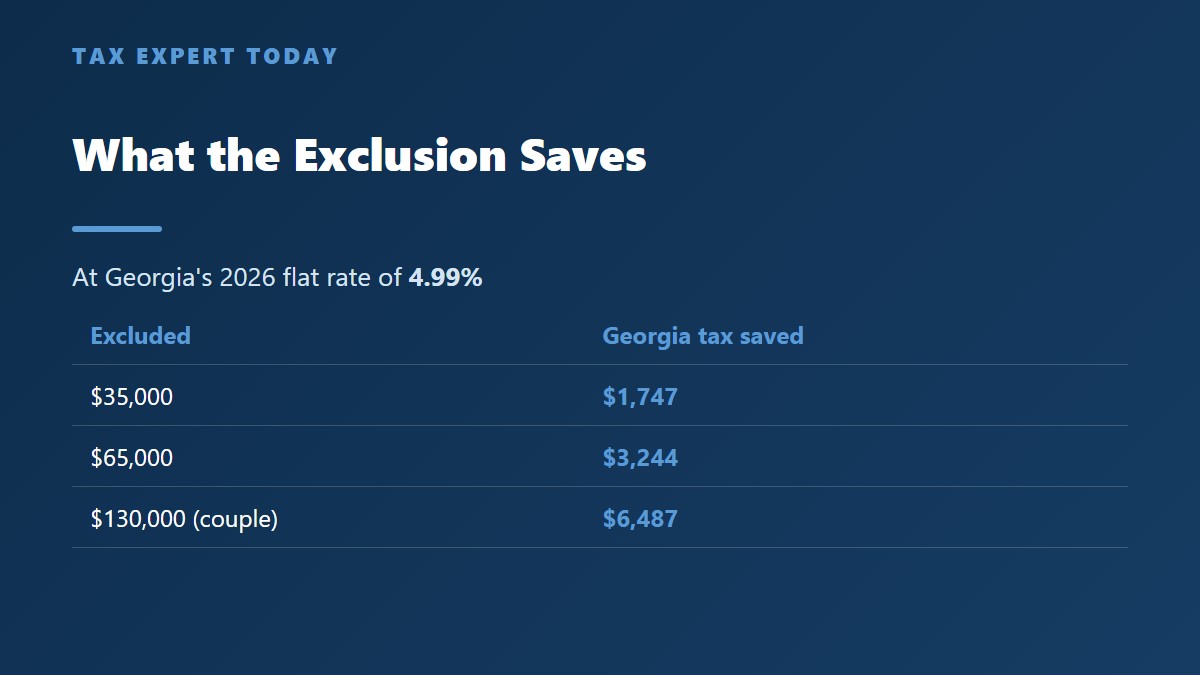
At Georgia’s 2026 flat individual income tax rate of 4.99%, every dollar excluded saves just under five cents of Georgia tax. A full $65,000 exclusion saves about $3,244 per person, and a qualifying couple can save about $6,487 in one year.
| Amount excluded | Georgia tax saved at 4.99% |
|---|---|
| $35,000 (ages 62 to 64) | $1,747 |
| $65,000 (age 65 or older) | $3,244 |
| $130,000 (couple, both 65 or older) | $6,487 |
Georgia moved to a flat tax under House Bill 1437 and has accelerated the reductions since, reaching 4.99% for the 2026 tax year. Because the rate is flat, the exclusion is worth the same 4.99% to a modest pension and to a large one, up to the ceiling. Confirm the current-year rate on the Department of Revenue schedule before relying on it for planning, since Georgia has been cutting the rate on a rolling schedule.
Can married couples each claim the Georgia exclusion?
Yes. On a joint return, each spouse computes the exclusion separately against that spouse’s own income. If both spouses are 65 or older, the return can carry two $65,000 exclusions for a combined $130,000, provided each spouse has that much of their own qualifying income.
| Item | Spouse A (age 67) | Spouse B (age 66) |
|---|---|---|
| Pension and annuity income | $48,000 | $12,000 |
| Interest and dividends | $9,000 | $6,000 |
| Wages (capped at $5,000 each) | $5,000 | $0 |
| Countable retirement income | $62,000 | $18,000 |
| Exclusion allowed (max $65,000 each) | $62,000 | $18,000 |
In this example the couple excludes $80,000 in total, even though the combined ceiling is $130,000, because Spouse B does not have enough of their own income to use the full $65,000. The room does not transfer. Couples with lopsided income sometimes benefit from planning which spouse holds income-producing assets in the years before and after age 65.
Who qualifies under the disability path before age 62?
A taxpayer under 62 who is permanently and totally disabled qualifies for the $35,000 tier even before reaching the age threshold. Georgia requires proof of the disability, typically a physician’s statement, kept with the return.
Retirees who take disability retirement in their late fifties often miss this. If the disability is documented, the $35,000 exclusion is available years before the age-based tiers would otherwise open. The disability has to be permanent and total, not partial or temporary.
How does the exclusion work when you move to Georgia mid-year?
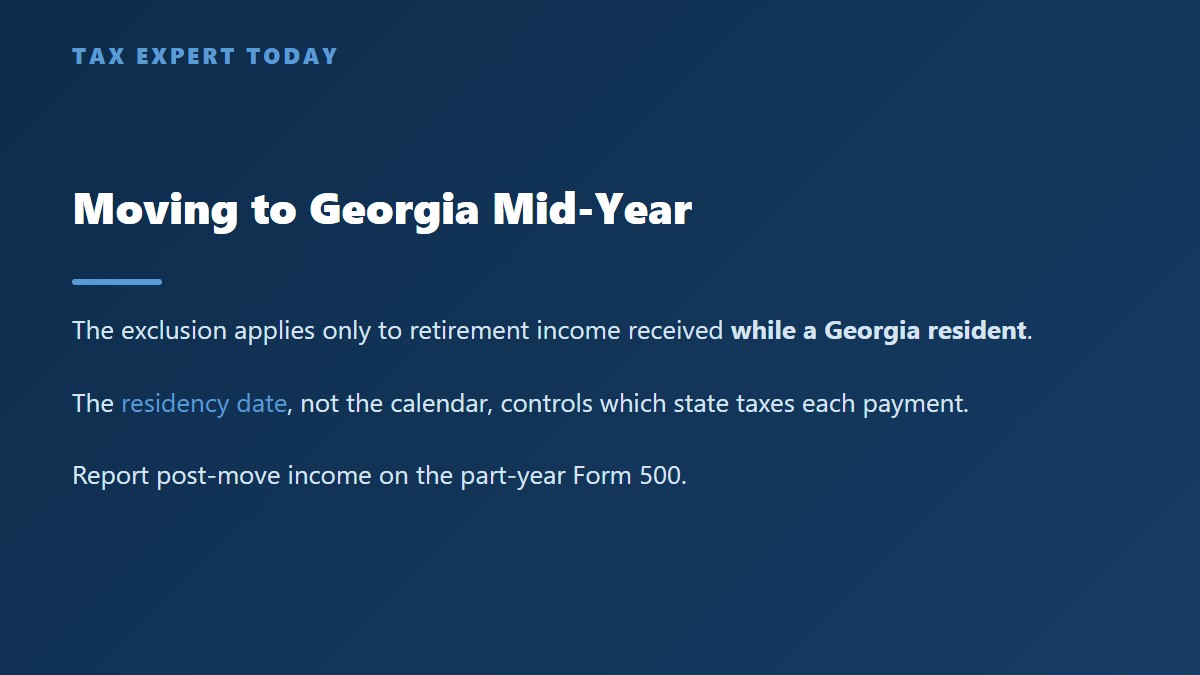
A taxpayer who becomes a Georgia resident partway through the year claims the exclusion only against retirement income received while a Georgia resident, reported on the part-year Form 500 return. The residency date, not the calendar, controls which state taxes a given payment.
A retiree who relocates on July 1 and starts a $5,000 monthly pension reports the six payments received after the move on the Georgia part-year return, and the exclusion shelters that Georgia-resident income up to the ceiling. The months before the move belong to the former state. This is where part-year returns most often go wrong, and it is one of the first things Georgia checks on a residency review.
The mechanics of that part-year filing, including how Form 500 Schedule 3 allocates income between the two states and prorates the standard deduction by the same ratio, are set out in our guide to the Georgia part year resident tax return.
Planning the residency date, the timing of pension start dates, and the sale of appreciated assets around a move is exactly the kind of relocation tax work our firm handles for clients moving between states. See our Georgia tax services overview, and if you are estimating quarterly liability, our Georgia estimated tax penalty calculator shows the safe-harbor math.
Georgia versus Florida for retirees: does the exclusion close the gap?
Florida taxes no personal income at all, so a retiree comparing the two starts from a Florida bill of zero. Georgia does tax income, but the retirement income exclusion plus untaxed Social Security means many retirees owe little or no Georgia income tax in practice.
A single 70-year-old with $60,000 of pension and investment income and $30,000 of Social Security may owe nothing to Georgia, because the Social Security is subtracted and the remaining $60,000 sits under the $65,000 ceiling. The comparison tips back toward Florida for higher-income retirees whose income runs well past the ceiling, or who hold large taxable portfolios. For those households the residency decision is a real dollars question, not a lifestyle one. As a Naples, Florida firm that handles Florida residency and multi-state relocation, we run that comparison for clients in both directions.
One situation worth separating out is an inherited retirement account. A distribution from an inherited traditional IRA is Georgia taxable income to the beneficiary, and the beneficiary claims the exclusion on their own age rather than the age of the person who died, so a beneficiary who is 65 or older has the full ceiling available against it. Our guide to Georgia inheritance tax covers how that interacts with the rest of an estate.
A missed exclusion is not necessarily a closed matter. Where the exclusion was available and was never claimed, the year can usually be corrected on Form 500X for as long as the refund window remains open, and Georgia pays interest on the resulting refund running back to the date the tax was paid. Our guide to the Georgia amended tax return sets out how long that window actually runs and what supporting detail the correction needs.
Military retired pay follows a separate track for retirees under 62. For tax year 2026 the dedicated military exclusion is still $17,500, with a second $17,500 tier that depends on Georgia earned income, and the $65,000 cap enacted by House Bill 266 applies only to tax years beginning on or after January 1, 2027. Our guide to the Georgia military retirement tax explains both years and the 2027 rule that stops a retiree from combining the two exclusions.
Common mistakes that cost Georgia retirees money
Five errors show up again and again on prior-year returns that new clients bring in:
- Folding Social Security into the exclusion. Social Security is a separate subtraction and does not consume the $35,000 or $65,000 ceiling. Combining them wastes exclusion room.
- Claiming one exclusion for a couple. The ceiling is per person. A joint return where both qualify should show two separate computations.
- Ignoring the $5,000 earned-income cap. Wages and self-employment income count toward the exclusion only up to $5,000, no matter how large the ceiling is.
- Never filing the worksheet. The exclusion is not automatic. If the Retirement Income Exclusion Worksheet is skipped, the subtraction never reaches Schedule 1.
- Mis-prorating the part-year move. New residents claim the exclusion only against income received while a Georgia resident, and the residency date has to be defensible.
How do you claim the Georgia retirement income exclusion?
You claim it by completing the Retirement Income Exclusion Worksheet in the Form IT-511 booklet and carrying the result to the retirement income exclusion line on Schedule 1 of Georgia Form 500. Part-year residents use the same worksheet against their Georgia-resident income. Keep the worksheet, and any disability documentation, with your records.
The retirement exclusion is not the only subtraction that reaches Schedule 1, and a household supporting grandchildren often carries a second one on the same schedule. Contributions to the state college savings plan produce their own subtraction, and a grandparent may claim it without owning the account. See our guide to the Georgia 529 plan tax deduction for the per beneficiary limits.
Georgia retirement tax help, served nationwide from Naples, Florida
Tax Expert Today LLC advises retirees and relocating professionals on Georgia retirement income, multi-state residency, and the timing of pension and asset income. We work with Georgia clients remotely from our Naples, Florida office and coordinate the federal and state pieces of a move together.
Tax Expert Today LLC
11983 Tamiami Trail N, Naples, FL 34110
Phone: (239) 441-2005
Hours: Monday to Friday, 10:00 AM to 5:00 PM ET
Georgia retirement tax help, served nationwide from Naples, Florida.
Do you have to be a Georgia resident to work with your firm on this?
No. We serve clients in all 50 states from our Naples, Florida office, including retirees who have already moved to Georgia and those still planning the move. The residency-date planning is often most valuable before the move happens.
When should you bring in a professional?
The exclusion math is simple for a single pension. It gets worth a second look when there are two spouses with uneven income, a part-year move, disability retirement before 62, or a large one-time event such as a business sale or a Roth conversion in the year of the move. Those are the situations where the order of operations and the residency date change the number materially. Schedule a consultation to review how the retirement income exclusion, your residency date, and the timing of pension and asset income fit together on your return.
Frequently asked questions about the Georgia retirement income exclusion
Is the Georgia retirement income exclusion the same as a deduction?
No. It is a subtraction from Georgia taxable income, computed on its own worksheet, and it is separate from the Georgia standard or itemized deduction. You can take both.
Does the exclusion apply to 401(k) and IRA withdrawals?
Yes. Distributions from 401(k) plans, traditional IRAs, and similar retirement accounts are pension and annuity income for this purpose and count toward the exclusion, subject to the $35,000 or $65,000 ceiling.
Do I qualify at 62 if I am not retired?
Yes. The exclusion is based on age, not on whether you have stopped working. A 63-year-old who is still employed still qualifies for the $35,000 tier, though only up to $5,000 of the exclusion can come from wages.
Does Georgia tax military retirement pay?
Georgia offers a separate military retirement income exclusion in addition to the age-based exclusion described here, with its own rules and worksheet in the IT-511 booklet. Military retirees should review both.
What happens to the exclusion when only one spouse is 65 or older?
The older spouse claims up to $65,000 against their own income, and the younger spouse claims their own age-based tier, $35,000 at 62 to 64 or nothing under 62 unless disabled. The exclusions do not combine into one shared pool.
Is Roth IRA income counted toward the Georgia exclusion?
Qualified Roth IRA distributions are not part of federal adjusted gross income, so they do not need the Georgia exclusion. That leaves more of the ceiling available to shelter taxable pension and investment income.
Published September 1, 2026 by Dr. Pellumb Kabashi « Back to Learning Center
Have a question this article touches on?
Tax Expert Today LLC, based in Naples, Florida and serving clients across the United States.
Schedule a Consultation (239) 441-2005