
By Dr. Pellumb Kabashi, DBA, MBA, EA, CFE, CES
Founder, Tax Expert Today LLC · Tax advisors, enrolled agents, CPAs, and attorneys · Serving clients in all 50 states
A Georgia Department of Revenue payment plan lets an individual or business pay a state tax balance over as many as 60 months, with a $25 minimum payment and a setup fee. All required returns must be filed first. Interest runs at 9.75 percent for 2026, refunds are still offset, and the mailed form waives protest and appeal rights. Call (239) 441-2005 for a free consultation.
What Is a Georgia Department of Revenue Payment Plan?
A Georgia Department of Revenue payment plan is a written installment agreement under which the Department accepts monthly payments on a state tax balance instead of immediate payment in full. It is available to individuals and businesses, it runs for up to 60 months, and it holds only while every payment and every future Georgia filing stays current.
- Agency: the Georgia Department of Revenue, through its Compliance Division.
- Request channel: the Georgia Tax Center online, known as GTC, or Form GA-9465 by mail.
- Taxes covered: individual income tax, corporate income tax, sales and use tax, withholding tax, and other state taxes listed on the form.
- What it is not: a reduction of the balance, a waiver of interest, or an agreement with the Internal Revenue Service.
The Department describes the arrangement on its Payment Plans page as an agreement to pay the state taxes owed within an extended time frame, and it states that payment plans are available for individuals and businesses. The instructions to Form GA-9465 add a sentence that most summaries leave out. Before requesting an installment agreement, the Department says, a taxpayer should consider less costly alternatives such as a bank loan or available credit. That is the Department telling the reader, in its own form, that the plan has a real cost.
The cost is the theme of this guide. A payment plan is often the right tool, and for many households it is the only realistic one. It is also an agreement with terms, and several of those terms are not visible on the summary pages that rank for this topic. The plan does not stop interest. It does not stop the late payment penalty. It does not stop the Department from keeping state and federal refunds. It suspends the clock that limits how long the Department can collect. The mailed request form also asks the taxpayer to give up the right to contest the assessment being paid. Each of these points is covered below with its source.
This article covers the Georgia agreement only. The federal installment agreement is a different program, run by a different agency, under different law, and it is explained in our guide to IRS installment agreement options. Readers looking for the wider picture of Georgia income, business, and credit rules can start with our Georgia tax services page.
Who Qualifies for a Georgia Department of Revenue Payment Plan?
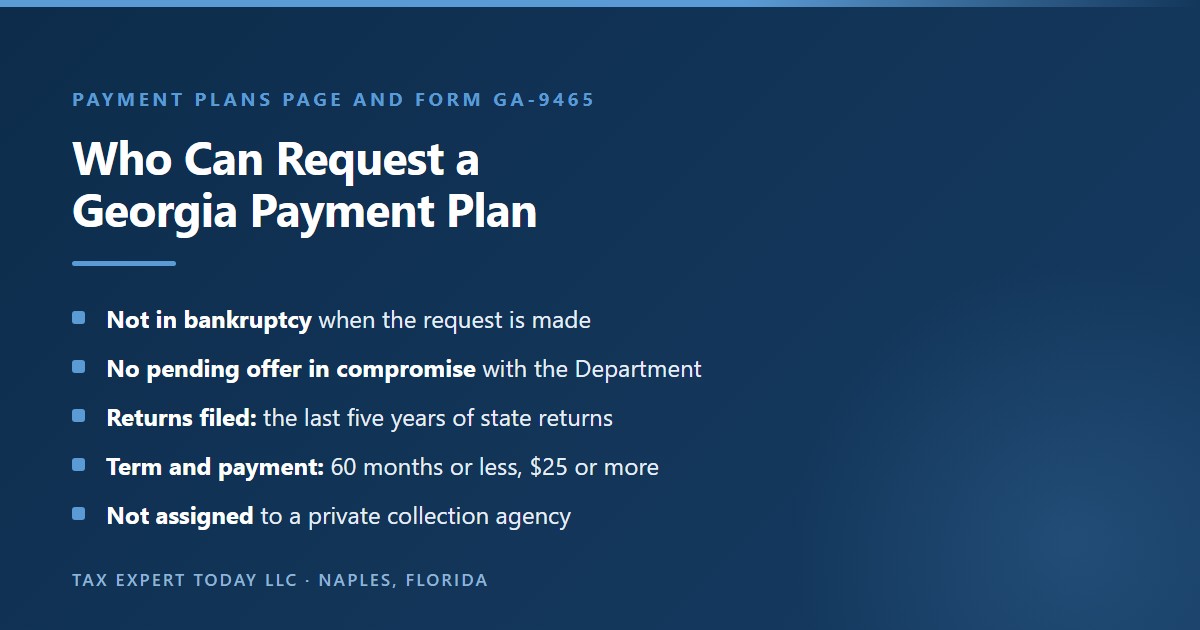
A taxpayer qualifies for a Georgia Department of Revenue payment plan when the taxpayer is not in bankruptcy, has no pending offer in compromise with the Department, has filed the last five years of state tax returns, and proposes payments of at least $25 a month that clear the balance within 60 months.
- No bankruptcy: a taxpayer in an open bankruptcy case cannot request a plan.
- No pending offer: a pending offer in compromise application blocks a plan request.
- Returns filed: the Department’s page requires the last five years of state returns.
- Not assigned out: a balance already assigned to a private collection agency is handled through that agency.
The requirements come from two Department documents that say slightly different things, and both should be read. The web page lists the basic requirements. The form instructions add the private collection agency rule and state the filing requirement more broadly.
| Requirement | What the Department says | Where it appears |
|---|---|---|
| Bankruptcy | The taxpayer cannot be in bankruptcy | Payment Plans page and Form GA-9465 |
| Offer in compromise | The taxpayer cannot have a pending offer in compromise application filed with the Department | Payment Plans page and Form GA-9465 |
| Filed returns | The taxpayer must file the last five years of state tax returns | Payment Plans page |
| Filed returns, form wording | The request will be denied if all required tax returns have not been filed | Form GA-9465 instructions |
| Private collection agency | If the liability has been assigned to a private collection agency, contact that agency for payment plan options | Form GA-9465 instructions |
| Term | The installment payment agreement cannot exceed 60 months | Payment Plans page and Form GA-9465 |
| Minimum payment | The minimum monthly payment is $25.00 | Payment Plans page and Form GA-9465 |
Two things are absent from this list. There is no published maximum balance, and there is no published income test. The Department does not state a dollar ceiling above which a plan is unavailable, and it does not ask for a financial statement as part of the standard request. That is a real difference from an offer in compromise, which requires a full collection information statement. It does not mean every request is approved. The Department reviews each request and, according to the form instructions, will usually respond within 30 days.
The filing requirement is the one that stops the largest number of requests. A taxpayer with unfiled Georgia returns has to file them before the plan, and filing them usually increases the balance. The order matters. File first, let the returns post, confirm the total in GTC, and then request a plan that covers the full amount. A plan built on an incomplete balance tends to default when the later assessment arrives. The general approach to catching up on several years at once is covered in our guide to unfiled tax returns, which addresses the federal side of the same problem.
How Long Can a Georgia Payment Plan Run and What Is the Minimum Payment?
A Georgia payment plan can run for up to 60 months, and the minimum monthly payment is $25. Those two limits work together. The payment proposed must be large enough to pay the full balance, plus the interest that accrues along the way, within the term selected, so the $25 minimum only fits a small balance.
- Maximum term: 60 months, stated on both the web page and the form.
- Minimum payment: $25.00 a month.
- Draft day: any day from the 1st to the 28th of the month on the mailed form.
- Frequency: one electronic draft a month, with extra payments allowed at any time.
The $25 minimum is widely quoted and widely misunderstood. It is a floor on the payment, not an entitlement to pay $25. At the 2026 interest rate of 9.75 percent, accruing monthly, a payment of $25 a month for 60 months retires a balance of roughly $1,180 when interest is counted. On a balance of about $3,077, a $25 payment covers only the monthly interest, and the balance never falls. Any balance above that figure grows under a $25 payment. These are hypothetical computations that ignore penalties and fees, and they are included to show why the term limit, not the payment floor, is the binding constraint for most taxpayers.
The practical way to size a request is to work backward from the term. Take the full balance shown in GTC, including penalties and interest to date. Add the administrative fee. Divide by the number of months, and then add a margin for the interest that will accrue during the plan. The Department’s payment plan questions page confirms that a taxpayer can make additional payments or pay the remaining debt in full at any time, and that doing so reduces the penalty and interest paid. A shorter plan with a payment that is actually affordable is usually better than a 60 month plan chosen by default.
The Department does not allow weekly or twice monthly drafts. Its questions page states that electronic drafts take place once a month on the date specified in the plan. A taxpayer who is paid weekly and wants to match payments to paychecks can do that only by making voluntary extra payments through GTC between the scheduled drafts.
How Do You Request a Payment Plan in the Georgia Tax Center?
A payment plan is requested in the Georgia Tax Center by logging in, opening the More tab, choosing Payments and Returns, and selecting Request Payment Plan. The taxpayer reviews the terms, enters bank information, chooses a first payment date and the number of payments, agrees to electronic notices, and authorizes the monthly debit.
- Step 1: log in to GTC and open the More tab.
- Step 2: under Payments and Returns, select Request Payment Plan and review the terms.
- Step 3: enter bank information, an optional down payment, the first payment date, and the number of payments.
- Step 4: agree to receive electronic notices through GTC and provide an email address.
- Step 5: review the details, select Yes, submit, and enter the GTC password to authorize the debit.
The Department publishes the sequence on its How to Request a Payment Plan page. After submission, a confirmation page shows a confirmation number. Once the plan is approved, a web notice with the terms appears under the Actions Center tab, in the unread messages, under a link titled GTC Payment Plan, Approved. That notice is the agreement. It should be saved as a file and kept with the tax records for the years involved.
Three details in the online sequence deserve attention. First, the second screen asks the taxpayer to review the payment plan terms before anything else is entered. Those terms are the contract, and they are shown only inside the account, so they cannot be reviewed from the public website. Read them in full, and compare them with the waiver language on the mailed form that is discussed later in this guide. Second, the request requires consent to electronic notices. A default warning sent to GTC is a valid notice even if the taxpayer never logs in, so the email address given must be one that is checked. Third, the password entry at the end is an authorization for the Department to debit the bank account until the plan is complete. It is not a one time payment.
The down payment field is optional, and it is useful. A down payment reduces the principal on which interest accrues from the first month, and it can bring a balance within reach of a shorter term. The Georgia Tax Center is also where a taxpayer confirms the balance, views notices by Letter ID, and makes voluntary extra payments during the plan.
When Is the Georgia Tax Center Request Not Available?
The online request is not available when the taxpayer has an active protest or appeal, is subject to a Department enforcement action, is in bankruptcy, has an accepted offer in compromise, or already has an active payment plan. The Form GA-9465 instructions list these five conditions, and each one points to a different next step.
- Active protest or appeal: the dispute and the plan cannot run together online.
- Enforcement action: a levy or garnishment in progress blocks the online request.
- Existing plan: a second plan cannot be opened while one is active.
- Accepted offer: a taxpayer paying under an accepted compromise is outside the plan process.
| Condition that blocks the GTC request | Practical next step |
|---|---|
| Active protest or appeal | Decide whether the dispute has merit before paying. A plan request can end the dispute, as the waiver section below explains |
| Department enforcement action in progress | Contact the Department using the number on the levy or garnishment notice and request an agreement directly |
| Open bankruptcy case | The debt is handled through the bankruptcy case and the Department’s proof of claim |
| Accepted offer in compromise | Follow the payment terms of the accepted offer |
| Active payment plan already in place | Cancel the current plan in GTC and request a new one that includes the new debt, which brings a new fee |
The enforcement row is the one that causes the most difficulty. A taxpayer who waits until a bank account has been levied or wages have been garnished finds that the simple online route has closed. The agreement is still possible, but it has to be negotiated with the Department’s collection staff, often with a down payment, and the 20 percent collection fee described below has usually been added by that point. The same balance is cheaper and easier to resolve before the state tax execution issues than after.
The protest row matters for a different reason. A taxpayer who disagrees with an assessment and also cannot pay it has two separate problems. The protest addresses the amount. The plan addresses the payment. Requesting the plan first can close off the protest, so the order of those two steps is a decision, not a formality.
How Does Form GA-9465 Work for a Mailed Request?
Form GA-9465 is the paper Installment Agreement Request, revised July 15, 2025. The taxpayer enters the Letter ID from the notice, the tax type and periods, the total owed, the number of months up to 60, the monthly payment of at least $25, a draft day, and bank account details, then signs line 9.
- Line 1: the Letter ID from the Department notice, which speeds processing.
- Lines 2 and 3: the tax type, identification numbers, periods, names, and address.
- Lines 4 to 7: the total owed, the number of months, the monthly amount, and the draft day.
- Line 8: the bank name, routing number, and account number, with a voided check attached.
- Line 9: the signature, the debit authorization, and the waiver of notice and appeal rights.
The form and its instructions are published on the Department’s GA-9465 page. The completed form is mailed to the Georgia Department of Revenue, Processing Center, PO Box 105596, Atlanta, GA 30374-0396. The instructions say the Department will usually notify the taxpayer within 30 days whether the request is approved or denied, and that an approved taxpayer receives a notice detailing the terms.
The form has a few mechanical rules that cause rejections. For a joint liability, both spouses sign, and the names and Social Security numbers are listed in the same order as on the return. For a business, line 3 shows the person responsible for paying the sales or withholding tax along with that person’s Social Security number. The routing number must be nine digits, and the instructions warn against using the routing number printed on a deposit slip. The form states that all payments must be made by electronic funds withdrawal.
One published summary of this process tells readers to mail Form 525-TV to request a plan. That is not correct. Form 525-TV is a payment voucher used to send a payment with an individual income tax balance. It does not request an installment agreement. The Department’s own Payment Plans page names Form GA-9465 as the mailed request, and that is the form to use.
What Rights Does Line 9 of Form GA-9465 Waive?
Line 9 of Form GA-9465 waives all rights of additional notice, refund, or appeal concerning the assessment and collection of the tax being paid through the agreement. It specifically waives the 45 day period to contest a proposed assessment under O.C.G.A. 48-2-46 and the right to appeal a final assessment.
- Protest right waived: the 45 day window to contest a notice of proposed assessment.
- Appeal right waived: the right to appeal the final assessment notice.
- Refund right waived: the signature acknowledges a waiver of rights concerning refund of the liability paid.
- Offset agreed: any state or federal tax refund is applied to the liability until it is paid.
This is the term that matters most and that no summary page discusses. The text of line 9 reads, in part, that the taxpayer waives all rights of any additional notice or appeal concerning the assessment and collection of any part or all of the tax liability to be paid by means of the installment payment agreement request. The signature block repeats the point and adds the word refund. A taxpayer who signs is agreeing that the amount is owed.
For most balances that is not a problem. A taxpayer who filed a return showing tax due and could not pay it has nothing to contest. The waiver matters when the balance comes from a Department adjustment, an audit, an estimated assessment for an unfiled year, or a responsible party assessment for a business tax. In those cases the number may be wrong, and the ordinary remedy is a protest within 45 days of the proposed assessment under O.C.G.A. 48-2-46, followed by an appeal of the official assessment if the protest is denied. Signing the plan request first gives those remedies away.
We could not review the terms shown on the online request, because they appear only inside a logged in account. The Department’s instructions place a terms screen at the start of the online sequence, and a taxpayer should read it for the same waiver language before selecting Next. The safe assumption is that the online agreement carries terms similar to the paper form. The safe practice is to resolve any dispute over the amount before requesting the plan, or to raise the dispute in a timely protest and request the plan only for the part of the balance that is not contested.
A correction route may remain for a taxpayer whose own return was wrong. An amended return corrects the taxpayer’s own reporting, which is a different thing from contesting an assessment, and the rules and deadlines are covered in our guide to the Georgia amended tax return. Whether an amended return can reduce a balance that is already under a signed agreement depends on the facts and on the Department’s position, and it should be reviewed before anything is signed rather than after.
What Fees Does Georgia Charge for a Payment Plan?
Georgia charges a $50 administrative fee on a payment plan paid by automatic draft, and the Department’s web page lists a $100 fee for agreements paid by mailed paper check. The Form GA-9465 instructions also describe a reduced $25 fee when income is below $22,050, and a $50 fee for modifying a plan.
- Automatic draft plans: $50, added to the balance and included in the plan.
- Paper check plans: $100, according to the Payment Plans page.
- Reduced fee: $25 when income is less than $22,050, according to the form instructions.
- Modification: $50, or $25 at the reduced level, when a change to the plan is approved.
| Fee | Amount | Source |
|---|---|---|
| Administrative fee, automatic draft plan | $50 | Payment Plans page and Form GA-9465 |
| Fee for agreements paid by paper check each month | $100 | Payment Plans page |
| Reduced administrative fee, income under $22,050 | $25 | Form GA-9465 instructions |
| Modification of an approved agreement | $50, or $25 at the reduced level | Form GA-9465 instructions |
| New plan created because new debt is added | New fees apply | Payment Plans page |
| Cost of collection fee when a state tax execution issues | 20 percent of the assessed tax liability | Ga. Comp. R. and Regs. 560-1-2-.02 |
The two Department documents do not match perfectly, and we report both rather than choosing one. The web page describes a $100 fee for plans paid by paper check. The current form states that all payments must be made by electronic funds withdrawal and does not describe a paper check option. The reduced fee appears in the form instructions and not on the web page. A taxpayer who believes the reduced fee applies should raise it in the request and confirm the fee shown in the approval notice.
The administrative fee is small next to the last row of the table. The 20 percent cost of collection fee is not a payment plan fee. It is charged when the Department issues a state tax execution, and it applies to the assessed tax. On a $12,000 assessment that fee is $2,400. Whether it has been charged depends on timing, and a plan requested before the execution issues can avoid it. That timing is explained in the sections on the assessment timeline and the collection fee.
What Interest Rate Applies to a Georgia Payment Plan in 2026?
The interest rate on past due Georgia taxes is 9.75 percent for calendar year 2026, accruing monthly. The Department announced the rate in Policy Bulletin ADMIN-2026-01. Under O.C.G.A. 48-2-40 the rate equals the bank prime loan rate plus 3 percent, reset each January, and interest continues throughout a payment plan.
- 2026 rate: 9.75 percent a year, accruing monthly.
- 2025 rate: 10.50 percent a year, according to the same bulletin.
- Formula: the bank prime loan rate in Federal Reserve release H.15, plus 3 percent.
- Partial months: any period of less than one month counts as a full month.
| Period | Annual interest rate on past due Georgia tax | Source |
|---|---|---|
| Months before July 1, 2016 | 12 percent, which is 1 percent a month | Department Penalty and Interest Rates page |
| Calendar year 2025 | 10.50 percent | Policy Bulletin ADMIN-2026-01 |
| Calendar year 2026 | 9.75 percent | Policy Bulletin ADMIN-2026-01 |
| Calendar year 2027 | Set from the first weekly H.15 posting on or after January 1, 2027 | O.C.G.A. 48-2-40 |
The rate is set by statute, not by the agreement. O.C.G.A. 48-2-40 provides that taxes owed to the state bear interest at an annual rate equal to the bank prime loan rate posted by the Board of Governors of the Federal Reserve System in statistical release H.15, plus 3 percent, to accrue monthly. The rate for each calendar year is fixed from the first weekly posting on or after January 1. The Department publishes the result each year, and the 2026 figure is in Policy Bulletin ADMIN-2026-01.
Two consequences follow for anyone on a multi year plan. The rate is variable. A 60 month plan that begins in 2026 will pass through five January resets, and the interest charged in later years will follow the prime rate in those years. No one can state today what a 60 month plan will cost in interest, and any figure offered for the full term is an estimate. The second consequence is the rounding rule. The statute treats any period of less than one month as one month, so a payment made a few days into a new month carries interest for that whole month.
Interest is rarely waived. O.C.G.A. 48-2-41 allows the commissioner to waive interest only to the extent the delay in payment was attributable to the action or inaction of the Department. Financial hardship is not a statutory ground for an interest waiver. That is a sharp contrast with penalties, which can be waived for reasonable cause, and it is one reason a penalty waiver request is worth considering before the plan is set.
Do Penalties Keep Accruing During a Georgia Payment Plan?
Yes. The Form GA-9465 instructions state that interest and any applicable penalties are charged until the balance is paid in full, even when the request to pay in installments is granted. For income tax, the late payment penalty is 0.5 percent of the unpaid tax for each month, up to a combined cap of 25 percent.
- Late payment penalty: 0.5 percent of the unpaid tax a month under O.C.G.A. 48-7-86.
- Late filing penalty: 5 percent of the unpaid tax a month when the return itself was late.
- Combined cap: the two penalties together cannot exceed 25 percent of the tax due on the return due date.
- Other taxes: sales tax and withholding tax carry their own, steeper penalty schedules.
The Department’s Penalty and Interest Rates page sets out the schedule by tax type. For individual and corporate income tax, the late payment penalty runs at 0.5 percent of the unpaid tax for each month or part of a month, and the combined total of the late filing and late payment penalties cannot exceed 25 percent of the tax due on the return due date. At that rate, a taxpayer who filed on time reaches the 25 percent ceiling about 50 months after the original due date. The late payment penalty is therefore still accruing for most of a long plan.
Business taxes are harsher. For sales and use tax, the failure to pay penalty is the greater of 5 percent of the tax or $5 for each late month, up to the greater of 25 percent or $25. For withholding tax, the penalty is $25 plus 5 percent of the tax for each late month, up to $25 plus 25 percent. These penalties typically reach their ceiling within five months, long before a plan is requested, so on a business tax plan the penalty is usually fixed by the time payments begin and only the interest keeps growing.
A taxpayer whose balance came from missed estimated payments faces a separate charge. The underpayment of estimated tax penalty is computed at 9 percent a year on Form 500 UET, and it can be estimated with our Georgia estimated tax penalty calculator. That penalty is part of the balance going into the plan. It also signals the most common cause of a repeat balance, which is a current year in which estimated payments are again being missed.
How Much Does a Georgia Payment Plan Cost Over Time?
The cost of a Georgia payment plan is the interest and penalty that accrue while the balance is outstanding, plus the administrative fee. On a hypothetical $12,000 balance at the 2026 rate of 9.75 percent, interest alone is about $646 over 12 months and about $3,223 over 60 months, before any late payment penalty.
- Shorter term: a higher payment and far less interest.
- Longer term: a lower payment and interest that can exceed a quarter of the balance.
- Extra payments: allowed at any time and applied to reduce the balance.
- Variable rate: the figures change each January with the statutory reset.
The table below is a hypothetical illustration. It assumes a $12,000 balance, a $50 administrative fee added to the balance, a level monthly payment, and interest at 9.75 percent a year accruing monthly for the whole term. It ignores the late payment penalty, refund offsets, and rate changes in later years. It is not a quote of what any taxpayer will pay.
| Term | Approximate monthly payment | Approximate total paid | Approximate interest |
|---|---|---|---|
| 12 months | $1,058 | $12,696 | $646 |
| 24 months | $555 | $13,312 | $1,262 |
| 36 months | $387 | $13,947 | $1,897 |
| 60 months | $255 | $15,273 | $3,223 |
The pattern is what matters when sizing a Georgia Department of Revenue payment plan. Moving from 36 months to 60 months lowers the payment by about $132 a month and adds about $1,326 of interest. Whether that trade is worth making depends on the household budget. A payment that is missed costs more than a payment that is slightly higher, because a default can bring enforcement and the collection fee. The right term is the shortest one the taxpayer can keep without fail.
The table also explains the Department’s own advice to consider a bank loan or available credit first. A taxpayer who can borrow at a rate below 9.75 percent, with no penalty accruing and no lien risk, may pay less in total by borrowing and paying the Department in full. A taxpayer whose only available credit is a card at a rate above 20 percent is usually better served by the plan. This is a comparison of costs and not a recommendation to borrow, and it depends on terms that vary from one household to the next.
A taxpayer who disputes part of an assessment should decide on the appeal before requesting a plan, because the request on Form GA-9465 waives the protest and the appeal for the liabilities it covers. Appeals of official assessments now go to the Georgia Tax Court, which replaced the former Tribunal on July 1, 2026, as explained in our guide to the Georgia Tax Tribunal and the new Georgia Tax Court.
What Happens Between an Assessment and a State Tax Execution?
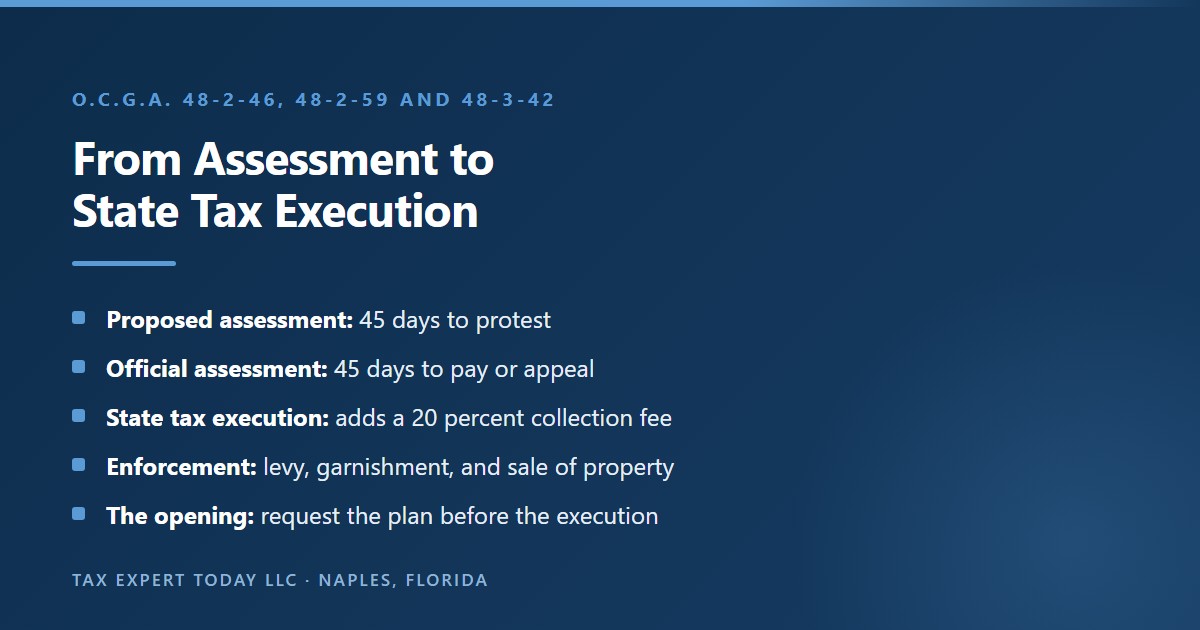
Georgia collection follows a sequence. The Department issues a proposed assessment, the taxpayer has 45 days to protest, an official assessment and demand for payment follows, the taxpayer has 45 days to pay or appeal, and after that the Department may issue a state tax execution, add a 20 percent collection fee, and begin enforced collection.
- Proposed assessment: 45 days to protest with the Department.
- Official assessment: 45 days to pay or to appeal to the Georgia Tax Court or superior court.
- State tax execution: may issue after that window, with the 20 percent fee.
- Enforcement: garnishment, levy, and sale of property become available to the Department.
| Stage | Time allowed | What the taxpayer can do | Source |
|---|---|---|---|
| Notice of proposed assessment | 45 days from the notice date | File a written protest, online in GTC or by mail | O.C.G.A. 48-2-46 |
| Official assessment and demand for payment | 45 days from the issued date | Pay, request a payment plan, or appeal to the Georgia Tax Court or superior court | O.C.G.A. 48-2-59 and the Taxpayer Bill of Rights |
| State tax execution | Filed within five years of the final assessment | Pay, request an agreement, or appeal the execution | O.C.G.A. 48-3-42 |
| Enforced collection | While the execution is active | Resolve the balance or request release of a levy | O.C.G.A. 48-2-55 |
Several pages that rank for this topic state that a Georgia taxpayer has 30 days to protest or appeal and that appeals go to the Georgia Tax Tribunal. Both statements are out of date. The protest period in O.C.G.A. 48-2-46 is 45 days, under an amendment effective July 1, 2025. The Department’s Taxpayer Bill of Rights gives 45 days to appeal an official assessment. Appeals now go to the Georgia Tax Court or to the appropriate superior court under O.C.G.A. 48-2-59, as amended effective July 1, 2026.
The Taxpayer Bill of Rights also describes a small claims division of the Georgia Tax Court for cases in which the tax and penalties in controversy are less than $15,000 for income tax or $50,000 for other tax types. Decisions in small claims cases are final. An appeal to the Georgia Tax Court or to superior court stays enforcement and collection by the Department, except in jeopardy assessment cases, although a judge may lift the stay for good cause.
The reason the sequence matters to a payment plan is the position of the 45 day window after the official assessment. A plan requested inside that window is requested before any execution and before the 20 percent fee. A plan requested after it may be requested against a larger balance, with a lien already of record. The time to act is when the official assessment arrives, not when the levy does.
What Is the 20 Percent Collection Fee and Can It Be Waived?
The 20 percent collection fee is a cost of collection fee that Georgia adds when the Department issues a notice of state tax execution. It equals 20 percent of the assessed tax liability, it is charged in addition to penalties and interest, and the Department may waive it when the deficiency was due to reasonable cause.
- Authority: O.C.G.A. 48-16-10(a) and Ga. Comp. R. and Regs. 560-1-2-.02.
- Trigger: the issuance of a notice of state tax execution.
- Base: the assessed tax liability.
- Waiver: available for reasonable cause, and it can be requested with a penalty waiver.
The statute, O.C.G.A. 48-16-10, authorizes the commissioner to impose by regulation a cost of collection fee of 20 percent of any deficiency assessed, in addition to all other penalties, fees, or costs. The regulation that imposes it, Rule 560-1-2-.02, states that when the Department issues a notice of state tax execution, the fee is calculated at the rate of 20 percent of the assessed tax liability.
The waiver standard in the regulation is specific. The Department may waive the fee when it reasonably determines that the deficiency is due to reasonable cause and is not the result of negligence, intentional disregard of administrative rules and regulations, or fraud. The regulation adds that a taxpayer may request a waiver of the collection fee along with, or in the alternative of, a penalty waiver. In practice this means one request can address both charges, and the facts that support reasonable cause for the penalty usually support it for the fee as well. No outcome can be promised. The Department decides each request on its own facts.
The Form GA-9465 instructions connect the fee to the plan in two sentences. If a tax execution was already recorded before the agreement was approved, the Department will not initiate enforcement action to collect the debt while the agreement is in effect. Upon default, the Department may initiate all appropriate enforced collection activity, and the issuance of a tax execution will result in an additional 20 percent collection fee added to the liability. A taxpayer who enters a plan before any execution and then defaults can therefore end up owing the fee that the plan had avoided.
The same regulation permits the Department to send a debt to a contracted collection agency or attorney once the collection fee has been added. That is the link between the fee and the private collection agency rule discussed later in this guide.
Does a Payment Plan Stop a Georgia State Tax Lien?
No. A payment plan does not prevent the Department from recording a state tax execution, which operates as a lien. The Department states that it may file a lien without notice, at any time, if that is in the interest of the state. A plan prevents enforcement while it is current, not the lien itself.
- Same instrument: a state tax lien is also called a state tax execution.
- Where recorded: with the clerk of superior court, electronically.
- What it reaches: existing and after acquired property, real and personal.
- Real property: the lien attaches only in a county where the execution is filed.
The Department’s Liens page explains that a state tax lien, also known as a state tax execution, is recorded with one or more clerks of superior court to make it a matter of public record and to secure the debt. It states that after a tax liability has become due and is in the collection process, the Department may file a lien without notice, at any time. Nothing on that page or on the Payment Plans page says that an active plan prevents the filing.
The priority of the lien depends on the type of tax, and O.C.G.A. 48-2-56 sets the rules. The general rule in subsection (b) is that liens for taxes are superior to all other liens. The income tax rule in subsection (e) is narrower. The lien for income tax arises and attaches when the execution is filed with the clerk of superior court, and it is not superior to the lien of a prior recorded instrument securing a bona fide debt. A mortgage recorded before the execution therefore keeps its priority over an income tax lien. Withholding tax has its own rule in subsection (f), under which the lien arises on the date of assessment.
The reach of an execution changed in 2018. Under O.C.G.A. 48-3-42, an execution filed on or after February 20, 2018 attaches to real property only in the county in which it has been filed. It attaches to all existing and after acquired property of the delinquent taxpayer with the same force as a recorded judgment. A companion section, O.C.G.A. 48-3-43, requires the Department to make execution records available to the public online at no charge, including official payoff information, and the Liens page directs taxpayers to the lien search in GTC for that purpose.
A lien is released when the liability is paid in full or otherwise resolved. O.C.G.A. 48-3-43 requires the Department to change the status of an execution to released within 15 business days of receiving payment in full. The Department also notes that it does not report liens to credit bureaus and cannot instruct a credit bureau to change its records. For the federal equivalent, which follows different rules, see our guide to IRS tax lien withdrawal.
How Does a Payment Plan Extend the Time Georgia Has to Collect?
A Georgia state tax execution expires ten years after it is filed, and the Department must file it within five years of the final assessment. Both periods are suspended for the duration of an installment agreement plus 90 days. A 60 month plan can therefore add more than five years to the collection period.
- Filing limit: the Department must file the execution within five years of the final assessment.
- Life of the execution: ten years from filing, with no renewal.
- Tolling for a plan: the duration of the installment agreement plus an additional 90 days.
- Other tolling events: bankruptcy, a pending offer in compromise, court proceedings, and enforcement actions.
The rule is in subsection (g) of O.C.G.A. 48-3-42. The Department shall file an execution within five years of the date of a final assessment. An execution filed or renewed after January 1, 2018 shall expire ten years from the date of filing and shall not be subject to renewal. The statute then provides that these periods of limitation shall be tolled and suspended for the duration of an installment agreement between the taxpayer and the commissioner for any tax liabilities contained within an execution, plus an additional 90 days.
| Hypothetical fact | Without a payment plan | With a 60 month plan |
|---|---|---|
| Execution filed | March 1, 2027 | March 1, 2027 |
| Ordinary ten year life | Expires March 1, 2037 | Would expire March 1, 2037 |
| Time suspended | None | 60 months plus 90 days |
| Approximate expiration | March 1, 2037 | Late May 2042 |
The example is hypothetical and simplified, and the exact date in an actual matter depends on when the agreement began and ended. The principle is fixed by the statute. Time spent in a payment plan does not count against the Department.
For a taxpayer who completes the plan, the tolling rule has no practical effect, because the debt is paid. It matters for a taxpayer who enters a plan on an older liability, pays for a period, and then defaults. The Department’s Liens page confirms the point in plain terms. It states that the ten year period may be extended for reasons that include the taxpayer filing bankruptcy, entering into a payment plan with the Department, filing an offer in compromise application, or having an open protest case.
This is a reason to check the age of a liability before requesting a plan. A balance from a recent year is nowhere near expiration, and tolling is not a concern. A balance on an execution that is already several years old calls for a closer look at the dates and at the alternatives. Federal time limits are set by federal law and work differently, and the federal assessment periods are covered in our guide to the IRS audit statute of limitations.
Will Georgia Still Take Your Refunds During a Payment Plan?
Yes. The Department does not send refunds to taxpayers with outstanding state tax debt, and a payment plan does not change that. State refunds are applied to the balance, and the Department also offsets federal income tax refunds through the Treasury Offset Program until the Georgia liability is satisfied, even when plan payments are current.
- State refunds: applied to the outstanding debt until it is paid in full.
- Federal refunds: offset through the Treasury Offset Program after a notice of intent to offset.
- Effect on the plan: an offset may reduce the number of payments or pay the debt in full.
- Monthly payments: still due after an offset unless the balance reaches zero.
The Department answers this question directly on its payment plan questions page. It does not send refunds to those that have outstanding state tax debt, and any refunds generated will be applied to the debt until it is paid in full. Offsets may decrease the number of plan payments or pay the debt in full. The Form GA-9465 instructions add that if a balance remains after a refund is applied, the taxpayer is still required to make the regular monthly payments.
The federal refund is also reachable. The Department’s Notice of Intent to Offset page explains that the letter informs a taxpayer that the Department intends to use the federal income tax refund toward the Georgia liability. It then addresses taxpayers with a current payment plan. They should continue to make the scheduled payments, and the Department will continue to offset federal and state income tax refunds until the Georgia liability is satisfied, even though the taxpayer is meeting the payment arrangement. Under O.C.G.A. 48-2-54.1, the commissioner may also charge to the taxpayer’s account the fee that the federal government charges for the offset.
Two planning points follow. A household that relies on an annual refund should not count on it while a Georgia balance is open. Withholding can be adjusted so that less is over withheld during the year, which leaves more in each paycheck to fund the plan, although the adjustment must not create a new balance due. A couple filing jointly should also know that a joint refund can be applied to a debt that belongs to one spouse. The Department’s bankruptcy page notes that a refund belonging to a debtor who is not in bankruptcy can still be offset to a joint tax debt, which shows how broadly the offset power is applied.
What Continues and What Pauses While a Plan Is Active?
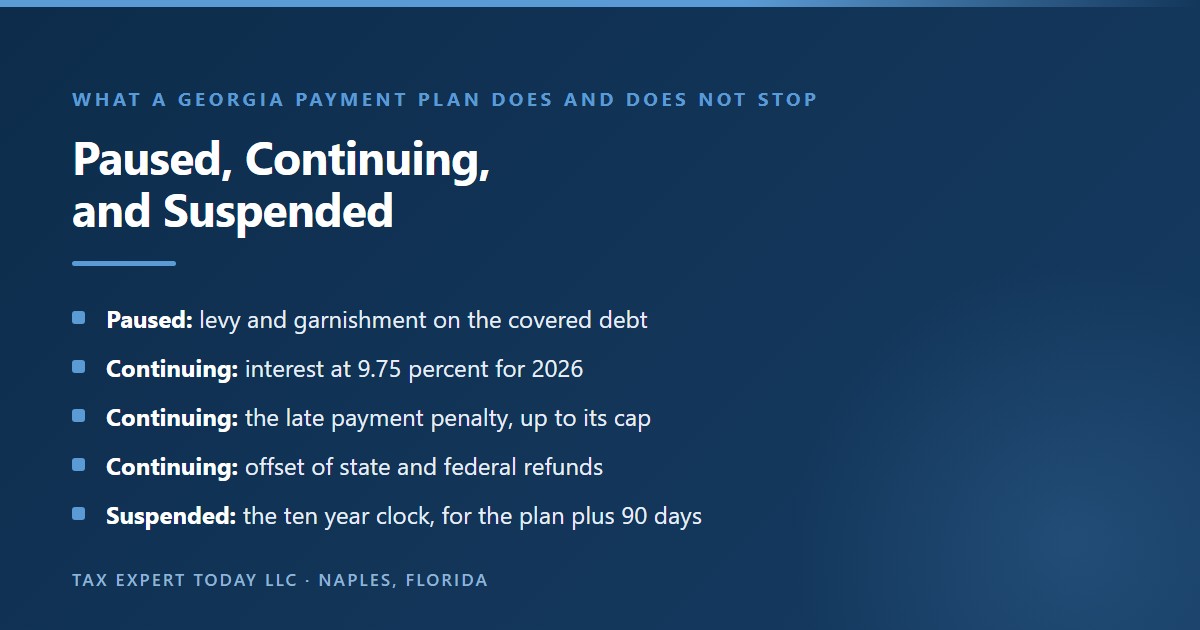
While a Georgia payment plan is current, the Department does not take enforcement action such as levy or garnishment on the debt covered by the plan. Interest, penalties, refund offsets, and any lien already recorded all continue, and the ten year collection period is suspended rather than running.
- Paused: levy, garnishment, and other enforced collection on the covered debt.
- Continuing: interest at the statutory rate and any penalty that has not reached its cap.
- Continuing: offset of state and federal refunds.
- Suspended: the periods of limitation for filing and enforcing the execution.
| Item | Status during a current plan | Source |
|---|---|---|
| Levy and garnishment on the covered debt | Not initiated while the agreement is in effect | Form GA-9465 instructions |
| Interest | Continues at the annual statutory rate | O.C.G.A. 48-2-40 and Form GA-9465 |
| Late payment penalty | Continues until the cap is reached or the balance is paid | Form GA-9465 and O.C.G.A. 48-7-86 |
| State refund offset | Continues | Payment plan questions page |
| Federal refund offset | Continues | Notice of Intent to Offset page |
| Recorded state tax execution | Remains of record until paid or released | O.C.G.A. 48-3-42 |
| Ten year life of the execution | Suspended for the plan plus 90 days | O.C.G.A. 48-3-42 |
| Duty to file and pay new returns | Continues, and a failure is a default | Payment Plans page |
The enforcement powers being paused are substantial. Under O.C.G.A. 48-2-55, all taxes are a personal debt of the person required to file the return or pay the tax. The commissioner may use garnishment to collect, and may levy upon all property and rights to property of the taxpayer, including any account with a financial institution. A financial institution served with a levy must remit within 15 days. Under O.C.G.A. 48-3-42, a filed execution has the same force and effect as a recorded judgment, so the execution does the work that a court judgment does for a private creditor.
That is the real value of a Georgia Department of Revenue payment plan. It does not reduce what is owed, and it does not stop the balance from growing. It keeps the taxpayer’s wages and bank accounts out of reach while payments are made on schedule. Readers dealing with federal enforcement at the same time can see how the federal versions of these tools work in our guides on how to stop an IRS wage garnishment and on an IRS bank levy release.
What Causes a Georgia Payment Plan to Default?
A Georgia payment plan defaults when a monthly payment is missed or returned by the bank, when a later return is not filed on time, or when tax due on a later return is not paid by its due date. The Department sends a written default notice first, with a date by which the taxpayer must act.
- Missed payment: a draft that fails for insufficient funds counts as a missed payment.
- New balance: a later return filed with tax due and no payment.
- Unfiled return: any required Georgia return not filed by its due date.
- Closed account: a bank account changed without telling the Department.
The Department states on its Payment Plans page that it will notify the taxpayer in writing if the plan is at risk of being cancelled or has reached defaulted status, along with the actions needed to keep the plan active. It warns that a payment that cannot be made, or that is returned unpaid by the bank, may subject the plan to cancellation or default and may bring additional fees and penalties.
The notice is described on the Department’s Payment Plan Default letter page. The letter tells the taxpayer that the plan requires attention, for reasons such as a missed payment or new debt incurred. The taxpayer must make the payment by the due date in the letter or the plan will be cancelled. If the notice is ignored, the Department may cancel the plan, continue to charge penalties and interest, and take further action to collect or make a legal claim on property, a bank account, or income.
Because the plan request requires consent to electronic notices, the default letter may arrive in GTC and not in the mailbox. A taxpayer who does not log in may not see it until the cure date has passed. The habit that prevents this is simple. Log in to GTC once a month, a few days after the scheduled draft, and confirm that the payment posted and that no new letters are waiting.
After a default, the Form GA-9465 instructions state that the Department may take enforcement actions, such as the filing of a state tax execution or a levy or garnishment action, to collect the entire amount owed. If no execution had been filed before, the default can be the event that brings the 20 percent collection fee. A defaulted plan is therefore more expensive than no plan, and a taxpayer who sees trouble coming should request a modification before the payment is missed rather than after.
Can You Change or Add Debt to an Existing Georgia Payment Plan?
Certain changes can be made to an existing Georgia payment plan, and they must be made at least 5 days before the scheduled draft. A change that requires a new plan, such as adding new debt, brings new fees. A change of bank account is made by telephone with the Department’s collection section.
- Timing: changes must take place 5 days before the scheduled draft.
- Adding debt: usually means cancelling the plan in GTC and requesting a new one.
- Bank change: the taxpayer contacts the Income Tax Collection Section with the new routing and account numbers.
- License holders: a holder of an alcohol or tobacco license cannot add new debt to a plan.
The Payment Plans page states that certain changes can be made to existing plans, and that if a change requires a new plan to be created, for example because additional debt is added, new fees will apply. The Form GA-9465 instructions describe the same process from the paper side. After an agreement is approved, the taxpayer may submit a request to modify it, a $50 administrative fee applies if the modification is approved, and the taxpayer must comply with the existing agreement while the Department considers the request.
The default letter page addresses new debt directly. A taxpayer with new taxes due is directed to the Georgia Tax Center to cancel the current plan and request a new one. The same page states that new debt cannot be added if the taxpayer also holds a license to sell alcohol or tobacco. For those businesses, a new balance has to be paid outside the plan, and an unpaid balance can affect the license.
A modification is the right tool when circumstances change. A job loss, a medical event, or a drop in business income can make the original payment impossible. The Department has no published hardship formula for plan payments, and a request is reviewed on its facts. The request should be made before a payment fails, it should propose a specific new amount that still clears the balance within the permitted term, and it should be kept in writing. When no affordable payment clears the balance within 60 months, the plan is the wrong tool and the offer in compromise discussed below may be the right one.
What Must You File and Pay While the Plan Is Active?
While a plan is active, every later Georgia return must be filed on time and any tax due must be paid by its due date. The Form GA-9465 instructions say the taxpayer must have enough withholding or estimated tax payments so that future income tax is paid in full when the return is filed.
- Returns: all future returns filed by their due dates.
- Payments: any tax due paid on or before the due date.
- Withholding: adjusted so wages carry enough Georgia tax.
- Estimated tax: paid quarterly by taxpayers with income not subject to withholding.
The Payment Plans page answers the question in one line. All future returns must be filed and any tax due must be paid on or before due dates for the payment plan to remain active. The default letter page repeats it and adds that a payment plan will not cover future taxes due.
This requirement is the one that ends plans for self employed taxpayers. The balance that led to the plan usually came from a year in which estimated payments were not made. If nothing changes, the next return also shows a balance, that balance is not covered by the plan, and the plan defaults. The fix has to be in place in the same month the plan begins. Quarterly payments are made on Form 500 ES, and the amounts, due dates, and safe harbors are covered in our guide to Georgia Form 500 ES.
Wage earners have the same duty in a different form. An employee whose Georgia withholding was too low needs a corrected Form G-4 on file with the employer, and employers carry their own filing duties that are covered in our guide to Georgia withholding tax. A taxpayer who needs more time to file a return can request a Georgia extension, but an extension of time to file is not an extension of time to pay. A balance unpaid on the original due date can still put the plan in default. The extension rules are explained in our guide to Georgia Form IT-303.
What If the Debt Is With a Private Collection Agency?
When the Department has assigned a liability to a private collection agency, the taxpayer arranges payment through that agency and not through Form GA-9465. The form instructions say so twice. Georgia law allows the Department to use contractors to collect delinquent taxes, and the regulation permits assignment once the collection fee has been added.
- Form rule: do not submit Form GA-9465 if the liability has been assigned to a private collection agency.
- Statute: O.C.G.A. 48-2-6(e) authorizes collection of delinquent taxes by approved contractors.
- Regulation: Rule 560-1-2-.02 allows assignment after the collection fee is imposed.
- Verification: the balance and its status can be confirmed in GTC before any payment is made.
The Form GA-9465 instructions state that if the tax liability has been assigned to a private collection agency, the taxpayer should contact that agency for payment plan options. The authority for the arrangement is O.C.G.A. 48-2-6, which authorizes the commissioner to provide for the collection of delinquent taxes, including penalties and interest, by contractors approved by the commissioner. The statute provides that such contractors are compensated only on a commission or contingent fee basis.
A call or letter from a collection agency about a Georgia tax debt should be verified before any money moves. The debt should appear in the taxpayer’s GTC account, with the same periods and a matching balance. A taxpayer who cannot match the agency’s figures to the account should contact the Department directly using a number from the Department’s own website or from an earlier Department notice. Scams that imitate state revenue agencies exist, and a genuine assignment can always be confirmed with the Department.
Assignment does not change what is owed or the taxpayer’s duties. Interest continues under the same statute, refund offsets continue, and an execution of record stays of record. An agreement made through the agency should be obtained in writing, with the monthly amount, the draft date, and the total balance stated. The same requirement to file and pay future returns on time applies.
How Do Payment Plans Work for Georgia Business and Trust Fund Taxes?
Businesses can request a Georgia payment plan for sales and use tax, withholding tax, and corporate income tax. Sales tax and withholding tax are trust fund taxes, and a person who was responsible for collecting and paying them and willfully failed to do so can be held personally liable under O.C.G.A. 48-2-52.
- Trust fund taxes: sales tax, withholding tax, and prepaid 911 tax, under Rule 560-1-2-.01.
- Personal liability: reaches officers, members, managers, partners, and employees with control over the funds.
- Two part test: the person must be responsible and the failure must be willful.
- Form GA-9465: a business request names the person responsible for the tax on line 3.
The Department is direct about how it views these taxes. Its penalty waiver page states that sales tax and withholding are trust fund taxes, that the money collected or withheld belongs to the state, that the debtor is holding the money in trust, and that it cannot be used by a business as additional operating capital or for any other purpose. A request for leniency on a trust fund balance is read in that light.
O.C.G.A. 48-2-52 makes an officer or employee of a corporation, a member, manager, or employee of a limited liability company, or a partner or employee of a limited liability partnership personally liable when that person has control or supervision of collecting the tax and willfully fails to collect it, account for it, or pay it over. The Department’s regulation, Rule 560-1-2-.01, explains that the liability is modeled on the federal responsible party statute. It lists the factors the Department considers, which include signing tax returns, authority to sign checks, control over financial affairs, and knowledge of the failure to pay. It also states that choosing to pay other creditors before the tax is an example of willfulness.
The regulation gives a responsible party the same procedural rights as any other taxpayer. The Department first issues a proposed assessment, and the person has 45 days to protest using the Department’s protest form. The regulation states that once the protest form is received, collection activity against the person for that liability is stayed. This is one of the clearest cases in which the order of steps matters. An owner who receives a responsible party proposed assessment and signs a plan request containing the line 9 waiver may give up a protest that had merit.
A business payment plan also depends on current compliance. A business that falls behind on a new sales tax or withholding return while paying an old balance will default. Related Georgia business rules are covered in our guides to the Georgia sales tax exemption and the Georgia net worth tax, which is a separate entity level tax that some businesses overlook and later find on a Department notice.
Should You Request a Penalty Waiver Before a Payment Plan?
Often, yes. A penalty waiver reduces the balance before the plan is sized, which lowers every payment and the interest that follows. Under O.C.G.A. 48-2-43, the commissioner may waive a penalty in whole or in part when the default was due to reasonable cause and not to gross or willful neglect.
- Standard: reasonable cause, and not gross or willful neglect or disregard of the law.
- How to request: in GTC under Request a Waiver of Penalty, or by mail on Form TSD-3.
- What is needed: the Letter ID from the assessment and a detailed reason.
- Collection fee: a waiver of the 20 percent fee can be requested at the same time.
The statute is short. O.C.G.A. 48-2-43 allows the commissioner to waive, in whole or in part, the collection of any amount due the state as a penalty whenever the commissioner reasonably determines that the default giving rise to the penalty was due to reasonable cause. The Department’s TSD-3 Request for Penalty Waiver page explains that each request is decided on its own merits, taking into account the documentation provided and the taxpayer’s compliance history, and that the Department may grant a partial waiver.
The order of steps is a judgment call. A waiver request takes time to decide, and interest continues while it is pending. If an official assessment has issued and the 45 day window is running, waiting on a waiver decision can let the execution and the 20 percent fee arrive. One workable approach is to request the plan on the full balance to stop the clock, request the waiver at the same time, and ask that any waived amount be applied to shorten the plan. The waiver language in the plan request should be read first, since a waiver of rights concerning the assessment could be argued to reach a later penalty request. We have not seen a Department statement on that point, so it is worth raising with the Department before signing.
A second statute is useful after the fact. Under O.C.G.A. 48-2-60, when a penalty has been paid and the commissioner determines within three years of the payment that the circumstances giving rise to it were reasonably beyond the control of the taxpayer, the commissioner may authorize a refund of all or part of the penalty and the interest paid on it. The federal standard for reasonable cause is similar in concept and is covered in our guide to reasonable cause penalty abatement. The Department has also issued a policy statement on penalty and interest waivers, which is linked from its TSD-3 page and should be read before a request is drafted. A Georgia request should rest on the documented facts of the particular failure.
Payment Plan or Offer in Compromise: Which One Fits?
A payment plan fits a taxpayer who can pay the full balance within 60 months. An offer in compromise fits a taxpayer who cannot, or who has real doubt about the liability. Georgia law allows the commissioner to compromise an assessment where there is doubt as to liability or doubt as to collectability.
- Payment plan: the full balance is paid over time, with interest.
- Offer in compromise: a lesser amount is accepted in settlement when the statutory grounds are met.
- Not both at once: a pending offer blocks a plan request.
- Both toll the clock: a plan and a pending offer each suspend the life of the execution.
| Feature | Georgia payment plan | Georgia offer in compromise |
|---|---|---|
| What is paid | The full balance, plus continuing interest and penalty | An agreed amount that is less than the full balance |
| Legal authority | Department procedure, with tolling under O.C.G.A. 48-3-42 | O.C.G.A. 48-2-18.1 |
| Form | GTC request or Form GA-9465 | Form OIC-1, with Form CD-14B or CD-14C for collectability or hardship offers |
| Fee | $50 administrative fee in the standard case | $100 nonrefundable application fee, waived at low income levels |
| Financial disclosure | Not part of the standard request | Collection information statement, pay stubs, and bank statements |
| Assessment required | A balance on a return or a notice | A final notice of assessment for all Georgia taxes owed |
| Returns | All required returns filed | All required returns filed, and estimated payments current |
The compromise statute is O.C.G.A. 48-2-18.1. It authorizes the commissioner to settle and compromise any proposed tax assessment, final tax assessment, or tax execution where there is doubt as to liability or doubt as to collectability and the settlement is in the interests of the state. Each offer must be accompanied by a $100 nonrefundable application fee, which is treated as part of the offer if the offer is accepted and which does not apply to applicants at or below the federal poverty guidelines. The Department’s Offer in Compromise page lists three grounds on the application, which are doubt as to collectability, doubt as to liability, and economic hardship.
The Department states that it will generally accept an offer when it is unlikely that the liability can be collected in full and the amount offered reasonably reflects collection potential. That is a demanding standard, and no taxpayer should assume an offer will be accepted. A taxpayer with steady income and equity in assets will usually be expected to pay in full over time.
The decision between an offer and a Georgia Department of Revenue payment plan is mostly arithmetic. If a realistic monthly payment clears the balance in 60 months, the plan is the tool. If it does not, the choices are a larger payment, a shorter list of expenses, or an offer. The two programs cannot be pursued at the same moment, and a taxpayer who files an offer while a levy is close should understand that the Department’s page requires timely filing and payment of all returns while the offer is pending. The federal program is separate in every respect and is covered in our guide to the IRS offer in compromise.
A taxpayer whose realistic payment will not clear the balance in 60 months can find the full offer process, including how Form CD-14C sets the minimum offer amount and what the terms of Form OIC-1 give up, in our guide to the Georgia offer in compromise.
Does a Georgia Payment Plan Cover a Federal Balance?
No. A Georgia payment plan covers only taxes owed to the Georgia Department of Revenue. A federal balance is owed to the Internal Revenue Service, a separate agency with its own agreements, forms, and collection law. A taxpayer who owes both needs two arrangements, and a default on one does not cure or excuse the other.
- Two creditors: the Georgia Department of Revenue and the Internal Revenue Service.
- Two agreements: each agency approves and monitors its own plan.
- Two budgets to reconcile: both payments have to fit the same household income.
- One shared asset: the federal refund, which either agency may reach.
| Item | Georgia | Federal |
|---|---|---|
| Agency | Georgia Department of Revenue | Internal Revenue Service |
| Online request | Georgia Tax Center | IRS Online Payment Agreement |
| Paper request | Form GA-9465 | Form 9465 |
| Interest authority | O.C.G.A. 48-2-40 | Internal Revenue Code section 6621 |
| Agreement authority | Department procedure and O.C.G.A. 48-3-42 | Internal Revenue Code section 6159 |
| Dispute forum | Georgia Tax Court or superior court | Federal procedures, including the United States Tax Court |
A Georgia balance and a federal balance often arrive together, because the Georgia return starts from federal adjusted gross income. An audit change or an amended federal return that raises federal income usually raises Georgia income too. Georgia taxpayers are required to report federal changes to the Department, and the process is covered in our guide to the Georgia amended tax return that is linked earlier in this article.
The IRS describes its own arrangements on its payment plans page. The federal terms changed in 2026, and older summaries of them are unreliable, so we do not restate them here. Our guides cover the current federal rules in detail, including the IRS partial payment installment agreement and IRS currently not collectible status. The Department’s published compliance pages describe payment plans, liens, offers in compromise, bankruptcy, and refund offsets. They do not describe a partial payment agreement or a hardship status that suspends collection, which is one more reason the Georgia plan has to be sized to pay the balance in full.
When both agencies are owed, the two payments should be planned together. Each agency will expect its own payment regardless of what was promised to the other. A budget that works for one agreement and fails for both will end in two defaults.
How Do Nonresidents and Former Georgia Residents Handle a Georgia Balance?
A nonresident or former resident who owes Georgia tax can request the same payment plan through the Georgia Tax Center from any state. Moving away does not end the liability. The Department can record an execution, offset federal refunds, and use the collection tools Georgia law provides, wherever the taxpayer now lives.
- Same plan: the requirements and terms do not depend on where the taxpayer lives.
- Federal refund: reachable through the Treasury Offset Program in any state.
- Georgia property: an execution filed in a Georgia county attaches to real property there.
- Appeal venue: nonresidents have specific venue rules under O.C.G.A. 48-2-59.
Georgia balances belonging to people who no longer live in Georgia tend to come from a few sources. One is a part year return for the year of the move that was filed with tax due or not filed at all, which is covered in our guide to the Georgia part year resident tax return. Another is the sale of Georgia real property by a nonresident, where withholding at closing did not cover the tax, which is covered in our guide to Georgia capital gains tax. A third is an ownership interest in a Georgia partnership or S corporation, where the owner is taxed on Georgia source income, which is covered in our guide to the Georgia composite return.
Notices are a recurring problem for people who have moved. The Department sends notices to the last known address on its records, and the statute measures several rules from that address. A taxpayer who moved without updating the address may learn of an assessment only after the protest window and the appeal window have both closed. The first step for a former resident who suspects a balance is to log in to GTC, update the address, and read every letter in the account.
The filing requirement also applies with a twist. The Department requires the last five years of state returns. A former resident who had no Georgia filing requirement in some of those years has not failed to file. A person in that position should be ready to explain which years carried no requirement and why, since an account that shows a missing year can lead to a denied request or an estimated assessment.
Can You Sell or Refinance Property While on a Georgia Payment Plan?
Yes, but a recorded state tax execution has to be dealt with at closing. The Department offers a partial release, which frees one property from the lien, and a subordination, which lowers the priority of the lien in favor of another lender. Requests should be submitted at least 30 days before closing.
- Partial release: Form CD-14135, used when a specific property is being sold.
- Subordination: Form CD-14134, used most often for a refinance.
- Timing: at least 30 days before the escrow closing date.
- Payoff figure: available through the lien search in the Georgia Tax Center.
The Department explains both tools on its partial release and subordination page. A partial release removes the lien from a specific piece of property while the lien stays in effect against any other property owned or later acquired. A subordination is different. It lowers the priority of the Department’s lien in favor of another lien, and the state tax lien remains in effect.
In evaluating a request, the Department states that it will review the reason and substantiation, verify that the property is being sold at or near fair market value, determine that industry standard fees and commissions are charged, and confirm that only senior lien holders and judgment creditors are paid. The last item means that sale proceeds are not to be paid out to the taxpayer or to junior creditors ahead of the state. The Liens page states that when there is a sale of the property, the lien attaches to the proportionate proceeds from the sale.
A taxpayer on a payment plan who plans to sell or refinance should begin by confirming whether an execution has been recorded and in which counties. If one has, the closing attorney will need either a payoff or a Department certificate. A sale can be the fastest way to end a plan, since the proceeds can pay the balance in full and stop the interest. A refinance can do the same at a lower rate than 9.75 percent, if the lender will proceed and the Department agrees to subordinate. Neither outcome is assured, and each request is decided by the Department on its facts.
Who Can Represent You in a Georgia Payment Plan Request?
A taxpayer may be represented before the Georgia Department of Revenue by an authorized agent, who may be an attorney, an accountant, or another person holding a properly completed power of attorney. Georgia uses Form RD-1061, and the Department will also accept federal Form 2848 in its place.
- Form RD-1061: the Georgia Power of Attorney and Declaration of Representative.
- Federal Form 2848: accepted by the Department in lieu of the Georgia form.
- Form RD-1062: a one time disclosure authorization that expires after the information is released.
- Account access: representatives work through their own GTC accounts, not the client’s login.
The right to representation is stated in the Taxpayer Bill of Rights. The forms are described on the Department’s power of attorney page. Form RD-1061 allows a representative to represent the taxpayer before the Department, receive confidential information, and perform certain acts on the taxpayer’s behalf. It is submitted through GTC or to the Department employee handling the matter. The Department notes that third parties may not access a client’s account through the client’s username and password.
Representation is about state procedure here. A Georgia payment plan, a Georgia penalty waiver, a Georgia protest, and a Georgia offer in compromise are all matters before a state agency under state law. Credentials that authorize practice before the Internal Revenue Service concern the federal agency. For Georgia matters, what the Department requires is the power of attorney described above. A taxpayer choosing a representative should ask whether the person has handled Georgia Department of Revenue collection matters in particular, since the forms, deadlines, and forums differ from the federal ones in the ways this guide has described.
Much of a Georgia Department of Revenue payment plan request can be handled by the taxpayer alone, and the Department has built the online request for that purpose. A representative adds the most value before the request, by confirming the balance, finding unfiled years, identifying any assessment worth protesting, preparing a penalty and collection fee waiver request, and sizing the payment so the plan does not default.
What Are the Most Common Georgia Department of Revenue Payment Plan Mistakes?
The most common mistakes are requesting a plan before filing missing returns, signing away a protest that had merit, choosing 60 months by default, ignoring the current year’s estimated tax or withholding, counting on a refund that will be offset, and waiting until after the state tax execution and its 20 percent fee.
- Requesting too early: a plan built on an incomplete balance defaults when the next assessment posts.
- Requesting too late: after the execution, the balance includes the 20 percent collection fee.
- Waiving a good protest: line 9 gives up the right to contest the assessment.
- Underfunding the current year: a new balance due is a default.
- Not reading GTC: default notices arrive electronically.
The first mistake is a sequencing error. The balance in GTC today may not be the whole balance. Unfiled years, a pending adjustment, or a federal change that has not yet been reported can each add to it. Requesting a plan on a partial balance and then cancelling it to add debt means paying the administrative fee twice and restarting the process.
The second mistake is the costly one. The window between the official assessment and the execution is 45 days. A taxpayer who spends that time hoping the notice is wrong, without protesting or paying or requesting a plan, can see a 20 percent fee added and a lien recorded. On a $12,000 assessment that is a hypothetical $2,400 for a delay of a few weeks.
The third mistake is signing without reading. The waiver on line 9 is printed on the form. It is not hidden, but almost no one who signs the form reads that paragraph, and none of the pages that currently rank for this topic mention it. A taxpayer who has any doubt about the amount should resolve that doubt first.
The fourth mistake is relying on stale information. Pages written before July 2025 describe a 30 day protest window. Pages written before July 2026 send appeals to the Georgia Tax Tribunal. Pages that quote an interest rate without a year are quoting a number that changes each January. For any figure that matters, the Department’s current page and the statute itself are the sources to check.
Georgia Department of Revenue Payment Plan Help in Naples & Southwest Florida
Tax Expert Today LLC works from Naples, Florida and handles state tax matters nationwide, including Georgia payment plan requests, balance verification in the Georgia Tax Center, unfiled Georgia returns, penalty and collection fee waiver requests, and state tax execution issues. Georgia clients are served from the Naples office and do not need to travel.
- Georgia tax payment plan help Naples covers Southwest Florida residents who moved from Georgia or who own Georgia property or businesses.
- Balance reviews begin with the GTC account, the notices by Letter ID, and the filing history for the last five years.
- Combined federal and Georgia balances are planned together so both payments fit one budget.
- Remote engagement is standard. Documents are exchanged through a secure client portal and not by email.
Tax Expert Today LLC
11983 Tamiami Trail N, Naples, FL 34110
Telephone: (239) 441-2005
Hours: Monday through Friday, 10:00 a.m. to 5:00 p.m. Eastern Time
A local question we are asked often: I moved from Atlanta to Naples two years ago and just received a Georgia notice for a year when I still lived there. Florida has no income tax, so can Georgia still collect? Yes. The liability belongs to the year in which you were a Georgia resident or had Georgia source income, and a later move to Florida does not change it. Georgia can record a state tax execution, offset a federal refund through the Treasury Offset Program, and use the collection tools in Georgia law. The first steps are to read the notice, note its date, confirm whether the 45 day protest or appeal window is still open, and check the GTC account for other years. The full range of Georgia engagements is described on our Georgia tax services page, and federal collection matters for Southwest Florida residents are covered on our Naples tax resolution page.
When to Engage a Professional
A taxpayer with a single year balance from a filed return, no dispute over the amount, and a payment that fits the budget can usually request a plan directly in the Georgia Tax Center. Review is worth it when returns are unfiled, the assessment is questionable, an execution has been recorded, or both Georgia and the IRS are owed.
- A taxpayer with unfiled Georgia years who needs the returns prepared before the plan can be requested.
- A taxpayer who disagrees with an assessment and needs to decide between a protest and a plan.
- A business owner facing a responsible party assessment for sales or withholding tax.
- A taxpayer who cannot clear the balance in 60 months and needs the offer in compromise evaluated.
- A taxpayer selling or refinancing property with a state tax execution of record.
Dr. Pellumb Kabashi is the founder of Tax Expert Today LLC, and the firm includes tax advisors, enrolled agents, certified public accountants, and attorneys. Georgia Department of Revenue matters are state tax matters and not federal ones, and they are handled under Georgia procedure and Georgia authority. Nothing in this article is advice for a particular taxpayer, and the result in any specific case depends on facts that a general article cannot know. The Department decides every payment plan, waiver, and compromise request on its own facts, and no outcome can be promised. Taxpayers who want a Georgia balance reviewed as part of a broader plan can start with our Georgia state tax advisory page, and those with a federal balance as well can review our IRS resolution and audit support services. Call (239) 441-2005 for a free consultation, or reach the Naples, Florida office during business hours.
Frequently Asked Questions
How long can a Georgia Department of Revenue payment plan last?
A Georgia Department of Revenue payment plan cannot exceed 60 months, according to the Department’s Payment Plans page and Form GA-9465. The payment proposed must be large enough to clear the full balance, including the interest that accrues during the plan, within the term selected. Extra payments are allowed at any time and reduce the penalty and interest paid.
What is the minimum monthly payment on a Georgia payment plan?
The minimum monthly payment is $25. That figure is a floor and not an entitlement. At the 2026 interest rate of 9.75 percent, a payment of $25 a month for 60 months retires a balance of roughly $1,180 in a hypothetical computation that ignores penalties and fees, so larger balances need a larger payment to finish within 60 months.
What interest rate does Georgia charge on unpaid taxes in 2026?
The annual interest rate on past due Georgia taxes is 9.75 percent for calendar year 2026, accruing monthly, as announced in Department Policy Bulletin ADMIN-2026-01. Under O.C.G.A. 48-2-40 the rate equals the bank prime loan rate plus 3 percent and is reset each January. The rate for 2025 was 10.50 percent.
Is there a fee to set up a Georgia payment plan?
Yes. The Department’s Payment Plans page lists a $50 administrative fee for automatic draft plans, which is added to the balance, and a $100 fee for agreements paid by paper check. The Form GA-9465 instructions describe a reduced fee of $25 when income is less than $22,050 and a $50 fee when a modification is approved.
Does a Georgia payment plan stop interest and penalties?
No. The Form GA-9465 instructions state that interest and any applicable penalties are charged until the balance is paid in full, even when the request to pay in installments is granted. For income tax, the late payment penalty is 0.5 percent of the unpaid tax for each month, subject to a combined cap of 25 percent with the late filing penalty.
Will Georgia keep my tax refund if I am on a payment plan?
Yes. The Department states that it does not send refunds to taxpayers with outstanding state tax debt and that refunds are applied to the debt until it is paid in full. It also offsets federal income tax refunds through the Treasury Offset Program, even when plan payments are current. Regular monthly payments remain due unless the offset pays the balance in full.
What happens if I miss a payment on a Georgia payment plan?
The Department sends a written notice stating that the plan is at risk of cancellation and giving a date by which the payment must be made. If the notice is ignored, the Department may cancel the plan, continue to charge penalties and interest, and take enforcement action, which can include a state tax execution, a levy, or a garnishment.
Does a payment plan extend the time Georgia has to collect?
Yes. Under O.C.G.A. 48-3-42, a state tax execution expires ten years after filing, and that period is suspended for the duration of an installment agreement plus an additional 90 days. A 60 month plan can therefore add more than five years to the period in which the Department may collect if the plan later defaults.
Does a Georgia payment plan cover what I owe the IRS?
No. A Georgia payment plan covers only taxes owed to the Georgia Department of Revenue. A federal balance is owed to the Internal Revenue Service and requires a separate federal agreement under federal law. A taxpayer who owes both agencies needs two arrangements, and both payments have to fit the same budget.
I live in Naples, Florida now. Can I still set up a Georgia payment plan?
Yes. A former Georgia resident or a nonresident with Georgia source income can request a plan through the Georgia Tax Center from any state. Moving to Florida does not end a Georgia liability for a year in which Georgia tax was owed. Tax Expert Today LLC handles Georgia payment plan matters from its Naples, Florida office at (239) 441-2005.
Published September 29, 2026 by Dr. Pellumb Kabashi « Back to Learning Center
Have a question this article touches on?
Tax Expert Today LLC, based in Naples, Florida and serving clients across the United States.
Schedule a Consultation (239) 441-2005