
By Dr. Pellumb Kabashi, DBA, MBA, EA, CFE, CES
Founder, Tax Expert Today LLC · Tax advisors, enrolled agents, CPAs, and attorneys · Serving clients in all 50 states
Quick Answer: In a 1031 exchange Georgia follows the federal deferral, so gain that is deferred federally is generally not taxed on the Georgia return. A nonresident selling Georgia real property faces 3 percent withholding at closing unless an exemption applies; a fully deferred exchange can use Form IT-AFF3, and boot is taxed at the 2026 flat rate of 4.99 percent. Call (239) 441-2005 for a free consultation.
Search for a 1031 exchange in Georgia and almost every page that comes back is written by a qualified intermediary or a Delaware statutory trust sponsor. Those pages explain the exchange itself well: the 45 day identification window, the 180 day closing window, the requirement that a qualified intermediary hold the cash, and the advice to buy property of equal or greater value and debt. What they cover in a sentence or two, if at all, is what the Georgia return and the Georgia closing table require of the seller. That is the part that catches people. A Florida resident selling an Atlanta rental, for example, can do everything right on the federal side and still have 3 percent of the sales price withheld at closing because nobody signed the right Georgia form. A Georgia resident who exchanges into a Tennessee duplex can wonder for years whether Georgia still has a claim on the deferred gain. This guide is about the state side of a 1031 exchange Georgia sellers actually face. Throughout, the phrase 1031 exchange Georgia rules means the Georgia statutes, regulations, and forms that apply when a federal like kind exchange involves Georgia property or a Georgia taxpayer.
Tax Expert Today LLC handles state tax matters nationwide from its office in Naples, Florida. The 1031 exchange Georgia questions that reach us most often come from investors who own Georgia rental or commercial property while living somewhere else, from Georgia residents who plan to sell and move, and from partnerships and LLCs that hold Georgia real estate for owners in several states. Our Georgia tax services overview shows how this topic fits with the rest of a Georgia taxpayer’s filings. Every Georgia figure in this article was read from Georgia Department of Revenue forms and pages, Georgia regulations, and the Internal Revenue Code on October 16, 2026. It is educational, not advice for any particular transaction, and every example is hypothetical.
A note on scope. The federal mechanics of an exchange, including identification rules, reverse exchanges, and how basis carries over, are covered in depth in our 1031 exchange rules guide. Georgia’s general treatment of capital gains, including rates and the retirement exclusion, is covered in our Georgia capital gains tax article. This page gives the federal rules only the space 1031 exchange Georgia questions need and spends the rest on what is specific to Georgia: conformity, boot, nonresident withholding, the IT-AFF forms, Form G2-RP, out of state replacement property, moves, and entity level situations.
What Does a 1031 Exchange Mean for Georgia Taxes?
Under 1031 exchange Georgia rules, gain deferred on the federal return is generally deferred on the Georgia return too, because Georgia starts its income computation from federal adjusted gross income. Gain that is recognized federally, usually because of boot, becomes Georgia income, and a nonresident seller must also deal with Georgia withholding at closing.
- Federal starting point: Form 500 begins with federal adjusted gross income.
- Deferral carries through: deferred gain never enters federal AGI, so it never enters Georgia income.
- Boot is taxed: recognized gain flows to the Georgia return at the flat rate.
- 1031 exchange Georgia withholding: nonresident sellers of Georgia real property face 3 percent withholding unless exempt.
- Later sale matters: the deferred gain is taxed when the replacement property is sold in a taxable sale.
A 1031 exchange is a federal provision. Under Internal Revenue Code Section 1031, no gain or loss is recognized when real property held for productive use in a trade or business or for investment is exchanged solely for real property of like kind that will also be held for business or investment use. The gain is not forgiven. It is carried into the replacement property through a lower basis, and it is recognized when that property is eventually sold in a taxable transaction, unless another exchange defers it again or another rule, such as the basis step up at death, changes the result.
There is no separate 1031 exchange Georgia statute that grants or denies deferral. It reaches the same result through conformity. The Georgia individual return begins with federal adjusted gross income, and the 2025 IT-511 instruction booklet states that Georgia conforms to the Internal Revenue Code as amended by federal law enacted on or before January 1, 2025. Section 1031 in its current form, limited to real property, has been in place since 2018, so Georgia’s conformity date captures it. When the federal return shows no recognized gain on a qualifying exchange, there is no gain in federal adjusted gross income for Georgia to start with.
That simple 1031 exchange Georgia rule has three practical consequences, and the rest of this guide is organized around them. First, anything the federal return recognizes, mainly boot and certain depreciation recapture, becomes Georgia income for a resident and Georgia source income for a nonresident who sold Georgia property. Second, Georgia’s nonresident withholding law operates at the closing table, separately from the income tax return, and it does not automatically know the sale is part of an exchange. Third, the deferred gain follows the replacement property, so where that property is located and where the owner lives when it is later sold decide which state taxes the gain in the end.
It helps to keep the two 1031 exchange Georgia systems apart. The income tax is figured on Form 500 once the year ends. The withholding under O.C.G.A. Section 48-7-128 is a prepayment collected by the buyer at closing, reported on Form G2-RP, and claimed as a credit on the seller’s Form 500. In a 1031 exchange Georgia withholding and Georgia income tax can point in different directions if the paperwork is missing: the return may show no tax at all while the closing statement shows a large amount withheld. The withheld amount can be recovered by filing, but the cash is tied up until the return is processed.
Does Georgia Follow the Federal 1031 Exchange Rules?
Yes. On 1031 exchange Georgia questions the state conforms to the Internal Revenue Code as amended by federal law enacted on or before January 1, 2025, according to the 2025 IT-511 booklet, and that includes Section 1031 as limited to real property. Georgia does not add its own identification deadlines, qualified intermediary requirements, or a separate deferral computation for individuals.
- Conformity date: federal law enacted on or before January 1, 2025, per the 2025 IT-511.
- Real property only: Georgia follows the post 2017 federal limit.
- Same deadlines: the 45 day and 180 day periods are federal and apply as written.
- No 1031 exchange Georgia form: the deferral itself is reported on federal Form 8824.
- Later federal changes: Georgia adopts them only when the conformity date is moved.
Georgia updates its Internal Revenue Code conformity by statute, usually each legislative session. The 2025 IT-511 booklet says Georgia had not adopted the changes in the federal One Big Beautiful Bill Act because that Act was signed on July 4, 2025, after the conformity date. None of the widely discussed provisions of that Act changed Section 1031 itself, but the point is a general one worth remembering: when federal law changes, Georgia follows only after its legislature moves the conformity date. For a 1031 exchange Georgia closing in 2026, the relevant question is the conformity date that applies to the 2026 Georgia return, which should be confirmed when the 2026 booklet is released.
Because Georgia follows Section 1031, every federal requirement for a valid exchange also decides the 1031 exchange Georgia result. If the exchange fails federally, it fails for Georgia. If the federal return correctly reports a partial exchange with boot, the Georgia return picks up the recognized portion. There is no Georgia election to defer gain that is recognized federally, and no Georgia rule that taxes gain the federal return properly defers. This is why a 1031 exchange Georgia review always begins with the federal Form 8824. The IRS page for Form 8824 describes it as the form used to report each exchange of business or investment real property for real property of a like kind, and the gain recognized on that form is the number that flows into federal adjusted gross income and from there into Georgia.
Georgia does have rules that touch an exchange indirectly. Depreciation is the clearest example. Georgia has, in some years, decoupled from federal bonus depreciation, which can leave a property with a different Georgia basis than federal basis. When basis differs, the gain recognized on a later taxable sale can differ too, and the difference is handled through Georgia adjustments rather than through the exchange computation itself. A seller with a long Georgia holding period and a history of bonus depreciation on improvements should have the Georgia basis schedule reviewed before assuming that the Georgia gain equals the federal gain.
| 1031 exchange Georgia element | Federal rule | Georgia treatment |
|---|---|---|
| Deferral of gain | IRC 1031(a) | Follows federal AGI, so deferred gain is not Georgia income |
| Qualifying property | Real property held for business or investment | Same, through conformity |
| Identification and closing | 45 days and the earlier of 180 days or the return due date with extensions | No separate Georgia deadline |
| Boot | Gain recognized up to the boot received | Recognized gain is Georgia income or Georgia source income |
| Reporting | Form 8824 with the federal return | No separate 1031 exchange Georgia form; Form 500 starts from federal AGI |
| Nonresident closing | FIRPTA applies only to foreign persons | O.C.G.A. 48-7-128 withholding applies to nonresidents of Georgia |
How Does Georgia Tax a Deferred Gain for a Georgia Resident?
A Georgia resident pays no Georgia tax on gain that is deferred in a valid 1031 exchange, because the gain never enters federal AGI. After a 1031 exchange Georgia taxes the deferred gain later only if the owner is still a Georgia resident, or the property is in Georgia, when the replacement property is sold in a taxable sale.
- Year of exchange: no Georgia tax on deferred gain; boot is taxed in that year.
- Residents taxed on all income: a later sale anywhere is Georgia income while you are a resident.
- Replacement in Georgia: a later sale is Georgia source income even after you move away.
- Replacement elsewhere: a later sale after you leave Georgia generally is not Georgia source income.
- Credit for other states: available to residents when another state also taxes the gain.
The IT-511 booklet states that full year residents are taxed on all income, except tax exempt income, regardless of the source or where it is derived. For a 1031 exchange Georgia residents complete, that means the location of the replacement property does not matter while you remain a Georgia resident. If you exchange an Augusta rental for an apartment building in South Carolina and later sell the South Carolina building in a taxable sale while still living in Georgia, the entire gain, including the gain deferred from the Augusta property, appears in your federal adjusted gross income and is Georgia income. South Carolina would also tax the gain from property located there, and Georgia allows a credit for taxes paid to another state, which the booklet says requires a copy of the other state’s return.
In 1031 exchange Georgia planning, residence at the time of the later taxable sale is the decisive fact. A Georgia resident who exchanges, then moves to Florida, and then sells the replacement property is in a different position, explained in detail in the sections on out of state replacement property and moves below. The short version is that Georgia taxes nonresidents only on Georgia source income, and gain from selling property located outside Georgia is generally not Georgia source income for a nonresident.
There is one more 1031 exchange Georgia scenario worth naming for residents. A Georgia resident who exchanges repeatedly, from property to property, never recognizes the deferred gain until the chain ends. If the chain ends at death, the federal basis step up under Internal Revenue Code Section 1014 generally eliminates the deferred gain for the heirs, and Georgia, starting from federal figures, follows. Georgia has no estate tax, as our Georgia inheritance tax article explains, so the step up carries particular weight in long term Georgia planning. That is a planning consideration that depends on the facts of each estate, and it should be weighed with an estate planning attorney rather than assumed.
How Does Georgia Tax Boot in a 1031 Exchange?
In a 1031 exchange Georgia taxes boot because federal law does. When an exchanger receives cash, net debt relief, or other non like kind property, Section 1031(b) recognizes gain up to that boot. The recognized gain enters federal adjusted gross income and becomes Georgia income for a resident or Georgia source income for a nonresident selling Georgia property.
- Cash boot: proceeds released from the exchange account to the seller.
- Mortgage boot: debt relief on the old property not offset by new debt or added cash.
- Personal property: furniture or equipment that is not real property after 2017.
- Non qualifying costs: some closing charges paid from exchange funds can create boot.
- Recognized, not total, gain: boot is taxed only up to the realized gain.
Section 1031(b) provides that if an exchange would qualify except that the taxpayer also receives money or other property, gain is recognized but not in excess of the money and the fair market value of the other property received. The common sources of boot are cash taken out of the exchange, a replacement property bought for less than the relinquished property, and replacement debt lower than the debt paid off at the sale, unless the shortfall in debt is made up with new cash. Since 2018, items of personal property included in a sale, such as appliances in a furnished rental or equipment in a commercial building, are not like kind to real property and are treated as sold.
1031 exchange Georgia rules add nothing to the computation. Whatever gain the federal Form 8824 shows as recognized appears in federal adjusted gross income, and Georgia applies its flat rate through Form 500. There is no Georgia capital gains rate. The 2026 rate of 4.99 percent, confirmed on the Georgia Department of Revenue Important Tax Updates page on the date of this article, applies to the recognized gain like any other income, after Georgia adjustments and deductions.
| Type of boot | How it arises | Georgia effect |
|---|---|---|
| Cash boot | Exchange funds released to the seller or used for non exchange purposes | Recognized gain is taxed on Form 500 in the year received |
| Mortgage boot | Debt paid off exceeds new debt plus added cash | Same as cash boot |
| Personal property | Furnishings, equipment, or other non real property in the sale | Treated as a taxable sale of that property |
| Excess property value | Replacement property worth less than relinquished property | Usually appears as cash boot or mortgage boot |
| Non qualifying expenses | Certain charges paid from exchange proceeds | May be treated as boot depending on the item |
For a nonresident, boot from a Georgia property is the part of a 1031 exchange Georgia actually taxes, and it is also the part that drives Georgia withholding at closing, as discussed in the withholding sections below. For a part year resident, the timing of the boot relative to the move decides whether it is treated as income earned while a resident or Georgia source income earned while a nonresident, which Schedule 3 of Form 500 sorts out.
What Georgia Rate Applies to Recognized Gain in 2026?
In a 1031 exchange Georgia taxes recognized gain at its flat individual income tax rate, listed as 4.99 percent for 2026. The 2025 rate was 5.19 percent according to the 2025 IT-511 booklet. Georgia has no separate capital gains rate, so long term gain, short term gain, and recapture are all taxed at the same rate.
- 2026 rate: 4.99 percent, per the Department’s Important Tax Updates page.
- 2025 rate: 5.19 percent, per the 2025 IT-511 booklet.
- No preferential rate: capital gains are taxed as ordinary Georgia income.
- Rolling reductions: Georgia has cut the rate in steps, so confirm the year’s rate.
- Corporations and electing entities: the Department lists 4.99 percent for 2026 as well.
The flat rate makes Georgia simpler than the federal system for gain. Federally, long term capital gain is taxed at preferential rates, unrecaptured Section 1250 gain on real property is taxed at a maximum of 25 percent, and Section 1245 recapture is taxed as ordinary income. Georgia does not distinguish among them. Every dollar of recognized gain that reaches federal adjusted gross income is taxed at the same Georgia rate, subject to the retirement income exclusion for qualifying taxpayers 62 and older, which is explained in our Georgia retirement income exclusion article.
Georgia has been reducing its rate on a rolling basis, so the year of the taxable event matters. The 2026 standard deduction also increased, to $15,000 for single filers, heads of household, and married filing separately, and $30,000 for married filing jointly, according to the same Department page. For a seller weighing whether to take some boot in 2026, those figures set the Georgia cost of the boot. For a seller weighing the timing of a later taxable sale, the rate in effect in that later year will apply, and that rate should be checked again when the time comes rather than assumed from today.
| Item | Figure | Source |
|---|---|---|
| 2026 Georgia individual rate | 4.99 percent flat | Department of Revenue, Important Tax Updates |
| 2025 Georgia individual rate | 5.19 percent flat | 2025 IT-511 booklet |
| 2026 standard deduction, single | $15,000 | Department of Revenue, Important Tax Updates |
| 2026 standard deduction, married filing jointly | $30,000 | Department of Revenue, Important Tax Updates |
| Nonresident closing withholding | 3 percent of price, or of gain with Form IT-AFF2 | Ga. Comp. R. & Regs. 560-7-8-.35 |
A hypothetical example shows the scale. Suppose a Georgia resident completes an exchange in 2026 and receives $40,000 of cash boot on a property with a realized gain far larger than that. Federally, $40,000 of gain is recognized. For Georgia, before considering deductions, other income, or the retirement exclusion, $40,000 at 4.99 percent is $1,996. The rest of the realized gain stays deferred for both returns. The numbers are illustrative only; the actual Georgia tax depends on the whole return.
How Is Depreciation Recapture Treated on the Georgia Return?
In a 1031 exchange Georgia treats depreciation recapture the way the federal return does. In a fully deferred exchange, recapture is generally deferred with the rest of the gain. Recapture that is recognized federally, for example on personal property in the sale or with boot, enters federal adjusted gross income and is taxed by Georgia at the flat rate.
- Deferred with the gain: recapture generally carries into the replacement property.
- Personal property: Section 1245 recapture on non real property is recognized.
- No rate difference: Georgia taxes recapture at the same rate as other gain.
- Basis differences: Georgia depreciation adjustments can change the Georgia gain.
- Cost segregation: components classified as personal property can create recognized gain.
Investors who used a cost segregation study to accelerate depreciation on a Georgia building should pay close attention here. A cost segregation study reclassifies parts of a building into shorter lived personal property and land improvement categories. When that building is later exchanged, the components treated as personal property are not like kind to real property under the post 2017 Section 1031, so the gain attributable to them may be recognized and taxed as ordinary income federally. Georgia taxes that recognized amount through federal adjusted gross income. Whether a component is real property for Section 1031 purposes is decided under the federal regulations, not by its depreciation class alone, so this is an area for a careful federal analysis before the Georgia effect can be stated.
Georgia’s own depreciation rules add a second layer. The 2025 IT-511 booklet refers to business income computed under the Internal Revenue Code as defined for Georgia purposes, with the Section 168(k) bonus depreciation disallowance, and it lists adjustments due to federal tax changes. When a taxpayer took bonus depreciation federally but not for Georgia, the Georgia adjusted basis of the property is higher than the federal adjusted basis. A higher Georgia basis means a smaller Georgia gain when the property is finally sold. In a 1031 exchange Georgia basis and federal basis both carry into the replacement property and should be tracked separately, because the difference will matter on the eventual taxable sale. Our bonus depreciation article covers the federal side of that rule.
The practical 1031 exchange Georgia step is simple to describe and often skipped: keep a separate Georgia basis schedule for the relinquished and replacement properties. Without it, a seller years later may report the federal gain on the Georgia return and pay Georgia tax on depreciation that Georgia never allowed in the first place.
What Is Georgia Nonresident Withholding on a Real Estate Sale?
Under O.C.G.A. Section 48-7-128, a buyer of Georgia real property from a nonresident of Georgia must withhold 3 percent of the purchase price and send it to the Department of Revenue, unless an exemption applies. With a sworn affidavit of gain, Form IT-AFF2, the 3 percent can be applied to the recognized gain instead of the price.
- Default rate: 3 percent of the purchase price or consideration.
- Gain alternative: 3 percent of recognized gain shown on Form IT-AFF2.
- Price threshold: no withholding when the price is less than $20,000.
- Liability threshold: no withholding when the liability is less than $600 on an IT-AFF2.
- Buyer liability: a buyer who fails to withhold is personally liable for the tax.
The Department’s withholding guide describes this as income tax withholding, not a sales tax or transfer tax. It works much like wage withholding. The buyer withholds Georgia income tax from the payment to the seller and gives the seller a statement, which the seller attaches to the Georgia income tax return to claim credit. The guide is explicit that the nonresident seller still has to file a Georgia return, because the actual tax is determined on the return, and the seller then either receives a refund of any overpayment or pays any balance due.
The statute, as reprinted in that guide, also caps the withholding. If the amount required to be withheld exceeds the net proceeds payable to the seller, the buyer withholds and pays over only the net proceeds. And because the person or entity named as the seller on the settlement statement is the seller for all purposes under the statute, the closing documents decide whose residency and whose forms count.
Georgia’s rule is separate from the federal FIRPTA regime. FIRPTA applies to foreign persons selling United States real property interests and is covered in our FIRPTA withholding guide and our article on Form 8288-B withholding certificates. Georgia’s rule applies to anyone whose residence or principal place of business is outside Georgia, which includes United States citizens living in Florida, Tennessee, or anywhere else. A foreign seller of Georgia property can face both regimes at the same closing. In a 1031 exchange Georgia withholding and FIRPTA withholding each have their own exchange paperwork, and one does not satisfy the other.
Who Counts as a Nonresident Seller for Georgia Withholding?
Rule 560-7-8-.35 treats an individual as a nonresident if their principal residence is outside Georgia at the time of closing, and a corporation, partnership, limited liability company, or limited liability partnership as a nonresident if its principal place of business is outside Georgia. Trusts are tested by the residence of the fiduciary or the beneficiaries taxed on the gain.
- Individuals: principal residence outside Georgia on the closing date.
- Entities: principal place of business outside Georgia.
- Trusts: nonresident fiduciary, or nonresident beneficiaries taxed on the gain.
- Deemed residents: sellers meeting every condition in 48-7-128(a) with an affidavit.
- Co-owners: each owner’s residence is determined separately.
The definition in rule 560-7-8-.35 is functional rather than technical. An individual who moved from Atlanta to Naples before closing is a nonresident for withholding purposes on that closing date, even if a Georgia part year return will be filed for the year. A Delaware LLC with its office in Savannah is not a nonresident under the rule, because the test is the principal place of business, not the state of organization. A Georgia LLC managed from Tampa is a nonresident.
| Seller type | Nonresident of Georgia when | Exchange note |
|---|---|---|
| Individual | Principal residence outside Georgia at closing | Most common exchange seller; may use IT-AFF3 or IT-AFF2 |
| Corporation | Principal place of business outside Georgia | Exchange rules apply to C corporations as well |
| Partnership or LLC taxed as a partnership | Principal place of business outside Georgia | Composite return or entity election can affect withholding |
| Limited liability partnership | Principal place of business outside Georgia | Same as partnership |
| Trust | Nonresident fiduciary, or nonresident beneficiaries taxed on the gain | Depends on who is taxed on the gain |
| Single member LLC | Listed with its owner on the Department forms | Both the LLC and the owner should be named |
Because withholding turns on status at closing, timing a move around a sale changes the paperwork. A seller who still lives in Georgia at closing is a resident for this rule, needs no affidavit, and simply reports the sale on a full year or part year Georgia return. A seller who has already moved is a nonresident at closing and needs an exemption, a gain affidavit, or deemed resident status to avoid withholding on the full price. For a seller doing a 1031 exchange Georgia withholding is usually avoidable, but only when the right form is in the closing file before the closing date.
Standing timber deserves a brief mention because it is common in rural 1031 exchange Georgia transactions. The Department’s guide states that under Georgia law standing timber is real property, so a sale of timber where title passes before severance is subject to the withholding rule, while timber sold after severance is personal property and is subject to withholding only if the land is sold with it. Timberland is a frequent relinquished property in exchanges, and the same exemption analysis applies.
How Does a 1031 Exchange Affect Georgia Withholding at Closing?
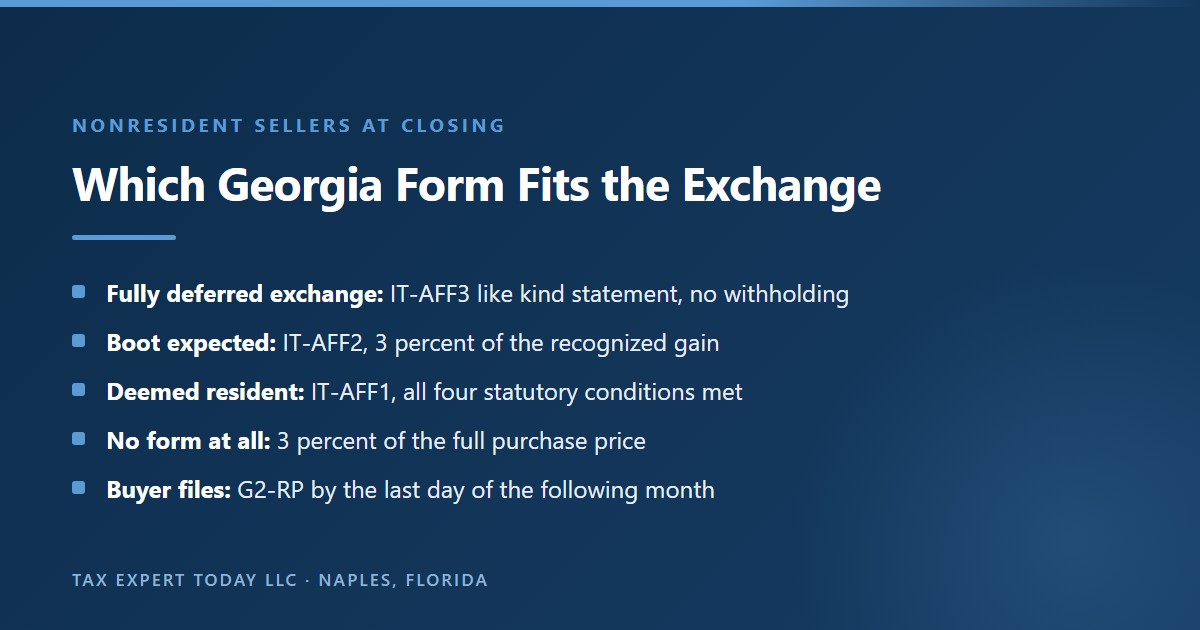
In a valid 1031 exchange Georgia withholding at closing can be removed. The Department’s guide lists a like kind exchange as an exemption when all the income from the sale is not subject to federal or state income tax, and its exchange answer says withholding is not required to the extent the income is not subject to Georgia income tax.
- Full deferral: no withholding, documented with the like kind statement on Form IT-AFF3.
- Partial deferral: withholding applies only to the gain that is recognized.
- Gain affidavit: Form IT-AFF2 lets the buyer withhold on recognized gain only.
- No form filed with the state: the exemption certificate stays in the closing file.
- Coordinate early: the closing attorney needs the forms before funds are disbursed.
The Georgia Department of Revenue’s guide to these rules lists nine exemptions in plain language. Item I reads, in substance, that the transaction is a like kind exchange and all of the income from the sale is not subject to federal or state income tax. The guide’s question and answer section asks directly whether withholding is required on a like kind exchange, and the Department’s answer is that withholding is not required to the extent the income from the sale is not subject to Georgia income tax. That wording matters. It does not exempt every exchange from every dollar of withholding. It exempts the part of the sale that produces no Georgia taxable income.
In a fully deferred 1031 exchange Georgia sees no taxable income at all: the seller receives no boot, the federal Form 8824 will show no recognized gain, and no withholding is due. For a partial exchange, where some boot is expected, the recognized gain is Georgia taxable income, and withholding applies to that part. The mechanism for limiting withholding to the recognized gain is the affidavit of gain, Form IT-AFF2, discussed below.
The difficulty in a 1031 exchange Georgia closing is timing. Withholding is decided at the closing of the relinquished property, when the exchange is not yet complete. The seller does not know for certain on that day whether the replacement property will be identified within 45 days and acquired within 180 days, or whether every dollar will be reinvested. The Department’s forms ask the seller to swear to the facts as they are expected to be, and the seller remains responsible for filing a Georgia return and paying any tax if the facts turn out differently. That is why the exemption should be treated as a representation the seller is prepared to stand behind, not as a box to tick.
The buyer’s side explains why closing attorneys care. Under the statute, a buyer who fails to withhold is personally liable for the tax. The Department’s guide says a buyer’s reasonable reliance on a seller’s sworn affidavit should be sufficient, under a good faith reliance standard, and that a buyer will be held liable if the buyer had actual or constructive knowledge that the affidavit was false or contained erroneous information. A closing attorney who cannot see a qualified intermediary agreement in the file may reasonably decline to rely on an exemption, so the exchange documents and the Georgia form should travel together.
What Is Form IT-AFF3 and When Does It Apply to a 1031 Exchange?
Form IT-AFF3 is the Seller’s Certificate of Exemption, currently Rev. 11/05/21. A nonresident seller initials the statement that applies, and one listed statement reads that the transaction is a like kind exchange and the income from this sale is not subject to federal or state income tax. The form is not filed with the Department; it protects the parties.
- Current version: IT-AFF3 Rev. 11/05/21 on the Department’s site.
- Like kind line: fits a fully deferred exchange with no taxable income.
- Not required by law: the form documents the buyer’s reliance on the seller.
- Signed under penalties of perjury: the seller swears the statement is true.
- SMLLC sellers: list both the LLC and its owner as the seller.
The Department’s IT-AFF3 page describes the form as provided for the convenience of the seller and the protection of the buyer, to be executed in sales of real property by nonresidents when the seller is exempt from the withholding requirements of O.C.G.A. Section 48-7-128. The instructions on the form itself say it is not required, but the seller may wish to execute it or a similar document to protect all parties. The seller initials any statement that applies, and if any one statement applies, the transaction is exempt.
The current form lists twelve statements. The one written for exchanges says the transaction is a like kind exchange and the income from this sale is not subject to federal or state income tax. Other statements cover a principal residence with no gain included in federal adjusted gross income, a foreclosure or deed in lieu with no additional consideration, government agency and federal mortgage agency buyers or sellers, private mortgage insurers, a purchase price under $20,000, a seller covered by a composite return under O.C.G.A. Section 48-7-129, a tax exempt organization seller, an insurance company that pays Georgia premium tax, a withholding liability under $600 shown on a completed IT-AFF2, and, for tax years beginning on or after January 1, 2022, a seller that has made or intends to make the Georgia pass through entity tax election under O.C.G.A. Section 48-7-21 or 48-7-23.
| IT-AFF3 statement | Typical exchange relevance |
|---|---|
| Like kind exchange with no income subject to federal or state tax | The usual line for a fully deferred exchange |
| Withholding liability under $600 on a completed IT-AFF2 | A partial exchange with small boot |
| Composite return filed under O.C.G.A. 48-7-129 | A partnership or S corporation seller with a composite return |
| Entity level election under O.C.G.A. 48-7-21 or 48-7-23 | An electing partnership or S corporation seller |
| Purchase price under $20,000 | Rare in exchanges, but listed |
| Principal residence with no gain in federal AGI | A mixed use property, only for the excluded residence portion |
Two 1031 exchange Georgia cautions apply to the like kind line. First, it describes a sale whose income is not subject to tax at all. If boot is expected, the line does not describe the transaction accurately, and the seller should use the gain affidavit route instead, or both forms as the facts require. Second, the line speaks of federal and state income tax. A seller whose exchange qualifies federally is generally also deferred for Georgia because of conformity, but the seller signs under penalties of perjury, so the federal exchange documents should be in place before the form is initialed.
Because the certificate is not filed with the Department, there is nothing to submit after closing. The closing attorney keeps it in the file, and the seller should keep a copy with the exchange records and the federal Form 8824. If the Department later asks why no withholding was remitted on a nonresident sale, the certificate and the exchange documents are the answer.
When Should a Seller Use Form IT-AFF2 Instead?
Form IT-AFF2, the Affidavit of Seller’s Gain, lets withholding be based on the recognized gain rather than the price. It fits a 1031 exchange Georgia sale where some boot is expected, or any nonresident sale where the gain is smaller than the price. It is notarized and goes to the Department with the withholding return when tax is due.
- Purpose: limits withholding to 3 percent of the gain required to be recognized.
- Computation: sales price, minus adjusted basis after depreciation, minus selling expenses.
- Notarized: the form includes a notary section.
- Sent with payment: filed with the G2-RP only when a balance is due.
- Keep the support: basis, depreciation, and expense records stay with the seller.
Statute subsection 48-7-128(c), as reprinted in the Department’s guide, allows a seller who determines that withholding on the full price would be excessive to give the buyer an affidavit, signed under oath, stating the amount of gain required to be recognized. The buyer then withholds 3 percent of that gain instead. The IT-AFF2 form, Rev. 12/11 on the Department’s site, walks through the computation: sales price, cost basis including improvements, depreciation, adjusted cost basis, selling expenses, and net taxable gain or loss.
In a 1031 exchange Georgia sellers report on the IT-AFF2 the gain required to be recognized, which is the boot portion, not the full realized gain. The form’s line structure computes realized gain, so a 1031 exchange Georgia seller should be clear in the closing file about how the recognized amount was determined, typically with a short schedule tying the IT-AFF2 figure to the expected Form 8824 computation. The Department’s guide says the IT-AFF2, along with an explanation of the cost basis and expenses, must be kept with the closing file, and the closing attorney may rely on the seller’s affidavit with that explanation.
| Form | Who signs | What it does | Filed with the Department? |
|---|---|---|---|
| IT-AFF1, affidavit of seller’s residence | Seller | Shows the seller is a resident or a deemed resident | No, kept by the buyer |
| IT-AFF2, affidavit of seller’s gain | Seller, notarized | Bases withholding on recognized gain | Yes, with the G2-RP when tax is due |
| IT-AFF3, certificate of exemption | Seller | Documents an exemption, including a like kind exchange | No, kept for the parties’ records |
| G2-RP, withholding return | Buyer | Reports and remits the tax withheld | Yes, by the last day of the month after closing |
The $600 rule also runs through this form. Rule 560-7-8-.35 says that if the purchase price exceeds $20,000 and the tax liability is less than $600, the seller may provide a completed affidavit of gain and the buyer is not required to withhold. At 3 percent, a liability under $600 means recognized gain under $20,000. A 1031 exchange Georgia seller expecting only a modest amount of boot, for example from a small personal property component, may fall under that threshold and avoid withholding entirely with a completed IT-AFF2.
What Happens to Withholding When an Exchange Produces Boot?
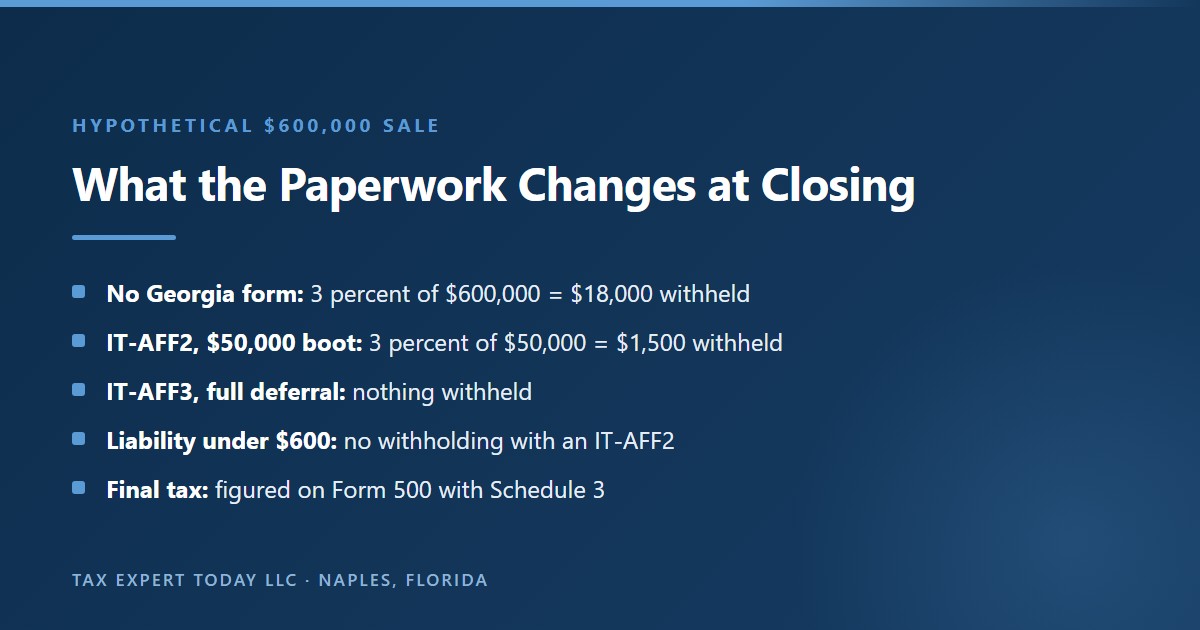
When boot is expected in a 1031 exchange Georgia withholding applies to the recognized gain. With a completed IT-AFF2, the buyer withholds 3 percent of the gain the seller swears will be recognized. Without any form, the buyer withholds 3 percent of the full price, and the seller recovers any excess by filing a Georgia return.
- With IT-AFF2: 3 percent of the recognized gain shown on the affidavit.
- With no paperwork: 3 percent of the full purchase price.
- Small boot: under $20,000 of recognized gain can fall below the $600 threshold.
- Credit on Form 500: the withholding is claimed on Line 25 with the G2-RP attached.
- Final tax: figured on the return, not at closing.
A hypothetical example makes the numbers concrete. A Florida resident sells a Georgia rental house for $600,000 as the relinquished property in an exchange. Adjusted basis after depreciation is $350,000, and selling expenses are $30,000, so the realized gain is $220,000. The seller expects to buy a replacement property for less and take $50,000 of cash boot, so $50,000 of gain will be recognized and $170,000 deferred.
| Scenario (hypothetical) | Withholding base | Amount withheld at 3 percent |
|---|---|---|
| No Georgia form in the closing file | $600,000 purchase price | $18,000 |
| IT-AFF2 showing $50,000 of recognized gain | $50,000 | $1,500 |
| Fully deferred exchange with IT-AFF3 like kind statement | None | $0 |
| IT-AFF2 showing $15,000 of recognized gain | Liability of $450 is under $600 | $0 |
In the first row, $18,000 leaves the seller’s proceeds at closing. If those proceeds were meant for the qualified intermediary, the shortfall may itself become a problem for the exchange, because the seller then has less to reinvest, and the seller recovers the excess only after filing a Georgia nonresident return for the year. In the second row, the withholding roughly tracks the tax that will actually be due: $50,000 of Georgia source gain at the 2026 rate of 4.99 percent is $2,495 before any deductions or proration, and the $1,500 withheld is a credit against it. In the third row, nothing is withheld because nothing is expected to be taxable.
The example also shows why the closing date is the planning date. Once the buyer withholds and remits on the full price, the money is with the Department. The statute and regulation do not provide a route for the closing attorney to undo it after the fact; the seller’s remedy is the Georgia return. A seller who expects to complete a 1031 exchange Georgia closing on a known date should have the residency status, the expected recognized gain, and the right form settled at least a week before that date.
What Is Form G2-RP and Who Files It?
Form G2-RP, currently Rev. 06/01/23, is the buyer’s withholding return for a sale by a nonresident. The buyer files it and remits the tax by the last day of the calendar month following the month of closing. The seller receives a copy and must attach it to the Georgia income tax return to claim credit for the tax withheld.
- Filed by: the buyer or transferee, usually through the closing attorney.
- Due date: last day of the month following the month of closing.
- Penalty and interest: apply if the return is received late.
- Seller’s copy: attached to Form 500 to claim the credit on Line 25.
- Pass through sellers: the G2-RP Allocation Schedule lists additional credit recipients.
The G2-RP form asks for the seller’s and buyer’s names, identification numbers, and addresses, the date of sale or installment payment, the total sales price, the taxable amount or gain when an affidavit is supplied, and the amount withheld. Line 14 is 3 percent of the total sales price on Line 12, unless the seller has supplied an IT-AFF2 to the buyer and a copy to the state, in which case it is 3 percent of the taxable amount or gain on Line 13. The form instructs the buyer to remit by mail with payment on or before the last day of the calendar month following the month within which the closing occurred, and it states that penalty and interest apply if the return is received late.
Rule 560-7-8-.35 allows a substitute. The buyer may use the closing statement, transfer tax statement, or another document showing the required information on a single page clearly designated at its head as the Georgia Withholding Tax Return for Real Estate Transfer. In practice most Georgia closing attorneys use the G2-RP itself, which also carries a page 2 Allocation Schedule for additional recipients of the withholding credit, such as partners or members of a pass through seller.
For a 1031 exchange Georgia seller who had tax withheld, the G2-RP is the receipt. The 2025 IT-511 booklet says tax withheld on the sale of real property by nonresidents is reported on Form G2-RP and entered on Form 500, Line 25, with a copy of the form included, and it warns that the credit will not be allowed without the statement. Line 4 of the income statement details section uses the income from G2-RP Line 12 or Line 13. A seller who lost the closing package should ask the closing attorney for the copy before preparing the return. For employers’ payroll withholding, which is a different system, see our Georgia withholding tax article.
Can a Nonresident Seller Be Deemed a Georgia Resident?
Yes, if every condition in O.C.G.A. 48-7-128(a) is met and the seller gives the buyer a sworn affidavit, usually Form IT-AFF1. The seller must have filed Georgia returns for the two preceding years, have continuing Georgia business or remaining Georgia real property, report the sale on a timely Georgia return, and, for corporations and limited partnerships, be registered in Georgia.
- Two years of Georgia returns: filed or extended for the two preceding tax years.
- Georgia presence: continuing business, or remaining Georgia real property of sufficient value.
- Report the sale: on a Georgia return for the current year, filed by its due date.
- Registration: corporations and limited partnerships registered to do business in Georgia.
- All conditions: meeting some but not all does not qualify.
Deemed residence is useful for 1031 exchange Georgia sellers who own several Georgia properties. The statute, as reprinted in the Department’s guide, treats as a resident any seller who meets all of four conditions and swears to them in an affidavit. The second condition can be satisfied either by being in business in Georgia and continuing substantially the same business after the sale, or by having real property remaining in Georgia at closing with a value, measured by the 100 percent property tax assessment, equal to or greater than the withholding tax liability.
| Deemed resident condition | What it requires | Practical note |
|---|---|---|
| Prior Georgia filings | Georgia returns or extensions for the two preceding income tax years | The guide treats the most recent two years whose due dates have passed as the test |
| Continuing Georgia presence | Same business continues, or remaining Georgia real property at least equal to the withholding | A multi property investor often meets the property test |
| Report the sale | Georgia return for the current year filed by its due date | A promise the seller must keep |
| Registration | Corporations and limited partnerships registered to do business in Georgia | Applies only to those entity types |
The Department’s guide answers several questions about this route. A seller who meets some but not all of the conditions does not qualify. If the sale happens before the due date of the prior year’s return, the two year condition is satisfied when returns or extensions have been filed for the most recent two tax years whose original due dates have passed. A Georgia resident does not need an IT-AFF1 at all, though the buyer may ask for one to document the seller’s representation of residence.
For a 1031 exchange Georgia seller, deemed residence and the like kind exemption reach the same practical result for a fully deferred exchange: no withholding. Deemed residence becomes more valuable when boot is expected, because a deemed resident is treated as a resident for withholding purposes and the buyer does not withhold at all, while the seller still reports and pays any Georgia tax on the boot on the return. The seller is swearing to file that return on time, so the obligation does not disappear.
What If the Exchange Fails After Closing?
If an exchange fails after the relinquished property closes with no withholding, the gain becomes taxable on the federal return and therefore on the Georgia return. A nonresident seller then owes Georgia tax on the Georgia source gain, reported on Form 500 with Schedule 3, and may need estimated payments to avoid an underpayment penalty.
- Common causes: no replacement identified in 45 days or not acquired in time.
- Federal first: the gain is recognized on the federal return for the year.
- Georgia follows: the recognized gain is Georgia source income for a nonresident.
- Estimated tax: Georgia’s estimated tax rules can apply to the unexpected gain.
- Installment reporting: some failed exchanges spanning two years may defer recognition.
The IT-AFF3 like kind statement describes the expected facts at closing. If the replacement property falls through and the 45 day or 180 day period expires, the exchange fails and the qualified intermediary releases the funds. Federally, the gain is recognized. When the failed exchange period spans two tax years, the federal regulations under Section 1031 generally allow the gain to be reported under the installment method when the funds are received in the later year, if the seller had a bona fide intent to exchange; that point is federal and fact specific. Whatever the federal year of recognition, Georgia follows it.
After a failed 1031 exchange Georgia estimated tax rules matter. The 2025 IT-511 booklet says estimated tax is required for each individual who reasonably expects gross income exceeding the sum of the exemption for dependents, estimated deductions, and $1,000 of income not subject to withholding, with installment dates tied to when the requirement is first met. A seller who learns of an unexpected Georgia gain in, say, August should look at the September or January installment. Our article on Georgia Form 500-ES explains the installment schedule and how the underpayment penalty is computed.
A failed exchange is not a withholding violation by the seller, provided the exemption statement was made in good faith on the facts known at closing. The Department’s guide frames the seller’s ongoing duty as filing the Georgia return and paying the actual tax. The seller should keep the correspondence showing why the exchange failed with the closing file, in case the Department later asks why no withholding was remitted.
How Do Co-Owners and Spouses Handle Georgia Withholding?
Each co-owner’s residence is determined separately. Rule 560-7-8-.35 requires withholding only on the amount realized or gain recognized by the nonresident co-owners, and the Department’s guide says married co-owners are also treated separately. Each nonresident co-owner can use the forms that fit their own share, including the $600 threshold.
- Separate status: joint tenants and tenants in common are tested individually.
- Nonresident share only: withholding applies to that owner’s portion.
- Married owners: ownership and the $600 test are determined separately.
- Separate G2-RPs: one form per seller other than a spouse.
- Different exchange choices: one co-owner may exchange while another cashes out.
The co-owner rule matters in 1031 exchange Georgia planning because co-owners often make different choices. Two siblings who inherited a Georgia rental as tenants in common may decide that one will exchange into another property and the other will take cash. If one sibling lives in Georgia and the other in Florida, only the Florida sibling’s share is subject to withholding at all. If the Florida sibling is the one exchanging, that sibling can use the like kind statement on IT-AFF3 for their share. If the Florida sibling is the one cashing out, that sibling can use IT-AFF2 to base withholding on their share of the gain.
The G2-RP instructions say that if there is more than one seller, other than a spouse, a separate form is submitted for each, and if multiple sellers are involved, the sales price and gain lines list only the portion attributed to the sellers named on that form. This keeps each co-owner’s withholding credit tied to that co-owner’s return. Co-owners who exchange through a tenancy in common structure should also confirm on the federal side that each owns an interest in real property rather than an interest in a partnership, because a partnership interest is not real property and does not qualify for a Section 1031 exchange.
How Is a Single Member LLC Seller Treated?
A single member LLC that is disregarded for federal tax purposes is treated as its owner for the exchange, and the Department’s forms tell both the LLC and its owner to be listed as the seller. The owner’s residence, or the LLC’s principal place of business, then decides how the withholding rule and the exemption forms apply.
- Listed together: IT-AFF2, IT-AFF3, and G2-RP all say to name both.
- Settlement statement: the named seller is the seller for all purposes.
- Exchange continuity: the same taxpayer should sell and buy.
- Credit flows to the owner: the owner claims the withholding on their return.
- Entity changes: converting the LLC near closing can complicate both systems.
All three Department forms carry the same instruction: if the seller is a disregarded single member limited liability company, both the SMLLC and its owner should be listed as the seller. The G2-RP adds that both may be listed on the settlement statement. Because the statute treats the person or entity named as the seller on the settlement statement as the seller for every purpose under the withholding rule, the closing documents should match the exchange documents. A mismatch, such as an LLC on the deed and the individual on the exchange agreement, is a common source of questions on both the federal and Georgia sides.
Federally, a disregarded single member LLC and its owner are the same taxpayer for Section 1031, so an owner can sell through the LLC and buy the replacement in the owner’s own name or in another disregarded LLC. For 1031 exchange Georgia purposes, the withholding credit belongs to the owner, who claims it on the owner’s Form 500. If the LLC has more than one member or has elected to be taxed as a corporation, the analysis changes, and the entity sections below apply. For the broader Georgia treatment of LLCs, see our Georgia LLC taxes guide.
Does a Nonresident Still File a Georgia Return After a 1031 Exchange?
Usually yes when any gain is recognized, and often yes even when none is. The IT-511 booklet says nonresidents who receive income from Georgia sources and must file federally are required to file Georgia Form 500 with Schedule 3. A fully deferred exchange may produce no Georgia income, but rental income and withholding credits often still require a return.
- Boot received: Georgia source gain requires a nonresident return.
- Rental income: a Georgia rental held part of the year usually produced Georgia income anyway.
- Withholding credit: a return is the only way to recover tax withheld at closing.
- Deemed resident promise: a seller who used IT-AFF1 swore to file.
- Schedule 3: separates Georgia income from total income.
The Department’s withholding guide answers this directly: in general, income from the sale of Georgia property is required to be reported on a Georgia income tax return, and once the return is completed, the actual tax is determined and the seller claims a refund or pays the balance. The withholding is not the tax. It is a prepayment, and the return is where the actual Georgia liability is computed.
For a nonresident whose exchange is fully deferred, there may be no Georgia gain to report. But the relinquished property was almost always producing Georgia rental or business income up to the date of sale, and that income, net of expenses and depreciation, is Georgia source income in its own right. A nonresident who owned a Georgia rental for the first five months of the year, for example, generally still has a Georgia filing requirement for those five months of rent, even if the exchange itself produced no Georgia gain. The 2025 IT-511 booklet’s filing rules for nonresidents turn on Georgia source income and a federal filing requirement, not on the size of the Georgia income.
Filing also preserves the 1031 exchange Georgia record. A Georgia nonresident return for the exchange year that shows the sale, references the federal Form 8824, and reports no recognized Georgia gain creates a clear history if the Department later compares county deed records with filed returns. For a seller who used the IT-AFF3 like kind statement, a consistent Georgia return is the natural follow through. Our Georgia part year and nonresident return guide walks through Schedule 3 line by line.
How Does Schedule 3 Treat Gain From Georgia Property?
Schedule 3 of Form 500 lists federal income in one column and the Georgia portion in another. For a nonresident, recognized gain from Georgia real property goes in the Georgia column because it is Georgia source income. Georgia then prorates deductions using the ratio of Georgia income to total income and applies the flat rate.
- Column A: income as reported on the federal return.
- Column B: the Georgia portion, including gain from Georgia property.
- Ratio: Georgia income divided by total income sets the proration.
- Deferred gain: appears in neither column because it is not in federal AGI.
- Withholding credit: claimed on Form 500 with the G2-RP attached.
The IT-511 booklet directs part year residents and nonresidents to skip the resident computation lines on Form 500 and follow the Schedule 3 instructions instead. Schedule 3 starts with the federal figures and isolates the Georgia portion. In a 1031 exchange Georgia income in that column includes the recognized gain from the Georgia relinquished property, the Georgia rental income before the sale, and any other Georgia source items. The deferred gain does not appear anywhere, because it never entered federal adjusted gross income.
Proration is the reason a nonresident’s 1031 exchange Georgia tax on boot is often less than the rate times the boot. Georgia allows deductions in proportion to the share of total income that is Georgia income. A nonresident with large non Georgia income and a modest Georgia gain will have a small Georgia ratio and a correspondingly small share of deductions, so the effective result depends on the whole return. The Georgia tax is computed on Georgia taxable income at the flat rate, and the G2-RP withholding is then credited against it.
| Item (hypothetical nonresident) | Federal column | Georgia column |
|---|---|---|
| Rental income from the Georgia property before sale | Included | Included |
| Recognized gain (boot) on the Georgia property | Included | Included |
| Deferred gain on the Georgia property | Not included | Not included |
| Rental income from the new out of state property | Included | Not included |
| Wages and investment income earned in Florida | Included | Not included |
Two refinements matter in 1031 exchange Georgia filing years. First, if the seller was a Georgia resident for part of the year, Schedule 3 separates income earned while a resident, which is all Georgia income, from Georgia source income earned while a nonresident. Second, the credit for taxes paid to another state applies to residents, so a nonresident cannot use it to offset Georgia tax on Georgia property gain. The other state where the nonresident lives, if it has an income tax, typically provides the credit instead.
What Happens When the Replacement Property Is Outside Georgia?
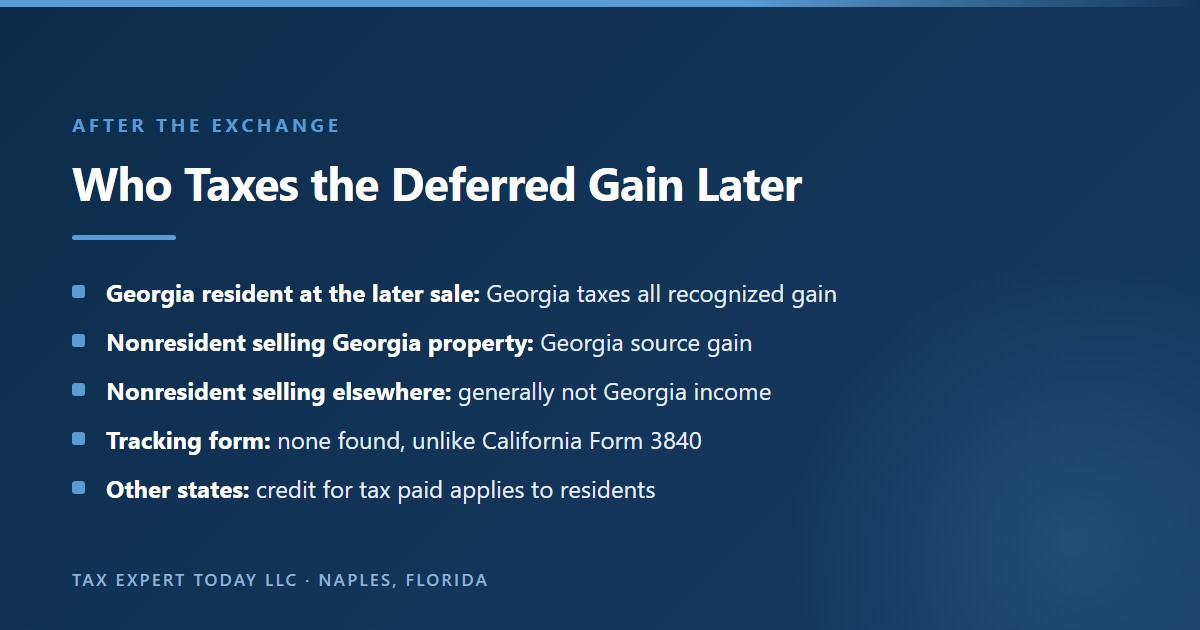
When a nonresident exchanges Georgia property for property in another state, Georgia does not tax the deferred gain in the exchange year. If the replacement property is later sold in a taxable sale while the owner is not a Georgia resident, the gain is from property outside Georgia, so it is generally not Georgia source income under Schedule 3.
- Exchange year: only boot is Georgia source income.
- Later sale as a nonresident: gain from non Georgia property is generally not Georgia source.
- Later sale as a resident: all gain is Georgia income while you live in Georgia.
- Other state’s rules: the state where the new property sits taxes its own source gain.
- Documentation: keep the Georgia sale records for the life of the replacement property.
This is the 1031 exchange Georgia question the intermediary pages rarely answer, and it is the one investors ask most. Consider a hypothetical Florida resident who exchanges a Georgia rental into a Florida rental. In the exchange year, Georgia taxes only the boot, if any. Years later the investor sells the Florida rental in a taxable sale while still living in Florida. The gain, which includes the gain deferred from the Georgia property, is recognized on the federal return. Florida has no personal income tax. For Georgia, the investor is a nonresident and the property sold is in Florida, so under the Schedule 3 source rules the gain is not Georgia income.
That result differs from a small number of states that track deferred gain after it leaves the state. California is the most widely cited example. It requires an annual information return, Form 3840, from a taxpayer who exchanges California property for property in another state, and it taxes the deferred California gain when the replacement property is eventually sold, as our article on the California 1031 exchange clawback explains. The Georgia materials reviewed for this article, which are O.C.G.A. Section 48-7-128 as reprinted by the Department, rule 560-7-8-.35, the 2025 IT-511 booklet, and the Department’s withholding guide and forms, contain no comparable tracking form or clawback filing requirement for individuals.
That statement is about what the reviewed sources contain, and it is not a promise about every fact pattern. Georgia’s source rules for nonresidents, including how intangible income and installment obligations are sourced, can reach income connected to Georgia property in ways that depend on the facts. The Department’s guide, for example, concludes that interest on an installment note from the sale of Georgia investment property by a nonresident is Georgia taxable income. An investor whose replacement property chain includes seller financing, a partnership interest, or a return to Georgia should have the later sale analyzed on its own facts.
Does Georgia Have a 1031 Clawback Like California?
Based on the Georgia statute, regulation, booklet, and Department forms reviewed for this article, 1031 exchange Georgia rules include no annual tracking return or clawback filing requirement for individuals comparable to California Form 3840. Georgia relies on residence and source: residents pay on all recognized gain, and nonresidents pay on Georgia source gain.
- No tracking form found: nothing like California Form 3840 in the reviewed Georgia sources.
- Residence rule: a Georgia resident is taxed on gain from property anywhere.
- Source rule: a nonresident is taxed on gain from Georgia property.
- Closing focus: Georgia’s enforcement point is withholding at the Georgia closing.
- Facts matter: installment notes and entity interests can change the answer.
The comparison is useful for investors who own property in several states. A California investor who exchanges into Georgia property, or a Georgia investor who exchanges into California property, can face different rules at each end. The table below compares the two approaches using the sources cited in this article and in our California article.
| Question | Georgia | California |
|---|---|---|
| Follows the federal deferral | Yes, through IRC conformity | Yes, with its own conformity rules |
| Withholding on nonresident sellers at closing | Yes, 3 percent under O.C.G.A. 48-7-128 unless exempt | Yes, under its own Form 593 regime |
| Annual tracking form after exchanging out of state | None found in the reviewed sources | Form 3840 |
| Taxes deferred gain after the owner leaves and sells out of state property | Not under the reviewed rules, which rely on residence and source | Yes, the California source gain |
| Rate on recognized gain | Flat 4.99 percent for 2026 | Graduated rates |
A Georgia resident who exchanges out of California property also has to plan for the California rule. If the resident later sells the replacement property in a taxable sale while living in Georgia, California may tax the California portion of the gain through the clawback, and Georgia taxes the full gain because the owner is a Georgia resident. Georgia’s credit for taxes paid to another state, which the IT-511 booklet says requires the other state’s return to be enclosed, is the mechanism that addresses the double taxation, subject to its own limits.
For investors who left Georgia, the absence of a 1031 exchange Georgia tracking requirement is not a reason to discard records. If the Department ever questions a Georgia return from the exchange year, the documents showing a valid exchange, the IT-AFF3 or IT-AFF2, and the G2-RP if one was filed are the evidence. Keep them as long as the replacement property, and any property later exchanged for it, is owned.
What If You Exchange Into Georgia Property From Another State?
A 1031 exchange Georgia investors make into Georgia property from another state does not trigger Georgia tax in the exchange year, because the deferred gain is not in federal AGI. The deferred gain becomes relevant to Georgia later: a sale of the Georgia replacement property is Georgia source income, and the recognized gain includes gain deferred from the other state.
- Exchange year: nothing for Georgia unless the owner already files there.
- Later sale of Georgia property: Georgia source income for a nonresident.
- Deferred gain inside: the federal gain on the later sale includes the carried over gain.
- Other state’s claim: a clawback state may also tax its portion.
- Withholding at the later sale: Georgia’s 3 percent rule applies to a nonresident seller.
Here is the scenario. A hypothetical investor living in Florida exchanges a California rental into an apartment building in Savannah. When the investor later sells the Savannah building in a taxable sale, the federal gain equals the price minus the carried over basis, so it includes the gain deferred from California. For Georgia, the investor is a nonresident selling Georgia real property, so the gain is Georgia source income, and Georgia’s closing withholding applies unless an exemption or a gain affidavit is used. California, through its clawback, may also claim the California portion of the same gain.
Whether Georgia taxes the entire federal gain on the Savannah sale, or whether any part of the gain is attributed to California property for Georgia sourcing purposes, is a technical question that the reviewed Georgia sources do not address expressly. The plain reading of Schedule 3, which places gain from Georgia property in the Georgia column, suggests the entire recognized gain on the Georgia property is Georgia source income. An investor facing this overlap should have both states’ returns prepared together, because the credit rules in the investor’s state of residence, if it taxes income, are what usually resolve the overlap.
The planning point is that a 1031 exchange Georgia buyers complete into Georgia property brings the deferred gain within Georgia’s reach on a later sale, even though that gain arose elsewhere. That is not a reason to avoid Georgia property; it is a reason to model the exit before the exchange, including the Georgia rate, the closing withholding, and the other state’s rules.
How Does a Move to or From Georgia Affect a Deferred Gain?
A move changes which state taxes a later sale. A Georgia resident is taxed on all gain recognized while a resident. After a move, Georgia taxes only Georgia source gain. For a part year resident, Schedule 3 separates gain recognized before and after the move, so each taxable sale’s date relative to the move decides the Georgia result.
- Moving in: gain recognized after you become a resident is Georgia income.
- Moving out: gain recognized after you leave is taxed only if Georgia sourced.
- Exchange year move: boot is sorted by when it was received.
- Residence facts: domicile is decided by facts, not a single document.
- Closing status: withholding turns on where you live on the closing date.
Moves and 1031 exchange Georgia questions interact more often than people expect, because the decision to sell a property is often part of a decision to relocate. A hypothetical Georgia resident who plans to retire to Naples might exchange a Georgia rental into a Florida rental, move to Florida, and later sell the Florida rental. In the exchange year, any boot received before the move is income earned while a Georgia resident. After the move, the Florida rental’s later sale is gain from property outside Georgia, recognized while a nonresident, which generally is not Georgia income under the Schedule 3 rules.
The reverse move works the other way. A Florida resident who owns a Tennessee rental moves to Georgia, then exchanges the Tennessee rental into a Georgia property, then sells the Georgia property in a taxable sale years later while living in Georgia. All of that gain is Georgia income, including the gain that accumulated while the investor lived in Florida and owned property in Tennessee. Georgia does not prorate the deferred gain by the years of Georgia residence. An investor moving into Georgia with large deferred gains in replacement property should understand that before the move, and our article on selling rental property after moving covers the multi state pattern in more detail.
| Hypothetical pattern | Georgia result on the later taxable sale |
|---|---|
| Georgia resident exchanges Georgia property into Florida property, moves to Florida, then sells | Generally no Georgia tax; property and owner are outside Georgia |
| Georgia resident exchanges into Florida property and sells while still a Georgia resident | Taxed by Georgia on all recognized gain |
| Florida resident exchanges into Georgia property, then sells while living in Florida | Georgia source gain, with closing withholding unless exempt |
| Florida resident moves to Georgia, then sells out of state replacement property | Taxed by Georgia on all recognized gain as a resident |
Residence itself is a factual question. Georgia’s part year resident rules look at where you actually lived, and a change of domicile is shown by the whole pattern of facts: home, driver’s license, voter registration, where family lives, and where time is spent. A move that is not well documented can leave a later sale exposed to a residence question. Our part year resident guide explains the filing mechanics for the move year.
How Do Partnerships and LLCs Exchange Georgia Property?
A partnership or multi member LLC that owns Georgia property can complete a 1031 exchange at the entity level, and the deferral flows through to the owners’ federal and Georgia returns. Georgia withholding at closing turns on the entity’s principal place of business, and a composite return or the entity level election can remove withholding.
- Entity exchanges: the partnership sells and buys, and the deferral passes through.
- Interests excluded: partnership interests are not real property for Section 1031.
- Withholding test: the entity’s principal place of business outside Georgia.
- Composite return: an exemption from closing withholding under 48-7-128(e).
- Credit pass through: withholding passes to owners with a schedule and the G2-RP copy.
When the partnership itself is the exchanger, the federal partnership return reports the exchange, and each partner’s share of any recognized gain appears on the Schedule K-1. Georgia follows those figures. For nonresident partners, the recognized gain from Georgia property is Georgia source income, which Georgia collects either through the partnership’s withholding on nonresident members, through a composite return, or through the partners’ own returns. Our Georgia composite return guide explains those options in detail.
Closing withholding is a separate 1031 exchange Georgia question. The statute, as reprinted in the Department’s guide, says that if the seller is a partnership, S corporation, or other unincorporated organization that certifies to the buyer that a composite return is being filed for its nonresident owners and that it remits the tax on the gain on their behalf, the buyer is not required to withhold. The same subsection imposes a penalty on any nonresident partner, shareholder, or member who falsely certifies that a composite return is being filed, of $500 or 10 percent of the amount required to be withheld, whichever is greater.
When tax is withheld from a pass through seller, the Department’s guide explains how the credit moves. The entity allocates and passes the withholding credit through in the same manner as its income, through each tier in a multitier structure, with each owner’s share listed on the K-1 along with a schedule and a copy of the original G2-RP. Each owner claims the credit on their own Georgia return. If the entity files a composite return, it may claim the credit there, but only for the share attributable to owners included in the composite return.
Partnerships whose owners want to go separate ways often consider a drop and swap, in which the partnership distributes tenancy in common interests to partners before the sale so that each can exchange or cash out individually. That structure is a federal question first, with holding period and intent issues that depend on the facts. For Georgia, after the distribution each former partner becomes a co-owner whose residence is tested separately at closing, which brings the co-owner rules discussed above into play.
How Does the Pass Through Entity Tax Election Interact With an Exchange?
A partnership or S corporation that makes Georgia’s entity level election under O.C.G.A. Section 48-7-21 or 48-7-23 pays Georgia tax at the entity level on its income, including recognized gain from an exchange. Form IT-AFF3 lists that election, for tax years beginning on or after January 1, 2022, as a ground for exemption from closing withholding.
- Entity pays: recognized gain is taxed on the entity’s Georgia return.
- Deferred gain: unaffected by the election, because it is not recognized.
- Withholding exemption: listed on IT-AFF3 for electing entities.
- Rate: the Department lists 4.99 percent for electing partnerships for 2026.
- Timing: the election year should match the year boot is recognized.
The Georgia pass through entity tax election lets a qualifying partnership or S corporation pay Georgia income tax at the entity level, which can produce a federal deduction for the state tax at the entity level. For an entity that completes an exchange with boot, the recognized gain is part of the income the electing entity reports, and the entity pays the Georgia tax on it. For a fully deferred exchange, there is no recognized gain for the election to reach.
The IT-AFF3 statement for this situation reads that, for taxable years of the seller beginning on or after January 1, 2022, the seller qualifies for and has made or intends to make the election to be taxed at the entity level. An electing entity selling Georgia property in an exchange with boot therefore has two possible exemption statements available, the entity election and, where it applies, the like kind statement. Which statement fits depends on whether any gain will be recognized and whether the election will in fact be made for that year. Our Georgia pass through entity tax article explains who can elect, how the election is made, and how owners report it.
One 1031 exchange Georgia caution applies to the word intends. An entity that initials the election statement at closing and then does not make the election for that year has given the buyer an inaccurate certificate, and the Georgia tax on the recognized gain then has to be paid through the owners’ returns or a composite return. The decision to elect should be made, or at least firmly planned, before the closing date.
How Do Installment Sales and Seller Financing Work With Georgia Withholding?
On a nonresident installment sale of Georgia property, rule 560-7-8-.35 requires the buyer to withhold 3 percent of the price less the installment note at closing, then 3 percent of each principal payment, or of the gain portion with an affidavit. In a 1031 exchange Georgia follows the federal treatment of seller financing: generally boot unless handled through the exchange.
- At closing: 3 percent of price less the note, or of the gain received at closing.
- Each payment: 3 percent of principal, or of the gain portion of principal.
- Remittance timing: tied to cumulative withholding exceeding $300 for the year.
- Threshold test: applied to the total price or gain, not each payment.
- Interest: not subject to this withholding, though Georgia may tax it.
Rule 560-7-8-.35 sets out the installment mechanics in detail. The initial return and payment are due by the last day of the month following the month of the sale, computed as 3 percent of the purchase price less the installment note, or, if the seller elects to base withholding on gain, 3 percent of the gain recognized from the proceeds received at closing. For each later principal payment, the buyer withholds 3 percent of the principal, or of the gain portion. The buyer remits by the last day of the month following the month in which the cumulative amount withheld for the year, less payments already made, exceeds $300, or by the last day of the month following year end if that amount never exceeds $300 in the year. The $20,000 and $600 thresholds are applied to the total price or gain as if the sale were not on the installment basis.
In a 1031 exchange Georgia follows the federal rule: a note from the buyer received by the exchanger is generally boot, because it is not like kind real property. Some exchanges handle a buyer note by having it issued to the qualified intermediary and sold or used toward the replacement property, which can keep it within the exchange. That is a federal structuring question. For Georgia, if the note is boot, the gain it represents is Georgia source income for a nonresident when recognized under the installment method, and the withholding mechanics above apply to the principal payments.
The Department’s guide also addresses the interest on such a note. It concludes that interest on an installment note held by a nonresident individual, not in the business of holding notes, from the sale of Georgia investment or rental property is Georgia taxable income, but that it is not subject to the withholding requirement of O.C.G.A. Section 48-7-128, although the buyer may withhold on it if the parties agree. A nonresident holding a note from a Georgia sale should expect to report that interest on Georgia returns for the life of the note.
Which Federal 1031 Rules Matter Most for Georgia Sellers?
Because 1031 exchange Georgia rules follow the federal result, the federal rules that decide whether an exchange qualifies also decide the Georgia result. The ones that matter most are the 45 day identification and 180 day completion periods, the real property requirement, the related party rule, and the rule that United States and foreign real property are not like kind.
- 45 days: replacement property identified within 45 days of transferring the old property.
- 180 days or the return due date: whichever is earlier, counting extensions.
- Real property only: held for business or investment, not primarily for sale.
- Related parties: a two year holding rule applies to exchanges with related persons.
- Domestic for domestic: United States and foreign real property are not like kind.
Section 1031(a)(3) treats replacement property as not like kind if it is not identified on or before the 45th day after the transfer of the relinquished property, or if it is received after the earlier of the 180th day or the due date, with extensions, of the transferor’s federal return for the year of the transfer. The second limit catches exchanges that close late in the year. A relinquished property sold in December can have its 180 day window cut short by the April due date of the federal return unless the return is extended. 1031 exchange Georgia rules add no separate deadline; if the federal exchange qualifies, the Georgia deferral follows.
| Federal rule | Section | Why it matters in Georgia |
|---|---|---|
| Identify within 45 days | IRC 1031(a)(3)(A) | A missed deadline makes the IT-AFF3 like kind statement inaccurate in hindsight |
| Acquire by the earlier of 180 days or the return due date with extensions | IRC 1031(a)(3)(B) | Late year sales may need a federal extension to keep the full window |
| Real property held for business or investment | IRC 1031(a)(1) | Personal property in a Georgia sale is taxed on the Georgia return |
| Not property held primarily for sale | IRC 1031(a)(2) | Georgia lots held by a developer generally do not qualify |
| Related party two year rule | IRC 1031(f) | A disposition within two years can trigger gain in that later year |
| United States and foreign property not like kind | IRC 1031(h) | A Georgia property cannot be exchanged into property abroad |
The related party rule in Section 1031(f) generally requires that, in an exchange between related persons, neither party dispose of the property received within two years of the last transfer, subject to listed exceptions such as death and involuntary conversion. If the rule is broken, the gain is recognized as of the date of the later disposition, and Georgia picks up that gain in that later year. Family investors in Georgia, who often trade property among relatives or related entities, should keep that two year period in view. For a deeper federal discussion, including reverse exchanges and the treatment of vacation homes and former residences, see our 1031 exchange rules guide.
What Are Common 1031 Exchange Georgia Mistakes?
The most common 1031 exchange Georgia mistakes are closing without any Georgia withholding form, using the like kind exemption when boot is expected, mismatching the seller on the settlement statement and the exchange documents, losing the G2-RP copy, and failing to file a nonresident Georgia return for the exchange year.
- No form at closing: 3 percent of the full price withheld.
- Wrong exemption: the like kind line used for a partial exchange.
- Seller mismatch: LLC on the deed, individual on the exchange agreement.
- Missing statement: the withholding credit is not allowed without the G2-RP.
- No Georgia return: rent, boot, or a withholding refund left unreported.
| Mistake | Consequence | How it is usually avoided |
|---|---|---|
| No IT-AFF3, IT-AFF2, or IT-AFF1 in the closing file | Buyer withholds 3 percent of the price | Settle the seller’s status and form a week or more before closing |
| Like kind statement used with expected boot | Certificate does not match the facts | Use IT-AFF2 for the recognized gain |
| Seller named differently on the deed and exchange documents | Questions on both the federal exchange and the Georgia forms | Align the settlement statement, deed, and exchange agreement |
| G2-RP copy lost | Withholding credit not allowed on Form 500 | Request the copy from the closing attorney before filing |
| No Georgia nonresident return for the exchange year | Unreported Georgia rent or boot, and no refund of excess withholding | File Form 500 with Schedule 3 |
| Georgia basis not tracked separately | Georgia tax on depreciation Georgia never allowed | Keep a Georgia basis schedule for each property |
| Composite or entity election certified but not filed | Penalty exposure and unpaid Georgia tax | Confirm the filing plan before the closing date |
Most of these 1031 exchange Georgia mistakes come from the same root cause: the qualified intermediary manages the federal exchange, the closing attorney manages the Georgia closing, and nobody owns the Georgia return. A short checklist shared between the intermediary, the closing attorney, and the tax preparer before closing resolves most of them. If a mistake has already happened, such as excess withholding on a sale that turned out to be fully deferred, the remedy is to file the Georgia return for the year and claim the credit. If a prior year Georgia return already omitted the sale, our Georgia amended return guide explains Form 500X and its time limits.
What Records Should a 1031 Exchange Georgia Seller Keep?
Keep the exchange agreement, identification notice, settlement statements for both properties, the Georgia form used at closing, any G2-RP, the federal Form 8824, the Georgia return for the exchange year, and a federal and Georgia basis schedule. Keep them for as long as you own the replacement property, plus the amendment period for the later sale’s return.
- Exchange documents: qualified intermediary agreement and identification notice.
- Closing documents: both settlement statements and deeds.
- Georgia forms: IT-AFF1, IT-AFF2, or IT-AFF3, and any G2-RP.
- Returns: federal Form 8824 and the Georgia Form 500 for the exchange year.
- Basis schedules: federal and Georgia, carried into each replacement property.
Ordinary record retention periods are measured from the filing of the return that reports a transaction. For a 1031 exchange Georgia record keeping turns on a later date: the relevant return is the one that reports the eventual taxable sale, which may be decades after the exchange. The basis of the replacement property is computed from the relinquished property’s basis, so the records that prove the original basis, the improvements, and the depreciation on the first property remain necessary until the last property in the chain is sold.
The 1031 exchange Georgia forms deserve their own folder. The IT-AFF2 instructions tell the seller to retain documentation of the cost basis, depreciation, and selling expenses claimed and to provide it to the Department only when requested. The IT-AFF3 is not filed anywhere, so the seller’s copy may be the only copy outside the closing attorney’s file. And the G2-RP is required to claim the withholding credit, as the 2025 IT-511 booklet warns. An investor who exchanges several times should keep one record set per exchange, labeled with the property, the date, and the Georgia form used.
Hypothetical Example: A Florida Resident Exchanging a Georgia Rental
In this hypothetical 1031 exchange Georgia example, a Naples resident exchanges an Atlanta rental into a Florida rental with no boot. The seller gives the closing attorney an IT-AFF3 with the like kind statement, no Georgia tax is withheld, the federal Form 8824 shows no recognized gain, and a Georgia nonresident return reports only the rent earned before the sale.
- Seller: Florida resident, so a nonresident of Georgia at closing.
- Property: Atlanta rental sold as the relinquished property.
- Closing form: IT-AFF3 like kind statement initialed and signed.
- Withholding: none, because no income is expected to be taxable.
- Georgia return: Form 500 with Schedule 3 for the pre sale rent.
The facts are invented for illustration. The seller has owned the Atlanta rental for twelve years and moved to Naples four years ago. The seller signs a qualified intermediary agreement before closing, identifies a Fort Myers rental within 45 days, and closes on it within 180 days at a higher price with more debt, so no boot is expected. Before the Atlanta closing, the seller initials the like kind statement on IT-AFF3 and gives it to the closing attorney along with a copy of the exchange agreement. The buyer withholds nothing.
When the year ends, the federal return includes Form 8824 showing the exchange and no recognized gain. The Georgia return is a nonresident Form 500 with Schedule 3. The Georgia column shows the net rent from the Atlanta property for the months before the sale and no gain. If the seller later sells the Fort Myers rental in a taxable sale while still living in Florida, the gain, including the gain deferred from Atlanta, is from Florida property recognized by a Florida resident, and under the Georgia sources reviewed for this article it is not Georgia income.
Change one fact and the 1031 exchange Georgia result changes. If the Fort Myers purchase fell through on day 60, with no other property identified, the exchange would fail and the gain would be recognized. The seller would then report the Georgia source gain on the Georgia nonresident return, pay Georgia tax at the rate for that year, and look at estimated tax for the rest of the year. Nothing would have been withheld at closing, so the full Georgia tax would be due with the return or estimates.
Hypothetical Example: A Partial Exchange With Boot
In this hypothetical 1031 exchange Georgia example, a Tennessee resident sells a Georgia warehouse, buys a cheaper replacement, and takes cash boot. The seller signs a notarized IT-AFF2 showing the expected recognized gain, the buyer withholds 3 percent of that gain on a G2-RP, and the seller claims the credit on a Georgia nonresident return that reports the boot.
- Seller: Tennessee resident with no Georgia business after the sale.
- Expected boot: cash left over after the replacement purchase.
- Closing form: IT-AFF2 for the recognized gain, not the IT-AFF3 like kind line.
- Withholding: 3 percent of the recognized gain, reported on a G2-RP.
- Return: Form 500 with Schedule 3, G2-RP attached, credit on Line 25.
Again the facts are invented. The warehouse sells for $1,200,000, with an adjusted basis of $500,000 and selling expenses of $60,000, so the realized gain is $640,000. The seller plans to buy a replacement for $1,100,000 with equal debt and expects $100,000 of cash boot. The seller signs an IT-AFF2 showing $100,000 as the gain required to be recognized, with a schedule tying that figure to the expected federal computation. The buyer withholds 3 percent of $100,000, which is $3,000, and files the G2-RP with the IT-AFF2 by the last day of the following month.
On the Georgia nonresident return, the $100,000 of recognized gain is Georgia source income in the Georgia column of Schedule 3. At the 2026 rate of 4.99 percent, the tax on $100,000 before any proration of deductions would be $4,990, and the $3,000 withheld is credited against the actual liability on Line 25, with the G2-RP attached. The remaining $540,000 of gain is deferred into the replacement property. Without the IT-AFF2, the buyer would have withheld 3 percent of $1,200,000, which is $36,000, and the seller would have waited for the Georgia return to recover the excess.
1031 Exchange Georgia Help in Naples & Southwest Florida
Tax Expert Today LLC helps clients with 1031 exchange Georgia questions, including nonresident withholding planning, IT-AFF form selection, Georgia nonresident and part year returns, and basis tracking, from its office at 11983 Tamiami Trail N, Naples, FL 34110. Georgia clients are served nationwide from Naples, by phone and secure document exchange. Call (239) 441-2005.
- 1031 exchange tax help Naples: the Georgia return and closing forms for a 1031 exchange Georgia sale.
- Withholding planning: choosing IT-AFF1, IT-AFF2, or IT-AFF3 before closing.
- Nonresident returns: Form 500 with Schedule 3 for the exchange year.
- Movers: Georgia residents relocating to Southwest Florida with Georgia property.
- Entities: composite return and entity election questions on a Georgia sale.
Tax Expert Today LLC is based at 11983 Tamiami Trail N, Naples, FL 34110, and our office is open Monday through Friday, 10 a.m. to 5 p.m. Eastern time. You can reach us at (239) 441-2005. Many of the 1031 exchange Georgia questions we see come from people who now live in Collier or Lee County but still own Atlanta, Savannah, or north Georgia rental property, and from Georgia residents planning a sale and a move south at the same time. We work with Georgia clients remotely, and there is no need to visit Naples to work with us.
For the full range of our Georgia work, see our Georgia tax services page. For Florida residents planning across both states, including the timing of a sale relative to a move, our Naples tax planning services page explains how we approach it. Related Georgia topics include the Georgia capital gains tax and the Georgia net operating loss, both of which can come up in the same transaction year.
A point of scope, stated plainly: Georgia Department of Revenue matters are state tax matters. Our role is the Georgia computation, the closing forms, the returns, and correspondence with the Department. We are not a qualified intermediary and we do not hold exchange funds. The exchange agreement, the deed, and the closing itself are handled by the intermediary and the closing attorney, and we work alongside them.
When to Engage a Professional
Consider 1031 exchange Georgia help before the closing of a Georgia relinquished property if you live outside Georgia, expect any boot, sell through an LLC or partnership, are moving into or out of Georgia, or own replacement property in a state with a clawback rule. Afterward, it helps when a deferred exchange had tax withheld or an exchange failed.
- Before closing: to settle residency status and the right Georgia form.
- Boot expected: to compute the recognized gain for the IT-AFF2.
- Entity sellers: to coordinate composite returns or the entity election.
- Moves: to time the sale and document the change of residence.
- After closing: to recover excess withholding or report a failed exchange.
A 1031 exchange can defer Georgia tax for years, and the 1031 exchange Georgia side is usually straightforward when it is planned before the closing date. It becomes expensive when 3 percent of the price is withheld without need, when a nonresident return is never filed, or when a later sale is reported without the Georgia basis history. If your situation fits any of the items above, talk with us before the closing or the next filing deadline. You can learn more about our Georgia state tax services or call (239) 441-2005 for a free consultation.
This article is general educational information about the state tax side of a 1031 exchange Georgia sellers and buyers face, as of October 16, 2026, based on Internal Revenue Code Section 1031, Ga. Comp. R. & Regs. 560-7-8-.35, O.C.G.A. Section 48-7-128 as reprinted in the Georgia Department of Revenue’s withholding guide, Forms IT-AFF2 (Rev. 12/11), IT-AFF3 (Rev. 11/05/21), and G2-RP (Rev. 06/01/23), the 2025 IT-511 instruction booklet, the Department’s Important Tax Updates page, and the IRS page for Form 8824, read on that date. It is not tax or legal advice for any specific transaction. All examples are hypothetical. Georgia forms, rates, and rules change; confirm current requirements with the Georgia Department of Revenue or a qualified professional before closing or filing.
Frequently Asked Questions About 1031 Exchange Georgia Rules
Do 1031 exchange Georgia rules follow federal law?
Yes. Georgia starts its income tax computation from federal adjusted gross income and conforms to the Internal Revenue Code as amended through January 1, 2025, per the 2025 IT-511 booklet. Gain deferred under Section 1031 is not in federal AGI, so it is generally not taxed on the Georgia return.
Is Georgia withholding required on a 1031 exchange?
Not to the extent the income from the sale is not subject to Georgia income tax, according to the Department of Revenue’s withholding guide. A nonresident seller in a fully deferred exchange can document this with the like kind statement on Form IT-AFF3. Expected boot is handled with Form IT-AFF2.
What is the Georgia withholding rate on a nonresident real estate sale?
Three percent of the purchase price under O.C.G.A. 48-7-128 and rule 560-7-8-.35, or 3 percent of the recognized gain if the seller gives the buyer a sworn affidavit of gain on Form IT-AFF2. No withholding is required when the price is under $20,000 or the liability on an IT-AFF2 is under $600.
What is Form IT-AFF3?
It is the Georgia Seller’s Certificate of Exemption, Rev. 11/05/21. A nonresident seller initials the statement that applies, including one for a like kind exchange whose income is not subject to federal or state income tax. It is not filed with the Department; the parties keep it to document the exemption.
How is boot taxed in a Georgia 1031 exchange?
Boot is taxed the same way it is federally. Gain is recognized up to the cash, debt relief, or other non like kind property received, and that recognized gain is Georgia income for a resident or Georgia source income for a nonresident selling Georgia property. The 2026 Georgia rate is 4.99 percent.
Does Georgia have a 1031 exchange clawback?
The Georgia statute, regulation, booklet, and Department forms reviewed for this article contain no tracking return or clawback filing requirement for individuals like California Form 3840. Georgia taxes residents on all recognized gain and nonresidents on Georgia source gain, so residence and property location at the later sale decide the result.
If I exchange Georgia property for Florida property and move to Florida, does Georgia tax the later sale?
Generally not under the sources reviewed here. Gain from selling Florida property while you are a Florida resident is not Georgia source income on Schedule 3. Boot received in the exchange year and any installment note interest from the Georgia sale are different and can be Georgia income.
Do I need to file a Georgia return after a 1031 exchange?
Often yes. Nonresidents with Georgia source income who must file a federal return are required to file Form 500 with Schedule 3, and a Georgia rental usually produced rent before the sale. A return is also the only way to recover tax withheld at closing.
Who files Form G2-RP?
The buyer files it and remits the tax withheld by the last day of the month following the month of closing. The seller receives a copy and must attach it to the Georgia Form 500 to claim the credit on Line 25; without the statement the credit is not allowed.
I live in Naples, Florida, and own a rental in Georgia. Can you help with the Georgia side of my 1031 exchange?
Yes. Tax Expert Today LLC handles state tax matters nationwide from its Naples, Florida office at 11983 Tamiami Trail N, including Georgia nonresident withholding planning, IT-AFF form selection, and Georgia nonresident returns for exchange years. We work with your intermediary and closing attorney. Call (239) 441-2005 for a free consultation.
Published October 16, 2026 by Dr. Pellumb Kabashi « Back to Learning Center
Have a question this article touches on?
Tax Expert Today LLC, based in Naples, Florida and serving clients across the United States.
Schedule a Consultation (239) 441-2005