
By Dr. Pellumb Kabashi, DBA, MBA, EA, CFE, CES
Founder, Tax Expert Today LLC · Tax advisors, enrolled agents, CPAs, and attorneys · Serving clients in all 50 states
Quick Answer
A Georgia amended tax return is filed on Form 500X, and it runs on two separate clocks. A claim for refund must be made within three years of the later of the date you paid the tax or the return due date including extensions. A change to your federal return must be reported to Georgia within 180 days of the final determination date, and failing to report it forfeits 10 percent of your own overpayment. Call (239) 441-2005 for a free consultation.
What Is a Georgia Amended Tax Return?
A Georgia amended tax return is a corrected individual income tax return filed on Form 500X after the original Form 500 has already been submitted. The Department of Revenue is explicit that the two forms are not interchangeable. Its guidance states that a taxpayer must “File Form 500X to correct any incorrect information reported on Form 500,” and that you should “not use Form 500 to correct a previously filed return and do not use a Form 500X as an original return.”
- Form 500X replaces the original figures rather than reporting only the difference, so the whole return is restated as corrected.
- An explanation of changes is required, and it is the part of the form most often left thin, which is what invites correspondence.
- The original return does not need to be attached. The Department states directly that “when filing an amended return, you are not required to send in a copy of your original return.”
- Form 500X is year-specific, so a 2023 correction is made on the 2023 version of the form and not on the current one.
The distinction between a Georgia amended tax return and a superseding return matters more than most filers expect. A correction submitted before the original due date replaces the first return outright and is treated as the return for the year. A correction submitted after the due date is an amendment, and it inherits every consequence attached to the original filing date, including the point from which interest runs. That single difference is why the calendar drives almost every decision described below.
What Is the Deadline to File a Georgia Amended Tax Return?
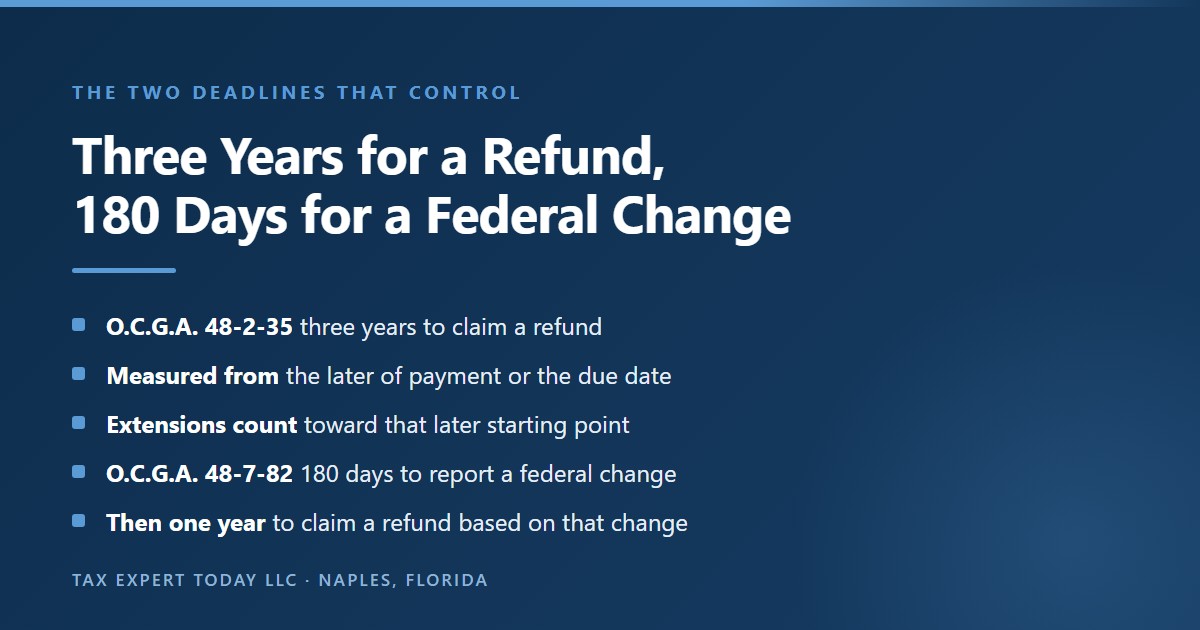
Georgia gives you three years to claim a refund, but it measures those three years differently from the federal rule. Under O.C.G.A. § 48-2-35, a refund claim may be made within three years after the date the tax was paid or, “in the case of income taxes, the later of the date of the payment of the tax or fee to the commissioner or the due date for filing the applicable income tax return, including any extensions which have been granted.”
- The clock starts at the later of two dates, which means an early payment does not shorten the window.
- Extensions push the starting point out, so a return placed on extension carries a later deadline than one filed in April.
- Withholding is treated as paid on the return due date, which is what gives most wage earners a clean three years from April.
- Military service tolls the period. The statute provides that where a person is prevented from filing a claim because of armed forces service, “the period of limitation shall date from the discharge.”
The practical effect of the “later of” language is that Georgia is slightly more generous than the federal refund rule in the common case, and materially more generous where an extension was filed. A taxpayer who extended a 2022 return to October 2023 and paid the balance in April 2023 measures three years from October 2023, not from April. Nothing on the current search results for this topic explains that, and it is the difference between a live refund claim and a dead one for filers who routinely extend.
| Situation | When the three years starts | Authority |
|---|---|---|
| Return filed and paid in April, no extension | The April due date | 48-2-35(c)(1)(A)(ii) |
| Return extended to October, balance paid in April | The October extended due date | 48-2-35(c)(1)(A)(ii) |
| Return extended, balance paid in October with the return | The October extended due date | 48-2-35(c)(1)(A)(ii) |
| Assessment paid years later after an audit | The date that payment was made | 48-2-35(c)(1)(A)(i) |
| Refund claim denied by the Department | Two years from the denial to bring an action | 48-2-35(c)(6)(A)(i) |
Note the last row, because it is a second trap. Filing the claim on time preserves the claim, but it does not preserve it forever. Once the Department denies a claim, a separate two-year period governs how long you have to take the dispute further. A claim filed on the last available day and then denied leaves a much shorter runway than filers assume.
Must You Amend Georgia When the IRS Changes Your Federal Return?
Yes, and this is the deadline that is missing from every page currently ranking for this topic. O.C.G.A. § 48-7-82(e) requires a taxpayer whose federal net income has been changed or corrected to report that change to the Georgia commissioner “within 180 days after the final determination date of the changed or corrected net income.” This obligation is independent of the three-year refund window, and it applies whether the federal change increases or decreases Georgia tax.
- 180 days, not three years. The reporting duty runs on its own short clock regardless of how much time is left under O.C.G.A. § 48-2-35.
- Then a one-year window opens. After the change report is filed, the statute gives the commissioner one year to assess and gives the taxpayer one year to “claim a refund based on the change or correction.”
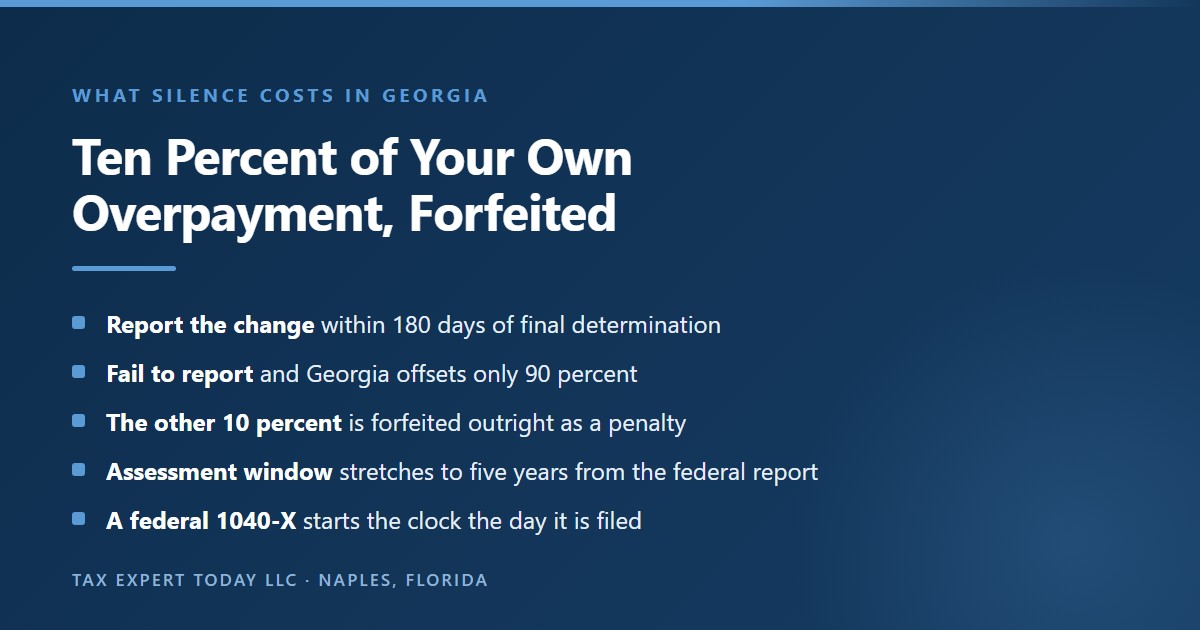
- Filing a federal 1040-X starts the clock immediately. Where the adjustment “results from filing an amended federal return, a federal refund claim, or an administrative adjustment request,” the statute sets the final determination date as “the day on which the amended return, refund claim, administrative adjustment request, or other similar report was filed.”
- An audit ends differently. For an examination, the final determination date is “the first day on which no changes or corrections for a particular audit remain to be finally determined, whether by agreement, or, if appealed or contested, by a final decision with respect to which all rights of appeal have been waived or exhausted.”
- Consolidated groups wait for the group. Where the taxpayer filed as part of a combined or consolidated group, the date is the first day no related changes remain outstanding for the entire group.
The 1040-X rule deserves separate emphasis because it inverts what most people assume. A taxpayer who amends a federal return and then waits to see whether the IRS accepts it has already started the Georgia clock. The 180 days ran from the day the 1040-X was mailed or transmitted, not from the day a federal refund arrived. Waiting for federal closure is the single most common way this deadline is missed, and the cost of missing it is described next.
What Happens If You Do Not Report a Federal Change to Georgia?
Georgia keeps part of your refund. Where a taxpayer neglects to file the change report required by O.C.G.A. § 48-7-82(e)(1), the statute permits the commissioner to credit only “90 percent of any overpayment so determined against any additional tax liability so determined, the remaining 10 percent of the overpayment being totally forfeited as a penalty for failure to make a return as required.” The forfeiture is measured against your overpayment, not against tax you owe.
- It is a forfeiture, not an ordinary penalty. The 10 percent is taken from money that was yours, which makes it structurally different from a late payment charge.
- It applies even where the net result favors you. A federal change that produces a Georgia overpayment still triggers the forfeiture if the change was never reported.
- The assessment window stretches to five years. Where the commissioner receives the federal report without the taxpayer’s notification, assessment may be made “within five years from the date the report from the United States government or its agent is actually received.”
- Georgia learns about federal changes anyway. The five-year rule exists precisely because the federal government reports adjustments to the state, so non-reporting delays discovery rather than preventing it.
This provision is the reason the “should I bother amending Georgia” question usually answers itself. Where a federal adjustment has occurred, the choice is not between amending and doing nothing. It is between filing the change report on time and accepting a longer assessment exposure plus a fixed haircut on any overpayment. Our guide to the IRS audit statute of limitations covers the federal side of the same timeline, which is worth reading alongside this because the two periods do not expire together.
| What triggered the federal change | Final determination date | Georgia report due |
|---|---|---|
| You filed a federal Form 1040-X | The day the 1040-X was filed | 180 days later |
| You filed a federal refund claim | The day the claim was filed | 180 days later |
| IRS examination closed by agreement | The day the last party signed | 180 days later |
| IRS examination appealed and concluded | When all appeal rights are waived or exhausted | 180 days later |
| Partnership administrative adjustment request | The day the request was filed | 180 days later |
Can Form 500X Be Filed Electronically, or Must It Be Paper?
Georgia supports electronic amendment, and the widespread claim that Georgia amended returns must be paper filed describes a software limitation rather than state law. The Department of Revenue publishes an electronic amendment path through the Georgia Tax Center: “From the Account Summary page, click the View Return link for the desired filing period. Click the Amend button and make the necessary changes. Confirm your request the same way you did for the original return.”
- The Georgia Tax Center carries an Amend button against a previously filed period, which is the Department’s own described route.
- For some filers electronic amendment is mandatory. The Department states that taxpayers remitting by electronic funds transfer “must file all associated returns and forms electronically,” a list that expressly “includes, but is not limited to” all amended returns.
- Form 500X is also fillable online on the Department’s forms page for the current year and for several prior years.
- Paper remains available, and it is still the right route for older years where the online form is not offered.
The contradiction is worth naming plainly because both sides of it sit on the first page of search results for this topic. One consumer software support article states that amended state returns must be paper filed and instructs the user to print, sign and mail. A professional support article from the same company states that “Georgia supports electronic filing for Form 500X.” Both statements are accurate about their own product. Neither is a statement about Georgia law. If your software cannot transmit a 500X, that is a fact about your software, and it does not mean Georgia refuses electronic amendments.
Practically, the choice usually comes down to the year being corrected. Recent years amend cleanly through the Georgia Tax Center or through professional software. Older years fall off the online form list and revert to paper. The Department currently offers Form 500X for completion online back several years, with downloadable paper versions covering the older range, so the year you are amending determines the mechanism more than any preference of yours does.
Does Amending Restart Penalties and Interest in Georgia?
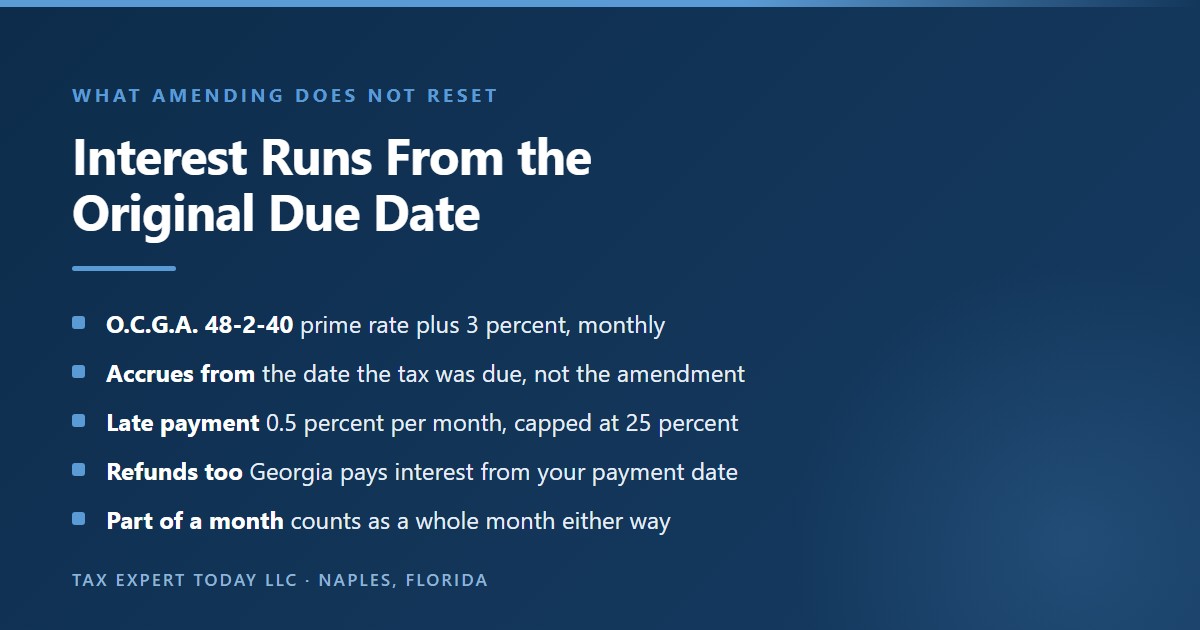
No, and this is the fact that most often decides whether a voluntary amendment is worth filing. Georgia interest does not run from the date you amend. Under O.C.G.A. § 48-2-40, interest accrues at “an annual rate equal to the bank prime loan rate as posted by the Board of Governors of the Federal Reserve System in statistical release H.15 or any publication that may supersede it, plus 3 percent, to accrue monthly,” and it “shall begin to accrue from the date the tax is due until the date the tax is paid.”
- Interest runs from the original due date, so an amendment that increases 2022 tax carries interest back to the 2023 filing deadline.
- The rate is reset each January and is “determined for each calendar year based on the first weekly posting of statistical release H.15 on or after January 1 of each calendar year.”
- Part of a month is a whole month. The statute provides that “any period of less than one month shall be considered to be one month,” so a payment landing one day into a new month picks up a full month of interest.
- Late payment penalty accrues the same way, at 0.5 percent of the unpaid tax per month, capped at 25 percent of the tax due.
- Penalty waiver is available for reasonable cause. The Department may waive penalty in whole or in part under O.C.G.A. § 48-2-43 where the failure “was not a result of purposeful disregard of tax requirements.”
The published Georgia penalty schedule is worth reading before deciding how to present an amendment, because the negligence penalty and the fraud penalty attach to the underpayment rather than to lateness, and they are the two charges a poorly explained amendment can invite.
| Charge | What triggers it | Rate | Maximum | Statute |
|---|---|---|---|---|
| Late filing | Return not filed by the due date | 5 percent of tax not paid by the original due date, plus 5 percent per additional month | 25 percent of tax due | 48-7-57 |
| Late payment | Tax not paid by the original return due date | 0.5 percent of unpaid tax, plus 0.5 percent per additional month | 25 percent of tax due | 48-7-86 |
| Negligent underpayment | Underpayment due to negligence or disregard of requirements | 5 percent of the underpayment | None stated | 48-7-86 |
| Fraudulent underpayment | Underpayment due to fraud | 50 percent of the underpayment | None stated | 48-7-86 |
| Underpaid estimated tax | Estimated tax shortfall, computed on Form 500 UET | 9 percent per year of the underpayment | None stated | 48-7-120 |
| Interest | Any unpaid tax | Prime rate plus 3 percent, monthly | None | 48-2-40 |
The Department also confirms that the combined total of the late filing penalty and the late payment penalty cannot exceed 25 percent of the tax due on the return due date. That combined ceiling is the one piece of good news in the table, and it means a long-overdue correction is not penalized without limit even though interest continues to run. If the underlying problem is an estimated tax shortfall rather than a reporting error, our Georgia estimated tax penalty calculator handles that computation separately.
Does Georgia Pay Interest on an Amended Return Refund?
Yes, and the starting point favors the taxpayer. The Department states that “unless otherwise provided by statute or regulation, interest on refunds accrues from the date of payment of the tax,” at the same prime rate plus 3 percent that applies to underpayments. A refund produced by an amendment therefore carries interest running back to the original overpayment rather than from the date the amended return was filed.
- The accrual date is your payment date, which on a wage-withholding return is effectively the original due date.
- The rate matches the underpayment rate, so Georgia does not pay a reduced rate on money it held.
- Delay does not erode the interest entitlement, though it does risk the three-year window closing entirely.
- The same monthly rounding applies, since the shorter-than-a-month rule is drawn from the same interest provision.
This is the mirror image of the underpayment rule and it is absent from every competing page. A taxpayer sitting on a discovered overpayment from two years ago is not choosing between a refund now and the same refund later. The refund itself accrues interest for the whole period it was held, so the calculation is about the deadline rather than about erosion. What that does not do is create a reason to wait, because the three-year limit under O.C.G.A. § 48-2-35 is absolute and the interest entitlement dies with the claim.
Which Tax Year’s Rate Applies to a Georgia Amended Return?
The rate for the year being amended, never the current rate. This matters more in Georgia than in most states because the flat rate has moved in each of the last several years. The Department of Revenue currently states that “the Georgia income tax rate has been reduced to a flat rate of 4.99%” and that “the Georgia standard deduction has been increased to $15,000 for single taxpayers, heads of households, and married taxpayers filing separately, or $30,000 for married taxpayers filing jointly.”
- An amended 2025 return uses the 2025 rate, which was higher than the current figure.
- The standard deduction moves with the year too, so a recomputation must pull both figures from the correct year.
- Third-party rate pages lag. At the time of writing, at least one widely cited national tax policy site still shows Georgia at the prior year rate.
- Georgia cuts the rate on a rolling basis, which means any guidance that does not name a tax year should be treated as unusable for an amendment.
This is a genuine source of error on amended returns. A filer who corrects a two-year-old return using this year’s rate will produce a number that does not reconcile with anything, and the Department will not adopt the taxpayer’s arithmetic. The rate sequence also explains why the value of a given correction differs by year: the same overlooked deduction is worth more on an older return than on a current one. Where the correction involves retirement income, the Georgia retirement income exclusion amounts are similarly year-specific and are a common reason for an amendment in the first place.
| Tax year | Georgia flat rate | Where it comes from |
|---|---|---|
| 2026 | 4.99 percent | Department of Revenue, Important Tax Updates |
| 2025 | 5.19 percent | The rate the 2026 reduction was measured down from |
| Earlier years | Higher, and it changed annually | The IT-511 booklet for that specific year |
For any year older than those shown, the reliable source is the IT-511 Individual Income Tax Booklet published for that year, which the Department keeps online going back well over a decade. Do not reconstruct an older rate from a current page.
Should You Amend Federal First or Georgia First?
Federal first, in almost every case where both returns are affected. Georgia taxable income begins with federal adjusted gross income, so a Georgia amendment built on federal figures that are themselves about to change produces a return that must be amended twice. The sequencing also matters for the deadline, because filing the federal amendment is what fixes the final determination date that starts the Georgia 180-day clock.
- Georgia builds on the federal return, so the federal number has to settle before the state computation is meaningful.
- Filing the 1040-X sets the Georgia clock, which means the two filings should be planned together rather than months apart.
- Do not wait for the IRS to finish. The 180 days runs from the day the amended federal return was filed, not from the day it was processed.
- Georgia-only corrections skip this entirely. A change to a Georgia subtraction or credit that does not touch federal adjusted gross income needs no federal amendment at all.
That last point separates two very different situations that filers tend to merge. A missed Form W-2 changes both returns and calls for the federal-first sequence. A missed Georgia retirement exclusion, a miscomputed part-year ratio, or an unclaimed state credit changes only the Georgia return, and there is nothing federal to wait for. Part-year filers in particular tend to discover the second kind of error, and the mechanics of that computation are covered in our guide to the Georgia part-year resident tax return.
How Long Does Georgia Take to Process Form 500X?
The Department does not publish a processing time specific to amended returns, and the widely repeated 90-day figure is being applied to the wrong thing. The State of Georgia’s filing page states that “if you are due a refund, it can take up to 90 days from the time you file to receive it,” which is a general outer bound for a refund. The Department’s own refund tracker asks filers to “allow at least 2-3 weeks of processing time before checking the status,” which describes an ordinary return.
- The 90 days is a general refund ceiling, not a published amended return service standard.
- Two to three weeks is the Department’s guidance for when it is even worth checking a normal return’s status.
- Amended returns are reviewed by hand in practice, so they routinely run longer than an original filing.
- A thin explanation of changes extends the wait, because it converts a processing task into a correspondence exchange.
We are stating this precisely rather than repeating the common summary, because several sources currently assert a 90-day amended return processing time and attribute it to the Department. What the state actually publishes is a 90-day general refund outer bound and a two to three week status-check guideline for ordinary returns. No amended-return-specific figure appears on the Department’s pages. The honest answer is that Form 500X takes longer than an original return, that the Department has not committed to a number, and that the quality of the explanation attached to the form is the variable a taxpayer actually controls.
What Are the Most Common Reasons to Amend a Georgia Return?
Most reasons for filing a Georgia amended tax return fall into a small number of recurring categories, and the majority of them are state-only corrections that never touch the federal return. Recognizing which category a correction falls into determines whether a federal amendment is needed, which deadline applies, and whether the change is likely to produce a refund or a balance due.
- A late-arriving income document, most often a corrected Form W-2 or a Form 1099 that appeared after filing.
- A missed Georgia subtraction, with the age-based retirement exclusion the most frequent single item.
- A residency status correction, where a filer used a full-year form for a year in which they moved.
- A credit claimed incorrectly or not at all, including credits purchased from another taxpayer.
- A federal adjustment flowing through, which triggers the 180-day reporting duty rather than an ordinary amendment.
Residency corrections are the category most likely to be worth real money and the one most likely to be filed wrong the second time as well. Georgia allocates income for a part-year resident but prorates the deduction, and getting one of those two treatments right while getting the other wrong is a common outcome on a self-prepared amendment. Where the year involved a property sale, the basis and withholding mechanics in our guide to Georgia capital gains tax frequently drive the correction, and an inherited asset changes the starting basis in a way explained in our guide to Georgia inheritance tax.
When Is It Better Not to Amend?
An amendment is not automatically the right response to a discovered error. Where the change produces no refund and no additional tax, filing one adds a document to the file and invites review without improving the taxpayer’s position. The decision turns on whether the correction is material, whether a reporting duty independently requires it, and whether the refund window is still open at all.
- The three years has closed. A refund claim outside O.C.G.A. § 48-2-35 cannot be revived by filing anyway.
- The change is immaterial and produces no movement in tax after the correction is carried through.
- The correction increases tax and no federal change or reporting duty compels it, which is a judgment call rather than a rule.
- A federal change is pending and the Georgia return should wait for it rather than be filed twice.
The third item deserves care rather than a slogan. Where an amendment would increase Georgia tax, there is no general obligation to file one absent a federal change report duty, but there is also an accuracy interest and a continuing exposure while the assessment period under O.C.G.A. § 48-2-49 remains open. That is a situation to evaluate on its own facts with someone who can look at the whole return, not one to resolve from an article. Entity owners face the same question in a different shape, since an entity-level correction can flow to every owner at once, which is why the Georgia pass through entity tax election and the Georgia composite return both have their own amendment consequences.
What Records Should Support a Georgia Amended Return?
The explanation of changes carries the return. Form 500X restates the entire return as corrected, so the Department is comparing two complete sets of numbers and relying on the explanation to understand why they differ. An amendment supported by a clear narrative and the underlying documents is processed. One supported by a single line is queued for correspondence.
- The corrected source document, such as the amended Form W-2 or the late Form 1099 that caused the change.
- The federal amendment, where one was filed, together with the date it was filed.
- A short computation showing how the corrected figure was derived, particularly for allocations and prorations.
- Proof of the original payment date, which governs both the refund deadline and the interest accrual.
- Any certificate or schedule supporting a credit, which is the item most often omitted on credit amendments.
Keep the file for as long as the assessment period stays open rather than for as long as the refund window runs, because the two are different periods. Where a credit was purchased or transferred, the supporting documentation chain matters more than the arithmetic, which is a recurring theme in our guide to the Georgia film tax credit.
Georgia Amended Tax Return Help in Naples & Southwest Florida
Tax Expert Today is based at 11983 Tamiami Trail N, Naples FL 34110, and the office is open Monday through Friday, 10:00 to 5:00 Eastern. Georgia clients are served nationwide from Naples, which is a routine arrangement for amended state returns: the original year is reconstructed, the corrected return is prepared, and the filing is made electronically or on paper depending on the year involved. Southwest Florida holds a large population of former Georgia residents, and that group generates a particular kind of amendment, namely returns filed as full-year Georgia residents for a year in which the taxpayer had already moved.
Naples, Florida sits at the southern end of the I-75 corridor that runs directly to Atlanta, and a large share of the amendments we handle involve the year somebody drove south. If you have found an error on a Georgia return, received a federal adjustment that has to be reported to Georgia, or been told your refund window has closed and want that verified, call (239) 441-2005. You can also review our Georgia tax services for the full range of state work handled from this office, or our Naples tax planning services if the correction sits inside a broader plan.
Does moving to Florida change whether an old Georgia return should be amended? It often creates the reason to amend rather than removing it. A taxpayer who relocated mid-year and filed a full-year Georgia return has usually overpaid, because Georgia should have taxed only the Georgia-source and Georgia-period income rather than the full year. Florida imposes no individual income tax, so there is no offsetting home-state consequence to weigh and the correction is generally one-directional. The constraint is the calendar rather than the merits: the three-year window under O.C.G.A. § 48-2-35 runs from the later of payment or the extended due date, so a move from three or four years ago may already be outside it while a more recent one is comfortably inside.
When Should You Engage a Professional?
A Georgia amended tax return concentrates risk in a way an original return does not. The deadline analysis is unforgiving, a single filing can open a correspondence exchange on a year that was closed in the taxpayer’s mind, and the 180-day federal change rule carries a forfeiture that no amount of later diligence undoes. The situations that most warrant review are a federal adjustment of any size, a residency or part-year correction, a refund claim filed near the end of the three-year window, a credit that was purchased or transferred, and any year where the taxpayer is unsure whether the original return was ever actually accepted.
Tax Expert Today works on state tax matters nationwide, and Georgia amendments are a regular part of that work. The first step is usually establishing which deadline governs, because that single determination decides whether the rest of the analysis is worth doing. Call (239) 441-2005 to talk it through.
Frequently Asked Questions
Can I file a Georgia amended return if I never filed the original? No. Form 500X corrects a previously filed Form 500, and the Department states directly that you should not use a Form 500X as an original return. An unfiled year is filed on the Form 500 for that year.
How many years back can I amend a Georgia return? For a refund, three years measured from the later of the date you paid the tax or the return due date including extensions, under O.C.G.A. § 48-2-35. There is no equivalent outer limit on filing an amendment that increases tax.
Does Georgia have its own version of Form 1040-X? Yes, Form 500X. It serves the same function for the Georgia individual income tax return but runs on Georgia deadlines, which differ from the federal ones in both measurement and length.
Will amending my Georgia return trigger an audit? An amendment is not itself an audit trigger, but it does place the year in front of a reviewer. A clear explanation of changes and complete supporting documentation is the practical protection.
What if the IRS changed my return years ago and I never told Georgia? The reporting duty under O.C.G.A. § 48-7-82(e) does not expire by being ignored, and the commissioner has five years from receipt of the federal report to assess. Filing late is generally better than not filing, and the 10 percent forfeiture applies to the overpayment rather than to the whole liability.
Can I amend to change my filing status? Generally yes where the federal filing status is being changed correspondingly, since Georgia follows the federal status. A Georgia-only status change without a matching federal position is unusual and should be reviewed before filing.
Does Georgia charge interest if my amendment produces a refund? Georgia pays interest to you in that situation. Interest on refunds accrues from the date of payment of the tax at the prime rate plus 3 percent.
How do I check the status of a Georgia amended return? Through the Georgia Tax Center account for the filing period involved. The Department’s general refund tracker is built around original returns, so an amended return status is more reliably tracked from the account than from the public refund tool.
Do I need to amend Georgia if the federal change does not affect my Georgia tax? The reporting duty under O.C.G.A. § 48-7-82(e) is written around a change or correction to federal net income rather than around whether Georgia tax moves, so a change that flows into the Georgia computation should be reported even where the net result is zero.
Is there a penalty for filing a Georgia amended return late? Not for the amendment itself. The penalties that apply are the ones attached to the underlying tax, principally late payment at 0.5 percent per month capped at 25 percent, plus interest from the original due date.
Published September 10, 2026 by Dr. Pellumb Kabashi « Back to Learning Center
Have a question this article touches on?
Tax Expert Today LLC, based in Naples, Florida and serving clients across the United States.
Schedule a Consultation (239) 441-2005