
By Dr. Pellumb Kabashi, DBA, MBA, EA, CFE, CES
Founder, Tax Expert Today LLC · Tax advisors, enrolled agents, CPAs, and attorneys · Serving clients in all 50 states
Quick answer: A Georgia composite return is Form IT-CR, filed by a partnership, S corporation, or LLC to report and pay Georgia tax for its nonresident owners in place of the 4 percent nonresident withholding. Georgia permission is not required, and filing the return is itself the election. The rate is the individual rate for the year, 5.19 percent for 2025 and 4.99 percent for 2026. Call (239) 441-2005 for a free consultation.
What is a Georgia composite return?
A Georgia composite return is a single Form IT-CR that a partnership, S corporation, or LLC files on behalf of its nonresident owners, reporting and paying their Georgia income tax on their share of Georgia source income. Ga. Comp. R. & Regs. 560-7-8-.34(3)(a) allows it in lieu of the 4 percent nonresident withholding that O.C.G.A. § 48-7-129 otherwise requires. The Department of Revenue instructions state plainly that permission is not required.
- The filing is the election. The regulation states that the filing of the composite return shall constitute the election. There is no separate form, no advance application, and no approval letter to wait for.
- It replaces withholding, it does not sit beside it. O.C.G.A. § 48-7-129(b)(2) exempts an entity from the withholding requirement where it files a compliant composite return.
- It removes a filing obligation from the owner. A nonresident member included in the computation is not subject to withholding and is not required to file a Georgia income tax return to report that entity’s income.
- It is irrevocable once the deadline passes. The election must be made by the due date of the composite return including approved extensions, and after that date the return may not be amended to add or remove members.
The mechanics are less interesting than the decision behind them. Georgia gives a pass-through entity with out of state owners three ways to satisfy the state, and the composite return is only one of them. Most published material on this subject stops at describing Form IT-CR. The harder question, and the one that actually changes what an owner pays, is whether the composite return is the right container for that owner at all. A fourth container sits outside that set and switches the other three off entirely, because an entity that makes the Georgia pass through entity tax election files no composite return at all for that year.
Who can be included on a Georgia composite return?
Ga. Comp. R. & Regs. 560-7-8-.34(3)(a) permits individuals, corporations, partnerships, limited liability companies, estates, trusts, Qualified Subchapter S Trusts, and Electing Small Business Trusts to be included. The gating question is not entity type. It is whether the member has Georgia source income from anywhere other than the entity, because a member who does is generally barred from the composite return except at the highest marginal rate.
- Nonresident status is fixed on one day. The regulation determines nonresident status on the last day of the entity’s tax year, not by counting days across the year.
- Other Georgia income is the disqualifier. Members with Georgia income from sources other than the entity may not be included, and are instead subject to withholding, unless the entity uses the highest marginal rate computation.
- Small members may still be included. Members whose aggregate annual share of Georgia source income is under $1,000 are not required to be withheld upon, but the regulation expressly allows them to be included on the composite return anyway.
- A corporate member does not escape the net worth tax. The regulation is explicit that a corporation included on a composite return is still required to file a separate net worth tax return.
- Exclusion has consequences on both sides. Any nonresident member left off the composite return is subject to withholding and is required to file a Georgia income tax return.
The definition of a nonresident reaches further than most owners expect. The regulation defines a nonresident as an individual or fiduciary member who resides outside Georgia, and all other members whose headquarters or principal place of business is located outside Georgia. A Delaware holding company managed from Charlotte is a nonresident member of a Georgia operating partnership even though no natural person is involved.
What tax rate applies on a Georgia composite return?
The composite rate is the ordinary Georgia individual income tax rate for the filing year, because the regulation sends the computation to the rate provided in O.C.G.A. § 48-7-20. That rate was 5.19 percent for tax year 2025 and is 4.99 percent for tax year 2026. The 5.75 percent figure that still circulates in search results, including in the Google AI Overview for this topic, is a retired rate carried forward from old forum posts.
This is worth stating carefully because the error is live right now. As of the date of this article, the AI Overview Google returns for the phrase Georgia composite return quotes a practitioner forum thread describing a flat 5.75 percent rate applied to the owner’s distributive share. That was correct once. It has not been correct for several filing seasons, and Georgia has reduced the rate again since.
| Tax year | Rate applied on Form IT-CR | Source |
|---|---|---|
| 2024 | 5.39 percent | Form IT-CR for 2024 |
| 2025 | 5.19 percent | 2025 Form IT-CR, stated in the instructions and applied in the form’s own worked examples |
| 2026 | 4.99 percent | Department of Revenue, Important Tax Updates |
Two rate provisions can appear on the same composite return. Individual members use the rate in O.C.G.A. § 48-7-20. Non-individual members, under Ga. Comp. R. & Regs. 560-7-8-.34(3)(c)2, apply the rate in subsection (a) of O.C.G.A. § 48-7-21 instead, which is the corporate rate provision. Anyone confirming that figure should read the current statutory text rather than a search result, because the version of § 48-7-21 that ranks highly in general search is a snapshot labelled current as of March 2024 and it reflects the pre-reduction corporate rate. Confirm the rate for the filing year against the current Form 600 instructions.
The withholding alternative uses a different number again. O.C.G.A. § 48-7-129(a)(2) sets withholding at 4 percent of the nonresident member’s share of Georgia source income. That is now below the 4.99 percent tax rate, so withholding no longer covers the full liability even in a simple case. The statute makes any excess refundable to the member at the end of the taxable year, but it does nothing about a shortfall, which stays with the member.
Why did Option 3 disappear from the Georgia composite return?
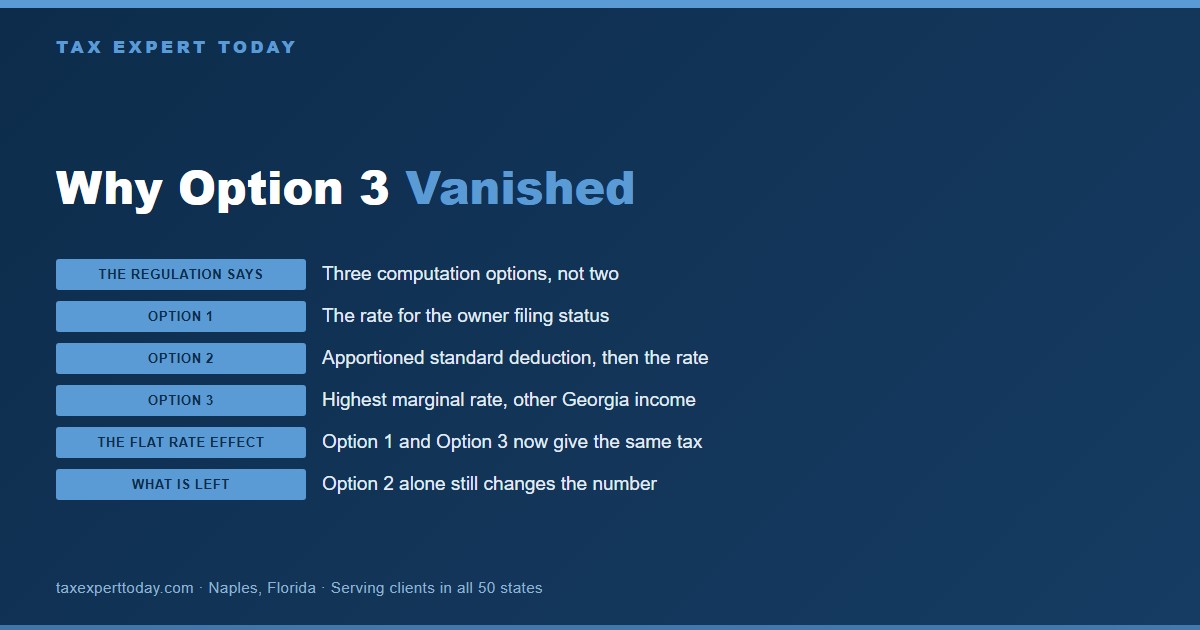
The regulation authorises three computation options, not two. Ga. Comp. R. & Regs. 560-7-8-.34(3)(c)1 lists Option 1 based on filing status, Option 2 with an apportioned standard deduction and dependent credit, and Option 3 at the highest marginal rate for a member who has other Georgia income. The current Form IT-CR describes only two. The reason is that Georgia now taxes at a flat rate, so Option 1 and Option 3 produce an identical number.
The regulation drafted those options when Georgia had a graduated bracket structure. Option 1 applied the rate that matched the member’s filing status. Option 3 applied the highest marginal rate as a penalty of sorts, and it was the only route open to a member who also had Georgia income from somewhere else. Under a graduated schedule those two produced different tax. Under a single flat rate they cannot.
The 2025 Form IT-CR proves the point in its own worked example. The Option 1 illustration lists four members with different marital statuses and applies 5.19 percent to every one of them. Filing status no longer changes the rate, so the distinction Option 1 was built on has gone. That is why the form instructions now say only that an individual who is otherwise required to file a Georgia return may still be included provided that member uses Option 1, folding what the regulation calls Option 3 into the same line.
- Option 2 is the only election that still changes the number. It is the sole option that reduces the base before the rate is applied.
- The option is chosen member by member. The entity does not have to apply one option across the whole schedule.
- The option is chosen every year. The election of options may be changed annually, so a member on Option 1 last year is not locked into it.
- The option locks at filing. The regulation states the election shall not be changed after the filing of the return, and the form instructions repeat it.
- Option 1 and Option 2 require an annual affidavit. Form CR-AFF, signed by the member each year, verifies that the member has no Georgia income from sources other than the entity and confirms the member’s Georgia filing status.
Form CR-AFF is the step most often missed. It is not filed with the Department. It is a signed statement the entity must obtain and hold for each member using Option 1 or Option 2, refreshed every year, and it is the entity’s only evidence that the member was eligible for the option used. The regulation requires it in terms.
How does Option 2 actually compute the tax?
Option 2 reduces the member’s Georgia source income by an apportioned standard deduction and an apportioned credit for dependents before applying the rate. The apportionment ratio is the member’s Georgia income divided by that member’s share of the entity’s total income. For tax year 2025 the amount to which the ratio is applied is capped at $12,000 for single, head of household, and married filing separately, or $24,000 for married filing jointly, with a $4,000 dependent exemption.
A worked illustration makes the shape of it clear. Assume a nonresident member of a Georgia partnership with $40,000 of total distributive share income, of which $15,000 is Georgia source, filing as single with no dependents, for tax year 2025. The Georgia ratio is 15,000 divided by 40,000, or 37.5 percent. The $12,000 standard deduction is reduced to $4,500. Georgia income of $15,000 less $4,500 leaves $10,500, which at 5.19 percent produces $545. Under Option 1 the same member would pay 5.19 percent on the full $15,000, which is $779. The Option 2 saving in this illustration is $234. These are illustrative figures only, and the result for any particular member depends on facts this article cannot know.
Two features of that arithmetic are easy to miss. The ratio uses the member’s own income, not the entity’s apportionment percentage, so two members of the same partnership can have very different ratios. And the deduction is prorated rather than allocated, which is the same structural rule that governs a Georgia part-year individual return, explained in our guide to the Georgia part-year resident tax return.
For tax year 2026 the Department of Revenue has increased the Georgia standard deduction to $15,000 for single filers, heads of household, and married taxpayers filing separately, and to $30,000 for married taxpayers filing jointly. The 2026 Form IT-CR has not been released as of the date of this article, so the composite instructions for that year should be read when they appear rather than assumed from the individual figures.
Composite return, withholding, or an owner filing individually?
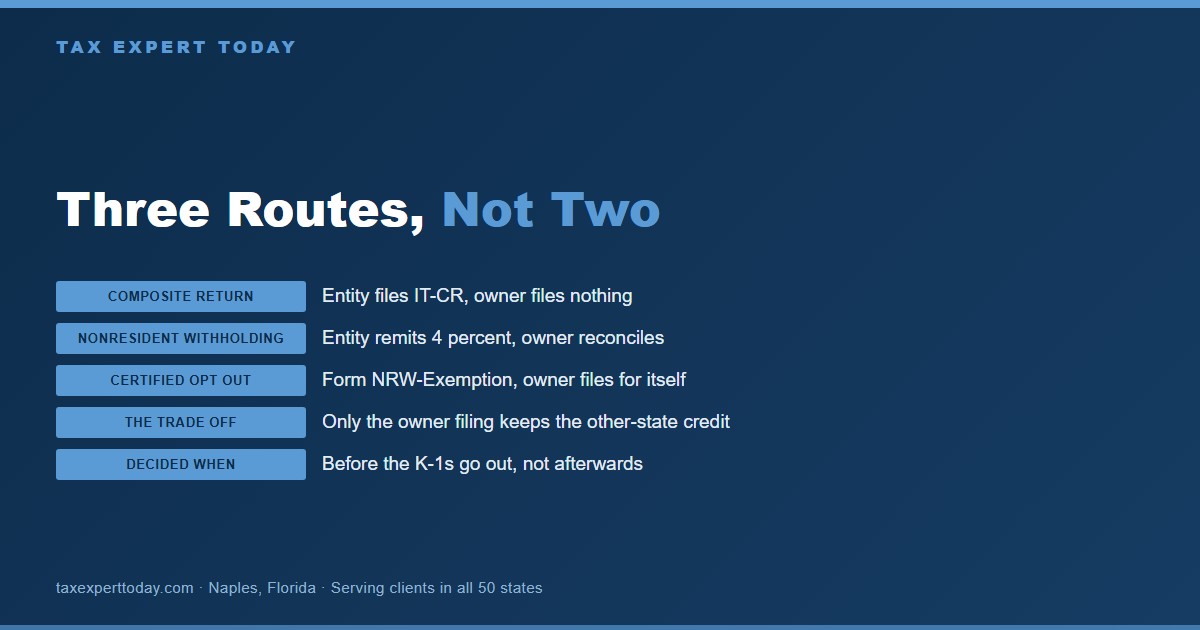
Georgia offers three routes, and most published material describes only two. Beyond the composite return and the 4 percent withholding, Ga. Comp. R. & Regs. 560-7-8-.34(2)(g) lets an individual, fiduciary, or C corporation member escape withholding entirely by certifying on Form NRW-Exemption that it consents to Georgia personal jurisdiction, will file Georgia returns, and will make estimated payments if required.
| Feature | Composite return (IT-CR) | 4 percent withholding | Certified opt-out (NRW-Exemption) |
|---|---|---|---|
| Owner files a Georgia return | No, for that entity’s income | Yes | Yes |
| Rate applied | 4.99 percent for 2026 | 4 percent of Georgia source share | Owner’s actual Georgia liability |
| Deductions available | Apportioned standard deduction under Option 2 only | None at withholding stage | Full individual computation |
| Credit for taxes paid to another state | Not available on the composite return | Available on the owner’s own return | Available on the owner’s own return |
| Who carries the compliance burden | Entity | Entity remits, owner reconciles | Owner, after a one time certification |
| Entity forms involved | IT-CR, CR-ES, CR-PV, CR-AFF held on file | CRF-002, G-7-NRW, G-2-A, G-1003 | NRW-Exemption, or 600S-CA for an S corporation |
The certified opt-out is the quiet option. A member who agrees in writing to be subject to Georgia personal jurisdiction for all income tax purposes, to file returns, and to make estimated payments where required, removes the withholding obligation for that member. The certification is made once, on or before the unextended due date of the entity’s return, and the form must then be attached to the entity’s income tax return each year. An S corporation uses Form 600S-CA instead, and one already obtained for the Georgia S election does not have to be obtained a second time.
The catch is that the exception fails backwards. If a member certifies and then does not meet the conditions, the regulation provides that withholding is due as originally required, as if the certification had never been made. The entity carries that exposure, not the member who broke the promise.
What does a member give up by joining a composite return?
A composite return is not the member’s own return, so nothing that belongs to the member personally travels onto it. The regulation disallows deductions for items subject to other limitations, including charitable contributions, investment interest expense, IRC § 179 expense, casualty losses, and capital losses, and it disallows deductions normally taken in computing adjusted gross income such as self-employment deductions, self-employed health insurance, Keogh, and SEP contributions.
- No credit for taxes paid to another state. That credit belongs on a return the member files, and a member on a composite return is not filing one for this income.
- No itemising. Option 2 offers an apportioned standard deduction and nothing else, and Option 1 offers neither.
- No personal exclusions. The regulation frames the computation as closed, and the form instructions state that no other options or alternatives are allowed, so personal-level items have no place on it. That includes the exclusion described in our guide to the Georgia retirement income exclusion, which is computed on an individual Georgia return.
- No use of the member’s other Georgia positions. A loss or credit sitting elsewhere in the member’s Georgia picture cannot be brought to the composite return.
- Business credits are the exception. The Form IT-CR does carry Schedule 2 and Schedule 2B, so entity-level business credits, including transferable credits acquired by purchase, can be applied against composite tax.
That last point deserves emphasis because it runs the other way from everything above it, and it is absent from every page currently ranking for this topic. A composite return is a real Georgia income tax return with a credit usage schedule attached. An entity that has bought a block of transferable credit, of the kind discussed in our guide to the Georgia film tax credit, can apply it against the composite liability rather than pushing the credit out to owners who may or may not be able to use it. For a partnership with a scattered nonresident owner group, that is often the cleanest place for a purchased credit to land.
A partnership that files a composite return still files its own partnership return. On Georgia Form 700 the partnership checks the Composite Return Filed box on page 1, and the Georgia source income shown for each partner on Schedule 4 should tie to the amounts reported on Form IT-CR. Our guide to the partnership return walks through those schedules and the due dates the two returns share.
What are the deadlines and estimated tax rules?
A calendar year entity files the composite return on the individual deadline, April 15 for a 2025 return. A fiscal year entity files by the fifteenth day of the fourth month after its fiscal year end, which the form instructions describe as within three and a half months. Estimated tax is required whenever the composite tax exceeds $500 for the year, using Form IT-CR UET to compute any penalty.
- Estimates use Form CR-ES. The Department has already published the 2026 composite estimated tax voucher, and estimated payment dates match the individual dates.
- Large estimates must be paid electronically. Under O.C.G.A. § 48-2-32(f)(2), a composite estimate taxpayer with quarterly payments of $10,000 or more must pay through the Georgia Tax Center, and a 10 percent penalty applies if the payment is not submitted electronically.
- A federal extension carries over. Georgia honors a federal extension where the Georgia return is filed with the federal approval form on or before the extended federal due date. Where no federal extension exists, Form IT-303 requests a Georgia extension.
- An extension does not extend payment. Tax due must be paid on Form IT-560C by the statutory due date rather than the extended filing date.
- Payment with the return uses Form CR-PV. Tax remitted at the time the IT-CR is due goes with the CR-PV payment voucher.
The interaction between the composite estimated tax rules and an owner’s own Georgia estimates is a common source of duplicate payment. An owner included on a composite return does not need to make personal Georgia estimates for that income, because the entity is paying it. An owner excluded from the composite return does. The underpayment mechanics that follow from getting that wrong are set out in our Georgia estimated tax penalty calculator.
How do net operating losses work on a composite return?
A net operating loss computed on a Georgia composite return may be carried forward to another composite return year, and may never be carried back. Georgia did not adopt the revised net operating loss provisions of the 2020 CARES Act, and did not adopt the CARES Act modification to the IRC § 461(l) limitation, so the pre-CARES excess business loss limitation still applies. Losses for 2018 and later are capped at 80 percent of Georgia income before net operating losses.
- The computation is per member. The 80 percent limitation and every other federal limitation are applied member by member, not to the composite return as a whole.
- The option must match. For an individual member, income in the year the loss is carried to must be recomputed using the option that was used in the loss year, before the loss is applied.
- A loss cannot cross an exclusion. A loss from a year when the member was excluded from the composite return cannot be carried into a year when the member is included.
- A loss must follow the member out. A loss from a year when the member was included must be carried forward to a year in which the member files the member’s own return.
That fourth rule is the one that catches entities that stop filing composite returns. The loss does not sit dormant waiting for the entity to resume. It transfers to the member and belongs on the member’s own Georgia return, which means the entity has to tell the member it exists.
The composite rules above are one piece of a larger set of Georgia loss rules. A member’s Georgia loss is computed separately from the federal loss, is reported on Schedule 4 of Form 500 for tax years beginning in 2023 and later, and is limited to 80 percent of Georgia income for losses from 2018 forward. Our guide to the Georgia net operating loss explains how a composite year loss fits with the member’s own returns.
What happens in tiered partnership structures?
In a tiered structure, Ga. Comp. R. & Regs. 560-7-8-.34(4) requires withholding only from an entity that does business in Georgia on its own account or owns Georgia property on its own account, rather than by reason of being a member of something else. A composite return may be filed at any level, and tax withheld at one level can be claimed on a composite return at another level.
- Withholding travels on paper. Withholding is passed up each tier by attaching the Form G-2-A of the entity that was required to withhold, together with a schedule allocating the withholding between members at each tier by profit and loss percentage.
- Missing paper means no credit. The regulation states that failure to include this documentation will result in disallowance of the withholding credit.
- Only direct members count. In deciding whether withholding is required, only members that directly own an interest in the entity are considered.
- Losses do not net across entities. Where one member holds interests in several entities subject to withholding, each entity withholds on that member even if the combined result across all of them would be a net loss.
- An upper tier can elect out for itself. Under paragraph (5), an entity member avoids withholding by electing annually in writing on Form NRW-Exemption to withhold at 4 percent from its own nonresident members and consenting to Georgia jurisdiction.
The tiered election has an unusual failure mode worth planning around. If any entity in any tier makes the election and then fails to actually withhold at 4 percent where required, withholding becomes due as originally required and as if the elections had never been made by any entity in any tier. One entity’s slip unwinds the arrangement for the whole chain, which is a reason to document the chain rather than rely on each level to remember.
One obligation survives the composite return entirely and carries its own penalty. Ga. Comp. R. & Regs. 560-7-8-.34 provides that a corporation included on a composite return is still required to file a separate net worth tax return to pay the net worth tax due to Georgia, so a corporate member that treated Form IT-CR as the end of its Georgia filing has an unfiled return accruing a flat penalty. Our guide to the Georgia net worth tax sets out who owes it, what the table produces, and when the return falls due.
Penalty exposure on the income tax side is only part of what a multistate entity carries in Georgia. On the sales and use tax side the Department assesses the seller rather than the buyer when an exemption certificate is defective, even where the purchaser would have qualified. Our guide to the Georgia sales tax exemption explains how O.C.G.A. 48-8-38 shifts that burden and what a certificate has to contain.
What are the penalties for getting this wrong?
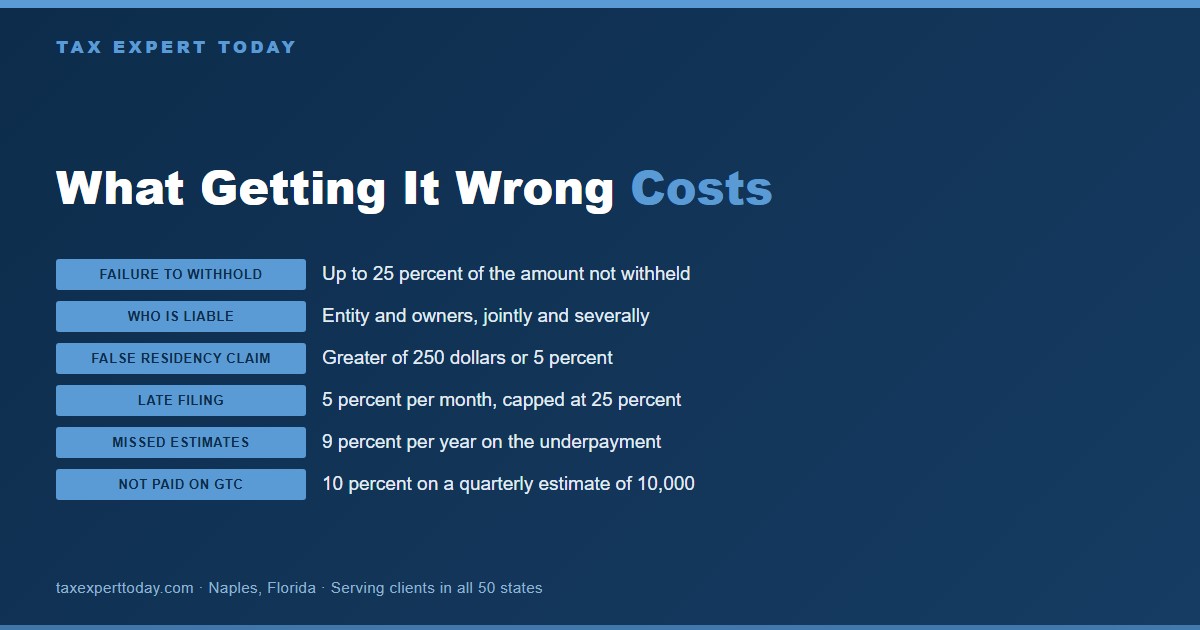
The costliest exposure is not on the composite return, it is on the withholding an entity failed to do. O.C.G.A. § 48-7-129(a)(3) allows a penalty equal to 25 percent of the amount not withheld and paid over, and subsection (a)(4) makes the entity and its members jointly and severally liable for the underlying withholding tax. A false representation that a member is a Georgia resident carries a further penalty of the greater of $250 or 5 percent of what should have been withheld.
| Failure | Charge | Authority |
|---|---|---|
| Failure to withhold and pay over | Up to 25 percent of the amount not withheld | O.C.G.A. § 48-7-129(a)(3) |
| False representation of Georgia residency | Greater of $250 or 5 percent of the amount that should have been withheld, joint and several | O.C.G.A. § 48-7-129(c)(1) |
| Late filing of the composite return | 5 percent of unpaid tax per month or part month, to 25 percent | Form IT-CR instructions |
| Failure to pay tax shown on the return | 0.5 percent per month or part month, to 25 percent, with a combined 25 percent cap | Form IT-CR instructions |
| Negligent underpayment | 5 percent of the underpayment | Form IT-CR instructions |
| Fraudulent underpayment | 50 percent of the underpaid amount | Form IT-CR instructions |
| Failure to file estimated tax | 9 percent per annum for the period of underpayment | Form IT-CR instructions |
| Quarterly estimate of $10,000 or more not paid electronically | 10 percent | O.C.G.A. § 48-2-32(f)(2) |
Joint and several liability is the provision that changes how this should be handled. An owner who assumed the entity dealt with Georgia, and an entity that assumed the owner would file, are both exposed to the same assessment. Interest accrues separately under O.C.G.A. § 48-7-81.
Which excuses does Georgia not accept?
An entity may petition for relief from withholding on grounds of undue hardship, but the regulation defines the ground narrowly and then lists what does not qualify. The petition must be filed in writing with the Commissioner at least sixty days before the withholding tax is due, is decided case by case, and if granted is valid for one year only and must be requested again the following year.
- Inability to pay is not undue hardship. The regulation names it first among the circumstances that do not qualify.
- Cost and inconvenience are not undue hardship. Additional recordkeeping cost and paperwork being too cumbersome are both expressly excluded.
- Missing K-1 data is not undue hardship. The regulation names missing social security numbers and addresses specifically, which removes the most common practical excuse.
- Not knowing the rules is not undue hardship. Unfamiliarity with the filing requirements and inadequate records are both listed as non-qualifying.
There is also an anti-avoidance clause. Where the Commissioner reasonably determines that a transaction or payment was entered into for the purpose of avoiding the withholding regulation, the Commissioner may characterise any payment or portion of it to reflect the true substance of the transaction. Restructuring a distribution to sit outside the withholding base is a strategy the regulation anticipates.
Not everything is subject to withholding in the first place, and knowing the carve-outs is usually more productive than seeking relief. Withholding does not apply where the member is an individual retirement account, Roth IRA, or qualified employer plan certified on Form NRW-Exemption, where an exempt organization’s share produces no unrelated business taxable income, where an insurance company actually pays Georgia premium tax, where the aggregate annual share of Georgia source income is under $1,000, or where the income is already subject to withholding under other provisions of Georgia law. Payments to an owner in a capacity other than as an owner are also outside the base, which the regulation illustrates with S corporation salaries, rents, and royalties. The reasonableness of that salary figure is a separate federal question, addressed in our guide to S corporation reasonable compensation.
When an entity withholds instead of filing a composite return, the withholding runs at 4 percent of the nonresident member’s share of Georgia income, which is below the 4.99 percent tax rate for 2026, so a member should not assume the withholding settles the year. Payroll withholding, nonresident member withholding, and the penalties that apply to each are explained in our article on Georgia withholding tax.
An S corporation that files a composite return still has a consent question to answer. The Department’s S corporation booklet asks that a Form 600S-CA be attached for each nonresident shareholder even when a composite return has been filed, and that the Composite Return Filed box be checked on the company’s return. Those steps are explained in our guide to Georgia Form 600S for S corporations.
How does a member claim credit for tax already withheld?
A nonresident member claims the credit by attaching a copy of Form G-2-A to a Georgia income tax return. The credit is claimed for the member’s tax year in which the entity’s withholding tax year ends, which is a matching rule rather than a payment-date rule and matters whenever the entity and the member have different year ends.
- The entity registers separately. Registration for nonresident withholding uses Application CRF-002 and is separate from payroll withholding registration.
- Payment uses Form G-7-NRW. Tax withheld is due on the entity’s income tax return due date without regard to any extension of time to file.
- Reporting uses G-2-A with G-1003. The Form G-2-A goes to the member and in duplicate to the Department, transmitted with Form G-1003.
- Timing follows the entity’s year. A partnership with a January year end withholding for that year feeds a calendar year member’s return for the year in which the entity’s year ended.
A member excluded from a composite return files a Georgia nonresident return to report the income and claim the withholding credit. The general shape of that filing is covered in our guide to the nonresident state tax return, and where the member also has Georgia investment gains, our guide to Georgia capital gains tax covers how those interact with the same return.
Georgia composite return help in Naples & Southwest Florida
Tax Expert Today LLC advises on state tax matters nationwide from an office in Naples, Florida. Composite return questions reach us from both ends of the same transaction: a Georgia operating entity deciding whether to file Form IT-CR for a nonresident owner group, and an individual owner in another state who received a K-1 with Georgia income on it and does not know whether a Georgia return is owed. Our team includes tax advisors, enrolled agents, CPAs, and attorneys, and Georgia clients are served nationwide from the Naples office.
Terse searches such as Georgia composite return help Naples and state tax advisor Naples FL generally come from the same engagement viewed from two sides, once while the entity return is being planned and once when an owner is trying to work out a personal filing obligation. Deciding it at the entity level, before the K-1s go out, is materially cheaper than resolving it afterwards for each owner separately.
Tax Expert Today LLC, 11983 Tamiami Trail N, Naples, FL 34110. Telephone (239) 441-2005. Office hours Monday through Friday, 10:00 to 5:00 Eastern time. Where a composite return sits inside a wider Georgia compliance picture, our Georgia tax services page sets out how we handle Georgia planning and filing together, and our Naples tax planning practice covers the Florida side for owners who have relocated.
Do I need to be in Georgia to get help with a Georgia composite return?
No. We serve clients in all 50 states and the work is handled remotely through a secure document portal, with calls scheduled Monday through Friday during office hours. Clients in Southwest Florida who prefer to meet in person are welcome at the Tamiami Trail office. A number of the composite return questions we handle come from Florida residents who hold an interest in a Georgia partnership or S corporation and have no other connection to the state, which is precisely the fact pattern the composite return was designed for.
When should you bring in a professional?
A single-tier Georgia partnership with a handful of nonresident individual owners, none of whom has other Georgia income, filing Option 1 on a timely Form IT-CR with CR-AFF affidavits on file, is a routine annual filing.
The decision stops being routine where the owner group is mixed, where any owner has Georgia income from another source, where the structure has more than one tier, where an owner is a trust or an entity rather than an individual, where the entity is carrying a composite net operating loss, where a purchased credit is available to apply, or where an owner would benefit from a credit for taxes paid to another state that the composite return cannot deliver. In each of those cases the composite return may still be right, but it is a choice rather than a default, and the cost of choosing wrongly is borne by owners who never saw the decision being made.
The election is also close to permanent within the year. Because it becomes irrevocable at the due date and the return cannot afterwards be amended to add or remove members, the analysis has to be done before filing rather than corrected after.
This article is general information about Georgia income tax rules and is not tax advice for any particular person. Georgia law, forms, rates, and thresholds change, and the correct treatment depends on facts this article cannot know. Confirm current figures against the Department of Revenue instructions for the year you are filing, and consult a qualified professional about your own circumstances.
Frequently asked questions about the Georgia composite return
Does Georgia require permission to file a composite return?
No. The Form IT-CR instructions state that permission is not required. The regulation provides that the filing of the composite return itself constitutes the election, so there is no separate application and no approval to wait for. The election must be made by the due date of the composite return including any approved extension, and it is irrevocable once that date passes.
What is the Georgia composite return tax rate?
The composite return applies the ordinary Georgia individual income tax rate for the filing year, because the regulation directs the computation to the rate in O.C.G.A. 48-7-20. That rate was 5.19 percent for tax year 2025 and is 4.99 percent for tax year 2026. The 5.75 percent figure that still appears in search results and forum threads is a retired rate. Non-individual members instead use the corporate rate provision in O.C.G.A. 48-7-21(a).
Can a member with other Georgia income be included on a composite return?
Generally not under the standard options. Ga. Comp. R. and Regs. 560-7-8-.34 restricts Option 1 and Option 2 to nonresident individual members with no Georgia income from sources other than the entity. The regulation provides a third option at the highest marginal rate for a member who does have other Georgia income, and any income included that way is then excluded from that member’s own Georgia return. Because Georgia now taxes at a flat rate, that third option produces the same tax as Option 1.
Is Georgia nonresident withholding 4 percent or the income tax rate?
Withholding is 4 percent of the nonresident member’s share of Georgia source income under O.C.G.A. 48-7-129(a)(2). That is a separate figure from the income tax rate applied on a composite return, and it is now lower than the 4.99 percent tax rate, so withholding does not fully settle the liability. Any excess withheld is refundable to the member after year end, but a shortfall remains the member’s to pay.
Can a nonresident owner avoid both the composite return and withholding?
Yes, in many cases. An individual, fiduciary, or C corporation member may certify on Form NRW-Exemption that it agrees to Georgia personal jurisdiction for income tax purposes, will file Georgia returns, and will make estimated payments if required. An S corporation shareholder uses Form 600S-CA instead. The certification is made once by the unextended due date of the entity return and must be attached to that return each year. If the member later fails the conditions, withholding becomes due as if the certification had never been made.
Does a composite return allow a credit for taxes paid to another state?
No. A credit for taxes paid to another state is claimed on a return the taxpayer files personally, and a member included on a Georgia composite return is not filing a Georgia return for that income. This is one of the main reasons an owner who is resident in a state that taxes the same income may be better served by being excluded from the composite return and filing a Georgia nonresident return instead.
When is a Georgia composite return due and when are estimates required?
A calendar year entity files on the individual due date, April 15 for a 2025 return. A fiscal year entity files by the fifteenth day of the fourth month after its fiscal year end. Estimated tax is required whenever the composite tax exceeds $500 for the year, paid on Form CR-ES. Under O.C.G.A. 48-2-32(f)(2), a quarterly estimate of $10,000 or more must be paid electronically through the Georgia Tax Center, and a 10 percent penalty applies if it is not.
Can a composite return use purchased Georgia tax credits?
Yes. Form IT-CR carries Schedule 2 and Schedule 2B for business credit usage, so entity-level credits, including transferable credits acquired by purchase, may be applied against the composite liability. For an entity with a widely scattered nonresident owner group, applying a purchased credit at the composite level is often simpler than passing it out to owners whose individual capacity to use it varies.
What is Form CR-AFF and who has to sign it?
Form CR-AFF is an affidavit signed by a nonresident member confirming that the member has no Georgia income from sources other than the entity, and confirming the member’s Georgia filing status. The regulation requires the entity to obtain a signed statement each year from every individual member for whom it uses Option 1 or Option 2. It is held by the entity as support for the option used rather than filed with the Department.
Published September 7, 2026 by Dr. Pellumb Kabashi « Back to Learning Center
Have a question this article touches on?
Tax Expert Today LLC, based in Naples, Florida and serving clients across the United States.
Schedule a Consultation (239) 441-2005