
By Dr. Pellumb Kabashi, DBA, MBA, EA, CFE, CES
Founder, Tax Expert Today LLC · Tax advisors, enrolled agents, CPAs, and attorneys · Serving clients in all 50 states
Quick Answer: The Georgia surplus tax refund for 2026 is a one time refund of 2024 Georgia income tax under HB 1000, capped at $250 for single and married filing separately, $375 for head of household, and $500 for married filing jointly. You qualify only if you filed both your 2024 and 2025 Georgia returns on time and had 2024 tax liability. Extended 2025 filers have until October 15, 2026. Call (239) 441-2005 for a free consultation.
What Is the Georgia Surplus Tax Refund?
The Georgia surplus tax refund is a one time payment, authorized by HB 1000 and signed on March 20, 2026, that returns some or all of a taxpayer’s 2024 Georgia individual income tax. It is paid automatically from the state surplus to filers who meet the statutory test, with no separate application.
- Legal source: HB 1000 adds a new Code section, O.C.G.A. 48-7-20.4.
- What it refunds: 2024 Georgia income tax liability, up to a cap set by 2024 filing status.
- How it is paid: automatically, by direct deposit or check, after the 2025 return is filed.
- When it started: the Department of Revenue began issuing refunds on May 4, 2026.
- How often: this is the fourth such round, after 2022, 2023, and 2025.
The Department of Revenue surplus refund page and its FAQ describe the payment as a refund of “some or all” of Tax Year 2024 income taxes. That framing matters for everything that follows. The surplus tax refund is not a grant, a stimulus check, or a new credit that depends on income level. It is a statutory return of tax that you already paid on your 2024 Georgia return, and the size of the payment is tied directly to the tax shown on that return.
The bill text published by the Georgia General Assembly creates O.C.G.A. 48-7-20.4. Under subsection (b), once a qualified taxpayer files a 2025 individual income tax return, the Department “shall automatically credit” that taxpayer with a one time refund equal to the lesser of the 2024 liability or a fixed amount based on 2024 filing status. Because the credit is automatic, most eligible taxpayers never interact with the program at all. The money simply arrives, often with a bank description that confuses people, which we cover later.
The people who do need to act are the ones whose refund never arrived, arrived smaller than expected, or was taken to pay a debt. They are also people who have not yet filed a 2025 return and are running out of time, and people who itemized deductions on their federal return and now have to decide whether part of the payment is federal income. This guide is written for those situations. It does not replace the Department’s own status tool; it explains what the tool’s answers mean and what can be done about them.
Georgia taxpayers sometimes call this payment a rebate, a stimulus, a bonus refund, or the HB 1000 refund. The Department uses “Surplus Tax Refund” and “special tax refund” in its own materials. All of those labels refer to the same one time payment discussed here.
Who Qualifies for the Georgia Surplus Tax Refund in 2026?
You qualify for the Georgia surplus tax refund if you are an individual who filed both a 2024 and a 2025 Georgia income tax return by the 2025 due date, including any extension, and you had Georgia income tax liability for 2024. Residents, part year residents, and nonresidents with Georgia liability can all qualify.
- Two returns: both the 2024 and the 2025 Georgia individual returns must be filed.
- On time: both must be filed by the due date of the 2025 return, including extensions.
- Liability: 2024 tax on Form 500 Line 16 or Form 500EZ Line 4 must be above zero.
- Excluded: nonresident aliens, estates and trusts, and most 2024 dependents.
- Prorated: part year residents and nonresidents receive a share of the cap.
The statute defines a “qualified taxpayer” as an individual who filed an individual income tax return for both the 2024 and 2025 taxable years by the due date for the 2025 return, including any extensions granted. The definition then carves out three groups: any nonresident alien individual, any individual claimed as a dependent by another taxpayer for federal or Georgia purposes for 2024, and any estate or trust. A dependent is put back into the eligible group if that person had earned income for 2024.
The Department’s FAQ states the same rule in plainer terms. A full year resident in 2024 and 2025 who filed timely returns for both years is eligible. Part year residents and nonresidents who file Georgia returns for both years are eligible for a proportional refund. The Governor’s May 4, 2026 press release adds that eligible taxpayers must “have paid into the system, and not owe the State Department of Revenue,” which reflects the liability test and the offset rule discussed later.
| Requirement | What the law and the Department say | Where it is found |
|---|---|---|
| Filed a 2024 Georgia return | Required, by the 2025 return due date including extensions | O.C.G.A. 48-7-20.4(a); DOR FAQ |
| Filed a 2025 Georgia return | Required, by the 2025 due date including extensions | O.C.G.A. 48-7-20.4(a); DOR FAQ |
| 2024 tax liability above $0 | The refund cannot exceed 2024 liability, so $0 liability means no refund | O.C.G.A. 48-7-20.4(b)(3); DOR FAQ |
| Not a nonresident alien | Nonresident alien individuals are excluded | O.C.G.A. 48-7-20.4(a)(1)(A) |
| Not a 2024 dependent | Excluded unless the dependent had 2024 earned income | O.C.G.A. 48-7-20.4(a)(1)(B) and (a)(2) |
| Not an estate or trust | Fiduciary returns do not qualify | O.C.G.A. 48-7-20.4(a)(1)(C) |
| Residency | Residents, part year residents, and nonresidents can qualify; the latter two are prorated | O.C.G.A. 48-7-20.4(b)(2); DOR FAQ |
Notice what the test does not include. There is no income ceiling. There is no requirement that you still live in Georgia in 2026. There is no application form. And there is no requirement that you received a regular refund for 2024 or 2025. A taxpayer who owed money with both returns can still qualify, as long as the 2024 return shows liability and both returns were filed on time.
The test also does not look at what you paid to the IRS. The Department’s FAQ is explicit that federal taxes “do not meet eligibility requirements.” Only Georgia individual income tax liability for 2024 counts. A retiree who paid federal tax on pension income but owed nothing to Georgia because of the state retirement exclusion will not receive a surplus refund. We return to that common situation below.
How Much Is the Georgia Surplus Tax Refund?
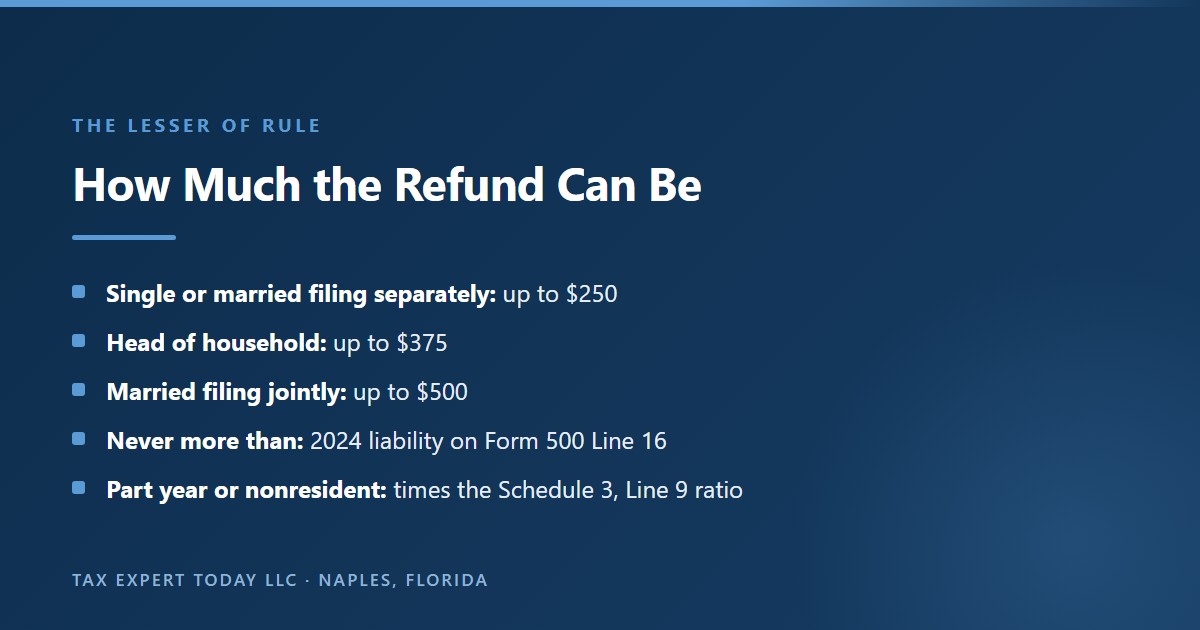
The Georgia surplus tax refund is the lesser of your 2024 Georgia income tax liability or a cap based on your 2024 filing status: $250 for single and married filing separately, $375 for head of household, and $500 for married filing jointly. Part year residents and nonresidents receive a prorated share of that amount.
- Single: up to $250.
- Married filing separately: up to $250 for each spouse who qualifies on their own return.
- Head of household: up to $375.
- Married filing jointly: up to $500 for the couple.
- Never more than 2024 liability: a smaller 2024 tax means a smaller refund.
| 2024 filing status | Maximum surplus refund | Paid as |
|---|---|---|
| Single | $250 | One refund to the filer |
| Married filing separately | $250 | One refund per separate return that qualifies |
| Head of household | $375 | One refund to the filer |
| Married filing jointly | $500 | One refund on the joint account |
These amounts are set in the statute itself, at O.C.G.A. 48-7-20.4(b)(1)(B), and the Department repeats them on its surplus refund page and in its press release. They are the same caps Georgia used in earlier rounds, so taxpayers who received a refund in 2025 will recognize the figures.
The phrase “up to” is where most confusion starts. The cap is a ceiling, not a promised amount. Subsection (b)(3) adds that in no event may the Department credit any taxpayer with a refund greater than the 2024 liability as properly reported. A married couple whose 2024 joint Georgia liability was $310 receives $310, not $500. A single filer whose 2024 liability was $90 receives $90. The Department’s own FAQ uses an example of a single filer with $200 of 2024 liability who receives $200.
Two married people who filed separately in 2024 are treated as two separate taxpayers. Each can receive up to $250, but each is limited to the liability on that spouse’s own separate 2024 return. If one spouse had liability and the other did not, only one refund is paid. Combining the two separate returns is not an option, because the statute ties the cap and the liability to each return as filed.
Nothing in the statute or the Department’s materials scales the cap to income. A high earner with large 2024 liability receives the same capped amount as a moderate earner whose 2024 liability exceeded the cap. Above the cap, more tax paid does not mean a larger surplus refund.
How Is Your Refund Amount Calculated From the 2024 Return?
Start with your 2024 Georgia return. Take the liability on Form 500 Line 16 or Form 500EZ Line 4, compare it with the cap for your 2024 filing status, and the smaller figure is your refund. Part year residents and nonresidents then multiply by the Georgia income ratio on 2024 Schedule 3, Line 9.
- Step 1: find your 2024 filing status on the 2024 Georgia return.
- Step 2: read 2024 liability from Form 500 Line 16 or Form 500EZ Line 4.
- Step 3: take the lesser of that liability and the cap for your status.
- Step 4: if you were part year or nonresident, apply the Schedule 3, Line 9 ratio.
- Step 5: subtract any offset for debts the Department applies before payment.
The Department’s FAQ explains that “tax liability is the amount of tax owed on the return before credit for any withholding, tax credits, or other tax payments.” That definition matters because many taxpayers look at the wrong number. The refund you received for 2024, or the balance you paid with your 2024 return, has nothing to do with the surplus calculation. A taxpayer who had a large 2024 refund because of heavy withholding may still have substantial liability on Line 16, and that liability is what counts.
The statute uses the phrase “as properly reported” on the 2024 lines. In practice, the Department works from the liability on its records for your 2024 return. If your 2024 return was later adjusted, the figure on the Department’s records may differ from the figure on the copy you kept. We discuss amended and adjusted returns in a later section.
| Hypothetical filer | 2024 status | 2024 liability | Cap | Proration | Surplus refund before offsets |
|---|---|---|---|---|---|
| A, full year resident | Single | $1,840 | $250 | None | $250 |
| B, full year resident | Married filing jointly | $310 | $500 | None | $310 |
| C, full year resident | Head of household | $2,600 | $375 | None | $375 |
| D, retiree with exclusion | Married filing jointly | $0 | $500 | None | $0 |
| E, part year resident | Single | $900 | $250 | 40 percent | $100 |
| F, nonresident | Married filing jointly | $1,200 | $500 | 15 percent | $75 |
All six filers above are hypothetical and the figures are illustrative only. For E and F, the proration is applied to the amount determined under paragraph (1), which is the lesser of liability and the cap. That reading follows the bill text, which prorates “the amount of the refund credit determined pursuant to paragraph (1).” It is also consistent with the Department’s FAQ, which describes the proportional refund as “the maximum amounts based on filing status multiplied by the share of their income taxable in Georgia.” Because the statute also bars any refund greater than 2024 liability, the prorated amount can never exceed what the filer owed.
If your own numbers do not match the amount you received, three explanations cover most cases: a different liability figure on the Department’s records, the proration ratio, or an offset. Each is covered in its own section below.
What Filing Deadline Do You Have to Meet to Qualify?
Both your 2024 and 2025 Georgia returns must be filed by the due date of the 2025 return, including any extension. The Department’s FAQ states that taxpayers with an extension for tax year 2025 have until October 15, 2026, to file the 2025 return and still qualify.
- Regular due date: the 2025 Georgia return was due in April 2026.
- Extended due date: October 15, 2026, for filers with a valid extension.
- Both returns count: a missing 2024 return also has to be filed by that date.
- After the deadline: the statute gives no route to qualify for a late filed 2025 return.
- Extension source: a federal extension or Georgia Form IT-303.
The statutory language is “by the due date for filing the income tax return for the 2025 taxable year, including any extensions which have been granted.” The Department’s FAQ lists as a common reason for no refund that the taxpayer “did not file by the due date or timely request an extension of October 15th, 2026,” and separately notes that “if an extension was filed for tax year 2025, you have until October 15, 2026, to file your 2025 return.”
One caution about the Department’s main surplus refund page. As of October 8, 2026, its eligibility bullet reads “filed your 2024 and 2025 Georgia individual income tax returns by April 15, 2025 or by October 15, 2025, if you received an extension.” A 2025 tax year return could not have been filed by April 15, 2025, so those dates appear to have been carried over from the prior year’s program. The FAQ and the bill text both point to the 2025 return due dates in 2026, and the dates in this guide follow them. If you are relying on the deadline, confirm it with the Department directly.
How a taxpayer gets a Georgia extension matters here. Georgia generally accepts the federal automatic extension, as described in the IT-511 Individual Income Tax Instruction Booklet, and Georgia Form IT-303 is the state request for taxpayers who need one without a federal extension. Our guide to Georgia Form IT-303 and state extensions covers when each route applies. An extension extends the time to file, not the time to pay, so a balance due on the 2025 return still accrues interest and penalties from the original date.
A taxpayer reading this close to October 15, 2026, with an unfiled 2025 return, has a practical choice. File a complete and accurate return by the extended date and remain eligible, or file late and, on the statutory text, lose the surplus refund. A return filed on time and later corrected by amendment is a different matter from a return never filed on time.
How Do You Check the Status of Your Georgia Surplus Tax Refund?
Use the Department of Revenue’s Check Your Surplus Tax Refund tool in the Georgia Tax Center. You need your Social Security number or ITIN and the federal adjusted gross income shown on your 2024 Georgia return, Form 500 Line 16 or Form 500EZ Line 4 per the tool’s instructions. Status updates post nightly.
- Where: the Check Your Surplus Tax Refund link on the Department’s surplus refund page.
- What you need: SSN or ITIN, plus the 2024 federal adjusted gross income on the Georgia return.
- When: available around the clock; results update nightly.
- Calling: phone agents see the same status information as the online tool.
- Official only: use the Department’s own site, never a link from a text or email.
The Department’s surplus refund page lists what the Check Your Surplus Tax Refund checker requires: “Your SSN or ITIN” and “The amount of your Federal Adjusted Gross Income listed on your 2024 tax year Georgia Individual Income Tax return Form 500, Line 16 or Form 500EZ, Line 4.” Note that the page uses the same line references for adjusted gross income that the FAQ uses for tax liability. Whichever label applies on your copy of the 2024 return, enter the figure the tool asks for exactly as it appears on the return filed with Georgia, not an amended or recalculated figure.
The Department also notes that its call center representatives “can only provide the same status information available through the online” tool, and that phone lines are busy during the issuance period. If the tool shows a status you do not understand, calling will usually produce the same answer. The more productive step is to work out which eligibility condition or offset explains the result, which is what the rest of this guide is for. Regular 2025 refunds are tracked separately on the Department’s check my refund status page.
This article does not replicate the status tool and cannot check your status. It explains the rules behind the answers. The Department’s Georgia Tax Center information page explains how to set up an account. If you are not sure the site you are on belongs to the Department, type dor.georgia.gov into your browser rather than following a link. The Department does not charge a fee to issue the surplus refund, and nobody needs your bank login to send it.
Why Did I Not Receive a Georgia Surplus Tax Refund?
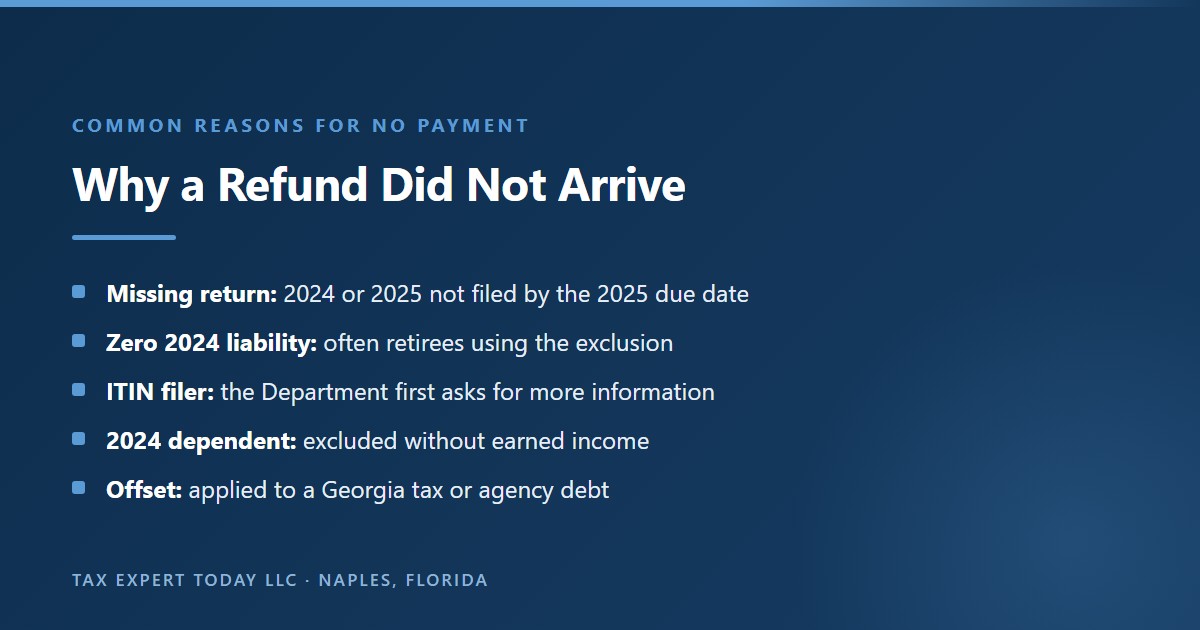
The usual reasons are that a 2024 or 2025 Georgia return was not filed on time, 2024 liability was zero, the return used an ITIN and the Department is still requesting information, you were a 2024 dependent without earned income, or a part year or nonresident proration produced less than $1. An offset can also take the entire payment.
- Missing return: no 2024 or 2025 Georgia return on file by the 2025 due date.
- Zero liability: nothing on 2024 Form 500 Line 16 or Form 500EZ Line 4.
- ITIN on either return: a Department letter asks for more information first.
- Dependent status: claimed as a 2024 dependent with no 2024 earned income.
- Full offset: the payment went entirely to a Georgia debt.
The Department’s FAQ lists these as the common reasons a taxpayer may not have received an HB 1000 refund. The list is practical, because almost every missing payment traces back to one of them. Work through it in order, alongside the general guidance on the Department’s refunds page, before calling anyone, since the call center will see the same status information you see online.
| Reason listed by the Department | What to check | Can it still be fixed? |
|---|---|---|
| Did not file both the 2024 and 2025 returns before the 2025 deadline | Georgia Tax Center account history for both years | Yes, if both are filed by October 15, 2026 with a valid extension |
| Did not file by the due date or timely request an extension | Date the 2025 return was filed and whether an extension applied | Generally no, once the extended date has passed |
| Filed using an ITIN on the 2024 or 2025 return | Any Department letter requesting additional information | Possibly, by responding to the letter |
| 2024 tax amount due was $0 | 2024 Form 500 Line 16 or Form 500EZ Line 4 | No, unless the 2024 liability itself was misreported |
| Prorated amount under $1.00 | 2024 Schedule 3, Line 9 ratio | No |
| Claimed as a 2024 dependent with no earned income | Whether anyone claimed you in 2024 | No, under the statutory definition |
Two items on the list deserve emphasis. First, the zero liability case is far more common than people expect. Georgia’s retirement income exclusion, its standard deduction, its dependent exemptions, and various credits mean that a large number of Georgia filers owe no income tax for a given year. If that described your 2024 return, there is nothing for the surplus refund to return.
Second, the filing test has two parts. Taxpayers sometimes assume that filing the 2025 return is enough. It is not. A taxpayer who skipped the 2024 Georgia return, perhaps because they believed nothing was owed, has no 2024 liability on file and cannot qualify until the 2024 return is filed. If a 2024 return was required and was never filed, filing it by the 2025 extended due date preserves eligibility on the statutory text, although late filing penalties and interest may apply to any 2024 balance.
Why Was Your Surplus Refund Smaller Than Expected?
A partial surplus refund usually means your 2024 Georgia liability was below the cap for your filing status, you were prorated as a part year resident or nonresident, or part of the payment was applied to a debt owed to the State of Georgia. The cap is a ceiling, not a fixed amount.
- Low liability: the refund equals 2024 liability when liability is under the cap.
- Proration: the Schedule 3, Line 9 ratio reduces the refund for partial Georgia income.
- Offset: delinquent taxes, child support, or another agency debt.
- Filing status: the 2024 status controls, not the 2025 status.
- Separate returns: each spouse is capped at $250 and at their own liability.
The Department’s FAQ answers this question directly: “Your refund may have been offset due to debts owed to the State of Georgia, such as delinquent taxes or delinquent child support. You should receive notification from the agency that offset your debt. You also might not have received the full refund if your 2024 tax liability was less than $250, $375, or $500.”
A quick way to diagnose a short payment is to do the arithmetic yourself. Pull your 2024 Georgia return and read the liability line. Compare it with the cap for your 2024 filing status. If you were not a full year resident, find the ratio on Schedule 3, Line 9 and apply it. The result is the amount the statute provides before offsets. If what you received is lower than that figure, look for an offset notice in your mail. If what you received matches the figure, the payment is correct even if it is below the headline cap.
Taxpayers who changed filing status between years are often surprised. A taxpayer who filed single for 2024 and head of household for 2025 is capped at $250, not $375. The Department’s FAQ uses exactly that example. A couple who married in 2025 and filed jointly for 2025, after each filing single for 2024, are each evaluated on their own 2024 single return, so two refunds of up to $250 each are possible if each meets the test, while a single joint refund of up to $500 is the rule for a couple who also filed jointly in 2024.
How Does an Offset Reduce or Take a Surplus Refund?
HB 1000 requires the Department to apply the surplus refund first against any outstanding liability, and it makes the refund subject to Georgia’s setoff debt collection law. That allows delinquent state taxes and debts certified by other agencies, such as child support, to be taken before anything is paid to you.
- Department of Revenue debts: credited against outstanding Georgia tax first.
- Other agencies: setoff under Article 7 of Chapter 7 of Title 48.
- Notice: a letter to your last known address explains the transfer.
- Floor: agency setoffs apply where the refund is at least $25.
- Excess: anything beyond the certified debt is sent to you.
Two provisions of the new Code section work together. Subsection (d) says the refund “shall first be credited against any outstanding liability existing at the time the refund provided for in this Code section is to be issued.” Subsection (f) says any amount due “shall be subject to the setoff debt collection provisions of Article 7 of this chapter.” Article 7 is Georgia’s general setoff law, O.C.G.A. 48-7-160 and the sections that follow.
The Department’s page on refund offsets explains that “Georgia law allows other agencies to use individual income tax refunds to pay outstanding obligations,” and that a state refund “may be applied to a debt with the IRS, another state agency, or the Georgia Department of Revenue.” It lists possible recipients, including the Georgia Administrative Office of the Courts, the Department of Community Supervision, the Department of Human Services, the Department of Labor, the Georgia Lottery Corporation, and the Georgia Student Finance Commission, among others.
| Type of debt | Who takes it | Where the rule comes from | Who to contact |
|---|---|---|---|
| Unpaid Georgia income or other state tax | Georgia Department of Revenue | O.C.G.A. 48-7-20.4(d) | Department of Revenue |
| Child support arrears | Department of Human Services | Article 7 setoff, O.C.G.A. 48-7-164 | Child support services |
| Unemployment overpayments | Georgia Department of Labor | Article 7 setoff | Department of Labor |
| Court fines and fees | Administrative Office of the Courts | Article 7 setoff | The court or the Administrative Office |
| State student loan debts | Georgia Student Finance Commission | Article 7 setoff | Georgia Student Finance Commission |
| Federal tax debt | IRS, where a state offset program applies | Listed on the Department’s offset page | IRS |
The setoff statute, O.C.G.A. 48-7-164, describes the mechanics. A claimant agency certifies a debt to the Department. If the Department determines the debtor is entitled to a refund of at least $25.00, it transfers an amount equal to the refund, not exceeding the certified debt, to the agency. When the refund exceeds the debt and the administrative fee, the excess goes to the taxpayer. The Department notifies the taxpayer at the time of transfer.
The practical lesson is to read your mail. The offset notice tells you who took the money and why. Questions about the debt itself go to that agency, not to the Department of Revenue, which only moves the funds. If you owe Georgia tax, a setoff of the surplus refund also reduces that balance, which may affect a pending Georgia Department of Revenue payment plan or an offer under consideration.
How Do You Contest a Setoff of Your Surplus Refund?
The setoff notice gives you 30 days from its mailing date to apply in writing for a hearing with the agency that claimed the debt. If you miss that window, Georgia law treats it as a waiver of the right to contest the setoff. The funds are held in escrow while a timely contest is resolved.
- Deadline: 30 days from the date the notice was mailed.
- Form: a written application, sent to the agency named in the notice.
- Forum: a hearing under the Georgia Administrative Procedure Act.
- Escrow: the agency holds the funds until the debt is finally determined.
- Adjustment: an overstated debt must be reduced and any excess refunded.
Under O.C.G.A. 48-7-164(c), the notice must state the debtor’s name, how the debt arose, the amount claimed, the transfer, the amount of the refund in excess of the debt, the taxpayer’s opportunity to give written notice to contest within 30 days of the mailing date, the name and mailing address of the agency to which the application for a hearing must be sent, and the fact that failure to apply in writing within 30 days is a waiver. Section 48-7-164(d) requires the agency to hold the transferred funds in an escrow account until the validity of the debt is finally determined.
Section 48-7-165 then requires the claimant agency, once it receives a timely written application, to hold a hearing under the Georgia Administrative Procedure Act, Chapter 13 of Title 50. If the amount asserted is wrong, the claimed debt is adjusted, and under 48-7-166 the agency credits the finally determined amount and refunds any excess. These code sections are cited from public copies of the Georgia Code, and the hearing procedures of each agency vary, so read the notice itself carefully and follow its instructions.
Not every setoff is worth contesting. If the debt is valid and the amount is correct, the setoff simply reduces what you owe. A contest makes sense when the debt was already paid, the amount is overstated, the debt belongs to someone else, or, in the case of a joint return, the debt belongs to only one spouse. Gather proof before writing: payment records, court orders, agency correspondence, and a copy of the notice. A short, specific letter that names the error and attaches the evidence tends to move faster than a general objection.
A setoff of a Georgia tax debt by the Department of Revenue itself is handled differently, because it is a credit against your own account rather than a transfer to another agency. If you disagree with the underlying Georgia assessment, the routes are the Department’s protest procedures and, after July 1, 2026, the Georgia Tax Court, which replaced the Georgia Tax Tribunal.
What Happens if Only One Spouse Owes the Debt?
For a joint return, the setoff notice must name any spouse against whom no debt is claimed and explain that this spouse may be entitled to their share of the refund. To obtain it, that spouse must apply in writing for a hearing with the agency named in the notice within 30 days of the mailing date.
- Joint notice: names the spouse who does not owe the debt.
- Entitlement: that spouse may be entitled to the refund due to them.
- Action required: a written hearing application within 30 days.
- Federal parallel: different rules and forms apply to IRS offsets.
- Records: wage and withholding records support each spouse’s share.
The surplus refund for a married couple who filed jointly in 2024 is a single payment of up to $500. If one spouse owes child support from a prior relationship or a debt to a state agency, the setoff can reach the joint payment. Georgia’s setoff statute addresses this situation in the notice requirements. O.C.G.A. 48-7-164(c) states that, in the case of a joint return, the notice must state the name of any taxpayer named in the return against whom no debt is claimed, that a debt is not claimed against that taxpayer, that the taxpayer is entitled to receive a refund if it is due to them regardless of the debt asserted against the spouse, and that to obtain the refund the taxpayer must apply in writing for a hearing within 30 days.
How the hearing officer divides a joint surplus refund between spouses is not spelled out in HB 1000 or the Department’s FAQ, and we do not state a formula here. The statute measures the refund by joint 2024 liability, so the division is likely to turn on how that liability and the related payments are attributed between the spouses. Bring each spouse’s 2024 W-2s, Forms 1099, and withholding records to support the claim.
This Georgia process is separate from the federal injured spouse procedure, which applies when the IRS offsets a federal refund to pay one spouse’s debt. If a federal refund was also taken, see our guide to injured spouse relief, which explains the federal form and timing. The two systems do not share forms or deadlines.
Why Do Many Georgia Retirees Receive No Surplus Refund?
Many retirees owed no Georgia income tax for 2024 because Georgia excludes up to $35,000 of retirement income per person at ages 62 to 64 and up to $65,000 at age 65 or older. With zero 2024 Georgia liability there is nothing for the surplus refund to return, even if federal tax was paid.
- Ages 62 to 64: up to $35,000 of retirement income excluded per person.
- Age 65 and older: up to $65,000 per person.
- Zero liability: no 2024 Georgia tax means no surplus refund.
- Federal tax irrelevant: IRS payments do not count toward eligibility.
- Some retirees qualify: income above the exclusion can create liability.
The Department’s FAQ addresses retirees specifically: “Georgia law provides an income tax exclusion for retirees over 62. If you did not owe taxes to Georgia in Tax Year 2024 due to this exclusion, you would not have received a refund. Taxes paid to the federal government (IRS) do not meet eligibility requirements.” It then restates the exclusion amounts of up to $35,000 for ages 62 to 64 and up to $65,000 for age 65 and over.
Social Security benefits are also not taxed by Georgia. A retired couple living on Social Security, a pension, and modest IRA withdrawals within the exclusion limits will often show $0 on the 2024 liability line, and the surplus refund for that return is $0. That is not an error and there is no appeal from it, because the statute caps every refund at 2024 liability.
Retirees who did have 2024 Georgia liability, for example because of large IRA distributions, part time wages above the exclusion’s earned income limit, or investment income above the exclusion, can qualify on the same terms as anyone else. The Department’s own retirement income exclusion page lists the income types that qualify. Our guide to the Georgia retirement income exclusion explains what counts as retirement income, the earned income cap within the exclusion, and how the exclusion applies separately to each spouse. Retirees who left military service should also see our page on Georgia military retirement tax.
How Are Part Year Residents and Nonresidents Prorated?
Part year residents and nonresidents receive a surplus refund prorated by the ratio of income taxable to Georgia shown on 2024 Form 500, Schedule 3, Line 9. That ratio is applied to the lesser of 2024 liability and the filing status cap, so a smaller Georgia share means a smaller refund.
- Who: taxpayers whose 2024 tax was prorated under O.C.G.A. 48-7-85.
- Ratio source: 2024 Form 500, Schedule 3, Line 9.
- Applied to: the amount under the lesser of rule.
- Floor: a prorated refund under $1.00 is not paid.
- Both years required: 2024 and 2025 Georgia returns must both be filed.
Subsection (b)(2) of the new Code section provides that, for any taxable nonresident or part year resident whose tax was prorated under O.C.G.A. 48-7-85, the refund credit “shall be prorated based on the ratio of income taxable to Georgia as properly reported on Schedule 3, Line 9 of the Georgia Form 500 for the 2024 taxable year.” The Department’s FAQ repeats that the refunds “will be prorated in the same manner as tax liabilities are prorated for such taxpayers.”
The requirement to file both returns creates a trap for people who moved. A taxpayer who moved out of Georgia during 2024 and had no Georgia income at all in 2025 would normally have no 2025 Georgia filing requirement. On the statutory text, that taxpayer is not a qualified taxpayer unless a 2025 Georgia return was filed, because the definition requires returns “for both the 2024 and 2025 taxable years.” Whether filing a 2025 Georgia return showing no Georgia income would be accepted for this purpose is a question for the Department; we do not take a position on it here.
The reverse case is simpler. A taxpayer who moved into Georgia during 2024 filed a 2024 part year return, then a 2025 full year return. That taxpayer qualifies if both returns were filed on time and the 2024 part year return showed liability, with the refund prorated by the 2024 ratio. Anyone in this position should start with our Georgia tax services overview. Our guide to the Georgia part year resident tax return walks through Schedule 3 line by line, and our page on nonresident state tax returns after a move covers the multistate filing picture.
Nonresidents who work in Georgia, such as commuters from Alabama, Florida, South Carolina, Tennessee, or North Carolina, and owners of Georgia rental property or pass through business income, file Form 500 with Schedule 3 every year. If they filed both years on time and had Georgia liability for 2024, they receive a prorated refund. Their ratio is usually small, so the payment is usually small.
Can a Dependent Receive the Georgia Surplus Tax Refund?
A person claimed as a dependent on someone else’s 2024 federal or Georgia return is excluded, unless that person had earned income for 2024. A working teenager or college student who filed both returns on time and owed Georgia tax for 2024 can therefore qualify for their own refund.
- General rule: 2024 dependents are excluded.
- Exception: dependents with 2024 earned income are put back in.
- Still required: both returns filed on time and 2024 liability above zero.
- Common case: students with summer or part time jobs.
- Usual result: small liability means a small refund.
The statute excludes any “individual who was claimed as a dependent by another taxpayer for federal or Georgia income tax purposes for the 2024 taxable year,” then includes “any individual taxpayer excluded solely due to” that rule “provided that such individual had earned income for the 2024 taxable year.” The Department’s FAQ phrases the exclusion as being “claimed as a dependent on another taxpayer’s income tax return for tax year 2024 and did not earn income for that year.”
A dependent who had only investment income, such as interest or dividends from a custodial account, did not have earned income and is excluded even if they filed a Georgia return and owed tax. A dependent with wages qualifies if the other tests are met. Many young workers owe little or no Georgia income tax because of the standard deduction, so the refund is often zero or modest even when the dependent is eligible.
The parent’s own refund is unaffected. Claiming a child as a dependent does not reduce the parent’s surplus refund, which is measured only by the parent’s own 2024 liability and filing status.
What Happens if You Filed Your Return With an ITIN?
Taxpayers who used an Individual Taxpayer Identification Number on their 2024 return receive a Department letter requesting more information before eligibility is decided. Responding through the Georgia Tax Center or by mail is the path to the refund. Nonresident aliens remain excluded by the statute.
- Letter first: ITIN filers are asked for additional information.
- All statuses: single, separate, head of household, and joint returns.
- Joint returns: the letter applies when even one spouse used an ITIN.
- Response: through the Georgia Tax Center or by mail.
- Exclusion: nonresident alien individuals do not qualify.
The Department’s FAQ says ITIN filers “Maybe” qualify and explains that “Taxpayers who utilized an ITIN number on their 2024 return will receive a letter from the Department requesting additional information to determine if they qualified.” The letter goes to all filing statuses “including those filing as Married Filing Joint where only one individual of the joint return uses an ITIN number.”
The letter matters because the statute excludes nonresident alien individuals, and the Department uses the response to apply that exclusion. A resident alien for federal tax purposes who files with an ITIN is not a nonresident alien and is not excluded on that ground. The answer turns on federal tax residency status for 2024, which depends on lawful permanent residence or the substantial presence test, not on immigration labels in general.
The IRS explains who uses an Individual Taxpayer Identification Number and why. If you received the Georgia letter and have not answered it, do so. If you used an ITIN and received no letter, check your Georgia Tax Center account for correspondence and confirm your mailing address with the Department. The common reasons list in the FAQ includes “You filed using an ITIN on your 2024 or 2025 return,” so an unanswered letter is a likely explanation for a missing payment.
Does a Change in Filing Status Affect the Surplus Refund?
Yes. The cap is set by your 2024 filing status, not your 2025 status. A single 2024 filer is capped at $250 even if they filed as head of household or jointly for 2025, and a couple who filed jointly for 2024 is capped at $500 even if they divorced before filing 2025.
- Controls: 2024 filing status and 2024 liability.
- Does not control: 2025 filing status.
- Payment route: the 2025 return’s refund instructions.
- Separate 2024 returns: one capped refund per qualifying return.
- Joint 2024 return: one capped refund for the couple.
The Department’s FAQ is direct: “The refund is based on the taxpayer’s 2024 tax return filing status. For example, if your filing status was Single in 2024 and Head of Household in 2025, you would receive a maximum refund of $250, not the maximum refund of $375 that is allowed for Head of Household filers.”
That rule produces predictable results in common life events. A widow or widower who filed jointly for 2024 with a spouse who died in 2024 is evaluated on that joint return. A newly married couple who each filed single for 2024 and jointly for 2025 are evaluated on two single 2024 returns. A taxpayer who became a head of household in 2025 after a child moved in is still capped at the 2024 single amount.
The statute separately says the refund is sent based on “the taxpayer’s refund instructions, if any, as indicated on the taxpayer’s income tax return for the 2025 taxable year.” So the measuring return is 2024, and the payment instructions come from 2025. That split is the source of most of the confusion after a divorce, which the next section covers.
What Happens to a Joint Surplus Refund After Divorce or Separation?
A couple who filed jointly for 2024 is measured as one taxpayer with a $500 cap, but the payment follows the refund instructions on the 2025 return. When former spouses file separate 2025 returns, the routing of a single joint refund is not addressed in HB 1000 or the Department’s FAQ, so ask the Department.
- Measuring return: the joint 2024 return and its liability.
- Payment instructions: taken from the 2025 return.
- Gap in the guidance: no published rule on splitting between two 2025 returns.
- Divorce decree: may allocate tax refunds between the parties.
- Practical step: contact the Department before assuming either spouse is entitled.
The statute ties eligibility and amount to the 2024 return and ties payment to the 2025 return’s refund instructions. For an intact couple filing jointly in both years, those two rules point to the same bank account. For a couple who divorced or separated in 2025 and filed separate 2025 returns, they do not. Neither the bill text nor the Department’s FAQ explains whether the Department pays the refund to one spouse, splits it, or issues a check in both names. We do not guess at the Department’s practice.
What can be said with confidence is that the parties’ own agreement often matters more than the tax rules. Many divorce settlements allocate refunds of taxes for joint years between the spouses, and a surplus refund measured by 2024 joint liability is a refund of 2024 tax. If one former spouse receives the full payment, the other may have a claim under the decree, which is a family law question for the parties’ attorneys rather than a tax question.
If the payment was offset to pay one former spouse’s separate debt, the joint return notice rules described above apply, and the spouse who does not owe the debt must act within 30 days of the notice.
What Happens if the Taxpayer Died?
HB 1000 requires both the 2024 and 2025 returns to be filed, and it excludes estates and trusts. Where a taxpayer died after filing 2024, the 2025 Georgia return filed by a surviving spouse or personal representative may still satisfy the test, but the Department has not published specific guidance, so confirm before relying on it.
- Estates excluded: fiduciary returns do not qualify.
- Final individual return: the 2025 return of a decedent is still an individual return.
- Joint filers: a surviving spouse can file jointly for the year of death.
- Payment: follows the 2025 return’s refund instructions.
- No published rule: confirm the Department’s handling for your facts.
The statute excludes any “estate or trust,” which refers to the estate as a separate taxpayer filing a fiduciary return. A decedent’s final individual Georgia return is not a fiduciary return. A surviving spouse who filed a joint 2025 return for the year of death, or a personal representative who filed the decedent’s final 2025 individual return, has filed an individual return for that year. Whether the Department treats that filing as satisfying the qualified taxpayer test is not addressed in the FAQ.
A taxpayer who died during 2025 before filing the 2024 return, with no return ever filed for 2024, is in a harder position, because the statute requires both returns by the 2025 due date. A personal representative who is still within the October 15, 2026 extended date may be able to file the missing 2024 return and the final 2025 return, but outcomes will depend on the Department’s view of the facts.
Checks issued in a decedent’s name, and direct deposits to a closed account, raise practical questions about who may negotiate the payment. A personal representative should contact the Department with letters of administration or other proof of authority. We do not cite a Georgia form number for claiming a decedent’s refund here, because we have not verified one for this program.
Will the Refund Come by Direct Deposit or Paper Check?
The surplus refund follows the refund instructions on your 2025 Georgia return. If you chose direct deposit, the money goes to that account. If you chose a paper check, or gave no instructions, a check is mailed. Direct deposits often appear on bank statements as GASTTAXRFD, which is not a gas tax refund.
- Instructions source: the 2025 Georgia return.
- Direct deposit: the account listed on that return.
- Paper check: mailed to the address on file.
- Bank description: GASTTAXRFD, meaning Georgia State Tax Refund.
- Prior rounds: over 75 percent were paid by direct deposit.
The statute says refunds “shall be either electronically transmitted or sent by check to such taxpayer, based on the taxpayer’s refund instructions, if any, as indicated on the taxpayer’s income tax return for the 2025 taxable year.” The Department’s FAQ adds that in prior surplus refund rounds more than 75 percent of refunds were issued by direct deposit, and that taxpayers who already received their regular 2025 refund need to do nothing; the Department “will automatically credit your account and send the refund to your designated bank account or mail the check if you did not receive your most recent refund by direct deposit.”
The bank description is worth knowing. The Department’s FAQ explains that “The direct deposit transaction for Georgia filers often shows up as ‘GASTTAXRFD.’ This has led to confusion on the existence of a gas tax refund. There is not a refund of gas taxes for Georgia drivers.” The letters stand for Georgia State Tax Refund. If you see that description for an amount between $1 and $500 between May and the end of 2026, it is very likely your surplus refund.
If the account on your 2025 return has since been closed, the bank will normally reject the deposit and return the funds to the state. The Department has not published a specific reissue process for surplus refunds in its FAQ, so contact the Department and confirm your current mailing address so that any reissued payment can reach you.
What if You Moved After Filing Your 2024 Return?
Update your address with the Department through the Georgia Tax Center or by calling 1-877-423-6711 so a mailed check reaches you. Moving out of Georgia does not by itself end eligibility, but you still need both returns filed on time, and a move during 2024 or 2025 brings proration.
- Online: update your address in the Georgia Tax Center.
- Phone: 1-877-423-6711, as listed in the Department’s FAQ.
- Future refunds: consider direct deposit to avoid mail delays.
- Still a resident test: none; the statute does not require 2026 residence.
- Proration: applies if your 2024 return was part year or nonresident.
The Department’s FAQ says that if your address has changed since you filed your 2024 return, you may update it “through the Georgia Tax Center or by calling the Department at 1-877-423-6711. This will ensure that mailed checks arrive at your current address.” It also suggests electing direct deposit for future refunds.
Many of our clients are former Georgia residents who moved to Florida, and our Georgia tax services work often starts with this question. A taxpayer who was a full year Georgia resident in 2024 and moved to Naples, Florida in mid 2025 filed a 2024 full year resident return and a 2025 part year return. On those facts, the surplus refund is measured by the full 2024 liability with no proration, because proration under the statute looks only at the 2024 return. The 2025 part year return satisfies the filing test if it was filed on time.
A taxpayer who moved away during 2024 is prorated on the 2024 ratio and must also have filed a 2025 Georgia return, which, as noted above, may not otherwise have been required. Florida residents with continuing Georgia income, such as rental property or a Georgia business interest, typically file Georgia nonresident returns every year and are in a better position to meet the two year test.
Does the Georgia Surplus Tax Refund Earn Interest?
No. HB 1000 states that the surplus refund or credit will not accrue interest for the benefit of the taxpayer and will not be paid or credited with interest. A refund paid late in 2026 is the same amount as one paid in May 2026.
- Statutory rule: O.C.G.A. 48-7-20.4(e) bars interest.
- Applies to: both the refund and any credit against a balance.
- Regular refunds differ: ordinary Georgia refund interest rules do not reach this payment.
- Federal side: with no interest paid, there is no interest income to report.
- Timing: late filers within the extension receive the same amount.
Subsection (e) reads: “In no event shall the amount of a refund or credit provided for in this Code section accrue interest for the benefit of the taxpayer or be paid or credited to the taxpayer with interest.” That is a deliberate departure from the rules that can apply to ordinary overpayments, and it removes any incentive to delay.
It also simplifies the federal picture. IRS Publication 525 notes that interest received on a state tax refund is reported as interest income. Because no interest is paid on the surplus refund, there is nothing of that kind to report, and the only federal question is whether the refund itself is income, which the next two sections address.
Is the Georgia Surplus Tax Refund Taxable in Georgia?
No. HB 1000 provides that the refunds and credits do not constitute taxable income for Georgia individual income tax purposes. If the surplus refund is included in your federal adjusted gross income, the Department’s FAQ says to subtract it on the Schedule 1 adjustment line of Form 500.
- Statute: O.C.G.A. 48-7-20.4(c) excludes the refund from Georgia income.
- When it matters: only if the refund is in federal income.
- Where to subtract: Form 500, Schedule 1, the adjustment line the FAQ identifies as line 12.
- Which year: the Georgia return for the year the refund was received.
- Software check: confirm the subtraction carries through.
Subsection (c) of the new Code section says “The refunds and credits provided for in this Code section shall not constitute taxable income for Georgia individual income tax purposes.” The Department’s HB 1000 FAQ answers the same question: “You will not pay any Georgia tax on the surplus refund because HB 1000 prohibits it. If state income tax refunds, including the surplus refund, are included in your federal taxable income, subtract them on the line 12 adjustment on the Schedule 1 of Form 500.”
Georgia starts its individual computation with federal adjusted gross income, and the current Important Tax Updates page lists the 4.99 percent flat rate for 2026 that applies to the rest of that computation. If any part of the surplus refund is included in federal income under the tax benefit rule, that amount flows into the Georgia starting point and has to be backed out. The FAQ points to the Schedule 1 adjustment line; line numbers on Georgia forms change from year to year, so check the instructions for the year in which you report the refund. Our guide to Georgia Form 500 ES estimated tax covers the related point that a refund included in federal income should not drive up Georgia estimated payments.
For most Georgia filers, who take the federal standard deduction, the refund never enters federal income, so there is nothing to subtract on the Georgia return.
Is the Georgia Surplus Tax Refund Federally Taxable?
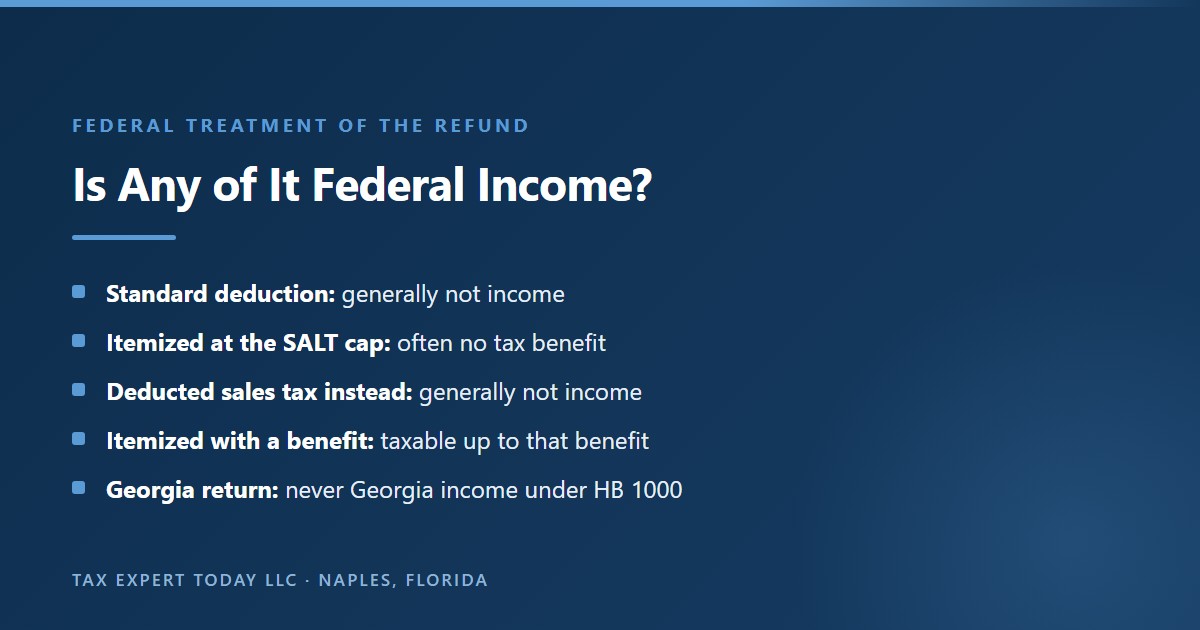
It depends on your 2024 federal return. If you took the standard deduction, or itemized without a tax benefit from deducting Georgia income tax, the refund is generally not federal income. If you itemized and deducted Georgia income tax with a benefit, part or all of it may be taxable under the tax benefit rule.
- Standard deduction in the deduction year: generally not taxable.
- Itemized without benefit: generally not taxable, for example at the SALT cap.
- Itemized with benefit: taxable to the extent of the benefit.
- Legal basis: IRC 111 and the tax benefit rule.
- Guidance gap: the IRS has not issued a statement on the 2026 payment.
The Department’s FAQ explains that the IRS made a determination about the earlier HB 1302 surplus refund of tax year 2020 liability and “has not released similar guidance since then.” That earlier determination is IRS news release IR-2023-23 of February 10, 2023. In it, the IRS listed Georgia among the states whose 2022 payments were refunds of state taxes paid, and said such a payment “is not included in income for federal tax purposes” if “the recipient claimed the standard deduction or itemized their deductions but did not receive a tax benefit (for example, because the $10,000 tax deduction limit applied).”
That release addressed 2022 payments, but the reasoning it applied to Georgia is the ordinary tax benefit rule rather than a special one time exception. The rule is codified in IRC 111, which excludes from gross income a recovery of an amount deducted in a prior year “to the extent such amount did not reduce the amount of tax imposed.” Because the 2026 surplus refund is, by statute, a refund of 2024 Georgia income tax, the same analysis is a reasonable starting point. Absent new IRS guidance, that remains an inference, not a ruling.
| Your federal return for the year the tax was deducted | Likely federal treatment of the surplus refund | Why |
|---|---|---|
| Standard deduction | Not included in income | No deduction for Georgia tax, so no tax benefit to recover |
| Itemized, total state and local taxes above the cap | Often not included, or only partly | The cap limited the deduction, so the refund may not have produced a benefit |
| Itemized, deducted general sales tax instead of income tax | Generally not included | Georgia income tax was not the tax deducted |
| Itemized, deducted Georgia income tax below the cap, itemizing by a wide margin | Likely included, up to the refund | The deduction reduced federal tax dollar for dollar at the margin |
| Itemized by a narrow margin over the standard deduction | Included only up to the margin | The benefit is limited to the excess of itemized over standard |
The table summarizes general rules from IRC 111 and IRS Publication 525; it is not a determination for any return. Your answer depends on your own deduction year figures, which the next section explains how to work through.
How Do You Work Out the Taxable Portion if You Itemized?
Identify the year or years in which the Georgia tax being refunded was deducted, then apply the itemized deduction recovery worksheet in IRS Publication 525. The taxable amount is limited to the federal benefit you actually received, considering the SALT cap, the sales tax election, and the standard deduction margin.
- Which tax: 2024 Georgia income tax.
- When deducted: 2024 for withholding and 2024 estimates; 2025 for a balance paid in 2025.
- Allocate: split the refund between years on a pro rata basis.
- Limit: the excess of itemized deductions over the standard deduction.
- Cap test: the SALT limit in the deduction year.
Publication 525 explains that a refund of state income tax is included in income only to the extent the earlier deduction reduced your federal tax. It provides a worksheet for itemized deduction recoveries and addresses several situations that matter here. If you could choose between deducting state income taxes and general sales taxes, the maximum refund you may have to include is limited to the excess of the tax you chose to deduct over the tax you did not choose. If a refund relates to amounts paid in two or more separate years, you allocate it on a pro rata basis between those years.
The two year point is important for the surplus refund. Georgia income tax for 2024 was paid through 2024 withholding and estimated payments, but a balance due paid with the 2024 return in April 2025, and a fourth quarter estimate paid in January 2025, were deductible on the 2025 federal return, not the 2024 return. Publication 525 includes an example of exactly this allocation for a regular state refund. A taxpayer who paid a large 2024 Georgia balance in 2025 may need to treat part of the surplus refund as a recovery of a 2025 deduction instead.
The SALT cap also changed. For 2024, the federal deduction for state and local taxes under IRC 164(b)(6) was capped at $10,000, or $5,000 for married filing separately. Federal legislation enacted in 2025 raised the cap for later years. A recovery of tax deducted in a capped year is generally a recovery only to the extent the refund would have reduced your deduction below the cap. A taxpayer whose 2024 state and local taxes exceeded $10,000 by more than the surplus refund generally received no federal benefit from the refunded portion, and IR-2023-23 described the cap as one reason a Georgia refund may not be taxable.
| Hypothetical 2024 itemizer | State and local taxes paid | Deduction allowed | Surplus refund | Likely recovery |
|---|---|---|---|---|
| G, well over the cap | $16,400 | $10,000 | $500 | $0, the deduction stays at the cap |
| H, just over the cap | $10,200 | $10,000 | $500 | $300, the excess below the cap |
| J, under the cap | $7,800 | $7,800 | $250 | Up to $250, subject to the standard deduction margin |
| K, under the cap but itemized by $120 | $6,000 | $6,000 | $250 | Up to $120, the margin over the standard deduction |
The four filers above are hypothetical and the figures are illustrative. Real computations also account for the allocation between years, the sales tax election, and other recoveries in the same year, which is why the Department’s FAQ tells itemizers to “Use the federal Instructions for Schedule 1 or consult your tax advisor to determine the amount you should include in your federal taxable income.”
Which Tax Year Do You Report the Surplus Refund On?
A refund of state tax that is federally taxable is reported in the year you receive it. A surplus refund received in 2026 belongs on the 2026 federal return filed in 2027, not on an amended 2024 return, and any Georgia subtraction goes on the 2026 Georgia return.
- Year received: 2026 for this round.
- Federal form: Schedule 1 of the 2026 Form 1040, if any part is taxable.
- No amendment: do not amend 2024 to reduce the deduction.
- Georgia subtraction: on the 2026 Form 500, Schedule 1.
- Offset still counts: a refund applied to a debt was still received.
| Item | Tax year it relates to | Where it is reported, if anywhere |
|---|---|---|
| 2024 Georgia liability that measures the refund | 2024 | Already on the 2024 Georgia return; nothing new to file |
| Surplus refund received in 2026, standard deduction filer | Received in 2026 | Not reported federally; nothing to subtract on the Georgia return |
| Surplus refund received in 2026, itemizer with a tax benefit | Received in 2026 | Taxable part on the 2026 federal Schedule 1; subtracted on the 2026 Georgia Schedule 1 |
| Surplus refund applied to a Georgia balance | Received in 2026 | Same as above; the offset does not change the year |
| 2025 Georgia return that unlocks eligibility | 2025 | Filed by the 2025 due date, including an extension to October 15, 2026 |
Publication 525 frames itemized deduction recoveries as income in the year of recovery, reported on Schedule 1 of Form 1040, with an explanation attached when the amount differs from any information return. The prior year return is not reopened. A surplus refund received in May 2026 is therefore a 2026 item, even though it measures 2024 liability.
A refund that was offset to pay a debt is still a refund you received for tax purposes, because it satisfied an obligation you owed. If the offset went to a debt of your former spouse under a joint return, the analysis is more complicated, and the injured spouse allocation principles may inform how the amount is divided between the two of you.
Will You Receive a Form 1099-G for the Surplus Refund?
The Department has not stated in its HB 1000 FAQ whether it will issue Form 1099-G for the 2026 surplus refund. Check your Georgia Tax Center account in early 2027. Whether or not a form arrives, your own deduction year figures decide whether any amount is federally taxable.
- Not stated: the FAQ does not address Form 1099-G for this payment.
- Where to look: your Georgia Tax Center correspondence in January 2027.
- Form is not the answer: a 1099-G reports the payment, not the taxable amount.
- Standard deduction filers: generally report nothing even if a form is issued.
- Itemizers: keep the worksheet with your records.
The IRS page About Form 1099-G describes the form. States generally issue Form 1099-G for refunds of state income tax to taxpayers who itemized in the prior year, but whether Georgia will issue one for this special refund, and to whom, is not stated in the materials we reviewed. We do not predict it. If you receive a Form 1099-G and your computation shows a smaller taxable amount, Publication 525 instructs taxpayers to attach a computation explaining why the amount reported is less than the amount shown on the Form 1099-G.
Most taxpayers who take the federal standard deduction can ignore the federal question entirely, with or without a form. Itemizers should keep their 2024 Schedule A, their 2025 Schedule A if they paid a 2024 Georgia balance in 2025, and the record of the surplus refund deposit or check.
How Does the 2026 Round Compare With Earlier Surplus Refunds?
Georgia issued special income tax refunds in 2022, 2023, and 2025 before the 2026 round. Each used the same structure: an automatic refund of one earlier year’s liability, capped at $250, $375, or $500 by filing status, for taxpayers who filed two consecutive returns on time. Only the measuring year moves forward.
- 2026 round: HB 1000, measured by 2024 liability, 2024 and 2025 returns required.
- Same caps: $250, $375, and $500 by filing status.
- Earlier rounds: 2022, 2023, and 2025, per the Department.
- First round: HB 1302, measured by tax year 2020 liability.
- No carryover: missing one round does not affect eligibility for the next.
The Department’s May 4, 2026 press release states that “Previous special refunds were issued in 2022, 2023, and 2025,” and that the 2026 refund is the fourth of its kind. The FAQ confirms that “In 2022, 2023 and 2025, the Georgia General Assembly passed and Governor Kemp signed similar legislation allowing for an additional refund of income taxes paid by Georgia filers,” and refers to the HB 1302 refund for tax year 2020 in its federal tax discussion.
| Feature | 2026 surplus refund (HB 1000) | What stays the same across rounds |
|---|---|---|
| Measuring year | 2024 liability | One earlier year’s liability is the base |
| Returns required | 2024 and 2025, by the 2025 due date including extensions | Two consecutive years, filed on time |
| Caps | $250, $375, $500 | Same caps by filing status |
| Proration | 2024 Schedule 3, Line 9 ratio | Part year and nonresident filers prorated |
| Georgia taxability | Not Georgia income | Excluded by the authorizing bill |
| Federal taxability | Tax benefit rule; no new IRS statement | Depends on the deduction year |
| Interest | None | Not paid with interest |
| Offsets | Outstanding liability first, then Article 7 setoff | Subject to setoff |
Because the rounds are separate statutes, a refund missed in an earlier year cannot be claimed through the 2026 program, and the 2026 refund does not depend on whether you received an earlier one. A taxpayer who was ineligible in 2025 because of a late return, or who had zero liability in 2023, may well qualify in 2026 on the 2024 numbers.
There is no announced 2027 round. Future refunds depend on future legislation and the state budget, and nothing in HB 1000 commits the state to another one. Taxpayers should not plan around a refund that has not been enacted.
Does a Late 2025 Georgia Return Disqualify You?
On the statutory text, yes. A qualified taxpayer must file both returns by the due date of the 2025 return, including any extension granted. A 2025 return filed after the original due date without an extension, or after October 15, 2026 with one, does not meet that test, and the Department lists late filing as a reason for no refund.
- Test date: the 2025 due date, including any extension granted.
- With extension: October 15, 2026.
- Without extension: the original April 2026 due date.
- No reasonable cause rule: the statute does not provide one for this refund.
- Remaining value: filing still stops failure to file penalties from growing.
Unlike penalty provisions, which often allow relief for reasonable cause, the qualified taxpayer definition is a filing date test written into the statute itself. Neither the bill nor the FAQ describes a waiver. Some taxpayers will ask whether a return filed one day late could still be accepted; we do not know of any published Department policy that would allow it, and we would not advise counting on one.
That makes October 15, 2026 the practical deadline for anyone who extended their 2025 Georgia return. A taxpayer who has an extension and is waiting on a late Schedule K-1, a corrected Form 1099, or a cost basis figure should consider whether to file a complete return by the deadline using the information available and amend later. An amended return corrects a return that was filed on time; it does not turn a late return into a timely one.
Taxpayers who missed the 2025 deadline still have good reasons to file. Georgia failure to file and failure to pay penalties grow over time, and a return filed late is better than one not filed at all. The Department’s Form 500X page has the current form. Our guide to the Georgia amended tax return covers Form 500X and its deadlines for correcting a timely return.
What if You Never Filed a 2024 Georgia Return?
Without a 2024 return there is no 2024 liability on file, so there is no surplus refund. If you were required to file for 2024 and you have a valid 2025 extension, filing both the 2024 and 2025 returns by October 15, 2026 meets the statutory test, though penalties and interest may apply to any 2024 balance.
- Two returns, one date: both by the 2025 due date including extensions.
- 2024 balance: late penalties and interest still apply.
- Refund amount: lesser of 2024 liability and the cap.
- Offset: the surplus refund may first pay the 2024 balance.
- Not required to file: without liability there is no refund in any case.
The statutory definition looks at whether the taxpayer “filed an individual income tax return for both the 2024 and 2025 taxable years by the due date for filing the income tax return for the 2025 taxable year.” It does not say the 2024 return must have been filed by the 2024 due date. On the plain text, a 2024 return filed late, but before the 2025 extended due date, can count. We note that the Department applies the statute and may take a different view of the facts in individual cases.
A taxpayer in this position should expect the surplus refund to be applied first to any unpaid 2024 tax, penalties, and interest, because subsection (d) credits the refund against “any outstanding liability existing at the time the refund” is issued. If a balance remains, our pages on the Georgia payment plan and the Georgia offer in compromise explain the collection options.
A taxpayer who had no Georgia filing requirement for 2024, for example because income was below the filing threshold, would have had no liability anyway, so filing a 2024 return now would not create a refund.
What if the Department Adjusted Your 2024 Return?
HB 1000 measures the refund by 2024 liability “as properly reported” on Form 500 Line 16 or Form 500EZ Line 4. If your 2024 return was amended or adjusted, the Department’s records may show a different liability than your original copy, which can change the refund amount up or down.
- Phrase that matters: “as properly reported.”
- Department adjustments: may change the liability on file.
- Taxpayer amendments: a Form 500X can change 2024 liability.
- Timing: the Department’s practice on post issuance changes is not published.
- Check: your Georgia Tax Center account for the 2024 assessed liability.
The statute uses “properly reported” twice: once in the lesser of formula and once in the overall limit. The natural reading is that the Department may use a corrected liability where the original return understated or overstated tax, rather than being bound to a figure it later found to be wrong. The FAQ does not explain how adjustments made after a surplus refund was issued are handled, and we do not speculate on whether the Department would issue a second payment or seek repayment.
A taxpayer who discovers an error on a 2024 return should correct it for its own sake, not to engineer a larger surplus refund. The refund is capped at $250, $375, or $500, so for most filers whose 2024 liability exceeds the cap, a change in liability has no effect at all. It matters only near or below the cap.
If the Department adjusted your 2024 return and you disagree, the adjustment notice explains your protest rights. Disputes over an underlying assessment follow the Department’s protest procedures and, from July 1, 2026, the Georgia Tax Court.
Can Owing Georgia Tax Block Your Surplus Refund?
It does not block eligibility, but it can absorb the payment. The surplus refund is first credited against any outstanding Georgia liability when the refund is issued, so a taxpayer with an unpaid balance may see the refund applied to that balance instead of deposited. The Department’s press release describes eligible taxpayers as those who do not owe the Department.
- Statutory order: outstanding liability first, then payment of any remainder.
- Payment plans: the credit reduces the balance on the plan.
- Disputed balances: may still be offset while a protest is pending.
- Other agencies: Article 7 setoff can follow.
- Notice: look for a Department letter explaining the credit.
The press release lists as an eligibility point that taxpayers must “not owe the State Department of Revenue.” The statute itself treats this as an offset rather than a disqualification: under subsection (d), the refund “shall first be credited against any outstanding liability.” In practice, the result for a taxpayer with a balance larger than the refund is the same either way: nothing is deposited, and the balance goes down.
A taxpayer on an installment agreement with the Department should keep making scheduled payments. A credit of the surplus refund reduces the balance but does not necessarily replace a scheduled installment. A taxpayer with a pending offer in compromise should keep a record of the credit, since the balance used in the offer analysis will change.
Estimated payments that fall short can do the same; see our Georgia estimated tax penalty calculator. Withholding problems can also create Georgia balances. Employees who claimed the wrong number of allowances, or employers who under withheld, can find a balance due when they file. Our guide to Georgia withholding tax explains how withholding is set and corrected for the current year.
How Do You Spot a Georgia Surplus Refund Scam?
The surplus refund is automatic, so any message asking you to apply, pay a fee, or confirm bank details to receive it should be treated as suspect. Use only the Department’s own website, dor.georgia.gov, and the Georgia Tax Center to check status.
- No application: the statute credits qualified taxpayers automatically.
- No fee: nothing in HB 1000 charges taxpayers to receive the refund.
- Payment route set: the 2025 return’s refund instructions control.
- Official channel: type dor.georgia.gov rather than clicking a link.
- Report suspicious contact: to the Department through its published channels.
Every round of special refunds draws imitation, and the Department’s eligibility explainer is the reference to compare any message against. Text messages and emails that promise a “Georgia rebate” or “gas tax refund,” and ask for a card number or banking login to release it, are inconsistent with how the program works. The statute says the Department “shall automatically credit” qualified taxpayers and pay them according to the refund instructions on the 2025 return. There is no step at which the taxpayer supplies new bank details to a third party.
The Department’s own FAQ addresses the “gas tax refund” confusion caused by the GASTTAXRFD bank description, which scammers may try to exploit. If you are uncertain whether a message is genuine, do not reply to it. Go to the Department’s website directly and use the status tool, or call the number published on that site.
The same caution applies to anyone offering to “claim” the surplus refund for a percentage. There is nothing to claim. A tax professional can help with the underlying returns, the deadline, an offset dispute, or the federal treatment, but no one can speed up or enlarge the statutory payment.
What Should You Check Before October 15, 2026?
Confirm that both your 2024 and 2025 Georgia returns are filed, that your 2024 return shows liability, that your address and refund instructions are current, and that any offset notice has been answered within 30 days. Extended 2025 filers should file by October 15, 2026 to remain eligible.
- Returns: both years filed and accepted in the Georgia Tax Center.
- Liability: 2024 Form 500 Line 16 or Form 500EZ Line 4 above zero.
- Status: run the Department’s surplus refund checker.
- Mail: look for ITIN requests and offset notices.
- Records: keep the deposit or check record for the 2026 federal return.
| Situation | Action | Deadline or timing |
|---|---|---|
| 2025 Georgia return not yet filed, extension in place | File a complete 2025 return | By October 15, 2026 |
| 2024 Georgia return never filed but required | File 2024 along with 2025 | By October 15, 2026, with a 2025 extension |
| Received a setoff notice | Decide whether to contest; write to the named agency | Within 30 days of the notice mailing date |
| Joint refund taken for one spouse’s debt | Non owing spouse applies in writing for a hearing | Within 30 days of the notice mailing date |
| Received an ITIN information request | Respond through the Georgia Tax Center or by mail | As stated in the letter |
| Moved or changed banks | Update address with the Department | As soon as possible |
| Itemized on the federal return | Work the recovery worksheet for the 2026 return | When preparing the 2026 return in 2027 |
For many readers, the checklist ends at the first line, and our Georgia tax services page lists the related filings. Filing a 2025 return that is already extended is the one action that converts an ineligible taxpayer into an eligible one, and it has a fixed date. Everything else on the list is about collecting a refund already earned, or reporting it correctly.
Georgia Surplus Tax Refund Help in Naples & Southwest Florida
Tax Expert Today LLC serves Georgia taxpayers nationwide from its office at 11983 Tamiami Trail N, Naples, Florida 34110. Georgia surplus tax refund help in Naples covers the 2024 and 2025 Georgia returns, extension deadlines, offset notices, part year proration after a move to Florida, and the federal tax benefit computation.
- Office: 11983 Tamiami Trail N, Naples, FL 34110.
- Phone: (239) 441-2005.
- Hours: Monday to Friday, 10 a.m. to 5 p.m. Eastern.
- Scope: state tax matters nationwide, including Georgia individual returns.
- Typical clients: former Georgia residents in Southwest Florida and nonresidents with Georgia income.
Southwest Florida has many residents who lived or worked in Georgia, and many who still own Georgia rental property or business interests. For them, the surplus refund raises the same handful of questions every year a round is enacted: whether a part year or nonresident return was required, whether it was filed on time, how the proration works, and whether any part of the payment is federally taxable. We handle those questions as state tax matters, alongside the related Georgia filings, and coordinate with Georgia counsel where an agency hearing is involved.
A typical engagement starts with the 2024 and 2025 Georgia returns, any Department correspondence including offset or ITIN letters, and the 2024 and 2025 federal returns if the taxpayer itemized. From there we confirm eligibility, compute the expected refund, identify any missing filings that can still be made by the extended deadline, and prepare the federal and Georgia reporting for the year of receipt. Outcomes depend on each taxpayer’s facts and the Department’s determinations. Our Georgia tax services page describes the full range of Georgia work handled from Naples, and our Naples tax planning page covers the Florida side of a move.
When to Engage a Professional
Most taxpayers can check their status online and need no help. Professional review makes sense when a Georgia return is still unfiled with the October 15, 2026 deadline approaching, when a refund was offset and the debt is disputed, when you moved during 2024 or 2025, or when you itemized and must compute the federal amount.
- Unfiled returns for 2024 or 2025 with an extension in place.
- Offset disputes, especially on a joint refund for one spouse’s debt.
- Moves into or out of Georgia that trigger proration and two year filing questions.
- Itemized deductions near the SALT cap or with a 2024 balance paid in 2025.
- Estates and surviving spouses handling a decedent’s final returns.
Tax Expert Today LLC brings together tax advisors, enrolled agents, CPAs, and attorneys and serves clients in all 50 states on federal and state tax matters, including Georgia individual income tax. A surplus refund review is usually brief, and it often reveals a larger issue worth fixing, such as an unfiled year, an unresolved Georgia balance, or a residency question after a move. The Department of Revenue decides every refund and offset. Related reading includes our Georgia lottery tax guide, which explains how state debts are set off against prize payments, and our Georgia tax services page. Call (239) 441-2005 for a free consultation.
Frequently Asked Questions About the Georgia Surplus Tax Refund
What is the Georgia surplus tax refund?
It is a one time refund of 2024 Georgia individual income tax authorized by HB 1000, signed March 20, 2026, and codified at O.C.G.A. 48-7-20.4. The Department of Revenue began issuing payments on May 4, 2026. It is paid automatically to qualified taxpayers, with no application.
How much is the 2026 Georgia surplus tax refund?
The refund is the lesser of your 2024 Georgia income tax liability or a cap based on 2024 filing status: $250 for single and married filing separately, $375 for head of household, and $500 for married filing jointly. Part year residents and nonresidents receive a prorated amount.
Who qualifies for the Georgia surplus tax refund?
Individuals who filed both 2024 and 2025 Georgia income tax returns by the 2025 due date, including any extension, and who had 2024 Georgia tax liability. Nonresident aliens, estates and trusts, and 2024 dependents without earned income are excluded.
What is the deadline to qualify for the Georgia surplus tax refund?
Both returns must be filed by the due date of the 2025 Georgia return, including extensions. The Department’s FAQ states that taxpayers with an extension for tax year 2025 have until October 15, 2026, to file the 2025 return.
Why did I not get a Georgia surplus tax refund?
Common reasons are a 2024 or 2025 return not filed on time, zero 2024 Georgia liability, an ITIN on either return with a pending Department information request, being a 2024 dependent without earned income, a prorated amount under $1, or an offset to a debt.
Why do retirees often get no Georgia surplus tax refund?
Georgia excludes up to $35,000 of retirement income per person at ages 62 to 64 and up to $65,000 at 65 or older, and does not tax Social Security. Many retirees therefore had no 2024 Georgia liability, and the refund cannot exceed that liability.
Is the Georgia surplus tax refund taxable?
It is not taxable in Georgia; HB 1000 excludes it. Federally, it is generally not income if you took the standard deduction or itemized without a tax benefit from deducting Georgia income tax. If you deducted Georgia income tax with a benefit, part may be taxable under the tax benefit rule.
Can my Georgia surplus tax refund be taken for a debt?
Yes. HB 1000 applies the refund first to any outstanding Georgia liability and makes it subject to Georgia’s setoff law, so debts such as child support or certain state agency debts can be taken. The setoff notice gives 30 days from mailing to request a hearing in writing.
How do I check my Georgia surplus tax refund status?
Use the Check Your Surplus Tax Refund tool on the Department of Revenue website through the Georgia Tax Center. You need your SSN or ITIN and the federal adjusted gross income from your 2024 Georgia return. Status updates post nightly.
I moved from Georgia to Naples, Florida. Can you help with my Georgia surplus tax refund?
Yes. Tax Expert Today LLC handles state tax matters nationwide from its Naples, Florida office at 11983 Tamiami Trail N, including Georgia part year and nonresident returns, surplus refund eligibility, offset notices, and the federal reporting of the refund. Call (239) 441-2005 for a free consultation.
Published October 8, 2026 by Dr. Pellumb Kabashi « Back to Learning Center
Have a question this article touches on?
Tax Expert Today LLC, based in Naples, Florida and serving clients across the United States.
Schedule a Consultation (239) 441-2005