
By Dr. Pellumb Kabashi, DBA, MBA, EA, CFE, CES
Founder, Tax Expert Today LLC · Tax advisors, enrolled agents, CPAs, and attorneys · Serving clients in all 50 states
Quick answer: A Georgia part year resident tax return is filed on Form 500 with Schedule 3, which splits your income into a Georgia column and a non-Georgia column. Georgia then taxes only the Georgia column, but it prorates your standard deduction and dependent exemptions by the same ratio, so the deduction shrinks with the income. Call (239) 441-2005 for a free consultation.
Who has to file a Georgia part year resident tax return?
You file a Georgia part year resident tax return if you were a legal resident of Georgia for only part of the tax year and you are required to file a federal income tax return. The Georgia Department of Revenue puts this plainly: a part-year resident files Form 500 and must complete Schedule 3 to determine Georgia taxable income. There is no separate part-year form in Georgia.
- You moved into Georgia during the year and became a legal resident partway through it.
- You moved out of Georgia during the year and established legal residence in another state.
- You are required to file federally. The Georgia filing duty for a part-year resident is tied to the federal filing requirement.
- You use the same form as everyone else. Georgia routes residents, part-year residents and nonresidents all through Form 500, with the residency status indicated on the form itself.
- You had Georgia withholding but low income. Even below the filing thresholds, filing is how you recover Georgia tax that was withheld.
This matters more than it sounds, because the form does not change but the arithmetic does. A full-year resident reports everything and subtracts a full deduction. A part-year resident reports everything, carves out the non-Georgia portion, and then subtracts only a fraction of the deduction. Taxpayers who assume the second step is simply the first step with smaller numbers tend to understate the Georgia liability.
When does Georgia consider you a resident?
Georgia defines residency in O.C.G.A. §48-7-1(10). You are a resident if you are a legal resident of the state on income tax day, if you live in the state on a regular or permanent basis rather than as a visitor, or if you have resided in the state for 183 days or part-days or longer in the aggregate during the immediately preceding 365 day period. Income tax day is December 31.
- The count is 183 days or part-days. A partial day of residence counts as a day, so travel days are not free days.
- The window is the preceding 365 days, not the calendar year. The test is applied looking backward from December 31.
- Legal residence stands on its own. Domicile in Georgia on income tax day makes you a resident regardless of the day count.
- Regular presence can be enough. Living in Georgia on a more or less permanent basis, and not as a visitor or sojourner, is its own independent test.
| Statutory test | What it looks at | Measured when |
|---|---|---|
| Legal residence | Domicile in Georgia | On income tax day, December 31 |
| Regular or permanent presence | Living in the state other than as a visitor | On income tax day, December 31 |
| 183 day test | 183 days or part-days in the aggregate | Across the immediately preceding 365 days |
In ordinary practice the Department of Revenue administers part-year status by the dates on which legal residence began or ended, and Schedule 3 is the mechanism that gives effect to those dates. The statutory tests above become decisive when residency itself is in dispute, which happens far more often on the way out of Georgia than on the way in.
Why does Georgia keep taxing some people after they move away?
Because the statute makes residency sticky. Under O.C.G.A. §48-7-1(10)(B), a person who has become a Georgia resident is deemed to continue being a resident until that person shows, to the satisfaction of the commissioner, both that he or she has become a legal resident or domiciliary of another state and that he or she does not fall within the 183 day test. The burden sits with the taxpayer, not with the state.
- Two showings are required, not one. New domicile elsewhere is only half of it. The 183 day test must also fail.
- Only then does apportionment apply. On that showing, the person is taxable as a resident only to the date of becoming a nonresident.
- Arrivals are treated in parallel. Subparagraph (C) provides that a first-time Georgia resident is taxable as a resident only from the date residence began, again on an apportionment basis.
- Timing interacts with the day count. Because the 183 day window looks back a full 365 days from December 31, a departure late in the year leaves a large number of Georgia days inside the lookback period.
The practical consequence is worth stating carefully. A move out of Georgia in the second half of the year can leave the taxpayer having resided in Georgia for well over 183 part-days of the 365 days preceding December 31. Where that is the case, the second showing required by subparagraph (B) is difficult to make on the statutory language, and the residency position may be challenged. Anyone whose departure date falls close to the middle of the year should have the facts reviewed before the return is filed rather than after a notice arrives.
Documentation is what carries the burden. A driver license surrender date, a homestead exemption ended in Georgia and claimed in the new state, a lease or closing statement, voter registration, vehicle registration and the physical relocation of household goods all build the record. Taxpayers who treat the move as complete because the house sold, without the paperwork to date the change of domicile, are the ones who struggle to make the showing the statute demands. For movers heading to Florida specifically, the evidence checklist in our guide to establishing Florida residency is the same record Georgia will want to see on the way out.
Withholding often lags a move. Georgia residents working in a state with no income tax, such as Florida, still have Georgia tax withheld, so after the domicile change it is worth giving payroll a new address and certificate. Our guide to Georgia Form G-4 covers when to file a new one and how nonresident wages are treated.
How does Form 500 Schedule 3 compute your Georgia tax?
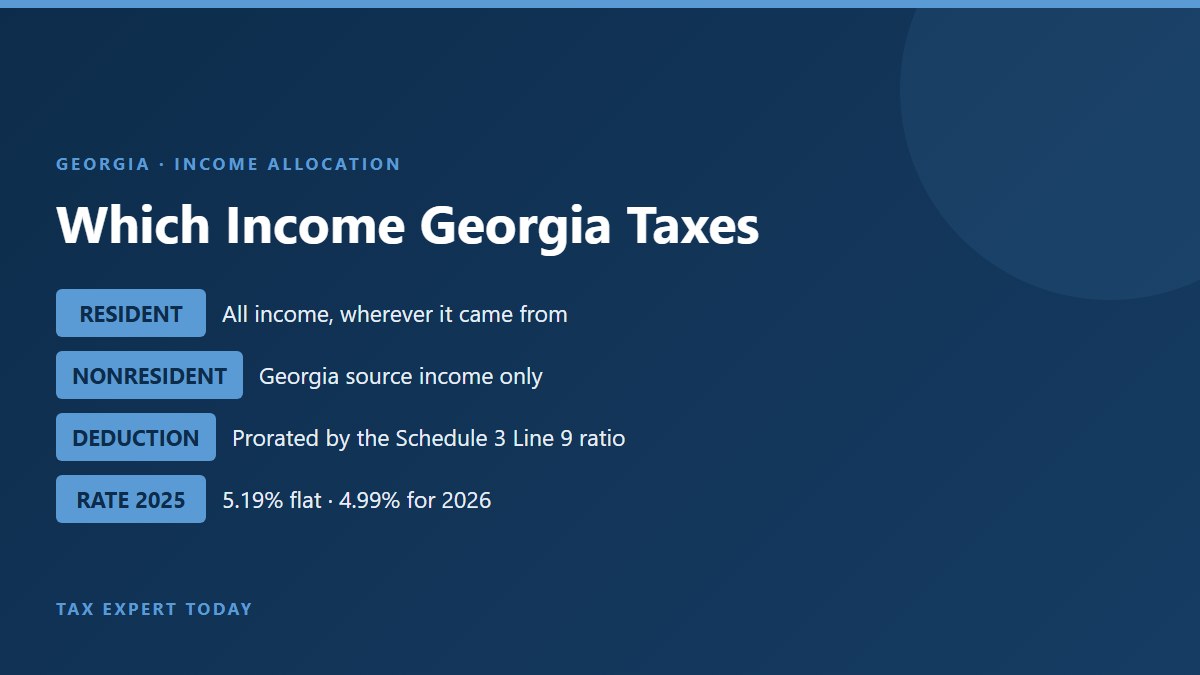
Schedule 3 uses three columns. Column A is your federal income after Georgia adjustments, Column B is the income not taxable to Georgia, and Column C is the Georgia income. Column A must equal Column B plus Column C. The schedule then computes a ratio of Georgia income to total income and applies that ratio to your deductions and exemptions, not to your income.
- Lines 1 through 5 report wages, interest and dividends, business income and other income, in all three columns.
- Lines 6 and 7 subtract federal adjustments and Georgia Schedule 1 adjustments to reach adjusted gross income on Line 8.
- Line 9 is the ratio. Georgia adjusted gross income divided by total adjusted gross income, expressed as a percentage.
- Lines 10 through 13 total the standard or itemized deduction plus dependent exemptions, then multiply that total by the Line 9 ratio.
- Line 14 is Georgia taxable income. Line 8 Column C minus the prorated deduction on Line 13, carried to Form 500 Line 15a.
The statutory authority for that proration is O.C.G.A. §48-7-85, which allows the commissioner to prorate the tax for a person moving into or out of the state and to require the taxpayer to prorate any exemptions on the basis of time spent within the state. The Georgia Supreme Court addressed the limits of that discretion in Forrester v. Culpepper, 194 Ga. 744 (1942), holding that the commissioner may determine the facts necessary to apply the provision but may not redefine the law or withhold a benefit a taxpayer is entitled to.

What does the Schedule 3 math look like in practice?
The single most misunderstood point is that Georgia allocates income but prorates deductions. Income is assigned to the state where it was earned or received while a resident. The standard deduction and dependent exemptions are not assigned anywhere. They are multiplied by the Georgia ratio, so a taxpayer with a third of the year in Georgia keeps roughly a third of the deduction.
Consider a hypothetical single taxpayer who was a Georgia resident from January 1 through April 30 of 2025 and then established residence in Florida. The figures below are illustrative only and are not drawn from any client file.
| Schedule 3 line | Column A, total | Column B, not Georgia | Column C, Georgia |
|---|---|---|---|
| Line 1, wages | $90,000 | $60,000 | $30,000 |
| Line 2, interest and dividends | $6,000 | $4,000 | $2,000 |
| Line 5, total income | $96,000 | $64,000 | $32,000 |
| Line 6, federal adjustments | $4,000 | $4,000 | $0 |
| Line 8, adjusted gross income | $92,000 | $60,000 | $32,000 |
| Line 9, Georgia ratio | $32,000 divided by $92,000, or 34.78% | ||
| Line 10, standard deduction, single | $12,000 | ||
| Line 13, prorated deduction | $12,000 times 34.78%, or $4,174 | ||
| Line 14, Georgia taxable income | $32,000 minus $4,174, or $27,826 | ||
At the 5.19% rate that applies to tax year 2025, Georgia taxable income of $27,826 produces roughly $1,444 of Georgia tax. Had the same taxpayer subtracted the entire $12,000 standard deduction instead of the prorated $4,174, Georgia taxable income would have come to $20,000 and the tax to roughly $1,038. The difference of about $406 is the whole point of Line 13, and it is the error that most often has to be corrected on a part-year return prepared without the schedule.
Note also that Column A must reconcile to Column B plus Column C on every line. A return where the columns do not tie is the most common reason a Georgia part-year filing is questioned, because the mismatch is visible on the face of the schedule without any examination of the underlying records.
Which income belongs in the Georgia column?
Two different rules fill Column C. Income received while you were a Georgia resident goes in the Georgia column regardless of where it came from. Income received while you were not a resident goes in the Georgia column only if it is Georgia source income, which the Department of Revenue describes as wages, Georgia lottery winnings, income from flow-through entities, and rents.
- While a resident: all income is Georgia income, including interest, dividends and gains from outside the state.
- After residency ends: only Georgia source income remains taxable, such as wages for work performed in Georgia or rent from Georgia property.
- Flow-through income from S corporations, partnerships, limited liability companies, trusts and estates follows the Georgia source rule.
- A capital gain generally follows residency at the time of sale, which is why the closing date relative to the move matters.
- A narrow nonresident exception applies where the only Georgia activity is services as an employee and the compensation does not exceed the lesser of five percent of wages everywhere or $5,000.
Timing is therefore a planning question and not only a compliance question. A bonus, a vesting event, an exercise of options or the sale of an appreciated asset falls on one side of the residency line or the other, and the side it falls on decides whether Georgia taxes it. Where a move and a liquidity event are both on the calendar, the order of the two is worth deciding deliberately. Our guide on the dual state residency tax trap covers what happens when two states each treat the same person as a resident for the same year. California runs the same split through a different form, and the contrast is useful because California does not prorate the way Georgia does, as our guide to the California part year resident tax return explains.
Georgia Lottery prizes stay in the Georgia column even for people who no longer live in Georgia. The Department lists Georgia lottery winnings as Georgia source income, so an annuity winner who moves away should expect each later installment to remain reportable to Georgia on a nonresident return. The rules for nonresident and moving winners are covered in our guide to Georgia lottery tax for nonresidents and annuity winners.
How is the retirement income exclusion prorated for part-year residents?
Part-year residents and nonresidents must prorate the Georgia retirement income exclusion, and the earned income portion and the unearned income portion are prorated separately. The earned portion uses the ratio of Georgia source earned income to total earned income. The unearned portion uses the ratio of Georgia source unearned retirement income to total unearned retirement income, each computed as if the taxpayer had been a Georgia resident for the entire year.
- Two ratios, not one. Applying a single blended percentage to the whole exclusion is not the method the instructions prescribe.
- The caps still apply first. The maximum exclusion is $35,000 for ages 62 through 64, and $65,000 at age 65 or older, per qualifying person.
- The earned income sublimit survives. No more than $5,000 of the exclusion may come from earned income.
- Each spouse qualifies separately. Jointly owned income is allocated 50% to each spouse for this calculation.
- Military retirement has its own rule. Part-year residents and nonresidents may claim the $17,500 base military retirement exclusion, and a further $17,500 only after meeting the earned income threshold with Georgia source earned income.
This is where a retiree who moves during the year is most likely to lose money or create an error, because the exclusion is large enough that a mistaken proration moves the tax noticeably. The full mechanics of the underlying benefit, including the age tiers and the treatment of Social Security, are covered in our guide to the Georgia retirement income exclusion.
Military retirees who move into or out of Georgia face a different proration rule from the one above. The booklet lets a part-year resident apply the base military exclusion against total military retired pay received, but the second tier is available only with Georgia source earned income. Our guide to Georgia military retirement tax rules covers the move year and the federal limit that stops Georgia from taxing the pension once residency has ended.
Which tax rate applies to your part-year return?
Georgia now applies a single flat rate to taxable net income, and the rate depends on which year the return covers. The rate is 5.39% for tax year 2024, 5.19% for tax year 2025, and 4.99% for taxable years beginning on or after January 1, 2026 under O.C.G.A. §48-7-20(a.1). Because the rate is flat, the Georgia ratio on Schedule 3 drives the outcome rather than any bracket effect.
| Tax year | Georgia flat rate | Source |
|---|---|---|
| 2024 | 5.39% | 2024 Form IT-511 instruction booklet |
| 2025 | 5.19% | 2025 Form IT-511 instruction booklet |
| 2026 | 4.99% | O.C.G.A. §48-7-20(a.1) |
| 2027 and forward | Reduced by 0.125 points annually until the rate reaches 3.99% | O.C.G.A. §48-7-20(a.1) |
The scheduled reductions after 2026 are conditional. The statute provides that each annual reduction is delayed by one year for each year that the prospective annual increases in the standard deduction are delayed for the reasons set out in O.C.G.A. §48-7-27(a)(1.1), so the glide path toward 3.99% should be treated as the current schedule rather than as a certainty. Anyone modeling a multi-year move should confirm the rate in force for each year rather than projecting a straight line.
The standard deduction that feeds Schedule 3 Line 10 changed between the two most recent tax years, so match the figure to the year you are actually filing. For tax year 2025 the deduction is $24,000 for married filing jointly and $12,000 for single, married filing separately, head of household and qualifying surviving spouse, and the dependent exemption on Line 11 is $4,000 for each dependent claimed on Form 500 Line 7c. For tax year 2026 the Department of Revenue has increased the standard deduction to $30,000 for married filing jointly and $15,000 for single taxpayers, heads of household and married taxpayers filing separately. Whichever year applies, the deduction and the exemptions are prorated by the Line 9 ratio before they reach Georgia taxable income, so a larger deduction does not change the part-year mechanic. It only changes the figure the ratio is applied to.
Where the income being allocated is a capital gain, the residency date at the closing rather than the ratio on Schedule 3 usually decides the outcome. Our guide to Georgia capital gains tax covers that sourcing question and the 3 percent withholding a nonresident faces on Georgia real property.
That credit is available only on a return the taxpayer files personally, which is why it matters whether a nonresident owner of a Georgia business is reported on the entity return instead. An owner included on a Georgia composite return is not filing a Georgia return for that income and therefore cannot claim the other state credit against it.
For the rate, the standard deduction, and the other Form 500 rules that apply to every filer, including the 2026 changes made by HB 463, see our overview of the Georgia state income tax.
How do you claim credit for taxes paid to another state?
A part-year resident who claims a credit for taxes paid to another state on income earned while a Georgia resident must include a copy of the income tax return filed with that other state. The Georgia instructions are explicit that the credit will not be allowed otherwise. This is a documentation requirement, not a discretionary preference, and it is a frequent cause of adjusted returns.
- Attach the other state’s return. A copy of the filed return travels with the Georgia return.
- The credit covers the resident period. It applies to income taxed by both states while you were a Georgia resident.
- Electronic filing still requires the attachment. Confirm the other state return is transmitted or retained as the software requires.
- Order of operations matters. Prepare the other state return first so the credit figure is known.
Mixed-residency couples raise a related question. Where one spouse is a Georgia resident and the other is not, the Department of Revenue instructs that the taxpayer enter residency code three, the nonresident code, on Form 500 and use Schedule 3 to calculate Georgia taxable income. A married part-year resident with Georgia income whose spouse is a nonresident may instead file a separate Georgia return claiming his or her own exemptions and deductions. Which of the two produces the better result depends on the income split and is worth computing both ways.
If one of these mistakes is already sitting on a return you filed, the correction is made on Form 500X rather than on a second Form 500, and it is worth checking the deadline before anything else. Georgia measures the refund window from the later of the date you paid or the return due date including extensions, so a year you extended stays open longer than a year you did not. Our guide to the Georgia amended tax return walks through that calculation and the separate 180-day rule that applies when the change came from the federal side.
The year of a move also changes Georgia estimated tax. A new resident often first meets the estimate requirement after March 31, which moves the first installment to June 15 or September 15 and spreads the year over fewer payments. The dates, the 70 percent and 100 percent targets, and the voucher itself are explained in our guide to Georgia Form 500 ES.
When the Department disagrees with a move date or an income allocation, it issues a proposed assessment that can be protested within 45 days, and the official assessment that follows can be appealed within 45 days. Since July 1, 2026, those appeals go to the Georgia Tax Court rather than the old Tribunal. The full path is explained in our guide to the Georgia Tax Tribunal and the Georgia Tax Court.
Common mistakes on a Georgia part year resident tax return
Most part-year errors are structural rather than arithmetic. They come from treating the Georgia return as a smaller copy of the federal return instead of running the allocation and proration that Schedule 3 requires. The five below account for the majority of corrections.
- Taking the full standard deduction. Line 13 prorates it by the Georgia ratio, and skipping that step understates Georgia tax.
- Columns that do not tie. Column A must equal Column B plus Column C on every line.
- Prorating the retirement exclusion with one ratio. The earned and unearned portions are prorated separately.
- Omitting the other state return. The credit for taxes paid to another state is disallowed without the attachment.
- No documentation of the residency date. The statute places the burden of showing a change of domicile on the taxpayer.

A sixth issue is procedural. Calendar year returns are due April 15, and Georgia will accept the federal extension if a copy of Form 4868 or the IRS confirmation is filed with the Georgia return. Form IT-303 is available where no federal extension was obtained. An extension to file is not an extension to pay, so tax owed on the Georgia portion is still due by the original date. Separately, note that the Georgia Tax Court succeeded the Georgia Tax Tribunal on July 1, 2026, so appeal procedure references in older material may name the wrong forum.
A move into Georgia can also raise a sales and use tax question that is separate from the income tax return. Household goods brought in as a result of a change of domicile are generally exempt from Georgia use tax, but equipment brought in for use in a trade, business, or profession is not. The rules are explained in our guide to Georgia use tax when you move or buy out of state.
Georgia part-year filing help in Naples & Southwest Florida
Tax Expert Today LLC advises on state tax matters nationwide from an office in Naples, Florida. Part-year Georgia returns are a regular part of that work, particularly for people moving between Georgia and Florida, where the contrast between a flat state income tax and no state income tax makes the residency date financially significant. Our team includes tax advisors, enrolled agents, CPAs and attorneys, and Georgia clients are served nationwide from the Naples office.
Tax Expert Today LLC, 11983 Tamiami Trail N, Naples, FL 34110. Telephone (239) 441-2005. Office hours Monday through Friday, 10:00 to 5:00 Eastern time. If a Georgia move is part of a broader relocation plan, our Georgia tax services page sets out how we handle Georgia compliance and planning together, and our Naples tax planning practice covers the Florida side of the same move.
Do I need to be in Naples to have you prepare a Georgia part-year return?
No. We serve clients in all 50 states and the work is handled remotely through a secure document portal, with calls scheduled Monday through Friday during office hours. Clients in Southwest Florida who prefer to meet in person are welcome at the Tamiami Trail office, and many of our Georgia to Florida movers do exactly that once the relocation is complete.
When should you bring in a professional?
A part-year return with a single employer, a clean mid-year move and no investment activity is a return many taxpayers complete on their own, provided Schedule 3 is actually completed and the deduction is prorated. The calculation stops being routine when the facts get closer to the lines the statute draws.
Consider professional help where the departure date falls near the middle of the year and the 183 day lookback is in play, where a liquidity event such as a business sale, an option exercise or a large capital gain sits near the residency date, where retirement income has to be prorated across two ratios, where two states are each asserting residency for the same year, or where a prior year return was filed without Schedule 3 and may need to be corrected. In each of those situations the cost of getting the residency date and the allocation right is small next to the cost of defending a position that was never documented. Our Georgia estimated tax penalty calculator is a useful starting point for anyone who under-withheld during the transition year, and taxpayers whose situation is nonresident rather than part-year should start with our guide to the nonresident state tax return.
This article is general information about Georgia income tax rules and is not tax advice for any particular person. Georgia law, forms and rates change, and the correct treatment depends on facts this article cannot know. Confirm current figures against the Department of Revenue instructions for the year you are filing, and consult a qualified professional about your own circumstances.
Frequently asked questions about the Georgia part year resident tax return
Is there a separate Georgia form for part-year residents?
No. Georgia uses Form 500 for residents, part-year residents and nonresidents alike. What changes is the residency status entered on the form and the requirement that part-year residents and nonresidents complete Schedule 3 to compute Georgia taxable income.
Does Georgia prorate the standard deduction for a part-year resident?
Yes. Schedule 3 Line 13 multiplies the total of the standard or itemized deduction and dependent exemptions by the Georgia ratio computed on Line 9. The authority for that proration is O.C.G.A. §48-7-85, which permits requiring a taxpayer to prorate exemptions on the basis of time spent in the state.
What is the 183 day rule in Georgia?
Under O.C.G.A. §48-7-1(10)(A)(iii), a person who on income tax day has resided in Georgia for 183 days or part-days or longer in the aggregate during the immediately preceding 365 day period is a resident. Income tax day is December 31, so the count runs backward from the end of the year rather than across the calendar year.
How does Georgia treat a couple where one spouse is a resident and one is not?
The Department of Revenue instructs that residency code three, the nonresident code, be entered on Form 500 and that Schedule 3 be used to calculate Georgia taxable income. A married part-year resident with Georgia income whose spouse is a nonresident may alternatively file a separate Georgia return claiming his or her own exemptions and deductions.
Can I claim the Georgia retirement income exclusion as a part-year resident?
Yes, but it must be prorated, and the earned income portion and the unearned income portion are prorated separately using different ratios. The underlying caps of $35,000 for ages 62 through 64 and $65,000 at age 65 or older still apply per qualifying person before the proration.
What happens if I moved out of Georgia late in the year?
The statute deems a former resident to continue being a resident until the taxpayer shows both a new legal residence elsewhere and that the 183 day test does not apply. A late-year departure leaves many Georgia days inside the 365 day lookback, which can make that second showing difficult. Facts of that kind should be reviewed before filing.
Do I need to attach the other state’s tax return to claim the credit?
Yes. Georgia instructs that a part-year resident claiming a credit for taxes paid to another state on income earned while a Georgia resident must include a copy of the return filed with that state, and that the credit will not be allowed otherwise.
Published September 2, 2026 by Dr. Pellumb Kabashi « Back to Learning Center
Have a question this article touches on?
Tax Expert Today LLC, based in Naples, Florida and serving clients across the United States.
Schedule a Consultation (239) 441-2005