
By Dr. Pellumb Kabashi, DBA, MBA, EA, CFE, CES
Founder, Tax Expert Today LLC · Tax advisors, enrolled agents, CPAs, and attorneys · Serving clients in all 50 states
Georgia Form 500 ES is the voucher individuals and fiduciaries use to pay Georgia income tax during the year when withholding does not cover it. Under O.C.G.A. 48-7-114 you generally must pay if you expect more than $1,000 of income not subject to withholding. For 2026 the installments are due April 15, June 15, September 15 and January 15, 2027. Call (239) 441-2005 for a free consultation.
What Is Georgia Form 500 ES?
Georgia Form 500 ES is the Individual and Fiduciary Estimated Tax Payment Voucher issued by the Georgia Department of Revenue. It lets residents, taxable nonresidents, estates and trusts pay Georgia income tax in installments during the year on income that has no Georgia withholding, such as business profit, rent, interest, dividends and capital gains.
- Who issues it: the Georgia Department of Revenue, which publishes a new version for each tax year.
- Who uses it: individuals who file Form 500 and fiduciaries who file Form 501.
- What it pays: Georgia income tax only. Federal estimates go to the IRS on Form 1040-ES.
- How it is filed: as a paper voucher mailed with a check, or replaced entirely by an electronic payment through the Georgia Tax Center.
The Department describes the purpose plainly in the 2026 Form 500 ES instructions: estimated tax lets taxpayers who have income not subject to withholding pay their income tax currently, instead of all at once when the return is filed. The annual return then claims credit for every amount paid.
The form itself has two parts. The first page is a worksheet with instructions, which you keep. The second is the voucher that goes to the Department with your payment. The worksheet is marked in capital letters with a request not to mail it, and a surprising number of vouchers still arrive with the worksheet attached.
It helps to separate the voucher from the obligation. Georgia Form 500 ES is only the payment slip. The legal duty to pay estimated tax comes from Article 5 of Chapter 7 of Title 48 of the Official Code of Georgia, and that duty exists whether you mail a voucher, pay online, or have extra tax withheld from a paycheck instead.
Who Must Make Georgia Estimated Tax Payments?
Under O.C.G.A. 48-7-114(b), a resident or taxable nonresident must pay estimated tax if they expect to be required to file a Georgia return and expect gross income to include more than $1,000 from sources other than wages subject to withholding. The Form 500 ES instructions phrase the test as income above exemptions, deductions and that $1,000.
- Self employed individuals with Schedule C profit that has no withholding.
- Landlords with rental income reported on Schedule E.
- Investors with interest, dividends or capital gains, including a single large sale.
- Retirees whose pension or IRA distributions exceed the retirement exclusion and have no Georgia withholding.
- Partners and S corporation shareholders whose share of income arrives without withholding.
The statute has two prongs. First, the taxpayer must reasonably expect to be required to file a Georgia income tax return for the year. Second, gross income must be expected to include more than $1,000 from sources other than wages as defined in O.C.G.A. 48-7-100. The codified text of O.C.G.A. 48-7-114 still pairs that with dollar thresholds tied to the old personal and marital exemptions, which Georgia eliminated for tax years after 2023, so the Department’s plain language test on the voucher is the practical one to apply.
That plain language test, repeated on page 14 of the 2025 IT-511 booklet, reads as a sum. Estimated tax is required when expected gross income exceeds the exemption for dependents, plus estimated deductions, plus $1,000 of income not subject to withholding. In practice, a wage earner with a small amount of bank interest is well below the line, while anyone with a side business, a rental, or a large investment sale should run the numbers.
Two groups are carved out by statute. Under subsection (d), the rule does not apply in a year when the taxpayer’s allowable credits exceed the tax before credits and the taxpayer reasonably expected that result when the estimate would otherwise have been due. Under subsection (e), estates and certain testamentary trusts are excused for the first two years after the decedent’s death, which is covered in its own section below.
The voucher adds one practical exception of its own. Estimated tax is not required if, under an agreement with the employer, additional Georgia tax is withheld to cover the income that would otherwise require estimates. For a household with one wage earner and one self employed spouse, raising withholding on the wage side is often simpler than mailing four vouchers.
What Are the Georgia Form 500 ES Due Dates for 2026?
For a calendar year taxpayer who meets the requirement before April 1, the four Georgia Form 500 ES installments for 2026 are due April 15, June 15 and September 15, 2026, and January 15, 2027. A date that falls on a weekend or holiday moves to the next business day, and fiscal year filers use the corresponding months.
- Four equal installments are the default under O.C.G.A. 48-7-116(a)(1).
- The schedule is uneven. The gaps are two months, three months and four months, not three each.
- Paying early is allowed. Subsection (d) lets you pay any installment before its due date.
- Paying all at once is allowed. The full year can be paid with the first required installment.
| Installment for tax year 2026 | Due date | Day of week | Income period it roughly covers |
|---|---|---|---|
| First | April 15, 2026 | Wednesday | January through March |
| Second | June 15, 2026 | Monday | April and May |
| Third | September 15, 2026 | Tuesday | June through August |
| Fourth | January 15, 2027 | Friday | September through December |
Georgia uses the same four dates as the federal system, which makes it easy to pair the two payments. The statutory text in O.C.G.A. 48-7-116 fixes the dates, and the voucher adds the weekend and holiday rule. None of the four 2026 dates falls on a weekend, so no installment for this year shifts.
The fourth installment is the one most often missed. It falls after the holidays and after the tax year has closed, and it is easy to assume the balance can wait until the April return. It can, but only at the cost of the underpayment charge on that installment for the months it stays unpaid, unless one of the exceptions described later applies.

What If the Requirement Starts Later in the Year?
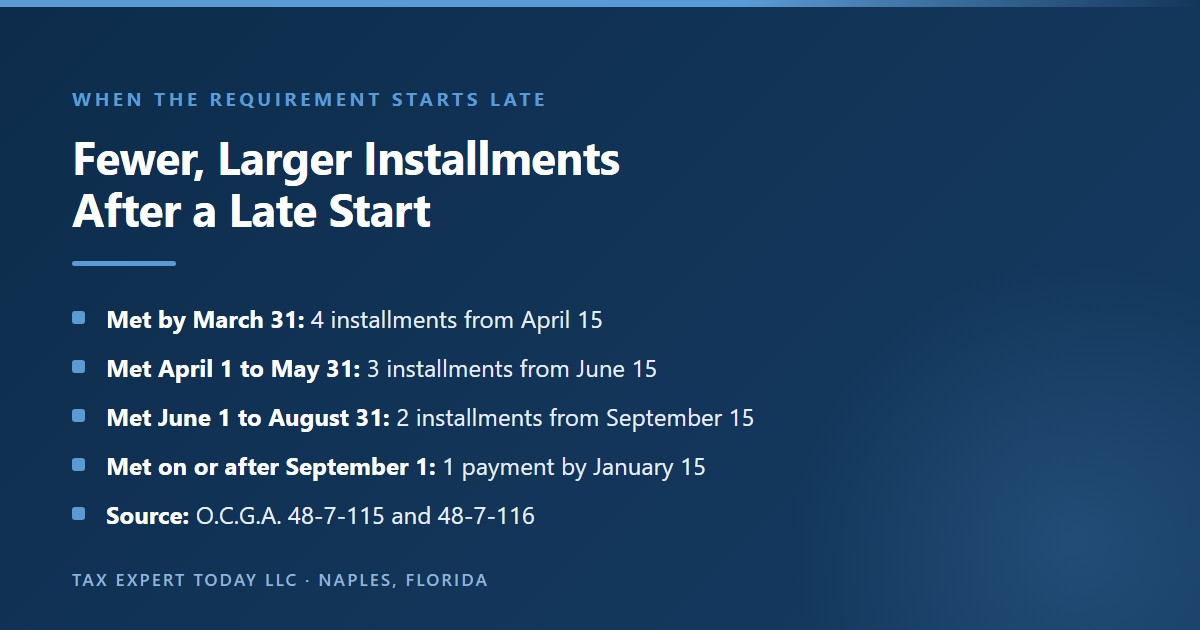
If you first meet the Georgia estimated tax requirement after March 31, you start later and pay fewer, larger installments. O.C.G.A. 48-7-115 moves the first due date to June 15, September 15 or January 15 depending on when the requirement arises, and O.C.G.A. 48-7-116 spreads the year’s estimate over the remaining dates.
- A business launched in May starts with the June 15 installment.
- A property sold in July starts with the September 15 installment.
- A bonus of non-wage income in October is paid in full by January 15.
- A move to Georgia mid-year can push the first required date later as well.
| Requirement first met | First voucher due | Number of installments | Share of the year’s estimate in each |
|---|---|---|---|
| January 1 to March 31 | April 15 | 4 | 25 percent |
| April 1 to May 31 | June 15 | 3 | One third |
| June 1 to August 31 | September 15 | 2 | 50 percent |
| On or after September 1 | January 15 of the next year | 1 | 100 percent |
The same schedule appears in Instruction B of Form 500 UET, which labels the last column the maximum number of installments required. The Form 500 ES instructions describe it in the same terms and tell you to divide the year’s estimated tax by the number of quarters of liability.
There is a catch in paragraph (5) of O.C.G.A. 48-7-116(a). If you should have started on April 15 but did not file your first estimate until later, the shorter schedules do not apply to you. Every installment that would have been due by the time you file must be paid at once, and the remaining installments stay on their original dates and amounts. The late start rule rewards a genuine change in circumstances, not a delayed decision.
For someone who moved to Georgia during the year, the requirement often arises only once Georgia source or Georgia resident income begins to accumulate. The part-year return that follows is its own project, and our guide to the Georgia part year resident tax return explains how income is split between the two states on Schedule 3.
How Much Should Each Georgia Estimated Payment Be?
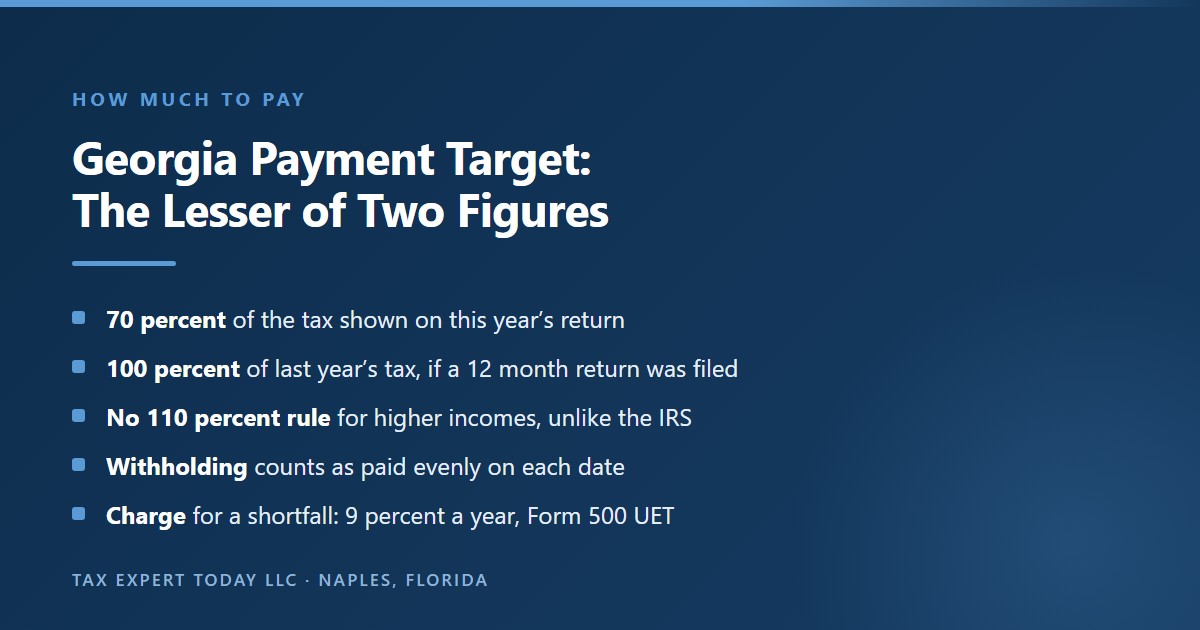
To stay clear of the underpayment charge, your timely Georgia payments generally need to reach the lesser of 70 percent of the tax shown on your current year return or 100 percent of the tax shown on your prior year return, provided the prior year covered twelve months and a return was filed. Divide the target by the number of installments.
- 70 percent of this year: the lower target, but only knowable once the year ends.
- 100 percent of last year: a fixed number you can read from last year’s Form 500.
- No high income surcharge: Georgia has no 110 percent prior year rule for larger incomes.
- Twelve month rule: a short prior year cannot be used for the prior year target.
Those two targets come from subsection (b) of O.C.G.A. 48-7-120, and they appear as Lines 4 and 5 of Form 500 UET. Line 4 asks for 100 percent of the immediately preceding year’s tax, and the form notes the return must be for a 12-month period. Line 5 asks for 70 percent of the current year balance.
Most people plan with the prior year number because it is certain. If your 2025 Form 500 showed $3,600 of tax, four payments of $900 meet the prior year target for 2026 regardless of how 2026 turns out. The 70 percent figure is attractive when income is falling, but it depends on an estimate that can move.
Note what these targets do and do not do. Meeting them protects you from the addition to tax for underpaying installments. They do not reduce the tax itself, and any remaining balance is still due with the return by April 15. Our Georgia estimated tax penalty calculator models the charge on a shortfall, so this article does not repeat that computation.
The tax used for these targets is the Georgia tax after credits, but before the credit for Georgia income tax withheld from wages. Subsection (f) of O.C.G.A. 48-7-120 defines it that way, which is why withholding is counted on the payment side of the comparison rather than netted out of the target.
How Does Georgia’s Estimated Tax Rule Compare With the Federal Rule?
Georgia is more lenient than the federal system. The IRS generally expects 90 percent of the current year tax or 100 percent of the prior year tax, rising to 110 percent for higher incomes. Georgia accepts 70 percent of the current year or 100 percent of the prior year, with no higher percentage for higher incomes.
- Same four due dates for calendar year individuals.
- Different current year percentage: 70 percent for Georgia against 90 percent federally.
- Different income threshold: Georgia looks at $1,000 of non-wage income, the IRS at $1,000 of tax owed.
- Different charge: Georgia uses a fixed 9 percent annual rate, the IRS uses its quarterly underpayment rate.
| Feature | Georgia (Form 500 ES) | Federal (Form 1040-ES) |
|---|---|---|
| Who must pay | More than $1,000 of income not subject to withholding, per O.C.G.A. 48-7-114 | Expected tax due of $1,000 or more after withholding and credits |
| Current year target | 70 percent | 90 percent |
| Prior year target | 100 percent, any income level | 100 percent, or 110 percent above $150,000 of prior year AGI |
| Farmers and fishermen | Two thirds of gross income test, 66 2/3 percent target, March 1 return option | Two thirds of gross income test, 66 2/3 percent target, March 1 return option |
| Charge for underpaying | 9 percent a year, computed on Form 500 UET | Federal underpayment rate, computed on Form 2210 |
| Where to pay | Georgia Tax Center or voucher by mail | IRS Direct Pay, EFTPS, or voucher by mail |
The federal figures come from 26 U.S.C. 6654 and the IRS page for Form 1040-ES. The practical lesson is that a plan built to satisfy the IRS usually satisfies Georgia too, because the Georgia percentages are lower. The reverse is not true: meeting 70 percent of Georgia tax says nothing about whether the federal payments are enough.
Our quarterly estimated tax calculator covers the federal side, and the IRS underpayment penalty calculator models Form 2210. Georgia is computed separately, on its own return, with its own form.
How Do You Estimate Your 2026 Georgia Tax for Form 500 ES?
Start from projected federal adjusted gross income, apply Georgia additions and subtractions such as the retirement exclusion, subtract the 2026 standard deduction of $15,000 for single filers or $30,000 for joint filers and any dependent exemptions, then apply the flat 4.99 percent rate and subtract expected credits and withholding.
- Rate for 2026: a flat 4.99 percent, confirmed on the Department’s Important Tax Updates page.
- Standard deduction for 2026: $15,000 single, head of household or married filing separately, and $30,000 married filing jointly.
- Retirement exclusion: up to $35,000 at ages 62 to 64 and $65,000 at 65 or older, per person.
- Tips and overtime: Georgia allows up to $1,750 of each to be excluded for 2026.
The Department’s Important Tax Updates page lists the 2026 changes in one place: the rate reduced to a flat 4.99 percent, the standard deduction raised to $15,000 and $30,000, and a statement that Georgia did not adopt the federal exemptions for overtime and tips but allows up to $1,750 of each to be excluded in computing taxable net income. The same page describes a one-time credit of up to $500 for residents who paid tax in 2024 and 2025. Confirm how that credit is delivered before reducing any installment on the strength of it.
The 2025 IT-511 individual income tax booklet contains a Schedule for Estimating Georgia Income Taxes, and the Form 500 ES instructions point to that schedule for the computation. It follows the Form 500 line order, so anyone who prepared last year’s return can reuse its structure and swap in projected numbers.
For retirees, the exclusion is often the largest single variable. Our guide to the Georgia retirement income exclusion explains which income qualifies and the separate cap on earned income. Veterans have a separate exclusion, and the Georgia military retirement tax guide explains why the larger military figure enacted in 2025 does not reach tax year 2026.
For investors, the treatment of gains matters more than the rate. Georgia taxes capital gains as ordinary income at the flat rate, so a large sale in any quarter can create an estimate requirement on its own. Our article on Georgia capital gains tax covers the few exclusions that exist.
Why Does the 2026 Form 500 ES Show 2025 Figures?
The 2026 Georgia Form 500 ES carries a revision date of May 12, 2025, and its reference box is headed as the exemption amounts for tax year 2025. It prints a standard deduction of $12,000 single and $24,000 joint, while the Department’s own updates page gives $15,000 and $30,000 for 2026. Use the 2026 figures.
- Revision date on the 2026 voucher: 05/12/25.
- Box heading: exemption amount for tax year 2025.
- Standard deduction printed: $12,000 and $24,000.
- Standard deduction for 2026 per the Department: $15,000 and $30,000.
| Item | Printed on the 2026 Form 500 ES | Figure to use for 2026 | Source for the 2026 figure |
|---|---|---|---|
| Standard deduction, single, head of household, married filing separately | $12,000 | $15,000 | DOR Important Tax Updates |
| Standard deduction, married filing jointly | $24,000 | $30,000 | DOR Important Tax Updates |
| Tax rate | Not printed, refers to the booklet | 4.99 percent flat | DOR Important Tax Updates |
| Dependent exemption | $4,000 | $4,000 as printed, confirm when the 2026 booklet is released | 2026 Form 500 ES |
| Retirement income exclusion | $35,000 at 62 to 64, $65,000 at 65 or older | Same | 2026 Form 500 ES |
This is not unusual. States publish the next year’s voucher early so that taxpayers can make the April payment, often before the legislature finishes changing the numbers the voucher refers to. The voucher itself is only a payment slip, and the figures in the reference box are there to help with the worksheet, not to set the law.
The practical effect is small but real. A single filer who used the printed $12,000 instead of $15,000 would overstate 2026 taxable income by $3,000, and at 4.99 percent that overstates the tax by about $150. Overpaying estimates is not penalized, and the excess comes back as a refund or a credit, but there is no reason to fund it.
The rate change works in the same direction. Anyone who built 2026 estimates on last year’s 5.19 percent rate would also be slightly high. Our guide to the Georgia corporate tax rate sets out how HB 463 moved the rate for 2026 and the conditions that govern the next scheduled step, which matters when planning 2027 estimates.
How Is Georgia Withholding Counted Against Estimated Tax?
Georgia treats income tax withheld during the year as paid in equal parts on each installment date, unless you prove the actual dates it was withheld. O.C.G.A. 48-7-120(e) sets that rule, which means extra withholding late in the year can cover shortfalls in earlier quarters, something a late estimated payment cannot do.
- Default rule: total withholding is spread evenly across the four installment dates.
- Election: you may instead use the actual withholding dates if you can establish them.
- Planning use: a larger withholding from a December paycheck counts toward April as well.
- Form 500 UET Line 9: says withholding is treated as paid equally for each quarter.
The statute is specific. Paragraph (2) of subsection (e) deems the credit for tax withheld to be a payment of estimated tax, with an equal part deemed paid on each installment date. If the taxpayer establishes the dates on which amounts were actually withheld, those dates are used instead. Form 500 UET repeats the default on Line 9 and Line 13.
This rule is the most useful planning tool in the Georgia estimated tax system. Suppose a consultant forgets the April and June vouchers. A catch-up voucher in September covers only September forward, because an estimated payment counts on the date it is made. But if the consultant’s spouse raises Georgia withholding at work for the rest of the year, the extra withholding is spread back across all four dates by default.
The same logic applies to retirees who can ask a pension payer or an IRA custodian for Georgia withholding. Withholding requests are made to the payer, not to the Department, and the payer’s own form controls the timing. Anyone relying on this approach should confirm with the payer that Georgia tax, not only federal tax, is being withheld.
Withholding also carries one limit. The estimate is computed without any reduction for expected withholding under O.C.G.A. 48-7-120(e)(1), and the withholding then shows up on the payment side. The effect is the same arithmetic, but it explains why Form 500 UET starts from total tax before the withholding credit.
What Is the Annualized Income Exception in Georgia?
If your income arrives unevenly, Georgia lets you measure each installment against the tax on your income earned so far. Under the annualized method, payments are sufficient if they reach 70 percent of the tax on income annualized to the month before the installment is due. A second method uses 90 percent of the tax on actual year to date income.
- Exception 1: last year’s income taxed at this year’s rates.
- Exception 2: 70 percent of tax on annualized current year income.
- Exception 3: 90 percent of tax on actual income over 3, 5 and 8 months.
- Different exceptions for different quarters are allowed with a separate computation page.
These exceptions are written into O.C.G.A. 48-7-120(d) and explained in Instruction D of Form 500 UET. They matter most to seasonal businesses, commission earners, and anyone with a large gain in the second half of the year, because the default rule assumes income arrives evenly and charges for early quarters that were, in reality, lean.
| Installment due | Income period measured | Annualizing factor | Share of the annualized tax required by that date |
|---|---|---|---|
| April 15 | January through March (3 months) | 12 divided by 3 | 70 percent times 25 percent |
| June 15 | January through May (5 months) | 12 divided by 5 | 70 percent times 50 percent |
| September 15 | January through August (8 months) | 12 divided by 8 | 70 percent times 75 percent |
| January 15 | January through December (12 months) | None | 70 percent times 100 percent |
Form 500 UET gives the annualization steps. Figure adjusted gross income less deductions from the start of the year through the month before the installment, multiply by 12, divide by the number of months, and subtract dependent exemptions. The form’s own worked example annualizes three months of income and then requires 70 percent times 25 percent of the resulting tax by the first date.
Exception 1 has become more valuable because of the rate cuts. It compares your payments with the tax on last year’s income computed at this year’s rates, using last year’s other facts and law. With the rate at 4.99 percent for 2026 against 5.19 percent for 2025, last year’s income taxed at the new rate produces a lower figure than last year’s actual tax, so this exception can protect a taxpayer whose payments fell slightly short of 100 percent of the 2025 tax.
Exception 3 has a limit worth knowing. The Form 500 UET instructions state that the law does not permit its use for the fourth installment period. The fourth installment must be protected another way, which in most cases means the regular 70 or 100 percent test.
Can You Skip the January Payment by Filing Early?
Sometimes. Under O.C.G.A. 48-7-114(c), if your estimate was not required during the year but was due by January 15, filing the full Georgia return and paying the tax in full by January 31 treats the return as the estimate. Form 500 UET adds that a balance paid with a return by January 31 is treated as paid on January 15.
- Who it helps: taxpayers whose requirement first arose on or after September 1.
- Deadline: the return filed and the tax paid by January 31 of the following year.
- Farmers and fishermen: the same idea applies with a March 1 date.
- What it requires: complete year end records in January, which not everyone has.
The statutory rule in subsection (c) is narrower than it first sounds. It applies when the estimate was not required to be filed during the taxable year but was required on or before January 15, which describes a taxpayer who first met the requirement on or after September 1. For that taxpayer, a complete return filed with full payment by January 31 stands in for the voucher.
Instruction F of Form 500 UET is written more broadly for penalty purposes: if you filed your return and paid the balance of tax by January 31st of the following year, the balance is considered paid as of January 15th. In practice that protects the fourth installment for anyone able to file early, though it does nothing for shortfalls in April, June or September.
Few people can file a complete Georgia return in January. Brokerage statements, K-1s and corrected 1099s often arrive later. For most households, the January 15 voucher remains the simpler path, and an early return is a fallback rather than a plan.
What Are the Farmer and Fisherman Rules for Form 500 ES?
If at least two thirds of your total gross income comes from farming or fishing, Georgia lets you make a single estimated payment by January 15, or skip estimates entirely by filing your return and paying the full tax by March 1. The underpayment test for this group uses 66 2/3 percent instead of 70 percent.
- Qualifying test: gross income from farming or fishing of at least two thirds of gross income from all sources.
- Option one: one estimate filed and paid by January 15 of the following year.
- Option two: file Form 500 and pay in full by March 1, with no estimate at all.
- Penalty base: 66 2/3 percent of the tax, measured from January 15 only.
The rule is set by O.C.G.A. 48-7-115(b) and 48-7-116(b), and the Form 500 ES instructions summarize it: individuals whose gross income from farming or fishing is at least two thirds of total gross income may file as other taxpayers or file their return by March 1 and pay the full amount of tax due by that date.
Instruction G of Form 500 UET explains the relief. A qualifying farmer or fisherman who filed and paid by March 1 enters zero on the penalty line and checks the exception box on Form 500. One who meets the gross income test but did not file or pay by March 1 computes a charge only on the last quarter, using 66 2/3 percent of the tax as the base.
The test uses gross income, not net income. A farm with large receipts and a modest profit can meet the two thirds threshold even when wages or investment income produce most of the household’s taxable income. The Department’s 2026 updates also exclude payments under the Farmer Bridge Assistance Program and the Assistance for Specialty Crop Farmers Program from taxable income, subject to conditions, which can change the estimate for farm households this year.
Do Estates and Trusts Use Georgia Form 500 ES?
Yes. Fiduciaries that file Form 501 are subject to the same estimated tax rules as individuals and use the same Georgia Form 500 ES voucher, entering the fiduciary FEIN. An estate, and a testamentary trust as defined in federal law, is excused for taxable years ending before the date two years after the decedent’s death.
- Same voucher: Form 500 ES covers both individuals and fiduciaries.
- Identifier: the fiduciary’s federal employer identification number.
- Two year relief: for estates and certain testamentary trusts only.
- Exception box: Form 500 UET Exception 4, reported on Form 501.
Subsection (e) of O.C.G.A. 48-7-114 applies the article to fiduciaries for taxable years beginning on or after January 1, 1988, in the same manner as individuals. Paragraph (2) excludes any taxable year ending before the date two years after the decedent’s death, for the decedent’s estate or for a testamentary trust as defined in IRC section 6654(l)(2)(B).
Form 500 UET implements that as Exception 4. The fiduciary enters zero on Line 21 and checks the box marked “500 UET Exception Attached” on Form 501. After the two year window, the estate or trust estimates like any other taxpayer.
A revocable living trust that becomes irrevocable at death is a common source of confusion here, because whether it counts as a testamentary trust depends on the federal definition and any federal election. Fiduciaries working through a Georgia estate may also find our guide to Georgia inheritance tax useful, which explains why Georgia imposes no estate or inheritance tax but still taxes income earned during administration.
Do Nonresidents and Part-Year Residents Pay Georgia Estimated Tax?
Yes, when they have Georgia taxable income. O.C.G.A. 48-7-114(b) applies to every resident and every taxable nonresident individual. A Florida resident who owns Georgia rental property or a share of a Georgia business can owe Georgia estimates on that Georgia source income even though Florida has no income tax.
- Nonresident rental owners with Georgia real property.
- Nonresident partners and shareholders in entities doing business in Georgia.
- Part-year residents who moved in or out during the year.
- Nonresident sellers of Georgia real estate with a large gain.
For nonresident owners of pass-through entities, the entity may cover the obligation. A partnership or S corporation that files a composite return or makes the Georgia pass-through entity election pays tax at the entity level on the owners’ Georgia income. Our guides to the Georgia composite return and the Georgia pass through entity tax explain when that happens and how the owner then reports.
Where the entity does not pay, the owner does. A Southwest Florida resident with a Georgia K-1 who files a nonresident Georgia return should treat the Georgia share like any other non-wage income and test it against the $1,000 threshold. The installments follow the same dates.
Part-year residents apply the same rule to the income taxed by Georgia under the Schedule 3 ratio. In the year of a move into Georgia, the requirement may first be met after March 31, which shortens the schedule under O.C.G.A. 48-7-115. In the year of a move out, the obligation continues for Georgia income earned before the move and any Georgia source income after it.
How Do You Pay Georgia Estimated Tax Online or by Mail?
You can pay Georgia estimated tax electronically through the Georgia Tax Center, or by mailing the Form 500 ES voucher with a check or money order payable to the Georgia Department of Revenue. The 2025 IT-511 booklet states that electronic check payments can be made without a Georgia Tax Center login, while card payments require an account.
- Georgia Tax Center quick payment: electronic check, no login needed.
- Card or PayPal: accepted through a Georgia Tax Center account, with a processor convenience fee.
- Mail: Processing Center, Georgia Department of Revenue, PO Box 740319, Atlanta, GA 30374-0319.
- In person: by appointment with the Department.
The state’s Pay Estimated Tax page describes the three routes and calls electronic payment the fastest. The Georgia Tax Center is the Department’s self-service portal, and page 4 of the 2025 IT-511 booklet lists estimated tax payments among the quick payments that can be made without logging in.
An electronic payment replaces the voucher. You do not mail Form 500 ES for an amount paid online. The voucher exists for taxpayers who pay by check, and it carries the identifying information the Department needs to post the payment to the right account and year.
Keep a record of every payment by date and amount. When the return is prepared, Line 26 of Form 500 asks for estimated tax payments, including amounts credited from a previous return and any payment made with the extension voucher. A missing payment on that line produces a balance due notice that takes time to clear, even though the money was paid.
How Do You Fill Out the Georgia Form 500 ES Voucher?
The 2026 Georgia Form 500 ES is a fillable PDF. You complete a short worksheet with your Social Security number or fiduciary FEIN, spouse’s number, name, address, return type, tax year end, the installment due date and the amount, and the form builds the voucher for printing. You mail only the voucher and the payment.
- Use Adobe Reader as the Department instructs, since some browsers do not run the form’s scripts.
- One voucher per installment, each with its own due date and amount.
- Do not staple the check to the voucher, and remove check stubs.
- Keep the worksheet and do not mail it.
The first page of the 2026 form lists the worksheet fields in order: taxpayer SSN, spouse’s SSN, individual or fiduciary name, two address lines, city, state and ZIP, the type of return, an address change box, calendar year or fiscal year ending, due date, and amount paid. The printed voucher then carries the tax year, quarter and due date alongside the payment amount.
A few habits prevent most posting problems. Write the tax year and the last four digits of the Social Security number in the check memo line. Use the same name order as the return. For a joint estimate, include both spouses’ numbers in the same order they will appear on Form 500, because a payment credited to only one spouse can be hard to apply if the couple later files separately.
The Department’s forms page also lists older versions going back many years. Use the voucher for the tax year you are paying. A 2025 voucher used for a 2026 payment can be posted to the wrong year, and the fix requires correspondence.
What Happens If a Georgia Estimated Payment Is Late or Short?
Georgia adds a charge at 9 percent a year on the amount of each underpaid installment, for the period from its due date until it is paid or until the 15th day of the fourth month after year end, whichever comes first. It is computed on Form 500 UET and reported on Form 500, unless an exception applies.
- Rate: 9 percent per year under O.C.G.A. 48-7-120(a).
- Measured per installment, not on the year as a whole.
- Stops accruing on payment or on April 15 for a calendar year taxpayer.
- Reported on Form 500 Line 42, with Form 500 UET attached.
The charge is distinct from the late payment penalty and interest that apply to a balance due with the return. The 2025 IT-511 booklet lists the “Failure to File Estimated Tax Penalty” at 9 percent per year for the period of underpayment and directs taxpayers to Form 500 UET, and it lists interest on unpaid tax separately at the prime rate plus 3 percent.
The computation mechanics, including the carry forward of an overpayment from one installment to the next, belong to the penalty page rather than this one. Our Form 500 UET penalty calculator applies the regular method with four equal installments and the 9 percent rate. For the annualized exceptions, the form itself has to be completed.
A 1967 Attorney General opinion noted in the annotations to O.C.G.A. 48-7-120 states that when a return has been filed, the addition should be computed on the tax shown on the return and not by reference to a later deficiency. An assessment after an audit does not by itself recompute the estimated tax charge.
How Do Credits and Overpayments Affect Georgia Estimates?
Expected credits reduce the estimate, because Georgia defines estimated tax as the expected tax less expected credits. A prior year overpayment credited forward on Form 500 counts as an estimated payment. If your credits are expected to exceed your entire tax, O.C.G.A. 48-7-114(d) removes the estimate requirement for that year.
- Definition: estimated tax is tax less allowable credits under O.C.G.A. 48-7-114(a).
- Credit carryforward: Form 500 Line 31 lets you apply a refund to next year’s estimate.
- Credit exemption: no estimate required when credits are expected to exceed tax.
- Withholding is separate, counted as a payment rather than as a credit in the target.
The 2025 Form 500 includes Line 31, “Amount to be credited to 2026 ESTIMATED TAX.” Choosing that line instead of a refund is common for taxpayers who expect to owe again, because it funds the first installment without a new payment. Line 26 of the following year’s return then picks up the credited amount together with any new payments.
Georgia’s transferable and business credits can make the exemption in subsection (d) relevant for some households. A taxpayer who has purchased Georgia film tax credits, for example, may expect credits to exceed the liability. Our guide to the Georgia film tax credit explains how purchased credits are claimed. The statutory exemption depends on a reasonable expectation at the time the estimate would otherwise be due, so it should be documented.
If a prior year return is later changed, the estimate targets can move with it. The prior year target uses the tax shown on the prior return, and an amended return changes that figure. Our article on the Georgia amended tax return covers Form 500X timing.
Georgia Form 500 ES Example: A Self-Employed Consultant in 2026
In this hypothetical, a single consultant in Georgia had $3,600 of Georgia tax on the 2025 return and projects 2026 Georgia taxable income of $85,000 after the $15,000 standard deduction. The projected 2026 tax is $4,241.50, so 70 percent of it is $2,969.05, which is lower than the $3,600 prior year target.
- Projected 2026 tax: $85,000 times 4.99 percent equals $4,241.50.
- Current year target: 70 percent equals $2,969.05, or about $742 a quarter.
- Prior year target: 100 percent of $3,600, or $900 a quarter.
- Balance at filing: whatever is not paid during the year is due by April 15, 2027.
| Step | Computation | Result |
|---|---|---|
| Projected 2026 Georgia taxable income | Net profit and other income less $15,000 standard deduction | $85,000 |
| Projected 2026 Georgia tax | $85,000 times 4.99 percent | $4,241.50 |
| Current year target | 70 percent of $4,241.50 | $2,969.05 |
| Prior year target | 100 percent of 2025 tax | $3,600.00 |
| Lower of the two | Divided by four installments | $742.26 each |
| Certain protection regardless of 2026 results | $3,600 divided by four | $900.00 each |
The choice between $742 and $900 a quarter is a choice about risk. The lower figure works only if 2026 income comes in as projected. If a large contract lands in the fourth quarter and the actual 2026 tax rises to $5,500, the 70 percent target becomes $3,850 and payments of $742 a quarter fall short. The $900 figure meets the prior year test whatever happens.
Either way, the consultant still owes the full $4,241.50 for the year. Payments of $2,969 during the year leave about $1,272 due with the return. The targets decide only whether an underpayment charge applies, not how much tax is owed. These figures are illustrations, not a projection for any taxpayer, and actual Georgia tax depends on items this example leaves out.
The same consultant would also make federal estimates on a different basis. Federal targets are 90 percent of the current year or 100 percent of the prior year, and the federal payment is sent separately. Coordinating the two on the same four dates is simple once both numbers are known.
Do Business Owners and Corporations Use Form 500 ES?
Individual owners do. Sole proprietors, partners and S corporation shareholders pay tax on business income through Form 500 and estimate it on Georgia Form 500 ES. C corporations do not use this voucher. They estimate under O.C.G.A. 48-7-117 when Georgia net income is expected to exceed $25,000, on the corporate schedule in O.C.G.A. 48-7-119.
- Sole proprietors and single member LLCs: Form 500 ES, on their own return.
- Partners and S corporation shareholders: Form 500 ES, unless the entity pays for them.
- C corporations: a separate corporate estimate, with its own threshold of $25,000 of net income.
- Electing pass-through entities: pay at the entity level, which can reduce the owner’s estimate.
The corporate rules sit next to the individual ones in the same article of the Code. O.C.G.A. 48-7-117 requires every domestic and foreign corporation taxed under O.C.G.A. 48-7-21 to pay estimated tax if its net income can reasonably be expected to exceed $25,000, and O.C.G.A. 48-7-119 sets installments on the 15th day of the fourth, sixth, ninth and twelfth months of the taxable year. That last installment falls within the tax year, unlike the individual January date.
Owners should also watch the timing mismatch between entity and individual years. A fiscal year partnership passes income through on the owner’s calendar year return, so the owner’s estimate follows the calendar dates even when the entity does not.
For a C corporation that also pays the net worth tax, the estimate covers the income tax portion only. Our guide to the Georgia net worth tax covers the other half of Form 600.
What Are the Most Common Georgia Form 500 ES Mistakes?
The errors that recur most are paying only federal estimates, skipping the January installment, using the printed 2025 deduction figures, sending a voucher for the wrong year, omitting a payment from Line 26 of the return, and assuming a large mid-year gain can wait until April.
- Federal only: Georgia requires its own estimates even when federal payments are correct.
- Missing January: the fourth installment is due after year end but before the return.
- Stale worksheet figures: the 2026 voucher still prints 2025 deduction amounts.
- Wrong year voucher: payments can post to the prior year.
- Lost payments: an online payment left off Form 500 Line 26.
A second group of mistakes involves life changes. A new business, a first rental, a retirement that ends wage withholding, or a move to Georgia each creates a first year in which estimates may be required and no one is reminding the taxpayer. The rule is triggered by income expectations, not by a notice from the Department.
A third group involves the entity level. Owners of an electing pass-through entity sometimes pay personal estimates on income the entity already taxed, and owners of a non-electing entity sometimes assume the entity paid. The fix is to confirm the entity’s election before the first installment of each year.
The last is overcorrecting. Some taxpayers pay 100 percent of an inflated projection every quarter to be safe. That is not penalized, but the money earns nothing while the Department holds it. The prior year target, or withholding adjustments later in the year, usually provides the same protection with less cash tied up.
Georgia Estimated Tax Help in Naples & Southwest Florida
Tax Expert Today LLC works from Naples, Florida and handles state tax matters nationwide, including Georgia estimated tax planning, Form 500 ES computations, withholding adjustments, annualized income reviews, and Form 500 UET exception analysis. Georgia clients are served from the Naples office and do not need to visit Georgia or Florida.
- Georgia estimated tax help Naples covers installment planning for residents, part-year residents and nonresidents with Georgia income.
- Southwest Florida owners of Georgia property or businesses often need nonresident Georgia estimates alongside federal ones.
- Uneven income reviews test the annualized exceptions before year end instead of after.
- Remote engagement is standard. Documents are exchanged through a secure client portal rather than by email.
Tax Expert Today LLC
11983 Tamiami Trail N, Naples, FL 34110
Telephone: (239) 441-2005
Hours: Monday through Friday, 10:00 a.m. to 5:00 p.m. Eastern Time
A local question we are asked often: I live in Naples, and I sold a rental house in Savannah this summer. Do I need to pay Georgia estimated tax on the gain? Probably, if the gain is taxable in Georgia and no Georgia tax was withheld at closing. As a Florida resident you are a nonresident of Georgia, but O.C.G.A. 48-7-114 applies to every taxable nonresident, and a sale in July first triggers the requirement between June 1 and August 31, which points to a September 15 installment covering half the year’s estimate and a January 15 installment for the rest. Any Georgia withholding on the sale counts toward those amounts. The full range of Georgia engagements is described on our Georgia tax services page, and planning for Southwest Florida residents is covered on our Naples tax planning services page.
When to Engage a Professional
A salaried Georgia resident with modest investment income can usually handle Georgia Form 500 ES alone by paying 100 percent of last year’s tax in four parts. Review is worth it when income is uneven, when a large gain or business sale arrives, when you move in or out of Georgia, or when an entity election changes who pays.
- A first year of self employment with no prior year Georgia tax to anchor the target.
- A large one-time gain that makes the annualized exception worth computing.
- A move into or out of Georgia with income taxed partly by each state.
- An electing pass-through entity whose payments may already cover the owner.
- A notice from the Department that proposes an underpayment charge.
Dr. Pellumb Kabashi is an enrolled agent and the founder of Tax Expert Today LLC, and the firm includes tax advisors, enrolled agents, certified public accountants, and attorneys. Georgia Department of Revenue matters are state tax matters rather than federal ones, and they are handled under Georgia procedure and Georgia authority. Nothing in this article is advice for a particular taxpayer, and the result in any specific case depends on facts that a general article cannot know. Households and business owners who want a complete Georgia plan rather than a single calculation can start with our Georgia tax planning and business advisory page. Call (239) 441-2005 for a free consultation, or reach the Naples, Florida office during business hours.
Frequently Asked Questions
What is Georgia Form 500 ES used for?
It is the Georgia Department of Revenue voucher that individuals and fiduciaries use to pay Georgia income tax in installments during the year on income that is not subject to withholding, such as business profit, rent, interest, dividends and capital gains.
Who must file Georgia Form 500 ES?
Generally, a Georgia resident or taxable nonresident who expects to file a Georgia return and expects more than $1,000 of income from sources other than wages subject to withholding, under O.C.G.A. 48-7-114. Extra withholding arranged with an employer can replace the estimates.
When are Georgia estimated tax payments due for 2026?
April 15, June 15 and September 15, 2026, and January 15, 2027, for a calendar year taxpayer who meets the requirement before April 1. If a date falls on a weekend or holiday, it moves to the next business day.
How much do I have to pay to avoid a Georgia underpayment charge?
Generally the lesser of 70 percent of the current year tax or 100 percent of the prior year tax, if the prior year was a full twelve months and a return was filed. Georgia has no 110 percent rule for higher incomes.
Can I pay Georgia estimated tax online?
Yes. The Georgia Tax Center accepts estimated tax payments. The 2025 IT-511 booklet states that electronic check payments can be made without a login, while card and PayPal payments require an account and carry a processor fee.
Where do I mail Georgia Form 500 ES?
To the Processing Center, Georgia Department of Revenue, PO Box 740319, Atlanta, GA 30374-0319, with a check or money order payable to the Georgia Department of Revenue. Mail only the voucher and payment, not the worksheet.
Does Georgia withholding count toward estimated tax?
Yes. Under O.C.G.A. 48-7-120(e), tax withheld is treated as paid in equal parts on each installment date unless you establish the actual dates. That lets extra withholding late in the year cover earlier quarters.
Do I need to pay Georgia estimated tax if I live in Florida?
You may, if you have Georgia taxable income such as rent from Georgia property, a Georgia business share, or a gain on Georgia real estate. The requirement applies to every taxable nonresident, unless an entity pays the tax for you.
Why does the 2026 Form 500 ES show a $12,000 standard deduction?
The 2026 voucher was revised on May 12, 2025 and its reference box is labelled for tax year 2025. The Department’s Important Tax Updates page gives $15,000 for single filers and $30,000 for joint filers for 2026.
Are farmers exempt from Georgia estimated tax?
Not exempt, but treated differently. If at least two thirds of gross income is from farming or fishing, you may pay one estimate by January 15, or file the return and pay in full by March 1 with no estimate.
Published September 18, 2026 by Dr. Pellumb Kabashi « Back to Learning Center
Have a question this article touches on?
Tax Expert Today LLC, based in Naples, Florida and serving clients across the United States.
Schedule a Consultation (239) 441-2005