
By Dr. Pellumb Kabashi, DBA, MBA, EA, CFE, CES
Founder, Tax Expert Today LLC · Tax advisors, enrolled agents, CPAs, and attorneys · Serving clients in all 50 states
Quick Answer: A Georgia net operating loss is computed separately from the federal NOL, using only Georgia amounts. For tax years beginning in 2023 and later, individuals report it on Schedule 4 of Form 500 instead of the older Form 500-NOL. Losses from 2018 forward generally carry forward without a time limit but can offset only 80 percent of Georgia income. Call (239) 441-2005 for a free consultation.
A Georgia net operating loss is one of those topics where the forms changed faster than the internet did. Search for the term and most of what comes back describes Form 500-NOL: a separate application, printed and mailed, that could not be attached to the Georgia return. That description was accurate for years. For individual tax years beginning on or after January 1, 2023, though, the Georgia Department of Revenue moved the computation onto Schedule 4 of Form 500, filed with the return itself. Meanwhile the forum threads that rank for this question are preparers asking each other how to make the old form work, and the software help pages explain which screen to fill in without explaining why the Georgia number differs from the federal one. This guide walks a loss year from the federal computation to the Georgia Schedule 4, through the 80 percent limit, the carryback and carryforward rules, part year and nonresident proration, pass through and composite return situations, and corporate losses on Form 600. Every figure was read from Georgia Department of Revenue booklets, Georgia regulations, and IRS pages on October 15, 2026. It is educational, not advice for any particular return, and every example is hypothetical.
Tax Expert Today LLC handles state tax matters nationwide from its office in Naples, Florida. Questions about a Georgia net operating loss reach us most often from business owners who had a loss year and a Georgia filing obligation at the same time: a Georgia resident whose Schedule C or rental activity turned negative, a pass through owner whose K-1 showed a large loss, a Floridian who moved from Georgia with an unused loss carryforward, or a corporation that needs to know what its Georgia carryforward actually is. Our Georgia tax services overview shows how this topic fits with the rest of a Georgia taxpayer’s filings.
This page is about the state computation. The federal net operating loss rules under Internal Revenue Code Section 172 are summarized only as far as Georgia depends on them, and several related Georgia topics, such as part year returns, amended returns, and the pass through entity tax election, have their own detailed articles on this site. Where that is the case we explain the NOL point and link to the full discussion.
What Is a Georgia Net Operating Loss?
A Georgia net operating loss is the loss that remains after you make every Georgia adjustment to your federal income and deductions, using only Georgia amounts. It is a separate figure, not a copy of the federal NOL. You can have a federal NOL and no Georgia NOL, or a Georgia NOL that differs in size from the federal one.
- Separate computation: Georgia rule 560-7-4-.01 requires the same adjustments made to federal adjusted gross income.
- Georgia amounts only: the IT-511 booklet says only amounts attributable to Georgia can be used.
- Business losses drive it: nonbusiness deductions cannot create a net operating loss.
- Reported on Schedule 4: for individual tax years beginning in 2023 and later.
- Used in other years: the loss is never deducted in the loss year itself.
The concept starts with the federal definition. Under Internal Revenue Code Section 172, a net operating loss is generally the excess of deductions over gross income, computed with modifications that strip out items that should not create a carryable loss. The most important modification for individuals is that nonbusiness deductions, such as the standard deduction, itemized deductions that are not business related, and IRA contributions, can only offset nonbusiness income. They cannot add to a business loss. That is why a retiree with large itemized deductions and modest income does not have a net operating loss, while a self employed person whose business lost money often does.
Georgia takes that federal structure and runs it through Georgia law. The Georgia regulation on individual net taxable income, Ga. Comp. R. & Regs. 560-7-4-.01, says that for any year in which you have a federal net operating loss, the Georgia net operating loss is computed by making the same adjustments to the federal loss that are made to federal adjusted gross income to arrive at Georgia taxable net income. If those Georgia adjustments completely offset the federal loss, there is no Georgia net operating loss for that year, and any excess of the Georgia adjustments over the federal loss is Georgia taxable income.
Two practical consequences follow. First, a Georgia net operating loss is tracked on its own schedule, year by year, and the Georgia carryforward balance at any point may not match the federal carryforward balance in your federal return. Second, the federal NOL deduction never flows into Georgia income directly. The regulation requires that any federal NOL deduction claimed in a year be added back, and a separate Georgia deduction is allowed instead for the Georgia net operating loss carried to that year. On the 2025 Form 500, that separate deduction sits on Line 15b, labeled Georgia NOL Utilized.
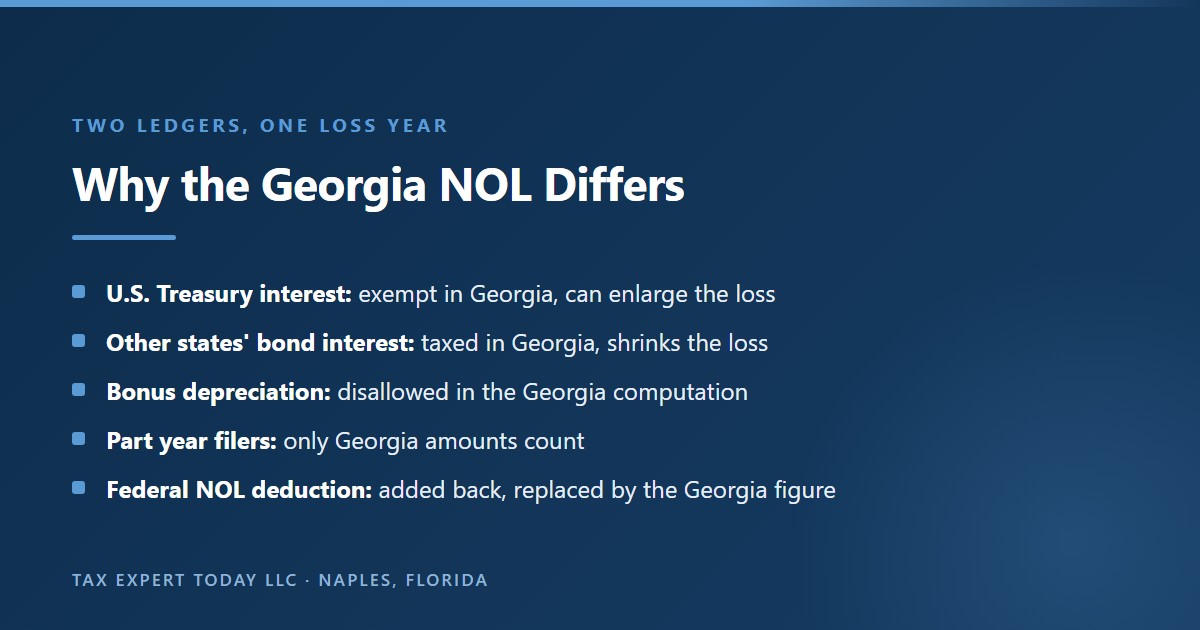
Think of it as two ledgers that start from the same events. The federal ledger records the loss under federal rules. The Georgia ledger records the loss after Georgia has removed income it does not tax, added income it taxes that the federal return excludes, applied its own depreciation rules, and limited the result to Georgia amounts. Most of the work in a Georgia net operating loss case is reconciling those two ledgers and documenting why they differ.
How Is a Georgia NOL Different From the Federal NOL?
The structure is the same, but the inputs and some timing rules differ. Georgia starts from the federal computation, applies its own income adjustments, uses only Georgia amounts, applies the 80 percent limit to Georgia income, and did not adopt the 2020 CARES Act carryback provisions. The result is a separate loss with its own carryforward balance.
- Different income base: Georgia adds and subtracts items the federal return treats differently.
- Different depreciation: business income is recomputed under the Code as Georgia adopts it.
- 80 percent applied to Georgia income: not to federal taxable income.
- No CARES Act carryback: Georgia did not adopt the five year carryback for 2018 to 2020 losses.
- Separate forms and deadlines: Schedule 4 for individuals, Schedule 9 and IT-552 for corporations.
The table below compares the two systems for an individual loss arising in a tax year beginning in 2023 or later. The federal column describes the general rule under Section 172 and the IRS Form 172 instructions; the Georgia column comes from the 2025 IT-511 booklet and rule 560-7-4-.01.
| Feature | Federal NOL | Georgia net operating loss |
|---|---|---|
| Where it is computed | Form 172 for individuals, estates, and trusts | Schedule 4 of Form 500 or 500X |
| Starting point | Federal income and deductions with Section 172 modifications | The federal computation after Georgia adjustments, Georgia amounts only |
| Carryback for a normal loss | None for losses arising after 2017, with exceptions | None; a normal loss only carries forward |
| Farm loss carryback | Two years | Two years |
| Carryforward period | Indefinite for post 2017 losses | Until exhausted for a normal or farm loss; 20 years for an insurance loss |
| 80 percent limit | Applied to federal taxable income | Applied to Georgia income before NOLs on Line 15a |
| Where the deduction appears | Schedule 1 of Form 1040 | Form 500 Line 15b, Georgia NOL Utilized |
| Federal NOL deduction in Georgia | Not applicable | Added back; replaced by the Georgia figure |
The differences that create the biggest gaps between the two numbers are income adjustments. Interest on United States obligations is taxable federally but exempt in Georgia, so it is a negative Georgia adjustment. Interest on another state’s municipal bonds is tax free federally but taxable in Georgia, so it is a positive adjustment. The Georgia retirement income exclusion removes some income entirely. Georgia also requires business income and deductions to be computed under the Internal Revenue Code as Georgia adopts it, which the IT-511 booklet describes as including the Section 168(k) disallowance, meaning federal bonus depreciation is not taken in the Georgia computation. Each of these can make the Georgia net operating loss larger or smaller than the federal one.
One more difference is easy to miss: the federal computation treats the year as a whole, while a part year resident or nonresident of Georgia computes a Georgia net operating loss only from Georgia amounts and prorates deductions. A federal loss earned partly in Florida and partly in Georgia does not become a Georgia loss in full. We cover that computation in its own section below.
Which Form Reports a Georgia Net Operating Loss Now?
For individuals and fiduciaries with a loss in a tax year beginning on or after January 1, 2023, the Georgia net operating loss is computed on Schedule 4, filed with Form 500 or Form 500X. For earlier loss years, Form 500-NOL remains the application. Corporations use Form 600 Schedule 9, and Form IT-552 for a tentative carryback.
- Individual loss years 2023 and later: Schedule 4, Net Operating Loss Application, with the return.
- Individual loss years before 2023: Form 500-NOL, completed online, printed, and mailed.
- Using the loss in a later year: Form 500 Line 15b, with the 80 percent worksheet.
- C corporations: Form 600 Schedule 9 and, for a carryback, Form IT-552.
- Electing pass through entities: treated like a C corporation for NOL purposes.
The 2025 IT-511 booklet contains a section titled Schedule 4: 500 Net Operating Loss Instructions, 2023 tax year and forward. It says that for taxable years beginning on or after January 1, 2023, taxpayers use the Schedule 4 Net Operating Loss Application to compute the individual net operating loss, and that for earlier years the Form 500 NOL return is used. It also says Schedule 4 must be completed and filed with the 500 or 500X return no later than three years from the due date of the loss year income tax return, including extensions. That is a real change from the older system, in which the regulation said Form 500-NOL could not be filed as an attachment to Form 500.
The Form 500-NOL page on the Department’s website is still live, and it still says the form is completed online, saved, printed, and mailed to the address on the form. The form on that page carries a revision date of December 31, 2020. If your loss year is 2022 or earlier, and you are still within the claim window or are documenting an older carryforward, that is the form the Department designed for those years. For anything 2023 and later, look to Schedule 4.
| Taxpayer and loss year | Where the Georgia NOL is computed | How it is filed |
|---|---|---|
| Individual or fiduciary, loss year beginning 2023 or later | Schedule 4, Parts I and II | With Form 500 or 500X for the loss year |
| Individual, carryback of a farm or insurance loss, 2023 or later | Schedule 4, Part III | With the loss year return; no 500X for the carryback years |
| Individual or fiduciary, loss year before 2023 | Form 500-NOL | Printed and mailed, separate from Form 500 |
| Individual using a carryforward | Line 15b worksheet in the IT-511 booklet | Form 500 for the year the loss is used |
| C corporation | Form 600 Schedule 9 | With Form 600; Form IT-552 attached to the front of the loss year return for a tentative carryback |
| Partnership or S corporation electing to pay at the entity level | As a C corporation would | Form IT-552 for a carryback if eligible |
Fiduciary returns deserve a note. The Form 500-NOL title covers individuals and fiduciaries, and rule 560-7-4-.01 governs both. The IT-511 booklet describes Schedule 4 for Form 500 filers. A trust or estate with a loss year in 2023 or later should confirm the current Form 501 instructions for the fiduciary version of the computation before filing, because the fiduciary booklet, not the individual one, controls that return.
Why Can You Have a Federal NOL but No Georgia NOL?
Because Georgia adjustments can absorb the federal loss. Georgia adds income it taxes that the federal return excludes, such as other states’ municipal bond interest, recomputes business income without federal bonus depreciation, and limits the computation to Georgia amounts. If those adjustments exceed the federal loss, the Georgia result is income, not a loss.
- Bonus depreciation: a federal loss built on Section 168(k) can shrink or disappear in Georgia.
- Out of state bond interest: taxable in Georgia, so it offsets the loss.
- Non Georgia income for part year filers: a loss earned elsewhere is not a Georgia loss.
- Prior year losses from non Georgia years: they are added back, not deducted.
- Nonbusiness limits: the same Section 172 modifications apply in both systems.
The Department says it directly in the IT-511 booklet: a Georgia net operating loss must be computed separately from any federal NOL, and it is possible to have a federal NOL but not a Georgia NOL. The regulation adds the mechanics. When the net Georgia adjustments completely offset the federal loss, there is no Georgia net operating loss for that year, and if the adjustments are larger than the federal loss, the excess is Georgia taxable net income.
Depreciation is the most common cause in business cases. Suppose a Georgia resident buys equipment for a sole proprietorship and claims federal bonus depreciation, creating a federal loss. Georgia does not allow the federal bonus depreciation in its computation, so the Georgia version of the business deducts ordinary depreciation for the year instead. The Georgia business result may be a smaller loss, or a profit. In later years the relationship flips: Georgia will have remaining depreciation to deduct after the federal asset is fully written off, and that difference shows up as a Georgia subtraction. The Georgia net operating loss and the Georgia depreciation schedule have to be kept in step.
Investment income is the other usual cause. A taxpayer with a business loss and a large portfolio of out of state municipal bonds may have a federal NOL, because that interest is excluded federally, but the same interest is a positive Georgia adjustment. It reduces or eliminates the Georgia loss. In the opposite direction, interest on United States Treasury obligations is a negative Georgia adjustment and can make a Georgia loss larger than the federal loss.
The reverse situation also occurs: a Georgia net operating loss with no federal NOL. The regulation and the IT-511 booklet both anticipate it, and they allow a Georgia only election to waive the carryback in that case, under the same rules as the federal election. We come back to that election below.
How Do You Compute a Georgia NOL on Schedule 4?
Part I of Schedule 4 starts with Georgia income before NOLs from Form 500 Line 15a, adds back exemptions, excess nonbusiness deductions from Part II, and nonbusiness capital losses, then adds any disallowed excess business loss. If the result on Line 8 is negative, that is the Georgia net operating loss.
- Line 1: Form 500 or 500X Line 15a, Georgia income before NOLs.
- Line 2: exemptions from Line 14, prorated for part year and nonresident filers.
- Line 3: excess nonbusiness deductions from Part II, Line 18.
- Line 4: nonbusiness capital losses over nonbusiness capital gains after the federal limit.
- Lines 7 and 8: the Section 461(l) carryforward amount and the total loss.
The Schedule 4 Part I instructions in the 2025 IT-511 booklet read as follows, in substance. Line 1 is the amount from Form 500 or 500X Line 15a. Line 2 is the amount from Line 14 for full year residents, with separate instructions for part year and nonresident filers. Line 3 comes from Part II, the Georgia nonbusiness deductions worksheet, Line 18. Line 4 is any nonbusiness capital losses over nonbusiness capital gains after the 3,000 dollar federal limitation, entered as a positive number. Line 5 is reserved. Line 6 adds Lines 1 through 4. Line 7 is the Section 461(l) loss eligible to be carried forward only, entered as a negative amount. Line 8 combines them, and if Line 8 is zero or more, you do not have a Georgia net operating loss.
The logic mirrors the federal one. Line 15a is Georgia taxable income, which already reflects your standard or itemized deduction and your dependent exemption amounts. Those personal items are not allowed to create a net operating loss, so the schedule adds them back. Exemptions go back in on Line 2. Nonbusiness deductions go back in only to the extent they exceed nonbusiness income, which is what Part II measures. Capital losses that are not business losses go back in on Line 4. What remains after all of that is the loss that comes from business activity, and that is the Georgia net operating loss.
The booklet gives two short illustrations for the Line 7 interaction. In the first, Line 6 is a loss of 39,000 dollars and the Section 461(l) carryforward amount is 7,400 dollars, so Line 8 is a total loss of 46,400 dollars. In the second, Line 6 is positive income of 39,000 dollars, but there is still a 7,400 dollar Section 461(l) amount, so Line 8 is a loss of 7,400 dollars. The second case matters: a taxpayer can have positive Georgia income for the year and still carry a Georgia net operating loss forward, because the disallowed excess business loss becomes a carryforward on its own.
The schedule is filed with the return for the loss year. You do not deduct the Georgia net operating loss in that same year; the booklet is explicit that the NOL cannot be taken in the loss year. You use it in later years on Line 15b, or, for the limited loss types that allow it, carry it back using Part III.
What Counts as Nonbusiness Income and Deductions in the Georgia NOL?
Part II of Schedule 4 separates nonbusiness items. Nonbusiness income includes nonbusiness capital gains, dividends, interest, alimony received, pensions and annuities, adjusted for Georgia items. Nonbusiness deductions include the standard or itemized deduction with certain items removed, Keogh or SEP contributions, alimony paid, early withdrawal penalties, and deductible IRA contributions.
- Income side, Lines 1 to 10: capital gains, dividends, interest, alimony, pensions, Georgia adjustments.
- Deduction side, Lines 11 to 17: standard or itemized deduction, retirement plan contributions, alimony paid, penalties, IRA.
- Itemized deductions: reduced by casualty and theft losses, Form 2106 deductions, and state and local income taxes.
- Line 18: only the excess of nonbusiness deductions over nonbusiness income goes to Part I.
- Georgia adjustments: exempt interest, non Georgia municipal interest, and the retirement exclusion.
The Part II worksheet is where the Georgia version of the federal nonbusiness rule lives. On the income side, Line 1 is the excess of nonbusiness capital gains over nonbusiness capital losses, Line 2 is dividends, Line 3 is interest, Line 4 is alimony received, and Line 5 is pensions and annuities. Line 6 is the nonbusiness portion of the Georgia retirement income exclusion, entered as a negative number. Line 7 is the Georgia adjustment for interest that is federally taxable but exempt in Georgia, such as interest on United States obligations, entered as a negative number, or interest that is federally exempt but taxable in Georgia, entered as a positive number. Line 8 is the adjustment for non Georgia municipal interest, entered as a positive number. Line 9 holds other adjustments, including the Georgia military retirement income exclusion as a negative amount. Line 10 totals nonbusiness income.
On the deduction side, Line 11 is the standard deduction from Form 500 Line 11, or the itemized deduction from Line 12c less casualty and theft losses, Form 2106 deductions, and state and local income taxes. Line 12 is contributions to a self employed pension plan or Keogh. Line 13 is alimony paid. Line 14 is the forfeited interest penalty on early withdrawal. Line 15 is deductible IRA contributions. Line 16 is other adjustments, and Line 17 totals nonbusiness deductions. Line 18 is the excess of nonbusiness deductions over nonbusiness income, and if that is zero or less, the entry is zero.
Two items on this list surprise people. The first is that casualty and theft losses come out of the itemized deduction figure. That is because a casualty loss can be treated as a business type loss for NOL purposes under the federal rules, rather than as a nonbusiness deduction limited to nonbusiness income. The second is that the 2026 Georgia standard deduction, which the Department lists as 15,000 dollars for single filers, heads of household, and married filing separately, or 30,000 dollars for married filing jointly, is entirely a nonbusiness deduction. It cannot add to a business loss.
| Schedule 4 Part II line | Item | Sign or treatment |
|---|---|---|
| Line 1 | Nonbusiness capital gains over nonbusiness capital losses | Positive |
| Lines 2 to 5 | Dividends, interest, alimony received, pensions and annuities | Positive |
| Line 6 | Nonbusiness portion of the retirement income exclusion | Negative |
| Line 7 | Georgia adjustment for exempt or taxable interest | Negative for U.S. obligations; positive for federally exempt interest Georgia taxes |
| Line 8 | Non Georgia municipal interest | Positive |
| Line 9 | Other adjustments, including the military retirement exclusion | As applicable; military exclusion negative |
| Line 11 | Standard deduction, or itemized less casualty, Form 2106, and state and local income taxes | Nonbusiness deduction |
| Lines 12 to 16 | Keogh or SEP, alimony paid, early withdrawal penalty, IRA, other | Nonbusiness deductions |
| Line 18 | Excess of nonbusiness deductions over nonbusiness income | To Part I, Line 3; zero if negative |
How Does the Retirement Income Exclusion Affect a Georgia NOL?
The nonbusiness portion of the Georgia retirement income exclusion is entered as a negative number in Part II of Schedule 4. You compute it by dividing the nonbusiness income included in the exclusion by the total income included in the exclusion, then multiplying that percentage by the exclusion amount. Married couples compute each spouse separately.
- Why it matters: excluded income should not be counted twice as income available to absorb deductions.
- The ratio: nonbusiness income in the exclusion divided by total income in the exclusion.
- Floor: if nonbusiness income in the exclusion is zero or less, the percentage is zero.
- Ceiling: if nonbusiness income exceeds total income in the exclusion, the percentage is 100.
- Joint returns: a separate computation for each spouse.
The Georgia retirement income exclusion lets qualifying older taxpayers exclude retirement income, including interest, dividends, and a limited amount of earned income, from Georgia taxable income. When the same person also has a business loss, the exclusion interacts with the Georgia net operating loss computation. Part of the excluded income is nonbusiness income, and the NOL worksheet needs to know how much, so that the nonbusiness income total on Line 10 reflects what Georgia actually taxes.
The IT-511 booklet gives the method and an example. A taxpayer has 8,000 dollars in wages, of which only 5,000 dollars can be included in the exclusion, 20,000 dollars in interest income, and 9,000 dollars in S corporation income. The total income included in the exclusion is therefore 34,000 dollars, and the nonbusiness portion is the 20,000 dollars of interest. The taxpayer divides 20,000 by 34,000 and multiplies the result by the retirement exclusion amount. That product is the nonbusiness portion of the exclusion, entered on Line 6 of Part II as a negative number.
The booklet sets two boundary rules. If the nonbusiness income included in the exclusion is zero or less, the percentage is zero, even if the total income included is also zero or less. If the nonbusiness income included is greater than zero and exceeds the total income included, the percentage is 100, even if the total income included is zero or less. The second rule matters in a loss year, because the S corporation or business income included in the exclusion may be negative, which can push total included income below the nonbusiness amount.
For a retired business owner, this is where a Georgia net operating loss can be over or understated without anyone noticing. Software may compute the exclusion correctly on Form 500 and still leave the Schedule 4 Line 6 entry blank. Because the exclusion figures and age brackets are set by statute and the Department publishes them each year, confirm them in the current booklet for the loss year rather than relying on a prior return.
How Does the 80 Percent Limit Work in Georgia?
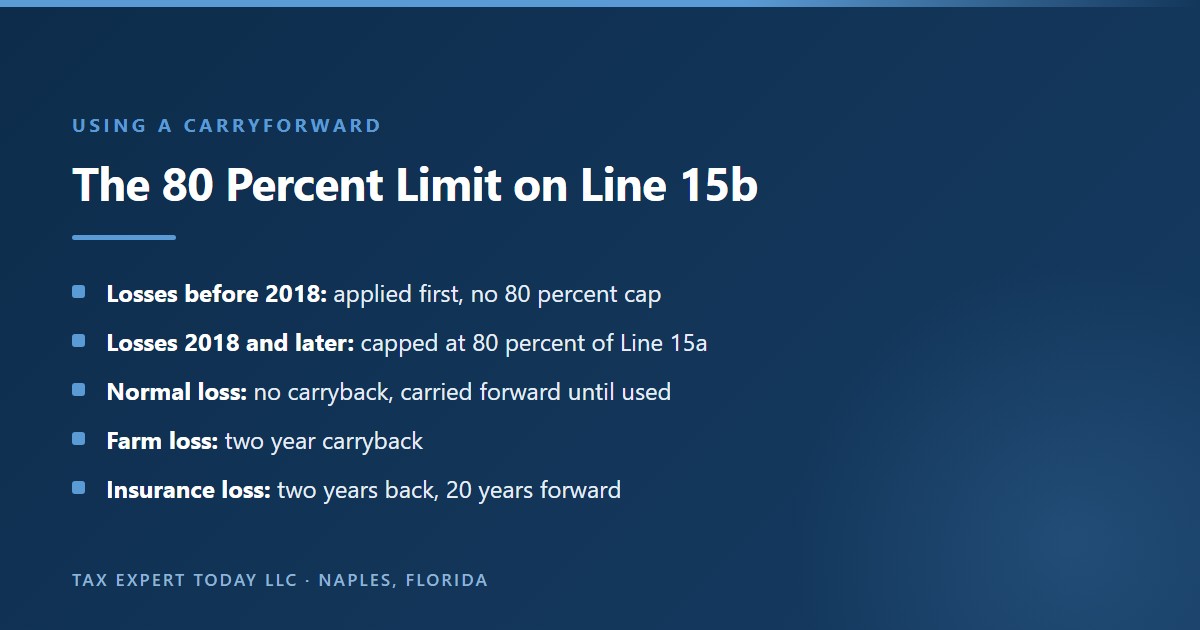
For Georgia net operating losses from tax years 2018 and later, the amount you can deduct in a year cannot exceed 80 percent of Georgia income before NOLs, which is Form 500 Line 15a. Pre 2018 losses are not subject to that limit. The IT-511 worksheet applies older losses first, then newer losses up to the cap.
- Base: Georgia income before NOLs, Form 500 Line 15a, not federal taxable income.
- Pre 2018 losses: Worksheet Line 1, applied without the 80 percent cap.
- 2018 and later losses: Worksheet Line 2, capped at 80 percent of Line 3.
- Result: the total on Worksheet Line 6 goes to Form 500 Line 15b.
- Effect: at least 20 percent of Georgia income stays taxable in a year a post 2017 loss is used.
The regulation states the principle: any limitation in the Internal Revenue Code on the amount of net operating loss usable in a year applies in Georgia, including the 80 percent limitation, but the limitation is applied to Georgia taxable net income. The IT-511 instructions for Line 15b turn that into a six line worksheet. Line 1 is the carryforward available from years before 2018. Line 2 is the carryforward available from 2018 and later. Line 3 is income before the Georgia NOL, Form 500 Line 15a. Line 4 is the amount from Line 1 applied to the current year. Line 5 is the amount from Line 2 applied, which cannot exceed 80 percent of Line 3. Line 6 adds Lines 4 and 5 and goes to Line 15b.
Here is a hypothetical example using the 2026 Georgia rate of 4.99 percent, which the Department lists on its Important Tax Updates page. A full year Georgia resident has a Georgia net operating loss carryforward of 150,000 dollars from a 2024 business loss and no older losses. In 2026 the resident has Georgia income before NOLs of 100,000 dollars on Line 15a.
| Line 15b worksheet, hypothetical 2026 return | Amount |
|---|---|
| Line 1, carryforward from years before 2018 | 0 |
| Line 2, carryforward from 2018 and later | 150,000 |
| Line 3, Georgia income before NOL (Form 500 Line 15a) | 100,000 |
| Line 4, pre 2018 loss applied | 0 |
| Line 5, 2018 and later loss applied, capped at 80 percent of Line 3 | 80,000 |
| Line 6, total applied, to Form 500 Line 15b | 80,000 |
| Form 500 Line 15c, taxable income after NOL | 20,000 |
| Georgia tax at 4.99 percent, before credits | 998 |
In this example 80,000 dollars of the loss is used, and the remainder, about 70,000 dollars before any modifications under Section 172(b)(2), carries to 2027. Those modification rules, which Georgia follows through its adoption of Section 172, decide exactly how much of a partly used loss survives, and the Department’s carryover schedules walk through them line by line. The point for planning is that a large Georgia net operating loss is absorbed more slowly than many owners expect, and some Georgia tax is due even in years with a large carryforward. That remaining tax still has to be paid through withholding or Georgia Form 500-ES estimated payments, so a carryforward is not a reason to stop making them.
Losses from tax years before 2018 sit on Worksheet Line 1 and are not capped. A taxpayer with both older and newer losses should apply the older losses first, which the worksheet structure does, both because they are not limited and because pre 2018 losses generally carry forward only 20 years. Once a pre 2018 loss is past its 20th year it is lost, while the newer losses do not expire if they are normal or farm losses.
Can a Georgia Net Operating Loss Be Carried Back?
Usually not. For losses in taxable years ending after December 31, 2017, Georgia allows no carryback for a normal loss. A farm loss can be carried back two years, and an insurance loss can be carried back two years and forward 20. Georgia did not adopt the CARES Act five year carryback for 2018 to 2020 losses.
- Normal loss: carried forward only, until exhausted.
- Farm loss: two year carryback, then forward until exhausted.
- Insurance loss: two year carryback, 20 year carryforward.
- Older losses: years ending on or before December 31, 2017, generally had a two year carryback.
- CARES Act: its revised NOL carryback provisions were not adopted for Georgia purposes.
Schedule 4 asks you to select the type of loss for tax years beginning on or after January 1, 2018. The IT-511 booklet lists three types. A normal loss can only be carried forward until exhausted. An insurance loss can be carried back two years and carried forward for 20 years or until exhausted. A farm loss can be carried back two years and carried forward until exhausted. Part III of Schedule 4, the carryback computation of overpayments, applies only to losses that allow a carryback, and the instructions say to leave Part III blank if the loss is only being carried forward.
The CARES Act point needs emphasis because federal returns from that period are still being reviewed and amended. Federally, the 2020 CARES Act allowed losses arising in 2018, 2019, and 2020 to be carried back five years. Georgia did not follow. The IT-511 booklet says Georgia adopted the CARES Act for taxable years beginning on or after January 1, 2019, but did not adopt the revised net operating loss provisions or the CARES Act modification to the Section 461(l) limitation. The IT-611 corporate booklet says the same for corporations. So a 2020 loss that was carried back federally to 2015 was, for Georgia, a carryforward only, unless it was a farm or qualifying insurance loss.
That mismatch created a common reconciliation problem. A federal carryback absorbs part of the loss in earlier years, which reduces the federal carryforward. The Georgia loss, never carried back, keeps its full balance moving forward. Years later, the Georgia carryforward is larger than the federal carryforward, and anyone who assumes the two match will leave a Georgia deduction unused. If your federal returns from 2015 through 2020 were amended for a CARES Act carryback, check whether a Georgia carryforward survives.
| Georgia loss type and year | Carryback | Carryforward | 80 percent limit |
|---|---|---|---|
| Normal loss, taxable year ending after December 31, 2017 | None | Until exhausted | Yes, for years beginning 2018 and later |
| Farm loss, after 2017 | 2 years | Until exhausted | Yes |
| Insurance loss, after 2017 | 2 years | 20 years | Corporate booklet excepts certain insurance companies |
| Loss in a taxable year ending on or before December 31, 2017 | Generally 2 years, with special periods | Generally 20 years | No |
| 2018 to 2020 loss carried back five years federally under the CARES Act | Not for Georgia | Forward under Georgia rules | Yes |
For older losses, the booklet lists the special federal periods Georgia generally followed: five years for farmers, three years for certain casualty losses, ten years for specified liability losses, and three years for small business losses attributable to federally declared disasters. It also lists federal provisions Georgia did not follow, including the special carryback rules enacted in 2009, several Gulf Opportunity Zone provisions under Section 1400N, the five year carryback of certain disaster losses under Sections 172(b)(1)(J) and 172(j), and the Kansas storm public utility election. If you are working with a pre 2018 loss, those exceptions can change which years absorb it.
How Long Can a Georgia NOL Be Carried Forward?
A normal or farm Georgia net operating loss from a taxable year ending after December 31, 2017, carries forward until it is used up. An insurance loss carries forward 20 years. Losses from earlier years generally carried forward 20 years, and any part not absorbed by then is lost. The year order follows Internal Revenue Code Section 172.
- Post 2017 normal loss: no expiration, subject to the 80 percent limit each year.
- Post 2017 insurance loss: 20 year carryforward.
- Pre 2018 losses: generally 20 years, with older losses used first.
- Sequence: earliest loss years are applied first, as Section 172 requires.
- Record keeping: a running Georgia schedule, separate from the federal one.
The regulation ties the timing to the federal rules: the procedural sequence of years to which a Georgia net operating loss may be carried, and the number of years, are the same as provided in the Internal Revenue Code as adopted for Georgia purposes. The IT-511 booklet translates that for current years: losses generated in 2018 and forward can be used until exhausted, with the exception of insurance losses. It also repeats an older example. A taxpayer with a large loss in 2017, who elected federally to forgo the carryback, must carry the Georgia loss forward as well, and any portion not absorbed after 20 years is lost.
Unlimited carryforward does not mean unlimited value. Each year the 80 percent cap restricts how much of a post 2017 loss can be used, and a loss can only offset Georgia income. A taxpayer who moves out of Georgia and stops having Georgia income may carry a balance indefinitely without ever using it. A taxpayer who dies with an unused individual carryforward generally loses it after the final return, following the federal rule that an individual’s NOL does not pass to heirs. These are reasons to plan the use of a large Georgia net operating loss rather than assume it will take care of itself.
Keep the Georgia schedule even in years when nothing is used. The 2025 IT-511 booklet says that when a carryover is used in a later year, the amount is reported on that year’s return, and the older Form 500-NOL instructions told taxpayers to attach a schedule to each carryover year showing the computation of what remains for the next year. Whether you use the older form or Schedule 4, the burden of showing the remaining Georgia balance sits with the taxpayer.
How Do You Elect to Waive the Carryback in Georgia?
If a loss can be carried back and you elect federally to forgo the carryback, you must forgo it for Georgia too. If you have a Georgia net operating loss but no federal NOL, you can make an irrevocable Georgia only election by attaching a statement to the loss year Georgia return by its due date, including extensions.
- Federal election binds Georgia: waive federally, and the Georgia carryback is waived.
- No federal waiver, no Georgia waiver: Georgia does not allow a waiver on its own in that case.
- Georgia only election: available when there is no federal NOL.
- Timing: by the loss year due date, including extensions.
- Scope today: matters mainly for farm and insurance losses.
Rule 560-7-4-.01 sets out the election. When a net operating loss is allowed to be carried back and the taxpayer elects to forgo the federal carryback, the taxpayer also forgoes the Georgia carryback. When the taxpayer does not have a federal net operating loss, the taxpayer may make an irrevocable election to forgo the Georgia carryback period, provided the loss is allowed to be carried back and an affirmative statement is attached to the Georgia return for the year of the loss. The statement must be made on or before the due date of the loss year return, including extensions. And if the loss is allowed to be carried back and the taxpayer does not waive the federal carryback, the waiver is not allowed for Georgia purposes.
Since normal losses after 2017 cannot be carried back at all, the election mostly matters now for farm and insurance losses. A farmer whose carryback years were taxed at a higher Georgia rate may prefer to carry back and claim a refund, while a farmer expecting higher income in coming years may prefer to waive the carryback and use the loss forward. Georgia’s flat rate has been cut in recent years, from 5.19 percent for 2025 to 4.99 percent for 2026, so the value of a deduction now depends on which year absorbs it. The IT-511 booklet still asks that a copy of the federal election be attached to the Georgia return, and that Schedule 4 be completed even when the carryback period is forgone.
What Are the Deadlines for Claiming a Georgia Net Operating Loss?
For individual loss years beginning in 2023 and later, Schedule 4 must be filed with Form 500 or 500X within three years of the loss year due date, including extensions. A carryback refund claim has the same window. Under the older Form 500-NOL system, a carryforward had to be established by the loss year due date.
- Schedule 4: with the loss year return, within three years of its extended due date.
- Carryback refund: three years after the loss year due date, including extensions.
- Older Form 500-NOL carryforward: filed by the loss year due date, including extensions.
- Waiver statement: by the loss year due date, including extensions.
- Corporate tentative carryback: within 12 months after the end of the loss year.
The deadlines matter because a Georgia net operating loss that was never established may be challenged when you try to use it. Rule 560-7-4-.01 says Form 500-NOL must be separately filed when the taxpayer forgoes the carryback so the net operating loss can be established on the Department’s system for future years, and that the filing must occur by the due date of the loss year return, including extensions. The Form 500-NOL instructions say the same thing in plain terms: the form must also be filed by the due date of the loss year return when the taxpayer only carries the loss forward, so the NOL can be established in the Department’s system, and the carryback page is left blank.
The 2025 booklet’s Schedule 4 language is broader: Schedule 4 must be completed and filed with the 500 or 500X no later than three years from the due date of the loss year return, including extensions. A taxpayer who filed a 2024 return without Schedule 4 and later realizes there was a Georgia net operating loss can generally file a 500X for 2024 with Schedule 4 within that window. Waiting until the carryforward is needed, years later, risks being outside it.
| Action | Deadline | Source |
|---|---|---|
| Schedule 4 for a 2023 or later individual loss | Three years from the loss year due date, including extensions | 2025 IT-511 booklet |
| Individual carryback refund claim | Three years after the loss year due date, including extensions | Rule 560-7-4-.01(3)(f); O.C.G.A. 48-7-21(b)(10.1) |
| Form 500-NOL to establish a carryforward, pre 2023 loss | Loss year due date, including extensions | Rule 560-7-4-.01(3)(e); Form 500-NOL instructions |
| Georgia only waiver of a carryback | Loss year due date, including extensions | Rule 560-7-4-.01(3)(e) |
| Corporate tentative carryback, Form IT-552 | Within 12 months after the end of the loss year | Rule 560-7-3-.06 |
| Corporate carryback by amended return | Within the general refund period under O.C.G.A. 48-7-21 | Rule 560-7-3-.06 |
For 2025 individual returns the Department lists April 15, 2026, as the filing deadline without an extension. A 2025 loss year return filed on extension is due later, and the three year Schedule 4 window runs from that extended due date. Calendar the window when the loss year return is filed, not when the carryforward is first needed. Our Georgia amended tax return guide covers Form 500X mechanics in detail.
How Does the Excess Business Loss Rule Affect a Georgia Net Operating Loss?
Georgia follows the Section 461(l) excess business loss limitation, but you first compute business income and deductions under the Code as Georgia adopts it, including the bonus depreciation disallowance, and then apply Section 461(l). The disallowed amount that carries forward is entered on Schedule 4 Part I, Line 7, as a negative number.
- Georgia follows 461(l): as the IT-511 booklet states.
- Order matters: Georgia business income first, the 461(l) limit second.
- Carryforward only: the disallowed amount is entered as a carryforward, not a carryback.
- Line 7 of Part I: combined with the regular loss to reach the total on Line 8.
- CARES Act change: Georgia did not adopt the CARES Act modification to 461(l).
Section 461(l) limits how much of a noncorporate taxpayer’s net business losses can offset nonbusiness income in a year. The disallowed amount is treated as a net operating loss carryforward in the following year. The IT-511 booklet says Georgia follows the limitation, but with a sequencing instruction: before applying it, the taxpayer should compute business income and deductions under the Internal Revenue Code as defined for Georgia purposes, with the Section 168(k) disallowance and similar differences, and then apply Section 461(l). The Section 461(l) loss that is disallowed and eligible to carry forward goes on Line 7.
The two booklet illustrations discussed above show why the order matters. A Georgia business loss computed without bonus depreciation may be smaller than the federal business loss, which changes how much is disallowed under Section 461(l) for Georgia. And because the disallowed amount is a carryforward only, a high income year can still generate a Georgia net operating loss carryforward on Line 8 even when Line 6 shows positive income. Owners who sold a business, sold qualified small business stock, or had a large investment gain in the same year as an operating loss are the usual candidates, and the related planning appears in our article on taxes on selling a business.
The federal Section 461(l) threshold is indexed for inflation and has been amended several times since 2017, so this guide does not quote a dollar figure. Use the federal form and instructions for the loss year to determine the disallowed amount, and then recompute it with Georgia business figures for Schedule 4.
Does Georgia Follow Bonus Depreciation When Computing an NOL?
No. The IT-511 booklet tells taxpayers to compute business income under the Internal Revenue Code as defined for Georgia purposes, with the Section 168(k) disallowance. A federal loss created or enlarged by bonus depreciation can therefore be smaller in Georgia, or disappear, and later Georgia depreciation deductions make up the difference over time.
- Federal bonus depreciation: not taken in the Georgia business computation.
- Georgia depreciation: regular recovery over the asset’s life.
- Loss year effect: the Georgia loss is often smaller than the federal loss.
- Later years: Georgia keeps deducting depreciation after the federal asset is written off.
- Basis tracking: a separate Georgia depreciation schedule for every affected asset.
Georgia adopts the Internal Revenue Code as of a specific date each year through the definition in O.C.G.A. Section 48-1-2, and it has consistently decoupled from certain federal depreciation provisions. The NOL instructions refer to the Section 168(k) disallowance as part of computing business income for Georgia purposes. In practice, a Georgia business owner who expensed equipment through bonus depreciation federally reports a Georgia addition in the year of purchase and Georgia subtractions in later years.
The NOL consequence is straightforward but often overlooked. If the federal loss exists only because of bonus depreciation, the Georgia computation may show income instead of a loss. If the federal loss is larger than the bonus depreciation, the Georgia net operating loss will be the federal loss reduced by the Georgia addition. Either way, the Georgia return for the loss year and the Georgia depreciation schedule need to agree, and both need to be kept for as long as the carryforward or the asset remains.
Section 179 expensing can raise the same question in any year when the Code as Georgia adopts it differs from the federal rules. Confirm the Georgia treatment for the specific loss year in that year’s Department instructions and in the Georgia depreciation form, and carry any difference into the Georgia business computation before Schedule 4.
How Does a Part Year Resident or Nonresident Compute a Georgia NOL?
Only amounts attributable to Georgia can be used. Part year residents and nonresidents compute the Georgia net operating loss from Georgia source income and deductions, and they prorate exemptions and the standard or itemized deduction using the ratio on Schedule 3, Line 9, of Form 500. A federal loss earned outside Georgia is not a Georgia loss.
- Georgia amounts only: income and losses sourced to Georgia or earned while a resident.
- Exemptions: Schedule 3, Line 11, multiplied by Schedule 3, Line 9.
- Deductions: the standard or adjusted itemized deduction multiplied by the Line 9 ratio.
- Georgia itemized deductions: the booklet says not to prorate those in the carryback computation.
- Nonresident businesses: the loss from Georgia operations is computed under O.C.G.A. 48-7-30.
The IT-511 booklet has a section titled Part Year and Nonresidents within the Schedule 4 instructions, and its first sentence sets the rule: in computing the Georgia net operating loss, only amounts attributable to Georgia can be used. For Part I, Line 2, exemptions are prorated by multiplying Schedule 3, Line 11, by Schedule 3, Line 9. For Part II, Line 11, deductions are prorated: itemized deductions on Schedule 3, Line 10, less casualty, Form 2106 deductions, and state and local income taxes, multiplied by Line 9; or the standard deduction on Line 10, multiplied by Line 9.
The booklet’s own illustration uses a Schedule 3, Line 9, ratio of 78.98 percent. Itemized deductions of 15,000 dollars become prorated deductions of 11,847 dollars, and a standard deduction of 12,000 dollars becomes 9,478 dollars. The same ratio method applies in Part III if the loss is being carried back to a part year or nonresident year, where the instructions call for recalculating prorated deductions and exemptions after applying the NOL.
For nonresident individuals, trusts, and estates doing business both inside and outside Georgia, rule 560-7-4-.01 says the loss attributable to Georgia operations is computed as provided in O.C.G.A. Section 48-7-30, the allocation and apportionment statute. A Florida resident who owns an operating business with locations in both states does not carry the whole federal loss into Georgia. Only the Georgia portion becomes a Georgia net operating loss, and only that portion can reduce Georgia income in later years. Our Georgia part year resident tax return guide explains Schedule 3 and the ratio in more detail.
| Hypothetical part year situation | Federal result | Georgia net operating loss |
|---|---|---|
| Business loss earned entirely while a Georgia resident | Federal NOL | Generally yes, after Georgia adjustments and proration of personal deductions |
| Business loss earned entirely after moving to Florida | Federal NOL | Generally no; the loss is not attributable to Georgia |
| Loss from a Georgia rental owned by a Florida resident | Part of a federal NOL | Possibly, to the extent the loss is Georgia source |
| Loss in Florida, income in Georgia, same year | Federal NOL | The Georgia income is not offset by the Florida loss in the Georgia computation |
What Happens to a Loss Carryover From Before You Moved to Georgia?
It does not follow you into Georgia. Georgia requires an addition for loss carryovers from years when you were not subject to Georgia income tax, including net operating loss carryovers. If your federal return deducts an NOL that arose before you became a Georgia taxpayer, the Georgia return adds it back.
- The rule: rule 560-7-4-.01(2) adds back deductions from transactions in years you were not subject to Georgia tax.
- Covered items: net operating loss carryovers, capital loss carryovers, and contribution carryovers.
- Where it appears: as an addition to income on Form 500 Schedule 1.
- Federal NOL deduction: separately added back in every year it is claimed.
- Who it affects: new Georgia residents with losses from a prior state.
The regulation is direct. There shall be added to net income the amount of deductions reflected therein which resulted from transactions occurring in years in which the individual was not subject to Georgia income tax, and those deductions include contribution carryovers, capital loss carryovers, and net operating loss carryovers. The IT-511 booklet lists the same item among the additions to income: loss carryovers from years when you were not subject to Georgia income tax. It separately lists the net operating loss carryover deducted on the federal return as an addition.
For someone moving into Georgia from a state with no income tax, such as Florida or Texas, this matters. A business owner who lost money in Florida in 2024, moved to Atlanta in 2025, and deducts the federal NOL on the 2026 federal return will add that deduction back on the Georgia return. Georgia never taxed the income the loss would have offset, so it does not allow the loss to reduce Georgia income. The person’s Georgia net operating loss balance is zero unless a Georgia loss arose after the move.
Part year years are the gray zone. If the loss year was itself a part year Georgia year, the Georgia portion of that loss, computed under the part year rules, can be a Georgia net operating loss. The non Georgia portion is excluded. This is why the Schedule 3 ratio and the source of each item in the loss year need to be documented when the loss year return is filed.
What Happens to a Georgia NOL When You Move Away From Georgia?
The Georgia carryforward stays on Georgia’s books, but it can only reduce income Georgia taxes. After you move, you can use it on a Georgia nonresident return in a year you have Georgia source income, computed through Schedule 3. If you have no Georgia income, it simply sits unused. Your new state applies its own rules.
- Still a Georgia attribute: the balance does not convert into a loss in another state.
- Useful only against Georgia income: such as a Georgia rental or business interest.
- Nonresident return: Form 500 with Schedule 3 in years you have Georgia income.
- Florida: no personal income tax, so no Florida use for an individual loss.
- Documentation: keep the Georgia schedule in case Georgia income returns.
Rule 560-7-4-.01 and the IT-511 booklet both contemplate a loss carried to a part year or nonresident return, and the Form 500-NOL carryover schedule told taxpayers what to enter in that case: the Schedule 3 taxable income for the carryover year, with personal items multiplied by the Schedule 3 ratio. The effect is that a Georgia net operating loss reduces Georgia taxable income on a nonresident return, and only Georgia income.
Many of our clients in Naples, Florida, are former Georgia residents who kept a Georgia rental, a Georgia partnership interest, or a Georgia business. For them, a Georgia net operating loss carryforward from their resident years can still have value if that Georgia income continues. For those who cut every Georgia tie, it has none, and there is no mechanism to transfer it. If you are planning a move and have a large Georgia carryforward, the timing of income recognition before and after the move deserves attention.
How Do Pass Through Owners Get a Georgia Net Operating Loss?
A partnership, LLC taxed as a partnership, or S corporation has no Georgia net operating loss of its own unless it elects to pay tax at the entity level. Its loss passes through to the owners, who report their Georgia share. If an owner’s total Georgia result is a loss, the Georgia net operating loss belongs to that owner.
- Partnerships and LLCs: Form 700 reports each member’s Georgia share.
- S corporations: Form 600S passes the loss through to shareholders.
- Owner level: the NOL arises on the owner’s Form 500, not on the entity return.
- Federal limits still apply: basis, at risk, and passive loss rules come first.
- Exception: an entity that elects the pass through entity tax keeps its own losses.
Georgia rule 560-7-3-.08 says partnerships, as such, are not subject to Georgia income tax but must file returns, and that when the result of partnership operation is a net loss, the loss is divisible among the partners in the same proportion as income would have been. The same pass through principle applies to S corporations whose shareholders have consented to Georgia tax. The loss lands on the owner’s return as a Schedule E item, and it can contribute to the owner’s Georgia net operating loss in the same way a sole proprietorship loss would.
Before a pass through loss can feed a net operating loss, it has to survive the federal limits that apply at the owner level: the owner’s basis in the entity, the at risk rules, and, for passive activities, the passive loss rules. Losses suspended under those rules are not part of the current year’s net operating loss. Georgia follows the federal treatment of those limits, adjusted for Georgia differences such as depreciation, so the Georgia suspended loss balance can differ from the federal one. Our guides to Georgia Form 700 and Georgia Form 600S explain how each entity reports the Georgia share to its owners.
Owners who live outside Georgia face an extra step. A nonresident owner’s Georgia share of a pass through loss is Georgia source, and if the owner has a Georgia net operating loss from it, that loss is usable only against later Georgia income. That is often the same entity’s Georgia income in a later profitable year, which makes the nonresident owner’s own Georgia return, rather than a composite return, the place the loss can be used.
How Does a Composite Return Affect a Georgia NOL?
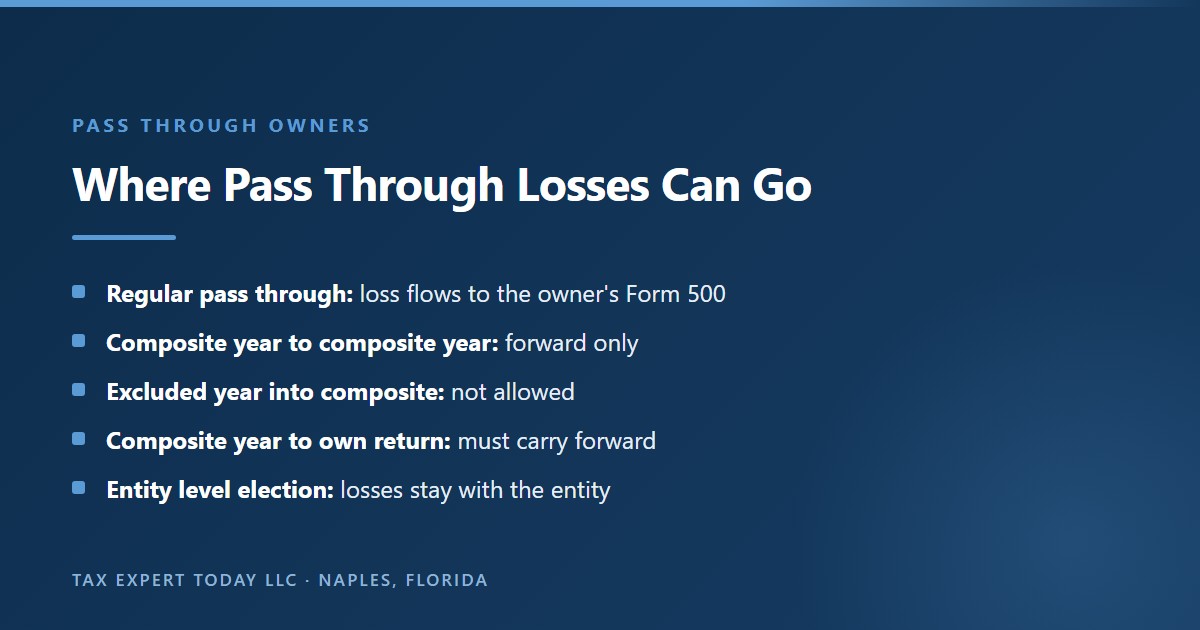
A loss computed on a Georgia composite return can be carried forward to another composite year for each member, but never back. A member cannot bring a loss from an excluded year into a composite year, and a loss from a composite year must be carried forward when the member later files their own return.
- Forward only: composite NOLs may not be carried back.
- Composite to composite: allowed, member by member.
- Excluded year to composite year: not allowed.
- Composite year to own return: the loss must be carried forward to that return.
- 80 percent limit: applied member by member to composite income.
A composite return, Form IT-CR, lets a partnership, LLC, or S corporation file one Georgia return on behalf of participating nonresident members instead of withholding on each of them. Ga. Comp. R. & Regs. 560-7-8-.34, paragraph (3)(h), sets the net operating loss rules for composite returns. A net operating loss computed on a composite return may be carried forward to another composite return year for each member. It may not be carried back. For an individual member, the income for the year the loss is carried to must be recomputed using the same filing option used for the loss year before the loss is applied. A net operating loss cannot be carried from a year in which the member was excluded from the composite return to a year in which the member is included. A loss must be carried forward from a year where the member was included on the composite return to a year the member files the member’s own return. And the Code limits, including the 80 percent limit, apply to each member using the income computed for the composite.
The practical risk lies in the one way door. A nonresident member who was excluded from the composite in a loss year, perhaps because they had other Georgia income, cannot later use that loss inside a composite return. They need to file their own Form 500 to use it. Composite returns also disallow many deductions that are limited elsewhere in the Code, including Section 179 expense, capital losses, investment interest, and self employment related deductions, so a member’s composite loss may be smaller than the loss they would compute on their own return.
| Member’s situation | Can the Georgia NOL move? | Rule 560-7-8-.34(3)(h) |
|---|---|---|
| Loss on composite, next year also on composite | Yes, forward | Paragraph 1 |
| Loss on composite, carry to an earlier year | No | Paragraph 1 |
| Excluded from composite in loss year, included next year | No, not into the composite | Paragraph 2 |
| Loss on composite, member files own Form 500 next year | Yes, must carry forward to the own return | Paragraph 3 |
| Any composite carryforward | Subject to the 80 percent limit per member | Paragraph 4 |
Our Georgia composite return guide covers who qualifies and the filing options in detail. The NOL point to take from it is that the decision to include a member in the composite in a loss year affects where that member’s Georgia net operating loss can be used for years afterward.
What Happens to NOLs When an Entity Elects the Pass Through Entity Tax?
An electing pass through entity generates and uses net operating losses the same way a C corporation does. Losses from non election years stay with the owners. Losses the entity generates while electing stay with the entity and do not pass to owners if it stops electing. A carryback, if eligible, uses Form IT-552.
- Entity level attribute: losses in election years belong to the entity.
- Owner losses stay put: pre election losses remain on the owners’ returns.
- No pass through later: entity losses do not flow out if the election ends.
- C corporation rules: applied under rule 560-7-3-.06.
- Special S corporation case: C corporation filing year losses carry into election years.
Georgia’s pass through entity tax election lets a partnership or S corporation pay Georgia tax at the entity level, at the same 4.99 percent rate for 2026. The election changes who owns tax attributes. The Georgia regulation on electing entities, rule 560-7-3-.03, says tax attributes, including credits and net operating losses, for an electing entity are generated, claimed, and utilized in the same manner as a C corporation. Attributes from years when the election was not made remain with the owners and cannot be transferred to the entity. Attributes generated during election years generally do not pass through to the owners and remain with the entity if it does not elect in a later year. Net operating losses are treated as allowed for C corporations under rule 560-7-3-.06, and the electing entity files Form IT-552 to carry back losses if eligible.
This creates a planning trade off that is easy to miss when the election is made for its federal benefit. If an electing entity has a loss year, the loss is trapped at the entity level. If the entity later stops electing, the owners do not receive that loss, and the entity has no Georgia tax of its own to offset in a non election year. Owners who expect losses, or who expect to alternate between electing and not electing, should weigh that before making the election. The regulation also addresses one special case: an S corporation with nonresident owners that has been filing in Georgia as a C corporation, typically because the nonresident consents were not in place, and that then elects to pay at the entity level, carries over the net operating losses from its C corporation filing years.
Our Georgia pass through entity tax guide covers the election itself. For NOL purposes, the rule is simple to state and hard to undo: an entity level Georgia net operating loss stays with the entity.
How Do Corporations Claim a Georgia Net Operating Loss?
A corporation computes its Georgia net operating loss on Form 600, allocating to Georgia only the loss attributable to Georgia operations, and tracks it on Schedule 9. Post 2017 losses carry forward without a carryback, except farm and certain insurance losses, and are limited to 80 percent of Georgia income. A tentative carryback uses Form IT-552.
- Apportioned loss: only the Georgia share of a multistate corporation’s loss.
- Schedule 9: computes how much of the carryforward is usable in the current year.
- 80 percent limit: applies to 2018 and later losses, except certain insurance companies.
- Form IT-552: tentative carryback, attached to the front of the loss year return.
- Statement required: a complete statement detailing the sources of the NOL deduction.
The 2025 IT-611 corporate booklet explains the corporate version. Corporations doing business both inside and outside Georgia that incur a loss compute the net operating loss carryover deduction by allocating to Georgia only the amount of the loss attributable to operations within Georgia. The loss is carried back, if applicable, and forward in the sequence provided by Section 172 as defined in Georgia law. Georgia did not adopt the revised NOL provisions in the 2020 CARES Act, so for losses in taxable years ending after December 31, 2017, there is no carryback and unlimited carryforward, with a two year carryback for farming losses and a two year carryback and 20 year carryforward for certain insurance company losses.
The booklet adds that net operating losses for tax years 2018 and later, except those of certain insurance companies, cannot exceed 80 percent of Georgia income before NOLs, and that Schedule 9 computes how much can be used in the current year. A corporation claiming an NOL deduction must file a complete statement detailing the sources of the deduction, and the booklet asks that Form IT-552 and Form 600 Schedule 9 be attached. Among the common errors the booklet lists is improper enclosure of Form IT-552: it should be attached to the front of the loss year return, not to a duplicate original return.
Rule 560-7-3-.06 gives the carryback procedure. A corporation entitled to a refund because of a carryback may file an amended return within the period in O.C.G.A. Section 48-7-21, or may file an application for a tentative carryback adjustment within 12 months after the end of the loss year. Within 90 days after the end of the month in which the application is filed, the Commissioner makes a limited examination, may disallow an application with uncorrectable computation errors or material omissions, and credits or refunds the decrease without interest. If the amount refunded turns out to be too large, the excess can be assessed as if it were a mathematical error.
| Item | Individuals and fiduciaries | C corporations |
|---|---|---|
| Computation form | Schedule 4 for 2023 and later; Form 500-NOL earlier | Form 600 with Schedule 9 |
| Georgia portion | Georgia amounts; O.C.G.A. 48-7-30 for nonresident businesses | Loss attributable to Georgia operations |
| Carryback claim | Schedule 4 Part III, within three years | Form IT-552 within 12 months, or amended return |
| 80 percent limit | Form 500 Line 15b worksheet | Schedule 9; certain insurance companies excepted |
| Ownership change rules | Sections 108, 381, 382, 384 apply | Sections 108, 381, 382, 384 apply |
| 2026 rate the deduction offsets | 4.99 percent | 4.99 percent |
For the corporate rate and Form 600 mechanics generally, see our article on the Georgia corporate tax rate.
What Happens to a Corporate NOL When a Company Switches Between S and C Status?
Georgia does not let losses cross the S and C line. Losses from an S corporation year cannot be carried to a C corporation year, and losses from a C corporation year cannot be used in an S corporation year. The S years still count toward the number of years a C corporation loss may be carried.
- S year losses: pass to shareholders, never to a later C year.
- C year losses: wait unused during S years.
- Clock keeps running: S years count toward the carry period.
- Returning to C status: the old C loss can be used again.
- Entity level election: a narrow carryover rule applies in one S corporation situation.
Rule 560-7-3-.06 gives an example. A corporation is a C corporation in 2002 and has a net operating loss. It elects to forgo the carryback and carries the loss forward. In 2003 it is an S corporation, and the 2002 loss may not be claimed in 2003. In 2004 it is a C corporation again, and the 2002 loss may be claimed. The 2003 S year, however, counts as a taxable year for determining how many years the loss may be carried.
For post 2017 losses with unlimited carryforward, the clock matters less, but the blocking rule still matters. A C corporation with a large Georgia carryforward that elects S status gives up the use of that carryforward for as long as it remains an S corporation, subject to the narrow carryover rule in rule 560-7-3-.03 for an S corporation that had been filing in Georgia as a C corporation and then elects to pay tax at the entity level. Owners deciding whether to elect S status should count the Georgia carryforward as part of the cost.
Do Ownership Changes Limit a Georgia Net Operating Loss?
Yes, the same way they do federally. Georgia follows Internal Revenue Code Sections 108, 381, 382, and 384 as they relate to net operating losses. A debt cancellation exclusion can reduce the Georgia loss, an acquisition can carry it over, and an ownership change can limit how much is usable each year.
- Section 108: excluded cancellation of debt income reduces tax attributes, including NOLs.
- Section 381: carryovers in certain corporate acquisitions and reorganizations.
- Section 382: an annual limit after an ownership change.
- Section 384: limits using preacquisition losses against built in gains.
- Applied to Georgia figures: using the Georgia loss and Georgia computations.
For individuals, rule 560-7-4-.01(3)(g) says Sections 108, 381, 382, and 384, as amended, apply for Georgia purposes as they relate to net operating losses. For corporations, the IT-611 booklet says Georgia law has specifically followed those sections since tax years beginning on or after January 1, 2005, and rule 560-7-3-.06 explains that, for a corporation, the Section 108 reduction of the Georgia net operating loss is the federal reduction multiplied by the Georgia apportionment percentage for the year of the discharge.
The most common individual case is Section 108. A business owner whose debt is cancelled in insolvency or bankruptcy may exclude the cancellation income federally, but the exclusion comes at the cost of reducing tax attributes, starting with the net operating loss. Georgia applies the Section 108 attribute reduction to the Georgia net operating loss as well. Since the Georgia and federal NOLs can differ, the effect on the Georgia balance should be computed and documented rather than assumed to match the federal Form 982. For corporations, Section 382 is the usual concern after an acquisition, and the Georgia annual limit follows the federal computation applied to the Georgia carryforward.
How Do You Claim a Georgia NOL Carryback Refund?
For individual losses that allow a carryback, such as farm and insurance losses, you complete Schedule 4 Part III with the loss year return, applying the loss to the oldest carryback year first. You do not file Form 500X for the earlier years. The Department makes a limited examination within about 90 days, and any refund is paid without interest.
- Part III only for carrybacks: left blank when a loss only carries forward.
- Oldest year first: apply the loss to the earliest carryback year.
- No 500X for carryback years: the booklet says not to amend the prior years for this.
- Recompute credits: including the credit for taxes paid to other states.
- Limited examination: within 90 days of the end of the month filed.
The IT-511 booklet’s Part III instructions walk through each carryback year in columns. Line 1 is federal adjusted gross income excluding the federal NOL, from Form 500 or 500X Line 8, and it should not be reduced by the federal or Georgia NOL. Line 2 is the net Georgia adjustments from Schedule 1. Line 3 is the Georgia net operating loss allowed to be carried back, entered as a negative number in the earliest year. Lines 4 through 8 rebuild Georgia taxable income for that year. Line 9 applies the Georgia rate for that carryback year, which the booklet says to take from that year’s IT-511. Line 10 recomputes credits, Line 11 is tax after credits, and Line 13 is the decrease in tax.
Rule 560-7-4-.01 describes what happens after filing. The claim for refund constitutes a claim for credit or refund under O.C.G.A. Section 48-2-35. Within 90 days from the last day of the month in which the claim is filed, the Commissioner examines it to the extent practicable and applies the decrease first against any unpaid tax, then credits or refunds the rest. That refund within the 90 day period is paid without interest. If the claim has computation errors that cannot be corrected within the period, or material omissions, the Commissioner can disallow it without further action or ask for corrections, and the date of correction becomes the filing date for the 90 day period. The Commissioner can also examine the claim later, within the statute of limitations.
Two practical notes. First, the refund depends on the carryback year’s rate and credits, not the current year’s, so a carryback to a year with a higher Georgia rate produces a larger decrease per dollar of loss. Second, the booklet’s instruction not to file a 500X for prior years is specific to applying an NOL carryback; a 500X for the loss year itself, to add a missing Schedule 4, is a different situation that the booklet expressly allows.
What Documents Support a Georgia Net Operating Loss Claim?
The IT-511 booklet lists what must be included: the federal Form 1040 for the loss year, pages 1 and 2, with Schedules 1, A, C, D, E, or F where the loss arises; federal returns for any carryback years; Georgia returns for the carryback or carryforward years; and a copy of federal Form 1045 for a carryback.
- Loss year federal return: Form 1040 pages 1 and 2 plus the schedules that generate the loss.
- Carryback year federal returns: pages 1 and 2, Schedule 1, Schedule A, and any recalculated schedules.
- Georgia returns: for each carryback or carryforward year.
- Federal Form 1045: for a carryback.
- Federal Form 172: keep it as the federal starting point for the Georgia computation.
The booklet warns that Schedule 4 must be complete and the listed documents included, or the application may be disallowed. The older Form 500-NOL carried a similar list: the federal NOL application, the federal loss year return with Schedules 1, A, D, and E, the federal carryback year returns, the Georgia carryback or carryforward year returns, and the loss year Form 500. On the federal side, the IRS now uses Form 172 for individuals, estates, and trusts to figure the NOL, the carryover, and the deduction, and the IRS page for Publication 536 says that publication will no longer be revised. Federal Form 1045 remains the application for a tentative federal refund from a carryback.
| Document | Why Georgia wants it | Keep until |
|---|---|---|
| Loss year federal Form 1040 and loss schedules | Shows the federal starting point and source of the loss | The carryforward is used up, plus the limitations period for the last year it is used |
| Federal Form 172 for the loss year | The federal NOL and nonbusiness computations Georgia adjusts | Same |
| Georgia Form 500 or 500X with Schedule 4 | Establishes the Georgia net operating loss | Same |
| Georgia depreciation schedule | Explains bonus depreciation and other Georgia differences | The life of the assets and the carryforward |
| Schedule 3 ratio support | Part year and nonresident proration | Same as the Schedule 4 support |
| Annual Georgia carryforward schedule | Shows the balance used and remaining each year | Same |
Why Does Tax Software Often Miss the Georgia Net Operating Loss?
Because the Georgia computation is separate, software needs Georgia specific inputs that are easy to skip: the Georgia carryforward balance, Georgia depreciation, the nonbusiness portion of the retirement exclusion, and part year proration. If those are blank, the program may add back the federal NOL deduction without allowing a Georgia deduction, or carry the wrong balance.
- Carryforward not entered: the federal NOL is added back and nothing replaces it.
- Federal balance copied: the Georgia balance is overstated or understated.
- Depreciation mismatch: bonus depreciation flows into the Georgia loss.
- Older form expectations: preparers look for Form 500-NOL in 2023 and later years.
- No year to year schedule: the 80 percent limit is not tracked correctly.
The top search results for this topic include software help pages and preparer forums. One professional software support page, last updated in 2024, still tells users that Form 500-NOL is not available in the program and must be completed on the Department’s website before an NOL is used on Form 500. Another software knowledge base describes a Schedule 4 input screen. Forum threads show preparers trying to complete the older form. Those pages are useful for the mechanics of a given program, and they share a theme: the software cannot know the Georgia carryforward unless someone enters it, and it cannot know the Georgia carryforward is different from the federal one unless someone computes it.
The most expensive error we see is the one that is invisible on a summary page. The federal return deducts an NOL. The Georgia return correctly adds back the federal deduction as Schedule 1 requires. But Line 15b, Georgia NOL Utilized, is empty, because no Georgia carryforward was ever entered. The return looks normal, the taxpayer pays Georgia tax on income the Georgia net operating loss should have partly offset, and nobody notices until the next year, or never. A Georgia carryforward schedule kept with the return file is the simplest fix.
What Are Common Georgia Net Operating Loss Mistakes?
The common mistakes are copying the federal NOL into Georgia, forgetting the federal NOL add back, missing the 80 percent limit, deducting the loss in the loss year, using Form 500X to apply a carryback, missing the three year window, and carrying a pre move loss into Georgia. Each has a specific fix in the booklet or regulation.
- Federal number reused: the Georgia loss must be computed separately.
- Add back missed: the federal NOL deduction belongs on Schedule 1.
- Limit missed: post 2017 losses capped at 80 percent of Line 15a.
- Wrong year or form: no deduction in the loss year; no 500X for carrybacks.
- Pre move loss used: losses from non Georgia years are added back.
| Mistake | What the rule says | Source |
|---|---|---|
| Using the federal NOL as the Georgia NOL | Compute separately; a federal NOL may not be a Georgia NOL | IT-511 booklet; rule 560-7-4-.01(3)(c) |
| Not adding back the federal NOL deduction | Add it back; take the Georgia deduction instead | Rule 560-7-4-.01(3)(b); IT-511 Schedule 1 |
| Deducting more than 80 percent of income | 2018 and later losses capped at 80 percent of Line 15a | IT-511 Line 15b worksheet |
| Deducting the loss in the loss year | The NOL cannot be taken in the loss year | IT-511 Schedule 4 instructions |
| Filing 500X for each carryback year | Use Schedule 4 Part III instead | IT-511 Schedule 4 instructions |
| Never filing Schedule 4 | File with the loss year 500 or 500X within three years | IT-511 Schedule 4 instructions |
| Carrying back a normal post 2017 loss | Normal losses carry forward only | IT-511; IT-611 |
| Deducting a loss from before the move to Georgia | Add back carryovers from years not subject to Georgia tax | Rule 560-7-4-.01(2) |
| Using a composite year loss inside a different structure | Follow the one way rules for composite losses | Rule 560-7-8-.34(3)(h) |
How Does a Georgia NOL Affect the Credit for Taxes Paid to Other States?
When a Georgia net operating loss is carried back, the credit for taxes paid to other states in the carryback year must be recomputed using the new Georgia income and deductions. In a carryforward year, the NOL lowers Georgia taxable income, which can reduce the credit Georgia allows. The credit can never exceed the Georgia tax.
- Carryback years: Part III, Line 10, recomputes the credit.
- Liability based credits: adjusted when the tax decreases.
- Unused credits: carried forward if the credit itself allows a carryforward.
- Cap: credits cannot exceed the recomputed Georgia tax.
- Who it affects: Georgia residents with income taxed in another state.
The IT-511 booklet says that in the carryback computation, the credit for taxes paid to other states should be recomputed based on the new Georgia adjusted gross income and deductions, that other credits based on liability should be adjusted accordingly, and that credits not allowed but eligible for carryforward can be carried forward. The credit entry cannot be greater than the recomputed tax. A Georgia resident who paid tax to North Carolina or Alabama on part of their income in the carryback year should expect the credit to shrink when the Georgia tax shrinks, which reduces the net refund from the carryback.
The same logic applies, without a special line, in carryforward years. Using a Georgia net operating loss reduces Georgia tax, and Georgia’s credit for tax paid to another state is limited by the Georgia tax attributable to the double taxed income. For residents with significant out of state income, the value of the Georgia carryforward is the reduction in Georgia tax after the credit, not the gross deduction times 4.99 percent.
What Happens If Georgia Adjusts or Disallows Your NOL?
The Department can disallow a claim with uncorrectable errors or material omissions during its 90 day review, ask you to correct it, examine it later within the statute of limitations, or assess an excessive carryback refund as if it were a mathematical error. Disputes follow the normal Georgia procedures, including an appeal to the Georgia Tax Tribunal.
- Quick disallowance: errors not correctable within the review period.
- Correction request: the corrected date becomes the new filing date.
- Later examination: within the limitations period.
- Excess refund: assessed as if it were a math error.
- Appeals: the Department’s process, then the Georgia Tax Tribunal.
Rule 560-7-4-.01(3)(f) gives the Commissioner each of those tools for individual carryback claims, and the corporate rule mirrors them. The math error treatment matters because it shortens the usual path: an excess refund from a carryback can be assessed without the full deficiency process that applies to other adjustments. A taxpayer who receives such an assessment should review the computation promptly. Our article on the Georgia Tax Tribunal explains the independent appeal route, and our Georgia Department of Revenue payment plan guide covers what happens if a balance is assessed.
Federal changes are the other trigger. If the IRS adjusts your federal NOL, or you amend a federal return that affected it, the Georgia computation that started from the federal figures may need to be revisited. Georgia requires taxpayers to report federal changes, and the Department publishes its rules on income tax adjustments due to federal changes. The safest practice is to treat every federal NOL adjustment as a prompt to recompute the Georgia net operating loss and its carryforward.
What Does a Georgia NOL Look Like in Practice?
Two hypothetical examples show the pattern. A full year resident with a business loss and Treasury interest ends up with a Georgia NOL larger than the federal one. A business owner who expensed equipment with bonus depreciation has a federal NOL but a much smaller Georgia NOL. Both use the loss later, subject to the 80 percent limit.
- Example one: a Georgia NOL larger than the federal NOL.
- Example two: a Georgia NOL smaller than the federal NOL.
- Both: Schedule 4 with the loss year return, Line 15b in later years.
- Figures: rounded and hypothetical, for illustration only.
- Not covered: credits, the retirement exclusion, and Section 461(l), to keep the math visible.
Example one, hypothetical. Dana, a single full year Georgia resident, runs a consulting practice that loses 60,000 dollars in 2025. Dana also earns 40,000 dollars of interest on United States Treasury notes and takes the standard deduction. Federally, the interest is nonbusiness income. It first absorbs the standard deduction, and the interest left over offsets part of the business loss, so the federal NOL is noticeably smaller than 60,000 dollars. In Georgia, Treasury interest is exempt, so the Line 7 adjustment in Part II of Schedule 4 removes it. Georgia nonbusiness income is then close to zero, the standard deduction becomes an excess nonbusiness deduction that is added back, and the business loss stands in full. The Georgia net operating loss is about 60,000 dollars, larger than the federal NOL. Dana files Schedule 4 with the 2025 Form 500, establishes the Georgia carryforward, and uses it from 2026 onward, capped at 80 percent of Line 15a each year.
Example two, hypothetical. Marcus, a married Georgia resident filing jointly, buys 200,000 dollars of equipment for a landscaping business in 2025 and claims bonus depreciation federally. The business would otherwise have earned 120,000 dollars, so the federal result is a business loss of about 80,000 dollars and a federal NOL. Georgia disallows the bonus depreciation in its computation and allows regular depreciation instead, say 40,000 dollars for the first year. The Georgia business result is income of 80,000 dollars, not a loss. Marcus has a federal NOL and no Georgia net operating loss for 2025. In later years Marcus deducts the remaining Georgia depreciation, which lowers Georgia income, while the federal return uses the federal NOL. Copying the federal NOL into the Georgia return would deduct the same equipment cost twice in Georgia, once through the copied loss and again through Georgia depreciation.
| Hypothetical | Federal result | Georgia result | Main reason |
|---|---|---|---|
| Dana, consulting loss with Treasury interest | NOL, reduced by the interest left after the standard deduction | Georgia NOL of about the full business loss | Treasury interest is exempt in Georgia |
| Marcus, equipment purchase with bonus depreciation | NOL of about 80,000 | No Georgia NOL; Georgia income | Section 168(k) disallowed in Georgia |
Neither example reflects a real client, and both simplify the computation. Real loss years add the retirement exclusion, credits, part year proration, pass through limits, and Section 461(l), and the order of those steps changes the result.
Georgia Net Operating Loss Help in Naples & Southwest Florida
Tax Expert Today LLC helps clients with Georgia net operating loss computations, Schedule 4 filings, carryforward reconstructions, and part year and nonresident loss questions from its office at 11983 Tamiami Trail N, Naples, FL 34110. Georgia clients are served nationwide from Naples, by phone and secure document exchange. Call (239) 441-2005.
- Georgia NOL help Naples: Schedule 4 preparation and review for 2023 and later loss years.
- Carryforward reconstruction: rebuilding a Georgia balance that was never tracked.
- Movers: former Georgia residents in Southwest Florida with Georgia income or losses.
- Pass through owners: composite, withholding, and entity level election interactions.
- Corporations: Form 600 Schedule 9 and Form IT-552 questions.
Tax Expert Today LLC is based at 11983 Tamiami Trail N, Naples, FL 34110, and our office is open Monday through Friday, 10 a.m. to 5 p.m. Eastern time. You can reach us at (239) 441-2005. Many of the Georgia net operating loss questions we see come from people who now live in Collier or Lee County but still have a Georgia business, rental, or partnership interest, or who left Georgia with a carryforward and want to know whether it still has value. We work with Georgia clients remotely, and there is no need to visit Naples to work with us.
For the full range of our Georgia work, see our Georgia tax services page. For Florida residents planning across both states, including the timing of income before and after a move, our Naples tax planning services page explains how we approach it. Related Georgia topics include Georgia LLC taxes and the Georgia capital gains tax, both of which often come up in the same loss year conversation.
A point of scope, stated plainly: Georgia Department of Revenue matters are state tax matters. Our role is the computation, the filings, and correspondence with the Department. When a loss is tied to a bankruptcy, a dispute among owners, or a corporate reorganization, we work alongside the client’s attorney rather than in place of one.
When to Engage a Professional
Consider professional help when a loss year return is about to be filed, when a Georgia carryforward was never established or tracked, when you moved into or out of Georgia around a loss year, when a pass through entity made or dropped the entity level election, or when the Department has questioned a Georgia net operating loss.
- Loss year filing: to file Schedule 4 with the return and establish the Georgia balance.
- Missing history: to rebuild a Georgia carryforward within the three year window.
- Moves: to separate Georgia and non Georgia amounts correctly.
- Entity elections: before electing or dropping the pass through entity tax.
- Notices: Department letters about a disallowed or adjusted NOL.
A Georgia net operating loss can reduce Georgia tax for years after the loss, and it can also be lost through a missed schedule or a federal number copied into the wrong place. If your situation fits any of the items above, talk with us before the next filing deadline. You can learn more about our Georgia state tax services or call (239) 441-2005 for a free consultation.
This article is general educational information about the Georgia net operating loss as of October 15, 2026, based on the Georgia Department of Revenue’s 2025 IT-511 and IT-611 instruction booklets, the Form 500-NOL page and form, the Important Tax Updates and Taxes for Business pages, Ga. Comp. R. & Regs. 560-7-4-.01, 560-7-3-.03, 560-7-3-.06, 560-7-3-.08, and 560-7-8-.34, Internal Revenue Code Section 172, and the IRS pages for Form 172, Form 1045, and Publication 536, read on that date. It is not tax or legal advice for any specific return. All examples are hypothetical. Georgia forms, rates, and rules change; confirm current requirements with the Georgia Department of Revenue or a qualified professional before filing.
Frequently Asked Questions About the Georgia Net Operating Loss
What is a Georgia net operating loss?
It is the loss left after you make all Georgia adjustments to your federal income and deductions, using only Georgia amounts. Georgia computes it separately from the federal NOL, so you can have a federal NOL with no Georgia NOL, or a Georgia NOL of a different size.
What form do I use for a Georgia net operating loss?
For individual tax years beginning on or after January 1, 2023, use Schedule 4 of Form 500, filed with Form 500 or 500X for the loss year. Form 500-NOL is the application for earlier loss years. Corporations use Form 600 Schedule 9 and Form IT-552 for a tentative carryback.
Does Georgia allow an NOL carryforward?
Yes. A normal or farm loss from a taxable year ending after December 31, 2017, carries forward until it is used up, and an insurance loss carries forward 20 years. Losses from tax years 2018 and later can offset no more than 80 percent of Georgia income before NOLs in any year.
Can I carry a Georgia net operating loss back?
Only for certain loss types. A normal loss from a taxable year ending after 2017 carries forward only. A farm loss or an insurance loss can be carried back two years using Schedule 4 Part III. Georgia did not adopt the CARES Act five year carryback for 2018 to 2020 losses.
Is the Georgia NOL the same as my federal NOL?
Often not. Georgia removes income it does not tax, such as U.S. Treasury interest, adds income it does tax, such as other states’ municipal bond interest, disallows federal bonus depreciation, and uses only Georgia amounts. The federal NOL deduction is added back and replaced with the Georgia figure.
What is the deadline to file Schedule 4 for a Georgia NOL?
The IT-511 booklet says Schedule 4 must be filed with Form 500 or 500X no later than three years from the due date of the loss year return, including extensions. A carryback refund claim has the same three year window. File it with the loss year return when you can.
Can I use a loss from before I moved to Georgia?
Generally no. Georgia adds back loss carryovers from years when you were not subject to Georgia income tax, including net operating loss carryovers. A loss from a part year Georgia year can count to the extent it is attributable to Georgia under the part year rules.
What happens to a Georgia NOL on a composite return?
It can be carried forward to another composite year for that member but not carried back. A member cannot bring a loss from a year they were excluded into a composite year, and a loss from a composite year must be carried forward to the member’s own return when they file one.
Does the pass through entity tax election change who owns the NOL?
Yes. An electing partnership or S corporation generates and uses net operating losses like a C corporation. Losses from non election years stay with the owners, and losses the entity generates while electing stay with the entity, even if it stops electing later.
I live in Naples, Florida, and had a Georgia business loss. Can you help with my Georgia net operating loss?
Yes. Tax Expert Today LLC handles state tax matters nationwide from its Naples, Florida office at 11983 Tamiami Trail N, including Georgia net operating loss computations, Schedule 4 filings, carryforward reconstructions, and part year questions. Call (239) 441-2005 for a free consultation.
Published October 15, 2026 by Dr. Pellumb Kabashi « Back to Learning Center
Have a question this article touches on?
Tax Expert Today LLC, based in Naples, Florida and serving clients across the United States.
Schedule a Consultation (239) 441-2005