
By Dr. Pellumb Kabashi, DBA, MBA, CES, CFE, EA
Founder, Tax Expert Today LLC · Tax advisors, enrolled agents, CPAs, and attorneys · Serving clients in all 50 states
Quick Answer
A safe harbor 401k lets a business owner defer the full 2026 limit of $24,500, plus catch-up, without failing the ADP and ACP tests, in exchange for a fully vested employer contribution such as a 3 percent nonelective or 4 percent match for staff. Adding profit sharing can lift the owner toward the $72,000 limit. Call (239) 441-2005 for a free consultation.
What is a safe harbor 401k?
A safe harbor 401k is a 401(k) plan that commits the employer to a fully vested contribution for non-highly compensated employees, either a matching formula or a 3 percent nonelective contribution, in exchange for an automatic pass on the annual ADP deferral test and, for matches that meet the rules, the ACP test.
- Statutory home: IRC section 401(k)(12) for the traditional design and 401(k)(13) for the automatic enrollment version.
- The trade: a required employer contribution in return for no deferral testing.
- Vesting: traditional safe harbor money is 100 percent vested when made.
- Who benefits most: owners and other highly compensated employees whose deferrals would otherwise be capped by testing.
Every 401(k) plan has to show that it does not favor highly compensated employees. For elective deferrals, the default way to prove that is the actual deferral percentage test, usually called the ADP test, described in IRC section 401(k)(3). The test compares the average deferral rate of the highly compensated group with the average rate of everyone else. When rank-and-file employees save little, the owner’s permitted deferral shrinks, sometimes to a fraction of the dollar limit.
Section 401(k)(12) offers a way out. If the plan promises one of the statutory employer contributions and, for a matching design, gives employees a written notice, the arrangement “shall be treated as meeting” the ADP requirement. The plan does not run the test at all. That is why the design is called a safe harbor: the employer buys certainty with a contribution formula that is written into the plan before the year begins.
For a business owner, the practical meaning is simple. A safe harbor 401k converts the owner’s deferral from a number that depends on what the staff saves into a number that depends only on the dollar limit in the Code. In 2026 that limit is $24,500 under the IRS 2026 limits notice, plus $8,000 of catch-up for anyone age 50 or older. The rest of this guide shows the arithmetic, the deadlines that decide whether the design is available this year, and how a profit sharing layer can sit on top.
| Element | What the law provides | Where it comes from |
|---|---|---|
| Testing relief | Deferrals treated as passing the ADP test; qualifying matches treated as passing the ACP test | IRC 401(k)(12)(A), 401(m)(11) |
| Required contribution | Basic match, enhanced match, or at least 3 percent nonelective for each eligible non-highly compensated employee | IRC 401(k)(12)(B) and (C) |
| Vesting | Fully vested when made (QACA designs may use a two-year schedule) | IRC 401(k)(12)(E)(i), 401(k)(13)(D)(iii) |
| Notice | Required for matching designs; removed for nonelective designs after 2019 | IRC 401(k)(12)(D); Notice 2020-86, Q&A-4 |
| Timing | Generally adopted before the plan year and kept for a full 12 months | Reg. 1.401(k)-3(e) |
| Top-heavy | Exempt only if the plan consists solely of safe harbor contributions | IRC 416(g)(4)(H) |
Why do owners choose a safe harbor 401k over a traditional 401(k)?
Owners choose a safe harbor 401k because a traditional 401(k) can return part of their deferrals when employees save little. The safe harbor design removes that risk, lets the owner defer the full dollar limit, and creates a predictable employer cost that can be budgeted in advance rather than discovered after year-end testing.
- Certainty: the owner knows in January how much can be deferred in December.
- No corrective refunds: no taxable return of excess deferrals after the test fails.
- Fixed cost: the employer contribution follows a formula, not a testing result.
- A platform: the safe harbor contribution often satisfies other rules that a profit sharing layer would trigger.
In a small company the highly compensated group is often one or two people, and the non-highly compensated group may include younger employees who defer little or nothing. The ADP test then sets a ceiling on the owner that has nothing to do with the owner’s own savings goals. When the test fails, the plan usually corrects by distributing the excess to the highly compensated employees by the deadline in IRC section 401(k)(8). Those refunds are taxable, and the owner loses the tax-deferred growth on that money permanently.
A safe harbor 401k replaces that uncertainty with a cost that is known in advance. The trade does have a price. The employer contribution is mandatory for the year, it vests immediately in the traditional design, and it generally cannot be dropped without following a formal suspension procedure. Owners who cannot commit to the contribution in a weak year need to plan for that before choosing the design, a topic covered later in this guide.
| Feature | Traditional 401(k) | Safe harbor 401k |
|---|---|---|
| ADP test on deferrals | Required every year | Treated as satisfied |
| ACP test on matches | Required every year | Treated as satisfied if the match meets 401(m)(11) |
| Owner deferral | Limited by staff deferral rates | Up to the 402(g) dollar limit |
| Employer contribution | Optional | Required for the full plan year |
| Vesting of employer money | May use a schedule up to six years | Immediate (two years possible under a QACA) |
| Corrective refunds to owners | Possible when testing fails | Not needed for deferral testing |
| Top-heavy minimum | Applies if the plan is top-heavy | Exempt only when no other employer contributions are made |
What do the ADP and ACP tests do to an owner’s deferrals?
The ADP test limits the average deferral rate of highly compensated employees to a margin above the average of everyone else, generally 1.25 times their rate or, if greater, the lesser of two times their rate or their rate plus two points. When staff defer 3 percent, the owner is capped near 5 percent of pay.
- ADP: actual deferral percentage, which measures elective deferrals.
- ACP: actual contribution percentage, which measures matching and after-tax contributions.
- Two groups: highly compensated employees compared with everyone else who is eligible.
- Correction: refunds of excess contributions, or added employer money, after the year ends.
The arithmetic is in IRC section 401(k)(3)(A)(ii). The highly compensated group’s average deferral rate may not exceed the greater of 125 percent of the non-highly compensated average or, alternatively, the lesser of 200 percent of that average or that average plus two percentage points. In practice, when the rank-and-file average is between 2 and 8 percent, the binding limit is the average plus two points.
The table below runs the test for a hypothetical owner age 52 earning $250,000 of W-2 pay with four employees. The employees’ deferral rates are assumptions chosen to show how quickly the ceiling binds in a small company. The ACP test works the same way for matching contributions, which is why an unlimited discretionary match in a traditional plan can create a second failure even when deferrals pass.
| Participant | W-2 pay | Deferral rate | Deferral |
|---|---|---|---|
| Employee A | $60,000 | 4.0% | $2,400 |
| Employee B | $50,000 | 3.0% | $1,500 |
| Employee C | $45,000 | 2.0% | $900 |
| Employee D | $35,000 | 3.0% | $1,050 |
| Non-highly compensated average | 3.0% | ||
| Maximum highly compensated average | 5.0% (3.0% plus 2 points) | ||
| Owner, age 52 | $250,000 | 5.0% cap | $12,500 regular deferral |
Because the owner is 50 or older, deferrals above the ADP cap can generally be recharacterized as catch-up contributions up to $8,000, since catch-up amounts are not counted in the test under IRC section 414(v)(3). In this hypothetical the owner could keep $20,500 in the traditional plan. If the owner had deferred the full $24,500 plus $8,000, about $12,000 would come back as a taxable corrective distribution. Under a safe harbor 401k, the same owner keeps all $32,500.
| Item | Traditional 401(k) | Safe harbor 401k |
|---|---|---|
| Owner elected deferral | $24,500 | $24,500 |
| Owner elected catch-up | $8,000 | $8,000 |
| Amount allowed by the ADP result | $12,500 plus $8,000 recharacterized | Not tested |
| Corrective distribution, taxable | About $12,000 | $0 |
| Owner deferrals kept in the plan | $20,500 | $32,500 |
What are the safe harbor contribution formulas?
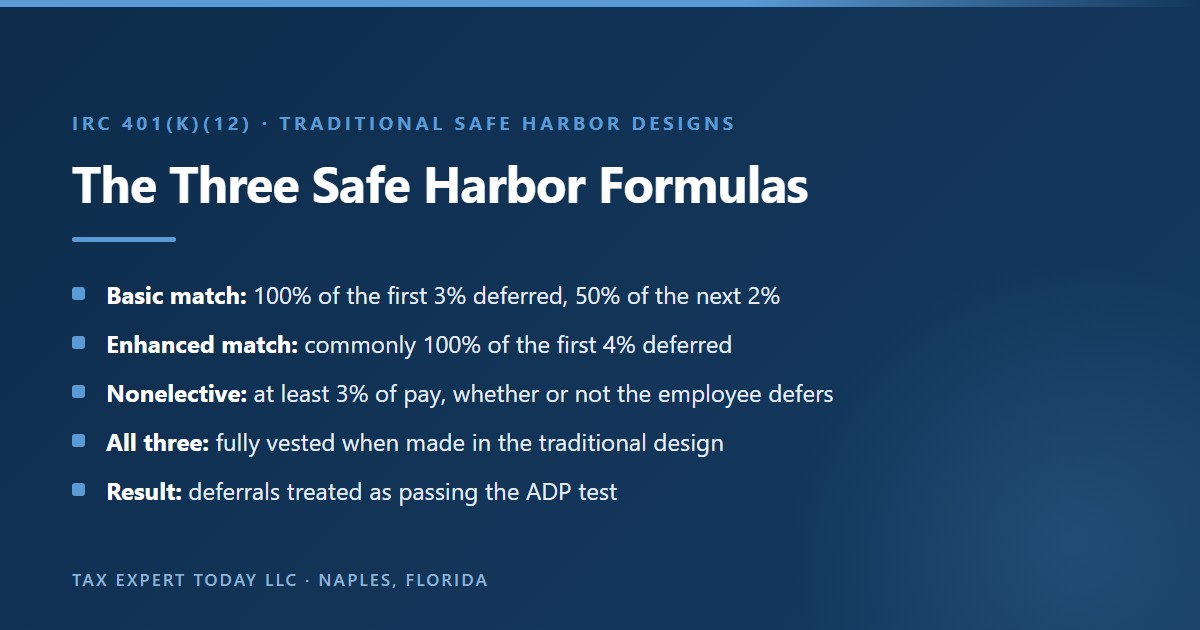
There are three standard formulas. The basic match gives 100 percent on the first 3 percent of pay deferred and 50 percent on the next 2 percent. An enhanced match gives at least as much at every deferral rate, commonly 100 percent up to 4 percent. The nonelective design gives at least 3 percent of pay to every eligible employee.
- Basic match: a maximum of 4 percent of pay for an employee who defers at least 5 percent.
- Enhanced match: any formula that never pays less than the basic match and does not rise as deferrals rise.
- Nonelective: at least 3 percent of pay, whether or not the employee defers.
- QACA versions: a lower match formula or the same 3 percent nonelective, paired with automatic enrollment.
The formulas come straight from IRC section 401(k)(12)(B) and (C) and are restated in Treasury Regulation section 1.401(k)-3. The enhanced match rule has two conditions: the aggregate match at each deferral rate must be at least what the basic formula would provide, and the rate of match may not increase as an employee’s deferral rate increases. The regulation also bars a richer match rate for a highly compensated employee than for any non-highly compensated employee at the same deferral rate.
The choice among the three is mostly a cost and behavior question. A match costs nothing for employees who do not defer, so it is usually cheaper in a workforce with low participation. A nonelective contribution costs the same no matter what employees do, but it removes the notice requirement after 2019, it can be adopted late in the year, and it supports a profit sharing design better than a match does.
| Formula | Rule | Maximum cost per employee | Cost for an employee who defers nothing |
|---|---|---|---|
| Basic match | 100% of the first 3% deferred plus 50% of the next 2% | 4% of pay | 0% |
| Enhanced match (common version) | 100% of the first 4% deferred | 4% of pay | 0% |
| Enhanced match (richer version) | 100% of the first 6% deferred | 6% of pay | 0% |
| Nonelective | At least 3% of pay to every eligible non-highly compensated employee | 3% of pay (or more if chosen) | 3% of pay |
How does the basic safe harbor match work?
The basic safe harbor match pays a dollar for each dollar an employee defers up to 3 percent of pay, then fifty cents on the dollar for deferrals between 3 and 5 percent. An employee deferring 5 percent or more receives a 4 percent match; an employee deferring nothing receives nothing from the formula.
- Tier one: 100 percent of deferrals up to 3 percent of compensation.
- Tier two: 50 percent of deferrals from 3 to 5 percent of compensation.
- Cap: 4 percent of compensation in total.
- Notice: required each year, because the match design keeps the notice rule.
The basic formula is written into IRC section 401(k)(12)(B)(i). Its appeal is that the employer pays only for participation. If half the workforce declines to defer, half the workforce costs nothing. Its drawback for an owner is that the match goes only to people who save, so it does nothing to help a profit sharing allocation pass the cross-testing rules discussed later, and it carries an annual notice obligation.
Matching contributions under a safe harbor 401k also count for the ACP test. Under IRC section 401(m)(11), a safe harbor match is treated as passing that test if no match is made on deferrals above 6 percent of pay and the match rate does not rise with the deferral rate. A plan that adds a discretionary match on top of the safe harbor match has to watch both limits or the ACP exemption is lost.
| Participant | W-2 pay | Deferral rate | Match rate earned | Match |
|---|---|---|---|---|
| Employee A | $60,000 | 4.0% | 3.5% | $2,100 |
| Employee B | $50,000 | 3.0% | 3.0% | $1,500 |
| Employee C | $45,000 | 2.0% | 2.0% | $900 |
| Employee D | $35,000 | 3.0% | 3.0% | $1,050 |
| Total for employees | $190,000 | $5,550 | ||
| Owner deferring $24,500 (9.8%) | $250,000 | 9.8% | 4.0% | $10,000 |
How does the enhanced match differ from the basic match?
An enhanced match must equal or exceed the basic match at every deferral rate, and its rate cannot increase as deferrals increase. The most common version matches 100 percent of deferrals up to 4 percent of pay, which costs slightly more than the basic formula for employees who defer between 3 and 5 percent.
- Simplicity: a single tier is easier for employees to understand.
- Cost: slightly higher than the basic match for mid-range savers.
- Ceiling for ACP relief: no match on deferrals above 6 percent of pay.
- Same notice duty: enhanced matches are matching designs and need the annual notice.
The enhanced match rule appears in IRC section 401(k)(12)(B)(iii) and Reg. 1.401(k)-3(c)(3). Employers often prefer it because “we match the first 4 percent” is easier to communicate than a two-tier formula, and the added cost is modest. The hypothetical below uses the same four employees as the basic match table.
| Participant | Deferral rate | Basic match | Enhanced 4% match | Difference |
|---|---|---|---|---|
| Employee A ($60,000) | 4.0% | $2,100 | $2,400 | $300 |
| Employee B ($50,000) | 3.0% | $1,500 | $1,500 | $0 |
| Employee C ($45,000) | 2.0% | $900 | $900 | $0 |
| Employee D ($35,000) | 3.0% | $1,050 | $1,050 | $0 |
| Total for employees | $5,550 | $5,850 | $300 |
In this hypothetical the enhanced match costs $300 more, all of it attributable to the one employee who defers between 3 and 5 percent. If employees respond to an easier message by saving more, the cost rises, which many employers regard as the point of offering a plan in the first place. The owner’s own match is the same $10,000 under either formula, because the owner defers well above 5 percent of pay.
How does the 3 percent nonelective contribution work?
The nonelective design requires the employer to contribute at least 3 percent of pay for every eligible non-highly compensated employee, whether or not that employee defers. It costs more when participation is low, but it needs no annual notice after 2019, can be adopted late in the year, and pairs naturally with profit sharing.
- Rule: at least 3 percent of compensation under IRC 401(k)(12)(C).
- Everyone eligible receives it: participation in deferrals is irrelevant.
- No annual notice: removed by SECURE Act section 103 for nonelective designs.
- Late adoption: possible at 3 percent before December 1 for a calendar year, or at 4 percent later.
The nonelective formula in IRC section 401(k)(12)(C) is the design most often chosen by owners who want to maximize their own contributions. Because every eligible employee receives the same percentage, the contribution also counts toward the gateway minimum that a cross-tested profit sharing allocation must give rank-and-file employees and toward the 3 percent top-heavy minimum under IRC section 416(c)(2). One contribution does three jobs.
The SECURE Act of 2019 made the design more flexible still. IRS Notice 2020-86, at Q&A-4, confirms that section 103 eliminated the safe harbor notice requirement for a traditional plan using the nonelective contribution. Section 103 also added the late adoption rule in section 401(k)(12)(F), which can rescue a year in which a traditional plan is headed for a failed test.
| Participant | W-2 pay | Defers? | 3% nonelective |
|---|---|---|---|
| Employee A | $60,000 | Yes, 4% | $1,800 |
| Employee B | $50,000 | Yes, 3% | $1,500 |
| Employee C | $45,000 | Yes, 2% | $1,350 |
| Employee D | $35,000 | Yes, 3% | $1,050 |
| Total for employees | $190,000 | $5,700 | |
| Owner | $250,000 | Yes | $7,500 |
In this hypothetical the nonelective design costs $150 more for employees than the basic match, because every employee in the example defers at least something. In a workforce where half the employees defer nothing, the nonelective contribution can cost noticeably more than a match. Owners comparing the two should run the numbers with their own census and should weigh the flexibility of the nonelective design, which often matters more than a few hundred dollars of cost.
| Question | Safe harbor match | 3% nonelective |
|---|---|---|
| Cost when participation is low | Lower | Higher |
| Annual safe harbor notice | Required | Not required after 2019 |
| Can be adopted after the year begins | No | Yes, under 401(k)(12)(F) |
| Counts toward a cross-testing gateway | No | Yes |
| Counts toward the top-heavy minimum | Yes, under 416(c)(2)(A) | Yes |
| Rewards employees who save | Yes | No, paid regardless |
What is a QACA safe harbor and when does it fit?
A qualified automatic contribution arrangement, or QACA, is a safe harbor 401k that automatically enrolls employees at a rising default rate and pairs that with either a smaller match or a 3 percent nonelective contribution. It allows a two-year vesting schedule, which can lower cost where employee turnover is high.
- Automatic deferral: at least 3 percent in the first period, rising to at least 6 percent by the fourth year.
- Ceiling on the default: 15 percent, or 10 percent during the first period.
- QACA match: 100 percent of the first 1 percent deferred plus 50 percent of the next 5 percent, a maximum of 3.5 percent.
- Vesting: may require up to two years of service before safe harbor money is fully vested.
The QACA rules are in IRC section 401(k)(13). The qualified percentage must be applied uniformly and must be at least 3 percent through the end of the first full plan year after the employee’s first automatic deferral, then at least 4, 5, and 6 percent in the following years. The SECURE Act raised the maximum default from 10 to 15 percent after the first period, which Notice 2020-86 confirms plans may adopt but are not required to adopt.
The QACA match is cheaper than the traditional basic match at every deferral rate of 2 percent or more, and the two-year vesting option means an employee who leaves in the first two years forfeits the safe harbor money. Those features make the QACA attractive in businesses with seasonal or short-tenure staff. The tradeoff is automatic enrollment itself: more employees participate, so a matching QACA can cost more in total than a traditional match where many employees would otherwise opt out.
A QACA can also be paired with an eligible automatic contribution arrangement under IRC section 414(w), which lets an employee who was automatically enrolled ask for a refund of those default deferrals within 90 days of the first one. That feature reduces complaints from employees who did not read the enrollment materials, and the refunded amounts are simply treated as taxable wages. Notice 2020-86, at Q&A-6, confirms that the SECURE Act did not remove the separate notice that section 414(w) requires, so a QACA using the 90-day withdrawal feature still sends an annual notice even when it uses the nonelective contribution. For an owner, the QACA decision usually turns on three practical questions: how long employees typically stay, how many would enroll without a default, and whether the business expects to cross the 10-employee threshold that brings the automatic enrollment mandate for new plans into play, a rule discussed later in this guide.
| Employee deferral rate | Traditional basic match | QACA match |
|---|---|---|
| 1% | 1.0% | 1.0% |
| 2% | 2.0% | 1.5% |
| 3% | 3.0% | 2.0% |
| 4% | 3.5% | 2.5% |
| 5% | 4.0% | 3.0% |
| 6% or more | 4.0% | 3.5% |
| Period for the employee | Minimum default rate | Maximum default rate |
|---|---|---|
| Through the end of the first full plan year after automatic deferrals begin | 3% | 10% |
| Next plan year | 4% | 15% |
| Following plan year | 5% | 15% |
| Each later plan year | 6% | 15% |
What are the 2026 contribution limits for a safe harbor 401k?
For 2026 the elective deferral limit is $24,500, catch-up is $8,000 for ages 50 and older, and ages 60 through 63 may use $11,250 instead. Total annual additions are capped at $72,000, excluding catch-up, and no more than $360,000 of pay may be counted. These figures come from IRS Notice 2025-67.
- Elective deferral limit: $24,500 under section 402(g)(1).
- Annual additions limit: $72,000 under section 415(c)(1)(A).
- Compensation cap: $360,000 under section 401(a)(17).
- Highly compensated threshold: $160,000 of prior-year pay under section 414(q)(1)(B).
Every figure in this guide was checked against the text of IRS Notice 2025-67 on the publication date. Two points trip up owners. First, the $72,000 limit in IRC section 415(c) counts the owner’s own deferrals, all employer contributions, and any after-tax contributions together, but it does not count catch-up contributions. Second, the $24,500 deferral limit is per person across all plans, while the $72,000 limit generally applies per employer, which matters to owners with more than one business.
| Limit | 2025 | 2026 | Code section |
|---|---|---|---|
| Elective deferrals | $23,500 | $24,500 | 402(g)(1) |
| Catch-up, age 50 and older | $7,500 | $8,000 | 414(v)(2)(B)(i) |
| Catch-up, ages 60 to 63 | $11,250 | $11,250 | 414(v)(2)(E)(i) |
| Annual additions to a defined contribution plan | $70,000 | $72,000 | 415(c)(1)(A) |
| Compensation that may be counted | $350,000 | $360,000 | 401(a)(17) |
| Highly compensated employee threshold | $160,000 | $160,000 | 414(q)(1)(B) |
| Key employee officer threshold | $230,000 | $235,000 | 416(i)(1)(A)(i) |
| Roth catch-up wage threshold (prior-year FICA wages) | $145,000 | $150,000 | 414(v)(7)(A) |
| SIMPLE deferral limit, for comparison | $16,500 | $17,000 | 408(p)(2)(E) |
How much can an owner contribute through a safe harbor 401k in 2026?
An owner age 50 or older with enough pay can defer $24,500 plus $8,000 of catch-up through a safe harbor 401k, receive the safe harbor contribution, and, with a profit sharing layer, receive employer money up to the $72,000 annual additions limit. In the hypothetical below that reaches $80,000 in total.
- Deferral only: $24,500 plus catch-up, limited by pay.
- Plus safe harbor: 3 or 4 percent of pay from the employer.
- Plus profit sharing: employer money up to the $72,000 annual additions limit.
- Catch-up on top: $8,000, or $11,250 at ages 60 through 63.
The table below brings the earlier examples together. It uses the same hypothetical owner, age 52 with $250,000 of W-2 pay from an S corporation, and the same four employees earning $190,000 in total. Design D adds a profit sharing contribution allocated under a new comparability formula and assumes the plan passes the nondiscrimination testing described in the next sections. None of these figures is a projection for any business; a plan’s actual results depend on its census, its document, and testing performed by its administrator.
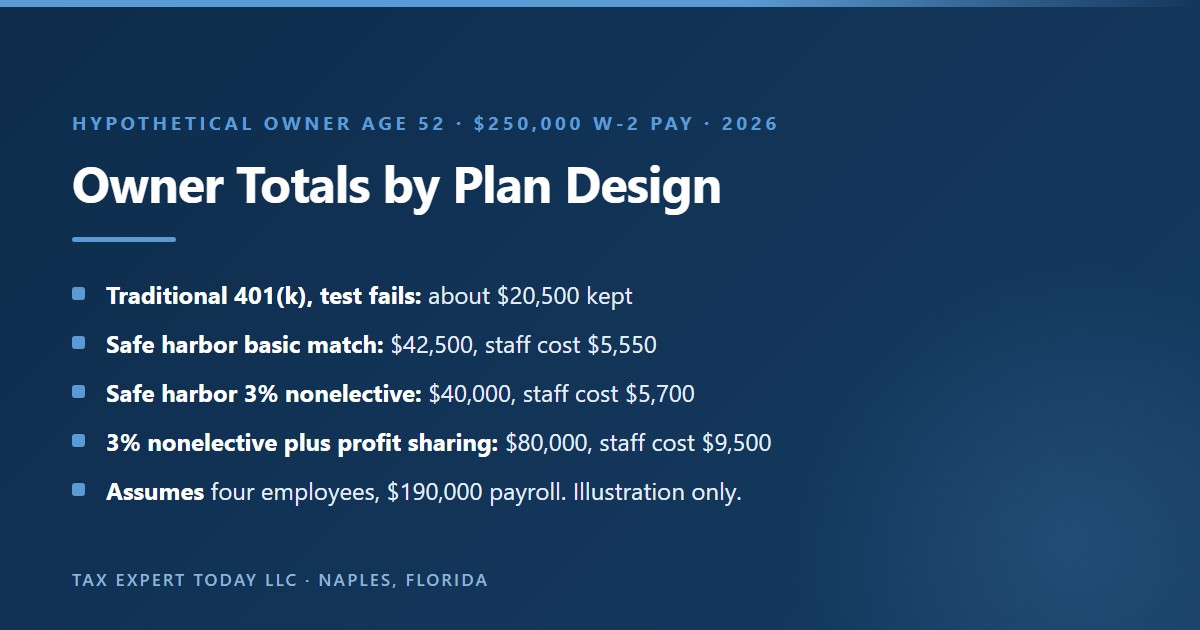
| Design | Owner deferral and catch-up | Owner employer money | Owner total | Employer cost for employees |
|---|---|---|---|---|
| A. Traditional 401(k), ADP test fails | $20,500 | $0 | $20,500 | $0 |
| B. Safe harbor basic match | $32,500 | $10,000 | $42,500 | $5,550 |
| C. Safe harbor 3% nonelective | $32,500 | $7,500 | $40,000 | $5,700 |
| D. 3% nonelective plus profit sharing | $32,500 | $47,500 | $80,000 | $9,500 |
The jump from design C to design D is the reason many owners adopt the nonelective version of the safe harbor 401k. The 3 percent contribution clears deferral testing, satisfies the top-heavy minimum, and counts toward the profit sharing gateway, so the extra $40,000 of owner profit sharing costs only another 2 percent of employee pay in this example. Whether that result holds for a particular company depends heavily on ages and pay, which is why the design is tested before it is adopted.
| Component | Amount | Counts toward $72,000? |
|---|---|---|
| Owner elective deferral | $24,500 | Yes |
| Safe harbor nonelective (3% of $250,000) | $7,500 | Yes |
| Profit sharing allocation | $40,000 | Yes |
| Subtotal of annual additions | $72,000 | At the limit |
| Catch-up contribution | $8,000 | No, excluded |
| Total owner contributions | $80,000 |
How does adding profit sharing to a safe harbor 401k raise the owner’s total?
A profit sharing contribution is discretionary employer money allocated under a formula in the plan. Layered on a safe harbor 401k, it fills the gap between the owner’s deferral plus safe harbor contribution and the $72,000 limit. A new comparability formula can direct a larger share to the owner if testing passes.
- Discretionary: the amount can usually be decided after year-end, up to the return due date.
- Allocation formula: pro rata, integrated with Social Security, or new comparability.
- Testing: the allocation must pass the general nondiscrimination test unless it is a design-based safe harbor.
- Cost of adding it: the plan loses the automatic top-heavy exemption.
A pro rata profit sharing formula gives every participant the same percentage of pay, so an owner receiving 16 percent means every employee receives 16 percent as well. A new comparability formula, sometimes called cross-testing, instead converts each allocation into an equivalent benefit at retirement age. Because an older owner has fewer years until retirement, a larger current allocation to the owner can produce a comparable projected benefit to a smaller allocation for a younger employee. The test that permits this is the general nondiscrimination test under IRC section 401(a)(4) and its regulations.
The detailed allocation formulas, and the choice among them, are a separate topic. This guide covers only how the profit sharing layer interacts with the safe harbor 401k. The interaction is the important part: in design D the safe harbor nonelective contribution is the foundation that lets the profit sharing allocation work at a reasonable cost, and the profit sharing contribution is what takes the owner from $40,000 to $80,000.
| Participant | Pay | Safe harbor 3% | Profit sharing | Total employer | Rate |
|---|---|---|---|---|---|
| Owner, age 52 | $250,000 | $7,500 | $40,000 | $47,500 | 19.0% |
| Employee A | $60,000 | $1,800 | $1,200 | $3,000 | 5.0% |
| Employee B | $50,000 | $1,500 | $1,000 | $2,500 | 5.0% |
| Employee C | $45,000 | $1,350 | $900 | $2,250 | 5.0% |
| Employee D | $35,000 | $1,050 | $700 | $1,750 | 5.0% |
| Total | $440,000 | $13,200 | $43,800 | $57,000 |
In this hypothetical about 83 percent of the employer’s $57,000 contribution is allocated to the owner. That share is what makes the design worth considering, and it is also why the IRS requires the testing described next. Owners whose W-2 pay is set under the S corporation reasonable compensation rules should know that the pay figure drives every number in this table, so the salary decision and the plan design belong in the same conversation.
What is the cross-testing gateway contribution?
A plan that tests a profit sharing allocation on projected benefits must first give every non-highly compensated participant a minimum allocation, called the gateway. The gateway is generally the lesser of 5 percent of pay or one-third of the highest allocation rate given to any highly compensated employee. A 3 percent safe harbor nonelective counts toward it.
- Purpose: prevents a cross-tested plan from giving rank-and-file employees almost nothing.
- Rate: lesser of 5 percent or one-third of the top highly compensated rate.
- Safe harbor credit: nonelective safe harbor contributions generally count toward the gateway.
- Match does not count: safe harbor matching contributions are not allocations given regardless of deferral.
The gateway is in the regulations under section 401(a)(4), at Reg. 1.401(a)(4)-8(b)(1)(vi). In design D the owner’s employer allocation rate is 19 percent of pay, so one-third of that is about 6.3 percent and the 5 percent cap controls. Each employee already receives 3 percent as a safe harbor nonelective contribution, so the profit sharing formula needs to add only 2 percent more. If the safe harbor were a match instead, the full 5 percent gateway would have to come from profit sharing, raising the cost.
| Step | Figure |
|---|---|
| Owner employer allocation ($47,500 of $250,000) | 19.0% |
| One-third of the owner’s rate | 6.33% |
| Gateway (lesser of 5% or one-third) | 5.0% |
| Already provided by the 3% safe harbor nonelective | 3.0% |
| Additional profit sharing needed for each employee | 2.0% |
| Added cost on $190,000 of employee pay | $3,800 |
| Item | Nonelective foundation | Match foundation |
|---|---|---|
| Safe harbor contribution for employees | $5,700 | $5,550 |
| Profit sharing needed to reach the 5% gateway | $3,800 | $9,500 |
| Total employer cost for employees | $9,500 | $15,050 |
This comparison shows why the nonelective version is the usual foundation for an owner-focused design. The gateway is not the end of testing. After the gateway is met, the plan still has to pass the rate group testing under section 401(a)(4), and the result turns on the ages and pay of every participant. A younger owner with older employees may find that cross-testing does not deliver a large owner share at all.
Does a safe harbor 401k avoid the top-heavy rules?
Only if the plan consists solely of safe harbor deferrals and safe harbor contributions. Under IRC section 416(g)(4)(H), adding profit sharing or other employer money ends the exemption. A plan that becomes top-heavy must give non-key employees at least 3 percent of pay, which a 3 percent nonelective already satisfies.
- Top-heavy: key employees hold more than 60 percent of plan account balances.
- Exemption: applies only to a plan with no contributions beyond the safe harbor design.
- Minimum if top-heavy: 3 percent of pay for each non-key participant, under section 416(c)(2).
- Practical effect: with a 3 percent nonelective, the minimum is generally already met.
Small owner-led plans are frequently top-heavy because the owner’s account is the largest. The exemption in IRC section 416(g)(4)(H) protects a plan that consists solely of a 401(k)(12) or 401(k)(13) arrangement and matching contributions meeting the ACP safe harbor. The IRS 401(k) plan overview states the same limit plainly: plans “that do not provide any additional contributions in a year are exempted” from the top-heavy rules.
Once profit sharing is added, the plan is tested for top-heavy status like any other plan. If it is top-heavy, section 416(c)(2) generally requires an employer contribution of at least 3 percent of pay for each non-key employee who is a participant on the last day of the year, or a lower rate equal to the highest rate given to a key employee. A 3 percent nonelective safe harbor contribution generally satisfies that minimum. A matching safe harbor design may not, because employees who defer little receive little match, which is another reason owners pair profit sharing with the nonelective design.
| Design | Top-heavy exempt? | If top-heavy, is the 3% minimum already met? |
|---|---|---|
| Safe harbor match only | Yes | Not tested |
| Safe harbor nonelective only | Yes | Not tested |
| Safe harbor match plus profit sharing | No | Only for employees whose match reaches 3%, so a top-up may be needed |
| 3% nonelective plus profit sharing | No | Generally yes |
| Safe harbor plus a discretionary match above the ACP safe harbor | No | Depends on each employee’s match |
How do the catch-up contributions work for owners over 50?
Participants age 50 or older by year-end may defer an extra $8,000 in 2026, and those who turn 60, 61, 62, or 63 during the year may defer $11,250 instead. Catch-up contributions do not count toward the $72,000 annual additions limit and are not included in ADP testing.
- Age 50 rule: attaining age 50 by December 31 is enough for the whole year.
- Ages 60 to 63: the higher $11,250 amount under the SECURE 2.0 Act.
- Age 64 and later: the amount returns to the standard catch-up limit.
- Plan must permit it: catch-up is optional for the plan, but common.
Catch-up contributions are governed by IRC section 414(v). For an owner, the catch-up sits outside both of the limits that usually bind. It is above the $24,500 deferral limit and outside the $72,000 annual additions limit. An owner at the $72,000 ceiling through deferrals, safe harbor, and profit sharing can still add the catch-up, which is why design D in this guide totals $80,000 rather than $72,000.
| Owner age at year-end | Annual additions | Catch-up | Total possible |
|---|---|---|---|
| Under 50 | $72,000 | $0 | $72,000 |
| 50 to 59 | $72,000 | $8,000 | $80,000 |
| 60 to 63 | $72,000 | $11,250 | $83,250 |
| 64 or older | $72,000 | $8,000 | $80,000 |
Owners in their early sixties sometimes add a defined benefit layer at the same time, because the four-year window for the larger catch-up often lines up with the last working years before a sale or retirement. That combination is outside the scope of this guide and is discussed in our article on the cash balance plan for business owners. Owners who are already at the $72,000 limit and want more after-tax room in the same plan should also read about the mega backdoor Roth, which works only when the annual additions limit is not already used up.
Must an owner’s catch-up be Roth in 2026?
Yes, if the owner’s FICA wages from the employer sponsoring the plan exceeded $150,000 in 2025. Under IRC section 414(v)(7), that participant’s 2026 catch-up contributions must be designated Roth contributions. The $8,000 or $11,250 still goes in, but it is taxed now rather than deducted.
- Test: prior calendar year wages under section 3121(a) from the plan sponsor.
- 2026 threshold: $150,000 of 2025 FICA wages, per Notice 2025-67.
- Effect: catch-up is after-tax going in and potentially tax-free coming out.
- Plan requirement: the plan must offer a Roth option or no one may make catch-up contributions.
The SECURE 2.0 Act added IRC section 414(v)(7). It provides that, for an eligible participant whose wages for the preceding calendar year from the employer sponsoring the plan exceed the threshold, catch-up contributions are permitted “only if” they are designated Roth contributions. Notice 2025-67 sets the threshold that applies for 2026 at $150,000, measured on 2025 wages, up from $145,000.
Two features matter to owners in particular. The test uses FICA wages, so a sole proprietor or partner with self-employment income and no W-2 wages from the business is generally outside it, while an S corporation owner with a salary above the threshold is inside it. The statute also says that if any participant is subject to the rule, the plan must let catch-up contributions be made as Roth, or catch-up is not available to anyone under the plan. A safe harbor 401k without a Roth feature therefore needs an amendment before an owner over the threshold can use catch-up at all.
| Owner | 2025 wages from the plan sponsor | 2026 catch-up must be Roth? |
|---|---|---|
| S corporation owner, W-2 salary $250,000 | $250,000 | Yes |
| S corporation owner, W-2 salary $120,000 | $120,000 | No, pre-tax or Roth by choice |
| Sole proprietor with $300,000 of net earnings | No FICA wages from the business | Generally no |
| Owner who joined a new employer in 2026 | No 2025 wages from that employer | No for 2026 |
For the hypothetical owner in this guide, the $8,000 catch-up is a Roth contribution. At an assumed 32 percent federal marginal rate that means about $2,560 of tax is paid now rather than deferred. Whether that is a cost or an advantage depends on the owner’s expected tax rate in retirement. For a Florida resident with no state income tax who expects to remain in Florida, the Roth catch-up removes future federal tax on that money and its growth if the qualified distribution rules are later met. Owners weighing Roth money more broadly may find our guide to the backdoor Roth IRA useful, since it applies at the IRA level rather than inside the plan.
What compensation counts for an S corporation owner?
For an S corporation owner, only W-2 wages count as compensation for a safe harbor 401k. Shareholder distributions do not. Deferrals, the safe harbor percentage, profit sharing, and the deduction limit are all computed from the W-2 salary, so the reasonable compensation decision directly sets how much the owner can contribute.
- Counts: W-2 salary, bonus, and other wages reported for the owner.
- Does not count: distributions of S corporation profit reported on Schedule K-1.
- Cap: no more than $360,000 of pay may be counted in 2026.
- Timing: deferrals must come out of pay actually paid in the year.
Compensation for retirement plan purposes is defined by reference to IRC section 415(c)(3), and for an S corporation shareholder-employee that is the W-2 wage. The profit that flows to the owner on Schedule K-1 is not earned income for plan purposes. That creates a familiar tension: a lower salary reduces payroll taxes, while a higher salary increases how much can go into the plan.
The table below shows the employer allocation rate the hypothetical owner would need to reach the $72,000 annual additions limit at different salary levels, assuming a $24,500 deferral and a 3 percent nonelective contribution. At lower salaries the required rate rises sharply, and very high rates make cross-testing harder to pass. Above $360,000, extra salary adds nothing for plan purposes, because the compensation cap stops counting it.
| Owner W-2 salary | 3% nonelective | Profit sharing needed | Total employer rate needed |
|---|---|---|---|
| $150,000 | $4,500 | $43,000 | 31.7% |
| $200,000 | $6,000 | $41,500 | 23.8% |
| $250,000 | $7,500 | $40,000 | 19.0% |
| $300,000 | $9,000 | $38,500 | 15.8% |
| $360,000 | $10,800 | $36,700 | 13.2% |
| $400,000 | $10,800 (capped pay) | $36,700 | 13.2% of capped pay |
Salary also has to be paid when the deferral is made. An owner who takes most of the year’s compensation as a single December bonus can defer from that bonus only if the plan’s definition of compensation includes bonuses and payroll processes the election in time. The reasonable compensation analysis itself is covered in our guide to S corporation reasonable compensation. Owners who reimburse themselves for business expenses through payroll should also keep those amounts off the W-2 under an accountable plan, because reimbursements under a proper plan are not wages and do not raise the plan compensation base.
How do sole proprietors and partners calculate contributions?
A sole proprietor or partner uses earned income, which is net self-employment earnings reduced by the deduction for half of self-employment tax and by the owner’s own employer contributions. That circular calculation lowers the effective employer rate, so a nominal 25 percent profit sharing rate works out to about 20 percent of net earnings.
- Earned income: defined in IRC section 401(c)(2).
- Reductions: half of self-employment tax and the owner’s own employer contributions.
- Deferrals: still limited to $24,500 plus catch-up.
- Deduction: owner contributions are deducted on Form 1040, not on the business return.
For self-employed owners, IRC section 401(c)(2) defines earned income as net earnings from self-employment, taking into account the deduction allowed for the plan contributions themselves. Because the contribution reduces the base on which it is computed, the effective rate is lower than the stated rate. IRS Publication 560 contains the worksheets used to make the calculation, and the result interacts with the self-employment tax computation covered in our self-employment tax calculator.
| Stated employer rate in the plan | Approximate effective rate on net earnings after the half SE tax deduction |
|---|---|
| 3% | About 2.91% |
| 10% | About 9.09% |
| 15% | About 13.04% |
| 25% | About 20.00% |
Partnerships add a second layer. The employer contribution for a partner is generally treated as made on the partner’s behalf and is deducted by the partner rather than reducing the partnership’s ordinary income allocated to others, so the partnership agreement and the plan’s allocation formula need to agree on who bears the cost. In a multi-owner practice, the safe harbor contribution for staff is a business expense that the partners share, while each partner’s own contribution is a personal deduction. Getting that allocation wrong is a common source of disputes among partners and of errors on Schedules K-1.
Who counts as a highly compensated or key employee?
A highly compensated employee for 2026 is anyone who owned more than 5 percent of the business in 2025 or 2026, or who earned more than $160,000 in 2025. Ownership is attributed between family members, so an owner’s spouse, children, and parents are generally highly compensated regardless of their pay.
- Ownership test: more than 5 percent in the current or preceding year.
- Pay test: more than $160,000 in the preceding year, optionally limited to the top 20 percent of earners.
- Family attribution: under section 318, through section 416(i)(1)(B)(iii).
- Key employee: a separate top-heavy definition, including officers paid more than $235,000.
The definition is in IRC section 414(q). Safe harbor contributions are required only for non-highly compensated employees, so a plan may exclude the owner and family members from the safe harbor contribution, although most owner-focused designs include them so the owner receives the contribution as well. Family attribution surprises many owners: a spouse who works part time in the business and earns $30,000 is still highly compensated because the spouse is treated as owning the owner’s shares.
| Person | Facts | Highly compensated? | Key employee? |
|---|---|---|---|
| Owner | 100% shareholder, $250,000 salary | Yes, more than 5% owner | Yes, more than 5% owner |
| Owner’s spouse | No shares in own name, $30,000 salary | Yes, by family attribution | Yes, by attribution |
| Office manager | No shares, $165,000 salary in 2025 | Yes, pay above $160,000 | Only if an officer above $235,000 |
| Employee A | No shares, $60,000 salary | No | No |
Family attribution also affects the gateway and testing results. When a spouse and an adult child are both highly compensated, the profit sharing design has to account for their allocations, and the one-third gateway is measured against the highest highly compensated rate in the group. Families that employ relatives should provide the plan administrator with ownership and family details each year rather than assume the census captures them.
Which employees must be covered?
A safe harbor 401k must cover employees who meet the plan’s age and service rules, which may be as strict as age 21 and one year of service. Long-term part-time employees must be allowed to defer after two consecutive years of at least 500 hours, but they may be excluded from safe harbor employer contributions.
- Maximum entry conditions: age 21 and one year of service under section 410(a).
- Long-term part-time workers: deferral rights after two consecutive years of 500 or more hours.
- Related businesses: controlled and affiliated service groups are treated as one employer.
- Coverage testing: the plan must still benefit enough non-highly compensated employees under section 410(b).
Entry conditions are written into the plan document, and the safe harbor contribution goes to every eligible non-highly compensated employee who meets them. Section 416(g)(4)(H) confirms that a plan does not lose its top-heavy exemption merely because it gives no matching or nonelective contributions to long-term part-time employees described in section 401(k)(15)(B)(i). That is a meaningful cost control for businesses with many part-time workers.
Owners of more than one company must look at the group as a whole. Under the controlled group and affiliated service group rules in IRC section 414(b), (c), and (m), a second business with common ownership can be treated as the same employer. A safe harbor 401k at one company that ignores employees of a commonly owned second company may fail coverage, and the owner’s $72,000 limit is generally shared across the group.
A common example in professional practices is an owner who runs an operating company and a separate management or real estate company that employs one or two people. If the two companies are under common control, the employees of the second company count when the plan tests coverage, even though they never appear on the operating company’s payroll. The fix may be as simple as having the second company adopt the plan as a participating employer, which brings its employees into the safe harbor contribution and keeps the testing clean. Spouses who each own a separate business can also be linked through the attribution rules, particularly when they have minor children, so a married couple with two companies should have the controlled group question answered before either plan is designed. Ignoring the issue does not make it go away; it usually surfaces years later in a plan audit or during due diligence for a sale, when correction is more expensive.
| Plan choice | Effect on who receives the safe harbor contribution |
|---|---|
| Immediate entry for all employees | Highest cost; covers new hires at once |
| Age 21 and one year of service | Lowest cost permitted for full contributions |
| Separate, earlier entry for deferrals only | Employees may defer sooner; safe harbor may follow the stricter rule if the plan is tested accordingly |
| Long-term part-time employees | May defer; may be excluded from safe harbor money |
| Commonly owned second business | Must be considered for coverage and limits |
What is the deduction limit for employer contributions?
Employer contributions to a safe harbor 401k with profit sharing are generally deductible up to 25 percent of the total compensation paid to all participants, under IRC section 404(a)(3). Elective deferrals do not count against that limit. Contributions are deductible for a year if paid by the business’s return due date, including extensions.
- Limit: 25 percent of aggregate covered compensation, not of each person’s pay.
- Deferrals excluded: section 404(n) keeps elective deferrals outside the 25 percent limit.
- Timing: payment by the extended due date counts for the prior year under section 404(a)(6).
- Excess: nondeductible contributions may trigger a 10 percent excise tax under section 4972.
The deduction limit in IRC section 404(a)(3) is measured across the whole plan. In design D, covered pay is $440,000, so the limit is $110,000, well above the $57,000 of employer contributions. The limit binds more often in a company with one highly paid owner and no other employees, where 25 percent of the owner’s pay may be less than the room left under the $72,000 limit.
| Item | Amount |
|---|---|
| Total covered compensation | $440,000 |
| Deduction limit at 25% | $110,000 |
| Safe harbor nonelective (owner and employees) | $13,200 |
| Profit sharing (owner and employees) | $43,800 |
| Total employer contributions | $57,000 |
| Room left under the limit | $53,000 |
| Owner elective deferrals (not counted) | $24,500 plus $8,000 catch-up |
Timing has its own trap. Notice 2020-86, Q&A-9 explains that a late 4 percent nonelective contribution made after the prior year’s return due date, including extensions, is not deductible for that prior year; it is deductible in the year it is paid. Owners who adopt the late 4 percent design need to fund it before the business return is filed if they want the deduction on that return.
How do employer contributions interact with the QBI deduction?
For a pass-through owner, employer contributions reduce business income, and reduced business income reduces the 20 percent qualified business income deduction. In a simple case each dollar of employer contribution lowers taxable income by about 80 cents, not a full dollar, which reduces the federal tax saving by roughly one-fifth.
- Deduction first: plan contributions reduce the business’s net income.
- QBI effect: the section 199A deduction is computed on that lower income.
- Net effect: taxable income falls by about 80 percent of the contribution when the 20 percent deduction is fully available.
- Exceptions: the result differs above the income thresholds for specified service businesses.
The qualified business income deduction under IRC section 199A is generally 20 percent of qualified business income. Retirement plan contributions attributable to the business reduce that income. Our guide to the qualified business income deduction explains the wage and property limits and the specified service business phase-out, which can change the result in either direction for higher-income owners.
| Contribution | Amount | Tax effect without QBI interaction | Tax effect with QBI interaction |
|---|---|---|---|
| Owner pre-tax deferral | $24,500 | About $7,840 deferred | About $7,840 deferred (wages are not QBI) |
| Owner Roth catch-up | $8,000 | No current deduction | No current deduction |
| Employer contributions for the owner | $47,500 | About $15,200 | About $12,160 |
| Employer contributions for employees | $9,500 | About $3,040 | About $2,432 |
The owner’s elective deferral comes out of W-2 wages, which are not qualified business income, so the deferral’s tax effect is not reduced by the QBI interaction. The employer contributions are deducted by the S corporation and reduce the income that passes through. In this hypothetical, the employer’s $9,500 cost for employees has an after-tax cost closer to $7,068 once the reduced QBI deduction is considered. Every figure here is an illustration at an assumed rate; actual results depend on the owner’s full return.
When must the safe harbor notice be delivered?
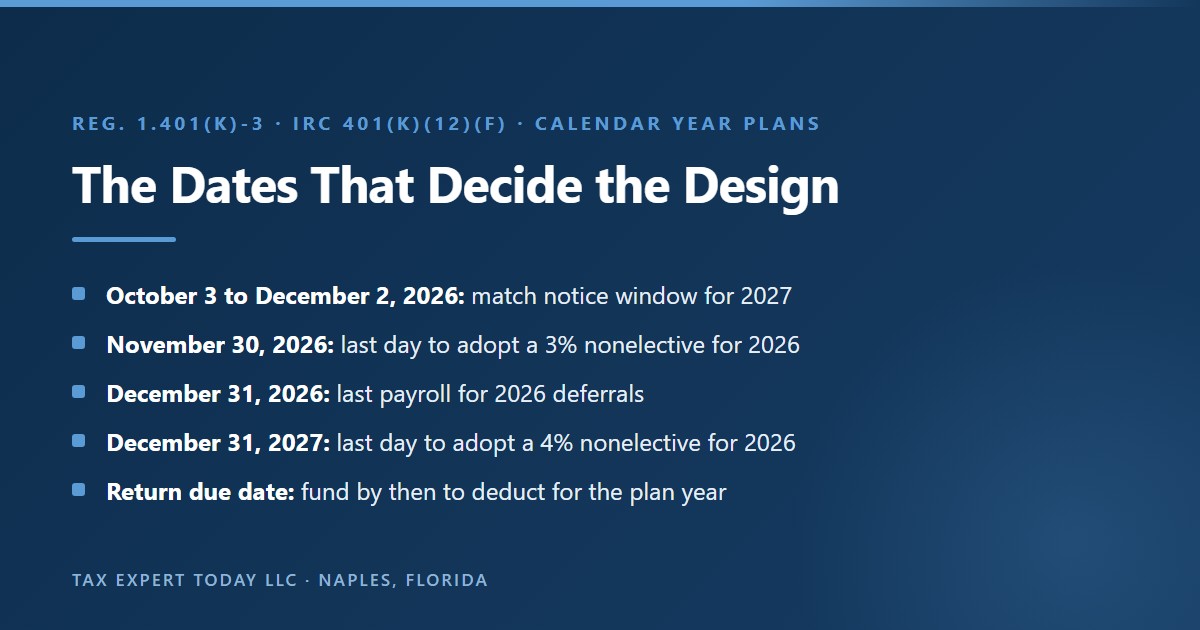
For a matching safe harbor 401k, each eligible employee must receive a written notice within a reasonable period before the plan year, which is deemed met if delivered 30 to 90 days in advance. For a calendar 2027 plan year, that window runs from October 3 through December 2, 2026. Nonelective designs no longer require it.
- Deemed timely: at least 30 and no more than 90 days before the plan year begins.
- New employees: no more than 90 days before, and no later than, the date of eligibility.
- Content: the formula, other contributions, the plan to which they are made, and election procedures.
- Nonelective plans: no annual notice after 2019, though a notice can preserve the ability to suspend.
The notice requirement is in IRC section 401(k)(12)(D), and Reg. 1.401(k)-3(d)(3)(ii) provides the deemed timing rule: the notice is timely if it is given “at least 30 days (and no more than 90 days)” before the beginning of each plan year. The IRS safe harbor notice page repeats that rule and adds that a notice outside the window is judged on all the facts and circumstances.
The SECURE Act changed the picture for nonelective plans. Notice 2020-86, Q&A-4 states that section 103 eliminated the safe harbor notice requirement for a traditional plan using the nonelective contribution. Q&A-7 explains that an employer may still provide a notice containing the statement that contributions may be reduced or suspended mid-year, which keeps that option available. Many nonelective plans continue to send a notice for that reason.
| Plan year | Earliest deemed-timely date | Latest deemed-timely date | Designs that must send it |
|---|---|---|---|
| 2027 | October 3, 2026 | December 2, 2026 | Basic match, enhanced match, QACA match |
| 2027 (nonelective design) | Same window if sent | Same window if sent | Not required; optional to preserve suspension rights |
| New employee eligible March 1, 2027 | December 1, 2026 | March 1, 2027 | Matching designs |
Practitioners often target the first business day of December or earlier, because a notice delivered on December 3 for a January 1 plan year falls outside the deemed window and has to be defended on the facts. Electronic delivery is generally permitted when the plan follows the IRS rules for electronic notices. The notice must be written in a way the average eligible employee can understand, which in a bilingual workforce may mean more than one language.
Can a safe harbor 401k be adopted late in the year?
Yes, for the nonelective design. Under IRC section 401(k)(12)(F), a plan may adopt a 3 percent nonelective contribution for the current year if the amendment is adopted before the 30th day before the year ends, which is December 1 for a calendar year. A 4 percent contribution may be adopted until the end of the following plan year.
- 3 percent window: amendment adopted before December 1, 2026, for a calendar 2026 plan year.
- 4 percent window: amendment adopted by December 31, 2027, for the same 2026 plan year.
- Not available: if the plan provided a safe harbor match at any time during the year.
- Deferrals already made: late adoption protects deferrals already taken from pay; it cannot create new ones for a closed year.
The SECURE Act added this rule in section 401(k)(12)(F). Clause (i) permits the amendment “at any time before the 30th day before the close of the plan year,” or later, up to the last day for distributing excess contributions for the year, which is generally the end of the following plan year. Clause (iii) adds the condition that the later route requires a contribution of at least 4 percent of pay. Notice 2020-86 restates both conditions and the exception for plans that used a safe harbor match during the year.
This is the most useful December planning tool in the safe harbor rules. A traditional 401(k) whose mid-year testing projection shows the owner will receive a refund can be amended to a 3 percent nonelective safe harbor before December 1, and the year’s deferrals then pass automatically. If the deadline has passed, the 4 percent route remains open until the end of 2027, but the contribution then has to be paid for the deduction to fall in the right year.
| Amendment adopted | Required rate | Cost for employees | Owner contribution | Deductible for 2026 if paid |
|---|---|---|---|---|
| On or before November 30, 2026 | 3% | $5,700 | $7,500 | By the 2026 return due date with extensions |
| December 1, 2026 through December 31, 2027 | 4% | $7,600 | $10,000 | By the 2026 return due date with extensions; otherwise deductible when paid |
| Plan used a safe harbor match during 2026 | Not available | Not applicable | Not applicable | Not applicable |
The late adoption rule protects deferrals that were actually withheld from pay during 2026. It does not let an owner who deferred only a small amount during the year go back and defer the full $24,500 after the year has ended, because elective deferrals must come from compensation that had not yet been paid when the election was made. Owners who want to use the rule for the current year should increase payroll deferrals before the last paychecks of the year, then rely on the amendment to make those deferrals pass.
The late route also changes the order in which a December planning meeting runs. The first question is whether the traditional plan is actually headed for a failed test, which the plan administrator can usually estimate from year-to-date payroll data. The second is the cost of the cure: in the four-employee example, the 3 percent route costs $5,700 for employees, while the expected refund to the owner under a failed test would be about $12,000 of deferrals pushed back into taxable income. The third is whether a profit sharing contribution should be layered on top for the same year, since the nonelective contribution adopted late can serve as the foundation for a profit sharing allocation decided after year-end. Because the amendment must be adopted before December 1 for the 3 percent rate, the meeting itself needs to happen in October or early November, not at the holiday party.
Can an existing 401(k) be converted to safe harbor mid-year?
A traditional 401(k) generally cannot add a safe harbor match after the plan year begins, because Reg. 1.401(k)-3(e) requires safe harbor terms to be in place for a full 12-month year. The exception is the late nonelective route under section 401(k)(12)(F). New plans may start with a short first year of at least three months.
- Full-year rule: safe harbor provisions adopted before the plan year and kept for 12 months.
- Nonelective exception: late adoption at 3 or 4 percent under the SECURE Act.
- New plans: a first plan year of at least three months is permitted.
- Brand-new businesses: a shorter first year is allowed if the plan is set up as soon as feasible.
Reg. 1.401(k)-3(e)(1) states the general rule that safe harbor provisions must be “adopted before the first day of the plan year and remain in effect for an entire 12-month plan year.” Paragraph (e)(2) carves out a newly established plan, which may have a short initial plan year if it lasts at least three months, so a new safe harbor 401k effective October 1 works for a calendar year, while one effective November 1 generally does not.
| Situation | Rule | Latest practical effective date for 2026 |
|---|---|---|
| New plan, existing business | Initial plan year of at least 3 months | October 1, 2026 |
| New plan, business formed in 2026 | Shorter first year if set up as soon as administratively feasible | Facts and circumstances |
| Existing traditional 401(k) adding a match | Full 12-month year required | January 1, 2027 |
| Existing traditional 401(k) adding a nonelective | Late adoption under 401(k)(12)(F) | November 30, 2026 at 3%; December 31, 2027 at 4% |
Because of these limits, the fourth quarter is when owners decide next year’s design. An owner who wants a matching safe harbor 401k for 2027 has to sign the amendment and deliver the notice by early December 2026. An owner who wants a nonelective design has more room, which is another reason the nonelective version is often the default recommendation for owner-heavy plans.
Can safe harbor contributions be reduced or suspended mid-year?
Yes, but only under strict conditions. The employer must be operating at an economic loss or have told employees in advance that a suspension is possible, must give a supplemental notice, and must wait at least 30 days. The plan then must pass ADP and ACP testing for the whole year.
- Trigger: economic loss for the year, or a reservation of the right in the prior notice.
- Supplemental notice: to every eligible employee, explaining the change and its timing.
- Waiting period: effective no earlier than 30 days after the notice or the amendment date, if later.
- Consequence: full-year ADP and ACP testing, and possible top-heavy exposure.
The rules are in Reg. 1.401(k)-3(g), with parallel paragraphs for matching and nonelective designs. In each case the employer must either be “operating at an economic loss” as described in section 412(c)(2)(A) or must have included in the original notice a statement that the plan may be amended during the year to reduce or suspend contributions. Employees must receive a supplemental notice and a reasonable chance to change their deferral elections, and the employer must make the safe harbor contributions earned through the effective date.
| Condition | What it requires |
|---|---|
| Permitted reason | Economic loss for the year, or an advance statement in the safe harbor notice |
| Supplemental notice | Given to all eligible employees, explaining the effect and the effective date |
| Effective date | No earlier than the later of the amendment date or 30 days after the notice |
| Election opportunity | Employees may change deferral elections before the change takes effect |
| Contributions already earned | Must still be made for compensation through the effective date |
| Testing for the year | The plan must pass ADP and ACP testing using the current year testing method |
This is why many advisors recommend that even a nonelective plan send a notice with the reservation statement. It costs little and keeps an exit open if revenue falls sharply. A business that suspends contributions should expect the owner’s deferrals to be tested for the whole year, so the owner may face a corrective refund in the same year the business is under pressure.
Which mid-year changes are prohibited?
IRS Notice 2016-16 allows most mid-year changes to a safe harbor plan if updated notices are given, but prohibits several: lengthening QACA vesting, narrowing the group eligible for safe harbor money, switching between traditional and QACA designs, and increasing or adding a match formula unless done early and retroactively.
- QACA vesting: may not be made longer during the year.
- Eligible group: may not be narrowed for safe harbor contributions.
- Plan type: may not switch from traditional to QACA, or the reverse, mid-year.
- Match increases: permitted only if adopted at least three months before year-end and made retroactive.
Notice 2016-16 takes a general approach: a mid-year change to a safe harbor plan or notice does not violate the safe harbor rules merely because it is mid-year, provided updated notice and election opportunity conditions are met and the change is not on the prohibited list. Section III.D of the notice lists the prohibited changes, and section III.B separately preserves the regulatory rules for late adoption and for suspension.
| Change | Status |
|---|---|
| Increase QACA vesting service requirement | Prohibited |
| Reduce or narrow the employees eligible for safe harbor contributions | Prohibited (permissible entry date changes for not-yet-eligible employees aside) |
| Change from traditional safe harbor to QACA, or the reverse | Prohibited |
| Add or increase a match formula, or allow discretionary matching | Prohibited unless adopted at least 3 months before year-end, noticed, and retroactive for the full year |
| Increase the nonelective rate from 3% to 4% | Generally permitted with updated notice where a notice applies |
| Add a Roth feature or change investment options | Generally permitted with updated notice |
| Reduce or suspend safe harbor contributions | Only under Reg. 1.401(k)-3(g) |
Adding a Roth option mid-year has become common because of the Roth catch-up rule. A plan that discovers in 2026 that an owner’s catch-up must be Roth can usually add Roth deferrals mid-year with an updated notice, which avoids leaving the owner unable to make catch-up contributions for the rest of the year.
What tax credits help a small employer start a safe harbor 401k?
An eligible employer starting a new plan may claim the section 45E startup credit for administrative costs, generally up to $5,000 a year for three years, plus a separate credit for employer contributions of up to $1,000 per employee earning under an inflation-adjusted $100,000, phasing down over five years.
- Startup cost credit: 50 percent of qualified costs, or 100 percent for employers with 50 or fewer employees.
- Startup cap: greater of $500 or the lesser of $250 per eligible non-highly compensated employee or $5,000.
- Contribution credit: up to $1,000 per employee, at 100, 100, 75, 50, and 25 percent over five years.
- New plans only: no qualified plan for substantially the same employees in the prior three years.
The credits are in IRC section 45E. The employer contribution credit in subsection (f) applies to contributions other than elective deferrals and excludes employees whose FICA wages exceed $100,000 as adjusted for inflation, so an owner’s own contribution generally does not generate it. For employers with more than 50 employees, the contribution credit phases down by 2 percentage points for each employee over 50. Credits reduce the related deduction to prevent a double benefit.
| Year | Applicable percentage | Contribution credit (four employees, capped at $1,000 each) | Startup cost credit cap |
|---|---|---|---|
| Year plan is established | 100% | $4,000 | $1,000 |
| Following year | 100% | $4,000 | $1,000 |
| Second following year | 75% | $3,000 | $1,000 |
| Third following year | 50% | $2,000 | $0 |
| Fourth following year | 25% | $1,000 | $0 |
In this hypothetical, the employer’s $5,700 safe harbor cost for employees in the first year would be offset by up to $4,000 of contribution credit, because each employee’s 3 percent contribution exceeds $1,000 and all four earn less than the wage limit. The startup cost credit cap is $1,000 here because the cap is $250 times four eligible non-highly compensated employees. Credit eligibility turns on the employer’s history and size, so the figures are illustrations only.
Does a new safe harbor 401k have to automatically enroll employees?
Most 401(k) plans established after December 29, 2022 must automatically enroll employees under IRC section 414A, starting at 3 to 10 percent and increasing each year. Businesses under three years old and those that normally employ 10 or fewer employees are exempt until they grow past those limits.
- Applies to: new 401(k) and 403(b) plans established after the SECURE 2.0 Act was enacted.
- Exempt: plans that existed before enactment, SIMPLE 401(k) plans, governmental and church plans.
- New business exception: employer in existence for less than three years.
- Small business exception: until one year after the year the employer normally employs more than 10 employees.
IRC section 414A imposes the mandate, and subsection (c) lists the exceptions. A five-person business like the one in this guide would generally fall within the small business exception, so it could adopt a traditional safe harbor 401k without automatic enrollment. A business that expects to grow past 10 employees should know that the mandate will eventually apply, and a QACA design, which already includes automatic enrollment, may be a smoother long-term fit.
| Employer profile | Section 414A mandate | Design often considered |
|---|---|---|
| Plan established before December 29, 2022 | Not subject | Traditional safe harbor or QACA |
| New plan, business under three years old | Exempt while under three years | Traditional safe harbor, revisited at year three |
| New plan, 10 or fewer employees | Exempt until growth triggers it | Traditional safe harbor |
| New plan, more than 10 employees, established business | Subject | QACA, or traditional safe harbor with a compliant automatic feature |
How does a safe harbor 401k compare with a SIMPLE IRA or a SEP?
A SIMPLE IRA is cheaper to run but caps 2026 deferrals at $17,000 and allows no profit sharing. A SEP allows only employer contributions, at the same percentage of pay for everyone. A safe harbor 401k costs more to administer but permits the $24,500 deferral, catch-up, Roth, and a profit sharing layer.
- SIMPLE IRA: lower deferral limit, mandatory 3 percent match or 2 percent nonelective, 100 or fewer employees.
- SEP: no employee deferrals, uniform percentage of pay, up to the $72,000 limit.
- Safe harbor 401k: highest owner potential, highest administration cost and filing burden.
- Exclusive plan rule: a SIMPLE IRA generally cannot be maintained alongside another plan in the same year.
The SIMPLE IRA rules are in IRC section 408(p), with the 2026 deferral limit of $17,000 confirmed in Notice 2025-67. A SEP under section 408(k) allows only employer contributions, and those contributions must be the same percentage of pay for every eligible employee, so an owner who wants 20 percent of pay for themselves must give 20 percent to every eligible employee. The IRS guide to choosing a 401(k) plan and the related IRS pages on SEP and SIMPLE plans set out the same contrasts.
| Feature | SIMPLE IRA | SEP | Safe harbor 401k with profit sharing |
|---|---|---|---|
| Owner deferral | $17,000 | None | $24,500 |
| Owner catch-up at 52 | Yes, at the SIMPLE amount | None | $8,000 |
| Employer contribution for owner | 3% match, about $7,500 | Up to 25% of pay, $62,500 | $47,500 in design D |
| Cost for employees at the owner’s maximum | 3% match or 2% nonelective | Same rate as the owner, up to $47,500 | $9,500 in design D |
| Roth deferrals | Permitted under SECURE 2.0 if the provider offers them | Roth SEP contributions permitted if offered | Yes |
| Annual Form 5500 filing | No | No | Generally Form 5500-SF |
The SEP comparison shows why the safe harbor 401k with profit sharing often wins for an owner with employees. To reach a large owner contribution through a SEP, the employer must give every eligible employee the same high percentage. In the hypothetical, a 19 percent SEP contribution for the owner would mean 19 percent for each employee, about $36,100, compared with $9,500 under design D. The SEP remains attractive for owners with no employees or with employees who are not yet eligible, because it is simple and needs no annual filing.
When does a cash balance plan belong on top of a safe harbor 401k?
A cash balance plan belongs on top of a safe harbor 401k when the owner already reaches the $72,000 defined contribution limit, has stable profits, and wants to deduct far more each year, often for a planned sale or retirement within five to ten years. The 401(k) usually remains the foundation for deferrals and testing.
- Trigger: owner at the $72,000 limit with more to save.
- Profile: stable or rising profits and an owner generally in their late forties or older.
- Commitment: required annual funding determined by an actuary.
- Interaction: combined deduction and testing rules affect the 401(k) side.
A cash balance plan is a defined benefit plan, subject to a different limit under IRC section 415(b), which Notice 2025-67 sets at an annual benefit of $290,000 for 2026. Combining the two plans brings in rules that limit the 401(k) side, including combined deduction limits and testing that treats the plans together. When the employer contributions to the defined contribution plan exceed 6 percent of pay, the combined deduction limit in section 404(a)(7) generally comes into play, which is one reason combined designs often hold the profit sharing layer near 6 percent.
The design and funding questions are covered in detail in our guide to the cash balance plan for business owners. For this guide, the point is sequencing. The safe harbor 401k comes first, because it secures the owner’s deferral and supplies the staff contribution that the combined design builds on. A cash balance layer makes sense only when cash flow can support a required contribution every year, which a 13-week cash flow forecast can help test.
| Layer | What it adds | Main constraint |
|---|---|---|
| 1. Safe harbor 401k deferrals | $24,500 plus catch-up with no ADP risk | Owner’s pay |
| 2. Safe harbor contribution | 3 to 4 percent of pay; satisfies top-heavy and gateway | Required every year |
| 3. Profit sharing | Employer money up to $72,000 in total additions | Cross-testing and the 25% deduction limit |
| 4. Cash balance plan | Large additional deductible contributions | Required funding, actuarial costs, combined limits |
What does a safe harbor 401k cost an owner in a bad year?
In a bad year the safe harbor contribution is still owed unless the plan follows the suspension rules, while the profit sharing layer can usually be reduced to zero. In design D, the fixed floor is the $5,700 safe harbor cost for employees; the $3,800 profit sharing gateway falls away if no profit sharing is made.
- Fixed: the safe harbor contribution for the full year, absent a valid suspension.
- Flexible: discretionary profit sharing, decided after the year ends.
- Owner side: the owner can reduce their own deferral at any time.
- Planning tool: a reservation statement in the notice keeps suspension available.
This flexibility is a key advantage of combining a safe harbor 401k with discretionary profit sharing rather than relying on a large fixed formula. The owner decides the profit sharing amount after seeing the year’s results and can make it as late as the return due date with extensions. Only the safe harbor portion is locked in at the start of the year.
| Component | Strong year (design D) | Weak year (no profit sharing) |
|---|---|---|
| Safe harbor 3% for employees | $5,700 | $5,700 |
| Profit sharing for employees | $3,800 | $0 |
| Safe harbor 3% for owner | $7,500 | $7,500 (optional to fund for owner if the plan excludes HCEs) |
| Profit sharing for owner | $40,000 | $0 |
| Total employer cost | $57,000 | $13,200 (or $5,700) |
Owners who expect volatile results sometimes prefer a match, because the match costs nothing for employees who stop deferring, or a plan that excludes highly compensated employees from the safe harbor contribution so the owner’s own contribution is optional. Those choices trade some of the upside in good years for a lower floor in bad years. A fractional CFO engagement can model both scenarios against margin and cash flow before the design is fixed; our article on what a fractional CFO does describes that kind of work, and our guide on how to improve gross margin covers the profit side of the equation.
What happens if the safe harbor contribution is missed or late?
A missed or late safe harbor contribution is an operational failure. The employer generally corrects it by contributing the missed amount with earnings, often through self-correction under the IRS Employee Plans Compliance Resolution System. Uncorrected, it can cost the plan its safe harbor status and, in serious cases, its qualified status.
- Correction: contribute the missed amount adjusted for lost earnings.
- Program: the Employee Plans Compliance Resolution System, or EPCRS.
- Self-correction: available for many operational errors if procedures are in place.
- Deadline awareness: plan documents and regulations set deposit dates for safe harbor money.
The IRS describes correction methods on its EPCRS overview page. Many safe harbor errors arise from payroll definitions rather than from a decision not to pay: bonuses excluded from compensation when the plan includes them, a new employee missed at the eligibility date, or a match computed per payroll when the plan calls for a year-end true-up. Each produces a shortfall that must be made up with earnings.
| Error | Usual correction |
|---|---|
| Safe harbor contribution not deposited | Deposit the missed amount plus earnings |
| Wrong compensation definition used | Recalculate and contribute the shortfall plus earnings |
| Eligible employee left out | Corrective contribution for missed deferral opportunity and safe harbor money |
| Safe harbor notice not delivered for a matching design | Facts and circumstances; may require corrective steps under EPCRS |
| Contribution made after the deduction deadline | Deductible in the year paid, not the prior year |
Plans with employees generally file Form 5500-SF each year, and the filing asks about late deposits and operational failures. The IRS Form 5500 corner explains the filing options. The time to catch an error is before the filing, not after a Department of Labor or IRS inquiry.
What are the most common safe harbor 401k mistakes?
The most common safe harbor 401k mistakes are missing the notice window for a matching design, adding profit sharing without planning for top-heavy rules, using the wrong compensation definition, ignoring a commonly owned second business, setting the owner’s salary too low to reach the target, and forgetting the Roth catch-up rule.
- Notice timing: matching designs need delivery 30 to 90 days before the year.
- Top-heavy surprise: profit sharing ends the exemption.
- Compensation errors: bonuses and pre-entry pay handled inconsistently.
- Roth catch-up: no Roth feature means no catch-up for anyone once an owner crosses the threshold.
Most of these mistakes come from treating the plan as a payroll product rather than a tax design. The recordkeeper administers the account, but the decisions about salary, plan formula, entity structure, and timing are tax decisions that need to be made together. A design that works well for an owner in one year can stop working when the business adds employees, the owner reaches 60, or the owner’s salary changes.
| Mistake | Consequence | Prevention |
|---|---|---|
| Match notice sent after early December | Safe harbor status questioned for the year | Calendar the October to early December window |
| Profit sharing added to a match-only design | Top-heavy minimum may require a top-up | Use a 3% nonelective foundation |
| Owner salary set without the plan in mind | Owner cannot reach the intended total | Set reasonable compensation and plan design together |
| Second business ignored | Coverage failure and shared limits | Review controlled group status each year |
| No Roth feature in 2026 | Catch-up unavailable to everyone if an owner is over $150,000 | Add Roth deferrals with an updated notice |
| Late 4% contribution paid after the return | Deduction shifts to the year paid | Fund before filing the business return |
| Year-end deferral catch-up attempted after December 31 | Deferrals must come from pay in the year | Raise payroll deferrals before the last paychecks |
Owners heading toward a sale should also think about the plan’s endgame. A safe harbor 401k terminated in connection with an asset sale may be able to end mid-year under the special rules in Reg. 1.401(k)-3(e)(4), while a stock sale may bring the buyer’s plan and the controlled group rules into play. Our guide to selling a business and taxes covers the transaction side, and an owner holding company stock in a plan should also review net unrealized appreciation before any distribution.
Safe Harbor 401k Help in Naples & Southwest Florida
Safe harbor 401k help Naples business owners ask for usually comes down to three decisions each fall: which safe harbor formula to use, whether to add profit sharing, and how the owner’s salary should be set to reach the target. Our office in Naples, Florida reviews those decisions alongside each owner’s return and entity.
Southwest Florida has a large population of closely held businesses, professional practices, and owners who moved from higher-tax states. Florida’s lack of a personal income tax changes the arithmetic of plan design: the federal deduction is the only current saving, and Roth contributions, including the required Roth catch-up, are not taxed by the state when contributed or when withdrawn by a Florida resident. A plan review is usually part of a broader Naples tax planning engagement that also covers entity structure and compensation. Owners who want cash flow and margin modeling alongside the plan design may also consider our fractional CFO services in Naples.
- Design review: match, nonelective, or QACA, tested against the employee census.
- Owner modeling: deferral, safe harbor, profit sharing, and catch-up at different salary levels.
- Deadline management: the notice window and the late nonelective dates each December.
- Coordination: with the plan administrator, the payroll provider, and the business return.
Tax Expert Today LLC
11983 Tamiami Trail N, Naples FL 34110
Phone: (239) 441-2005
Hours: Monday to Friday, 10:00 to 5:00 ET
Where can I get help with a safe harbor 401k in Naples, FL? Tax Expert Today LLC, at 11983 Tamiami Trail N in Naples, Florida, helps business owners choose and coordinate a safe harbor 401k: comparing match and nonelective designs, modeling a profit sharing layer, setting owner compensation, tracking the notice and late adoption deadlines, and coordinating with the plan administrator and the business return. The firm includes tax advisors, enrolled agents, CPAs, and attorneys, and serves clients in all 50 states. Results depend on each business’s facts.
| Item | Why it helps |
|---|---|
| Employee census with birth dates, hire dates, hours, and pay | Drives the safe harbor cost and cross-testing results |
| Current plan document and adoption agreement, if any | Shows the formulas, compensation definition, and amendment options |
| Last three years of testing results | Shows whether ADP or ACP tests have been failing |
| Owner W-2 and the business return | Sets plan compensation and the deduction picture |
| Ownership of any other businesses, including family members | Identifies controlled group and attribution issues |
When to Engage a Professional
A safe harbor 401k touches payroll, plan qualification, deduction limits, and owner compensation, and several of its deadlines cannot be extended. A professional review is worthwhile before adopting a plan, every fall before the notice window, before adding profit sharing or a cash balance layer, and whenever ownership or headcount changes.
- Before adopting a plan, to choose the formula and the eligibility rules.
- Each October, to confirm next year’s design before the notice window closes.
- Before November 30, to consider late 3 percent nonelective adoption if testing is projected to fail.
- Before adding profit sharing, to test the allocation and plan for top-heavy status.
- When the business changes, such as a new entity, an acquisition, or a sale.
- At filing time, to confirm contributions are deductible in the intended year.
Tax Expert Today LLC is a multidisciplinary practice of tax advisors, enrolled agents, certified public accountants, and attorneys serving clients in all 50 states. To discuss how a safe harbor 401k fits within a broader Naples tax planning approach or our tax planning services, call (239) 441-2005. Readers working through related decisions may also find our guides to the cash balance plan, the mega backdoor Roth, the Roth conversion ladder, and the self-employed health insurance deduction useful, along with our quarterly estimated tax calculator for owners whose plan contributions change their estimates.
This article is general information about federal tax and retirement plan provisions and is not tax, legal, or investment advice for any specific person or business. Statutory figures were verified against the text of IRC sections 401(k), 401(m), 401(c), 402(g), 404, 408(p), 414(q), 414(v), 414A, 415, 416, 45E, and 199A, Treasury Regulation section 1.401(k)-3, IRS Notices 2025-67, 2020-86, and 2016-16, and IRS guidance on safe harbor notices and 401(k) plans on October 22, 2026. All dollar examples, including salaries, employee censuses, deferral rates, tax rates, and testing outcomes, are hypothetical illustrations, not client outcomes and not predictions for any business. Plan results depend on the plan document, the employee census, and testing by the plan administrator, and tax laws apply differently to each person’s facts. Consult a qualified professional about your situation before taking any action.
Published October 22, 2026 by Dr. Pellumb Kabashi « Back to Learning Center
Have a question this article touches on?
Tax Expert Today LLC, based in Naples, Florida and serving clients across the United States.
Schedule a Consultation (239) 441-2005