
By Dr. Pellumb Kabashi, DBA, MBA, EA, CFE, CES
Founder, Tax Expert Today LLC · Tax advisors, enrolled agents, CPAs, and attorneys · Serving clients in all 50 states
Quick Answer: Georgia Form 600S is the annual return for an S corporation that does business, owns property, or has income in Georgia. It reports the income that flows to shareholders, carries the net worth tax, and needs a signed Form 600S-CA from every nonresident shareholder or Georgia can tax the company as a C corporation. It is due on the 15th day of the third month after year end. Call (239) 441-2005 for a free consultation.
What Is Georgia Form 600S?
Georgia Form 600S is the Corporation Tax Return that an S corporation files with the Georgia Department of Revenue. It computes the Georgia share of income that flows through to shareholders, any entity level income tax, and the annual net worth tax. One filing covers both taxes, for two different periods.
- Who uses it: corporations with a federal S election that have a Georgia filing requirement.
- What it reports: flow through income, allocation and apportionment, credits, and the net worth tax.
- What it rarely shows: income tax owed by the company itself, which arises only in narrow cases.
- Who it serves: the shareholders, whose own Georgia returns start from its numbers.
The current version of the form on the Department’s 600S Corporation Tax Return page is labelled Georgia Form 600S (Rev. 09/11/25). Its cover carries two tax years at once: the 2025 income tax return and the 2026 net worth tax return. That pairing surprises many owners the first time they see it, and it is one of the reasons Georgia Form 600S deserves more attention than a simple state copy of the federal Form 1120-S.
In most years an S corporation pays no Georgia income tax itself. The income passes to the shareholders, who report it on their own returns, and the corporation’s job is to compute and report the Georgia figures they need. The IT-611S instruction booklet explains that Georgia law recognizes an election to file as an S corporation under the Internal Revenue Code as Georgia defines it, and that it also imposes a net worth tax on the same corporations. Both obligations meet on this one form.
That makes Georgia Form 600S less a tax bill and more a reporting hub. Errors on it rarely cost the corporation directly. They show up a year or two later on the shareholders’ Georgia returns, in withholding notices, or in a letter saying the S election is not recognized. This guide walks through each decision the form forces, in the order a preparer meets them, and links to our separate guides where a single topic needs its own page. For the broader picture of Georgia business taxes, our Georgia tax planning and business advisory page is the starting point.
Who Must File Georgia Form 600S?
Every corporation with a federal S election that owns property in Georgia, does business in Georgia, or derives income from Georgia sources must file. The test does not depend on profit. A company with a loss, a dormant company keeping its charter, and an out of state company with Georgia customers can all be required to file Georgia Form 600S.
- Georgia corporations: file every year, even when inactive, because the net worth tax applies to the charter.
- Foreign corporations: file when they do business, own property, or earn Georgia source income.
- Partners in partnerships: a corporation is treated as doing business in Georgia through a Georgia partnership.
- Losses: do not remove the filing requirement.
The booklet’s filing requirements section states that all corporations that own property, do business in Georgia, or derive income from Georgia sources are required to file a Georgia income tax return. That language is broad on purpose. It reaches a Florida or Tennessee S corporation that sends employees into Georgia, ships goods to Georgia customers, or earns service income from a Georgia marketplace, not just companies with an office in Atlanta.
The partnership rule is easy to miss. According to the booklet, a corporation will be considered to own property in Georgia, do business in Georgia, or have income from Georgia sources whenever it is a partner, limited or general, in a partnership that owns property or does business in Georgia or has Georgia source income. An out of state S corporation that holds an interest in a Georgia operating partnership therefore has a Georgia filing obligation of its own, separate from the partnership’s Form 700.
Georgia corporations face a second reason to file. The net worth tax section of the booklet says a dormant corporation must file a net worth tax return and pay the tax, if applicable, to retain its charter, and that a foreign corporation admitted into Georgia must keep filing until it has withdrawn. An S corporation that stopped operating but never dissolved is still a Georgia Form 600S filer.
| Situation | Georgia Form 600S required? | Why |
|---|---|---|
| Georgia incorporated S corporation, active | Yes | Does business in Georgia and owes the net worth tax |
| Georgia incorporated S corporation, dormant | Yes | Net worth tax return needed to keep the charter |
| Out of state S corporation with Georgia employees or property | Yes | Does business or owns property in Georgia |
| Out of state S corporation selling to Georgia customers | Generally yes | Georgia source receipts; Public Law 86-272 may limit income tax but not the filing |
| S corporation that is a partner in a Georgia partnership | Yes | Treated as doing business in Georgia through the partnership |
| S corporation with a loss for the year | Yes | The test is presence and source, not profit |
Does Georgia Recognize the Federal S Election Automatically?
Georgia recognizes a valid federal S election for Georgia income tax purposes, but only if every nonresident shareholder consents to pay Georgia tax on their share. Without that consent on Form 600S-CA, the Commissioner can refuse to recognize the election, and the company is taxed in Georgia as a regular C corporation.
- Federal election first: Georgia does not have a separate S election form.
- Resident shareholders: no consent form is needed; they are taxable in Georgia already.
- Nonresident shareholders: each must sign Form 600S-CA.
- Consequence of a gap: C corporation treatment for Georgia income tax.
The federal election itself is made under IRC 1362 with IRS Form 2553, by a corporation that meets the shareholder and stock limits of IRC 1361, and Georgia follows it. The booklet’s introduction is direct about the condition attached: any nonresident shareholders must complete Form 600S-CA for the election to be recognized. The instructions for nonresident shareholders repeat the point, saying that under O.C.G.A. 48-7-21 and 48-7-27 all nonresident shareholders must execute an agreement on Form 600S-CA in which they agree to pay Georgia income tax on their portion of the corporation’s Georgia taxable income, or the S corporation election will be terminated by the Commissioner.
The logic is practical. Georgia gives up the right to tax the corporation because it expects to tax the shareholders instead. A Georgia resident is already within reach of the Department. A shareholder living in Florida or Texas is not, unless that person signs an agreement bringing their share of the Georgia income into the Georgia system. The consent is how Georgia secures the tax it would otherwise collect from the corporation.
For a company whose shareholders all live in Georgia, the S election usually carries over without any extra paperwork. The risk sits almost entirely with companies that have at least one shareholder outside Georgia, which in practice includes many family companies after a parent retires to Florida and many professional firms with partners in neighboring states.
What Is Form 600S-CA and Why Does It Matter?
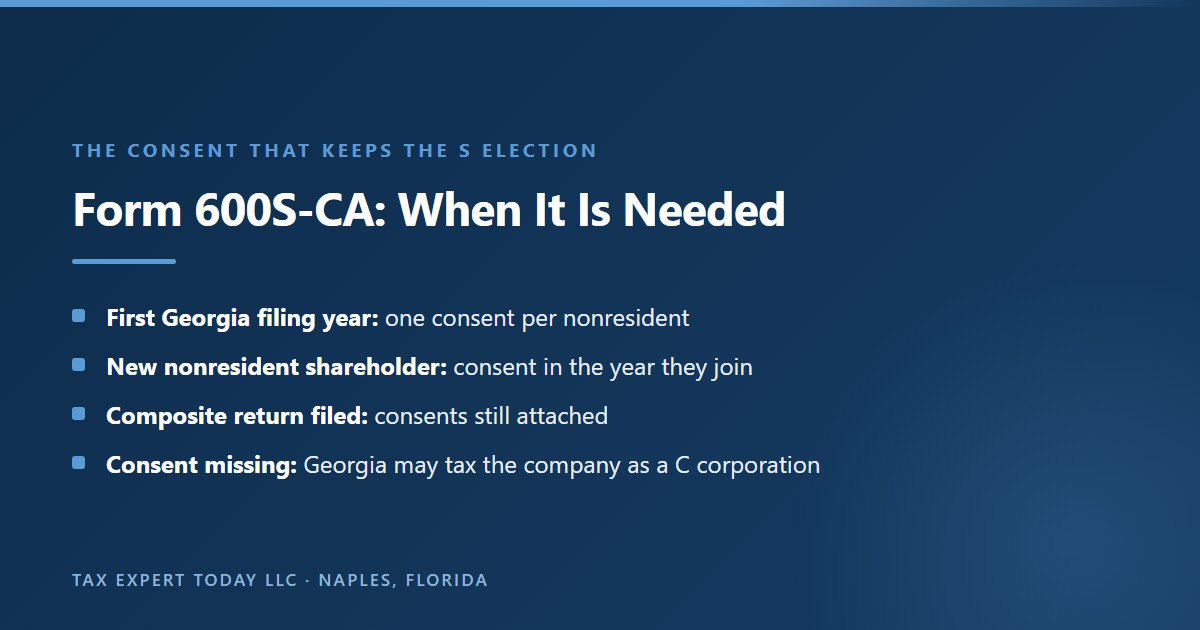
Form 600S-CA is the S Corporation Tax Consent for nonresident shareholders. Each nonresident signs one, agreeing to file and pay Georgia tax on their share of Georgia income. It is generally filed once, in the first year the company must file in Georgia, and again for each new nonresident who joins later.
- One consent per nonresident shareholder, attached to Georgia Form 600S.
- Timing: the first year the corporation is required to file a Georgia return.
- New shareholders: a consent is needed in the year each new nonresident joins.
- Attach it even with a composite return, according to the booklet.
- It also affects withholding: a valid consent can remove the withholding requirement.
The full filing requirement text in the Department’s booklet, which reads the same in the 2024 and 2025 editions, says nonresidents only need to file a single consent in the year in which the S corporation is first required to file a Georgia income tax return. For an S corporation in existence before January 1, 2008, the consent had to be filed for each shareholder in the first Georgia return for a year beginning on or after January 1, 2008. A consent must also be filed in any later year for any additional nonresident who becomes a shareholder that year.
The nonresident shareholder instructions add a practical instruction that many preparers overlook: to ensure Georgia’s recognition of the S election, attach a properly completed Form 600S-CA for each nonresident shareholder to Georgia Form 600S when it is filed, even if a composite return has been filed. A composite return is a payment method. It does not replace the consent.
The consent also changes the withholding picture. The booklet’s special note says an S corporation with nonresident members is subject to withholding unless one of several exceptions applies, and then adds that if the shareholder has a properly executed 600S-CA, withholding is not due provided the shareholder reports the income and pays the tax. That makes the consent a document with real cash consequences, discussed in the withholding section below.
Because the form is signed once and then forgotten, it is often missing when it matters. A company that has filed for twenty years may not be able to produce the consent signed by a shareholder who moved to Florida in 2014. When ownership changes hands, when a shareholder moves out of Georgia, or when a trust or estate becomes a shareholder, the consent file is worth checking before the next Georgia Form 600S is filed.
| Event | Form 600S-CA needed? | Practical note |
|---|---|---|
| First year the company must file in Georgia | Yes, for each nonresident shareholder | Attach to that year’s Georgia Form 600S |
| A new nonresident shareholder joins | Yes, for that shareholder | Filed with the return for the year they join |
| A Georgia resident shareholder moves out of state | Review needed | The booklet ties the consent to nonresident shareholders; secure one to avoid a later dispute |
| Company files a composite return for nonresidents | Still attach consents | The booklet says attach them even if a composite return has been filed |
| All shareholders are Georgia residents | No | Residents are already taxable on their full share |
What Happens If a Nonresident Shareholder Never Signs Form 600S-CA?
Georgia can disregard the S election, and the corporation is then taxed for Georgia purposes as a C corporation on Form 600. The Department’s regulation sets the consequences: separately stated items come back into taxable income with C corporation limits, and net operating losses cannot move between S years and C years.
- Entity level tax: the company pays Georgia corporate income tax on its income.
- Separately stated items: included, with Section 179 and charitable deductions limited as for a C corporation.
- Loss walls: S year losses and C year losses do not cross over.
- Shareholder relief: resident shareholders may adjust to avoid double tax on income the company paid tax on.
The governing rule is Ga. Comp. R. and Regs. 560-7-3-.06(6), titled S elections. Paragraph (b) applies in the case of an S corporation where the election is not recognized as provided by O.C.G.A. 48-7-21 and 48-7-27, and it sets three rules. First, losses incurred in a year the corporation is treated as an S corporation cannot be carried to a year it is treated as a C corporation. Second, net operating losses from a C corporation year cannot be carried to an S corporation year. Third, in order to pay the tax at the entity level in a C corporation year, federal taxable income is the federal taxable income of the S corporation including separately stated items such as charitable contributions and the Section 179 deduction, but those deductions and any other deduction subject to a federal limitation are limited to what the Code allows a C corporation.
The regulation gives an example that shows how sharp the loss rule is. A corporation is a C corporation in 2002 with a loss that it carries forward, an S corporation in 2003, and a C corporation again in 2004. The 2002 loss cannot be used in 2003. It can be used in 2004, but the S year still counts as a taxable year for purposes of measuring the carryforward period. A company that bounces between recognized and unrecognized status can lose the use of losses that would otherwise have sheltered income.
The booklet’s list of common errors approaches the same problem from the other side. Error six reads, in substance, that S corporations file on Form 600 by mistake, and that the correct form is Form 600S unless the nonresident shareholders have not consented to be taxed. When consent is missing, Form 600 is the correct form, which is exactly what the company wants to avoid.
There is a partial safety valve for resident shareholders. The booklet says Georgia resident shareholders of S corporations may make an adjustment to federal adjusted gross income for S corporation income where the election is not recognized for Georgia purposes or by another state. The adjustment exists to avoid double taxation and is allowed only for the portion of income on which tax was actually paid by the corporation to Georgia or to another state. It softens the result but does not restore the S treatment, and it does nothing for the corporation’s own tax.
A multi member LLC that never elected S corporation status is a partnership for Georgia purposes and does not file Form 600S at all. It files the partnership return, which has its own rules for nonresident partners, guaranteed payments, and the entity level election. Our guide to Georgia Form 700 covers that return for owners deciding between the two structures.
When Does an S Corporation File Form 600 Instead of Georgia Form 600S?
An S corporation files Form 600, the regular corporation return, when Georgia does not recognize its S election, usually because a nonresident shareholder has not consented. Otherwise Georgia Form 600S is the correct form, and filing a Form 600 for a recognized S corporation is one of the errors the Department lists.
- Recognized S election: Georgia Form 600S.
- Unrecognized election: Form 600, with tax at the corporate level.
- Year of conversion from C status: Georgia Form 600S, with the C Corp Last Year box checked.
- Entity level election: still Georgia Form 600S, with its own box on page 1.
The two forms are not interchangeable. Form 600 computes corporate income tax as the primary result. Georgia Form 600S computes Georgia net income for the shareholders and only rarely produces corporate income tax. The page 1 check boxes on the 2025 Georgia Form 600S include one labelled C Corp Last Year, which signals that the company was a C corporation in the prior year and is filing its first S return. That box matters because a former C corporation can carry built in gains into its S years, discussed below.
Another page 1 box reads S Corporation elects to pay the tax at the entity level. That is the elective pass through entity tax, covered in detail in our guide to the Georgia pass through entity tax election. An electing S corporation still files Georgia Form 600S, not Form 600. The election changes who pays the income tax, not which form is used.
Corporations that are not S corporations, including C corporations and LLCs taxed as corporations, file Form 600. Partnerships and LLCs taxed as partnerships file Form 700. A single member LLC owned by an S corporation is generally disregarded and reported inside the parent’s Georgia Form 600S, although credit reporting for disregarded entities has its own instructions in the booklet.
What Is the Georgia Form 600S Due Date?
Georgia Form 600S is due on or before the 15th day of the third month after the close of the tax year, the same as the federal Form 1120-S. For a calendar year company that is March 15. When that date falls on a weekend or holiday, the return is due on the next business day.
- Calendar year 2025 return: March 15, 2026 fell on a Sunday, so the due date moved to Monday, March 16, 2026.
- Calendar year 2026 return: March 15, 2027, a Monday.
- Fiscal years: the 15th day of the third month after the fiscal year ends.
- Net worth tax: its own timing rule, explained in the net worth section.
The booklet’s when and where to file section states that the return is due on or before the 15th day of the 3rd month following the close of the taxable year, and that if the due date falls on a weekend or holiday, it is due on the next day that is not a weekend or a holiday. Because the federal Form 1120-S follows the same calendar, most companies prepare both returns together.
| Tax year | Original due date | Notes |
|---|---|---|
| Calendar 2025 | March 16, 2026 | March 15, 2026 was a Sunday |
| Calendar 2026 | March 15, 2027 | A Monday |
| Fiscal year ending June 30, 2026 | September 15, 2026 | 15th day of the third month after year end |
| Fiscal year ending September 30, 2026 | December 15, 2026 | 15th day of the third month after year end |
The due date is also the date that matters for payment. Late payment penalties and interest run from the statutory due date even when the company has an extension to file, which is the subject of the next section. For a company that pays no entity level income tax and owes only a small net worth tax, the payment side is usually modest, but it is still due on the original date.
How Does a Georgia Form 600S Extension Work?
A company with an approved automatic federal extension does not need a separate Georgia request. Georgia accepts the return without late filing penalties if it arrives within the federal extended period plus one month, with seven months as the limit. Without a federal extension, Form IT-303 requests the Georgia extension. No extension delays payment.
- Federal extension in place: no Georgia form needed; check the Extension box and attach a copy.
- No federal extension: file Form IT-303 for Georgia.
- Maximum: seven months from the original due date.
- Payment: prepay with Form IT-560C by the original due date.
The booklet’s extension section cites O.C.G.A. 48-7-57 for the rule that a taxpayer need not apply for a Georgia extension if it applies for and receives an automatic six month extension of the federal return. If the Georgia return is received within the time extended by the IRS plus one additional month, no late filing penalty is incurred, and Georgia law prohibits an extension of more than seven months from the due date. The new provisions section of the 2025 booklet describes the same rule as granting corporate taxpayers seven months when they receive the automatic federal extension.
For a calendar 2025 S corporation, the federal extended due date of Form 1120-S was September 15, 2026. Adding the extra Georgia month points to mid October 2026, and the outer seven month limit runs from the March 16, 2026 original due date. Companies still working on 2025 returns as this guide is published should confirm the exact final date for their own year rather than rely on a rule of thumb, because the penalty rules described below begin to apply immediately afterward.
The form itself adds a documentation rule. Page 3 of the 2025 Georgia Form 600S states that no extension of time for filing will be allowed unless a copy of the request for a federal extension or Form IT-303 is attached to the return. The booklet’s filing checklist asks the same question, and the Extension box on page 1 should be checked whenever a federal or Georgia extension was granted. Our guide to Georgia Form IT-303 and state extension rules covers the Georgia request in detail.
| Extension item | Rule from the IT-611S booklet |
|---|---|
| Federal automatic extension approved | No separate Georgia request needed |
| No federal extension | Request a Georgia extension on Form IT-303 |
| Penalty free filing window | Federal extended period plus one month |
| Outer limit | Seven months from the original due date |
| Payment of tax due | Prepay with Form IT-560C; claim it on Schedule 4, Line 2 |
| Late payment penalty during an extension | Income tax 1/2 of 1 percent per month up to 25 percent; net worth tax 10 percent |
The payment rule is where extended filers most often get caught. The booklet says a taxpayer with an extension must prepay the Georgia tax with Form IT-560C and claim the prepayment on Schedule 4, Line 2. If the tax is not paid by the statutory due date, late payment penalties are assessed until it is paid, at 1/2 of 1 percent per month up to 25 percent for income tax and at 10 percent for the net worth tax, plus interest from the statutory due date. An extension of time to file does not change the interest or penalty charge for late payment.
Where Is Georgia Form 600S Filed, and When Is E-Filing Required?
Paper returns go to the Georgia Department of Revenue Processing Center, P.O. Box 740391, Atlanta, Georgia 30374-0391. Electronic filing is mandatory when the company pays by electronic funds transfer, when its federal return must be e-filed, or when the return involves any Series 100 business tax credit.
- Mailing address: Processing Center, P.O. Box 740391, Atlanta, GA 30374-0391.
- EFT payments: trigger mandatory e-filing.
- Federal e-file mandate: if Form 1120-S must be e-filed, so must Georgia Form 600S.
- Series 100 credits: any credit coded 100 through 199 requires e-filing.
- Federal return copy: must accompany a paper return.
The booklet lists three triggers for mandatory electronic filing of non individual returns: payments remitted by electronic funds transfer, whether mandatory or voluntary; a federal counterpart that must be filed electronically under the Internal Revenue Code or IRS regulations; and a return that generates, allocates, claims, utilizes, or includes in any manner a Series 100 tax credit. Because the IRS requires most business filers that file ten or more returns of any type in a year to file electronically, many S corporations meet the second test without realizing it.
The credit trigger is the strictest. The booklet’s filing checklist asks whether a company claiming Georgia business credits filed electronically, and the common errors list includes failure to file electronically when claiming a Georgia business credit. Schedules 11 and 11B on the form both carry the printed warning that credits must be filed electronically. An S corporation that passes even one Series 100 credit through to its owners belongs in the e-file system.
For paper returns, the booklet asks that the full federal return and all supporting schedules be attached, that the federal Schedule L balance sheet be completed on the Georgia copy even when it is not required federally, that staples not be used, and that the return and payment be mailed together with Form PV-CORP when tax is due. Sending the return by certified mail, the booklet notes, delays processing. Amended returns must be filed electronically if the original was filed electronically.
What Does Each Schedule on Georgia Form 600S Do?
The 2025 Georgia Form 600S has thirteen numbered schedules plus Schedule 11B. Schedules 6, 7, 8, 9 and 5 compute Georgia income for the shareholders. Schedule 1 computes any entity level income tax. Schedules 2 and 3 compute the net worth tax. Schedule 4 totals what is owed or refunded, and Schedules 10 through 13 handle losses and credits.
- Income for shareholders: Schedules 6, 7, 8, 9 and 5, in that working order.
- Entity level income tax: Schedule 1, with Schedule 10 for losses.
- Net worth tax: Schedule 3, with Schedule 2 for foreign corporations.
- Credits: Schedules 11, 11B, 12 and 13.
- Bottom line: Schedule 4.
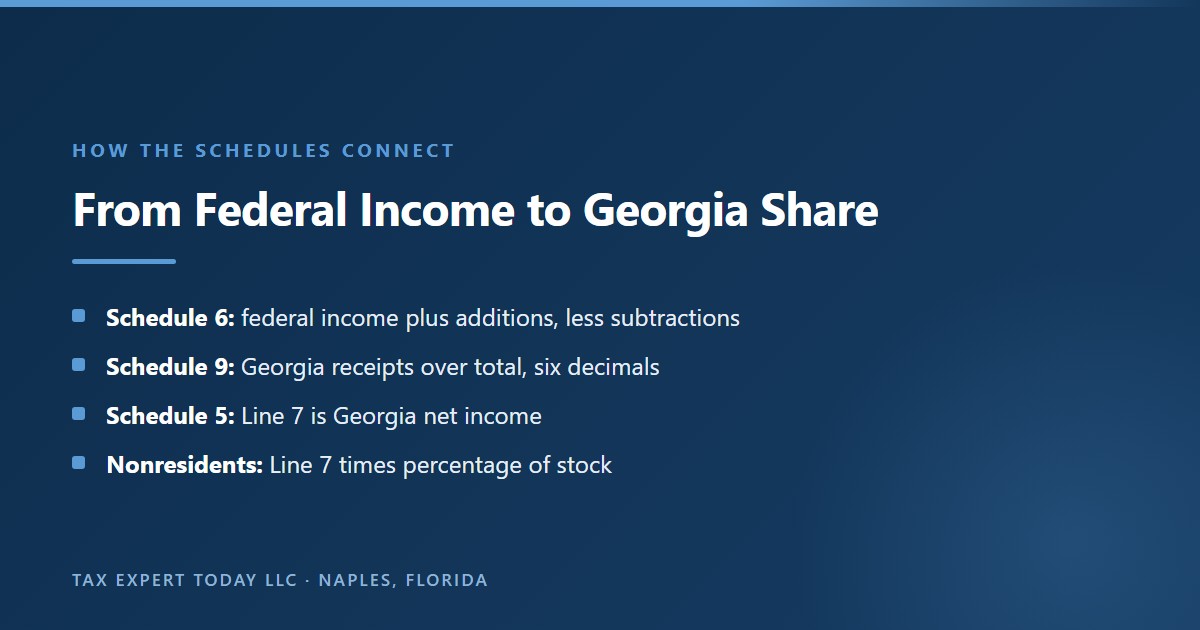
The schedule numbers do not follow the order in which a preparer works. The computation starts on Schedule 6 with federal income, adjusts it on Schedules 7 and 8, apportions it with Schedule 9, and finishes on Schedule 5 with Georgia net income. Only then does Schedule 1 matter, and only if the company owes entity level tax. The table below maps each schedule on the 2025 form to its job.
| Schedule | Title on the 2025 form | What it does |
|---|---|---|
| 1 | Computation of Georgia Taxable Income and Tax | Entity level income tax only, at 5.19 percent on the 2025 form |
| 2 | Computation of Net Worth Ratio | Foreign corporations only: Georgia share of property and receipts |
| 3 | Computation of Net Worth Tax | Capital stock, paid in surplus and retained earnings, then the table |
| 4 | Computation of Tax Due or Overpayment | Income tax and net worth tax columns, payments, credits, withholding, penalties |
| 5 | Computation of Georgia Net Income | Allocation and apportionment; Line 7 is the figure nonresidents use |
| 6 | Computation of Total Income for Georgia Purposes | Federal ordinary, rental, portfolio and Section 1231 items plus adjustments |
| 7 | Additions to Federal Taxable Income | Other state bond interest, other state income taxes, addbacks |
| 8 | Subtractions from Federal Taxable Income | U.S. obligation interest and addback exceptions |
| 9 | Apportionment of Income | Single gross receipts factor to six decimals |
| 10 | NOL carryforward worksheet | Losses against entity level income, with the 80 percent limit |
| 11 and 11B | Credit Usage and Carryover; Refundable Tax Credits | One schedule per credit code; must be e-filed |
| 12 | Allocation of credits to owners | Passes credits to shareholders |
| 13 | Assignment to affiliated entities | Credits assigned within an affiliated group |
The page 1 header also asks for information the Department uses to cross check shareholder returns: the total number of shareholders, the total number of nonresident shareholders, the amount of nonresident withholding tax paid by the S corporation, the Georgia withholding account numbers for payroll and nonresident withholding, and the latest tax year adjusted by the IRS along with when that adjustment was reported to Georgia. Each of those fields connects to a rule discussed later in this guide.
How Is Total Income Computed on Schedule 6?
Schedule 6 starts with the federal flow through items from Form 1120-S, including ordinary business income, rental income, portfolio income and Section 1231 gains, totals them, adds the Schedule 7 additions, and subtracts the Schedule 8 subtractions. The result, Line 11, is total income for Georgia purposes before apportionment.
- Lines 1 to 6: ordinary income, rental real estate, other rentals, portfolio income, Section 1231, other income.
- Line 7: total federal income.
- Line 8: additions from Schedule 7.
- Line 10: subtractions from Schedule 8.
- Line 11: total income for Georgia purposes.
The 2025 form lays out Schedule 6 line by line. Line 1 is ordinary income or loss per the federal return. Line 2 is net income from rental real estate. Line 3 nets gross income and expenses from other rental activities. Line 4 lists portfolio income in six parts: interest, dividends, royalties, net short term capital gain, net long term capital gain, and other portfolio income. Line 5 is net Section 1231 gain or loss, Line 6 is other income or loss, and Line 7 totals them.
The booklet explains why the schedule exists. To determine total income for Georgia purposes, certain additions and subtractions required by Georgia law are included in the Schedule 6 computation. The total of the additions is entered on Schedule 6 and itemized on Schedule 7, and the total subtractions are entered on Schedule 6 and itemized on Schedule 8. The booklet adds that Schedule 6 reflects flow through income from the federal return, which is taxable to the individual shareholders.
That last point shapes the whole return. Schedule 6 is not a computation of the corporation’s tax. It is a computation of the Georgia income base that the shareholders will report. When it is wrong, every shareholder’s Georgia return inherits the error. That is why an S corporation that operates only in Georgia and has only Georgia resident shareholders still needs to get its Schedule 6 adjustments right, even though nothing on Schedule 1 will ever be taxed.
What Additions Belong on Schedule 7?
Schedule 7 adds back items that federal income excludes or deducts but Georgia does not. The printed lines cover interest on other states’ bonds, income taxes paid to other jurisdictions, expenses tied to tax exempt income, intangible expenses and captive REIT expenses paid to related members, and other additions such as depreciation differences.
- Line 2: state and municipal bond interest from outside Georgia.
- Line 3: net income taxes imposed by jurisdictions other than Georgia.
- Line 5: expense attributable to tax exempt income.
- Lines 6 and 7: related member intangible and captive REIT expenses.
- Line 8: other additions, with a schedule attached.
The intangible expense rule is mechanical and frequently missed. The booklet says a corporation must add back all intangible expenses and related interest expense paid directly or indirectly to a related member, and that all such expenses must be listed as an addition even if the taxpayer qualifies for an exception. If an exception applies, Form IT-Addback is completed and the excepted amount is subtracted on Schedule 8. Captive REIT expenses follow the same pattern with Form IT-REIT. A closely held S corporation that pays royalties or license fees to a related holding company should expect this addback.
The booklet also requires an addback for payments of more than $600 in a taxable year to employees who are not authorized employees and are not excepted by O.C.G.A. 48-7-21.1, defining an authorized employee as someone legally allowed to work in the United States. The other additions line is where most depreciation differences land, because Georgia does not follow federal bonus depreciation, as described below.
| Schedule 7 line | Item | Typical source |
|---|---|---|
| 2 | State and municipal bond interest, other than Georgia | Portfolio interest on out of state municipal bonds |
| 3 | Net income or net profits taxes imposed by other jurisdictions | Income taxes paid to other states and deducted federally |
| 5 | Expense attributable to tax exempt income | Costs of carrying exempt investments |
| 6 | Intangible expenses and related interest costs | Royalties and interest paid to related members; exception on IT-Addback |
| 7 | Captive REIT expenses and costs | Rent or interest paid to a captive REIT; exception on IT-REIT |
| 8 | Other additions, schedule attached | Bonus depreciation difference, unauthorized employee wages over $600 |
What Subtractions Belong on Schedule 8?
Schedule 8 removes income that Georgia does not tax or that was already added back. The printed lines cover interest on United States obligations, reduced by the related interest expense, the IT-Addback and IT-REIT exceptions, and other subtractions with a schedule, such as qualifying Georgia bond interest and certain disaster relief payments.
- Line 2: U.S. obligation interest, net of direct and indirect interest expense.
- Line 3: exception to the intangible expense addback, with IT-Addback.
- Line 4: exception to the captive REIT addback, with IT-REIT.
- Line 5: other subtractions, with a schedule attached.
The U.S. obligations subtraction is not the full amount of interest received. The booklet says U.S. obligation income subtracted must be reduced by direct and indirect interest expense, computed by multiplying total interest expense by a fraction whose numerator is the average adjusted basis of the U.S. obligations and whose denominator is the average adjusted basis of all assets, and it points to the Department’s regulation for the detail (Rule 560-7-3-.10). A company with large Treasury holdings and significant borrowing will see a smaller subtraction than the interest figure suggests.
The booklet lists several other subtractions that can appear on Line 5. A corporation may subtract federally taxable interest on Georgia municipal bonds designated as Build America Bonds, and interest on Georgia bonds that carry a special Georgia exemption. A company that is a party to state contracts may subtract 10 percent of qualified payments to classified subcontractors, up to $100,000 per year. For tax years beginning in 2025 through 2029, the booklet adds a subtraction for federal or Georgia disaster relief payments for 2024 agricultural losses from Hurricane Helene, and for 2025 a subtraction for federal crop insurance proceeds for Helene crop damage, in each case only to the extent included in federal income.
| Schedule 8 line | Item | Condition |
|---|---|---|
| 2 | Interest on U.S. obligations | Reduced by direct and indirect interest expense |
| 3 | Exception to intangible expense addback | Form IT-Addback attached |
| 4 | Exception to captive REIT addback | Form IT-REIT attached |
| 5 | Georgia Build America Bond interest and specially exempt Georgia bond interest | Federally taxable interest on qualifying Georgia bonds |
| 5 | Classified subcontractor payments | 10 percent of qualified payments, up to $100,000 |
| 5 | Hurricane Helene agricultural relief and crop insurance | Only to the extent included in federal income; year limits apply |
Why Are Section 179 and Charitable Contributions Left Off the Entity Computation?
Federally, Section 179 expense and charitable contributions are separately stated to shareholders because their limits apply at the shareholder level. Georgia follows that design. The booklet says deductions subject to further limitations are not deducted in computing the S corporation’s total income, and the shareholders may claim them on their own Georgia returns.
- Section 179: separately stated; claimed by shareholders, not on Schedule 6.
- Charitable contributions: separately stated; claimed by shareholders who itemize.
- Section 179 gain on sale: reported separately to shareholders, with any Georgia adjustment.
- Exception: when the election is not recognized, C corporation limits apply instead.
The booklet’s adjustments section says that any deductions subject to further limitations such as a Section 179 deduction, charitable contributions, and similar items are not deductible in the calculation of total income for Georgia purposes, and that these items may be deductible by the individual shareholder on his or her individual return. That matches the federal Schedule K structure, where those items never enter ordinary business income in the first place.
The Department’s federal tax changes page adds a related rule for dispositions. Since 2003 the IRS has required separate reporting to S corporation shareholders and partners of gain from the sale of assets for which a Section 179 deduction was claimed, and Georgia follows that treatment. The gain is not reported directly on the S corporation return; it is reported separately to the shareholders along with any Georgia adjustment to the gain caused by federal changes Georgia did not adopt. The same page notes that Georgia has not adopted the Section 179 deduction for certain real property.
The picture changes only if the election is not recognized. Under Regulation 560-7-3-.06(6)(b)3, in a year the company is taxed as a C corporation for Georgia purposes, federal taxable income includes the separately stated items, and charitable contributions and Section 179 are limited to what the Code allows a C corporation. That is one more reason the Form 600S-CA consent file deserves attention.
Which Federal Provisions Does Georgia Not Follow on Form 600S?
Georgia starts from federal income but does not follow every federal rule. The most common differences on an S corporation return are bonus depreciation, which Georgia has not adopted, the business interest limit, which Georgia applies in its pre 2018 form, and research expenditures, where Georgia does not follow the 2017 changes to IRC 174.
- Bonus depreciation under IRC 168(k): not adopted by Georgia; compute Georgia depreciation separately.
- IRC 163(j): Georgia follows the version in effect before Public Law 115-97.
- IRC 174: Georgia does not follow the 2017 amendment.
- Section 179 for certain real property: not adopted.
- Conformity date: set each year by the General Assembly; check the Department’s page.
The booklet states that Georgia follows the provisions of IRC 163(j) as they existed before the 2017 Tax Cuts and Jobs Act and does not follow IRC 174 under that act, and it points to O.C.G.A. 48-7-21 for other adjustments. The Department’s federal changes page lists the 30, 50 and 100 percent bonus depreciation rules of IRC 168(k) among the provisions Georgia has not adopted, explains that the 30 percent business interest limitation is applied under the pre 2018 rules so the real property trade or business election is not recognized, and notes that when property for which federal bonus depreciation was claimed is sold, the Georgia gain or loss will differ.
For an S corporation, each of these differences flows through Schedule 6 and then to the shareholders. A company that claimed large bonus depreciation federally will usually show a positive Georgia adjustment in the year the asset is placed in service and negative adjustments in later years as Georgia depreciation catches up. Keeping a separate Georgia fixed asset ledger is the practical way to get this right year after year. Our bonus depreciation guide for 2026 covers the federal side.
Conformity is a moving target. The Department’s page describes Georgia’s practice of annually updating its tie to the Internal Revenue Code by statute and lists the update bills by session. Because federal law changed again in 2025, a preparer should confirm on that page which version of the Code applies to the year being filed before relying on any federal provision, especially for depreciation, research costs and interest.
| Federal provision | Georgia treatment | Where it shows on Georgia Form 600S |
|---|---|---|
| Bonus depreciation, IRC 168(k) | Not adopted | Schedule 7 other additions or Schedule 8 other subtractions |
| Business interest limit, IRC 163(j) | Pre 2018 version followed | Adjustment to federal income on Schedule 6 |
| Research expenditures, IRC 174 | 2017 amendment not followed | Adjustment to federal income on Schedule 6 |
| Section 179 for certain real property | Not adopted | Separately stated to shareholders with the Georgia figure |
| Net operating losses after 2017 | No carryback, 80 percent limit on Georgia income | Schedule 10, entity level income only |
How Does Apportionment Work on Schedules 5 and 9?
An S corporation operating in and outside Georgia first removes nonbusiness income that is allocated directly, then apportions the remaining business income using a single gross receipts factor on Schedule 9. Schedule 5 multiplies business income by that ratio, adds income allocated to Georgia, and produces Georgia net income on Line 7.
- Step one: allocate nonbusiness investment income and gains by situs.
- Step two: apportion business income by Georgia receipts over total receipts.
- Ratio: computed to six decimals and not rounded.
- Result: Schedule 5, Line 7, the Georgia net income figure.
The booklet explains the allocation step in plain terms. Interest on bonds held for investment and income from other intangible property held for investment are not apportioned, nor are rents from real estate held purely for investment and not used in the business. The expenses connected with that income follow it. Net investment income from intangibles is allocated to Georgia if the corporation’s situs is in Georgia or the property was acquired from Georgia property or business; net income from tangible property in Georgia is allocated to Georgia. Gains on property not used in the business are allocated to Georgia if the property is real or tangible property in Georgia, or intangible property with a Georgia situs.
What remains is business income, apportioned by a single factor. For tax years beginning on or after January 1, 2008, the booklet says the Georgia ratio is computed by applying only the gross receipts factor, with Ga. Comp. R. and Regs. 560-7-7-.03 supplying the detail. Receipts from sales of tangible property are Georgia receipts when the goods are shipped or delivered to Georgia customers. Receipts from other business are Georgia receipts when received from customers in Georgia or otherwise attributable to the Georgia marketplace. A company that is a partner in a business partnership includes its pro rata share of the partnership’s gross receipts in its own factor.
The Schedule 9 grid on the form has two columns, within Georgia and everywhere, and an instruction printed in the third column: do not round, compute to six decimals. The same six decimal instruction appears on the Schedule 2 net worth ratio for foreign corporations. A ratio rounded to two places can move thousands of dollars of income between Georgia and other states on a larger company.
| Income type | Treatment | Georgia share |
|---|---|---|
| Operating business income | Apportioned on Schedule 9 | Georgia receipts divided by total receipts |
| Investment interest and intangible income | Allocated | All to Georgia if the corporation’s situs or the source is in Georgia |
| Rent from Georgia investment real estate | Allocated | All to Georgia |
| Gain on Georgia real property not used in the business | Allocated | All to Georgia |
| Gain on out of state real property not used in the business | Allocated | None to Georgia |
How Do Resident and Nonresident Shareholders Report Their Share?
A Georgia resident shareholder reports their full share of S corporation income, wherever it was earned. A nonresident reports only their share of the Georgia figure: Schedule 5, Line 7 multiplied by their percentage of stock. That product is the nonresident’s starting Georgia income, adjusted for separately stated items, on Georgia Form 500.
- Residents: full share of income, through federal adjusted gross income.
- Nonresidents: Schedule 5, Line 7 times ownership percentage.
- Separately stated items: adjusted on the shareholder’s own return.
- Shareholder return: Georgia Form 500, with Schedule 3 for nonresidents and part year residents.
The booklet’s allocation section draws the line clearly. A resident shareholder is required to report their full share of corporate income or loss. A nonresident shareholder reports only their share of allocated and apportioned income as computed on Schedule 5. The nonresident instructions spell out the arithmetic: the Georgia net income computed on Schedule 5, Line 7 should be multiplied by the percentage of stock owned, and the result is the beginning taxable income for the nonresident, reported on the Georgia individual return and adjusted for separately stated items.
That instruction ties the corporate return to a specific shareholder computation. A Florida shareholder who owns 25 percent of a company whose Schedule 5, Line 7 shows $400,000 starts with $100,000 of Georgia income on their Georgia return, before their own adjustments. If the Schedule 5 figure is wrong, the shareholder files on a wrong number without knowing it. Our guide to the Georgia part year and nonresident Form 500 return explains how Schedule 3 handles the shareholder’s side.
Shareholders who moved during the year sit between the two rules. For the months they were Georgia residents, their share is generally reported in full; for the months they were not, only the Georgia share applies. The S corporation’s Georgia Form 600S does not make that split. The shareholder’s own return does, which is why a mid year move is a conversation the company’s preparer should have with the shareholder before K-1 information goes out.
| Shareholder | Georgia income reported | Starting figure |
|---|---|---|
| Full year Georgia resident | Full share of S corporation income | Federal adjusted gross income, then Georgia adjustments |
| Full year nonresident | Georgia share only | Schedule 5, Line 7 times percentage of stock |
| Part year resident | Full share while resident, Georgia share otherwise | Form 500 Schedule 3 allocation |
| Resident whose S election is not recognized elsewhere | Full share, with a possible double tax adjustment | Adjustment limited to income on which the corporation actually paid tax |
Does an S Corporation Ever Pay Georgia Income Tax on Form 600S?
Yes, in three situations. Schedule 1 computes Georgia income tax when the company owes federal entity level tax, such as the built in gains tax on a former C corporation, when it elects to pay tax at the entity level, or when Georgia treats it as a C corporation because consent is missing. Otherwise the shareholders pay.
- Built in gains: a former C corporation selling appreciated assets within the federal recognition period.
- Passive investment income: a former C corporation with earnings and profits and heavy passive income.
- Elective entity level tax: the pass through entity election.
- Unrecognized election: taxed as a C corporation, on Form 600.
The booklet’s Schedule 1 instruction is brief: if an S corporation is required to pay tax at the federal level, it may be required to pay tax at the state level, and multistate S corporations apportion that income to Georgia. The two federal entity level taxes that most often apply are the built in gains tax under IRC 1374, which reaches gain on assets a former C corporation held when its S election took effect, and the tax on excess net passive income under IRC 1375, which reaches a former C corporation with accumulated earnings and profits whose passive investment income is large relative to its gross receipts.
Schedule 1 on the 2025 form runs in seven lines: Georgia net income from Schedule 5, Line 7; additional Georgia taxable income; total income; the Georgia net operating loss deduction from Schedule 10, subject to the 80 percent limit; a passive loss or capital loss deduction with a schedule attached; total Georgia taxable income; and income tax at 5.19 percent of Line 6 for 2025. The booklet asks for a statement about the passive loss and capital loss deductions when they are used.
The C Corp Last Year box on page 1 is a signal that Schedule 1 may need attention in the years ahead. A company that converted from C to S status and then sells its business or a major asset within the recognition period should expect the federal built in gains computation to carry over into Georgia. That is a planning question to address before the sale is signed rather than at return time.
What Rate Applies on Georgia Form 600S for 2025 and 2026?
Entity level income tax on Georgia Form 600S uses the same flat rate that applies to individuals for the year. The 2025 booklet and form use 5.19 percent. The Department’s Important Tax Updates page shows the flat rate reduced to 4.99 percent for 2026. Fiscal year filers use the rate for the year their tax period begins.
- Tax years beginning in 2024: 5.39 percent.
- Tax years beginning in 2025: 5.19 percent, printed on Schedule 1, Line 7.
- Tax years beginning in 2026: 4.99 percent.
- Fiscal years: rate set by the start of the period, not prorated.
The new provisions section of the 2025 booklet explains the link: for tax years beginning on or after January 1, 2024, the income tax rate for S corporations electing to pay tax at the entity level is the same rate imposed on individual taxpayers for the corresponding year, and the rate for a year beginning on or after January 1, 2025 is 5.19 percent. It adds that the rate is not prorated, that fiscal filers must use the rate based on the start of their filing period, and that the rate for later years may change. The 2024 booklet showed 5.39 percent for 2024.
For 2026, the Department’s Important Tax Updates page states that the Georgia income tax rate has been reduced to a flat rate of 4.99 percent. Pages that still quote 5.39 or 5.19 percent for 2026 are using an older booklet. Georgia has reduced its rate on a rolling basis, so the safest practice is to read the rate printed on the form for the year being filed. Our guide to the Georgia corporate tax rate for 2026 covers the history and the scheduled path in more depth.
| Tax year beginning in | Rate for entity level tax on Georgia Form 600S | Source |
|---|---|---|
| 2024 | 5.39 percent | 2024 IT-611S booklet |
| 2025 | 5.19 percent | 2025 IT-611S booklet and 2025 Form 600S, Schedule 1, Line 7 |
| 2026 | 4.99 percent | Department of Revenue Important Tax Updates |
| Fiscal year starting July 1, 2025 | 5.19 percent for the whole year | Rate follows the start of the period and is not prorated |
Two cautions apply. First, the rate matters only for income actually taxed at the entity level, which for most S corporations is none. Second, the rate does not affect the net worth tax, which is a fixed table based on net worth rather than a percentage of income.
How Does the Pass Through Entity Election Show Up on Form 600S?
An S corporation that makes Georgia’s elective entity level tax election checks the box on page 1 of Georgia Form 600S and computes the tax on Schedule 1. The shareholders then exclude that income on their own Georgia returns. The mechanics, the federal deduction rationale, and the trade offs belong in a separate analysis.
- Where it is made: on a timely filed Georgia Form 600S, by checking the page 1 box.
- Where the tax is computed: Schedule 1.
- Withholding: an electing company is outside the nonresident withholding requirement.
- Full analysis: our separate guide on the election.
This guide does not re-explain the election. Whether it still makes sense for a particular S corporation in 2026 depends on the federal state and local tax deduction limit, the shareholders’ states of residence, available credits and losses, and how the company handles estimated payments. Our full guide to the Georgia pass through entity tax election walks through who may elect, how the election is made, what the entity gives up, and how credits and losses behave.
For Georgia Form 600S purposes, three points are enough. The election is reflected on the return itself through the page 1 box. The tax is computed on Schedule 1 at the rate for the year. And the booklet’s special note on withholding lists an irrevocable election to pay tax at the entity level as one of the conditions that removes the nonresident withholding requirement. Credits on Schedule 11 can be used against entity level tax only when the S corporation pays the income tax, according to the instructions printed on Line 11 of that schedule.
How Does the Net Worth Tax Fit on the Same Return?
The Georgia net worth tax is computed on Schedule 3 of Georgia Form 600S and paid with it, but for the following year. The 2025 form is the 2025 income tax return and the 2026 net worth tax return. Net worth up to $100,000 owes nothing, and the table tops out at $5,000.
- Base: issued capital stock, paid in surplus and retained earnings.
- Zero bracket: net worth of $100,000 or less.
- Highest bracket: $5,000 for net worth over $22 million.
- Foreign corporations: taxed on the Georgia share computed on Schedule 2.
- Full guide: our separate net worth tax analysis.
Schedule 3 on the 2025 form adds total capital stock issued, paid in or capital surplus, and total retained earnings to reach net worth, applies a ratio of 100 percent for Georgia and domesticated foreign corporations or the Schedule 2 ratio for foreign corporations, and looks up the tax in the booklet’s table. The booklet and the Department’s net worth tax FAQ add that treasury stock is not deducted from issued capital stock, that a corporation with a deficit net worth must file but owes no tax, and that the QSSS and its parent file separate net worth returns.
The two year label on the form is the source of most confusion. The booklet explains that after the initial return, the annual net worth return is due on or before the fifteenth day of the third month following the beginning of the corporation’s taxable period, and the tax is based on net worth on the first day of the net worth year. Filing the income tax return for one year therefore pays the net worth tax for the next. Our guide to the Georgia net worth tax explains the timing, the initial return, short periods, apportionment for foreign corporations, and penalties in full.
| Net worth (Schedule 3) | Net worth tax |
|---|---|
| $100,000 or less | $0 |
| Over $100,000 to $150,000 | $125 |
| Over $500,000 to $750,000 | $300 |
| Over $750,000 to $1,000,000 | $500 |
| Over $1,000,000 to $2,000,000 | $750 |
| Over $10,000,000 to $12,000,000 | $2,000 |
| Over $22,000,000 | $5,000 |
The table above is an excerpt; the full table in the IT-611S booklet has nineteen brackets. One limit on credits is also printed on the form: tax credits from Schedule 11 may be applied against income tax liability only, not net worth tax liability.
What Withholding Applies to Nonresident Shareholders?
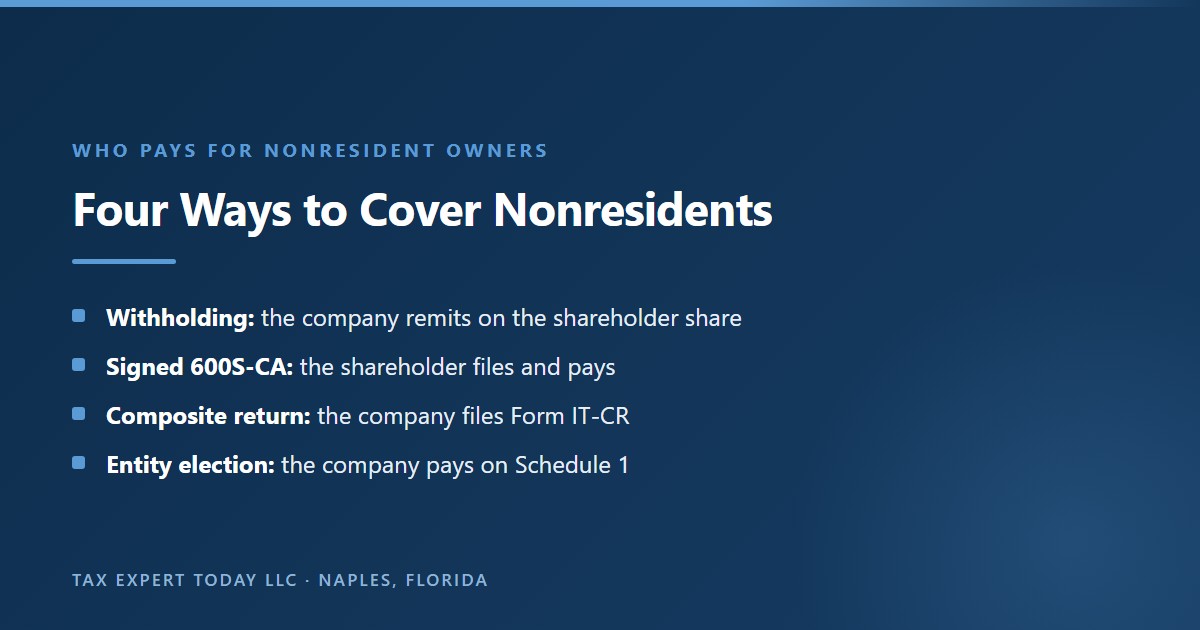
An S corporation with nonresident shareholders must generally withhold Georgia tax on their share of Georgia income. Withholding is not required if a composite return is filed, if the company makes the entity level election, if a shareholder’s Georgia share is under $1,000, or if a shareholder with a valid Form 600S-CA reports and pays the tax.
- Default rule: withhold on nonresident shareholders’ Georgia income.
- Composite return: filing Form IT-CR removes the withholding requirement.
- Entity level election: also removes it.
- Small shares: under $1,000 of Georgia income for the year are excluded.
- Valid 600S-CA: no withholding when the shareholder reports and pays.
The booklet’s special note reads, in substance, that any S corporation with nonresident members is subject to withholding tax unless a composite return is filed, the company makes an irrevocable election to pay income tax at the entity level, or the aggregate annual member’s share of taxable income sourced to Georgia is less than $1,000. It continues that if the shareholder has a properly executed 600S-CA, withholding is not due provided the shareholder reports the income and pays the tax. That last condition puts the burden on the shareholder to actually file; a consent does not excuse a shareholder who never files a Georgia return.
The page 1 header of Georgia Form 600S asks for the nonresident withholding account number and the amount of nonresident withholding tax paid by the S corporation. The booklet’s common errors list includes failure to include withholding Forms G2-A and G2-RP. Shareholders claim the withholding on their own returns, and the S corporation can claim withholding credits shown on Forms G2-A, G2-LP or G2-RP on Schedule 4, Line 4, for example where Georgia tax was withheld on a real property sale by the company.
The withholding rules themselves, including rates, deposit schedules and the reconciliation forms, are covered in our guide to Georgia withholding tax for employers and pass through entities. The decision this guide focuses on is which of the four exits from withholding the company is using, and whether the paperwork for that exit is in the file.
| Approach | Who pays the Georgia tax | Paperwork |
|---|---|---|
| Withholding | The S corporation remits on the shareholder’s behalf | Nonresident withholding account and Form G2-A |
| Signed 600S-CA, shareholder files | The shareholder, on Form 500 | Consent attached to Georgia Form 600S; shareholder must actually file and pay |
| Composite return | The S corporation, on behalf of participating nonresidents | Form IT-CR, plus consents still attached to Georgia Form 600S |
| Entity level election | The S corporation, on Schedule 1 | Page 1 election box on Georgia Form 600S |
| Georgia share under $1,000 | The shareholder, if a return is required | Exception applies to that shareholder only |
How Does a Composite Return Interact With Georgia Form 600S?
A composite return on Form IT-CR lets the S corporation pay Georgia tax for participating nonresident shareholders, who then usually do not file their own Georgia returns. Permission is not required. Georgia Form 600S has a Composite Return Filed box, and the booklet still asks for a Form 600S-CA for each nonresident.
- Box on page 1: check Composite Return Filed when an IT-CR is filed.
- No advance approval: the booklet says permission is not required.
- Consents still attached: composite filing does not replace Form 600S-CA.
- Credits: Schedule 11, Line 13 shows credits used on Form IT-CR.
The booklet’s nonresident instructions say that permission to file a composite return is not required, that a properly completed Form 600S-CA should be attached for each nonresident even if a composite return has been filed, and that the Composite Return Filed box on page 1 should be checked when applicable. The credit schedules connect the two returns: Line 13 of Schedules 11 and 11B shows the amount of each credit used on Form IT-CR.
Whether composite filing suits a given shareholder better than individual filing depends on the rate the composite return uses, the deductions a shareholder gives up, and whether the shareholder has other Georgia income. Our guide to the Georgia composite return on Form IT-CR covers who can be included, how the tax is computed, and the deadlines, so it is not repeated here.
Does an S Corporation Owe Georgia Estimated Tax?
Only when it owes income tax at the entity level. The corporate estimated tax rule applies to a corporation subject to Georgia tax whose net income is reasonably expected to exceed $25,000. For an S corporation that usually means a pass through entity election or a built in gains year. Shareholders make their own estimated payments otherwise.
- Threshold: net income reasonably expected to exceed $25,000.
- Calendar year installments: 25 percent each by April 15, June 15, September 15 and December 15.
- Form: Form 602ES for the first payment; the Georgia Tax Center for electronic payment.
- Penalty: computed on Form 600 UET at 9 percent per year on the underpayment.
- Electronic payment: required for quarterly corporate payments over $10,000.
The booklet’s estimated tax section says every domestic or foreign corporation subject to taxation in Georgia shall pay estimated tax if its net income for the year can reasonably be expected to exceed $25,000, with the estimated tax paid in full by the 15th day of the twelfth month. When the requirement is first met before the first day of the fourth month, 25 percent is due by the 15th day of the fourth, sixth, ninth and twelfth months. Later starts compress the schedule to three, two or one payment.
| Requirement first met | 4th month | 6th month | 9th month | 12th month |
|---|---|---|---|---|
| Before the first day of the 4th month | 25 percent | 25 percent | 25 percent | 25 percent |
| After the 3rd month, before the 6th month | 33 1/3 percent | 33 1/3 percent | 33 1/3 percent | |
| After the 5th month, before the 9th month | 50 percent | 50 percent | ||
| After the 8th month, before the 12th month | 100 percent |
The consequences of missing a payment are set out in the same section: a penalty of 5 percent of the income tax for failure to pay estimated tax and a charge at 9 percent per year for underpayment, computed on Form 600 UET and entered on Schedule 4 of Georgia Form 600S, with a box on page 1 to check when an annualization exception is attached. Separately, under O.C.G.A. 48-2-32(f)(2), corporate estimated taxpayers with quarterly payments of more than $10,000 must pay by electronic funds transfer, and a 10 percent penalty applies to a payment not made electronically through the Georgia Tax Center.
For most S corporations the more important estimated tax question is the shareholders’. A shareholder whose S corporation income jumps should consider whether their own Georgia estimated payments are enough. Our guide to Georgia Form 500-ES estimated tax covers the individual side.
How Are Credits Reported and Passed Through on Form 600S?
Georgia business credits earned by an S corporation are reported on Schedule 11, one schedule per credit code, and usually allocated to shareholders on Schedule 12. Refundable credits use Schedule 11B. Credits are used by the company itself only when it pays income tax, and every return that touches a Series 100 credit must be filed electronically.
- Schedule 11: credits generated, assigned, sold, used, allocated and carried over.
- Schedule 11B: refundable credits, such as the 2025 Timber Tax Credit.
- Schedule 12: total allocated to owners.
- Schedule 13: amounts assigned to affiliated entities.
- Electronic filing: mandatory for any Series 100 credit.
Schedule 11 on the 2025 form has fifteen lines. Lines 2 through 7 list the company or companies that generated the credit, with an identification number and a Department certificate number for preapproved credits. Line 8 totals the credit available. Lines 9 through 13 then dispose of it: assigned to affiliated entities on Schedule 13, sold where the statute allows, used by the S corporation itself when it pays income tax, allocated to owners on Schedule 12, or used on Form IT-CR. Line 15 is the potential carryover. The printed instructions say a separate schedule is needed for each credit code and point to the relevant forms, statutes and regulations to determine how the credit is allocated, when carryovers expire, and whether the credit is limited to a percentage of tax.
The 2025 booklet flags several changes that matter for credit heavy companies. It introduces new 2025 credit codes, 155 through 161, that must be used to generate credits carrying the new carryforward periods, and it states that carryforward years have been reduced for several 2025 credits and that installment periods for certain credits have been shortened. Companies using credits such as the Georgia research and development tax credit or the Georgia quality jobs tax credit should confirm the current code and carryforward period on the Department’s tax credits pages before the return is prepared.
| Schedule 11 line | What it records |
|---|---|
| 1 | Credit code |
| 2 to 7 | Company generating the credit, ID number, certificate number, amount |
| 8 | Total available credit for the year |
| 9 | Assigned to affiliated entities (Schedule 13) |
| 10 | Sold, only for credits the statute allows to be sold |
| 11 | Used by the S corporation, only when it pays income tax |
| 12 | Allocated to owners (Schedule 12) |
| 13 | Used on Form IT-CR |
| 15 | Potential carryover to next year |
How Are Qualified Subchapter S Subsidiaries Handled?
For income tax, Georgia follows the federal treatment of a qualified subchapter S subsidiary, so the subsidiary’s income is reported on the parent’s Georgia Form 600S. For the net worth tax, Georgia does not: the subsidiary and its parent file separate net worth returns, and consolidating them is a listed error.
- Income tax: federal QSSS treatment followed; income reported by the parent.
- Net worth tax: separate returns for the QSSS and the parent.
- QSSS Exempt box: for a parent with no Georgia presence of its own.
- Credits: Schedules 11, 12 and 13 move QSSS credits to the parent.
Regulation 560-7-3-.06(6)(a) states that the federal treatment of a QSSS applies for income tax purposes but not for net worth tax purposes, and the booklet says the QSSS and its parent must file separate net worth tax returns. If the parent is not registered with the Secretary of State and does not do business or own property in Georgia other than through the QSSS, the parent is not required to file a net worth return, and the QSSS Exempt box on page 1 of Georgia Form 600S is checked.
Credits need extra handling. The booklet says the QSSS should complete Schedule 11 if it generates credits or has credits assigned, allocated or transferred to it, use Schedule 12 to transfer the credits to the parent S corporation, and complete Schedule 13 where applicable, so that the returns can be processed and the credits reach the proper taxpayer. The common errors list includes incorrectly consolidating net worth tax for parent and subsidiary corporations.
Does Public Law 86-272 Remove the Need to File?
No. Public Law 86-272 can protect an out of state company whose only Georgia activity is soliciting orders for tangible goods approved and shipped from outside Georgia, but it covers income tax only. The net worth tax still applies, so the company files Georgia Form 600S, checks the PL 86-272 box, and attaches a statement.
- Scope: solicitation of orders for tangible personal property only.
- Lost by: any activity beyond mere solicitation.
- Not covered: the net worth tax.
- Filing: complete the income schedules except Schedule 1 and attach the federal return.
The booklet describes the federal protection, codified at 15 U.S.C. 381, and its limits. If an employee merely solicits orders for sales of tangible personal property that are sent outside Georgia for approval and filled and shipped from outside Georgia, the exemption may apply, but if the employee goes beyond mere solicitation, it does not. The booklet then states that the exemption does not apply to the net worth tax, so a Form 600 or 600S must be filed with Georgia and the net worth tax paid if due.
Even when the exemption applies, the booklet recommends completing all income tax schedules except Schedule 1, attaching a copy of the federal return, attaching a statement explaining why the company believes it is protected, and checking the PL 86-272 box on page 1. For an S corporation, that matters because nonresident shareholders still need a Georgia figure on Schedule 5 to decide their own filing obligations. Service businesses and companies selling software or digital products generally fall outside the statute’s protection for tangible goods.
What Penalties and Interest Apply to Georgia Form 600S?
Late filing costs 5 percent of unpaid tax per month up to 25 percent, late payment costs 1/2 of 1 percent per month up to 25 percent, and the two together cannot exceed 25 percent. The net worth tax has its own 10 percent penalties. Interest runs at the prime rate plus 3 percent.
- Late filing: 5 percent per month or part, up to 25 percent.
- Late payment: 1/2 of 1 percent per month or part, up to 25 percent.
- Negligence: 5 percent; fraud: 50 percent.
- Net worth tax: 10 percent for late filing and 10 percent for late payment.
- Interest: Federal Reserve prime rate plus 3 percent, reviewed each January.
The booklet’s penalties section lists each charge. The combined total of the late filing and late payment penalties cannot exceed 25 percent of the tax not paid by the original due date, and the late payment penalty is not due when the return is being amended because of an IRS audit. Interest accruing from July 1, 2016 runs at the Federal Reserve prime rate plus 3 percent, reviewed and possibly adjusted each January, as the Department’s penalty and interest rates page explains. For the net worth tax, the delinquent filing penalty is 10 percent of the tax due and the delinquent payment penalty is 10 percent, plus interest.
| Charge | Income tax | Net worth tax |
|---|---|---|
| Late filing | 5 percent per month or part, up to 25 percent | 10 percent of tax due |
| Late payment | 1/2 of 1 percent per month or part, up to 25 percent | 10 percent of tax due |
| Combined filing and payment cap | 25 percent of tax not paid by the original due date | Not stated as combined |
| Negligent underpayment | 5 percent | |
| Fraudulent underpayment | 50 percent | |
| Estimated tax | 5 percent failure to pay plus 9 percent per year on Form 600 UET | |
| Interest | Prime rate plus 3 percent | Prime rate plus 3 percent |
For an S corporation with no entity level income tax, the penalty exposure on the return itself is usually small, because the percentages apply to tax due. That does not mean a late Georgia Form 600S is harmless. The shareholders may be unable to file accurate Georgia returns, nonresident withholding may be missed, and the net worth tax penalties apply regardless of profit. Where a penalty has already been assessed, the Georgia Tax Center allows penalty waiver requests, and outcomes depend on the facts and the Department’s review.
How Do You Amend Georgia Form 600S?
Georgia has no separate amended form. The company files a new Georgia Form 600S with the Amended Return box checked and attaches the federal Form 1120-S or the federal audit adjustments. If the original was filed electronically, the amendment must be too. Refund claims generally must be made within three years.
- Same form: check Amended Return on page 1.
- Attachments: federal Form 1120-S or federal audit adjustments.
- Method: electronic if the original was electronic.
- Refund window: three years from the later of payment or the due date, including extensions.
- Shareholders: usually need to amend their own returns too.
The booklet’s amended returns paragraph sets out the mechanics: check the amended return box on Form 600S, attach a copy of the federal Form 1120-S or federal audit adjustments, and mail the amended return to the Processing Center, P.O. Box 740391, unless the original was filed electronically, in which case the amendment must also be filed electronically. Its refund paragraph states that a claim for refund must be made within three years from the later of the payment of the tax or the due date of the return, including extensions granted.
Because the S corporation rarely pays tax itself, an amended Georgia Form 600S usually matters most to the shareholders. A change to Schedule 5 or Schedule 6 changes every shareholder’s Georgia income, and each shareholder may need to amend their own return. Our guide to the Georgia amended return on Form 500X covers the individual side and its deadlines.
What Must Happen After an IRS Audit of the S Corporation?
When a federal audit changes the S corporation’s income, Georgia requires an amended Georgia Form 600S within 180 days of the final determination, with the Amended due to IRS Audit box checked. A resulting refund must be claimed within one year of reporting the change. The late payment penalty does not apply to the amendment.
- Deadline: 180 days from the final determination date.
- Box: Amended due to IRS Audit, on page 1.
- Refunds: claimed within one year of the date the changes are submitted.
- Header fields: latest year adjusted by the IRS and when it was reported to Georgia.
- Self initiated changes: the final determination date is the filing date.
The booklet’s relation to federal return section says that if a federal audit changes taxable income, the taxpayer shall file a return reflecting the corrected income within 180 days of the final determination by filing an amended Form 600S, and that a resulting refund must be claimed within one year of the date the changes are submitted. The 2025 new provisions section adds that when federal changes result from an amended federal return, a federal refund claim, an administrative adjustment request, or a similar report under IRC 6225(c), the final determination date is the date that document is filed.
The page 1 header fields T and U, the latest tax year adjusted by the IRS and when it was reported to Georgia, let the Department compare its records to the federal audit history. An S corporation that settled an IRS examination and never reported it to Georgia leaves its shareholders exposed to Georgia assessments years later. Where an IRS audit is still open, our IRS audit support and resolution page describes how federal examinations are handled, and the Georgia follow up should be planned at the same time.
With a federal S corporation adjustment, the booklet says the S corporation is required to file an amended Georgia return. The shareholders’ Georgia returns must also reflect the change, and nonresident shareholders whose Georgia share changes may have their own reporting obligations.
How Does a Georgia Audit of an S Corporation Work Under HB 849?
Since 2017, a Georgia audit of an S corporation can be resolved at the entity level. The company may elect, by checking a box on Georgia Form 600S, to pay the tax due on behalf of its shareholders. If it elects, the Department issues a notice to the company. If not, the company and each shareholder must amend.
- Law: House Bill 849 of 2017, amending O.C.G.A. 48-7-53.
- Effective: tax years beginning on or after January 1, 2017, or earlier by agreement.
- When to elect: on an original or amended return filed before the audit starts, or at the time of the audit.
- If elected: no amended returns; the Department bills the company.
- If not elected: the company and its shareholders file amended returns.
The booklet explains that House Bill 849, enacted in 2017, modified O.C.G.A. 48-7-53 to provide for Georgia S corporation audit adjustments and related appeals. For a Georgia S corporation audit, the company may elect to pay the tax due on behalf of its shareholders by checking the box on page 1. The election can be made on an original or amended return filed before the audit starts, or at the time of the audit. If it is made, the S corporation does not file an amended return; the Department issues a notice to the company to collect the tax. If it is not made, the S corporation and its shareholders must file amended returns.
The choice has practical weight. A company with many shareholders, or with shareholders who have left, may find a single entity level payment far simpler than chasing amended returns from each owner. A company whose shareholders are in very different tax positions may prefer that each owner absorb their own adjustment. The decision should be made before an audit begins, while it can still be made on a return.
How Do You Protest a Georgia Form 600S Assessment?
From July 1, 2025, a taxpayer has 45 days from a notice of proposed assessment to file a protest with the Department, and 45 days from an official assessment and demand for payment to petition the court. Since July 1, 2026, that petition goes to the Georgia Tax Court, which succeeded the Tax Tribunal.
- Proposed assessment: 45 days to protest with the Department.
- Refund denial or partial payment: 45 days to protest.
- Official assessment: 45 days to petition the Georgia Tax Court.
- Online tools: the Georgia Tax Center accepts protests and penalty waiver requests.
The 2025 booklet lists the 45 day periods in its new provisions section and confirms that starting July 1, 2026, the Georgia Tax Court officially succeeds the Tax Tribunal and begins accepting tax appeal petitions, with cases pending before the Tribunal on June 30, 2026 transferred to the new court unless the petitioner asked otherwise. The Georgia Tax Center’s listed features include protests of proposed assessments, penalty waiver requests, installment plan agreements and offers in compromise.
The deadlines are short and strict, so the date on the notice controls the response. The court’s own Georgia Tax Court website posts its filing rules, and our guide to the Georgia Tax Court and the former Tax Tribunal walks through the petition process, and where a balance cannot be paid at once, our guide to the Georgia Department of Revenue payment plan explains the booklet’s payment agreement terms, also summarized in the Department’s installment agreements FAQ, which run up to 60 months for taxpayers with all returns filed.
Georgia Form 600S Example: A Two Shareholder Company
A hypothetical calendar year 2026 S corporation incorporated in Georgia has two shareholders: one living in Georgia owning 60 percent and one living in Naples, Florida owning 40 percent. The example shows how Schedules 6, 9 and 5 produce each owner’s Georgia figure, why the consent matters, and how the net worth tax is computed.
- Facts are illustrative only; real returns depend on the full facts.
- The Florida shareholder reports only the Georgia share.
- The Georgia shareholder reports the full share.
- The company pays only the net worth tax.
Assume the company’s federal Form 1120-S shows ordinary business income of $500,000 after $120,000 of federal bonus depreciation. Georgia depreciation on the same assets would have been $80,000, so the company adds $40,000 on Schedule 7 as an other addition. It also reported $30,000 of Section 179 expense on its federal Schedule K, which is separately stated and does not enter Schedule 6. There are no other adjustments.
| Line | Item | Amount |
|---|---|---|
| Schedule 6, Line 7 | Total federal income | $500,000 |
| Schedule 6, Line 8 | Additions (bonus depreciation difference) | $40,000 |
| Schedule 6, Line 11 | Total income for Georgia purposes | $540,000 |
| Schedule 9 | Georgia receipts $3,000,000 over total receipts $5,000,000 | 0.600000 |
| Schedule 5, Line 5 | Business income apportioned to Georgia | $324,000 |
| Schedule 5, Line 7 | Georgia net income | $324,000 |
| Florida shareholder, 40 percent | Beginning Georgia income on Form 500 | $129,600 |
| Georgia shareholder, 60 percent | Full share of total income | $324,000 before individual adjustments |
The Florida shareholder starts with $129,600 of Georgia income on a nonresident Form 500, before their own deductions and the separately stated Section 179 share. At the 2026 flat rate of 4.99 percent, every $10,000 of Georgia taxable income carries about $499 of Georgia tax, so the shareholder’s final figure depends on their deductions. The Georgia shareholder reports a full 60 percent share of the company’s income, 60 percent of the $540,000 Georgia total or $324,000 on these facts, because a resident is taxed on income from everywhere, subject to whatever credit for taxes paid to other states the individual return allows.
The paperwork decides who pays. If the Florida shareholder signed Form 600S-CA, and actually files and pays, the company does not need to withhold. If no consent is on file, Georgia can decline to recognize the S election, which would put the full $324,000 of Georgia income through corporate tax on Form 600 instead. If the company files a composite return for that shareholder, it checks the Composite Return Filed box and still attaches the consent.
Finally, the net worth tax. Suppose the net worth figure used on Schedule 3 of the Georgia Form 600S for 2026, which is also the 2027 net worth return, is $850,000. Schedule 3 shows that net worth, a ratio of 100 percent because the company is a Georgia corporation, and a tax of $500 from the table. That $500 is the only tax the company itself pays with this return on these facts.
Salary paid to a shareholder who serves as an officer is wages for payroll purposes, separate from the income reported on Form 600S. Georgia treats officers of a corporation, including an S corporation, as employees for unemployment insurance, so that salary belongs on the quarterly report to the Georgia Department of Labor. Our guide to Georgia unemployment tax explains the officer rule and the quarterly filings.
What Happens on a Final Georgia Form 600S?
A company that is closing files a final Georgia Form 600S with the Final Return box checked and an explanation attached. A corporation that has liquidated and files its final income tax return does not file a net worth tax return for the next year, and it does not get a refund of net worth tax already paid.
- Box: Final Return on page 1, with an explanation attached.
- Net worth tax: no further return after liquidation.
- No refund: of net worth tax previously paid.
- Accounts: withholding and sales tax accounts are closed separately.
- Charter: dissolution with the Secretary of State is a separate step.
The booklet’s net worth section says that a corporation that has been liquidated and is filing its final income tax return is not required to file a net worth tax return, nor is it entitled to a refund of previously paid net worth tax. Because the net worth tax on each return covers the following year, a company that closes partway through a year has usually already paid for that year, and that payment stays with the state.
A final return is also the last chance to get shareholder figures right. Liquidating distributions, the sale of assets, and any built in gains for a former C corporation all flow through the final Georgia Form 600S. The nonresident withholding account and any payroll withholding account the company opened should be closed through the proper channels, which our Georgia withholding tax guide covers. A company that simply stops filing without closing anything leaves open accounts that can generate notices and estimated assessments.
How Does Georgia Form 600S Relate to the Secretary of State Annual Registration?
They are separate obligations with separate deadlines. Georgia corporations and foreign corporations qualified to do business in Georgia file an annual registration with the Secretary of State between January 1 and April 1. Georgia Form 600S goes to the Department of Revenue. Filing one does not satisfy the other.
- Secretary of State: annual registration and fee, January 1 to April 1.
- Department of Revenue: Georgia Form 600S, income and net worth tax.
- Foreign corporations: may need a Certificate of Authority under O.C.G.A. 14-2-1501.
- QSSS Exempt: turns partly on whether the parent is registered with the Secretary of State.
The booklet reminds filers that all Georgia corporations and foreign corporations that qualify to do business in Georgia must file an annual registration with the Secretary of State, with the registration and fee due between January 1 and April 1, and that the Secretary of State sends a notice to the principal office in early January. It adds that foreign corporations should review O.C.G.A. 14-2-1501 to decide whether they need a Certificate of Authority, and that these obligations are separate from any filings with the Department of Revenue.
The two systems interact in one place on Georgia Form 600S. The QSSS Exempt box applies only when the parent is not registered with the Secretary of State and does not do business or own property in Georgia other than through the QSSS. Registration status therefore affects whether the parent owes its own net worth return.
What Are the Most Common Georgia Form 600S Mistakes?
The Department’s own list starts with wrong addresses and identification numbers, missing year ends, and missing schedules. For S corporations the costly ones are filing Form 600 by mistake, missing Form 600S-CA consents, leaving out withholding forms, consolidating parent and subsidiary net worth tax, and paper filing a return that carries a business credit.
- Missing consents: the S election may not be recognized.
- Wrong form: Form 600 used for a recognized S corporation.
- Missing withholding forms: G2-A and G2-RP not attached.
- Credits on paper: Series 100 credits require electronic filing.
- Extension without payment: penalties and interest run from the original due date.
The booklet closes with a list of nine common errors: incorrect addresses and federal ID numbers; failure to show the tax year end; incomplete returns referencing schedules that were not submitted; incorrectly consolidating net worth tax for parent and subsidiary corporations; claiming prepayments made under another name, ID number, or period without a schedule; S corporations filing on Form 600, when the correct form is Form 600S unless the nonresident shareholders have not consented; improper attachment of Form IT-552 for a tentative carryback; failure to include Georgia credit schedules and withholding Forms G2-A and G2-RP; and failure to file electronically when claiming a Georgia business credit.
From the shareholder side, other errors appear often enough to list. Rounding the Schedule 9 ratio instead of carrying six decimals. Deducting Section 179 or charitable contributions in the entity’s Georgia total income. Ignoring the bonus depreciation difference, which then follows the asset for years. Forgetting to report an IRS audit adjustment within 180 days. And sending K-1 style Georgia information to a nonresident shareholder without the Schedule 5, Line 7 figure they need.
| Mistake | Consequence | Prevention |
|---|---|---|
| No Form 600S-CA for a nonresident | S election may not be recognized; C corporation tax on Form 600 | Keep signed consents on file and attach them as required |
| Form 600 filed for a recognized S corporation | Listed error; processing problems | Use Georgia Form 600S unless consent is missing |
| Withholding forms not attached | Credits not matched; notices | Attach G2-A and G2-RP as applicable |
| Business credits on a paper return | Return out of compliance with the e-file rule | E-file any return with a Series 100 credit |
| Parent and QSSS net worth combined | Listed error; net worth tax misstated | Separate net worth returns, QSSS Exempt box where it applies |
| Schedule 9 ratio rounded | Wrong Georgia income for every nonresident | Carry six decimals as printed on the form |
| Bonus depreciation not adjusted | Georgia income understated now, overstated later | Separate Georgia depreciation records |
| IRS audit not reported | Later Georgia assessments for the company or shareholders | Amended return within 180 days of final determination |
What Should Be on a Georgia Form 600S Filing Checklist?
Before filing, confirm the company’s identifying details and tax year, every page 1 box that applies, the consent file for nonresident shareholders, the full federal return with Schedule L, the extension copy if extended, withholding forms, credit schedules, and the payment voucher when tax is due. Then confirm the filing method.
- Identity: name, address, FEIN, NAICS code, tax year.
- Boxes: extension, composite, entity election, PL 86-272, QSSS Exempt, C Corp Last Year.
- Consents: one Form 600S-CA for each nonresident, as required.
- Attachments: federal return, Schedule L, G2 forms, credit schedules.
- Method: electronic when any e-file trigger applies.
The booklet’s own filing checklist asks whether the corporate name, address and federal ID number are correct, whether the tax year is shown, whether a copy of any extension request is enclosed and the extension box checked, whether a copy of the federal return and schedules is included, whether Form PV-CORP and the payment accompany any amount due on Schedule 4, Line 11, whether an overpayment is shown as refunded or credited on Schedule 4, Line 12, whether the envelope is addressed to the Department and not the IRS, whether returns claiming Georgia business credits are filed electronically, and it asks filers not to use staples.
| Checklist item | Where on Georgia Form 600S |
|---|---|
| Total and nonresident shareholder counts | Page 1, fields Q and R |
| Nonresident withholding paid | Page 1, field S |
| Latest year adjusted by the IRS and when reported | Page 1, fields T and U |
| Extension, composite, entity election and other boxes | Page 1 check boxes |
| Federal income and Georgia adjustments | Schedules 6, 7 and 8 |
| Apportionment ratio to six decimals | Schedule 9 |
| Georgia net income for nonresidents | Schedule 5, Line 7 |
| Net worth and net worth tax | Schedule 3, and Schedule 2 for foreign corporations |
| Payments, credits, withholding, penalties | Schedule 4 |
| Credits by code and allocation to owners | Schedules 11, 11B, 12 and 13 |
A final practical step is the shareholder package. Each nonresident needs their share of Schedule 5, Line 7 and the separately stated items with any Georgia adjustment. Each resident needs the Georgia adjustments that change their federal figures. A clean Georgia Form 600S that never reaches the shareholders in usable form defeats its own purpose.
Georgia Form 600S Help in Naples & Southwest Florida
Tax Expert Today LLC works from Naples, Florida and handles state tax matters nationwide, including Georgia Form 600S preparation and review, Form 600S-CA consent files, nonresident shareholder computations, composite and withholding choices, and responses to Georgia Department of Revenue notices. Georgia clients are served from the Naples office and do not need to travel.
- Georgia Form 600S help Naples serves Southwest Florida owners of Georgia companies and Georgia companies with Florida shareholders.
- Before filing: consent review, apportionment, depreciation differences, and the entity level election question.
- After filing: amended returns, audit adjustments, and Department notices.
- Remote engagement is standard. Documents are exchanged through a secure client portal and not by email.
Tax Expert Today LLC
11983 Tamiami Trail N, Naples, FL 34110
Telephone: (239) 441-2005
Hours: Monday through Friday, 10:00 a.m. to 5:00 p.m. Eastern Time
A local question we are asked often: I moved from Atlanta to Naples but still own 40 percent of the family S corporation in Georgia. Does the company need anything from me? Usually yes. Once you are a nonresident shareholder, Georgia generally expects a signed Form 600S-CA consent on file with the company’s Georgia Form 600S, and you would report your share of the Georgia income from Schedule 5, Line 7 on a nonresident Georgia Form 500. Without the consent, the company may have to withhold on your share, use a composite return, or risk Georgia not recognizing the S election. Our Georgia tax services page describes how Georgia matters are handled from Naples, and our Naples tax planning page covers the Florida side.
When to Engage a Professional
A single state S corporation with Georgia resident owners and no credits can often be filed with standard software. Professional review is worth it when a shareholder lives outside Georgia, when the company converted from C status, operates in several states, claims Georgia credits, faces an audit, or is weighing the entity level election.
- Nonresident shareholders where consents, withholding or composite filing are in question.
- A former C corporation selling assets within the built in gains period.
- Multistate operations where allocation and the receipts factor drive each owner’s Georgia income.
- Georgia business credits with new codes and shorter carryforwards.
- An IRS or Georgia audit with 180 day and 45 day deadlines running.
Tax Expert Today LLC brings together tax advisors, enrolled agents, CPAs, and attorneys and serves clients in all 50 states on federal and state tax matters, including Georgia income and net worth tax. A Georgia Form 600S engagement usually begins with the prior two years of federal and Georgia returns, the shareholder list with each owner’s state of residence, and the consent and withholding history, followed by a review of the apportionment, the Georgia adjustments, and the shareholder information package. Outcomes depend on the facts and the law in effect, and the Department of Revenue decides every assessment and refund. Related topics include S corporation reasonable compensation on the federal side and the Georgia net worth tax on the state side, and our Georgia tax services page lists the full range. Call (239) 441-2005 for a free consultation.
Frequently Asked Questions About Georgia Form 600S
What is Georgia Form 600S?
Georgia Form 600S is the Corporation Tax Return an S corporation files with the Georgia Department of Revenue. It reports the Georgia share of income that flows to shareholders, computes any entity level income tax, and carries the annual net worth tax. The 2025 form covers the 2025 income tax year and the 2026 net worth tax year.
When is Georgia Form 600S due?
Georgia Form 600S is due on the 15th day of the third month after the tax year ends, the same as federal Form 1120-S. For a calendar year company that is March 15, moved to the next business day when it falls on a weekend or holiday. The 2025 calendar year return was due March 16, 2026.
Does Georgia require its own S corporation election?
No. Georgia follows the federal S election made with IRS Form 2553. However, every nonresident shareholder must sign Form 600S-CA agreeing to pay Georgia tax on their share. Without those consents the Commissioner can refuse to recognize the election and tax the company as a C corporation on Form 600.
What is Georgia Form 600S-CA?
Form 600S-CA is the consent a nonresident shareholder signs agreeing to file and pay Georgia income tax on their share of the company’s Georgia income. It is generally filed once, in the first year the company must file in Georgia, and again for each new nonresident shareholder. The booklet says to attach it even when a composite return is filed.
Does an S corporation pay Georgia income tax?
Usually not. The shareholders pay tax on their shares. The company pays Georgia income tax on Schedule 1 only when it owes federal entity level tax such as the built in gains tax, when it makes the elective entity level tax election, or when Georgia treats it as a C corporation because consents are missing.
What is the Georgia S corporation tax rate for 2026?
Entity level income tax uses the individual flat rate for the year. The Department’s Important Tax Updates page shows 4.99 percent for 2026. The 2025 Form 600S uses 5.19 percent. Fiscal year filers use the rate for the year their tax period begins, and the rate is not prorated.
Can I get an extension for Georgia Form 600S?
Yes. If the IRS grants the automatic federal extension, no separate Georgia request is needed, and the Georgia return is accepted without late filing penalties within the federal extended period plus one month, up to seven months. Without a federal extension, use Form IT-303. Tax is still due by the original date.
Do nonresident shareholders of a Georgia S corporation have to file in Georgia?
Generally yes, unless they are included on a composite return. A nonresident’s Georgia income is Schedule 5, Line 7 of Form 600S multiplied by their percentage of stock, reported on Georgia Form 500. Withholding may apply unless a valid Form 600S-CA is on file and the shareholder reports and pays the tax.
How do I amend Georgia Form 600S?
Georgia has no separate amended form. File a new Georgia Form 600S with the Amended Return box checked and attach the federal Form 1120-S or the federal audit adjustments. If the original was filed electronically, the amendment must be filed electronically. After an IRS audit, the amendment is due within 180 days of the final determination.
I live in Naples, Florida and own shares in a Georgia S corporation. Can you help?
Yes. Tax Expert Today LLC handles state tax matters nationwide from its Naples, Florida office at 11983 Tamiami Trail N, including Georgia Form 600S review, Form 600S-CA consents, nonresident Georgia Form 500 returns for shareholders, and Georgia Department of Revenue notices. Call (239) 441-2005 for a free consultation.
Published October 7, 2026 by Dr. Pellumb Kabashi « Back to Learning Center
Have a question this article touches on?
Tax Expert Today LLC, based in Naples, Florida and serving clients across the United States.
Schedule a Consultation (239) 441-2005