
By Dr. Pellumb Kabashi, DBA, MBA, EA, CFE, CES
Founder, Tax Expert Today LLC · Tax advisors, enrolled agents, CPAs, and attorneys · Serving clients in all 50 states
Quick Answer: An IRS CP220 notice tells a business that the IRS changed its tax account for the period shown, after an audit or a data processing adjustment, and that the change left a balance due, a refund, or a zero balance. Compare the change with your return and your account transcript, pay any balance by the date on the notice, and call the number on the notice if you disagree. Call (239) 441-2005 for a free consultation.
What is an IRS CP220 notice?
An IRS CP220 notice is a business notice reporting that the IRS adjusted the tax account for one return period, either after an examination or after a data processing adjustment. The notice explains the change and shows whether the account now has a balance due, an overpayment, or an even balance, along with any penalties and interest.
- It is an adjustment notice. Something on the account changed after the return was processed.
- It is a business notice. Three-digit CP numbers are used on business accounts.
- It can go either way. The change may create a bill, a refund, or a zero balance.
- It does not always mean an audit. Many CP220 changes come from requests the business made itself.
The IRS page for the CP210 and CP220 describes the notice in one short sentence: the IRS made one or more changes for the tax year specified on the notice. The page tells you to read the notice, pay any balance by the due date, call the number on the notice if you disagree, and correct the copy of the return you kept. That is accurate, but it is thin, and it leaves out the question most business owners are actually asking, which is where the change came from.
The Internal Revenue Manual fills that gap. IRM 21.3.1.7.31 titles the notice as an examination (audit) or data processing tax adjustment resulting in a balance due, overpayment, or even balance, and explains that the IRS CP220 is “an adjustment notice from Exam or Data Processing.” The same section notes that the CP220 is also issued as a return settlement notice when penalties are assessed on an overpaid module. In other words, an IRS CP220 can come from three places: an audit, an account adjustment worked by IRS employees, or a penalty assessed on a period that otherwise had a credit.
That distinction controls everything that follows. An audit change has already been through examination procedures, and disputing it usually means an audit reconsideration or an appeal. A data processing change can often be corrected by phone, fax, or letter with documents. A penalty-only change is usually a penalty relief question rather than a tax question. Reading the explanation paragraph on the IRS CP220 carefully, and then confirming it on the account transcript, is how you tell which situation you are in.
Is the IRS CP220 a business notice or an individual notice?
The IRS CP220 is a business notice. IRS Document 6209 explains that three-digit CP numbers are used for Business Master File accounts, while individual notices carry two-digit numbers. The individual counterparts of the CP210 and CP220 are the CP21 and CP22 series, such as the CP22A after a requested change.
- Business accounts: Forms 941, 940, 943, 944, 945, 1120, 1120-S, 1065, 1041, 720 and similar returns.
- The CP210 twin: the companion business notice that IRM 21.3.1.7.29 describes for adjustments that leave an overpayment or a zero balance.
- The CP220J variant: an employer shared responsibility payment under the Affordable Care Act.
- The individual version: CP21 or CP22 notices, covered in our CP22A guide.
Ranking pages disagree about this point, so it is worth settling from the source. The general section of IRS Document 6209, Section 9 states that computer paragraph numbers are “3-digit number for BMF AND IRAF, 2-digit number for IMF.” BMF is the Business Master File, which holds employment tax, corporate, partnership, trust, excise and other business accounts. IMF is the Individual Master File. The CP220 appears in the BMF list as an audit or data processing adjustment with a balance due, even balance or refund due, and the CP220J appears directly below it as the same kind of adjustment “for ACA 4980H provision.”
The IRS consumer page for the notice sits under an “individuals” web address, and its FAQ refers to “your tax return,” which is why some summaries describe the IRS CP220 as an individual notice. The web address is a site structure choice, not a statement about which accounts the notice is issued on. The Internal Revenue Manual handles CP210 and CP220 calls under its business account procedures and refers employees to IRM 21.7, Business Tax Returns and Non-Master File Accounts, for the underlying adjustments. One wrinkle is worth knowing: a sole proprietor with employees has an EIN account for payroll returns, so an individual owner can receive a CP220 for the Form 941 side of the business while receiving CP22 series notices for the Form 1040 side.
If what you received is an individual notice after an amended Form 1040 or a similar change you asked for, our IRS CP22A notice guide covers that situation. This page stays with the business notices, the CP210 and the IRS CP220.
Why did the IRS change my business tax account?
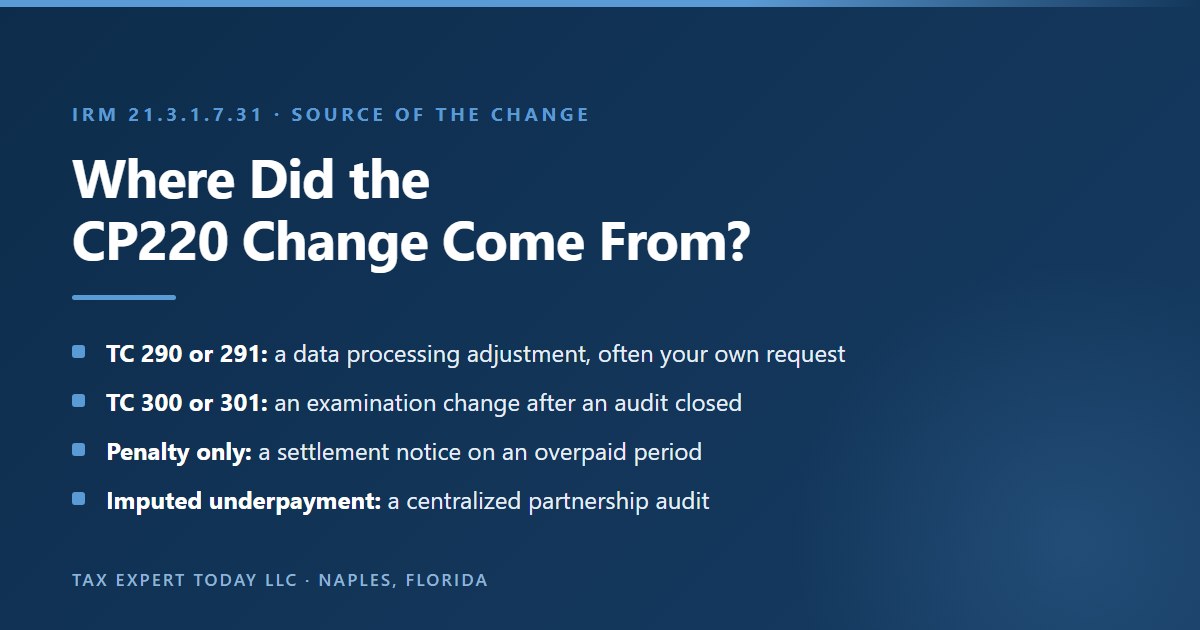
The IRS CP220 reports a change from one of three sources: an examination of the return, a data processing adjustment worked by IRS account staff, or a penalty assessed on a period that otherwise had a credit. Data processing adjustments often start with something the business sent, such as an amended return, a Form 941-X, or an abatement request.
- An audit closed: agreed or unagreed examination changes were assessed.
- Your own request was processed: an amended return, a 941-X, a 1120-X, or a claim.
- The IRS corrected the account: credits, payments, or reported figures were adjusted.
- A penalty was settled on the account: late filing, late payment, or deposit penalties.
- A partnership audit flowed through: an imputed underpayment under the centralized audit regime.
Many owners assume a CP220 means they were audited without being told. That is rarely the case. An examination generates correspondence long before any assessment, and a business that went through an audit usually knows it. Far more often the trigger is mundane. A payroll provider filed a Form 941-X to fix a reporting error. The controller requested abatement of a penalty and the IRS granted part of it. A corporation filed an amended return claiming a credit. Each of those requests ends with the IRS adjusting the account, and the adjustment produces an IRS CP220 or a CP210 explaining the result.
The IRS FAQ anticipates this confusion directly. It quotes notice language that begins “Based on the information you provided, we changed your 20XX Form XXXX,” and answers the question “I do not remember sending any change” by telling the taxpayer to call the number on the notice for specifics. In practice, the information “you provided” may have come from a payroll service, a bookkeeper, a former officer, or a preparer acting under authority, so checking with everyone who files for the business is the first step.
| Source of the change | Typical trigger | How to tell | Main dispute route |
|---|---|---|---|
| Data processing adjustment | Amended return, 941-X, claim, or IRS account correction | Explanation refers to information provided or an account correction; transcript generally shows TC 290 or TC 291 | Call, fax, or write with documents to the address on the notice |
| Examination | Agreed or unagreed audit changes | Prior audit correspondence; transcript generally shows TC 300 or TC 301 | Audit reconsideration or Appeals, depending on the history |
| Return settlement penalty | Penalty assessed on a period that otherwise had a credit | Penalty lines change, tax does not | Penalty relief request (first-time abate or reasonable cause) |
| Partnership audit (BBA) | Imputed underpayment from a centralized partnership audit | The words “Imputed Underpayment” in the billing summary | Usually closed; consult the partnership representative |
| Employer shared responsibility (CP220J) | ESRP assessed after Letter 226-J | Notice number ends in J | Written request or Form 843 to the return address on the notice |
What does the IRS CP220 notice show?
An IRS CP220 identifies the business, the EIN, the form and tax period, and explains the change in a short paragraph. A billing summary then shows the account before and after the adjustment, the tax change, any penalties and interest, payments and credits, and the amount due, the refund, or the zero balance, with a date to pay.
- Form and period: confirm the change is on the return and quarter or year you expect.
- Explanation paragraph: the single most useful line for identifying the source.
- Tax change: the increase or decrease to the tax itself.
- Penalties and interest: often the largest part of a CP220 balance.
- Amount due and date: the notice and demand that starts the payment clock.
The IRS does not publish a sample CP220 the way it does for some individual notices, so the best guide to its layout is the notice itself and the IRM description. Read the explanation paragraph first, then the billing summary. When the change resulted from a request the business made for an exact amount, the IRS can print abbreviated wording. IRM 21.7.1.4.2 explains that a Notice Suppression Indicator suppresses the adjustment detail on the CP210 and IRS CP220 and replaces it with: “This is in response to your request for an adjustment to your tax account for the period indicated above. The adjustment was made for the exact amount you requested.” If your notice carries that sentence, the IRS is telling you it did what was asked. The task then is to confirm that the request was correct, not to dispute the IRS.
| Part of the CP220 | What it means | What to check |
|---|---|---|
| Notice date | The date of notice and demand for any new balance | Count 21 calendar days forward, or 10 business days if the amount is $100,000 or more |
| Form and tax period | The module the IRS adjusted | Confirm the form number and the quarter or year |
| Explanation of changes | Why the IRS made the adjustment | Match it to an audit, a request you filed, or a penalty |
| Tax change | The increase or decrease in tax | Compare to your amended return or the audit report |
| Penalties | Late filing, late payment, deposit or other penalties | Check eligibility for first-time abate or reasonable cause |
| Interest | Interest charged from the original due date | Recompute to the notice date; check the large corporate rate |
| Amount due, refund, or zero | The bottom line after the adjustment | Agree it to the transcript before paying or waiting for a refund |
How long do I have to respond to an IRS CP220?
If the IRS CP220 shows a balance, pay by the date on the notice. Under IRC section 6601(e)(3), paying within 21 calendar days of the notice date, or 10 business days if the amount is $100,000 or more, stops further interest on the billed amount. If you disagree, call before that date so the account can be reviewed before collection continues.
- 21 calendar days: the interest-free window for billed amounts under $100,000.
- 10 business days: the shorter window for billed amounts of $100,000 or more.
- Failure to pay penalty: section 6651(a)(3) uses the same windows.
- Disagreement: contact the IRS before the due date, with documents ready.
Two statutes set the clock. IRC section 6601(e)(3) provides that if notice and demand is made for an amount and that amount is paid within 21 calendar days, or 10 business days if the amount is $100,000 or more, interest on the amount paid is not imposed for the period after the notice and demand. IRC section 6651(a)(3) adds a failure to pay penalty of 0.5 percent per month, up to 25 percent, on tax that was required to be shown on a return but was not, if it is not paid within the same 21 calendar day or 10 business day window. That second rule matters on a CP220, because an audit or adjustment increase is exactly that kind of tax.
The 10 business day rule surprises larger businesses. A corporation that receives an IRS CP220 for a six-figure examination change has roughly two weeks, not three, to pay before the failure to pay penalty begins to run on the new amount. Larger corporate balances can also carry a higher interest rate. The IRS announced that for the fourth quarter of 2026 the underpayment rate is 7 percent and the large corporate underpayment rate is 9 percent, according to its quarterly interest rate release. Those rates change quarterly.
There is no statutory response deadline for disagreeing with a CP220 in the way there is for a notice of deficiency. The IRS page simply says to contact the number on the notice if you disagree, and to contact it by the payment due date if you are asking for penalty relief. Waiting does not preserve rights. It only lets interest and penalties grow and lets the account move toward collection while the question remains unanswered.
How do I check an IRS CP220 change against the account transcript?
Pull the account transcript for the form and period on the notice through Business Tax Account, a representative, or the IRS. Look for the adjustment code and date that match the notice: TC 290 or TC 291 generally marks a data processing tax change, and TC 300 or TC 301 generally marks an examination change. Penalty and interest codes appear beside them.
- TC 290 and TC 291: additional tax assessed or tax decreased by an account adjustment.
- TC 300 and TC 301: additional tax assessed or tax decreased by examination.
- TC 166 and TC 276: failure to file and failure to pay penalties.
- TC 186 and TC 196: failure to deposit penalty and interest assessed.
The transcript is the IRS’s own ledger for the period, and it removes most of the guesswork from a CP220. The IRS Business Tax Account lets eligible businesses view balances by year, payment history, tax transcripts, and the notices themselves. A representative authorized on Form 2848 or Form 8821 can also request transcripts. Line the transcript up against the notice: the adjustment should post with a date close to the notice date and an amount equal to the tax change in the billing summary.
The Internal Revenue Manual describes the main adjustment codes. IRM 21.7.1 lists TC 290 to increase tax and TC 291 to decrease tax as the codes used on business account adjustments, and the IRS uses TC 300 and TC 301 for examination assessments and abatements. The IRM penalty sections describe TC 166 and TC 167 as the systemic assessment and abatement of the failure to file penalty and TC 276 and TC 277 as the same for the failure to pay penalty. When a CP220 shows a large penalty but only a modest tax change, the transcript will usually show the penalty code posting on the same cycle as the tax change.
| Transcript code | General meaning | What it tells you about the CP220 |
|---|---|---|
| TC 290 | Additional tax assessed by adjustment | A non-audit change increased the tax, often from your own amended return or 941-X |
| TC 291 | Prior tax abated by adjustment | A non-audit change decreased the tax, which may produce a CP210 refund or zero balance |
| TC 300 | Additional tax assessed by examination | An audit closed with an increase; dispute routes are audit reconsideration or Appeals |
| TC 301 | Tax abated by examination | An audit or reconsideration reduced the tax |
| TC 166 or TC 276 | Failure to file or failure to pay penalty | Penalty relief, not a tax dispute, may be the main issue |
| TC 186 | Failure to deposit penalty | Common on payroll periods after a 941-X increases tax |
| TC 196 | Interest assessed | Interest computed to the notice date; more accrues if unpaid |
The code alone does not prove the change is right or wrong. It tells you which IRS function made it and therefore which door to knock on. A TC 290 that matches a Form 941-X your payroll provider filed points you to the provider’s file. A TC 300 points you to the examination report. A penalty code with no tax change points you to penalty relief.
What should I do if the CP220 change came from my own request?
If the IRS CP220 reflects an amended return, a Form 941-X, or a claim the business filed, compare the notice to that filing. If the IRS processed it exactly as requested, the remaining work is paying any balance or waiting for any refund. If the IRS processed it differently, call with the filing in hand and ask which line was changed and why.
- Find the filing: ask the payroll provider, bookkeeper and preparer what was sent and when.
- Match the amounts: the notice should equal the change on the amended form.
- Look for partial processing: a credit or claim may have been allowed only in part.
- Correct your records: the IRS asks you to update the copy of the return you kept.
Payroll returns are the most common example. When an employer discovers that wages, tips, or withholding were underreported on a filed Form 941, it corrects the quarter on Form 941-X. When the IRS processes that form, the account is adjusted and an IRS CP220 may follow showing the additional tax and any related penalty and interest. If the 941-X was filed correctly and paid on time, the CP220 should show little or nothing due. If it was filed late or without payment, the CP220 may show a balance the business did not expect.
Credit claims work the same way in reverse. A business that claimed a credit on an amended employment tax return or an amended income tax return may receive a CP210 or CP220 showing the credit allowed. If the IRS allowed less than was claimed, the explanation paragraph should say so. That is the point to look for a separate disallowance letter, because a claim disallowance comes with its own appeal and refund suit timelines that a CP220 does not restate.
The IRM 21.3.1.7.29 dispute table, which the IRM applies to both the CP210 and the CP220, tells IRS employees what to do when a taxpayer disagrees with an adjustment that did not result from an examination: ask the taxpayer for documentation, accept it by fax during the call where possible, or have the taxpayer mail the request and documents to the address on the notice. That is useful leverage. You do not need to file a new form simply to correct a processing error on a CP220. A clear letter with documents is generally enough to start the review.
How do I dispute an IRS CP220 that came from a processing adjustment?
Call the number on the IRS CP220 with the notice, the return, and your documents ready, and ask what information the IRS used. If the IRS erred, send a short letter with supporting documents by fax if offered, or by mail to the address on the notice. Keep proof of what you sent and follow the transcript until the correction posts.
- Call first: the IRS page and the IRM both route disagreements to the notice phone number.
- Ask for the source: which document or request triggered the adjustment.
- Send documents: the IRM allows employees to accept faxed documentation.
- Ask for a collection hold: request time while the dispute is reviewed.
A strong dispute package is short. It includes a copy of the CP220, a one-page letter identifying the business, EIN, form and period, a plain statement of what is wrong and what the correct figure is, and the documents that prove it. For a payroll period, that might be the filed Form 941, the Form 941-X, Schedule B, payroll registers and deposit confirmations. For an income tax period, it might be the original and amended returns and the schedule the IRS changed. Every page should carry the EIN and the tax period.
Math error corrections on business returns are a related but separate category. When the IRS corrects a mathematical or clerical error on an income tax return, IRC section 6213(b)(2) allows the taxpayer to request abatement within 60 days after the notice is sent, and the IRS must abate the assessment, subject to reassessment under deficiency procedures. Business math error notices generally carry their own CP numbers in the 100 series, such as the CP102 for Form 941 math errors, so a CP220 that reflects a broader adjustment does not automatically carry that 60 day right. If your explanation paragraph describes a math or clerical correction, ask the IRS on the call whether section 6213(b) applies to the change, and act within 60 days if it does. Our IRS CP11 notice guide covers the 60 day math error rule in detail for individuals.
How do I dispute an IRS CP220 that came from an audit?
An examination CP220 reflects an audit that has already closed, so the dispute route is usually audit reconsideration with new information, or Appeals where rights remain. IRM 21.3.1.7.29 tells IRS employees that a taxpayer disputing an examination assessment may request reconsideration under certain conditions, and IRM 4.13.1 sets out that process.
- Read the audit report: the CP220 assesses what the examination determined.
- New information: reconsideration requires facts not considered in the audit.
- Unpaid assessments: reconsideration is aimed at assessments that remain unpaid.
- Income tax history: a notice of deficiency may already have been issued.
IRM 4.13.1.2 defines audit reconsideration as “the process the IRS uses to reevaluate the results of a prior audit where additional tax was assessed and remains unpaid, or a tax credit was reversed.” The taxpayer must provide new information on the audited issues that was not considered during the original examination. The same process covers IRS computational or processing errors in assessing the tax. Our IRS audit reconsideration guide walks through the request and the documents that tend to move it.
For income tax, an examination increase is normally assessed only after the deficiency procedures run their course: a 30 day letter, then a statutory notice of deficiency with its 90 day window to petition the Tax Court, unless the business agreed to the changes. By the time an IRS CP220 arrives for an income tax examination, that window has usually closed or the business signed an agreement. For employment taxes, the path is different, as the next section explains.
The IRS’s appeal rights publication, Publication 5, explains how to prepare a protest when Appeals rights are available. Whether those rights are still open after a CP220 depends on what happened before the assessment, which is why reading the examination file is the first step.
What does an IRS CP220 mean for a Form 941 payroll period?
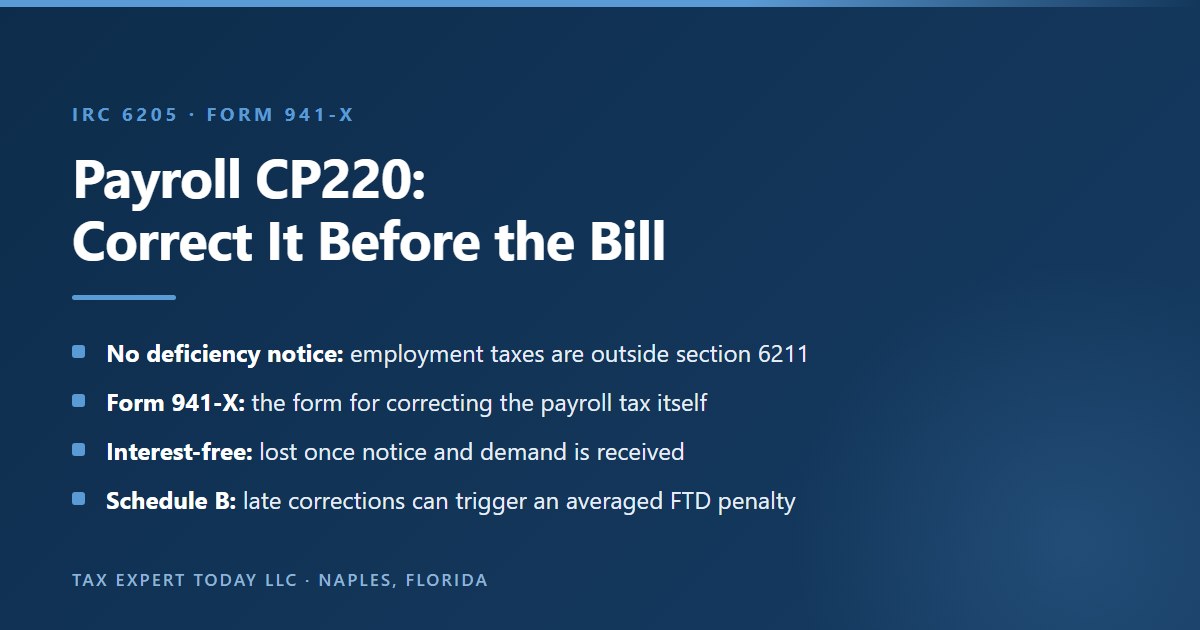
A CP220 on a Form 941 period reports a change to employment taxes. Employment taxes are outside the deficiency procedures, so there is no Tax Court petition before assessment. Errors are generally corrected on Form 941-X, and once the IRS issues notice and demand for an underreported amount, a later correction of that amount is no longer eligible for interest-free treatment.
- No deficiency notice: section 6211 limits deficiencies to income, estate, gift and certain excise taxes.
- Correct on Form 941-X: not on Form 843, which employers cannot use for FICA or withholding.
- Interest-free window: lost once notice and demand is received.
- Deposit penalties: an amended Schedule B may avoid an averaged FTD penalty.
- Trust fund exposure: unpaid withholding can reach responsible persons personally.
Payroll periods produce a large share of business CP220s, and the rules are distinct. IRC section 6211(a) defines a deficiency only for income, estate and gift taxes under subtitles A and B and excise taxes under chapters 41 through 44. Employment taxes are in subtitle C. That means the IRS can assess an employment tax change without first issuing a notice of deficiency, and the remedy for a wrong assessment is generally an abatement request, an amended return on Form 941-X, or a refund claim and suit after payment.
The Instructions for Form 941-X explain that the form covers interest-free adjustments under sections 6205 and 6413 as well as refund and abatement claims. Section 6205 provides that when less than the correct amount of employment tax is paid, proper adjustments “shall be made, without interest.” The instructions then list when a correction is not eligible for interest-free treatment, and one item applies directly here: the employer “received a notice and demand for payment.” A balance due CP220 is a notice and demand. A business that discovers an underreporting error should correct it before the IRS bills it, because the interest-free route closes once the bill arrives.
Form 843 is often suggested as the universal fix for penalties and errors, and for payroll it is not. The Instructions for Form 843 state that employers cannot use Form 843 to request a refund or abatement of FICA tax, RRTA tax, or income tax withholding, and cannot use it to amend a previously filed employment tax return. Form 843 remains the right form for many penalty abatement requests, which our IRS Form 843 guide covers. For the tax itself on a payroll period, the correction goes on Form 941-X.
The 941-X instructions also explain a deposit penalty trap. If an underreporting correction is filed late, the employer must attach an amended Schedule B; otherwise the IRS may assess an “averaged” failure to deposit penalty. A CP220 that shows a deposit penalty much larger than expected may reflect exactly that. Our IRS CP161 notice guide explains the deposit penalty tiers and how deposits get misapplied between periods.
Finally, unpaid payroll balances carry a risk no other business tax carries. The withheld income tax and the employee share of Social Security and Medicare are trust fund taxes. Under IRC section 6672, a person responsible for collecting and paying them who willfully fails to do so can be held personally liable for a penalty equal to the unpaid trust fund amount. Our trust fund recovery penalty guide covers how the IRS decides who is responsible. A CP220 on a Form 941 period that goes unpaid is how many of those cases begin.
What is a CP220J notice?
A CP220J tells an applicable large employer that the IRS has assessed or adjusted an employer shared responsibility payment under the Affordable Care Act, section 4980H. It follows Letter 226-J, which proposed the payment, and the employer’s response or Appeals. Disagreements go in writing, or on Form 843, to the return address on the notice.
- Who gets it: applicable large employers, generally those with 50 or more full-time employees including equivalents.
- What came before: Letter 226-J, Form 14764 and the Form 14765 employee listing.
- Collection: the IRS states an assessed ESRP is subject to lien and levy.
- Interest: charged on any balance until paid in full.
The IRS CP220J page says simply that the IRS charged an employer shared responsibility payment. The background sits in IRC section 4980H, which applies when an applicable large employer does not offer affordable, minimum value coverage to full-time employees and at least one of them receives a premium tax credit. The IRS computes the proposed amount from the employer’s Forms 1094-C and 1095-C and from employees’ individual returns, and proposes it on Letter 226-J, which the IRS states is not a bill.
The CP220J is the bill. IRM 21.3.1 lists the CP220J alongside the CP233J, CP503J and CP504J as notices issued “once assessment has been posted or adjusted on MFT 43,” the account type used for the payment, and tells employees that a taxpayer who disagrees should submit a written request or a Form 843 explaining the circumstances to the assessing function at the return address on the notice. Because a CP220J follows a proposal and response cycle, the most important question is what happened to the employer’s response to Letter 226-J. If the employer showed that particular employees were offered coverage, were not full time, or were not allowed a premium tax credit, the CP220J should reflect it. If it does not, the written request should say so and attach the response that was filed.
What does “imputed underpayment” on an IRS CP220 mean?
The words “Imputed Underpayment” on a CP210 or CP220 billing summary mean the adjustment came from a centralized audit of a partnership under the Bipartisan Budget Act rules. The IRM explains the assessment is made only after the Appeals or petition period has passed, so the partnership is generally told to pay and to consult its partnership representative for detail.
- Partnership level tax: section 6225 computes the tax at the partnership level.
- Timing: section 6232 delays assessment until the challenge periods end.
- The partnership representative: the person who handled the audit holds the file.
- Payment options: installment agreements are generally available for the balance.
IRM 21.3.1.7.29 includes a note that “The words ‘Imputed Underpayment’ only appear in the billing summary of a CP210 or CP220 that is related to a BBA audit.” For a partnership disputing that kind of assessment, the IRM tells IRS employees to explain that the audit has been resolved, either through Appeals or because the time to challenge the results has expired, that BBA assessments are not made until those critical dates have passed, and that the partnership should consult its partnership representative for more detail. Under IRC section 6225, the imputed underpayment is computed at the partnership level, and section 6232 governs when it may be assessed.
Partners who were not involved in the audit sometimes learn about it only when the IRS CP220 arrives at the partnership. The practical steps are to obtain the final audit documents from the partnership representative, confirm the imputed underpayment matches the final determination, and decide how the partnership will pay. Questions about pushing the adjustment out to partners, or about modifications to the imputed underpayment, belong to the audit stage and are usually closed by the time the bill arrives.
Can penalties and interest on an IRS CP220 be removed?
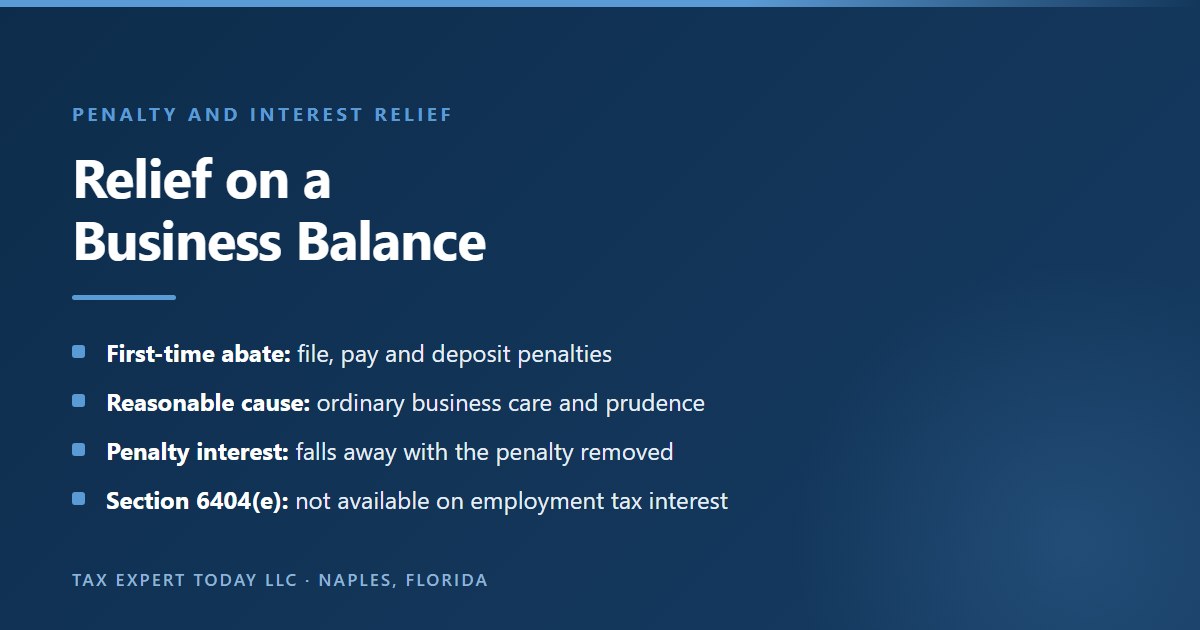
Penalties on an IRS CP220 may be removed if the business qualifies for first-time abatement or shows reasonable cause. The IRS states first-time abatement can cover failure to file, failure to pay and failure to deposit penalties. Interest generally follows the tax, and interest abatement for IRS errors is not available on employment taxes.
- First-time abate: a clean three year compliance history is the usual test.
- Reasonable cause: facts showing ordinary business care and prudence.
- Penalty interest: removing a penalty removes the interest on that penalty.
- Interest on tax: generally stays unless the tax itself is reduced.
- IRS delay: section 6404(e) relief excludes employment tax interest.
The IRS page for the CP210 and CP220 invites a request: if you cannot pay because of circumstances beyond your control, contact the IRS “by the due date of your payment and, depending on your situation, we may be able to remove the penalty.” The IRS first-time abate page states the IRS will not assess penalties for failure to file, failure to pay, or failure to make a deposit when the administrative waiver applies, and lists the failure to deposit penalty under IRC section 6656 among the penalties covered. The reasonable cause page covers relief when the business exercised ordinary care and prudence but could not comply.
Our first-time penalty abatement guide and reasonable cause guide explain how to build each request. For a business, one point deserves emphasis: first-time abatement is tested separately for each return type, so a corporation with a clean payroll history may qualify on a Form 941 period even if it had a problem on a Form 1120.
Interest is harder to remove. Interest on tax runs from the original due date under section 6601 and generally can be reduced only by reducing the tax. IRC section 6404(e) allows abatement of interest caused by an unreasonable IRS error or delay in a ministerial or managerial act, but the Form 843 instructions state that this relief applies only to taxes for which a notice of deficiency is required and that interest related to employment taxes cannot be abated under it. A corporate income tax CP220 may qualify where the IRS sat on a file; a payroll CP220 generally will not. Our IRS penalty and interest calculator can help estimate how the balance grows while a request is pending.
| Charge on the CP220 | Relief to consider | Key limit |
|---|---|---|
| Failure to file penalty | First-time abate or reasonable cause | Compliance history is tested by return type |
| Failure to pay penalty | First-time abate or reasonable cause | Keeps accruing until the balance is paid |
| Failure to deposit penalty | First-time abate, reasonable cause, or deposit corrections | An amended Schedule B may matter on late 941-X filings |
| Interest on penalties | Falls away with the penalty | Only for the portion of the penalty removed |
| Interest on tax | Section 6404(e) for IRS ministerial or managerial error | Not available for employment tax interest |
What if the IRS CP220 shows a refund or a zero balance?
If the IRS CP220 or CP210 shows an overpayment, the IRM tells IRS employees to advise that a refund is generally issued within two to three weeks, plus mail time, if no other federal taxes or obligations are owed. A zero balance generally needs no action beyond correcting your records and confirming the transcript agrees.
- Refund timing: about two to three weeks, plus up to two more weeks for mail.
- Offsets: other federal tax balances can absorb the credit first.
- Freezes: an account hold can delay a refund that the notice shows.
- Interest paid to you: a Form 1099-INT if the interest is $10 or more.
A refund CP220 is good news, but it is still worth checking. IRM 21.3.1.7.29 tells IRS employees to review freeze conditions before telling a taxpayer when to expect the credit, which means a refund shown on the notice can still be held if another issue is open on the account. The IRS can also apply the credit to other federal tax debts under IRC section 6402(a), which is common when a business has an unpaid payroll quarter alongside an overpaid one. If a refund has not arrived three weeks after the notice and no other balances exist, the IRS page says to call the number on the notice.
Corporations should also note the rate difference. For the fourth quarter of 2026 the IRS announced a 6 percent overpayment rate for corporations and 4.5 percent on the portion of a corporate overpayment exceeding $10,000, while the corporate underpayment rate is 7 percent. A business carrying an overpayment on one period and a balance on another usually comes out ahead by asking that the credit be applied to the balance promptly rather than waiting for a refund.
How is an IRS CP220 different from a CP161, CP22A, CP11, CP60 or CP2000?
The IRS CP220 reports a change to a business account after examination or adjustment. A CP161 bills an unpaid business balance with no change to the return. A CP22A is the individual notice after a requested change. A CP11 reports an individual math error. A CP60 reports a removed payment. A CP2000 proposes, rather than makes, an income change.
- Change made versus proposed: a CP220 reports a completed adjustment; a CP2000 only proposes one.
- Business versus individual: CP220, CP210 and CP161 are business notices.
- Tax versus payment: a CP60 changes the payment side, not the tax.
| Notice | Account type | What changed | First response |
|---|---|---|---|
| CP220 | Business | Tax, penalties or credits after examination or adjustment | Match the change to an audit, a request, or a penalty |
| CP210 | Business | Same kind of adjustment, leaving an overpayment or zero balance | Confirm the credit and watch for offsets |
| CP161 | Business | Nothing changed; an unpaid balance is billed | Pay or trace deposits |
| CP22A | Individual | A change you requested, leaving a balance | Compare to your amended return |
| CP11 | Individual | A math error correction | Request abatement within 60 days if wrong |
| CP60 | Individual | A misapplied payment was removed | Trace the payment |
| CP2000 | Individual | Proposed income change from third party reports | Respond by the date on the notice |
Two of those siblings come up constantly with businesses. The CP161 is the first bill on a business return that was filed with a balance and no math error, and it often arrives on the same payroll periods that later produce a CP220 after a 941-X. The CP60 is the individual notice for a removed payment; on a business account the payment side of the problem is the CP260, while a CP220 deals with the tax side. If your notice shows a change in payments rather than a change in tax, the cause is usually a misapplied deposit rather than an adjustment, and the fix is a payment trace.
The CP2000 is the most important contrast. A CP2000 proposes an income change and asks for a response before anything is assessed. A CP220 reports a change that has already been assessed. That is why the response to a CP220 is about correcting or paying an existing assessment, not about answering a proposal.
Can I pay an IRS CP220 balance or set up a business payment plan?
Yes. A business can pay a CP220 balance through EFTPS, Business Tax Account, or by check, and can request a payment plan. The IRS directs business taxpayers to call the number on the notice or 800-829-4933 and offers simple payment plans for individuals and businesses. Larger balances may require Form 433-B financial disclosure.
- Pay in full: within the notice window to stop further interest and penalty.
- Short-term plans: no user fee for those who qualify.
- Installment agreements: monthly payments, with a lien filing possible on larger balances.
- Financial statements: Form 433-B may be required for business plans outside streamlined terms.
The IRS payment plans page states that the IRS “now offers Simple payment plans for individuals and businesses,” that a short-term plan carries no user fee for those who qualify, and that business taxpayers should call the number on the notice or 800-829-4933. When the requested monthly amount does not meet the plan requirements, the IRS directs taxpayers to Form 433-H, Form 433-F, or Form 433-B, the collection information statement for businesses. Our IRS installment agreement options guide compares the plan types.
A business with an open payroll liability should be careful about which periods payments go to. Voluntary payments can generally be designated to a specific period and to the trust fund portion of an employment tax liability, which can reduce the exposure of responsible persons under section 6672. Undesignated payments are applied as the IRS chooses. If a CP220 balance sits alongside other unpaid periods, our IRS tax debt help Naples page explains how the options fit together, including payment plans, currently not collectible status for a business that has stopped operating, and an offer in compromise where the numbers support one.
What happens if I ignore an IRS CP220?
An unpaid IRS CP220 balance continues to accrue interest and the failure to pay penalty, and the account moves through further balance due notices toward a CP504B and a final notice of intent to levy. IRS Document 6209 describes the CP504B as a final business notice after which liens and levies on certain assets may follow. Unpaid payroll balances also raise trust fund penalty risk.
- Interest and penalty: both grow monthly on the unpaid amount.
- Refund offsets: overpayments on other periods can be applied to the balance.
- Liens and levies: available once the notice sequence runs its course.
- Personal exposure: responsible persons on payroll balances.
Document 6209 describes the CP504B as the final balance due notice on a business account, and states that no response allows for lien filing and levies on certain assets. Our IRS CP504 notice guide covers what that stage means, and our Letter 1058 and LT11 guide covers the final notice of intent to levy and the collection due process rights that come with it. The IRS also notes on its payment plans page that not paying taxes when due “may cause the filing of a Notice of Federal Tax Lien and/or an IRS levy action.”
Silence also forecloses the cheapest fixes. A wrong data processing adjustment is easiest to correct while the file is fresh. A penalty relief request made by the payment due date is the one the IRS page specifically invites. And on a payroll period, the gap between a CP220 and a trust fund recovery penalty interview can be shorter than owners expect. Our failure to pay penalty guide shows how the monthly penalty compounds the problem over time.
CP220 notice help Naples: tax resolution Naples and Southwest Florida
Tax Expert Today LLC provides IRS tax resolution from its Naples, Florida office: back taxes and IRS tax debt, payment plans and installment agreements, offers in compromise, wage garnishment and bank levy release, federal tax lien withdrawal, penalty abatement, unfiled returns, and audit representation. The firm is led by Dr. Pellumb Kabashi, an Enrolled Agent with unlimited rights to represent taxpayers before the IRS, a Certified Fraud Examiner, and a Certified Estate and Trust Specialist, with a team of enrolled agents, CPAs, and tax attorneys.
- Address: 11983 Tamiami Trail N, Naples, FL 34110.
- Phone: (239) 441-2005.
- Hours: Monday through Friday, 10 a.m. to 5 p.m. Eastern Time.
- Representation: on Form 2848, which lets us speak with the IRS on your behalf.
Southwest Florida has a dense base of small employers in construction, hospitality, landscaping, medical practices and property management, and those businesses run payroll through outside providers more often than not. That is the profile where a Form 941-X filed by a provider, or a deposit penalty on a busy season quarter, turns into an IRS CP220 the owner was not expecting. Our Naples tax resolution services cover these business account adjustments alongside balance due notices, payment plans and penalty relief, and our IRS resolution and audit support covers the cases where a CP220 follows an examination or overlaps with a collection action. For balances that have already reached the reminder or levy notices, our IRS tax debt help Naples page explains the next steps.
Most CP220 work is documentary. With a Form 2848 on file, a representative can pull the business transcripts, identify the adjustment code and its source, obtain the examination file or the processed amended return, and prepare a dispute letter, a penalty relief request, or a payment plan, whichever the facts call for. Businesses outside Florida can work with the office remotely; representation before the IRS is not limited by state.
Frequently Asked Questions About the IRS CP220 Notice
What is an IRS CP220 notice?
An IRS CP220 notice tells a business that the IRS adjusted its tax account for one return period after an examination or a data processing adjustment. The notice explains the change and shows whether the account now has a balance due, an overpayment, or an even balance, including any penalties and interest.
Is a CP220 for businesses or individuals?
Businesses. IRS Document 6209 explains that three-digit CP numbers are used for Business Master File accounts and two-digit numbers for individual accounts. The individual counterparts are the CP21 and CP22 series, such as the CP22A. A sole proprietor with employees can receive a CP220 on the payroll account.
Does a CP220 mean my business was audited?
Not necessarily. A CP220 can come from an examination, but it is also issued after data processing adjustments, such as an amended return or Form 941-X the business filed, and as a settlement notice when penalties are assessed on an overpaid period. The explanation paragraph and the account transcript show which.
How long do I have to pay a CP220 balance?
Pay by the date on the notice. Under IRC sections 6601(e)(3) and 6651(a)(3), paying within 21 calendar days of the notice date, or 10 business days if the amount is $100,000 or more, avoids further interest on the billed amount and the failure to pay penalty on the new tax.
How do I dispute an IRS CP220?
Call the number on the notice and ask what information the IRS used. If the adjustment was a processing error, send a short letter with documents by fax if offered or by mail to the address on the notice. If it came from an audit, audit reconsideration with new information is the usual route.
What is a CP220J?
A CP220J reports that the IRS assessed or adjusted an employer shared responsibility payment under section 4980H of the Affordable Care Act. It follows Letter 226-J. The IRM directs employers who disagree to submit a written request or Form 843 to the return address on the notice.
Can I use Form 843 to fix a CP220 on Form 941?
Not for the tax itself. The Form 843 instructions state that employers cannot use it to request a refund or abatement of FICA tax or income tax withholding, or to amend an employment tax return. The tax correction goes on Form 941-X. Form 843 can still be used for many penalty abatement requests.
Can penalties on a CP220 be removed?
Possibly. The IRS states first-time abatement can cover failure to file, failure to pay and failure to deposit penalties for businesses with a clean recent history, and reasonable cause relief is available when the business used ordinary care. Interest on removed penalties falls away; interest on the tax generally remains.
What does imputed underpayment mean on a CP220?
It means the adjustment came from a centralized partnership audit under the Bipartisan Budget Act rules. The IRM notes those words appear only on CP210 or CP220 notices related to a BBA audit, that the assessment follows the close of the challenge period, and that the partnership representative holds the audit detail.
Where can I get help with an IRS CP220 notice in Naples, FL?
Tax Expert Today LLC, 11983 Tamiami Trail N, Naples, FL 34110, (239) 441-2005, helps businesses in Collier and Lee Counties and nationwide read CP220 adjustments against their transcripts, dispute processing errors, request penalty relief, and set up payment plans. A representative authorized on Form 2848 can work with the IRS on the business’s behalf.
When to Engage a Professional
Many businesses can resolve an IRS CP220 on their own, especially when the notice reflects an amended return they filed and the numbers match, or when the change is a small refund or a zero balance. Consider engaging a representative when the business does not recognize the source of the change, when the CP220 follows an examination and new information is available, when a payroll period now shows a balance that the business cannot pay quickly, when deposit or failure to pay penalties are a large share of the bill, when a CP220J does not reflect the response the business filed to Letter 226-J, or when an imputed underpayment arrived without the audit file. Those are the cases where the transcript codes, the employment tax rules and the penalty relief standards decide the result, and where an unpaid payroll balance can become a personal problem for owners and officers. You can review our IRS resolution and audit support services, or start with our tax resolution Naples page. Dr. Kabashi is an Enrolled Agent authorized to represent taxpayers before the IRS in all 50 states, and every engagement starts from the statute, the regulations and the IRS’s own procedures rather than assumptions about what the IRS will do. Outcomes depend on each business’s facts.
This article is educational and general in nature. It does not constitute tax or legal advice for any particular taxpayer, and outcomes depend on individual facts and circumstances. Interest rates, penalty rules and IRS procedures are current as of the publication date and are subject to change.
Published October 22, 2026 by Dr. Pellumb Kabashi « Back to Learning Center
Have a question this article touches on?
Tax Expert Today LLC, based in Naples, Florida and serving clients across the United States.
Schedule a Consultation (239) 441-2005