
By Dr. Pellumb Kabashi, DBA, MBA, EA, CFE, CES
Founder, Tax Expert Today LLC · Tax advisors, enrolled agents, CPAs, and attorneys · Serving clients in all 50 states
Quick answer: Georgia capital gains tax is not a separate tax. Georgia starts from federal adjusted gross income and taxes every capital gain at the same flat rate it applies to wages, with no reduced long term rate. The rate is 5.19 percent for tax year 2025 and 4.99 percent for tax year 2026. Call (239) 441-2005 for a free consultation.
How does Georgia tax capital gains?
Georgia has no capital gains tax of its own. The Georgia return begins with federal adjusted gross income, which already contains your net capital gain, and applies a single flat rate to the whole figure. A gain held eleven months and a gain held eleven years are taxed identically in Georgia, because the state makes no long term or short term distinction.
That one structural fact drives almost everything else in this guide. Because Georgia inherits the federal number rather than recomputing it, every federal rule that changes the size of your gain also changes your Georgia bill, and no Georgia rule creates a preferential rate to soften it.
- No holding period benefit. Georgia does not mirror the federal 0, 15 and 20 percent long term brackets. Selling after the twelve month mark saves federal tax and saves nothing at the state level.
- Federal basis carries over. Improvements, selling costs and depreciation adjustments that move federal basis move the Georgia figure by the same amount.
- Federal exclusions carry over. Gain excluded on the federal return, such as principal residence gain under 26 U.S.C. §121, never enters federal adjusted gross income, so it never reaches the Georgia return either.
- Capital losses carry over. The federal net capital loss limitation applies first, and Georgia accepts the result.
- No local layer. Georgia counties and cities do not impose an income tax, so there is no municipal surcharge on a gain.
What is the Georgia capital gains tax rate for 2025 and 2026?
The rate depends entirely on the tax year, and this is where most published guidance is wrong. The 2025 IT-511 instruction booklet states that effective January 1, 2025, the income tax rate is 5.19 percent. The Department of Revenue separately confirms that the rate has been reduced to a flat 4.99 percent for tax year 2026.
Georgia has been cutting the flat rate on a rolling basis rather than holding it steady, which means a page written two filing seasons ago is not merely dated, it reports a rate that no longer exists. At the time of writing, several of the highest ranking pages on this topic still quote 5.39 percent, which was the rate for tax year 2024, and at least one of them labels that figure as current for 2026. Confirm the rate against the instruction booklet for the year you are actually filing before you run any projection.
| Tax year | Georgia flat rate on capital gains | Where the figure is published |
|---|---|---|
| 2024 | 5.39 percent | 2024 IT-511 instruction booklet |
| 2025 | 5.19 percent | 2025 IT-511, What is New section: effective January 1, 2025 |
| 2026 | 4.99 percent | Department of Revenue, Important Tax Updates |
Georgia has legislated a longer path of further annual reductions toward a floor below the current rate, but those steps are conditioned on state revenue performance and a scheduled reduction can be paused. Treat any rate beyond 2026 as a planning assumption rather than a published figure, and reconfirm it when the booklet for that year is released.
The practical effect on a sale is straightforward arithmetic. A $400,000 long term gain recognized by a Georgia resident carries roughly $20,760 of Georgia tax at the 2025 rate and roughly $19,960 at the 2026 rate, before any exclusion is applied. The federal tax on the same gain, at a 20 percent long term rate plus the 3.8 percent net investment income tax under 26 U.S.C. §1411, is several times larger. Georgia is the smaller number in most sales, which is precisely why it gets overlooked until a notice arrives.
A gain recognized inside a C corporation is taxed at the corporate level instead, and Georgia applies the same flat rate there because O.C.G.A. 48-7-21(a) borrows the individual rate for the corresponding taxable year. An owner comparing an asset sale by the company with a sale of the shares can read how that rate is set, and how a fiscal year changes it, in our guide to the Georgia corporate tax rate.
Do capital gains qualify for the Georgia retirement income exclusion?
Yes, and this is the most valuable and least discussed provision in Georgia capital gains tax. The Department of Revenue lists capital gains income as a qualifying category of retirement income. A taxpayer aged 65 or older may exclude up to $65,000 of it per person, so a qualifying married couple can shelter up to $130,000 of gain from Georgia tax entirely.
The 2025 IT-511 booklet sets the ceilings and the eligibility rules. The maximum exclusion is $35,000 for a taxpayer aged 62 through 64, or for a taxpayer under 62 who is permanently disabled to such an extent that they are unable to perform any type of gainful employment. The maximum rises to $65,000 for a taxpayer aged 65 or older. The exclusion is available to both spouses, but each must qualify on a separate basis, so a couple where one spouse is 66 and the other is 58 has one ceiling, not two.
| Taxpayer status | Maximum exclusion per person | Married couple where both qualify |
|---|---|---|
| Aged 62 through 64 | $35,000 | Up to $70,000 |
| Under 62 and permanently disabled | $35,000 | Per qualifying spouse |
| Aged 65 or older | $65,000 | Up to $130,000 |
| Under 62, not disabled | None | None |
Capital gains sit on the unearned side of the worksheet, and the mechanics matter more than the headline number. On the Form 500 Schedule 1 retirement income exclusion worksheet, capital gains are reported on Line 9, alongside interest on Line 6, dividends on Line 7, taxable individual retirement account distributions on Line 11, taxable pensions on Line 12, and rent and royalty income on Line 13. Only $5,000 of the maximum allowable exclusion may be earned income, which leaves the great majority of the ceiling available for a gain.
- The ceiling is shared, not stacked. Interest, dividends, pension income and capital gains all draw on the same $65,000, so a retiree already using the exclusion against pension income has less of it left for a sale.
- Jointly held assets split evenly. The booklet directs that income from a jointly held item be allocated to each taxpayer at 50 percent, which is what lets a couple reach two ceilings on one asset.
- Social Security is separate. Social Security and Railroad Retirement benefits paid by the Railroad Retirement Board are excluded from Georgia income on their own footing and should not be entered in the retirement exclusion calculation at all.
- Some income is disqualified outright. Retirement income does not include amounts received directly or indirectly from lotteries, gambling, illegal sources or similar income.
- Active business income counts as earned. Rental, royalty or partnership income subject to FICA or self employment tax belongs on Line 2 rather than Line 13, as does S corporation trade or business income in which the taxpayer or spouse materially participated. That reclassification pushes the amount against the $5,000 earned income sublimit instead of the full ceiling.
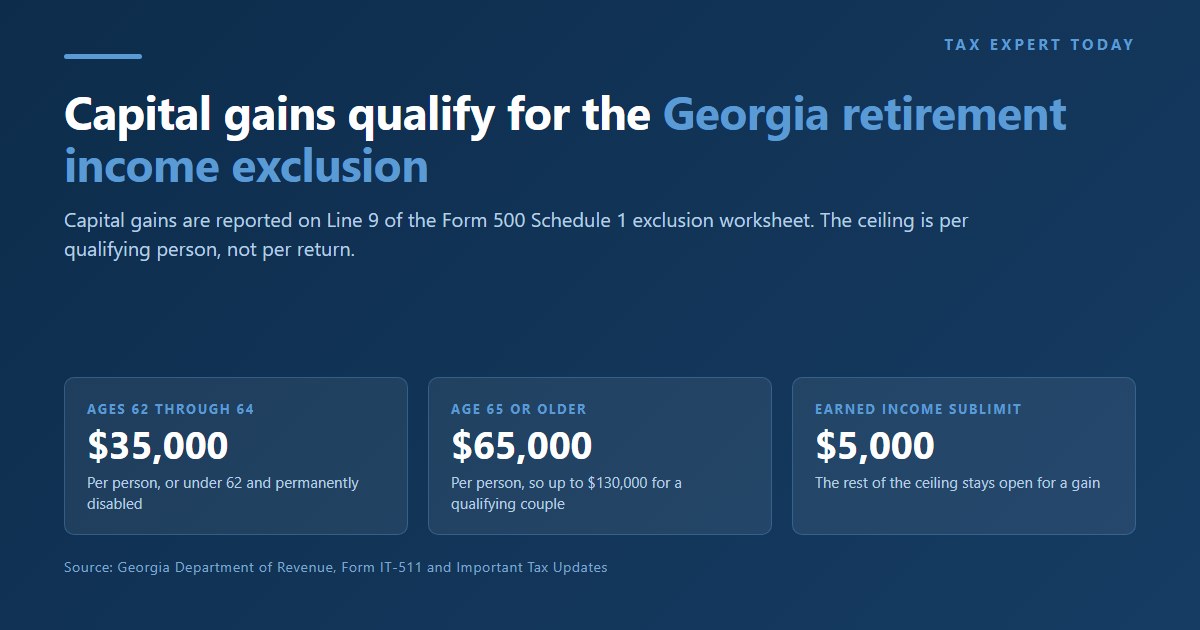
The timing consequence is the part worth planning around. A taxpayer who turns 65 during a year in which a large sale is contemplated moves from a $35,000 ceiling to a $65,000 ceiling, and a couple in that position moves from $70,000 to $130,000 once both cross the line. Our guide to the Georgia retirement income exclusion works the ceilings and the per person rule through in detail, including how the exclusion interacts with pension and individual retirement account income competing for the same room.
How does Georgia treat the sale of a primary residence?
Georgia follows the federal result rather than granting a separate break. Because the exclusion under 26 U.S.C. §121 removes up to $250,000 of gain for a single filer and up to $500,000 for a married couple filing jointly before federal adjusted gross income is computed, that excluded gain never appears on the Georgia return and Georgia never taxes it.
The consequence is that the Georgia question on a home sale is really a federal question. If the ownership and use tests are met and the gain fits inside the federal ceiling, there is nothing to report to Georgia. If the gain exceeds the ceiling, only the excess flows through to federal adjusted gross income, and Georgia taxes that excess at the flat rate.
- Basis discipline decides the Georgia number. Capital improvements, the original purchase price, closing costs on both ends and any casualty adjustments all reduce the gain before Georgia sees it, so records kept over decades of ownership are the most effective Georgia planning tool available on a residence.
- Depreciation recapture is not excludable. Gain attributable to depreciation claimed on a period of rental use is recaptured federally and is not covered by the residence exclusion, so it reaches the Georgia return in full.
- A partial exclusion is possible. Where the two of five year use test fails for a qualifying reason, a reduced federal exclusion may apply, and Georgia again accepts whatever the federal computation produces.
- Retirement age changes the answer on the excess. A seller aged 65 or older can apply the retirement income exclusion against the taxable excess, which is an interaction almost no home sale guidance addresses.
What happens when a nonresident sells Georgia real estate?
Georgia requires withholding at closing. Ga. Comp. R. & Regs. 560-7-8-.35 imposes a 3 percent withholding tax computed by applying the 3 percent rate to the purchase price when a nonresident sells or transfers Georgia real property. The buyer or closing agent remits it on Form G2-RP, and the seller recovers any overpayment only by filing a Georgia return.
This is the provision that surprises out of state sellers most often, because it operates on the gross sale price rather than on the gain. A nonresident selling a Georgia rental property for $600,000 at a modest gain can see $18,000 withheld at closing even though the actual Georgia liability is a fraction of that. The regulation provides a way out, and it depends on paperwork filed before the closing rather than after.
| Situation | Withholding treatment | Form to file |
|---|---|---|
| Seller is a Georgia resident or deemed resident | No withholding required | IT-AFF1 residency affidavit |
| Purchase price is less than $20,000 | No withholding required | None |
| Nonresident seller, no gain affidavit filed | 3 percent of the full purchase price | G2-RP |
| Nonresident seller who swears to the gain | 3 percent of the recognized gain only | IT-AFF2 plus G2-RP |
| Price above $20,000 but computed tax under $600 | Withholding may be avoided | Completed gain affidavit |
| Transaction is otherwise exempt | No withholding required | IT-AFF3 certificate of exemption |
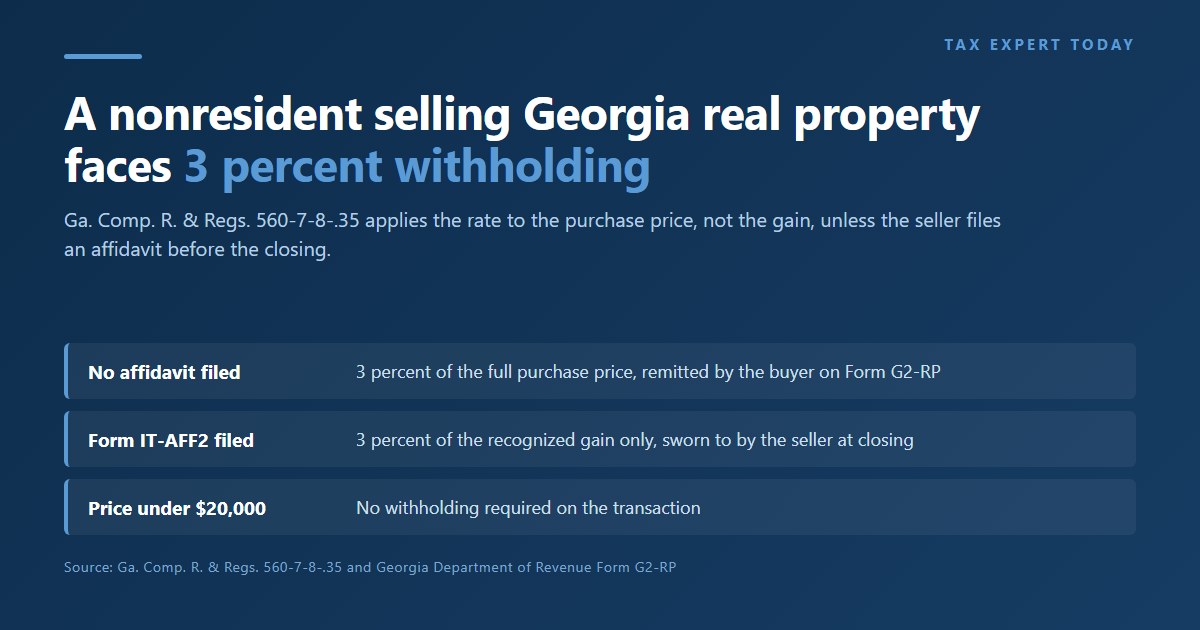
Three details decide whether this goes smoothly. First, the affidavit of seller’s gain on Form IT-AFF2 is what converts the base from the purchase price to the recognized gain, and it has to be in the closing agent’s hands at the closing table, not mailed afterward. Second, the initial return and payment are due on or before the last day of the calendar month following the calendar month in which the sale or transfer occurred, with penalty and interest for a late remittance. Third, the definition of nonresident reaches entities as well as individuals, covering corporations, partnerships, limited liability companies and limited liability partnerships whose principal place of business is outside Georgia, and trusts with nonresident fiduciaries or beneficiaries.
Withholding is a prepayment, not a final tax. The amount held back is credited against the Georgia liability computed on the return, and any excess is refunded, which means a nonresident seller who skips the Georgia return simply forfeits the overpayment.
Where the property was inherited rather than bought, the gain calculation starts from a different place, because the basis is reset to the date of death value and a prompt sale often produces almost no gain at all. That reset also changes what a nonresident heir should be withholding at closing, which our guide to Georgia inheritance tax works through alongside the Form IT-AFF2 affidavit of gain.
When the Georgia sale is the relinquished property in a 1031 exchange, the withholding question changes. The Department of Revenue’s guide says withholding is not required to the extent the income from the sale is not subject to Georgia income tax, and Form IT-AFF3 includes a like kind exchange statement for a fully deferred exchange. Our guide to the 1031 exchange in Georgia explains when to use IT-AFF3 or IT-AFF2 and how boot is taxed.
How is a capital gain split when you move into or out of Georgia?
The residency date at the moment of the sale controls. A gain recognized while you are a Georgia resident is Georgia income in full, wherever the asset sits. A gain recognized after residency ends is Georgia income only if the asset is Georgia source, which for practical purposes means Georgia real property or a Georgia business interest.
That makes the closing date a state tax decision and not only a real estate one. A taxpayer who sells appreciated securities in March and establishes Florida residency in June has a Georgia gain, because the sale happened during the resident period. The same taxpayer who reverses the order has no Georgia gain on those securities at all, because intangible property is generally not Georgia source income to a nonresident.
- Intangibles follow the seller. Stock, mutual funds and other intangible property sold after residency ends are generally outside Georgia’s reach, which is what makes sequencing valuable.
- Georgia real property does not. Gain on Georgia land or buildings remains Georgia source regardless of where the seller lives, and it brings the 3 percent withholding with it.
- Installment sales straddle the line. Where a gain is reported over several years, the character of each year’s installment is tested against that year’s residency status, so an installment stream can be partly taxable and partly not.
- The retirement exclusion must be prorated. The booklet requires part-year residents and nonresidents to prorate the exclusion, and to prorate the earned and unearned portions separately using two different ratios.
- Documentation carries the burden. A residency change asserted without evidence of a new legal residence and an abandoned Georgia one is the position most likely to be unwound on examination.

The allocation itself runs through Form 500 Schedule 3, which splits income into a Georgia column and a non-Georgia column and then prorates the deduction by the same ratio. Our guide to the Georgia part year resident tax return walks the Schedule 3 arithmetic with the booklet’s own worked example, including the statutory residency tests that decide whether a mover is a part-year filer in the first place.
Does Georgia allow a credit for a gain taxed by another state?
Yes. A Georgia resident who pays income tax to another state on the same gain may claim a credit for taxes paid to that state, computed on the Form 500 Schedule 2 credit section. The credit is limited to the lesser of the tax actually paid to the other state or the Georgia tax attributable to that income, so it prevents double taxation without ever producing a refund of another state’s tax.
The situation arises most often when a Georgia resident sells real property located elsewhere. The state where the property sits taxes the gain as source income, Georgia taxes it as resident income, and the credit reconciles the overlap. The limitation matters because the credit will not exceed what Georgia itself would have charged: a resident who pays a higher rate to the source state absorbs the difference.
- Only income taxes qualify. Transfer taxes, recording fees and property taxes paid at a closing are not creditable against Georgia income tax.
- The other return is the evidence. A copy of the other state’s return is the standard support for the credit and should be retained with the Georgia file.
- Nonresidents do not claim it. The credit belongs to Georgia residents. A nonresident selling Georgia property claims the credit, if any, on the return filed in the state of residence.
- No credit against Florida tax. Florida imposes no individual income tax, so a Georgia resident selling Florida property has no other state tax to credit and simply pays Georgia on the gain.
A Georgia taxpayer facing a large one-time liability sometimes asks whether a purchased transferable credit can absorb it. That route exists, and our guide to the Georgia film tax credit sets out what a buyer actually acquires, how the credit is claimed on Schedule 2, and why the carryforward period is shorter than most published guidance states.
Do you owe Georgia estimated tax after a large capital gain?
Usually yes. A capital gain is income not subject to withholding, so a taxpayer who realizes a substantial gain during the year and makes no estimated payment can face an underpayment penalty even if the return is filed and paid on time. Georgia estimated payments are made on Form 500-ES or through the Georgia Tax Center.
The trap is timing rather than amount. Georgia computes the underpayment charge quarter by quarter, so a gain realized in the first quarter that is only funded with a payment in April of the following year has been underpaid for four quarters, not one. Selling early in the year and waiting until the filing deadline is the pattern that generates the penalty most reliably.
- Fund the quarter of the sale. An estimated payment made in the quarter the gain is recognized stops the charge from that point forward.
- Withholding is a substitute. Increasing Georgia withholding on wages or on a pension distribution can cover a gain without a separate voucher, though withholding is generally treated as paid evenly across the year.
- Closing withholding counts. Where 3 percent was withheld on a Georgia real property sale, that amount is already a credit and reduces or eliminates the need for an estimate on that gain.
- Model the exclusion first. A retiree whose gain fits inside the retirement income exclusion may owe no Georgia tax at all, in which case an estimated payment is simply an interest free loan to the state.
Anyone who under-funded a transition year can size the exposure with our Georgia estimated tax penalty calculator before deciding how much to pay and when.
A sale in the middle of the year usually means a late start rather than a missed payment. If the gain is what first creates the requirement, O.C.G.A. 48-7-115 sets the first installment by the date of the sale, so a July closing points to September 15 and a November closing to January 15. The schedule and the voucher are laid out in our guide to Georgia Form 500 ES.
What does Georgia not follow from the federal capital gains rules?
Georgia conforms to the federal computation of gain but not to every federal deduction that surrounds it. The clearest divergence is that Georgia does not allow the 20 percent qualified business income deduction under 26 U.S.C. §199A, although because Georgia begins with federal adjusted gross income rather than taxable income, no add-back adjustment is required on the return.
Several other differences are worth knowing before a projection is built on federal figures alone.
- No state net investment income tax. The 3.8 percent charge under 26 U.S.C. §1411 is federal only, applying above modified adjusted gross income of $250,000 for joint filers, $125,000 for married filing separately and $200,000 for other taxpayers. Georgia adds no equivalent.
- No preferential state rate. There is no Georgia analogue to the federal 0, 15 and 20 percent brackets, and no Georgia exclusion for a percentage of long term gain.
- The standard deduction is separate. Georgia allows $12,000 for single, married filing separately, head of household and qualifying surviving spouse filers for tax year 2025, and $24,000 for married filing jointly. The Department of Revenue has increased those figures to $15,000 and $30,000 respectively for tax year 2026.
- Surplus refunds are not Georgia income. A Georgia surplus refund is not taxable for Georgia individual income tax purposes, though it may be federally taxable.
- Form 500EZ is gone. The short form was discontinued for tax years beginning on or after January 1, 2025, so every individual filing for 2025 forward uses Form 500.
- An itemizer credit now exists. Full-year and part-year residents who itemize may claim a credit of up to $300 per taxpayer on Form 500, Line 19, limited to the tax liability and not carried forward.
Georgia capital gains tax help in Naples & Southwest Florida
Tax Expert Today LLC advises on state tax matters nationwide from an office in Naples, Florida. Georgia capital gains work is a recurring part of that practice, in large part because the Georgia to Florida move is one of the most common relocations we see: the contrast between a flat state income tax and no state income tax at all turns the closing date on an appreciated asset into a decision with a measurable cost attached. Our team includes tax advisors, enrolled agents, CPAs and attorneys, and Georgia clients are served nationwide from the Naples office.
Searches for a capital gains tax advisor Naples FL and for Georgia capital gains tax help frequently come from the same person at different stages of the same transaction, one before the move and one after the closing. Both are the same engagement.
Tax Expert Today LLC, 11983 Tamiami Trail N, Naples, FL 34110. Telephone (239) 441-2005. Office hours Monday through Friday, 10:00 to 5:00 Eastern time. If a Georgia sale sits inside a wider relocation or entity plan, our Georgia tax services page sets out how we handle Georgia compliance and planning together, and our Naples tax planning practice covers the Florida side of the same transaction.
Do I need to be in Naples for help with a Georgia capital gain?
No. We serve clients in all 50 states and the work is handled remotely through a secure document portal, with calls scheduled Monday through Friday during office hours. Clients in Southwest Florida who prefer to meet in person are welcome at the Tamiami Trail office, and many of the Georgia to Florida movers we work with do exactly that once the relocation is complete.
When should you bring in a professional?
A single sale of publicly traded stock by a full-year Georgia resident, reported on a Form 1099-B with a clean basis, is a return many taxpayers complete without help. The flat rate makes the Georgia arithmetic simple once the federal gain is right.
The calculation stops being routine when facts start crossing the lines the statute draws. Consider professional help where a residency change falls in the same year as a liquidity event and the sequencing of the two is still open, where a nonresident is selling Georgia real property and the choice between withholding on the price and swearing to the gain has to be made before the closing, where the retirement income exclusion has to be allocated across competing categories of unearned income or prorated across two states, where an installment sale spans a residency change, where a business sale mixes goodwill, real property and depreciation recapture with different sourcing outcomes, or where two states are each asserting the right to tax the same gain. In each of those situations the cost of documenting the position correctly at the outset is small next to the cost of defending one that was never documented at all.
Taxpayers whose situation is a nonresident filing rather than a residency change should start with our guide to the nonresident state tax return, and anyone weighing the Florida side of the move will find the residency mechanics in our guide on how to establish Florida residency.
This article is general information about Georgia income tax rules and is not tax advice for any particular person. Georgia law, forms and rates change, and the correct treatment depends on facts this article cannot know. Confirm current figures against the Department of Revenue instructions for the year you are filing, and consult a qualified professional about your own circumstances.
Frequently asked questions about the Georgia capital gains tax
Does Georgia have a separate capital gains tax rate?
No. Georgia taxes capital gains as ordinary income at the same flat rate it applies to wages, interest and business income. There is no reduced Georgia rate for long term gains and no Georgia analogue to the federal 0, 15 and 20 percent long term brackets.
What is the Georgia capital gains tax rate right now?
The 2025 IT-511 instruction booklet states that effective January 1, 2025, the income tax rate is 5.19 percent. The Department of Revenue confirms the rate has been reduced to a flat 4.99 percent for tax year 2026. Several widely read guides still quote 5.39 percent, which was the tax year 2024 rate.
Can a retiree in Georgia avoid tax on a capital gain?
Possibly, within limits. The Department of Revenue lists capital gains as a qualifying category of retirement income, and the maximum exclusion is $65,000 per person at age 65 or older, or $35,000 for ages 62 through 64. The ceiling is shared with interest, dividends, pensions and rents, so the amount available for a gain depends on what else is already drawing on it.
Does Georgia tax the gain on selling my house?
Only the portion that reaches federal adjusted gross income. The exclusion under 26 U.S.C. §121 removes up to $250,000 of gain for a single filer and $500,000 for a joint filer before the Georgia return begins, so excluded gain is never taxed by Georgia. Gain above the federal ceiling, and gain attributable to depreciation recapture, does reach the Georgia return.
How much is withheld when a nonresident sells Georgia property?
Ga. Comp. R. & Regs. 560-7-8-.35 sets 3 percent of the purchase price, remitted by the buyer on Form G2-RP. If the seller provides a completed affidavit of gain on Form IT-AFF2, the 3 percent is applied to the recognized gain instead. Withholding is not required where the purchase price is less than $20,000.
Does Georgia tax capital gains for a part-year resident?
Georgia taxes a gain recognized during the resident period in full, and a gain recognized after residency ends only if the asset is Georgia source, which generally means Georgia real property or a Georgia business interest. The allocation runs through Form 500 Schedule 3, and the retirement income exclusion must be prorated with separate earned and unearned ratios.
Do I have to make an estimated payment after a large gain?
Generally yes, because a capital gain is not subject to withholding. Georgia computes the underpayment charge quarter by quarter, so funding the quarter in which the gain was recognized, on Form 500-ES or through the Georgia Tax Center, is what stops the charge accruing.
Does Georgia have its own net investment income tax?
No. The 3.8 percent net investment income tax under 26 U.S.C. §1411 is a federal charge that applies above modified adjusted gross income of $250,000 for joint filers, $125,000 for married filing separately and $200,000 for other taxpayers. Georgia imposes no equivalent surcharge, and no Georgia county or city levies an income tax on a gain.
Published September 3, 2026 by Dr. Pellumb Kabashi « Back to Learning Center
Have a question this article touches on?
Tax Expert Today LLC, based in Naples, Florida and serving clients across the United States.
Schedule a Consultation (239) 441-2005