
By Dr. Pellumb Kabashi, DBA, MBA, EA, CFE, CES
Founder, Tax Expert Today LLC · Tax advisors, enrolled agents, CPAs, and attorneys · Serving clients in all 50 states
A Georgia offer in compromise lets a taxpayer settle an assessed Georgia tax debt for less than the full balance when the Department of Revenue doubts it can collect in full, doubts the liability, or finds economic hardship. It requires Form OIC-1, a $100 fee unless low income applies, all returns filed, and five years of later compliance. Call (239) 441-2005 for a free consultation.
This guide is written for the Georgia taxpayer who has to build and defend an offer, not for the Department deciding it. It walks through the statute, the three grounds, the arithmetic on Form CD-14C that sets the minimum offer amount, the terms a taxpayer accepts by signing Form OIC-1, and what happens after acceptance, rejection, or default. A Georgia offer in compromise is a state program. It does nothing to a federal balance, and the federal program is covered separately in our guide to the IRS offer in compromise. For the wider picture of Georgia filing and collection matters, start with our Georgia tax services page.
What Is a Georgia Offer in Compromise?
A Georgia offer in compromise is an agreement between a taxpayer and the Georgia Department of Revenue that settles an assessed state tax liability for less than the full amount owed. The Department generally accepts one only when the liability is unlikely to be collected in full and the amount offered reasonably reflects collection potential.
- Settlement, not forgiveness: the taxpayer pays an agreed amount, and the Department releases the rest only after every term is met.
- Assessed debts only: a period the Department has not assessed cannot be compromised.
- Discretionary: the commissioner may accept an offer but is never required to.
- Conditioned on compliance: future returns and payments must be on time for at least five years after acceptance.
The Department’s Offer in Compromise page describes the program as a settlement for payment of less than the full amount owed. It adds that the program works only if taxpayers make adequate proposals consistent with their ability to pay and the Department makes prompt and reasonable decisions. That framing matters. A Georgia offer is not a discount available to anyone who asks. It is a negotiated result in which the taxpayer’s financial disclosure, not the size of the debt, drives the number.
The Department also describes an accepted offer as creating a fresh start for the taxpayer, paired with an expectation of full compliance going forward. In practice that means the offer is the end of one problem and the start of a five year monitoring period. A taxpayer who is not ready to file and pay every Georgia obligation on time for that period is not ready to submit an offer, however strong the financial case looks.
A Georgia offer in compromise covers the tax plus interest, penalties, additions to tax, and other amounts required by law for the periods listed on the form. That is the wording of Section 2 of Form OIC-1. The offer amount therefore replaces the whole balance for those periods, not only the tax portion. A taxpayer who wants penalties removed but can pay the tax should look first at whether a penalty waiver or a payment plan fits better, since an offer demands full financial disclosure for a result that may be available by a simpler route.
What Law Authorizes a Georgia Offer in Compromise?
O.C.G.A. 48-2-18.1 authorizes the commissioner to settle and compromise any proposed assessment, final assessment, or state tax execution where there is doubt as to liability or doubt as to collectability and the settlement is in the interests of the state. The statute also requires a $100 nonrefundable application fee with each offer.
- Two statutory grounds: doubt as to liability and doubt as to collectability.
- A third administrative ground: the Department’s application adds economic hardship.
- Procedures delegated: the commissioner must develop acceptance and rejection procedures.
- A record of every compromise: the statute requires the commissioner to keep one, with the reasons.
The text of O.C.G.A. 48-2-18.1 is short. Subsection (a) grants the authority and names the two grounds. Subsection (b) imposes the $100 application fee, treats the fee as part of the offer if the offer is accepted, and exempts applicants whose total monthly income is at or below levels based on the poverty guidelines of the United States Department of Health and Human Services. The statute was enacted in 1984 and last amended in 2005 by the State and Local Tax Revision Act of 2005.
Two points in that text shape everything else. First, the statute reaches a proposed assessment as well as a final one, yet the Department’s own procedure requires a final notice of assessment before it will process an offer. The procedure is narrower than the statute, and the procedure is what the Department applies at intake. Second, economic hardship is not in the statute. It appears on the Department’s page and on Form OIC-1 as a third reason, and the Department evaluates it under the same discretionary standard. A hardship offer therefore rests on the commissioner’s discretion to find that a compromise serves the interests of the state, and the narrative and documents that support it carry more weight than in a collectability case.
The Georgia Department of Revenue decides these requests under Georgia law. They are state tax matters and not federal ones, and nothing about the Internal Revenue Service’s compromise program binds the Department, even where the Department borrows federal expense standards for its own analysis.
Who Qualifies to Submit a Georgia Offer in Compromise?
A taxpayer qualifies to have a Georgia offer processed only if all required tax returns and reports are filed, a final notice of assessment has been received for every Georgia tax owed, and the taxpayer is not in an open bankruptcy case. If any of those three statements is false, the Department will not process the offer.
- All returns filed: every return the taxpayer was legally required to file.
- Final assessment received: for all Georgia state taxes owed, not only the ones in the offer.
- No open bankruptcy: an active case blocks the offer entirely.
- Current year estimates paid: required estimated payments must be up to date.
The Department’s page frames these as three statements that must each be answered yes, and it tells a taxpayer who answers no to any of them to stop. That is an intake rule, not a scoring factor. An offer submitted with an unfiled year does not get a lower score; it simply is not processed. The same page adds that a taxpayer who did not file a return for a prior period because no return was legally required must include a detailed explanation of those circumstances with the offer.
The compliance requirement also runs forward. Timely filing and payment of all returns is required while the offer is pending, and all required estimated payments for the current year must be paid to date. The Department states that it will give the taxpayer an opportunity to make those payments before returning or denying the offer, but a taxpayer who is already behind on the current year should expect that shortfall to be raised early in the review. For individuals, the mechanics of current year estimates are covered in our guide to Georgia Form 500-ES estimated payments.
A taxpayer with unfiled years has one order of operations: file first. That may mean preparing several years of Georgia returns, including returns for years of part year residence. Our guide to the Georgia part year resident tax return covers the apportionment rules that apply to taxpayers who moved into or out of Georgia, and the federal side of an unfiled history is covered in our guide to unfiled tax returns.
Why Must the Georgia Liability Be Assessed Before an Offer Is Filed?
The Department will not consider an offer for a period it has not assessed, because the offer compromises a fixed liability and the Department needs a final figure to compare against collection potential. A taxpayer holding a proposed assessment usually has to protest it or let it become final before an offer can be processed.
- Proposed assessment: a taxpayer may protest in writing within 45 days under O.C.G.A. 48-2-46.
- Official assessment: a taxpayer may appeal within 45 days to the Georgia Tax Court or superior court.
- After 45 days unpaid and unappealed: the Department may issue a state tax execution and add a 20 percent collection fee.
- Unassessed periods: cannot be listed in an offer at all.
The Department’s page states the rule directly: liabilities must be assessed by the Department to be considered for settlement, and an offer cannot be processed for a period that has not been assessed. That rule interacts with Georgia’s assessment and appeal clock. Under O.C.G.A. 48-2-46, a taxpayer may protest a proposed assessment within 45 days of the notice. The 45 day period replaced a 30 day period in an amendment effective July 1, 2025. Under O.C.G.A. 48-2-47, the commissioner then makes a final assessment subject to the right of appeal.
The Georgia Taxpayer Bill of Rights sets out the next step. An official assessment and demand for payment may be appealed to the Georgia Tax Court or to the appropriate superior court within 45 days of its issued date. If the taxpayer neither pays nor appeals within 45 days, the Department may issue a state tax execution and impose a 20 percent collection fee, and the execution may be recorded as a lien on all property in which the taxpayer has an interest.
That sequence creates a planning choice for a taxpayer who believes the tax is wrong. A protest or appeal is the ordinary route to contest an assessment. A doubt as to liability offer is a second route that becomes available once the liability is assessed. The two are not interchangeable, and choosing the offer can have consequences for later rights, as discussed below under doubt as to liability. For a taxpayer who believes an error sits on the taxpayer’s own return, an amended return may resolve the problem before any compromise is needed; our guide to the Georgia amended tax return covers Form 500X and its deadlines.
What Are the Three Grounds for a Georgia Offer in Compromise?
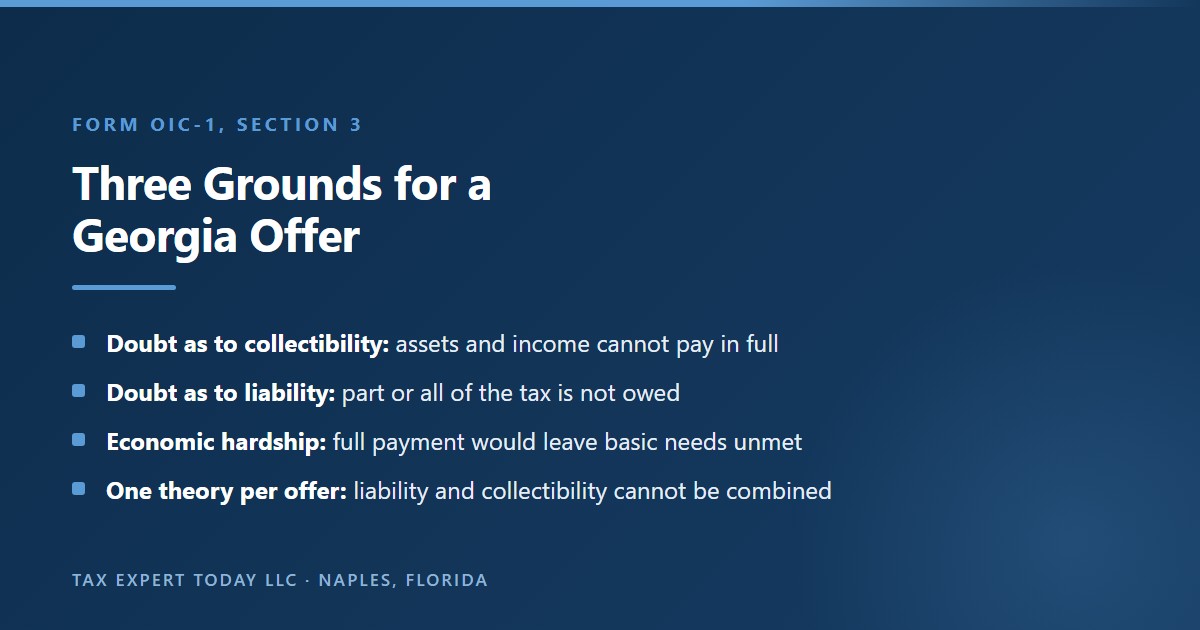
Form OIC-1 lists three reasons for an offer: doubt as to collectibility, doubt as to liability, and economic hardship. Collectibility offers argue the taxpayer cannot pay in full. Liability offers argue the tax is wrong. Hardship offers accept that the tax is correct and collectible but show that full payment would cause serious hardship.
- Doubt as to collectibility: “I have insufficient assets and income to pay the full amount.”
- Doubt as to liability: “I do not believe I owe this amount.”
- Economic hardship: the taxpayer owes the tax and could pay it, but exceptional circumstances make full payment a hardship.
- One theory at a time: liability and collectibility cannot be claimed together on the same offer.
| Ground | What the taxpayer asserts | Financial statement required | Key attachment |
|---|---|---|---|
| Doubt as to collectibility | Assets and income are not enough to pay in full, by liquidation or a payment plan | Yes, Form CD-14B or CD-14C | Pay stubs, bank statements, and valuation support |
| Doubt as to liability | Part or all of the assessed tax is not owed | No | A corrected tax computation, an explanation, and verifying documents |
| Economic hardship | The tax is correct and collectible, but exceptional circumstances make full payment a hardship | Yes, Form CD-14B or CD-14C | A written narrative plus documents proving the hardship |
The quoted phrases above are the short statements printed beside each reason in Section 3 of Form OIC-1. The Department’s page adds a practical test for choosing between the two financial grounds. If the taxpayer cannot pay the liability in full, the offer should be a doubt as to collectibility offer. If the potential exists to pay in full, but collection would create an economic hardship, the offer should be an economic hardship offer. Choosing the wrong ground does not usually end the matter on its own, but it frames the review around the wrong question and can lead to a request for information the taxpayer was not prepared to give.
Form OIC-1 also states that a taxpayer cannot submit one offer claiming both that the liability is incorrect and that the taxpayer cannot pay it. A taxpayer who has both problems has to decide which one to lead with. In many cases the better sequence is to resolve the liability question first, through a protest, an appeal, or an amended return where one is still available, and then assess collectibility against the corrected balance.
How Does Doubt as to Collectibility Work in Georgia?
A doubt as to collectibility offer asks the Department to accept less because the taxpayer cannot pay the full balance by liquidating assets or through a payment plan. The Department tests that claim against the taxpayer’s collection information statement, and the offer must at least equal the minimum offer amount the statement produces.
- The core test: could the full balance be paid from assets, or over time from income?
- The evidence: Form CD-14C for individuals or Form CD-14B for businesses, fully completed.
- The floor: net equity in assets plus projected future income.
- The ceiling on expenses: the federal collection financial standards.
The Department’s page says it will consider a collectibility offer when the taxpayer is unable to pay in full either by liquidating assets or through a current payment plan, and that the taxpayer must submit the appropriate collection information statement with all required supporting documents. That second clause is the one that trips taxpayers up. A payment plan under the Department’s program can run for up to 60 months, as explained in our guide to the Georgia Department of Revenue payment plan. If the statement shows enough monthly income to clear the balance within that kind of term, the Department’s page says the offer will be rejected, because the taxpayer can pay in full through a payment plan.
A collectibility offer is therefore mostly an exercise in accurate disclosure. The Department compares what the taxpayer reports with bank statements, pay records, credit reports, and property records. Form OIC-1 authorizes the Department to contact third parties, including credit bureaus, and states that the taxpayer will not be told which third parties are contacted. An offer built on a statement that omits an account or understates a property value is likely to be rejected, and a signed statement that is willfully false carries its own exposure under O.C.G.A. 48-1-6, which the form cites in its signature block.
A strong collectibility file usually shares three features. The balance is large relative to the taxpayer’s income and equity. The taxpayer’s assets are few, heavily encumbered, or exempt in practice. And the household budget is already at or near the federal standards, so there is little room for the Department to reallocate income toward the debt. When all three are present, the minimum offer amount computed on the statement will often be well below the balance. When any one is missing, a payment plan is usually the more realistic tool.
When the appeal window is still open, a taxpayer who disputes the tax itself usually has a stronger route than an offer. An official assessment can be appealed within 45 days to the Georgia Tax Court without paying the tax or posting a bond, and filing generally stays collection. The court, its filing steps, and its small claims limits are covered in our guide to the Georgia Tax Tribunal and its replacement.
When Does Doubt as to Liability Make Sense Instead of a Protest or Appeal?
A doubt as to liability offer makes sense when the protest and appeal windows have closed, the liability is assessed, and the taxpayer can document that part or all of the tax is not owed. It is a settlement route, not a trial, and acceptance ends the taxpayer’s right to contest the amount in court or elsewhere.
- What to include: a corrected computation, an explanation of how it was reached, and supporting documents.
- What is not required: neither Form CD-14B nor Form CD-14C.
- Where it fits: after the 45 day protest and appeal windows have passed.
- What it waives: under Section 7(h), any later contest of the tax debt once the offer is accepted.
The Department’s page lists what a liability offer must contain: a computation of the claimed corrected tax due, an explanation of how the taxpayer arrived at that amount, and any verifying documentation. No collection information statement is required. That makes a liability offer lighter on financial disclosure and heavier on technical proof. The file resembles an audit reconsideration package more than a hardship request.
The timing question is the important one. While a proposed assessment can still be protested, a protest is usually the direct route, because it keeps the dispute inside the ordinary assessment process and preserves appeal rights. While an official assessment can still be appealed to the Georgia Tax Court or superior court, an appeal gives an independent decision maker. The Taxpayer Bill of Rights notes that the Georgia Tax Court’s small claims division handles cases where the tax and penalties in controversy are less than $15,000 for income tax or $50,000 for other tax types, and that small claims decisions are final. A liability offer becomes the natural route when those windows have closed and the taxpayer still has documentation that the assessment is wrong.
Signing Form OIC-1 has a consequence here that deserves a plain statement. Section 7(h) provides that once the Department accepts the offer in writing, the taxpayer has no right to contest the amount of the tax debt, in court or otherwise. A taxpayer who wins a partial reduction through a liability offer has settled the question permanently. A taxpayer who believes the whole assessment is wrong and still has a live appeal right should weigh that before choosing the offer.
Liability offers are also common in responsible person cases. Georgia can assess an officer, member, manager, partner, or employee personally for unpaid sales or withholding tax under O.C.G.A. 48-2-52, but only if that person had control or supervision of collecting and paying over the tax and willfully failed to do so. A person listed as an officer who had no such control may have a liability argument. Form OIC-1 includes a specific line for personal liability as a responsible person, discussed further below.
What Counts as Economic Hardship for a Georgia Offer?
Economic hardship covers a taxpayer who owes the tax and could technically pay it, but whose exceptional circumstances mean full payment would leave the household unable to meet necessary living expenses. The Department names advanced age and serious illness from which recovery is unlikely as examples, and it requires documents proving the circumstances.
- Named examples: advanced age and serious illness from which recovery is unlikely.
- The open category: any factor that affects the ability to pay while providing for the family.
- Required: a collection information statement, a written narrative, and supporting documents.
- Where it is written: Section 3, Explanation of Circumstances, on Form OIC-1.
The Department’s page describes a hardship offer as one where the taxpayer has no doubt that the tax is correct and there is potential to collect the full amount, but an exceptional circumstance exists that would allow the Department to consider an offer. The taxpayer must demonstrate that collection in full would create an economic hardship. The required package is a collection information statement with its attachments, a written narrative explaining the special circumstances and why full payment would be a hardship, and documentation proving it.
Form OIC-1 gives the same idea in its own words. The explanation section acknowledges that unplanned events or special circumstances, such as serious illness, may mean that paying the full amount or even the minimum offer amount would impair the taxpayer’s ability to provide for the taxpayer and the family. If the taxpayer can document the situation, the form states that the offer may be accepted despite the taxpayer’s financial profile. The Department’s page lists the kinds of documents it expects: copies of actual monthly expenses, out of pocket medical expenses, and physicians’ statements detailing the illness.
A hardship offer is not a way around the minimum offer amount for a taxpayer who simply prefers to keep assets. The narrative has to connect specific facts, such as a diagnosis, a fixed income, or a dependent’s care needs, to a specific inability to pay. A taxpayer whose largest asset is retirement savings needed for a medical condition, or a home that would have to be sold with no affordable replacement, has the kind of fact pattern the section is designed for. The outcome in any particular case depends on the Department’s review, and no hardship offer can be assumed to succeed.
How Does Georgia Calculate the Minimum Offer Amount?
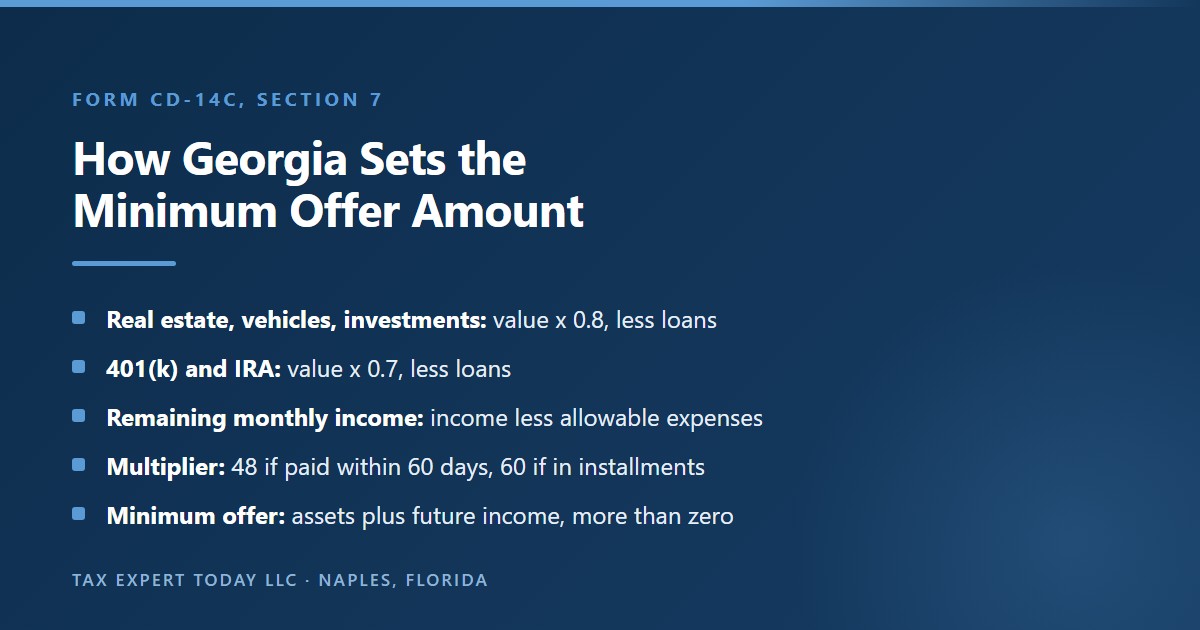
Georgia’s minimum offer amount equals the net equity in the taxpayer’s assets plus the income the Department projects it could collect in the future. Form CD-14C values most assets at 80 percent of market value, and retirement accounts at 70 percent, less loans, and then adds remaining monthly income multiplied by 48 or 60.
- Real estate, vehicles, and investments: current market value times 0.8, less loan balances.
- 401(k) and IRA accounts: value times 0.7, less loan balances.
- Remaining monthly income: household income less allowable household expenses.
- Multiplier: 48 if the offer is paid within 60 days of acceptance, 60 if paid in installments.
- Result: must be more than zero.
The Department’s page states that the minimum collection amount equals the net equity of the taxpayer’s assets plus the amount the Department projects it could collect from future income, and that the offer must equal or exceed that minimum. The mechanics are on the collection information statement itself. Form CD-14C, revision 3-2012, is used by individuals, and Form CD-14B, also revision 3-2012, is used by corporations, partnerships, limited liability companies, and other business entities.
| Asset on Form CD-14C | Valuation factor printed on the form | Then subtract |
|---|---|---|
| Real estate, including a primary residence | Current market value times 0.8 | Mortgages and other loan balances |
| Vehicles owned | Current market value times 0.8 | Loan balance (a leased vehicle is entered at zero) |
| Stocks, bonds, and other investment accounts | Current market value times 0.8 | Loan balance |
| 401(k) and IRA accounts | Value times 0.7 | Loan balance |
| Artwork, collections, jewelry, and other valuables | Current market value times 0.8 | Loan balance |
| Business tools, equipment, and machinery of the self-employed | Current market value times 0.8 | Loan balance |
| Cash, bank accounts, notes receivable, and cash value of life insurance | Listed without a discount factor | Policy loans where applicable |
The totals of those lines become Box 1, Total Available Assets. The income side of the form builds Box 3, Total Household Income, and Box 4, Household Expenses, from the taxpayer’s average monthly figures. Box 5, Remaining Monthly Income, is Box 3 less Box 4. Section 7 of the form then multiplies Box 5 by 48 or by 60, depending on how quickly the offer will be paid, and adds the result to Box 1. The form states that the minimum offer amount must be more than zero, and the Department’s page repeats that all offer amounts must exceed zero.
The 0.8 and 0.7 factors reflect what the Department could realistically net from a forced sale or an early withdrawal, rather than full retail value. They are not negotiable percentages chosen by the taxpayer. The Department’s page warns that it will assess the value of all property the taxpayer owns and may reject the offer if it finds a value higher than the one on the statement. Supporting a value with a recent appraisal, a dealer quote, or an account statement is far more persuasive than an estimate.
Form CD-14B follows the same design for a business. It values real estate, vehicles, and investment accounts at 80 percent of market value less loans, computes the business’s remaining monthly income, and applies the same 48 and 60 multipliers. A business offer and the owners’ individual offers are separate applications with separate statements.
How Do the 48 and 60 Month Multipliers Change a Georgia Offer?
The multiplier sets how much future income the Department counts. An offer paid in full within 60 days of written acceptance uses 48 months of remaining income. An offer paid in monthly installments over more than 60 days and up to 60 months uses 60 months. Paying faster therefore produces a smaller minimum offer amount.
- Payment Option 1: paid within 60 days of written acceptance, income multiplied by 48.
- Payment Option 2: paid in monthly installments for up to 60 months, income multiplied by 60.
- The difference: twelve months of remaining monthly income.
- A funding question: Section 6 of Form OIC-1 asks where the money will come from.
Form CD-14C states the rule in plain terms: the amount of time the taxpayer takes to pay the offer in full affects the minimum offer amount, and paying over a shorter period results in a smaller minimum. The hypothetical below applies the printed factors to a simple set of facts. The numbers are illustrative only. They are not drawn from any client matter, and the Department’s own analysis may adjust any line, including expenses it considers above the allowable standards.
| Hypothetical line | Computation | Amount |
|---|---|---|
| Assessed Georgia balance, all periods | Tax, penalty, and interest to date | $48,000 |
| Checking and savings | Balances as listed | $2,500 |
| Vehicle | $18,000 times 0.8 = $14,400, less $11,000 loan | $3,400 |
| Brokerage account | $5,000 times 0.8 | $4,000 |
| IRA | $20,000 times 0.7 | $14,000 |
| Box 1, Total Available Assets | Sum of the lines above | $23,900 |
| Box 5, Remaining Monthly Income | $5,200 household income less $5,000 allowable expenses | $200 |
| Payment Option 1 future income | $200 times 48 | $9,600 |
| Minimum offer, Option 1 | $23,900 plus $9,600 | $33,500 |
| Payment Option 2 future income | $200 times 60 | $12,000 |
| Minimum offer, Option 2 | $23,900 plus $12,000 | $35,900 |
Three observations follow from the hypothetical. First, the IRA drives the result. At 70 percent of value it contributes more than half of Box 1, which is why retirement savings are often the deciding asset in a Georgia collectibility offer. Second, the choice of payment option changes the minimum by exactly twelve months of remaining income, $2,400 here. Third, a $200 swing in monthly expenses changes the Option 2 minimum by $12,000, which is why the expense lines receive such close review.
The hypothetical also shows why the arithmetic is a floor and not a prediction. The Department’s page states that offering the minimum amount does not assure acceptance, because the Department audits the taxpayer’s financial condition as part of the review. If a vehicle is worth more than listed, if an expense exceeds the standards, or if an account was omitted, the minimum rises and an offer at the original figure falls short.
Which Expenses Does Georgia Allow on Form CD-14C?
Form CD-14C lists monthly household expenses such as housing and utilities, vehicle payments and operating costs, public transportation, health insurance, out of pocket health care, court ordered payments, and child or dependent care. The Department caps claimed expenses at the national collection financial standards produced by the Internal Revenue Service.
- Housing and utilities: rent or mortgage and average monthly utility costs.
- Transportation: vehicle loan or lease payments, operating costs, and public transit fares.
- Health: insurance premiums and out of pocket costs.
- Obligations: court ordered payments and child or dependent care.
- Secured debts: payments on debts secured by listed assets, but not unsecured credit cards.
Section 6 of Form CD-14C builds Box 4, Household Expenses, from line items numbered 41 through 52. The form instructs the taxpayer not to include unsecured debt such as credit cards. That exclusion is significant. A household whose budget depends on paying down credit card balances will find that those payments are not recognized, which raises remaining monthly income and therefore the minimum offer amount.
The Department’s page explains the cap. Under the heading of excess expenses, it states that the Department uses the national collection financial standards produced by the Internal Revenue Service to determine maximum allowable amounts, and that expenses exceeding those standards will be adjusted to the maximum allowed. The standards themselves are published on the IRS’s Collection Financial Standards page. This is one of the few places where a federal rule enters a Georgia offer, and it enters only as a yardstick. The decision remains a Georgia decision under Georgia law.
Practical preparation follows from that. Actual expenses should be documented with statements and receipts. Expenses above the standards should be expected to be reduced unless the taxpayer can show why they are necessary, and that showing belongs in the Section 3 narrative if it is part of a hardship claim. Expenses that are voluntary, such as contributions to retirement plans or payments to family members, are unlikely to be allowed in full, and listing them without explanation can undermine the credibility of the rest of the statement.
What Documents Must Accompany Form OIC-1?
A complete Georgia offer includes Form OIC-1, a collection information statement unless the offer is based on doubt as to liability, the last two pay stubs for a wage earner, complete copies of the last three bank statements, documents supporting any special circumstances, and a separate certified check or money order for the $100 fee.
- Form OIC-1: signed, with every applicable section completed.
- Form CD-14B or CD-14C: with every section completed and N/A entered for items that do not apply.
- Income and bank proof: two pay stubs and three complete bank statements.
- Circumstance proof: medical, expense, and other records supporting Section 3.
- Payments: the fee and any offer payment, as separate instruments.
The Department’s page lists these items and adds a timing rule: the taxpayer must respond within the requested time frame for additional information. The statement must be signed with the appropriate identification numbers and all sections completed, and items that do not apply should be marked N/A. The Department states that it will only process an offer if the application is fully completed along with supporting documentation, so a blank section is not a neutral omission. It can stop the review at intake.
For a doubt as to liability offer, the attachments change. The page asks for a computation of the claimed corrected tax due, an explanation of how the taxpayer arrived at that amount, and verifying documentation, and it states that neither Form CD-14B nor Form CD-14C is required. Form OIC-1 asks for the detailed explanation on a separate sheet.
Form OIC-1 itself asks for identifying details for the taxpayer and, for a joint offer, the spouse; the business name and employer identification number for a business offer; the tax types and periods in Section 2; the reason in Section 3; the low income certification in Section 4 where it applies; the offer amount and payment option in Section 5; the source of funds in Section 6; and signatures in Section 9. If the list of periods runs long, the form allows an attachment titled “Attachment to Form OIC-1,” signed and dated after the list.
How Do You Submit a Georgia Offer in Compromise Online or by Mail?
A Georgia offer can be submitted online through the Georgia Tax Center, where the taxpayer selects the offer request, chooses the reason, explains the circumstances, enters the offer and fee information, and uploads Form OIC-1 and the collection statement. It can also be mailed to the Department’s Central Collections Section in Atlanta.
- Online: log in to the Georgia Tax Center, then use the I Want To menu and its See more links option.
- Upload: Form OIC-1 plus Form CD-14B or CD-14C, and the supporting attachments.
- Mail: Georgia Department of Revenue, Central Collections Section, 2595 Century Parkway, Suite 339, Atlanta, Georgia 30345.
- Payments by mail: separate checks for the fee and any offer payment, attached to the front of Form OIC-1.
The Department’s page walks through the online path in steps. After logging in to the Georgia Tax Center, the taxpayer clicks See more links under I Want To, selects the request for an offer in compromise, downloads Form OIC-1 and the applicable collection information statement, selects the reason for the offer, enters an explanation of circumstances, enters the offer information, enters application payment information if applicable, adds attachments, and submits. The online route still depends on the same forms, so the preparation work is identical.
The mailing address appears on the last page of Form OIC-1. Section 6 of the form instructs the taxpayer to make payments payable to the Georgia Department of Revenue, to attach them to the front of the form, not to send cash, and to send a separate application fee with each offer rather than combining it with any other tax payment, since combining them may delay processing. The form warns that the offer will be returned if the fee and required payments are not properly remitted or if a check is returned for insufficient funds.
Whichever route is used, the taxpayer should keep a complete copy of everything submitted, along with proof of the submission date. The date the Department acknowledges the offer matters for the collection pause and for the suspension of the collection period, both discussed below, so the acknowledgment letter should be kept with the file.
What Does the $100 Application Fee Cover and Who Is Exempt?
Georgia law requires a $100 nonrefundable application fee with every offer. It must be paid by certified check or money order, it is kept even if the offer is rejected or withdrawn, and it is treated as part of the offer if accepted. Individuals whose gross monthly household income is at or below the Form OIC-1 table are exempt.
- Amount: $100 under O.C.G.A. 48-2-18.1(b).
- Form of payment: certified check or money order for mailed offers.
- Nonrefundable: kept on rejection, return, or withdrawal.
- Credited on acceptance: applied to the assessed tax debt.
- Exemption: individuals only, based on the low income table in Section 4.
The low income certification in Section 4 of Form OIC-1 applies only to individuals. A taxpayer qualifies if gross monthly household income is less than or equal to the amount shown for the family size and the place of residence. The Department’s page states that the poverty guideline exception applies only to individuals, and that offers received without the fee will not be processed unless the applicant qualifies for the certification. The table printed on the August 2024 revision of the form reads as follows.
| Size of family unit | 48 contiguous states and D.C. | Hawaii | Alaska |
|---|---|---|---|
| 1 | $2,256 | $2,596 | $2,819 |
| 2 | $3,035 | $3,492 | $3,794 |
| 3 | $3,815 | $4,388 | $4,769 |
| 4 | $4,594 | $5,283 | $5,744 |
| 5 | $5,373 | $6,179 | $6,719 |
| 6 | $6,152 | $7,075 | $7,694 |
| 7 | $6,931 | $7,971 | $8,669 |
| 8 | $7,710 | $8,867 | $9,644 |
| Each additional person | $779 | $896 | $975 |
The figures are monthly gross household income limits as printed on the form. The statute ties the exemption to the poverty guidelines published by the United States Department of Health and Human Services, which are available on the HHS poverty guidelines page. The guidelines are updated each year, and the table on the form is updated only when the Department revises the form. A taxpayer near the line should check the current revision of Form OIC-1 before relying on the table above.
The fee is separate from any payment toward the offer. Section 7(b) of the form states that payments and the fee are not refundable even if the taxpayer withdraws the offer or the Department rejects or returns it. The Department’s page adds that any money sent with the offer will not be returned and will be applied to the liability. A taxpayer who sends a deposit with the offer should treat that money as a payment on the debt, whatever the outcome.
What Payment Options Does Form OIC-1 Offer?
Form OIC-1 offers two payment options. Option 1 pays the accepted offer within 60 days of written acceptance, with an optional down payment. Option 2 pays in monthly installments over more than 60 days and up to 60 months, by automatic bank debit, and interest keeps running on sales and withholding tax liabilities.
- Option 1: lump sum within 60 days of acceptance, 48 month income multiplier.
- Option 2: installments up to 60 months, 60 month income multiplier.
- Automatic debit: Option 2 payments are drawn by ACH from the account listed in Section 5.
- Interest on trust fund taxes: continues to accrue under Option 2 for sales and withholding tax.
| Feature | Payment Option 1 | Payment Option 2 |
|---|---|---|
| When the offer is paid | In full within 60 days of written acceptance | Monthly, over more than 60 days and up to 60 months |
| Amount sent with the offer | A down payment, if any | An initial payment stated on the form |
| Future income multiplier on CD-14C | 48 | 60 |
| How later payments are made | By the due date in the acceptance letter | Automatic ACH debit each month after acceptance |
| Interest after acceptance | Limited by the short payment window | Continues on sales and withholding tax liabilities until the terms are met |
| State tax execution | Released when the accepted amount is paid | May be filed to protect the Department and released when the terms are satisfied |
Section 5 of Form OIC-1 asks the taxpayer to enter the offer amount and to check one option. Under Option 2 the taxpayer states the amount submitted with the form, the monthly amount, the day of the month, and the number of months, and the total must equal the offer amount. The first automatic debit occurs on the stated day of the month following written acceptance. Section 8(n) authorizes the Department and its financial agent to initiate those debits and stays in effect until the taxpayer notifies the Department to end it.
The form states twice that interest continues to accrue on sales tax and withholding tax liabilities under Option 2, and Section 7(g) adds that penalty and interest continue to accrue on all sales and withholding tax liabilities until all payment terms of the offer are met. For those tax types, a long installment offer costs more than its face amount. The statutory rate under O.C.G.A. 48-2-40 is the bank prime loan rate plus 3 percent, set each calendar year, and Policy Bulletin ADMIN-2026-01 fixes it at 9.75 percent for 2026, accruing monthly, down from 10.50 percent in 2025.
Section 6 asks where the money will come from and suggests sources such as borrowing from friends or family, taking out a loan, or selling assets. The answer is not a formality. An offer that depends on a loan not yet approved, or on the sale of an asset not yet listed, invites the question of whether the taxpayer can actually perform. The Department’s page states that payment of an accepted offer must be made by the due date in the acceptance letter or under a payment plan, so the funding source should be in place before the offer is signed.
What Terms Do You Accept When You Sign Form OIC-1?
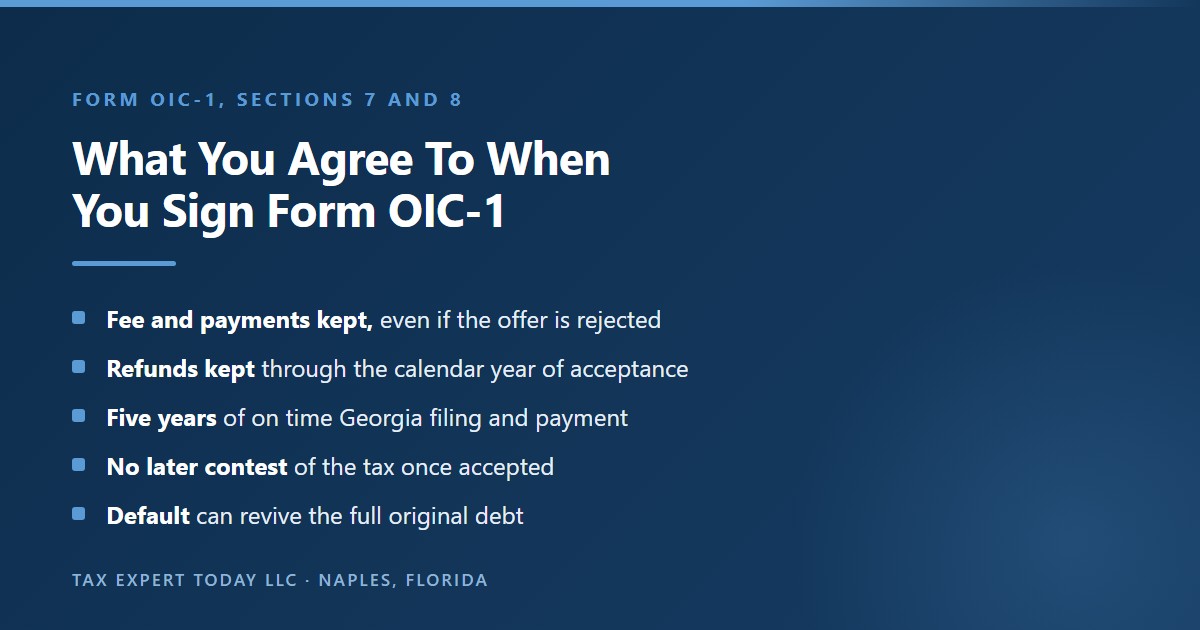
Signing Form OIC-1 binds the taxpayer to terms in Sections 7 and 8, including forfeiture of payments and the fee, loss of certain refunds, five years of required compliance, no later contest of the tax, reinstatement of the full debt on default, an extension of the assessment period, and a possible state tax execution during the review.
- Money kept: the fee, payments, and money collected before the offer.
- Refunds kept: refunds for periods through the calendar year of acceptance.
- Rights waived: any later contest of the amount once the offer is accepted.
- Time extended: the assessment period, and the collection period is suspended.
- Consent given: third party contacts, including credit bureaus.
| Paragraph on Form OIC-1 | What the taxpayer agrees to |
|---|---|
| 7(a) | The offer covers the tax debt with interest, penalties, and other amounts, and the Department may add any assessed debt the taxpayer failed to list in Section 2 |
| 7(b) | Payments and the fee are not refundable, even on withdrawal, rejection, or return |
| 7(c) | The Department keeps refunds, with interest, for periods through the calendar year of acceptance |
| 7(d) | Money collected before the offer is kept, and levy remains possible until the acknowledgment letter is sent |
| 7(e) | The offer is pending from the acknowledgment letter date until acceptance, rejection, return, termination, or withdrawal |
| 7(f) | All returns filed and taxes paid for five years from acceptance, or until the offer is paid, whichever is longer |
| 7(g) | The original debt stays on the records until all terms are met, and penalty and interest continue on sales and withholding liabilities |
| 7(h) | No right to contest the amount of the tax debt after written acceptance |
| 7(i) | On default, enforced collection of up to the original debt without further notice, with interest from the default date |
| 7(j) | The assessment period is extended by the pending period plus one year if the offer does not end in acceptance, and the collection period is suspended |
| 7(k) | A state tax execution may be filed during the investigation and on deferred payment offers |
| 8(l) | Third parties, including credit bureaus, may be contacted without the taxpayer being told which ones |
| 8(m) | An individual offer on a joint liability does not release the co-obligor |
| 8(n) | Monthly ACH debits under Option 2 |
Most taxpayers read Section 3 and Section 5 carefully and skim Section 7. That is backward. Section 7 is where the real price of the offer sits. A taxpayer expecting a large refund for the current year will lose it under 7(c). A taxpayer who believed an appeal could still be filed after the settlement loses that option under 7(h). A taxpayer who misses a return in year four can face collection of the full original balance under 7(i). Each of those terms is printed on the form, and each should be read against the taxpayer’s own situation before signing.
The signature block adds a further layer. The taxpayer declares under penalties of perjury that the offer and its schedules are true, correct, and complete, and the form notes that willfully preparing or presenting a fraudulent or false document is a criminal misdemeanor under O.C.G.A. 48-1-6. A collection statement is a sworn document, and it should be prepared with the same care as a return.
Does a Pending Offer Stop Georgia Collection Activity?
Generally yes, but not automatically and not immediately. After the Department determines the offer is complete and submitted for processing, it generally will not act to collect while it evaluates the offer. Levy remains possible until the acknowledgment letter is sent, and collection continues if the Department concludes the offer was filed to delay collection.
- Before acknowledgment: the Department may still levy assets.
- After acknowledgment: collection is generally paused during the evaluation.
- Delay exception: no pause for an offer filed to delay or jeopardize collection.
- Intent to deny: the taxpayer generally has 14 days to respond to the Department’s letter.
The Department’s page answers the question “Will collections stop?” with the words “not necessarily.” It then explains that there are certain circumstances when collection is suspended, that the pause applies after an offer is determined to be complete and submitted for processing, and that it does not apply if the Department determines the offer was submitted to delay collection or to cause a delay that would jeopardize its ability to collect. The Offer in Compromise FAQ gives the shorter version: after an offer is submitted for processing and acknowledged by the Department, the Department will generally not act to collect while it evaluates the offer.
Section 7(d) of Form OIC-1 fixes the moment. The Department may levy the taxpayer’s assets up to the time a Department official sends a letter acknowledging receipt of the offer. A taxpayer facing an imminent levy should therefore not assume that mailing an offer, or clicking submit in the Georgia Tax Center, protects the bank account that week. An incomplete offer that is returned at intake never reaches the pending stage at all.
The pause also does not undo an execution already on record, and Section 7(k) allows the Department to file a state tax execution during the offer investigation. A taxpayer selling or refinancing property while an offer is pending should expect the execution, where one exists, to appear in the title search and to need a payoff or a release. For the separate mechanics of executions and liens during a payment plan, see our guide to the Georgia DOR payment plan rules.
How Does a Georgia Offer Affect the Statute of Limitations?
A Georgia offer extends both clocks. The taxpayer agrees that the assessment period runs for the time the offer is pending plus one more year if the offer is not accepted, and the ten year life of a state tax execution is suspended while the commissioner considers the offer under O.C.G.A. 48-3-42.
- Assessment period: ordinarily three years after a return is filed under O.C.G.A. 48-2-49.
- Extension by the offer: the pending period plus one year on rejection, return, termination, or withdrawal.
- Execution filing limit: within five years of the final assessment.
- Execution life: ten years from filing, suspended while an offer is under consideration.
- Form OIC-1 wording: collection is also suspended for 30 days after a rejection and while a rejection is reconsidered.
Under O.C.G.A. 48-2-49, tax on a filed return generally must be assessed within three years after the return was filed, a return filed early is treated as filed on its due date, and there is no time limit where no return was filed or a fraudulent return was filed with intent to evade. Subsection (d) allows the commissioner and the taxpayer to agree in writing to extend that period. Section 7(j) of Form OIC-1 is such an agreement. The taxpayer agrees that the assessment deadline becomes the existing deadline plus the time the offer is pending plus one additional year if the Department rejects, returns, or terminates the offer or the taxpayer withdraws it.
The form states that the taxpayer has the right not to waive the assessment period, or to limit the waiver to certain periods or issues, but that the Department may not consider the offer if the taxpayer refuses or gives only a limited waiver. In other words, the waiver is a practical condition of review. The main risk is for a taxpayer with open years that have not yet been examined. Extending the assessment period for those years gives the Department more time to audit them.
Collection runs on a separate clock. Under subsection (g) of O.C.G.A. 48-3-42, the Department must file an execution within five years of the date of a final assessment, and an execution filed or renewed after January 1, 2018, expires ten years from the date of filing. Those periods are tolled and suspended for several events, and paragraph (5) names the period during which a taxpayer’s offer in compromise is under consideration by the commissioner. Section 7(j) of the form describes the same suspension in broader words: during the time the offer is pending, for 30 days after any rejection, and while any rejection is being considered.
| Clock | Ordinary rule | Effect of a Georgia offer | Source |
|---|---|---|---|
| Assessment of tax on a filed return | Three years after filing | Extended by the pending period, plus one year if the offer is not accepted | O.C.G.A. 48-2-49; Form OIC-1, 7(j) |
| Filing a state tax execution | Within five years of the final assessment | Suspended while the offer is under consideration | O.C.G.A. 48-3-42(g)(5) |
| Life of a filed execution | Ten years from filing, no renewal | Suspended while the offer is under consideration | O.C.G.A. 48-3-42(g)(5) |
| Collection after a rejection | Not applicable | Suspended for 30 days after rejection and during reconsideration | Form OIC-1, 7(j) |
The practical lesson is that an offer is not a delay tactic. Time spent on a rejected offer is added back to the Department’s collection window, and the Department’s page states that collection will not be paused for an offer filed to delay. For a taxpayer whose execution is close to its ten year expiration, an offer can extend the Department’s reach rather than shorten it, and that trade should be weighed deliberately.
How Long Does the Georgia Department of Revenue Take to Decide an Offer?
The Department’s FAQ states that processing takes up to 180 days from receipt of the application. The review starts with an intake check for completeness, continues with requests for more documents, and ends with an acceptance, a counteroffer recommendation, or a decline, each communicated by mail to the taxpayer and any designated representative.
- Stated processing time: up to 180 days from receipt.
- First step: an initial review of whether the offer can be processed.
- Second step: requests for additional documentation, with deadlines to respond.
- Final step: acceptance, a recommended counteroffer, or a decline.
| Stage | What happens | What the taxpayer should do |
|---|---|---|
| Intake | The Department checks returns, assessments, bankruptcy status, the fee, and completeness | Submit a complete package the first time |
| Acknowledgment | A letter confirms receipt, and the offer becomes pending as of its date | Keep the letter and note its date |
| Investigation | The Department verifies income, assets, expenses, and values, and may contact third parties | Answer document requests within the stated time |
| Intent to deny | A letter gives notice that the Department intends to deny | Respond, generally within 14 days |
| Decision | Acceptance, counteroffer recommendation, or decline, by mail | Pay, respond to the counteroffer, or arrange payment |
The 180 day figure is the Department’s stated processing time, not a deadline the Department must meet, and a file that needs several rounds of document requests can take longer to resolve. During that time the taxpayer must keep filing and paying current obligations. A new balance that appears while the offer is pending is one of the more common reasons an otherwise acceptable offer runs into trouble, because the Department’s page makes timely filing and payment of all returns a condition of the pending offer.
Once the offer is pending, the date on the acknowledgment letter controls several terms. Section 7(e) of the form defines the pending period from that letter date until the offer is accepted, rejected, returned, terminated, or withdrawn. A withdrawal is effective when the Department receives written notice by personal delivery or certified mail, or when the taxpayer informs the Department by other means and the Department acknowledges the withdrawal in writing.
What Happens After the Department Accepts, Counters, or Declines a Georgia Offer?
An accepted offer must be paid by the date in the acceptance letter or under a payment plan, and a recorded execution is released once the accepted amount is paid. A counteroffer invites a higher offer. A declined offer leaves the full liability due, and the Department directs the taxpayer to pay it or request a payment plan.
- Accepted: pay on the stated terms, then keep five years of compliance.
- Counteroffer: the Department recommends an increased amount the taxpayer may agree to offer.
- Declined: contact the Department immediately to pay in full or request a plan.
- Execution: released when the accepted amount is paid in full.
The Department’s page sets out each outcome. On acceptance, the Department notifies the taxpayer and the designated representative by mail, and payment is due either by the date in the acceptance letter or under a payment plan. A recorded state tax execution is released when the Department receives full payment of the accepted amount. On a deferred payment offer, Section 7(k) allows the execution to remain until the payment terms are satisfied.
A counteroffer is not a rejection. The Department contacts the taxpayer when it believes the taxpayer may qualify at an increased amount, and the taxpayer may agree and offer that amount based on the Department’s recommendation. Whether to accept depends on whether the higher figure can be funded and whether it still makes sense compared with a payment plan for the full balance. The counteroffer is usually a signal that the Department’s analysis found more equity or income than the statement showed, and the difference is worth understanding line by line.
On a decline, the Department’s page tells the taxpayer to contact the Department immediately to arrange payment of the entire liability or to request a payment plan. Collection, which was generally paused during the evaluation, can resume, subject to the 30 day suspension the form describes after a rejection. The fee and any payments sent with the offer are kept and applied to the balance under Section 7(b). A declined offer does not prevent a later offer if circumstances change, but a second offer on the same facts is unlikely to fare differently.
Why Do Georgia Offers in Compromise Get Rejected?
The Department’s page lists the main reasons: expenses above the federal collection standards, insufficient documentation, property worth more than reported, omitted income or assets, trust fund tax debts, a history of noncompliance, and the commissioner’s judgment that acceptance is not in the interests of the state. An offer below the computed minimum is also rejected unless hardship is shown.
- Ability to pay: the analysis shows the taxpayer can pay more, or in full.
- Weak file: undocumented figures or omitted items.
- Tax type: taxes collected from others and not remitted.
- History: regular or willful noncompliance with Georgia tax law.
- Discretion: the commissioner may decline any offer.
| Rejection reason on the Department’s page | How it arises | Preparation that addresses it |
|---|---|---|
| Excess expenses | Claimed expenses exceed the federal collection financial standards and are reduced | Compare every line with the standards before filing and document any necessary excess |
| Insufficient documentation | Income, expenses, or other items are not substantiated | Attach statements, pay records, and bills for each figure |
| Property valuation | The Department values property higher than the statement | Support values with appraisals, quotes, or account statements |
| Omitted items | Income, assets, or other significant items are left off | Reconcile the statement with bank deposits and credit reports |
| Trust fund taxes | The debt is sales or withholding tax collected from others but not remitted | Address how the failure occurred and that current deposits are made |
| History of noncompliance | Regular or willful noncompliance with Georgia tax law | Show a period of current compliance before filing |
| Other | The commissioner determines acceptance is not in the interests of the state | Present a complete, consistent, and credible file |
Before any of those reasons, the Department’s page states the governing rule: the offer will be rejected if the financial analysis indicates the taxpayer can pay more than the amount offered, or can pay the liability in full, either immediately or through a payment plan. Every item in the table is a way the analysis moves in that direction. Excess expenses raise remaining income. Undervalued property raises Box 1. Omitted accounts raise both.
The page also answers whether an offer below the minimum will be considered, and the answer is yes, if economic hardship explains why. The taxpayer uses Section 3 of Form OIC-1 to explain the situation and attaches documents supporting the claim. A below minimum offer without that explanation is simply an offer the analysis says is too low.
Can Business Owners Compromise Georgia Sales Tax and Withholding Liabilities?
Yes, sales and use tax, employer withholding tax, and a responsible person assessment under O.C.G.A. 48-2-52 can all be listed on Form OIC-1. These trust fund debts are harder to compromise, because the Department’s page names them as a rejection risk, and interest and penalty continue on them until every payment term is met.
- Listed tax types: sales and use, employer withholding, corporate income, IFTA fuel, and others.
- Responsible person line: personal liability for a business’s sales or withholding tax.
- Business statement: Form CD-14B for corporations, partnerships, and LLCs.
- Continuing accruals: penalty and interest on sales and withholding debts until the terms are met.
Section 2 of Form OIC-1 lists individual income tax, employer withholding tax, sales and use tax, corporate income tax, IFTA fuel tax, and other tax types, each with the periods involved. It also has a separate line for personal liability as a responsible person of a named business under O.C.G.A. 48-2-52, for sales tax and withholding tax periods. Corporate income tax periods, whose rate and filing rules are covered in our guide to the Georgia corporate tax rate, are listed the same way. That structure reflects how Georgia collects trust fund taxes. The business owes the tax. An individual with control over collecting and paying it who willfully failed to do so can be assessed personally in the same manner as the tax.
The Department’s page says an offer may be rejected if the debt is based on taxes collected from others, such as sales or employee withholding taxes, but not remitted. That is a stated risk, not a bar, and doubt as to liability offers on responsible person assessments are a recognized use of the program. A person who was named as an officer but had no authority over the accounts, or who did not act willfully, may have a liability argument on the statute’s own terms. The court decisions annotated to 48-2-52 treat willfulness as a voluntary preference for other creditors with knowledge of the tax claim, which is a lower bar than fraud, so the facts need careful development.
For a business still operating, the Department will also look at whether current deposits are being made. An offer for last year’s withholding tax from an employer who is not depositing this year’s withholding is difficult to support. The employer side of that obligation is covered in our guide to Georgia withholding tax, and the sales tax side begins with the exemption and certificate rules in our guide to the Georgia sales tax exemption.
How Does a Joint Georgia Offer Work for Married Taxpayers?
Spouses with a joint Georgia income tax liability can submit one offer that both sign, and Form OIC-1 lets “we” replace “I” throughout. If one spouse later fails the compliance terms, only that spouse defaults. An individual offer on a joint liability does not release the other spouse, who remains fully collectible.
- Joint offer: both spouses listed in Section 1 and both sign in Section 9.
- Default is individual: only the noncompliant spouse is in default under 7(f).
- Individual offer on a joint debt: the co-obligor stays liable under 8(m).
- Household statement: Form CD-14C reports household income and expenses.
Section 2 of Form OIC-1 states that the pronoun “we” may be assumed in place of “I” when there are joint liabilities and both parties sign. Section 7(f) adds that, for an offer on joint tax debt, if one spouse does not comply with future obligations, only the noncompliant taxpayer is in default. That is a useful protection for a spouse who separates after acceptance and cannot control the other spouse’s filing.
Section 8(m) addresses the opposite case. If the liability is joint and individual, and one person submits an offer to compromise only that person’s individual liability, acceptance does not release or discharge the co-obligor, and the Department reserves all rights of collection against the co-obligor. Divorced and separated taxpayers should read that paragraph carefully. Settling one spouse’s share can leave the full remaining balance collectible from the other.
A joint offer also means a joint financial statement. Form CD-14C asks for household income and expenses, and the Department will look at both spouses’ assets. A spouse with separate property should understand that the property will be reported and valued before agreeing to a joint submission.
What Happens to Georgia Refunds During and After an Offer?
The Department keeps any refund, with interest, for tax periods extending through the calendar year in which it accepts the offer. The taxpayer cannot apply that refund to next year’s estimates or to the offer amount, and must return any such refund received after the offer was submitted. Refunds are not credited toward the accepted amount.
- Refunds kept: for all periods through the calendar year of acceptance.
- No redirection: not to estimates and not to the offer.
- Return required: a refund received after submission must be sent back.
- Pre-offer collections: kept by the Department under 7(d).
Section 7(c) of Form OIC-1 contains this term. Its effect depends on timing. An offer accepted in December can cost the taxpayer the refund for the whole calendar year of acceptance, which may include a year the taxpayer has not yet filed. A taxpayer with significant Georgia withholding should consider that before timing the submission, and should consider adjusting withholding so that a large refund is not created in the acceptance year.
This term is also why the Department’s refund offset continues to matter during an offer. Money the Department collected before the offer, including prior offsets, is kept under 7(d), and the offer does not reach back to return it.
What Must You Do for Five Years After a Georgia Offer Is Accepted?
For five years from the date of acceptance, or until the offer is paid in full if that takes longer, the taxpayer must file every required Georgia return and pay every required Georgia tax on time. The original debt stays on the Department’s records until all terms are met, and a lapse can revive it.
- Duration: five years from acceptance, or until the offer is paid, whichever is longer.
- Scope: all Georgia returns and taxes, not only the tax types in the offer.
- Records: the original debt stays on the books until the terms are met.
- Bankruptcy: a Department claim filed before the terms are met is a tax claim.
Sections 7(f) and 7(g) of Form OIC-1 set these terms. The five year compliance period is the cost of the fresh start the Department’s page describes. It covers every Georgia filing obligation the taxpayer has, including individual returns, estimated payments, and, for business owners, sales, withholding, and entity returns. A taxpayer who moves out of Georgia after acceptance may still have Georgia filing obligations for Georgia source income, and those count. Estimated payments are part of the same obligation, and a taxpayer who is unsure whether a quarter was underpaid can check it with our Georgia estimated tax penalty calculator.
A taxpayer who expects a filing problem during the compliance period, such as a return that will need an extension, should use the ordinary tools on time rather than risk a default. Georgia’s extension rules are explained in our guide to Georgia Form IT-303. An extension of time to file is not an extension of time to pay, and unpaid tax on an extended return can be treated as a compliance failure.
What Happens If You Default on an Accepted Georgia Offer?
On default, the Department may issue and record a state tax execution and begin levy or garnishment to collect any amount from the unpaid balance of the offer up to the original tax debt, without further notice. Interest runs from the default date until the amount is paid, and payments already made are kept.
- Trigger: failure to meet any term, including a late return or a missed payment.
- Exposure: anywhere from the unpaid offer balance to the full original debt.
- Enforcement: execution, levy, and garnishment without further notice.
- Interest: from the default date until the amount is fully paid.
Section 7(i) of Form OIC-1 is the default clause, and its reach is wide. It allows collection of any amount ranging from the unpaid balance of the offer to the original amount of the tax debt. The Department decides the amount due after default, and interest is added from the date of default. Because Section 7(g) keeps the original debt on the Department’s records until all terms are met, the full balance is available to the Department if it chooses to pursue it.
For an installment offer, the most common defaults are a failed ACH debit and a late return. The first can often be avoided by keeping a buffer in the debited account and updating the bank details before an account is closed. The second is avoided by treating every Georgia filing date during the compliance period as a hard deadline. A taxpayer who sees a default coming should contact the Department before it happens, since options narrow considerably after the Department has declared a default.
Does a Georgia Offer in Compromise Settle a Federal Tax Balance?
No. A Georgia offer in compromise settles only debts owed to the Georgia Department of Revenue. A federal balance is owed to the Internal Revenue Service, which runs its own offer program under its own law and forms. A taxpayer who owes both agencies needs two separate resolutions, and each agency evaluates its own case.
- Separate creditors: the Georgia Department of Revenue and the Internal Revenue Service.
- Separate programs: Form OIC-1 in Georgia and a separate federal application.
- Separate outcomes: acceptance by one agency does not bind the other.
- One shared input: Georgia uses the federal expense standards as a yardstick.
| Feature | Georgia offer in compromise | Federal offer in compromise |
|---|---|---|
| Agency | Georgia Department of Revenue | Internal Revenue Service |
| Legal authority | O.C.G.A. 48-2-18.1 | Federal law and IRS procedure |
| Application | Form OIC-1 with Form CD-14B or CD-14C | Federal forms, described on the IRS program page |
| Debts covered | Assessed Georgia taxes only | Federal taxes only |
| Where to read more | This guide and the Department’s pages | Our IRS offer in compromise guide and the IRS program page |
This is the single most misunderstood point about a Georgia offer. Taxpayers who settle a federal balance sometimes assume the matching Georgia balance goes away, or the reverse. It does not. The Georgia debt and the federal debt arise under different laws and are owed to different governments. The federal program is described on the IRS’s Offer in Compromise page, and our own guide to the IRS offer in compromise explains how that program works. The federal figures and forms are not repeated here, because they belong to a different agency.
What the two programs share is a household budget. A taxpayer who owes both agencies has one income and one set of assets, and both agencies will want to count them. The offers should be prepared together so that the same asset is not promised twice, the same income is not allocated to both, and the payment terms of one do not make the other impossible. Our research report on the IRS offer in compromise acceptance rate covers the federal side of that planning. Other states run their own programs as well; California’s is covered in our guide to the FTB offer in compromise, and it has no effect on a Georgia debt either.
Taxpayers with a federal balance alongside a Georgia one can review our IRS resolution and audit support services for the federal side.
Georgia Offer in Compromise or Payment Plan: How Do You Choose?
The choice is mostly arithmetic. If a realistic monthly payment clears the full Georgia balance within 60 months, a payment plan is the tool, and an offer would likely be rejected. If the minimum offer amount on Form CD-14C is well below the balance, or the tax is disputed, an offer may fit.
- Payment plan: the full balance over time, no financial statement in the standard case.
- Offer: less than the full balance, with full financial disclosure and five years of monitoring.
- Protest or appeal: the direct route when the tax is wrong and the window is open.
- Not at once: the Department’s payment plan page excludes taxpayers with a pending offer.
| Situation | Tool that usually fits | Why |
|---|---|---|
| Proposed assessment believed to be wrong, within 45 days | Protest | Contests the tax directly and preserves appeal rights |
| Official assessment believed to be wrong, within 45 days | Appeal to the Georgia Tax Court or superior court | An independent decision on the liability |
| Assessed tax believed to be wrong, windows closed | Doubt as to liability offer | A documented settlement of a disputed amount |
| Correct tax, full balance payable within 60 months | Payment plan | An offer would be rejected for ability to pay in full |
| Correct tax, minimum offer well below the balance | Doubt as to collectibility offer | The balance exceeds collection potential |
| Correct and collectible tax, documented serious illness or similar | Economic hardship offer | Full payment would leave basic needs unmet |
Our guide to the Georgia Department of Revenue payment plan covers the plan side in detail, including the waiver language on the mailed request, the fees, and the effect on the life of an execution. The point here is sequencing. The Department’s Payment Plans page lists having no pending offer in compromise as a requirement for a plan, so a taxpayer cannot hold both at once. A taxpayer who submits an offer and has it declined can request a plan afterward, and the Department’s page on declined offers directs the taxpayer to do exactly that.
A rough test before choosing: complete Form CD-14C honestly, compute the minimum offer under both payment options, and compare it with the balance and with what a 60 month plan would require. If the minimum is close to the balance, the offer adds disclosure, forfeitures, and five years of monitoring for little benefit. If the minimum is a small fraction of the balance and the file can be documented, the offer deserves a closer look.
How Do Former Georgia Residents in Florida Handle a Georgia Offer?
A former Georgia resident can submit a Georgia offer from any state through the Georgia Tax Center or by mail, using the same forms and rules. Moving to Florida does not end a Georgia liability for a year when Georgia tax was owed, and the offer’s five year compliance term covers any Georgia filing obligation that continues after the move.
- Same program: residence at the time of the offer does not change the rules.
- Same statement: Form CD-14C reports all household income and assets, wherever located.
- Continuing obligations: Georgia source income can still require Georgia returns.
- Two agencies: a federal balance is handled separately.
Southwest Florida has many former Georgia residents, and a Georgia notice for a year before the move is a common starting point. The liability belongs to the year in which the taxpayer was a Georgia resident or earned Georgia source income. The Department collects it with the same tools regardless of where the taxpayer now lives, including executions on Georgia property and refund offsets.
For a Florida resident, the collection statement will usually reflect a Florida household budget and Florida assets. Florida’s lack of a state income tax does not affect how the Department values those assets or projects income. What it does affect is the compliance period: a taxpayer with no remaining Georgia income may have few Georgia filing obligations after the move, which can make the five year terms easier to meet. A taxpayer with Georgia rental property, a Georgia business interest, or a Georgia pass through entity may still have annual Georgia returns to file. Owners of entities that made the election described in our guide to the Georgia pass through entity tax, and nonresident owners included on a Georgia composite return, should confirm which Georgia filings remain in their names before signing the five year terms.
Who Can Represent You in a Georgia Offer in Compromise?
A taxpayer may name a third party designee on Form OIC-1 to discuss the offer with the Department, but a representative who will make decisions and act for the taxpayer needs Form RD-1061, the Department’s power of attorney. The Taxpayer Bill of Rights allows representation by an attorney, accountant, or other authorized agent.
- Third party designee: Section 11 of Form OIC-1, for discussion only.
- Power of attorney: Form RD-1061 to act on the taxpayer’s behalf.
- Preparer disclosure: Section 10 identifies anyone who prepared the application.
- Notices: the Department sends decisions to the taxpayer and the designated representative.
Section 11 of Form OIC-1 asks whether the taxpayer wants to allow another person to discuss the offer with the Department. The form’s note states that Form RD-1061 must be submitted if the taxpayer wants to authorize someone to make decisions and act on the taxpayer’s behalf regarding the offer. Section 10 separately identifies anyone other than the taxpayer who prepared the application. The Georgia Taxpayer Bill of Rights confirms the right to representation by an authorized agent with a properly completed power of attorney in any hearing or conference with the Department.
A Georgia offer is a Georgia Department of Revenue matter, handled under Georgia procedure. Representation before the Department rests on the Department’s own power of attorney form rather than on any federal credential, and the preparation work, including the financial statement, the valuations, and the narrative, is the same whoever signs the form.
What Are the Most Common Georgia Offer in Compromise Mistakes?
The most common mistakes are filing before every return is filed and every liability is assessed, leaving sections of the collection statement blank, understating asset values, claiming expenses above the federal standards without support, missing current year estimates while the offer is pending, and signing Section 7 without reading what it forfeits.
- Premature filing: unfiled returns or unassessed periods stop the offer at intake.
- Incomplete statements: blank sections instead of N/A, or missing attachments.
- Optimistic values: property or vehicles listed below market value.
- Unsupported expenses: claims above the standards with no explanation.
- Unread terms: surprises over refunds, appeal rights, and default exposure.
Several other errors recur. Taxpayers sometimes combine the $100 fee with a tax payment, which the form says may delay processing. Some claim doubt as to liability and doubt as to collectibility on the same offer, which the form does not permit. Some submit an offer to hold off a levy and discover that collection continues until the acknowledgment letter is sent, and not at all if the Department concludes the offer was filed to delay. Some choose Payment Option 2 for convenience without noticing that it raises the minimum offer by twelve months of remaining income and, for trust fund taxes, keeps interest running.
A final mistake is treating the minimum offer amount as the answer. The Department’s page is explicit that offering the minimum does not assure acceptance, and its list of rejection reasons shows how the figure can change on review. A well prepared Georgia offer in compromise presents a number the taxpayer can defend line by line, with documents behind every figure, and a funding source already in place.
Georgia Offer in Compromise Help in Naples & Southwest Florida
Tax Expert Today LLC works from Naples, Florida and handles state tax matters nationwide, including Georgia offers in compromise, collection information statements, unfiled Georgia returns, responsible person assessments, and state tax execution issues. Georgia clients are served from the Naples office and do not need to travel to Atlanta for any part of the process.
- Georgia offer in compromise help Naples serves Southwest Florida residents who moved from Georgia or who own Georgia property or businesses.
- Offer preparation starts with the Georgia Tax Center account, every assessment by period, and the filing history.
- Combined federal and Georgia balances are planned together so one household budget supports both resolutions.
- Remote engagement is standard. Documents are exchanged through a secure client portal and not by email.
Tax Expert Today LLC
11983 Tamiami Trail N, Naples, FL 34110
Telephone: (239) 441-2005
Hours: Monday through Friday, 10:00 a.m. to 5:00 p.m. Eastern Time
A local question we are asked often: I retired to Naples from Georgia and still owe the Georgia Department of Revenue for a year before the move. My income is now mostly Social Security and an IRA. Can I use a Georgia offer in compromise from Florida? Yes, the program is available from any state, and the application is the same. The IRA will be counted on Form CD-14C at 70 percent of its value less any loan, so it often drives the minimum offer amount for a retiree. If the IRA is needed for medical or basic living costs, the economic hardship section of Form OIC-1 is where that case is made, with documents. The first steps are to confirm every Georgia period is filed and assessed, pull the balance by period in the Georgia Tax Center, and complete the collection statement before deciding between an offer and a payment plan. The full range of Georgia engagements is described on our Georgia tax advisory services page, and federal collection matters for Southwest Florida residents are covered on our Naples tax resolution page.
When to Engage a Professional
A taxpayer with one undisputed Georgia balance that income clears within 60 months usually does not need an offer. Review is worth it when the balance is large relative to income, the tax is disputed after the appeal windows closed, a responsible person is assessed, or both Georgia and the IRS are owed.
- A taxpayer whose minimum offer may be well below the balance and who needs the statement prepared and documented.
- A taxpayer with a disputed assessment weighing a liability offer against remaining appeal rights.
- A business owner facing a responsible person assessment for sales or withholding tax.
- A taxpayer with a serious illness or fixed income considering an economic hardship offer.
- A taxpayer who owes both Georgia and the IRS and needs the two resolutions to fit one budget.
Dr. Pellumb Kabashi is the founder of Tax Expert Today LLC, and the firm includes tax advisors, enrolled agents, certified public accountants, and attorneys. Georgia Department of Revenue matters are state tax matters and not federal ones, and they are handled under Georgia procedure and Georgia authority. Nothing in this article is advice for a particular taxpayer, and the result in any specific case depends on facts that a general article cannot know. The Department decides every offer on its own facts and in its own discretion, and no outcome can be promised. Taxpayers who want a Georgia balance reviewed as part of a broader plan can start with our Georgia state tax advisory page, and those who also owe federal tax can review our IRS resolution and audit support services. Call (239) 441-2005 to schedule a free consultation.
Frequently Asked Questions
What is a Georgia offer in compromise?
A Georgia offer in compromise is an agreement with the Georgia Department of Revenue that settles an assessed state tax liability for less than the full amount owed. It is authorized by O.C.G.A. 48-2-18.1 and filed on Form OIC-1. The Department generally accepts an offer only when the liability is unlikely to be collected in full and the amount offered reasonably reflects collection potential.
How much is the Georgia offer in compromise application fee?
The fee is $100, nonrefundable, and it must accompany each offer. It is paid by certified check or money order for a mailed offer. If the offer is accepted, the fee is treated as part of the offer. Individuals whose gross monthly household income is at or below the low income table in Section 4 of Form OIC-1 do not pay the fee.
How long does the Georgia Department of Revenue take to decide an offer in compromise?
The Department’s Offer in Compromise FAQ states that processing takes up to 180 days from receipt of the application. The time can run longer when the Department requests more documents. The taxpayer must keep filing and paying current Georgia obligations while the offer is pending.
How is the Georgia minimum offer amount calculated?
The minimum offer amount equals total available assets plus future remaining income. On Form CD-14C, most assets count at 80 percent of market value and retirement accounts at 70 percent, less loans. Remaining monthly income is multiplied by 48 if the offer is paid within 60 days of acceptance, or by 60 if it is paid in installments.
Does a Georgia offer in compromise stop collection?
Generally, after the Department acknowledges a complete offer and submits it for processing, it will not act to collect while it evaluates the offer. The Department may still levy until the acknowledgment letter is sent, and it will not pause collection for an offer it concludes was filed to delay collection.
Can a Georgia offer in compromise include sales tax or withholding tax?
Yes. Form OIC-1 lists sales and use tax, employer withholding tax, and personal liability as a responsible person under O.C.G.A. 48-2-52. The Department’s page notes that offers on taxes collected from others but not remitted may be rejected, and penalty and interest continue on those liabilities until all payment terms are met.
What happens if I miss a payment or a return after my Georgia offer is accepted?
Missing a term is a default under Section 7(i) of Form OIC-1. The Department may record a state tax execution and levy or garnish to collect any amount from the unpaid offer balance up to the original tax debt, without further notice, with interest from the default date. The compliance term runs five years from acceptance or until the offer is paid, whichever is longer.
Does a Georgia offer in compromise settle my IRS debt too?
No. A Georgia offer settles only debts owed to the Georgia Department of Revenue. A federal balance is owed to the Internal Revenue Service, which has its own separate offer program. A taxpayer who owes both needs two resolutions, and acceptance by one agency does not bind the other.
Can I request a Georgia payment plan while my offer is pending?
No. The Department’s Payment Plans page lists having no pending offer in compromise as a requirement for a payment plan. If an offer is declined, the Department directs the taxpayer to arrange full payment or to request a payment plan at that point.
I live in Naples, Florida now. Can I still submit a Georgia offer in compromise?
Yes. A former Georgia resident can submit an offer through the Georgia Tax Center or by mail from any state, using the same forms and rules. Moving to Florida does not end a Georgia liability for a year in which Georgia tax was owed. Tax Expert Today LLC handles Georgia offer in compromise matters from its Naples, Florida office at (239) 441-2005.
Published September 30, 2026 by Dr. Pellumb Kabashi « Back to Learning Center
Have a question this article touches on?
Tax Expert Today LLC, based in Naples, Florida and serving clients across the United States.
Schedule a Consultation (239) 441-2005