
By Dr. Pellumb Kabashi, DBA, MBA, EA, CFE, CES
Founder, Tax Expert Today LLC · Tax advisors, enrolled agents, CPAs, and attorneys · Serving clients in all 50 states
Quick Answer: Georgia Form G-4 is the Employee’s Withholding Allowance Certificate you give your employer so it knows how much Georgia income tax to take from each paycheck. The current revision, dated June 3, 2026, asks for a marital status letter, dependent allowances, a worksheet for Georgia adjustments, any extra dollar amount, and exempt status if you qualify. Call (239) 441-2005 for a free consultation.
Most people meet Georgia Form G-4 on their first day at a new job, in a stack of paperwork next to the federal W-4 and the I-9. It is one page, it looks simple, and most new hires fill it out in under a minute. That minute decides how much Georgia income tax comes out of every paycheck for the rest of the year, and whether a refund or a balance due is waiting in April.
The form also changed in 2026. The Georgia Department of Revenue issued a new revision dated June 3, 2026, after House Bill 463 cut the flat rate to 4.99 percent and raised the standard deduction to $15,000 for single filers and $30,000 for married couples filing jointly. The new version drops the old personal allowance numbers on Line 3, renames Line 5 as the Georgia Adjustments Allowance, and rebuilds the worksheet around $5,000 units. Yet most of the copies that show up first in a search are still the July 2014 revision, posted years ago by university and county human resources offices.
This guide walks through the current Georgia Form G-4 line by line from the employee’s side, with the worksheet math, the exempt tests, the military spouse rule, and the situations that call for a new form. It is part of our Georgia tax services library. If you run payroll and want the employer side (deposit schedules, Form G-7, and penalties), see our guide to Georgia withholding tax instead.
What Is Georgia Form G-4?
Georgia Form G-4 is the State of Georgia Employee’s Withholding Allowance Certificate. O.C.G.A. 48-7-102 requires employees to complete it and give it to their employer, which uses the marital status letter, allowances, and any extra amount on the form to figure Georgia income tax withholding. It goes to the employer, not to the Department of Revenue.
- Who fills it out: employees whose wages are subject to Georgia withholding, including nonresidents who work in Georgia.
- Who keeps it: the employer, which holds it in payroll records.
- When it goes to the state: only when it claims more than 14 allowances or exempt status.
- Companion forms: the federal W-4 for federal tax, and Form G-4P for pension and annuity payments.
The Department’s 2026 Employer’s Tax Guide answers a common question directly: employees should file both a G-4 and a W-4, one for state and one for federal withholding, citing O.C.G.A. 48-7-102(c). The two forms are not interchangeable. The federal W-4 was redesigned in 2020 and no longer uses allowances at all, while Georgia still works in allowances. An employer may fall back on W-4 information when it is sufficient to calculate Georgia withholding, but the cleaner route is a properly completed G-4.
Retirees receiving a pension or annuity use a different certificate, Form G-4P, to make their Georgia withholding election on those payments under O.C.G.A. 48-7-101(h). If you are a retiree with both a pension and a part time job, you may have one of each. Our guide to the Georgia retirement income exclusion explains how the exclusion interacts with that income.
What Changed on the June 2026 Revision of Georgia Form G-4?
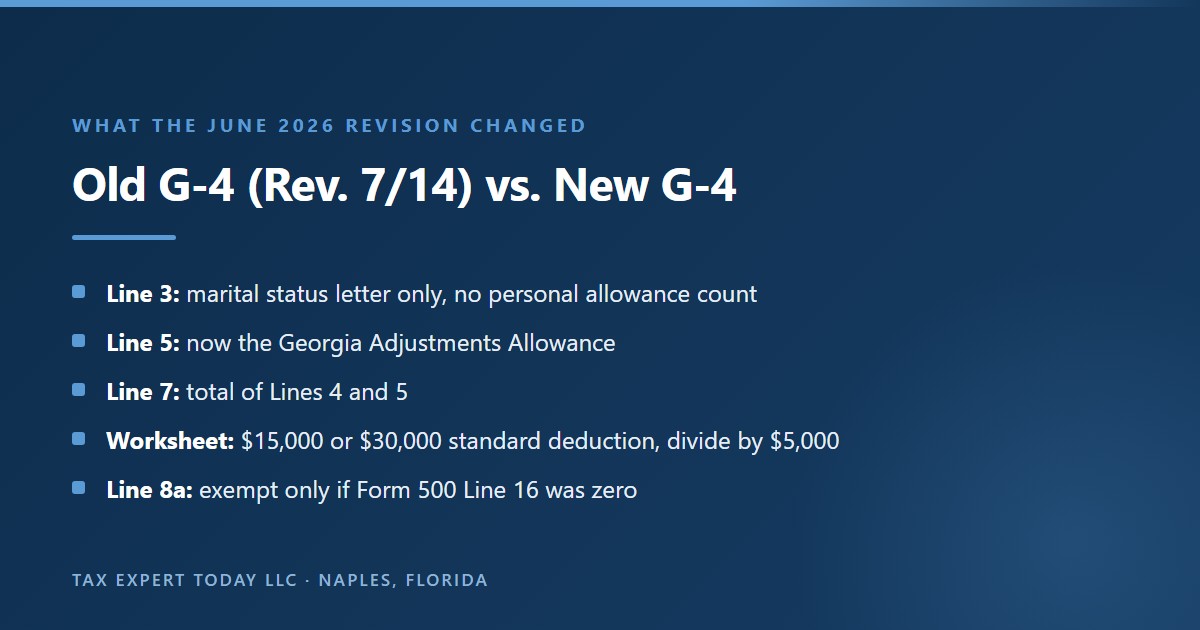
The June 3, 2026 revision removed the numbered personal allowances from Line 3, so you now enter only a letter for marital status. Line 5 became the Georgia Adjustments Allowance, the worksheet now divides by $5,000, and the standard deduction amounts printed on the form rose to $15,000 and $30,000 to match House Bill 463.
- Line 3: letter only (A, B, C, or D), with no personal allowance count beside it.
- Line 5: renamed from additional allowances to Georgia Adjustments Allowance.
- Worksheet Line H: divide by $5,000, and round up when the remainder is over $2,500.
- Line 8a test: now refers only to Line 16 of Form 500, since Form 500EZ is gone.
The table compares the July 2014 revision that still circulates with the current June 2026 version. If the form your employer handed you says “Rev. 7/14” in the upper corner, ask for the current one from the Department’s G-4 download page.
| Item | Form G-4 (Rev. 7/14) | Form G-4 (Rev. 06/03/26) |
|---|---|---|
| Line 3, marital status | Letter plus a count of personal allowances (0, 1, or 2) beside the status | Letter only: A Single, B Married Filing Separate or Joint with both spouses working, C Married Filing Joint with one spouse working, D Head of Household |
| Line 5 | Additional allowances from the worksheet | Georgia Adjustments Allowance from the worksheet |
| Line 7, total allowances | Total of Lines 3 through 5 | Total of Lines 4 and 5 |
| Worksheet divisor | A smaller allowance unit tied to the old law | $5,000, round up if the remainder is over $2,500 |
| Standard deduction printed on the worksheet | Pre 2024 amounts | $15,000 single, head of household, or married filing separate; $30,000 married filing joint |
| Exempt test, Line 8a | Line 4 of Form 500EZ or Line 16 of Form 500 was zero | Line 16 of Form 500 was zero |
| Military spouse test, Line 8b | Spouse domicile must match the servicemember’s | Domicile matches, or the spouse elected to use the servicemember’s residence for tax purposes |
None of these changes by itself raises or lowers your tax for the year. Your actual Georgia liability is set when you file Form 500 for 2026. What the G-4 controls is how close your withholding comes to that number, and an outdated form can leave you noticeably over or under.
How Do You Fill Out Georgia Form G-4 Line by Line?
Enter your name, Social Security number, and address on Lines 1a through 2b. Pick a marital status letter on Line 3, list dependents on Line 4, use the worksheet only for Line 5 adjustments, add any extra amount on Line 6, total Lines 4 and 5 on Line 7, and sign. Line 8 is only for exempt claims.
- Lines 1a to 2b: identity and home address, which also tells payroll whether you live in Georgia.
- Lines 3 to 7: the withholding calculation inputs.
- Line 8: the two exempt boxes, which replace Lines 4 through 7.
- Signature: made under penalty of perjury.
| Line | What you enter | Practical note |
|---|---|---|
| 1a, 1b | Full legal name and Social Security number | Match your Social Security card so W-2 reporting lines up |
| 2a, 2b | Home street address, city, state, ZIP | A Florida or other out of state address signals nonresident status to payroll |
| 3 | Marital status letter A, B, C, or D | Write the same letter again on Line 7 |
| 4 | Number of dependent allowances | Dependent has the Internal Revenue Code meaning, with a Georgia addition described below |
| 5 | Georgia Adjustments Allowance from worksheet Line H | Leave blank unless you complete the worksheet; an unsupported claim is denied |
| 6 | Additional withholding per pay period, in dollars | Useful for side income, two jobs, or a past balance due |
| 7 | Letter from Line 3 and total of Lines 4 and 5 | This is the line payroll actually keys into the system |
| 8a, 8b | Exempt boxes | Do not complete Lines 4 through 7 if you check either box |
| 9 | Employer name, address, FEIN, withholding number | Completed by the employer only when the form must be mailed to DOR |
The certification above the signature line reads, in substance, that you are entitled to the allowances or exempt status claimed and that you authorize the extra amount on Line 6. Because it is signed under penalty of perjury, the numbers should reflect a reasonable estimate of your situation, not a guess designed to raise take home pay.
Which Marital Status Letter Should You Use on Line 3?
Use A if you are single, B if you are married filing separately or married filing jointly with both spouses working, C if you are married filing jointly and only one spouse works, and D if you qualify as head of household. The letter selects the standard deduction your employer builds into the withholding calculation.
- Letter A, Single: $15,000 standard deduction in the 2026 formula.
- Letter B, two earner couples or separate filers: $15,000 per job.
- Letter C, one earner couples: $30,000, the full joint deduction on one paycheck.
- Letter D, Head of Household: $15,000, the same amount as single for withholding.
The most common error on this line is a two earner married couple where both spouses choose letter C. Each employer then subtracts the full $30,000 joint deduction, so the household’s withholding is computed as if it had $60,000 of deductions when the return will allow $30,000. Letter B exists to prevent that: each job gets $15,000, and the two halves add up to the joint amount. If one spouse later stops working, the working spouse can file a new G-4 and switch to C.
Letter D follows the federal head of household definition, so it generally requires that you are unmarried and pay more than half the cost of keeping up a home for a qualifying person. The 2026 withholding formula published by the USDA National Finance Center uses the same $15,000 standard deduction for single and head of household, so choosing D over A does not change Georgia withholding much; it matters more on the federal side.
How Many Dependent Allowances Can You Claim on Line 4?
Enter one allowance for each dependent you expect to claim on your Georgia return. The form defines dependent by reference to the Internal Revenue Code, with one Georgia addition for an unborn child with a detectable human heartbeat. In the 2026 withholding formula, each allowance removes $5,000 of annual wages from Georgia tax.
- Value per allowance: $5,000 times 4.99 percent, or about $249.50 less withholding a year.
- Same child, one parent: divorced or separated parents should not both claim the same child.
- Change of status: a birth, adoption, or a child aging out is a reason to file a new form.
- Georgia rule: the unborn child provision follows Code Section 1-2-1, as printed on the form.
The $5,000 figure comes from the dependent deduction House Bill 463 raised from $4,000 to $5,000 for 2026, which the 2026 Employer’s Tax Guide lists among the changes for tax year 2026. Payroll systems apply it per allowance on Line 7, whether the allowance came from Line 4 or Line 5. Before you count a dependent, confirm you will actually be entitled to claim that person on the return. Our guide to the Georgia state income tax explains the dependent deduction on Form 500.
How Does the Georgia Adjustments Allowance Worksheet Work?
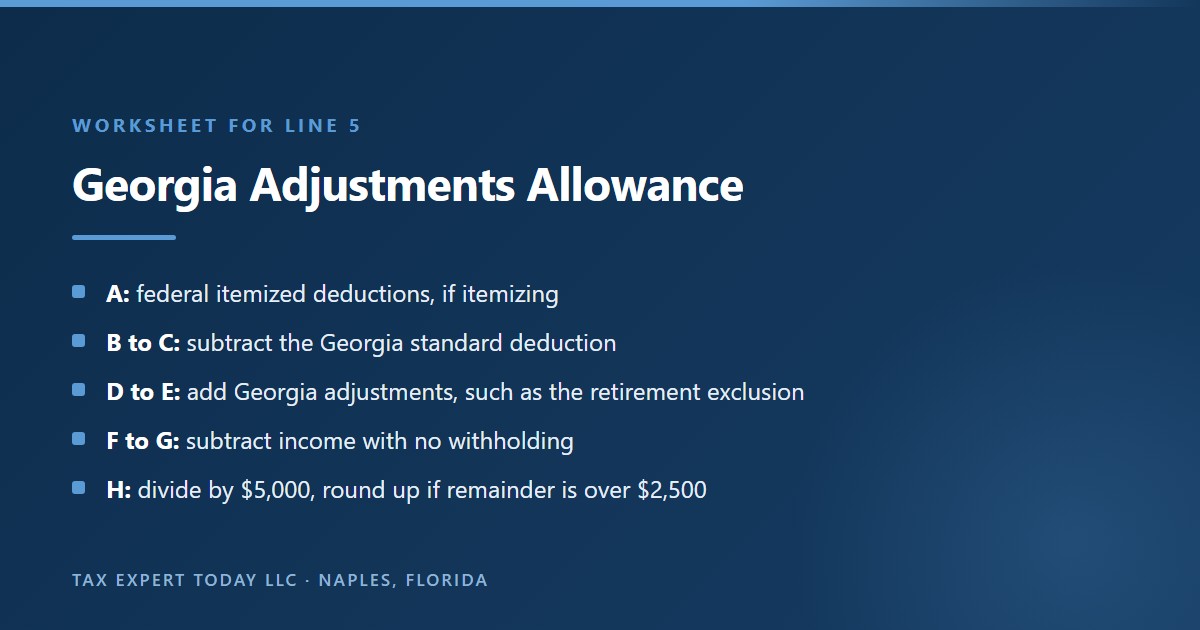
The worksheet converts deductions and Georgia subtractions you expect on your return into extra allowances. You start with estimated federal itemized deductions, subtract the Georgia standard deduction, add Georgia adjustments such as the retirement income exclusion, subtract income not subject to withholding, then divide what is left by $5,000 to get Line 5.
- Line A: federal estimated itemized deductions, only if you itemize.
- Line B: the Georgia standard deduction for your status ($15,000 or $30,000).
- Line D: allowable Georgia adjustments to federal adjusted gross income.
- Line F: taxable income that has no withholding, such as interest or rent.
- Line H: Line G divided by $5,000, rounded up when the remainder is over $2,500.
Here is the full sequence as printed on the June 2026 form, with a hypothetical single employee, age 63, who works part time, itemizes on the federal return, and expects to use part of the retirement income exclusion against pension income.
| Worksheet line | Description on the form | Hypothetical amount |
|---|---|---|
| A | Federal estimated itemized deductions (if itemizing) | $22,000 |
| B | Georgia standard deduction (single) | $15,000 |
| C | Line A minus Line B (zero or more) | $7,000 |
| D | Allowable Georgia adjustments to federal AGI | $8,000 |
| E | Line C plus Line D | $15,000 |
| F | Estimate of taxable income not subject to withholding | $4,000 |
| G | Line E minus Line F (stop if zero or less) | $11,000 |
| H | Line G divided by $5,000; round up if the remainder is over $2,500 | 2 allowances ($1,000 remainder is not over $2,500) |
In this example the employee enters 2 on Line 5. At the 2026 rate, those two allowances reduce annual Georgia withholding by about $499. The page 2 instructions say Line D covers items “such as Retirement Income Exclusion, U.S. Obligations, and other allowable deductions per Georgia Law,” and point to the IT-511 booklet for the list. House Bill 463 also created limited Georgia subtractions for qualified overtime and cash tips for 2026 through 2028; the Employer’s Tax Guide notes that reporting those amounts does not by itself reduce withholding, so if you expect the subtraction, the worksheet is the place where it may be reflected. Treat that as a question to confirm against the IT-511 booklet before you rely on it.
Two cautions. First, the instructions state that failing to complete and submit the worksheet “will result in automatic denial” of the Line 5 claim, so attach it. Second, Line F works against you on purpose. If you have large interest, dividend, or rental income with no withholding, it can wipe out Line G entirely, and you may instead need extra withholding on Line 6 or quarterly estimates on Georgia Form 500-ES.
When Should You Use Line 6 for Additional Withholding?
Use Line 6 when the standard calculation will not cover your Georgia tax. Typical cases are two jobs at once, a spouse with self employment income, large investment income, or a prior year balance due. You enter a flat dollar amount per pay period, and O.C.G.A. 48-7-101(f)(3) lets your employer withhold it in addition to the regular amount.
- Two jobs: each employer subtracts a full standard deduction unless you adjust.
- Side business: net self employment income has no withholding at all.
- Investment income: Line F on the worksheet does not add withholding; Line 6 does.
- Safe planning: a small Line 6 amount can stand in for quarterly estimates.
A simple way to size the amount is to estimate the Georgia tax on the income that has no withholding, then divide by the number of pay periods left in the year. For example, $10,000 of freelance profit at 4.99 percent is about $499 of Georgia tax; with 10 biweekly paychecks left, an extra $50 per paycheck covers it. This is hypothetical arithmetic, not a projection of your return, and the actual liability depends on the full Form 500.
Who Can Claim Exempt on Georgia Form G-4 Line 8?
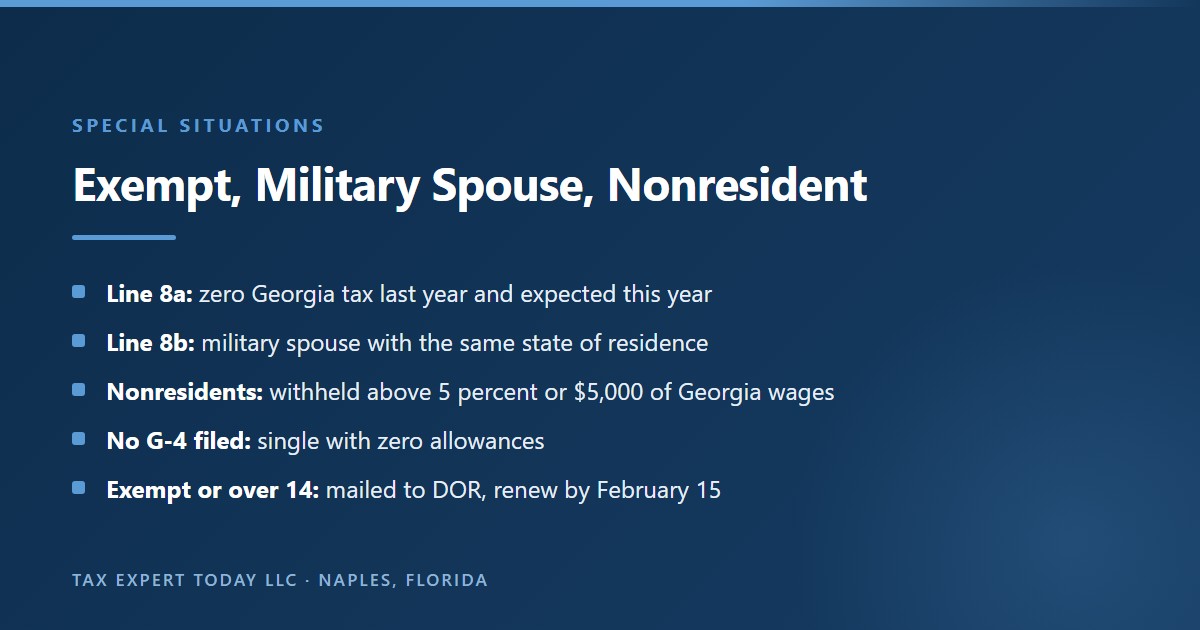
You may check Line 8a only if you filed a Georgia return last year showing zero on Line 16 of Form 500 and you expect no Georgia tax liability this year. A refund alone does not qualify you, and without a prior year Georgia return you cannot claim exempt. Employers mail exempt forms to the Department.
- Test one: last year’s Form 500 Line 16 tax was $0.
- Test two: you expect $0 Georgia tax for this year.
- Not enough: getting all of your withholding back as a refund.
- Duration: an exempt form stays in effect until changed or until February 15 of the next year.
The form gives two examples that settle most questions. If your employer withheld $500 and Line 16 of your Form 500 showed $100, you had a tax liability and cannot claim exempt, even though you got $400 back. If Line 16 showed $0 and you filed, you qualify, provided you also expect no liability this year. Students with summer jobs and workers whose income falls under the standard deduction are the usual candidates.
Because exempt and over 14 allowance certificates are sent to the Department, and because such forms “remain in effect until changed or until February 15 of the following year,” plan to give your employer a new exempt certificate each year by mid February if you still qualify. The 2026 Employer’s Tax Guide also says the Department will not send written correspondence on G-4 submissions unless the certificate should not be honored, so silence does not mean the claim was reviewed and approved.
How Does the Military Spouse Exemption Work on Line 8b?
Line 8b lets the spouse of a servicemember claim exemption from Georgia withholding on wages earned in Georgia under the Servicemembers Civil Relief Act. The servicemember must be in Georgia on military orders, the spouse must be there solely to be with the servicemember, and their state of residence must match or the spouse must have elected the servicemember’s residence.
- Orders: the servicemember is present in Georgia in compliance with military orders.
- Purpose: the spouse is in Georgia solely to be with the servicemember.
- Domicile: the servicemember maintains domicile in another state.
- Match: same domicile, or an election to use the servicemember’s residence for taxation.
The spouse writes both states of residence on the form, and the form states plainly that they must be the same to be exempt. The page 2 instructions tell employers not to report those wages as Georgia wages on the W-2. The reverse case also appears in the instructions: a Georgia domiciled spouse who claims the same protection in another state must still file a G-4 so Georgia tax is withheld when the other state does not require it. Military families should also read our guide to Georgia military retirement tax for the separate retirement pay exclusion.
Do Florida Residents Who Work in Georgia Need a Form G-4?
Usually, yes. The 2026 Employer’s Tax Guide says employers must withhold Georgia tax from a nonresident’s Georgia wages when more than 5 percent of total earned income, or more than $5,000 of wages, is attributable to Georgia. A Florida resident who works in Georgia should file a G-4 so the employer applies the correct status and allowances.
- Threshold: more than 5 percent of earned income or more than $5,000 of wages from Georgia work.
- Remote work: days physically worked in Florida are generally not Georgia source wages.
- Filing: nonresidents with Georgia wages generally file Form 500 with Schedule 3.
- Georgia residents abroad: if the other state does not require withholding, Georgia tax is withheld.
The reverse matters for people who move. Under O.C.G.A. 48-7-100(10)(H), as summarized in the guide, Georgia residents are subject to the withholding laws of the state where they work, and if that state does not require withholding, the employer withholds for Georgia. Florida has no individual income tax, so a Georgia resident working in Florida still has Georgia tax withheld. Once you change domicile to Florida and stop working in Georgia, give payroll your new address and a new state certificate so Georgia withholding stops. Our guide to the Georgia part year resident tax return covers the year of the move.
What Happens If You Never Turn In a Georgia Form G-4?
If you do not submit a properly completed Georgia Form G-4, O.C.G.A. 48-7-102 directs your employer to withhold as though you are single with zero allowances. The 2026 Employer’s Tax Guide adds that an employer may instead use your federal W-4 if it contains enough information to compute Georgia withholding.
- Default status: single, letter A, zero allowances.
- Who it hurts: one earner married couples and parents, who lose the $30,000 deduction or dependent allowances.
- Erroneous forms: an employer that knows a G-4 is wrong should withhold at single and zero until corrected.
- Result: over withholding, which comes back only when you file Form 500.
The difference can be meaningful. The table below applies the 2026 percentage formula from the USDA National Finance Center bulletin (annual wages, less the standard deduction for the status letter, less $5,000 per allowance, times 4.99 percent) to a hypothetical $60,000 salary. These are formula estimates for illustration only; actual withholding depends on pretax deductions, pay frequency, and the employer’s tables.
| Hypothetical G-4 on $60,000 of wages | Taxable for withholding | Annual Georgia withholding | Per biweekly check |
|---|---|---|---|
| No G-4 filed: single, 0 allowances | $45,000 | $2,245.50 | $86.37 |
| Letter C, 0 allowances | $30,000 | $1,497.00 | $57.58 |
| Letter C, 2 dependent allowances | $20,000 | $998.00 | $38.38 |
| Letter C, 2 dependents plus 2 worksheet allowances | $10,000 | $499.00 | $19.19 |
In this hypothetical, a one earner couple with two children who never files a G-4 would have about $1,248 more withheld during the year than with a completed form. That money is not lost, but it sits with the state until the return is processed.
When Should You File a New Georgia Form G-4?
File a new Georgia Form G-4 whenever your marital status, dependents, jobs, or expected Georgia adjustments change, and review it after a rate change like the 2026 cut to 4.99 percent. The Employer’s Tax Guide says a new form takes effect with the first payroll period after the employer receives it and stays in effect until replaced.
- Life events: marriage, divorce, a birth or adoption, or a dependent leaving the household.
- Work changes: a second job, a spouse starting or stopping work, or retirement.
- Exempt claims: renew by February 15 each year.
- Law changes: the June 2026 revision is a natural point to replace a 2014 era form.
There is no limit on how often you can change it; O.C.G.A. 48-7-102(c)(3), as cited in the guide, lets employees update the form as often as they wish. The 2026 rate change also had a timing wrinkle: the guide says employers had to keep withholding at 5.19 percent until the change took effect and could begin withholding at 4.99 percent starting May 11, 2026, even though the lower rate applies to the whole 2026 tax year. Many employees were therefore slightly over withheld early in the year, which our Georgia withholding tax guide explains from the payroll side.
What Are the Most Common Georgia Form G-4 Mistakes?
The most common mistakes are both spouses choosing letter C, claiming worksheet allowances without attaching the worksheet, claiming exempt after merely receiving a refund, using a 2014 revision with the old personal allowance numbers, and forgetting to file a new form after a move, a marriage, or a second job.
- Double joint deduction: two earners on letter C under withhold.
- Missing worksheet: the Line 5 claim is automatically denied.
- Refund confusion: a refund is not the same as zero liability.
- Old form: personal allowance counts on Line 3 no longer belong on the form.
- Stale form: a G-4 from five years ago rarely fits this year.
A useful year end check is to compare the Georgia withholding on your last pay stub with your estimated Georgia tax. If the gap is large in either direction, a new G-4 in January is easier than a surprise in April. If you owe because withholding fell short, our guide to the Georgia Department of Revenue payment plan explains the options.
Georgia Form G-4 Help in Naples & Southwest Florida
Tax Expert Today LLC reviews Georgia Form G-4 and federal W-4 withholding, prepares Georgia Form 500 returns, and plans estimated payments from its office at 11983 Tamiami Trail N, Naples, FL 34110. Georgia employees and retirees are served nationwide from Naples, Florida, by phone and secure document exchange. Call (239) 441-2005.
- Georgia G-4 help Naples: line by line review of the June 2026 form and worksheet.
- Two earner households: coordinating G-4 and W-4 elections across both jobs.
- Retirees: G-4 and G-4P elections alongside the retirement income exclusion.
- Movers: stopping Georgia withholding after a move to Florida.
- Nonresidents: Florida residents with Georgia wages and Form 500 Schedule 3.
Tax Expert Today LLC is based at 11983 Tamiami Trail N, Naples, FL 34110, and our office is open Monday through Friday, 10 a.m. to 5 p.m. Eastern time. You can reach us at (239) 441-2005. Many of the Georgia withholding questions we see come from Collier and Lee County residents who still draw a Georgia paycheck or pension, and from families who relocated from Atlanta and want Georgia withholding to stop cleanly. We work with Georgia clients remotely, and there is no need to visit Naples to work with us.
For the full range of our Georgia work, see our Georgia tax services page. Related guides include Georgia state income tax for the return itself, the Georgia retirement income exclusion for Line D of the worksheet, and Georgia amended tax returns if a prior year needs correcting.
A point of scope, stated plainly: Georgia Form G-4 is a Georgia Department of Revenue matter. Our team of tax advisors, enrolled agents, CPAs, and attorneys handles state tax matters nationwide, and we explain how the Georgia rules apply to your facts rather than predicting any particular result.
When to Engage a Professional
A G-4 is a short form, but some situations deserve a second look before you sign: two earners with uneven pay, a large retirement income exclusion or other Georgia adjustment, a mid year move into or out of Georgia, a military spouse claim, or a prior year where you owed Georgia tax and an underpayment notice.
- Before you sign: when the worksheet produces more than a few allowances.
- Before you claim exempt: when you are not sure last year’s Line 16 was zero.
- After a notice: when DOR questions an exempt or over 14 allowance certificate.
- At year end: when withholding and estimated tax are far apart.
Call (239) 441-2005 to schedule a free consultation. We will look at your current G-4, last year’s Georgia return, and your expected income, and explain the options in writing.
Frequently Asked Questions About Georgia Form G-4
What is Georgia Form G-4?
Georgia Form G-4 is the State of Georgia Employee’s Withholding Allowance Certificate. Employees complete it under O.C.G.A. 48-7-102 and give it to their employer, which uses the marital status letter, allowances, and any additional amount to calculate Georgia income tax withholding from each paycheck.
What is the current revision of Georgia Form G-4?
The current form on the Georgia Department of Revenue website is Form G-4 (Rev. 06/03/26). It replaced the July 2014 revision, removed the personal allowance counts from Line 3, renamed Line 5 the Georgia Adjustments Allowance, and uses a $5,000 divisor and the $15,000 and $30,000 standard deductions on the worksheet.
Do I need both a W-4 and a Georgia Form G-4?
Yes. The 2026 Employer’s Tax Guide says employees should file each form, the W-4 for federal withholding and the G-4 for Georgia withholding. An employer may use W-4 information for Georgia if it is sufficient, but otherwise withholds as if you are single with zero allowances.
How much is one allowance worth on Georgia Form G-4 in 2026?
In the 2026 withholding formula published by the USDA National Finance Center, each dependent or additional allowance removes $5,000 of annual wages from Georgia withholding. At the 4.99 percent rate, that is about $249.50 less Georgia tax withheld over a full year.
Can I claim exempt on Georgia Form G-4 if I got a refund last year?
Not on that basis. Line 8a requires that you filed a Georgia return last year with zero on Line 16 of Form 500 and that you expect no Georgia liability this year. The form states that receiving a refund for the prior year does not qualify you to claim exempt.
What happens if I claim more than 14 allowances on Form G-4?
Your employer must mail the form to the Georgia Department of Revenue, Taxpayer Services Division, and should honor it as submitted unless the Department says otherwise. Such forms remain in effect until changed or until February 15 of the following year.
Which letter do married couples use on Georgia Form G-4?
Use letter B if you are married filing separately or married filing jointly with both spouses working, and letter C if you file jointly and only one spouse works. Two working spouses who both choose C can be under withheld, because each job applies the full $30,000 joint deduction.
I live in Naples, Florida, and work part of the year in Georgia. Can you help with my Georgia Form G-4?
Yes. Tax Expert Today LLC reviews Georgia Form G-4 elections and prepares nonresident Georgia Form 500 returns from its Naples, Florida office at 11983 Tamiami Trail N. Georgia clients work with us remotely. Call (239) 441-2005 for a free consultation.
Published October 22, 2026 by Dr. Pellumb Kabashi « Back to Learning Center
Have a question this article touches on?
Tax Expert Today LLC, based in Naples, Florida and serving clients across the United States.
Schedule a Consultation (239) 441-2005