
By Dr. Pellumb Kabashi, DBA, MBA, EA, CFE, CES
Founder, Tax Expert Today LLC · Tax advisors, enrolled agents, CPAs, and attorneys · Serving clients in all 50 states
The Georgia military retirement tax rules change in 2027, not 2026. For tax year 2026, a military retiree under 62 still excludes up to $17,500 of retired pay, plus another $17,500 only with more than $17,500 of Georgia earned income. The $65,000 exclusion for retirees under 65 in HB 266 applies to tax years beginning on or after January 1, 2027. Call (239) 441-2005 for a free consultation.
Does Georgia Tax Military Retirement Pay in 2026?
Yes, in part. For tax year 2026, Georgia taxes military retirement pay above the exclusion a retiree qualifies for. A retiree under 62 excludes up to $17,500, plus up to $17,500 more with Georgia earned income above $17,500. A retiree 62 or older uses the general retirement income exclusion instead, which counts military retired pay as retirement income.
- Under 62: the dedicated military exclusion in O.C.G.A. 48-7-27(a)(5.1), capped at $17,500 or $35,000 depending on earned income.
- Ages 62 through 64: the general exclusion in paragraph (a)(5), capped at $35,000 of all retirement income combined.
- Age 65 and older: the general exclusion, capped at $65,000 of all retirement income combined for 2026.
- Anything above the cap: taxed at the Georgia flat rate, which is 4.99 percent for 2026.
The 2025 IT-511 instruction booklet states the rule in two sentences on its subtractions page: up to $17,500 of military retirement income can be excluded for taxpayers under 62 years of age, and an additional $17,500 can be excluded for such taxpayers with more than $17,500 of earned income in Georgia. The codified statute on Justia carries the same language and is labeled as the version effective until January 1, 2027. That label is the whole story of the Georgia military retirement tax question for 2026. The version that takes over on January 1, 2027 is the one most summaries are already describing, a year early.
The flat rate matters because it converts every exclusion dollar into a known amount of tax. The Department of Revenue Important Tax Updates page confirms that the Georgia income tax rate has been reduced to a flat 4.99 percent for 2026 and that the standard deduction is $15,000 for single filers and $30,000 for married couples filing jointly. At that rate, a $17,500 exclusion removes $873.25 of Georgia tax and a $35,000 exclusion removes $1,746.50, before any other adjustment on the return.
What Did House Bill 266 Actually Change, and When?
House Bill 266, signed on May 13, 2025 as Act 181, rewrote the military exclusion so that a retiree under 65 may exclude military retired pay up to $65,000, with no earned income condition. Section 3(b) of the Act makes that change effective January 1, 2027 and applicable only to tax years beginning on or after January 1, 2027.
- Age ceiling: raised from under 62 to under 65.
- Dollar cap: the two $17,500 tiers are replaced by a single cap of $65,000.
- Earned income test: removed entirely.
- New limit: no individual may take the military exclusion in addition to the general retirement exclusion.
- Effective date: tax years beginning on or after January 1, 2027, per Section 3(b).
The Georgia General Assembly bill record shows HB 266 was signed by the Governor on May 13, 2025, became Act 181, and carries a general effective date of July 1, 2025. That July 1, 2025 date is the source of much of the confusion. The Act does two unrelated things. Section 2 rewrites the credit for contributions to law enforcement foundations, and Section 3(a) makes that part effective July 1, 2025 for tax years beginning on or after January 1, 2026. Section 3(b) then carves Section 1, the military retirement change, out of that rule entirely. Section 1 becomes effective on January 1, 2027 and applies to taxable years beginning on or after January 1, 2027.
For Georgia military retirement tax purposes, read in order, the text of HB 266 as passed leaves no room for a 2026 reading of the military provision. A calendar year filer first benefits on the tax year 2027 return, which is filed in 2028. A 2026 return filed in the spring of 2027 is still computed under the two tier $17,500 rule.
Why Do So Many Sources Say the $65,000 Rule Starts in 2026?
Because the Act has two effective dates and much of the coverage reported only the first. Several widely read summaries, and the AI generated overview shown for this search, state that the $65,000 exclusion applies to retirees of any age beginning with tax year 2026. The enrolled text supports neither the year nor the any age wording.
- The year is wrong because Section 3(b) defers the military change to tax years beginning in 2027.
- The age wording is wrong because the new paragraph still applies only to an individual less than 65 years of age.
- The state pages are right for 2026. The Department of Revenue and the Department of Veterans Service both still publish the $17,500 rule.
- The booklet is right for 2025 and describes the same two tier worksheet the statute still requires for 2026.
A reader comparing Georgia military retirement tax sources will see what looks like the state lagging behind the law. It is the other way around. The Department of Revenue Retirement Income Exclusion page states that beginning January 1, 2022, $17,500 of military retirement income can be excluded for taxpayers under 62 and an additional $17,500 can be excluded for taxpayers with more than $17,500 of earned income in Georgia. That remains the correct rule for every tax year from 2022 through 2026. The Department of Veterans Service page gives the same two tiers.
The any age phrasing has a separate origin. A retiree who is 65 or older already had access to a $65,000 general exclusion that treats military retired pay as retirement income, so a summary that folds both paragraphs together can make it sound as if every age group lands on $65,000. The statute does not work that way. The two paragraphs have different age tests, different income definitions, and from 2027 onward they cannot be combined. For a household making withholding or estimated tax decisions for 2026, the difference between the two readings can be several hundred dollars of Georgia tax per spouse. Bills proposing a complete exemption for military retirement pay have also been filed, including HB 361 in 2025, but as of September 2026 none of them has been enacted, and the capped HB 266 rule is the law.
How Do the 2026 and 2027 Georgia Military Retirement Tax Rules Compare?
For 2026 the dedicated military exclusion covers only retirees under 62 and turns on Georgia earned income. For 2027 it covers retirees under 65, has one $65,000 cap and no earned income test, and cannot be claimed together with the general retirement exclusion. The general exclusion for 65 and older also rises.
| Retiree age during the year | Tax year 2026 rule | Tax year 2027 rule |
|---|---|---|
| Under 62 | Military exclusion up to $17,500, plus up to $17,500 more if Georgia earned income exceeds $17,500 | Military exclusion up to $65,000, no earned income condition |
| Under 62 and permanently and totally disabled | Military exclusion as above, and the current statute text treats it as in addition to the general exclusion of up to $35,000 | Military exclusion up to $65,000 or the general exclusion up to $35,000, not both |
| 62 through 64 | General retirement exclusion up to $35,000 of all retirement income, including military retired pay | Military exclusion up to $65,000 or the general exclusion up to $35,000, not both |
| 65 and older | General retirement exclusion up to $65,000 of all retirement income | General retirement exclusion up to $70,000 of all retirement income |
| Married couple filing jointly | Each spouse qualifies and is capped separately | Each spouse qualifies and is capped separately |
The 65 and older figure for 2027 comes from a different Act. The codified text of O.C.G.A. 48-7-27(a)(5)(A)(xiv), added by HB 463 of 2026 (Ga. L. 2026, p. 397), sets the general exclusion at $70,000 for each taxpayer 65 or older for taxable years beginning on or after January 1, 2027, while the $35,000 figure for ages 62 through 64 and for the permanently disabled is unchanged. HB 463 is the same Act that set the 4.99 percent rate for 2026. For the general exclusion, the age tests in paragraph (a)(5)(D) are met if the age is reached during any part of the taxable year, so a retiree who turns 62 in December qualifies for the $35,000 tier for that year.
Who Qualifies for the Georgia Military Retirement Income Exclusion?
The exclusion covers income paid as retirement benefits from military service in the armed forces of the United States or the reserve components. For 2026 the recipient must be under 62. Each spouse qualifies on a separate basis, so a couple in which both spouses receive military retired pay may each claim the exclusion against their own pay.
- Covered service: active component retirement and reserve component retirement both fall inside the statutory wording.
- Covered income: retirement benefits paid to the individual, reported as taxable military retirement from Form 1099-R on the worksheet.
- Age test: under 62 for 2026, under 65 from 2027.
- Residency: the exclusion is a Georgia subtraction, so it matters only where Georgia has the right to tax the pay at all.
Paragraph (a)(5.1)(B) says that in the case of a married couple filing jointly, each spouse who is otherwise qualified shall be individually entitled to exclude retirement income received by that spouse up to the exclusion amount. The Department of Revenue page adds the practical corollary: each spouse must qualify on a separate basis, and if both qualify, each may claim the amounts. What the rule does not allow is transfer. A spouse with no military retired pay cannot lend an unused exclusion to a spouse whose pay exceeds the cap, and a spouse with no Georgia earned income cannot borrow the other spouse’s wages to unlock the second $17,500 tier.
Georgia starts its computation from federal adjusted gross income. Only military retired pay that is actually included in federal adjusted gross income reaches the Georgia return in the first place, which is why the worksheet asks for the taxable amount from Form 1099-R rather than the gross amount.

How Does the $17,500 Earned Income Test Work for 2026?
The first $17,500 of military retired pay is excluded for any qualifying retiree under 62. The second $17,500 is available only when the retiree has Georgia earned income, already included in Georgia taxable net income, that exceeds $17,500. The additional exclusion is limited to the lesser of the remaining retired pay or the allowed amount.
- Base tier: lesser of taxable military retirement or $17,500.
- Threshold: Georgia earned income must exceed $17,500, so exactly $17,500 does not qualify.
- What counts: taxable Georgia salary and wages plus other earned Georgia income.
- Total cap: $35,000 per qualifying spouse.
The statute says the additional amount is available provided the individual has Georgia earned income in an amount that exceeds $17,500. The Schedule 1 worksheet enforces that with a stop instruction: if Georgia earned income is less than 17,501, the filer stops and carries only the base amount. The Department of Veterans Service page describes the condition as at least $17,500 of earned income. That is a one dollar difference, and it only matters to a retiree whose wages land exactly on the threshold, but the statute and the worksheet control.
| Hypothetical retiree under 62, tax year 2026 | Taxable military retired pay | Georgia earned income | Military exclusion | Georgia tax removed at 4.99% |
|---|---|---|---|---|
| Retired, not working | $30,000 | $0 | $17,500 | $873.25 |
| Working part time | $30,000 | $12,000 | $17,500 | $873.25 |
| Wages exactly at the threshold | $30,000 | $17,500 | $17,500 | $873.25 |
| Second career in Georgia | $30,000 | $60,000 | $30,000 | $1,497.00 |
| Second career, larger pension | $48,000 | $60,000 | $35,000 | $1,746.50 |
| Small pension | $9,000 | $60,000 | $9,000 | $449.10 |
The examples are illustrations of the arithmetic only. They ignore the interaction with every other line of the return, and actual tax depends on the full facts.
How Is the Exclusion Claimed on Form 500 Schedule 1?
The exclusion is computed on page 3 of Form 500 Schedule 1, the Military Retirement Income Exclusion worksheet, and carried to Schedule 1 line 7b for the taxpayer and line 7e for the spouse. The net Schedule 1 adjustment then flows to line 9 of Form 500. The worksheet page should be included with the return.
- Line 1: taxable military retirement from Form 1099-R.
- Lines 2 and 3: base exclusion and the lesser of line 1 or line 2.
- Lines 4 through 6: taxable Georgia salary and wages, other earned Georgia income, and the total.
- Lines 7 and 8: total additional exclusion allowed, then the lesser of line 1 or line 7.
The 2025 booklet instructs filers to complete and include the Military Retirement Income Exclusion calculation, page 3 of Schedule 1, whenever an amount is entered on Schedule 1 lines 7b or 7e. The same Schedule 1 labels those lines “Military Retirement Income Exclusion (Must be under 62 years of age).” The worksheet opens with two eligibility questions, whether the filer has any military retirement income and whether the filer is under 62, and directs anyone who answers no to either question not to complete the page. Two stop points follow: one for taxable military retirement below 17,501, where only line 3 is carried, and one for Georgia earned income below 17,501.
A retiree 62 or older does not use this page at all for 2026. That retiree completes page 2 of Schedule 1, the general Retirement Income Exclusion, where military retired pay is entered along with pensions, interest, dividends and the other listed categories. The Department of Revenue has not yet published the tax year 2027 worksheet, so how the 2027 choice between the two exclusions will be presented on the form is not yet known.
What About Military Retirees Who Are 62 or Older?
For 2026, a military retiree who is 62 or older is outside the dedicated military exclusion and uses the general retirement income exclusion. Military retired pay is expressly listed as retirement income, and it shares one cap with pensions, annuities, interest, dividends, rental income, capital gains, royalties and up to $5,000 of earned income.
- Ages 62 through 64: $35,000 per qualifying spouse.
- Age 65 and older: $65,000 per qualifying spouse for 2026.
- Shared cap: military pay and every other listed retirement item draw on the same limit.
- Earned income: no more than $5,000 of wages or business income may be counted inside the exclusion.
Paragraph (a)(5)(E)(i) defines retirement income to include income from military retirement, and states that the receipt of earned income does not diminish eligibility except to the extent of the $5,000 limit. That is the opposite of the under 62 rule, where earned income is what unlocks the second tier. A 64 year old retiree with a large Georgia salary gains nothing from the salary under the general exclusion, while a 61 year old with the same salary gains the full second $17,500 tier. Our guide to the Georgia retirement income exclusion walks through the general exclusion, the joint ownership allocation and the page 2 worksheet in full.
The Department of Revenue page on the general exclusion also confirms that Social Security and Railroad Retirement benefits are handled separately. They are subtracted under their own paragraph to the extent included in federal income and are not part of the retirement income exclusion calculation, so they do not consume any of the $35,000 or $65,000 cap.
How Will the No Stacking Rule Work From 2027?
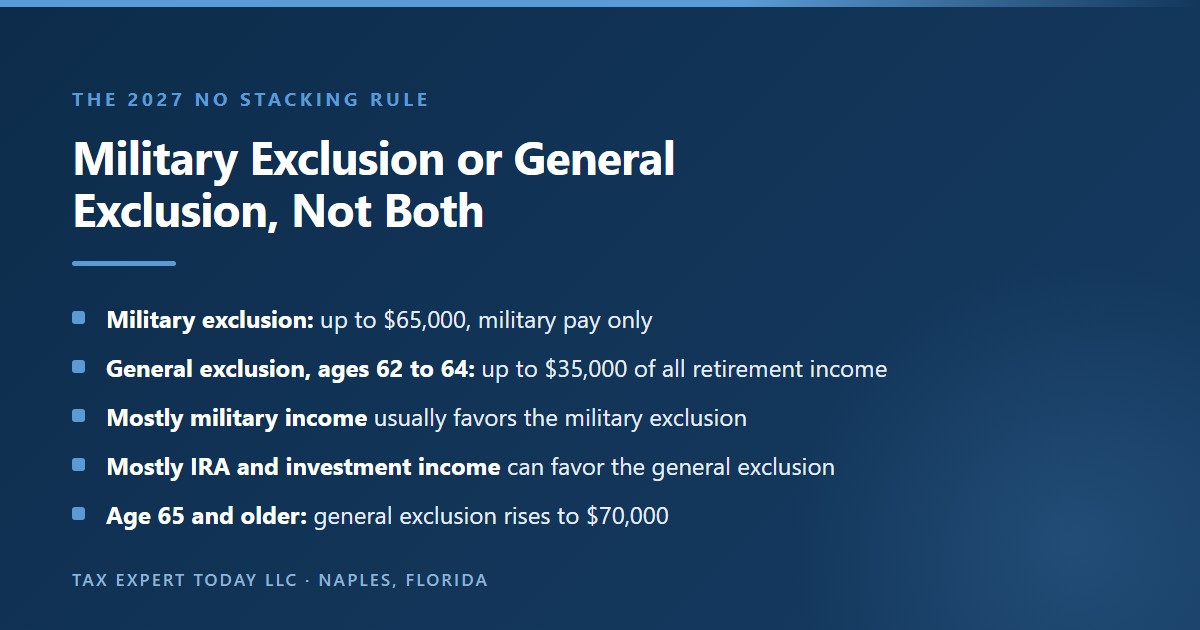
From 2027, HB 266 adds a proviso that no individual shall be allowed the military exclusion in addition to the general retirement exclusion. A retiree aged 62 through 64, or a permanently disabled retiree under 62, therefore takes one or the other. Which is larger depends on how much of that retiree’s retirement income is military pay.
- Military exclusion from 2027: up to $65,000, but it covers military retired pay only.
- General exclusion: up to $35,000 for ages 62 through 64, but it covers all listed retirement income.
- Mostly military income: the military exclusion usually produces the larger subtraction.
- Mostly other retirement income: the general exclusion can produce the larger subtraction.
The current version of paragraph (a)(5.1)(C) says only that the military exclusions shall be in addition to the adjustments under any other paragraph. HB 266 keeps that sentence and appends the new proviso. The comparison below uses a 63 year old single filer in tax year 2027 and assumes, for illustration, that the higher of the two exclusions may be chosen. The statute does not describe the election mechanics, and the Department of Revenue has not yet published the 2027 worksheet.
| Hypothetical 63 year old, tax year 2027 | Military retired pay | IRA, interest and dividends | Military exclusion (up to $65,000) | General exclusion (up to $35,000) | Larger subtraction |
|---|---|---|---|---|---|
| Military pay only | $48,000 | $0 | $48,000 | $35,000 | Military, by $13,000 |
| Mostly military | $40,000 | $20,000 | $40,000 | $35,000 | Military, by $5,000 |
| Mixed | $25,000 | $25,000 | $25,000 | $35,000 | General, by $10,000 |
| Mostly other income | $12,000 | $40,000 | $12,000 | $35,000 | General, by $23,000 |
The practical lesson for a retiree approaching 62 is that the Georgia military retirement tax planning question changes shape in 2027. Under the 2026 rule, a 62nd birthday moves the retiree from one paragraph to the other automatically. Under the 2027 rule, the retiree aged 62 through 64 has a real comparison to run each year, and the answer can flip as required distributions or investment income grow.
What Happens at Age 65 Under Each Rule?
At 65 the dedicated military exclusion stops applying under both versions of the statute, and the retiree relies on the general retirement income exclusion. For 2026 that exclusion is $65,000 per qualifying spouse. For tax years beginning in 2027 it is $70,000 per qualifying spouse under the HB 463 amendment.
- 2026 at 65 or older: $65,000 of all retirement income, military pay included.
- 2027 at 65 or older: $70,000 of all retirement income, military pay included.
- Turning 65 in 2027: the retiree is 65 during part of the year and qualifies for the $70,000 general exclusion tier for that year.
- Shared cap still applies: a large IRA distribution consumes the same limit military pay uses.
This is where a single $65,000 figure in a summary becomes misleading. In 2026 the $65,000 amount belongs to the general exclusion for retirees 65 and older. In 2027 the $65,000 amount belongs to the military exclusion for retirees under 65, and the general exclusion for those 65 and older moves to $70,000. A retiree who is 66 in 2027 and reads that the military exclusion is $65,000 at any age will understate the available subtraction by $5,000 and misunderstand what it covers.
Because the general exclusion age test is met during any part of the taxable year, the birthday year matters. A retiree who turns 65 on December 31, 2027 is 65 during part of 2027 and qualifies for the $70,000 general exclusion tier for that year. How the Department will apply the under 65 military test in that same birthday year is not addressed in any published 2027 instruction.
How Are Married Couples With Military Retired Pay Treated?
Each spouse is tested and capped on his or her own income. A couple filing jointly does not pool exclusions, earned income, or retired pay. Where both spouses served and both receive retired pay, each may claim the exclusion separately, and in 2026 each spouse needs his or her own Georgia earned income above $17,500 for the second tier.
- Separate testing: age, retired pay and earned income are each measured per spouse.
- No transfer: an unused exclusion does not move to the other spouse.
- Mixed ages: one spouse may use the military worksheet while the other uses the general worksheet.
- Joint property: income from jointly owned property is split 50 percent to each spouse for the general exclusion.
| Hypothetical couple, tax year 2026 | Spouse A | Spouse B | Combined subtraction |
|---|---|---|---|
| Both retired from service, both 58, no wages | $17,500 military exclusion | $17,500 military exclusion | $35,000 |
| Both 58, only Spouse A works in Georgia at $70,000 | $35,000 military exclusion if retired pay is at least $35,000 | $17,500 military exclusion | Up to $52,500 |
| Spouse A 59 with retired pay, Spouse B 66 with a pension | $17,500 military exclusion | General exclusion up to $65,000 | Up to $82,500 |
| Spouse A 60 with retired pay, Spouse B 55 with no retirement income | $17,500 military exclusion | None | $17,500 |
Filing separately does not change the per spouse structure, but it changes the standard deduction and several other items on the return, so the filing status decision should be made on the whole return rather than on the exclusion alone.
Does Georgia Tax Military Retired Pay If You Move to Florida?
No, not once Georgia residency has actually ended. Federal law at 4 U.S.C. 114 bars any state from imposing income tax on the retirement income of an individual who is not a resident or domiciliary of that state, and the definition expressly includes retired or retainer pay of a uniformed service computed under chapter 71 of title 10.
- Nonresident for the full year: Georgia cannot tax the retired pay at all, even if the retiree has other Georgia income.
- Part-year resident: Georgia taxes the retired pay received while a resident, and the exclusion is applied under the booklet’s part-year rules.
- Residency is decided by Georgia law: the federal statute defers to the state’s own residency and domicile rules.
- Florida has no personal income tax, so a completed move ends state income tax on the pay.
The federal rule in 4 U.S.C. 114 is a source rule, not an exclusion. It prevents Georgia from reaching the pension of a Florida resident who still owns a Georgia rental property or does occasional work in Georgia, although Georgia can still tax that rental or work income itself. The parenthetical in subsection (a) matters: residency and domicile are determined under the laws of the taxing state, so the question of whether a move is complete is answered by Georgia’s rules, including its 183 day and domicile tests. Our guides to retiring to Florida and establishing Florida residency cover the evidence that supports a completed change of domicile.
How Do Part-Year Residents Prorate the Military Exclusion?
The 2025 booklet allows part-year residents and nonresidents to claim the base $17,500 military exclusion against the total military retirement income they received. The additional $17,500 is available only after the earned income threshold is met with Georgia source earned income, so wages earned in another state before or after the move do not count.
- Base tier: applied against total military retired pay received.
- Second tier: requires more than $17,500 of Georgia source earned income.
- Where it lands: the exclusion is entered on Form 500 Schedule 3 in the part-year computation.
- General exclusion differs: it is prorated separately for its earned and unearned portions.
The general retirement exclusion uses a more involved proration. The booklet requires the earned portion and the unearned portion to be prorated separately, each by the ratio of Georgia source income to total income of that type computed as if the taxpayer were a Georgia resident for the whole year, and it publishes a worked Schedule 3 example. The military exclusion instruction is shorter and turns on the source of the earned income rather than on a ratio. A retiree who moves into or out of Georgia during the year should read both, because a 62nd birthday in the move year can move the retiree from one method to the other. Our guide to the Georgia part-year resident tax return walks through Schedule 3 line by line.
Are VA Disability Payments Taxed in Georgia?
Benefits paid under laws administered by the Secretary of Veterans Affairs are exempt from taxation under 38 U.S.C. 5301. Because they are not included in federal adjusted gross income, they never enter the Georgia computation, and they do not use any part of the military or general retirement exclusion.
- VA disability compensation: exempt at the federal level and therefore outside the Georgia starting point.
- Military retired pay: taxable federally to the extent reported as taxable on Form 1099-R.
- Waived retired pay: retired pay that is waived to receive VA compensation generally does not appear as taxable retired pay.
- No double counting: the Georgia exclusion applies only to the taxable military retirement amount.
The statutory language in 38 U.S.C. 5301(a)(1) provides that payments of benefits under any law administered by the Secretary shall be exempt from taxation. The practical effect for a Georgia filer is that the worksheet starts from the taxable military retirement shown on Form 1099-R, which already reflects the federal treatment. A retiree with a disability rating who is permanently and totally disabled may separately qualify for the general retirement income exclusion before age 62, which is a different question from whether the VA payments are taxable.
What Georgia Rule Applies to Military Survivor Benefits?
The codified statute states that any income received by a surviving family member that is based on the service record of a deceased veteran shall be excluded from Georgia taxable net income without regard to the age of the surviving family member. The booklet does not describe how that provision is reported, so a survivor should confirm the treatment against the current year instructions.
- Where it sits: O.C.G.A. 48-7-27(a)(5)(E)(ii), inside the general retirement income exclusion paragraph.
- Age: the provision applies without regard to the age of the surviving family member.
- Typical income: survivor annuity payments that are based on the deceased member’s service.
- Open point: the 2025 IT-511 booklet contains no line instruction for this provision.
The placement of the survivor sentence inside paragraph (a)(5), which is otherwise built around dollar caps, leaves a genuine reporting question that the published booklet does not answer. That is a reason for care, not a reason to ignore the provision. A surviving spouse who is under 62 and receives a survivor annuity is exactly the filer most likely to be told by a general summary that no exclusion is available, when the statute speaks directly to the situation. Estate and inheritance questions that arise alongside a survivor benefit are covered in our guide to the Georgia inheritance tax.
What Other Military Rules Appear on a Georgia Return?
The IT-511 booklet contains several military provisions that sit apart from the retirement exclusion. Residents in service are taxed on all income unless a specific exemption applies, reserve and National Guard combat zone pay is excluded, and service outside the continental United States extends the filing time. These rules mostly affect members still serving.
| Situation | Georgia treatment per the 2025 IT-511 booklet | Who it usually affects |
|---|---|---|
| Georgia legal resident on active duty | Subject to Georgia tax on all income regardless of where earned, unless specifically exempt | Members who keep Georgia as their home of record |
| Nonresident member stationed in Georgia | Files only if there is Georgia source income such as off duty work, property income or business income | Members at Georgia installations with a home of record elsewhere |
| National Guard or reserve combat zone pay | Not subject to Georgia tax for the period covered by the orders; a copy of the federal return is enclosed | Guard and reserve members on qualifying orders |
| Service outside the continental United States | Return may be filed within six months after return, with no penalties or interest during that period | Members deployed or stationed overseas |
| Spouse of a nonresident member | Income may be excluded on Schedule 3 when the residency conditions are met | Military spouses who moved to Georgia on orders |
| Guard members on active duty more than 90 consecutive days | Credit for qualified life insurance premiums, claimed on Form IND-CR 203 | Georgia National Guard and Air National Guard members |
None of these provisions changes the Georgia military retirement tax exclusion itself, but they matter to a household in which one spouse has retired and the other is still serving, which is common in communities near Georgia installations.

Can You Amend a Prior Georgia Return to Claim a Missed Exclusion?
Yes, within the Georgia refund claim period. A retiree under 62 who reported military retired pay without the exclusion, or who missed the second tier despite qualifying Georgia wages, may file Form 500X for an open year. The amended return should include the Schedule 1 worksheet page for the year being corrected.
- Use the rule for that year: the $17,500 two tier structure has applied since tax year 2022.
- Before 2022: the dedicated military paragraph did not exist, so earlier years turn on the general exclusion only.
- Attach the worksheet: the booklet asks for page 3 of Schedule 1 when lines 7b or 7e are used.
- Watch the deadline: refund claims are limited by the Georgia statute of limitations.
The Justia amendment notes confirm that paragraph (a)(5.1) was added by a 2022 amendment effective July 1, 2022. Missed exclusions are one of the more common corrections for younger military retirees, particularly those who started a Georgia civilian career partway through a year and did not realize their wages unlocked the second tier. The deadline rules, electronic filing options and interaction with a federal amended return are set out in our guide to the Georgia amended tax return.
Should Military Retirees Change Georgia Withholding for 2027?
A retiree under 65 whose retired pay exceeds $17,500 may see a lower Georgia liability in 2027, so Georgia withholding set for the 2026 rule may exceed what 2027 requires. The reverse risk applies to anyone who relied on the 2026 reading of HB 266 and reduced withholding early.
- 2026 withholding: should reflect the two tier $17,500 rule.
- 2027 withholding: may reflect the $65,000 cap for a retiree under 65.
- Retirees 62 through 64: compare both exclusions before changing anything for 2027.
- Estimated payments: a retiree with little withholding and other income should check the Georgia safe harbor.
Georgia expects tax to be paid through the year. A retiree who reduced Georgia withholding on retired pay for 2026 in the belief that the $65,000 rule already applied may face a balance due and a possible underpayment computation on the 2026 return. Our Georgia estimated tax penalty calculator estimates that exposure. State withholding elections on military retired pay are changed through the retired pay center’s own process rather than on a Georgia form, so any change for 2027 should be timed to begin with 2027 payments rather than late 2026 payments.
How Much Does the 2027 Georgia Military Retirement Tax Change Save?
For a retiree under 62 with no Georgia wages, the 2027 rule can exclude up to $47,500 more than the 2026 rule. At the 4.99 percent illustration rate that is up to $2,370.25 per qualifying spouse. For a retiree already using the $35,000 second tier, the additional exclusion is up to $30,000.
- Largest gain: retirees under 62 with substantial retired pay and no Georgia earned income.
- Smaller gain: retirees under 62 who already qualified for the second $17,500 tier.
- Choice rather than gain: retirees 62 through 64, who compare the two exclusions.
- No military change: retirees 65 and older, whose gain comes from the $70,000 general exclusion instead.
| Hypothetical retiree under 62, retired pay $65,000 | 2026 exclusion | 2027 exclusion | Additional exclusion | Illustrative tax effect at 4.99% |
|---|---|---|---|---|
| No Georgia earned income | $17,500 | $65,000 | $47,500 | $2,370.25 |
| Georgia wages of $40,000 | $35,000 | $65,000 | $30,000 | $1,497.00 |
| Retired pay of $25,000 instead, no wages | $17,500 | $25,000 | $7,500 | $374.25 |
The 4.99 percent figure is used only to make the Georgia military retirement tax arithmetic concrete. The rate for 2027 is set under O.C.G.A. 48-7-20 and may differ, so the actual tax effect for 2027 depends on the rate in force for that year and on the rest of the return.
What Are the Most Common Georgia Military Retirement Tax Mistakes?
The most common mistakes are applying the $65,000 rule to a 2026 return, missing the second $17,500 tier when Georgia wages qualify, counting out of state or spouse wages toward that tier, and assuming the military worksheet applies at 62 or older. Each produces a return that is wrong in a predictable direction.
- Using the 2027 cap on a 2026 return, which overstates the subtraction and invites a notice.
- Skipping the second tier when Georgia earned income exceeds $17,500, which overpays tax.
- Counting the wrong wages, such as a spouse’s salary or wages earned before a move into Georgia.
- Completing page 3 at age 62 or older instead of page 2 of Schedule 1.
- Omitting the worksheet page, which the booklet asks filers to include with the return.
A sixth mistake is structural rather than arithmetic. A Georgia military retirement tax question is rarely only about the exclusion. It usually arrives with a relocation, a second career, a sale of the Georgia home, or a spouse approaching 65, and each of those changes a different line. Where a sale of a Georgia residence or other property is involved, our guide to Georgia capital gains tax covers the gain and the nonresident withholding side.
Georgia Military Retirement Tax Help in Naples & Southwest Florida
Tax Expert Today LLC works from Naples, Florida and handles state tax matters nationwide, including Georgia military retirement exclusion reviews, Schedule 1 worksheet preparation, part-year residency computations for retirees relocating between Georgia and Florida, and amended Georgia returns for missed exclusions. Georgia clients are served from the Naples office and do not need to be present in Georgia or in Florida.
- Military retirement tax help Naples covers Georgia exclusion reviews, 2026 and 2027 withholding planning, and move year returns.
- Relocating retirees are common in Southwest Florida, where many former service members arrive from Georgia installations.
- Dual income households often need both Schedule 1 worksheets, one per spouse.
- Remote engagement is standard. Documents are exchanged through a secure client portal rather than by email.
Tax Expert Today LLC
11983 Tamiami Trail N, Naples, FL 34110
Telephone: (239) 441-2005
Hours: Monday through Friday, 10:00 a.m. to 5:00 p.m. Eastern Time
A local question we are asked often: I retired from the Army at 52, lived in Georgia for a few years, and moved to Naples, Florida this year. What does Georgia still tax? For the move year, Georgia taxes the retired pay received while a Georgia resident, and the booklet allows the base $17,500 military exclusion against the total retired pay received, with the second tier available only if Georgia source wages exceeded $17,500. Once the move is complete, 4 U.S.C. 114 prevents Georgia from taxing the pension at all, provided Georgia’s own residency and domicile rules treat the move as finished. Georgia rental income or Georgia work would still be taxable by Georgia as nonresident income. Georgia specific engagements are described on our Georgia tax services page, and broader planning for Southwest Florida retirees is covered on our Naples tax planning services page.
When to Engage a Professional
A retiree under 62 with military retired pay, no other income and a full year of Georgia residency can usually complete the worksheet without help. The situations that benefit from review are the ones where the exclusion interacts with a move, a second career, a spouse in a different age band, or the 2027 choice between exclusions.
- A move into or out of Georgia in the same year the retiree works in Georgia.
- A 62nd or 65th birthday falling in a year with large IRA distributions or investment income.
- Prior year returns that reported military retired pay without the exclusion.
- A survivor annuity where the reporting of the survivor provision needs to be settled.
- Withholding decisions for 2027 made before the Department of Revenue publishes the new worksheet.
Dr. Pellumb Kabashi is an enrolled agent and the founder of Tax Expert Today LLC, and the firm includes tax advisors, enrolled agents, certified public accountants, and attorneys. Georgia Department of Revenue matters are state tax matters rather than federal ones, and they are handled under Georgia procedure and Georgia authority. Nothing in this article is advice for a particular taxpayer, and the outcome in any specific case depends on facts that a general article cannot know. Retirees whose Georgia and Florida residency overlap during a move should also review the dual state residency tax trap, and the full range of Georgia engagements is described on our Georgia tax services page. Call (239) 441-2005 for a free consultation, or reach the Naples, Florida office during business hours.
Frequently Asked Questions
Does Georgia tax military retirement pay in 2026?
Partly. For tax year 2026 a retiree under 62 excludes up to $17,500, plus up to $17,500 more with Georgia earned income above $17,500. A retiree 62 or older uses the general retirement income exclusion of $35,000 for ages 62 through 64 or $65,000 for 65 and older. The remainder is taxed at 4.99 percent.
When does the $65,000 military retirement exclusion start?
Section 3(b) of HB 266 makes the military change effective January 1, 2027 and applicable to taxable years beginning on or after January 1, 2027. A calendar year filer first uses it on the 2027 return, filed in 2028.
Is the $65,000 exclusion available at any age?
No. The amended paragraph applies to an individual less than 65 years of age. A retiree 65 or older uses the general retirement income exclusion, which is $65,000 for 2026 and $70,000 for tax years beginning in 2027.
Can a retiree claim the military exclusion and the general exclusion together?
For 2026 the statute says the military exclusion is in addition to other adjustments. From 2027, HB 266 provides that no individual may take the military exclusion in addition to the general retirement income exclusion, so a retiree who qualifies for both takes one.
What counts as Georgia earned income for the second $17,500?
The worksheet adds taxable Georgia salary and wages and other earned Georgia income, and the total must exceed $17,500. Part-year residents and nonresidents may count only Georgia source earned income toward the threshold.
Where is the military exclusion entered on the Georgia return?
It is computed on page 3 of Form 500 Schedule 1 and entered on Schedule 1 line 7b for the taxpayer and line 7e for the spouse. The booklet asks filers to include the worksheet page with the return.
Does Georgia tax military retirement pay after a move to Florida?
Not after Georgia residency ends. 4 U.S.C. 114 bars a state from taxing the retirement income of a nonresident, including uniformed service retired pay computed under chapter 71 of title 10. Residency is determined under Georgia law.
Are VA disability payments taxed by Georgia?
No. 38 U.S.C. 5301 exempts benefits paid under laws administered by the Secretary of Veterans Affairs from taxation. They are not in federal adjusted gross income, so they never reach the Georgia computation.
Are military survivor benefits taxed in Georgia?
O.C.G.A. 48-7-27(a)(5)(E)(ii) states that income received by a surviving family member based on the service record of a deceased veteran is excluded without regard to the survivor’s age. The booklet does not describe how that is reported, so the current instructions should be checked.
Can I amend a Georgia return to claim a missed military exclusion?
Yes, for years still open under the Georgia refund claim period, using Form 500X and the Schedule 1 worksheet for that year. The dedicated military exclusion applies to tax years from 2022 onward.
Published September 16, 2026 by Dr. Pellumb Kabashi « Back to Learning Center
Have a question this article touches on?
Tax Expert Today LLC, based in Naples, Florida and serving clients across the United States.
Schedule a Consultation (239) 441-2005