
By Dr. Pellumb Kabashi, DBA, MBA, EA, CFE, CES
Founder, Tax Expert Today LLC · Tax advisors, enrolled agents, CPAs, and attorneys · Serving clients in all 50 states
The Georgia qualified education expense credit gives a dollar for dollar Georgia income tax credit for a preapproved gift to a student scholarship organization, up to $2,500 for a single filer, $5,000 for a joint return, $25,000 for a pass-through owner, and 75 percent of tax for a corporation. The statewide cap sells out on the first business day of January, and the credit usually removes the federal charitable deduction. Call (239) 441-2005 for a free consultation.
What Is the Georgia Qualified Education Expense Credit?
The Georgia qualified education expense credit is a state income tax credit for money given to a student scholarship organization that funds private school tuition and fees. It is created by O.C.G.A. 48-7-29.16, administered by the Georgia Department of Revenue under Tax Credit Code 125, and allowed only after the Department preapproves the amount.
- What it rewards: a cash gift to a student scholarship organization, often called an SSO.
- How it pays: a credit against Georgia income tax, dollar for dollar, up to a limit.
- Who can use it: individuals, pass-through owners, corporations, trusts, and electing pass-through entities.
- What controls it: a statewide cap that is handed out first come, first served.
The statute defines a qualified education expense as the expenditure of funds by the taxpayer during the tax year to a student scholarship organization operating under Chapter 2A of Title 20, which the organization uses for tuition and fees for a qualified school or program. The text is in O.C.G.A. 48-7-29.16(a)(3). The credit therefore follows the gift, not the school bill. A parent who pays private tuition directly receives nothing under this section.
The program dates to HB 1133 in 2008. The Georgia Department of Audits and Accounts has published an economic analysis of it, and the Department of Revenue page summarizes it in one sentence: a tax credit for qualified educational expenditures made to a student scholarship organization, allowed on a first come, first served basis.
That last phrase is the part most donors underestimate. The limits in the statute describe the most a taxpayer could ever claim. What a taxpayer actually receives is decided in the first days of January, when the Department divides the statewide cap among every request filed on the opening day. For a Georgia household the credit is one piece of a larger state plan, the kind of planning described on our Georgia tax services page. The sections below take the mechanics in the order a donor meets them: the limits, the cap, the preapproval, the payment window, the return, and then the federal side, which is where most of the planning mistakes happen.
How Does the Georgia Qualified Education Expense Credit Work?
A taxpayer asks the Department for preapproval, receives an approved amount, pays that amount to the scholarship organization within 60 days, and then claims the credit on the Georgia return for the year of the gift. Because the credit equals the gift, the cash mostly moves from the Georgia tax bill to the scholarship organization.
- Step one: a preapproval request on Form IT-QEE-TP1, submitted through the Georgia Tax Center.
- Step two: a Department notice that approves, denies, or prorates the request.
- Step three: payment to the organization within 60 days of the notice and within the same calendar year.
- Step four: the credit claimed on the Georgia return, supported by the organization’s letter of confirmation.
The simplest way to think about the credit is as a redirect. A household that owes $6,000 of Georgia income tax and is approved for a $2,500 credit still pays $6,000 in total. It simply pays $2,500 of it to the scholarship organization and $3,500 to the state. Nothing in that arithmetic creates a profit, and the credit is not a refund of money the household would not otherwise have paid.
The redirect framing also explains who can use the credit fully. The statute caps an individual’s credit at the individual’s Georgia income tax liability under O.C.G.A. 48-7-29.16(e). A taxpayer with little Georgia liability, such as a retiree whose income is mostly excluded under the Georgia retirement income exclusion, can end up with a credit that sits unused and must be carried forward.
Timing is the other half of the mechanism. The gift happens early in the year, often in January or February, while the credit is not claimed until the return for that year is filed the following spring. In between, the donor has paid the scholarship organization cash that would otherwise have gone out through withholding or estimated payments. A later section explains how to adjust those payments so the donor is not paying twice during the year.
How Much Can You Claim? Georgia Credit Limits by Filer
The statute sets the maximum credit at the lesser of the amount given or $2,500 for a single filer or head of household, $5,000 for a married couple filing jointly, $25,000 for a pass-through owner using the owner limit, and 75 percent of Georgia income tax liability for a corporation, trust, or electing pass-through entity.
- Single or head of household: up to $2,500 a year.
- Married filing jointly: up to $5,000 a year.
- Married filing separately: up to $2,500 a year, per the Department’s published guidance.
- Owner of an LLC, S corporation, or partnership: up to $25,000, limited to tax actually paid on that income.
- Corporation, fiduciary, or electing entity: up to 75 percent of its Georgia income tax liability.
| Donor type | Maximum credit | Additional limit | Authority |
|---|---|---|---|
| Single or head of household | $2,500 | Georgia income tax liability for the year | O.C.G.A. 48-7-29.16(b)(1) and (e) |
| Married filing jointly | $5,000 | Georgia income tax liability for the year | O.C.G.A. 48-7-29.16(b)(2) and (e) |
| Married filing separately | $2,500 | Georgia income tax liability for the year | Department of Revenue cap report and Reg. 560-7-8-.47 |
| Member, shareholder, or partner using the owner limit | $25,000 | Tax actually paid on the selected Georgia pass-through income | O.C.G.A. 48-7-29.16(b)(3) |
| C corporation, fiduciary, or electing S corporation or partnership | 75 percent of Georgia income tax liability | Cannot pass through to owners or beneficiaries | O.C.G.A. 48-7-29.16(c) |
| Insurance company paying premium tax | 75 percent of premium tax, never more than $1 million | Insurance credits limited to 6 percent of the statewide cap | O.C.G.A. 48-7-29.16(c.1) and (f)(1.1) |
The individual amounts were raised by the 2022 amendment, effective January 1, 2023. Before that change a single filer could claim $1,000, a joint return $2,500, and a pass-through owner $10,000. The statutory history notes in the codified section record the substitution, and older articles still quoting the lower figures are describing a law that no longer applies.
The statute itself names only two individual categories, single or head of household and married filing jointly, plus the owner category. The married filing separately figure of $2,500 comes from the Department’s published instructions in its January 2026 cap status report, which lists all three individual filing statuses. Couples deciding between joint and separate returns for other reasons should notice that two separate returns can together support the same $5,000 as one joint return.
Every limit is a ceiling on the credit, never a floor. The amount a taxpayer actually receives is the smallest of the statutory limit, the amount the Department approves after proration, the amount actually paid to the organization within the 60 day window, and the taxpayer’s Georgia income tax liability for the year, with any excess over liability carried forward.

How Did HB 328 Change the Georgia Credit Cap for 2027?
HB 328, enacted in 2026 and effective July 1, 2026, raised the aggregate amount of Georgia qualified education expense credits from $120 million a year to $150 million a year. The Department’s credit page still showed $120 million on September 22, 2026, so donors planning for January 2027 should confirm the figure the Department applies.
- Before 2023: $100 million a year for tax years ending before January 1, 2023.
- 2023 through 2026: $120 million a year.
- After HB 328: $150 million a year under the amended subsection (f)(1).
- Still first come, first served: the larger cap does not change how the credits are allocated.
| Period | Statewide cap | Where it is stated |
|---|---|---|
| Tax years ending before January 1, 2023 | $100 million | Department of Revenue credit page |
| Tax years beginning on or after January 1, 2023 | $120 million | Department of Revenue credit page and 2026 cap report |
| After HB 328 (Ga. L. 2026, p. 389, effective July 1, 2026) | $150 million per year | O.C.G.A. 48-7-29.16(f)(1) as amended |
| 2026 allocation status | $120 million preapproved, $0 remaining as of January 3, 2026 | Cap status report dated January 22, 2026 |
The statutory history on the codified section records the change plainly: the 2026 amendment, Ga. L. 2026, p. 389, section 6, HB 328, effective July 1, 2026, substituted a single sentence stating that the aggregate amount of tax credits shall not exceed $150 million per year. The earlier text had used a tiered schedule. Scholarship organizations have also begun describing the credit as $150 million beginning in 2027; the Georgia GOAL Scholarship Program FAQ uses that wording.
The Department of Revenue credit page, read on the same day, still says only that the cap is $100 million for tax years ending before 2023 and $120 million for tax years beginning on or after January 1, 2023. That is not a contradiction about the law, which the codified text settles, but it is a reason not to plan off the Department page alone. The practical question for a January 2027 request is how much of the higher cap the Department makes available and how the proration comes out, and neither is knowable in September.
A larger cap does not mean every request will be filled. The 2026 cap was exhausted on the first business day and requests were prorated, as the next section shows. A 25 percent increase in the cap could raise the proration percentage, lower it if demand grows faster, or leave it roughly where it was. Any projection of the 2027 proration is a guess, and a household should budget for a partial approval.
Why Does the Georgia Credit Sell Out on the First Business Day of January?
Requests far exceed the statewide cap, and the Department allocates credits in the order requests arrive. Scholarship organizations collect donor applications during the prior year and file them on the opening business day, so the whole cap is usually committed within the first days of January and every request is prorated.
- 2026: the Department reported $0 remaining as of January 3, 2026.
- Proration: approved amounts are a percentage of the amount requested.
- Late requests: a request filed after the cap is committed is generally denied.
- Next window: for the 2027 tax year, the first business day is Monday, January 4, 2027.
The Department’s cap status report of January 22, 2026 states that for preapprovals processed through the date of the report, $120,000,000 of the $120 million cap had been preapproved, and that as of January 3, 2026 there was $0 remaining. The monthly report archive shows the same pattern in earlier years.
The statute tells the Commissioner to preapprove, deny, or prorate a requested amount within 30 days after receiving the request, and to base preapproval solely on the availability of credits under the aggregate limit, under O.C.G.A. 48-7-29.16(f)(3) and (f)(4). When the opening day requests together exceed the cap, the only way to honor the first come rule among requests that arrived at the same moment is to prorate them.
Scholarship organizations publish the resulting percentages. One organization, Pay it Forward Scholarships, reports that approved requests received 63 percent of the amount requested for 2024, 53.3 percent for 2025, and 48 percent for 2026. Those figures come from a participant rather than the Department, and they describe past years only, but the direction is clear: as requests have grown against a fixed $120 million cap, each donor has received a smaller share of what was asked for.
| Tax year | Statewide cap | Reported proration of requests | A $5,000 joint request would have received |
|---|---|---|---|
| 2024 | $120 million | 63 percent | About $3,150 |
| 2025 | $120 million | 53.3 percent | About $2,665 |
| 2026 | $120 million | 48 percent | About $2,400 |
| 2027 | $150 million under HB 328 | Not known until January 2027 | Plan for a partial approval |
The table is illustrative arithmetic on reported percentages, not a forecast. The planning lesson is narrower and more reliable: a household that wants the credit has to be in the opening day queue, and it should treat the statutory limit as a request ceiling rather than an expected result.
How Does Preapproval Work on Form IT-QEE-TP1?
Before giving anything, the taxpayer must electronically notify the Department of the amount it intends to give, using Form IT-QEE-TP1 through the Georgia Tax Center. The Department then approves, denies, or prorates the request and notifies both the taxpayer and the scholarship organization. A gift made without preapproval earns no credit.
- Electronic only: the Department states that Form IT-QEE-TP1 must be submitted through the Georgia Tax Center.
- Organization on the list: the SSO must appear on the Department of Education list before the request is submitted.
- Estimate your liability: entities and pass-through owners estimate their Georgia tax on the request.
- Letters by mail and online: preapproval letters are mailed and can also be viewed in the Georgia Tax Center.
The statutory rule is in O.C.G.A. 48-7-29.16(f)(3): before making a contribution, the taxpayer shall electronically notify the Department, in a manner the Department specifies, of the total amount it intends to give. The Department’s 2026 cap report adds the practical conditions: the request is electronic, a taxpayer who has never filed a Georgia return must first call the Taxpayer Services Call Center to register for a Georgia Tax Center logon, and the correct mailing address should be on file because approval letters are mailed.
In practice, most individual donors never touch the Georgia Tax Center themselves. Scholarship organizations collect a donor application during the year and submit the requests on the donor’s behalf on the first business day of January. The Georgia GOAL FAQ, for example, describes a 2027 application window from June 1 through December 31, 2026, submission to the Department on the first business day of January 2027, and notice of the approved amount in January. Other organizations publish similar calendars. Whichever route a donor uses, the request that reaches the Department on the opening day is the one that matters.
A donor may request less than the statutory maximum, and there are reasons to. A household whose Georgia liability for the coming year will be low, such as a family expecting a large retirement exclusion or a move out of Georgia, gains nothing by locking in a credit it cannot use soon. A corporation or pass-through owner should also request against a realistic estimate of Georgia tax, because, as later sections explain, an approved amount that turns out to exceed the allowable credit is lost rather than carried forward.
The credit must go to the organization, not to a named child. O.C.G.A. 48-7-29.16(d)(1) denies the credit if the taxpayer designates the gift for the direct benefit of any particular individual, whether or not that individual is the taxpayer’s dependent. Many organizations let a donor recommend a participating school, but a gift earmarked for the donor’s own child, or any other named student, fails the statute.
What Is the 60-Day Contribution Rule for the Georgia Credit?
After receiving notice that an amount was preapproved, the taxpayer must pay it to the scholarship organization within 60 days. The Department also requires payment by the end of the calendar year of the preapproval, whichever comes first. A donor who misses the window loses that preapproval and must apply again.
- Statutory window: 60 days after the Department’s notice of preapproval.
- Calendar year limit: the gift must also be made in the year it was preapproved.
- Missed window: the preapproved amount is released back to the cap for other donors.
- Reapplying: in a year the cap is exhausted on the opening day, a new request is unlikely to be filled.
The 60 day rule is in O.C.G.A. 48-7-29.16(f)(3), which provides that the Commissioner shall not count an uncompleted preapproval toward the cap if the taxpayer does not make the contribution within 60 days. The Department’s instructions state both halves: the contribution must be made within 60 days of the date of the preapproval notice or by the end of the calendar year in which it was preapproved, whichever is earlier. The instructions add that a taxpayer who does not contribute within the 60 day window will need to reapply.
For a January approval, the 60 day window typically closes in early March. A notice dated January 4, 2027 would put the outer limit at Friday, March 5, 2027. Scholarship organizations generally publish a payment deadline with the approval, and a donor should pay against the earlier of that stated date and 60 days from the date on the Department’s notice.
The window is also the moment to confirm the approved amount before paying. A prorated approval of $2,400 on a $5,000 request supports a $2,400 credit. Paying the full $5,000 does not increase the credit; the extra $2,600 becomes an ordinary charitable gift, with the federal treatment described later, and no Georgia credit.

How Do Pass-Through Owners Use the $25,000 Georgia Limit?
An individual who is a member of an LLC, a shareholder of an S corporation, or a partner may claim up to $25,000 instead of the ordinary $2,500 or $5,000, but only against Georgia tax actually paid on the pass-through income the owner selects. A spouse filing jointly may separately claim for the spouse’s own ownership interests.
- Who qualifies: LLC members, including a single member LLC owner, S corporation shareholders, and partners.
- Owner limit: the lesser of the amount given or $25,000, across all entities combined.
- Income test: credit is allowed only for Georgia tax actually paid on the selected entities’ income.
- Exclusive choice: an owner who elects this path cannot also claim the individual $2,500 or $5,000 amount.
The statutory text is O.C.G.A. 48-7-29.16(b)(3): notwithstanding the individual limits, an individual who is a member of an LLC, a shareholder of an S corporation, or a partner may claim the amount given or $25,000, whichever is less, but only for the portion of income on which tax was actually paid. The Department’s 2026 instructions fill in how that works, drawing on Regulation 560-7-8-.47.
Four details in those instructions shape the planning. First, an owner in more than one pass-through entity is capped at $25,000 in total, and the owner decides which entities to include. Second, all Georgia income, loss, and expense from the selected entities are combined, so a loss in one selected entity reduces the income that supports the credit from another. Third, the combined Georgia income is multiplied by the applicable marginal rate to find the tax actually paid. Fourth, if the owner is preapproved for more than the amount that turns out to be allowable when the return is filed, the excess cannot be claimed and cannot be carried forward.
The spouse rule is easy to miss and valuable when both spouses own businesses. The instructions say that on a joint return, the taxpayer’s spouse may also claim a credit for the spouse’s own ownership interests and is separately eligible under the owner paragraph. Two owner spouses can therefore each request up to $25,000, each supported by the Georgia tax on that spouse’s own selected pass-through income.
The trade-off is the exclusivity rule. Once a taxpayer chooses to be preapproved under the owner paragraph, the instructions say the taxpayer is subject to that paragraph for all purposes of claiming the credit and is not entitled to claim any other amounts under the section. An owner whose Georgia pass-through income is modest can end up with less than the $5,000 a joint return would have allowed, which is why the computation in the next section should come before the request, not after the approval.
How Is Tax Actually Paid Computed for the Pass-Through Limit?
Take the combined Georgia income, loss, and expense of the pass-through entities the owner selects, exclude any income already taxed at the entity level under a Georgia pass-through entity election, and multiply the result by Georgia’s rate, 4.99 percent for 2026. The product is the most the owner limit can support.
- Selected income only: wages, interest, and entities not selected do not count.
- Losses net in: a loss from a selected entity reduces the base.
- Entity level income excluded: income subtracted because the entity paid Georgia tax itself does not count.
- Break even: at 4.99 percent, about $100,200 of selected income supports $5,000, and about $501,000 supports the full $25,000.
The Department’s Important Tax Updates page confirms that the Georgia income tax rate for 2026 is a flat 4.99 percent. Georgia has cut the rate in each of the last several years, and the rate for 2027 is set by statute and the state’s revenue triggers rather than by this article, so the thresholds below should be recomputed for the year of the gift. The corporate side of those rate changes is traced in our article on the Georgia corporate tax rate.
| Selected Georgia pass-through income | Tax actually paid at 4.99 percent | Most the owner limit can support | Compared with a $5,000 joint request |
|---|---|---|---|
| $60,000 | $2,994 | $2,994 | Owner path supports less |
| $100,200 | About $5,000 | About $5,000 | Roughly equal |
| $250,000 | $12,475 | $12,475 | Owner path supports more |
| $501,000 | About $25,000 | $25,000 | Full owner limit reached |
| $800,000 | $39,920 | $25,000 | Capped at $25,000 |
The table is hypothetical arithmetic at the 2026 rate, and it assumes every selected dollar is Georgia income taxed at the individual level. It shows why a request should be sized to income. An owner who asks for $25,000 on $250,000 of selected income, and is approved in full, can claim only about $12,475. The remaining $12,525 of approval is neither claimable nor carried forward, and if the owner paid the full $25,000 to the organization, the extra payment earns no Georgia credit at all.
Proration interacts with this in a way that can help. If opening day requests are prorated at about half, an owner who requests $25,000 on $250,000 of income may be approved for roughly $12,500, which lands close to the supportable figure. That is a coincidence of one year’s proration, though, and it is not a reason to over request. The safer approach is to request against a documented estimate of Georgia pass-through income and accept whatever proration applies.
How Does the Credit Work With the Georgia Pass-Through Entity Tax Election?
An S corporation or partnership that elects to pay Georgia tax at the entity level under O.C.G.A. 48-7-21 or 48-7-23 may claim the credit itself, up to 75 percent of its Georgia liability, but cannot pass it through. Owners must exclude the entity-taxed income when computing their own $25,000 owner limit.
- Entity route: the electing entity requests and claims the credit against its own tax.
- No pass through: the Department states electing entities cannot pass the credit to shareholders or partners.
- Owner route shrinks: income subtracted on the owner’s return because the entity paid the tax does not count.
- Choose deliberately: the election year decides which route has a base to claim against.
The Department’s instructions, drawing on Regulation 560-7-8-.47, state that in determining Georgia income for the owner limit, the owner shall exclude any income that was subtracted on the owner’s Georgia return because the entity paid tax at the pass-through entity level as provided in Regulation 560-7-3-.03. The same instructions state that an S corporation or partnership electing to pay tax at the entity level is allowed a credit of up to 75 percent of its income tax liability, and cannot pass the credit through.
The consequence is that the two routes compete for the same Georgia tax. If a profitable S corporation makes the election described in our article on the Georgia pass-through entity tax, its owners’ Georgia pass-through income largely disappears from their individual returns, and with it the base for the $25,000 owner limit. The entity can still request the credit, but at the entity level, and the cap for the entity is 75 percent of its own Georgia liability rather than $25,000 per owner.
The federal side, covered below, also differs sharply between the two routes. For that reason the decision is worth making in the fall, before the scholarship organizations’ application windows close in December, rather than after an approval letter arrives in January for the wrong taxpayer.
How Do C Corporations, Trusts, and Electing Entities Claim the Georgia Credit?
A C corporation, a fiduciary, or an electing S corporation or partnership may claim the lesser of the amount given or 75 percent of its Georgia income tax liability for the year. The request is sized on an estimate, and any approved amount above 75 percent of the actual liability is lost, not carried forward.
- Limit: 75 percent of the entity’s Georgia income tax liability, not a fixed dollar amount.
- Estimate on the request: the entity states its expected liability on Form IT-QEE-TP1.
- Overestimate risk: approval above the final allowable amount cannot be claimed or carried.
- Carryforward: an allowable credit that exceeds the year’s tax carries to the next three years.
The statutory limit is in O.C.G.A. 48-7-29.16(c). The Department’s instructions give a worked example with round numbers, which can be restated as a hypothetical: a corporation estimates a Georgia liability of $100,000 and is preapproved for $75,000. It pays the $75,000 within 60 days. When the return is filed, its actual Georgia liability is $80,000, so the most it may claim is $60,000, which is 75 percent of the actual figure. The other $15,000 cannot be claimed and cannot be carried forward.
That example is the main risk for businesses, and it points to a simple discipline. Estimate conservatively, especially in a year when income may fall, and remember that the income tax liability for a corporation is separate from the Georgia net worth tax, which the credit does not reduce. Our article on the Georgia net worth tax explains that second tax.
Fiduciaries are in the same category as corporations. An estate or trust that expects Georgia income tax may request the credit up to 75 percent of its liability, but the Department states that fiduciary entities cannot pass the credit through to beneficiaries. A trust that distributes most of its income, and therefore pays little Georgia tax itself, has little base to claim against.
Is a Georgia Qualified Education Expense Credit Gift Also a Federal Charitable Deduction?
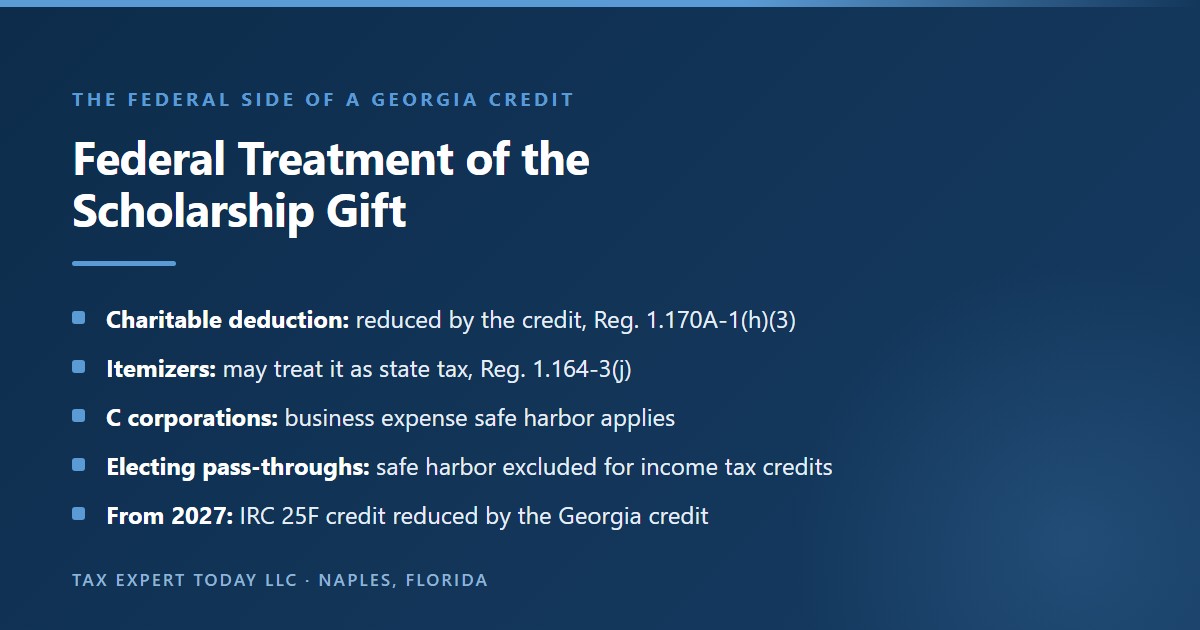
Generally not for the credited amount. Under Treas. Reg. 1.170A-1(h)(3), a federal charitable deduction is reduced by any state tax credit the donor receives or expects to receive for the gift. Because the Georgia credit equals the gift, the credited portion normally produces no federal charitable deduction at all.
- The rule: the deduction is reduced by the state or local tax credit received or expected.
- The exception: no reduction when total credits are 15 percent or less of the payment, which never fits a 100 percent credit.
- Uncredited excess: a gift above the approved amount is an ordinary charitable gift.
- Timing: the reduction applies when the credit is expected, not only when it is claimed.
The regulation, finalized in 2019 after the federal cap on state and local tax deductions, is Treas. Reg. 1.170A-1(h)(3)(i): if a taxpayer makes a payment to an entity described in section 170(c), the charitable contribution deduction is reduced by the amount of any state or local tax credit the taxpayer receives or expects to receive in consideration for the payment. Paragraph (h)(3)(vi) excepts a payment only when the total credits are 15 percent or less of the payment. The regulation’s own first example uses a 70 percent state credit on a $1,000 gift and reduces the deduction by $700. At 100 percent, the reduction is the whole credited amount.
This is the most common error in the advice circulating about the Georgia credit. Some older materials describe a Georgia credit plus a federal charitable deduction on the same dollars, which reflects the law before the regulation. For a gift made after the regulation took effect, a donor who is approved for a $2,500 Georgia credit and pays $2,500 should not expect a $2,500 federal charitable deduction for the same payment.
The uncredited portion is different. If a donor pays more than the approved amount, only the approved amount carries a credit, and the rest is a charitable gift like any other, deductible federally if the donor itemizes and meets the ordinary substantiation rules. Donors who want a larger charitable footprint in the same year often combine the capped credit gift with a separate gift, sometimes through a trust such as the one covered in our article on charitable remainder trust taxes, or through a vehicle discussed in our articles on the donor advised fund tax deduction and the qualified charitable distribution.
Can You Treat the Contribution as a State Tax Payment on Schedule A?
Yes, for an individual who itemizes. Treas. Reg. 1.164-3(j) lets an itemizer treat the portion of the payment disallowed as a charitable deduction as a payment of state tax under IRC 164. That deduction is still subject to the federal cap on state and local taxes, $40,400 for 2026 before any income phasedown.
- Who may use it: individuals who itemize deductions and receive a state or local tax credit for the payment.
- Year of the deduction: the year of payment, to the extent the credit offsets that year’s or the prior year’s state tax.
- Carried credits: a carryforward is treated as tax paid in the year it is used.
- The cap still applies: the safe harbor cannot be used to avoid the IRC 164(b)(6) limit.
The safe harbor is in Treas. Reg. 1.164-3(j). Its practical effect is neutrality. A Georgia itemizer who redirects $2,500 of Georgia tax to a scholarship organization pays $2,500 less to the state and is treated as having paid $2,500 of state tax through the gift. The total state and local tax on Schedule A is unchanged. The household neither gains nor loses a federal deduction by using the credit, provided its state and local taxes were below the cap in the first place.
The cap is set by IRC 164(b)(7) as amended in 2025. The applicable limitation amount is $40,000 for tax years beginning in 2025 and $40,400 for 2026, then 101 percent of the prior year’s amount through 2029, which works out to about $40,800 for 2027. It is reduced by 30 percent of modified adjusted gross income above a threshold of $505,000 for 2026, rising 1 percent a year, but never below $10,000, and it reverts to $10,000 for tax years beginning after 2029. A household already above the cap gets no federal benefit from the extra state tax treatment, and loses nothing either.
A household that takes the standard deduction is also unaffected federally. For those donors the credit is purely a Georgia item, and the analysis ends at the Georgia return.
Can a Business Deduct the Contribution for Federal Tax Purposes?
A C corporation generally can, as a business expense to the extent of the credit, under Treas. Reg. 1.162-15(a)(3)(i). The parallel safe harbor for S corporations and partnerships does not apply when the credit reduces a state income tax, so an electing Georgia pass-through entity should not assume a federal deduction.
- C corporations: may treat the payment as an ordinary and necessary business expense to the extent of the credit.
- Specified pass-through entities: safe harbor unavailable where the credit offsets a state income tax.
- Georgia electing entities: the qualified education expense credit reduces Georgia income tax, so the exception applies.
- Owner limit credits: claimed by individuals, so the individual rules above generally govern.
The two safe harbors are in Treas. Reg. 1.162-15(a)(3). Paragraph (a)(3)(i) allows a C corporation that pays a section 170(c) entity and receives a state or local tax credit to treat the payment as meeting the requirements of an ordinary and necessary business expense to the extent of the credit. Paragraph (a)(3)(ii) offers a similar rule for a specified passthrough entity, but subparagraph (C) states that the safe harbor does not apply if the credit received or expected to be received reduces a State or local income tax.
| Donor | Georgia credit | Federal charitable deduction for the credited amount | Federal alternative |
|---|---|---|---|
| Individual taking the standard deduction | Up to $2,500 or $5,000 | None | None needed; no federal effect |
| Individual who itemizes | Up to $2,500 or $5,000 | Reduced by the credit under Reg. 1.170A-1(h)(3) | Treated as state tax paid under Reg. 1.164-3(j), within the SALT cap |
| Owner using the $25,000 limit | Up to tax paid on selected income | Reduced by the credit | Individual safe harbor if itemizing, within the SALT cap |
| C corporation | Up to 75 percent of Georgia liability | Reduced by the credit | Business expense safe harbor, Reg. 1.162-15(a)(3)(i) |
| Electing S corporation or partnership | Up to 75 percent of entity liability | Reduced by the credit | Pass-through safe harbor excluded for income tax credits, Reg. 1.162-15(a)(3)(ii)(C) |
The practical reading of the last row is that a Georgia electing pass-through that uses the entity route is spending pre-tax dollars for a Georgia credit only, with no federal deduction for the credited payment under either the charitable rules or the business expense safe harbor. The entity still breaks even on the Georgia side, because the credit replaces tax it would have paid. It simply does not get the federal deduction a C corporation would. That is a facts and circumstances conclusion and worth confirming against the entity’s own return before the request is filed.
What Is the Georgia Add-Back for Charitable Deductions?
Georgia requires a taxpayer to add back to Georgia taxable income any federal charitable contribution deduction taken for a gift that also earns the Georgia credit. The statute separately denies the credit for any amount deducted as a charitable contribution, so the same dollars cannot produce both a Georgia credit and a deduction.
- Department rule: add back any federal charitable deduction for which a credit is allowed.
- Statutory rule: no credit for an amount deducted as a charitable contribution to a 501(c)(3) organization.
- Usual result: under the Treasury rule the federal deduction is already reduced, so there is often nothing to add back.
- When it bites: a return that claimed the credited gift on Schedule A in error.
The Department states the add-back on its credit page: the taxpayer must add back to Georgia taxable income that part of any federal charitable contribution deduction taken on a federal return for which a credit is allowed. The statute, O.C.G.A. 48-7-29.16(h)(1), provides that no credit shall be allowed with respect to any amount deducted from taxable net income as a charitable contribution to a bona fide section 501(c)(3) organization.
For most individual donors after 2018, the federal and Georgia rules now point the same way. The credited portion is not a federal charitable deduction, so there is nothing to add back, and the credit stands. The add-back matters when a return is prepared as if the old law applied, or when software carries the scholarship receipt onto Schedule A without the credit reduction. A preparer reviewing a Georgia return with this credit should read Schedule A and the Georgia adjustments together.
The rule on the recipient side is simpler. Under O.C.G.A. 48-7-29.16(h)(2), the amount of any scholarship received by an eligible student is excluded from Georgia taxable net income. Families receiving scholarships do not report them as Georgia income.
How Does the New Federal Scholarship Credit Interact Starting in 2027?
IRC 25F, added in 2025, allows individuals a federal credit of up to $1,700 for cash gifts to scholarship granting organizations in states that opt in, for tax years ending after December 31, 2026. Georgia’s Governor opted in on January 20, 2026. The federal credit is reduced by any state credit claimed for the same qualifying contributions.
- Federal amount: up to $1,700 per taxpayer per year, individuals only.
- Georgia status: opted in for 2027, as reported on January 20, 2026.
- No double benefit: reduced by a state credit for qualified contributions, and no charitable deduction for the credited amount.
- Different students: federal scholarships are limited to households at or below 300 percent of area median income.
The federal statute is IRC 25F. Subsection (b)(1) caps the credit at $1,700. Subsection (b)(2) reduces it by the amount allowed as a credit on any state tax return for qualified contributions made during the taxable year. Subsection (e) denies a charitable deduction for any contribution for which the federal credit is allowed, and subsection (f) allows a five year carryforward. A state participates only if its Governor, or another designated official, elects in and provides the Treasury with a list of qualifying organizations. WABE reported on January 20, 2026 that Governor Kemp had opted Georgia into the program.
The interaction with the Georgia credit turns on the reduction rule. A donor who gives to an organization that is both a Georgia student scholarship organization and a federally listed scholarship granting organization, and claims the Georgia credit on that gift, should expect the federal credit to be reduced by the Georgia credit. A $2,500 Georgia credit on a qualified contribution would reduce a $1,700 federal credit to zero. The two credits do not stack on the same dollars.
Whether a donor can make one gift for the Georgia credit and a separate gift for the federal credit depends on which organizations appear on the Georgia list filed with the Treasury, on how the Treasury applies the phrase qualified contributions made during the taxable year, and on regulations the statute directs the Treasury to issue. None of that is settled as of this writing, and it should not be planned around until guidance is published. What is settled is that the Georgia credit, capped and prorated, and the federal credit, uncapped nationally but limited to $1,700 per taxpayer, are two separate programs with separate rules about eligible students.
How Do You Claim the Georgia Qualified Education Expense Credit on the Return?
Claim the credit on the Georgia return for the year the gift was made, using Form IT-QEE-TP2 and the scholarship organization’s Form IT-QEE-SSO1 letter of confirmation. The Department states that electronic filing is mandatory for this credit, and that the credit must be claimed within one year rather than the usual three year window.
- Computation: Form IT-QEE-TP2, the Qualified Education Expense Credit Computation Form.
- Support: Form IT-QEE-SSO1 from the organization, with name, taxpayer number, amount, date, and credit.
- E-file: individuals who e-file keep the SSO1 letter and produce it on request.
- Credit code: the Department lists this credit as Tax Credit Code 125.
The Department’s credit page lists the four forms: IT-QEE-TP1 for preapproval, IT-QEE-TP2 for the computation, IT-QEE-SSO1 as the organization’s letter of confirmation, and IT-QEE-SSO2 as the organization’s own report. The statute requires the letter of confirmation to show the taxpayer’s name, address, taxpayer identification number, the amount and date of the contribution, and the amount of the credit, under O.C.G.A. 48-7-29.16(g).
The one year statement on the Department page is the part to diarize. It says the credit must be claimed within one year instead of the normal three year statute of limitation period. A donor who files the Georgia return and forgets the credit should not assume the ordinary refund window will rescue it. Our article on the Georgia amended tax return covers the Form 500X process that would be used to add it.
Donors who moved into or out of Georgia during the year should read the credit against the part-year return. The credit reduces Georgia income tax liability, and a part-year resident’s Georgia liability is computed on the Georgia share of income. Our guide to the Georgia part year resident tax return explains how that liability is measured.
What Happens to Unused Georgia Credit?
An allowable credit that exceeds the year’s Georgia income tax carries forward for three years for tax years beginning on or after January 1, 2025, down from five years. It cannot be carried back. An approved amount that exceeds what the credit rules allow when the return is filed is lost entirely.
- Carryforward: three succeeding years under O.C.G.A. 48-7-29.16(e) as amended by HB 1181.
- Earlier credits: the Department states credits from before 2025 carried for five years.
- No carryback: the statute bars use against prior years’ tax.
- Lost approval: excess preapproval for entities and owners is neither claimable nor carried.
The statutory history in the codified section notes that the 2024 amendment, HB 1181, effective January 1, 2025, substituted three years’ tax liability for five years’ tax liability. The Department’s credit page states the same change. The distinction between a carryforward and a lost approval matters most to business owners. A carryforward is an allowable credit that the year’s tax could not absorb. A lost approval is an approved amount that was never allowable because it exceeded 75 percent of the entity’s actual liability, or the owner’s tax actually paid on selected income.
How Does the Credit Affect Georgia Withholding and Estimated Payments?
Because the donor pays the organization early in the year but claims the credit on the following spring’s return, cash leaves twice unless payments are adjusted. Once the gift is approved and paid, a donor may reduce later estimated payments or withholding by the expected credit, keeping the Georgia safe harbor in mind.
- Estimated payments: reduce later Form 500-ES installments by the credit, spread across them.
- Withholding: an employee may update Form G-4 so less Georgia tax is withheld.
- Adjust after payment: reduce only once the approved amount is actually paid.
- Keep a margin: an overestimated credit can leave an underpayment.
The installment rules are in our guide to Georgia Form 500 ES. The logic is straightforward: the credit reduces the Georgia tax for the year, so the payments needed to cover that tax fall with it. What can go wrong is sequencing. A donor who reduces payments in January on the strength of a request, and then receives a prorated approval for half the amount, has underpaid. The safer order is request, approval, payment to the organization, and only then a reduction in withholding or estimates for the rest of the year. How a shortfall is priced is covered in our Georgia estimated tax penalty calculator.
Georgia Qualified Education Expense Credit Example: Three Donors
Three hypothetical 2027 donors show how the limit, the proration, and the federal rules combine. Each example assumes, for illustration only, that opening day requests are prorated at 50 percent and that the Georgia rate is 4.99 percent. Actual proration and rates will differ.
- Single employee: a Georgia credit only, with no federal effect.
- Itemizing couple: a Georgia credit and a neutral federal result through the state tax safe harbor.
- S corporation owner: the owner limit supports more than the joint limit would.
| Item | Donor A: single, standard deduction | Donor B: joint, itemizing | Donor C: S corporation owner, no entity election |
|---|---|---|---|
| Georgia income tax before credit | $4,200 | $14,000 | $18,000, including $14,970 on $300,000 of selected pass-through income |
| Amount requested | $2,500 | $5,000 | $15,000 under the owner limit |
| Approved at an assumed 50 percent | $1,250 | $2,500 | $7,500 |
| Paid within 60 days | $1,250 | $2,500 | $7,500 |
| Georgia credit allowed | $1,250 | $2,500 | $7,500, within the $14,970 supportable |
| Georgia tax still paid to the state | $2,950 | $11,500 | $10,500 |
| Federal treatment of the gift | No effect | No charitable deduction; $2,500 treated as state tax, so Schedule A is unchanged below the cap | Same individual rules as Donor B if itemizing |
In every column, the donor’s total outlay is the same as it would have been without the gift. Donor A pays $1,250 to the organization and $2,950 to Georgia instead of $4,200 to Georgia. Donor B pays $2,500 and $11,500 instead of $14,000. The credit decides where the tax goes, not how much of it there is. Donor C shows the one place where the choice of path changes the result: under the joint limit the couple could never have exceeded $5,000, while the owner limit supports up to $14,970 on this income, and $7,500 after the assumed proration. If Donor C’s entity had made the Georgia pass-through entity election, most of that $300,000 would have been excluded from the owner’s base, and the owner path would have shrunk accordingly.
Georgia’s rural hospital credit is the other large donation credit, and it works very differently. It is allocated request by request without proration, the 2026 cap was still about 46 percent unused on September 17, and individuals may be approved for $5,000 or $10,000 through June 30 with no dollar limit after July 1. Donors weighing both programs can read our guide to the Georgia rural hospital tax credit, which sets the two side by side.
How Is This Different From the Public School Credit and the 529 Deduction?
Georgia runs a separate Qualified Education Donation Tax Credit for gifts to public schools, with its own smaller cap, and a separate state income tax deduction for contributions to the Georgia 529 plan. Each has its own statute, its own limits, and its own application process, and none substitutes for the others.
- Public schools: the Qualified Education Donation credit, O.C.G.A. 48-7-29.21, credit code 140.
- Its cap: $15 million for 2024 and later years, per the Department page.
- Georgia 529 plan: a deduction from income, not a credit, with per beneficiary limits.
- Different value: a credit offsets tax dollar for dollar; a deduction saves only the tax rate on the amount.
The Department’s Qualified Education Donation Tax Credit page describes a first come, first served credit with an aggregate limit of $15 million for 2024 and all subsequent tax years, the same add-back rule, and the same three year carryforward for tax years beginning on or after January 1, 2025. It is the answer to the related search about a credit for public school contributions, and it is a different program with a different cap.
The 529 deduction is not a credit at all. It reduces Georgia taxable income, so at a 4.99 percent rate a deduction saves about five cents on each dollar, where the education expense credit saves a full dollar of Georgia tax on each approved dollar. The mechanics are in our article on the Georgia 529 plan tax deduction. A family paying for private school may use both: the 529 deduction for its own savings, and the education expense credit, within the proration, for a gift that funds other students.
What Are the Most Common Georgia Qualified Education Expense Credit Mistakes?
The recurring mistakes are missing the opening day queue, paying before or without preapproval, missing the 60 day window, over requesting under the owner or entity limits, claiming a federal charitable deduction on the credited amount, and cutting estimated payments before the approval is known.
- Late request: in recent years the cap has been committed in the first days of January.
- No preapproval: a gift made without an approved request earns no credit.
- Designating a student: naming a particular child, including your own, voids the credit.
- Over requesting: excess entity or owner approvals are lost, not carried forward.
- Double counting: the credited amount is not also a federal charitable deduction.
Two further mistakes are specific to 2026 and 2027. The first is planning from the $120 million figure on the Department page when the codified statute now states $150 million, or the reverse, assuming the higher cap will fill every request in full. The second is assuming the new federal credit simply adds $1,700 on top of the Georgia credit for the same gift, which the reduction rule in IRC 25F(b)(2) does not allow. Both are the kind of error that looks harmless in September and costs money in April.
Georgia Qualified Education Expense Credit Help in Naples & Southwest Florida
Tax Expert Today LLC works from Naples, Florida and handles state tax matters nationwide, including Georgia credit planning, sizing preapproval requests against Georgia liability, owner limit computations, pass-through election trade-offs, and the federal treatment of the gift. Georgia clients are served from the Naples office and do not need to visit Georgia or Florida.
- Georgia tax credit help Naples covers residents, part-year residents, and business owners with Georgia income.
- Southwest Florida owners of Georgia businesses often weigh the owner limit against an entity level election.
- Request sizing ties the preapproval amount to a documented estimate rather than the statutory maximum.
- Remote engagement is standard. Documents are exchanged through a secure client portal rather than by email.
Tax Expert Today LLC
11983 Tamiami Trail N, Naples, FL 34110
Telephone: (239) 441-2005
Hours: Monday through Friday, 10:00 a.m. to 5:00 p.m. Eastern Time
A local question we are asked often: I moved from Atlanta to Naples this year but still own part of a Georgia S corporation. Can I use the Georgia education expense credit? Possibly, if you will still have Georgia income tax to offset. As a Florida resident you would file a Georgia nonresident or part-year return, and the credit can reduce only the Georgia tax on that return. Under the owner limit, the base is the Georgia tax actually paid on the S corporation income you select, and if the corporation elects to pay Georgia tax at the entity level, that income drops out of your base. The request should be sized to that figure before the scholarship organization files it in January. The full range of Georgia engagements is described on our Georgia tax services page, and planning for Southwest Florida residents is covered on our Naples tax planning services page.
When to Engage a Professional
A household with a steady Georgia tax bill and a standard deduction can usually handle this credit through a scholarship organization’s application. Review is worth it for business owners choosing between the owner limit and an entity election, for corporations sizing a request, for itemizers near the federal cap, and for anyone who moved states.
- An owner in several pass-through entities deciding which to select for the $25,000 limit.
- An S corporation or partnership weighing the Georgia pass-through entity election against the owner route.
- A C corporation or trust estimating Georgia liability for a request that cannot be corrected later.
- An itemizer near the SALT cap whose federal result depends on the state tax safe harbor.
- A donor who also wants the 2027 federal credit and needs the two programs kept apart.
Dr. Pellumb Kabashi is an enrolled agent and the founder of Tax Expert Today LLC, and the firm includes tax advisors, enrolled agents, certified public accountants, and attorneys. Georgia Department of Revenue matters are state tax matters rather than federal ones, and they are handled under Georgia procedure and Georgia authority. Nothing in this article is advice for a particular taxpayer, and the result in any specific case depends on facts that a general article cannot know. Households and business owners who want a complete Georgia plan rather than a single credit can start with our Georgia tax planning and business advisory page. Call (239) 441-2005 for a free consultation, or reach the Naples, Florida office during business hours.
Frequently Asked Questions
What is the Georgia qualified education expense credit?
It is a Georgia income tax credit under O.C.G.A. 48-7-29.16 for a preapproved cash gift to a student scholarship organization that funds private school tuition and fees. The credit equals the gift, up to limits set by filing status and taxpayer type.
How much is the Georgia qualified education expense credit?
Up to $2,500 for a single filer, head of household, or married filing separately, $5,000 for married filing jointly, $25,000 for a pass-through owner limited to tax actually paid on the selected income, and 75 percent of Georgia income tax liability for a corporation, trust, or electing entity.
What is the Georgia qualified education expense credit cap for 2027?
HB 328, effective July 1, 2026, set the aggregate cap at $150 million per year in O.C.G.A. 48-7-29.16(f)(1). The Department of Revenue page still showed $120 million on September 22, 2026, so confirm the figure the Department applies to 2027 requests.
When do I apply for the Georgia education expense credit?
The Department allocates credits first come, first served, and the 2026 cap was fully preapproved by January 3, 2026. Scholarship organizations collect applications during the prior year and file them on the first business day of January, which is Monday, January 4, 2027.
How long do I have to make the contribution after preapproval?
Sixty days from the date of the Department’s preapproval notice, or by the end of the calendar year of preapproval if that is earlier. A donor who misses the window must reapply, and in recent years the cap has been exhausted in early January.
Can I also deduct the donation on my federal return?
Generally not for the credited amount. Treas. Reg. 1.170A-1(h)(3) reduces the federal charitable deduction by the state credit. An itemizer may instead treat that amount as state tax paid under Treas. Reg. 1.164-3(j), subject to the federal cap on state and local taxes.
Can I choose which student receives my donation?
No. O.C.G.A. 48-7-29.16(d)(1) denies the credit if the gift is designated for the direct benefit of any particular individual, including the donor’s own child or dependent. Many organizations allow a donor to recommend a participating school.
What happens if my credit is more than my Georgia tax?
An allowable credit above the year’s Georgia income tax carries forward for three years for tax years beginning on or after January 1, 2025. It cannot be carried back, and an approved amount above what the rules allow for an entity or owner is lost.
Does the new federal $1,700 scholarship credit stack with the Georgia credit?
Not on the same dollars. IRC 25F reduces the federal credit by any state credit claimed for the same qualified contributions. Georgia opted into the federal program for 2027, and Treasury guidance on how separate gifts are treated is still pending.
How do I claim the credit on my Georgia return?
Complete Form IT-QEE-TP2 and keep the organization’s Form IT-QEE-SSO1 letter of confirmation. The Department states electronic filing is mandatory for this credit and that the credit must be claimed within one year rather than the normal three year period.
Published September 22, 2026 by Dr. Pellumb Kabashi « Back to Learning Center
Have a question this article touches on?
Tax Expert Today LLC, based in Naples, Florida and serving clients across the United States.
Schedule a Consultation (239) 441-2005