
By Dr. Pellumb Kabashi, DBA, MBA, EA, CFE, CES
Founder, Tax Expert Today LLC · Tax advisors, enrolled agents, CPAs, and attorneys · Serving clients in all 50 states
The Georgia corporate tax rate is 4.99 percent of Georgia taxable net income for tax years beginning on or after January 1, 2026. House Bill 463 set that rate, and O.C.G.A. 48-7-21(a) taxes corporations at the individual rate for the same year. A fiscal year that began in 2025 still uses 5.19 percent. Call (239) 441-2005 for a free consultation.
What Is the Georgia Corporate Tax Rate for 2026?
The Georgia corporate tax rate is a flat 4.99 percent for taxable years beginning on or after January 1, 2026. It applies to Georgia taxable net income after allocation and apportionment. The rate is the same one Georgia imposes on individuals for that year, because the corporate statute borrows the individual rate rather than stating its own number.
- Rate for 2026: 4.99 percent, set by House Bill 463 and signed on May 11, 2026.
- Rate for 2025: 5.19 percent, which is the figure still printed on several state and national pages.
- Structure: one flat rate with no brackets and no graduated schedule for corporations.
- Who pays it: domestic and foreign corporations that own property, do business, or have income from sources in Georgia.
Georgia does not publish a separate corporate rate in its code any longer. Subsection (a) of O.C.G.A. 48-7-21 requires every domestic and foreign corporation to pay an income tax on its Georgia taxable net income “at the same rate of the tax imposed on individuals under subsection (a.1) of Code Section 48-7-20 for the corresponding taxable year.” So the Georgia corporate tax rate for any year is found by reading the individual rate for that year.
For 2026, that individual rate comes from Section 2-1 of House Bill 463, which rewrote subsection (a.1)(1) of Code Section 48-7-20 to read 4.99 percent for taxable years beginning on or after January 1, 2026. The Department of Revenue Important Tax Updates page confirms that the Georgia income tax rate has been reduced to a flat rate of 4.99 percent for 2026. Read together, the two sources put the Georgia corporate income tax rate at 4.99 percent for a calendar year 2026 corporation.
The practical consequence is simple arithmetic. A corporation with $1,000,000 of Georgia taxable net income owes $49,900 of Georgia income tax for 2026, against $51,900 at the 2025 rate. That $2,000 difference per million dollars is the entire value of the 2026 cut, and it is worth knowing because it frames every planning conversation that follows in this article.
What Has the Georgia Corporate Income Tax Rate Been Each Year?
Georgia charged corporations a separate 5.75 percent rate through tax year 2023. From 2024 the corporate rate has matched the individual rate: 5.39 percent for 2024, 5.19 percent for 2025, and 4.99 percent for 2026. Each figure comes from the Department of Revenue IT-611 booklet for that year or from the enacted bill.
- 2023 and earlier: a corporate rate written directly into Code Section 48-7-21.
- 2024: the first year the corporate rate was tied to the individual rate.
- 2025 and 2026: two further reductions, each flowing through that link automatically.
- Labels matter: a rate quoted without a tax year is not usable for a return.
| Taxable year beginning in | Georgia corporate income tax rate | Where the rate is stated |
|---|---|---|
| 2019 through 2023 | 5.75 percent | Former text of O.C.G.A. 48-7-21(a); 2023 IT-611 booklet |
| 2024 | 5.39 percent | 2024 IT-611 booklet, first year at the individual rate |
| 2025 | 5.19 percent | 2025 IT-611 booklet, Computation of Income Tax |
| 2026 | 4.99 percent | HB 463 Section 2-1; DOR Important Tax Updates |
| 2027 and later | Scheduled to fall by 0.125 points a year toward 3.99 percent, subject to delay | O.C.G.A. 48-7-20(a.1) as amended by HB 463 |
The history note on the Justia copy of Code Section 48-7-21 records that a 2024 amendment, effective July 1, 2024, substituted “tax on its” for “tax equivalent to 5.75 percent of its” and inserted the cross reference to the individual rate. That single amendment is the reason the corporate rate has moved every year since, without any further amendment to the corporate statute itself.
The booklets confirm each step in the Department’s own words. The 2023 booklet says Georgia income tax is 5.75 percent of Georgia taxable income. The 2024 booklet says 5.39 percent. The 2025 booklet says 5.19 percent. A 2026 booklet has not been released as of the date this article was researched, which is normal, because the Department publishes each IT-611 booklet in the filing season that follows the year it covers.
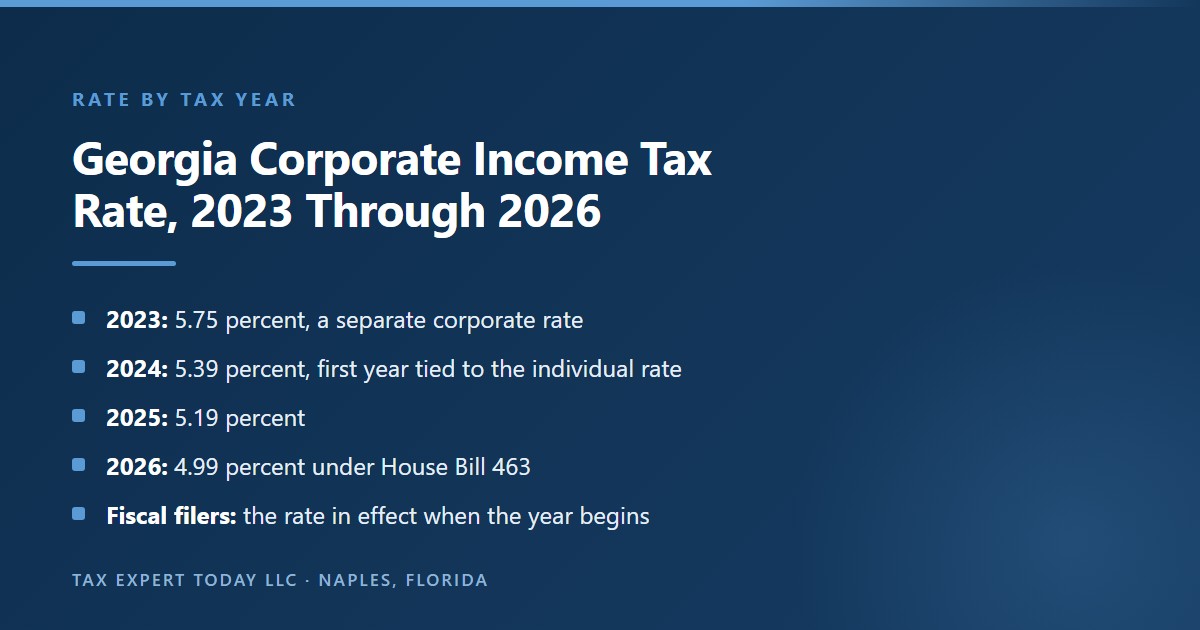
A useful habit for anyone reading a Georgia rate on a web page is to look for the tax year label first. A figure of 5.19 percent is correct for 2025 and wrong for 2026. A figure of 5.75 percent is correct for 2023 and wrong for everything after it. The number alone tells a reader nothing until it is attached to a year.
Why Do Some Sources Still Show a 5.19 Percent Georgia Corporate Tax Rate?
Because the 4.99 percent rate was enacted in May 2026 and applied back to January 1, and many pages were written before that. As of September 17, 2026, the Department of Revenue corporate overview page and its Taxes for Business page still describe a 5.19 percent corporate income tax, while its Important Tax Updates page states 4.99 percent for 2026.
- Timing: HB 463 was signed on May 11, 2026, more than four months into the tax year it governs.
- Retroactive application: Section 5-1 applies the Act to all taxable years beginning on or after January 1, 2026.
- Page maintenance: general overview pages are updated less often than the filing booklets.
- Different country: some results describe the Republic of Georgia, which uses an unrelated 15 percent system.
We read the Department’s pages directly on September 17, 2026 rather than relying on the snippets that appear in search results. The Corporate Income and Net Worth Tax page states that the rate of taxation is 5.19 percent of a corporation’s Georgia taxable net income. The Taxes for Business page describes a 5.19 percent income tax on corporations and on partnerships. Both statements match the 2025 booklet, which suggests the pages were last revised for the 2025 year and have not yet been refreshed for the 2026 change.
The Important Tax Updates page, by contrast, has been updated. It carries a heading for 2026 income tax changes, states that the Georgia income tax rate has been reduced to a flat rate of 4.99 percent, and reports the increased standard deduction. Because Code Section 48-7-21(a) ties the corporate rate to that individual rate for the corresponding taxable year, the 2026 corporate figure follows from the updated page and the statute, not from the older overview.
The same pattern shows up in secondary sources. A widely cited national research page for Georgia still lists a flat 5.19 percent corporate income tax rate, and a university fiscal research handbook computes Georgia corporate liability at 5.19 percent. Neither is wrong about 2025. They simply predate the 2026 legislation. When a search result and the enacted bill disagree, the enacted bill controls, and the booklet for the year in question is the best confirmation of how the Department applies it.
A second source of confusion is geographic. Search results for this topic regularly include pages about the country of Georgia, whose profit tax is described at 15 percent on distributed earnings. That system has nothing to do with a corporation filing Form 600 with the Georgia Department of Revenue in Atlanta, and it should be ignored for any United States filing purpose.
How Did House Bill 463 Set the 2026 Georgia Corporate Tax Rate?
House Bill 463, the Georgia Economic Growth and Tax Relief Act of 2026, amended the individual rate in O.C.G.A. 48-7-20(a.1) from 5.19 to 4.99 percent for taxable years beginning on or after January 1, 2026. It did not need to amend the corporate statute, because that statute already borrows the individual rate for the same year.
- Signed: May 11, 2026, according to the Governor’s announcement, and recorded as Act 465.
- Applicability: all taxable years beginning on or after January 1, 2026, under Section 5-1.
- Future steps: 0.125 percentage point reductions each year from January 1, 2027.
- Floor: 3.99 percent, replacing the earlier 4.99 percent floor.
The bill has an unusual history that explains why it is easy to miss. As first read in the House, House Bill 463 was a homestead exemption bill for senior citizens who volunteer with local governments. The version passed by both chambers is an entirely different income tax act, and its title now describes reducing the personal income tax rate, reducing the rates of taxation on corporate and partnership income, increasing the standard and dependent deductions, and repealing a list of income tax credits. Anyone searching the legislature’s site by the original summary would not recognize it.
The operative language in Section 2-1 is short. Subsection (a.1)(1) of Code Section 48-7-20 now provides that on and after January 1, 2026, the tax shall be 4.99 percent for taxable years beginning on or after January 1, 2026, and that the rate shall be reduced by 0.125 percent annually beginning on January 1, 2027, until the rate reaches 3.99 percent. The prior text set 5.19 percent for 2025, a 0.10 annual step, and a 4.99 percent floor.
The Governor’s May 11, 2026 announcement summarizes the bill as lowering Georgia’s state income tax rate from 5.19 percent to 4.99 percent beginning January 1, 2026, with further annual reductions and higher standard deductions. The announcement speaks about the state income tax rate generally. The corporate result follows from the cross reference in Code Section 48-7-21(a), which is why the bill’s title can promise reduced corporate rates without a separate corporate section.
The Act also reaches beyond the rate. It raises the retirement income exclusion for taxpayers 65 and older beginning in 2027, creates temporary exclusions for part of overtime compensation and cash tips, changes the Revenue Shortfall Reserve cap from 15 to 20 percent of prior year net revenue, and repeals several business credits discussed later in this article. For a corporation, the rate change and the credit repeals are the two provisions that matter most.
Why Does the Georgia Corporate Tax Rate Follow the Individual Rate?
Because Code Section 48-7-21(a) was amended in 2024 to tax corporations at the same rate imposed on individuals for the corresponding taxable year. Before that change the corporate statute named its own percentage. The link means every future individual rate cut also becomes a corporate rate cut without any further legislation.
- Parity by design: C corporations and individual owners of pass-through businesses face the same Georgia rate.
- Automatic movement: no separate corporate bill is needed when the individual rate changes.
- Same year rule: the phrase “corresponding taxable year” ties the rate to the corporation’s own year.
- Entity level elections: the same borrowed rate applies to an S corporation paying tax at the entity level.
Rate parity removes a choice of entity distortion that existed when Georgia taxed corporations at 5.75 percent and individuals under a graduated schedule. Today a Georgia business owner comparing a C corporation to an S corporation or partnership faces the same Georgia rate on business income either way. The difference between the structures is federal, where the corporate rate is 21 percent and pass-through income is taxed at individual rates, and in the second layer of tax on dividends, not in the Georgia rate itself.
The link also appears inside the pass-through entity election. Division (b)(7)(C)(ii) of Code Section 48-7-21 provides that an electing S corporation pays tax on its net income at the same rate imposed on individuals under subsection (a.1) of Code Section 48-7-20 for the corresponding taxable year. The 2025 IT-611 booklet repeats the point in its section on new items for the year, stating that the income tax rate for corporations electing to pay tax at the entity level is the same income tax rate imposed on individual taxpayers for the corresponding taxable year.
One consequence deserves attention from anyone who plans years ahead. Because the corporate rate now depends on the individual rate schedule, the delay triggers that can postpone an individual rate cut also postpone the corporate cut. There is no separate corporate schedule that could move on its own timetable.
Will the Georgia Corporate Tax Rate Keep Falling After 2026?
It is scheduled to, but not on a fixed calendar. HB 463 provides for a 0.125 percentage point reduction each January 1 beginning in 2027 until the rate reaches 3.99 percent. Each step can be delayed a year if revenue conditions are not met, so 2034 is the earliest year the floor could apply.
- First possible step: 4.865 percent for taxable years beginning in 2027.
- Number of steps: eight, from 4.99 down to 3.99 percent.
- Earliest floor year: 2034, if no step is ever delayed.
- Planning posture: treat any year after 2026 as unknown until the state confirms it.
| Taxable year beginning in | Rate if no step is delayed | Tax on $1,000,000 of Georgia taxable net income |
|---|---|---|
| 2026 (enacted) | 4.99 percent | $49,900 |
| 2027 | 4.865 percent | $48,650 |
| 2028 | 4.74 percent | $47,400 |
| 2029 | 4.615 percent | $46,150 |
| 2030 | 4.49 percent | $44,900 |
| 2031 | 4.365 percent | $43,650 |
| 2032 | 4.24 percent | $42,400 |
| 2033 | 4.115 percent | $41,150 |
| 2034 | 3.99 percent (floor) | $39,900 |
The table is a hypothetical ceiling on the pace of change, not a forecast. It assumes every annual reduction takes effect on schedule, which the statute does not promise. It also holds taxable income constant at $1,000,000 so that the only variable is the rate.
For income tax accounting, the distinction between an enacted rate and a scheduled one matters. Deferred tax balances are generally measured using enacted rates expected to apply when temporary differences reverse, and a reduction that depends on future revenue conditions is not the same as a reduction that will occur on a known date. Companies that prepare financial statements should discuss the contingent steps with their auditors rather than assume the schedule in the table.

What Can Delay a Scheduled Georgia Rate Cut?
Under O.C.G.A. 48-7-20(a.1)(2), each future reduction is delayed one year for each year that any of three conditions is true as of December 1. The Office of Planning and Budget makes the determination and reports it by December 1 to the Department of Revenue and legislative leaders.
- Revenue estimate test: the Governor’s estimate for the next fiscal year is not at least 3 percent above the current year’s estimate.
- Collections test: the prior fiscal year’s net revenue collection was not higher than each of the preceding three years.
- Reserve test: the Revenue Shortfall Reserve does not exceed the projected revenue cost of the next reduction.
- Timing: the determination for a January 1 step is made by the preceding December 1.
Any one condition is enough to delay a step, and the delay is counted in whole years. If, as of December 1, 2026, any of the three tests fails, the 4.865 percent rate scheduled for 2027 would not take effect on January 1, 2027, and 4.99 percent would remain the rate for taxable years beginning in 2027. The remaining schedule would then shift out by a year.
HB 463 also links the rate schedule to the standard deduction schedule. The amended text provides that the annual rate reductions are delayed by one year for each year that prospective annual increases in the standard deduction are delayed under the parallel conditions in Code Section 48-7-27(a)(1.1). The practical reading is that the rate and the deduction are meant to move together or not at all in a given year.
The reporting requirement in paragraph (3) gives corporations a date to watch. The Office of Planning and Budget must report its determinations by December 1 of each year to the Department, the Speaker of the House, the President of the Senate, and the chairs of the appropriations and revenue committees. A calendar year corporation that wants to size its first 2027 estimated payment should look for that determination rather than assume the next step.
These tests are measured on state fiscal years, which run from July 1 to June 30, not on the corporation’s own taxable year. A fiscal year corporation should therefore be careful not to confuse the state’s fiscal year references in the delay tests with its own taxable year, which is the period that decides its rate.
Which Georgia Corporate Tax Rate Does a Fiscal Year Corporation Use?
The rate in effect for the year in which the corporation’s taxable year begins, for the whole year. The 2025 IT-611 booklet states that the tax rate is not prorated but is applicable for the entire tax period, and that fiscal filers must use the tax rate based on the start of their filing period.
- Year beginning in 2025: 5.19 percent for all twelve months, including the months that fall in 2026.
- Year beginning in 2026: 4.99 percent for all twelve months, including months that fall in 2027.
- No blending: a fiscal year is never split across a January rate change.
- Short years: the start date of the short period decides the rate in the same way.
| Corporation’s taxable year | Year the taxable year begins | Georgia corporate tax rate for the entire year |
|---|---|---|
| July 1, 2025 through June 30, 2026 | 2025 | 5.19 percent |
| October 1, 2025 through September 30, 2026 | 2025 | 5.19 percent |
| January 1, 2026 through December 31, 2026 | 2026 | 4.99 percent |
| April 1, 2026 through March 31, 2027 | 2026 | 4.99 percent |
| July 1, 2026 through June 30, 2027 | 2026 | 4.99 percent, even if a 2027 step takes effect |
| January 1, 2027 through December 31, 2027 | 2027 | 4.865 percent if no delay applies, otherwise 4.99 percent |
This is the rule most summaries skip, and it is where a fiscal year corporation is most likely to misstate its liability. Consider a hypothetical company with a June 30 year end and $800,000 of Georgia taxable net income for the year that began July 1, 2025. At 5.19 percent the tax is $41,520. A preparer who applied 4.99 percent because the return is filed in 2026 would report $39,920, which understates the tax by $1,600 and invites a notice with penalty and interest.
The same rule works in the corporation’s favor on the other side of the change. A company whose year begins July 1, 2026 uses 4.99 percent for the whole year, even though half of that year falls in 2027. If a 2027 step takes effect, it does not reach that fiscal year, and the company waits until its year beginning July 1, 2027 to use any lower rate.

The statutory basis is the phrase “for the corresponding taxable year” in Code Section 48-7-21(a), combined with the individual rate language that applies each rate to taxable years beginning on or after a stated January 1. The booklet language simply states the result plainly. A corporation that changes its year end should check the start date of each resulting short period, since each short period takes the rate for the year in which it begins.
How Did the 2026 Rate Change Affect Georgia Corporate Estimated Tax Payments?
A calendar year corporation that made its April and June 2026 installments before or shortly after the May 11 signing likely computed them at 5.19 percent. The required annual payment is now measured at 4.99 percent, so those early installments may have covered slightly more than required, and the remaining installments can reflect the lower rate.
- Who must pay estimates: a corporation whose Georgia net income can reasonably be expected to exceed $25,000.
- Standard schedule: 25 percent by the 15th day of the 4th, 6th, 9th and 12th months of the taxable year.
- Form: Form 602ES for the first payment; the Georgia Tax Center for electronic payment.
- Underpayment computation: Form 600 UET, attached to Form 600.
| Hypothetical calendar 2026 corporation, $400,000 expected Georgia taxable net income | Computed at 5.19 percent | Computed at 4.99 percent |
|---|---|---|
| Annual Georgia income tax | $20,760 | $19,960 |
| Each 25 percent installment | $5,190 | $4,990 |
| Paid with the April and June installments | $10,380 | $10,380 (already paid) |
| Cumulative amount required through June | $10,380 | $9,980 |
| Remaining for September and December | $10,380 | $9,580, or $4,790 each |
The 2025 IT-611 booklet describes the installment rules in its corporation estimated income tax instructions. A corporation that first meets the requirement before the fourth month pays 25 percent in each of the four installment months. A corporation that first meets it later pays larger fractions in the remaining months, 33 and one third percent, 50 percent, or 100 percent, depending on when the requirement is first met. Failure to comply may result in a penalty of 5 percent of the income tax for failure to pay estimated tax and a charge at a rate of 9 percent per annum for underpayment, computed on Form 600 UET.
The table above is illustrative arithmetic, not a filing instruction. Form 600 UET measures each installment against the required amount, so an early overpayment generally reduces what is treated as underpaid later, but the worksheet for the year should be run before a corporation trims or skips a payment. Companies whose owners also make individual Georgia estimates can review the separate individual computation in our Georgia estimated tax penalty calculator, which covers Form 500 UET rather than the corporate form.
A fiscal year corporation whose year began in 2025 has no adjustment to make, because its rate for that entire year remains 5.19 percent. Its first year at 4.99 percent is the one that begins in 2026, and its estimates for that year should be computed at 4.99 percent from the first installment.
How Much Georgia Corporate Tax Does a Company Pay at Different Income Levels?
At a flat 4.99 percent, Georgia corporate income tax is simply Georgia taxable net income multiplied by 0.0499. There are no brackets, so the effective Georgia rate on apportioned income equals the statutory rate. The table shows the same income across the last four rates to isolate the effect of each change.
- No graduated schedule: the first dollar and the last dollar are taxed at the same rate.
- Base matters more than rate: apportionment and adjustments usually move liability more than a 0.20 point cut.
- Credits reduce tax, not income: they apply after the rate is applied.
- Net worth tax is separate: it is computed on a different base and added on Form 600.
| Georgia taxable net income | 2023 at 5.75% | 2024 at 5.39% | 2025 at 5.19% | 2026 at 4.99% |
|---|---|---|---|---|
| $100,000 | $5,750 | $5,390 | $5,190 | $4,990 |
| $250,000 | $14,375 | $13,475 | $12,975 | $12,475 |
| $500,000 | $28,750 | $26,950 | $25,950 | $24,950 |
| $1,000,000 | $57,500 | $53,900 | $51,900 | $49,900 |
| $5,000,000 | $287,500 | $269,500 | $259,500 | $249,500 |
All figures are hypothetical and ignore credits, the net worth tax, and any change in the income base between years. They show that the Georgia corporate tax rate has fallen by 0.76 percentage points since 2023, which on $1,000,000 of Georgia taxable net income is $7,600 a year. That is meaningful for a profitable company, but it is smaller than the swing that a change in the apportionment ratio can produce, which is why the base deserves as much attention as the rate.
The booklet places the computation on Schedule 1 of Form 600. The 2025 booklet states that Georgia income tax is computed on the Georgia taxable income after the passive loss and capital loss deduction shown on Schedule 1, line 9, and that the amount of tax is entered on Schedule 1, line 10, and on Schedule 3, line 1A. The 2026 form may renumber lines, so the current year form should be checked before preparing the return.
What Is the Combined Federal and Georgia Corporate Tax Rate?
For a C corporation with all of its income in Georgia, the combined rate for 2026 is about 24.94 percent. The federal rate is 21 percent under 26 U.S.C. 11(b), and Georgia’s 4.99 percent is deductible federally, so its net federal cost is 4.99 percent multiplied by 79 percent, or about 3.94 percentage points.
- Federal rate: a flat 21 percent of taxable income for C corporations.
- Federal deduction: state income taxes paid or accrued are generally deductible under 26 U.S.C. 164.
- Georgia add-back: Georgia adds its own and other income taxes back when computing Georgia income.
- Dividends: a second layer of tax applies when profits are distributed to shareholders.
The arithmetic works as follows for a hypothetical corporation with $1,000,000 of income before state taxes, all apportioned to Georgia. Georgia tax is $49,900. Federal taxable income after deducting that state tax is $950,100, and federal tax at 21 percent is $199,521. Total income tax is $249,421, or about 24.94 percent of the $1,000,000. At the 2025 Georgia rate the combined figure would have been about 25.10 percent.
The federal side is stable for now. The federal rate in 26 U.S.C. 11(b) remains 21 percent, and the deduction for state and local income taxes paid by a business in carrying on a trade or business continues under 26 U.S.C. 164. The federal limitation on state and local tax deductions applies to individuals, not to C corporations, which is part of why many pass-through owners elect to have their entities pay Georgia tax at the entity level.
On the Georgia side, Code Section 48-7-21(b)(2) requires a corporation to add back taxes on, or measured by, net income paid or accrued to the United States, a foreign country, or any state other than Georgia, to the extent those taxes were deducted in computing federal taxable income. The Georgia base therefore starts close to income before income taxes, which is why the combined rate computation above applies Georgia’s rate to the full $1,000,000.
What Income Does the Georgia Corporate Tax Rate Apply To?
The rate applies to Georgia taxable net income, which begins with federal taxable income and is then adjusted under O.C.G.A. 48-7-21(b) and allocated and apportioned under O.C.G.A. 48-7-31. The rate is only as meaningful as the base it multiplies, and the base is where most Georgia corporate disputes arise.
- Additions: interest on other states’ obligations and income taxes deducted federally.
- Subtractions: interest on United States obligations that is exempt from state tax.
- Loss limits: no deductions from years in which the corporation was not subject to Georgia tax.
- No double use: items already used in a prior Georgia computation cannot be used again.
Subsection (b) of the corporate statute lists the adjustments in numbered paragraphs. Paragraph (1) adds interest from obligations of other states and their subdivisions to the extent it was excluded federally, and subtracts interest and dividends on United States obligations that federal law exempts from state tax. Paragraph (2) adds back income taxes, as discussed above. Paragraph (3) bars the deduction of losses from years in which the taxpayer was not subject to Georgia tax, while preserving carryovers from years in which the taxpayer was taxed in Georgia under another method. Paragraph (4) prevents the same income, loss, or deduction from being used twice.
The statute also addresses federal elections. Paragraph (5) provides that elections under Section 338 of the Internal Revenue Code also apply for Georgia purposes, which matters in acquisitions structured as deemed asset purchases. For a business owner planning an exit, our guide to selling a business and the related tax rules covers the federal side of that decision.
Net operating losses deserve their own mention. The current statute applies federal limitations on the amount of net operating loss that can be used in a year, including the 80 percent limitation, to Georgia taxable net income. A corporation with a large Georgia loss carryforward should model the limitation at the Georgia level rather than assume that the federal computation carries over unchanged.
How Does Apportionment Change the Effective Georgia Corporate Tax Rate?
A multistate corporation pays 4.99 percent only on the share of its business income apportioned to Georgia. Since 2008 Georgia has used a single gross receipts factor, so the Georgia share equals Georgia receipts divided by receipts everywhere. The effective rate on total income can therefore be far below 4.99 percent.
- Single factor: property and payroll no longer enter the formula.
- Market sourcing: receipts from services and intangibles are Georgia receipts if the customer is in Georgia.
- Allocated income: certain investment income is allocated rather than apportioned.
- Schedules: Form 600 Schedules 6 and 7 carry the computation.
The 2025 IT-611 booklet explains that for tax years beginning on or after January 1, 2008, the Georgia apportionment ratio is computed by applying only the gross receipts factor. It adds that when receipts are derived from business other than the sale of tangible personal property, they are deemed derived from business done in Georgia if received from customers within Georgia or if they are otherwise attributable to Georgia’s marketplace.
A hypothetical shows the scale of the effect. A corporation with $2,000,000 of apportionable business income and $3,000,000 of Georgia receipts out of $10,000,000 of receipts everywhere has an apportionment ratio of 30 percent. Its Georgia business income is $600,000, and its Georgia tax at 4.99 percent is $29,940. Measured against the full $2,000,000, the effective Georgia rate is about 1.50 percent.
The booklet also carves out investment income. Interest on bonds held for investment, income from other intangibles held for investment, and rentals from real estate held purely for investment and not used in the business are not apportioned. Net investment income from intangibles is allocated to Georgia if the corporation’s situs is in Georgia or the property was acquired from Georgia business, and net investment income from tangible property in Georgia is allocated to Georgia. Misclassifying income between the allocated and apportioned buckets is a common source of Georgia adjustments.
Corporations with sales into other states face the same design question there. Our articles on the Texas franchise tax and the California LLC franchise tax describe how those states measure their own taxes on a different base.
Does the Georgia Corporate Tax Rate Apply to S Corporations and LLCs?
Generally not at the entity level. A Georgia S corporation files Form 600S and its shareholders pay tax on their shares, unless the entity elects to pay at the entity level. An LLC follows its federal classification. But an S corporation whose nonresident shareholders do not consent is taxed as a regular corporation.
- S corporations: Form 600S, with income passing through to shareholders.
- Nonresident consent: Form 600S-CA for each nonresident shareholder, or Georgia disregards the election.
- LLCs taxed as partnerships: Form 700, with income passing through to members.
- LLCs electing corporate status: Form 600 at the corporate rate.
The nonresident consent rule is the trap in this section. The 2025 IT-611 booklet states that S corporations having one or more stockholders who are nonresidents of Georgia must file consent Form 600S-CA on behalf of each nonresident, and that failure to furnish a properly executed Form 600S-CA for each nonresident stockholder negates Georgia’s recognition of the election, requiring the corporation to file Form 600 and pay the regular corporate tax. Among the common errors the booklet lists is an S corporation filing Form 600 when the correct form is Form 600S unless the nonresident shareholders have not consented to be taxed.
For an S corporation with owners in Florida, that rule has real consequences. A company that is a valid S corporation federally can still owe Georgia corporate income tax at 4.99 percent on its Georgia income if a nonresident shareholder’s consent is missing. The shareholders would then also face the second layer of tax on distributions. Nonresident owners of Georgia pass-through entities can review the related filing options in our guide to the Georgia composite return.
The entity level question for S corporations also connects to compensation planning. An S corporation that pays its owner a salary must still meet the federal reasonable compensation standard, which our guide to S corporation reasonable compensation explains. The Georgia rate is the same whether income reaches the owner as wages or as a pass-through share, so the Georgia rate should not drive that decision.
How Does the Rate Interact With the Georgia Pass Through Entity Election?
An S corporation or partnership that elects to pay Georgia tax at the entity level pays at the same rate imposed on individuals for the corresponding year, which is 4.99 percent for 2026. The owners then exclude the income on which the entity paid tax. The rate reduction flows through to electing entities automatically.
- Rate: identical to the individual and corporate rate for the year.
- Estimated payments: required for an electing entity, according to the Department’s business tax page.
- Owner treatment: shareholders and partners do not recognize their share of income already taxed.
- Federal purpose: the entity level payment is generally the route to a federal deduction for the state tax.
The statutory text is the same cross reference discussed earlier. Division (b)(7)(C)(ii) of Code Section 48-7-21 requires an electing S corporation to pay tax on its net income at the same rate imposed on individuals under Code Section 48-7-20(a.1) for the corresponding taxable year, and provides that shareholders do not recognize their share of the income on which tax was actually paid.
Because the election, its timing, and its effect on nonresident owners are covered in depth elsewhere, this article does not repeat them. Our guide to the Georgia pass through entity tax explains who benefits, how the election is made, and how it interacts with the federal limitation on state and local tax deductions. The point for this article is only that the 2026 rate for an electing entity is 4.99 percent, and that a fiscal year electing entity follows the same start of year rule as a C corporation.
Is the Georgia Net Worth Tax Part of the Corporate Tax Rate?
No. The net worth tax is a separate Georgia tax on corporations, measured on issued capital stock, paid in surplus and retained earnings rather than on income, and computed from a graduated table rather than a percentage rate. It is reported on the same Form 600 but has its own period and its own due date rules.
- Different base: net worth, not income.
- Different computation: a table of fixed amounts, not a flat rate.
- Different period: the net worth year runs forward from the start of the income tax year.
- Unaffected by HB 463: the 2026 rate change does not change the net worth table.
The 2025 booklet describes the tax as graduated based on net worth and defines net worth to include issued capital stock, paid in surplus and retained earnings. A new corporation files an initial net worth return by the fifteenth day of the fourth calendar month after incorporation or qualification, based on its beginning net worth. The booklet notes that the initial net worth return cannot be combined with the initial income tax return, because the due dates do not coincide.
A company that reads “Georgia corporate tax” on a search result may be looking at either tax, and some official summaries describe both in one paragraph. The distinction is important because the income tax rate changed for 2026 and the net worth tax did not. The full table, the exemption rules and the filing mechanics are covered in our guide to the Georgia net worth tax.
Which Georgia Business Tax Credits Did House Bill 463 Repeal?
Part IV of HB 463 repeals several income tax credits that corporations have used against Georgia liability, including the headquarters credit, the port traffic credits, the alternative fuel and electric vehicle charger credit, and the employee transportation vehicle credit. The Act applies to taxable years beginning on or after January 1, 2026.
- Lower rate, fewer credits: the Act pairs the rate cut with a narrower credit menu.
- Check each credit: a credit claimed in 2025 may not exist for a 2026 year.
- Carryforwards: confirm Department guidance before relying on an existing carryforward.
- Sales tax items: several sales and use tax exemptions were repealed at the same time.
| HB 463 section | Code section repealed | Credit described in the Act |
|---|---|---|
| 4-1 | O.C.G.A. 48-7-29.11 | Eligible teleworking expenses |
| 4-2 | O.C.G.A. 48-7-40.1A | Personal protective equipment manufacturers |
| 4-3 | O.C.G.A. 48-7-40.1B | Manufacturers of medical equipment and supplies, pharmaceuticals, and medicine |
| 4-4 and 4-5 | O.C.G.A. 48-7-40.15 and 48-7-40.15A | Base year port traffic increases |
| 4-6 | O.C.G.A. 48-7-40.16 | Alternative fuel, low emission and zero emission vehicles, and electric vehicle chargers |
| 4-7 | O.C.G.A. 48-7-40.18 | Businesses headquartered in the state and full-time jobs |
| 4-8 | O.C.G.A. 48-7-40.20 | Businesses manufacturing cigarettes for exportation |
| 4-9 | O.C.G.A. 48-7-40.22 | Business enterprises that purchase or lease a vehicle to transport employees |
For a corporation that was counting on one of these credits, the rate reduction may not offset the lost credit. A company that relied on the headquarters credit, for example, should compare the value of the 0.20 point rate reduction on its Georgia income with the credit it expected to claim. For many such companies the credit was worth more.
We did not find, in the enacted text we reviewed, a separate provision addressing credits already earned and carried forward under the repealed sections. That silence is not the same as a rule either way. A corporation holding such a carryforward should confirm the Department’s position, through the current year instructions or direct guidance, before claiming it on a 2026 return. Section 4-10 of the same Act repeals several sales and use tax exemptions, including the exemption for pollution control machinery, while allowing certificates issued before the effective date to continue under the prior rules. Sales tax certificate issues are covered in our guide to the Georgia sales tax exemption.
Credits that were not repealed remain available on their own terms, and the purchased film credit continues to be a common way for Georgia corporations to reduce liability. Our guide to the Georgia film tax credit covers how a buyer claims a transferred credit.
When Is the Georgia Corporate Return Due, and What Penalties Apply?
Form 600 is due by the 15th day of the 4th month after the taxable year ends, which is April 15 for a calendar year corporation. A corporation with an automatic federal six month extension receives seven months to file in Georgia, but the tax is still due by the original due date.
- Late filing: 5 percent of the unpaid tax for each month or part of a month, up to 25 percent.
- Late payment: one half of 1 percent a month, up to 25 percent.
- Combined cap: the filing and payment penalties together cannot exceed 25 percent of the tax.
- Interest: the Federal Reserve prime rate plus 3 percent, reviewed each January.
The 2025 IT-611 booklet describes the due date as on or before the 15th day of the 4th month following the close of the taxable year, moved to the next business day when it falls on a weekend or holiday. It also states that corporate taxpayers are granted seven months to file their Georgia income tax return if they apply for and receive an automatic six month federal extension. A corporation with an extension must still pay by the statutory due date, using Form IT-560C, and claim the prepayment on Form 600, Schedule 3.
The booklet lists the penalties in the Department’s own terms: delinquent filing at 5 percent of the tax not paid by the original due date for each month or fraction up to 25 percent, failure to pay at one half of 1 percent a month up to 25 percent, negligent underpayment at 5 percent, and fraudulent underpayment at 50 percent. It notes that the failure to pay penalty is not due if the return is being amended because of an IRS audit.
Two further deadlines matter to any corporation that files in Georgia. Federal changes resulting from a federal audit must be reported within 180 days of the final determination date, and a claim for refund must generally be made within three years of the later of the payment or the due date of the return including extensions. Amended corporate returns are filed on Form 600 with the amended box checked. The individual counterpart of these rules is explained in our guide to the Georgia amended tax return.
What Are the Most Common Georgia Corporate Tax Rate Mistakes?
The most common mistakes are applying the calendar year rate to a fiscal year, quoting a rate without a year, carrying 5.19 percent into 2026 estimates, assuming future cuts are certain, and confusing the income tax with the net worth tax. Each one produces a liability that differs from the statute.
- Prorating across January: the booklet says the rate is never prorated.
- Stale reference pages: a 5.19 percent figure is a 2025 figure.
- Assuming 4.865 percent for 2027: the step can be delayed under the December 1 tests.
- Missing Form 600S-CA: an S corporation can be taxed as a C corporation.
- Claiming a repealed credit: several credits no longer exist for 2026 years.
Beyond those five, two errors appear often in practice. The first is treating the Georgia rate as the whole story, when apportionment and the add-back of federally deducted income taxes change the base far more than the rate change does. The second is forgetting that an entity level election changes who pays the Georgia tax without changing the rate, which can leave owners paying Georgia tax twice if the owner level exclusion is not applied.
A smaller but recurring issue is the country of Georgia. Business owners researching the Georgia corporate tax rate sometimes find a 15 percent figure and assume it applies to their Atlanta subsidiary. It does not. That figure describes a foreign country’s profit tax and has no bearing on Form 600.
How Should a Corporation Prepare Its 2026 Georgia Return?
Confirm the start date of the taxable year and the rate that goes with it, rerun the 2026 estimate schedule at 4.99 percent, check every credit against the HB 463 repeal list, verify each nonresident shareholder consent, and recompute the apportionment ratio using current market sourcing rules.
- Rate check: year beginning in 2025 at 5.19 percent, in 2026 at 4.99 percent.
- Estimate check: compare installments paid with the 4.99 percent requirement.
- Credit check: remove repealed credits and confirm carryforward treatment.
- Entity check: Form 600S-CA on file for every nonresident shareholder.
- Base check: additions, subtractions, allocation and the single receipts factor.
The IT-611 booklet includes a filing checklist and a list of common errors, and the 2026 version should be read when it is published. Until then, the 2025 booklet is the best guide to form mechanics, with the rate substituted for years beginning in 2026. Corporations whose owners also have individual Georgia filings should coordinate the two, particularly where the owners sold stock or assets during the year, a topic covered in our guide to Georgia capital gains tax.
For 2027 planning, the December 1, 2026 determination by the Office of Planning and Budget is the first data point. A company that sets its 2027 estimates before that report should use 4.99 percent, which cannot understate the requirement if the step later takes effect, and should adjust once the determination is published.
Georgia Corporate Tax Help in Naples & Southwest Florida
Tax Expert Today LLC works from Naples, Florida and handles state tax matters nationwide, including Georgia corporate income tax reviews, fiscal year rate analysis, estimated tax recalculations after HB 463, apportionment reviews, and Form 600 and Form 600S preparation support. Georgia clients are served from the Naples office and do not need to visit Georgia or Florida.
- Georgia corporate tax help Naples covers rate, estimate and apportionment reviews for companies with Georgia operations.
- Florida owners of Georgia companies are common in Southwest Florida and often need both nonresident and entity filings reviewed.
- Entity choice reviews compare C corporation, S corporation and partnership treatment under Georgia and federal law.
- Remote engagement is standard. Documents are exchanged through a secure client portal rather than by email.
Tax Expert Today LLC
11983 Tamiami Trail N, Naples, FL 34110
Telephone: (239) 441-2005
Hours: Monday through Friday, 10:00 a.m. to 5:00 p.m. Eastern Time
A local question we are asked often: I live in Naples, and I own an S corporation that does most of its business in Georgia. Does the 4.99 percent Georgia corporate tax rate apply to my company? Usually not at the company level, provided Georgia recognizes the S election. As a Florida resident you are a nonresident shareholder, so the company must file Form 600S-CA with your consent to be taxed in Georgia on your share of Georgia income. With that consent on file, the company files Form 600S and you report your Georgia share on a nonresident Georgia return, or the company can elect to pay at the entity level at the same 4.99 percent rate for 2026. Without the consent, Georgia disregards the election and taxes the company at the corporate rate. The full range of Georgia engagements is described on our Georgia tax services page, and planning for business owners who live in Southwest Florida is covered on our Naples tax planning services page.
When to Engage a Professional
A calendar year corporation with all of its income in Georgia and no credits can usually apply the 4.99 percent rate without help. The situations that benefit from review are fiscal years that straddle the change, multistate apportionment, S corporations with nonresident owners, repealed credit carryforwards, and entity level elections.
- A fiscal year beginning in 2025 that must still be computed at 5.19 percent.
- Estimated payments made at the old rate that need to be reconciled on Form 600 UET.
- Receipts from customers in several states where market sourcing decisions change the Georgia ratio.
- A credit carryforward under one of the sections HB 463 repealed.
- A change of entity type or year end that creates a short period with its own rate.
Dr. Pellumb Kabashi is an enrolled agent and the founder of Tax Expert Today LLC, and the firm includes tax advisors, enrolled agents, certified public accountants, and attorneys. Georgia Department of Revenue matters are state tax matters rather than federal ones, and they are handled under Georgia procedure and Georgia authority. Nothing in this article is advice for a particular taxpayer, and the result in any specific case depends on facts that a general article cannot know. Companies considering whether Georgia is the right home for a new entity can start with our Georgia tax planning and business advisory page. Call (239) 441-2005 for a free consultation, or reach the Naples, Florida office during business hours.
Frequently Asked Questions
What is the Georgia corporate tax rate for 2026?
It is 4.99 percent of Georgia taxable net income for taxable years beginning on or after January 1, 2026. HB 463 set the individual rate at 4.99 percent, and O.C.G.A. 48-7-21(a) taxes corporations at the individual rate for the corresponding taxable year.
Was the Georgia corporate tax rate 5.19 percent in 2025?
Yes. The 2025 IT-611 booklet states that the tax rate for taxable years beginning on or after January 1, 2025 is 5.19 percent. The rate was 5.39 percent for 2024 and 5.75 percent for 2023.
Why does the Department of Revenue website still show 5.19 percent?
As of September 17, 2026, the Department’s corporate overview pages still describe a 5.19 percent rate, which matches 2025. The Important Tax Updates page states that the rate was reduced to 4.99 percent for 2026, and the enacted bill confirms it.
Does a fiscal year corporation prorate the rate?
No. The 2025 IT-611 booklet states that the rate is not prorated and that fiscal filers use the rate based on the start of their filing period. A year beginning July 1, 2025 uses 5.19 percent for all twelve months.
Will the Georgia corporate tax rate drop again in 2027?
It is scheduled to fall to 4.865 percent for years beginning in 2027, but the step is delayed if any of three revenue conditions is true as of December 1, 2026. The Office of Planning and Budget reports that determination by December 1.
What is the lowest the Georgia corporate tax rate can go under current law?
HB 463 sets a floor of 3.99 percent, reached through 0.125 point annual steps. With no delays, the floor would first apply to taxable years beginning in 2034.
Do Georgia S corporations pay the 4.99 percent rate?
Not at the entity level unless they elect to, or unless Georgia disregards the S election because a nonresident shareholder did not sign Form 600S-CA. An electing S corporation pays at the same 4.99 percent rate for 2026.
What is the combined federal and Georgia corporate tax rate?
For a C corporation with all income in Georgia, about 24.94 percent for 2026. The federal rate is 21 percent, and the Georgia tax is deductible federally, so its net cost is about 3.94 percentage points.
Did HB 463 repeal any Georgia corporate tax credits?
Yes. Part IV repeals credits including the headquarters credit, the port traffic credits, the alternative fuel and electric vehicle charger credit, the employee transportation vehicle credit, and the teleworking expense credit, applicable to taxable years beginning on or after January 1, 2026.
When is the Georgia corporate income tax return due?
Form 600 is due by the 15th day of the 4th month after the taxable year ends, which is April 15 for a calendar year filer. A federal automatic extension gives seven months to file in Georgia, but not more time to pay.
Published September 17, 2026 by Dr. Pellumb Kabashi « Back to Learning Center
Have a question this article touches on?
Tax Expert Today LLC, based in Naples, Florida and serving clients across the United States.
Schedule a Consultation (239) 441-2005