
By Dr. Pellumb Kabashi, DBA, MBA, EA, CFE, CES
Founder, Tax Expert Today LLC · Tax advisors, enrolled agents, CPAs, and attorneys · Serving clients in all 50 states
Quick Answer: Georgia Form 700 is the partnership tax return for any partnership or multi member LLC that files federal Form 1065 and does business, owns property, has Georgia source income, or has a partner domiciled in Georgia. It is usually an information return, unless the partnership elects to pay tax at the entity level, and it is due on the 15th day of the third month after year end. Call (239) 441-2005 for a free consultation.
Georgia Form 700 is one of the most misunderstood returns in Georgia business tax, partly because so little is written about it. Search for it and you will find blank PDFs on the Department of Revenue site, software help screens, copy and paste form mirrors, and pages about other forms that happen to share the number 700. None of them walks a partnership through the actual decisions the return forces each year: whether the entity is required to file at all, how the Georgia income figure is built from the federal Form 1065, what to do about partners who live outside Georgia, whether to pay tax at the entity level, and what happens when the IRS or the Department of Revenue later changes the numbers. This guide covers each of those questions, with the current rates, the 2025 form and booklet, and worked hypothetical examples. It is written for owners, managers, and the advisors who prepare these returns, and it is educational rather than advice for any particular entity.
Tax Expert Today LLC handles state tax matters nationwide from its office in Naples, Florida, and Georgia partnership filings are a frequent reason Florida residents call us: a family real estate partnership in Atlanta, a Savannah investment LLC with members who have moved south, or a professional practice with offices on both sides of the state line. If you want the broader picture of Georgia filing obligations first, our Georgia tax services overview is the place to start.
What Is Georgia Form 700?
Georgia Form 700 is the Georgia Department of Revenue partnership tax return. It reports a partnership’s income for Georgia purposes, apportions business income to Georgia, lists the Georgia source income of every partner, and, only when the partnership elects, computes and pays Georgia income tax at the entity level. Without that election it is an information return.
- Federal counterpart: the return mirrors federal Form 1065 and requires a complete copy of it.
- Usual role: an information return; the partners pay the tax on their own returns.
- Optional role: an entity level tax return when the partnership elects under O.C.G.A. 48-7-23.
- Current version: the 2025 Form 700 carries revision date 09/11/25.
- Instructions: the IT-711 Partnership Income Tax Instruction Booklet.
The Department of Revenue states the point plainly on its Taxes for Partnerships page: Form 700 “is an information return when not electing to pay tax at the entity level and as such the income tax is paid by the partners.” The same page adds that this applies to a limited liability company treated as a partnership for federal income tax purposes. When the partnership does elect, the tax is paid by the partnership and not by the partners.
That dual role explains most of the confusion. In a non electing year, Georgia Form 700 looks like a reporting exercise: income flows through, the partners carry their shares to Form 500 or Form 600, and the partnership owes nothing on the face of the return. In an electing year, the same form becomes a tax return with estimated payments, underpayment penalties, net operating loss tracking, and a tax line on Schedule 1. The form itself does not change between those years. What changes is one checkbox on page 1 and the schedules that checkbox brings to life.
Georgia Form 700 also sits at the center of a cluster of related obligations that are filed separately but depend on the same numbers: nonresident withholding on Form G-7NRW, the composite return on Form IT-CR, estimated payments on Form 602-ES for electing partnerships, extension payments on Form IT-560C, and the partners’ own Georgia returns. Getting Form 700 right is what makes the rest of that cluster reconcile.
Who Must File Georgia Form 700?
Any partnership, LLC classified as a partnership, syndicate, pool, joint venture, or other unincorporated organization that files federal Form 1065 must file Georgia Form 700 if it does business in Georgia, owns property in Georgia, has income from Georgia sources, or has a member domiciled in Georgia. Any one of the four triggers is enough.
- Doing business in Georgia: operations, employees, offices, or sales activity in the state.
- Owning Georgia property: including a single rental building or a parcel of land.
- Georgia source income: even with no office or employees in the state.
- A Georgia domiciled member: even if the partnership has no other Georgia contact.
- The federal link: the requirement attaches only to entities that file Form 1065.
The filing requirement in the 2025 IT-711 booklet reads: “A partnership, limited liability company, syndicate, group, pool, joint venture and unincorporated organization which is engaged in business or owns property located in Georgia or has members domiciled in Georgia or has income from Georgia sources, and which is required to file a Federal Income Tax return on Form 1065, is required to file a Georgia Income Tax return on Form 700.”
The fourth trigger surprises people. A partnership organized in Florida, with every asset and every customer in Florida, still has a Georgia Form 700 filing requirement if one of its partners is domiciled in Georgia. The reason is practical: the Department of Revenue needs the partnership’s information to verify that the Georgia resident partner reported a full share of partnership income on Form 500. In that situation the Georgia ratio on Schedule 7 may well be zero, and the return mainly identifies the partners and their shares.
| Partnership situation | Georgia Form 700 required? | Why |
|---|---|---|
| Georgia LLC taxed as a partnership operating only in Georgia | Yes | Does business and owns property in Georgia |
| Florida partnership that owns one rental house in Georgia | Yes | Owns property and has Georgia source rental income |
| Florida partnership with no Georgia activity and one partner living in Atlanta | Yes | A member is domiciled in Georgia |
| Tennessee partnership selling services to Georgia customers, no Georgia office | Generally yes | Receipts attributable to the Georgia marketplace can be Georgia source income |
| Single member LLC disregarded for federal purposes | No | It does not file Form 1065; its activity is on the owner’s return |
| LLC that elected to be taxed as an S corporation | No | It files Form 600S, the S corporation return |
The rule for corporate partners runs in the other direction. The booklet states that a corporation “will be considered to own property in Georgia, do business in Georgia, or have income from Georgia sources whenever the corporation is a partner, whether limited or general, in a partnership which owns property or does business in Georgia, or has income from Georgia sources.” A corporate partner of a Georgia partnership therefore has its own Georgia corporate filing, which our guide to the Georgia corporate tax rate and Form 600 explains.
Does a Multi Member LLC File Georgia Form 700?
Yes, in most cases. Georgia classifies a limited liability company the same way it is classified for federal income tax purposes, and a multi member LLC that has not elected corporate treatment is a partnership federally. It files Form 1065 and, if any Georgia trigger applies, Georgia Form 700.
- Default rule: a multi member LLC is a partnership unless it elects otherwise.
- S corporation election: the LLC files Form 600S instead of Form 700.
- C corporation election: the LLC files Form 600 and owes the net worth tax.
- Foreign LLCs: an LLC formed in another state follows the same classification rule.
The IT-711 booklet states that “each limited liability company and foreign limited liability company shall be classified as a partnership for Georgia income tax purposes unless classified otherwise for Federal income tax purposes, in which case the limited liability company or foreign limited liability company shall be classified for Georgia income tax purposes in the same manner as it is classified for federal income tax purposes.” Georgia does not run its own entity classification test. The federal check the box result controls.
That has a practical consequence for owners who change their federal classification. An LLC that files Form 2553 to be taxed as an S corporation stops filing Georgia Form 700 for the years the election is effective and starts filing Form 600S, which brings its own requirements, including the Form 600S-CA consent from each nonresident shareholder. Our guide to Georgia Form 600S covers that return. The final Georgia Form 700 for the partnership years should be marked as a final return, and any nonresident withholding for the last partnership year still needs to be reconciled.
Does a Single Member LLC File Georgia Form 700?
No. A single member LLC that is disregarded for federal purposes does not file Form 1065, so it does not file Georgia Form 700. Its income, deductions, and Georgia credits are reported on the owner’s return, whether that owner is an individual on Form 500, a corporation on Form 600, or a partnership on its own Form 700.
- Individual owner: the activity is reported on Form 500 through the federal Schedule C or Schedule E.
- Corporate owner: the activity is part of the corporation’s Form 600 computation.
- Partnership owner: the activity is part of the parent partnership’s Form 700.
- Credits: claimed on the owner’s return, with the credit forms filed in the LLC’s name.
- Entity level election: not available to the disregarded LLC by itself.
The IT-711 booklet addresses the credit point directly: if the taxpayer owns or is owned by a disregarded single member LLC, “the single member LLC should be disregarded for filing purposes. All credits should be claimed on the owner’s return.” The tax credit forms are filed in the name of the single member LLC but included with the owner’s return, so the Department can match the credit to the entity that earned it and still let it flow to the owner.
The HB 149 FAQ adds that single member LLCs not taxed as a partnership or S corporation are not eligible to make the entity level election. Under Ga. Comp. R. and Regs. 560-7-3-.03, a regarded owner of a disregarded entity may make the election for itself, and in that case the election covers the owner and all of its disregarded entities.
Is Georgia Form 700 the Same as the California Form 700?
No. The Form 700 that public officials file to disclose financial interests and possible conflicts of interest is a California form, the Statement of Economic Interests. Georgia Form 700 is a tax return for partnerships. The two share a number and nothing else, which is why search results for Georgia Form 700 are often unreliable.
- Georgia Form 700: the partnership income tax return, filed with the Georgia Department of Revenue.
- California Form 700: an ethics disclosure filed by California public officials and employees.
- Other “700” results: agency rule chapters and unrelated regulations that share the number.
- Practical test: a Georgia Form 700 always starts from a federal Form 1065.
When we read the search results for this topic on October 9, 2026, several pages describing “Georgia Form 700 instructions” were automatically generated text that described a conflict of interest disclosure, not a tax return. Some of the AI generated summaries that appear above search results have also quoted an out of date entity tax rate. The safest source for anything about Georgia Form 700 is the Department of Revenue itself: the form, the IT-711 booklet, and the partnership pages linked in the sources box above.
What Is the Georgia Form 700 Due Date?
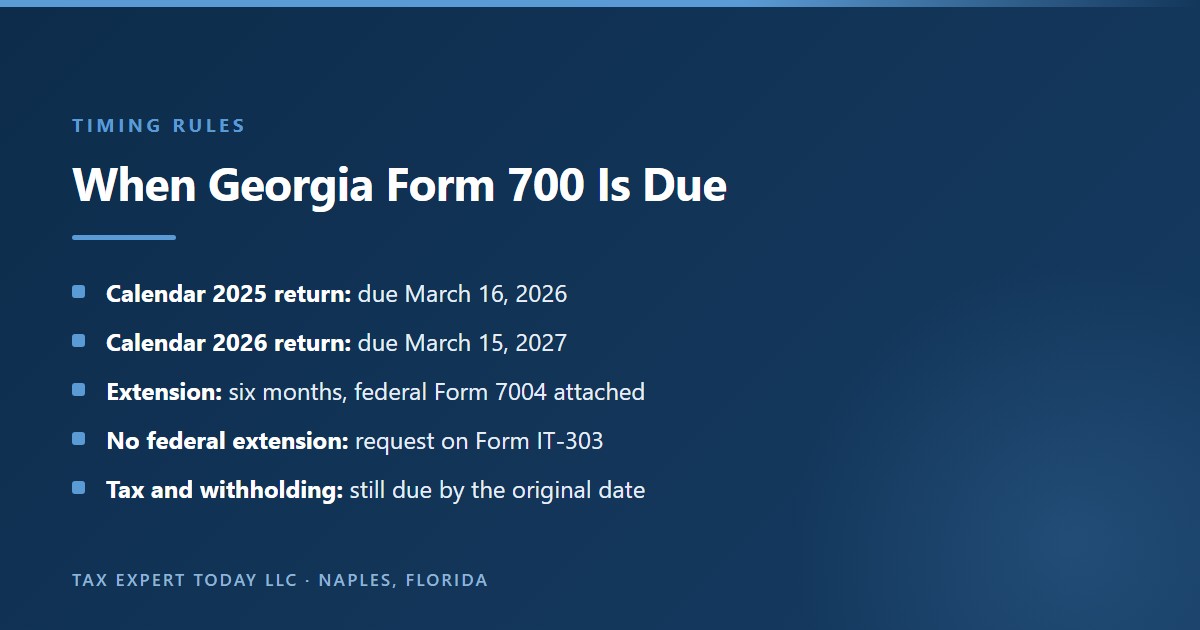
Georgia Form 700 is due on the 15th day of the third month after the partnership tax year ends, which is March 15 for a calendar year partnership, or the next business day when the 15th falls on a weekend or holiday. The 2025 calendar year return was due March 16, 2026.
- Calendar year 2025 return: due Monday, March 16, 2026, because March 15 was a Sunday.
- Calendar year 2026 return: due Monday, March 15, 2027.
- Fiscal years: the 15th day of the third month after the fiscal year ends.
- Same date as federal: federal Form 1065 is also due the 15th day of the third month.
- Payments: any tax is due by the original due date, even with an extension.
The IT-711 booklet sets the rule: “Form 700 must be filed on or before the 15th day of the third month following the close of the taxable year. This would be March 15th if filing on a calendar year basis.” It then applies the usual weekend and holiday rollover. The federal due date for Form 1065 under 26 U.S.C. 6072(b) is the same 15th day of the third month, so the two returns travel together.
| Tax year | Original due date | Extended due date (six months) |
|---|---|---|
| Calendar year 2025 | Monday, March 16, 2026 | Tuesday, September 15, 2026 |
| Calendar year 2026 | Monday, March 15, 2027 | Wednesday, September 15, 2027 |
| Fiscal year ending June 30, 2026 | Tuesday, September 15, 2026 | Monday, March 15, 2027 |
| Fiscal year ending September 30, 2026 | Tuesday, December 15, 2026 | Thursday, June 15, 2027 |
Dates in the table were computed from the statutory rule and the calendar on October 9, 2026; they do not account for any disaster postponement the Commissioner may announce for a particular area. Nonresident withholding paid on Form G-7NRW follows the same original due date of the entity return, without regard to any extension, which our guide to Georgia withholding tax explains.
How Does a Georgia Form 700 Extension Work?
A partnership with an approved federal extension on Form 7004 does not need to request a separate Georgia extension. It attaches the federal extension to Georgia Form 700 and checks the Extension box. Without a federal extension, it requests a Georgia extension on Form IT-303. Either way the extension is six months and does not extend the time to pay.
- Federal route: Form 7004 approved by the IRS, attached to the Georgia return.
- Georgia route: Form IT-303, used only when no federal extension exists.
- Extension box: failing to check it results in a late filing penalty assessment.
- Payment: any tax due is paid by the original due date on Form IT-560C.
- Limit: Georgia law prohibits an extension of more than six months.
The booklet cites O.C.G.A. 48-7-57 and states that “a taxpayer need not apply for a Georgia extension if the taxpayer applies for and receives an automatic six (6) month extension to file their Federal income tax return. If the return is received within the time extended by the Internal Revenue Service and Form 7004 is attached to the return, no late filing penalties will apply.” It then warns that “failure to attach a copy of the Federal extension will result in the return being considered filed late and the assessment of applicable penalties,” and separately that failure to check the Extension box “will result in assessment of a late filing penalty.”
Those two warnings describe the most avoidable Georgia Form 700 penalty notice we see: a return filed on time under a valid federal extension, but without the extension attached or the box checked. The Department’s systems read the return as late, and the partnership then has to respond to a notice to prove what was true all along. The Department publishes Form IT-303 on its site, and our guide to Georgia Form IT-303 covers the Georgia only extension route in more detail, including when it is the right choice.
For a non electing partnership there is usually no Georgia tax to prepay, because the partnership owes no tax on the face of the return. For an electing partnership, the booklet states that the tax must be paid by the statutory due date using Form IT-560C, and credit for that prepayment is claimed on Form 700, Schedule 3, Line 2. If the tax is not paid by the statutory due date, a late payment penalty of one half of 1 percent per month, up to 25 percent, and interest accrue from that date regardless of the extension.
Where Is Georgia Form 700 Filed, and When Is E-Filing Required?
Paper returns go to the Georgia Department of Revenue Processing Center, PO Box 740315, Atlanta, Georgia 30374-0315. Electronic filing is required whenever the federal Form 1065 must be filed electronically, and whenever the return generates, allocates, claims, or uses a Series 100 Georgia tax credit.
- Federal mirror rule: O.C.G.A. 48-7-54 ties the Georgia mandate to the federal one.
- Credit rule: any Series 100 credit on the return requires electronic filing.
- Paper filing: a complete copy of the federal return and schedules must be attached.
- Certified mail: the booklet notes it delays processing.
- Online completion: the Department offers a fillable web version of the form.
The booklet quotes the statute: the Commissioner requires any nonindividual taxpayer and any return preparer to file electronically “when the federal counterpart of such return, report, or other document is required to be filed electronically pursuant to the Internal Revenue Code of 1986 or Internal Revenue Service regulations.” Federal rules now require electronic filing for many partnerships, including those with more than 100 partners and, under regulations that apply to returns filed in 2024 and later, partnerships that file 10 or more returns of any type during the calendar year. When the partnership’s federal Form 1065 must be e-filed, Georgia Form 700 must be as well.
The booklet also states that “a complete copy of the Federal return and all supporting schedules must be included with the Georgia return. Otherwise, your return will be deemed incomplete.” A return deemed incomplete can be treated as not filed, which reopens every late filing question the partnership thought it had closed. The Department’s Form 700 page links the current and prior year forms, including paper versions for older years.
What Does Each Schedule on Georgia Form 700 Do?
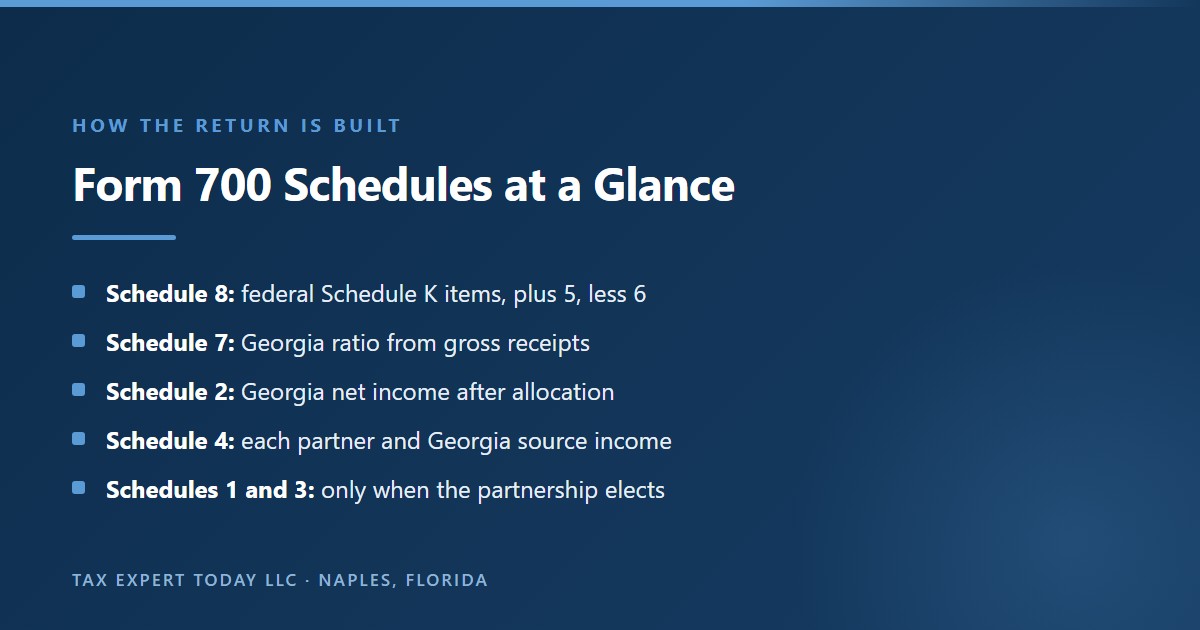
The 2025 Georgia Form 700 has eleven numbered schedules. Schedules 5, 6, 7, 8, and 2 build Georgia net income from the federal figures, Schedule 4 lists each partner’s Georgia source income, and Schedules 1, 3, 9, 10, and 10B are used for the entity level tax, credits, and losses.
- Income build: Schedule 8 starts with federal Schedule K items and Georgia adjustments.
- Apportionment: Schedule 7 computes the Georgia ratio from gross receipts.
- Partner listing: Schedule 4 shows identity, sharing percentage, and Georgia source income.
- Tax schedules: Schedules 1 and 3 are completed only when the partnership elects.
- Attributes: Schedule 9 tracks Georgia net operating losses; Schedule 10 tracks credits.
| Schedule | Title on the 2025 form | What it does |
|---|---|---|
| 1 | Computation of Georgia Taxable Income and Tax | Applies the net operating loss and the rate; used for the entity level election |
| 2 | Computation of Georgia Net Income | Separates allocated income from apportionable business income and applies the Georgia ratio |
| 3 | Computation of Tax Due or Overpayment | Payments, withholding credits, Schedule 10 credits, interest, penalties, refund or balance due |
| 4 | Income to Partners | Name, address, ID, ending profit or loss percentage, and Georgia source income for each partner |
| 5 | Additions to Federal Taxable Income | Non Georgia bond interest, other state income taxes, intangible and captive REIT expenses, other additions |
| 6 | Subtractions from Federal Taxable Income | United States obligation interest, add back exceptions, other subtractions |
| 7 | Apportionment of Income | Gross receipts within Georgia over gross receipts everywhere, to six decimals |
| 8 | Computation of Total Income for Georgia Purposes | Federal Schedule K items plus Schedule 5 less Schedule 6 |
| 9 | GA NOL Carry Forward Worksheet | Tracks Georgia net operating losses and the 80 percent limitation |
| 10 and 10B | Credit Usage and Carryover; Refundable Credits | One schedule per credit code; generated, sold, allocated, used, and carried over |
| 11 | Allocation of credits to owners | Shows credits passed through to partners (referenced on Schedule 10, Line 11) |
The order of work rarely follows the schedule numbers. In practice the preparer starts with Schedule 8, which carries the federal Schedule K amounts, then completes Schedules 5 and 6 for the Georgia adjustments, then Schedule 7 for the ratio, then Schedule 2 for Georgia net income, then Schedule 4 for the partners, and only then turns to Schedules 1 and 3 if the partnership is electing.
What Goes in the Page 1 Header of Georgia Form 700?
The page 1 header collects identifying and status information that drives how the Department processes the return: account numbers, the date business began in Georgia, the latest year adjusted by the IRS, the number of Schedule K-1s, whether there are nonresident partners, the nonresident withholding paid, the state partnership representative, and a row of status checkboxes.
- Withholding numbers: both the payroll and the nonresident withholding account numbers.
- Nonresident questions: Items R, S, and T ask whether there are nonresident partners, how many, and how much was withheld.
- IRS adjustment year: Item P asks for the latest taxable year adjusted by the IRS.
- State partnership representative: Items U, V, and W, if different from the federal representative.
- Status boxes: original, amended, amended due to IRS audit, final, composite return filed, extension, and the entity level election.
Items R, S, and T are worth slowing down for, because they tell the Department where to look. A return that reports nonresident partners but zero withholding, and does not check the Composite Return Filed box or the entity level election box, invites a question about where the nonresident partners’ tax went. The answer may be entirely legitimate, for example every nonresident partner filed Form NRW-Exemption or had a Georgia share under $1,000, but the return should make that answer easy to find.
Items U, V, and W are Georgia’s counterpart to the federal partnership representative under the centralized audit regime. The form asks for a state partnership representative “if different than Federal,” with a telephone number and an email address. When the Department audits the partnership, or when the partnership reports federal adjustments, this is the person the Department expects to deal with. Choosing that person deliberately, rather than leaving the field to default to whoever is the federal representative, is a governance decision that the partnership agreement should address.
The status boxes matter just as much. The Department’s HB 149 FAQ states that the entity level election “is made by checking the box and filling out the applicable schedule(s) on Form 600S if the entity is a S Corporation or on Form 700 if the entity is a Partnership.” One box on page 1 therefore changes the character of the entire return.
How Is Total Income Computed on Schedule 8?
Schedule 8 starts from the federal Schedule K: ordinary business income, rental income, portfolio income, guaranteed payments, Section 1231 gain, and other income. It adds the Georgia additions from Schedule 5 and subtracts the Georgia subtractions from Schedule 6 to reach total income for Georgia purposes on Line 12, which then flows to Schedule 2.
- Lines 1 through 7: federal income categories, including guaranteed payments on Line 5.
- Line 8: total federal income.
- Line 9: additions from Schedule 5, Line 8.
- Line 11: subtractions from Schedule 6, Line 5.
- Line 12: total income for Georgia purposes.
The IT-711 booklet describes Schedule 8 as “similar to the Federal Schedule K.” The important difference is what is in and out. Guaranteed payments to partners are included, because, in the booklet’s words, “payments made to a partner for services rendered or interest on capital contributions (guaranteed payments) are not deductible when computing the partnership’s net income.” Federally, guaranteed payments under 26 U.S.C. 707(c) reduce ordinary business income; on Georgia Form 700 they are added back as their own line so that the Georgia figure captures them.
The booklet’s own example uses ordinary income of $100 on Line 1 and guaranteed payments of $50 on Line 5, giving total income for Georgia purposes of $150 on Line 12. That figure, not the federal ordinary income alone, is what Schedule 2 then apportions. A preparer who carries only Form 1065, page 1, Line 23 into the Georgia return will understate Georgia income every year the partnership pays guaranteed payments.
| Schedule 8 line | Item | Typical federal source |
|---|---|---|
| 1 | Ordinary income (loss) | Form 1065, Schedule K, Line 1 |
| 2 | Net rental real estate income (loss) | Schedule K, Line 2 |
| 3a to 3c | Other rental activities, gross less expenses | Schedule K, Line 3 |
| 4a to 4f | Interest, dividends, royalties, short and long term capital gain, other portfolio income | Schedule K, Lines 5 through 9 and 11 |
| 5 | Guaranteed payments to partners | Schedule K, Line 4 |
| 6 | Net Section 1231 gain (loss) | Schedule K, Line 10 |
| 7 | Other income (loss) | Schedule K, Line 11, as applicable |
The federal line references in the table are the usual mapping and are offered for orientation; tax software and the specific facts of a partnership can route items differently, and the Georgia form governs what goes where.
What Additions Belong on Schedule 5?
Schedule 5 adds back income or deductions that Georgia treats differently from the federal return: interest on other states’ bonds, net income taxes paid to other jurisdictions, expenses tied to tax exempt income, intangible expenses and captive REIT expenses paid to related members, and other additions such as federal depreciation where Georgia does not follow bonus depreciation.
- Line 1: state and municipal bond interest other than Georgia obligations.
- Line 2: net income or net profits taxes imposed by jurisdictions other than Georgia.
- Line 5: intangible expenses and related interest costs paid to a related member.
- Line 6: captive REIT expenses and costs.
- Line 7: other additions, with a schedule attached.
The booklet is emphatic on the related member add backs: “A partnership must add back all intangible expense and related interest expenses directly or indirectly paid to a related member. All such expenses must be listed as an addition to Federal income even if the taxpayer qualifies for an exception.” The exception, if one applies, is then claimed as a subtraction on Schedule 6 with Form IT-Addback attached. The same two step structure applies to captive REIT expenses with Form IT-REIT. The add back is always shown, and the exception is always shown separately.
Another addition sometimes missed: the booklet requires taxpayers to add back payments of more than $600 in a taxable year made to employees who are not authorized employees and who are not excepted by O.C.G.A. 48-7-21.1. This is an immigration status rule written into the income tax, and it applies to partnerships as well as corporations.
Line 2 deserves attention for multistate partnerships. If the partnership elected to pay an entity level income tax in another state, that state tax was likely deducted federally. Georgia’s HB 149 FAQ states that an electing Georgia entity “cannot take a deduction for taxes that are based on or measured by gross or net income or any other variant thereof” when computing the income Georgia taxes. For a non electing partnership, the Schedule 5 addition for other states’ income taxes still applies to the Georgia income computation that the partners rely on.
What Subtractions Belong on Schedule 6?
Schedule 6 subtracts interest on United States obligations, reduced by the related interest expense, the exceptions to the intangible and captive REIT add backs, and other subtractions such as Georgia depreciation computed without bonus depreciation, wages disallowed federally because of a federal jobs credit, and certain Georgia municipal bond interest.
- Line 1: United States obligation interest, net of direct and indirect interest expense.
- Line 2: exception to intangible expense add back, with Form IT-Addback.
- Line 3: exception to captive REIT add back, with Form IT-REIT.
- Line 4: other subtractions, with a schedule attached.
The United States obligation subtraction carries a reduction that is easy to miss. The booklet requires that interest expense be allocated using “a fraction, the numerator of which is the taxpayer’s average adjusted basis of the U.S. obligations, and the denominator of which is the average adjusted basis of all assets of the taxpayer.” A partnership with significant borrowing and a Treasury portfolio will subtract less than the full Treasury interest.
Several targeted subtractions appear in the 2025 booklet: federally taxable interest on Georgia Build America Bonds and similar qualified bonds; for state contractors, 10 percent of qualified payments to classified subcontractors, capped at $100,000 per year; wages eliminated federally because a federal jobs tax credit was claimed, under Regulation 560-7-7-.05; and, for 2025 through 2029, certain Hurricane Helene agricultural disaster relief payments to the extent included in federal income. Each needs documentation, and the “other subtractions” line requires an attached schedule.
Why Are Section 179 and Charitable Contributions Left Off Schedule 8?
Because they are separately stated items that are limited at the partner level. The IT-711 booklet states that any expense subject to further limitation, such as the Section 179 deduction and charitable contributions, is not deductible in computing total income for Georgia purposes, though the partners may deduct them on their own returns.
- Section 179: passed to partners, who apply the limits on their own returns.
- Charitable contributions: passed to partners as itemized deductions.
- Section 179 gain on sale: reported separately to partners with any Georgia adjustment.
- Effect: Georgia Form 700 income can exceed federal ordinary income.
The booklet reads: “Any expense that is subject to further limitation (e.g., Section 179 Deduction, Charitable Contributions, etc.) is not deductible in calculating total income for Georgia purposes. However, these expenses may be deductible on the partner’s income tax return.” This mirrors the federal treatment, where these items are already separately stated on Schedule K rather than deducted in ordinary income, so in most cases nothing needs to be reversed.
The Department’s federal tax changes page adds a detail about the gain when Section 179 property is sold: Georgia follows the federal separate reporting, so “the gain should not be reported directly on the S corporation or partnership return, but the gain, along with any Georgia adjustment to the gain (due to the federal tax acts), should be reported separately to the shareholders or partners.” In a year when the partnership sells equipment it expensed, the Georgia K-1 information has to carry that gain and adjustment to each partner.
Which Federal Provisions Does Georgia Not Follow on Form 700?
Georgia generally conforms to the Internal Revenue Code as of a fixed date set each year, but it has decoupled from several provisions that matter to partnerships. The largest are bonus depreciation under IRC 168(k) and the post 2017 version of the business interest limit under IRC 163(j). Both create Georgia adjustments on Schedules 5 and 6.
- Bonus depreciation: not adopted; federal depreciation is added back and Georgia depreciation subtracted.
- Business interest limit: Georgia follows IRC 163(j) as it existed before Public Law 115-97.
- Real property trade or business election: not recognized for Georgia purposes as a result.
- Contributions to capital: Georgia follows the pre 2017 version of IRC 118.
- Annual conformity: check the Department’s federal tax changes page each year.
The Department’s Income Tax Federal Tax Changes page lists the 30, 50, and 100 percent bonus depreciation rules of IRC 168(k) among the provisions Georgia has not adopted, and instructs taxpayers to attach the federal Form 4562, add back federal depreciation on the other addition line, compute Georgia depreciation on Georgia Form 4562, and subtract it on the other subtraction line. The difference reverses over the asset’s life and on its sale, so Georgia basis records need to be kept separately from federal ones.
On interest, the page states that Georgia “follows the provisions of I.R.C. Section 163(j) that existed before enactment of federal Public Law 115-97.” It explains that, as a result, Georgia does not recognize the electing real property trade or business provisions, and a partnership that elected out of 163(j) federally and was forced onto the alternative depreciation system would “depreciate assets as if the new provisions of 163(j) had not been enacted” for Georgia. Real estate partnerships are the ones most often affected. The current federal limit is in 26 U.S.C. 163(j), and our article on bonus depreciation in 2026 covers the federal depreciation side.
When we read the Department’s page on October 9, 2026, the most recent conformity bill it described was House Bill 1162 of 2024, conforming to the Code as amended by federal law enacted on or before January 1, 2024. Whether and how Georgia has adopted later federal legislation for a given year is a question to confirm on that page and in the current year’s booklet before preparing the return, not something to assume.
How Does Apportionment Work on Schedule 7?
Georgia apportions partnership business income using a single gross receipts factor: gross receipts from business done in Georgia divided by gross receipts from business done everywhere, computed to six decimals on Schedule 7. Sales of goods are sourced to where the goods are delivered, and other receipts are sourced to Georgia customers or the Georgia marketplace.
- One factor: gross receipts only, for tax years beginning on or after January 1, 2008.
- Goods: Georgia receipts when shipped or delivered to customers in Georgia.
- Services and other receipts: Georgia receipts when received from customers in Georgia or attributable to its marketplace.
- Precision: the ratio is carried to six decimals and not rounded.
- Tiered partnerships: a partner includes its pro rata share of the lower partnership’s receipts.
The booklet sets out the rule: “The gross receipts factor is the ratio of gross receipts from business done within this State to total gross receipts from business done everywhere.” For tangible goods, receipts are Georgia receipts “if they were received from products shipped to customers in this State or products delivered within this State to customers.” For everything else, they are Georgia receipts “if received from customers within this state, or if the receipts are otherwise attributable to this State’s marketplace.” The detailed sourcing rules are in Ga. Comp. R. and Regs. 560-7-7-.03.
Two refinements in the booklet affect what goes in the denominator. A business that both manufactures or sells goods and earns other income must include gross receipts from both activities. A business whose income comes from activities other than selling goods includes only gross receipts from the activities that constitute its regular trade or business. And a partnership that is itself a partner in another business partnership, or a member of a business joint venture, “must include its pro rata share of the joint venture or partnership gross receipts values in its own apportionment formula.”
| Receipt type | Treated as Georgia receipts when |
|---|---|
| Sale of tangible goods | Shipped to, or delivered within Georgia to, customers in Georgia |
| Services | Received from customers within Georgia or otherwise attributable to the Georgia marketplace |
| Licensing or other intangibles in the regular business | Attributable to the Georgia marketplace under Regulation 560-7-7-.03 |
| Share of a lower tier partnership’s receipts | Included pro rata in the upper tier partnership’s own factor |
The ratio flows from Schedule 7, Column C, to Schedule 2, Line 4. It applies only to business income. Investment income that is separately allocated is handled before the ratio is applied, as the next section explains.
What Income Is Allocated Rather Than Apportioned on Georgia Form 700?
Investment income outside the business is allocated to one state instead of apportioned: interest and income from intangibles held for investment, rents from real estate held purely for investment, and gains on property not used in the business. It comes out on Schedule 2, Line 2, and the Georgia portion returns on Line 6.
- Investment intangibles: allocated to Georgia when the partnership’s situs is in Georgia, or the property was acquired from Georgia property or Georgia business.
- Investment real estate: net rents from Georgia real estate are allocated to Georgia.
- Non business gains: allocated to Georgia for Georgia real or tangible property, or intangibles with a Georgia situs.
- Related expenses: applied against the investment income, not apportioned.
The booklet describes the order: interest on bonds held for investment, income from other intangibles held for investment, and rentals from real estate “held purely for investment purposes and not used in the operation of the business” are not apportioned, and “all expenses connected with the interest and rentals from such investments are likewise not subject to apportionment but must be applied against the investment income.” Gains from property “not held, owned or used in connection with the trade or business of the partnership, nor for sale in the regular course of business” follow the property: Georgia gets them if the property is real or tangible property in Georgia or an intangible with a Georgia situs.
Schedule 2 then reads in sequence: total income for Georgia purposes, less income allocated everywhere, equals business income subject to apportionment; times the Georgia ratio; plus net income allocated to Georgia; equals Georgia net income on Line 7. Both the allocated everywhere amount and the allocated to Georgia amount require an attached schedule. A partnership that treats a rental building used in its own operations as “investment” property, or that allocates a gain on an asset it used in the business, is the most common source of an allocation dispute on audit.
How Do Schedule 4 and the K-1s Report Each Partner’s Share?
Schedule 4 lists every partner with name, address, identification number, the ending profit or loss sharing percentage from the federal K-1, and that partner’s Georgia source income. Resident partners report their full share of partnership income on their own returns; nonresident partners report only their share of Georgia apportioned and allocated income.
- Percentage: the ending percentage shown on the federal Schedule K-1.
- More than five partners: attach a separate schedule in the same format.
- Residents: taxed by Georgia on their entire share, wherever earned.
- Nonresidents: taxed only on Georgia apportioned and allocated income.
- Total may differ: Schedule 4 totals need not equal total net income.
The booklet explains why the Schedule 4 total can differ from the partnership’s total net income: “some of the partnership income (e.g., guaranteed payments) may not be based on the profit-sharing ratio, or the partner is a Georgia resident.” For a nonresident, the booklet instructs that “Georgia net income computed on Line 7 of Schedule 2 should be multiplied by the percentage of ownership,” then adjusted for the partner’s share of separately stated items.
Each partner’s distributive share is determined federally under 26 U.S.C. 704, and the partners, not the partnership, are liable for income tax under 26 U.S.C. 701. Resident partners report their entire distributive share on Form 500 because Georgia taxes residents on all income. If part of that share was earned and taxed in another state, the resident looks to the credit for taxes paid to other states. A partner who moved into or out of Georgia during the year is a part year resident and splits the share between the two periods, which our guide to the Georgia part year resident tax return walks through. Nonresident partners file Form 500 as nonresidents, and our article on nonresident state tax returns explains the general framework.
How Are Guaranteed Payments Treated for Nonresident Partners?
A resident partner reports the full guaranteed payment plus a share of ordinary income. A nonresident partner reports only the Georgia portion of the guaranteed payment, found by multiplying it by the Georgia ratio, plus the ownership share of ordinary income multiplied by that ratio. The IT-711 booklet works through a two partner example.
- Resident: 100 percent of the guaranteed payment is Georgia income.
- Nonresident: guaranteed payment times the Georgia ratio.
- Ordinary income: ownership percentage times income, times the ratio for a nonresident.
- Schedule 4: the resulting Georgia source income is entered for each partner.
In the booklet’s example, Partner One is a Georgia resident owning 25 percent with a $10 guaranteed payment; Partner Two is a nonresident owning 75 percent with a $40 guaranteed payment; ordinary income is $100 and the Georgia ratio is 50 percent. The booklet concludes that Partner One reports $35 and Partner Two reports $58. The table below reproduces the computation.
| Component | Partner One (resident, 25 percent) | Partner Two (nonresident, 75 percent) |
|---|---|---|
| Guaranteed payment | $10, all Georgia income | $40 times 50 percent = $20 |
| Share of ordinary income | $100 times 25 percent = $25 | $100 times 75 percent times 50 percent = $37.50, shown as $38 |
| Georgia income to report | $35 | $58 |
The same arithmetic, at real dollar amounts, decides how much nonresident withholding the partnership owes for each partner and how much tax a composite return reports. A guaranteed payment that is left out of the nonresident computation understates withholding, and the entity and the partner are jointly and severally liable for the shortfall under O.C.G.A. 48-7-129.
Does a Partnership Ever Pay Tax on Georgia Form 700?
Only in three situations: when it elects to pay tax at the entity level for the year, when it elects to pay on behalf of its partners after a federal partnership adjustment, and when it makes the comparable election in a Georgia partnership audit. Otherwise the partners pay the tax.
- Annual entity level election: the partnership pays at the individual rate for the year.
- Federal adjustment election: the partnership may pay on behalf of its partners.
- Georgia audit election: made on Schedule 1, Line 2 before or at the time of the audit.
- Not tax: nonresident withholding is a prepayment of the partners’ tax, not a partnership tax.
- No net worth tax: the booklet states partnerships are not subject to it.
Nonresident withholding is often mistaken for a partnership level tax because the partnership computes and pays it. It is not. The withholding is credited to each nonresident partner, reported on Form G2-A, and claimed on the partner’s own Georgia return. Similarly, a composite return pays the partners’ tax, not the partnership’s. The Taxes for Partnerships page states that when the partnership does not elect, “the income tax is paid by the partners.”
The booklet also confirms the point about the net worth tax in a single line: “Partnerships are not subject to net worth tax.” Corporations are, and an LLC that elects corporate treatment becomes subject to it. Our guide to the Georgia net worth tax explains the table and who owes it.
What Rate Applies on Georgia Form 700 for 2025 and 2026?
The entity level rate on Georgia Form 700 is the individual rate for the year: 5.19 percent for taxable years beginning in 2025, as the 2025 booklet and form state, and a flat 4.99 percent for 2026, per the Department. The rate follows the year the period begins and is not prorated.
- 2024 tax years: 5.39 percent.
- 2025 tax years: 5.19 percent, printed on Schedule 1, Line 7 of the 2025 form.
- 2026 tax years: 4.99 percent.
- Fiscal years: use the rate for the year in which the fiscal year begins.
- Nonresident withholding: a separate 4 percent rate under O.C.G.A. 48-7-129.
The 2025 booklet states that, for taxable years beginning on or after January 1, 2024, the rate for partnerships electing to pay tax at the entity level “is the same income tax rate imposed on individual taxpayers for the corresponding taxable year,” gives the rate for taxable years beginning in 2025 as 5.19 percent, and adds that the rate “is not prorated but is applicable for the entire tax period,” so fiscal year filers use the rate for the year in which their period starts. The Department’s Important Tax Updates page states that for 2026 the Georgia income tax rate has been reduced to a flat 4.99 percent.
| Tax period begins | Rate for an electing partnership | Tax on $500,000 of Georgia taxable income (hypothetical) |
|---|---|---|
| In 2024 | 5.39 percent | $26,950 |
| In 2025 | 5.19 percent | $25,950 |
| In 2026 | 4.99 percent | $24,950 |
| Fiscal year July 1, 2025 to June 30, 2026 | 5.19 percent for the whole year | $25,950 |
Two cautions. First, the Department’s own Taxes for Partnerships page still described a 5.19 percent rate when we read it on October 9, 2026; that is the correct figure for 2025 tax years but not for 2026. Second, older guidance and some automated search summaries still quote 5.75 percent or 5.39 percent. Georgia has cut the rate in steps and has said later years may change again, so the rate should be confirmed in the booklet for the year being filed. Our article on the Georgia corporate tax rate traces the same schedule for corporations.
How Does the Entity Level Election Work on Georgia Form 700?
A partnership elects to pay Georgia income tax at the entity level by checking the election box on page 1 of Georgia Form 700 and completing the tax schedules, by the due date of the return including extensions. The election is annual, irrevocable for that year, and binding on every partner, including nonresidents.
- Eligibility: for taxable years beginning on or after January 1, 2023, all partnerships may elect.
- How: check “Partnership elects to pay the tax at the entity level” on page 1.
- When: by the due date or extended due date of Form 700.
- Binding: on all partners once made; the partnership decides how to obtain consent.
- Annual: it must be made again each year; no notice is needed to stop.
This article summarizes only how the election appears on Georgia Form 700. The planning question, whether the federal deduction for an entity level state tax is worth the trade offs, is covered in our full guide to the Georgia pass through entity tax election, including the federal treatment under IRS Notice 2020-75.
On the return itself, the election changes four things. Schedule 1 is completed and the tax is computed at the rate for the year. Schedule 3 is completed with estimated payments, credits, interest, and the Form 600 UET penalty. Schedule 9 becomes relevant, because the IT-711 booklet states that tax attributes, “including but not limited to credits and net operating losses, do not pass through to the partners but remain with the electing partnership.” And the partners’ own returns change: the HB 149 FAQ directs partners to subtract the share of income taxed at the entity level on Form 500, Schedule 1, Line 12 with the description PTEDED, and to add back any share of loss on Line 5 with the description PTEADD.
The booklet adds a point that matters for credits: an electing partnership “may make an irrevocable election to pass through all or part of any credit, that is generated within the applicable statute of limitation period for the partnership, to its partners for the taxable year the credit is generated,” except the Qualified Education Expense credit, the Qualified Education Donation credit, and the Qualified Rural Hospital Expense credit. Partners also may not claim a credit for taxes paid to Georgia on income taxed at the entity level.
Which Georgia Form 700 Schedules Stay Blank Without the Election?
When the partnership does not elect, Schedule 1 and Schedule 3 on Georgia Form 700 should not be completed. The Department’s HB 149 FAQ warns that if information is entered into either schedule, the return will receive a balance due once processed. A non electing return reports income and partners, not tax.
- Leave blank: Schedule 1 (taxable income and tax) and Schedule 3 (tax due or overpayment).
- Complete: Schedules 2, 4, 5, 6, 7, and 8, and credit schedules if credits pass through.
- Risk: software that fills Schedule 1 by default can produce an unexpected bill.
- Fix: an amended Form 700 with the tax schedules cleared, plus a response to any notice.
The HB 149 FAQ reads: “When the election to pay tax at the entity level is not made, Schedule 1 on the Form 600S and Schedules 1 and 3 on the Form 700 should not be completed. If information is entered into any of these schedules, then the return will receive a balance due once processed.” That sentence explains a category of Georgia notices that look alarming but come from a data entry decision rather than any real tax owed.
The reverse error also happens: a partnership intends to elect, makes estimated payments on Form 602-ES during the year, and then files a return without checking the election box. The payments sit in the partnership’s account with no tax to apply them to, while the partners report their shares as if no election was made. Because the election must be made by the due date including extensions, a box left unchecked on a timely return is difficult to fix after that date passes. Reviewing page 1 before filing is cheaper than any remedy afterward.
What Withholding Applies to Nonresident Partners on Georgia Form 700?
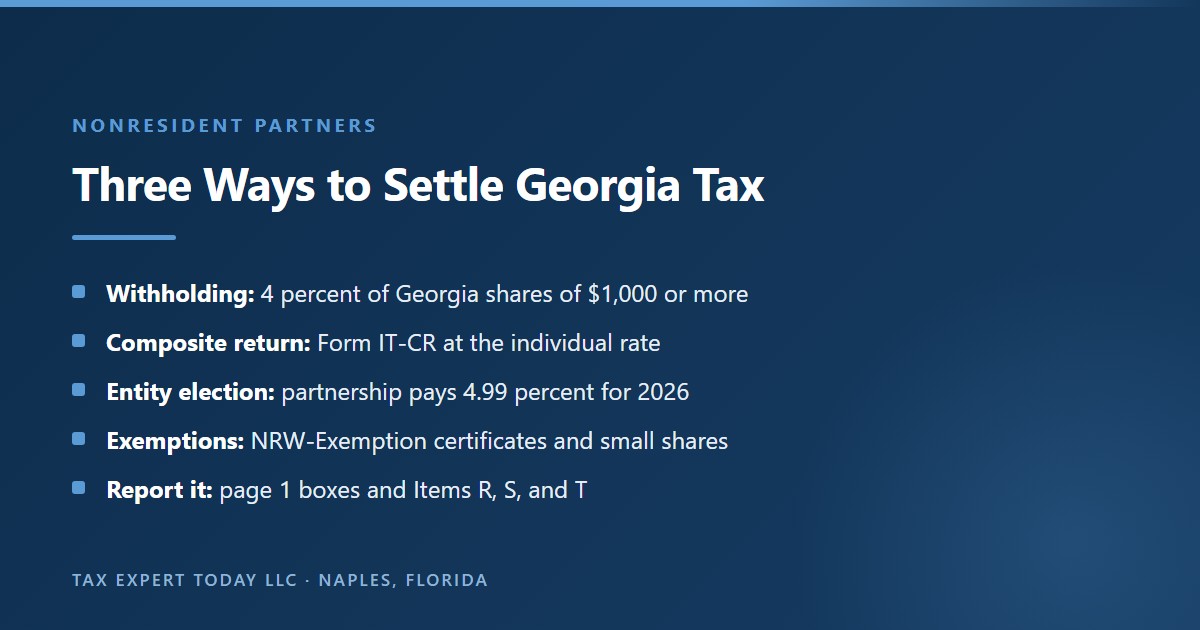
A partnership that does business or owns property in Georgia must withhold 4 percent of each nonresident partner’s share of Georgia source taxable income, whether or not cash is distributed, under O.C.G.A. 48-7-129. Withholding is not required for a partner whose annual Georgia share is under $1,000, and several other exemptions apply.
- Rate: 4 percent, below the individual tax rate, so the partner may still owe.
- Threshold: no withholding when the partner’s Georgia share is less than $1,000.
- Exemptions: listed in Regulation 560-7-8-.34, including a Form NRW-Exemption certification.
- Alternatives: a composite return, or the entity level election.
- Reporting on Form 700: the amount paid appears in page 1, Item T.
The IT-711 booklet states that a partnership that owns property or does business in Georgia “is required by O.C.G.A. 48-7-129 to withhold on the annual partner’s share of taxable income sourced to Georgia,” at a rate of 4 percent, and that withholding “is not required if the annual partner’s share of taxable income sourced to Georgia is less than $1,000.” The payment is made on Form G-7NRW by the original due date of the partnership return, without regard to any extension, and each partner receives Form G2-A.
The registration, deposit forms, penalties, and the joint and several liability rules are covered in our guide to Georgia withholding tax for employers and pass through entities, and this article does not repeat them. For Form 700 purposes, the key point is consistency: Schedule 4 Georgia source income, the G2-A amounts, the G-7NRW total, and Item T on page 1 should all tie to the same computation.
The booklet also notes an exemption under O.C.G.A. 48-7-24(c) for a nonresident partner of a partnership that derives income exclusively from buying, selling, dealing in, and holding securities on its own behalf. That exemption does not apply to a family limited partnership owned by related individuals, to a partner that participates in management, or to a partner in a unitary business with a person who participates in management.
How Does a Composite Return Interact With Georgia Form 700?
Instead of withholding, a partnership may file a composite return, Form IT-CR, that reports and pays Georgia tax for its nonresident partners. No permission is required. The partnership checks the Composite Return Filed box on page 1 of Georgia Form 700, and the composite return is filed separately.
- Form: IT-CR, the Georgia nonresident composite tax return.
- Permission: not required, according to the IT-711 booklet.
- Box on Form 700: Composite Return Filed, on page 1.
- Rate: the individual rate for the year, 5.19 percent for 2025 and 4.99 percent for 2026.
- Not with the election: a composite return is not filed for a year the entity elects.
The booklet states: “As an alternative to withholding, the partnership may file a composite return (Form IT-CR) for its nonresident partners. Permission is not required to file a composite return. Please check the Composite Return Filed box on page 1 of Form 700.” The Department posts the current Form IT-CR and the Form CR-ES voucher. The detailed computation options, which partners may be included, the estimated payments on Form CR-ES, and the affidavit requirements are covered in our guide to the Georgia composite return on Form IT-CR.
For Form 700, the interaction to watch is the year a partnership switches methods. The HB 149 FAQ states that an overpayment credit from a composite return “cannot be claimed on the electing entity’s income tax return” in a later election year, though it “can be refunded upon request.” A partnership moving from composite filing to the entity level election should plan its final composite estimates so a stranded overpayment does not sit in the composite account.
Withholding, Composite Return, or Entity Election: Which Path Fits?
Each path settles nonresident partners’ Georgia tax differently. Withholding is a 4 percent prepayment the partner later reconciles, a composite return pays the partners’ tax at the full rate on one return, and the entity level election moves the whole Georgia tax to the partnership. The right fit depends on the partners.
- Withholding: simplest for the entity; the partner still files a Georgia return.
- Composite: can spare included partners from filing their own Georgia returns.
- Election: binds every partner, residents included, and changes the federal picture.
- Mixed groups: partners under $1,000 or with exemption certificates may need no withholding.
| Feature | 4 percent withholding | Composite return (IT-CR) | Entity level election |
|---|---|---|---|
| Who pays | Partnership remits for each nonresident | Partnership pays for included nonresidents | Partnership pays on all Georgia net income |
| Rate | 4 percent | Individual rate for the year | Individual rate for the year |
| Partner files Georgia return? | Generally yes, to reconcile | Often not, for included partners | Residents still file; income taxed at entity is subtracted |
| Box on Georgia Form 700 | Items R, S, T on page 1 | Composite Return Filed | Partnership elects to pay the tax at the entity level |
| Applies to residents? | No | No | Yes, binding on all partners |
| Detailed guide | Georgia withholding tax | Georgia composite return | Georgia pass through entity tax |
The table is a summary. Whether any path helps a given partner depends on facts this article cannot see: the partner’s other state returns, federal itemizing and the federal SALT cap, the partner’s home state credit rules, and whether the partner wants to avoid filing in Georgia at all. A Georgia partnership whose partners live in several states may reach a different answer each year, which is one of the reasons we review this choice annually as part of our Georgia tax services.
Does a Partnership Owe Georgia Estimated Tax?
Only if it elects to pay tax at the entity level. An electing partnership must make estimated payments in the same manner as a C corporation, on Form 602-ES or through the Georgia Tax Center, if its net income for the year can reasonably be expected to exceed $25,000. A non electing partnership owes no estimated tax of its own.
- Threshold: net income reasonably expected to exceed $25,000.
- Calendar year due dates: April 15, June 15, September 15, and December 15.
- Form: Form 602-ES, or electronic payment through the Georgia Tax Center.
- Penalty computation: Form 600 UET, entered on Schedule 3, Line 9.
- Owner payments: cannot be transferred to the partnership.
The booklet’s estimated tax page sets out the schedule: when the requirement is first met before the first day of the fourth month, 25 percent is due by the 15th day of the fourth, sixth, ninth, and twelfth months. A later trigger spreads the payments over the remaining dates. The booklet warns that failure to comply may result in a penalty of 5 percent of the income tax for failure to pay estimated tax and a charge at 9 percent per year on the underpayment.
The HB 149 FAQ notes that partnerships cannot make quick payments outside a Georgia Tax Center account, so the partnership account must be registered to make estimated payments electronically. It also addresses the first election year: for the prior year safe harbor, the entity computes the penalty on Form 600 UET assuming the prior year tax was 5.75 percent of the prior year income, and may check the UET Annualization Exception Attached box. Owners’ own estimated payments cannot be moved to the partnership, but they can be taken into account in that penalty computation. Partners who remain individually liable, in non electing years, make their own estimates, which our guide to Georgia Form 500 ES explains, and the Georgia estimated tax penalty calculator can help estimate an individual shortfall.
How Are Credits Reported and Passed Through on Georgia Form 700?
Georgia income tax credits in the Series 100 codes are reported on Schedule 10, one schedule per credit code, showing credits generated, sold, allocated to owners on Schedule 11, used, and carried over. Refundable credits go on Schedule 10B. A return that involves any Series 100 credit must be filed electronically.
- Schedule 10: one per credit code, with company names, ID numbers, and any certificate numbers.
- Schedule 11: credits allocated to the partners.
- Schedule 10B: refundable credits; the booklet names the Timber Tax credit.
- E-file: mandatory for any return with a Series 100 credit.
- New 2025 codes: 155, 157, 158, 159, 160, and 161 carry shorter carryforward periods.
The booklet lists the credit codes and explains that, for taxable years beginning on or after January 1, 2025, several credits use new codes that “include the new credit carryforward periods,” because the General Assembly shortened carryforward and installment periods for certain credits. A partnership claiming the jobs credit for 2025, for example, uses code 157 rather than code 103. Codes can change from year to year, and the booklet asks filers to review them carefully.
In a non electing year, most credits flow to the partners through Schedule 11 and are claimed on the partners’ own returns. In an electing year, the credits stay with the partnership unless it makes the separate irrevocable election to pass them through. Credit specific rules, such as preapproval, caps, and the timing of contributions, come from each credit’s statute. Our guides to the Georgia Quality Jobs tax credit, the Georgia research credit, and the Georgia rural hospital credit cover three of the credits partnerships most often pass through.
How Does the Georgia Net Operating Loss Work on Form 700?
Schedule 9 tracks Georgia net operating losses for a partnership that pays tax at the entity level. Losses from taxable years beginning on or after January 1, 2018 carry forward with no carryback and may offset no more than 80 percent of current year income. Farm losses and certain insurance losses follow separate rules.
- Normal loss: carried forward until exhausted, no carryback.
- 80 percent limit: applies to losses from years beginning on or after January 1, 2018.
- Farm loss: two year carryback, indefinite carryforward.
- Insurance loss: two year carryback and twenty year carryforward.
- Where applied: Schedule 1, Line 4.
The 2025 booklet includes a worked Schedule 9 example: losses of $118,765 from 2021 and $386,280 from 2022 give a carryforward of $505,045; current year income of $404,036 allows a deduction of $323,229, which is 80 percent of that income; and $181,816 carries to the next year. Our own check of that example: 80 percent of $404,036 is $323,228.80, rounded to $323,229, and $505,045 less $323,229 is $181,816.
For a non electing partnership, losses flow through to the partners and are tracked on their returns, not on Schedule 9. The HB 149 FAQ notes that net operating losses of an electing partnership “shall be treated in the same manner as is allowed for C Corporations as provided in Regulation 560-7-3-.06,” and that losses stay with the partnership even in a later year when it does not elect. A partnership that alternates between electing and not electing needs a separate record of entity level losses that only the electing years can use.
What Penalties and Interest Apply to Georgia Form 700?
The IT-711 booklet lists a late filing penalty of 5 percent of unpaid tax per month up to 25 percent, a late payment penalty of one half of 1 percent per month up to 25 percent, a 5 percent negligence penalty, a 50 percent fraud penalty, and estimated tax penalties. Interest for 2026 accrues at 9.75 percent a year.
- Combined cap: late filing plus late payment cannot exceed 25 percent of tax unpaid by the original due date.
- Electronic payment: a 10 percent penalty when a required electronic payment is not made electronically.
- IRS audit amendments: no failure to pay penalty on a return amended because of an IRS audit.
- Interest: prime rate plus 3 percent, reset each January.
- Waivers: requested through the Georgia Tax Center or Form TSD-3.
| Penalty or charge | Amount stated in the 2025 IT-711 booklet or Department notice |
|---|---|
| Delinquent filing | 5 percent of tax not paid by the original due date, per month or part, up to 25 percent |
| Failure to pay tax shown | One half of 1 percent per month or part, up to 25 percent |
| Negligent underpayment | 5 percent of the underpayment |
| Fraudulent underpayment | 50 percent of the underpayment |
| Estimated tax (electing partnerships) | 5 percent of the tax for failure to pay, and a 9 percent per year charge on underpayments |
| Payment not made electronically when required | 10 percent, for partnerships with quarterly payments over $10,000 |
| Interest, calendar 2026 | 9.75 percent per year, accruing monthly, under Policy Bulletin ADMIN-2026-01 |
The interest rate comes from the Department’s Policy Bulletin ADMIN-2026-01, which sets 9.75 percent for 2026, down from 10.50 percent for 2025. The percentage penalties are measured against tax, so on a non electing Georgia Form 700 that shows no tax, the practical exposure usually sits elsewhere: in nonresident withholding not paid over, in the partners’ own late or understated returns, and in the cost of responding to notices. That is our reading of how the booklet’s penalties work, not a statement from the Department. Late withholding has its own penalties under O.C.G.A. 48-7-129, which our withholding guide sets out, and the Department summarizes rates by tax type on its penalty and interest rates page. Penalty waiver requests are made through the Georgia Tax Center or on Form TSD-3.
How Do You Amend Georgia Form 700?
File a new Georgia Form 700 with the Amended Return box checked, an amended Georgia K-1 for each partner, and a complete copy of the amended federal partnership return with its schedules, if there is one. When the amendment follows an IRS audit, check the Amended Due to IRS Audit box instead.
- Box: Amended Return, or Amended Due to IRS Audit.
- Partners: amended K-1 information for every partner affected.
- Federal copy: the complete amended federal return, if applicable.
- Downstream: partners may need to amend Form 500 or Form 600.
- Withholding: amended Georgia source income may change G-7NRW and G2-A.
The booklet states: “If a partnership becomes aware of changes after filing their return, it should file an amended Form 700. Check the Amended return box on Form 700 and submit an amended K-1 for each partner and a complete copy of the amended Federal partnership return, including schedules, if applicable.” Because Form 700 is usually an information return, an amendment rarely produces a Georgia bill for the partnership itself. Its real effect is on the partners, who may need to file amended Georgia returns of their own. Our guide to the Georgia amended tax return on Form 500X explains the partner side.
Refund claims, when the partnership has paid tax in an electing year, follow the general rule in the booklet: a claim “must be made within three years from the later date of either payment of the tax or the due date of the income tax return (including extensions which have been granted).”
What Must Happen After an IRS Audit of the Partnership?
Federal changes must be reported to Georgia within 180 days of the final determination date. After a federal partnership adjustment, the partnership files an amended Georgia Form 700 with the Amended Due to IRS Audit box checked, and it may elect to pay the resulting Georgia tax on behalf of its partners by checking a box on page 1.
- Deadline: 180 days after the final determination date.
- Self filed changes: for an amended federal return or an administrative adjustment request, the final determination date is the filing date.
- Box: Amended Due to IRS Audit, on page 1.
- Payment election: the partnership may pay the tax due on behalf of its partners.
- Item P: the latest taxable year adjusted by the IRS is reported on page 1.
The 2025 booklet’s list of new items states: “Taxpayers must report any federal changes or corrections resulting from a federal audit within 180 days of the final determination date. When those changes result from an amended federal return, a federal refund claim, an administrative adjustment request, or a similar report filed under Section 6225(c) of the Internal Revenue Code, the final determination date is the date the amended return, claim, adjustment request, or related report is filed.” That ties Georgia’s clock to the federal centralized partnership audit regime that begins at 26 U.S.C. 6221, including the modification procedures under 26 U.S.C. 6225.
The booklet explains the structure created by House Bill 849 of 2017, which amended O.C.G.A. 48-7-53 for taxable years beginning on or after January 1, 2018: “With a federal partnership adjustment, the partnership is required to file an amended Georgia return,” and “a partnership may elect to pay the tax due on behalf of its partners by checking the box on page 1 of Form 700. If the partnership makes this election, a schedule should be attached to the Form 700 which provides the details of the income reported for the partners and the total income should be entered on page 1 of Form 700.” If the partnership does not pay on behalf of its partners, the partners report the adjustments themselves. The booklet also states that the failure to pay penalty “is not due if the return is being amended due to an IRS audit.”
Federal partnership audits are handled with the IRS by the partnership representative designated under 26 U.S.C. 6223; the Georgia reporting that follows is a separate state tax matter with its own deadline. A partnership that resolves a federal examination and forgets the 180 day Georgia report leaves its partners exposed to Georgia assessments on adjustments they may not even know about.
How Does a Georgia Partnership Audit Work?
When the Department audits a partnership, the partnership can elect to pay the tax due on behalf of its partners by checking the box on Schedule 1, Line 2 of Georgia Form 700, before the audit starts or at its start. Otherwise the partnership and its direct and indirect partners file amended returns.
- Effective: taxable years beginning on or after January 1, 2017, or earlier by agreement.
- Election timing: before the audit starts or at the time of the audit.
- With the election: no amended return; the Department issues a notice to collect.
- Without it: the partnership and every direct and indirect partner amend.
- Contact person: the state partnership representative named in Items U, V, and W.
The booklet describes this Georgia audit regime in the same House Bill 849 passage: “For a Georgia partnership audit, a partnership may elect to pay the tax due on behalf of its partners by checking the box on Line 2 of Schedule 1. This election can be made on an original or amended return filed before the audit starts or at the time of the audit. If the election is made, the partnership will not file an amended return, instead the Department will issue a notice to the partnership to facilitate the collection of the tax. If the election is not made, the partnership and its direct and indirect partners must file amended returns.”
Common Georgia audit issues for partnerships, in our experience, are apportionment (how receipts were sourced), allocation (whether an item was really investment income), nonresident withholding (whether the right partners were withheld on at the right amount), and the related member add backs. Records that support Schedule 7 by customer location, and a reconciliation from Schedule 4 to the G2-A forms, answer most of the first round of questions.
How Do You Protest a Georgia Form 700 Assessment?
A proposed assessment can be protested with the Department within 45 days from the issued date on the notice, online through the Georgia Tax Center or on Form TSD-1. An official assessment can be appealed to the Georgia Tax Court or the superior court within 45 days. A proposed assessment cannot be taken directly to the Georgia Tax Court.
- Proposed assessment: protest within 45 days, starting July 1, 2025.
- Official assessment: appeal within 45 days to the Georgia Tax Court or superior court.
- Refund denial: protest, or appeal within the later of two years or 45 days after a protest decision.
- Georgia Tax Court: succeeded the Tax Tribunal on July 1, 2026.
- Not grounds for protest: inability to pay.
The Department’s Protests and Appeals page states that a protest of a proposed assessment or refund denial, made online or on Form TSD-1, must be filed “within 45 days from the issued date on the notice,” and that “you may not appeal a proposed assessment with the Georgia Tax Court.” The 2025 IT-711 booklet confirms the 45 day period beginning July 1, 2025 for protests and for petitions after an Official Assessment and Demand for Payment, and notes that starting July 1, 2026, “the Georgia Tax Court will officially succeed the Tax Tribunal.” The Georgia Tax Court publishes its own filing rules, and our guide to the Georgia Tax Tribunal and the new Georgia Tax Court covers that transition.
If the issue is the ability to pay rather than the amount, the Department points to payment plans, offers in compromise, and penalty waivers instead of a protest. Our guides to the Georgia Department of Revenue payment plan and the Georgia offer in compromise explain those routes. Georgia matters are state tax matters before the Department of Revenue; where a dispute moves to a court, coordination with Georgia counsel is part of the process.
Georgia Form 700 Example: A Three Member LLC
A hypothetical LLC taxed as a partnership earns $650,000 of total income for Georgia purposes in 2026, has a Georgia ratio of 0.400000, and has one Georgia resident member and two nonresident members. Its Georgia net income is $260,000, and the three nonresident paths produce very different results for the entity and the members.
- Facts are hypothetical: no client, no outcome, rounded for illustration.
- Rate used: 4.99 percent for a 2026 calendar year.
- Withholding rate: 4 percent under O.C.G.A. 48-7-129.
- Method: the IT-711 booklet’s guaranteed payment approach.
Assume the LLC’s federal Schedule K shows ordinary business income of $500,000 after deducting guaranteed payments of $100,000, of which $60,000 went to Member A and $40,000 to Member B. Federal depreciation includes bonus depreciation, so Schedule 5, Line 7 adds back $80,000 of federal depreciation, and Schedule 6, Line 4 subtracts $30,000 of Georgia depreciation. Gross receipts are $5,000,000 everywhere and $2,000,000 in Georgia. Member A owns 40 percent and lives in Georgia; Member B owns 40 percent and lives in Florida; Member C owns 20 percent and lives in Tennessee. There is no separately allocated income.
| Georgia Form 700 step | Computation | Result |
|---|---|---|
| Schedule 8, ordinary income | Federal $500,000 plus $80,000 addition less $30,000 subtraction | $550,000 Georgia adjusted |
| Schedule 8, guaranteed payments | Line 5 | $100,000 |
| Schedule 8, Line 12 | Total income for Georgia purposes | $650,000 |
| Schedule 7, Georgia ratio | $2,000,000 divided by $5,000,000 | 0.400000 |
| Schedule 2, Line 7 | $650,000 times 0.400000 | $260,000 Georgia net income |
Applying the booklet’s method to each member gives the Georgia income each must report. Member A, the resident, reports a full share wherever earned; Members B and C report only Georgia apportioned amounts.
| Member | Guaranteed payment portion | Ordinary income portion | Georgia income to report |
|---|---|---|---|
| A, Georgia resident, 40 percent | $60,000 (all) | $550,000 times 40 percent = $220,000 | $280,000 |
| B, Florida resident, 40 percent | $40,000 times 0.4 = $16,000 | $550,000 times 40 percent times 0.4 = $88,000 | $104,000 |
| C, Tennessee resident, 20 percent | None | $550,000 times 20 percent times 0.4 = $44,000 | $44,000 |
Now compare the three nonresident paths for the same year. The composite figures apply the flat rate to Georgia source income, before any of the computation options that Regulation 560-7-8-.34 allows, and the election figures ignore credits and losses.
| Path | What the LLC pays to Georgia | What the members still do |
|---|---|---|
| 4 percent withholding | B: $4,160; C: $1,760; total $5,920 on Form G-7NRW by March 15, 2027 | A files Form 500 on $280,000. B and C file nonresident Form 500 returns; B’s tax on $104,000 at 4.99 percent before deductions would be about $5,190, so the withholding covers part of it |
| Composite return (IT-CR) | B: about $5,190; C: about $2,196; total about $7,386 | A files Form 500 on $280,000. B and C, if included, generally need not file their own Georgia returns for this income |
| Entity level election | $260,000 times 4.99 percent = $12,974, with Form 602-ES estimates during the year | A subtracts the $112,000 taxed at the entity ($24,000 of apportioned guaranteed payment plus $88,000 of apportioned ordinary income) as PTEDED and still reports the rest of the $280,000 on Form 500; B and C have no Georgia return for this income |
Member A’s entity level share in the third row comes from the same apportionment: Member A’s guaranteed payment of $60,000 times 0.4 is $24,000, and Member A’s $220,000 share of ordinary income times 0.4 is $88,000, for $112,000. The remaining $168,000 of Member A’s share was apportioned outside Georgia, so it is not taxed by the entity election and stays on Member A’s Georgia return, where the credit for taxes paid to other states may apply if another state taxed it. The federal effect of the election, a partnership level deduction for the $12,974 under IRS Notice 2020-75, is outside the scope of this Form 700 walk through and is covered in our Georgia pass through entity tax guide.
The example is a model, not a recommendation. A real comparison needs each member’s full tax picture, including federal itemizing, the federal SALT cap, the member’s home state, and whether a Florida or Tennessee member values not filing in Georgia more than the dollars involved.
What Happens on a Final Georgia Form 700?
When a partnership terminates, converts to a corporation for tax purposes, or ends its Georgia filing requirement, it files a final Georgia Form 700 with the Final box checked, for the period ending on the termination date, with the final federal Form 1065. Nonresident withholding and composite filings for that last period still apply.
- Box: Final, on page 1.
- Period: the short year ending on the federal termination date.
- Withholding: nonresident withholding for the final year is still due with Form G-7NRW.
- Accounts: close the withholding and any sales tax accounts separately.
- Attributes: an electing partnership’s losses and credits do not pass to the partners.
A federal technical termination no longer exists after the 2017 federal changes, so termination generally follows the federal rules for the end of a partnership under 26 U.S.C. 708. The common Georgia issues on a final return are a liquidating gain that must be allocated or apportioned correctly, a final year in which nonresident partners receive large Georgia shares from the sale of Georgia property, and accounts left open at the Department that later generate non filing notices. Closing the nonresident withholding account, and any other account registered to the partnership, prevents notices for periods after the business has ended.
An LLC that changes its federal classification to an S corporation files a final partnership Form 700 for the period before the change and begins filing Form 600S. For an electing partnership, the HB 149 FAQ states that tax attributes stay with the entity, so unused entity level losses and credits do not move to the partners when the partnership ends.
What Are the Most Common Georgia Form 700 Mistakes?
The errors we see most often are filing an extended return without the federal extension attached or the Extension box checked, completing Schedules 1 and 3 when no election was made, leaving guaranteed payments out of Georgia income, mis-sourcing service receipts on Schedule 7, and Schedule 4 amounts that do not match the nonresident withholding forms.
- Extension not shown: treated as late filing.
- Tax schedules filled without the election: produces a balance due notice.
- Guaranteed payments omitted: understates Georgia income and nonresident withholding.
- Federal return not attached: the return is deemed incomplete.
- Stale rate: using 5.75 percent or 5.39 percent instead of the rate for the year.
| Mistake | What the booklet or FAQ says | Likely consequence |
|---|---|---|
| No federal extension attached, Extension box unchecked | Return considered filed late; late filing penalty assessed | Penalty notice and a response to prove the extension |
| Schedules 1 and 3 completed without the election | Return receives a balance due once processed | Unexpected bill; amended return or notice response |
| Election box missed on a timely return | Election must be made by the due date including extensions | Entity estimates stranded; partners taxed individually |
| Federal return not included | Return deemed incomplete | Possible treatment as not filed |
| Related member intangible expenses not added back | Must be listed as an addition even if an exception applies | Audit adjustment |
| Nonresident shares under or over withheld | 4 percent on Georgia source shares of $1,000 or more | Joint and several liability for the shortfall |
| Federal audit changes not reported | Report within 180 days of the final determination | Assessments against the partnership or partners |
Several of these have nothing to do with tax law and everything to do with process: a checkbox, an attachment, a software default. That is why a written review step before filing, done by someone other than the preparer, catches most of them.
What Should Be on a Georgia Form 700 Filing Checklist?
A practical checklist confirms the filing requirement and status boxes, ties every Georgia schedule to the federal return, verifies apportionment and allocation support, reconciles the partner schedule to withholding or composite filings, applies the correct rate for the year if electing, and confirms extension and payment timing.
- Status: original, amended, final, extension, composite, election, IRS audit boxes.
- Income: Schedule 8 ties to the federal Schedule K, with guaranteed payments included.
- Adjustments: depreciation, 163(j), add backs, and United States interest reduction.
- Partners: Schedule 4 agrees to G2-A forms, G-7NRW, and Item T.
- Timing: extension attached, payments made by the original due date.
| Area | Check before filing Georgia Form 700 |
|---|---|
| Filing requirement | Federal Form 1065 filer with Georgia business, property, Georgia source income, or a Georgia domiciled partner |
| Page 1 | Account numbers, Item P IRS year, K-1 counts, nonresident questions, state partnership representative |
| Schedule 8 | Federal Schedule K amounts, guaranteed payments on Line 5, Schedules 5 and 6 attached |
| Schedule 7 and 2 | Receipts sourced by customer location; ratio to six decimals; allocated income scheduled |
| Schedule 4 | Ending K-1 percentages; nonresident Georgia source income using the ratio |
| Nonresident path | Withholding, composite, exemption certificates, or election, chosen and documented |
| Election years only | Schedules 1, 3, and 9 completed; rate for the year; 602-ES payments credited; Form 600 UET |
| Non election years | Schedules 1 and 3 left blank |
| Credits | Schedule 10 per credit code, Schedule 11 allocations, electronic filing |
| Attachments | Complete federal return and schedules, federal Form 7004 if extended, Georgia Form 4562 |
Partners benefit from a short cover note with their Georgia K-1 information explaining which path the partnership used for the year. A Florida member who receives a G2-A without explanation often does not realize a Georgia nonresident return is still expected.
Georgia Form 700 Help in Naples & Southwest Florida
Tax Expert Today LLC works with Georgia partnerships and their partners from our office in Naples, Florida, at 11983 Tamiami Trail N, Naples FL 34110. We handle state tax matters nationwide, including Georgia Form 700 preparation and review, nonresident partner filings, the entity level election, and responses to Department of Revenue notices.
- Georgia partnership return help Naples: Form 700 preparation and second reviews.
- Nonresident partners: withholding, composite return, and partner return coordination.
- Elections: modeling the entity level election before the due date.
- Notices: late filing, balance due, and withholding notices from the Department.
Many of our Georgia clients are Florida residents who still own an interest in a Georgia partnership, or Georgia partnerships whose members now live in Southwest Florida. The Florida side is simple, because Florida has no personal income tax; the Georgia side is not. Our office is open Monday through Friday, 10 a.m. to 5 p.m. Eastern time, and you can reach us at (239) 441-2005. Georgia clients are served nationwide from Naples, by phone and secure document exchange, without needing to visit. To see the full range of Georgia work we do, visit our Georgia tax services page, and for Florida residents planning around a multistate picture, our Naples tax planning services page explains how we approach it.
Address: Tax Expert Today LLC, 11983 Tamiami Trail N, Naples FL 34110. Telephone: (239) 441-2005. Hours: Monday to Friday, 10 a.m. to 5 p.m. ET.
When to Engage a Professional
Consider professional help with Georgia Form 700 when the partnership has nonresident partners, operates in more than one state, is weighing the entity level election, has received a Department notice, has gone through an IRS partnership audit, or is changing classification or winding down. Each of those situations has deadlines that are hard to fix after they pass.
- Before the due date: the entity level election cannot be made after the extended due date.
- After a federal audit: the 180 day Georgia reporting clock is already running.
- After a notice: the 45 day protest window starts on the issued date.
- Before a sale: allocation and nonresident withholding on a large Georgia gain.
The value of a review usually comes from the decisions around the form rather than the arithmetic: which nonresident path to use, whether an item is business or investment income, how receipts are sourced, and how a federal change flows to Georgia and to each partner. Tax Expert Today LLC works with tax advisors, enrolled agents, CPAs, and attorneys, and coordinates with Georgia counsel where a dispute moves toward the Georgia Tax Court. If you want a second set of eyes on a Georgia partnership return, or help with a notice, start with our Georgia state tax services or call (239) 441-2005 for a free consultation.
This article is general educational information about Georgia Form 700 as of October 9, 2026, based on the 2025 IT-711 booklet, the 2025 Form 700, and Georgia Department of Revenue pages read on that date. It is not tax or legal advice for any specific partnership or partner. All examples are hypothetical. Georgia rates, forms, and rules change; confirm current requirements with the Department of Revenue or a qualified professional before filing.
Frequently Asked Questions About Georgia Form 700
What is Georgia Form 700?
Georgia Form 700 is the Georgia Department of Revenue partnership tax return. It reports a partnership’s income for Georgia purposes, apportions business income to Georgia, and lists each partner’s Georgia source income. It is an information return unless the partnership elects to pay Georgia income tax at the entity level.
Who must file Georgia Form 700?
Any partnership or LLC taxed as a partnership that files federal Form 1065 and does business in Georgia, owns property in Georgia, has Georgia source income, or has a member domiciled in Georgia. Any one of those four triggers creates the filing requirement.
When is Georgia Form 700 due?
It is due on the 15th day of the third month after the tax year ends, which is March 15 for a calendar year partnership, moving to the next business day when that date falls on a weekend or holiday. The 2026 calendar year return is due March 15, 2027.
How do I get an extension for Georgia Form 700?
An approved federal Form 7004 extension is honored automatically if it is attached to the Georgia return and the Extension box is checked. Without a federal extension, request a Georgia extension on Form IT-303. The extension is six months and does not extend the time to pay any tax.
Does a partnership pay tax on Georgia Form 700?
Usually not. The partners pay the tax on their own returns. A partnership pays tax only if it elects to pay at the entity level for the year, or elects to pay on behalf of its partners after a federal or Georgia audit adjustment.
What is the Georgia partnership tax rate for 2026?
For a partnership that elects to pay tax at the entity level, the rate is the individual income tax rate for the year: 5.19 percent for tax years beginning in 2025 and a flat 4.99 percent for tax years beginning in 2026, applied to the whole period without proration.
Does a single member LLC file Georgia Form 700?
No. A single member LLC disregarded for federal purposes does not file Form 1065, so it does not file Georgia Form 700. Its activity is reported on the owner’s return, and its Georgia credits are claimed there, with the credit forms filed in the LLC’s name.
What withholding applies to nonresident partners in Georgia?
A partnership must withhold 4 percent of each nonresident partner’s Georgia source share when that share is $1,000 or more, whether or not cash is distributed, under O.C.G.A. 48-7-129. A composite return on Form IT-CR or the entity level election can replace the withholding.
What schedules should be left blank on a non electing Georgia Form 700?
Schedule 1 and Schedule 3. The Department’s HB 149 FAQ states that when the entity level election is not made, those schedules should not be completed, and that entering information in them will cause the return to receive a balance due once processed.
I live in Naples, Florida, and own part of a Georgia partnership. Can you help with Georgia Form 700?
Yes. Tax Expert Today LLC handles state tax matters nationwide from its Naples, Florida office at 11983 Tamiami Trail N, including Georgia Form 700 reviews, nonresident partner returns, composite and withholding filings, and Department of Revenue notices. Call (239) 441-2005 for a free consultation.
Published October 9, 2026 by Dr. Pellumb Kabashi « Back to Learning Center
Have a question this article touches on?
Tax Expert Today LLC, based in Naples, Florida and serving clients across the United States.
Schedule a Consultation (239) 441-2005