
By Dr. Pellumb Kabashi, DBA, MBA, EA, CFE, CES
Founder, Tax Expert Today LLC · Tax advisors, enrolled agents, CPAs, and attorneys · Serving clients in all 50 states
Georgia Form IT-303 is the Department of Revenue application for more time to file a Georgia income tax return, and you need it only when you do not have a federal extension. Georgia automatically honors an approved federal extension. Either way the extension lasts up to six months and never extends the time to pay, so any tax owed is still due April 15. Call (239) 441-2005 for a free consultation.
What Is Georgia Form IT-303?
Georgia Form IT-303 is the Application for Extension of Time for Filing State Income Tax Returns. It asks the Georgia Department of Revenue for up to six more months to file an individual, fiduciary, partnership or corporate income tax return, or a corporate net worth tax return. It is a request for filing time only, never a payment form.
- Who issues it: the Georgia Department of Revenue. The current revision is dated June 7, 2024.
- What it covers: Form 500 for individuals, Form 501 for fiduciaries, Form 700 for partnerships, corporate income tax, and net worth tax.
- What it does not do: it does not extend the payment deadline and it does not carry a payment.
- When it is needed: only when there is no approved federal extension to rely on.
The form fits on a single page. Section 1 identifies the taxpayer, Section 2 names the return, the period and the date requested, and Section 3 asks for the reason. The page ends with a signed affirmation that the information is true to the best of the signer’s knowledge, made under the penalties prescribed by law.
The instruction page of Form IT-303 opens with the legal standard. Extensions may be granted in cases of sickness, absence, or other disability, or whenever reasonable cause exists. That language tracks O.C.G.A. 48-7-56(a), which lets the Commissioner allow further time for filing in the case of sickness or other disability, or whenever good cause exists in the Commissioner’s judgment.
Because the form serves every income tax return type, it is also the form businesses use. The same page that a salaried Atlanta resident might mail in April is the page a calendar year partnership would mail in March. The sections below take the individual case first, then turn to estates, trusts and businesses.
Do You Need Georgia Form IT-303 If You Have a Federal Extension?
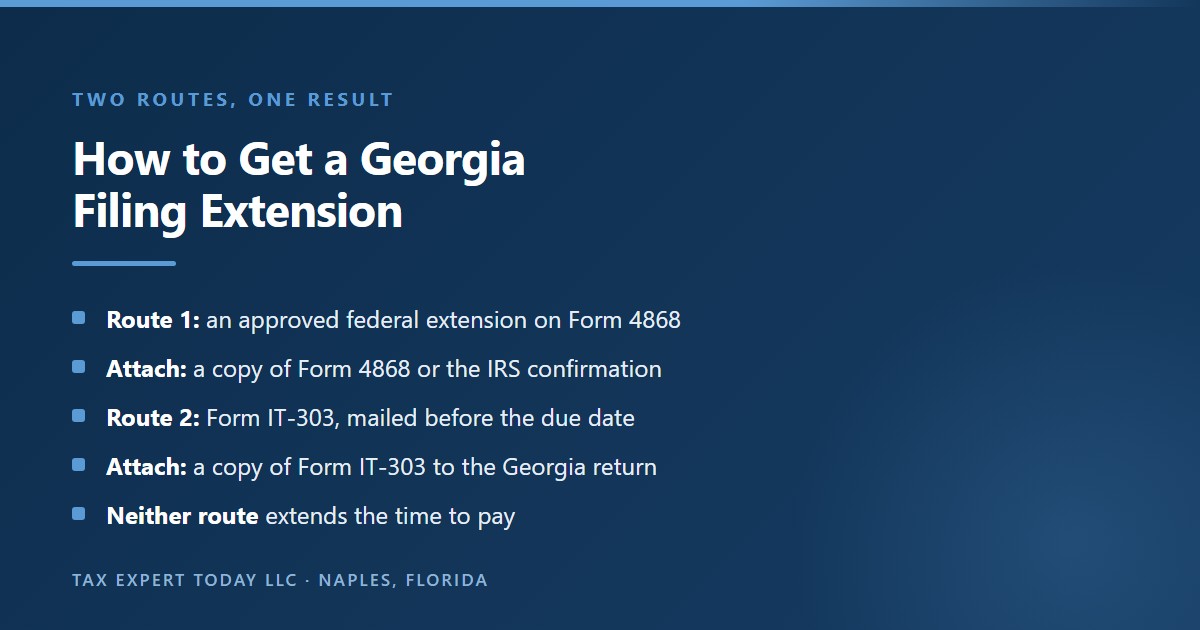
No. If the IRS has granted you a federal extension, Georgia extends your state filing deadline automatically and you do not file Georgia Form IT-303. You attach a copy of federal Form 4868, or the IRS confirmation if you requested the federal extension electronically, to the Georgia return when you file it.
- Automatic route: an approved federal extension becomes a Georgia extension.
- Proof required: a copy of Form 4868 or the IRS confirmation, attached to the Georgia return.
- Deadline that applies: the extended federal due date.
- No separate filing: nothing is mailed to Georgia in April to secure the extension.
This is the single most misunderstood point about Georgia extensions, and the Department states it directly. Its Requesting an Extension page says there are two ways to receive a six month extension: automatically, if you receive a federal extension, or by filing Form IT-303. The same page says you do not need to request a Georgia extension if you receive a federal one.
The statute behind that rule is paragraph (1) of O.C.G.A. 48-7-57(d). No late filing penalty is incurred if the taxpayer attaches to the state return a copy of an approved federal extension and files the state return within the period the extension specifies. In that case, the statute says, the taxpayer need not apply to the Commissioner for an extension of time to file the state return.
The form itself repeats the rule in a boxed note headed “Acceptance of Federal Extensions.” A federal extension will be accepted as a Georgia extension if the return is received within the time as extended by the IRS and a copy of the federal extension is attached to the return when filed. Both conditions matter. A return filed after the extended federal date, or filed without the attachment, loses the protection.
The federal request itself is made on IRS Form 4868, usually electronically through software or by making a federal payment marked as an extension payment. Our guide to federal tax extension payment options covers that side, so this article stays with the Georgia rules.
When Should You File Georgia Form IT-303 Instead?
File Georgia Form IT-303 when you need more time for your Georgia return but have no federal extension. That usually means your federal return is ready or already filed while the Georgia return is not, or you have a Georgia filing requirement without a matching federal one. The form must be mailed before the original Georgia due date.
- Federal return finished, Georgia return waiting on a K-1, an other state credit, or a Schedule 3 allocation.
- A Georgia filing obligation without a federal one, which O.C.G.A. 48-7-50(a)(5) contemplates.
- A missed federal extension, where the federal return is late but the Georgia deadline has not yet passed.
- A business return whose federal extension was not filed in time.
The first case is common for people with income in more than one state. The federal return can be complete while the Georgia return waits on a figure from another state, for example the tax paid to that state for the Georgia credit for taxes paid to other states. For a part-year resident, the Schedule 3 ratio can depend on allocations that arrive late. Our guide to the Georgia part year resident tax return explains that allocation.
The second case comes from the filing rules in O.C.G.A. 48-7-50. A Georgia return is required from a resident or nonresident who has taxable income subject to Georgia tax for the year even if that person has no taxable income subject to federal income tax. There is no federal extension to borrow in that situation, so Form IT-303 is the only route.
Instruction 5 of the form asks for something extra in these cases. If a federal extension was not needed, you are asked to explain why it was not necessary to request one. A short, factual line is enough, for example that the federal return was filed on time and the Georgia return awaits a statement from another state.
A table makes the choice mechanical.
| Your situation | File Form IT-303? | What to attach to the Georgia return | Georgia filing deadline |
|---|---|---|---|
| Approved federal extension on Form 4868 | No | Copy of Form 4868 or the IRS confirmation | Extended federal due date |
| Federal return filed on time, Georgia return not ready | Yes, mailed before the original due date | Copy of Form IT-303 | Date granted, up to six months |
| Georgia return required, no federal return required | Yes | Copy of Form IT-303 | Date granted, up to six months |
| Return ready and tax paid by the due date | No | Nothing | Original due date |
| Original due date already passed, no extension | Too late, file and pay as soon as possible | A reasonable cause statement, if one applies | Already passed |
When Is Georgia Form IT-303 Due, and How Long Is the Extension?
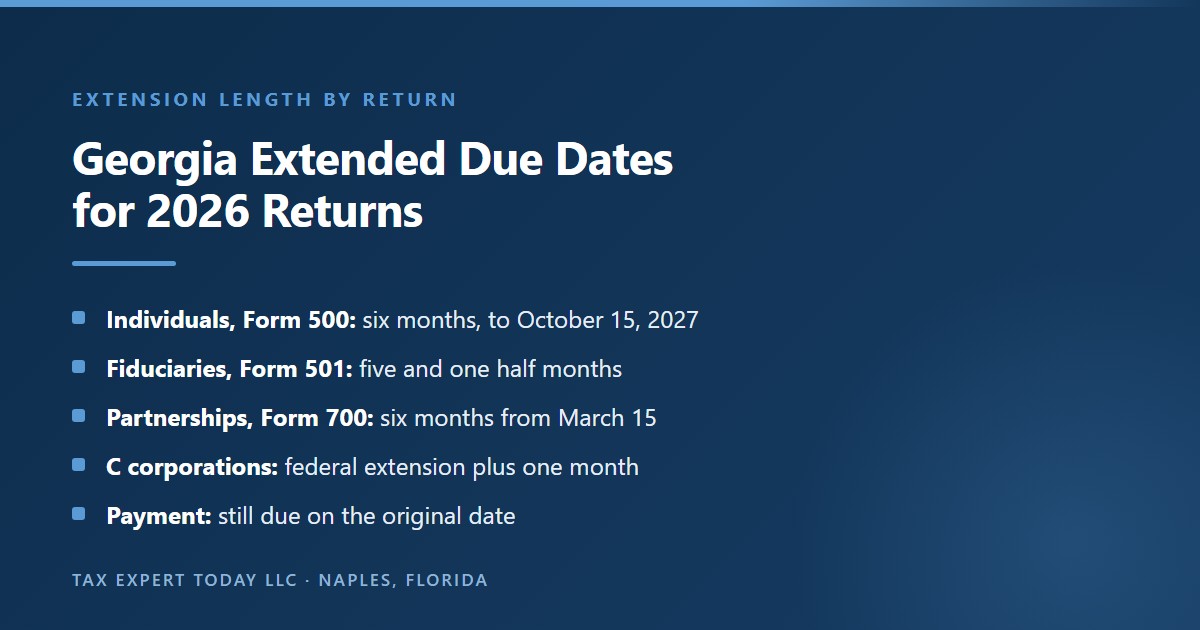
Georgia Form IT-303 must be mailed before the original due date, April 15 for calendar year individuals. The extension is limited by law to six months, so a calendar year individual’s return moves to October 15. Fiduciaries receive only five and one half months, and corporations receive one extra month for tax years beginning in 2025 or later.
- Individuals, Form 500: due April 15, extended to October 15.
- Fiduciaries, Form 501: five and one half months, the only return type the form limits below six.
- Partnerships, Form 700: due March 15 for calendar year filers, six months later on extension.
- Corporations: one additional month to file beginning with tax periods on or after January 1, 2025.
The original due dates come from O.C.G.A. 48-7-56(a). Individuals and other non-corporate filers file by April 15, or by the fifteenth day of the fourth month after a fiscal year ends. Partnerships and Georgia S corporations file by March 15, and other corporations by April 15. The 2025 IT-511 booklet confirms April 15, 2026 for calendar year individuals filing 2025 returns.
| Return | Original due date, calendar year 2026 return | Extension length | Extended due date |
|---|---|---|---|
| Individual, Form 500 | Thursday, April 15, 2027 | Six months | Friday, October 15, 2027 |
| Fiduciary, Form 501 | Thursday, April 15, 2027 | Five and one half months | Thursday, September 30, 2027 |
| Partnership, Form 700 | Monday, March 15, 2027 | Six months | Wednesday, September 15, 2027 |
| C corporation, Form 600, with a federal extension | Thursday, April 15, 2027 | Federal extension plus one month | Monday, November 15, 2027 |
| Individual 2025 return already on extension | Wednesday, April 15, 2026 | Six months | Thursday, October 15, 2026 |
The six month ceiling is printed on the form: except for fiduciaries, extensions are limited by law to six months. The fiduciary limit was set for tax years beginning on or after January 1, 2016, and the form marks the Form 501 box “5 1/2 months only.” The corporate month comes from the 2024 amendment to O.C.G.A. 48-7-57(d)(1), which adds one month to the federal extension period for a corporate taxpayer for tax years beginning on or after January 1, 2025.
For anyone who put a 2025 Georgia return on extension this spring, the practical date is Thursday, October 15, 2026. Weekend and holiday dates move to the next business day, which the 2025 IT-560 instructions state for payments. None of the individual dates in the table falls on a weekend.
Timing of the request matters as much as the length. The Department’s page says you must mail Form IT-303 before the statutory return due date, and instruction 2 on the form says to mail the original prior to the return due date. An application mailed after April 15 is not a timely request, and the late filing penalty for the months already passed cannot be undone by it.
How Do You Fill Out Georgia Form IT-303?
Complete Georgia Form IT-303 in triplicate. Section 1 takes the name, Social Security number or FEIN and address. Section 2 takes the return type, the period ending and the date requested. Section 3 takes the reason. Sign it, mail the original before the due date, attach one copy to the return, and keep one copy.
- Section 1: taxpayer name, SSN or FEIN, address, and the taxpayer’s name if the filer is an agent.
- Section 2: check Individual, Partnership, Fiduciary, Corporate Income Tax, Net Worth Tax, or Other.
- Section 3: a brief, truthful reason, such as awaiting a Schedule K-1.
- Signature: the taxpayer or an authorized agent, with the agent’s firm name if an agent signs.
Section 2 has three columns. Line 1 is the return type, Line 2 is the period ending, which is December 31 of the tax year for a calendar year filer, and Line 3 is the date to which the extension is requested. For an individual calendar year 2026 return, Line 3 would normally read October 15, 2027, the end of the six month window.
Instruction 4 matters for married couples. Separate applications must be submitted for husband and wife if separate returns are filed. A couple that expects to file jointly submits one application. A couple still deciding should consider whether the filing status choice will change, because a single application under one name may not protect a spouse who later files separately.
The reason line is short, but it should be accurate. The legal test is reasonable cause, and the affirmation is signed under penalty. Waiting on a corrected Form 1099, a Schedule K-1, a brokerage cost basis statement, or a figure from another state’s return are all common, factual reasons.
Instruction 5 rules out shortcuts. An extension request will not be accepted by telephone, and lists are not acceptable. The application must be made on this form, unless a copy of an approved federal extension is attached to the Georgia return when filed.
Where Do You Mail Georgia Form IT-303?
Mail the original Georgia Form IT-303 to the Georgia Department of Revenue, Processing Center, PO Box 740320, Atlanta, GA 30374-0320, before the return’s original due date. The Department notifies you only if the request is denied, so silence means the extension stands. Keep proof of the mailing date with your copy.
- Address on the current form: Processing Center, PO Box 740320, Atlanta, GA 30374-0320.
- Not by phone: telephone requests are not accepted.
- No approval letter: the Department writes only to deny a request.
- Not the payment address: Form IT-560 payments go to a different box.
That address appears in both instruction 2 and the mailing block on the June 2024 revision of the form. It is not the same box used for payments. The 2025 IT-511 booklet lists Form IT-560 extension payments at PO Box 105198, Atlanta, GA 30348-5198, and a check sent to the extension request box can slow its posting.
The Department’s page describes Form IT-303 as something you must mail, and the form is a paper document completed in triplicate. Some commercial software packages prepare Georgia business extensions and may offer to transmit them; if you rely on one, confirm with the provider how the request reaches the Department and keep the confirmation with your records.
The no news rule is written on the form: “We will notify you only if your extension request is denied.” In practice, that makes proof of timely mailing the taxpayer’s only evidence that a request was made. A certified mail receipt or a dated delivery record is inexpensive insurance, even though the booklet notes that sending the return itself by certified mail delays processing.
Does a Georgia Extension Give You More Time to Pay?
No. A Georgia extension, whether automatic through a federal extension or granted on Form IT-303, extends only the time to file. Tax must still be paid by the original due date, April 15 for calendar year individuals. Any balance unpaid after that date draws the late payment penalty and interest even while the extension is in force.
- Filing time: extended up to six months.
- Payment time: not extended at all.
- Late payment penalty: accrues regardless of an approved extension request.
- Interest: runs from the original due date until the tax is paid.
Every Georgia source repeats this. The 2025 IT-511 booklet says an extension to file does not extend the date for paying the tax, and that taxes must be paid by the statutory due date to avoid late payment penalties and interest. The Requesting an Extension page says the extension cannot exceed six months and does not extend the date for paying the tax. Instruction 8 on Form IT-303 says the late payment penalty accrues regardless of an approved extension request.
The statute is the reason. O.C.G.A. 48-7-86(a)(1)(A) imposes the late payment addition when the tax shown on a return is not paid on or before the date prescribed for payment, determined with regard to any extension of time for payment. An extension of time to file is not an extension of time for payment, so the payment date stays fixed.
For corporations, the 2024 amendment made the point explicit. Paragraph (2) of O.C.G.A. 48-7-57(d) says nothing in the federal extension rule allows a taxpayer to defer payment of a corporate income tax liability beyond the original due date in O.C.G.A. 48-7-56.
This is where most extension problems begin. A taxpayer files the extension, assumes the matter is handled, and learns in October that six months of penalty and interest have built up on a balance that could have been estimated and paid in April.
A taxpayer who cannot pay the full balance by the original due date still benefits from filing on time and paying what is possible. The remaining balance can be placed in an installment agreement, as described in our guide to a payment plan with the Georgia Department of Revenue, although interest and the late payment penalty continue until the balance is paid.
How Do You Pay Georgia Tax With Form IT-560?
Individuals and fiduciaries pay a balance due during an extension with Form IT-560, the Extension Payment Voucher, or electronically through the Georgia Tax Center. Corporations, partnerships and composite filers use Form IT-560C instead. The amount paid is later claimed on the return, on Line 26 of Form 500 for individuals.
- Individuals and fiduciaries: Form IT-560, vendor code 040 on the 2025 voucher.
- Corporations, partnerships and composite tax: Form IT-560C.
- Online: the Georgia Tax Center replaces the paper voucher.
- By mail: Processing Center, Georgia Department of Revenue, PO Box 105198, Atlanta, GA 30348-5198.
- On the return: Form 500 Line 26, or the Georgia Estimated Tax Paid line on Form 501.
The Department’s IT-560 page describes the form as the one used to submit any payment of tax when an extension has been requested or is in force, for individuals and fiduciaries. Instruction 9 on Form IT-303 draws the line between the two vouchers: individuals and fiduciaries remit on Form IT-560, while corporations and partnerships, and composite tax, remit on Form IT-560C.
The 2025 voucher carries several warnings worth reading. It says it is not an extension request form. It says the extension is for filing the return only and does not extend the time for paying the tax. It says Georgia will honor an automatic federal extension. And Form IT-303 adds the mirror image: remitting a payment with Form IT-560 or IT-560C will not extend the due date for filing your return.
Those two statements are the heart of the Georgia system. Form IT-303 buys filing time and carries no money. Form IT-560 carries money and buys no filing time. A taxpayer who needs both files the extension, or relies on the federal one, and makes the payment separately.
| Form | What it does | Who uses it | Mailing address | What it does not do |
|---|---|---|---|---|
| IT-303 | Requests up to six months to file | Any income tax or net worth tax filer without a federal extension | PO Box 740320, Atlanta, GA 30374-0320 | Carry a payment or extend the time to pay |
| IT-560 | Carries a payment during an extension | Individuals and fiduciaries | PO Box 105198, Atlanta, GA 30348-5198 | Extend the filing date, or serve as a quarterly estimate voucher |
| IT-560C | Carries a business payment during an extension | Corporations, partnerships, and composite tax | As printed on the current IT-560C | Extend the filing date |
| Federal Form 4868 | Extends the federal return and, by attachment, the Georgia return | Individual federal filers | Filed with the IRS | Pay any Georgia tax |
Mechanically, the voucher works like the estimated tax voucher. The PDF builds it from a short worksheet, and the Department asks you not to mail the worksheet, not to staple the payment, and to write your SSN or FEIN on the check. A payment made online replaces the voucher entirely.
When the return is prepared, the extension payment is treated as a prepayment. The 2025 voucher tells Form 500 filers to enter the amount on Line 26, the same line that collects estimated tax payments made on Georgia Form 500 ES. Leaving the extension payment off that line is a common cause of a balance due notice for tax that was, in fact, paid.
What Penalties Apply If You File or Pay Late in Georgia?
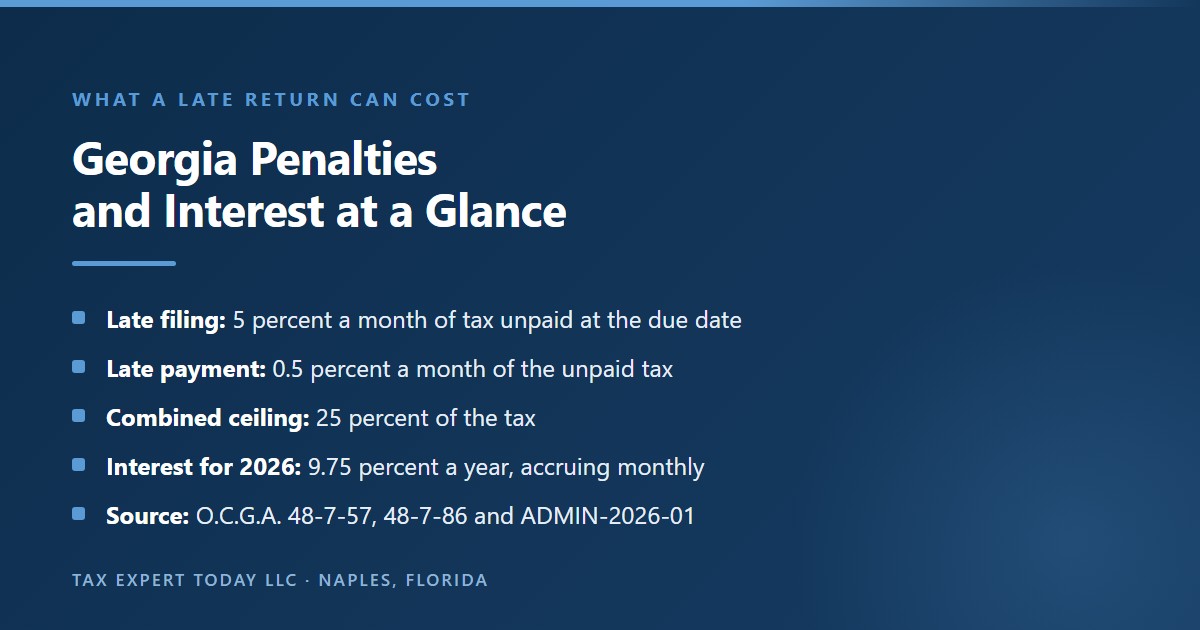
Georgia charges a late filing penalty of 5 percent per month of the tax not paid by the original due date, a late payment penalty of 0.5 percent per month of the unpaid tax, and interest at the prime rate plus 3 percent, which is 9.75 percent for 2026. The two penalties combined cannot exceed 25 percent of the tax.
- Late filing: 5 percent for each month or fraction of a month, under O.C.G.A. 48-7-57.
- Late payment: 0.5 percent for each month or fraction of a month, under O.C.G.A. 48-7-86.
- Combined ceiling: 25 percent of the tax due on the return due date.
- Interest for 2026: 9.75 percent a year, accruing monthly, per ADMIN-2026-01.
- Reasonable cause: neither penalty applies when the failure is due to reasonable cause and not willful neglect.
| Charge | Rate | Measured on | Limit | Authority |
|---|---|---|---|---|
| Late filing penalty | 5 percent per month or fraction | Tax not paid by the original due date | 25 percent | O.C.G.A. 48-7-57 |
| Late payment penalty | 0.5 percent per month or fraction | Unpaid tax at the start of each month | 25 percent, and 25 percent combined with late filing | O.C.G.A. 48-7-86 |
| Interest | Prime plus 3 percent, 9.75 percent for 2026 (10.50 percent for 2025) | Unpaid tax from the due date until paid | None | O.C.G.A. 48-2-40 |
| Negligent underpayment | 5 percent | The underpayment | None stated | O.C.G.A. 48-7-86(e) |
| Net worth tax, late filing and late payment | 10 percent each | Tax shown to be due | Not stated | O.C.G.A. 48-13-79 |
The rates are set out on the Department’s Penalty and Interest Rates page, which lists the statute for each one, and on page 11 of the 2025 IT-511 booklet. The interest rate is reset each January. The Department’s Policy Bulletin ADMIN-2026-01 sets 9.75 percent for calendar year 2026, accruing monthly, down from 10.50 percent in 2025.
The coordination rule is in O.C.G.A. 48-7-57(c). For any month in which both penalties apply, the late filing penalty is reduced by the late payment penalty for that month. The effect is that a month in which a return is both unfiled and unpaid costs 5 percent in total, not 5.5 percent.
Interest works differently from the penalties. It is compensation for the use of money rather than a sanction, and it is imposed by a separate statute, O.C.G.A. 48-2-40. The reasonable cause clauses discussed below appear in the two penalty statutes, O.C.G.A. 48-7-57 and 48-7-86. Interest accrues until the tax due has been paid in full, as the IT-511 booklet says, so plan on paying it even where a penalty is later removed.
Why Does Paying in Full by April 15 Remove the Late Filing Penalty?
Georgia measures the late filing penalty on the tax not paid by the original due date. Under O.C.G.A. 48-7-57(b), the tax required to be shown on the return is reduced by any part paid on or before the payment date and by credits claimed. If everything is paid by April 15, the base is zero and so is the penalty.
- Penalty base: tax on the return, less timely payments, less credits.
- Timely payments include withholding, estimated payments, and an IT-560 payment by April 15.
- Full payment by April 15: a late filing penalty computed on zero is zero.
- Partial payment: the penalty applies only to the part left unpaid.
This is the most useful sentence in the Georgia extension statute, and it is rarely explained. Subsection (b) of O.C.G.A. 48-7-57 reduces the amount on which the late filing penalty is computed by any part of the tax paid on or before the date prescribed for payment and by any credit claimed on the return. The Department’s own summaries describe the penalty the same way: 5 percent of the tax not paid by the original due date.
The practical consequence is that the payment decision in April controls both penalties. A taxpayer who pays the full liability by April 15 has no base for a late filing penalty even if the return is late, and no late payment penalty or interest either. The extension still matters, because a return filed late without one can raise questions and can affect other deadlines, but the dollars at risk come from the unpaid balance.
The same arithmetic explains why an overestimate in April is inexpensive. An overpayment on an extension voucher comes back as a refund or can be applied to the next year’s estimated tax. An underestimate leaves a base on which penalties and interest accrue each month.
A careful approach is to estimate the Georgia liability in early April using the prior year return and the documents already in hand, add a margin for the items still missing, and pay that figure with Form IT-560 or through the Georgia Tax Center. The extension then buys time to finish the return without buying exposure to penalties.
How Much Should You Pay With a Georgia Extension?
Pay what you reasonably expect the balance on the Georgia return to be, after withholding and estimated payments. Georgia’s income tax statutes contain no percentage threshold that protects a partial payment during an extension, and Form IT-303 says the late payment penalty accrues regardless of an approved extension, so any shortfall is exposed to penalty and interest.
- Start with the prior year Form 500 and this year’s withholding and estimates.
- Apply the rate: 5.19 percent for 2025 returns and 4.99 percent for 2026 returns.
- Adjust for known changes such as a sale, a new business, or a move.
- Add a margin for items still missing, since overpayments come back.
The federal system is different, and the difference causes confusion. Under Treas. Reg. 301.6651-1(c)(3), a federal taxpayer on an automatic extension is presumed to have reasonable cause for the late payment penalty during the extension period if at least 90 percent of the tax is paid by the original due date and the rest is paid with the return. Georgia’s late payment statute, O.C.G.A. 48-7-86, contains no parallel presumption.
That means a taxpayer who pays 90 percent federally and 90 percent to Georgia is treated differently by the two governments. The federal late payment penalty on the remaining 10 percent may be excused, while Georgia computes a late payment penalty and interest on its remaining 10 percent. The Georgia amounts on a small balance are modest, but they are not zero.
The rate matters when estimating. For 2025 returns, the 2025 IT-511 booklet uses 5.19 percent. For 2026 returns, O.C.G.A. 48-7-20 sets 4.99 percent, and the Department’s Important Tax Updates page confirms the 2026 rate together with a standard deduction of $15,000 for single filers and $30,000 for joint filers. Using the wrong year’s figures is a small error, but it is avoidable.
Taxpayers who expect a refund face no payment question at all. With no balance due, there is nothing on which a late payment penalty or interest can accrue, and the late filing penalty base is zero as well. The extension simply preserves the orderly filing date. Keep in mind that a refund claim has its own time limit, discussed below.
How Does a Georgia Extension Compare With a Federal Extension?
Both give six months to file and neither gives more time to pay. The differences are in the mechanics: the federal request is usually electronic and automatic, while Georgia’s own request is a mailed paper form that is needed only without a federal extension. Georgia also lacks the federal 90 percent reasonable cause presumption.
- Same length for individuals: six months, to October 15 for calendar year filers.
- Same rule on payment: tax is due on the original date in both systems.
- Different filing method: Form 4868 is often filed electronically, Form IT-303 is mailed.
- Different penalty rules on partial payments during the extension.
| Feature | Georgia | Federal |
|---|---|---|
| Request form | Form IT-303, only if there is no federal extension | Form 4868, or an extension payment |
| Automatic by another route | Yes, an approved federal extension is honored | Not applicable |
| Length for individuals | Six months | Six months |
| Payment voucher | Form IT-560, or the Georgia Tax Center | Form 4868 voucher, Direct Pay, or EFTPS |
| Late filing penalty | 5 percent per month of tax unpaid by the due date | 5 percent per month of the net amount due, under 26 U.S.C. 6651 |
| Late payment penalty | 0.5 percent per month | 0.5 percent per month |
| Partial payment protection during extension | None in the statute | Presumed reasonable cause at 90 percent paid |
| Approval notice | Notified only if denied | Electronic acknowledgment when filed electronically |
The federal penalty rules come from 26 U.S.C. 6651. The two systems are close enough that a federal plan usually works for Georgia on timing, but not on payment. A household that paid 90 percent of its federal tax in April should check whether it paid the full Georgia balance as well.
Georgia’s reliance on the federal extension also has a timing consequence. If the federal extension is filed and then the federal return is filed early, the Georgia deadline is still the extended federal date. Georgia does not shorten the state extension because the federal return was filed before October.
What Happens If Georgia Denies an Extension Request?
The Department writes only when it denies a request. If you receive a denial, the original due date applies and the return should be filed as quickly as possible to limit the 5 percent monthly late filing penalty. Paying the tax in full stops the penalty base from growing, and a written reasonable cause statement can be offered.
- Grounds for granting: sickness, absence, other disability, or reasonable cause.
- Silence: the Department does not send approvals.
- After a denial: file promptly and pay any balance.
- Penalty relief: both penalty statutes excuse failures due to reasonable cause.
A timely, complete request with a stated reason gives the Department what it asks for, but the standard on the form is not automatic. The statute gives the Commissioner discretion to allow further time when good cause exists, and it also lets the Commissioner require a tentative return, plainly marked “tentative” and stating the estimated tax, on or before the original due date. The Department does not routinely demand one, but the authority exists in O.C.G.A. 48-7-56(a).
Both penalty statutes carry the same relief clause. O.C.G.A. 48-7-57(a) provides that no late filing penalty is assessed when the failure is due to reasonable cause and not willful neglect, and O.C.G.A. 48-7-86(a)(2) says the same for the late payment penalty. A reasonable cause statement should explain what happened, when, and what was done to comply once the obstacle cleared.
Relief is not assured. Whether a particular set of facts meets the standard is decided by the Department, and the result in any case depends on its specific facts and documentation.
Can You Get More Than Six Months on a Georgia Extension?
Generally no. Georgia Form IT-303 states that extensions are limited by law to six months, and five and one half months for fiduciaries. You may ask for more time within that limit by filing a new form with a copy of the first request. Members of the armed forces serving outside the continental United States have a separate statutory extension.
- Six month ceiling: printed on the form for every return type except fiduciary returns.
- Second request: allowed within the ceiling, on a new Form IT-303 with a copy of the first.
- Armed forces abroad: six months after returning to the continental United States.
- Disaster postponements: announced separately by the Department when granted.
Instruction 6 covers the second request. Additional time to file, within the six month limit, requires the submission of a new form along with a copy of the first extension request. That situation arises when the first request asked for less than the full period, for example to August 15, and the return is still not ready.
The military rule is in O.C.G.A. 48-7-56(b). A member of the armed forces of the United States serving outside the continental United States may file the return for a taxable year ending during that service, without prior application, at any time within six months after returning to the continental United States. During that period no interest accrues and no penalties are imposed. That is broader than an ordinary extension, because it reaches payment as well as filing.
Disaster relief is a different mechanism. When a deadline is postponed for a declared disaster, the Department announces the covered areas and dates, and the relief applies because of the announcement rather than because an extension was requested. Anyone affected should read the Department’s announcement for the specific tax types and dates it covers.
Do Estates and Trusts Get the Same Georgia Extension?
No. Fiduciaries filing Georgia Form 501 receive at most five and one half months, a limit that applies for tax years beginning on or after January 1, 2016. They use Georgia Form IT-303 when there is no federal extension, pay with Form IT-560 like individuals, and report the payment on the Georgia Estimated Tax Paid line of Form 501.
- Extension length: five and one half months, to September 30 for a calendar year trust.
- Request form: Form IT-303, box “Fiduciary, Form 501 (5 1/2 months only).”
- Payment voucher: Form IT-560, the same voucher individuals use.
- Identifier: the fiduciary’s federal employer identification number.
The shorter period mirrors the federal rule for estates and trusts, which receive five and one half months on the federal extension. For a calendar year trust whose Form 501 is due April 15, 2027, the extended date is September 30, 2027. A fiduciary who assumes the individual October date will file two weeks late.
Fiduciaries also have estimated tax obligations during the year, discussed in our guide to Georgia Form 500 ES, and an extension payment at filing time is separate from those. For estates generally, our article on Georgia inheritance tax explains why Georgia has no estate or inheritance tax but still taxes income earned during administration.
How Do Partnerships and Corporations Request a Georgia Extension?
Partnerships and corporations use the same Georgia Form IT-303 when they lack a federal extension, and they pay with Form IT-560C rather than IT-560. Corporations filing consolidated returns file a separate net worth tax extension for each subsidiary, and corporations receive one extra month for tax years beginning in 2025 or later.
- Partnerships: Form 700 box, due March 15 for calendar year filers.
- Corporations not filing consolidated returns: income tax and net worth tax on one form.
- Consolidated groups: a separate net worth tax application for each subsidiary.
- Payments: Form IT-560C for corporate, partnership and composite tax.
Instruction 7 on the form governs corporate groups. Corporations filing consolidated returns must file a separate application for an extension of filing net worth tax for each subsidiary on Form IT-303. Corporations not filing consolidated returns may request an extension for income tax and net worth tax on the same form. The net worth tax penalties are larger and flat: 10 percent of the tax for late filing and 10 percent for late payment under O.C.G.A. 48-13-79. Our guide to the Georgia net worth tax covers Form 600 and the net worth schedule.
The corporate extra month came from the 2024 amendment to O.C.G.A. 48-7-57(d). For tax years beginning on or after January 1, 2025, a corporate taxpayer with an approved federal extension files within the federal extension period plus one month. For a calendar year C corporation with a federal extension to October 15, 2027, the Georgia return is due November 15, 2027. The same amendment made clear that the extra month does not defer payment. Our article on the Georgia corporate tax rate covers the rate that payment is computed on.
Pass-through entities have their own payment questions. A partnership or S corporation that files a composite return for nonresident owners pays that composite tax on Form IT-560C, and one that elects to pay tax at the entity level pays it as the entity. Our guides to the Georgia composite return and the Georgia pass through entity tax explain both. The Department’s penalty table applies the individual income tax penalty rates to partnerships electing to pay at the entity level.
Do Nonresidents Need a Georgia Extension?
Yes, if they have a Georgia filing requirement and need more time. The same two routes apply: an approved federal extension carries over automatically, and Georgia Form IT-303 is available when there is none. A Florida resident with Georgia rental income or a Georgia K-1 follows the same payment rule and pays any Georgia balance by April 15.
- Who must file: a nonresident with federal gross income from Georgia sources, under O.C.G.A. 48-7-50.
- Same extension routes as residents.
- Same payment deadline: the original due date.
- Entity payments may cover the owner through a composite return or an entity election.
Florida has no personal income tax, so a Southwest Florida resident’s Georgia return is often the only state return in the household. That makes the federal extension the natural route: the federal Form 4868 extends the Georgia return too, as long as a copy is attached. What it does not do is pay the Georgia tax, and the Georgia balance is easy to overlook when there is no home state return to prompt it.
Our guide to the nonresident state tax return explains how nonresident filing works across states, and the Georgia part year resident guide covers the year of a move. For a nonresident owner whose entity pays Georgia tax on the owner’s behalf, the owner’s own balance may be small or zero, which can make the extension purely a filing matter.
How Does an Extension Affect Georgia Refund Claims and Amended Returns?
An extension moves the refund claim clock. The 2025 IT-511 booklet states that a claim for refund must be made within three years from the later of the date the tax was paid or the due date of the return, including extensions. A return filed on extension therefore gives a later refund deadline than one filed in April.
- Refund window: three years from the later of payment or the due date including extensions.
- Net operating loss carrybacks: measured from the due date of the loss year return, including extensions granted.
- Amended returns: filed on Form 500X, never on Form 500.
- Federal changes: Georgia has its own reporting rule when the IRS adjusts a return.
The refund rule appears on page 3 of the 2025 IT-511 booklet, and the net operating loss section uses the same “including any extensions which have been granted” language for loss claims. These deadlines matter most for returns that later turn out to be wrong in the taxpayer’s favor, where every month of the claim window counts.
An extension does not change how a return is corrected. A Georgia return filed on extension that later needs a change is amended on Form 500X under the same rules as any other. Our guide to the Georgia amended tax return covers the timing and the federal change reporting rule.
Georgia Form IT-303 Example: Four Ways to Handle the Same Balance
In this hypothetical, a Georgia resident’s 2025 return shows $6,000 of Georgia tax against $4,200 of withholding, leaving $1,800 due on April 15, 2026. The return is filed on August 14, 2026. With full payment by April 15 the cost is zero, and with no extension and no payment the illustration produces about $418 of penalties and interest.
- Balance due: $1,800 on April 15, 2026.
- Return filed: August 14, 2026, four months or fractions of months after the due date.
- Interest assumption: 9.75 percent a year, applied simply by month for illustration.
- Penalty coordination: the late filing penalty is reduced by the late payment penalty for the same months.
| Scenario | Late filing penalty | Late payment penalty | Interest, approximate | Total, approximate |
|---|---|---|---|---|
| A. Federal extension, $1,800 paid on Form IT-560 by April 15 | $0 | $0 | $0 | $0 |
| B. Federal extension, $1,000 paid by April 15, $800 paid with the return | $0, return filed within the extension | $800 times 0.5 percent times 4 = $16 | $800 times 9.75 percent times 4/12 = $26 | $42 |
| C. No extension, nothing paid until August 14 | $1,800 times 20 percent = $360, less $36 = $324 | $1,800 times 0.5 percent times 4 = $36 | $1,800 times 9.75 percent times 4/12 = $58.50 | $418.50 |
| D. No extension, but $1,800 paid by April 15 | $0, no tax unpaid at the due date | $0 | $0 | $0 |
Scenario D is the one that surprises people. Because O.C.G.A. 48-7-57(b) measures the late filing penalty on tax unpaid at the due date, a taxpayer who paid everything on time faces no late filing penalty even without an extension. That does not make the extension pointless. A timely extension keeps the filing record clean and avoids any question about the return’s status, and it costs nothing to rely on a federal extension that has already been filed.
Scenario C shows the penalties working together. For each of the four months, the late filing penalty of 5 percent is reduced by the 0.5 percent late payment penalty for the same month, so the combined charge is 5 percent a month, or 20 percent for four months, below the 25 percent ceiling. Had the return been filed later, the combined penalties would have stopped at 25 percent while interest kept running.
These figures are illustrations, not a computation for any taxpayer. The Department computes interest monthly under its own method, and actual amounts depend on exact dates, payments and credits that this example leaves out.
What Are the Most Common Georgia Extension Mistakes?
The errors that recur are filing Georgia Form IT-303 when a federal extension already covers Georgia, forgetting to attach the federal extension to the Georgia return, treating the extension as more time to pay, mailing the payment to the extension address, leaving the extension payment off Line 26, and assuming a trust has until October.
- Duplicate requests: Form IT-303 is unnecessary with a federal extension.
- Missing attachment: the federal extension copy is a condition of Georgia relief.
- Payment assumed extended: the balance is due April 15 either way.
- Wrong box: requests go to PO Box 740320, IT-560 payments to PO Box 105198.
- Lost credit: an extension payment omitted from Form 500 Line 26.
A second group involves the wrong form for the wrong job. Mailing a check with Form IT-303 puts money on a document the form itself says is not a payment form. Sending Form IT-560 alone and expecting it to extend the return runs into the opposite warning on Form IT-303: remitting a payment with Form IT-560 will not extend the due date for filing. Each form does one thing.
A third group involves dates. Fiduciaries lose two weeks by assuming October 15. Partnerships have a March 15 original deadline, so a partnership extension request mailed in April is late. And the October 15 date for individuals is the end of the extension, not a grace period with its own extension behind it.
The last is the extension that becomes a habit. An extension is useful when documents are genuinely missing. Used every year by default, it tends to push the payment estimate to a rushed guess in April, and the penalties and interest in this article come almost entirely from that guess being low.
What If You Missed the Georgia Extension Deadline?
A Georgia Form IT-303 mailed after the original due date is not a timely request, so the practical step is to file the return and pay the balance as soon as possible. The late filing penalty grows by 5 percent a month on the unpaid tax until the 25 percent ceiling, and interest continues until the tax is paid.
- Check for a federal extension first: if one was filed, Georgia is already covered.
- Pay what you can now: each payment reduces the base for the months that follow.
- File the return: the late filing penalty stops at filing.
- Consider reasonable cause: document the facts if they support relief.
The first step is often the most useful. Many taxpayers who believe they missed the Georgia extension actually have a federal extension filed by their software or preparer, which Georgia honors automatically. If a federal extension exists, the remaining task is to attach its copy to the Georgia return and file by the extended federal date.
Where there is no extension and the balance cannot be paid in full, the return should still be filed. Filing stops the larger of the two penalties, and the Department has collection procedures for balances that are paid over time. The Georgia hub page on Georgia tax services describes how the firm approaches Department of Revenue balances and notices.
Georgia Form IT-303 Help in Naples & Southwest Florida
Tax Expert Today LLC works from Naples, Florida and handles state tax matters nationwide, including Georgia extension decisions, Form IT-303 and Form IT-560 preparation, extension payment estimates, and penalty reviews after a late Georgia return. Georgia clients are served from the Naples office and do not need to visit Georgia or Florida.
- Georgia tax extension help Naples covers residents, part-year residents and nonresidents with Georgia returns.
- Southwest Florida owners of Georgia rentals or businesses often need a Georgia payment estimate each April.
- Penalty reviews test the reasonable cause standard against the facts and the documents.
- Remote engagement is standard. Documents are exchanged through a secure client portal rather than by email.
Tax Expert Today LLC
11983 Tamiami Trail N, Naples, FL 34110
Telephone: (239) 441-2005
Hours: Monday through Friday, 10:00 a.m. to 5:00 p.m. Eastern Time
A local question we are asked often: I live in Naples and own a rental condo in Atlanta. My preparer filed a federal extension. Do I also need Georgia Form IT-303? Generally not. Georgia honors an approved federal extension for your nonresident Georgia return, so the Georgia filing date becomes the extended federal date, provided a copy of the federal extension or the IRS confirmation is attached to the Georgia return. The federal extension does not pay the Georgia tax, though, so any Georgia balance on the rental income was due on April 15, and a payment made now reduces the penalty and interest that continue to accrue. The full range of Georgia engagements is described on our Georgia tax services page, and planning for Southwest Florida residents is covered on our Naples tax planning services page.
When to Engage a Professional
A taxpayer with a federal extension and a simple Georgia return can usually handle the extension alone by attaching the federal copy and paying an estimated balance in April. Review is worth it when the Georgia balance is hard to estimate, when a trust or business return is involved, when the deadline has passed, or when a penalty notice arrives.
- An uncertain Georgia balance that depends on a K-1, a sale, or another state’s return.
- A fiduciary or business return with a different extension length or payment voucher.
- A missed deadline where the order of filing and payment affects the cost.
- A move into or out of Georgia that changes which income Georgia taxes.
- A notice from the Department proposing late filing or late payment penalties.
Dr. Pellumb Kabashi is an enrolled agent and the founder of Tax Expert Today LLC, and the firm includes tax advisors, enrolled agents, certified public accountants, and attorneys. Georgia Department of Revenue matters are state tax matters rather than federal ones, and they are handled under Georgia procedure and Georgia authority. Nothing in this article is advice for a particular taxpayer, and the result in any specific case depends on facts that a general article cannot know. Households and business owners who want a complete Georgia plan rather than a single form can start with our Georgia tax planning and business advisory page. Call (239) 441-2005 for a free consultation, or reach the Naples, Florida office during business hours.
Frequently Asked Questions
What is Georgia Form IT-303?
It is the Georgia Department of Revenue Application for Extension of Time for Filing State Income Tax Returns. It asks for up to six more months to file a Georgia income tax or net worth tax return. It does not extend the time to pay and it is not a payment form.
Do I need Form IT-303 if I filed a federal extension?
No. Georgia automatically honors an approved federal extension. Attach a copy of federal Form 4868, or the IRS confirmation for an electronic request, to the Georgia return and file by the extended federal due date.
When is Georgia Form IT-303 due?
It must be mailed before the original due date of the return, which is April 15 for calendar year individuals and March 15 for calendar year partnerships. A request mailed after the due date is not timely.
How long is a Georgia tax extension?
Up to six months, which moves a calendar year individual return to October 15. Fiduciary returns receive five and one half months, and corporations receive one additional month for tax years beginning on or after January 1, 2025.
Does a Georgia extension give me more time to pay?
No. An extension extends only the time to file. Tax is due by the original due date, and any unpaid balance draws a late payment penalty of 0.5 percent per month plus interest even while the extension is in force.
How do I pay Georgia tax when I file an extension?
Individuals and fiduciaries pay with Form IT-560 or electronically through the Georgia Tax Center. Corporations, partnerships and composite filers use Form IT-560C. The payment is claimed on Line 26 of Form 500.
Where do I mail Georgia Form IT-303?
To the Georgia Department of Revenue, Processing Center, PO Box 740320, Atlanta, GA 30374-0320. Form IT-560 payments go to a different address, PO Box 105198, Atlanta, GA 30348-5198.
Will Georgia confirm that my extension was approved?
No. The form states that the Department will notify you only if your extension request is denied. Keep proof of the mailing date with your copy of the form.
What is the Georgia penalty for filing late?
Five percent per month or fraction of a month of the tax not paid by the original due date, under O.C.G.A. 48-7-57. Combined with the late payment penalty it cannot exceed 25 percent of the tax, and interest is 9.75 percent for 2026.
If I paid all my Georgia tax by April 15, is there a late filing penalty?
Generally no. O.C.G.A. 48-7-57(b) reduces the penalty base by tax paid on or before the due date, so a return with nothing unpaid at the due date has no late filing penalty base, even though filing on time or on extension remains the rule.
Published September 21, 2026 by Dr. Pellumb Kabashi « Back to Learning Center
Have a question this article touches on?
Tax Expert Today LLC, based in Naples, Florida and serving clients across the United States.
Schedule a Consultation (239) 441-2005