
By Dr. Pellumb Kabashi, DBA, MBA, EA, CFE, CES
Founder, Tax Expert Today LLC · Tax advisors, enrolled agents, CPAs, and attorneys · Serving clients in all 50 states
Quick Answer: There is no Georgia electric vehicle tax credit for buying or leasing an EV in 2026. Georgia ended its low emission and zero emission vehicle credits on July 1, 2015, and the federal clean vehicle credits ended for vehicles acquired after September 30, 2025. Two narrow Georgia credits survive: one for business EV chargers and one for converted vehicles. Call (239) 441-2005 for a free consultation.
Search for a Georgia electric vehicle tax credit today and you will find dealer blog posts from 2025 promising $7,500 off, policy articles asking whether Georgia might replace the federal credit, and a state agency page about an annual fee. Very little of it answers the question a Georgia buyer is actually asking about the Georgia electric vehicle tax credit in 2026: what tax break, if any, do I get for buying an EV here, and what will the state charge me for owning one?
The short version is that the purchase credits are gone at both levels of government. Georgia stopped allowing its vehicle credits on July 1, 2015, and the federal New Clean Vehicle Credit, the Previously Owned Clean Vehicle Credit, and the Qualified Commercial Clean Vehicle Credit stopped for vehicles acquired after September 30, 2025. What remains is a short list of narrower items: a Georgia credit for businesses that install EV chargers, a Georgia credit for vehicles converted to run solely on an alternative fuel, a federal deduction for car loan interest that Georgia does not follow, and a set of Georgia charges that apply to every EV owner.
This guide to the Georgia electric vehicle tax credit works through each of those, with the Georgia Department of Revenue figures in effect for 2026 and 2027. It is part of our Georgia tax services library, and it focuses on the tax side of owning an EV in Georgia rather than on utility rebates or vehicle shopping.
Is There a Georgia Electric Vehicle Tax Credit in 2026?
No. Georgia has no income tax credit for buying or leasing an electric vehicle in 2026. The Georgia Environmental Protection Division states that the low emission vehicle and zero emission vehicle credits were discontinued effective July 1, 2015. Only the business EV charger credit and the converted vehicle credit remain under O.C.G.A. 48-7-40.16.
- Purchase or lease credit: none in Georgia since July 1, 2015.
- Business charger credit: 10 percent of cost, capped at $2,500, credit code 119.
- Converted vehicle credit: 10 percent of conversion cost, capped at $2,500 per vehicle, credit code 156.
- Federal purchase credits: ended for vehicles acquired after September 30, 2025.
- Annual Georgia EV fee: $238.59 for a non-commercial vehicle from July 1, 2026.
The confusion about the Georgia electric vehicle tax credit is understandable. For several years Georgia offered one of the more generous state EV incentives in the country, and many older articles still describe it in the present tense. The Georgia Environmental Protection Division, which certified vehicles for those credits, now labels its own page “Historic” for the LEV and ZEV programs and says plainly that the credits were discontinued. Anyone who reads a source describing a current Georgia EV purchase credit is reading something written before mid 2015 or copied from something that was.
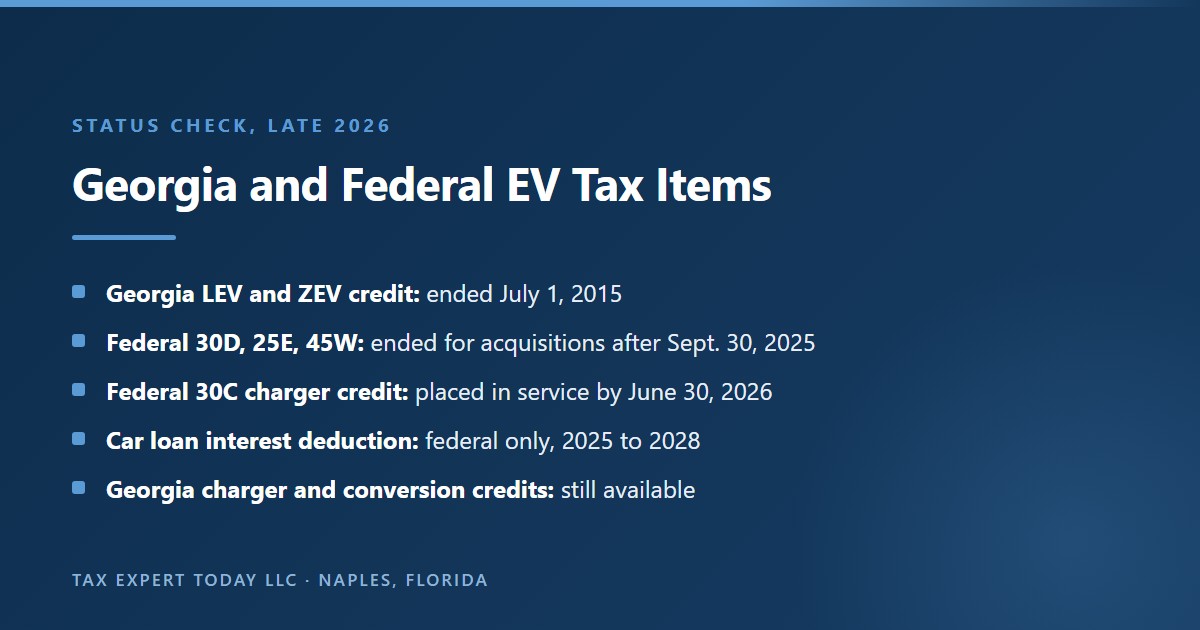
The table below summarizes every vehicle related item a Georgia EV owner is likely to encounter, with its status in late 2026.
| Item | Level | Status in 2026 | Amount |
|---|---|---|---|
| Georgia LEV and ZEV purchase or lease credit | State | Ended July 1, 2015 | None |
| Georgia EV charger credit (code 119) | State | Available to businesses | 10 percent of cost, up to $2,500 |
| Georgia converted vehicle credit (code 156) | State | Available with EPD certification | 10 percent of conversion cost, up to $2,500 per vehicle |
| Federal New Clean Vehicle Credit (section 30D) | Federal | Ended for vehicles acquired after September 30, 2025 | None for new acquisitions |
| Federal Previously Owned Clean Vehicle Credit (section 25E) | Federal | Ended for vehicles acquired after September 30, 2025 | None for new acquisitions |
| Federal charger credit (section 30C) | Federal | Property placed in service through June 30, 2026 | Home: 30 percent up to $1,000 per item |
| Federal car loan interest deduction | Federal | Tax years 2025 through 2028 | Up to $10,000 of interest per year |
| Georgia alternative fuel vehicle fee | State | Due at registration and each renewal | $238.59 non-commercial, $357.98 commercial |
| Georgia title ad valorem tax | State | Due once at titling | 7.0 percent of fair market value |
What Happened to the Old Georgia Electric Vehicle Tax Credit?
Georgia once allowed an income tax credit for buying or leasing a new low emission or zero emission vehicle, certified through the Environmental Protection Division. That credit, along with the medium duty and heavy duty vehicle credits, was discontinued effective July 1, 2015. Vehicles acquired on or after that date never qualified for the old Georgia electric vehicle tax credit.
- Programs ended: LEV, ZEV, and MDV and HDV vehicle credits.
- Effective date: July 1, 2015.
- Certifying agency: the Georgia Environmental Protection Division.
- Same legislative year: House Bill 170 of 2015, which the Department of Revenue cites for the annual alternative fuel vehicle fee.
The 2015 session reshaped how Georgia treats EVs from both directions. The vehicle credits went away, and the General Assembly created an annual alternative fuel vehicle fee, which the Department of Revenue still administers under House Bill 170. In effect, the state moved from paying people to buy EVs to charging EV owners a fee that stands in for the motor fuel tax they do not pay at the pump.
For a tax return in 2026, the history of the Georgia electric vehicle tax credit matters for one practical reason. Any credit, deduction, or carryforward that a software program or an old worksheet suggests for a Georgia EV purchase should be questioned. A credit that ended for vehicles acquired on or after July 1, 2015 cannot be claimed for a vehicle bought in 2024, 2025, or 2026, and an unused balance from a vehicle bought before that date has long since run out its carryforward period. If a Georgia return from a prior year claimed a credit that did not exist, an amended Georgia return on Form 500X is the usual way to correct it.
Which Parts of the Georgia Electric Vehicle Tax Credit Law Still Apply?
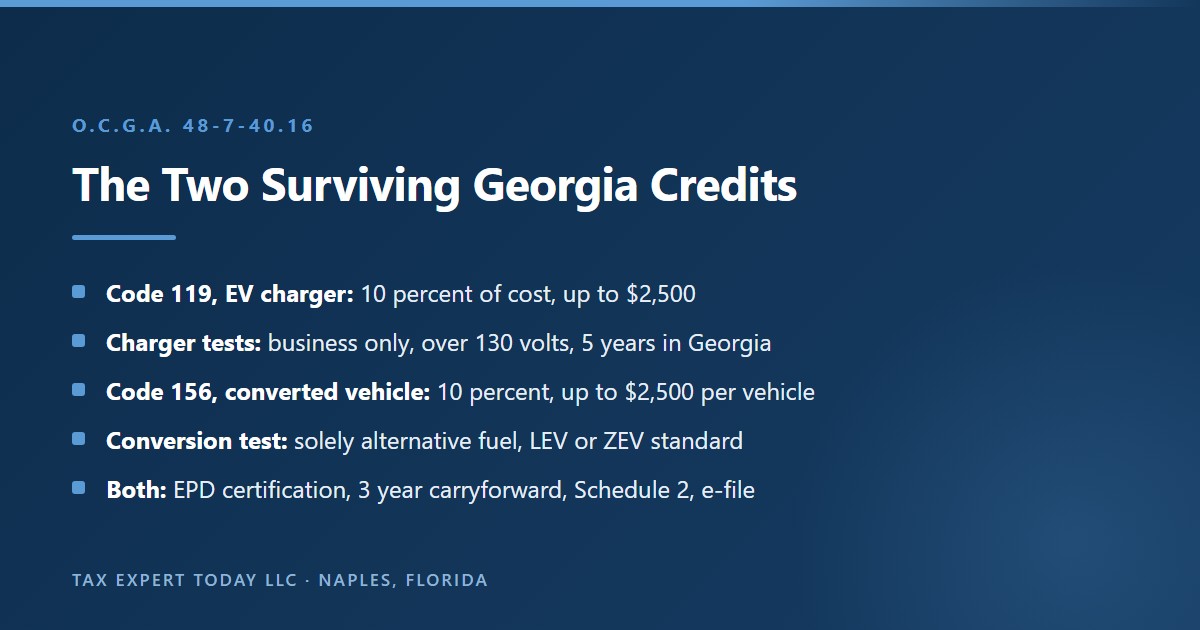
Two Georgia credits remain under O.C.G.A. 48-7-40.16: a credit for businesses that buy or lease and install a qualified EV charger in Georgia, and a credit for converting a conventionally fueled vehicle to run solely on an alternative fuel. Each is worth 10 percent of the cost, capped at $2,500, and each requires Environmental Protection Division certification.
- EV charger credit: credit code 119, businesses only, homes do not qualify.
- Converted vehicle credit: credit code 156, vehicle must run solely on an alternative fuel.
- Certification: issued by EPD before the Department of Revenue allows the credit.
- Carryforward: unused credit may be carried forward for three years.
- Where claimed: Schedule 2 of the Georgia return, which must be filed electronically.
For the two surviving pieces of the Georgia electric vehicle tax credit, the Environmental Protection Division handles the engineering side. It reviews the certification form and supporting documents, signs the form if the requirements are met, and sends it back. The Georgia Department of Revenue then administers the credit itself on the return. Both credits are Series 100 credits, and the IT-511 booklet requires a return that claims any Series 100 credit to be filed electronically, with the credit reported on Schedule 2 of Form 500 for individuals.
Neither surviving Georgia electric vehicle tax credit helps a household that simply buys a factory built EV and charges it in the garage. The charger credit is limited to businesses, and the converted vehicle credit applies to a vehicle that started life running on gasoline or diesel and was later retrofitted. A factory built battery electric vehicle is not a conversion.
How Does the Georgia Electric Vehicle Tax Credit for Chargers Work?
A business that buys or leases and installs a qualified EV charger in Georgia may claim a Georgia income tax credit equal to 10 percent of the charger cost or $2,500, whichever is less. The charger must be rated above 130 volts, designed to charge on road vehicles, certified by EPD, and kept in Georgia for five consecutive years.
- Eligible taxpayer: a business enterprise; individual homes do not qualify.
- Equipment test: rated greater than 130 volts and designed to charge on road vehicles.
- Location test: installed in Georgia and kept there for five consecutive years.
- Amount: the lesser of 10 percent of cost or $2,500.
- Carryforward: up to three years if the credit exceeds the tax.
The $2,500 cap is reached on a charger costing $25,000. Below that, the credit is a straight 10 percent. A dealership, an apartment complex, a hotel, or a retailer installing a Level 2 or DC fast charger for customers or employees is the typical claimant. The credit offsets Georgia income tax, so the business needs Georgia tax liability to use it in the year it is earned, or it carries the unused amount forward.
For a pass through entity, the practical question is where the credit lands. A Georgia S corporation or partnership that earns a Series 100 credit generally passes it through to its owners, who report it on their own returns, unless the entity has elected to pay tax at the entity level. Owners of a Georgia limited liability company should read our guide to Georgia LLC taxes on how the entity’s classification drives that flow.
Federally, a business charger placed in service from January 1, 2023 through June 30, 2026 may also have qualified for the section 30C credit of 6 percent of cost, up to $100,000 per item, if it sat in an eligible census tract. That federal window has closed for new property, but a charger placed in service on or before June 30, 2026 can still be claimed on the 2026 federal return.
Can You Claim the Georgia Converted Vehicle Credit?
Yes, if you convert a conventionally fueled vehicle registered in Georgia so that it runs solely on an alternative fuel and meets the low emission or zero emission standards. The credit is 10 percent of the conversion cost, capped at $2,500 per vehicle, and the EPD certification must be included with the return.
- Fuel test: fueled solely by an alternative fuel; dual fuel vehicles do not qualify.
- Qualifying fuels: compressed or liquefied natural gas, battery electric, propane, and hydrogen fuel cell.
- Emission test: meets the low emission or zero emission standards set by the Board of Natural Resources.
- Documentation: EPD certification provided with the return.
- Carryforward: three years from the year of conversion.
The converted vehicle version of the Georgia electric vehicle tax credit is most often used by fleets that move work trucks or vans to compressed natural gas or propane, but a battery electric conversion qualifies as well. A gasoline hybrid does not, and neither does a vehicle that can still run on gasoline or diesel. The IT-511 booklet lists this as credit code 156. The EPD page also points converters to the federal Environmental Protection Agency rules on aftermarket alternative fuel conversions, because a conversion that does not meet those rules is unlikely to meet the Georgia emission test either.
What Does Georgia Charge EV Owners Every Year?
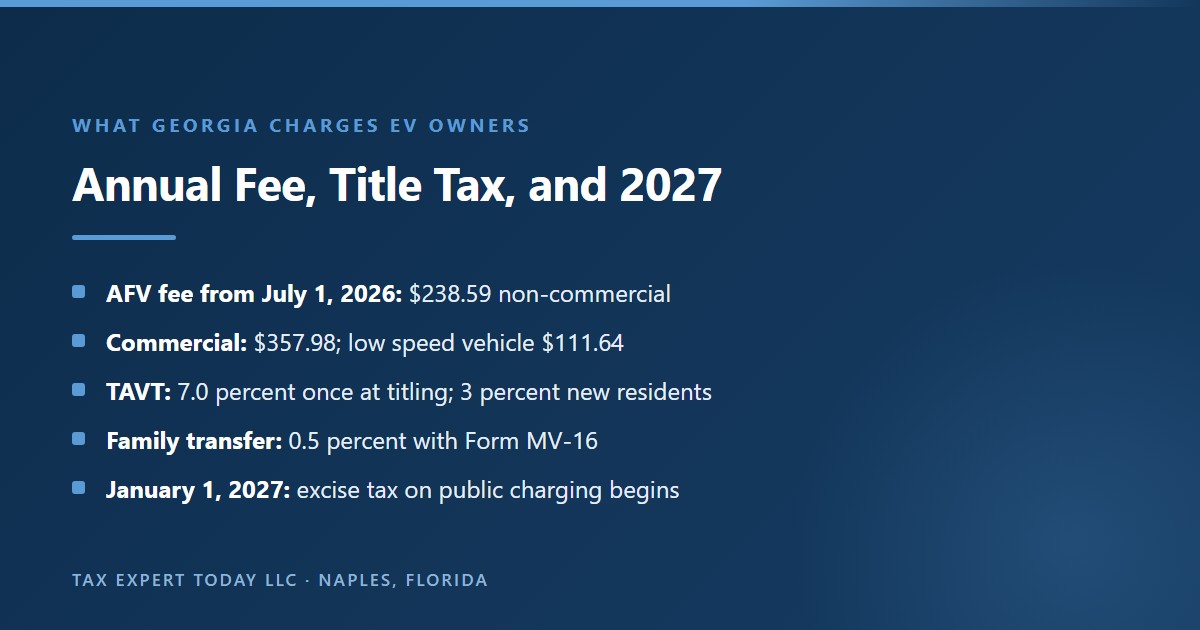
Georgia charges an annual alternative fuel vehicle fee at registration and at every renewal. For July 1, 2026 through June 30, 2027, the fee is $238.59 for a non-commercial vehicle, $357.98 for a commercial vehicle, and $111.64 for a low speed vehicle, in addition to ordinary registration fees.
- All electric vehicles: pay the fee whatever license plate they carry.
- Plug in hybrids and flex fuel vehicles: pay only if the owner elects an alternative fuel vehicle plate.
- Not subject to the fee: vehicles running primarily on natural gas or liquefied petroleum gas, and hybrids that do not plug in.
- No exemptions: government and farm vehicles pay it too.
- Annual adjustment: indexed to average fuel efficiency and the Consumer Price Index.
The fee is set by statute and adjusted every July 1 according to a formula based on the change in average motor vehicle fuel efficiency, as measured by the United States Department of Energy, multiplied by the change in the Consumer Price Index. The Department of Revenue publishes the new figures in a policy bulletin each year. The recent history looks like this:
| Fee period | Non-commercial | Commercial | Low speed vehicle |
|---|---|---|---|
| July 1, 2026 to June 30, 2027 | $238.59 | $357.98 | $111.64 |
| July 1, 2025 to June 30, 2026 | $234.97 | $352.56 | $109.95 |
| July 1, 2024 to June 30, 2025 | $219.84 | $329.86 | $102.87 |
| July 1, 2023 to June 30, 2024 | $210.87 | $316.40 | $98.68 |
Owners who choose the alternative fuel vehicle license plate also pay a one time $25 manufacturing fee, a $20 annual registration fee, and a $35 special tag fee, according to the Department of Revenue FAQ. The plate is what allows a qualifying vehicle to use certain HOV and HOT lanes. For a pure battery electric vehicle, switching to a standard plate does not remove the annual fee, because the fee follows the vehicle type rather than the plate.
Because there is no Georgia electric vehicle tax credit to offset it, the fee is a pure cost of ownership. From a federal income tax point of view, this fee is a flat registration charge rather than a tax based on the vehicle’s value, which matters if you itemize. Federal rules allow a deduction for personal property tax only when it is charged on value, so a flat fee is generally not deductible on Schedule A. Business owners who use the EV in a trade or business follow the ordinary business expense rules instead.
How Much Title Tax Do You Pay on an EV in Georgia?
An electric vehicle titled in Georgia pays the same title ad valorem tax as any other vehicle: a one time 7.0 percent of fair market value when the vehicle is titled. New Georgia residents pay 3 percent, and a qualifying immediate family transfer pays 0.5 percent. TAVT replaces sales tax and the annual ad valorem tax.
- Standard rate: 7.0 percent of fair market value, paid once at titling.
- New residents: 3 percent when a vehicle is first registered in Georgia.
- Family transfer: 0.5 percent with Form MV-16, if TAVT was already paid on the vehicle.
- What it replaces: sales and use tax and the annual ad valorem tax on vehicles bought on or after March 1, 2013.
For a new vehicle, the Department of Revenue uses the greater of the retail selling price, or for a lease the agreed upon value, and the value in the state assessment manual. EVs tend to carry higher sticker prices than comparable gasoline models, so the TAVT bill is often the largest single Georgia tax an EV buyer pays. On a vehicle with a $50,000 fair market value, 7.0 percent is $3,500, due at the tag office before the title issues, and no Georgia electric vehicle tax credit offsets it.
Two situations come up often with the clients we see. A family that moves from Florida to Georgia and brings an EV pays the 3 percent new resident rate rather than 7.0 percent, plus the annual alternative fuel vehicle fee from the first Georgia registration. A parent who transfers a Georgia titled EV to an adult child can use the 0.5 percent family rate, and the transfer itself may also raise federal gift tax reporting questions, which our guide to Georgia gift tax covers.
Can Georgia Buyers Still Claim the Federal EV Tax Credit?
Only for a vehicle acquired on or before September 30, 2025. The IRS states that the New Clean Vehicle Credit, the Previously Owned Clean Vehicle Credit, and the Qualified Commercial Clean Vehicle Credit are not available for vehicles acquired after that date. A binding written contract and a payment by September 30, 2025 count as acquisition.
- New vehicles: section 30D, up to $7,500, only for acquisitions on or before September 30, 2025.
- Used vehicles: section 25E, individuals only, same cutoff.
- Commercial vehicles: section 45W, up to $40,000, same cutoff.
- Late delivery: a vehicle placed in service after the cutoff still qualifies if it was acquired by then.
- Form: Form 8936 on the federal return for the year the vehicle is placed in service.
For buyers who hoped a federal credit would make up for the missing Georgia electric vehicle tax credit, the rule that trips people up is the split between acquiring a vehicle and placing it in service. A Georgia buyer who signed a binding written contract and made a payment in September 2025, but took delivery in 2026, may still claim the credit on the 2026 federal return, because the vehicle was acquired before the cutoff and placed in service in 2026. A buyer who signed in October 2025 or later has no federal credit regardless of when the vehicle arrives.
| Binding contract and payment | Vehicle placed in service | Federal clean vehicle credit |
|---|---|---|
| On or before September 30, 2025 | 2025 | May qualify on the 2025 return |
| On or before September 30, 2025 | 2026 | May qualify on the 2026 return |
| After September 30, 2025 | Any date | Not available |
| Lease signed after September 30, 2025 | Any date | Not available to the lessor or the lessee |
There has been no Georgia electric vehicle tax credit to pair with the federal credits since 2015, so there is nothing to add back or subtract on the Georgia return because of them. Georgia starts from federal adjusted gross income, and a federal credit reduces federal tax, not federal adjusted gross income. The Georgia return is simply unaffected.
Does the Federal Car Loan Interest Deduction Lower Your Georgia Tax?
No. The federal deduction of up to $10,000 a year of interest on a loan for a new, United States assembled personal vehicle applies for 2025 through 2028, but it is taken after adjusted gross income. Georgia starts from federal adjusted gross income, and the 2025 IT-511 booklet says Georgia has not adopted the One Big Beautiful Bill Act.
- Federal amount: up to $10,000 of qualified interest per year, 2025 through 2028.
- Phase out: begins at modified adjusted gross income over $100,000, or $200,000 for joint filers.
- Vehicle test: new, personal use, under 14,000 pounds, final assembly in the United States.
- Loan test: originated after December 31, 2024 and secured by a lien on the vehicle.
- Georgia effect: none, because the deduction sits below federal adjusted gross income.
This deduction is not limited to EVs, but with no Georgia electric vehicle tax credit and no federal clean vehicle credit for new acquisitions, it has become the main federal tax item left for many EV buyers. The IRS fact sheet on the new deductions notes that leases do not qualify, used vehicles do not qualify, and the vehicle identification number must be reported on the return each year the deduction is claimed. Itemizers and non-itemizers can both take it.
For Georgia, the 2025 IT-511 booklet states that Georgia conforms to the Internal Revenue Code as amended in federal law enacted on or before January 1, 2025, and that Georgia has not adopted the changes in the One Big Beautiful Bill Act, which was signed on July 4, 2025. The Department’s 2026 update page shows where Georgia chose to write its own rule instead: it did not conform to the federal overtime and tip deductions, but it allows up to $1,750 of each to be excluded from Georgia taxable income. No similar Georgia subtraction for car loan interest appears in the Department’s guidance. Unless the General Assembly changes that in a later conformity bill, the car loan interest deduction helps the federal return only. Our guide to Georgia state income tax walks through how the Georgia computation starts from federal adjusted gross income.
| Federal item | Where it sits federally | Effect on the Georgia return |
|---|---|---|
| Clean vehicle credit (Form 8936) | Credit against federal tax | None |
| Car loan interest deduction | Below adjusted gross income | None; not adopted by Georgia |
| Charger credit (Form 8911) | Credit against federal tax | None; the Georgia charger credit is separate |
| Business depreciation on an EV | Part of business income | Flows through adjusted gross income, subject to Georgia depreciation adjustments |
What About the Federal Home Charger Credit?
The federal Alternative Fuel Vehicle Refueling Property Credit under section 30C allowed 30 percent of the cost of a home charger, up to $1,000 per item, for property placed in service from January 1, 2023 through June 30, 2026, if the home was in an eligible census tract. There is no Georgia electric vehicle tax credit for home chargers.
- Home charger: 30 percent of cost, up to $1,000 per charging port.
- Business charger: 6 percent of cost, up to $100,000 per item.
- Location test: low income community or non-urban census tract.
- Deadline: placed in service on or before June 30, 2026.
- Georgia side: the state charger credit is limited to businesses.
A Georgia homeowner who installed a Level 2 charger in the first half of 2026 should check two things before claiming the federal credit on the 2026 return: the in service date, and whether the address falls in an eligible census tract under the IRS lookup tables. Utility rebates for home chargers, such as those offered by Georgia Power and some electric membership cooperatives, are not tax credits, and a rebate that reduces what you paid generally reduces the cost basis used for any federal credit as well.
What Changes for Georgia EV Drivers in 2027?
Starting January 1, 2027, Georgia applies its motor fuel excise tax to electricity sold at public EV charging stations, measured in gasoline gallon equivalents of no more than 11 kilowatt hours. Public chargers must also display electricity dispensed per kilowatt hour. Home charging is not subject to this tax.
- Effective date: January 1, 2027.
- What is taxed: electricity sold at public EV charging stations.
- Conversion rule: one gasoline gallon equivalent may not exceed 11 kilowatt hours.
- Display rule: public chargers must show per kilowatt hour delivery, with fines up to $1,000 for violations.
- Exemption: free charging by nonprofits on federal interstates, under House Bill 652 of 2025.
The Department of Energy summary of Georgia laws and incentives cites O.C.G.A. 48-9-3 for the tax and O.C.G.A. 10-1-220 through 10-1-228 for the display rule. Like the annual fee, the excise tax works in the opposite direction from the old Georgia electric vehicle tax credit. It is collected through the charging station operator, not on the driver’s income tax return, so it is a cost of charging rather than a filing item. For a business that operates public chargers, though, it means new registration, collection, and reporting duties with the Department of Revenue from 2027, alongside any charger credit the business claimed when it installed the equipment. A Georgia EV owner who charges mainly at home will continue to pay the annual alternative fuel vehicle fee instead.
What Are the Most Common Georgia Electric Vehicle Tax Credit Mistakes?
The most frequent errors are claiming a Georgia EV purchase credit that ended in 2015, claiming the federal clean vehicle credit for a vehicle acquired after September 30, 2025, deducting car loan interest on the Georgia return, treating the annual EV fee as deductible property tax, and missing the e-file rule for Series 100 credits.
- Phantom state credit: no Georgia purchase credit exists for vehicles acquired on or after July 1, 2015.
- Wrong federal date: the acquisition date, not the delivery date, controls the federal credit.
- Georgia car loan deduction: Georgia has not adopted it.
- Fee as property tax: the flat alternative fuel vehicle fee is not a value based tax.
- Paper filing: a return claiming credit code 119 or 156 must be filed electronically.
| Mistake | Why it fails | What to check |
|---|---|---|
| Claiming a Georgia purchase credit | The LEV and ZEV credits ended July 1, 2015 | EPD Clean Vehicle Related Tax Credits page |
| Claiming the federal credit on a late 2025 or 2026 deal | Acquisition after September 30, 2025 | Contract date and payment date |
| Home charger on the Georgia return | The Georgia charger credit is for businesses only | Who owns the charger and where it sits |
| Car loan interest on the Georgia return | Georgia has not adopted the deduction | Current IT-511 conformity statement |
| Paper return with code 119 or 156 | Series 100 credits require e-filing | Schedule 2 and the EPD certification |
Most Georgia electric vehicle tax credit mistakes come from carrying forward assumptions from an earlier year. A buyer who claimed the federal credit in 2024 may expect it again on a 2026 purchase. A business owner who heard about the charger version of the Georgia electric vehicle tax credit may assume it covers the owner’s home charger as well. A careful review of the purchase contract, the in service date, and the certification paperwork usually settles each question before the return is filed.
Georgia Electric Vehicle Tax Credit Help in Naples & Southwest Florida
Tax Expert Today LLC reviews Georgia charger and converted vehicle credits, federal clean vehicle and charger credits, and the Georgia return that goes with them from its office at 11983 Tamiami Trail N, Naples, FL 34110. Georgia clients are served nationwide from Naples, Florida, by phone and secure document exchange. Call (239) 441-2005.
- Georgia EV tax credit help Naples: review of credit codes 119 and 156 and the EPD certification.
- Business owners: charger credits for dealerships, hotels, apartments, and retail sites.
- Federal timing: checking acquisition and in service dates against the September 30, 2025 cutoff.
- Movers: TAVT, the new resident rate, and the first Georgia return after a move from Florida.
- Prior years: correcting a return that claimed a credit that no longer exists.
Tax Expert Today LLC is based at 11983 Tamiami Trail N, Naples, FL 34110, and our office is open Monday through Friday, 10 a.m. to 5 p.m. Eastern time. You can reach us at (239) 441-2005. Many of the Georgia electric vehicle tax credit questions we see come from Collier and Lee County residents who keep a home, a business, or a vehicle in Georgia, and from families splitting the year between Southwest Florida and metro Atlanta. We work with Georgia clients remotely, and there is no need to visit Naples to work with us.
For the full range of our Georgia work, see our Georgia tax services page. Related guides include the Georgia part year resident tax return for the year of a move, the Georgia R&D tax credit for another Series 100 credit claimed on Schedule 2, and Georgia use tax for purchases made outside the state.
A point of scope, stated plainly: Georgia vehicle credits, the alternative fuel vehicle fee, and TAVT are Georgia Department of Revenue matters. Our team of tax advisors, enrolled agents, CPAs, and attorneys handles state tax matters nationwide, and we explain how the Georgia rules apply to your facts rather than predicting any particular result.
When to Engage a Professional
Most EV owners do not need help to pay a registration fee. A review makes sense when a business is installing chargers, a fleet is converting vehicles, a federal credit depends on a contract date near September 30, 2025, a prior Georgia return claimed an EV credit, or a move between Florida and Georgia changes residency and title tax.
- Before installing chargers: to plan EPD certification and the five year location rule.
- Before converting a fleet: to confirm the vehicles meet the sole fuel and emission tests.
- Before filing: when a federal credit turns on the acquisition date.
- After a notice: when the Department of Revenue questions a credit on a prior return.
Call (239) 441-2005 to schedule a free consultation. We will look at the purchase or installation documents, the certification, and your Georgia return, and explain the options in writing.
Frequently Asked Questions About the Georgia Electric Vehicle Tax Credit
Is there a Georgia electric vehicle tax credit in 2026?
No. Georgia ended its low emission and zero emission vehicle income tax credits effective July 1, 2015, according to the Georgia Environmental Protection Division. Only two narrower Georgia credits remain: a business credit for installing EV chargers and a credit for converting a vehicle to run solely on an alternative fuel.
How much is the Georgia EV charger tax credit?
The credit is 10 percent of the cost of a qualified charger or $2,500, whichever is less. It is available only to businesses, the charger must be rated above 130 volts and certified by the Environmental Protection Division, and it must stay in Georgia for five consecutive years. Unused credit carries forward three years.
Can I get a Georgia tax credit for a home EV charger?
No. The Georgia Environmental Protection Division states that individual homes do not qualify for the Georgia charger credit. The federal section 30C credit allowed 30 percent of the cost, up to $1,000 per item, for home chargers placed in service through June 30, 2026 in an eligible census tract.
How much is the Georgia electric vehicle fee in 2026?
For July 1, 2026 through June 30, 2027, the Georgia Department of Revenue lists the alternative fuel vehicle fee at $238.59 for non-commercial vehicles, $357.98 for commercial vehicles, and $111.64 for low speed vehicles. It is due at registration and every renewal, in addition to ordinary registration fees.
Can I still claim the federal $7,500 EV credit if I live in Georgia?
Only if you acquired the vehicle on or before September 30, 2025. The IRS treats a binding written contract plus a payment by that date as acquisition, so a vehicle delivered in 2026 can still qualify. Vehicles acquired after September 30, 2025 do not qualify for the new, used, or commercial clean vehicle credits.
Does Georgia allow the federal car loan interest deduction?
Not under current guidance. The 2025 IT-511 booklet says Georgia conforms to the Internal Revenue Code as of January 1, 2025 and has not adopted the One Big Beautiful Bill Act. The deduction is also taken below federal adjusted gross income, which is where the Georgia computation starts.
Do I pay sales tax on an electric car in Georgia?
No. Vehicles titled in Georgia pay the title ad valorem tax instead of sales tax and the annual ad valorem tax. The rate is 7.0 percent of fair market value, 3 percent for a new Georgia resident, and 0.5 percent for a qualifying immediate family transfer.
I live in Naples, Florida, and own an EV registered in Georgia. Can you help with the Georgia side?
Yes. Tax Expert Today LLC reviews Georgia vehicle credits, the alternative fuel vehicle fee, and the Georgia return from its Naples, Florida office at 11983 Tamiami Trail N. Georgia clients work with us remotely. Call (239) 441-2005 for a free consultation.
Published October 23, 2026 by Dr. Pellumb Kabashi « Back to Learning Center
Have a question this article touches on?
Tax Expert Today LLC, based in Naples, Florida and serving clients across the United States.
Schedule a Consultation (239) 441-2005