
By Dr. Pellumb Kabashi, DBA, MBA, EA, CFE, CES
Founder, Tax Expert Today LLC · Tax advisors, enrolled agents, CPAs, and attorneys · Serving clients in all 50 states
Quick Answer: An IRS notice of deficiency is the statutory letter, commonly called the 90 day letter, that proposes additional tax and gives you the right to petition the United States Tax Court before the tax is assessed. Under IRC §6213(a) the window is 90 days from the mailing date, or 150 days if the notice is addressed to a person outside the United States. Call (239) 441-2005 for a free consultation.
What is an IRS notice of deficiency?
An IRS notice of deficiency is a statutory letter issued under IRC §6212 that formally determines additional tax is owed. It is not a bill. It is the document that opens the door to the United States Tax Court, because under IRC §6213(a) the IRS generally may not assess that tax or collect it while the petition period is running.
- It arrives by certified or registered mail. IRC §6212(a) authorizes the Secretary to send the notice by certified mail or registered mail, which is why these letters require a signature and why the mailing date matters more than the date the envelope was opened.
- It must identify the Taxpayer Advocate. The same subsection requires the notice to include the taxpayer right to contact a local office of the Taxpayer Advocate Service, along with that office location and phone number.
- It is a determination, not an assessment. The tax described in the notice has not yet been assessed. Assessment is what the notice makes possible once the petition period closes without a petition.
- It is the only pre-payment route to a court. Every other path to a federal court on the same liability generally requires paying the tax first and then suing for a refund.
That last point is why practitioners treat these letters differently from every other IRS notice. A CP14 balance due notice or an LT11 final notice of intent to levy concerns collection of a tax that already exists. A notice of deficiency concerns whether the tax should exist at all, and it carries a deadline that governs whether any court will ever consider that question without payment first.
CP3219A, CP3219N, or Letter 3219B: which notice arrived?
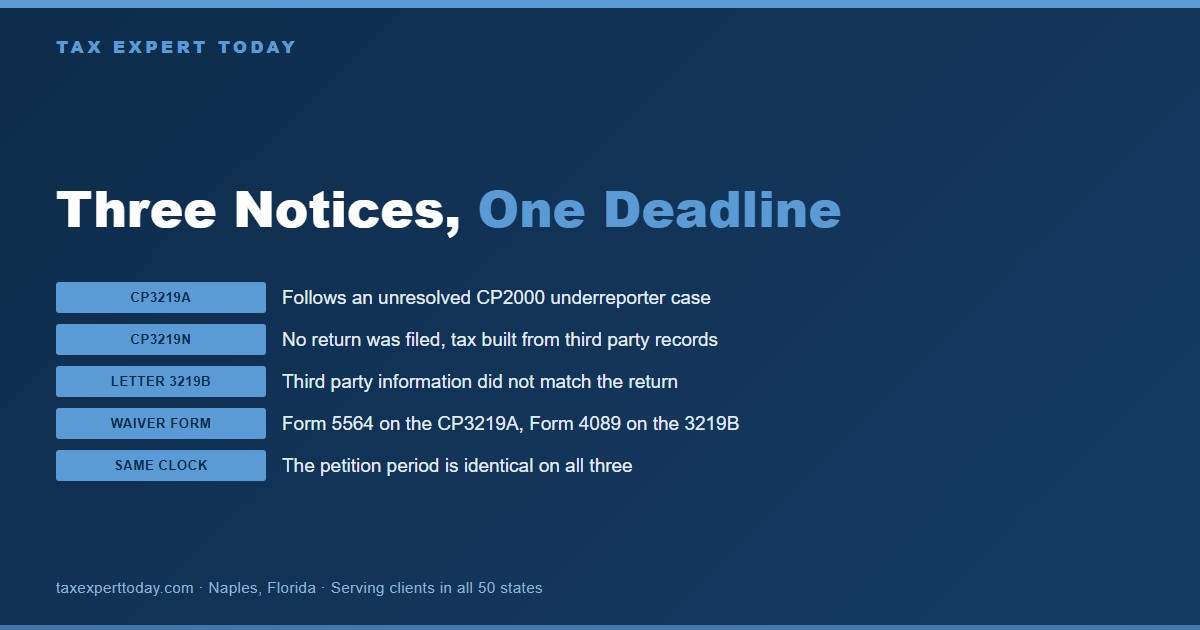
The IRS issues the statutory notice under several different numbers, and the number identifies which examination path produced it. A CP3219A follows an underreporter matching case. A CP3219N follows a return the IRS never received. A Letter 3219B follows a third party information mismatch. The petition deadline is identical across all three, but the productive response is not.
- The notice number sits in the upper right corner. Identify it before doing anything else, because the enclosed waiver form and the corrective step both differ by path.
- CP3219N means the IRS built a return. The IRS states that it did not receive the return and calculated the tax, penalty, and interest from wages and other income reported by employers, financial institutions, and others.
- CP3219A escalates the CP2000 process. It follows an underreported income notice that was never resolved, and the IRS points taxpayers to Publication 5181 for the underlying matching process.
- The waiver form is not the same document. CP3219A encloses Form 5564, Notice of Deficiency Waiver. Letter 3219B asks for Form 4089, Notice of Deficiency Waiver. Signing either one surrenders the Tax Court right for the items it covers.
| Notice | What produced it | Waiver form enclosed | The response that actually helps |
|---|---|---|---|
| CP3219A | An unresolved automated underreporter case, usually preceded by a CP2000 | Form 5564 | Supply the missing substantiation, or file Form 1040-X with CP3219A written on top together with Form 5564 where other income, credits, or expenses were also omitted |
| CP3219N | No return was filed, so the IRS computed the tax from third party income records | Response form at the end of the notice | File the actual return. The IRS directs taxpayers who disagree to file the past due return by the date shown on the notice |
| Letter 3219 or 3219B | Information reported by third parties did not match the return as filed | Form 4089 | Mail the supporting information immediately to the address on the notice, while treating the petition deadline as entirely unaffected by that correspondence |
The CP3219N path deserves particular attention because the corrective step is counterintuitive. The IRS is not asking for an argument. It is asking for the return. A substitute assessment built from third party records allows no dependents, no itemized deductions, and no business expenses, so a properly prepared return is very often lower than the proposed figure. Taxpayers in this position should review our guide to unfiled tax returns and the substitute for return process before responding, and should note the IRS caution that a refund for that year requires filing within three years of the due date.
One further detail on Letter 3219B is easy to miss. The IRS warns that the amount shown as due may not match the amount on the earlier notice, because not every item is subject to challenge in the Tax Court. A figure that changed between notices is therefore not necessarily an error.
How long is there to file a Tax Court petition?
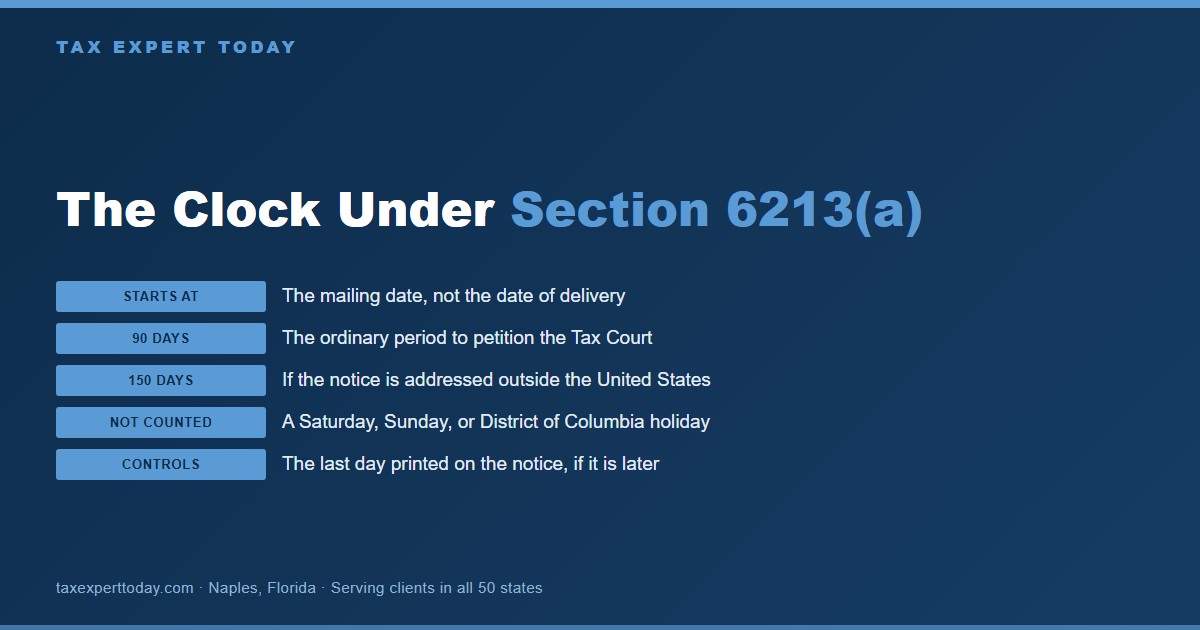
IRC §6213(a) allows 90 days from the mailing of the notice, or 150 days where the notice is addressed to a person outside the United States. A Saturday, Sunday, or legal holiday in the District of Columbia does not count as the last day. Where the IRS prints a later date on the notice, that printed date controls, and a petition filed on or before it is treated as timely.
- The clock starts at mailing, not at delivery. The statute measures the period from the date the notice is mailed, so a letter that sat unclaimed for two weeks has already consumed two weeks of the window.
- The printed last day is operative. The final sentence of §6213(a) provides that any petition filed on or before the last date specified by the Secretary in the notice is treated as timely filed, which protects a taxpayer who relied on a printed date later than a strict count would produce.
- District of Columbia holidays count, not state holidays. The exclusion in §6213(a) is specific to legal holidays in the District of Columbia, a distinction that matters in April when Emancipation Day falls near the filing season.
- Corresponding with the IRS does not pause the clock. The IRS answers this directly on the CP3219A page: there is no extension of time to respond, and working the case administratively does not extend the time to petition.
- The Tax Court cannot extend it either. The Court states that by law it cannot extend the time for filing a petition in response to a notice of deficiency.
This is the most common way a defensible tax position is lost. A taxpayer sends documents to the address printed on the notice, receives no reply, assumes the matter is under review, and learns months later that the petition period expired while the correspondence was in transit. The two tracks run in parallel and only one of them carries a deadline. Sending documents is sensible. Sending documents instead of protecting the deadline is not.
What are the three options after an IRS notice of deficiency?
There are three, and doing nothing is one of them. A taxpayer who agrees signs the enclosed waiver, which permits immediate assessment and stops further interest from accruing on the waived amount sooner. A taxpayer who disagrees petitions the Tax Court within the period. A taxpayer who does neither allows assessment to occur automatically when the period ends.
- Signing the waiver is a decision, not a formality. Form 5564 or Form 4089 gives up the right to have the Tax Court redetermine the deficiency for the items covered.
- Petitioning does not commit anyone to a trial. Filing preserves the pre-payment forum, and many petitioned cases are resolved with IRS Appeals rather than tried.
- Doing nothing is not neutral. Once the period closes the IRS assesses and the file moves to collection, beginning with a balance due notice.
- Partial agreement is possible. A taxpayer may concede some adjustments and contest others, and the CP3219A instructions contemplate submitting Form 1040-X alongside the waiver where additional items were also omitted.
| Option | Mechanism | Deadline | What follows |
|---|---|---|---|
| Agree | Sign and return Form 5564 or Form 4089 | No statutory deadline, but sooner limits further interest | The IRS assesses and issues a bill. Payment options and an installment agreement become available |
| Disagree | File a petition with the United States Tax Court | The last day printed on the notice, generally 90 days from mailing or 150 days if addressed outside the United States | Assessment and collection remain prohibited until the Tax Court decision becomes final |
| Do nothing | No action | The period expires on its own | The IRS assesses the proposed deficiency, collection begins, and the remaining routes are audit reconsideration or an offer based on doubt as to liability |
Taxpayers frequently ask whether petitioning the Tax Court is an aggressive step. In practical terms it is a preservation step. The petition holds the pre-payment forum open while the substantive discussion continues, and it is the only action within the taxpayer control that does so.
Can the 90 day deadline be extended or excused?
Assume it cannot. The Tax Court has held the deadline to be jurisdictional, and while several federal appellate courts have since disagreed and allowed equitable tolling in narrow circumstances, the courts are divided and the outcome depends on where an appeal would lie. For a Florida taxpayer the conservative and currently correct assumption is that a late petition cannot be heard.
- The Tax Court position remains jurisdictional. In Hallmark Research Collective v. Commissioner, 159 T.C. 126 (2022), the Tax Court concluded that the §6213(a) deadline is jurisdictional and not subject to equitable tolling.
- Boechler opened the question. In Boechler, P.C. v. Commissioner, 596 U.S. 199 (2022), the Supreme Court held that a different Tax Court filing deadline, the 30 day period for a collection due process petition, is not jurisdictional and is subject to equitable tolling. That reasoning is what prompted the challenges to §6213(a).
- Several circuits have since allowed tolling. The Third Circuit held in Culp v. Commissioner, 75 F.4th 196 (3d Cir. 2023), that the 90 day deadline is a claim processing rule rather than a jurisdictional bar, and further circuits have reached the same conclusion in the years since.
- Other circuits have not. The Seventh Circuit in Tilden v. Commissioner, 846 F.3d 882 (7th Cir. 2017), and the Ninth Circuit in Organic Cannabis Foundation, LLC v. Commissioner, 962 F.3d 1082 (9th Cir. 2020), treated the deadline as jurisdictional, and at least one circuit has more recently held the deadline mandatory and not subject to tolling even while agreeing it is not jurisdictional.
- Where the appeal would lie decides the question. Under the long standing Golsen rule the Tax Court follows the law of the circuit to which an appeal in the case would go. For an individual residing in Florida that is the Eleventh Circuit, which has not adopted equitable tolling for this deadline.
| Forum | Is the §6213(a) deadline jurisdictional? | Is equitable tolling available? | Practical effect on a late petition |
|---|---|---|---|
| United States Tax Court, absent contrary circuit law | Yes, per Hallmark Research Collective v. Commissioner, 159 T.C. 126 (2022) | No | Dismissed for lack of jurisdiction |
| Circuits following Culp v. Commissioner, 75 F.4th 196 (3d Cir. 2023) | No, treated as a claim processing rule | Yes, in narrow circumstances | May survive dismissal if diligence and an extraordinary circumstance are shown |
| Circuits following Tilden, 846 F.3d 882 (7th Cir. 2017) and Organic Cannabis Foundation, 962 F.3d 1082 (9th Cir. 2020) | Yes | No | Dismissed for lack of jurisdiction |
| Eleventh Circuit, which hears appeals from Florida | Has not adopted the tolling position | Not available at present | A late petition should be treated as fatal |
This is an unsettled and actively developing area, and nothing in it should be read as a reason to relax about a date. Even in a circuit that permits equitable tolling, the doctrine is narrow and is generally reserved for a taxpayer who pursued rights diligently and was prevented from filing by an extraordinary circumstance. Illness, a misdelivered envelope, or reliance on assurances from someone at the IRS may or may not qualify, and litigating the question is far more expensive than filing on time. The only sound planning assumption is the one the Tax Court prints on its own website, that the deadline cannot be extended.
What if the notice went to an old address?
An IRS notice of deficiency mailed to the last known address is valid whether or not it was received. IRC §6212(b)(1) provides that a notice mailed to the taxpayer at the last known address is sufficient, and it says so even where the taxpayer has died, is under a legal disability, or is a corporation that has terminated its existence. Actual receipt is not an element.
- The address of record governs. The last known address is generally the one on the most recently filed and properly processed return, unless the IRS has been given clear and concise notification of a different address.
- Form 8822 exists for this reason. Filing a change of address with the IRS is the ordinary way to update the record, and it is worth doing before a dispute rather than during one.
- Separated spouses may each be entitled to a copy. Under §6212(b)(2), where the IRS has been notified that separate residences have been established, a duplicate original of a joint notice is to be sent by certified or registered mail to each spouse at their last known address.
- A defective mailing is a real argument, but a narrow one. Where the IRS did not use the last known address, the validity of the notice can be contested, though the analysis is fact specific and turns on what the IRS knew and when.
The practical consequence is uncomfortable but important to state plainly. A taxpayer who moved, never updated the address, and never saw the certified letter may still find the deficiency assessed at the end of the period. Discovering the notice after the fact usually shifts the discussion toward audit reconsideration rather than the Tax Court, which is a materially weaker position because it depends on IRS discretion rather than a statutory right.
Can the IRS assess or levy while the 90 days are running?
Generally no. IRC §6213(a) prohibits assessment of the deficiency, any levy, and any court proceeding for collection until the notice has been mailed and the 90 day or 150 day period has expired, and where a petition is filed, until the Tax Court decision becomes final. The recognized exceptions are termination and jeopardy assessments under §§6851, 6852, and 6861.
- The prohibition covers three separate actions. No assessment, no levy, and no proceeding in court for collection of the deficiency during the restricted period.
- A violation can be enjoined. The statute provides that notwithstanding the Anti-Injunction Act at §7421(a), an assessment, proceeding, or levy made during the prohibition may be enjoined by a proceeding in the proper court, including the Tax Court.
- A refund of what was collected can be ordered. The same sentence allows a court to order a refund of any amount collected during the period in which collection was prohibited.
- The Tax Court route requires a timely petition. The Tax Court has no jurisdiction to enjoin or to order that refund unless a timely petition for redetermination has been filed, and then only as to the deficiency covered by the petition.
Two qualifications keep this from being broader than it is. First, the protection attaches to the deficiency described in the notice and not to other liabilities, so an unrelated assessed balance from a different year can still be collected during the same window. Second, the injunction remedy is meaningful in the Tax Court only for a taxpayer who filed on time, which is one more reason the petition is the action that preserves everything else.
Can an IRS notice of deficiency be rescinded?
Yes, but only by agreement. IRC §6212(d) permits the Secretary to rescind a notice of deficiency with the consent of the taxpayer. A rescinded notice is then treated as though it had never been issued for the key purposes, and the taxpayer has no right to petition on it. Rescission is discretionary on the IRS side and is not available on demand.
- Consent is required from both sides. The statute conditions rescission on the consent of the taxpayer, and in practice the IRS must also agree that rescission is appropriate.
- It resets the restriction on further notices. A rescinded notice is not treated as a notice of deficiency for purposes of §6212(c)(1), so the IRS retains the ability to issue a later notice for that year.
- It removes the Tax Court right along with the deadline. Because the rescinded notice is also disregarded for §6213(a), the petition right attached to it disappears.
- It is a case management tool, not relief. Rescission is typically considered where the notice was issued prematurely or in error and both sides would rather return the case to examination or Appeals.
Rescission is worth knowing about precisely because it is so rarely mentioned. It is not a way to escape a deficiency. It is a way to return a case to an administrative posture where the substantive dispute can be worked without the pressure of a running jurisdictional clock, and it trades away the Tax Court right to do so. That trade only makes sense where there is real confidence that the administrative route will resolve the matter.
Is a math error notice an IRS notice of deficiency?
No. Under IRC §6213(b)(1) a notice of an assessment arising from a mathematical or clerical error on the return is expressly not treated as a notice of deficiency, carries no right to petition the Tax Court, and does not trigger the restriction on assessment. In exchange, §6213(b)(2) gives the taxpayer a 60 day request that forces abatement.
- The notice must explain the error. The statute requires each math error notice to set forth the error alleged and an explanation of it.
- A 60 day request compels abatement. A taxpayer may file a request for abatement within 60 days after the notice is sent, and on receipt of that request the statute directs that the Secretary shall abate the assessment.
- Abatement converts it into a real deficiency case. Any reassessment of the tax after such an abatement becomes subject to the ordinary deficiency procedures, which means a genuine notice of deficiency and a genuine Tax Court right.
- Collection is stayed meanwhile. No levy or court proceeding to collect that assessment may be made or prosecuted during the period in which the assessment may be abated.
This is one of the most valuable and least used provisions in the collection area. A taxpayer who receives a math error notice and simply pays, or who argues the substance by telephone past the sixtieth day, has given up a statutory right to force the IRS back onto the deficiency track. The request itself does not require winning an argument. It requires being made in time.
How is a Tax Court petition actually filed?
A petition may be filed electronically through the Tax Court DAWSON system or on paper by mail or in person, and the filing fee is $60, payable by check, money order, or through Pay.gov. Where the amount in dispute is modest, IRC §7463 allows an election to have the case handled under simplified small tax case procedures.
- Electronic filing is encouraged. The IRS notice pages themselves direct taxpayers to the Tax Court DAWSON system, which requires registering for an account.
- Paper filing remains available. A petition may be mailed or hand delivered to the Clerk of the United States Tax Court at 400 Second Street NW, Washington, DC 20217.
- The small case election has a $50,000 ceiling. IRC §7463 applies where neither the deficiency placed in dispute nor any claimed overpayment exceeds $50,000 for any one taxable year, at the option of the taxpayer and with the concurrence of the Court before the hearing.
- The small case trade off is finality. Under §7463(b) a decision in a small tax case is not reviewable by any other court and is not treated as precedent in any other case.
- Representation is not limited to attorneys. A taxpayer may proceed without counsel, and non attorneys admitted to practice before the Tax Court may also represent petitioners.
The $50,000 threshold in §7463 should not be confused with the $25,000 ceiling that applies to a Small Case Request to IRS Appeals earlier in the process. They are different procedures at different stages with different consequences, and the earlier one is described in our guide to what happens if you get audited by the IRS.

What happens after the 90 days expire?
The IRS assesses the proposed deficiency and the file moves from examination into collection. A balance due notice follows, then the ordinary collection sequence. The Tax Court route is gone, but two administrative routes remain: audit reconsideration where new information exists, and an offer in compromise based on doubt as to liability.
- Assessment starts the collection clock. The ten year period for collection under IRC §6502 runs from assessment, which is covered in our guide to the IRS 10 year collection statute.
- Audit reconsideration is discretionary. It is generally available where new information not previously considered exists, where the taxpayer did not appear, or where the assessment came from a substitute for return, and the IRS is not obliged to grant it.
- Doubt as to liability is a separate offer track. An offer in compromise may be based on doubt that the liability is correct rather than on inability to pay.
- Collection appeal rights are still available. A lien filing or a final notice of intent to levy carries its own appeal rights, described in our comparison of the collection due process hearing and the collection appeals program.
It is worth being direct about the change in posture once an IRS notice of deficiency has ripened into an assessment. Before the deadline, the taxpayer holds a statutory right to a pre-payment hearing in a court. After it, the taxpayer is asking the IRS to reopen something it has already closed. The substantive facts may be identical. The leverage is not. Where a penalty was asserted alongside the tax, the accuracy related penalty analysis frequently continues to matter even after the deficiency itself is settled.
Notice of deficiency help Naples: 90 day letters in Naples and Southwest Florida
Taxpayers reach our office in Naples, Florida with a 90 day letter at one of two moments: within a few days of the certified mail slip, or with roughly two weeks left on the printed date. The first conversation is almost always about the date and the notice number rather than the tax position, because the notice number determines the productive response and the date determines whether the Tax Court option still exists. Tax resolution Naples clients are often surprised that documents already mailed to the IRS did nothing to protect the deadline.
Tax Expert Today LLC
11983 Tamiami Trail N, Naples, FL 34110
Phone: (239) 441-2005
Hours: Monday through Friday, 10:00 to 5:00 ET
Does living in Florida change how an IRS notice of deficiency works? The procedure is federal and identical in Naples, Fort Myers, Bonita Springs, and Marco Island. Florida residency does affect one thing that matters here. An appeal from a Tax Court decision in the case of an individual residing in Florida would go to the Eleventh Circuit, which has not adopted equitable tolling of the §6213(a) deadline, so the printed last day should be treated as absolute rather than as a date that a court might later forgive. Florida also imposes no state individual income tax, so there is no parallel state deficiency notice, although taxpayers who moved to Southwest Florida from another state may still see a federal adjustment flow through to a former state of residence for earlier years. Our IRS resolution and audit support service page and our Naples tax resolution page describe how these engagements are handled.
When to Engage a Professional
The value of representation on a 90 day letter is highest at the beginning of the period and falls sharply toward the end, because the options narrow as the date approaches. Consider engaging a representative as soon as an IRS notice of deficiency arrives, and particularly where the proposed adjustment involves business income or unreported items whose substantiation is incomplete, where a penalty has been asserted alongside the tax, where the notice covers a year for which no return was filed, where the notice reached you late or was addressed to a former residence, where more than one tax year is covered, or where fewer than thirty days remain on the printed date. Engagement before the period expires preserves the Tax Court option, and that option cannot be recreated afterward. Every notice turns on its own facts, and the date printed on the specific notice in a taxpayer file governs the choices actually available.
This article is educational and general in nature. It does not constitute tax advice for any particular taxpayer, and outcomes depend on individual facts and circumstances.
Published August 31, 2026 by Dr. Pellumb Kabashi « Back to Learning Center
Have a question this article touches on?
Tax Expert Today LLC, based in Naples, Florida and serving clients across the United States.
Schedule a Consultation (239) 441-2005