
By Dr. Pellumb Kabashi, DBA, MBA, EA, CFE, CES
Founder, Tax Expert Today LLC · Tax advisors, enrolled agents, CPAs, and attorneys · Serving clients in all 50 states
Quick Answer
IRS audit reconsideration is the administrative process for reopening a closed audit assessment when you have information the examiner never saw, when the IRS filed a return for you, or when the assessment contains a computational error. It is available only while the tax remains unpaid, and it has no deadline. Call (239) 441-2005 for a free consultation.
What Is IRS Audit Reconsideration?
IRS audit reconsideration is the process the Service uses when a taxpayer disagrees with the results of a completed audit, or with a return the IRS prepared on the taxpayer’s behalf under IRC §6020(b). Publication 3598 describes it as a way to have the assessment re-examined after the case has closed. It is administrative rather than judicial, so no petition and no filing fee are involved. A §6020(b) return also leaves the year open indefinitely, because it does not start the assessment period under §6501(b)(3), a point covered in our guide to the IRS audit statute of limitations.
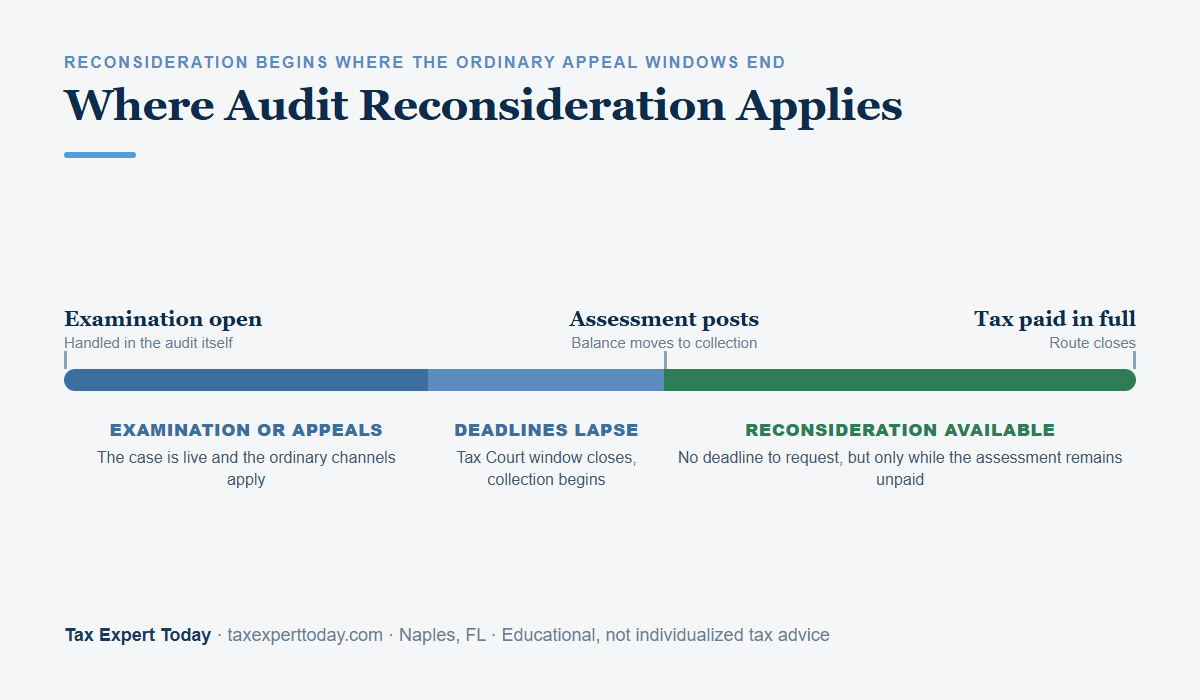
The distinction that matters most is timing. An audit that is still open is handled through the examination itself or through the Independent Office of Appeals, a sequence set out stage by stage in our guide to what happens if you get audited by the IRS. Reconsideration exists for the situation after the assessment has already posted to the account, when the ordinary appeal windows have closed and the balance has moved into collection. That is why it matters so often to taxpayers who never engaged with the audit in the first place.
Reconsideration, Amended Return, or Appeals: Which Applies?
Four post-assessment remedies are commonly confused, and they are not interchangeable. Which one applies turns on two facts: whether the tax has been paid, and whether the taxpayer has already signed something or received a court decision. Choosing wrongly is not merely inefficient, because some of these routes carry statutory deadlines that continue running while a misdirected request sits in a queue.
| Remedy | Use it when | Key limit |
|---|---|---|
| Audit reconsideration | Audit assessment is closed, tax is unpaid, and new information exists or a computational error occurred | Unavailable once paid in full, or after a closing agreement, accepted offer, Form 870-AD, TEFRA final adjustment, or court decision |
| Amended return (Form 1040-X) or Form 843 | The assessment has already been paid and a refund is sought | Refund limitation periods under IRC §6511 apply |
| Appeals conference | The examination is still open, or a reconsideration determination is disputed | Requires an open matter or a determination to appeal from |
| Offer in compromise, doubt as to liability (Form 656-L) | The dispute is genuinely about whether the tax is owed | Different theory from a collectibility offer; the liability itself must be questionable |
One boundary is worth stating plainly because it catches taxpayers repeatedly. An amended return is the remedy for a return the taxpayer filed and now wishes to correct after paying. Audit reconsideration is the remedy for an assessment the IRS imposed and the taxpayer has not paid. Where the IRS prepared the return under IRC §6020(b), neither description fits neatly, and the correct filing is an original return, as set out below. Where the assessment arises from a joint return and the disputed items belong to a spouse, innocent spouse relief is a separate remedy running on its own form and deadlines.
Who Qualifies for Audit Reconsideration?
Publication 3598 states that a request will be accepted if you submit information not previously considered, if you filed a return after the IRS completed one for you, if you believe the IRS made a computational or processing error, or if the liability is unpaid or credits were denied. The Internal Revenue Manual at IRM 4.13.1.2.1 restates these as cumulative screening criteria rather than alternatives.
Read together, the manual requires that a return has been filed, that the assessment remains unpaid or disputed credits were reversed, that the taxpayer identifies which specific adjustments are contested, and that new information is supplied for those adjustments or a computational error is identified. A general statement of disagreement, unaccompanied by documents, does not meet the standard. Publication 3598 is explicit on that point: documentation must accompany the request.
Publication 3598 also lists the practical circumstances that lead to most requests. Those are failing to appear for the audit, moving and never receiving the correspondence, holding additional information that was not presented during the original examination, and simply disagreeing with the assessment that resulted. An assessment that followed an unanswered CP2000 notice frequently arrives through the first of those routes, because the supporting documentation was never submitted at all. The second route, moving and never receiving the correspondence, turns on the last known address rule, which is explained in our guide to the IRS notice of deficiency.
When Is IRS Audit Reconsideration Not Available?
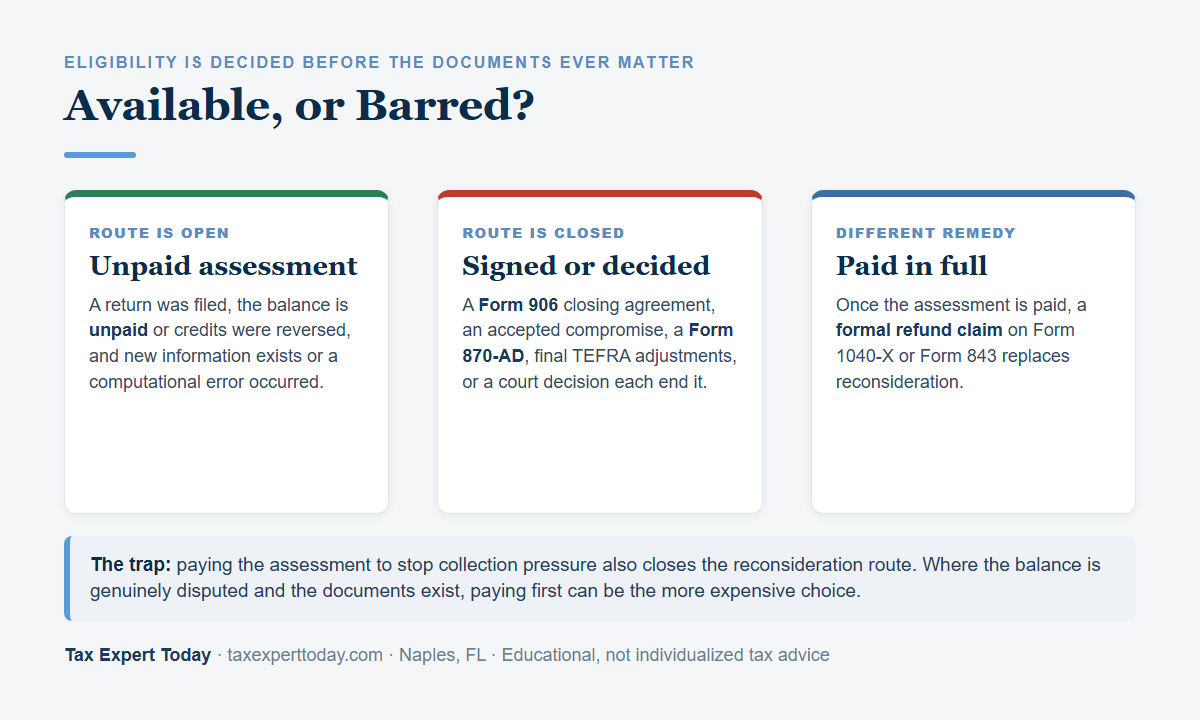
Reconsideration is barred in four situations, and this is the part of the process most commonly misunderstood. The IRS will not reconsider an assessment where the taxpayer has signed away the right to contest it, where a court has spoken, or where the money has already been paid. In those cases a different remedy applies, and pursuing reconsideration simply wastes months.
| Situation | Authority | Correct route instead |
|---|---|---|
| Tax paid in full, no reversed refundable credits | Pub. 3598; IRM 4.13.1.4.9.1 | Formal refund claim on Form 1040-X or Form 843 |
| Closing agreement signed (Form 866 or Form 906) | IRC §7121 | Generally final absent fraud, malfeasance, or misrepresentation of a material fact |
| Accepted offer in compromise, or Form 870-AD signed with Appeals | IRC §7122; Pub. 3598 | Terms of the agreement control |
| Final partnership item adjustments under TEFRA | Pub. 3598; IRM 4.13.1.4.9.1 | Partnership-level procedures |
| Final determination by the Tax Court or another court | IRM 4.13.1.4.5 | Generally none; the decision is res judicata |
The full-payment bar deserves particular attention because it produces a counterintuitive result. A taxpayer who scrapes together the money and pays the assessment in order to stop the collection pressure has, in doing so, given up the reconsideration route entirely. Publication 3598 directs that taxpayer to a formal claim on Form 1040-X instead, which carries its own refund limitation periods under IRC §6511. Where a balance is genuinely disputed and the documentation exists, paying first can be the more expensive choice.
How Does Reconsideration Work After a Substitute for Return?
When a taxpayer does not file, the IRS may prepare a return under IRC §6020(b). That substitute for return, commonly called an SFR, typically allows no dependents, no itemized deductions, and no business expenses, so the assessed balance is often far larger than the true liability. IRM 4.13.1.5 treats the taxpayer’s response as a reconsideration matter.
The mechanism is straightforward but frequently misunderstood. The taxpayer contests an SFR determination by filing an original delinquent return for the year in question. That return is the reconsideration request. It is not an amended return, because the taxpayer never filed an original one, so Form 1040-X is the wrong form. For SB/SE substitute-for-return cases the manual routes the submission to Examination Operation Stop 614, 1040 Waverly Avenue, Holtsville, NY 11742.
Because the assessed figure on an SFR reflects no deductions the taxpayer was entitled to claim, a correctly prepared original return frequently reduces the balance substantially. Our guide to unfiled tax returns and the substitute for return covers the filing side of that problem in detail.
How Do I Request IRS Audit Reconsideration?
There is no application form that the IRS requires. Publication 3598 answers this directly, stating that the IRS does not require a special form, although Form 12661, Disputed Issue Verification, is recommended for explaining the issues in dispute. A clearly written letter identifying each contested adjustment, supported by documents, satisfies the requirement.
The submission should identify each disputed adjustment separately, because the IRS considers each issue on its own merits. Attach photocopies of the supporting documents and, where available, a copy of the examination report on Form 4549. Publication 3598 warns against sending original documents, since originals are not returned. Include a daytime and evening telephone number.
Submissions may be uploaded through the IRS Document Upload Tool, which the IRS now recommends, or mailed to the campus shown on the examination report. Where documents are faxed, Publication 3598 instructs that identifying information appear on every page so that no page is separated from the case file.
What Documentation Actually Supports the Request?
The IRS reviews each disputed issue separately and changes an adjustment only where the new information and the tax law support the change. That framing sets the standard: the submission has to prove the specific element the examiner disallowed, not merely assert that the return was correct. A package of bank statements attached to a general objection rarely moves an assessment.
Publication 3598 also asks the taxpayer to verify that the material is genuinely new and that it belongs to the year in question. Where the examiner already reviewed a document and rejected it, resubmitting the same document without explanation does not meet the criterion of information not previously considered. The manual does note that where it appears the IRS never received something previously sent, resubmission is appropriate.
| Disallowed item | What the examiner is testing | Documentation that addresses it |
|---|---|---|
| Dependent or filing status | Relationship, residency, and support | Birth or adoption records, school and medical records showing address, custody order or Form 8332 release |
| Business expenses on Schedule C | Ordinary and necessary character, and substantiation | Invoices, canceled checks, contemporaneous logs, and a reconciliation tying totals to the return line |
| Unreported income from a Form 1099 | Whether the amount was received and correctly characterized | Corrected information return, payer statement, or records showing the amount belongs to another year or entity |
| Charitable or itemized deductions | Statutory substantiation requirements | Contemporaneous written acknowledgements, appraisals where required, and payment records |
| Basis on a reported sale | Cost, adjustments, and holding period | Purchase closing documents, improvement records, and depreciation schedules from prior years |
Presentation matters as much as content. Because the IRS considers issues individually, organizing the package issue by issue, with a short cover explanation for each and the supporting exhibits behind it, tracks the way the file will actually be reviewed. Form 12661 is built around exactly that structure, which is why Publication 3598 recommends it even though it does not require it. Where the assessment also carries penalties, the request can be paired with a separate argument for reasonable cause penalty abatement, which turns on different facts from the underlying adjustment.
Does Collection Stop During Audit Reconsideration?
Collection may pause, but no rule assures it, and the pause is discretionary rather than statutory. Publication 3598 states that the IRS may delay collection activity when the documentation is received, and may resume it if the documentation does not support the position and the taxpayer fails to respond to requests for further information within thirty calendar days.
The Internal Revenue Manual shows the mechanics behind that discretion. Under IRM 4.13.1.3.3(10), the hold placed on an account depends on its collection status: a STAUP for fifteen cycles where the account sits below status 22, or a Transaction Code 470 where the account is in status 22 or 24. The manual also directs that a hold is not input where less than one year remains on the collection statute, which means the taxpayers closest to the end of the ten-year period under IRC §6502 may see no pause at all. Our explanation of the IRS ten-year collection statute sets out how that clock is calculated.
Two practical consequences follow. An existing installment agreement must be maintained throughout, because Publication 3598 states that payments continue while a reconsideration is pending. And a reconsideration request is not a substitute for a collection alternative: where a levy is already in motion, the collection remedy and the reconsideration usually need to run in parallel.
How Long Does IRS Audit Reconsideration Take?
Publication 3598 tells taxpayers to expect to hear from the IRS within thirty days of submission. That reflects the quality-response standard under Policy Statement 21-3 rather than a promise of resolution, and IRM 4.13.1 notes that this standard does not apply to examination substitute-for-return non-filer reconsiderations, where acknowledgement and interim letters are not required.
In practice the initial contact and the final determination are different events. The manual requires cases to be controlled on the examination system within fourteen days of receipt in the centralized reconsideration unit, after which the substantive review proceeds. Taxpayers should plan around a process measured in months rather than weeks, and should not read silence at day thirty as a decision.
What Happens If the Request Is Denied?
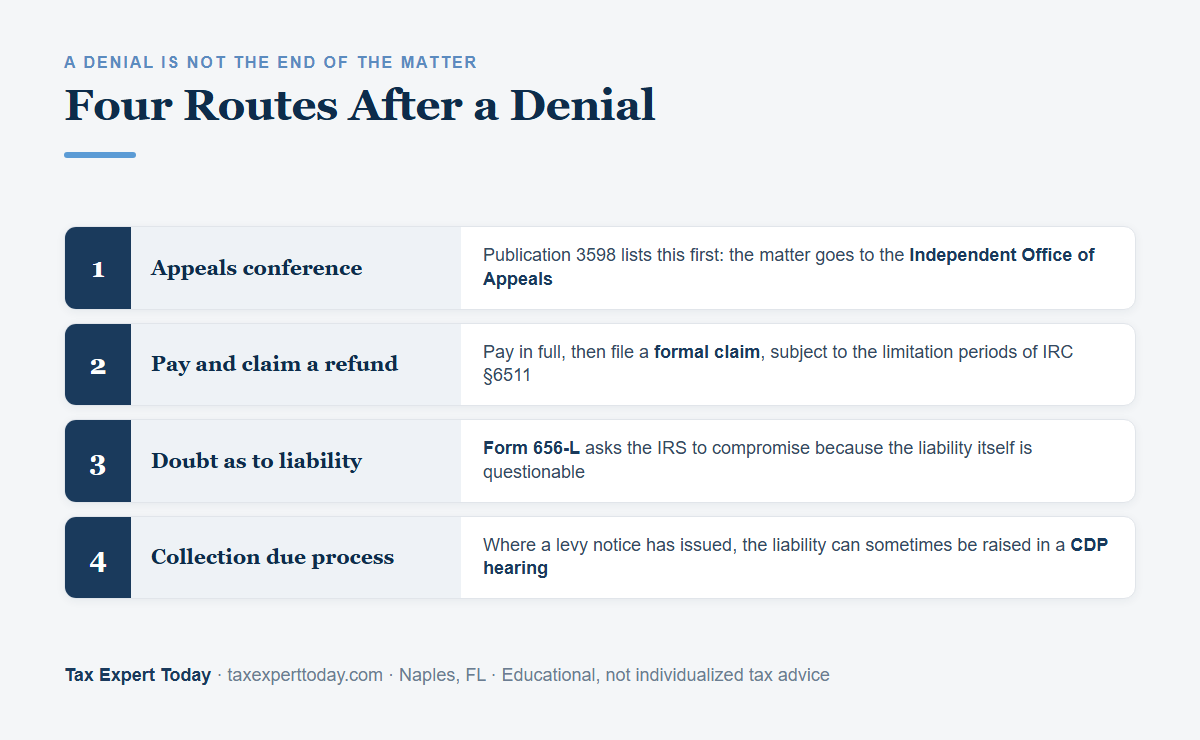
Publication 3598 sets out three paths where the taxpayer disagrees with the outcome. The first is to request an Appeals conference, which puts the matter before the Independent Office of Appeals. The second is to pay the amount due in full and file a formal claim for refund. The third is to do nothing, in which case the IRS issues a bill for the balance.
A fourth route exists where the dispute is genuinely about whether the tax is owed at all. An offer in compromise based on doubt as to liability, submitted on Form 656-L, asks the IRS to compromise the assessment because the underlying liability is questionable. That is a different theory from the more common doubt-as-to-collectibility offer, which concedes the debt and disputes only the ability to pay. Our guide to the IRS offer in compromise explains how the two grounds differ.
Where the balance has already reached the levy stage, a collection due process hearing may also be available, and in limited circumstances the underlying liability can be raised there. Our explanation of the LT11 final notice and collection due process rights covers those deadlines, which are short and unforgiving.
Audit Reconsideration Help in Naples & Southwest Florida
Tax resolution Naples: Tax Expert Today LLC works with taxpayers in Naples, Florida and across all fifty states on assessments that have already closed and moved into collection. Reconsideration cases turn on documentation and on choosing the correct remedy at the outset, since the wrong route can cost months on a balance that is still accruing interest. Our IRS resolution and audit support practice handles examination and post-assessment matters, and our Naples tax resolution page describes how local engagements are structured.
The firm is located at 11983 Tamiami Trail N, Naples, FL 34110. Call (239) 441-2005, Monday through Friday, 10am to 5pm ET.
Does it matter that the audit was handled by a campus outside Florida?
Generally no. Reconsideration requests are reviewed first at the IRS campus that issued the examination report, wherever that campus sits, and Publication 3598 directs the request to the address on that report. A face-to-face meeting, where one becomes necessary, is transferred to the office nearest the taxpayer. Representation is federal, so a Naples-based engagement can address a case controlled by any campus in the country.
When to Engage a Professional
Reconsideration rewards precision. The threshold question is whether the route is open at all, because a closing agreement, an accepted offer, a signed Form 870-AD, a final court decision, or full payment each closes it and points to a different remedy. Getting that determination wrong at the start is the most common and most costly error in these cases.
Beyond eligibility, the work is documentary. Each contested adjustment has to be identified and supported separately, because the IRS reviews issues individually and will change only what the new information and the tax law support. Where an assessment followed a substitute for return, the deliverable is a correctly prepared original return rather than a letter. Where collection is already active, the reconsideration and the collection alternative usually have to be managed together.
Tax Expert Today LLC is a multidisciplinary firm of tax advisors, enrolled agents, CPAs, and attorneys, founded by Dr. Pellumb Kabashi. Outcomes in reconsideration matters depend on the facts, the documentation available, and the tax law that applies to the year in question. To discuss a closed assessment, contact our office or call (239) 441-2005.
Published August 2, 2026 by Dr. Pellumb Kabashi « Back to Learning Center
Have a question this article touches on?
Tax Expert Today LLC, based in Naples, Florida and serving clients across the United States.
Schedule a Consultation (239) 441-2005