
By Dr. Pellumb Kabashi, DBA, MBA, CES, CFE, EA
Founder, Tax Expert Today LLC · Tax advisors, enrolled agents, CPAs, and attorneys · Serving clients in all 50 states
Quick Answer: An FTB offer in compromise asks the California Franchise Tax Board to accept less than the full amount of an undisputed final tax liability under Revenue and Taxation Code section 19443. The offer must be one lump sum, the taxpayer must show it is the most the state can expect to collect, and the Board’s best interest decision cannot be appealed. Call (239) 441-2005 for a free consultation.
An FTB offer in compromise is the California Franchise Tax Board program that lets a taxpayer offer a lesser amount to resolve a state income or franchise tax debt that the taxpayer does not dispute. It is authorized by a single statute, Revenue and Taxation Code section 19443, and it works differently from the federal program in ways that matter to anyone who owes both agencies. The FTB takes no installments toward the offer, publishes no pre qualifier tool, releases state tax liens on final approval, and keeps a public record of approved compromises above a modest threshold. Its decision that an offer is not in the best interest of the state is, by statute, not subject to administrative appeal or judicial review.
This guide explains the mechanism: what the statute requires, how the agency says it evaluates offers, what the application asks for, and what the signed agreement commits you to. It does not predict whether any particular offer will be accepted. The FTB states that it considers each request on its own facts, and no published figure lets anyone forecast an outcome. For readers who have already left California, a later section covers what the agency looks at when the taxpayer now lives in Florida or another state. The federal side of the same question is covered in our separate guide to the IRS offer in compromise, and this page does not repeat it.
What is an FTB offer in compromise?
An FTB offer in compromise is a written proposal, made on form FTB 4905PIT, form FTB 4905BE, or online through MyFTB, to pay the Franchise Tax Board less than the full amount of a final California income or franchise tax liability that the taxpayer agrees is owed. The agency approves an offer only when the amount offered represents the most it can expect to collect within a reasonable time.
The FTB program page describes the program in one sentence: it allows you to offer a lesser amount for payment of an undisputed tax liability. Each part of that sentence is doing work.
- A lesser amount. The offer is a specific dollar figure, paid in one lump sum when the agency asks for it, never a zero dollar offer.
- Undisputed. You must agree with the amount the FTB says you owe. A disagreement about the underlying tax belongs in a protest, an appeal, or a claim for refund, not in an offer.
- Final tax liability. Section 19443(b) defines the term to include tax under the Personal Income Tax Law and the Corporation Tax Law, plus related interest, additions to tax, and penalties.
- A separate evaluation. The FTB states that it evaluates your offer separately from any offer made to the CDTFA, the EDD, or the IRS.
The program covers individuals, estates, and trusts on the individual application and corporations, partnerships, and limited liability companies on the business entity application. It does not cover sales and use tax, which the California Department of Tax and Fee Administration administers, or payroll taxes, which the Employment Development Department administers. Each of those agencies runs its own program, and a later section explains the shared form that lets an individual apply to all three at once.
What law authorizes the FTB to compromise a tax debt?
Revenue and Taxation Code section 19443 is the only statute that authorizes the FTB to compromise a final tax liability. It sets who may approve an offer by dollar amount, lists the two conditions the taxpayer must establish, requires a best interest finding by the agency, and adds rules on public records, joint liabilities, and rescission.
The statute divides approval authority by the size of the reduction in tax, not by the size of the debt. That distinction matters because the reduction is the gap between what is owed and what is offered.
| Reduction in tax | Who may approve, per section 19443(a) | Practical note |
|---|---|---|
| $7,500 or less | The Executive Officer and Chief Counsel of the FTB, jointly, or their delegates | Handled at the staff level without going to the three member Board |
| More than $7,500 but less than $10,000 | The Executive Officer and Chief Counsel jointly, if the Board has delegated this band by resolution | Delegation is optional under paragraph (a)(3) |
| More than $7,500 (without delegation) or $10,000 and above | The Franchise Tax Board itself, on the joint recommendation of the Executive Officer and Chief Counsel | A recommendation to approve that the Board neither approves nor disapproves within 45 days is deemed approved |
The 45 day deemed approval rule applies to a staff recommendation that has already reached the Board. It is not a clock that starts when a taxpayer submits an application, and it should not be confused with the federal rule under which an IRS offer is treated as accepted if the IRS makes no determination within two years. Nothing in section 19443 deems a California offer accepted merely because time passes after filing.
- Subdivision (c) sets the conditions that must exist before any amount can be compromised.
- Subdivision (d) makes the best interest determination unreviewable.
- Subdivision (f) addresses spouses who are jointly and severally liable.
- Subdivision (g) requires a public record for compromises above $500.
- Subdivision (h) allows rescission for concealment, falsification, or later noncompliance.
Who can submit an FTB offer in compromise?
The FTB will process an offer only from a taxpayer who has filed every required California return, agrees with the amount owed, has explored payment options such as an installment agreement, and submits a complete, signed application with all supporting documents. The 4905PIT booklet adds that an application will not be accepted during a current, open bankruptcy.
The 4905PIT booklet lists these as processing requirements rather than eligibility factors. In other words, an application that misses one of them is not evaluated on its merits at all. It is returned.
| Threshold requirement | Source | What it means in practice |
|---|---|---|
| All required returns filed | FTB program page; 4905PIT page 3 | If you have no filing requirement for a year, the booklet says to note that on the application |
| Agreement with the amount owed | FTB program page; section 19443 (“final tax liability”) | A pending protest or appeal on the same liability is inconsistent with an offer |
| Payment options explored | FTB program page | The agency expects you to have considered a payment plan first |
| Complete application and documents | 4905PIT page 3 and checklist; FTB 4045 | Missing items cause the application to be returned as incomplete |
| Signed and dated application | 4905PIT page 3; FTB 4045 | Both spouses sign where a joint liability is involved |
| No current, open bankruptcy | 4905PIT, Frequent Topics | The booklet suggests seeking your own legal advice if bankruptcy is a consideration |
Representation is optional. The booklet states that the FTB does not require it, that you have the right to it, and that the program is available to all taxpayers whether or not they are represented. If a representative submits the offer, the checklist asks for a copy of the representative’s declaration on form FTB 3520-PIT, which is covered in our guide to the FTB power of attorney. A federal Form 2848 does not satisfy this requirement.
How does the FTB decide whether to accept an offer?
The taxpayer must establish two things under section 19443(c): that the amount offered is the most that can be paid or collected from present assets or income, and that there is no reasonable prospect of acquiring more income or assets within a reasonable time. The FTB must then separately find that accepting the compromise is in the best interest of the state.
The statute places the burden on the taxpayer for the first two conditions. The agency’s published factors describe how it weighs the facts the taxpayer presents. The program page and FTB 4045 list them in slightly different words, and the business entity booklet adds one of its own.
| Factor | Program page | FTB 4045 | 4905BE (entities) |
|---|---|---|---|
| Ability to pay | Yes | Yes | Yes |
| Value of, or equity in, assets | Yes | Yes | Yes |
| Present and future income | Yes | Yes | Yes |
| Present and future expenses | Yes | Yes | Yes |
| Age and health | Not listed | Yes | Not applicable |
| Potential for changed circumstances | Yes | Yes | Yes |
| Willingness to dissolve or cancel with the Secretary of State | Not listed | Not listed | Yes |
| Best interest of the state | Yes | Yes | Yes |
- Future income weighs as heavily as present income. The statute’s second condition looks forward, which is why a taxpayer early in a career or newly employed faces a harder showing.
- Health is evidence, not a narrative. FTB 4045 says that if a medical condition is part of the justification, you must provide documentation, and the checklist asks for a signed physician’s letter with diagnosis and prognosis.
- Prior payments count in the comparison. The booklet says prior payments cannot be applied to the offer, but the FTB considers prior payments and the offered amount against the total liability when evaluating it.
- The IRS result does not bind the FTB. The booklet states that the agency makes a separate determination, independent of the IRS, even when the IRS has accepted an offer.
What does “the most the FTB can expect to collect” mean?
It means the offer is measured against what the FTB believes it could realistically collect from your assets and your future income over a reasonable period if the offer were refused. The agency does not publish a formula, a multiplier, or a minimum percentage, so the application’s asset, income, and expense schedules are the evidence that frames the comparison.
This is the single most important difference between the published California program and the federal one. The IRS publishes a detailed method, national and local expense standards, and an online pre qualifier. The FTB publishes the principle and the application, and says it considers each request on its facts. Anyone who tells you what percentage of a California debt an offer “should” be is describing a guess, not a published rule.
What the application does show is where the agency looks. Section 4 of the 4905PIT totals cash, bank balances, vehicle equity, the loan or cash surrender value of life insurance, securities, safe deposit box contents, real estate equity, notes, receivables, judgments owed to you, aircraft and watercraft, and interests in trusts, estates, and business entities. Section 5 compares monthly net household income with monthly expenses. Section 6 asks for three years of gross household income. Section 7 asks you to state, in writing, the facts and reasons that justify the offer.
- Asset equity. Equity in property you own is a component of what could be collected, whether or not the property is for sale.
- Monthly surplus. A positive difference between net income and expenses suggests an ability to pay over time.
- Trend. The three year income summary shows whether income is rising, falling, or stable.
- Justification. FTB 4045 says the justification and source of funds sections cannot be left blank.
The program page also describes what happens when the numbers point to a different resolution. If the FTB concludes that you can make monthly payments that exceed the amount you offered, it states that it will work with you to set up a payment plan instead. That outcome is common enough that the agency describes it in the process section, which is one reason the FTB installment agreement should be understood before an offer is prepared.
Why must an FTB offer be paid as a single lump sum?
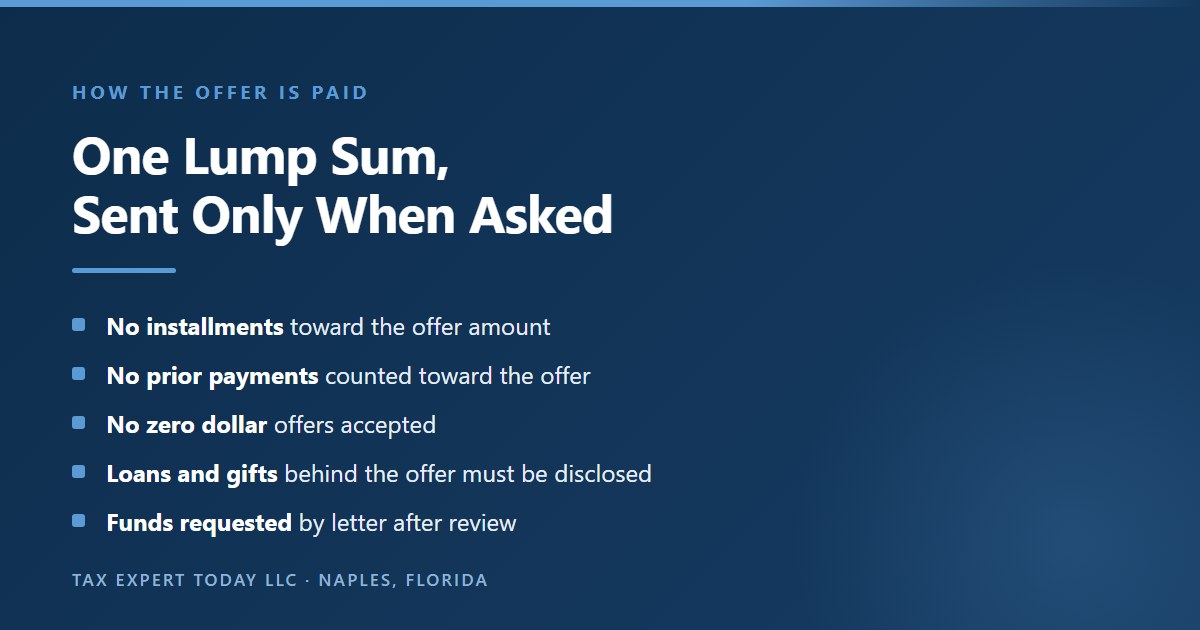
The FTB program page and both application booklets state that the offer must be a lump sum, that installment payments toward the offer are not accepted, that prior payments cannot be included, and that a zero dollar offer will not be accepted. You do not send money with the application; the agency asks for the funds by letter if it is prepared to accept.
The lump sum rule shapes the whole application because it forces the question of where the money will come from. Section 8 of the 4905PIT asks whether any part of the offer is a loan or a gift. If it is a loan, you attach the loan agreement and name the lender and amount. If it is a gift, you name the donor, the amount, and the donor’s relationship to you. Any other source of funds must be described.
| Payment rule | FTB offer in compromise | Source |
|---|---|---|
| Form of the offer | One lump sum only | Program page; 4905PIT page 3; 4905BE page 2 |
| Installments toward the offer | Not accepted | 4905PIT, Frequent Topics |
| Prior payments | Cannot be applied to the offer amount | Program page; 4905PIT, Frequent Topics |
| Zero dollar offer | Not accepted | Program page; 4905PIT, Frequent Topics |
| When funds are sent | Only when the FTB requests them by letter | 4905PIT page 3 and Section 8 |
| How funds are sent | Cashier’s check, money order, or WebPay for individuals; cashier’s check or money order for entities | 4905PIT page 3; 4905BE page 2 |
| Loans and gifts | Must be disclosed, with the loan agreement or donor details | 4905PIT Section 8 |
| If the offer is denied | Section 8 asks you to select what the FTB should do with any funds | 4905PIT Section 8 |
The practical effect is that an FTB offer suits a taxpayer who can assemble a defined sum, often from family, a loan against an asset, or the sale of something, but who cannot realistically pay the full balance. A taxpayer who can only pay over time is usually looking at an installment agreement or, where there is genuine hardship, a temporary delay in collection, both of which the program page names as possible outcomes of the review.
What documents does the FTB require with form 4905PIT?
The 4905PIT checklist requires proof of household income, three months of expense statements, six months of statements for every bank and mobile payment account, investment and retirement statements, leases, real estate records, IRS documents, legal documents, medical evidence where relevant, vehicle loan statements, and a power of attorney declaration if a representative files. Missing items cause the application to be returned.
The checklist is specific, and it covers both spouses or registered domestic partners. The booklet asks for copies only and says the agency will not return anything you send.
| Checklist item | What the 4905PIT asks for |
|---|---|
| Household income | Pay stubs for the past three months, or two years of financial statements if self employed, including income from any business entity or trust (dividends, K-1 income, distributions) |
| Expenses | Billing statements for the last three months and proof that expenses are being paid, including credit card, student loan, medical, and personal loan statements |
| Bank accounts | All accounts held in the past three years; the last six months of statements for every account; closing statements for accounts closed in the past two years; twelve months if self employed |
| Mobile payment services | The last six months of history for services such as Venmo, PayPal, and Zelle |
| Securities | Current statements for stocks, bonds, mutual funds, virtual currencies, and retirement or profit sharing plans, including IRAs, 401(k) plans, Keogh plans, and annuities |
| Real estate | Mortgage statements, the latest property tax bill for each property, and escrow statements for property owned, sold, or gifted in the last five years |
| IRS information | Any IRS offer application and determination letter or other IRS arrangement, unreported IRS adjustments, and notices of any open IRS audit |
| Legal documents | Marital settlement agreements, divorce decrees, property settlements, trust documents, and bankruptcy documents |
| Medical information | A signed physician’s letter with diagnosis and prognosis, if a condition should be considered |
| Vehicles | Loan or lease statements |
| Representation | A copy of form FTB 3520-PIT if a designated representative submits the offer |
- Escrow records reach back five years. Property sold or gifted recently is part of the review, which connects directly to the “recent transfer of assets” question on page 10.
- Unreported IRS changes surface here. The checklist asks for IRS adjustments you have not reported to the FTB, which can create a new California liability during the review.
- Virtual currency is named. The securities item and Section 3, Part D both list virtual currency and the exchange where it is held.
- Trust interests are listed regardless of value. Line 13 of Section 4 asks for interests as trustee, trustor, or beneficiary.
Page 10 of the application also asks yes or no questions about court orders, repossessions, anticipated increases in income, bankruptcies or receiverships, recent transfers of assets, and whether you are a beneficiary of a trust, estate, or profit sharing plan. It asks for the year of your last California return. FTB 4045 is direct about the consequence of leaving something out: if the agency locates omitted assets during the evaluation, that serves as grounds to deny the offer. Section 19443(h) goes further and allows an accepted compromise to be rescinded if property was concealed.
How is the business entity application, form 4905BE, different?
Form 4905BE applies the same statute to corporations, partnerships, and limited liability companies, but it adds the entity’s willingness to dissolve or cancel with the Secretary of State as an evaluation factor, asks for three months of bank statements rather than six, requires every return through the current year to be filed, and asks for owners, assumers, and any loan or gift behind the offer.
The 4905BE booklet is shorter than the individual version, but two of its differences carry real weight for owners who left California and left a company behind.
| Point of difference | Individuals (4905PIT) | Business entities (4905BE) |
|---|---|---|
| Extra evaluation factor | Age and health (per FTB 4045) | Willingness to dissolve or cancel with the Secretary of State |
| Bank statements | Last six months, twelve if self employed | Last three months for every account, including payroll accounts |
| Returns | All required returns filed | All returns up to the current year, which may include a partial year final return if the business is closed (FTB 4045) |
| Parties disclosed | Taxpayer, spouse or domestic partner, dependents | Owners and ownership percentages, primary contact, and any assumer of the liability |
| Payment methods | Cashier’s check, money order, or WebPay | Cashier’s check or money order |
| Representation | Form FTB 3520-PIT | Form FTB 3520-BE |
The dissolution factor matters because a California LLC or corporation that stays active keeps accruing the minimum franchise tax every year. An offer that resolves the past while the entity remains registered leaves a new liability building behind it. Our guide to the California LLC franchise tax explains how the $800 annual tax attaches and how an entity actually stops owing it.
- Dissolve or keep. Decide whether the entity has a future before preparing an entity offer, because the agency asks.
- File the final return. FTB 4045 notes that a closed business may need a partial year return marked final.
- Prove closed accounts. The agency asks for every bank account statement or proof that accounts have been closed.
- Keep owner and entity separate. The individual owner and the entity are separate taxpayers with separate applications.
How does the FTB offer in compromise compare with the IRS program?
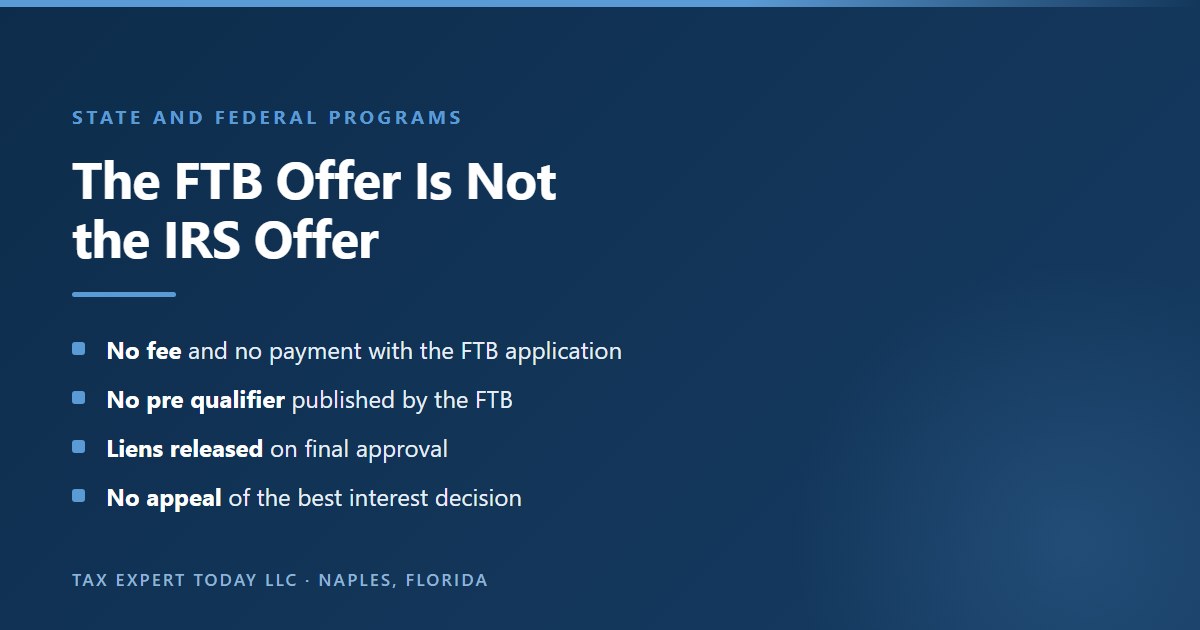
The two programs share the same core test, the most the agency can expect to collect within a reasonable time, but differ sharply on mechanics. The IRS charges a fee, takes an initial payment, allows periodic payment offers, publishes a pre qualifier, and allows an appeal. The FTB takes a single lump sum only when it asks, publishes no pre qualifier, and bars review of its best interest decision.
Taxpayers who owe both agencies often assume that one application covers both, or that a federal acceptance carries over. Neither is true. The IRS offer in compromise page and the FTB sources above describe two separate programs.
| Feature | IRS offer in compromise | FTB offer in compromise |
|---|---|---|
| Governing rule | IRC section 7122 and Form 656-B | R&TC section 19443 and form 4905PIT or 4905BE |
| Application fee | $205, non refundable, unless low income certification applies | No application fee is listed on the program page or in the booklet |
| Payment with application | 20 percent of a lump sum offer, or the first periodic payment | None; do not send funds until the FTB asks by letter |
| Periodic payment offers | Available | Not available; lump sum only |
| Pre qualifier tool | Published online | None published by the FTB |
| Collection during review | The IRS suspends other collection activity; the collection period is extended | Not automatic; in most cases no new action, but the FTB may continue if delay risks collection |
| Deemed acceptance | If no determination within two years of receipt | No comparable rule for the taxpayer; the 45 day rule applies only to a staff recommendation before the Board |
| Liens | Released after offer terms are satisfied | Released on final approval, per the booklet and program page |
| Rejection | Appeal within 30 days on Form 13711 | The best interest determination is not subject to administrative appeal or judicial review |
| Public disclosure | Public inspection file available on request | Public record for at least one year for compromises over $500 |
- Sequence matters. The 4905PIT asks for a copy of any IRS offer application and determination letter, so the federal file becomes part of the state review.
- Federal debt is a listed liability. Section 4, line 23 asks for taxes owed to the IRS, with recent notices, which is how a federal balance enters the California analysis.
- Federal method, state discretion. Federal standards such as the IRS allowable living expenses are a useful reference point, but the FTB does not state that it applies them.
For the federal statistics that are often quoted alongside this topic, our report on the IRS offer in compromise acceptance rate covers the published federal data. The FTB does not publish a comparable annual figure, and this guide does not estimate one.
What is the Multi-Agency Form DE 999CA, and when should you use it?
Form DE 999CA is a single offer in compromise application that an individual can file with the FTB, the CDTFA, and the EDD, or any combination of them, to avoid duplicating paperwork. It is hosted by the EDD. Each agency still evaluates the offer separately, and the CDTFA notes that separate payment arrangements must still be negotiated with each agency.
California has three agencies that collect state taxes, and a former business owner can easily owe all three: income tax to the FTB, sales and use tax to the CDTFA, and payroll taxes to the EDD. The FTB program page lists the Multi-Agency Form for Offer in Compromise (DE 999CA) for individuals who have tax debt with more than one agency.
| Agency | Taxes collected | Own offer form | Note from the agency |
|---|---|---|---|
| Franchise Tax Board | Personal income tax and corporation franchise and income tax | FTB 4905PIT and 4905BE | Evaluates its offer separately from CDTFA, EDD, and IRS offers |
| CDTFA | Sales and use tax and a range of special taxes and fees | CDTFA-490 and CDTFA-490-C | Publishes an online pre qualifier designed for closed businesses |
| EDD | Payroll taxes, including unemployment insurance and State Disability Insurance withholding | Accepts DE 999CA | Hosts the Multi-Agency Form |
The CDTFA program page adds rules that do not appear in the FTB materials. Its program is aimed at closed accounts where the taxpayer is no longer associated with the business, with a temporary expansion through January 1, 2028 for open businesses in limited situations. It also states that where a fraud penalty has been assessed, a minimum offer of the outstanding tax and fraud penalty is required for processing, and that an offer will not be considered from someone convicted of felony tax evasion. Those are CDTFA rules, and they should not be assumed to apply to an FTB offer.
- One form, three decisions. Filing DE 999CA does not produce a single combined outcome.
- Coordinate the numbers. The same assets and income are being measured by each agency, so the disclosures must be consistent.
- Entities use their own forms. The multi agency form is described for individuals; a business entity files the 4905BE with the FTB.
Does submitting an FTB offer stop collection?
Not automatically. The FTB states that in most cases no new collection actions will be taken while the offer is reviewed, but that it may continue collecting if a delay would risk its ability to collect. Penalties and interest keep accruing throughout. If the offer is approved, all collection actions stop and state tax liens are released.
This is one of the more consequential differences from the federal program, where the IRS page states that other collection activities are suspended while an offer is evaluated. At the state level, a taxpayer who submits an offer should not assume that an existing order to withhold or earnings withholding order will simply end.
- Existing actions may continue. The program page says collection actions will not automatically stop.
- New actions are usually held. The agency describes this as the general practice, not a promise.
- Interest and penalties run. The booklet says interest, fees, and penalties continue to accrue as prescribed by law.
- Approval ends collection. On approval, collection stops and liens are released.
Because the balance grows during the review, the running cost of penalties and interest is part of the analysis. Our guide to the California late payment penalty explains how the state penalties and interest accumulate on an unpaid balance.
How long does the FTB take to decide an offer?
The FTB program page, updated October 15, 2025, says an acknowledgment letter generally arrives within 2 to 4 weeks and a decision generally within 4 to 6 months after the account is assigned to a specialist, longer for complex accounts. The older 4905PIT booklet, revised June 2023, states 120 days from assignment.
The two published figures do not match, and the more recent program page gives the longer range. Either way, both clocks start when the account is assigned to a specialist, not when you mail the application, so the total elapsed time from submission is longer than either figure. The program page also describes what happens once the account is assigned: the FTB contacts you to review the application and determine the most appropriate resolution, which may be a payment plan, a delay in collection during a temporary hardship, or the offer itself, possibly with a collateral agreement.
| Stage | Published time frame | Source |
|---|---|---|
| Acknowledgment letter after receipt | Generally 2 to 4 weeks | FTB program page (updated 10/15/2025) |
| Decision after assignment to a specialist | Generally 4 to 6 months, longer if complex | FTB program page (updated 10/15/2025) |
| Decision after assignment to a specialist | Generally within 120 days, longer if complex | 4905PIT booklet (REV 06-2023) |
| Board action on a recommendation above the staff threshold | Deemed approved if not acted on within 45 days | R&TC section 19443(a)(2) |
| Withdrawal | Allowed at any time | FTB program page |
- Plan for the longer range. The October 2025 page is the more current statement.
- Keep filing and paying current taxes. New liabilities during the review undermine the offer and, after acceptance, can trigger rescission.
- Respond to requests promptly. The booklet says additional documentation may be requested as the evaluation proceeds.
What is an FTB collateral agreement?
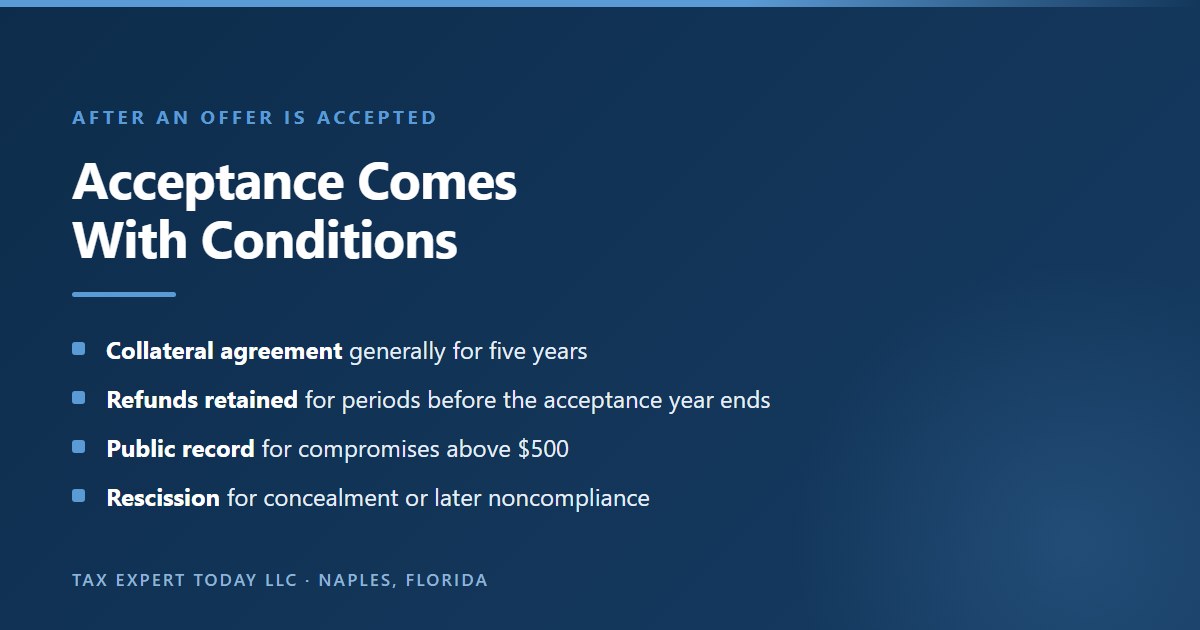
A collateral agreement is a contract, generally for five years, under which the taxpayer pledges to pay the FTB a percentage of future income above an agreed threshold. The booklet says one is generally required when there is significant potential for increased earnings, and generally not required for taxpayers on a fixed income or with limited potential for higher income.
The collateral agreement is how the state protects itself when the second statutory condition, no reasonable prospect of higher income, is close. It lets the FTB accept an offer based on today’s finances while sharing in any recovery. The Statement of Agreement in Section 9 makes the compromise conditional on full performance of any collateral agreement, which means a default on the collateral agreement is a default on the compromise itself.
- Term. Generally five years, according to both booklets.
- Trigger. Significant potential for increased earnings.
- Mechanism. A percentage of income above an agreed threshold is paid to the FTB.
- Exception. Fixed income or limited earning potential generally means no collateral agreement.
For a taxpayer who has just moved and expects income to rise in a new job or a new business, the collateral agreement is often the realistic shape of an acceptable offer, if one is acceptable at all. That possibility should be understood before the offer amount is chosen, because the agreement runs for years after the lump sum is paid.
Can you appeal if the FTB rejects an offer?
Not on the central question. Section 19443(d) provides that a determination by the FTB that accepting an offer would not be in the best interest of the state is not subject to administrative appeal or judicial review. The statute does require written notice when an offer is accepted or rejected, and the program page states that you may withdraw an application at any time.
This is a structural difference from the federal program, where a rejected offer can be appealed within 30 days to the IRS Independent Office of Appeals. In California, the best interest finding is the Board’s call, and the statute removes it from review by the Office of Tax Appeals and the courts. That makes the quality of the first submission far more important than it is federally, because there is no second forum in which to argue that the agency weighed the facts wrongly.
- No appeal of the best interest call. Subdivision (d) is explicit.
- Written notice either way. Subdivision (e) requires the FTB to notify the taxpayer in writing of acceptance or rejection.
- Other resolutions remain. The program page lists a payment plan and a hardship delay as outcomes the agency itself may propose.
- Changed facts are new facts. Nothing in the statute bars a later offer, but a later offer is judged on the facts at that time, and this guide does not suggest any particular approach is likely to succeed.
Subdivision (i) adds a separate trap. If the FTB determines that any portion of an offer or installment application meets the federal definition of a frivolous submission under Internal Revenue Code section 6702(b)(2)(A), as modified for California, it may treat that portion as never submitted, with no further administrative or judicial review. Our guide to the frivolous tax return penalty explains the federal definition that California borrows.
What happens after the FTB accepts an offer?
The FTB notifies you in writing and asks for the lump sum by letter. Once the offer is finally approved, collection stops and state tax liens are released. Under the signed Statement of Agreement, the FTB keeps prior payments and any refunds for periods ending before the end of the year of acceptance, and you give up any right to contest the compromised liability.
The Statement of Agreement in Section 9 of the 4905PIT is the contract. Several of its terms are easy to overlook when the focus is on the offer amount.
| Term in the Statement of Agreement | What it means |
|---|---|
| The offer does not relieve the liability until accepted and fully performed | Collection authority remains until every term, including any collateral agreement, is met |
| The FTB keeps all payments and credits already on the account for the covered periods | Money already paid is not refunded when a lower amount is accepted |
| The FTB keeps overpayments for periods ending before the end of the calendar year of acceptance | A California refund you would otherwise receive for those periods is retained |
| No right to contest the compromised liability after notice of acceptance | The amount is settled for good once accepted, and cannot later be litigated |
| Default permits rescission, reinstatement, retention of deposits, and collection of the balance | A default puts you back where you started, minus what you paid |
| Authorization to obtain a consumer credit report | The agency may verify the application through credit data |
| Signature under penalty of perjury under California law | False statements carry legal exposure beyond losing the offer |
- File every return on time afterward. The Statement of Agreement lists failure to file future required returns as a rescission ground.
- Pay future liabilities on time. Failure to pay later final liabilities timely is also listed.
- Keep the acceptance letter. It is the evidence that the liability was compromised and the lien released.
Can the FTB undo an accepted compromise?
Yes. Section 19443(h) allows the FTB to rescind a compromise, reestablish all compromised liabilities without regard to any statute of limitations, and keep the amount paid, if anyone concealed property or falsified records in making the offer, or if the taxpayer fails to meet the terms or fails to file or pay later liabilities within 20 days after notice and demand.
Rescission is the reason an FTB offer is a long commitment rather than a single transaction. The statute names two families of grounds.
| Ground for rescission | Statutory text, section 19443(h) |
|---|---|
| Concealment | Concealing from the FTB any property belonging to the taxpayer or another person liable for the tax |
| Records and statements | Receiving, withholding, destroying, mutilating, or falsifying any book, document, or record, or making any false statement about the estate or financial condition |
| Terms of the offer | Failing to comply with any of the terms and conditions of the offer |
| Later compliance | Failing to file later required returns and pay later final liabilities within 20 days after the FTB issues a notice and demand warning that continued failure may result in rescission |
- No limitations defense. Rescinded liabilities are reestablished without regard to any statute of limitations that would otherwise apply.
- No refund. No portion of the amount offered is refunded on rescission.
- A 20 day window. For later filing or payment failures, the statute requires notice and demand first, then 20 days.
Is an accepted FTB offer made public?
Yes, for larger compromises. Section 19443(g) requires that whenever a compromise of tax, penalties, or both above $500 is approved, a public record be kept on file for at least one year in the office of the FTB Executive Officer, showing the taxpayer’s name, the unpaid amount, the amount offered, and a summary of why the compromise is in the best interest of the state.
Very few competing explanations of the program mention this, and it matters to anyone for whom privacy is a real concern, including business owners and professionals whose names are publicly searchable. The statute limits what the record may contain and how it is used.
- Included: the taxpayer’s name, the amount of unpaid tax and related amounts, the amount offered, and a summary of the best interest reason.
- Excluded: information about trade secrets, patents, processes, business secrets, or organizational structure whose disclosure would harm the taxpayer or national defense.
- No lists or releases: the statute says no list shall be prepared and no releases distributed by the FTB in connection with these statements.
- Duration: at least one year.
How does an FTB offer affect a spouse on a joint liability?
Section 19443(f) provides that when spouses are jointly and severally liable, accepting an offer from one spouse does not relieve the other spouse of the entire liability. The other spouse still owes the balance, reduced by the amount of the accepted offer. Both spouses must be disclosed on the 4905PIT, and both sign where the liability is joint.
This rule surprises couples who separated or divorced after filing joint California returns. An offer made by one former spouse does not resolve the other’s exposure. The checklist asks for marital settlement agreements and divorce decrees precisely because they bear on who holds which assets and who agreed to pay which debts.
- Joint and several means each owes all of it. One spouse’s compromise only reduces the other’s balance by the amount paid.
- A divorce decree does not bind the FTB. Allocation of tax debt between former spouses is a private agreement, not a release by the agency.
- Spousal relief is a separate question. Whether one spouse should be relieved of joint liability is a different analysis from an offer; our guide to federal innocent spouse relief covers the federal version, and California has its own procedures.
Why does the 20 year collection period matter to an FTB offer?
Section 19255 gives the FTB 20 years from the date a liability becomes due and payable to collect it, twice the federal ten year period. The period is suspended during bankruptcy plus six months, during certain installment agreement periods, and during other suspensions by operation of law. A long runway means the state’s expected future collections are large.
Federally, the ten year collection statute is a real factor in offer analysis, because an older federal debt has less time left to collect. Our guide to the IRS 10 year rule explains the federal version. In California, section 19255 doubles that window.
| Feature | IRS (federal) | FTB (California, section 19255) |
|---|---|---|
| Collection period | Generally 10 years from assessment | 20 years from the date the latest liability for the year becomes due and payable |
| Bankruptcy | Suspends the period | Suspended during the bankruptcy plus six months |
| Installment agreements | Can extend the period | Suspended for the period described in section 19008(d) |
| Civil action or probate claim | A judgment can extend collection | A timely civil action or probate claim extends the period until the judgment is satisfied or unenforceable |
| Expiration | The balance is no longer collectible | The liability is abated, and amounts later received are treated as overpayments |
- Waiting is rarely a plan. A 20 year window leaves the FTB a long horizon for future income and assets.
- Later due dates reset the start. If more than one liability becomes due for a year, the later date starts the 20 years.
- Suspensions apply to both spouses. Subdivision (e)(2) applies a suspension to both parties of a joint liability.
What if you have already moved from California to Florida?
Moving does not end a California liability or change how an offer is judged. The 4905PIT asks about all property you own and all household income, not only California property or California source income, so a Florida home, Florida wages, and accounts held anywhere are part of the disclosure. The same statute, factors, and forms apply.
Many of the people who search for this topic have already left. The debt usually traces to a final California year, a residency dispute, or a sale that happened before or around the move. Our guides to leaving California taxes and moving from California to Florida explain how those liabilities arise. Once one exists and is final, the offer process looks the same from Naples as it does from Sacramento.
- Section 3, Part F asks for all property you own. It does not limit the question to California real estate.
- Section 5 counts household income wherever earned. A new Florida salary is part of the monthly income analysis even though Florida has no state income tax.
- Future income is judged from your new position. A relocation for a higher paying role bears directly on the “reasonable prospects” condition and on a collateral agreement.
- Recent transfers are asked about. Page 10 and the five year escrow request capture property sold or gifted around the move.
- The final year must be right first. An offer requires agreement with the liability, so if the amount itself is wrong, the question is the underlying return, often a California part year resident return, not an offer.
Where the liability came from an FTB residency determination, the stronger question is often whether the assessment was correct. Our guide to the California residency audit explains how those cases are built, and our guide to California source income covers income the state can tax even after the move. An offer concedes the amount; it is the right tool only when the amount is genuinely not in dispute.
What alternatives should you weigh before an FTB offer?
The FTB program page requires you to have explored payment options before applying, and it names the outcomes the agency itself may reach: a payment plan if you can pay monthly more than you offered, or a delay in collection during a temporary hardship. If the amount is disputed, a protest, appeal, or claim for refund is the correct path instead.
| Option | When it generally fits | Key limits |
|---|---|---|
| Pay in full | Funds are available, including by borrowing | Stops further penalties and interest; nothing to rescind |
| FTB installment agreement | The balance can be paid over time from monthly income | Penalties and interest continue; terms and fees apply |
| Temporary hardship delay | A short term inability to pay, with a realistic recovery | Collection is delayed, not forgiven; the balance grows |
| Offer in compromise | Assets and future income cannot realistically cover the balance | Lump sum only; best interest decision not reviewable; public record over $500; rescission risk |
| Protest, appeal, or claim for refund | The amount itself is wrong | Deadlines apply; an offer is not available while the liability is disputed |
| Penalty relief | Penalties were caused by reasonable cause or qualify for one time abatement | Reduces penalties, not tax; considered separately from an offer |
- Start with the numbers. The same financial picture that supports an offer will show whether a payment plan is realistic.
- Separate penalty relief. Penalty abatement, covered in our late payment penalty guide, can shrink the balance before any offer is considered.
- Correct the tax first. An offer on a wrong assessment concedes an amount that might have been reduced on the merits.
What mistakes get FTB offers returned or denied?
The agency’s own materials identify the recurring problems: unfiled returns, incomplete applications, blank justification or source of funds sections, missing signatures, missing bank or mobile payment statements, and omitted assets. FTB 4045 states that omitted assets found during the evaluation are grounds to deny the offer.
- Filing an offer with a return still missing. Every required return must be filed before the application can be processed.
- Leaving “not applicable” blank. FTB 4045 says to write “not applicable” in fields that do not apply rather than skipping them.
- Omitting an account or an asset. This is both a denial ground and, after acceptance, a rescission ground.
- Sending money early. The booklet says not to send funds until the FTB asks.
- Treating the IRS result as decisive. The FTB makes its own determination.
- Using a federal power of attorney. A representative needs form FTB 3520-PIT or 3520-BE.
- Offering while disputing. An offer requires agreement with the amount owed.
None of these points predicts whether a complete, accurate offer will be accepted. They describe what keeps an offer from being evaluated fairly in the first place, which, given that the best interest decision cannot be appealed, is where most of the work belongs.
FTB Offer in Compromise Help in Naples & Southwest Florida
FTB offer in compromise help Naples residents can use begins with a plain question: is the California amount right, and if it is, what can realistically be paid. Tax Expert Today LLC advises on state residency and tax matters nationwide, including California departures and Florida arrivals, from our office in Naples, Florida. Our team includes tax advisors, enrolled agents, CPAs, and attorneys, and we review the underlying liability, prepare the financial disclosures, and coordinate any federal and multi agency filings so the state and federal pictures agree.
We are located at 11983 Tamiami Trail N, Naples FL 34110. Call (239) 441-2005, Monday through Friday, 10:00 to 5:00 Eastern Time. Clients across Naples, Bonita Springs, Estero, Fort Myers, Marco Island, and the wider Southwest Florida region engage us for FTB collection matters, California part year returns, and residency questions. Our California tax services page describes the state engagements we take, Naples tax planning covers our local advisory work, and federal balances are handled through our IRS resolution and audit support practice and our Naples tax resolution team.
Local FAQ: I moved to Naples from San Diego and the FTB says I still owe for my last California year. Can a Naples advisor prepare an FTB offer in compromise for me? Yes. The FTB does not limit representation to California based professionals, and an offer can be submitted online through MyFTB or by mail to the Offer in Compromise Group in Rancho Cordova once you sign form FTB 3520-PIT naming your representative. Bring the FTB notices, your last California return, and current statements for every account and property you own, including Florida ones, and we can first check whether the amount is correct and then compare an offer with a payment plan.
When to Engage a Professional
Engage a professional before submitting an FTB offer when you owe more than one agency, when the liability came from a residency or audit determination you have not fully examined, when significant assets or a recent move are involved, or when a spouse or business entity shares the debt. The best interest decision cannot be appealed, so the first submission carries the weight.
- One submission, no appeal. Subdivision (d) removes the best interest decision from review.
- Consistency across agencies. The IRS, the FTB, the CDTFA, and the EDD may all see the same financial statements.
- Long tail obligations. Collateral agreements and rescission rules run for years after payment.
- Disclosure risk. Omitted assets and a public record over $500 both deserve deliberate attention.
Tax Expert Today LLC advises on state residency and tax matters nationwide. We can review whether the California liability is correct, compare an offer with an FTB installment agreement and penalty relief, prepare the application and supporting schedules, and file the FTB power of attorney needed to act for you. We do not promise any particular result, and outcomes depend on facts and on law that may change. Call (239) 441-2005 to discuss your situation, or review our California tax services.
Frequently Asked Questions About the FTB Offer in Compromise
What is an FTB offer in compromise?
It is a request, made on form FTB 4905PIT for individuals, form FTB 4905BE for business entities, or online through MyFTB, asking the California Franchise Tax Board to accept less than the full amount of a final income or franchise tax liability that the taxpayer does not dispute. It is authorized by Revenue and Taxation Code section 19443.
Can I make monthly payments on an FTB offer in compromise?
No. The FTB states that an offer must be a single lump sum, that it cannot accept installment payments toward the offer amount, and that prior payments cannot be included. You do not send the funds with the application; the agency requests them by letter if it is prepared to accept the offer.
Does the FTB accept an offer because the IRS accepted one?
No. The 4905PIT booklet states that the FTB makes a separate determination about whether to accept an offer, independent of the IRS. The FTB does ask for a copy of any IRS offer application and determination letter, and it lists taxes owed to the IRS as a liability in its financial analysis.
Can I appeal a rejected FTB offer in compromise?
Not on the central question. Revenue and Taxation Code section 19443(d) provides that the FTB determination that accepting an offer would not be in the best interest of the state is not subject to administrative appeal or judicial review. The FTB must notify you in writing of the decision, and it may propose a payment plan or a hardship delay instead.
How long does an FTB offer in compromise take?
The FTB program page, updated October 15, 2025, says an acknowledgment generally arrives within 2 to 4 weeks and a decision generally within 4 to 6 months after the account is assigned to a specialist, longer for complex cases. The older 4905PIT booklet states 120 days from assignment.
Does an FTB offer in compromise stop wage garnishment or bank levies?
Not automatically. The FTB states that collection actions do not automatically stop when you apply, that in most cases no new actions are taken during the review, and that it may continue if delay risks collection. Interest and penalties keep accruing. If the offer is approved, collection stops and state tax liens are released.
Is an accepted FTB offer in compromise public?
For compromises above $500, yes. Revenue and Taxation Code section 19443(g) requires a public record to be kept for at least one year showing the taxpayer name, the unpaid amount, the amount offered, and a summary of why the compromise is in the best interest of the state.
Can a Naples, Florida advisor file an FTB offer in compromise for a former California resident?
Yes. The FTB does not limit representation to California based professionals. A former California resident now living in Naples, Florida can sign form FTB 3520-PIT naming a Florida based representative, who can then submit the offer online or by mail to the FTB Offer in Compromise Group in Rancho Cordova.
This article is general information about California law and agency procedure as published on the date shown, not legal or tax advice for any particular situation. Agency practices and time frames change, and the FTB evaluates each offer on its own facts. Reading this article does not create a client relationship with Tax Expert Today LLC.
Published September 29, 2026 by Dr. Pellumb Kabashi « Back to Learning Center
Have a question this article touches on?
Tax Expert Today LLC, based in Naples, Florida and serving clients across the United States.
Schedule a Consultation (239) 441-2005