
By Dr. Pellumb Kabashi, DBA, MBA, CES, CFE, EA
Founder, Tax Expert Today LLC · Tax advisors, enrolled agents, CPAs, and attorneys · Serving clients in all 50 states
Quick Answer: An FTB levy is how the Franchise Tax Board takes money for unpaid California tax without a court judgment. It reaches bank accounts after a hold of at least 10 business days, wages at up to 25 percent of disposable earnings, and payments others owe you. The debt follows you to Florida, although some collection tools reach less far after a move. Call (239) 441-2005 for a free consultation.
An FTB levy rarely arrives as a surprise to the Franchise Tax Board, but it very often arrives as a surprise to the taxpayer. The first sign is usually a bank statement line that reads something like “legal order debit Franchise Tax Board,” a frozen account, or a call from a payroll department. By that point the notices that preceded the levy may have gone to an old California address, the 30 day window to request a review has usually closed, and the bank has started counting down the hold period the statute gives it before the money is sent to Sacramento.
This guide explains how California collection actually works, statute by statute. It covers the different orders the FTB issues, what each one can reach, how long a bank holds the funds, how the wage garnishment amount is computed and why the familiar California 20 percent limit does not apply to tax orders, which property is protected, how a levy is released, and what the review and Taxpayer Rights Advocate procedures offer. It then turns to the question the ranking pages do not answer: what the FTB can still do once you have moved to Florida, which tools follow you, and which ones stop at the state line. Every example is a hypothetical illustration, not a description of any client.
California tax collection is a state matter governed by the Revenue and Taxation Code and the Code of Civil Procedure, not by the Internal Revenue Code. A taxpayer who knows the federal collection rules well will find that several of them, including the 21 day bank hold and the collection due process hearing, have California counterparts that work differently. Where federal and California rules are compared below, the comparison is there to prevent a federal assumption from shaping a California decision.
What is an FTB levy?
An FTB levy is a legal order the Franchise Tax Board serves on a third party, such as a bank, an employer, or a client who pays you, requiring it to send the FTB money that belongs to you. It is issued administratively, without a lawsuit or a court judgment, once a California tax liability is due and unpaid.
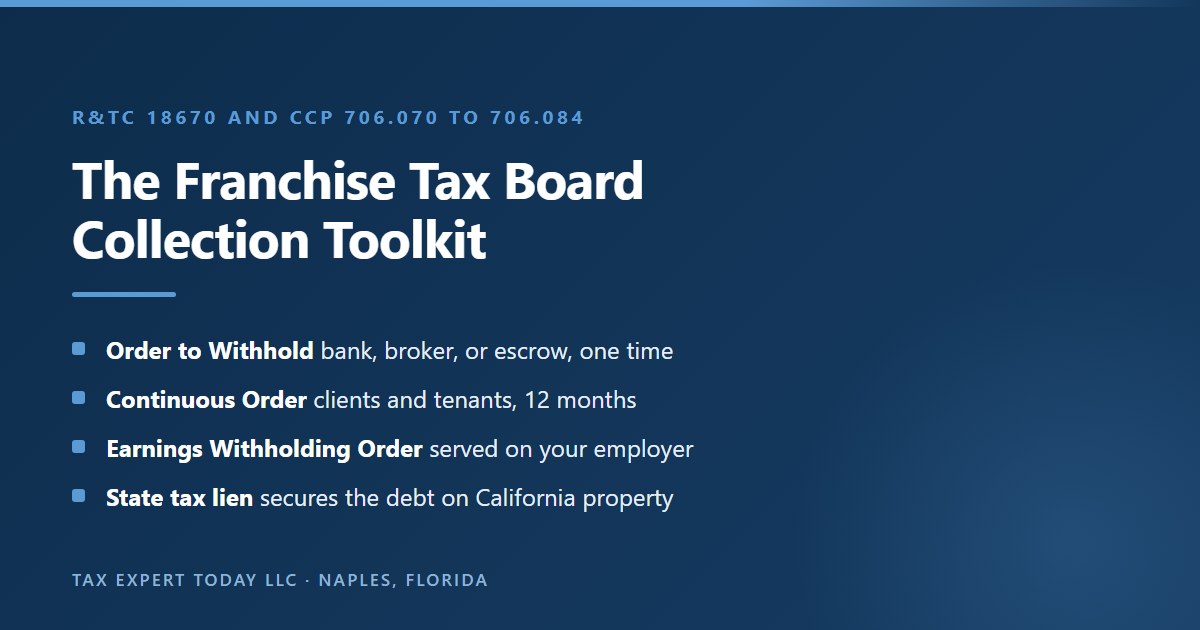
- Order to Withhold (OTW): a one time order to a bank or other holder of your property, the classic bank levy.
- Continuous Order to Withhold (COTW): an order that attaches to payments owed to you for 12 months.
- Earnings Withholding Order for Taxes (EWOT): a wage garnishment served on your employer.
- Warrant and seizure: a rarely used power to seize and sell personal property at public auction.
The FTB describes withholding orders as legal orders issued to collect past due income taxes or bills owed to other agencies, and it lists four types: the earnings withholding order for taxes, the earnings withholding order for non-tax debts, the order to withhold, and the continuous order to withhold. Its withholding orders page states that a personal income tax order to withhold collects 100 percent of the available assets or the entire balance due, whichever is less. The wage version for taxes is issued on form FTB 2905, the bank version on form FTB 2900, and the continuous version on form FTB 2910.
Three features separate an FTB levy from a creditor garnishment. First, no judgment is required: Code of Civil Procedure section 706.072(d) states that a withholding order for taxes may be issued whether or not the state tax liability has been reduced to judgment. Second, the FTB serves the order itself, rather than through a sheriff or marshal. Third, several exemptions that protect ordinary debtors do not apply to state tax collection, which is covered in detail below.
| Collection tool | FTB form | Served on | What it reaches |
|---|---|---|---|
| Order to Withhold for Taxes | FTB 2900 | Banks, credit unions, brokers, escrow holders, others holding your property | Funds or property held on the date of service, up to the balance due |
| Continuous Order to Withhold | FTB 2910 | Clients, tenants, and other payers who owe you money | Payments that come due over the following 12 months |
| Earnings Withholding Order for Taxes | FTB 2905 | Your employer | A portion of each paycheck until the balance is paid or the order is released |
| Warrant, seizure, and sale | Warrant under section 19231 | The taxpayer’s personal property | Personal property sold at public auction after notice |
| Notice of State Tax Lien | Recorded or filed notice | County recorder or Secretary of State | Secures the debt against California property; not itself a levy |
The lien deserves a word because it is often confused with a levy. A lien is a claim against property that secures the debt; a levy actually takes the property. Revenue and Taxation Code section 19221 makes an unpaid liability a perfected and enforceable state tax lien when it becomes due and payable, and the FTB may then record a Notice of State Tax Lien with county recorders or file it with the Secretary of State. The FTB explains on its liens page that a recorded lien becomes public record, attaches to California property you own or later acquire, and is effective for at least 10 years. A lien can make a sale or refinance difficult, but it does not move money out of an account. The levy does.
What law lets the FTB levy without going to court?
Revenue and Taxation Code section 18670 authorizes the FTB to require anyone holding a taxpayer’s money or property to withhold and send it to the FTB, and section 18670.5 allows the same notice to be served on banks electronically. Wage garnishment runs through Code of Civil Procedure sections 706.070 to 706.084, which give the state its own tax order procedure.
- Section 18670: the core order to withhold, served by personal service or first class mail.
- Section 18670.5: electronic service on depository institutions the FTB has reason to believe hold your funds.
- Section 19264: electronic service of wage orders on employers.
- Sections 19231 and 19262: warrants, seizure, and public auction of personal property.
- Code of Civil Procedure 706.070 to 706.084: the withholding order for taxes article.
Section 18670(a) is drafted broadly. It reaches any employer, person, or government body “having in their possession, or under their control, any credits or other personal property or other things of value” belonging to the taxpayer, and it requires the holder to withhold the tax, interest, and penalties due and send them to the FTB at the times the FTB designates. Section 18670.5 adds electronic service on banks, which is how most bank levies are now delivered. A holder that fails to comply after service becomes liable for the amount under section 18670(d).
Wage levies are treated separately because California law channels every wage levy through one procedure. Code of Civil Procedure section 706.071 provides that no levy upon earnings held by an employer is effective unless it is made under the wage garnishment chapter. The state may issue its own withholding order for taxes under section 706.074, apply to a court for a larger order under section 706.076, or serve a jeopardy order in limited cases. Section 19264, rewritten by AB 3372 effective January 1, 2021, allows those orders and the employer’s return to be exchanged electronically, and the FTB is piloting an eGarnishment program with payroll providers.
| Statute | What it does | Why it matters to you |
|---|---|---|
| R&TC 18670 | Order to withhold served on any holder of your property | Sets the 10 business day minimum before a bank remits and the 90 day securities liquidation rule |
| R&TC 18670.5 | Electronic order to withhold on banks | Explains how accounts you never reported can still be found |
| R&TC 18674 | Duties and protection of the holder | Bank must mail you a notice; may charge a fee of up to $3 |
| CCP 706.072 | When a tax wage order may issue | Requires notice and an opportunity for administrative review first |
| CCP 706.074 | Amount of the standard tax wage order | Uses the federal 25 percent formula, not the California 20 percent formula |
| CCP 706.075 | Hearing to modify the wage order | Decision within 15 days of your request |
| R&TC 21015.5 | Pre-levy notice and review | 30 days of notice and a review that suspends the levy |
| R&TC 21016 | Release of levy | Lists the grounds on which a levy must be released |
What notices come before an FTB levy?
Before a first levy for a taxable period, Revenue and Taxation Code section 21015.5 requires the FTB to mail a notice at least 30 days in advance that states the amount due, explains levy and sale, and describes your right to an independent review. In practice that requirement is met by the Final Notice Before Levy and Lien, which follows earlier balance due notices.
- Notice of State Income Tax Due: the bill for a balance due on a filed return or a final assessment.
- Final Notice Before Levy and Lien: the 30 day notice required by section 21015.5.
- Collection cost recovery fee: added when the FTB must take involuntary action after that notice.
- Intent to Offset Federal Payments (FTB 1102): a separate 60 day notice before a federal offset referral.
Section 21015.5(a) provides that no levy may be made on any property unless the FTB has notified the person in writing of the right to request a review, by first class mail to the address of record, not less than 30 days before the first levy for the unpaid tax of that period. The notice must state the amount due, a telephone number, the right to review, the levy and sale provisions, the alternatives that could prevent a levy including installment agreements, and the legal requirements for release. Two limits on the notice matter in practice. It is required only once for a taxable period, so a second levy on the same year needs no new 30 day warning. And it is not required if earlier mail to the same address came back undelivered with no forwarding address.
That second limit is the one that catches people who have moved. The notice goes to the address of record. A taxpayer who left California, stopped filing California returns, and never told the FTB about the new Florida address may find that the only notice the statute requires was mailed to a house they sold years ago. Office of Tax Appeals decisions have upheld the collection cost recovery fee where the FTB mailed a Final Notice Before Levy and Lien and the balance was not paid; once the fee is properly imposed, there is no reasonable cause exception that excuses it.
The fee itself is set by statute and the annual Budget Act. Section 19254 imposes a collection cost recovery fee when the FTB has mailed a notice warning that continued failure to pay may result in collection action, and the FTB’s penalties and fees page currently lists the amount as $362 for individuals and partnerships and $292 for corporations. Interest does not accrue on the fee, but it is a liability that can be collected like tax, and the FTB notes that a later fee can restart the collection period for that year.
| Stage | What you receive | Window to act | What happens if you do nothing |
|---|---|---|---|
| Balance established | Notice of State Income Tax Due or a final assessment | Pay or arrange a plan by the due date shown | Interest and penalties continue to accrue |
| Pre-levy warning | Final Notice Before Levy and Lien | 30 days to pay, arrange an alternative, or request review | Collection cost recovery fee and eligibility for levy and lien |
| Federal referral warning | Intent to Offset Federal Payments, FTB 1102 | 60 days to pay or present evidence | Referral to the Treasury Offset Program |
| Levy served | Bank notice of hold, or employer copy of the wage order | The hold period, or a hearing request at any time for wages | Funds remitted; wage withholding continues each pay period |
How long does a bank hold funds under an FTB levy?
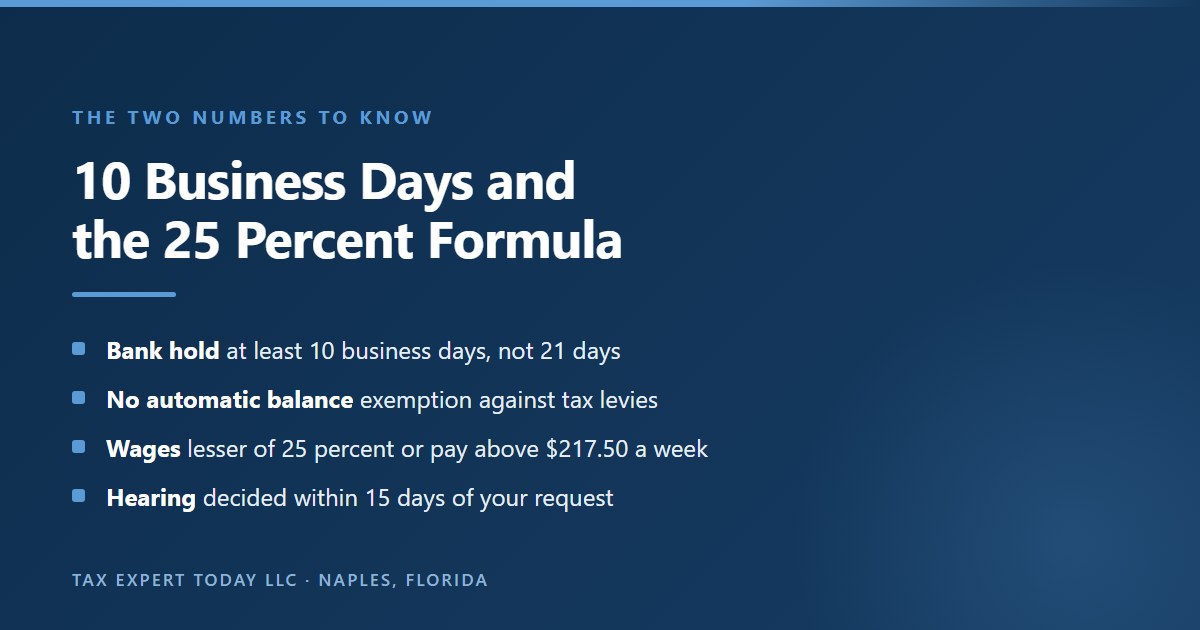
A bank must hold the funds and may not send them to the FTB for at least 10 business days after it receives the order. Section 18670(a) states that amounts from a depository institution “shall be transmitted to the Franchise Tax Board not less than 10 business days from receipt of the notice.” The 21 day figure often quoted online is the federal IRS rule, not the California one.
- California minimum: 10 business days from the bank’s receipt of the order, which is roughly two calendar weeks.
- Federal comparison: 21 calendar days under Internal Revenue Code section 6332(c).
- Weekends and holidays: do not count toward the California business day period.
- The order controls the date: the bank remits at the time the FTB designates, which cannot be earlier than the statutory minimum.
This is the question the ranking pages get wrong most often, and the answer is in the statute rather than in practice reports. Competitor pages quote 10 days and 21 days with equal confidence. The 21 days comes from Internal Revenue Code section 6332(c), which requires a bank served with a federal levy to surrender the deposits only after 21 days. California’s rule is in section 18670(a), and section 18670.5 repeats the same “not less than 10 business days” floor for electronically served orders. A taxpayer who assumes three weeks may in fact have closer to two.
The hold period is the practical window for action. Inside it, the FTB can release the levy in whole or in part if a ground under section 21016 applies, if the funds are exempt, or if the taxpayer resolves the balance. After the bank remits, the money is a payment on the account, and recovering it requires a refund claim or a showing that the levy was wrongful. Because the 10 business days begin when the bank receives the order rather than when the taxpayer notices it, every day spent trying to understand the bank statement entry comes out of that window.
| Hypothetical service date (bank receives order) | Business days counted | Earliest permitted remittance |
|---|---|---|
| Monday, March 2 | March 3 to March 16, weekdays only | On or after Monday, March 16 |
| Thursday, November 19 | Skipping the weekend and the Thanksgiving holidays | Not before early December |
| Federal levy for comparison, served March 2 | 21 calendar days under IRC 6332(c) | On or after March 23 |
The dates above are hypothetical and illustrate counting only; the exact remittance date is the one stated in the order, and banks follow their own processing calendars within the statutory minimum. The point of the table is that a California bank levy moves on a shorter clock than a federal one.
How much can an FTB bank levy take?
For personal income tax, an FTB order to withhold takes 100 percent of the funds available in the account on the date of service, up to the balance due. Unlike a private creditor’s levy, it is not subject to California’s automatic deposit account exemption, so there is no protected minimum balance unless another exemption, such as the federal benefits rule, applies.
- Reach: the full available balance, or the full liability, whichever is less.
- No automatic exemption: Code of Civil Procedure section 704.220(c) excludes Revenue and Taxation Code levies.
- Bank fee: the bank may charge each named account holder up to $3 for processing the notice.
- Joint accounts: the bank is protected when it remits from a joint account, so the dispute runs between the co-owner and the FTB.
California gives ordinary judgment debtors an automatic exemption for a minimum amount in a deposit account. Code of Civil Procedure section 704.220(a) protects money up to the minimum basic standard of adequate care for a family of four for Region 1, without the debtor having to file a claim. Section 704.220(c) then states that the exemption does not apply to money levied upon to satisfy a provision of the Revenue and Taxation Code, or to a warrant or notice of levy issued by the state or any of its agencies. An FTB bank levy for income tax is both, so the automatic floor that protects a consumer from a credit card judgment does not protect a taxpayer from the FTB.
Joint accounts produce the hardest conversations. Section 18674(a) provides that a bank paying the FTB from a deposit account in which the delinquent taxpayer and another person have an interest is not liable to any of the account holders for doing so. The bank therefore has no reason to sort out who contributed what. Section 18674(b) requires the bank to mail each person named on the account a notice explaining the hold, the amount, and the remittance date, and allows a service charge of up to $3 per person. A spouse, parent, or business partner whose own money sits in a joint account with the taxpayer needs to raise the ownership question with the FTB during the hold period, with records showing whose deposits funded the balance.
Business accounts follow the same rule when the business itself owes the tax. When an individual owes and the account belongs to a separate entity, the FTB generally needs a basis to treat the entity’s funds as the taxpayer’s property, such as an alter ego or nominee theory, and that question turns on facts. A single member LLC that is disregarded for income tax purposes is still a separate owner of its bank account under state law, which is a point to raise promptly rather than after remittance.
What does “legal order debit Franchise Tax Board” mean on a bank statement?
A line such as “legal order debit Franchise Tax Board” usually means your bank received an FTB order to withhold and has either placed a hold on the account or remitted funds under it. Banks label these entries differently, but the source is the same: a section 18670 or 18670.5 order served on the bank for an unpaid California balance.
- Hold entry first: many banks first show a hold or freeze on the levied amount.
- Debit entry later: the debit appears when the bank sends the funds after the hold period.
- Possible non-tax source: the FTB also collects court-ordered debt and vehicle registration debt for other agencies.
- First step: confirm which debt and which year the order covers before deciding how to respond.
The FTB collects more than its own income tax. Through its Court-Ordered Debt and Vehicle Registration Collections programs, it collects fines, restitution, and registration fees owed to courts and the Department of Motor Vehicles, and its withholding orders page notes that orders for those debts take 100 percent of the available assets after required exemptions. A “legal order” entry may therefore relate to a traffic fine as easily as to an income tax year. The remedies differ: court-ordered debt is disputed with the referring court or agency, while an income tax levy is addressed under the Revenue and Taxation Code.
The quickest way to identify the debt is the bank’s own notice under section 18674(b), which states the amount and the reason, and the taxpayer’s MyFTB account, where the FTB shows withholding order status for individuals. Where the taxpayer has authorized a representative, our guide to the FTB power of attorney explains which authority the representative needs to see and discuss collection actions.
Does an FTB bank levy take money deposited after the hold?
A standard order to withhold is a one time levy. It attaches to the funds the bank holds when the order is served, and deposits made afterward are not swept by that order. The FTB can serve a new order later, and a continuous order to withhold attaches to payments owed to you over 12 months, which is a different tool aimed at payers rather than banks.
- One time order: captures the balance on the date of service, up to the amount stated.
- Repeat orders: the FTB may serve another order on the same bank at a later date.
- Continuous order: remains in effect for 12 months against payments owed to you.
- No new 30 day notice: the section 21015.5 notice is required only once per taxable period.
The distinction matters for planning cash flow during a dispute. A taxpayer whose account was levied on the 1st and who deposits a paycheck on the 15th has not, by that deposit alone, handed the second paycheck to the FTB under the first order. But the FTB is not limited to one bank levy per year, and the statute does not require another 30 day warning before a second levy for the same taxable period. Moving all deposits to a new bank does not change the analysis, because section 18670.5 allows the FTB to serve any depository institution it has reason to believe holds the taxpayer’s funds.
| Feature | Order to Withhold (FTB 2900) | Continuous Order to Withhold (FTB 2910) |
|---|---|---|
| Typical recipient | Bank, credit union, broker, escrow | Client, customer, tenant, other payer |
| Duration | Property held on the date of service | Payments due over 12 months |
| Amount for income tax | 100 percent of available assets or the balance, whichever is less | Payments owed, up to the balance |
| Typical taxpayer affected | Anyone with a bank account | Independent contractors, landlords, vendors |
| Modification request | Through the FTB during the hold | Through MyFTB or the FTB collection contact |
Can the FTB levy brokerage and investment accounts?
Yes. Section 18670(c) requires a broker, bank, or securities intermediary served with an order to withhold financial assets to liquidate them in a commercially reasonable manner within 90 days and remit the proceeds, less normal commissions, within five days of the sale. If the account holds more than the debt, you have 60 days to tell the firm which assets to sell.
- Covered assets: certificated and uncertificated securities, security entitlements, and securities accounts.
- Liquidation window: 90 days from issuance of the order.
- Remittance: within five days after liquidation, net of ordinary commissions and fees.
- Your instruction right: 60 days after service to choose which assets are sold.
- Default rule: without instructions, the most recently purchased assets are sold first.
The default rule in section 18670(c)(2) is worth reading twice. If the taxpayer does not instruct the firm, it liquidates “beginning with the financial assets purchased most recently.” Recent purchases often carry little gain, which can be a reasonable outcome, but they may also be positions bought for a reason, and a forced sale can create a taxable event of its own. A taxpayer facing a securities levy who wants to control which lots are sold, or who holds positions with large embedded gains, has a short window in which the instruction right can be used.
Retirement accounts are treated differently and are discussed in the section on protected property below. A taxable brokerage account has no special protection from an FTB order to withhold.
How does an FTB wage garnishment work?
An FTB wage garnishment is an Earnings Withholding Order for Taxes, form FTB 2905, served on your employer. The employer must give you a copy within 10 days, may not withhold from pay periods that end before the 10th day after service unless it is a jeopardy order, and must keep withholding each payday until the balance is paid or the FTB releases the order.
- Who is served: the employer or its payroll provider, by mail, by an FTB employee, or electronically with consent.
- Your copy: delivered by the employer within 10 days of service, with a notice of your hearing rights.
- Start date: pay periods ending on or after the 10th day following service.
- End date: payment in full, release by the FTB, or one year after your employment with that employer ends.
- Priority: a tax order displaces earlier creditor garnishments, but not a support order.
The mechanics are spread across a handful of short sections. Code of Civil Procedure section 706.075(b) requires the state to serve the employer with an extra copy of the order and a notice of the taxpayer’s rights, and requires the employer to deliver them to the employee within 10 days. Section 706.078 bars withholding from earnings for any pay period that ends before the 10th day after service, unless the order is a jeopardy withholding order, and provides that the order terminates automatically one year after the employment ends. The FTB’s employer guidance on wage garnishments for taxes adds the practical side: the employer sends an acknowledgment, makes the first payment within 15 days of the last pay period, and continues until the order is paid in full or released, and only the FTB can change the amount.
Priority is set by section 706.077. An employer served with a withholding order for taxes must withhold under it and stop withholding under any earlier earnings withholding order, except that a support order keeps its priority. A second tax order served while a first is in effect is ineffective. For a taxpayer who already has a creditor garnishment running, the arrival of an FTB order therefore changes who receives the money rather than adding a second deduction on top of the first.
| Event | Rule | Source |
|---|---|---|
| Order served on employer | Service complete when the employer receives it | CCP 706.080 |
| Copy to employee | Within 10 days of service; immediately for a jeopardy order | CCP 706.075(b) |
| First pay period affected | Periods ending on or after the 10th day after service | CCP 706.078(a) |
| Hearing request | Any time after service; decided within 15 days of the request | CCP 706.075(c) |
| Withholding ends | Paid in full, released, or one year after employment ends | CCP 706.078(c) |
| Competing creditor order | Tax order takes priority; support order keeps priority | CCP 706.077 |
How much of your paycheck can an FTB wage garnishment take?
Unless the order states a lower figure, an FTB wage garnishment takes the amount allowed by the federal Consumer Credit Protection Act: the lesser of 25 percent of weekly disposable earnings or the amount by which disposable earnings exceed 30 times the federal minimum wage. The California formula of 20 percent, which protects debtors from ordinary creditors, does not govern tax orders.
- Standard tax order: 15 U.S.C. section 1673(a), applied through Code of Civil Procedure section 706.074(b).
- Weekly floor: earnings at or below 30 times $7.25, which is $217.50 a week, cannot be taken under the standard order.
- Disposable earnings: gross pay less deductions required by law, such as income tax withholding, Social Security, Medicare, and SDI.
- Not deducted: voluntary items such as 401(k) deferrals or most insurance premiums.
- Larger orders: only through a court order under section 706.076.
This is the second figure the online sources tend to blur. Code of Civil Procedure section 706.050, operative since September 1, 2023, limits most California wage garnishments to the lesser of 20 percent of disposable earnings or 40 percent of the amount by which they exceed 48 times the state minimum wage. That limit is a consumer protection, and it does not control the FTB’s standard tax order. Section 706.074(b) provides that, unless a lesser amount is specified, the amount withheld each pay period is the amount required under section 1673(a) of Title 15 of the United States Code, and is not subject to the exception in section 1673(b). Section 1673(a) sets the federal ceiling at the lesser of 25 percent of disposable earnings for the week or the amount by which they exceed 30 times the federal minimum hourly wage.
The FTB publishes an earnings withholding calculator for employers and employees that asks for gross earnings, federal and state income tax withheld, Social Security, and SDI, which reflects the disposable earnings definition. The hypothetical figures below illustrate the weekly computation under the standard order.
| Hypothetical weekly disposable earnings | 25 percent | Amount above $217.50 | Standard FTB withholding (lesser) |
|---|---|---|---|
| $250 | $62.50 | $32.50 | $32.50 |
| $400 | $100.00 | $182.50 | $100.00 |
| $1,000 | $250.00 | $782.50 | $250.00 |
| $3,000 | $750.00 | $2,782.50 | $750.00 |
For pay periods other than weekly, the federal formula is converted to an equivalent multiple of the minimum wage, and the FTB calculator handles the conversion. The practical lesson for a higher earner is that the 25 percent figure governs almost the entire range of professional salaries, and that the deduction is computed on disposable earnings, not take home pay after voluntary deductions. A taxpayer who increases 401(k) deferrals after an order arrives does not reduce the garnishment by doing so.
Can you ask the FTB to reduce a wage garnishment?
Yes. Code of Civil Procedure section 706.075(c) gives you the right to an administrative hearing to reconsider or modify the amount withheld, which you may request at any time after service. The FTB must hold the hearing and decide within 15 days of receiving the request, applying the standard of what you prove is necessary for the support of you and your family.
- Timing: any time after the order is served, not only at the start.
- Decision deadline: within 15 days after the FTB receives the request.
- Standard: the earnings necessary for the support of the taxpayer and the taxpayer’s family, under section 706.051(b).
- Judicial review: a petition for a writ of mandate within 90 days of the written determination.
- Not a liability forum: the hearing addresses the amount withheld, not whether the tax is owed.
There is an apparent contradiction in the statutes that is worth understanding. Section 706.051(c)(4) says the support exemption in section 706.051(b) is not available when the order is a state tax order. Section 706.075(c), however, directs that the FTB’s own hearing on the amount withheld “is subject to the standard provided in subdivision (b) of Section 706.051.” The two fit together: the taxpayer cannot claim the support exemption as a matter of right in a court proceeding, but the FTB applies the same support standard when it reconsiders the amount at the taxpayer’s request. The hearing is therefore the route, and the evidence is a household budget.
The FTB states on its withholding orders page that individuals can request a modification of an EWOT through MyFTB. A request supported by a complete picture of income, housing, medical costs, dependents, and other necessary expenses is more likely to be evaluated on its merits than a request that simply says the deduction is too high. Disputes about whether the tax is owed belong elsewhere: section 706.082 provides that no review of the tax liability is permitted in court proceedings under the wage garnishment chapter.
Can the FTB take more than 25 percent of your wages?
Only through a court. Under section 706.076, the FTB may apply to a court in the county where you last lived for a larger order, and after a hearing the court may require the employer to withhold all earnings except what you prove is necessary for support. Jeopardy orders and temporary earnings holding orders exist for cases where delay would put collection at risk.
- Court order: application in the county of last known residence, with notice to the taxpayer and a hearing.
- Amount: all earnings other than the amount proven necessary for support, but never less than the section 706.050 amount.
- Jeopardy withholding order: applies to earnings already due when served.
- Temporary earnings holding order: preserves earnings while a court application is pending.
Section 706.076 is used far less often than the standard order, but it explains why a taxpayer who ignores the standard order and the hearing process has not reached a ceiling. The court application route requires a statement under oath that the taxpayer was served with the application and a notice of the right to appear, and the clerk must mail a hearing notice at least 10 days before the hearing. The jeopardy provisions require an FTB determination that collection will be jeopardized by delay; they are not a routine tool.
| Order type | Who issues it | Amount withheld | Your remedy |
|---|---|---|---|
| Standard withholding order for taxes | The FTB itself | Federal formula, or a lesser stated amount | Administrative hearing within 15 days; writ of mandate within 90 days |
| Court withholding order for taxes | A court, on FTB application | All earnings above the proven support amount | Appear at the hearing and prove the support amount |
| Jeopardy withholding order | The FTB, on a jeopardy finding | Begins with earnings due at service | Hearing rights still apply |
| Temporary earnings holding order | The FTB, pending a court application | Earnings held, not yet paid over | Respond to the court application |
Can the FTB levy independent contractor income, rent, and receivables?
Yes. The FTB lists employers, banks, escrows, businesses paying other businesses or individuals, individuals paying for services, and renters among the payers it serves. For self-employed taxpayers and landlords, the continuous order to withhold, form FTB 2910, attaches to payments owed to you and remains in effect for 12 months.
- Clients: a business that pays you as an independent contractor can be ordered to remit your invoices.
- Tenants: the FTB states it can intercept a landlord’s rental payments.
- Escrow: sale proceeds held in escrow can be reached by an order to withhold.
- No wage formula: payments that are not earnings from employment are not limited by the 25 percent rule.
The FTB withholding orders page describes the continuous order as one that “attaches to payments you may be entitled to and remains in effect for 12 months,” and its list of payer types includes “businesses paying other businesses or individuals,” “individual paying for services provided,” and “renter (we can intercept a landlord’s rental payments).” For a consultant who invoices a handful of clients, a continuous order on the largest client can take a full invoice, because the wage garnishment limits in section 706.074 protect earnings paid by an employer, not fees paid to an independent business.
That difference creates real business risk. A client served with an FTB order learns that its consultant has a California tax problem, and the client must comply or become liable under section 18670(d). Where a taxpayer earns through an entity, the payer is often paying the entity rather than the individual, which brings back the separate owner question discussed above. These are situations where resolving the balance before the order reaches a client is worth considerable effort.
| Income source | Likely FTB tool | Amount limit |
|---|---|---|
| W-2 wages | Earnings Withholding Order for Taxes | Federal 25 percent formula unless a court orders more |
| Independent contractor invoices | Continuous Order to Withhold on the client | Payments owed, up to the balance |
| Rent from a tenant | Continuous Order to Withhold on the tenant | Rent owed, up to the balance |
| Proceeds in escrow | Order to Withhold on the escrow holder | Proceeds held, up to the balance |
| Brokerage account | Order to Withhold on the securities intermediary | Liquidated value, up to the balance |
Which property is protected from an FTB levy?
Some property remains protected even from state tax collection. Federal benefits such as Social Security deposited directly into an account are shielded by a two month lookback rule that applies to state agency orders, and qualified employer retirement plans are generally protected by federal anti-alienation rules. Other California exemptions may apply, but the automatic deposit account exemption does not.
- Federal benefit deposits: two months of directly deposited benefits are protected under 31 C.F.R. Part 212.
- Employer retirement plans: ERISA anti-alienation rules generally block state tax levies on plan benefits.
- IRAs: treated differently from employer plans; protection depends on the exemption claimed and the facts.
- Automatic deposit exemption: not available against Revenue and Taxation Code levies.
- Before any sale: the FTB must notify you of the Code of Civil Procedure exemptions.
The federal benefits rule is the most valuable protection and the least known. Treasury’s garnishment rule requires a bank that receives a garnishment order to review the account and protect the lesser of the benefit payments directly deposited during a two month lookback period or the account balance. The definition in 31 C.F.R. section 212.3 covers a writ, order, notice, or levy issued by “a State or State agency,” with the exceptions written for orders of the United States and state child support agencies. An FTB order to withhold is therefore within the rule, and a retiree whose account holds only two months of Social Security deposits should generally find that amount protected automatically. Benefits received by paper check, or transferred from another account, do not carry the automatic protection.
Employer plans such as a 401(k) are generally protected by the anti-alienation requirement in 29 U.S.C. section 1056(d), which requires that plan benefits may not be assigned or alienated. The recognized exception is for federal tax levies, not state ones. Individual retirement accounts are not ERISA plans, and their treatment turns on the California exemption rules. Section 21016(b) requires the FTB to notify the taxpayer in writing of the Code of Civil Procedure exemptions before selling seized property, and section 21017 adjusts those exemptions for inflation for purposes of income tax collection, which indicates that the Chapter 4 exemptions are part of FTB collection even though the automatic deposit exemption is carved out. Whether a specific account is protected in a specific case is a question to raise with the FTB promptly and with documentation.
| Asset | Protection against an FTB levy | Source | What to do |
|---|---|---|---|
| Directly deposited Social Security, SSI, VA, federal retirement | Two months of deposits protected automatically | 31 C.F.R. Part 212 | Confirm the bank applied the lookback |
| 401(k) or other ERISA plan | Generally protected while held in the plan | 29 U.S.C. 1056(d) | Funds withdrawn to a bank account lose plan status |
| IRA | Depends on the California exemption claimed | CCP Chapter 4, R&TC 21016(b) and 21017 | Raise the exemption with documentation |
| Ordinary checking or savings | No automatic minimum balance | CCP 704.220(c) | Act within the 10 business day hold |
| Wages | Federal 25 percent formula | CCP 706.074 | Request a hearing under CCP 706.075(c) |
How do you get an FTB levy released?
Section 21016 requires the FTB to release a levy in circumstances it deems appropriate, including when the Taxpayer Rights Advocate finds the levy threatens the health or welfare of the taxpayer or family, when the levy was issued contrary to procedures, when an installment agreement is in place unless that agreement allows the levy, and when release will facilitate collection.
- Pay in full: the most direct route, followed by a release notice to the bank or employer.
- Procedural defect: a levy issued not in accordance with administrative procedures.
- Hardship: an Advocate finding that the levy threatens health or welfare.
- Installment agreement: release unless the agreement provides for the levy.
- Uncollectible wages: release of a wage levy as soon as practicable on agreement that the tax is not collectible.
The release grounds in section 21016(a) are framed as circumstances in which the board “shall release” a levy, which makes them more than matters of grace once a ground is established. In practice, the ground has to be shown with evidence, and the timing matters. A bank levy that is released during the hold period returns control of the funds; a release after remittance stops future collection but does not by itself refund what was taken.
| Ground in section 21016 | What it means | Evidence usually needed |
|---|---|---|
| (a)(1) Cost of sale exceeds the debt | Seizure and sale would cost more than it collects | Asset value and sale cost estimate |
| (a)(2) Advocate hardship finding | The levy threatens health or welfare of the taxpayer or family | Household budget, medical, housing, dependent records |
| (a)(3) No reasonable reduction | Sale proceeds would not meaningfully reduce the debt | Valuation and lien priority information |
| (a)(4) Procedural defect | The levy was not issued in accordance with procedures | Notice history, addresses, dates |
| (a)(5) Installment agreement | An agreement under section 19008 is in place | The agreement terms |
| (a)(6) Facilitates collection | Release serves both the taxpayer and the state | A credible payment proposal |
| (d) Wages, uncollectible | Agreement that the tax is not collectible | Full financial disclosure |
Does an installment agreement stop an FTB levy?
An installment agreement bars new levies while a request is pending and while the agreement is in effect, under section 19008(d), and section 21016(a)(5) lists an agreement as a ground for releasing a levy unless the agreement allows it. A levy issued before the request, however, is not lifted automatically, and the agreement terms decide whether an existing wage order continues.
- New levies: generally barred during the request and the agreement.
- Existing levies: not automatically lifted by a later request.
- Release ground: an agreement in effect, unless it provides for the levy.
- Collection period: suspended while the levy bar applies.
The mechanics of applying, the $25,000 threshold for the mandatory acceptance track, and the four periods covered by the statutory levy bar are set out in our guide to the FTB installment agreement, so they are not repeated here. The point for a taxpayer who already has a levy in place is sequencing. A request filed after a bank levy is served does not stop the hold from running, so the conversation with the FTB about releasing the existing levy has to happen during the hold, alongside the payment plan request. Where a lump sum settlement is under consideration instead, our guide to the FTB offer in compromise explains how a pending offer interacts with collection.
What is the independent administrative review before an FTB levy?
Section 21015.5 gives you one independent departmental review per taxable period, which you request within the 30 day notice period. It is conducted by staff with no prior involvement, can consider spousal defenses, the appropriateness of collection, and alternatives such as a bond, substitute assets, an installment agreement, or an offer, and the levy is suspended while it is pending.
- Request window: during the 30 days after the pre-levy notice.
- Reviewer: an officer or employee with no prior involvement with the unpaid tax.
- Issues: spousal defenses, challenges to collection, and offers of alternatives.
- Balancing test: efficient collection weighed against intrusiveness.
- Suspension: levy action is suspended while the review is pending.
This is California’s closest counterpart to the federal collection due process hearing described in our guide to the IRS collection due process hearing, and it is easy to miss because the FTB does not use that name. Under section 21015.5(b) and (c), the Taxpayers’ Rights Advocate establishes the review procedures, the reviewer must verify that legal and administrative requirements were met, and the determination must consider “whether any proposed collection action balances the need for the efficient collection of taxes with the legitimate concern of the person that any collection action not be more intrusive than necessary.” Section 21015.5(d) suspends the levy actions under review while the review is pending, and no period expires before the 15th day after a final determination.
The limits are just as important. Only one review is available per taxable period. An issue raised and considered in an earlier review or proceeding in which the taxpayer participated meaningfully cannot be raised again, unless circumstances have changed. Frivolous positions are excluded. And under section 21015.5(e), if the FTB has made a jeopardy finding, the review comes after the levy rather than before it. A taxpayer who received the notice at an old address and learned of it only from a bank levy has usually lost the pre-levy window, which leaves the release grounds, the Advocate, and the alternatives described in this guide.
When should you contact the FTB Taxpayer Rights Advocate?
Contact the Taxpayer Rights Advocate when normal FTB channels have not resolved the problem and a bank levy, wage garnishment, or lien is causing financial hardship, when FTB delay or error is driving the harm, or when you believe your rights were not respected. Section 21004 allows the Advocate to stay actions where a taxpayer has suffered or will suffer irreparable loss.
- Financial hardship: including hardship caused by a bank levy, wage garnishment, or lien.
- Time based hardship: FTB delays beyond its own processing time frames.
- Unfair or unlawful treatment: including inability to present your position in collection.
- Tax relief: abatement where FTB error or unreasonable delay caused penalties or interest.
- How to ask: online form, telephone 800-883-5910, or form FTB 914 by fax or mail.
Section 21004(b) directs the Advocate to give highest priority to reviewing and taking prompt action, “including staying actions where taxpayers have suffered or will suffer irreparable loss as the result of board action.” A stay tolls the applicable statutes of limitation and does not stop penalties and interest from accruing. Section 21016(a)(2) separately requires release of a levy when the Advocate finds that it threatens the health or welfare of the taxpayer, a spouse, or dependents. The FTB’s Taxpayer Advocate Services page lists the four eligibility categories and states that the Advocate generally will not take cases that have not first gone through normal channels, with an exception where delay creates an immediate economic hardship relating to a bank levy, wage garnishment, or tax lien.
| Route | When it fits | What it can do | Limit |
|---|---|---|---|
| Independent review, R&TC 21015.5 | Within 30 days of the pre-levy notice | Suspends the levy; weighs alternatives and intrusiveness | One per taxable period |
| Wage hearing, CCP 706.075(c) | Any time after a wage order is served | Modifies the amount withheld | Amount only, not the tax owed |
| Taxpayer Rights Advocate, R&TC 21004 | Hardship after normal channels fail | Stay for irreparable loss; release on a health or welfare finding | Generally requires normal channels first |
| Release request, R&TC 21016 | A listed ground applies | Release of bank or wage levy | Evidence of the ground is needed |
Can the FTB still levy you after you move to Florida?
Yes, in part. Moving does not end a California tax debt, and the 20 year collection period keeps running wherever you live. What changes is reach: California property, California payers, and banks that operate in California remain within the FTB’s administrative tools, while purely Florida assets and payers are harder for a California order to reach without a court.
- The debt follows you: residency changes future tax, not an assessed balance.
- California property stays exposed: the state tax lien attaches to property located in California.
- Multistate banks: an order served at a bank’s designated address can reach accounts the bank holds, depending on the institution.
- California payers: rent from California property, California escrows, and California clients remain reachable.
- Florida only assets: generally require a court judgment enforced in Florida.
Start with what certainly survives the move. Government Code section 7170 attaches the state tax lien to property “belonging to the taxpayer and located in this state,” including after-acquired property. A Florida resident who still owns a California rental, a vacation home, or an interest in California real estate carries the lien on that property, and the FTB’s liens page notes that escrow companies are expected to pay off FTB liens through eDemand during a sale. The most common moment an FTB balance surfaces after a move to Florida is the sale of the former California home, when the escrow officer finds the recorded lien.
Banks are the harder question, and the honest answer is that it depends on the institution. Section 18670(a) and (b) direct the order to the branch reported in the bank’s information returns, the branch where the property is held, or an address the bank designates for receiving notices to withhold, and section 18670.5 allows electronic service on any depository institution the FTB believes holds the taxpayer’s funds. A large national bank with California operations typically processes levies centrally, so an account opened at a Florida branch of that bank may be reached by an order the bank receives at its designated address. A Florida credit union or community bank with no California presence is in a different position, because a California administrative order relies on the recipient being subject to California process. That is an inference from the structure of the statute rather than a rule the FTB publishes, and the result in any case turns on the institution and its own compliance policy.
Employers follow the same logic. A national employer with California payroll operations will generally honor an EWOT, while a Florida business with no California connection may not be bound by one. Payments with a California source, such as rent from a California tenant or a fee from a California client, remain squarely within the continuous order to withhold. Our guide to California source income explains which income a Florida resident still owes California tax on, which is often what generates the next balance. Retirees should also read our guide to retiring to Florida taxes, because pension and retirement plan payers are among the information returns that keep an old California address on file.
| Collection route | Reach after a move to Florida | Basis |
|---|---|---|
| State tax lien on California real estate | Continues; surfaces on sale or refinance | Gov. Code 7170; R&TC 19221 |
| Bank levy, bank with California operations | Often reachable through the bank’s designated address | R&TC 18670(b), 18670.5 |
| Bank levy, Florida only institution | Uncertain without a court judgment | Inference from R&TC 18670 |
| Wage order, employer with California payroll | Generally honored | CCP 706.074, R&TC 19264 |
| Rent or fees from California payers | Reachable by continuous order | R&TC 18670; FTB 2910 |
| Federal income tax refund | Limited by the federal address test | IRC 6402(e)(2); 31 C.F.R. 285.8 |
| Lawsuit and Florida judgment | Available within the statutory period | R&TC 19371; Fla. Stat. 55.503 |
Does the FTB take your federal tax refund after you move?
Generally not for a year in which your federal return shows a Florida address. Internal Revenue Code section 6402(e)(2) permits offset of a federal income tax refund for a state income tax debt only if the address on the federal return for that year is in the state seeking the offset, and Treasury’s regulation at 31 C.F.R. section 285.8 applies the same test.
- Address test: the address on the federal return for the year of the overpayment controls.
- Pre-move years: a refund on a return filed with a California address can still be offset.
- Notice: the FTB sends an Intent to Offset Federal Payments, FTB 1102, with 60 days to respond.
- Other federal payments: the FTB states it may also offset federal payments other than refunds, which follow different rules.
- Other states: the Multistate Offset Program can redirect refunds from partner states, which Florida cannot produce.
This is the point where many summaries of FTB collection go wrong, including the assumption that the federal refund offset is not geographic. Section 6402(e)(1) requires the Treasury to reduce a federal overpayment by a past due, legally enforceable state income tax obligation, but section 6402(e)(2) is headed “Offset permitted only against residents of State seeking offset” and applies paragraph (1) only if “the address shown on the Federal return for such taxable year of the overpayment is an address within the State seeking the offset.” The Fiscal Service rule at 31 C.F.R. section 285.8 repeats that limitation. A federal return filed from a Naples address therefore generally falls outside the state income tax refund offset for a California debt.
The limit is narrower than it first appears. It applies to federal tax refunds; the FTB’s Treasury Offset Program page states that it partners with Treasury “to offset federal payments and tax refunds,” and other federal payments are governed by different offset rules. It applies year by year, so a refund on an amended return for a pre-move year filed with a California address is in a different position. And the 60 day notice period in section 6402(e)(4) still matters for any year that is within the test: the FTB must notify by certified mail, give at least 60 days to present evidence, and consider that evidence before referral.
The Multistate Offset Program works between states with income taxes. Under Revenue and Taxation Code sections 19291 and 19377.5, the FTB has agreements under which partner states transfer a taxpayer’s state refund to pay a California debt, and the FTB notes that offsets continue even during a payment plan. Florida has no individual income tax and therefore no Florida refund to transfer. A Florida resident who files a nonresident return in a partner state, however, for a rental in Georgia or wages earned in another income tax state, may find that refund redirected to California.
| Refund or payment | Can it be offset for a California debt? | Rule |
|---|---|---|
| Federal refund, return shows a Florida address | Generally no | IRC 6402(e)(2); 31 C.F.R. 285.8 |
| Federal refund, return shows a California address | Yes, after the 60 day notice | IRC 6402(e)(1) and (4) |
| California state refund | Yes, applied to the California balance | FTB offset of its own refunds |
| Refund from another income tax state | Possibly, through the Multistate Offset Program | R&TC 19291, 19377.5 |
| Other federal payments | Depends on the payment type | FTB Treasury Offset Program page |
Can the FTB sue you in Florida?
Yes. Section 19371 allows the FTB, within 10 years after the liability is determined or while a recorded lien is in force, to sue in the courts of California, any other state, or the United States. A California judgment can then be recorded in Florida under the Florida Enforcement of Foreign Judgments Act and enforced as a Florida judgment, subject to Florida’s own exemptions.
- Time limit: 10 years after determination of the liability, or while a recorded lien remains in force.
- Forum: courts of this state, any other state, or the United States.
- Florida recording: a certified foreign judgment is recorded with a circuit court clerk.
- Florida exemptions: once enforcement is in Florida, Florida exemption law becomes relevant.
Section 19371(a) is short and direct, and its reference to “the courts of this state, of any other state, or of the United States” is the reason a California tax debt does not become unenforceable simply because the taxpayer has crossed the state line. Once a judgment exists, Florida Statutes section 55.503 provides that a certified foreign judgment recorded with the clerk of a circuit court has the same effect as a Florida judgment and may be enforced in the same way.
Enforcement in Florida brings Florida law with it. Florida Statutes section 222.11, for example, exempts all disposable earnings of a head of family whose disposable earnings are $750 a week or less, and bars garnishment above that level without a written waiver in the form the statute prescribes. Florida’s homestead protection is another example, and our guide to Florida asset protection for new residents explains how those protections work in general. Whether and how those protections apply to a particular judgment depends on the facts and on the claim being enforced, and this is an area where a taxpayer should get advice before assuming an outcome. In practice, a lawsuit is a slower and more expensive route than an administrative levy, and the size of the balance usually decides whether the FTB pursues it.
California law also authorizes cooperative collection. Under section 19377.5, the FTB may enter into agreements with the Internal Revenue Service or another income tax state for the collection of California tax debts, and section 19291 lets the FTB collect for them in return. These agreements are the legal basis for the multistate offsets described above.
What if the FTB is levying for a year after you moved to Florida?
A levy for a year after the move often traces back to an estimated assessment issued when the FTB received income information, such as a W-2 or 1099 showing a California address, and no California return was filed. The levy process cannot be used to dispute the tax itself, so the usual route is to file the correct return for that year, nonresident or part-year, and ask the FTB to replace the estimate.
- Common trigger: information returns still showing a California address after the move.
- The estimate: based on reported gross amounts, often without deductions or the nonresident apportionment.
- Not decided in the levy: Code of Civil Procedure section 706.082 bars review of the liability in wage garnishment proceedings.
- The fix: a filed Form 540NR, or evidence that no California return was required.
The pattern is common after a move. A former employer, brokerage, or retirement plan keeps a California address on file, the FTB receives the information return, and its filing enforcement program sends a demand and then an assessment based on the gross amount. If the notices go to the old address, the first contact the taxpayer sees is the levy. Filing the correct return generally addresses the underlying assessment, while the residency facts decide what that return shows. Our guides to the California part-year resident return, the nonresident state tax return, and the California residency audit cover the filing and the evidence. Where the FTB challenges the move itself, the issue is residency, and the collection action follows the outcome of that question rather than the other way around.
The liability side has its own timetable that is separate from collection. A taxpayer who receives a Notice of Proposed Assessment has a protest period, and an estimated assessment that has become final can still be addressed by filing a return and, where tax has been paid, a claim for refund within the applicable period. Our guide to the California late payment penalty explains the penalties that usually accompany these balances, and the leaving California taxes guide covers the steps that reduce the chance of the problem arising.
How long can the FTB keep levying?
The FTB generally has 20 years to collect, measured from the date the latest liability for a taxable year becomes due and payable, under section 19255. A later assessment for the same year, including a collection cost recovery fee, can restart the period, and bankruptcy, installment agreements, and other events suspend it. When the period expires, the liability is abated and levies must be released.
- Length: 20 years, compared with 10 years for the IRS.
- Start: the latest due and payable date for the taxable year.
- Restart: later fees and assessments for the same year can reset the start date.
- Suspension: bankruptcy plus six months, installment agreement periods, combat zone and disaster postponements, and others.
- At expiration: collection actions are released and later payments are overpayments.
Section 19255(a) provides that after 20 years from the date the latest tax liability for a taxable year becomes due and payable, the FTB may not collect it and the liability is abated, and that any collection actions on an uncollectible liability must be released, withdrawn, or terminated. Section 19255(c)(2) uses the latest due and payable date when more than one liability exists for a year, which is why the FTB’s statute of limitations page gives the example of a collection cost recovery fee assessed years later resetting the 20 year period. A lawsuit under section 19371 or a probate claim extends the period until the judgment is satisfied or unenforceable.
The length of the period changes the planning for a taxpayer who has left California. A balance that would have expired federally after 10 years may remain collectible in California for twice as long, and the clock can move forward each time a new fee is added. Treating an FTB balance as something that will fade with time is rarely a sound assumption.
How does an FTB levy compare with an IRS levy?
The two systems share a structure, notice then levy then release, but the details differ in ways that matter. California banks hold for 10 business days instead of 21 days, California wage orders use a percentage formula rather than the federal exempt amount table, and California collects for 20 years instead of 10. The pre-levy review exists in both systems under different names.
- Bank hold: 10 business days in California; 21 days federally.
- Wages: the 25 percent formula in California; an exempt amount based on filing status and dependents federally.
- Collection period: 20 years in California; 10 years federally.
- Pre-levy review: independent departmental review in California; collection due process hearing federally.
On the federal side, Internal Revenue Code section 6334(d) exempts from a wage levy an amount tied to the standard deduction and the number of dependents, which can leave a larger share of pay untouched for a lower earner and a smaller share for a higher one than the California formula. Section 6502 sets the federal collection period at 10 years after assessment. The federal procedures are covered in our guides to an IRS bank levy release, stopping an IRS wage garnishment, and the IRS CP504 notice. Those procedures do not transfer to an FTB collection action, which is why a taxpayer facing both agencies needs two separate plans.
| Feature | FTB levy | IRS levy |
|---|---|---|
| Bank hold before remittance | Not less than 10 business days (R&TC 18670) | 21 days (IRC 6332(c)) |
| Wage amount | Lesser of 25 percent or excess over 30 times the federal minimum wage (CCP 706.074) | All pay above an exempt amount (IRC 6334(d)) |
| Automatic bank account minimum | None for tax levies (CCP 704.220(c)) | None, apart from federal benefit rules |
| Pre-levy review | Independent departmental review (R&TC 21015.5) | Collection due process hearing (IRC 6330) |
| Hardship release | Advocate finding on health or welfare (R&TC 21016(a)(2)) | Economic hardship release (IRC 6343) |
| Collection period | 20 years (R&TC 19255) | 10 years (IRC 6502) |
| Refund offset after a move | Federal refunds limited by the address test (IRC 6402(e)(2)) | IRS offsets its own refunds regardless of address |

What should you do in the first days after an FTB levy?
Identify the debt and the year, confirm the hold deadline, gather the records that support a release or an exemption, and contact the FTB before the bank remits. If the notices went to an old address, update the address of record at the same time, because later notices and the next levy will go wherever the FTB thinks you live.
- Read the bank’s notice under section 18674(b) for the amount, the reason, and the remittance date.
- Confirm the source in MyFTB or with the FTB: income tax, court-ordered debt, or vehicle registration debt.
- Count the business days left in the hold.
- Check for protected funds, such as directly deposited Social Security, and confirm the bank applied the lookback.
- Decide the route: payment, an installment agreement, a release ground, an exemption claim, or the Advocate.
- Update your address with the FTB if you have moved.
The records that move a levy conversation forward are predictable. They are the notices, the account statements showing the hold, proof of the source of any protected deposits, a household budget for any hardship or wage modification request, and, for a taxpayer who has moved, the dates and evidence of the move. A representative needs a power of attorney on file to act, which is why the authorization is often the first document prepared.
| Document | Why it matters |
|---|---|
| Bank notice and statements | Shows the amount held, the date, and the remittance deadline |
| FTB notices for each year | Shows the years, the amounts, and whether the 30 day notice was sent |
| Federal benefit deposit records | Supports the two month protected amount |
| Household budget and proof of expenses | Supports a wage modification or hardship request |
| Joint account ownership records | Shows whose funds were in the account |
| Move date evidence | Supports nonresident filing for later years |
| FTB 3520-PIT power of attorney | Allows a representative to act on the account |
What mistakes make an FTB levy harder to resolve?
The most damaging mistakes are timing mistakes: assuming the federal 21 day hold, waiting for the next bank statement, or missing the 30 day review window. Close behind are address mistakes after a move, treating a liability dispute as a levy dispute, and moving money between banks instead of addressing the balance.
- Using federal deadlines: the California bank hold is shorter.
- Ignoring the address of record: statutory notices go to the last address the FTB has.
- Arguing the tax in the levy: the liability is addressed by filing returns, protests, and claims, not in the garnishment process.
- Moving accounts: section 18670.5 lets the FTB serve any bank it believes holds your funds.
- Assuming the debt expires in 10 years: California generally has 20.
- Assuming a payment plan lifts an existing levy: the release has to be addressed separately.
Each of these is avoidable with an early, accurate read of the notices. Taxpayers who are planning a move and know of an open California balance can read our guide to moving from California to Florida, the California exit tax overview, and the guide to establishing Florida residency, and can use the Florida 183 day rule calculator to track days.
Frequently Asked Questions About the FTB Levy
What is an FTB levy?
An FTB levy is a legal order the Franchise Tax Board serves on a bank, employer, or other payer requiring it to send the FTB money that belongs to a taxpayer with an unpaid California tax balance. It is issued administratively under Revenue and Taxation Code section 18670 and the Code of Civil Procedure, without a court judgment.
How long does a bank hold money for an FTB levy?
A bank may not remit levied funds to the FTB until at least 10 business days after it receives the order, under Revenue and Taxation Code sections 18670 and 18670.5. The 21 day hold often quoted online is the federal IRS rule under Internal Revenue Code section 6332(c), not the California rule.
How much can the FTB garnish from my wages?
Unless the order states less, a standard FTB earnings withholding order for taxes takes the lesser of 25 percent of disposable earnings or the amount by which weekly disposable earnings exceed 30 times the federal minimum wage, under Code of Civil Procedure section 706.074 and 15 U.S.C. section 1673(a). A court can order more under section 706.076.
Can I get an FTB wage garnishment reduced?
You may request an administrative hearing at any time after the order is served. Under Code of Civil Procedure section 706.075(c), the FTB must decide within 15 days, applying the standard of what you prove is necessary to support yourself and your family. Judicial review is by writ of mandate within 90 days.
Does the FTB levy protect a minimum bank balance?
No automatic minimum applies. Code of Civil Procedure section 704.220(c) excludes Revenue and Taxation Code levies and state agency levies from the automatic deposit account exemption. Directly deposited federal benefits such as Social Security remain protected for a two month lookback period under 31 C.F.R. Part 212.
Can the FTB levy my bank account after I move to Florida?
It can still try. The debt follows you and the collection period generally runs 20 years. Banks with California operations may process an FTB order received at their designated address, while a Florida institution with no California presence is less clearly bound. California property and California payers remain reachable.
Will the FTB take my federal tax refund if I live in Florida?
Generally not for a year in which your federal return shows a Florida address. Internal Revenue Code section 6402(e)(2) and 31 C.F.R. section 285.8 limit the federal refund offset for state income tax debts to returns showing an address in the state seeking the offset.
Can a Naples, Florida advisor help with an FTB levy?
Yes. An FTB levy is governed by California statutes that apply the same way wherever the advisor works. A Naples, Florida advisor can review the notices and account, check the hold deadline and protected funds, and prepare the filing, release request, or payment arrangement that fits the facts.
FTB Levy Help in Naples & Southwest Florida
FTB levy help Naples taxpayers can use starts with the notices, the hold deadline, and the residency dates, not with a call to the bank. Tax Expert Today LLC advises on state residency and tax matters nationwide, including California collection matters for taxpayers who now live in Florida, from our office in Naples, Florida. Our team of tax advisors, enrolled agents, CPAs, and attorneys reviews the FTB account, identifies the years and the collection tools in use, and evaluates the routes the statutes provide, including release grounds, wage modification, payment arrangements, and the filing that may be needed for years after a move.
We are located at 11983 Tamiami Trail N, Naples FL 34110. Call (239) 441-2005, Monday through Friday, 10:00 to 5:00 Eastern Time. Clients across Naples, Bonita Springs, Estero, Fort Myers, Marco Island, and the wider Southwest Florida region engage us on California balances, levies, and liens. Our Naples tax resolution page describes our local collection work, our tax resolution and audit support page explains how a resolution engagement is structured, and our California tax services page covers the state work we do for former California residents. For the planning side of a move, see our Naples tax planning page and our tax planning services.
- FTB bank levy review Naples FL: confirming the order, the hold date, and any protected funds.
- FTB wage garnishment review: checking the computation and preparing a modification request.
- Post-move filing: nonresident or part-year returns that replace estimated assessments.
- California lien before a sale: planning the escrow payoff on a former California home.
Local FAQ: I moved from San Diego to Naples two years ago and the FTB just levied my bank account for a year after I moved. Can a Naples advisor deal with a California levy? Yes. The California rules depend on the FTB notices, the account records, and your residency dates, not on where your advisor is located. Bring the bank notice, every FTB notice you have, the W-2 and 1099 forms for the year in question, and evidence of your move date, and we can review what the FTB assessed, what the hold deadline is, and which filing or release request fits the facts.
When to Engage a Professional
Engage a professional when a bank hold or wage order is already in place, when the FTB is collecting for a year after you moved, when a joint account or a business account has been levied, when federal and California balances are open together, or when a sale of California property is approaching with a lien on record.
- A levy is active and the hold period is running.
- The FTB assessed a year in which you lived in Florida.
- Someone else’s money was in a levied joint or business account.
- You owe both the IRS and the FTB and need two coordinated plans.
- A California sale or refinance is approaching with an FTB lien recorded.
This article explains California law as it stands in 2026. It is not legal or tax advice for any specific situation, and outcomes depend on the facts of each account, the notices issued, the residency evidence, and decisions that rest with the Franchise Tax Board. The examples are hypothetical illustrations, not client results. Call (239) 441-2005 to arrange a review.
Published October 13, 2026 by Dr. Pellumb Kabashi « Back to Learning Center
Have a question this article touches on?
Tax Expert Today LLC, based in Naples, Florida and serving clients across the United States.
Schedule a Consultation (239) 441-2005