
By Dr. Pellumb Kabashi, DBA, MBA, EA, CFE, CES
Founder, Tax Expert Today LLC · Tax advisors, enrolled agents, CPAs, and attorneys · Serving clients in all 50 states
Quick Answer: Form W-7 is the IRS application for an individual taxpayer identification number (ITIN), used by people who need a U.S. tax number but cannot get a Social Security number. Foreign owners of U.S. property usually need one to file a rental return, sell under FIRPTA, apply for a withholding certificate, or claim a treaty rate. It is normally filed with a tax return unless an exception applies. Call (239) 441-2005 for a free consultation.
What is Form W-7?
Form W-7 is the Application for IRS Individual Taxpayer Identification Number. An ITIN is a nine digit number the IRS issues to an individual who needs a U.S. taxpayer identification number for federal tax purposes but is not eligible for a Social Security number. The same form also renews an expired ITIN.
- Who uses it: nonresident aliens, resident aliens without work authorization, and spouses and dependents claimed for an allowable tax benefit.
- What it produces: a nine digit number in the same format as a Social Security number, used only inside the federal tax system.
- How it is filed: normally attached to the front of the federal tax return that creates the need for the number.
- When no return is attached: only when one of five documented exceptions applies.
The legal basis sits in 26 U.S.C. section 6109, which lets the IRS require identifying numbers on returns and statements, and in Treasury Regulation section 301.6109-1(d)(3), which defines the IRS individual taxpayer identification number as a number “issued to an alien individual by the Internal Revenue Service, upon application, for use in connection with filing requirements.” The same regulation says any individual who is not eligible for a Social Security number and is required to furnish a taxpayer identifying number “must apply” on Form W-7.
The current form is the December 2024 revision of Form W-7, used with the December 2024 instructions. The instructions are the working rulebook: they list the reasons an applicant may check, the five exceptions to the tax return requirement, the 13 acceptable identity documents, the mailing addresses, and the processing times. Most of what follows comes directly from them.
For a foreign individual who owns a condominium, a house, or a share of a building in the United States, Form W-7 is rarely the main event. It is the gate in front of the main event. Without a taxpayer identification number, a foreign owner cannot file the rental return the law expects, cannot receive the stamped withholding statement that proves FIRPTA tax was paid on a sale, and cannot complete a request to reduce that withholding. This guide is written around those situations, because the general explainers that dominate search results are written for immigrant families and expatriate spouses, not for the foreign owner of Southwest Florida real estate.
Who needs an ITIN as a foreign owner of U.S. property?
A foreign individual who owns U.S. real estate generally needs an ITIN to file a U.S. return, such as Form 1040-NR for rental income or a sale, to take part in a FIRPTA disposition, to apply for a withholding certificate on Form 8288-B, or when a withholding agent requires a number to apply a treaty rate.
- Filing a return: a nonresident reporting rental income or gain on Form 1040-NR checks reason b.
- Selling property: the seller needs a TIN for the Form 8288-A credit to be usable.
- Reducing withholding: every party’s TIN must appear on Form 8288-B.
- Passive income with withholding: Exception 1 may allow an application without a return.
- Not needed: to make an estimated tax payment or to file an extension.
The Form W-7 instructions describe eligibility in plain terms: any individual who is not eligible for a Social Security number, but who must furnish a taxpayer identification number for U.S. tax purposes or to file a U.S. federal tax return, must apply for an ITIN on Form W-7. The examples that follow include a nonresident alien claiming reduced withholding under a treaty, a nonresident alien who must file a return or is filing to claim a refund, and a resident alien under the substantial presence test who is not eligible for a Social Security number.
The IRS frames the same idea as a “federal tax purpose.” On its ITIN page the IRS says a federal tax purpose exists when you are legally required to file a return, want to claim a refund or report income on a return, can be claimed as a spouse or dependent for an allowable tax benefit, or must provide a taxpayer identification number for another federal tax purpose. It adds that a return showing all zero entries generally does not show a federal tax purpose.
The table below maps the most common property owner situations to the reason box on Form W-7 and to the document that replaces a tax return, if any.
| Foreign owner situation | Form W-7 reason | Return attached? | What goes with the application |
|---|---|---|---|
| Rents out a Florida condominium and files Form 1040-NR (net basis election) | Box b, nonresident alien filing a U.S. federal tax return | Yes | The completed Form 1040-NR and identity documents |
| Receives rent with 30 percent gross withholding and files no return | Box h, Exception 1(d) | No | A signed letter from the withholding agent stating an ITIN is required |
| Sells U.S. real estate and FIRPTA tax is withheld | Box h, Exception 4 | No (the sale year return comes later) | Forms 8288 and 8288-A and the sales contract or Closing Disclosure |
| Applies to reduce FIRPTA withholding before closing | Box h, Exception 4 | No | The completed Form 8288-B and the contract |
| Has a U.S. mortgage reported on Form 1098 | Box h, Exception 3 | No | Evidence of the home mortgage loan, such as the contract of sale |
| Claims a treaty reduced rate on U.S. passive income | Box a plus box h, Exception 1 | No | The treaty country, article number, and the Exception 1 documentation |
| Spouse of a U.S. citizen electing to file jointly | Box e, spouse of U.S. citizen or resident alien | Yes | The joint Form 1040 and identity documents |
Two points in that table deserve emphasis. First, an exception is not a shortcut available to anyone who would rather not file a return. The instructions say that if you are required to file a federal tax return, you are not eligible for Exception 1. Second, the exceptions require their own documents, which must show that withholding or information reporting is taking place in the current tax year.
An entity is different. A foreign corporation, partnership, trust, or estate that owns U.S. property uses an employer identification number, not an ITIN. The Form 8288-B instructions state the split directly: for U.S. individuals the TIN is a Social Security number, “For all other entities, it is an employer identification number (EIN),” and a nonresident alien individual who cannot get a Social Security number must apply for an ITIN. A foreign-owned U.S. company also has its own reporting, covered in our Form 5472 guide. A foreign owner who holds property through a company may still need personal ITINs for other reasons, such as a separate personal return or a responsible party role.
Does a foreign owner need an ITIN to rent out a Florida property?
Usually yes. A nonresident who elects net basis taxation under section 871(d) must file Form 1040-NR, which needs a taxpayer identification number, so the first return is filed with Form W-7 attached. An owner who accepts 30 percent withholding on gross rent may instead qualify for Exception 1(d) if the withholding agent requires the number.
- Default rule: rent paid to a nonresident is taxed at 30 percent of the gross amount, collected by withholding.
- Net basis election: section 871(d) lets the owner treat the rent as effectively connected and pay tax on net income.
- Consequence of the election: a Form 1040-NR is required every year, which means a TIN.
- First year mechanics: Form W-7 goes on the front of the first Form 1040-NR, mailed to the ITIN unit.
Rent from U.S. real estate paid to a nonresident alien individual is, by default, fixed or determinable income taxed under section 871(a) at 30 percent of the gross amount, without deductions for mortgage interest, property taxes, insurance, or depreciation. A property manager or tenant who pays the rent is the withholding agent. For most owners, a tax on gross rent is far higher than a tax on net rental income.
Section 871(d) offers the alternative. A nonresident alien individual who derives income “from real property held for the production of income and located in the United States” may elect to treat all of that income as effectively connected with a U.S. trade or business. The rent is then taxed at graduated rates on net income, after expenses and depreciation. Our guide to effectively connected income explains the election, its timing, and the risk of losing deductions when returns are not filed on time.
| Point of comparison | 30 percent gross withholding | Section 871(d) net basis election |
|---|---|---|
| Tax base | Gross rent, no deductions | Net rental income after expenses and depreciation |
| Rate | 30 percent, or a lower treaty rate if one applies to the income | Graduated individual rates |
| Annual return | Not required if withholding fully satisfies the liability | Form 1040-NR every year |
| ITIN route | Exception 1(d), with a letter from the withholding agent | Form W-7 attached to the first Form 1040-NR |
| Form given to the withholding agent | Form W-8BEN | Form W-8ECI |
The election changes the paperwork in a way that matters for Form W-7. Once the owner gives the property manager a Form W-8ECI, withholding generally stops and the owner becomes responsible for paying tax through estimated payments and the annual Form 1040-NR. Because a return is now required, Exception 1 is no longer available; the first Form 1040-NR is mailed with Form W-7 attached to its front, to the ITIN Operation address in the Form W-7 instructions rather than to the normal Form 1040-NR address. The instructions are explicit that a mailed application should not use the mailing address in the instructions for the tax return.
The owner who stays with gross withholding can still need an ITIN. Some withholding agents require one before they will apply a treaty rate or make distributions. Exception 1(d) covers individuals receiving distributions such as “pensions, annuities, rental income, royalties, dividends, etc.” who are required to provide an ITIN to the withholding agent. The required document is “an original document or signed letter from the withholding agent, on official letterhead,” showing the applicant’s name and verifying that an ITIN is required for distributions during the current tax year. Our Form W-8BEN guide covers the certificate the owner gives the payer in that situation.
Which Form W-7 exceptions apply to property owners?
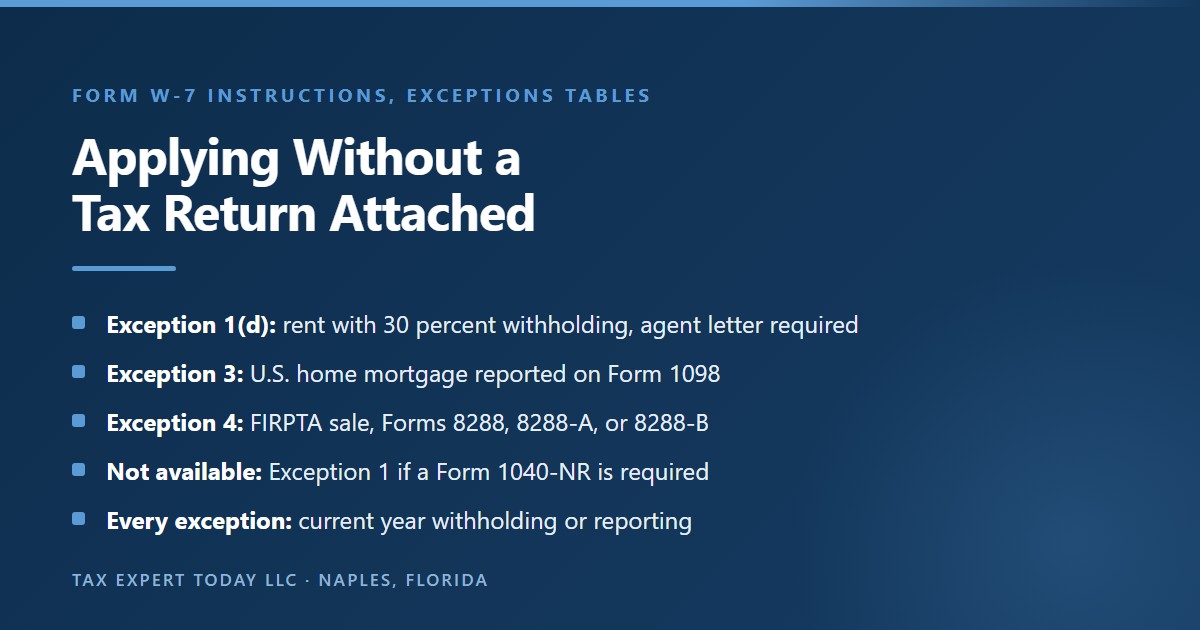
Five exceptions let an applicant file Form W-7 without a tax return. Three matter most to foreign property owners: Exception 1 for passive income such as rent subject to withholding, Exception 3 for a reported U.S. home mortgage, and Exception 4 for a disposition of a U.S. real property interest under FIRPTA. Each requires specific current year documents.
- Exception 1: passive income subject to third party withholding or covered by treaty benefits.
- Exception 2: treaty claims on wages, scholarships, and gambling winnings, and taxable scholarships.
- Exception 3: a home mortgage loan on U.S. real property subject to Form 1098 reporting.
- Exception 4: a party to a FIRPTA disposition, or a notice of non-recognition.
- Exception 5: a non-U.S. representative of a foreign corporation meeting e-filing rules under T.D. 9363.
An applicant who claims an exception checks box h, writes the exception on the dotted line next to it, and attaches the required documentation instead of a return. The instructions give the format: identify the exception “by its number, alpha subsection (if applicable), and category,” for example “Exception 1a-Partnership Income” or “Exception 3-Mortgage Interest.” Each Exceptions Table in the instructions carries the same note: “Federal tax withholding and/or information reporting must take place within the current tax year.”
| Exception | Who it fits | Documentation required | Typical information return |
|---|---|---|---|
| 1(a) Partnership income | A partner in a partnership that invests in the United States and has income subject to reporting and withholding | The portion of the partnership or LLC agreement showing the partnership EIN and the applicant as a partner | Schedule K-1 (Form 1065), Form 8805 |
| 1(b) Business bank interest | An individual with an interest bearing account producing effectively connected income | A signed bank letter on letterhead stating the business account is subject to reporting or withholding | Form 1042-S or Form 1099-INT |
| 1(c) Resident alien bank interest | A resident alien for tax purposes with an interest bearing deposit account | A signed bank letter on letterhead for the individual account | Form 1099-INT |
| 1(d) Distributions | A recipient of rent, pensions, annuities, royalties, or dividends whose withholding agent requires an ITIN | A signed letter from the withholding agent on letterhead, or a self-generated statement with the contract or a postmarked envelope | Form 1042-S, Form 1099-MISC |
| 3 Mortgage interest | An individual with a home mortgage loan on real property located in the United States | The contract of sale or similar evidence of the home mortgage loan | Form 1098 |
| 4 FIRPTA disposition | A buyer, seller, or other party to a disposition of a U.S. real property interest by a foreign person | A completed Form 8288, 8288-A, or 8288-B, plus the sales contract, Settlement Statement, or Closing Disclosure | Forms 8288 and 8288-A |
| 5 T.D. 9363 | A non-U.S. representative of a foreign corporation responsible for its e-filing | A signed employer letter on corporate letterhead | Not applicable |
Exception 2, which covers treaty claims on wages, salary, scholarships, fellowships, grants, and gambling income, rarely fits a property owner, so the table leaves it out. Exception 1(a) can fit an owner who holds a U.S. building through a partnership, because a foreign partner in a partnership with U.S. rental income receives a Schedule K-1 and often a Form 8805 for withholding under section 1446. Our guide to Form 8804 partnership withholding explains that regime. A partner who must file a Form 1040-NR to report the partnership income is back in the return category and cannot use Exception 1.
Exception 3 surprises many buyers. A foreign individual who finances a U.S. home with a mortgage loan subject to third party reporting can apply for an ITIN with evidence of the loan, so the lender can complete its Form 1098 reporting. The required document is “a copy of the contract of sale or similar documentation showing evidence of a home mortgage loan on real property located in the United States.” That exception solves the lender’s reporting problem. It does not replace the Form 1040-NR the owner may later have to file if the property produces rent.
How does Exception 4 work when a foreign owner sells U.S. real estate?
When a foreign person sells a U.S. real property interest, the buyer generally withholds 15 percent of the amount realized and reports it on Forms 8288 and 8288-A. A seller without a TIN can apply under Exception 4 by attaching the sales contract or Closing Disclosure and copies of the Forms 8288 and 8288-A the buyer filed.
- Withholding: section 1445 generally requires 15 percent of the amount realized, subject to exemptions and reduced rates.
- The seller’s credit: claimed on Form 1040-NR using the stamped Copy B of Form 8288-A.
- The catch: the IRS will not provide a stamped copy to a seller whose TIN is missing.
- The fix: apply for the ITIN early, ideally before closing, under Exception 4.
Under the Foreign Investment in Real Property Tax Act, the buyer of a U.S. real property interest from a foreign person must generally withhold a tax “equal to 15 percent of the amount realized on the disposition,” under 26 U.S.C. section 1445(a). Reduced rates and exemptions apply to certain residential sales; our FIRPTA withholding guide explains them. The buyer reports and pays the withholding with Form 8288 and attaches Form 8288-A, the statement of withholding that identifies the seller.
The identification number is where foreign sellers lose time. The Form 8288 instructions tell the buyer that if the seller’s TIN is missing, the forms must still be filed, but “A stamped copy of Form 8288-A will not be provided to the transferor if the transferor’s TIN is not included on that form.” The IRS then writes to the seller asking for a TIN. Only after the seller provides one does the IRS send the stamped Copy B. That stamped copy is what the seller generally attaches to Form 1040-NR, or to an application for an early refund, to receive credit for the tax withheld.
Exception 4 exists for this sequence. The Exceptions Table says it applies to “An individual who is a party to the disposition of U.S. real property interest by a foreign person (buyer or other transferee such as a withholding agent),” and to a notice of non-recognition under Regulation section 1.1445-2(d)(2). The documents are a completed Form 8288, Form 8288-A, or Form 8288-B, together with “a copy of the real estate sales contract, Settlement Statement (HUD-1), or Closing Disclosure.” For the seller, the table adds that copies of the contract or closing statement “and copies of Forms 8288 and 8288-A submitted by the buyer need to be attached to Form W-7.”
| Stage of the sale | Seller with an ITIN | Seller without an ITIN |
|---|---|---|
| Before closing | Can apply for a withholding certificate on Form 8288-B immediately | Attaches Form 8288-B to Form W-7, which adds the ITIN step to the timeline |
| At closing | TIN printed on Forms 8288 and 8288-A | Buyer files without the TIN; the forms are still required |
| After the buyer files | IRS mails the stamped Copy B of Form 8288-A | IRS sends a letter requesting a TIN; no stamped copy yet |
| Claiming the credit | Stamped Copy B attached to Form 1040-NR for the year of sale | Waits for the ITIN, then for the stamped copy, before the credit can be supported in the normal way |
A buyer who is also foreign can need an ITIN under the same exception. A foreign individual buying U.S. property from a foreign seller becomes the withholding agent and must identify itself on Form 8288. The documents are the same: the completed form plus the contract or closing statement.
The notice of non-recognition branch applies when a foreign person transfers property in a transaction where gain is not recognized, such as a qualifying like-kind exchange, and gives the buyer a notice instead of having tax withheld. For that case the instructions say the documents must show “the date of the transaction, the parties involved, and the type of transfer that took place,” for example a deed or a document identifying the replacement property in a like-kind exchange.
Can a foreign seller apply for an ITIN with Form 8288-B?
Yes. Form 8288-B requires the U.S. taxpayer identification number of every party. A nonresident alien seller without one can attach the completed Form 8288-B to a completed Form W-7 and send the package to the address in the Form W-7 instructions. The IRS then processes the ITIN application and the withholding certificate request together.
- Purpose of Form 8288-B: to ask the IRS to reduce or eliminate FIRPTA withholding before or at closing.
- TIN requirement: the U.S. TIN of all parties must be on the application.
- Combined route: Form 8288-B attached to Form W-7, mailed to the ITIN Operation address.
- Timing: the IRS normally acts on a complete Form 8288-B within 90 days, and the ITIN step comes first.
The Form 8288-B instructions are direct: “The U.S. TIN of all parties to the transaction must be on the application for a withholding certificate.” For a nonresident alien individual who is not eligible for a Social Security number, the instructions add that “you can apply for an ITIN by attaching the completed Form 8288-B to a completed Form W-7” and “forwarding the package to the IRS at the address given in the Form W-7 instructions.” The same instructions say the IRS “will normally act on an application within 90 days of receipt of all information necessary to make a proper determination.”
The combined route is useful but slower than having the number already. A seller who knows a sale is coming, often a seasonal resident who has decided to sell a Naples, Florida condominium next season, is better served by applying for the ITIN well before listing, through one of the in person routes described later, so the Form 8288-B can be filed as soon as a contract is signed. Our guide to Form 8288-B withholding certificates explains when a certificate is worth requesting and what the IRS needs to issue one.
One limit is worth stating. A withholding certificate settles only how much the buyer must withhold. The Form 8288-B instructions say it “applies only for the limited purpose of determining the withholding obligation under section 1445.” The seller’s actual tax on the gain is still determined on the Form 1040-NR for the year of sale, and the ITIN is what that return will carry.
How does a treaty claim work on Form W-7?
A nonresident who needs an ITIN only to claim a reduced treaty rate checks box a and box h, enters Exception 1 or 2 with its subsection, and names the treaty country and article. The treaty country must match the foreign address on line 3, and line 6b should show the tax number issued by that country.
- Boxes: box a for the treaty benefit, plus box h with the exception designation.
- Treaty details: the country and the article number go in the entry spaces below box h.
- Consistency rule: the treaty country must be the same as the country on line 3.
- Foreign tax number: a Canadian resident enters the Social Insurance Number on line 6b.
Some foreign owners never file a U.S. return but still receive U.S. income where a treaty lowers the withholding rate, such as dividends or interest from U.S. investments held alongside a property. Certain treaty benefits require an ITIN on the withholding certificate. The instructions cite Regulation section 1.1441-1(e)(4)(vii)(A) for that rule and explain that an applicant claiming a treaty benefit “must also check box h,” then enter the exception “by its number, alpha subsection, and category,” for example “Exception 1d-Pension Income.”
Two line rules catch Canadian and European applicants. Line 3 asks for the complete foreign address in the country where the applicant permanently or normally resides, and the instructions require that a treaty claimant’s treaty country be “the same as the country listed on line 3.” Line 6b asks for the tax number issued by the country of residence; the instructions use the Canadian example directly, telling a resident of Canada to enter the Canadian Social Insurance Number. Our Canada US tax treaty guide covers the treaty articles Canadian owners rely on most, and our guide to Form 8833 covers when a treaty position must be disclosed on a return.
A treaty claim does not turn rent into treaty exempt income. Most U.S. income tax treaties allow the United States to tax income from real property located in the United States, so a Canadian or European owner of a Florida rental generally pays U.S. tax on that rent regardless of the treaty. The treaty route on Form W-7 is mainly relevant to the owner’s other U.S. income.
What documents does Form W-7 require?
Every applicant must prove identity and foreign status with original documents or copies certified by the issuing agency, and the documents must be current. A valid passport is the only document that proves both on its own. Without one, the applicant submits at least two documents from the IRS list, and at least one must carry a photograph.
- Stand-alone document: an unexpired passport, or a certified copy from the issuing agency.
- Otherwise: at least two listed documents that together prove identity and foreign status.
- Originals or certified copies only: a notarized copy is not enough for most applicants.
- Return of originals: mailed documents come back to the line 2 address, usually within 60 days.
The instructions list 13 acceptable documents and mark which ones establish identity, which establish foreign status, and which do both. The core rule is that an original valid passport, or a certified copy from the issuing agency, needs no other document from the table. Otherwise, the applicant “must submit at least two types of documents.” At least one document must contain a photograph unless the applicant is a dependent under age 14, or under age 18 if a student.
| Document | Proves foreign status | Proves identity |
|---|---|---|
| Passport (the only stand-alone document) | Yes | Yes |
| U.S. Citizenship and Immigration Services photo identification | Yes | Yes |
| Visa issued by the U.S. Department of State | Yes | Yes |
| U.S. driver’s license | No | Yes |
| U.S. military identification card | No | Yes |
| Foreign driver’s license | No | Yes |
| Foreign military identification card | Yes | Yes |
| National identification card with name, photo, address, date of birth, and expiration date | Yes | Yes |
| U.S. state identification card | No | Yes |
| Foreign voter’s registration card | Yes | Yes |
| Civil birth certificate | Yes, if foreign | Yes |
| Medical records (dependents under age 6 only) | Yes, if foreign | Yes |
| School records (dependents under age 24, if a student) | Yes, if foreign | Yes |
A certified copy is defined narrowly. The instructions say it is “one that the original issuing agency provides and certifies as an exact copy of the original document and contains an official stamped seal from the agency.” A copy stamped by a notary, a lawyer, or a bank is not a certified copy for this purpose. Certification can also be obtained from officers at U.S. embassies and consulates abroad, whose consular sections provide certification and authentication services; the instructions recommend contacting the consulate in advance because services vary.
The documents must be current, meaning “not expired at the time you submit your application,” with the postmark date generally treated as the submission date. A passport that expires next month is acceptable if it is valid on the day the package is mailed, but it is a poor choice if the original will be in the IRS mail stream for weeks. The IRS may also later ask for “a certified translation of foreign-language documents.”
Mailing an original passport is the part of the process foreign owners dislike most. The instructions acknowledge it: original documents are returned to the line 2 mailing address, and if they are not returned within 60 days the applicant can call the IRS. An applicant who needs the documents back sooner “may wish to apply in person at an IRS Taxpayer Assistance Center or a CAA.” The instructions also allow a prepaid express mail or courier envelope for faster, more secure return of valuable documents.
Dependents carry extra rules. Applicants claimed as dependents generally must also prove U.S. residency, and a passport without a U.S. date of entry is not a stand-alone document for those dependents, with exceptions for dependents of U.S. military personnel stationed overseas and for certain dependents from Canada or Mexico. Those rules seldom apply to a foreign couple who own a vacation property, because neither spouse is a dependent of the other; the instructions note that “Your spouse is never considered your dependent.”
How do you submit Form W-7?
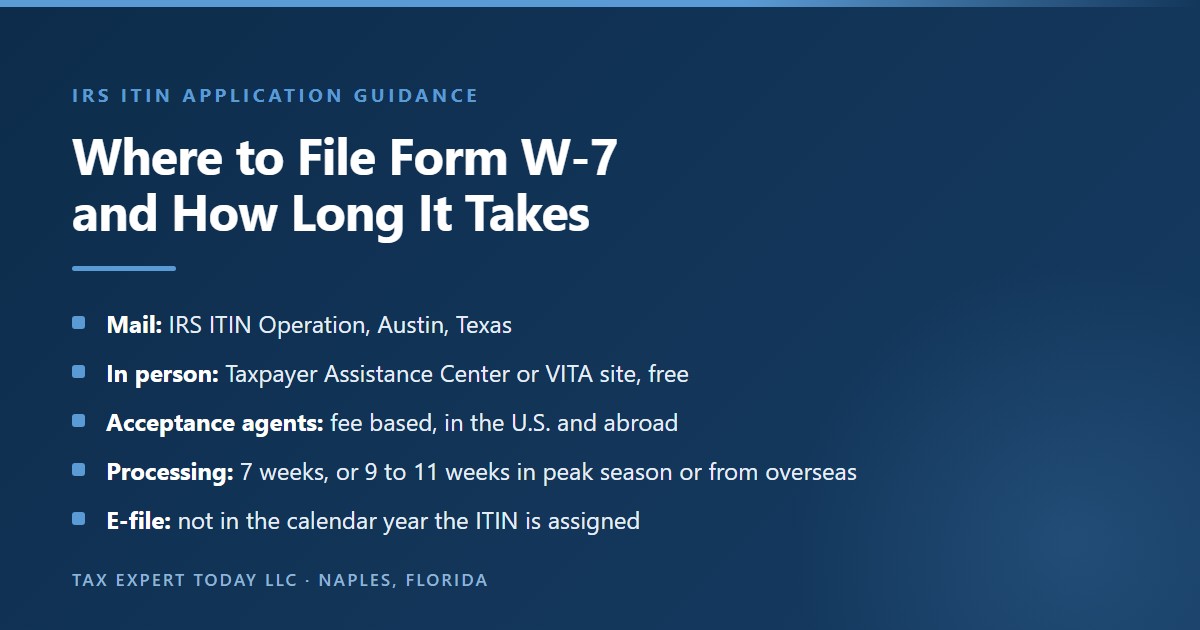
Form W-7 can be mailed to the IRS ITIN Operation in Austin, Texas, sent by private delivery service, or filed in person at a designated IRS Taxpayer Assistance Center, a Volunteer Income Tax Assistance site with ITIN services, a Certifying Acceptance Agent, or an Acceptance Agent. In person routes can authenticate most documents and return them immediately.
- By mail: Internal Revenue Service, ITIN Operation, P.O. Box 149342, Austin, TX 78714-9342.
- By private delivery: ITIN Operation, Mail Stop 6090-AUSC, 3651 S. Interregional, Hwy 35, Austin, TX 78741.
- Taxpayer Assistance Center: free, by appointment, at centers that offer ITIN document authentication.
- Acceptance agents: fee based, in the United States and abroad.
The IRS How to apply for an ITIN page sets out the four in person options and compares them. The table below follows that comparison.
| Route | Cost | Helps complete Form W-7 | Authenticates documents | Where |
|---|---|---|---|---|
| Mail to the ITIN Operation | No IRS charge | No | No; originals or certified copies are mailed | From anywhere |
| IRS Taxpayer Assistance Center with ITIN services | Free | No (reviews it) | Yes, most documents, returned at the appointment | United States |
| Volunteer Income Tax Assistance site with ITIN services | Free | Yes | Yes, most documents | Limited U.S. locations |
| Certifying Acceptance Agent | Fee based | Yes | Yes, most documents | United States and abroad |
| Acceptance Agent | Fee based | Yes | No; reviews and mails the documents | United States and abroad |
The difference between the two agent types is document handling. A Certifying Acceptance Agent can verify original documents and certified copies for primary and secondary applicants and return them immediately, except foreign military identification cards, and for dependents can only verify passports and birth certificates. An Acceptance Agent can help complete and file the form but “will need to submit original documentation or certified copies of the documentation from the issuing agency to the IRS for all applicants.” The IRS keeps a directory of approved agents by state and country on its acceptance agent program page, and it notes that agents are available “both domestically and abroad.” A Canadian owner can often apply through an agent in Canada before ever traveling south.
Taxpayer Assistance Center service is by appointment only, scheduled by calling 844-545-5640, and only designated centers offer ITIN document authentication. The IRS cautions that it “may take several weeks to get an appointment.” Centers that do not offer the authentication service mail the originals, the form, and the return to the Austin center, which defeats the purpose for an applicant who wanted the passport back the same day.
Whichever route is used, the mailing address rule matters when a return is attached. The return goes to the ITIN Operation as part of the application package, not to the normal filing address in the Form 1040-NR instructions. The IRS processes the Form W-7 first, writes the assigned ITIN onto the return, and then processes the return.
How long does Form W-7 processing take?
The IRS says to allow 7 weeks for notice of an ITIN decision, or 9 to 11 weeks for applications filed during the January 15 to April 30 peak or from overseas. A return filed with a new ITIN cannot be e-filed in the calendar year the ITIN is assigned, and mailed originals usually come back within 60 days.
- Standard time: about 7 weeks to hear the result.
- Peak or overseas: 9 to 11 weeks.
- CP565: the ITIN has been assigned.
- CP566: the IRS needs more information.
- CP567: the application was rejected and must be resubmitted.
The processing times appear in the instructions under “Processing times” and on the IRS application page: allow 7 weeks, and 9 to 11 weeks for an application submitted during the peak period from January 15 through April 30 or filed from overseas. If no ITIN or letter arrives by then, the applicant can call the IRS at 800-829-1040 from the United States or 267-941-1000 from abroad, which is not a toll free number.
The IRS application page lists the three notices an applicant may receive. A CP565 confirms the ITIN was assigned and requires no further action. A CP566 asks for more information, usually because a document was missing, unclear, or inconsistent with the form. A CP567 means the application was rejected and must be resubmitted. A rejection does not end the matter, but it restarts the clock, which is why consistency between the form and the documents matters so much. The instructions require that “the name, date of birth, and country(ies) of citizenship shown in the documentation must be the same as on Form W-7, lines 1a, 1b, 4, and 6a.”
The e-file restriction is easy to miss. The instructions say a return using an ITIN cannot be e-filed in the calendar year the ITIN is assigned. A foreign owner who applies with a 2026 return in early 2027 and receives the ITIN in 2027 files that return on paper with the application, and cannot e-file any return with the new ITIN, including prior year returns, until 2028. Multiple years can be attached to a single Form W-7 if several returns are owed.
How do you fill out Form W-7 line by line?
Form W-7 asks for the application type, the reason for applying, the applicant’s legal name, U.S. mailing address, foreign address, birth details, citizenship, foreign tax number, U.S. visa, identity document, any prior ITIN or IRSN, and a signature. The instructions say to enter N/A on any part of a line that does not apply rather than leaving it blank.
- Top of the form: new ITIN or renewal, then the reason box.
- Name lines: the legal name exactly as it appears on the identity document.
- Address lines: a U.S. or foreign mailing address on line 2 and the foreign residence on line 3.
- Blank spaces: enter N/A; the instructions say not to leave any section blank.
| Line | What it asks | Practical point for a foreign owner |
|---|---|---|
| Application type | New ITIN or renewal | A renewal must still check a reason box and complete lines 6e and 6f |
| Reason a to h | Why the ITIN is needed | Box b for a Form 1040-NR filer; box h plus the exception for FIRPTA, mortgage, or passive income cases |
| 1a and 1b | Legal name, and birth name if different | Must match the passport; the ITIN is established under this name |
| 2 | Mailing address | Where the IRS returns documents and sends notices; no privately operated mailbox service |
| 3 | Foreign address | The permanent residence abroad; must match any treaty country claimed |
| 4 and 5 | Date and place of birth, and gender | Date in MM/DD/YYYY format |
| 6a | Country or countries of citizenship | Full country names, no abbreviations; list both for dual citizens |
| 6b | Foreign tax identification number | For example, the Canadian Social Insurance Number |
| 6c | U.S. nonimmigrant visa | Classification, number, and expiration date, or N/A for visitors entering without a visa |
| 6d | Identity document and date of entry | “Never entered the United States” if that is the case |
| 6e and 6f | Prior ITIN or IRSN | Renewals must give the prior ITIN and the name it was issued under |
| 6g | School or business name and length of stay | Completed by students and by applicants temporarily in the United States for business |
| Signature | Applicant or authorized signer | A spouse cannot sign for the other spouse without an attached Form 2848 |
Line 2 deserves care. It “is the address the IRS will use to return your original documents and send written notification of your ITIN application status.” The instructions warn against “a post office box owned and operated by a private firm or company,” and against using a post office box or an in care of address on line 2 when only a country name appears on line 3. Many foreign owners use their own foreign home address on both lines, which the instructions allow.
Line 6e asks whether the applicant ever received an ITIN or an Internal Revenue Service Number. An IRSN is a nine digit number the IRS assigns when someone files a return or makes a payment without a taxpayer identification number. A foreign owner who once filed a return without a number, or whose buyer once reported a sale without one, may have an IRSN on old correspondence. Listing it helps the IRS connect the records.
The signature rules are stricter than many expect. The applicant must sign, with an original signature, unless the applicant is a dependent or cannot sign. The instructions say a spouse cannot sign for the other spouse unless the power of attorney box is checked and Form 2848 is attached to Form W-7, and that any power of attorney must be in English or come with a certified English translation.
Does a non-citizen spouse need an ITIN?
Only when there is a federal tax purpose. Since 2018, a spouse or dependent qualifies for an ITIN only if they file their own return or are claimed for an allowable tax benefit, such as a joint return. A foreign spouse who co-owns a U.S. rental and files Form 1040-NR has a tax purpose of their own.
- Joint return: a nonresident spouse who elects to file jointly with a U.S. citizen or resident checks box e.
- Own return: a co-owner reporting their share of U.S. rent checks box b.
- No tax purpose: a spouse listed only for information does not qualify.
- Signing: each spouse signs their own Form W-7 unless a Form 2848 is attached.
The instructions state the post-2017 limit plainly: “spouses and dependents are NOT eligible for an ITIN or to renew an ITIN unless they are claimed for an allowable tax benefit or they file their own tax return.” The listed allowable tax benefits include “A spouse filing a joint return,” head of household, qualifying surviving spouse, the American opportunity tax credit, the premium tax credit, the child and dependent care credit, and the credit for other dependents.
Two different property owner families fall on either side of that line. A married couple who are both Canadian residents and co-own a Florida condominium each report their share of the rent on their own Form 1040-NR if they make the net basis election, so each spouse applies on their own Form W-7 with their own return, checking box b. A U.S. citizen married to a nonresident who elects to file jointly under section 6013(g) attaches a Form W-7 for the nonresident spouse to the joint return and checks box e. Our guide to dual status tax returns explains that election and its consequences, including that the electing spouse is then taxed on worldwide income.
The joint election is a decision with lasting effects, not a paperwork step. Once a nonresident spouse is treated as a resident, their foreign accounts and foreign income come onto the U.S. return, and foreign accounts can bring FBAR and Form 8938 questions with them. The ITIN application should follow that decision, not drive it.
When does an ITIN expire, and how do you renew it?
An ITIN that is not included on at least one U.S. federal tax return for three consecutive tax years expires on December 31 of the third year. It must be renewed on Form W-7 before it is used on a return again. An ITIN used only on information returns, such as Forms 1099 or 1042-S, does not need renewal.
- Expiration trigger: three consecutive tax years with no federal return showing the ITIN.
- Older numbers: an ITIN assigned before 2013 and never renewed must be renewed with the next return.
- No renewal needed: when the ITIN appears only on information returns filed by others.
- Renewal package: Form W-7 marked “Renew an existing ITIN,” the return, and current documents.
The rule appears in the instructions under “Expired ITINs”: an ITIN not included on at least one U.S. federal tax return for the last 3 consecutive tax years “expires on December 31 of the third consecutive tax year, and must be renewed before being used again on a U.S. federal tax return.” The IRS ITIN expiration page adds that “Expired ITINs may continue to be used on information returns.”
That distinction matters to foreign owners who rent only some years. An owner who used the property personally for several seasons and filed no Form 1040-NR in that time may find the ITIN has lapsed when the property goes back on the rental market, or when it is sold. Filing with an expired ITIN does not fail outright, but the IRS warns that “there may be a delay in processing your return” and that certain credits may be disallowed until the ITIN is renewed.
| Owner’s situation | ITIN status | Action |
|---|---|---|
| Filed Form 1040-NR for 2023, none for 2024, 2025, or 2026 | Expires December 31, 2026 | Renew with the next return that will carry the ITIN |
| Files Form 1040-NR every year for a rental | Stays active | None |
| ITIN appears only on Forms 1042-S issued by a U.S. payer | May be expired | No renewal needed until a return is filed |
| ITIN issued in 2011 and never renewed | Must be renewed | Submit a renewal with the next federal return |
| Owner later receives a Social Security number | ITIN no longer used | Use the Social Security number; do not renew the ITIN |
The renewal process uses the same form. The applicant checks “Renew an existing ITIN” at the top, still checks a reason box, and completes lines 6e and 6f with the prior ITIN and the name it was issued under. The IRS renewal page and the instructions both say that a legal name change since the original assignment requires supporting documentation, such as a marriage certificate or court order. The renewal is filed with the return, under the same supporting document rules as a first application.
Do you need an ITIN before the tax return is due?
No ITIN is needed to make an estimated tax payment or to request an extension. The payer writes “ITIN TO BE REQUESTED” where the number is requested on Form 1040-ES (NR) or Form 4868. A first time application is then filed with the return, by its due date including extensions, to protect certain refundable credits.
- Estimated tax: pay with the voucher, marked “ITIN TO BE REQUESTED.”
- Extension: file Form 4868 the same way; do not attach Form W-7 to it.
- Return deadline: file Form W-7 with the return on or before the due date, including extensions.
- Issued on time: an ITIN applied for by the due date and then issued is treated as issued by that date.
The instructions answer the timing question directly. An applicant who must make estimated payments or wants more time to file should “complete all required information on the voucher except enter ‘ITIN TO BE REQUESTED’ wherever your social security number or ITIN is requested,” and should not file Form W-7 with the voucher or extension. “An ITIN will be issued only after you file a tax return and meet all other requirements.” A foreign owner who makes the net basis election in a year with substantial rent can therefore start paying estimated tax before the ITIN exists.
For the return itself, the instructions say to “file your application package with your tax return for which the ITIN is needed on or before the due date for the return,” and, if the return cannot be filed on time, to file an extension by the due date. They also say: “If an ITIN is applied for on or before the due date of a return (including extensions) and the IRS issues an ITIN as a result of the application, the IRS will consider the ITIN as issued on or before the due date of the return.” That treatment matters for credits that require a timely number.
For a nonresident, the due date depends on the income. A nonresident alien with wages subject to withholding generally files Form 1040-NR by April 15; one without wages subject to withholding, which describes most foreign rental owners, generally has until June 15. Our Form 1040-NR guide explains both deadlines and the extension rules.
What can an ITIN not do?
An ITIN is for federal tax purposes only. It does not authorize work in the United States, change immigration status, qualify anyone for Social Security benefits or the earned income credit, or serve as identification outside the federal tax system. A child with an ITIN cannot be a qualifying child for the child tax credit.
- Not work authorization: an ITIN does not permit employment.
- Not immigration status: the IRS states it neither provides nor changes status.
- Not a benefits number: no Social Security benefits and no earned income credit.
- Not a state identification: it is not identification outside the federal tax system.
The IRS ITIN page lists what an ITIN does not do: qualify the holder for Social Security benefits or the earned income tax credit, provide or change immigration status, authorize legal work in the United States, or “Serve as identification outside the federal tax system.” The instructions add that individuals filing returns with an ITIN are not eligible for the earned income credit.
For the child tax credit, 26 U.S.C. section 24(h)(7) now requires the Social Security number of the qualifying child and the Social Security number of the taxpayer, or of at least one spouse on a joint return, issued before the return’s due date. An ITIN does not satisfy that requirement. Foreign property owners filing Form 1040-NR are rarely eligible for that credit in any case, but a mixed status family filing jointly should confirm the current rules for the year at issue before relying on the credit.
An ITIN also cannot coexist with a Social Security number. The instructions say not to file Form W-7 if you have, or are eligible for, a Social Security number, and that “An ITIN will not be issued to you once you have been issued an SSN.” A foreign owner who later obtains work authorization and a Social Security number stops using the ITIN and uses the Social Security number on future returns. Treasury Regulation section 301.6109-1(d)(3) provides that an ITIN holder who later becomes a U.S. citizen, or is admitted for permanent residence or for U.S. employment, must obtain a Social Security number, notify the IRS, and use the Social Security number on all future returns.
Should a foreign owner use an ITIN or an EIN?
It depends on who owns the property. An individual who cannot get a Social Security number uses an ITIN, applied for on Form W-7. A foreign corporation, partnership, trust, or estate uses an employer identification number, applied for on Form SS-4. An entity’s EIN application asks for its responsible party’s SSN or ITIN, if the person has one.
- Individual owner: ITIN on Form W-7, used on Form 1040-NR and the FIRPTA forms.
- Entity owner: EIN on Form SS-4, used on the entity’s own returns and the FIRPTA forms.
- Responsible party: the SS-4 asks for that individual’s SSN or ITIN on line 7b.
- No number available: the SS-4 instructions allow “foreign” or N/A on line 7b when the person has none and is ineligible.
The split between the two numbers comes straight from the FIRPTA forms. The Form 8288-B instructions say that for U.S. individuals the TIN is a Social Security number, that “For all other entities, it is an employer identification number (EIN),” and that a nonresident alien individual who cannot get a Social Security number must apply for an ITIN. Form 8288 asks for the same identifying numbers for the buyer and the seller, whichever kind of person each one is.
An entity applies for its EIN on Form SS-4. The Form SS-4 instructions say online applications are available “only for applicants in the United States or U.S. territories,” and that international applicants can apply by telephone, fax, or mail. Line 7b asks for the SSN, ITIN, or EIN of the entity’s responsible party, defined as the person who “ultimately owns or controls the entity.” The instructions then allow an entry of “foreign” or N/A on line 7b when the responsible party does not have, and is ineligible to obtain, an SSN or ITIN. So a foreign individual does not need an ITIN merely to get an EIN for a company, but often needs one anyway for personal U.S. filings.
| Who holds title | Number needed | Application | Where the number is used |
|---|---|---|---|
| Foreign individual | ITIN | Form W-7 | Form 1040-NR, Forms 8288 and 8288-A, Form 8288-B, withholding certificates |
| Foreign married couple as co-owners | One ITIN for each spouse | A separate Form W-7 for each | Each spouse’s own Form 1040-NR and the sale forms |
| Foreign corporation | EIN | Form SS-4 | Form 1120-F and the FIRPTA forms |
| U.S. LLC owned by one foreign individual | EIN for the LLC | Form SS-4 | Form 5472 reporting; the owner may also need an ITIN for personal returns |
| Foreign trust or estate | EIN | Form SS-4 | The trust or estate return and the FIRPTA forms |
The choice of number follows the ownership structure; it is not a reason to choose a structure. Holding U.S. real estate through a corporation, an LLC, or a trust changes how rent, gain, and estate tax are computed, and that decision belongs with an adviser who can model the whole picture. The IRS overview in Publication 515 explains withholding on payments to foreign persons and entities, and Publication 519 explains how nonresident individuals are taxed, including on income from U.S. real property.
What are the most common Form W-7 mistakes?
The mistakes that cause delays and rejections are predictable: claiming an exception while also owing a return, mailing ordinary copies instead of certified copies, letting the passport expire, names that do not match the documents, sending the return to the normal address, and waiting until after a sale closes to apply.
- Wrong path: using Exception 1 when a Form 1040-NR is required.
- Wrong documents: notarized photocopies rather than issuing agency certified copies.
- Wrong address: mailing the package to the Form 1040-NR address.
- Wrong timing: applying after closing, which delays the stamped Form 8288-A.
| Mistake | What the rules say | Better practice |
|---|---|---|
| Claiming Exception 1 while required to file a return | A person required to file a federal return is not eligible for Exception 1 | Attach Form W-7 to the first Form 1040-NR |
| Sending notarized copies of a passport | Only originals or copies certified by the issuing agency are accepted for most applicants | Use a Certifying Acceptance Agent or a Taxpayer Assistance Center to keep the passport |
| Name on the form differs from the passport | Name, birth date, and citizenship must match lines 1a, 1b, 4, and 6a | Copy the name exactly as printed in the passport |
| Return mailed to the normal Form 1040-NR address | The package goes to the ITIN Operation address in Austin | Mail the whole package, return included, to the ITIN unit |
| Applying after a FIRPTA closing | No stamped Copy B of Form 8288-A without the seller’s TIN | Apply before listing, or attach Form 8288-B to Form W-7 |
| Treaty country differs from line 3 | The treaty country must match the foreign address country | Confirm residence before claiming the treaty |
| Spouse signs the other spouse’s form | Not allowed without Form 2848 attached | Each spouse signs their own Form W-7 |
| Leaving lines blank | The instructions say to enter N/A on any part that does not apply | Complete every entry space |
| Expecting to e-file in the year the ITIN is assigned | Not permitted in that calendar year | Plan for a paper return with the application |
None of these mistakes carries a penalty of its own, but each one adds weeks, and in a FIRPTA sale weeks can mean money held by the IRS that the seller expected back. The cleanest approach is to treat the ITIN as part of the plan for owning the property, not as a form to deal with when a letter arrives.
How does Form W-7 work for a Canadian couple who own a Naples, Florida condominium?
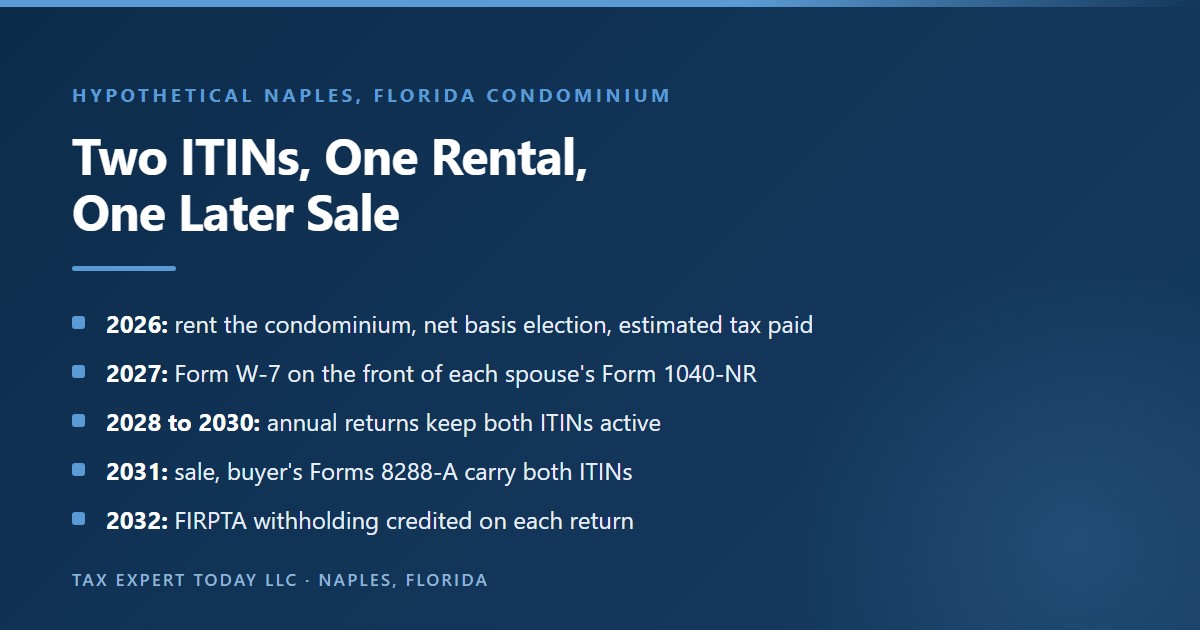
In this hypothetical, a Canadian couple rent out a Naples, Florida condominium, elect net basis taxation, and attach a Form W-7 for each spouse to their first Forms 1040-NR. Years later they sell, and because their ITINs are active, the buyer’s Forms 8288-A carry their numbers and the stamped copies arrive for the sale year returns.
- Facts: both spouses are Canadian residents and co-own the condominium equally.
- First rental year: each files Form 1040-NR with Form W-7 attached, checking box b.
- Middle years: annual returns keep both ITINs from expiring.
- Sale year: FIRPTA withholding is credited on each spouse’s Form 1040-NR.
The facts below are a hypothetical illustration only. They do not describe any client, and every case turns on its own facts.
Assume a married couple who live in Ontario buy a condominium in Naples, Florida in 2025 for personal use. In 2026 they decide to rent it through a local property manager for the months they are in Canada. Neither spouse has a Social Security number, and neither is a U.S. resident under the substantial presence test, because each files a Form 8840 closer connection statement or stays under the day count.
On the advice of their adviser, they decide to make the section 871(d) election so that tax is computed on net rental income rather than 30 percent of gross rent. They give the property manager Forms W-8ECI so the gross withholding stops, and they make estimated payments during 2026 marked “ITIN TO BE REQUESTED.” Each spouse prepares a 2026 Form 1040-NR reporting half the rent and half the expenses, with the election statement attached.
| Date (hypothetical) | Step | Form W-7 detail |
|---|---|---|
| During 2026 | Estimated tax paid on Form 1040-ES (NR) | “ITIN TO BE REQUESTED” written on each voucher |
| Spring 2027 | Each spouse completes Form W-7, box b | Line 3 shows the Ontario address; line 6b shows each Social Insurance Number |
| Spring 2027 | Documents authenticated by a Certifying Acceptance Agent in Canada | Passports returned the same day |
| Before June 15, 2027 | Package mailed to the ITIN Operation in Austin | Each Form W-7 attached to the front of that spouse’s 2026 Form 1040-NR |
| Summer 2027 | CP565 notices arrive | The IRS writes the ITINs on the returns and processes them |
| 2028 to 2030 | Annual Forms 1040-NR filed | ITINs stay active; e-filing becomes available from 2028 |
| 2031 | Condominium sold to a U.S. buyer | Forms 8288-A carry both ITINs, so stamped copies issue normally |
| 2032 | 2031 Forms 1040-NR report the gain | The FIRPTA withholding is claimed as a credit on each return |
Now change one fact. Suppose the couple never rented the condominium, filed no U.S. returns, and had no ITINs when they sold it. The buyer would still withhold and file Forms 8288 and 8288-A without the sellers’ numbers. The IRS would write to each seller asking for a TIN, and no stamped Copy B would issue until they provided one. Each spouse would then apply under Exception 4, attaching the closing statement and copies of the buyer’s forms, and wait for the ITIN before the credit could be supported in the normal way on the sale year return. Applying a few months before listing would have avoided that delay.
The example also shows what Form W-7 does not decide. Whether the couple should make the net basis election, how depreciation recapture and gain are computed on the sale, whether a withholding certificate is worth requesting, and how the sale is reported in Canada are separate questions. The Canadian return, in particular, is governed by Canadian law and the treaty, and should be reviewed with a Canadian adviser.
Form W-7 and ITIN Help in Naples & Southwest Florida
Tax Expert Today LLC works with international clients from an office in Naples, Florida and serves clients in all 50 states. Southwest Florida has a large community of Canadian and European owners of condominiums, houses, and rental units, and the ITIN question tends to surface at the worst moment: when the first rental return is due, when a property manager asks for a number, or when a buyer’s closing agent explains FIRPTA withholding. We help foreign owners determine whether an ITIN is needed and under which reason or exception, assemble the Form W-7 package with the return or the exception documents, and coordinate the application with the Form 1040-NR, the FIRPTA forms, or a Form 8288-B request. Applicants who want their documents authenticated in person can use a Taxpayer Assistance Center or any IRS-approved acceptance agent, and we will explain those options.
- ITIN application help Naples: Form W-7 preparation with the first Form 1040-NR or with the documents an exception requires.
- International tax Naples FL: net basis elections, nonresident rental returns, and treaty positions for foreign owners.
- Foreign tax Naples: FIRPTA withholding, Form 8288-B withholding certificates, and sale year reporting.
- FBAR Naples: foreign account reporting for spouses who become U.S. residents or elect to file jointly.
Our international and expat tax services page explains how we approach cross-border filings for nonresident owners, U.S. citizens abroad, and families with members on both sides of the border. The international tax Naples FL guide covers the broader picture for residents and seasonal residents of Southwest Florida.
Office: 11983 Tamiami Trail N, Naples FL 34110
Phone: (239) 441-2005
Hours: Monday through Friday, 10:00 to 5:00 ET
Frequently Asked Questions
I am Canadian and own a condominium in Naples, Florida that I rent out part of the year. Do I need an ITIN?
Usually yes. If you elect to be taxed on net rental income, you must file Form 1040-NR each year, and that return needs a taxpayer identification number, so the first return goes in with Form W-7 attached. If you instead accept 30 percent withholding on gross rent, you may qualify for Exception 1(d) when the withholding agent requires an ITIN.
What is Form W-7 used for?
Form W-7 is the application for an IRS individual taxpayer identification number, or ITIN, for an individual who needs a U.S. taxpayer identification number but is not eligible for a Social Security number. It is also used to renew an expired ITIN. It is normally attached to a federal tax return, unless one of five exceptions applies.
Can I file Form W-7 without a tax return?
Only if an exception applies. The five exceptions cover passive income subject to withholding or treaty benefits, certain treaty and scholarship income, a reported U.S. home mortgage, FIRPTA dispositions, and a foreign corporation representative under T.D. 9363. Each requires current year documents, and Exception 1 is not available to anyone who must file a return.
Does a foreign seller need an ITIN to sell U.S. property?
The sale can close without one, and the buyer must still withhold and file Forms 8288 and 8288-A. But the IRS will not provide the seller a stamped Copy B of Form 8288-A without the seller’s TIN, and that stamped copy is generally how the withholding is credited on Form 1040-NR. Exception 4 lets the seller apply without a return.
How long does it take to get an ITIN?
The IRS says to allow 7 weeks to be notified of the result, or 9 to 11 weeks for applications filed between January 15 and April 30 or from overseas. A CP565 notice confirms the number. Mailed original documents are generally returned within 60 days, and a return filed with a new ITIN cannot be e-filed in the year the ITIN is assigned.
Does an ITIN expire?
Yes. An ITIN that is not used on at least one federal tax return for three consecutive tax years expires on December 31 of the third year, and an ITIN issued before 2013 that was never renewed must be renewed. Renewal uses Form W-7 with the next return. An ITIN used only on information returns does not need renewal.
When to Engage a Professional
Form W-7 itself is short. The judgment sits around it: whether the owner has a federal tax purpose at all, whether a return is required or an exception genuinely applies, whether the net basis election is the right choice for the rental, how the application fits with a pending sale or a withholding certificate request, and whether a joint election for a non-citizen spouse brings foreign accounts and income onto the U.S. return. A wrong choice at that stage produces a rejected application, a lost season, or a credit that cannot be claimed when expected.
A professional review is worth considering when a foreign individual begins renting U.S. property, when a sale or a Form 8288-B request is approaching and no ITIN exists, when an ITIN may have expired after years without a return, when a property manager or bank asks for a number, when a U.S. citizen is considering a joint return with a nonresident spouse, or when prior years were not filed and the owner wants to understand the options before applying.
Tax Expert Today LLC is a tax advisory firm in Naples, Florida serving clients in all 50 states. Call (239) 441-2005 to discuss your facts.
This article is general information, not legal or tax advice for any particular taxpayer, and does not create a client relationship. The examples are hypothetical illustrations only and do not describe any client. An ITIN is issued for federal tax purposes only and has no effect on immigration status or work authorization; immigration questions should be directed to an immigration attorney. Canadian and other foreign tax treatment is determined under foreign law and should be reviewed by an adviser in that country. The rules described here reflect 26 U.S.C. sections 24, 871, 1445, and 6109, Treasury Regulations sections 301.6109-1 and 1.1445-2, the December 2024 Form W-7 and its instructions, Form 8288-B and its instructions, the January 2026 Instructions for Form 8288, and IRS ITIN guidance, as published when this article was written. Processing times and procedures change, so confirm current IRS guidance before applying.
Published October 23, 2026 by Dr. Pellumb Kabashi « Back to Learning Center
Have a question this article touches on?
Tax Expert Today LLC, based in Naples, Florida and serving clients across the United States.
Schedule a Consultation (239) 441-2005