
By Dr. Pellumb Kabashi, DBA, MBA, EA, CFE, CES
Founder, Tax Expert Today LLC · Tax advisors, enrolled agents, CPAs, and attorneys · Serving clients in all 50 states
Quick Answer: Form 8288-B is the application a foreign seller of U.S. real estate, or the buyer, files with the IRS for a withholding certificate that reduces or eliminates the 15 percent FIRPTA withholding. It rests on one of three grounds: an exemption or nonrecognition, a maximum tax liability below the withholding, or the installment sale rules. Call (239) 441-2005 for a free consultation.
What is Form 8288-B?
Form 8288-B is the Application for Withholding Certificate for Dispositions by Foreign Persons of U.S. Real Property Interests. A foreign seller or the buyer uses it to ask the IRS to reduce or eliminate the withholding that section 1445 requires on a sale, so the amount held back matches the tax the seller is actually likely to owe.
- The problem it solves: the buyer must withhold 15 percent of the amount realized, which is a percentage of the price and not of the gain.
- What it produces: a withholding certificate from the IRS that tells the buyer to withhold a reduced amount or nothing at all.
- Who signs it: the seller (the transferor), the buyer (the transferee), or an authorized agent with a power of attorney.
- Current revision: Rev. December 2025, mailed to the IRS at P.O. Box 409101, Ogden, UT 84409.
The Foreign Investment in Real Property Tax Act, usually shortened to FIRPTA, treats gain a foreign person realizes on U.S. real estate as income effectively connected with a U.S. business under 26 U.S.C. section 897. Because a foreign seller may leave the country with the sale proceeds before filing a return, Congress made the buyer the collector. Under section 1445(a), the buyer withholds a tax equal to 15 percent of the amount realized on the disposition and pays it to the IRS. Our FIRPTA withholding guide covers who counts as a foreign person, the exemptions, and how the buyer reports the tax. This page covers only the certificate application.
The difficulty is that 15 percent of the price can be far more than the tax. A seller who bought a Naples condominium for close to what it sells for has little or no gain, yet the buyer still holds back 15 percent of the full price. Without a certificate, that money goes to the IRS within 20 days of closing and comes back only when the seller files a U.S. return for the year of sale, which for a sale early in the year can mean a wait of well over a year. Form 8288-B is the mechanism the regulations provide to close that gap.
The form itself is short. Page 1 identifies the seller, the buyer, the withholding agent, the property, and the reason a certificate should be issued, and it is signed under penalties of perjury. The real substance is in the attachments, which differ by the ground claimed. The instructions on pages 2 and 3 of the December 2025 revision set out what each attachment must contain, and an application that is not substantially complete is rejected.
| Form | Who files it | When | Purpose |
|---|---|---|---|
| Form 8288-B | Seller or buyer, or an authorized agent | Ideally on or before the closing date | Applies for a withholding certificate that reduces or eliminates withholding |
| Form 8288 | The buyer, as withholding agent | By the 20th day after closing, or after the IRS acts on a pending application | Reports and pays the tax withheld |
| Form 8288-A | The buyer, attached to Form 8288 | With Form 8288 | Statement of withholding; the stamped Copy B goes to the seller |
| Form W-7 | A seller or buyer without a TIN | With Form 8288-B, if no ITIN exists | Applies for an individual taxpayer identification number |
| Form 1040-NR or 1120-F | The seller | The normal due date for the year of sale | Reports the actual gain and claims credit for the amount withheld |
How much FIRPTA withholding applies before a certificate?
The general rate is 15 percent of the amount realized. If the buyer will use the property as a residence and the amount realized is $1,000,000 or less, the rate is 10 percent, and at $300,000 or less no withholding is required. The amount realized includes cash, the value of other property, and any liability the buyer assumes.
- 15 percent: the default rate in section 1445(a) for any sale by a foreign person.
- 10 percent: the reduced rate in section 1445(c)(4) for a buyer who acquires the property as a residence for $1,000,000 or less.
- Zero: the exception in section 1445(b)(5) for a residence acquired for $300,000 or less.
- The residence test: on the transfer date the buyer must have definite plans to live in the property for at least 50 percent of the days it is used by anyone in each of the first two 12 month periods, under 26 CFR section 1.1445-2.
The rate is the starting point for every Form 8288-B decision, because the certificate is only worth applying for when the seller’s real tax is meaningfully below the rate. The IRS FIRPTA withholding page explains that the amount realized is the sum of the cash paid or to be paid (principal only), the fair market value of other property transferred, and the outstanding amount of any liability assumed by the buyer or to which the property is subject. A seller who carries a mortgage that the buyer pays off at closing still has the full price as the amount realized.
The residence rules turn on the buyer’s plans, not the seller’s. A seller cannot claim the 10 percent rate or the $300,000 exception on its own; the buyer must sign a statement about the intended use. The IRS has also said, in its published FIRPTA questions and answers, that the $300,000 exception is measured against the total amount realized, so two foreign co-owners who each receive less than $300,000 from a $500,000 sale do not qualify. Those details are covered in the parent FIRPTA guide.
| Amount realized | Buyer will use it as a residence | Buyer will not |
|---|---|---|
| $300,000 or less | No withholding (section 1445(b)(5)) | 15 percent |
| Over $300,000 up to $1,000,000 | 10 percent (section 1445(c)(4)) | 15 percent |
| Over $1,000,000 | 15 percent | 15 percent |
Condominium and single family prices in Collier and Lee counties often place a sale in the middle or upper row, and a sale to an investor or a second home buyer who will not meet the residence test is withheld at 15 percent regardless of price. Sellers in those rows are the ones for whom a Form 8288-B application is most likely to change what happens at closing.
Who can file Form 8288-B, the buyer or the seller?
Either party may apply. The regulations and the form allow the transferee (the buyer), the transferor (the seller), or another authorized person to submit Form 8288-B. In practice the foreign seller usually initiates it, because the seller is the one whose money is held back and the one who has the purchase records and depreciation history.
- The seller: applies most often, supplies the basis and depreciation evidence, and signs the maximum tax statement under penalties of perjury.
- The buyer: may apply, and the withholding agent named on line 4a is normally the buyer under section 1445(d)(4).
- An authorized agent: may sign with a power of attorney such as Form 2848.
- Written notice: a seller who applies must notify the buyer in writing that the application was submitted, on the day of or before the transfer.
The signature rules are set out in the form instructions and on the IRS format for applications page. The application must be signed by an individual, a responsible corporate officer, a general partner of a partnership, or a trustee, executor, or other fiduciary. It may also be signed by an authorized agent, in which case a copy of the power of attorney is attached. The IRS FIRPTA questions and answers suggest that line 3 of Form 2848 for a FIRPTA matter describe the matter as Withholding Tax under IRC 1445, list Forms 8288, 8288-A, and 8288-B, and show the year of the disposition.
When the application relies on facts supplied by another party, such as a buyer’s statement about intended use, that information must be supported by a written verification signed under penalties of perjury by that party and attached. This matters more than it sounds: a closing involves at least four people with different records, and an application that leaves a statement unsigned is incomplete, which restarts the processing clock.
The written notice requirement is easy to overlook and has real consequences. The rule that lets the buyer hold the withholding instead of sending it to the IRS within 20 days depends on an application being submitted on or before the date of transfer. The buyer, and the settlement agent acting for the buyer, need evidence that it was. A copy of the signed application with proof of mailing, delivered to the closing agent before closing, is the practical way to meet the requirement.
What are the three grounds for a withholding certificate on Form 8288-B?
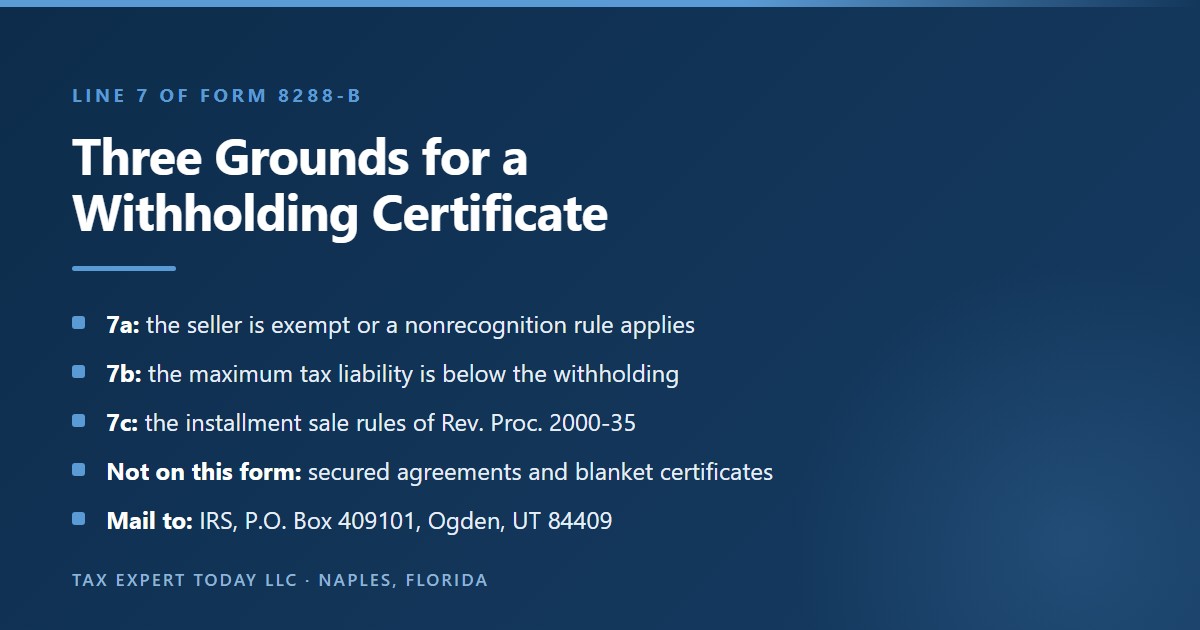
Line 7 of Form 8288-B offers three boxes: the seller is exempt from U.S. tax or a nonrecognition provision applies (7a), the seller’s maximum tax liability is less than the required withholding (7b), or the special installment sale rules in section 7 of Rev. Proc. 2000-35 allow reduced withholding (7c). Any other basis requires a separate application format.
- Box 7a, exemption or nonrecognition: for example, a qualifying like-kind exchange under section 1031 where the replacement property is also U.S. real property.
- Box 7b, maximum tax liability: the most common ground for an individual selling a Florida condominium or home.
- Box 7c, installment sale: for a seller who is not a dealer and will report under section 453.
- Not on this form: agreements secured by a bond or letter of credit, blanket certificates, and any other basis.
The three boxes map to the first three of six application categories in section 4.03 of Rev. Proc. 2000-35. The IRS withholding certificates page lists all six and says that Form 8288-B is used only for categories 1, 2, and 3. Categories 4, 5, and 6 are submitted as a letter in the labeled paragraph format the IRS publishes, not on the form.
| Category | Basis | How it is filed | Typical user |
|---|---|---|---|
| 1 | Exemption from tax or nonrecognition treatment | Form 8288-B, box 7a | Seller completing a qualifying exchange or holding an exempt status |
| 2 | Calculation of the seller’s maximum tax liability | Form 8288-B, box 7b | Individual or corporate seller whose gain is small relative to price |
| 3 | Special installment sale rules, Rev. Proc. 2000-35 section 7 | Form 8288-B, box 7c | Seller financing part of the price |
| 4 | Agreement for the payment of tax with conforming security | Letter in the IRS paragraph format | Seller posting a bond or letter of credit |
| 5 | Blanket withholding certificate, section 9 | Letter in the IRS paragraph format | Seller of many interests over a period |
| 6 | Any other basis | Letter in the IRS paragraph format | Facts that do not fit categories 1 to 5 |
For a box 7a application, the instructions require a brief description of the transfer, a summary of the law, the facts supporting the claim of exemption or nonrecognition, evidence that the seller has no unsatisfied withholding liability, and the most recent assessed value for state or local property tax purposes or another estimate of value. A nonresident alien or foreign corporation also attaches a statement of the adjusted basis immediately before the transfer. A nonrecognition claim is a technical position, and a like-kind exchange in particular has to satisfy every requirement of section 1031 and the FIRPTA regulations on exchanges, so it is not a box to check casually.
A seller can only check one reason. If the seller qualifies under more than one, the choice depends on which is easiest to document and least likely to be questioned. For most individual sellers of a Southwest Florida residence or rental, that is box 7b.
What is the transferor’s maximum tax liability on Form 8288-B?
Under Treasury Regulation section 1.1445-3(c), the maximum tax liability is the sum of two amounts: the most tax that could be imposed under section 871 or 882 on the sale, and the seller’s unsatisfied withholding liability from when the property was bought. If that sum is below the required withholding, the IRS may issue a certificate for the lower amount.
- Element one: for an individual, generally the contract price minus adjusted basis, multiplied by the maximum individual rate on long term capital gain.
- Element two: any tax the seller should have withheld, but did not, when the seller bought the property from a foreign person.
- Adjustments: treaty reductions, nonrecognition, earlier U.S. real property losses in the year, ordinary income amounts, and any other factor.
- Corporate sellers: the maximum corporate rate applies instead of the individual rate.
The regulation is deliberately conservative. It does not ask what the seller’s tax will actually be after deductions, other income, and the rate brackets on Form 1040-NR. It asks what the highest possible tax could be, so the IRS can be confident that the reduced withholding still covers the liability. Section 1.1445-3(c)(2) says that for an individual the amount will generally be the contract price minus adjusted basis, multiplied by the maximum individual income tax rate applicable to long term capital gain, and then adjusted for the five listed factors. The full text is on Cornell’s copy of 26 CFR section 1.1445-3.
Under section 1(h), the top rate on adjusted net capital gain is 20 percent, but gain attributable to depreciation on real property, called unrecaptured section 1250 gain, is taxed at up to 25 percent. Rev. Proc. 2000-35 section 4.06 and the form instructions both require the calculation to show amounts to be recaptured for depreciation and the maximum capital gain and ordinary income rates that apply, so a seller who rented the property cannot apply 20 percent to the whole gain. A foreign corporation’s gain is taxed at the 21 percent corporate rate in section 11(b).
One rate that does not belong in the calculation for an individual is the 3.8 percent net investment income tax. Section 1411(e)(1) says that tax does not apply to a nonresident alien. A seller who is a U.S. resident under the substantial presence test or a green card is not a foreign person for FIRPTA in the first place, which is why residency should be settled before anything else. Our guide to the substantial presence test explains how that status is determined.
The second element, the unsatisfied withholding liability, is explained in its own section below. It exists only where the seller bought the property after 1984 from a foreign person and the withholding owed on that purchase was never paid. When it exists, it is added to the calculation so the current buyer’s withholding can satisfy it.
How is the maximum tax calculated on the sale of a Naples condominium?
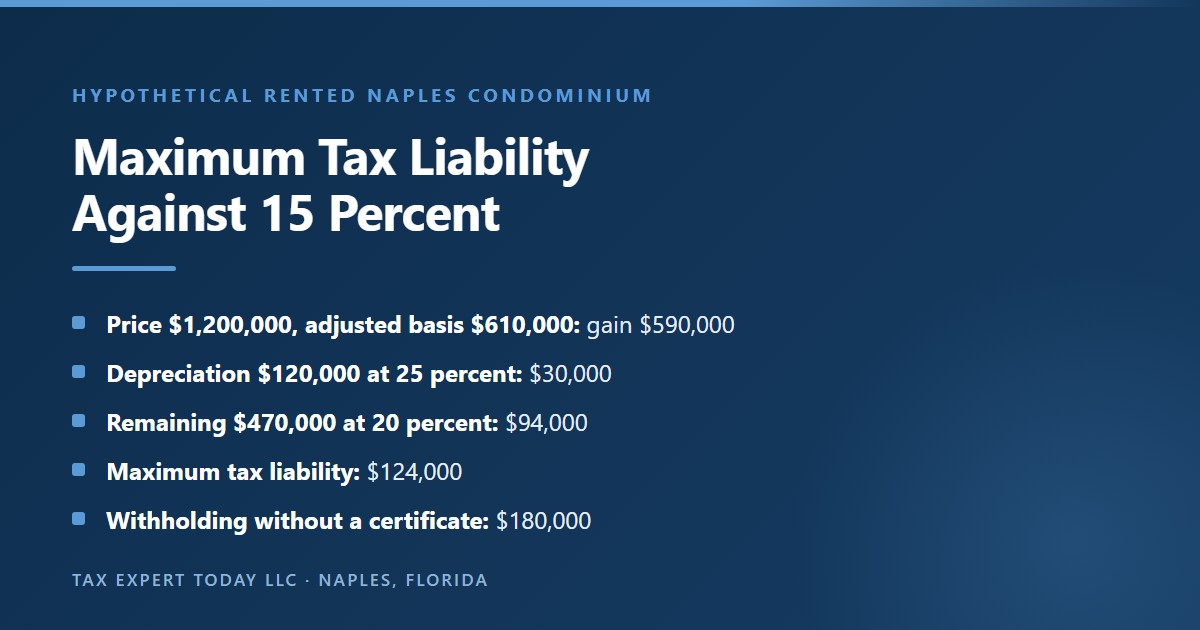
Start with the contract price, subtract the adjusted basis, split the gain into the depreciation portion taxed at up to 25 percent and the remainder taxed at up to 20 percent, add any unsatisfied withholding liability, and compare the total with the 15 or 10 percent withholding. The hypothetical below shows the arithmetic for a rented Naples condominium.
- Contract price: taken from the signed purchase agreement, which must be attached.
- Adjusted basis: cost plus improvements minus depreciation, supported by closing statements, invoices, and depreciation schedules.
- Depreciation layer: unrecaptured section 1250 gain at up to 25 percent.
- Remaining gain: at up to 20 percent for an individual.
Consider a hypothetical Canadian resident who is a nonresident alien for U.S. purposes. She bought a Naples condominium in 2015 for $700,000, added $30,000 of capital improvements, rented it for several years, and claimed $120,000 of depreciation on her Forms 1040-NR. She has agreed to sell it in 2026 for $1,200,000 to an investor who will not live in it, so the buyer must withhold 15 percent. The example is an illustration only and describes no client.
| Step | Hypothetical amount | Source of the rule |
|---|---|---|
| Contract price | $1,200,000 | Reg. 1.1445-3(c)(2); signed contract attached |
| Cost plus improvements | $730,000 | Closing statement and invoices attached |
| Less depreciation allowed | ($120,000) | Depreciation schedules attached |
| Adjusted basis | $610,000 | Line 6e of Form 8288-B |
| Gain | $590,000 | Contract price minus adjusted basis |
| Unrecaptured section 1250 gain at 25 percent | $120,000 x 25% = $30,000 | Section 1(h)(1)(E) |
| Remaining gain at 20 percent | $470,000 x 20% = $94,000 | Section 1(h)(1)(D) |
| Unsatisfied withholding liability | $0 (bought from a U.S. seller who signed a nonforeign certificate) | Reg. 1.1445-3(c)(3); line 8 |
| Maximum tax liability | $124,000 | Reg. 1.1445-3(c)(1) |
| Withholding without a certificate | $1,200,000 x 15% = $180,000 | Section 1445(a) |
| Difference a certificate could address | $56,000 | Subject to IRS review |
In this illustration the seller asks the IRS for a certificate that sets withholding at $124,000 instead of $180,000. If the IRS issues it, the buyer pays $124,000 to the IRS with Form 8288 and the remaining $56,000 is released to the seller from the amount held at closing. The seller still files Form 1040-NR for 2026, reports the actual gain, computes the actual tax at the graduated rates, and claims the $124,000 as a credit. If the actual tax is lower, which is common because not all of the gain is taxed at the top rate, the difference is refunded on the return.
Now change one fact. Suppose the same seller bought in 2022 for $1,300,000 and is selling at $1,200,000. There is no gain, so the first element of the maximum tax is zero, and if there is no unsatisfied withholding liability the IRS may issue a certificate that excuses withholding entirely. Without the certificate, $180,000 of a seller’s own money goes to the IRS at closing and waits for a return that reports a loss. Loss sales and small gain sales are where Form 8288-B makes the largest difference.
Several items move the numbers. Depreciation that was allowable but never claimed still reduces basis under section 1016(a)(2), and the instructions say that if no depreciation schedules are submitted, the application must state how the property was used and why depreciation was not allowed. Personal property sold with the unit, such as furniture, is not subject to section 897, but to exclude it the seller must list each item and its value and support the value with an appraisal or similar documentation. A seller with a net operating loss should read section 4.06 of Rev. Proc. 2000-35, which has special rules for that case.
When is a Form 8288-B application worth filing?
An application is worth considering when the maximum tax liability is clearly below the withholding. As a rough guide for an individual with no depreciation, that happens when the gain is under about 75 percent of the price at the 15 percent rate, or under half the price at the 10 percent rate.
- Loss or break-even sale: the strongest case, because the maximum tax may be zero.
- Small or moderate gain: usually worth it, especially on a high price.
- Very large gain on a long-held property: often not worth it, because the maximum tax may exceed the withholding.
- Tight closing timeline: the application still helps if submitted by closing, even though the IRS will not have acted.
The arithmetic behind the rule of thumb is simple. At a 15 percent withholding rate and a 20 percent maximum capital gain rate, the two are equal when the gain is 75 percent of the price (0.20 x 0.75 = 0.15). Below that, the maximum tax is lower than the withholding. At the 10 percent residence rate, the break-even gain is 50 percent of the price (0.20 x 0.50 = 0.10). Because depreciation is taxed at up to 25 percent, a property that was rented has a lower break-even point than one that was used only personally.
| Hypothetical gain as a share of the price | Maximum tax at 20 percent | Compared with 15 percent withholding | Compared with 10 percent withholding |
|---|---|---|---|
| Loss or 0 percent | 0 percent of price | Certificate may excuse all withholding | Certificate may excuse all withholding |
| 25 percent | 5 percent of price | Large reduction possible | Reduction possible |
| 50 percent | 10 percent of price | Reduction possible | About equal, little benefit |
| 75 percent | 15 percent of price | About equal, little benefit | Maximum tax exceeds withholding |
| 90 percent | 18 percent of price | Maximum tax exceeds withholding | Maximum tax exceeds withholding |
The table ignores the depreciation layer, any unsatisfied withholding liability, and treaty adjustments, so it is a screening tool and not a calculation. A seller near a break-even line should run the full maximum tax computation before deciding. The cost of preparing the application, and the possibility that the IRS will ask for more information, should also be weighed against the amount that would otherwise wait for a refund.
There is a second, less obvious benefit. Even when the reduction is modest, the regulations let the buyer hold the withholding instead of paying it over while the application is pending. For a seller who will owe close to the full withholding anyway, that has little value. For a seller who is likely to get most of it back, it means the money can stay in escrow with the closing agent rather than leaving for the IRS, and it is released under the certificate rather than through a refund claim.
What happens at closing if the Form 8288-B application is still pending?
If the application was submitted on or before the transfer date and is still pending, the buyer withholds the full 15 or 10 percent at closing but need not pay it to the IRS until the 20th day after the IRS mails the certificate or a denial. The buyer then pays over the certificate amount.
- Withhold in full: the statutory amount is still held back at closing.
- Hold, do not deposit: under Reg. 1.1445-1(c)(2), the deposit waits for the IRS decision.
- Pay over within 20 days: after the IRS mails the certificate or denial, using Forms 8288 and 8288-A.
- Anti-abuse rule: an application made mainly to delay payment triggers interest and penalties from the 21st day after the transfer.
The rule is in 26 CFR section 1.1445-1(c)(2). Normally a buyer must report and pay over the tax withheld by the 20th day after the date of the transfer. Where an application for a withholding certificate is pending on the transfer date, the buyer withholds the full amount but need not report or pay it over until the 20th day following the IRS’s final determination, which is the day the IRS mails the certificate or the denial. The IRS restates the same rule on its page on reporting and paying tax on U.S. real property interests.
In a Florida closing, the title company or closing attorney acting as settlement agent commonly holds the withheld amount in escrow under a written agreement among the parties until the IRS acts. That agreement should say who holds the funds, what happens if the IRS issues a certificate for a lower amount, what happens if it denies the application, and how the 20 day deadline will be met. Because the buyer remains the withholding agent and is liable if the tax is not paid, buyers and their counsel sometimes ask for evidence that the application was actually mailed before closing; providing it in advance avoids a dispute at the table.
The anti-abuse rule in Reg. 1.1445-1(c)(2)(ii) is the reason a seller should apply only where there is a genuine basis. If an application is submitted for a principal purpose of delaying the buyer’s payment to the IRS, interest and penalties are assessed on the amount ultimately paid over for the period from the 20th day after the transfer to the date of payment. An application that is well supported by the attachments the instructions require is the strongest protection against that characterization.
What if Form 8288-B is filed after the closing?
A seller may still apply after closing, but the pending application rule no longer helps: the buyer must pay the full withholding to the IRS within 20 days of the transfer. A certificate issued later can support an early refund of the excess under Reg. 1.1445-3(g), without interest, before the seller’s return is due.
- Buyer’s deadline unchanged: Form 8288 and the full payment are due by the 20th day after the transfer.
- Certificate after the transfer: may authorize an early refund or a normal refund, according to the form instructions.
- Early refund: requested before the return due date, with a copy of the certificate or combined with the application.
- Normal refund: claimed on Form 1040-NR or Form 1120-F for the year of sale.
The form instructions say a certificate issued before the transfer notifies the buyer that reduced or no withholding is required, while a certificate issued after the transfer may authorize an early or a normal refund. Under Reg. 1.1445-3(g), a seller who receives a certificate, where more than the certified amount was withheld, may apply for a refund of the excess without interest before the date the seller’s tax return is due, not counting extensions. No particular form is required, but the application has to set out specific information in separate paragraphs and must include a copy of the certificate or be combined with the certificate application. The IRS acts on an early refund application within 90 days of receiving it.
The practical lesson is timing. The single most valuable step a foreign seller can take is to submit Form 8288-B before closing, because doing so keeps the money with the closing agent rather than sending it to the IRS and asking for it back. Sellers who learn about the withholding only at the closing table usually lose that option, which is why the application belongs on the listing checklist rather than the closing checklist.
How long does the IRS take to process Form 8288-B?
The regulations say the IRS will act on an application not later than the 90th day after it is received, and an application counts as received only when all information needed for a determination has been provided. Missing TINs, missing evidence, or an unsigned statement push the start of the 90 days back.
- 90 day standard: set in Reg. 1.1445-3(a) and repeated on the form and the IRS page.
- Clock starts on completeness: not on the mailing date.
- Complex cases: the IRS may notify the applicant that more time is needed.
- Denial for missing information: possible after due notice if the applicant does not respond.
Section 1.1445-3(a) states that, solely for determining when the 90 day period begins, an application is received on the date all information necessary for a determination is provided. The form adds that an application that is not substantially complete when submitted will be rejected, and gives an example: an application without a specific or estimated date of transfer is not substantially complete. The IRS may also verify the information before issuing a certificate.
For planning, assume the IRS will not act before closing. Most residential contracts close within 30 to 60 days, and the 90 day period does not even start until the application is complete. The value of filing before closing is the pending application rule, not a certificate in hand at the table. Sellers who expect a refund should keep their mailing address current with the IRS; the IRS FIRPTA questions and answers address how a seller with an address outside the United States can make sure the certificate reaches them.
The certificate date also affects the paperwork. The IRS has explained that when a certificate is issued in a later year than the sale, the date of transfer shown on Form 8288-A may be the date of the certificate or denial letter. The seller still reports the sale on the return for the year in which the disposition actually occurred, so a December sale with a certificate issued in March is reported on the earlier year’s return.
Does the seller need an ITIN to file Form 8288-B?
Yes, every party’s U.S. taxpayer identification number must appear on the application. A foreign individual who is not eligible for a Social Security number needs an ITIN, and if none exists the seller can apply by attaching the completed Form 8288-B to a completed Form W-7 and sending the package to the address in the Form W-7 instructions.
- Individuals: a Social Security number, or an ITIN for a nonresident alien who cannot get one.
- Entities, estates, and trusts: an employer identification number.
- Form W-7 Exception 4: covers parties to a disposition of U.S. real property by a foreign person.
- Supporting documents: the sales contract, settlement statement, or Closing Disclosure.
The Instructions for Form W-7 list Exception 4 for dispositions by a foreign person of a U.S. real property interest. The supporting documentation for that exception is a completed Form 8288, 8288-A, or 8288-B, together with a copy of the sales contract, the settlement statement, or the Closing Disclosure. For a seller, the instructions note that copies of the sales contract or settlement statement and of the Forms 8288 and 8288-A submitted by the buyer need to be attached to Form W-7.
Each foreign co-owner is a separate transferor and needs a separate TIN. A married couple who own a Naples home together, neither of whom has an ITIN, will usually file two Forms W-7 with the Form 8288-B. ITIN processing adds time and requires original or certified identity documents, so this is another reason to start the application when the property is listed rather than when it goes under contract. A seller who also receives U.S. dividends or interest documents foreign status for those payments on Form W-8BEN, which also asks for a TIN when a treaty rate is claimed. A seller who already files Form 1040-NR for rental income will already have an ITIN, and the guide to Form 1040-NR for nonresident aliens explains how that return works.
What is an unsatisfied withholding liability on line 8 of Form 8288-B?
It is any FIRPTA tax the seller was required to withhold, but did not, when the seller acquired the property, or a predecessor property, from a foreign person after 1984. Line 8 asks whether one exists, and the seller must either calculate it or attach evidence that there is none.
- Why it is asked: it is added to the maximum tax so the current buyer’s withholding can satisfy it.
- Purchases before 1985: cannot create one, because section 1445 applies only after December 31, 1984.
- Common evidence: the nonforeign certificate the seller received when buying.
- Alternatives: pay the old liability with the application, or enter into an agreement for its payment.
The form instructions list eight kinds of evidence that no unsatisfied withholding liability exists. They include evidence that the property was acquired before 1985; a copy of the Form 8288 filed at the purchase with proof of payment; a prior withholding certificate with the related Form 8288 and payment; a copy of the nonforeign certificate furnished by the person the seller bought from, executed at the time of purchase; evidence that the seller bought for $300,000 or less, with a statement under penalties of perjury that it was bought for use as a residence; evidence that the prior seller paid any tax due; a notice of nonrecognition from the prior seller; or a statement under penalties of perjury explaining why withholding was not required on the seller’s purchase.
This line is where the closing file from the original purchase matters. Many foreign owners bought from U.S. sellers, and the evidence is simply the nonforeign affidavit in the original closing package, which the title company that handled that closing may still have. Where a foreign owner bought from another foreign owner and nobody withheld, the liability is real, and Reg. 1.1445-3(c)(3) lets it be paid with the application, covered by an agreement, or included in the maximum tax so the current withholding absorbs it.
What must be attached to Form 8288-B?
The attachments depend on the box checked on line 7. A maximum tax application needs the signed contract, basis evidence, depreciation schedules, recapture amounts, the rates applied, the tentative tax, any treaty or other adjustment, and a statement signed by the seller under penalties of perjury. Line 8 evidence is required in every case.
- Every application: names, addresses, and TINs for each seller and buyer, the date of transfer, the contract price, the adjusted basis, and a property description.
- Line 6g: whether U.S. income tax returns relating to the property were filed and tax was paid for the 3 preceding years.
- Box 7b: the six part maximum tax calculation and the perjury statement.
- Personal property: an itemized list with values and an appraisal, if it is to be excluded.
| Line | What it asks | What to have ready |
|---|---|---|
| 1 and 2 | Seller and buyer names, street addresses, and TINs | SSN, ITIN, or EIN for each party; additional sheets for co-owners |
| 3 | Whether the applicant is the seller or the buyer | One box |
| 4a to 4d | Withholding agent, and any estate, trust, or entity | Normally the buyer; entity name and EIN where relevant |
| 5 | Address for the certificate | An address that will reliably receive IRS mail |
| 6a to 6f | Transfer date, contract price, interest type, use, basis, description | Specific or estimated closing date; contract; basis records |
| 6g | U.S. returns filed and tax paid for the 3 preceding years | Copies or details of Forms 1040-NR or 1120-F for the property |
| 7a, 7b, or 7c | The ground for the certificate | The attachments the instructions list for that box |
| 8 | Unsatisfied withholding liability | A calculation, or one of the eight kinds of evidence |
| 9 | Whether the application is under section 1445(e) | Entity distributions only |
| Signature | Penalties of perjury declaration | Signed by the applicant, or by an agent with Form 2848 attached |
Line 6g deserves attention. It asks whether U.S. income tax returns relating to the property were filed for the three preceding tax years and whether tax was paid. A foreign owner who rented the property and filed Form 1040-NR can answer yes and show when and where. A foreign owner who rented without filing will be answering that question under penalties of perjury, which is one reason to address past rental filings before applying. The Florida rental rules for a Canadian owner, including the net basis election under section 871(d), are covered in our Canada US tax treaty guide.
For box 7b, the instructions require six elements: evidence of the amount to be realized, such as the signed contract; evidence of adjusted basis, such as closing statements, improvement invoices, and depreciation schedules; amounts to be recaptured; the maximum capital gain and ordinary income rates; the tentative tax; and evidence of any increase or reduction of tax, including any reduction under a U.S. income tax treaty. The seller also signs a statement under penalties of perjury that the calculation and all supporting evidence are true and correct to the seller’s knowledge and belief.
How does Form 8288-B work for joint owners, LLCs, and estates?
Each foreign co-owner is a separate transferor with a separate TIN. If the property is held in a single member LLC that is disregarded for U.S. tax, the owner, not the LLC, is the transferor. An estate or trust applies through its fiduciary, and lines 4c and 4d identify it and its EIN.
- Spouses who are both foreign: two transferors, two TINs, and each spouse’s share of the price and basis.
- A foreign and a U.S. co-owner: only the foreign owner’s share is subject to withholding.
- Disregarded LLC: Reg. 1.1445-2(b)(2)(iii) treats the owner as the transferor.
- Partnerships: withholding on a partnership’s sale follows a different route under section 1445(e) and section 1446.
The disregarded entity rule surprises some owners. A Florida LLC with one foreign member that has not elected corporate treatment is disregarded, and Reg. 1.1445-2(b)(2)(iii) says a disregarded entity is not the transferor for purposes of sections 897 and 1445; the owner is. The FIRPTA analysis therefore looks through the LLC to the foreign owner, and so does the Form 8288-B. A foreign owned single member LLC also has its own annual reporting, explained in our guide to Form 5472 for foreign owned entities.
A domestic partnership with foreign partners is handled differently. When the partnership itself sells, it is the seller and is a U.S. person, so the buyer does not withhold under section 1445(a); instead the partnership withholds on the foreign partners’ shares of effectively connected income under section 1446, reported on Form 8804. Our guide to Form 8804 partnership withholding covers that cycle. Distributions of real property by partnerships, trusts, and estates to foreign persons fall under section 1445(e), which is what line 9 of Form 8288-B is for.
When a foreign owner dies and the estate sells the Florida property, the executor is the applicant and signs in a fiduciary capacity. The estate’s own U.S. tax position, and any U.S. estate tax on the property, are separate questions from the withholding certificate and need separate attention.
How do installment sales work with Form 8288-B?
A buyer must withhold on the full price even if only a down payment is made at closing. If the seller is not a dealer and reports under section 453, box 7c allows a certificate for reduced withholding, but the buyer must agree to withhold on the down payment and on each later payment.
- Down payment: withholding applies to it, including liabilities the buyer assumes.
- Each later payment: withholding applies to principal and to interest on the deferred tax liability.
- Reporting: each amount is paid over on Forms 8288 and 8288-A with the seller’s TIN.
- Notice: the buyer notifies the IRS before disposing of or encumbering the property and pays the balance when it does.
The form instructions and section 7 of Rev. Proc. 2000-35 set out five conditions the buyer must agree to before the IRS will consider an installment sale certificate. Any certificate based on the installment method will provide for interest on the deferred tax liability under section 453A(c) where it applies. The buyer must also continue to withhold under the reduced certificate until an amended certificate is issued, even if the seller pledges the installment note.
Most residential sales are paid in full at closing, but seller financing does arise, particularly with land and commercial property. Because the buyer takes on an ongoing obligation, the installment certificate needs the buyer’s cooperation from the start, and the parties should address it in the purchase contract rather than after signing.
When should Form 8288-B not be used?
Form 8288-B is not used for an agreement secured by a bond or letter of credit, for a blanket withholding certificate, or for any basis other than the three on line 7. It is also unnecessary when no withholding is required at all, such as when the seller gives a nonforeign certificate or the $300,000 residence exception applies.
- Secured agreement (category 4): a letter in the IRS paragraph format with the proposed agreement and security.
- Blanket certificate (category 5): for a seller of multiple interests over a period, under section 9 of Rev. Proc. 2000-35.
- Other basis (category 6): a letter that explains the basis and the facts.
- No withholding required: a U.S. seller, a $300,000 residence sale, or another exception in the IRS list of exceptions.
A category 4 agreement for the payment of tax can cover the seller’s maximum tax liability plus an additional 25 percent of that amount to secure interest and penalties, under Reg. 1.1445-3(e). It is a heavier process with more documents, used where a seller needs certainty at closing and can post acceptable security. Most individual sellers of a single residence do not need it.
The decision tree is short. First confirm that the seller really is a foreign person, because a U.S. citizen or resident alien simply signs a nonforeign certificate and no withholding applies. Then confirm whether an exception applies. Only then decide whether a Form 8288-B application is worth the effort, using the maximum tax screen above.
Does a withholding certificate settle the seller’s U.S. tax on the sale?
No. The certificate decides only how much the buyer withholds. The seller still files a U.S. return for the year of sale, Form 1040-NR for an individual or Form 1120-F for a corporation, reports the actual gain, and claims the amount withheld as a credit using the stamped Copy B of Form 8288-A. Any overpayment is refunded on that return.
- Limited purpose: the form says a certificate applies only to the withholding obligation and not to any substantive tax issue.
- Not binding: IRS acceptance of evidence for the certificate does not bind the IRS for any other purpose.
- The credit: Copy B of Form 8288-A, stamped by the IRS, supports the credit on the return.
- Due date: Form 1040-NR is generally due June 15 for an individual with no U.S. wages subject to withholding.
The form instructions are explicit that a withholding certificate applies only for the limited purpose of determining the withholding obligation under section 1445 and does not apply to any substantive issue that may arise in connection with the transfer. The IRS may later examine the return and reach a different view of basis, depreciation, or the character of the gain. A seller should treat the certificate calculation as a preview of the return, built from the same records, so the two are consistent.
Under Reg. 1.1445-1(c)(1), the IRS stamps Form 8288-A to show receipt and mails a stamped copy to the seller, who attaches it to the return to claim the credit. Sellers who have moved, or who used a foreign address, should make sure that copy reaches them. IRS Publication 519 explains the June 15 due date for a nonresident alien with no wages subject to withholding, and the Form 1040-NR page has the current return and instructions. A seller who missed earlier filings or penalties connected with the property should also read our guide to reasonable cause penalty abatement.
How does a Canadian seller of Florida property use Form 8288-B?
The same way as any other foreign seller, with two added points. The Canada US tax treaty lets the United States tax gain on U.S. real property, so it usually does not reduce the maximum tax. Canada also taxes the gain and generally credits the U.S. tax, so an accurate U.S. figure matters on both returns.
- Article XIII of the treaty: the United States keeps the right to tax gain on real property situated in the United States.
- Article XXIV: Canada generally relieves the double tax with a foreign tax credit for the U.S. tax.
- Line 7b item 6: any treaty reduction must be shown with evidence; for a Florida condominium there is usually none to claim.
- Currency: the U.S. calculation is made in U.S. dollars, using U.S. dollar cost and sale price.
For Canadian owners, the treaty questions that come up on a sale are covered in our guide to the Canada US tax treaty for Florida snowbirds. For the withholding certificate, the key point is that the withheld amount is not the tax. A Canadian seller who lets the full 15 percent go to the IRS waits for a U.S. refund while Canada calculates its own tax on the gain, and the foreign tax credit on the Canadian side depends on the U.S. tax actually owed, which is determined on Form 1040-NR. Canadian rules are outside the scope of this article and should be confirmed with a Canadian adviser.
Some Canadian owners claimed residence in Canada under the treaty tie-breaker or filed Form 8840 in earlier years. That history matters to the residency question at the time of sale, and it is worth reviewing with the guides to Form 8840 and Form 8833 before the application is signed, because a seller who is a U.S. resident in the year of sale is not a foreign person and should not be filing Form 8288-B at all.
What does a Form 8288-B timeline look like for a Naples, Florida closing?
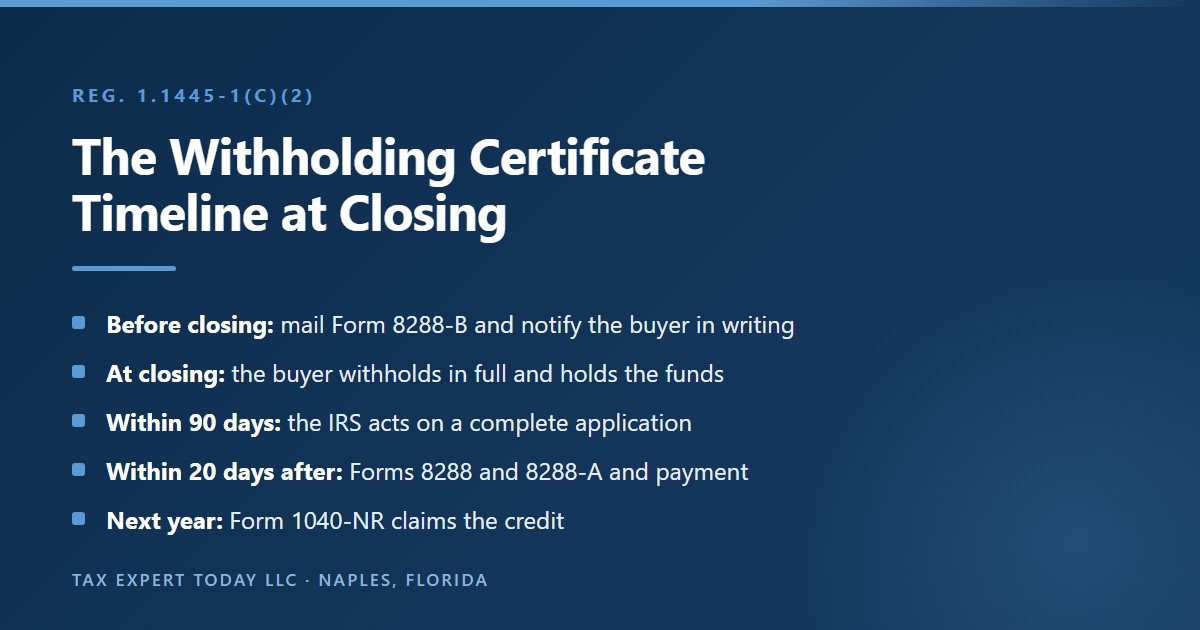
Gather records when the property is listed, prepare the maximum tax calculation and any Form W-7 when a contract is signed, submit the application and give the buyer written notice before closing, hold the withholding in escrow at closing, and pay over the certificate amount within 20 days of the IRS decision. The return follows the next year.
- At listing: collect the purchase closing statement, improvement invoices, depreciation schedules, and past Forms 1040-NR.
- At contract: fix the contract price, the estimated closing date, and whether the buyer will use the home as a residence.
- Before closing: mail Form 8288-B, with Form W-7 if needed, and deliver written notice to the buyer and the closing agent.
- After the IRS acts: the buyer files Forms 8288 and 8288-A within 20 days and releases the excess.
| Stage | Hypothetical date | Action | Rule |
|---|---|---|---|
| Listing | February 2026 | Seller gathers basis, depreciation, and past return records | Form 8288-B lines 6e, 6g, and 8 |
| Contract signed | March 10, 2026 | Maximum tax calculation prepared; ITIN status checked | Reg. 1.1445-3(c); Form W-7 Exception 4 |
| Application mailed | March 25, 2026 | Form 8288-B sent to Ogden; written notice to buyer | Form 8288-B instructions |
| Closing | April 15, 2026 | Buyer withholds 15 percent and holds it in escrow | Reg. 1.1445-1(c)(2) |
| IRS decision mailed | Within 90 days of a complete application | Certificate or denial issued | Reg. 1.1445-3(a) |
| Payment to IRS | Within 20 days after the IRS mails its decision | Buyer files Forms 8288 and 8288-A and pays the certificate amount | Reg. 1.1445-1(c)(2) |
| Return | June 15, 2027 | Seller files Form 1040-NR for 2026 and claims the credit | Publication 519 |
The dates are hypothetical. Starting the work when the property is listed, rather than when it goes under contract, is what leaves reasonable time for an application before closing. A seller who is out of the country for the summer should arrange for an agent with a power of attorney to receive IRS correspondence, because a request for more information that goes unanswered can lead to a denial.
What are the most common Form 8288-B mistakes?
The most common mistakes are applying after closing, leaving out a TIN or the transfer date, forgetting the written notice to the buyer, applying the 20 percent rate to depreciation that is taxed at up to 25 percent, missing line 8 evidence, and treating the certificate as the final tax answer instead of filing the return.
- Late application: after closing, the full amount goes to the IRS within 20 days.
- Incomplete application: no TIN, no transfer date, or unsigned statements delay or defeat it.
- Wrong rate on depreciation: unrecaptured section 1250 gain is taxed at up to 25 percent.
- No return: the credit and any refund come only through Form 1040-NR or Form 1120-F.
| Mistake | Consequence | Prevention |
|---|---|---|
| Application submitted after closing | Full withholding paid to the IRS; money returns only by refund | Start at listing; mail before closing |
| Missing or estimated date of transfer left blank | Application not substantially complete and rejected | Enter the contract closing date |
| No written notice to the buyer | Buyer may deposit within 20 days of closing | Deliver notice and proof of mailing to the closing agent |
| 20 percent applied to all gain on a rental | Calculation understated; IRS questions or denies it | Separate the depreciation layer at up to 25 percent |
| No line 8 evidence | Application incomplete | Locate the nonforeign certificate from the purchase closing |
| Ignoring line 6g | Past unfiled rental returns surface under penalties of perjury | Review past filings before applying |
| Assuming the certificate ends the matter | Credit never claimed; refund lost or delayed | File Form 1040-NR or 1120-F with Copy B of Form 8288-A |
Florida has no personal income tax, so a sale of Florida property by a foreign individual involves only the federal withholding; a sale in California adds that state’s own nonresident withholding, explained in our guide to California Form 593. Most of these are timing and documentation problems rather than technical ones. A foreign owner who keeps the purchase closing file, the depreciation records, and copies of past returns together will find the application straightforward. Our earlier guide on selling a home after moving to Florida covers the domestic side of a sale for owners who are U.S. residents.
Form 8288-B Help in Naples & Southwest Florida
Tax Expert Today LLC works with international clients from an office in Naples, Florida and serves clients in all 50 states. Foreign owners sell condominiums, homes, and investment property across Naples, Bonita Springs, Fort Myers, and Marco Island every year, and the FIRPTA withholding on those sales is often the first U.S. tax issue a seller meets in person. We prepare the maximum tax calculation and the Form 8288-B application, help with the ITIN, and prepare the Form 1040-NR that reports the sale and claims the credit.
- Form 8288-B help Naples: maximum tax calculations, line 8 evidence, and timely submission before closing.
- FIRPTA withholding certificate Naples FL: coordination with the closing agent on escrow and the 20 day rule.
- International tax Naples FL: Form W-7 applications and Form 1040-NR for the year of sale.
- Foreign tax Naples: U.S. side coordination for Canadian and other foreign sellers with their home country adviser.
Our international and expat tax services page explains how we approach cross-border work, including FIRPTA withholding certificates for foreign sellers. The international tax Naples FL guide and the Naples tax planning page cover the wider picture for residents and seasonal residents of Southwest Florida.
Office: 11983 Tamiami Trail N, Naples FL 34110
Phone: (239) 441-2005
Hours: Monday through Friday, 10:00 to 5:00 ET
Frequently Asked Questions
I am a foreign owner selling a condominium in Naples, Florida. When should I file Form 8288-B?
Ideally before closing. If the application is submitted on or before the transfer date, the buyer withholds the full amount but holds it until 20 days after the IRS mails a certificate or denial. If you apply after closing, the buyer pays the full amount to the IRS within 20 days and any excess comes back only by refund.
How long does the IRS take to issue a withholding certificate?
The regulations say the IRS will act within 90 days after it receives a complete application. The 90 days begin only when all necessary information, including every party’s TIN, has been provided, and the IRS may take longer in complicated cases. Plan on the certificate arriving after closing.
Can Form 8288-B eliminate FIRPTA withholding completely?
It can, where the facts support it. If the seller is exempt, a nonrecognition rule applies, or the maximum tax liability is zero, as on a sale at a loss with no unsatisfied withholding liability, the IRS may issue a certificate excusing withholding. Approval is subject to IRS review of the attachments.
Do I need an ITIN to file Form 8288-B?
Every party’s U.S. taxpayer identification number must be on the application. A nonresident alien who is not eligible for a Social Security number uses an ITIN, and if you do not have one you can attach the completed Form 8288-B to a completed Form W-7 under Exception 4 and send the package to the address in the Form W-7 instructions.
Where do I mail Form 8288-B?
The December 2025 instructions direct applications to the Internal Revenue Service, P.O. Box 409101, Ogden, UT 84409. If the application is attached to a Form W-7 for an ITIN, the package goes to the address given in the Form W-7 instructions instead.
Do I still file a U.S. tax return if I receive a withholding certificate?
Yes. The certificate decides only the withholding. An individual seller files Form 1040-NR for the year of sale, reports the actual gain, and claims the amount withheld as a credit with the stamped Copy B of Form 8288-A. A foreign corporation files Form 1120-F. Any overpayment is refunded on the return.
When to Engage a Professional
FIRPTA withholding is a percentage of the price, and the tax is a percentage of the gain. Form 8288-B is the bridge between the two, but it works only if it is filed on time, with every TIN, every attachment, and a maximum tax calculation that holds up under review. Most of the cost of getting it wrong is time: a large share of the seller’s proceeds sitting with the IRS until a return is filed and processed.
A professional review is worth considering when a foreign owner first lists U.S. property for sale, when the expected gain is small relative to the price or the sale is at a loss, when the property was rented and depreciation was claimed, when no ITIN exists, when the property is held through an LLC, partnership, trust, or estate, when past rental returns were not filed, or when the seller also files in Canada or another country and needs the U.S. figure to support a foreign tax credit there.
Tax Expert Today LLC is a tax advisory firm in Naples, Florida serving clients in all 50 states. Call (239) 441-2005 to discuss your facts.
This article is general information, not advice for any particular taxpayer, and does not create a client relationship. The examples are hypothetical illustrations only and do not describe any client. The rules described here reflect 26 U.S.C. sections 1, 897, 1411, 1445, and 453A, Treasury Regulations sections 1.1445-1, 1.1445-2, and 1.1445-3, Rev. Proc. 2000-35, Form 8288-B (Rev. December 2025) and its instructions, the Instructions for Form W-7 (Rev. December 2024), and IRS Publication 519, as of the date of writing. Canadian and other foreign tax rules are outside the scope of this article and should be confirmed with an adviser in that country. Verify current rules and confirm your own facts with a qualified tax professional before filing or making a decision.
Published October 14, 2026 by Dr. Pellumb Kabashi « Back to Learning Center
Have a question this article touches on?
Tax Expert Today LLC, based in Naples, Florida and serving clients across the United States.
Schedule a Consultation (239) 441-2005