
By Dr. Pellumb Kabashi, DBA, MBA, EA, CFE, CES
Founder, Tax Expert Today LLC · Tax advisors, enrolled agents, CPAs, and attorneys · Serving clients in all 50 states
Quick Answer
Form 8621 is the annual IRS information return a United States person files for each passive foreign investment company, or PFIC, such as a foreign mutual fund or a non-U.S. ETF. It reports distributions, sales, and elections, and it is generally required even in quiet years unless an exception applies. Call (239) 441-2005 for a free consultation.
What is Form 8621?
Form 8621 is the IRS information return a United States shareholder of a passive foreign investment company attaches to the income tax return. One form is filed for each PFIC. It reports the shareholder’s holdings, computes the tax on excess distributions and sales, and is where the QEF and mark-to-market elections are made.
- One form per fund. Five foreign funds generally means five separate Forms 8621.
- It rides with the return. The form is attached to Form 1040 and is due with it, including extensions.
- It is both a report and a tax computation. Parts I and II report and elect; Parts III through VI compute the income or tax.
- The current revision is December 2025. It adds a currency code line and a U.S. dollar line to Part V.
The full name of the form is “Information Return by a Shareholder of a Passive Foreign Investment Company or Qualified Electing Fund.” The annual reporting duty comes from 26 U.S.C. section 1298(f), which says each United States person who is a shareholder of a passive foreign investment company “shall file an annual report” with the information the Treasury requires. Form 8621 is that report. According to the IRS page for Form 8621, a United States person that is a direct or indirect shareholder of a PFIC files the form if the person receives certain distributions, recognizes gain on a disposition, reports a QEF or mark-to-market election, makes an election reportable in Part II, or is required to file the annual report under section 1298(f).
Most people who run into Form 8621 did nothing unusual. They bought a mutual fund through a bank in the country where they used to live, kept a pension-linked investment account after moving to the United States, or bought an ETF on the London or Toronto exchange because it tracked the same index as a fund they knew. The rules were written in 1986 to stop United States investors from deferring tax through offshore funds, and they apply regardless of intent. That is why a retiree in Naples, Florida with a modest Canadian or British fund can face the same form, and the same computation, as a hedge fund investor.
This guide explains when the form is required, when it is not, how the three tax regimes work, and what the numbers look like on a sale. The related questions of foreign account reporting and foreign company ownership belong to other forms and have their own guides: the FBAR threshold is covered in our FBAR filing guide, and ownership of a foreign operating company is covered in our Form 5471 guide.
What is a PFIC?
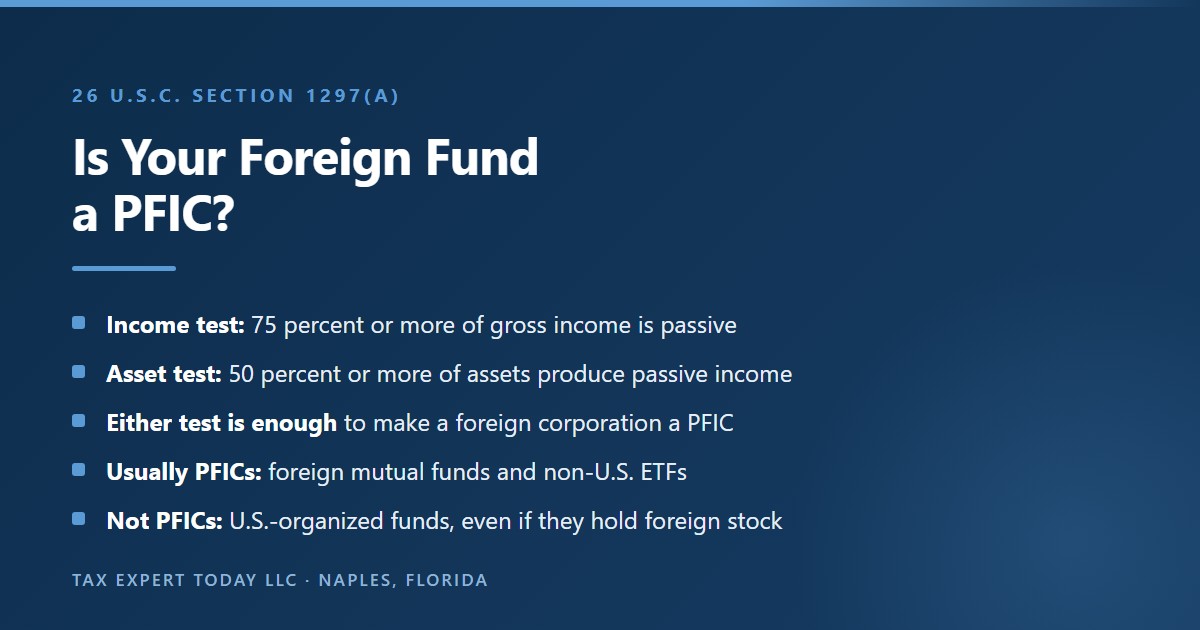
A PFIC is any foreign corporation that meets either of two tests for its tax year: 75 percent or more of its gross income is passive, or at least 50 percent of its assets, on average, produce passive income or are held to produce it. Most foreign mutual funds and non-U.S. ETFs meet one of these tests automatically.
- Income test. Dividends, interest, royalties, rents, and gains are generally passive income.
- Asset test. Cash, securities, and other investment assets count toward the 50 percent.
- Foreign is the key word. A fund organized in the United States is not a PFIC, even if it holds only foreign stocks.
- Operating companies can qualify. A foreign startup sitting on raised cash can fail the asset test.
The two tests are in 26 U.S.C. section 1297(a). The income test looks at gross income for the tax year, and the asset test looks at the average percentage of assets held during the year, measured under section 1297(e). The Form 8621 instructions add two measurement rules. A publicly traded foreign corporation must measure assets at fair market value. A corporation that is not publicly traded but is a controlled foreign corporation generally uses adjusted basis, and some other non-traded companies may elect to use adjusted basis. The instructions also describe a look-through rule: a foreign corporation that owns at least 25 percent of another corporation, by value, is treated as holding its proportionate share of that company’s assets and receiving its share of that company’s income.
In practice, the following holdings are the ones that most often turn out to be PFICs for individual investors:
| Holding | Usually a PFIC? | Why |
|---|---|---|
| Mutual fund organized outside the United States (for example a Canadian, UK, Irish, or Luxembourg fund) | Yes, in most cases | A foreign corporation or entity treated as one, holding investment assets and earning passive income |
| ETF listed and organized outside the United States | Yes, in most cases | Same analysis as a foreign mutual fund; the listing exchange does not change the entity’s foreign status |
| U.S.-organized ETF or mutual fund that invests in foreign stocks | No | The fund itself is a domestic entity; its foreign holdings do not make it a foreign corporation |
| Individual shares of a large foreign operating company | Usually not | An operating business with active income and operating assets normally fails both tests, though status is tested every year |
| Foreign holding company or family investment company | Often | Its income is typically dividends, interest, and gains; the look-through rule can change the answer when it owns 25 percent or more of an operating company |
| Early-stage foreign startup holding investor cash | Possibly | Cash is a passive asset, so a company with little revenue can fail the 50 percent asset test |
| Certain foreign insurance and investment-linked policies | Possibly | Depends on whether the policy or wrapper is treated as owning the underlying fund shares; the insurance exceptions in section 1297(f) are narrow |
Two points trip people up. First, the fund’s legal form in its own country does not control. A unit trust or an open-ended investment company that is not a corporation under local law can still be classified as a corporation for United States tax purposes, and a foreign entity classified as a corporation that holds investment assets is the classic PFIC. Second, status is tested every year, and under section 1298(b)(1) stock is treated as PFIC stock if the company was a PFIC that was not a qualified electing fund at any time during the holder’s holding period. That is the source of the phrase “once a PFIC, always a PFIC.” A company that stops being a PFIC does not clean up the shares automatically; the shareholder generally has to make a purging election, discussed below.
Who must file Form 8621?
A United States person who owns PFIC stock directly or indirectly generally files Form 8621 for each PFIC every year. The filing is triggered by a distribution, a sale or other disposition, a QEF or mark-to-market election in effect, a new election, or the general annual report under section 1298(f), subject to the exceptions.
- United States persons. Citizens, green card holders, and people who meet the substantial presence test.
- Direct and indirect owners. Ownership through a partnership, trust, estate, or foreign company can count.
- Each PFIC in a chain. A fund that owns another fund can require a form for each.
- Joint filers can combine. Spouses filing jointly may file one form per PFIC they both own.
The Instructions for Form 8621 list the same five circumstances as the IRS form page and add that a separate Form 8621 must be filed for each PFIC in which stock is held directly or indirectly. A single form per PFIC can serve several purposes at once: it can carry the Part I annual summary, make an election in Part II, and report income or tax in Parts III through VI.
United States person status is the threshold question. A green card holder is a United States person from the start of residency, and a visa holder becomes one by meeting the substantial presence test described in our guide to the substantial presence test. That is why the form so often lands on new residents. A professional who moves to Naples on a work visa, or a retiree who arrives on a green card, often brings a portfolio of home-country funds that was ordinary and tax-efficient at home and becomes PFIC stock the day the person becomes a United States resident for tax purposes. How the holding period and any pre-residency growth are treated for someone who arrived as a nonresident is a fact-specific question that should be reviewed before the first return is filed.
Indirect ownership is broader than most people expect. The instructions say a United States person is generally an indirect shareholder of a PFIC if the person owns 50 percent or more of a foreign corporation that is not a PFIC and that owns PFIC stock, owns a PFIC that itself owns another PFIC, or owns an interest in a partnership, S corporation, trust, or estate that owns a PFIC. Regulation section 1.1291-1(b)(8) contains the detailed attribution rules. In a chain of ownership, the first United States person in the chain is generally the one who files Part I for each PFIC owned through it.
Pass-through entities add a layer. A domestic partnership, S corporation, United States trust, or estate that owns a PFIC generally files its own Form 8621, and its owners must also file if the entity fails to file or if the owner must recognize income under section 1291. A United States person treated as the owner of a trust under the grantor trust rules files for PFIC stock held in that trust.
When is Form 8621 not required?
Form 8621 is generally not required for a section 1291 fund when all of the shareholder’s PFIC stock is worth $25,000 or less at year end, or $50,000 or less on a joint return, and there was no excess distribution or sale. Retirement accounts, some treaty pension plans, and certain indirect holdings are also excepted.
- The $25,000 test counts every PFIC. QEF and mark-to-market stock count toward the total even though they cannot use the exception.
- It is lost by a sale. Any excess distribution or gain on a disposition requires the form, whatever the value.
- Indirect holdings have a $5,000 test. A small indirect stake in a section 1291 fund can be excepted.
- IRAs and 401(k) plans are outside the rules. A PFIC held inside a U.S. tax-exempt account is not treated as owned by you.
The exceptions are in Treasury Regulation section 1.1298-1(c) and are summarized in the instructions. The most used is the $25,000 exception. It applies only to a section 1291 fund, meaning a PFIC for which no QEF or mark-to-market election is in effect. It is tested on the last day of the tax year using the value of all PFIC stock the shareholder owns directly or indirectly, other than stock owned through another United States person or through another PFIC. The regulation’s own example shows the effect: a taxpayer who owns $5,000 of a QEF, $10,000 of a mark-to-market fund, and $4,000 of a third PFIC with no election must file for the first two, but not for the third, because the total is under $25,000 and the third fund had no excess distribution or sale.
The exception is narrower than it looks. It requires that the shareholder not receive an excess distribution from the fund and not recognize gain on a sale or other disposition of it during the year. A normal distribution that is not an excess distribution does not by itself break the exception, but a sale of any shares at a gain does. The joint return threshold is $50,000 for both spouses combined, not $50,000 each.
The other exceptions work as follows:
| Situation | Form 8621 required? | Source |
|---|---|---|
| All PFIC stock worth $25,000 or less at year end ($50,000 joint), section 1291 fund, no excess distribution or sale | No, for that fund | Reg. 1.1298-1(c)(2) |
| Indirect stake in a section 1291 fund worth $5,000 or less at year end, no excess distribution or sale | No, for that indirect stake | Reg. 1.1298-1(c)(2) |
| PFIC held inside an IRA, 401(k), 403(b), 457(b), or 529 plan | No; you are not treated as the shareholder | Form 8621 instructions |
| PFIC held inside a foreign pension that a U.S. treaty treats as a pension fund, where income is taxed only when paid out | No, for that PFIC interest | Reg. 1.1298-1(c)(4) |
| U.S. beneficiary of a foreign nongrantor trust or foreign estate that owns a PFIC, with no election, excess distribution, or gain | No Part I for that stock | Reg. 1.1298-1(b)(3)(ii) |
| 10 percent U.S. shareholder of a controlled foreign corporation that is also a PFIC, during the qualified portion of the holding period | Generally no PFIC regime for that stock | 26 U.S.C. 1297(d) |
| QEF or mark-to-market election in effect, at any value | Yes, every year | Reg. 1.1298-1(c)(2) |
| Any excess distribution or sale of the fund during the year | Yes | Reg. 1.1298-1(c)(2) |
The treaty pension exception deserves care. It applies when the shareholder is a member or beneficiary of a plan that an income tax treaty treats as a foreign pension fund, and the treaty provides that the income earned by the plan may be taxed to the shareholder only when and to the extent it is paid out. Whether a particular Canadian registered plan, UK pension, or other foreign arrangement qualifies depends on the treaty text and sometimes on an election or a treaty-based return position, which is the subject of our Form 8833 guide. A tax-free savings account or an ordinary investment account abroad is generally not a pension for this purpose.
How is a PFIC taxed if you make no election?
Without an election, a PFIC is a section 1291 fund. Excess distributions and all gain on a sale are spread evenly across every day of the holding period. The current-year share is ordinary income, and each earlier year’s share is taxed at that year’s highest rate, plus interest as if the tax had been paid late.
- No capital gains rate. Gain on the sale of a section 1291 fund is never taxed at the long-term capital gains rates.
- Highest rate, not your rate. Earlier years are taxed at the top rate in effect then, 37 percent for 2018 through 2025.
- An interest charge. Interest runs from each earlier year’s return due date to the current year’s due date.
- Losses do not offset. A loss on one fund does not reduce the section 1291 gain on another.
This default regime is in 26 U.S.C. section 1291, and it is what applies to most individuals who hold a foreign fund without knowing it is a PFIC. It has three moving parts.
The excess distribution. Under section 1291(b), an excess distribution is the part of the current year’s distributions that exceeds 125 percent of the average distributions received during the three preceding tax years, or during the shorter period the shares were held. No part of a distribution received in the first year of the holding period is an excess distribution. The instructions stress that the computation is made per share and separately for each block of shares with its own holding period. Under section 1291(a)(2), all gain on a disposition is treated as an excess distribution, and the instructions note that stock is considered disposed of if it is sold, transferred, or pledged, so borrowing against the shares can itself trigger the rules.
The allocation. The excess distribution or gain is allocated ratably to each day in the holding period. The portions allocated to the current tax year, and to any years before the company became a PFIC, are included in income as ordinary income. The portions allocated to earlier PFIC years are not included in current income. Instead, each produces a separate tax.
The deferred tax and interest. Under section 1291(c), the tax on each earlier year’s portion is figured at the highest rate in effect for that year under section 1 for individuals, not the taxpayer’s actual bracket. The instructions reproduce the historical table: 37 percent for 2018 through 2025, 39.6 percent for 2013 through 2017, and 35 percent for 2003 through 2012. Interest is then charged on each year’s tax from the due date of that year’s return, without extensions, to the due date of the return for the year of the distribution or sale, using the section 6621 underpayment rates. The individual reports the deferred tax on Form 1040 with the notation “1291TAX” and the interest on Schedule 2.
Foreign taxes help only a little. Creditable foreign taxes tied to the excess distribution are allocated the same way as the distribution. Taxes allocated to an earlier PFIC year can reduce the deferred tax for that year, but not below zero, and there is no carryover of any unused amount. Losses are also treated harshly: the instructions state that a loss on the disposition of a section 1291 fund is not taken into account under section 1291 and does not reduce the gain subject to it, although the loss may be recognized under other Code provisions.
How does the excess distribution math work in a worked example?
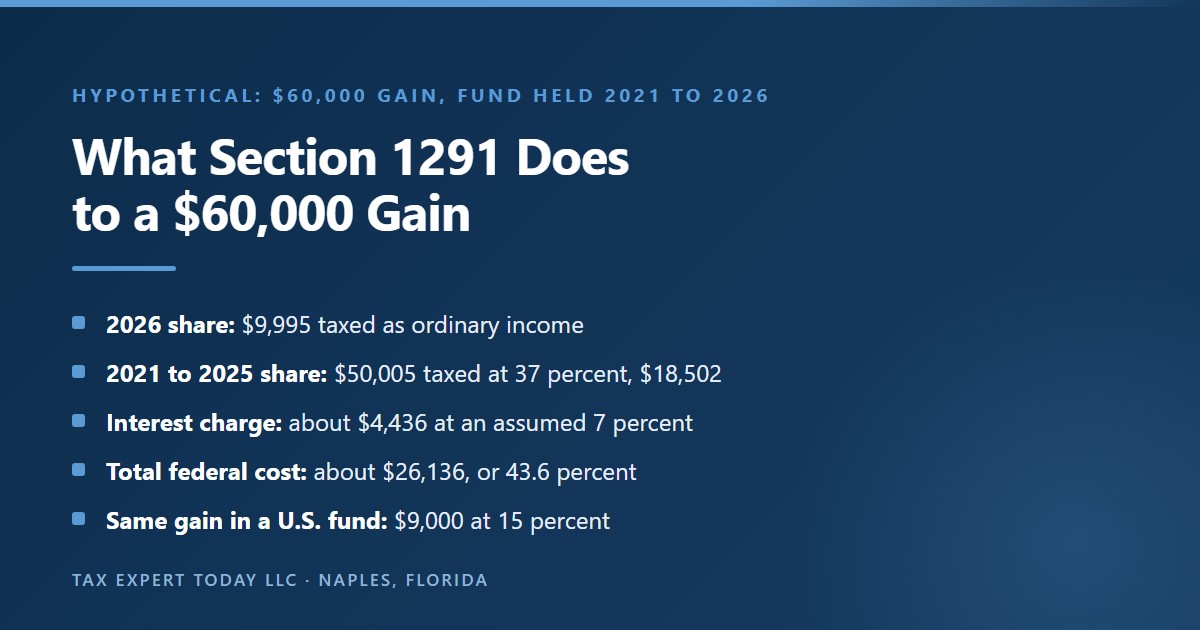
In a hypothetical sale of a foreign fund bought January 1, 2021 and sold December 31, 2026 for a $60,000 gain, section 1291 spreads the gain over 2,191 days. About $10,000 is 2026 ordinary income, about $50,000 is taxed at 37 percent for 2021 through 2025, and interest is added on top.
- Total federal cost in this illustration: about $26,100. That is roughly 43.6 percent of the gain.
- A U.S. fund with the same gain: $9,000. At a 15 percent long-term capital gains rate.
- Interest is the smallest piece but grows with time. Here it is about $4,400 on five earlier years.
- The rate you actually paid in those years is irrelevant. The top rate applies regardless.
The example below is hypothetical and simplified. It assumes a married couple in Naples who have been United States residents throughout, who bought $100,000 of a foreign-organized index fund on January 1, 2021, received no distributions, made no election, and sold every share on December 31, 2026 for $160,000. It assumes the 2026 portion is taxed at a 32 percent marginal rate and uses an assumed flat 7 percent interest rate compounded daily. Actual section 6621 rates change quarterly, and a real computation uses the published rate for each quarter. The net investment income tax, state tax, currency translation, and foreign tax credits are ignored.
| Tax year | Days held | Gain allocated | Treatment | Tax | Interest (illustrative) |
|---|---|---|---|---|---|
| 2021 | 365 | $9,995 | Earlier PFIC year, 37 percent | $3,698 | $1,551 |
| 2022 | 365 | $9,995 | Earlier PFIC year, 37 percent | $3,698 | $1,196 |
| 2023 | 365 | $9,995 | Earlier PFIC year, 37 percent | $3,698 | $864 |
| 2024 | 366 | $10,023 | Earlier PFIC year, 37 percent | $3,708 | $557 |
| 2025 | 365 | $9,995 | Earlier PFIC year, 37 percent | $3,698 | $268 |
| 2026 | 365 | $9,995 | Current year, ordinary income at 32 percent | $3,199 | None |
| Total | 2,191 | $60,000 | $21,700 | $4,436 |
The total federal cost in this illustration is about $26,136, or 43.6 percent of the $60,000 gain. Had the same couple held a United States-organized fund with the same investments, the gain would generally have been long-term capital gain taxed at 15 percent, or $9,000, and at most 23.8 percent, or $14,280, at the top capital gains rate plus the net investment income tax. The difference is the price of the default regime, and it grows with each additional year the fund is held because more of the gain is pushed into earlier years at the top rate and the interest period lengthens.
Two refinements matter in real files. First, a purchase made in several lots creates several holding periods, and each block of shares is computed separately. Second, the 2026 portion here is taxed at the couple’s own 2026 rate because it is current-year ordinary income; only the earlier years are forced to the highest rate. The Form 8621 instructions direct the shareholder to show the allocation on a separate sheet attached to the form, which is why a sale of a long-held foreign fund produces a multi-page attachment even when the gain is modest.
What is a QEF election on Form 8621?
A qualified electing fund, or QEF, election under section 1295 lets a shareholder include a pro rata share of the fund’s ordinary earnings and net capital gain in income each year, keeping capital gain character and avoiding the section 1291 interest charge. It requires an annual information statement from the fund.
- Current tax, normal character. Ordinary earnings are ordinary income; net capital gain stays long-term capital gain.
- Basis goes up with inclusions. Tax on a later sale is limited to growth not already taxed.
- The fund must cooperate. Without a PFIC Annual Information Statement, the election is not available.
- Timing is everything. The election is made by the due date of the return for the first year it applies.
Under 26 U.S.C. section 1293, a shareholder of a QEF includes each year, as ordinary income, the pro rata share of the fund’s ordinary earnings and, as long-term capital gain, the pro rata share of its net capital gain. The shareholder’s basis increases by the amounts included and decreases when previously taxed amounts are distributed. The shareholder may also make Election B on Form 8621 to extend the time to pay tax on undistributed earnings, with interest, until the election terminates.
The practical obstacle is the information. The instructions require, for each year the election applies, a PFIC Annual Information Statement from the fund, or an Annual Intermediary Statement, showing the shareholder’s pro rata share of ordinary earnings and net capital gain or enough information to compute it. Many retail funds sold outside the United States do not prepare these statements for United States investors, so the QEF election is often unavailable in practice for exactly the funds individuals are most likely to own. Some fund families do publish them, and it is worth asking before assuming the election is closed.
The election is made by checking box A in Part II and completing Part III, attached to a timely filed return for the first year the election is to apply. Under section 1295 and Regulation section 1.1295-3, a late or retroactive QEF election is allowed only under a protective statement regime, for a shareholder who reasonably believed the company was not a PFIC and filed a protective statement, or under a consent regime. The consent regime requires, among other things, reasonable reliance on a competent tax professional and a request made before the PFIC issue is raised on audit.
A QEF election made after the first year of the holding period creates an unpedigreed QEF. The earlier years remain subject to section 1291 unless the shareholder also makes a purging election: Election D, a deemed sale that taxes the built-in gain as an excess distribution on the first day of the QEF year, or, for a PFIC that is also a controlled foreign corporation, Election E, a deemed dividend of post-1986 earnings. After the purge, the fund becomes a pedigreed QEF for that shareholder.
What is the mark-to-market election for PFIC stock?
The section 1296 mark-to-market election is available only for marketable PFIC stock, generally shares regularly traded on a qualifying exchange. Each year the shareholder includes the increase in value as ordinary income and deducts decreases only up to earlier inclusions. It avoids the interest charge but not ordinary income treatment.
- Only for marketable stock. Shares regularly traded on a registered or qualifying foreign exchange.
- Ordinary income every year. Unrealized gains are taxed annually at ordinary rates.
- Losses are capped. Deductions are limited to unreversed inclusions from prior years.
- A first-year trap. Electing after the first year triggers section 1291 on the built-in gain in the election year.
Under 26 U.S.C. section 1296, a shareholder who elects includes in income each year the excess of the stock’s fair market value at year end over its adjusted basis. If the value falls below basis, the shareholder deducts the decline, but only to the extent of unreversed inclusions, meaning prior mark-to-market income not already offset by prior deductions. Gains and allowed losses are ordinary and are reported on the other income line. Basis moves up and down with the inclusions and deductions.
The first-year trap is in section 1296(j) and Regulation section 1.1296-1(i). When a shareholder makes the election in a year other than the first year the stock is held, and no QEF election was in effect, the stock is treated as sold at fair market value on the last day of the election year and the gain is an excess distribution under section 1291. Distributions during that year are also subject to section 1291. In other words, the election stops the interest charge from growing in the future, but the shareholder first pays the section 1291 cost on everything that built up before. For a new resident who arrives with foreign ETFs, making the election in the first year the shares are held as a United States person, when the facts support it, can matter a great deal.
The election is made by checking box C in Part II. In the first year, the shareholder completes Part V if the coordination rule applies, and Part IV in all other cases. Once made, it applies to later years unless revoked with IRS consent or terminated under the regulations, so a shareholder who has made it files Form 8621 every year the stock is held, at any value.
How do you choose between the default rules, a QEF election, and mark-to-market?
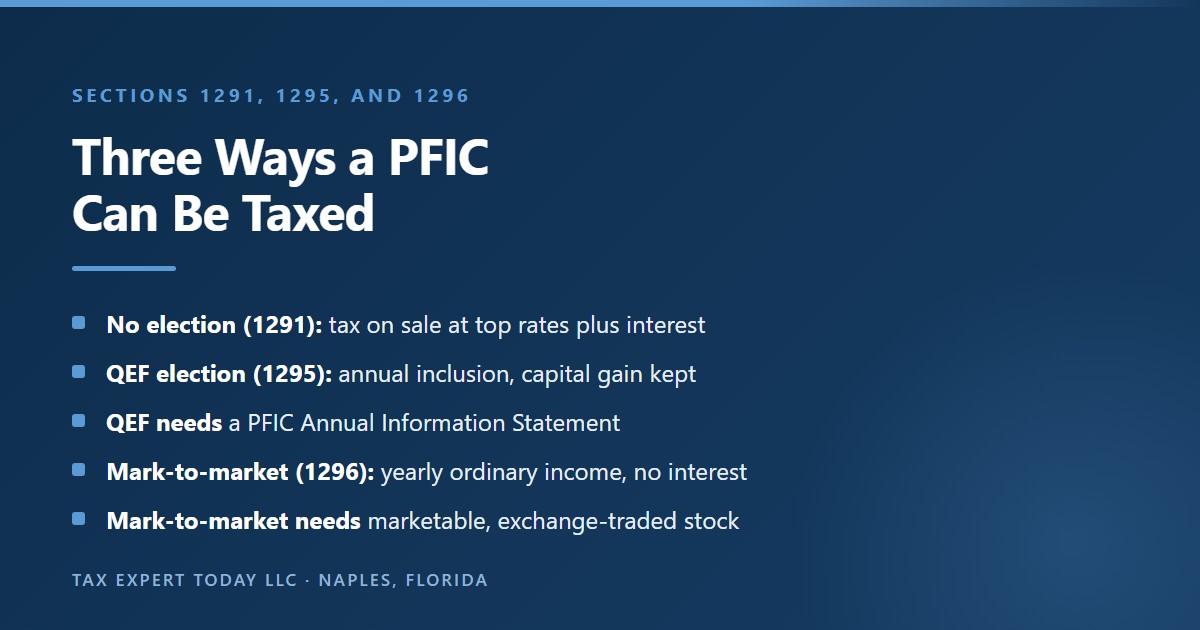
The choice usually depends on two facts: whether the fund provides a PFIC Annual Information Statement, which a QEF election requires, and whether the shares are marketable, which mark-to-market requires. When neither is available, the default section 1291 rules apply, and the practical options are to hold, sell, or restructure.
- QEF is usually the most favorable when available from the first year, because it preserves capital gain treatment.
- Mark-to-market is usually second for listed foreign ETFs, trading capital gains for simplicity.
- The default regime is the most expensive the longer the fund is held.
- Selling does not escape it. A sale is exactly the event that triggers the section 1291 computation.
| Feature | Section 1291 default (no election) | QEF election (section 1295) | Mark-to-market (section 1296) |
|---|---|---|---|
| When tax is paid | On an excess distribution or sale | Every year on the fund’s earnings | Every year on the change in value |
| Character | Ordinary, with earlier years at the highest rate | Ordinary earnings as ordinary income; net capital gain as long-term capital gain | Ordinary income and limited ordinary loss |
| Interest charge | Yes | No (unless Election B defers payment) | No, after the first-year coordination rule |
| What you need | Nothing; applies automatically | PFIC Annual Information Statement from the fund | Marketable stock traded on a qualifying exchange |
| Form 8621 parts | Part I, and Part V when there is an excess distribution or sale | Parts I, II (box A), and III | Parts I, II (box C), and IV |
| $25,000 exception available | Yes, if no excess distribution or sale | No | No |
| Losses | Not taken into account under section 1291 | Capital loss on sale under normal rules | Deductible only up to unreversed inclusions |
| Typical fit | Small, long-held positions with no practical alternative | Funds that publish the statement, elected from the first year | Listed foreign ETFs where no statement is available |
For many individuals the right answer is not an election at all but a portfolio decision: replacing foreign funds with United States-organized funds that hold similar investments, once the tax cost of exiting has been measured. That decision has consequences in the other country, too, and a foreign-country tax on the sale does not always line up with the United States computation. The timing, and whether a mark-to-market election for the year before a sale would reduce the cost, should be modeled before anything is sold.
When is Form 8621 due, and how is it filed?
Form 8621 is attached to the shareholder’s federal income tax return and filed by the return’s due date, including extensions: April 15, or October 15 on extension, for most individuals. A shareholder not otherwise required to file a return sends the form alone to the IRS in Ogden, Utah.
- Same deadline as the return. An extension of the return extends the form.
- Stand-alone filing is possible. The address is Internal Revenue Service Center, Ogden, UT 84201-0201.
- A reference ID number. Required when the PFIC has no EIN, and used consistently every year.
- New currency lines. The 12/2025 revision asks for a three-letter currency code and a U.S. dollar amount in Part V.
The current instructions, revised in December 2025, say to attach Form 8621 to the shareholder’s tax return and file both by the due date, including extensions, at the service center where the return is filed. The summary of new items at the top of the instructions describes two new Part V lines: a three-letter currency code entered above line 15a, and line 15e(2), which asks for the line 15e(1) amount in United States dollars. The instructions explain that the excess distribution is generally computed in dollars, with each distribution translated at the spot rate on its date, unless every relevant distribution was made in a single foreign currency.
Most foreign funds do not have a United States employer identification number. In that case the filer assigns a reference ID number of up to 50 letters and numbers, with no spaces or special characters, and uses the same number every year for that fund. The instructions allow values to be rounded to whole dollars, and they allow a shareholder to rely on periodic account statements for the year-end value on line 4 unless the shareholder knows or has reason to know the statement does not reflect a reasonable estimate.
A shareholder who also files Form 8938 checks the box at the top of Form 8621 for excepted specified foreign financial assets and counts the Form 8621 on Form 8938. That box exists because the same asset should not be described twice, but it does not remove the FBAR filing for the account that holds the fund, which is a separate Treasury filing explained in our FBAR vs Form 8938 comparison.
What records do you need to prepare Form 8621?
Preparing Form 8621 requires, for each fund, the date and cost of every purchase lot, year-end values, every distribution with its date and currency, any sale proceeds, the Forms 8621 filed in earlier years, and, for a QEF, the fund’s annual information statement. Missing purchase history is the most common obstacle in a catch-up filing.
- Every lot has its own holding period. Monthly purchases and reinvested distributions each start a new lot.
- Distributions need dates and currency. The 125 percent test and the spot-rate translation depend on them.
- Prior forms carry forward. Reference ID numbers, elections, and unreversed inclusions continue year to year.
- Interest needs the right rates. The section 1291 interest charge uses the quarterly section 6621 rates.
| Record | Why it is needed | Usual source |
|---|---|---|
| Purchase confirmations or full transaction history | Establishes each lot’s holding period and basis for the daily allocation | Foreign bank or broker statements, platform downloads |
| Distribution history for the current and three prior years | Needed for the 125 percent excess distribution test in section 1291(b) | Annual fund or account statements |
| Year-end value of each fund | Part I line 4, the $25,000 exception, and mark-to-market gain or loss | December statements; periodic statements may generally be relied on |
| Sale or redemption confirmations | Gain on a disposition is treated as an excess distribution | Broker contract notes |
| PFIC Annual Information Statement | Required for each year a QEF election applies | The fund manager or an intermediary |
| Prior Forms 8621 and election statements | Reference ID numbers, election history, unreversed inclusions, and section 1294 deferrals | Earlier federal returns |
| Foreign tax withheld on distributions | Allocated with the excess distribution under the section 1291 credit rules | Fund tax vouchers or annual tax statements |
The definitions behind these records, including when a person is an indirect shareholder and how the holding period is measured, are set out in Treasury Regulation section 1.1291-1. The interest charge under section 1291(c)(3) is computed using the underpayment rates and methods of 26 U.S.C. section 6621, which is why a long holding period means many separate interest periods. A shareholder who wants to preserve a later QEF election should also keep the protective statement described in Treasury Regulation section 1.1295-3.
The same statements usually support the other filings for the account. The account balance history drives the FBAR, discussed for late filers in our guide to filing a late FBAR, and the IRS Form 8938 page explains the separate specified foreign asset report. Funds held through a foreign trust raise additional reporting explained in our Form 3520 guide, and Americans living abroad who hold local funds should read the fund question alongside our comparison of the foreign earned income exclusion and the foreign tax credit.
What happens if you never filed Form 8621?
An unfiled Form 8621 keeps the statute of limitations open. Under section 6501(c)(8), the IRS time to assess tax for the related return does not expire until three years after the required information is furnished. The Code does not attach a separate dollar penalty to Form 8621 itself, but tax and interest still apply.
- The open statute is the main exposure. A return can stay open for years after it was filed.
- Reasonable cause narrows it. If the failure was due to reasonable cause, only the related items stay open.
- Section 1291 tax is still owed. Unreported excess distributions and gains carry tax and interest.
- Related filings have their own penalties. A missed FBAR or Form 8938 on the same account is separate.
The statute is the key text. 26 U.S.C. section 6501(c)(8)(A) provides that for information required to be reported under section 1298(f), among other international information provisions, the time for assessing any tax with respect to the related return, event, or period “shall not expire before the date which is 3 years after the date on which the Secretary is furnished the information.” Section 6501(c)(8)(B) limits the extension to the items related to the failure if the failure was due to reasonable cause and not willful neglect, a standard discussed more generally in our reasonable cause guide. Without reasonable cause, the extension can apply to the whole return.
Unlike Form 5471, which carries a $10,000 penalty under section 6038, and Form 8938, which carries its own penalty under section 6038D, Form 8621 has no stand-alone dollar penalty in the Code for simply failing to file. That is a narrower point than it sounds. Any unreported income from the fund, including section 1291 tax and interest on a sale, is still due, and an accuracy-related penalty under section 6662 can apply to an understatement. A missed FBAR on the account that held the fund carries the separate Title 31 penalties described in our FBAR penalties guide. Missed years can also cost the elections. A QEF election that was not made on time is generally available later only under the protective statement or consent regimes, and late purging elections after the three-year amendment window may require Form 8621-A.
Catching up is usually done by filing the missing forms with amended or late returns, and the right path depends on whether the failure was willful. For a taxpayer whose failure to report foreign income and file international forms was non-willful, the Streamlined Filing Compliance Procedures can be available, and they require a certification of non-willful conduct signed under penalty of perjury. The procedures are not a fit for anyone whose conduct was willful, and a false certification creates its own exposure. No outcome is assured in any catch-up filing, and the facts should be reviewed with a professional before choosing a path.
How does Form 8621 fit with the FBAR, Form 8938, and Form 5471?
Form 8621 reports the fund and computes its tax. The FBAR reports the foreign account where the fund is held. Form 8938 reports specified foreign financial assets above its thresholds. Form 5471 reports ownership of a foreign corporation at 10 percent or more. One foreign fund can trigger several of them in the same year.
- Different agencies. The FBAR goes to FinCEN; the others go to the IRS with the return.
- Different thresholds. The FBAR starts above $10,000 in aggregate; Form 8621 has its own exceptions.
- Some overlap relief. Form 8938 need not repeat a fund already reported on Form 8621.
- A CFC can also be a PFIC. Section 1297(d) generally switches off the PFIC regime for a 10 percent U.S. shareholder.
| Filing | What it covers | Filed with | Typical trigger for a foreign fund investor |
|---|---|---|---|
| Form 8621 | Each PFIC: holdings, elections, excess distributions, sales | Form 1040, by the return due date | Owning a foreign mutual fund or ETF, subject to the exceptions |
| FBAR (FinCEN Form 114) | Foreign financial accounts, including brokerage accounts holding funds | FinCEN, electronically | Aggregate foreign account balances above $10,000 at any time in the year |
| Form 8938 | Specified foreign financial assets | Form 1040 | Assets above the Form 8938 thresholds for the filer’s status and residence |
| Form 5471 | Foreign corporations with United States officers, directors, or 10 percent shareholders | Form 1040 | Owning 10 percent or more of a foreign company, including a family investment company |
| Form 1116 | Foreign tax credit for foreign taxes paid | Form 1040 | Foreign withholding on fund distributions or foreign tax on a sale |
The overlap between a controlled foreign corporation and a PFIC is worth a sentence of its own. Under section 1297(d), a United States shareholder, as defined for controlled foreign corporation purposes, is generally not subject to the PFIC rules for the same stock during the qualified portion of the holding period. That shareholder is instead taxed under subpart F and the rules explained in our GILTI guide. The attribution rules still apply for other purposes, so a family investment company can be a controlled foreign corporation for one family member and a PFIC for a smaller shareholder. Foreign taxes withheld on fund distributions are generally claimed on Form 1116, covered in our Form 1116 guide, subject to the section 1291 limits above.
Does Florida tax PFIC income?
Florida does not impose a personal income tax on individuals, so a Naples, Florida resident generally owes no state income tax on PFIC distributions, mark-to-market inclusions, or section 1291 gains. The federal PFIC rules and Form 8621 still apply in full, and a former home country may also tax the same fund.
- No Florida return for this income. Florida has no personal income tax return for individuals.
- Federal rules are unchanged. Section 1291, the elections, and Form 8621 apply the same way in every state.
- Moving here does not reset the fund. The holding period and PFIC history follow the shares.
- The other country may tax too. A treaty and the foreign tax credit may help but rarely line up perfectly.
For someone who moved to Southwest Florida from a state with an income tax, the state that was the tax home in earlier years may still claim tax on income from those years, depending on its own rules. That is separate from the federal computation. For the federal side, Florida residency changes nothing: the fund is a PFIC because of what it is, not where the owner lives.
Form 8621 Help in Naples & Southwest Florida
Tax Expert Today LLC works with international clients from an office in Naples, Florida, and serves clients in all 50 states. Collier and Lee counties are home to Canadian and European retirees who kept home-country funds, professionals on work visas and green cards whose savings sit in foreign accounts, and United States citizens who returned from years abroad with investments bought there.
- Form 8621 help Naples: identifying which holdings are PFICs, applying the exceptions, and preparing one form per fund.
- PFIC tax Naples FL: computing section 1291 excess distributions and the interest charge before a sale, not after it.
- International tax Naples FL: testing the QEF and mark-to-market elections, including the first-year rules for new residents.
- Foreign mutual fund tax Naples: coordinating Form 8621 with the FBAR, Form 8938, Form 1116, and treaty positions.
Our international and expat tax services page explains how we approach cross-border engagements for investors with foreign funds, and our Naples tax planning page covers the broader planning work for Southwest Florida residents.
Office: 11983 Tamiami Trail N, Naples FL 34110
Phone: (239) 441-2005
Hours: Monday through Friday, 10:00 to 5:00 ET
Frequently Asked Questions
I moved to Naples from Canada and still hold Canadian mutual funds in a regular account. Do I need Form 8621?
Generally yes, once you are a United States person for tax purposes. Canadian-organized mutual funds and ETFs are usually PFICs, and each one generally needs its own Form 8621 unless your total PFIC stock is $25,000 or less at year end, or $50,000 or less on a joint return, and you had no excess distribution or sale. Funds held inside a registered retirement plan are a separate question under the treaty pension exception.
Do I have to file Form 8621 every year?
Generally yes, for each PFIC you hold, unless an exception applies for that year. A QEF or mark-to-market election requires the form every year the stock is held. For a fund with no election, the $25,000 exception can remove the requirement in a year with no excess distribution and no sale, and the test is repeated each year.
Is there a penalty for not filing Form 8621?
The Code does not impose a separate dollar penalty for failing to file Form 8621 itself. The main consequence is that section 6501(c)(8) keeps the assessment period open until three years after the information is furnished. Tax and interest on unreported PFIC income still apply, accuracy penalties can apply to an understatement, and related FBAR or Form 8938 failures carry their own penalties.
Are foreign ETFs PFICs?
Most ETFs organized outside the United States are PFICs, because they are foreign corporations for United States tax purposes that hold investment assets and earn passive income. An ETF organized in the United States is not a PFIC, even if it invests only in foreign stocks. Listed foreign ETFs are often eligible for the mark-to-market election, which avoids the section 1291 interest charge.
Does a PFIC in my IRA need Form 8621?
No. The instructions provide that a United States person who owns PFIC stock through an IRA, a 401(k) plan, or another listed tax-exempt account is not treated as a shareholder of the PFIC. The form is not required for those holdings, and the section 1291 rules do not apply to them while they stay inside the account.
Can I sell my PFIC to avoid Form 8621?
A sale does not avoid the rules. Gain on a sale of a section 1291 fund is an excess distribution, and the year of the sale requires Form 8621 with the full computation in Part V, even under $25,000. Selling can end future filings, so it is often part of the plan, but the tax cost of exiting should be modeled first.
When to Engage a Professional
Form 8621 is one of the more demanding forms an individual can file. A single foreign fund held for several years, with several purchases and reinvested distributions, can require dozens of daily allocations and interest computations at changing rates. The elections that make the rules tolerable are time sensitive, and the most valuable ones, the QEF election and a mark-to-market election in the first year, are lost if the return is filed without them. Mistakes tend to surface years later, because the statute of limitations stays open until the form is filed.
A professional review is worth considering if you became a United States resident with foreign funds, if you plan to sell a foreign fund or ETF, if you hold funds through a foreign trust, company, or pension, if you did not file Form 8621 for past years, or if a foreign fund family offers a PFIC Annual Information Statement and you have not decided whether to elect. The right time to model the options is before a sale and before the first return that reports the fund.
Tax Expert Today LLC is a tax advisory firm in Naples, Florida serving clients in all 50 states. Call (239) 441-2005 to discuss your facts.
Primary Sources
- IRS: About Form 8621, Information Return by a Shareholder of a PFIC or QEF
- IRS: Instructions for Form 8621 (Rev. December 2025)
- 26 U.S.C. section 1291 (excess distributions, deferred tax, and interest)
- 26 U.S.C. section 1297 (PFIC income and asset tests)
- 26 U.S.C. section 1298 (annual reporting under 1298(f))
- Treasury Regulation section 1.1298-1 (filing requirement and exceptions)
This article is general information, not advice for any particular taxpayer, and does not create a client relationship. The Naples fund figures are hypothetical illustrations only and simplify the computation by assuming a single purchase, no distributions, a flat 7 percent interest rate compounded daily in place of the actual quarterly section 6621 rates, and a 32 percent marginal rate for the current year, and by ignoring the net investment income tax, currency translation, foreign taxes, and state tax. The rules described here reflect the December 2025 Instructions for Form 8621 and the Code and regulations as of the date of writing. Treaty pension positions and the treatment of holdings acquired before United States residency require review of the specific facts. Verify current rules and confirm your own facts with a qualified tax professional before filing or making an election.
Published September 30, 2026 by Dr. Pellumb Kabashi « Back to Learning Center
Have a question this article touches on?
Tax Expert Today LLC, based in Naples, Florida and serving clients across the United States.
Schedule a Consultation (239) 441-2005