
By Dr. Pellumb Kabashi, DBA, MBA, EA, CFE, CES
Founder, Tax Expert Today LLC · Tax advisors, enrolled agents, CPAs, and attorneys · Serving clients in all 50 states
Quick Answer: FIRPTA is the Foreign Investment in Real Property Tax Act, and it requires the buyer of United States real property to withhold tax when the seller is a foreign person. The general rate is 15 percent of the amount realized, which is the gross price rather than the profit. A reduced 10 percent rate and a full exemption apply to certain residence purchases, and Form 8288-B can lower the amount before closing. Call (239) 441-2005 for a free consultation.
What Is FIRPTA, and When Does It Apply?
FIRPTA is the withholding regime that makes the buyer of United States real property responsible for collecting tax when the seller is a foreign person. Section 1445 requires the transferee to deduct and withhold 15 percent of the amount realized on the disposition. The withholding is not the tax itself. It is a prepayment against whatever the seller ultimately owes on the gain.
- The buyer is the withholding agent. In most transactions the transferee carries the duty, and the IRS states plainly that a transferee who fails to withhold may be held liable for the tax.
- A disposition is broader than a sale. The IRS treats disposition as it is used anywhere in the Internal Revenue Code, which reaches sales, exchanges, liquidations, redemptions, gifts, and other transfers.
- Withholding runs on gross, not on gain. The 15 percent applies to the amount realized, so a seller who breaks even, or who sells at a loss, still has money withheld.
- The buyer must determine the seller status. The obligation begins with finding out whether the transferor is a foreign person, which is why the nonforeign affidavit is standard at closing.
- Entity sellers shift the agent role. Where a United States business entity such as a corporation or partnership disposes of the property, that entity is the withholding agent instead of the buyer.
The property covered is a United States real property interest, which the IRS defines as an interest other than as a creditor in real property located in the United States or the United States Virgin Islands, including interests in mines, wells, and other natural deposits, and certain associated personal property such as farming machinery. It also reaches shares in a domestic corporation unless it can be established that the corporation was at no time a United States real property holding corporation during the shorter of the holding period or the five year period ending on the disposition date.
How Much FIRPTA Withholding Applies to a Sale?
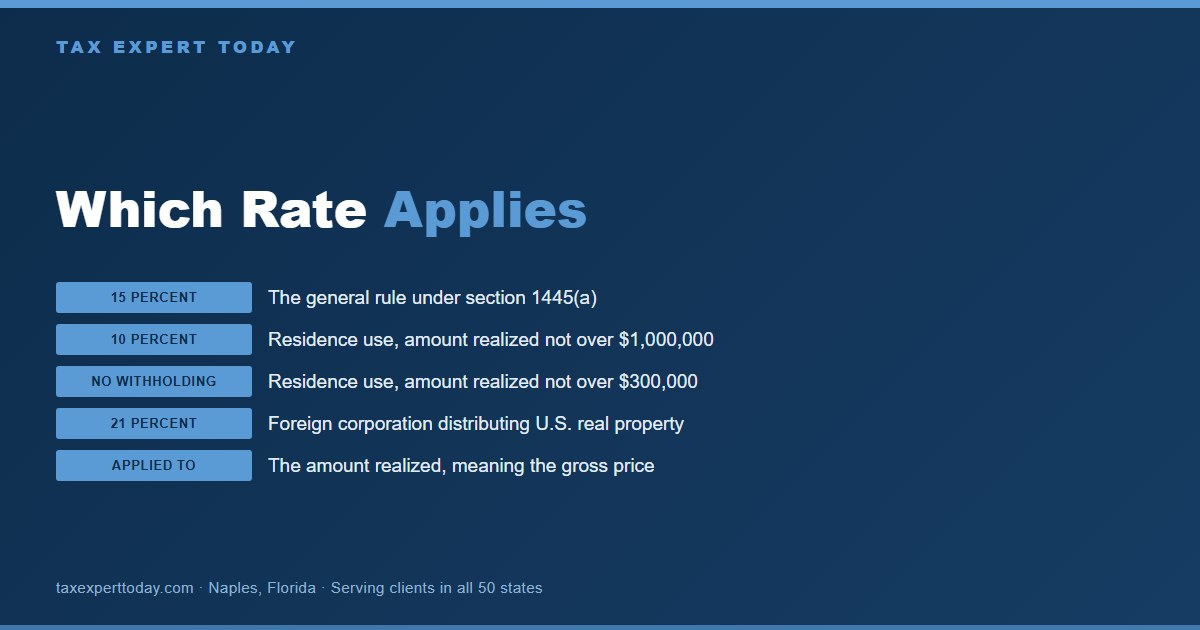
Three rates exist and the correct one turns on the price and on what the buyer intends to do with the property. The general rate is 15 percent. A 10 percent rate applies where the buyer acquires the property as a residence and the amount realized does not exceed $1,000,000. No withholding is required where the buyer acquires it as a residence and the amount realized does not exceed $300,000.
- 15 percent is the default. Section 1445(a) states the general rule, and the 10 percent figure that still appears in older material applies only to dispositions before February 17, 2016.
- The 10 percent tier sits in section 1445(c)(4). It applies where the property is acquired by the transferee for use as a residence, the amount realized does not exceed $1,000,000, and the $300,000 exemption does not apply.
- Both reduced outcomes require residence use. A buyer purchasing purely as an investment gets 15 percent regardless of price.
- Foreign corporations face 21 percent on distributions. A foreign corporation distributing a United States real property interest withholds 21 percent of the gain it recognizes on the distribution to foreign shareholders.
- The rate applies to the amount realized. That is the cash paid or to be paid as principal, plus the fair market value of other property transferred, plus any liability assumed by the transferee or to which the property is subject immediately before and after the transfer.
| Amount realized | Buyer acquires as a residence | Buyer acquires as an investment | Authority |
|---|---|---|---|
| $300,000 or less | No withholding, subject to the residence test | 15 percent | Sec. 1445(b)(5) |
| $300,001 to $1,000,000 | 10 percent | 15 percent | Sec. 1445(c)(4) |
| Over $1,000,000 | 15 percent | 15 percent | Sec. 1445(a) |
| Foreign corporation distribution | 21 percent of the gain recognized on the distribution | IRS FIRPTA withholding | |
One allocation rule deserves attention because it surprises mixed nationality couples regularly. Where the property is owned by a foreign person together with at least one other person, the amount realized is allocated among the transferors based on the capital contribution of each. The IRS addresses the point directly in its FIRPTA questions and answers, and treats a married couple as having contributed 50 percent each. The amount realized cannot be assigned entirely to the United States spouse in order to avoid withholding on the foreign spouse share. Ownership through an LLC taxed as a partnership changes the mechanics, because a domestic partnership is not a foreign seller; it withholds on its foreign partners’ share of the gain under section 1446 and reports it on Form 8804.
Who Counts as a Foreign Person Under FIRPTA?
A foreign person for FIRPTA purposes is a nonresident alien individual, or a foreign corporation, partnership, trust, or estate that has not elected to be treated as domestic. The determination is a tax residency question rather than an immigration question, so a visa category alone does not answer it. The buyer relies on a seller affidavit to resolve the point at closing.
- Tax residency is the test. An individual who meets the substantial presence test is a resident alien for income tax purposes and is therefore not a foreign person for FIRPTA, even while holding a foreign passport.
- Green card holders are generally not foreign persons. Lawful permanent residents are taxed as United States residents, which ordinarily takes the sale outside FIRPTA withholding.
- The nonforeign affidavit is the mechanism. Under section 1445(b)(2) the seller furnishes an affidavit under penalty of perjury stating a United States taxpayer identification number and that the seller is not a foreign person.
- A qualified substitute can hold the affidavit. The person responsible for closing, other than the seller agent, or the buyer agent, may hold the certification and give the buyer a statement to that effect.
- Actual knowledge destroys the protection. A certification is not effective if the buyer or the qualified substitute has actual knowledge that it is false, or receives notice from an agent that it is false.
The affidavit is the reason most closings involving a foreign seller are decided long before anyone reaches the withholding calculation. It is also where the timing pressure sits, because a seller who does not yet hold a taxpayer identification number cannot furnish a complete certification, and cannot apply for a reduction either. That sequencing problem is discussed further below.
Which Sales Are Exempt from FIRPTA Withholding?
The IRS lists a defined set of situations in which withholding is not required, although notification requirements still have to be met. The most commonly used are the residence exception at $300,000 or less, a seller affidavit of nonforeign status, a withholding certificate issued by the IRS, and a written notice that a nonrecognition provision or a treaty provision applies to the transfer.
- Publicly traded stock. An interest in a domestic corporation is excepted where a class of its stock is regularly traded on an established securities market, subject to a carve out for substantial non publicly traded interests.
- A corporate certification of non USRPHC status. The corporation certifies under penalty of perjury that the interest is not a United States real property interest, dated not more than 30 days before the transfer.
- Nonrecognition or treaty notice. The seller gives written notice meeting the five requirements of 26 CFR 1.1445-2(d)(2)(iii), and the buyer files a copy by the 20th day after the transfer with the Ogden Service Center, P.O. Box 409101, Ogden, UT 84409.
- Zero amount realized. Where the seller realizes nothing on the transfer, there is nothing to withhold against.
- Government acquisitions. Property acquired by the United States, a state or possession, a political subdivision, or the District of Columbia is excepted.
| Exception | What it rests on | Who supplies it | Filing that goes with it |
|---|---|---|---|
| Residence at $300,000 or less | Buyer intent plus the 50 percent use test | Buyer, who must be an individual | Notification requirements still apply |
| Nonforeign affidavit | Seller is not a foreign person | Seller, or a qualified substitute | Held by the buyer under penalty of perjury |
| Withholding certificate | IRS determination on Form 8288-B | Buyer, buyer agent, or seller | Certificate issued before or after closing |
| Non USRPHC certification | Interest is not a U.S. real property interest | The domestic corporation | Dated within 30 days of the transfer |
| Nonrecognition or treaty notice | 26 CFR 1.1445-2(d)(2)(iii) | Seller gives written notice | Buyer files a copy by the 20th day |
| Zero amount realized | Nothing is realized on the transfer | Follows from the transaction | None |
Two of these are frequently misread. The option rule excepts the grant or lapse of an option to acquire a United States real property interest, but the buyer must still withhold on the sale, exchange, or exercise of that option. And a treaty claim is narrower here than clients expect. A treaty rarely removes United States taxing rights over gains from real property situated in the United States, so a treaty based notice under this heading is the exception rather than the norm. Where a treaty position is genuinely available, the separate disclosure rules for a treaty-based return position on Form 8833 may also apply.
How Does the $300,000 Residence Exception Actually Work?
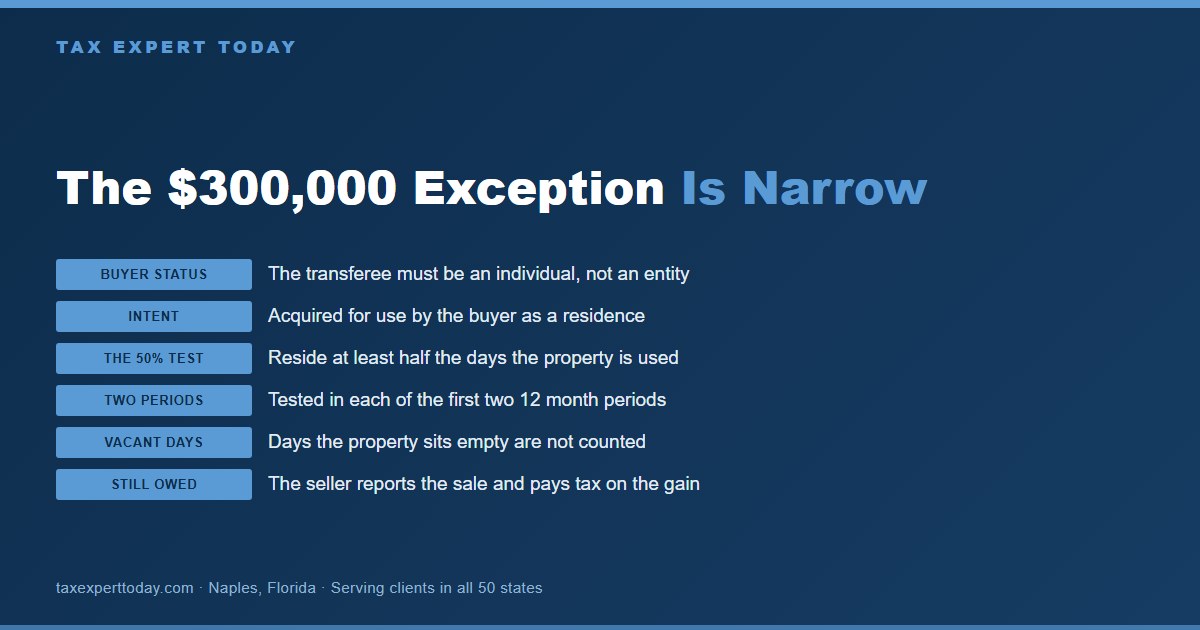
The exception is stricter than the headline number suggests. Beyond the price ceiling, the buyer must be an individual acquiring the property for use as a residence, and the buyer or a member of the buyer family must have definite plans to reside there for at least 50 percent of the number of days the property is used by any person during each of the first two 12 month periods after the transfer.
- Vacant days are excluded. When counting days of use, days on which the property will be vacant are not counted, which is what makes the exception workable for a seasonal residence.
- The buyer must be an individual. An entity buyer cannot use this exception, which rules out purchases taken in the name of a limited liability company for liability or privacy reasons.
- Two separate 12 month periods are tested. The 50 percent standard must be satisfied in each of the first two periods, not on average across them.
- It does not remove the seller tax duty. The exception removes the buyer withholding obligation only. The foreign seller still reports the sale and pays tax on any gain.
- Notification requirements survive. The IRS states that these situations still carry notification requirements even where withholding is not required.
The practical consequence for a rental heavy market is significant. A buyer who intends to rent the property out for most of the year cannot satisfy the 50 percent test, and the exception is unavailable no matter how low the price. That is a common outcome for the smaller condominium units where the $300,000 threshold would otherwise be reached most often.
Can FIRPTA Withholding Be Reduced Before Closing?
Yes. Form 8288-B is the application for a withholding certificate, and it is the main tool for aligning the withheld amount with the tax that will actually be owed. The IRS may reduce or eliminate withholding where the required amount exceeds the seller maximum tax liability, where reduced withholding would not jeopardize collection, where the gain is exempt, or where an agreement for payment with security is in place.
- Either party may apply. The buyer, the buyer agent, or the seller may request a withholding certificate.
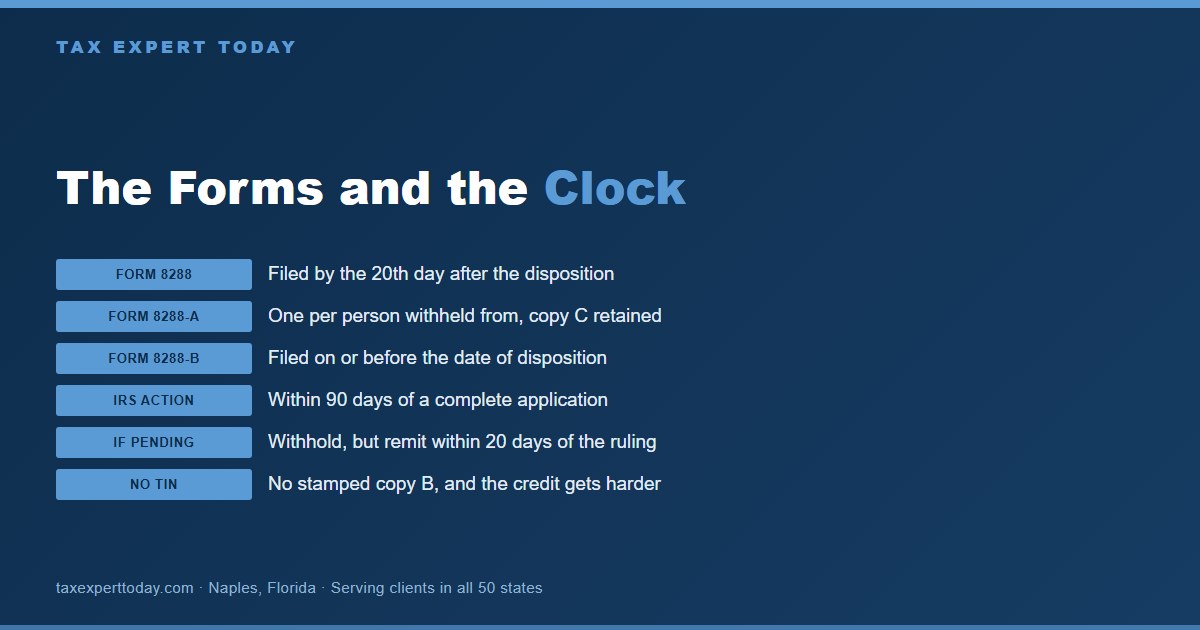
- The statute sets a 90 day window. Section 1445(c)(3)(B) requires the IRS to act on a request within 90 days after receipt, and the IRS states this runs from receipt of a complete application including the taxpayer identification numbers of all parties.
- The seller must notify the buyer in writing. A seller applying for a certificate must tell the buyer in writing that the certificate has been applied for, on the day of or the day prior to the transfer.
- Applications fall into six categories. These run from nonrecognition or exemption claims, through maximum tax liability calculations, installment sale rules, payment agreements with conforming security, blanket certificates, and any other basis.
- Incomplete files get rejected. The applicant must make the supporting information available within the prescribed time, and failure to do so usually results in rejection unless the IRS extends the target date.
The timing mechanic is the part most often handled incorrectly, and it is worth stating precisely. If the application is submitted on or before the date of disposition and is still pending on that date, the statutory amount must still be withheld, but it does not have to be reported and paid to the IRS immediately. The withheld amount, or the lesser amount the IRS determines, is reported and paid within 20 days following the day the IRS mails the certificate or the notice of denial to the buyer. The IRS pairs that relief with an anti abuse rule: where the principal purpose of applying is to delay paying the withheld tax, interest and penalties are assessed beginning on the 21st day after the date of transfer and ending on the day payment is made.
How Do You Report and Pay FIRPTA Withholding?
Two forms carry the reporting. Form 8288 is the withholding tax return and the transmittal, and Form 8288-A is the statement prepared for each person from whom tax was withheld. The buyer generally files Form 8288 by the 20th day after the date of the disposition, attaching copies A and B of Form 8288-A and retaining copy C.
- Both taxpayer identification numbers are required. The IRS states that the TIN of both the seller and the buyer must be included on the forms.
- The IRS stamps copy B and returns it. The stamped Form 8288-A goes to the seller, who attaches it to a United States income tax return to claim credit for the tax withheld.
- Form 8288 covers partnership interests too. The same form series reports withholding under section 1446(f)(1) on transfers of non publicly traded partnership interests, and under section 1446(f)(4), with Form 8288-C used for the latter statement.
- Publicly traded trusts and REITs use a different route. Those distributions are reported on Forms 1042 and 1042-S using income codes 24, 25, and 26.
- FIRPTA documents go to Ogden. The IRS processes them at the Ogden Service Center, P.O. Box 409101, Ogden, UT 84409.
| Form | Purpose | Filed by | Timing |
|---|---|---|---|
| Form 8288 | Withholding tax return and transmittal | Buyer or withholding agent | By the 20th day after the disposition |
| Form 8288-A | Statement of withholding, one per person withheld from | Buyer, attached to Form 8288 | With Form 8288; copy C retained |
| Form 8288-B | Application to reduce or eliminate withholding | Buyer, buyer agent, or seller | On or before the date of disposition |
| Form 8288-C | Statement of withholding under section 1446(f)(4) | Partnership | Per the section 1446(f)(4) rules |
| Form W-7 | Application for an ITIN where the seller has no TIN | Seller | Before the credit is claimed |
The identification number requirement carries a trap that costs foreign sellers real time. The IRS cautions that a stamped copy B of Form 8288-A will not be provided to the seller if the seller taxpayer identification number is not included on that form. In that situation the seller must instead attach to the United States income tax return substantial evidence of withholding, such as closing documents, together with a statement containing all the information required on Forms 8288 and 8288-A including the seller TIN. Applying for an individual taxpayer identification number on Form W-7 early, rather than after closing, avoids the problem entirely. How the withholding is then claimed as a credit on line 25f, and why the sale year return should be filed promptly, is covered in our guide to Form 1040-NR.
What Happens If the Buyer Fails to Withhold?
The buyer becomes exposed to the tax that should have been withheld, along with interest and penalties. The IRS states that where the seller is a foreign person and the buyer fails to withhold, the buyer may be held liable for the tax. A withholding agent is personally liable for the full amount of FIRPTA withholding that was required.
- An ineffective certification offers no shelter. A nonforeign affidavit does not protect a buyer who has actual knowledge that it is false, or who fails to furnish a required copy to the IRS in the prescribed time and manner.
- Agents carry a separate duty. Where an agent or qualified substitute has actual knowledge that a certification is false, the agent must notify the buyer or be held liable for the tax.
- Agent liability is capped. Under the IRS guidance the liability of an agent or qualified substitute is limited to the compensation that person receives from the transaction.
- Clerical roles are not agency. Receiving and disbursing consideration, recording documents, clerical tasks, obtaining title insurance and condition reports, and transmitting documents between parties do not by themselves make a person an agent.
- Penalty relief is fact specific. Where a failure has already happened, the analysis moves to the ordinary penalty framework, including whether reasonable cause can be established on the facts, and how a request to have IRS penalties removed is presented.
This is the reason title companies and closing agents in markets with heavy foreign ownership treat the FIRPTA question as a threshold item rather than a closing day detail. The exposure does not sit with the party who received the sale proceeds. It sits with the buyer, and to a capped extent with the agents, which is a distribution of risk that surprises first time purchasers.
How Does a Foreign Seller Recover Over Withheld Tax?
By filing a United States income tax return for the year of the sale and claiming credit for the amount withheld. Because withholding runs on the gross amount realized rather than on gain, the amount held is frequently larger than the tax owed, and in a loss sale it can exceed the tax entirely. The return is the mechanism that reconciles the two.
- The stamped Form 8288-A supports the credit. It is attached to the return, and without a TIN on the form the substitute evidence route described above applies instead.
- A nonresident individual files Form 1040-NR. The gain is computed in the ordinary way, with basis and selling costs taken into account rather than the gross price.
- A withholding certificate is usually faster. Reducing the withholding before closing avoids waiting for a refund cycle that runs from the following filing season.
- Depreciation recapture affects the number. A property that was rented carries recapture consequences that reduce the expected refund, so a projection built on price minus basis alone tends to be optimistic.
- Other filings may travel with the sale. Foreign sellers who hold United States accounts should check whether FBAR reporting or other information returns apply for the same year, and a foreign gift or trust distribution received in that year raises separate Form 3520 questions.
The choice between reducing withholding up front and recovering it later is largely a cash flow question, and it is worth deciding early. A seller who accepts 15 percent withholding on a seven figure sale and then waits for a refund has committed a substantial sum for the better part of a year. A seller who files Form 8288-B on time may have the same money available at closing. The same choice arises on ordinary passive income, where the up front route is a valid Form W-8BEN on file before the payment is made rather than a refund claim filed long afterward. How the application works, including the maximum tax calculation and the rule that lets the buyer hold the withholding while it is pending, is set out in our guide to Form 8288-B.
FIRPTA Help in Naples and Southwest Florida
Tax Expert Today LLC works with foreign owners selling United States real estate, with buyers who have discovered a withholding duty late in a transaction, and with closing agents who need the position documented correctly. If you are searching for FIRPTA help Naples, international tax Naples FL, or FIRPTA withholding Naples, the office is on Tamiami Trail North, and the review usually begins with confirming whether the seller is in fact a foreign person.
Our office is at 11983 Tamiami Trail N, Naples, FL 34110, and the phone is (239) 441-2005. Hours are Monday through Friday, 10am to 5pm ET. The firm is led by Dr. Pellumb Kabashi, founder of Tax Expert Today LLC, and serves clients in all 50 states as well as United States taxpayers living abroad. Naples, Florida sits in a market with a high concentration of foreign owned residential property, including seasonal owners from Canada and Europe holding condominiums and single family homes, which makes FIRPTA one of the more frequently encountered international provisions in this region. Our international and expatriate tax services cover the withholding analysis, the Form 8288-B application, and the return that closes out the year.
Does Florida charge its own withholding on a foreign seller? No. Florida imposes no state individual income tax, so FIRPTA withholding on a Naples, Florida sale is a federal matter only. That is a genuine simplification compared with states that operate a parallel nonresident withholding regime, and it means the federal analysis is the whole analysis. The trade off is that the federal amount is the entire exposure, so getting the rate and any certificate application right carries the full weight.
Frequently Asked Questions
Is FIRPTA withholding the actual tax owed? No. It is a prepayment collected at closing against the tax the foreign seller will owe on the gain. The final liability is determined on a United States income tax return, and any excess withheld is recovered through that return.
Does FIRPTA apply if the seller is selling at a loss? Yes. Withholding is calculated on the amount realized rather than on gain, so a loss sale still triggers it. The route to relief is a withholding certificate on Form 8288-B before closing, or a return claiming the credit afterward.
Who is responsible if FIRPTA withholding is missed? The buyer, as withholding agent, may be held liable for the tax that should have been withheld. An agent or qualified substitute with actual knowledge of a false certification who fails to notify the buyer can also be liable, limited to the compensation received from the transaction.
How long does a FIRPTA withholding certificate take? Section 1445(c)(3)(B) requires the IRS to act on a request within 90 days after receipt, and the IRS measures that from a complete application including the taxpayer identification numbers of all parties to the transaction.
Can a green card holder be subject to FIRPTA? Generally no, because lawful permanent residents are taxed as United States residents rather than as foreign persons. The status is confirmed at closing through a nonforeign affidavit stating a United States taxpayer identification number under penalty of perjury.
What if the foreign seller has no ITIN at closing? The IRS will not send a stamped copy B of Form 8288-A without the seller taxpayer identification number. The credit can still be claimed by attaching substantial evidence of withholding and a statement containing the required information, but applying for the number early is the simpler path.
Does Florida charge its own withholding on a foreign seller? No. Florida imposes no state individual income tax, so FIRPTA withholding on a Naples, Florida sale is a federal matter only. The federal amount is therefore the entire exposure on the transaction.
When to Engage a Professional
FIRPTA looks mechanical from the outside, and the arithmetic is genuinely simple once the inputs are settled. The difficulty is in the inputs. Whether the seller is a foreign person, whether the buyer intent supports a reduced rate or the exemption, how the amount realized is allocated among joint owners, and whether a certificate application is worth filing are all determinations made before any percentage is applied. Each of them changes the number, and several of them cannot be revisited after closing. A foreign seller who held the property through a United States limited liability company also carries an annual reporting obligation that is separate from the closing, described in our guide to Form 5472 and foreign owned entities.
Consider professional help where the sale involves joint owners of different tax residencies, where the property was rented and recapture will affect the gain, where the buyer is taking title in an entity, where a certificate application needs to be filed against a closing date, or where a closing has already happened without withholding. To discuss your situation, call (239) 441-2005 or review our international and expatriate tax services. Every situation turns on its own facts, and this article is general information rather than advice on yours.
Published September 1, 2026 by Dr. Pellumb Kabashi « Back to Learning Center
Have a question this article touches on?
Tax Expert Today LLC, based in Naples, Florida and serving clients across the United States.
Schedule a Consultation (239) 441-2005