
By Dr. Pellumb Kabashi, DBA, MBA, EA, CFE, CES
Founder, Tax Expert Today LLC · Tax advisors, enrolled agents, CPAs, and attorneys · Serving clients in all 50 states
Quick Answer: Subpart F income is passive and easily shifted income, such as interest, dividends, most rents, royalties, and certain related-party sales and services income, earned by a controlled foreign corporation. A U.S. person who owns 10 percent or more of that company reports a share of it each year as ordinary income on the return, whether or not the company pays a dividend, and it is reported on Form 5471. Call (239) 441-2005 for a free consultation.
What is Subpart F income?
Subpart F income is the part of a controlled foreign corporation’s earnings that U.S. law taxes to its larger U.S. owners right away instead of waiting for a dividend. It is mostly passive or mobile income, and each U.S. shareholder includes a share of it as ordinary income for the year the company earns it.
- Who is taxed: the U.S. shareholders, not the foreign company itself.
- What is taxed: categories listed in section 952, led by foreign base company income.
- When it is taxed: in the year earned, even if the cash stays offshore.
- How it is taxed: as ordinary income, without the lower qualified dividend rate.
- Where it is reported: on Form 5471 and Schedule 1 of Form 1040.
The name comes from where the rules sit in the Internal Revenue Code: Subpart F of Part III of Subchapter N, sections 951 through 965. Congress enacted these rules in 1962. Before then, a U.S. person could move investments into a foreign company in a low tax country, let the interest and dividends pile up inside it, and pay no U.S. tax until the company paid a dividend, which might be never. The IRS practice unit on Subpart F for individual shareholders describes the purpose plainly: the provisions end deferral for certain categories of foreign income by taxing certain U.S. persons currently on their pro rata share of that income.
The mechanism matters for planning. Subpart F does not tax the foreign corporation. It treats each qualifying U.S. owner as if the owner had received a share of certain current earnings, and section 951(a) requires that share to be included in gross income. The company can keep every dollar in its foreign bank account and the owner still reports the income on a U.S. return. When the company later pays out those same earnings, section 959 generally excludes the distribution from income because it was already taxed.
For individuals the result is usually unattractive. An individual’s Subpart F inclusion is taxed at ordinary rates, which reach 37 percent for 2026 under section 1, and an individual generally receives no foreign tax credit for income taxes the foreign company paid unless the individual makes a section 962 election. That is why a U.S. person who owns a foreign holding company, a foreign rental company, or a foreign family investment company needs to know which of its income is Subpart F income before the year closes, not after.
| Question | Short answer | Where the rule lives |
|---|---|---|
| Is the foreign company taxed by the United States? | No, Subpart F taxes the U.S. shareholders | Section 951(a) |
| Which owners are taxed? | U.S. persons owning 10 percent or more of vote or value | Section 951(b) |
| Which companies are covered? | Controlled foreign corporations, more than 50 percent owned by U.S. shareholders | Section 957(a) |
| Which income is covered? | Insurance income, foreign base company income, and three smaller categories | Sections 952 and 954 |
| Is the inclusion capped? | Yes, at the company’s current earnings and profits | Section 952(c) |
| Is the cash taxed again when paid out? | Generally no, it is previously taxed earnings | Section 959 |
| Where is it reported? | Form 5471 and Schedule 1 (Form 1040), line 8n | Instructions for Form 5471 |
Who is a U.S. shareholder of a controlled foreign corporation?
A U.S. shareholder is a U.S. citizen, resident, domestic entity, or domestic trust or estate that owns at least 10 percent of a foreign corporation’s voting power or total value, counting direct, indirect, and constructive ownership. The company is a controlled foreign corporation when U.S. shareholders together own more than 50 percent of vote or value.
- 10 percent test: vote or value, whichever reaches 10 percent first, under section 951(b).
- More than 50 percent test: U.S. shareholders combined, under section 957(a).
- Ownership through entities: stock held by foreign entities is attributed up to owners under section 958(a).
- Constructive ownership: family and entity attribution under section 958(b) can create shareholder status.
- Small holders: a U.S. person under 10 percent is not a U.S. shareholder and has no Subpart F inclusion.
The definition in section 951(b) asks whether a United States person owns, or is considered to own, 10 percent or more of the total combined voting power of all classes of voting stock, or 10 percent or more of the total value of all classes of stock. The value prong was added in 2017, so a nonvoting preferred class or a tracking class can make someone a U.S. shareholder even with no vote at all. “United States person” is defined in section 957(c) by reference to the general Code definition, so it covers citizens and residents, including green card holders and individuals who meet the substantial presence test, as well as domestic partnerships, corporations, estates, and trusts.
The company becomes a controlled foreign corporation under section 957(a) when more than 50 percent of its total combined voting power, or more than 50 percent of the total value of its stock, is owned or considered owned by U.S. shareholders on any day of its taxable year. Only U.S. shareholders count toward the 50 percent. Five unrelated U.S. persons with 9 percent each own 45 percent but are not U.S. shareholders, so their stock does not count, and the company is not a CFC because of them.
Ownership is measured in two layers by section 958. Section 958(a) counts stock owned directly and stock owned indirectly through foreign corporations, partnerships, trusts, and estates, proportionately. Only section 958(a) ownership produces an actual Subpart F inclusion. Section 958(b) then layers on the constructive ownership rules of section 318, modified, for deciding who is a U.S. shareholder and whether the company is a CFC. Family attribution is the classic trap: an individual is generally treated as owning stock held by a spouse, children, grandchildren, and parents. A U.S. child can become a U.S. shareholder through a parent’s holding, although section 958(b)(1) blocks attribution from a nonresident alien individual to a citizen or resident for this purpose.
| Hypothetical ownership pattern | U.S. shareholder? | CFC? |
|---|---|---|
| One U.S. citizen owns 100 percent of a foreign holding company | Yes | Yes |
| Two U.S. siblings own 30 percent each; a foreign cousin owns 40 percent | Yes, both | Yes, 60 percent held by U.S. shareholders |
| Six unrelated U.S. friends own 9 percent each; a foreign fund owns 46 percent | No, each is under 10 percent | No, U.S. shareholders own 0 percent |
| A U.S. resident owns 8 percent; a U.S. spouse owns 4 percent | Yes, each is treated as owning 12 percent through family attribution | Depends on the other owners |
| A U.S. person owns 15 percent of the value through nonvoting shares | Yes, under the value test | Depends on the other owners |
| A U.S. person owns 20 percent; a nonresident alien parent owns 40 percent; others are foreign | Yes, the U.S. person holds 20 percent directly | No, only 20 percent is held by U.S. shareholders, and the parent’s stock is not attributed to the U.S. child under section 958(b)(1) |
Form filing follows the same tests but with its own categories. A U.S. shareholder of a CFC is generally a Category 5 filer of Form 5471, and a U.S. person who controls the company is generally a Category 4 filer. Our Form 5471 guide walks through the filer categories, the constructive owner exceptions, and the penalties. This article stays with the income side: what is included, how much, and how it comes out later.
What changed for Subpart F income in 2026?
Public Law 119-21, enacted July 4, 2025, changed Subpart F for foreign corporation years beginning after December 31, 2025. The pro rata share rule now reaches anyone who owned stock on any day of the year, the 958(b)(4) attribution limit returned, the look-through rule became permanent, and the one-month deferral year ended.
- Pro rata share: sellers and buyers each include their own share for the days they owned stock.
- Downward attribution: section 958(b)(4) is restored, with new section 951B for foreign controlled U.S. shareholders.
- Look-through rule: section 954(c)(6) no longer has an expiration date.
- Tax year: the one-month earlier CFC year election is repealed under section 898.
- GILTI renamed: section 951A now taxes net CFC tested income.
The 2025 reconciliation act, Public Law 119-21, is the largest change to the CFC rules since 2017. The statutory notes at Cornell’s Legal Information Institute set out each effective date, and the December 2025 Form 5471 instructions already reflect two of them. Most of the changes apply to taxable years of foreign corporations beginning after December 31, 2025, which for a calendar year CFC means its 2026 year, reported on returns filed in 2027.
The pro rata share rule. Before 2026, section 951(a) required an inclusion only from a U.S. shareholder who owned the stock on the last day of the year on which the company was a CFC. A seller who exited in June generally had no inclusion, and the buyer included the full year, reduced by dividends paid to the seller. Rewritten section 951(a)(1)(A) now requires each U.S. shareholder that owns stock under section 958(a) on any day during the CFC year to include its pro rata share, and new section 951(a)(2) measures that share by the period during which the shareholder owned the stock, was a U.S. shareholder, and the company was a CFC. The inclusion lands in the shareholder’s tax year that contains the last day it owned the stock during that CFC year. The Code also authorizes rules allowing or requiring the CFC’s year to close on a disposition. A transition rule covers certain dividends paid in the year that straddles the change, and the Form 5471 instructions point to IRS Notice 2025-75 for it.
Downward attribution. The 2017 law repealed section 958(b)(4), which had stopped stock owned by a foreign person from being attributed down to a U.S. person. The repeal turned many foreign-parented groups into CFCs on paper. The 2025 act restored section 958(b)(4) and added section 951B, which applies the Subpart F and net CFC tested income rules to a “foreign controlled United States shareholder,” a U.S. person that would own more than 50 percent of a foreign controlled foreign corporation if downward attribution still applied. For most individual owners in Southwest Florida this change matters less than the others, but it can change whether a sister company of a foreign family group is a CFC.
The look-through rule. Section 954(c)(6) excludes dividends, interest, rents, and royalties received by one CFC from a related CFC to the extent they come out of the payor’s active income. It was a temporary provision that Congress extended repeatedly and that was scheduled to stop applying for years beginning on or after January 1, 2026. Public Law 119-21 struck that end date, so the rule now applies to CFC years beginning after December 31, 2005 with no expiration.
The CFC tax year. Section 898 generally requires a CFC to use its majority U.S. shareholder’s tax year. A former election let the CFC use a year beginning one month earlier, which deferred an inclusion by eleven months. The 2025 act struck that election for specified foreign corporation years beginning after November 30, 2025, and a transition rule shortens the first year so it ends with the required year. The December 2025 Form 5471 instructions list this as the first new item for the year.
GILTI becomes net CFC tested income. Section 951A was retitled “Net CFC tested income included in gross income of United States shareholders,” and the related corporate foreign tax credit in section 960(d) rose from 80 to 90 percent. Our GILTI guide for individual shareholders covers that regime in detail. The point for this article is that Subpart F income still comes out first: tested income is computed after excluding Subpart F income, so every dollar classified here is not taxed again there.
| Provision | Before Public Law 119-21 | After Public Law 119-21 | Effective for |
|---|---|---|---|
| Who includes Subpart F income, section 951(a)(1)(A) | U.S. shareholders owning stock on the last CFC day of the year | U.S. shareholders owning stock on any day of the CFC year | Foreign corporation years beginning after December 31, 2025 |
| Pro rata share, section 951(a)(2) | Full year share less dividends paid to prior owners | Share for the period actually owned while a U.S. shareholder of a CFC | Foreign corporation years beginning after December 31, 2025 |
| Downward attribution, section 958(b)(4) | Repealed in 2017 | Restored; section 951B added for foreign controlled U.S. shareholders | Foreign corporation years beginning after December 31, 2025 |
| Related CFC look-through, section 954(c)(6) | Scheduled to stop for years beginning on or after January 1, 2026 | Permanent | Foreign corporation years beginning after December 31, 2025 |
| One-month deferral year, section 898(c)(2) | Allowed by election | Repealed | Specified foreign corporation years beginning after November 30, 2025 |
| GILTI, section 951A | Global intangible low-taxed income | Net CFC tested income | Taxable years beginning after December 31, 2025 |
Which types of income count as Subpart F income?
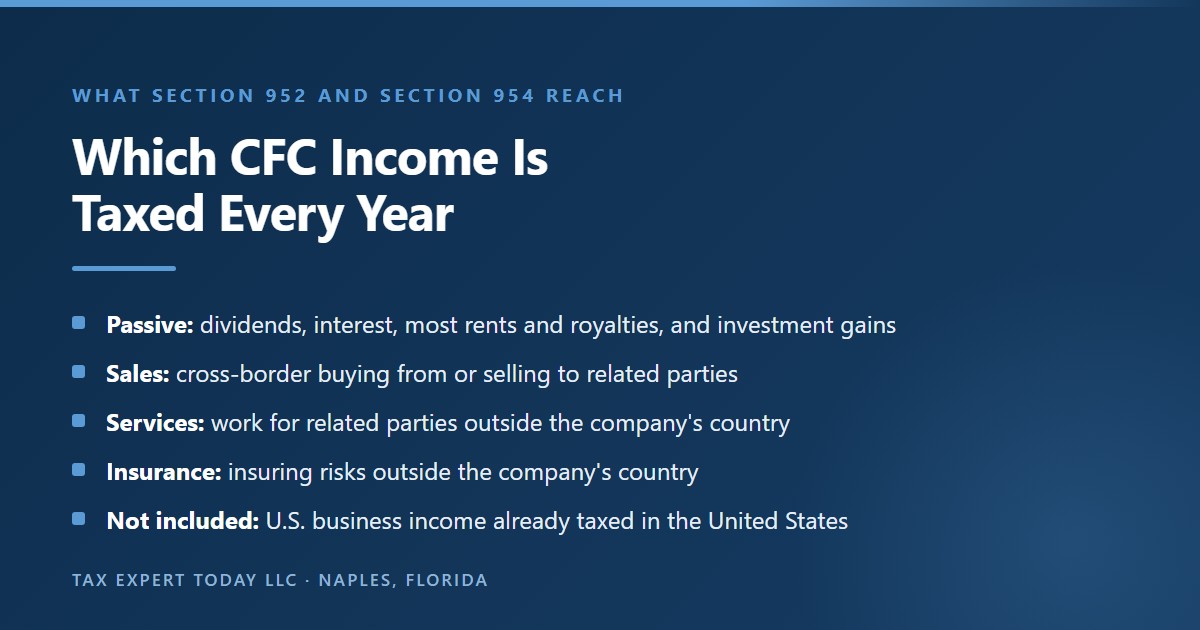
Section 952 lists five categories: insurance income, foreign base company income, international boycott income, illegal bribes and kickbacks paid by the company, and income from countries covered by section 901(j). For individual owners, foreign base company income is the category that matters, and passive investment income is the largest part of it.
- Foreign personal holding company income: dividends, interest, rents, royalties, and certain gains.
- Foreign base company sales income: buying from or selling to related parties across borders.
- Foreign base company services income: services performed for related parties outside the CFC’s country.
- Insurance income: insuring risks outside the CFC’s country of incorporation.
- U.S. business income: excluded if effectively connected and taxed here, unless a treaty reduces it.
Section 952(a) defines Subpart F income as the sum of insurance income under section 953, foreign base company income under section 954, an amount tied to participation in an international boycott, the amount of illegal bribes, kickbacks, or other payments made by or for the corporation to government officials, and income derived from a country during a period when section 901(j) applies to it. The last three categories rarely arise for the family holding and rental companies this article is written for. Foreign base company oil related income, a former category, was repealed in 2017.
Foreign base company income under section 954(a) is itself the sum of three items: foreign personal holding company income, foreign base company sales income, and foreign base company services income, each reduced by the deductions, including taxes, properly allocable to it. The common thread is mobility. Interest, dividends, and royalties can be booked in any country, and sales and services income can be routed through a low tax company that adds little. Congress targeted income that is easy to move, not income produced by a real local business.
Section 952(b) carves out one important item: income from U.S. sources that is effectively connected with a U.S. trade or business of the CFC is not Subpart F income, because the company already pays U.S. tax on it directly, unless a treaty exempts it or reduces the rate. A foreign company that owns and actively operates a U.S. business and files Form 1120-F is the usual example.
| Category | Code section | Typical example for an individual owner | How often it arises |
|---|---|---|---|
| Foreign personal holding company income | 954(c) | A foreign holding company earning bank interest, bond interest, and stock dividends | Very often |
| Foreign base company sales income | 954(d) | A trading company in one country buying goods from a related manufacturer and reselling abroad | Sometimes |
| Foreign base company services income | 954(e) | A foreign consulting company billing a related U.S. company for work done outside its country | Sometimes |
| Insurance income | 953 | A captive insurer covering a family business’s risks in other countries | Rarely |
| Boycott, bribe, and section 901(j) income | 952(a)(3) to (5) | Income from a sanctioned country or unlawful payments | Rarely |
What is foreign personal holding company income?
Foreign personal holding company income is the passive category of Subpart F income. Under section 954(c) it includes dividends, interest, royalties, rents, and annuities, net gains from selling property that produces that income or produces no income, commodity and currency gains, and income from certain personal service contracts.
- Investment income: dividends, interest, and annuities from portfolio holdings.
- Property gains: net gain on stocks, bonds, and land held for investment.
- Rents and royalties: included unless an active business exception applies.
- Currency and commodities: net gains, outside ordinary business hedging.
- Personal service contracts: fees where a 25 percent owner is named to do the work.
Section 954(c)(1) builds the list item by item. Subparagraph (A) covers dividends, interest, royalties, rents, and annuities. Subparagraph (B) covers the excess of gains over losses from selling property that gives rise to that kind of income, an interest in a trust, partnership, or REMIC, or property that gives rise to no income at all, which is how raw land held for appreciation is caught. Inventory and other dealer property is excluded. Subparagraphs (C) through (G) reach commodity gains, foreign currency gains outside business needs, income equivalent to interest such as commitment fees, notional principal contract income, and substitute dividend payments. Subparagraph (H) reaches personal service contracts where someone other than the company can designate the individual who performs, or the individual is named in the contract, and that individual owns 25 percent or more of the company.
For a typical family investment company the analysis is short. A foreign company that holds a brokerage account earns dividends, interest, and capital gains, and nearly all of it is foreign personal holding company income. If the company is a CFC and the owner is a U.S. shareholder, the owner reports the share every year as it is earned. That is often the same economic result as owning the account directly, except at ordinary rates instead of qualified dividend and long-term capital gain rates, and with Form 5471 compliance added. Many U.S. persons who inherited or set up such companies before moving to the United States discover this only when a preparer asks about foreign corporations for the first time.
Not every dividend or interest payment is passive income. Section 954(c)(3) excludes dividends and interest received from a related corporation organized in the same country that uses a substantial part of its assets in a trade or business in that country, and rents and royalties from a related corporation for the use of property in the CFC’s own country. The exception does not apply to payments that reduce the payor’s own Subpart F income. Section 954(c)(6), now permanent, excludes dividends, interest, rents, and royalties from a related CFC to the extent they come out of income that is neither Subpart F income nor effectively connected U.S. income. Together these rules let a group move money among operating companies without converting active earnings into passive income.
| Item earned by the CFC | Generally foreign personal holding company income? | Common exception to check |
|---|---|---|
| Bank and bond interest | Yes | Active banking or financing business rules |
| Dividends on listed stocks | Yes | None for portfolio holdings |
| Dividends from a related operating CFC | Often no | Section 954(c)(6) look-through, or the same-country exception |
| Gain on sale of portfolio stock | Yes, net gains | Dealer exception for regular dealers |
| Gain on sale of vacant land held for appreciation | Yes, property producing no income | Property used in the company’s business |
| Rent from unrelated tenants | Yes, unless active | Active rents exception in Treas. Reg. 1.954-2(c) |
| Royalties from unrelated licensees | Yes, unless active | Active royalties exception in Treas. Reg. 1.954-2(d) |
| Consulting fees where the 25 percent owner is named | Yes | Contracts where no individual is designated |
When are rents from foreign real estate Subpart F income?
Rent a CFC receives is foreign personal holding company income unless it comes from the active conduct of a rental business and from unrelated tenants. For real property, the company’s own officers or employees must regularly perform active and substantial management and operational functions while the property is leased.
- Default rule: rent is passive foreign personal holding company income.
- Active rents exception: the company itself manages and operates the property through its own staff.
- Related tenants: rent from a related person does not qualify under section 954(c)(2)(A).
- Outsourced management: using an independent agent generally does not count as the company’s own functions.
- Fallback test: a substantial foreign marketing organization, with a 25 percent expense safe harbor.
Many U.S. persons in Southwest Florida hold an apartment, a vacation villa, or a small commercial building abroad through a local company, often because local law or a bank required it. Section 954(c)(2)(A) excludes rents and royalties derived in the active conduct of a trade or business and received from a person that is not related. The regulations then define “active” narrowly.
Treasury Regulations section 1.954-2(c)(1) treats rents as derived in the active conduct of a trade or business in four cases: leasing property the lessor manufactured or produced, or added substantial value to, through its own officers or staff; leasing real property for which the lessor, through its own officers or staff of employees, regularly performs active and substantial management and operational functions while the property is leased; leasing personal property ordinarily used in the business during a temporary idle period; and leasing property as a result of marketing functions performed by an organization of its own officers or employees in a foreign country that is substantial in relation to the rents. Paragraph (c)(2)(ii) treats that organization as substantial when active leasing expenses equal or exceed 25 percent of adjusted leasing profit, and paragraph (c)(2)(iii) excludes compensation paid to shareholders and related persons from active leasing expenses.
Read together, these rules mean that a single apartment or villa held in a foreign company, managed by the owner or by an outside rental agent, usually produces passive rent. A larger portfolio with its own employees who lease, maintain, and operate the buildings can qualify. The facts, payroll records, and contracts decide it, which is why we ask clients for the company’s staffing and management agreements before classifying any rent.
Rent is measured net. Section 954(b)(5) reduces foreign base company income by deductions properly allocable to it, including depreciation, interest, repairs, and foreign taxes, so a fully leveraged property may produce little or no net Subpart F income in a given year. The company’s earnings and profits limit, covered below, can also cap the inclusion in a year with large depreciation.
| Hypothetical rental arrangement held in a CFC | Likely classification | Why |
|---|---|---|
| One apartment, owner finds tenants and collects rent | Passive rent | No officers or staff of the company perform management functions |
| Three villas, managed by an independent local agency for a fee | Usually passive rent | The functions are performed by an outside agent, not the company’s own employees |
| Office building leased to a company owned by the same family | Passive rent | Rent from a related person cannot use the active rents exception |
| Forty unit apartment complex with an on-site manager and maintenance staff employed by the company | Possibly active rent | The company’s own staff regularly perform active and substantial management and operational functions |
| Equipment leasing company with its own sales team abroad | Possibly active rent | Marketing organization test, with the 25 percent active leasing expense safe harbor |
What are foreign base company sales and services income?
Foreign base company sales income is profit a CFC earns buying from or selling to a related person when the goods are made outside, and sold for use outside, the CFC’s own country. Services income is fees for services the CFC performs for or on behalf of a related person outside its own country.
- Related person: generally a person controlling, or controlled by, or under common control with the CFC, at more than 50 percent.
- Sales income: buy from related, sell to anyone, or buy from anyone, sell to related, across borders.
- Same-country escape: goods made in, or sold for use in, the CFC’s country are outside the rule.
- Manufacturing: a CFC that substantially transforms the goods itself is generally outside the rule.
- Services income: work for a related party performed outside the CFC’s country.
Section 954(d)(1) defines foreign base company sales income as income from four kinds of transactions with a related person: buying personal property from a related person and selling it to anyone, selling personal property to anyone on behalf of a related person, buying property from anyone and selling it to a related person, or buying property from anyone on behalf of a related person. Two further conditions must both be met: the property is manufactured, produced, grown, or extracted outside the CFC’s country of incorporation, and it is sold for use, consumption, or disposition outside that country. Goods made in the CFC’s country, or sold to customers there, fall outside the definition. The regulations add a manufacturing exception for a CFC that substantially transforms the property or makes a substantial contribution to its manufacture.
The rule was aimed at a common 1950s structure: a U.S. manufacturer sells its goods to a subsidiary in a low tax country, which resells them to customers elsewhere, and the profit sits in the subsidiary. It still catches smaller structures. A Naples, Florida resident who owns a U.S. distribution business and a separate trading company abroad that buys from the U.S. company and resells to customers in third countries may find the trading company’s margin is foreign base company sales income.
Section 954(e)(1) treats income from technical, managerial, engineering, architectural, scientific, skilled, industrial, commercial, or similar services as foreign base company services income when the services are performed for or on behalf of a related person and outside the CFC’s country of incorporation. A consulting company in one country that bills a related U.S. company for work its staff perform in a third country is the typical case. Services performed in the CFC’s own country, or for unrelated customers, are outside this category, although they may still be tested income under section 951A.
| Hypothetical transaction | Related party involved? | Made or sold outside CFC country? | Likely Subpart F sales or services income? |
|---|---|---|---|
| CFC buys goods from its related U.S. company and resells them to customers in a third country | Yes | Yes, made in the U.S. and sold outside the CFC country | Yes |
| CFC buys goods from an unrelated maker and sells them to unrelated buyers | No | Not relevant | No |
| CFC buys from its related U.S. company and sells only to customers in its own country | Yes | No, sold for use in the CFC country | No |
| CFC manufactures goods in its own factory and sells them to a related distributor abroad | Yes | No, made in the CFC country | No, and the manufacturing exception may also apply |
| CFC staff perform engineering work in a third country for a related U.S. company | Yes | Yes, performed outside the CFC country | Yes, services income |
| CFC staff perform design work in their own country for unrelated clients | No | No | No |
How do the de minimis and full inclusion rules work?
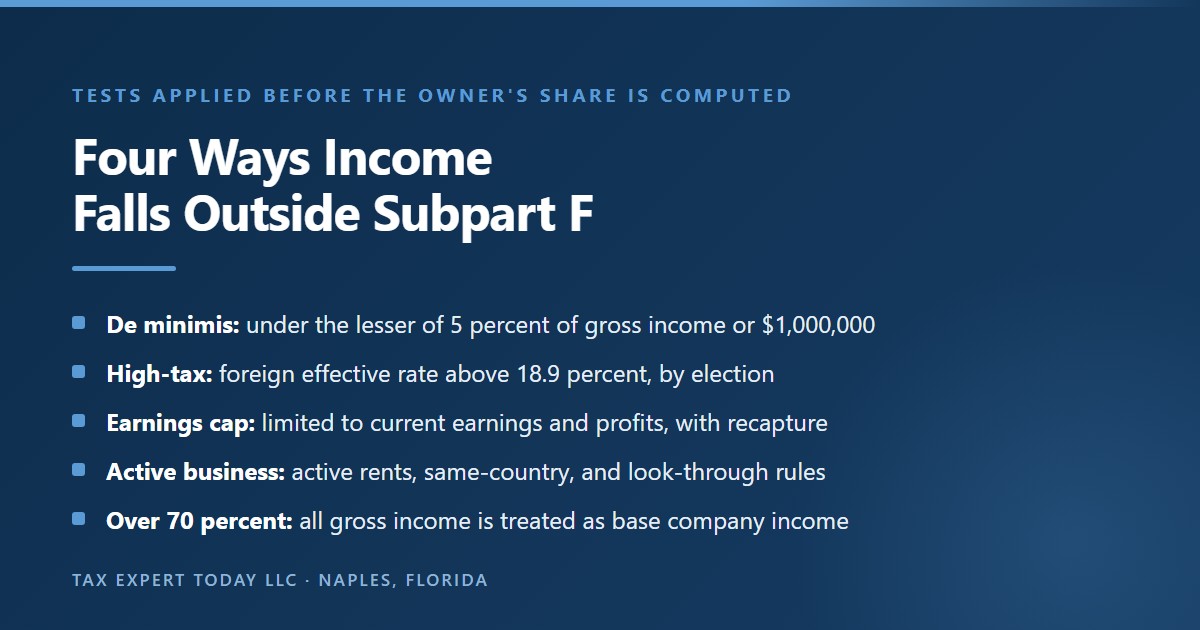
If a CFC’s gross foreign base company income plus gross insurance income is less than the lesser of 5 percent of its gross income or $1,000,000, none of it is Subpart F income for the year. If that income exceeds 70 percent of gross income, all of the company’s gross income is treated as foreign base company income.
- De minimis threshold: the lesser of 5 percent of gross income or $1,000,000.
- Measured gross: before deductions allocated under section 954(b)(5).
- All or nothing: under the threshold, zero; at or over it, the whole amount counts.
- Full inclusion: over 70 percent, all gross income becomes foreign base company income.
- High-tax override: the high-tax exception can still remove items after full inclusion.
Section 954(b)(3)(A) sets the de minimis rule. If the sum of foreign base company income, determined without the deduction allocation of paragraph (5), and gross insurance income is less than the lesser of 5 percent of gross income or $1,000,000, then no part of the gross income for the year is treated as foreign base company income or insurance income. Section 954(b)(3)(B) sets the opposite rule: if that sum exceeds 70 percent of gross income, the entire gross income is treated as foreign base company income or insurance income, subject to the high-tax exception and the deduction rules. The $1,000,000 figure is fixed in the statute and is not adjusted for inflation.
The de minimis rule helps an operating company with a modest treasury: a foreign restaurant group or manufacturing company that earns a little interest on its working cash usually stays below the threshold, and its interest is not Subpart F income. It rarely helps a holding company, because a holding company’s income is mostly passive by design. The full inclusion rule is the mirror image: a company whose income is mostly passive cannot shelter its small amount of active income from Subpart F.
| Hypothetical CFC | Gross income | Gross foreign base company income | Threshold or test | Result |
|---|---|---|---|---|
| Operating company with cash interest | $3,000,000 | $120,000 | Lesser of $150,000 or $1,000,000 = $150,000 | $120,000 is under the threshold; none is Subpart F income |
| Same company, larger treasury | $3,000,000 | $160,000 | Lesser of $150,000 or $1,000,000 = $150,000 | $160,000 exceeds it; all $160,000, net of allocable deductions, is foreign base company income |
| Large operating company | $40,000,000 | $900,000 | Lesser of $2,000,000 or $1,000,000 = $1,000,000 | $900,000 is under the threshold; none is Subpart F income |
| Mostly passive holding company | $500,000 | $380,000 | 76 percent, over the 70 percent full inclusion line | All $500,000 of gross income is treated as foreign base company income, before deductions and the high-tax exception |
How does the high-tax exception work?
Under section 954(b)(4), an item of foreign base company income is excluded if it was subject to a foreign effective tax rate greater than 90 percent of the top U.S. corporate rate. With the corporate rate at 21 percent, the line is more than 18.9 percent, and the exclusion requires an election binding on every U.S. shareholder.
- Threshold: foreign effective rate above 18.9 percent, which is 90 percent of 21 percent.
- Effective rate: foreign taxes divided by the item’s net income under U.S. principles.
- Election: made under Treas. Reg. 1.954-1(d)(5), binding on all U.S. shareholders.
- Consistency: eligible passive items must be excluded consistently for the year.
- Coordination: a related high-tax exclusion exists for net CFC tested income.
The exception reflects the reason Subpart F exists. Congress wanted to stop deferral of income parked in low tax countries. Income already taxed abroad at close to the U.S. corporate rate is not the target, so section 954(b)(4) lets the taxpayer establish that an item was subject to an effective foreign rate greater than 90 percent of the maximum rate in section 11. Section 11(b) sets the corporate rate at a flat 21 percent, so the test is a foreign effective rate above 18.9 percent.
Treasury Regulations section 1.954-1(d) supplies the mechanics. An item qualifies only if an election is made under paragraph (d)(5) and it is established that the net item was subject to foreign income taxes at an effective rate greater than 90 percent of the section 11 rate for the CFC’s taxable year. The effective rate is the foreign income taxes paid or accrued on the item divided by the item’s net income computed under U.S. tax principles, which is why a country with a 20 percent headline rate can still fail the test when its tax base is narrower than the U.S. base. Paragraph (d)(4)(i) adds a consistency rule for passive items: high-taxed passive foreign personal holding company income must be excluded or included consistently for the year. The election is binding on all U.S. shareholders of the CFC.
The binding effect is the practical issue for families. When siblings or business partners each own part of a CFC, the controlling shareholders generally make the election and the minority shareholders are bound. The election can be favorable or unfavorable for an individual: excluding high-taxed income from Subpart F means it is not taxed currently, but it may then be tested income under section 951A unless the separate high-tax exclusion for tested income also applies. Our GILTI guide explains how that second exclusion is coordinated and why an individual compares no election, a section 962 election, and the high-tax exclusion side by side before choosing.
| Hypothetical item of CFC income | Net income under U.S. principles | Foreign tax on the item | Effective rate | Eligible for the high-tax exclusion? |
|---|---|---|---|---|
| Interest taxed in a 25 percent country | $100,000 | $25,000 | 25.0 percent | Yes, above 18.9 percent |
| Rent taxed in a 20 percent country | $100,000 | $20,000 | 20.0 percent | Yes, above 18.9 percent |
| Rent taxed in a 20 percent country with a narrower base | $100,000 | $15,000 | 15.0 percent | No |
| Royalties taxed at exactly 18.9 percent | $100,000 | $18,900 | 18.9 percent | No, the rate must be greater than 18.9 percent |
| Dividends taxed at 0 percent in a holding regime | $100,000 | $0 | 0 percent | No |
How does the earnings and profits limit cap Subpart F income?
Section 952(c)(1)(A) limits a CFC’s Subpart F income for a year to its current earnings and profits for that year. When an operating loss or large deductions push current earnings below Subpart F income, the excess is not included that year, but section 952(c)(2) recaptures it in later years.
- Current year cap: Subpart F income cannot exceed current earnings and profits.
- Losses elsewhere count: an active business loss can reduce current earnings and profits.
- Recapture: later earnings above Subpart F income are recharacterized as Subpart F income.
- Qualified deficits: limited prior year deficits can offset certain inclusions under 952(c)(1)(B).
- Records: earnings and profits are tracked on Form 5471, Schedules H and J.
Section 952(c)(1)(A) states that the Subpart F income of any CFC for a taxable year shall not exceed its earnings and profits for that year. Earnings and profits is a U.S. tax measure of the company’s economic income, computed under U.S. principles from the foreign books, and it is reported on Form 5471. A company that earns $200,000 of interest but loses $150,000 in its active trading business has current earnings of about $50,000, and its Subpart F income for that year is capped at roughly $50,000.
The relief is a timing rule, not a permanent exclusion. Section 952(c)(2) provides that if Subpart F income was reduced by the earnings and profits limit, any excess of the company’s earnings and profits over its Subpart F income in a later year is recharacterized as Subpart F income, under rules similar to the overall foreign loss recapture rules of section 904(f)(5). In the example, when the trading business returns to profit, the $150,000 that escaped in the loss year comes back in as Subpart F income, even though the later profit is active. Tracking these recapture accounts across years is one of the more common gaps we see in self-prepared Form 5471 filings.
Section 952(c)(1)(B) separately allows a qualified deficit from a prior year, attributable to the same qualified activity, to reduce a shareholder’s inclusion. Its scope is narrow, covering activities such as insurance, certain financing, and commodities businesses, and it rarely applies to a family holding or rental company.
| Hypothetical year | Subpart F income before the cap | Current earnings and profits | Subpart F income after the cap | Recapture account at year end |
|---|---|---|---|---|
| Year 1 | $200,000 | $50,000 | $50,000 | $150,000 carried forward |
| Year 2 | $40,000 | $140,000 | $40,000 plus $100,000 recaptured = $140,000 | $50,000 remaining |
| Year 3 | $30,000 | $120,000 | $30,000 plus $50,000 recaptured = $80,000 | $0 |
How is a U.S. shareholder’s pro rata share computed in 2026?
For CFC years beginning after December 31, 2025, each U.S. shareholder includes the Subpart F income attributable to the stock it owned under section 958(a) and to the part of the year it owned that stock while it was a U.S. shareholder and the company was a CFC. A mid-year seller and buyer each report their own share.
- Ownership measure: direct and indirect ownership under section 958(a) only.
- Time measure: the days in the CFC year during which all three conditions were met.
- Year of inclusion: the shareholder year containing the last day it owned the stock in that CFC year.
- Classes of stock: allocation follows the economic rights of each class.
- Closing the year: the Code authorizes rules allowing or requiring a closing on a disposition.
Rewritten section 951(a)(2) defines a U.S. shareholder’s pro rata share of a CFC’s Subpart F income for a CFC year as the portion attributable to the stock it owns within the meaning of section 958(a) and to any period of the CFC year during which it owned that stock, was a U.S. shareholder of the corporation, and the corporation was a CFC. Section 951(a)(3) places the inclusion in the shareholder’s taxable year that includes the last day on which it owns the stock during that CFC year, and section 951(a)(4) authorizes regulations or other guidance to allow, or require, the CFC’s taxable year to close on a direct or indirect disposition.
The change matters most in sales of a business or a family transfer. Under the prior rule, a seller who exited before year end often reported nothing, and the buyer, who owned the stock on the last day, picked up the full year with an adjustment for dividends the company had paid the seller. Under the new rule, each owner reports for its own ownership period. Until regulations or guidance address how income is assigned within the year, a straight daily allocation is the natural starting point, and a closing of the books may produce a different split when income was earned unevenly.
| Hypothetical facts (calendar year CFC, 2026) | Owner A, a U.S. citizen | Owner B, a U.S. resident |
|---|---|---|
| Ownership | 100 percent from January 1 to June 30 (181 days) | 100 percent from July 1 to December 31 (184 days) |
| CFC Subpart F income for 2026, earned evenly | $365,000 | |
| Pro rata share under the 2026 rule, daily allocation | $365,000 x 181 / 365 = $181,000 | $365,000 x 184 / 365 = $184,000 |
| Year in which the share is included | 2026, the year containing June 30 | 2026, the year containing December 31 |
| Result under the pre-2026 last day rule, for comparison | Generally $0 | Up to $365,000, reduced by dividends paid to A during the year |
Purchase agreements for foreign companies should now address who bears the Subpart F tax for the period before closing, who prepares the Form 5471 for the year of sale, and whether the parties will close the CFC’s books if guidance allows it. These are drafting points for the transaction lawyer, but they start with the tax facts.
How is Subpart F income taxed on an individual’s return?
An individual U.S. shareholder reports the Subpart F inclusion as ordinary income on Schedule 1 of Form 1040, line 8n, taxed at regular rates up to 37 percent. It is not a qualified dividend, and without a section 962 election the individual cannot claim a credit for income taxes the foreign company paid.
- Character: ordinary income, not qualified dividend or capital gain.
- Return line: Schedule 1 (Form 1040), line 8n, other income, section 951(a) inclusion.
- Foreign taxes paid by the CFC: no credit for an individual without the 962 election.
- Net investment income tax: timing depends on the Treas. Reg. 1.1411-10(g) election.
- Estimated tax: the inclusion increases quarterly estimated payment needs.
The Form 5471 instructions tell a noncorporate U.S. shareholder to enter the Schedule I amounts on Schedule 1 (Form 1040), line 8n, “Other income, section 951(a) inclusion.” The inclusion then flows into adjusted gross income and is taxed at the individual’s ordinary rates under section 1. Because the inclusion is not an actual dividend, the reduced qualified dividend rates do not apply to it, a point the IRS practice unit makes directly.
Foreign income taxes are the second cost. Section 960(a) deems a domestic corporation that includes Subpart F income to have paid the CFC’s foreign income taxes properly attributable to it, so a corporate shareholder can credit them. An individual is not a domestic corporation and generally gets no such credit. The individual can still claim a foreign tax credit on Form 1116 for foreign taxes the individual personally pays, such as withholding on a later distribution, but not for the company’s own corporate tax. The section 962 election, covered below, is the statutory route to the corporate credit.
The net investment income tax adds a timing question. Under Treasury Regulations section 1.1411-10, a section 951(a) inclusion generally is not net investment income in the year it is included, unless the income is derived from a trade or business described in the regulations or the shareholder makes the election in paragraph (g). Without that election, the later distribution of the previously taxed earnings is generally treated as a dividend for net investment income purposes, so the 3.8 percent tax under section 1411 applies when the cash comes out, if the individual is above the threshold that year. The election aligns the two taxes in the same year, which can simplify records but accelerates the 3.8 percent tax.
| Hypothetical: a Naples, Florida resident owns 100 percent of a foreign holding company | Amount |
|---|---|
| Company’s interest and dividend income, all from unrelated portfolio holdings | $200,000 |
| Foreign income tax paid by the company at 10 percent | $20,000 |
| Net foreign personal holding company income after allocable taxes, section 954(b)(5) | $180,000 |
| Current earnings and profits | $180,000, so the section 952(c) cap does not bind |
| De minimis or high-tax relief | None; the income is nearly all passive and taxed below 18.9 percent |
| Inclusion on Schedule 1, line 8n | $180,000 |
| Federal income tax at a 37 percent marginal rate, no election | $66,600 |
| Credit for the company’s $20,000 foreign tax | None for an individual without a section 962 election |
| Combined foreign and U.S. income tax on the $200,000 | $86,600, about 43.3 percent, before any 3.8 percent net investment income tax |
| Florida income tax on the inclusion | None; Florida does not tax the income of natural persons |
The example is a simplified hypothetical and does not describe any client. It assumes the full inclusion is taxed at the top marginal rate, ignores currency translation, and does not compute the net investment income tax because its timing depends on the election discussed above. It shows why individual owners of passive foreign companies usually compare the cost of keeping the company, making a section 962 election, or holding the investments another way.
What does the section 962 election do for Subpart F income?
A section 962 election lets an individual U.S. shareholder be taxed on Subpart F and net CFC tested income inclusions as if a domestic corporation received them: at the 21 percent corporate rate, with a deemed paid credit for the CFC’s foreign taxes. The trade-off is a second tax when those earnings are later distributed.
- Rate: the section 11 corporate rate, 21 percent, applied to the inclusion.
- Credit: the section 960 deemed paid foreign tax credit becomes available.
- Gross-up: the section 78 amount is included in the computation.
- Second layer: distributions are taxable to the extent they exceed the U.S. tax paid at inclusion.
- Annual choice: made year by year with the return, and not revocable without IRS consent.
Section 962(a) provides that, for an electing individual, the tax on amounts included under section 951(a) equals the tax that section 11 would impose if a domestic corporation had received them, and that section 960 applies as if they were received by a domestic corporation. Treasury Regulations section 1.962-1 includes the section 78 gross-up in the computation, so the CFC’s foreign taxes are added to the base and then credited. Section 962(d) is the catch: when the electing shareholder later receives those earnings, the distribution is included in gross income to the extent it exceeds the U.S. tax paid under the election, notwithstanding section 959.
In the hypothetical above, a 962 election would compute U.S. tax at inclusion of about $22,000: $180,000 plus the $20,000 gross-up equals $200,000, times 21 percent is $42,000, less a $20,000 deemed paid credit. When the company later distributes the $180,000, the amount above the $22,000 of tax paid, $158,000, is taxable as a dividend. Whether that dividend is qualified, and taxed at 20 percent rather than ordinary rates, depends in part on whether the company is a qualified foreign corporation under section 1(h)(11)(C), generally one eligible for a comprehensive U.S. income tax treaty. The election usually helps most when the earnings will stay in the company for years, or when the company pays meaningful foreign tax. Our GILTI guide carries the full side by side computation, including the dividend stage, and the same framework applies to Subpart F inclusions.
| Feature | No election | Section 962 election |
|---|---|---|
| Rate on the inclusion | Individual ordinary rates, up to 37 percent | 21 percent corporate rate |
| Credit for the CFC’s foreign income taxes | None | Deemed paid credit under section 960, with the section 78 gross-up |
| Tax when the earnings are distributed | Generally none under section 959, apart from the net investment income tax timing | Taxable to the extent the distribution exceeds the U.S. tax paid at inclusion, section 962(d) |
| Hypothetical U.S. tax at inclusion on the $200,000 example | $66,600 | About $22,000 |
| Often suits | Earnings distributed promptly, low foreign tax, owner in a lower bracket | Earnings retained, meaningful foreign tax, treaty country company |
How do previously taxed earnings come out without a second tax?
Once a U.S. shareholder includes Subpart F income, section 959 treats the matching earnings as previously taxed earnings and profits. When the company later distributes them, the distribution is excluded from the shareholder’s income, and section 961 adjusts stock basis up at inclusion and down at distribution.
- Exclusion: distributions of previously taxed earnings are not included again, section 959(a).
- Ordering: section 959(c) treats distributions as coming from previously taxed earnings first.
- Basis up: stock basis increases by the amount included, section 961(a).
- Basis down: basis decreases when the excluded amount is distributed, section 961(b).
- Currency: foreign currency gain or loss can arise when the earnings are distributed.
Section 959(a) provides that earnings and profits of a foreign corporation attributable to amounts that are, or have been, included in a U.S. shareholder’s gross income under section 951(a) are not included again when distributed to that shareholder, or to a U.S. person who acquired the shareholder’s interest and can prove it. Section 959(b) extends the same treatment through a chain of foreign corporations, so earnings taxed at a lower-tier CFC can move up to the top-tier company without a new inclusion. Section 959(c) sets the ordering rule that sends distributions out of previously taxed earnings first, before untaxed earnings.
Section 961 keeps basis in step. Under section 961(a) the shareholder’s basis in the CFC stock rises by the amount included, and under section 961(b) it falls when previously taxed earnings are distributed and excluded, with any excess over basis treated as gain from the sale of property. Without these adjustments a later sale of the stock would tax the same earnings twice.
Two qualifications matter in practice. First, the exclusion is from income tax under chapter 1. As noted above, the net investment income tax may still reach the distribution unless the paragraph (g) election was made. Second, previously taxed earnings are tracked in the company’s functional currency and the distribution is translated at the rate on the day it is paid, so a currency gain or loss can arise. The Form 5471 instructions require the gain or loss to be reported on Schedule I and the previously taxed earnings accounts to be tracked on Schedule P.
| Hypothetical step | Subpart F inclusion | Distribution received | Taxable on distribution | Stock basis |
|---|---|---|---|---|
| Start of 2026 | $50,000 | |||
| 2026 inclusion | $180,000 | $230,000 | ||
| 2027 distribution of 2026 earnings | $180,000 | $0 income tax under section 959, ignoring currency effects | $50,000 | |
| 2028 distribution of untaxed earnings | $40,000 | $40,000 dividend | $50,000 |
How does Subpart F income interact with net CFC tested income?
Subpart F income is computed first. Net CFC tested income, the 2026 name for GILTI under section 951A, then reaches most of the CFC’s remaining income, after excluding Subpart F income, effectively connected U.S. income, and high-taxed income. The same dollar is never included under both.
- Order: classify Subpart F income, then compute tested income on what is left.
- Exclusions: tested income excludes Subpart F income and certain high-taxed income.
- Same tax result for individuals: both are ordinary income without the 962 election.
- Different relief: corporate deductions and credits differ between the two regimes.
- Shared accounts: both feed previously taxed earnings under section 959.
Since 2018, most income of a CFC that escapes Subpart F has been swept into section 951A. Tested income is the CFC’s gross income after excluding, among other items, income taken into account in determining Subpart F income, effectively connected income, and income excluded under the high-tax exception, less allocable deductions. For an individual without a section 962 election, the two regimes produce a similar answer: ordinary income each year. The distinction still matters because the de minimis and high-tax rules, the earnings and profits cap, the corporate deduction under section 250, and the foreign tax credit rules work differently for each.
This is why the classification step is never wasted for an individual owner. Moving an item out of Subpart F may simply move it into tested income, or it may move it into an exclusion. Our guide to GILTI for individual shareholders covers the tested income computation and the elections that interact with it. The Schedule K-3 guide explains how a partnership passes CFC information to partners who are U.S. shareholders through the partnership.
| Feature | Subpart F income, sections 951 to 954 | Net CFC tested income, section 951A |
|---|---|---|
| What it targets | Specific passive and mobile categories | Most remaining active income of the CFC |
| Computed | CFC by CFC | Aggregated across all of the shareholder’s CFCs, tested losses offset tested income |
| Capped at current earnings and profits | Yes, section 952(c) | No equivalent cap |
| De minimis rule | Yes, section 954(b)(3) | No |
| Individual rate without election | Ordinary rates up to 37 percent | Ordinary rates up to 37 percent |
| Corporate foreign tax credit | Section 960(a), full deemed paid credit | Section 960(d), 90 percent for years beginning after 2025 |
| Form 5471 schedule | Schedule I | Schedule I-1, then the shareholder level computation |
What if the foreign company is also a PFIC?
A U.S. shareholder of a CFC is generally shielded from the PFIC rules for the period it is a U.S. shareholder and the company is a CFC. Section 1297(d) turns off PFIC status for that qualified portion, and section 951(c) makes Subpart F the only regime when both would include the same amount.
- Overlap rule: section 1297(d) turns off PFIC status for the CFC holding period.
- Who benefits: only U.S. shareholders, owners of 10 percent or more.
- Who does not: U.S. owners under 10 percent of a passive foreign company.
- Prior PFIC years: earlier PFIC taint can persist without a purging election.
- Coordination: section 951(c) gives priority to Subpart F over a QEF inclusion.
A foreign holding company that earns mostly interest and dividends usually meets the passive foreign investment company income or asset test. If the U.S. owner holds 10 percent or more and the company is a CFC, section 1297(d) provides that the corporation is not treated as a PFIC with respect to that shareholder during the qualified portion of the holding period, and section 951(c) provides that an amount that would otherwise be included under both section 951(a) and the qualified electing fund rules of section 1293 is included only under section 951(a). The result is current taxation under Subpart F instead of the PFIC excess distribution regime.
The protection is not universal. A family member who owns 5 percent and is not a U.S. shareholder is outside Subpart F, so that person faces the PFIC rules directly and files Form 8621. Stock held before the company became a CFC, or before the owner became a U.S. person, can carry PFIC history into the CFC years. Our Form 8621 guide covers the PFIC side, including purging elections.
What is a section 956 investment in U.S. property?
Section 956 is a second Subpart F inclusion. When a CFC holds U.S. property, such as a loan to its U.S. owner, stock of a related U.S. company, or U.S. real estate, the shareholder may include an amount up to the company’s untaxed earnings, even though no dividend was paid.
- Trigger: the CFC’s average investment in U.S. property during the year.
- Common examples: loans to the U.S. owner, guarantees of the owner’s U.S. debt, U.S. real estate.
- Limit: applicable earnings that have not already been taxed.
- Corporate relief: Treas. Reg. 1.956-1(a)(2) reduces the amount for corporate shareholders.
- Individuals: the regulatory relief is tied to section 245A and generally does not reach them.
Section 951(a)(1)(B) requires a U.S. shareholder that owns stock on the last day of the year on which the corporation is a CFC to include the amount determined under section 956, to the extent not excluded as previously taxed earnings. Section 956 measures the CFC’s average investment in U.S. property, which includes tangible property located in the United States, stock of a domestic corporation, an obligation of a U.S. person, and certain rights to use intellectual property in the United States, subject to exceptions such as U.S. bank deposits and certain trade receivables. A pledge or guarantee by the CFC supporting a U.S. owner’s loan can be treated as holding the obligation.
Treasury Regulations section 1.956-1(a)(2), issued in 2019, reduces the section 956 amount for certain U.S. shareholders to the extent a hypothetical distribution would be eligible for the section 245A dividends received deduction. That deduction is available only to domestic corporations, so individual owners generally remain fully exposed. A Naples, Florida resident who borrows from a foreign company, or who has it buy a Florida condominium, should expect the transaction to be reviewed under section 956 before it is completed.
Which Form 5471 schedules report Subpart F income?
Form 5471 is the reporting vehicle. Schedule I summarizes the shareholder’s Subpart F and section 956 inclusions, Schedule Q reports the CFC’s income by group, Schedule J tracks accumulated earnings, and Schedule P tracks previously taxed earnings. The inclusion then moves to Schedule 1 of Form 1040.
- Schedule I: the shareholder’s income from the foreign corporation, including line 1 Subpart F items.
- Schedule I-1: information for the net CFC tested income computation.
- Schedule J: accumulated earnings and profits, including recapture accounts.
- Schedule P: previously taxed earnings and profits of the U.S. shareholder.
- Schedule Q: CFC income by CFC income groups.
The Instructions for Form 5471 (Rev. 12/2025) walk through Schedule I, Worksheet A, which builds the Subpart F inclusion line by line: foreign personal holding company income, sales income, services income, the de minimis and full inclusion rules, the high-tax exception, and the earnings and profits limit. The December 2025 revision added Worksheet A, line 46 instructions for the pro rata share transition rule and a new Schedule G question identifying dividends that may be subject to it. The About Form 5471 page carries the current form and any later updates.
Form 5471 is attached to the U.S. shareholder’s income tax return and is due with it, including extensions. For an individual that is generally April 15, or October 15 on extension, and Americans abroad get an automatic two month extension to June 15. A full walkthrough of the categories, due dates, and exceptions is in our Form 5471 guide, and related foreign entity forms are covered in our guides to Form 8858 for foreign branches and disregarded entities and Form 8865 for foreign partnerships.
| Item | Where it is reported | What it shows |
|---|---|---|
| Subpart F inclusion | Form 5471, Schedule I, line 1, then Schedule 1 (Form 1040), line 8n | The shareholder’s pro rata share of each Subpart F category |
| Section 956 inclusion | Form 5471, Schedule I, then Schedule 1 (Form 1040), line 8n | Investment in U.S. property included under section 951(a)(1)(B) |
| Income by category | Form 5471, Schedule Q | The CFC’s gross income, deductions, and taxes by income group |
| Earnings and profits | Form 5471, Schedules H and J | Current and accumulated earnings, including recapture accounts |
| Previously taxed earnings | Form 5471, Schedule P | Annual previously taxed earnings accounts by category |
| Currency gain or loss on distributions | Form 5471, Schedule I, line 6, then Schedule 1 (Form 1040), line 8z | Section 986(c) gain or loss on previously taxed earnings distributions |
| Section 962 election | Statement attached to the return under Treas. Reg. 1.962-2 | The election and the corporate rate computation |
What are the penalties for not reporting Subpart F income?
An unreported inclusion is an income tax underpayment, with interest and possible accuracy penalties. A missing or incomplete Form 5471 also carries a $10,000 penalty per year under section 6038, rising by $10,000 per 30 days after IRS notice to a $50,000 maximum, and keeps the assessment period open.
- Income tax: the unreported inclusion, interest, and possible section 6662 penalties.
- Form 5471 penalty: $10,000 per annual accounting period under section 6038(b).
- Continuation penalty: $10,000 per 30 days beginning 90 days after notice, up to $50,000 more.
- Credit reduction: section 6038(c) can reduce foreign tax credits.
- Statute of limitations: section 6501(c)(8) keeps the year open until 3 years after the form is filed.
Section 6038(b)(1) imposes a $10,000 penalty for each annual accounting period for which the required information about a foreign business entity is not furnished on time. Under section 6038(b)(2), if the failure continues more than 90 days after the IRS mails a notice, an additional $10,000 applies for each 30 day period or fraction, up to $50,000. Section 6038(c) separately reduces foreign tax credits. Reasonable cause can excuse these penalties when the facts support it, and the courts have recently addressed how the IRS assesses them, which our Form 5471 guide discusses.
Section 6501(c)(8) provides that when information required under section 6038 is not furnished, the time to assess any tax with respect to the related return, event, or period does not expire until 3 years after the information is furnished. A missing Form 5471 can therefore leave the whole return open, not just the foreign items. Our article on the IRS audit statute of limitations explains how that extension interacts with the normal three year rule.
What can an owner do when Subpart F income was never reported?
The available paths depend on the facts. Unreported inclusions are usually corrected by amended returns with the missing Forms 5471. Where the failure was non-willful and income is involved, the Streamlined Filing Compliance Procedures may be available. Where only information returns are missing, the delinquent submission procedures may fit.
- Gather records first: CFC financial statements, ownership history, and foreign tax returns for each open year.
- Quantify the exposure: recompute Subpart F, section 956, and tested income inclusions.
- Streamlined procedures: available only to taxpayers whose failure was non-willful, certified under penalty of perjury.
- Delinquent information returns: for missing forms where no income is unreported and reasonable cause applies.
- Willfulness concerns: a different path, discussed with counsel before anything is filed.
The Streamlined Filing Compliance Procedures are limited to taxpayers whose failure to report income, pay tax, and file information returns was due to non-willful conduct, and each taxpayer certifies non-willfulness under penalty of perjury. A taxpayer whose conduct was willful should not use them, because a false certification creates its own exposure. The IRS delinquent international information return submission procedures cover taxpayers who need to file missing information returns, such as Form 5471, and who have reasonable cause, and the IRS notes that penalties may be assessed during processing without considering an attached reasonable cause statement, so a response to later correspondence may be needed. Neither path guarantees penalty relief. The facts decide which, if any, applies.
Owners who also held foreign accounts in the company’s name, or had signature authority over them, may have FBAR exposure as well. Our guides to whether you need to file an FBAR, FBAR signature authority, and FBAR penalties explain those separate rules.
Does Florida tax Subpart F income?
No. Florida’s constitution bars a state tax on the income of natural persons who are residents or citizens of the state beyond amounts creditable against federal tax, so a Florida resident individual pays no state income tax on a Subpart F inclusion. Federal tax, Form 5471, and the net investment income tax still apply.
- Individuals: no Florida personal income tax on Subpart F or tested income.
- Corporations: a separate Florida corporate income tax applies to corporate taxpayers.
- Moving here: a former resident of a taxing state should check that state’s exit rules.
- Federal unchanged: the inclusion, the forms, and the penalties are all federal.
- Treaty residence: Florida residence does not change U.S. person status.
Article VII, section 5(a) of the Florida Constitution provides that no tax upon the income of natural persons who are residents or citizens of the state shall be levied in excess of amounts that may be credited against a similar federal tax, and Florida levies none. Many Subpart F questions we see in Collier and Lee counties come from people who moved from a high tax state or from abroad and brought a foreign company with them. The state result is simple. The federal result is not, and it does not change with the move.
Individuals who recently became U.S. residents through a green card or the substantial presence test should know that U.S. person status, and with it U.S. shareholder status, can begin on the residency starting date. Our guide to the dual status tax return covers the first year, and the Canada U.S. tax treaty guide covers the many Canadian holding companies owned by Southwest Florida snowbirds who later become residents.
Which common structures create Subpart F income for Florida residents?
The structures we see most often are a foreign holding company with a brokerage account, a foreign company owning a rental apartment or villa, a foreign trading company buying from a related U.S. business, a foreign consulting company billing a related company, and a foreign company that lends to its U.S. owner.
- Investment holding company: nearly all income is passive and included each year.
- Single property rental company: rent is usually passive without the company’s own staff.
- Related-party trading company: margin on cross-border related sales may be sales income.
- Related-party service company: fees for work done abroad for affiliates may be services income.
- Company lending to its owner: the loan may trigger a section 956 inclusion.
Most of these companies were not set up to avoid U.S. tax. Many were formed years before the owner moved to the United States, because a home country bank, a property registry, or a family arrangement required a company. Subpart F applies anyway, from the day the owner becomes a U.S. person who meets the 10 percent test. The table below summarizes how each common structure is usually analyzed, as a starting point and not a conclusion, since the facts of each company decide the result.
| Hypothetical structure | Likely Subpart F category | Exit or relief to test | Related guide |
|---|---|---|---|
| Foreign company holding listed stocks, bonds, and deposits | Foreign personal holding company income | High-tax exception if the home country taxes the income above 18.9 percent | PFIC overlap |
| Foreign company owning one rented apartment | Foreign personal holding company income, passive rent | Earnings cap in years with heavy depreciation or interest | Form 5471 |
| Foreign trading company buying from the owner’s U.S. business | Foreign base company sales income | Same-country sales, manufacturing exception, de minimis rule | Form 5472 for the U.S. side |
| Foreign consulting company billing a related U.S. company | Foreign base company services income | Services performed in the company’s own country | Foreign tax credit |
| Foreign operating company that lends its cash to the U.S. owner | Section 956 investment in U.S. property | Previously taxed earnings, short-term obligation and other exceptions | Net CFC tested income |
| Foreign company held through a foreign trust | Depends on the company’s income; ownership attributed through the trust | Trust reporting and beneficiary attribution | Form 3520 |
Two patterns deserve particular care. The first is the new resident. A person who becomes a U.S. resident in the middle of a year is a U.S. person only from the residency starting date, and under the 2026 pro rata rule the inclusion follows the days the person was a U.S. shareholder of a CFC. The second is the departing owner. A U.S. citizen who renounces, or a long-term resident who gives up a green card, may face the expatriation rules on the company shares as well, which our Form 8854 and exit tax guide explains. In both cases the date matters as much as the amount, and a treaty-based return position on Form 8833 may be part of the analysis where a tie-breaker rule applies.
What should an owner review each year?
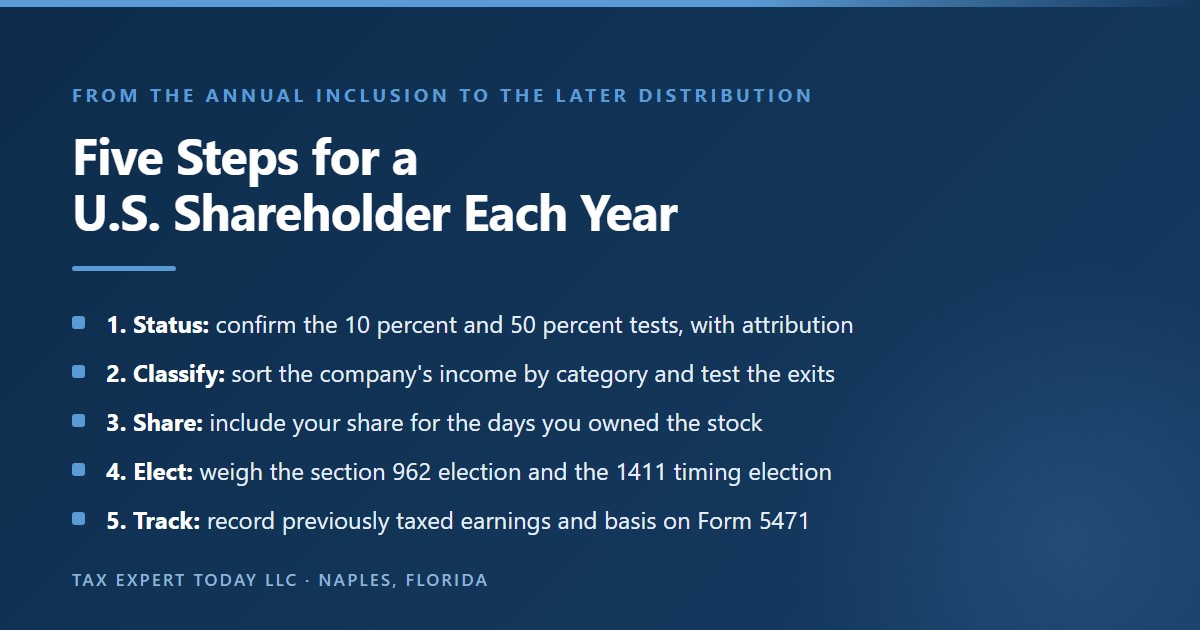
Each year, confirm U.S. shareholder and CFC status, classify the company’s income by category, apply the de minimis, high-tax, and earnings limits, compute each owner’s pro rata share for the days owned, decide on the section 962 and paragraph (g) elections, update previously taxed earnings, and file Form 5471 with the return.
- Status: recheck ownership, including family attribution and any 2026 transfers.
- Classification: sort income into passive, sales, services, and other categories.
- Exits: test the de minimis rule, the high-tax exception, and the earnings cap.
- Share: apply the 2026 period-of-ownership rule for any mid-year change.
- Elections and records: section 962, Treas. Reg. 1.1411-10(g), Schedules J and P.
The IRS practice unit lists the audit steps examiners use: confirm whether the corporation is a CFC and the taxpayer a U.S. shareholder, determine whether the CFC has Subpart F income, compute the pro rata share, and confirm that the inclusion and the previously taxed earnings were reported. A file that answers those questions in that order, with source documents, usually resolves examination questions faster.
| Step | Question to answer | Documents usually needed |
|---|---|---|
| 1. Ownership | Is each U.S. person a U.S. shareholder, and is the company a CFC? | Share register, family tree for attribution, entity chart |
| 2. Income | Which income is passive, sales, services, or other? | Foreign financial statements, general ledger, contracts, payroll records |
| 3. Exits | Do the de minimis, high-tax, or earnings limits apply? | Foreign tax returns and payments, earnings and profits computation |
| 4. Share | How much does each owner include for the days owned? | Transfer documents, dates, class rights |
| 5. Elections | Is a section 962 election or a paragraph (g) election worthwhile? | Projection of distributions and foreign taxes |
| 6. Reporting | Are Form 5471 and the Schedule 1 inclusion complete? | Prior year Schedules J and P, current year schedules |
Subpart F Income Help in Naples & Southwest Florida
Tax Expert Today LLC works with U.S. owners of foreign companies from an office in Naples, Florida and serves clients in all 50 states. Southwest Florida is home to many families who hold a foreign investment company, a rental company abroad, or a stake in a family business overseas, often set up before they became U.S. residents. We help owners determine whether they are U.S. shareholders and whether the company is a CFC, classify its income, test the de minimis and high-tax exits, compute pro rata shares under the 2026 rules, model the section 962 election, keep previously taxed earnings accounts, and prepare Form 5471 with the related inclusions.
- Subpart F income help Naples: classification, pro rata shares, and the 2026 ownership period rule.
- International tax Naples FL: Form 5471, Form 8858, Form 8865, and the coordination with net CFC tested income.
- Foreign tax Naples: foreign tax credits, section 962 modeling, and treaty questions.
- FBAR Naples: reporting accounts owned by, or signed for, a foreign company.
Our international and expat tax services page explains how we work with U.S. owners of foreign companies and with Americans abroad, and the international tax Naples FL guide covers the wider picture for Southwest Florida residents with foreign income, accounts, and entities. Owners comparing the foreign tax credit with the exclusion for wages earned abroad can also read our guide on the foreign earned income exclusion versus the foreign tax credit.
Office: 11983 Tamiami Trail N, Naples FL 34110
Phone: (239) 441-2005
Hours: Monday through Friday, 10:00 to 5:00 ET
Frequently Asked Questions
I moved to Naples, Florida and still own 100 percent of a holding company in my home country that earns bank interest and dividends. Do I report that income even if the company pays me nothing?
Generally yes, once you are a U.S. person. If you own 10 percent or more and U.S. shareholders own more than 50 percent, the company is a controlled foreign corporation, and its passive income is generally Subpart F income that you report each year on Form 5471 and Schedule 1 of Form 1040. Florida does not add a state income tax.
Is Subpart F income taxed as a qualified dividend?
No. A Subpart F inclusion is ordinary income for an individual. A later distribution of the same earnings is generally excluded under section 959, while a dividend paid out of earnings that were never included may qualify for the lower rate if the company is a qualified foreign corporation.
Does the 5 percent de minimis rule apply to a holding company?
Rarely. The rule excludes foreign base company income only when it is less than the lesser of 5 percent of gross income or $1,000,000. A company whose income is mostly passive is far above that line, and above 70 percent the full inclusion rule treats all of its gross income as foreign base company income.
What is the high-tax exception rate for 2026?
An item is eligible when its foreign effective tax rate is greater than 90 percent of the 21 percent U.S. corporate rate, which is more than 18.9 percent. The exclusion requires an election that binds all U.S. shareholders of the company.
I sold my shares in a foreign company in the middle of 2026. Do I still report Subpart F income for that year?
Likely yes. For foreign corporation years beginning after December 31, 2025, each U.S. shareholder that owned stock on any day of the year includes its share for the period it owned the stock, so a seller reports its share even after selling. Before 2026, a seller who exited before the last day often reported nothing.
Can I get a foreign tax credit for taxes my foreign company paid?
Not directly as an individual. The deemed paid credit under section 960 is available to domestic corporations. An individual U.S. shareholder can access it only by making a section 962 election, which taxes the inclusion at the corporate rate and adds a second tax when the earnings are later distributed.
When to Engage a Professional
Subpart F looks like a classification exercise, but the classification drives years of tax: whether a family member is a U.S. shareholder through attribution, whether rent is active, whether a related-party sale or service contract creates base company income, whether the high-tax election helps or hurts the other owners, how the earnings cap and its recapture run across years, how the 2026 pro rata rule splits a year of sale, and whether a section 962 election pays off once the dividend stage is counted. Mistakes compound, because previously taxed earnings accounts and basis carry forward.
A professional review is worth considering when a U.S. person owns 10 percent or more of any foreign company, when a new resident brings a foreign holding or rental company to the United States, when a foreign company lends to or guarantees debt for its U.S. owner, when shares changed hands during 2026, when Form 5471 was never filed, or when the company pays meaningful foreign tax and the owner has never compared the section 962 election. Corporate and transaction questions should also involve the company’s local advisers and qualified legal counsel.
Tax Expert Today LLC is a tax advisory firm in Naples, Florida serving clients in all 50 states. Call (239) 441-2005 to discuss your facts.
This article is general information, not legal or tax advice for any particular taxpayer, and does not create a client relationship. The examples are hypothetical illustrations only, do not describe any client, and use simplified figures that ignore currency translation and other adjustments. Whether a person is a U.S. shareholder, whether a company is a controlled foreign corporation, how its income is classified, and whether an exception or election applies depend on the facts and on regulations and guidance that may change. The rules described here reflect 26 U.S.C. sections 1, 11, 78, 318, 898, 951, 951A, 951B, 952, 954, 956, 957, 958, 959, 960, 961, 962, 1297, 1411, 6038, and 6501 as amended by Public Law 119-21, Treasury Regulations sections 1.954-1, 1.954-2, 1.956-1, 1.962-1, and 1.1411-10, the Instructions for Form 5471 (Rev. 12/2025), the IRS practice unit Overview of Subpart F Income for U.S. Individual Shareholders, IRS guidance on the delinquent international information return submission procedures, and Article VII, section 5 of the Florida Constitution, all reviewed on November 6, 2026.
Published November 6, 2026 by Dr. Pellumb Kabashi « Back to Learning Center
Have a question this article touches on?
Tax Expert Today LLC, based in Naples, Florida and serving clients across the United States.
Schedule a Consultation (239) 441-2005