
By Dr. Pellumb Kabashi, DBA, MBA, EA, CFE, CES
Founder, Tax Expert Today LLC · Tax advisors, enrolled agents, CPAs, and attorneys · Serving clients in all 50 states
Quick Answer: Form 5472 is the information return a 25 percent foreign-owned U.S. corporation, a foreign corporation engaged in a U.S. trade or business, or a foreign-owned U.S. disregarded entity files to report transactions with related parties. The penalty for failing to file is $25,000 per return, and a further $25,000 applies for each 30-day period after the IRS gives notice. A foreign-owned single-member LLC has no income tax to pay and still has to file, attached to a pro forma Form 1120 that cannot be filed electronically. Call (239) 441-2005 for a free consultation.
What Is Form 5472, and Who Has to File It?
Form 5472 is the Information Return of a 25% Foreign-Owned U.S. Corporation or a Foreign Corporation Engaged in a U.S. Trade or Business. A filer is called a reporting corporation, and it files when it has a reportable transaction with a related party. The current form revision is December 2023 and the current instructions are dated December 2024. The return carries information rather than tax, so nothing is calculated or paid on it.
- It reports relationships, not income. The return describes ownership and the money that moved between the U.S. entity and its foreign related parties during the year.
- Three kinds of filers exist. A 25 percent foreign-owned domestic corporation, a foreign corporation carrying on a U.S. trade or business, and a foreign-owned U.S. disregarded entity.
- It is filed as an attachment. Form 5472 rides along with the reporting corporation’s income tax return rather than travelling on its own.
- One return per related party. A reporting corporation with several foreign related parties files a separate Form 5472 for each one.
- The statutes behind it are sections 6038A and 6038C. Section 6038A covers domestic corporations with foreign ownership, and section 6038C covers foreign corporations operating in the United States.
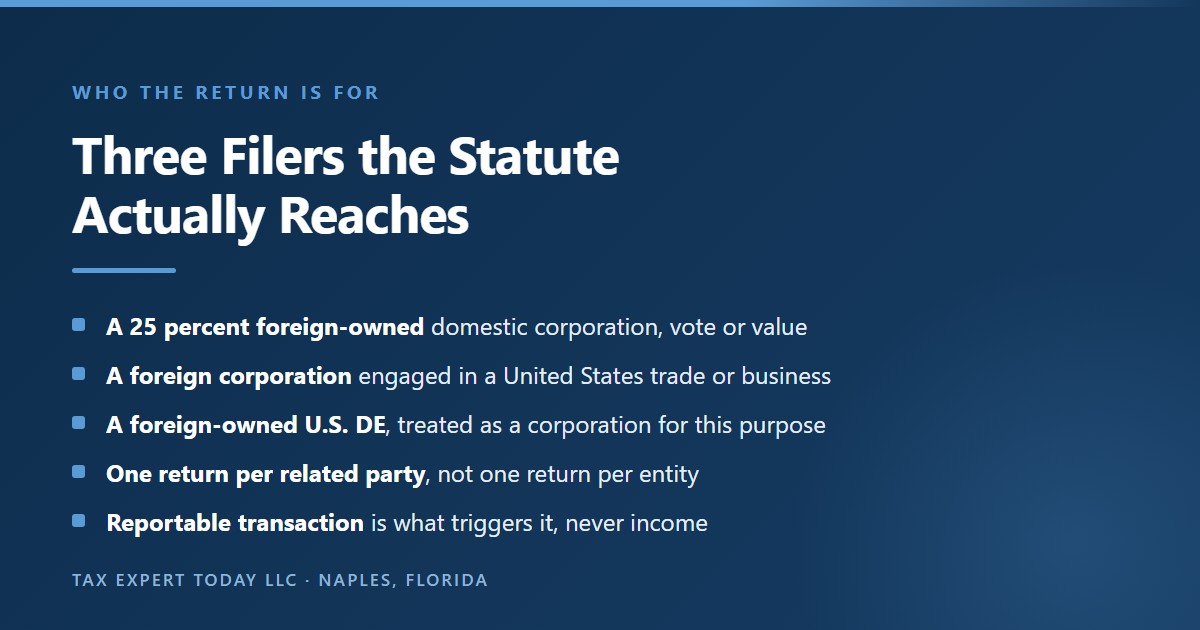
The purpose is transparency rather than revenue. Congress wanted the IRS to be able to see the flow of money between a U.S. entity and the foreign people or companies standing behind it, because transfer pricing, disguised distributions, and untaxed cross-border flows are all invisible if nobody has to describe them. The return is the description. What makes Form 5472 unusual is that the obligation survives the absence of tax entirely, which is the single point that catches most first-time filers by surprise.
Does a Foreign-Owned Single-Member LLC Have to File Form 5472?
Yes. A domestic disregarded entity wholly owned by a foreign person is treated as a corporation separate from its owner for the limited purposes of section 6038A. The rule applies to tax years beginning on or after January 1, 2017 and ending on or after December 13, 2017. The entity has no income tax return requirement of its own, so it files a pro forma Form 1120 carrying nothing but identifying information, with Form 5472 attached.
- Only the name, address, and items B and E are completed on the Form 1120. The rest of the corporate return is left blank, because the entity is not actually computing corporate tax.
- “Foreign-owned U.S. DE” is written across the top of the Form 1120. That marking routes the package correctly inside the IRS.
- The tax year follows the owner. The disregarded entity uses whatever tax year its owner uses for U.S. filing purposes, and the calendar year if the owner has none.
- The Form 5471 exception does not rescue it. Two of the general exceptions from filing are expressly unavailable to foreign-owned disregarded entities.
- Zero revenue changes nothing. Formation costs, capital contributed, and distributions are themselves reportable, so a dormant entity can still owe a return.
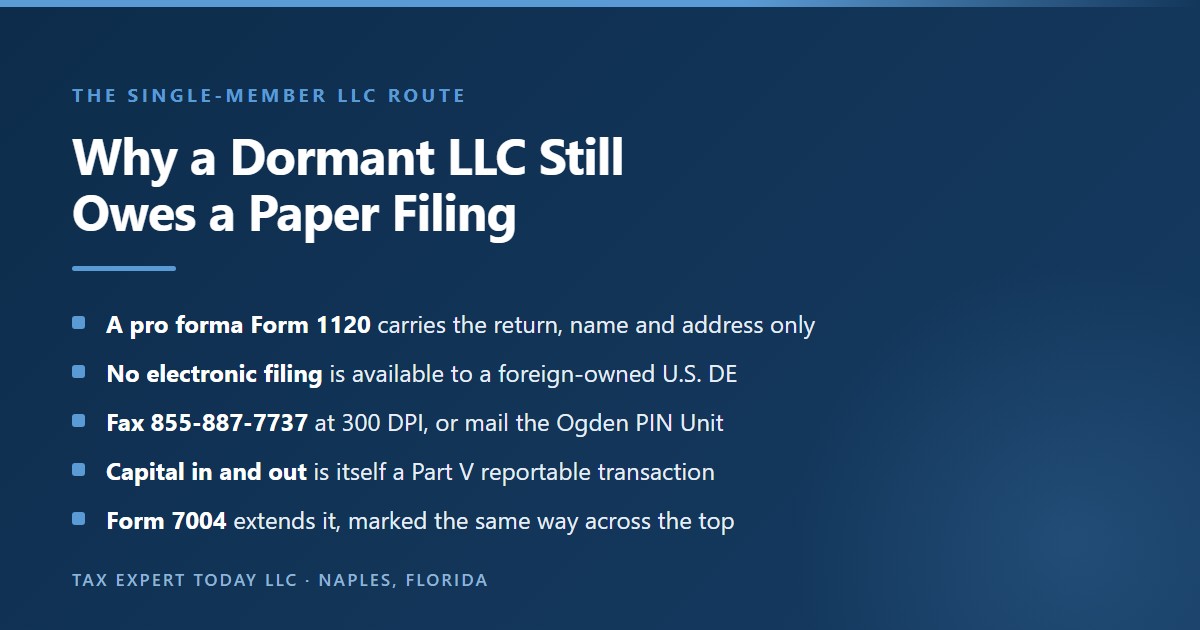
This is the fact pattern that produces most of the unpleasant surprises. A foreign individual forms a Florida or Delaware single-member LLC, treats it as a pass-through that does nothing until the business starts, and files nothing for two or three years. The entity was a reporting corporation the whole time. Because the rule is a classification rule rather than an income rule, the absence of profit, the absence of a bank balance, and the absence of any U.S. activity do not turn it off. The regulation at 26 C.F.R. section 301.7701-2 is where the reclassification lives, and the IRS final regulations are published at T.D. 9796.
What Counts as a Reportable Transaction on Form 5472?
A reportable transaction is any monetary transaction listed in Part IV of the form, anything listed in Part V, or any transaction or group of transactions listed in Part VI. Part IV covers ordinary items such as sales, rents, royalties, interest, and amounts loaned or borrowed. Part V exists only for foreign-owned disregarded entities and captures contributions, distributions, formation, and dissolution. Part VI covers nonmonetary transactions and those made for less than full consideration.
- Money moving in either direction counts. Amounts paid to the related party and amounts received from it are both reportable.
- Capital movements count for a disregarded entity. Part V reaches amounts paid or received in connection with formation, dissolution, acquisition, and disposition of the entity, including contributions and distributions.
- Barter and bargain transfers count. Part VI requires an attached schedule describing each nonmonetary or less-than-full-consideration transaction in enough detail to value it.
- Transactions with U.S. related parties need not be itemized. They can create the filing obligation without being specifically identified in Parts IV, V, and VI.
- Accrual filers report accruals. A reporting corporation on the accrual method uses accrued payments and receipts rather than cash movement.
| Part of the form | What it captures | Which filers use it | Attachment required |
|---|---|---|---|
| Part IV | Monetary transactions such as sales, rents, royalties, interest, amounts loaned and borrowed | All reporting corporations | No |
| Part V | Formation, dissolution, acquisition, disposition, contributions, and distributions | Foreign-owned U.S. disregarded entities only | Yes, a describing statement |
| Part VI | Nonmonetary transactions and those for less than full consideration | All reporting corporations, foreign related parties only | Yes, a valuing schedule |
| Part II | The direct and ultimate indirect 25 percent foreign shareholders | All reporting corporations | No |
| Part III | The related party the return is being filed for | All reporting corporations | No |
The width of Part V is what people underestimate. Wiring startup money into your own LLC is a reportable transaction. Paying the registered agent from the owner’s personal account is a reportable transaction. Taking money back out is a reportable transaction. None of those feels like a dealing with a related party in ordinary commercial language, and all three are treated as exactly that here.
What Is the Penalty for Not Filing Form 5472?
A penalty of $25,000 is assessed on a reporting corporation that fails to file Form 5472 when due and in the manner prescribed. The same penalty applies to a failure to maintain the records required by the regulations. If the failure continues more than 90 days after the IRS gives notice, an additional $25,000 applies for each related party for each 30-day period, or part of a period, that the failure continues. Filing a substantially incomplete return counts as a failure to file.
| Failure | Amount | How it multiplies | Authority |
|---|---|---|---|
| Failure to file a timely, complete Form 5472 | $25,000 | Per return, so per related party | Sec. 6038A(d)(1) |
| Failure to maintain required records | $25,000 | Treated the same as a failure to file | Reg. 1.6038A-3 |
| Continued failure after 90 days from IRS notice | $25,000 | Per related party, per 30-day period or part | Sec. 6038A(d)(2) |
| Each member of a consolidated group | $25,000 | Separate penalty, joint and several liability | Instructions, Penalties |
| Substantially incomplete return | $25,000 | Treated as never having been filed | Instructions, Penalties |
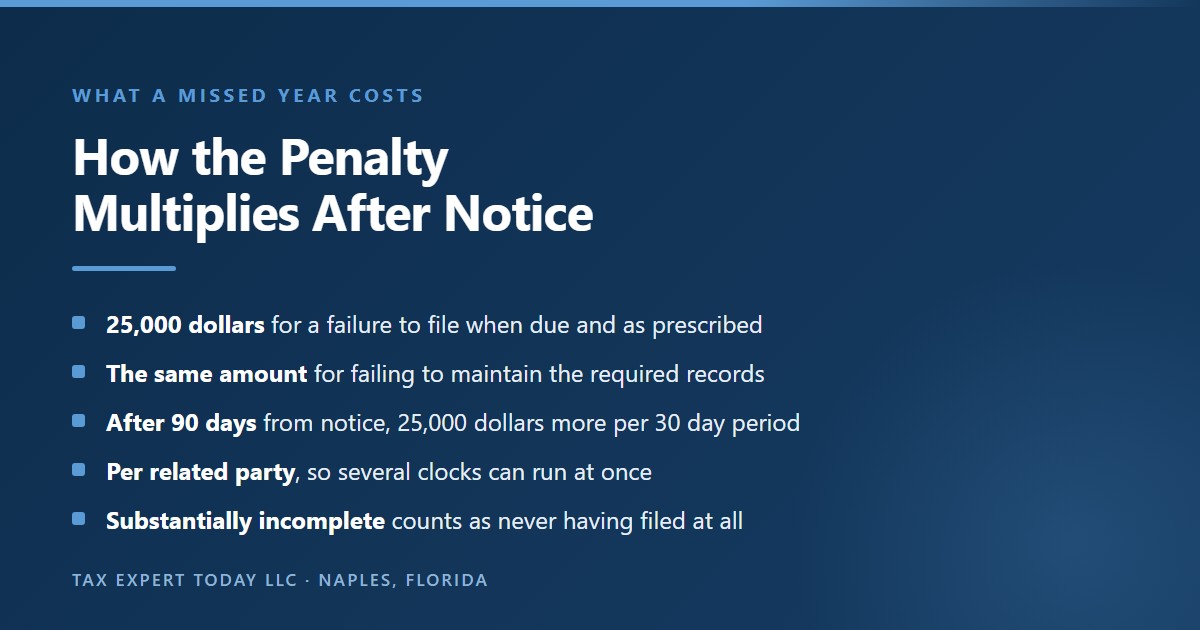
Criminal penalties under sections 7203, 7206, and 7207 may also apply. The continuation structure is the part that turns a modest problem into a serious one, because it runs per related party and per 30-day period rather than once. A reporting corporation with three foreign related parties that ignores an IRS notice is not looking at one clock but at three running in parallel.
Reasonable cause is the general route out of an information return penalty, and it is a facts-and-circumstances showing rather than a form you file to make the penalty disappear. Whether a given set of facts supports that showing depends entirely on what those facts are. Our guide to reasonable cause for IRS penalty relief sets out what the standard generally asks for.
When Is Form 5472 Due, and Where Does It Go?
Form 5472 is due with the reporting corporation’s income tax return, by that return’s due date including extensions. A foreign-owned U.S. disregarded entity, having no return of its own, files by the due date of the pro forma Form 1120 it attaches to. Those disregarded entity packages use a dedicated channel rather than the ordinary Form 1120 address. They go by fax to 855-887-7737 at 300 DPI or higher, or by mail to the IRS at 1973 Rulon White Blvd, M/S 6112, Attn: PIN Unit, Ogden, UT 84201.
- The dedicated address is not optional. The instructions are explicit that these filers do not use the mailing address given in the Form 1120 instructions.
- Extensions run on Form 7004. The disregarded entity files Form 7004 by the regular due date, entering the code for Form 1120 in Part I, line 1.
- Mark the extension the same way. “Foreign-owned U.S. DE” is written across the top of the Form 7004 as well, and it goes to the same fax number or address.
- An extension of time to file is not an extension of anything else. It moves the filing date and leaves the underlying obligations where they were.
- Fax quality matters. The instructions specify 300 DPI or higher, which is a resolution requirement rather than a suggestion.
Can You File Form 5472 Electronically?
A corporation that files its income tax return electronically attaches Form 5472 to that electronic return in the ordinary way. A foreign-owned U.S. disregarded entity cannot. The instructions state plainly that a foreign-owned U.S. DE cannot file Form 5472 electronically, which is why the fax and mail channel exists for these filers. The paper route is the only route for that category.
This single sentence in the instructions is responsible for a meaningful share of late filings. Somebody prepares the package correctly, attempts to transmit it through software that has no path for a pro forma Form 1120, receives a rejection, and sets the problem aside intending to solve it later. The filing date passes while the package sits finished on a desk. If you are handling one of these, build the fax confirmation into the process and keep it, because the confirmation is your evidence of timely filing.
How Does Form 5472 Differ from Form 5471?
The two returns run in opposite directions. Form 5472 is an inbound return: a U.S. entity reports on the foreign people or companies that own it or transact with it. Form 5471 is an outbound return: a U.S. person reports on a foreign corporation in which they are an officer, director, or shareholder. Confusing them is common, and the filer, the subject entity, and the penalty structure all differ.
| Feature | Form 5472 | Form 5471 |
|---|---|---|
| Direction | Inbound, foreign ownership of a U.S. entity | Outbound, U.S. ownership of a foreign corporation |
| Who files | The reporting corporation or disregarded entity | The U.S. person who is an officer, director, or shareholder |
| Statute | Sections 6038A and 6038C | Section 6038 |
| Base penalty | $25,000 per return | $10,000 per form per year |
| One return per | Related party | Foreign corporation |
The two do meet in one place. A U.S. person who controls the foreign related corporation and files Form 5471 for the year, completing Schedule M to show all reportable transactions between the reporting corporation and the related party, can rely on that as an exception from the Form 5472 filing. That exception is closed to foreign-owned disregarded entities. Our companion guide to Form 5471 and who must file it covers the outbound side in full.
Who Is a 25 Percent Foreign Shareholder?
A foreign person is a 25 percent foreign shareholder if that person owns, directly or indirectly, at least 25 percent of either the total voting power of all classes of voting stock or the total value of all classes of stock. The constructive ownership rules of section 318 apply with modifications, including substituting 10 percent for 50 percent in section 318(a)(2)(C). Ownership is therefore tested on attribution as well as on the share register.
- Vote or value, whichever reaches the threshold. Either test alone is enough, so a non-voting position with enough value counts.
- Indirect ownership counts. A chain of entities does not break the test, and attribution rules pull related holdings together.
- A foreign person includes more than individuals. Foreign partnerships, corporations, trusts, and estates fall within the definition alongside non-citizens and non-residents, and a foreign trust in the ownership chain can raise its own Form 3520 foreign gift and trust reporting questions.
- Residency status drives the answer for individuals. Whether a person is a resident for tax purposes is a separate determination made under the substantial presence test.
- Direct and ultimate indirect shareholders are reported separately. Part II of the form has distinct lines for each.
What Exceptions Excuse a Form 5472 Filing?
Several exceptions exist, and the most important is the simplest. A reporting corporation does not file if it had no reportable transactions of the types listed in Parts IV and VI, and for a foreign-owned disregarded entity, none of the type listed in Part V either. The other exceptions cover a controlling U.S. person filing Form 5471 with Schedule M, a foreign sales corporation filing Form 1120-FSC, a foreign corporation with no U.S. permanent establishment that timely files Form 8833, and a foreign corporation whose gross income is entirely exempt under section 883.
- The no-transaction exception is narrow for a disregarded entity. Part V is wide enough that contributions and distributions alone defeat it.
- Two exceptions expressly exclude foreign-owned disregarded entities. The Form 5471 exception and the foreign sales corporation exception are both unavailable to them.
- The treaty exception requires an actual filing. It depends on a timely Form 8833 treaty-based return position disclosure, not merely on the treaty being available.
- Small corporation and de minimis rules exist. Regulations sections 1.6038A-1(h) and 1.6038A-1(i) provide special rules for small corporations and for de minimis related party transactions.
- An exception is a conclusion, not an assumption. Each one has conditions that have to be satisfied and documented before it is relied on.
What Records Must a Reporting Corporation Keep?
A reporting corporation must keep the permanent books of account or records required by section 6001, sufficient to establish the correctness of its federal income tax return. That includes information or records relevant to determining the correct treatment of transactions with related parties. The record requirement carries its own $25,000 penalty, assessed on the same terms as the failure to file, so records are not a secondary obligation.
For a foreign-owned single-member LLC the records that matter are usually the least formal ones. Wire confirmations showing money coming in from the owner, the operating agreement, invoices between the entity and affiliates abroad, and any documentation of what a transfer was actually for. Regulations section 1.6038A-3 sets out the detail, with the small-corporation and de minimis relief at 1.6038A-1(h) and 1.6038A-1(i). The practical test is whether a person arriving three years later could reconstruct what happened from what was kept.
How Does Form 5472 Fit with a Florida Property Sale?
They are separate regimes that frequently apply to the same person. A foreign individual who holds U.S. real estate through a single-member LLC has a Form 5472 obligation running annually from formation, and a FIRPTA withholding obligation that arrives once, at the sale. Neither substitutes for the other. The annual information return does not reduce withholding at closing, and withholding at closing does not cure any information return that was never filed.
- The obligations start at different moments. Form 5472 begins with the first reportable transaction, often the capital contribution that funds the purchase.
- A sale is itself reportable. Disposition of the entity and distributions out of it fall within Part V for a disregarded entity.
- Closing is where old gaps surface. Diligence before a sale is a common moment for unfiled years to be discovered.
- The withholding analysis stands on its own. Our guide to FIRPTA withholding when a foreign person sells U.S. real property covers the rate, the exceptions, and the reduced-withholding certificate.
- Payments out to the owner raise a third question. Whether a distribution carries chapter 3 withholding depends on its character, which is where Form W-8BEN and foreign status certification comes in.
Form 5472 Help in Naples and Southwest Florida
Tax Expert Today LLC works with foreign owners of U.S. entities, with U.S. companies that discovered a foreign shareholder crossed the 25 percent line, and with people who have learned about the filing several years after forming the entity. If you are searching for Form 5472 help Naples, international tax Naples FL, or foreign-owned LLC filing Naples, the office is on Tamiami Trail North, and the review normally starts by establishing which years were open filing years rather than by preparing the current one.
Our office is at 11983 Tamiami Trail N, Naples, FL 34110, and the phone is (239) 441-2005. Hours are Monday through Friday, 10am to 5pm ET. The firm is led by Dr. Pellumb Kabashi, founder of Tax Expert Today LLC, and serves clients in all 50 states as well as U.S. taxpayers living abroad. Naples, Florida draws a steady flow of Canadian and European buyers who hold property and businesses through U.S. limited liability companies, which is precisely the structure the 2017 regulations brought into the reporting net. Our international and expatriate tax services cover the entity classification question, the back-year filings, and the reporting that continues after the structure is cleaned up.
Does Florida require its own version of Form 5472? No. Florida imposes no individual income tax and has no parallel related party information return, so the Form 5472 analysis for a Naples, Florida entity is entirely federal. A Florida limited liability company with a foreign owner may still have Florida corporate income tax questions depending on how it is classified, but those are separate from the federal information return and do not change it.
Frequently Asked Questions
Does a foreign-owned LLC with no income have to file Form 5472? Frequently yes. The obligation depends on reportable transactions rather than on income, and Part V treats contributions, distributions, formation, and dissolution as reportable for a foreign-owned disregarded entity. An entity that received capital from its owner has generally had a reportable transaction.
What is the penalty for filing Form 5472 late? The statute provides a $25,000 penalty for failing to file when due and in the manner prescribed, with an additional $25,000 for each related party for each 30-day period the failure continues beyond 90 days after IRS notification. Reasonable cause relief is a facts-and-circumstances determination.
Can Form 5472 be filed electronically by a single-member LLC? No. The IRS instructions state that a foreign-owned U.S. disregarded entity cannot file Form 5472 electronically. Those filers fax the package to 855-887-7737 at 300 DPI or higher, or mail it to the dedicated Ogden address.
What is the difference between Form 5472 and Form 5471? Form 5472 is filed by a U.S. entity reporting its foreign owners and related party transactions. Form 5471 is filed by a U.S. person reporting an interest in a foreign corporation. One looks inbound and the other looks outbound.
Who is considered a related party for Form 5472? The category includes any direct or indirect 25 percent foreign shareholder of the reporting corporation and any person related to the reporting corporation or to a 25 percent foreign shareholder under the attribution rules the regulations apply.
When did foreign-owned single-member LLCs become subject to Form 5472? The requirement applies to tax years beginning on or after January 1, 2017 and ending on or after December 13, 2017, under the final regulations published at T.D. 9796.
Does Florida require its own version of Form 5472? No. Florida imposes no individual income tax and has no parallel related party information return, so the Form 5472 analysis for a Naples, Florida entity is entirely federal.
When to Engage a Professional
Form 5472 is short, and a current-year filing for a clean structure is a manageable piece of work. The difficulty almost never sits on the form. It sits in the questions that precede it: how the entity is classified, which years were filing years, whether attribution pushes a shareholder over 25 percent, and whether transactions nobody thought of as transactions were reportable all along. Those answers determine the size of the exposure before a single line is completed.
Consider professional help where an entity has been formed for several years with nothing filed, where ownership sits behind a chain of foreign entities or trusts, where a sale or refinancing is approaching and diligence will look at prior filings, where an IRS notice has already arrived and the 90-day continuation clock matters, or where you are unsure whether the entity is a disregarded entity at all. To discuss your situation, call (239) 441-2005 or review our international and expatriate tax services. Every situation turns on its own facts, and this article is general information rather than advice on yours.
Published September 11, 2026 by Dr. Pellumb Kabashi « Back to Learning Center
Have a question this article touches on?
Tax Expert Today LLC, based in Naples, Florida and serving clients across the United States.
Schedule a Consultation (239) 441-2005